EP0226080A2 - Vollaromatische mesomorphe Polyesteramide, deren Herstellung und Verwendung - Google Patents
Vollaromatische mesomorphe Polyesteramide, deren Herstellung und Verwendung Download PDFInfo
- Publication number
- EP0226080A2 EP0226080A2 EP86116272A EP86116272A EP0226080A2 EP 0226080 A2 EP0226080 A2 EP 0226080A2 EP 86116272 A EP86116272 A EP 86116272A EP 86116272 A EP86116272 A EP 86116272A EP 0226080 A2 EP0226080 A2 EP 0226080A2
- Authority
- EP
- European Patent Office
- Prior art keywords
- mol
- repeating units
- formulas
- polyester amides
- fully aromatic
- Prior art date
- Legal status (The legal status is an assumption and is not a legal conclusion. Google has not performed a legal analysis and makes no representation as to the accuracy of the status listed.)
- Granted
Links
- XSKYSZIUFMTTQD-UHFFFAOYSA-N C[NH+](C1C=CC([NH+](C)[O-])=CC1)[O-] Chemical compound C[NH+](C1C=CC([NH+](C)[O-])=CC1)[O-] XSKYSZIUFMTTQD-UHFFFAOYSA-N 0.000 description 1
- DUOFCQNXGRPNRU-UHFFFAOYSA-N C[NH+](C1CC([NH+](C)[O-])=CCC1)[O-] Chemical compound C[NH+](C1CC([NH+](C)[O-])=CCC1)[O-] DUOFCQNXGRPNRU-UHFFFAOYSA-N 0.000 description 1
Classifications
-
- C—CHEMISTRY; METALLURGY
- C08—ORGANIC MACROMOLECULAR COMPOUNDS; THEIR PREPARATION OR CHEMICAL WORKING-UP; COMPOSITIONS BASED THEREON
- C08G—MACROMOLECULAR COMPOUNDS OBTAINED OTHERWISE THAN BY REACTIONS ONLY INVOLVING UNSATURATED CARBON-TO-CARBON BONDS
- C08G69/00—Macromolecular compounds obtained by reactions forming a carboxylic amide link in the main chain of the macromolecule
- C08G69/44—Polyester-amides
-
- C—CHEMISTRY; METALLURGY
- C08—ORGANIC MACROMOLECULAR COMPOUNDS; THEIR PREPARATION OR CHEMICAL WORKING-UP; COMPOSITIONS BASED THEREON
- C08G—MACROMOLECULAR COMPOUNDS OBTAINED OTHERWISE THAN BY REACTIONS ONLY INVOLVING UNSATURATED CARBON-TO-CARBON BONDS
- C08G69/00—Macromolecular compounds obtained by reactions forming a carboxylic amide link in the main chain of the macromolecule
- C08G69/02—Polyamides derived from amino-carboxylic acids or from polyamines and polycarboxylic acids
- C08G69/26—Polyamides derived from amino-carboxylic acids or from polyamines and polycarboxylic acids derived from polyamines and polycarboxylic acids
- C08G69/32—Polyamides derived from amino-carboxylic acids or from polyamines and polycarboxylic acids derived from polyamines and polycarboxylic acids from aromatic diamines and aromatic dicarboxylic acids with both amino and carboxylic groups aromatically bound
Definitions
- the invention relates to fully aromatic mesomorphic polysteramides which form a liquid-crystalline spring-forming melt below 320 ° C.
- polyesteramides composed of 4-hydroxibenzoic acid, 2,6-naphthalenedicarboxylic acid, hydroquinone, isophthalic acid and 4-aminophenol or 1,4-phenylenediamine.
- US Pat. No. 4,330,457 describes polyesteramides composed of hydroxynaphthalene carboxylic acid, terephthalic acid, hydroquinone and p-aminophenol. However, such polyester amides have a glass transition temperature of about 105 ° C. The same applies to the polyester amides known from US Pat.
- the new polyester amides have the advantage that they show a liquid-crystalline thread-forming melt at a temperature below 320 ° C. and are easy to process. Another advantage of the new polyester amides is that they have a smooth, abrasion-resistant surface and good heat resistance. Furthermore, the new polyester amides are characterized by good mechanical values, in particular good impact strength.
- the liquid-crystalline state of the polyester amides can be detected with a polarizing microscope using a method described in DE-AS25 20 819. Between crossed polarizers, the polymer melts, which are applied in a layer thickness of 10 ⁇ m between glass plates, have textures that can be assigned to a mesomorphic phase.
- polyester amides which are built up from recurring units of the formula I, 11, 111, V, VI and VII in the molar ratios indicated above.
- Preferred fully aromatic polyester amides have a glass transition temperature of ⁇ 140 ° C., in particular 2; 150 ° C.
- the glass temperature should be measured using the DSC method as described by KH Illers in Makromol. Chem., Volume 127 (1969)
- the fully aromatic liquid-crystalline polyesteramides form a liquid-crystalline thread-forming melt at a temperature of ⁇ 320 ° C.
- liquid-crystalline aromatic polyesteramides which have partial crystallinity at a temperature of> 200 ° C. and ⁇ 300 ° C.
- liquid-crystalline polyesteramides according to the invention can be obtained by a number of techniques, as are described, for example, in US Pat. Nos. 4,375,530 and 4,118,372.
- the polyester amides according to the invention are obtained in a one-step process in which the starting materials are used in the non-derivatized state using anhydrides of lower fatty acids, e.g. Fatty acids with 2 to 4 carbon atoms, especially acetic anhydride, are implemented. It is possible to use catalysts such as those e.g. in EP-A-13 18 846, page 9, amounts of 0.001 to 1% by weight can also be used.
- the non-derivatized starting materials, together with fatty acid anhydride are advantageously heated in an at least 5% molar excess, based on the hydroxyl and amino groups present, under an inert gas atmosphere and stirring to a temperature at which reflux can be observed.
- the temperature is advantageously increased gradually, e.g. at most 5 hours, preferably up to 2 hours at 130 to 200 ° C. Then the temperature is e.g. Increased to 250 to 350 ° C within 2 to 2 1/2 hours. Excess fatty acid hydrides and fatty acids are distilled off. In order to complete the reaction, it has proven advantageous to reduce the pressure, e.g. from 200 to 0.1 mbar.
- the fully aromatic liquid crystalline polyester amides thus obtained are advantageously in the solid state, e.g. condensed at temperatures of 150 to 250 ° C to the desired viscosity.
- This post-condensation in the solid phase can take place both before and after thermoplastic processing.
- the solid phase condensation is advantageously carried out in an inert gas atmosphere, e.g. in nitrogen through.
- polyesteramides according to the invention can be modified by conventional additives such as stabilizers, oxidation retardants, agents against heat decomposition and decomposition by ultraviolet light, lubricants and mold release agents, colorants such as dyes and pigments, fibrous or powdery fillers and reinforcing agents, nucleating agents or plasticizers, which are incorporated in usual effective amounts are used.
- additives such as stabilizers, oxidation retardants, agents against heat decomposition and decomposition by ultraviolet light, lubricants and mold release agents, colorants such as dyes and pigments, fibrous or powdery fillers and reinforcing agents, nucleating agents or plasticizers, which are incorporated in usual effective amounts are used.
- the stabilizers can be added to the polymers at any stage of manufacture or to the finished polymers. Preferably, the stabilizers are added at an early stage to prevent decomposition from beginning before the polymers can be protected.
- Oxidation retarders and heat stabilizers that can be added to the polyester amides include those that are generally added to polymers such as group I metal halides of the periodic system, e.g. of sodium, potassium or lithium such as chlorides, bromides or iodides with copper-I halides such as chlorides, bromides or iodides, sterically hindered phenols, hydroquinones, various substituted representatives of these groups and combinations thereof in concentrations of up to 1% by weight, based on the polymer.
- Suitable UV stabilizers are, for example, substituted resorcinols, salicylates, benzotriazoles, benzophenones and the like, and mixtures thereof. Such UV stabilizers are generally used in amounts of up to 2% by weight, based on the polymer.
- Organic dyes such as nigrosine, pigments such as titanium dioxide, cadmium sulfide, cadmium sulfide selenite, phthalocyanines, ultramarine blue or carbon black can also be added. Dyes and pigments are generally used in amounts of up to 5.0% by weight.
- fibrous or powdery fillers and reinforcing agents such as carbon fibers, glass fibers, amorphous silica, asbestos, calcium silicate, aluminum silicate, magnesium carbonate, kaolin, chalk, powdered quartz, mica, feldspar, generally in amounts up to 70% by weight of the like equipped mass.
- Suitable nucleating agents are, for example, talc, calcium fluoride, sodium phenylphosphinate, aluminum oxide and finely divided polytetrafluoroethylene.
- suitable additives are plasticizers in amounts of up to 20% by weight, such as dioctyl phthalate, dibenzyl phthalate, butyl benzyl phthalate, hydrocarbon oils, N, n-butylbenzenesulfonamide, o- and p-toluenesulfonamide.
- the fully aromatic liquid-crystalline polyesteramides according to the invention are suitable for the production of threads, foils, foams and technical moldings by injection molding, pressing or extrusion.
- the molded parts produced from the polyester amides according to the invention are distinguished by excellent mechanical properties such as rigidity, strength and toughness. They are extremely chemical resistant and flame retardant. In addition, they have high heat resistance and a smooth, abrasion-resistant surface.
- the polyester amides according to the invention are therefore outstandingly suitable for producing molded parts for electrical engineering and data technology, vehicle construction and other technical fields. However, they can also be used as coating and coating agents in powder form or as a film.
- 0.2 mol of terephthalic acid, 0.26 mol of p-hydroxibenzoic acid, 0.07 mol of hydroquinone, 0.07 mol of dihydroxibiphenyl and 0.06 mol of m-aminophenol and 85 ml of acetic anhydride are stirred at 150 ° C. under a nitrogen atmosphere and with stirring for 3 hours heated to 300 ° C. Excess acetic anhydride and acetic acid are distilled off. The pressure is then reduced to 55 mbar within 1 h. A viscous thread-forming melt is obtained.
- the polymer melt and the cooled polymer show a pearlescent sheen.
- the polymer has a smooth, hard and abrasion-resistant surface.
- a glass transition temperature of 154 ° C and a melting temperature of 290 ° C result from DSC measurements.
- the inherent viscosity is 1.93 dl / g, measured in 0.1% (w / v) solution in pentafluorophenol at 60 ° C.
- 0.2 mol of terephthalic acid, 0.26 mol of p-hydroxibenzoic acid, 0.07 mol of hydroquinone, 0.04 mol of dihydroxibiphenyl and 0.09 mol of m-aminophenol and 105 mol of acetic anhydride are at 150 ° C. under a nitrogen atmosphere and with stirring for 2 h 40 min heated to 350 ° C. Excess acetic anhydride and acetic acid are distilled off. The pressure is then reduced to 110 mbar within 40 minutes. A highly viscous thread-forming melt is obtained.
- the polymer melt and the cooled polymer show a pearlescent sheen.
- the polymer has a smooth, hard and abrasion-resistant surface.
- a glass transition temperature of 158 ° C results from DSC measurements.
- the inherent viscosity is 1.09 dl / g, measured in 0.1% (w / w%) solution in pentafluorophenol at 60 ° C.
- 0.2 mol of terephthalic acid, 0.26 mol of p-hydroxibenzoic acid, 0.07 mol of hydroquinone and 0.13 mol of m-aminophenol and 105 ml of acetic anhydride are from 150 ° C. to 300 ° C. under a nitrogen atmosphere and with stirring within 2 h 40 min heated. Excess acetic anhydride and acetic acid are distilled off. The pressure is then reduced to 90 mbar within 40 minutes. A highly viscous thread-forming melt is obtained.
- the plymer has a smooth, hard and abrasion-resistant surface.
- the DSC measurement shows a glass temperature of 166 ° C.
- the inherent viscosity is 0.62 dl / g, measured in 0.1% (w / v) solution in pentafluorophenol at 60 ° C.
Landscapes
- Chemical & Material Sciences (AREA)
- Health & Medical Sciences (AREA)
- Chemical Kinetics & Catalysis (AREA)
- Medicinal Chemistry (AREA)
- Polymers & Plastics (AREA)
- Organic Chemistry (AREA)
- Polyamides (AREA)
- Compositions Of Macromolecular Compounds (AREA)
Abstract
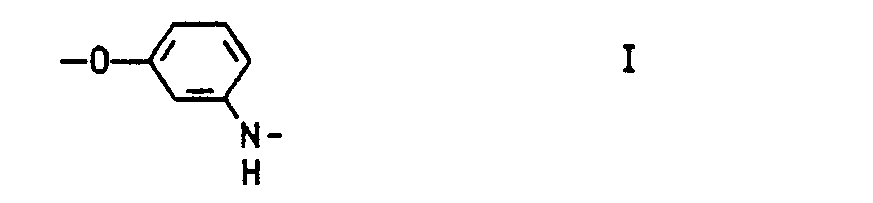
- a) 3 bis 30 Mol% wiederkehrenden Einheiten der Formel I
- b) 3 bis 25 Mol.% mindestens eine der wiederkehrenden Einheiten der Formeln II, III und IV

- c) einer der Summe der Komponenten a) und b) entsprechenden molaren Menge an wiederkehrenden Einheiten der Formeln V und/oder VI

- d) wiederkehrende Einheiten der Formel VII

- e) gegebenenfalls 5 bis 25 Mol.% wiederkehrenden Einheiten der Formel VIII
Description
- Gegenstand der Erfindung sind vollaromatische mesomorphe Polysteramide, die unterhalb 320°C eine flüssigkristalline fedenbildende Schmelze bilden.
- Es sind schon eine Reihe von flüssig-kristallinen Polyesteramiden bekannt. Solche Polymere sind jedoch hinsichtlich ihrer Wärmeformbeständigkeit, ihrer Verarbeitbarkeit und insbesondere ihrer geringen Abriebfestigkeit verbesserungsbedürftig. In der US-PS 43 55 132 werden Polyesteramide aufgebaut aus 4-Hydroxibenzoesäure, 2,6-Naphthalindicarbonsäure, Hydrochinon, Isophthalsäure und 4-Aminophenol oder 1,4-Phenylendiamin beschrieben. In der US-PS 43 30 457 werden Polyesteramide, aufgebaut aus Hydroxinaphthalincarbonsäure, Terephthalsäure, Hydrochinon und p-Aminophenol beschrieben. Solche Polyesteramide haben jedoch eine Glasübergangstemperatur von etwa 105°C. Das gleiche gilt für die aus US-PS 43 51 917 bekannten Poyesteramide, die aus p-Aminophenol, p-Hydroxibenzoesäure und Hydroxinaphthalincarbonsäure aufgebaut sind. In der EP-PS 7715 werden Polyesteramide, die aus mindestens 50 % Resten von p-Aminophenol sowie Alkoxiterephthalsäure aufgebaut sind beschrieben. Schließlich sind aus der EP-Anmeldung 81 900 Polyesteramide bekannt, die mindestens zu 40 % aus coaxialen Einheiten wie aromatischen Dicarbonsäuren, hydroxiaromatischen Carbonsäuren, Bisphenolen und Aminophenolen bestehen und eine ausreichende Menge an nicht-linearen Resten enthalten, die sich von aromatischen meta-Aminoverbindungen oder zweikernigen aromatischen Sulfonen ableiten. Es wird jedoch kein Hinweis gegeben, welche Zusammensetzung erforderlich ist, um die gewünschte Eigenschaftskombination zu erzielen.
- Es war deshalb die technische Aufgabe gestellt, vollaromatische mesomorphe Polyesteramide zur Verfügung zu stellen, die unterhalb 320°C eine flüssig-kristalline fadenbildende Schmelze zeigen, und sich somit leicht verarbeiten lassen und darüberhinaus eine hohe Wärmeformbeständigkeit, eine gute Abriebfestigkeit sowie eine gute Zähigkeit aufweisen.
- Diese Aufgabe wird gelöst durch vollaromatische mesomorphe Polyesteramide, die unterhalb 320°C eine flüssig-kristalline fadenbildende Schmelze bilden, aufgebaut aus
- a) 3 bis 30 Mol.% wiederkehrenden Einheiten der Formel I

- b) 3 bis 25 Mol.% mindestens eine der wiederkehrenden Einheiten der Formeln 11, 111 und IV

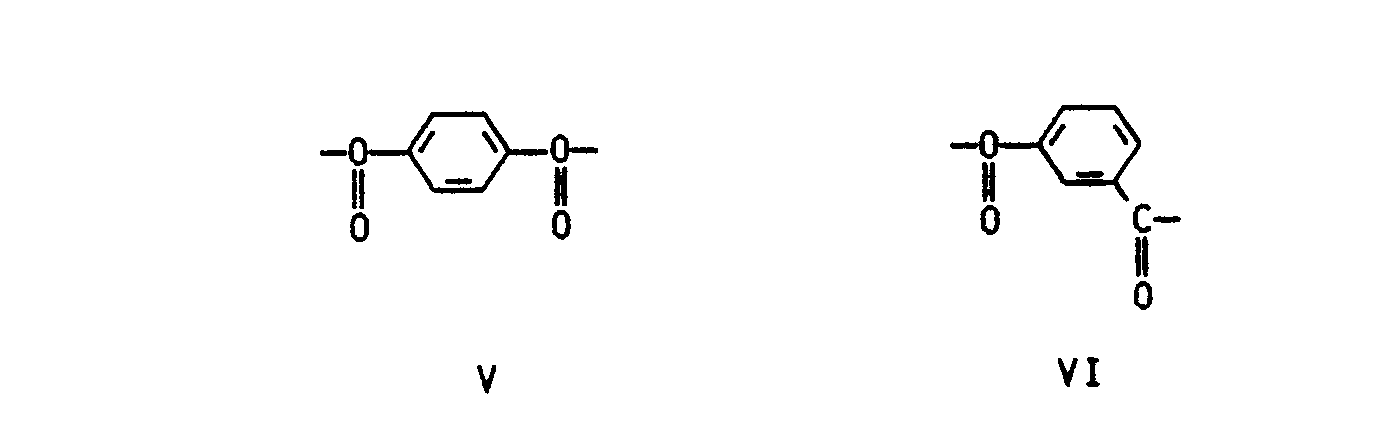
- c) einer der Summe der Komponenten a) und b) entsprechenden molaren Menge an wiederkehrenden Einheiten der Formeln V und/oder VI

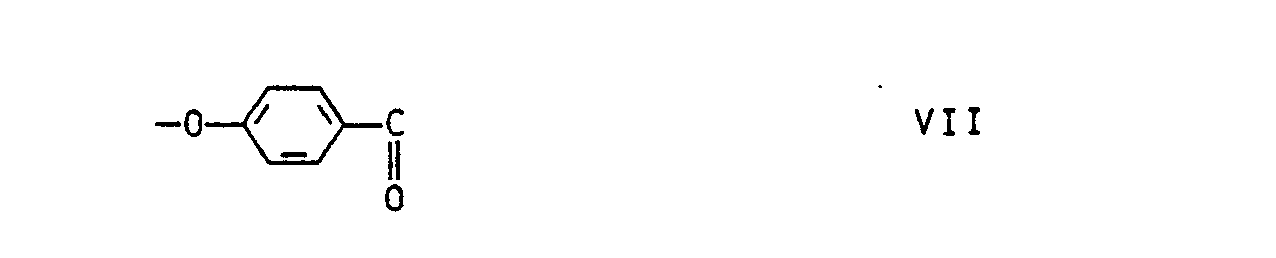
- d) wiederkehrende Einheiten der Formel VII

- e) gegebenenfalls 5 bis 25 Mol.% an wiederkehrenden Einheiten der Formel VIII

- Die neuen Polyesteramide haben den Vorteil, daß sie bei einer Temperatur unterhalb 320°C eine flüssigkristalline fadenbildende Schmelze zeigen und leicht verarbeitbar sind. Weiter haben die neuen Polyesteramide den Vorteil, daß sie eine glatte abriebfeste Oberfläche aufweisen und eine gute Wärmeformbeständigkeit haben. Ferner zeichnen sich die neuen Polyesteramide durch gute mechanische Werte, insbesondere eine gute Kerbschlagzähigkeit aus.
- Der flüssigkristalline Zustand der Polyesteramide kann mit dem Polarisationsmikroskop nach einer in der DE-AS25 20 819 beschriebenen Methode nachgewiesen werden. Zwischen gekreuzten Polarisatoren weisen die Polymerschmelzen, die in einer Schichtdicke von 10 um zwischen Glasplatten aufgetragen sind, Texturen auf, die einer mesomorphen Phase zugeordnet werden können.
- Die erfindungsgemäßen Polyesteramide sind aufgebaut aus
- a) 3 bis 30 Mol.%, insbesondere 5 bis 25 Mol% wiederkehrenden Einheiten der Formel 1

- b) 3 bis 25 Mol%, vorzugsweise 5 bis 20 Mol% mindestens eine der wiederkehrenden Einheiten der Formeln 11, III oder IV

- c) einer Summe der Komponenten a) und b) entsprechenden molaren Menge an wiederkehrenden Einheiten der Formeln V und/oder VI

- d) wiederkehrenden Einheiten der Formel VII vorteilhaft in einer Menge von mindestens 10 Mol.%, insbesondere mindestens 20 Mol.%
- e) gegebenenfalls 5 bis 25 Mol.%, insbesondere 5 bis 15 Mol.% wiederkehrenden Einheiten der Formel VIII

- Besonders bevorzugt sind die Polyesteramide, die aus wiederkehrenden Einheiten der Formel I, 11, 111, V, VI und VII in den oben angegebenen molaren Verhältnissen aufgebaut sind.
- Bevorzugte vollaromatische Polyesteramide haben eine Glasübergangstemperatur von ≧140°C, insbesondere 2;150"C. Die Glastemperatur soll dabei gemessen werden mit der DSC-Methode, wie sie beschrieben ist, von K.H. Illers in Makromol. Chem., Band 127 (1969), Seiten 1 ff. Die vollaromatischen flüssigkristallinen Polyesteramide bilden bei einer Temperatur <320°C eine flüssigkristalline fadenbildende Schmelze. Bevorzugt sind auch flüssig-kristalline aromatische Polyesteramide, die bei einer Temperatur >200°C und <300°C Teilkristallinität aufweisen.
- Die erfindungsgemäßen flüssigkristallinen Polyesteramide lassen sich erhalten durch eine Reihe von Techniken, wie sie beispielsweise in der US-PS 43 75 530 und 41 18 372 beschrieben werden.
- Nach einer vorteilhaften Arbeitsweise erhält man die erfindungsgemäßen Polyesteramide in einem Einstufen-Verfahren, bei dem man die Ausgangsstoffe in nicht-derivatisiertem Zustand unter Verwendung von Anhydriden niederer Fettsäuren, z.B. Fettsäuren mit 2 bis 4 Kohlenstoffatomen, insbesondere Essigsäureanhydrid, umsetzt. Es ist möglich, hierbei Katalysatoren wie sie z.B. in der EP-A-13 18 846, Seite 9 beschrieben sind in Mengen von 0,001 bis 1 Gew.% mitzuverwenden. Bei der Umsetzung werden die nichtderivatisierten Ausgangsstoffe zusammen mit Fettsäureanhydrid vorteilhaft in einem mindestens 5 %igen molaren Überschuß, bezogen auf die vorhandenen Hydroxl-und Aminogruppen unter Inertgasathmosphäre und Rühren auf eine Temperatur erhitzt, bei der Rückfluß zu beobachten ist. Vorteilhaft wird die Temperatur stufenweise gesteigert, z.B. höchstens 5 Stunden, vorzugsweise bis zu 2 Stunden auf 130 bis 200°C. Anschließend wird die Temperatur z.B. innerhalb von 2 bis 2 1/2 Stunden auf 250 bis 350°C gesteigert. Hierbei werden überschüssige Fettsäurenahydride und Fettsäuren abdestilliert. Um die Reaktion zu vervollständigen, hat es sich als vorteilhaft erwiesen, gegen Ende der Umsetzung verminderten Druck, z.B. von 200 bis 0,1 mbar anzuwenden.
- Bemerkenswert und nicht vorherzusehen bei der Anwendung dieses Einstufen-Verfahrens ist zunächst die problemlose und vollständige Reaktion ohne Katalysator-Zusatz zu den gewünschten Polymeren in einer relativ kurzen Zeit. Dies ist umso bemerkenswerter, als durch die Vielzahl chemisch unterschiedlicher Hydroxy-und Aminogruppen eine Abstufung der Reaktivitäten und damit ein mangelhafter polymerer Aufbau zu erwarten wäre.
- Die so erhaltenen vollaromatischen flüssig-kristallinen Poyesteramide werden vorteilhaft in festem Zustand, z.B. bei Temperaturen von 150 bis 250°C bis zur gewünschten Viskosität weiter kondensiert. Diese Nachkondensation in fester Phase kann sowohl vor, als auch nach einer thermoplastischen Verarbeitung erfolgen. Die Festphasenkondensation führt man vorteilhaft in Inertgasatmosphäre, z.B. in Stickstoff durch.
- Die Polyesteramide gemäß der Erfindung können durch übliche Zusatzstoffe wie Stabilisatoren, Oxidationsverzögerer, Mittel gegen Wärmezersetzung und Zersetzung durch ultraviolettes Licht, Gleit-und Entformungsmittel, Färbemittel wie Farbstoffe und Pigmente, faser-oder pulverförmige Füllstoffe und Verstärkungsmittel, Keimbildungsmittel oder Weichmacher modifiziert werden, die in üblichen wirksamen Mengen eingesetzt werden.
- Die Stabilisatoren können den Polymeren in jedem Stadium der Herstellung oder den fertigen Polymeren zugesetzt werden. Vorzugsweise werden die Stabilisatoren zu einem frühen Zeitpunkt zugesetzt, um zu verhindern, daß die Zersetzung bereits beginnt, bevor die Polymeren geschützt werden können.
- Zu den Oxidationsverzögerern und Wärmestabilisatoren, die den Polyesteramiden zugesetzt werden können, gehören diejenigen, die allgemein zu Polymeren zugesetzt werden wie Halogenide von Metallen der Gruppe I des periodischen Systems, z.B. von Natrium, Kalium oder Lithium wie Chloride, Bromide oder lodide mit Kupfer-I-Halogeniden wie Chloriden, Bromiden oder lodiden, sterisch gehinderte Phenole, Hydrochinone, verschiedene sub stituierte Vertreter dieser Gruppen und Kombinationen derselben in Konzentrationen bis 1 Gew.%, bezogen auf das Polymere. Geeignete UV-Stabilisatoren sind beispielsweise substituierte Resorcine, Salicylate, Benztriazole, Benzophenone und dgl. sowie Mischungen derselben. Solche UV-Stabilisatoren werden in der Regel in Mengen bis zu 2 Gew.% bezogen auf das Polymere angewandt.
- Ferner können zugesetzt werden organische Farbstoffe wie Nigrosin, Pigmente wie Titandioxid, Cadmiumsulfid, Cadmiumsulfid-Selenit, Phthalocyanine, Ultramarineblau oder Ruß. Farbstoffe und Pigmente werden im allgemeinen in Mengen bis zu 5,0 Gew.% angewandt. Ferner faser-oder pulverförmige Füllstoffe und Verstärkungsmittel wie Kohlenstoff-Fasern, Glasfasern, amorphe Kieselsäure, Asbest, Kalziumsilikat, Aluminiumsilikat, Magnesiumcarbonat, Kaolin, Kreide, gepulverter Quarz, Glimmer, Feldspat, in der Regel in Mengen bis zu 70 Gew.% der so ausgerüsteten Masse. Geeignete Keimbildungsmittel sind beispielsweise Talkum, Calciumfluorid, Natriumphenylphosphinat, Aluminiumoxid und feinteiliges Polytetrafluorethylen. Schließlich sind geeignete Zusatzstoffe Weichmacher in Mengen bis zu 20 Gew.% wie Phthalsäuredioctylester, Phthalsäuredibenzylester, Phthalsäurebutylbenzylester, Kohlenwasserstofföle, N,n-Butylbenzolsulfonamid, o-und p-Toluolethylsulfonamid.
- Die erfindungsgemäßen vollaromatischen flüssig-kristallinen Polyesteramide eignen sich zur Herstellung von Fäden, Folien, Schäumen und technischen Formteilen durch Spritzguß, Pressen oder Extrusion.
- Die aus den erfindungsgemäßen Polyesteramiden hergestellten Formteile zeichnen sich aus durch hervorragende mechanische Eigenschaften wie Steifigkeit, Festigkeit und Zähigkeit aus. Sie sind außerordentlich chemikalienresistent und flammwidrig. Zudem besitzten sie eine hohe Wärmeformbeständigkeit und eine glatte abriebfeste Oberfläche. Die erfindungsgemäßen Polyesteramide eignen sich daher hervorragend zur Herstellung von Formteilen für die Elektro-und Datentechnik, den Fahrzeugbau und andere technische Bereiche. Sie können aber auch als Überzugs-und Beschichtungsmittel pulverförmig dispergiert oder als Film verwendet werden.
- Die Erfindung sei an folgenden Beispielen veranschaulicht.
- 0,2 Mol Terephthalsäure, 0,26 Mol p-Hydroxibenzoesäure, 0,07 Mol Hydrochinon, 0,07 Mol Dihydroxibiphenyl und 0,06 Mol m-Aminophenol und 85 ml Acetanhydrid werden unter Stickstoffatmosphäre und Rühren innerhalb von 3 h von 150°C auf 300°C erhitzt. Dabei wird überschüssiges Acetanhydrid und Essigsäure abdestilliert. Anschließend wird innerhalb 1 h der Druck auf 55 mbar reduziert. Man erhält eine viskose fadenbildende Schmelze. Die Polymerschmelze und das erkaltete Polymer zeigen einen perlmuttartigen Glanz. Das Polymer besitzt eine glatte, harte und abriebfeste Oberfläche. Aus DSC-Messungen ergibt sich eine Glastemperatur von 154°C und eine Schmelztemperatur von 290°C. Die inhärente Viskosität beträgt 1,93 dl/g, gemessen in 0,1 %iger (Gew./Vol.) Lösung in Pentafluorphenol bei 60°C.
- 0,2 mol Terephthalsäure, 0,26 mol p-Hydroxibenzoesäure, 0,07 Mol Hydrochinon, 0,04 mol Dihydroxibiphenyl und 0.09 mol m-Aminophenol und 105 mol Acetanhydrid werden unter Stickstoffatmosphäre und Rühren innerhalb von 2 h 40 min von 150°C auf 350°C erhitzt. Dabei wird überschüssiges Acetanhydrid und Essigsäure abdestilliert. Anschließend wird innerhalb 40 min der Druck auf 110 mbar reduziert. Man erhält eine hochviskose fadenbildende Schmelze. Die Polymerschmelze und das erkaltete Polymer zeigen einen perlmutterartigen Glanz. Das Polymer besitzt eine glatte, harte und abriebfeste Oberfläche. Aus DSC-Messungen ergibt sich eine Glastemperatur von 158°C.
- Die inhärente Viskosität beträgt 1,09 dl/g, gemessen in 0,1 %iger (Gew.ΛIoI.) Lösung in Pentafluorphenol bei 60°C.
- 0,2 mol Terephthalsäure, 0,26 Mol p-Hydroxibenzoesäure, 0,07 mol Hydrochinon und 0,13 mol m-Aminophenol und 105 ml Acetanhydrid werden unter Stickstoffatmosphäre und Rühren innerhalb von 2 h 40 min von 150°C auf 300°C erhitzt. Dabei wird überschüssiges Acetanhydrid und Essigsäure abdestilliert. Anschließend wird innerhalb von 40 min der Druck auf 90 mbar reduziert. Man erhält eine hochviskose fadenbildende Schmelze. Das Plymer besitzt eine glatte, hart und abriebfeste Oberfläche. Die DSC-Messung ergibt sich eine Glastemperatur von 166°C. Die inhärente Viskosität beträgt 0,62 dl/g, gemessen in 0,1 %iger (Gew./Vol.) Lösung in Pentafluorphenol bei 60°C.
- 0,25 mol Isophthalsäure, 0,325 Mol p-Hydroxibenzoesäure, 0,0875 mol Hydrochinon, 0,0875 mol 4,4'-Dihydroxibiphenyl, 0,075 mol m-Aminophenol und 105 ml Acetanhydrid werden unter Stickstoffatmosphäre und Rühren innerhalb von 2 h 50 min von 150°C auf 300°C erhitzt. Dabei wird überschüssiges Acetanhydrid und Essigsäure abdestilliert. Anschließend wird innerhalb von 25 min der Druck auf 75 mbar reduziert. Man erhält eine viskose fadenbildende Schmelze. Das Polymer besitzt eine glatte, harte und abriebfeste Oberfläche. Die DSC-Messung ergibt sich eine Glastemperatur von 142°C. Die inhärente Viskosität beträgt 0,93 dl/g, gemessen in 0,1 %iger (Gew.Nol.) Lösung in Pentafluorphenol bei 60°C.
Claims (7)




Priority Applications (1)
| Application Number | Priority Date | Filing Date | Title |
|---|---|---|---|
| AT86116272T ATE101862T1 (de) | 1985-12-04 | 1986-11-24 | Vollaromatische mesomorphe polyesteramide, deren herstellung und verwendung. |
Applications Claiming Priority (2)
| Application Number | Priority Date | Filing Date | Title |
|---|---|---|---|
| DE3542856A DE3542856A1 (de) | 1985-12-04 | 1985-12-04 | Vollaromatische mesomorphe polyesteramide, deren herstellung und verwendung |
| DE3542856 | 1985-12-04 |
Publications (3)
| Publication Number | Publication Date |
|---|---|
| EP0226080A2 true EP0226080A2 (de) | 1987-06-24 |
| EP0226080A3 EP0226080A3 (en) | 1988-09-07 |
| EP0226080B1 EP0226080B1 (de) | 1994-02-23 |
Family
ID=6287602
Family Applications (1)
| Application Number | Title | Priority Date | Filing Date |
|---|---|---|---|
| EP86116272A Expired - Lifetime EP0226080B1 (de) | 1985-12-04 | 1986-11-24 | Vollaromatische mesomorphe Polyesteramide, deren Herstellung und Verwendung |
Country Status (6)
| Country | Link |
|---|---|
| US (1) | US4722993A (de) |
| EP (1) | EP0226080B1 (de) |
| JP (1) | JPS62132926A (de) |
| AT (1) | ATE101862T1 (de) |
| CA (1) | CA1268585A (de) |
| DE (2) | DE3542856A1 (de) |
Cited By (2)
| Publication number | Priority date | Publication date | Assignee | Title |
|---|---|---|---|---|
| EP0335006A3 (de) * | 1988-03-03 | 1989-10-18 | Hüls Aktiengesellschaft | Formmassen bestehend aus einem thermoplastisch verarbeitbaren, aromatischen Polyamid |
| EP0259670A3 (en) * | 1986-08-28 | 1989-10-18 | Basf Aktiengesellschaft | Wholly aromatic thermotropic polyesters |
Families Citing this family (14)
| Publication number | Priority date | Publication date | Assignee | Title |
|---|---|---|---|---|
| DE3542831A1 (de) * | 1985-12-04 | 1987-06-11 | Basf Ag | Fluessig-kristalline carbamidgruppen enthaltende polykondensate, deren herstellung und verwendung |
| US5025082A (en) * | 1988-08-24 | 1991-06-18 | Mitsubishi Kasei Corporation | Aromatic polyester, aromatic polyester-amide and processes for producing the same |
| IT1237524B (it) * | 1989-12-06 | 1993-06-08 | Francesco Casagrande | Poliesteriammidi termotropiche |
| US5470945A (en) * | 1990-02-05 | 1995-11-28 | Battelle Memorial Institute | Thermally reversible isocyanate-based polymers |
| US5239039A (en) * | 1990-02-05 | 1993-08-24 | Battelle Memorial Institute | Polyarylimidazolidines with phenolic hydroxyl end groups |
| US5097010A (en) * | 1990-02-05 | 1992-03-17 | Battelle Memorial Institute | Thermally-reversible isocyanate polymers |
| US6294640B1 (en) | 2000-01-14 | 2001-09-25 | Ticona Llc | Stretchable polymers and shaped articles produced by same |
| US6207790B1 (en) | 2000-01-14 | 2001-03-27 | Ticona Llc | Process for producing amorphous anisotropic melt-forming polymers having a high degree of stretchability and polymers produced by same |
| US6132884A (en) * | 2000-01-14 | 2000-10-17 | Ticona Llc | Process for producing amorphous anisotrophic melt-forming polymers having a high degree of stretchability and polymers produced by same |
| US6222000B1 (en) | 2000-01-14 | 2001-04-24 | Ticona Llc | Process for producing amorphous anisotropic melt-forming polymers having a high degree of stretchability |
| US6666990B2 (en) | 2001-02-14 | 2003-12-23 | Ticona Llc | Stretchable liquid crystal polymer composition |
| US6514611B1 (en) | 2001-08-21 | 2003-02-04 | Ticona Llc | Anisotropic melt-forming polymers having a high degree of stretchability |
| US20050221075A1 (en) * | 2004-03-31 | 2005-10-06 | Travelute Frederick L Iii | Low density light weight filament and fiber |
| CN108026268B (zh) * | 2015-09-09 | 2020-12-25 | 住友化学株式会社 | 芳香族聚酯、芳香族聚酯液状组合物、芳香族聚酯膜的制造方法及芳香族聚酯膜 |
Family Cites Families (14)
| Publication number | Priority date | Publication date | Assignee | Title |
|---|---|---|---|---|
| US3859251A (en) * | 1973-10-19 | 1975-01-07 | Eastman Kodak Co | Poly(ester-amide) |
| PH15509A (en) * | 1974-05-10 | 1983-02-03 | Du Pont | Improvements in an relating to synthetic polyesters |
| DE2966721D1 (en) * | 1978-07-24 | 1984-04-05 | Ici Plc | Thermotropic polyesteramides |
| ATE39263T1 (de) * | 1980-11-07 | 1988-12-15 | Ici Plc | Fumarsaeure oder substituierte fumarsaeure enthaltende polymere, die eine anisotrope schmelze bilden koennen. |
| US4330457A (en) * | 1980-12-09 | 1982-05-18 | Celanese Corporation | Poly(ester-amide) capable of forming an anisotropic melt phase derived from 6-hydroxy-2-naphthoic acid, dicarboxylic acid, and aromatic monomer capable of forming an amide linkage |
| US4351917A (en) * | 1981-04-06 | 1982-09-28 | Celanese Corporation | Poly(ester-amide) capable of forming an anisotropic melt phase derived from 6-hydroxy-2-naphthoic acid, aromatic monomer capable of forming an amide linkage, and other aromatic hydroxyacid |
| US4351918A (en) * | 1981-04-06 | 1982-09-28 | Celanese Corporation | Poly(ester-amide) capable of forming an anisotropic melt phase derived from 6-hydroxy-2-naphthoic acid, other aromatic hydroxyacid, carbocyclic dicarboxylic acid, and aromatic monomer capable of forming an amide linkage |
| US4355132A (en) * | 1981-04-07 | 1982-10-19 | Celanese Corporation | Anisotropic melt phase forming poly(ester-amide) derived from p-hydroxybenzoic acid, 2,6-naphthalenedicarboxylic acid, aromatic monomer capable of forming an amide linkage, and, optionally, hydroquinone and additional carbocyclic dicarboxylic acid |
| US4339375A (en) * | 1981-06-04 | 1982-07-13 | Celanese Corporation | Poly(ester-amide) capable of forming an anisotropic melt phase derived from p-hydroxybenzoic acid, 2,6-dihydroxynaphthalene, carbocyclic dicarboxylic acid, aromatic monomer capable of forming an amide linkage, and, optionally, additional aromatic diol |
| EP0081900B1 (de) * | 1981-11-16 | 1987-05-13 | Imperial Chemical Industries Plc | Anisotrope Polymere, die bei erhöhten Temperaturen ein verbessertes Beibehalten der physikalischen Eigenschaften besitzen, und Verfahren zu ihrer Herstellung |
| US4375530A (en) * | 1982-07-06 | 1983-03-01 | Celanese Corporation | Polyester of 2,6-naphthalene dicarboxylic acid, 2,6-dihydroxy naphthalene, terephthalic acid, and hydroquinone capable of forming an anisotropic melt |
| US4522974A (en) * | 1982-07-26 | 1985-06-11 | Celanese Corporation | Melt processable polyester capable of forming an anisotropic melt comprising a relatively low concentration of 6-oxy-2-naphthoyl moiety-4-benzoyl moiety, 1,4-dioxyphenylene moiety, isophthaloyl moiety and terephthaloyl moiety |
| US4473681A (en) * | 1983-03-21 | 1984-09-25 | Celanese Corporation | Polyester urea capable of forming an anisotropic melt phase |
| DE3325705A1 (de) * | 1983-07-16 | 1985-01-24 | Bayer Ag, 5090 Leverkusen | Mesomorphe aromatische polyester mit hoher zaehigkeitund verbesserter schmelzviskositaet, verfahren zu ihrer herstellung und ihre verwendung zur herstellung von formkoerpern, filamenten, fasern und folien |
-
1985
- 1985-12-04 DE DE3542856A patent/DE3542856A1/de not_active Withdrawn
-
1986
- 1986-11-24 EP EP86116272A patent/EP0226080B1/de not_active Expired - Lifetime
- 1986-11-24 DE DE86116272T patent/DE3689663D1/de not_active Expired - Lifetime
- 1986-11-24 AT AT86116272T patent/ATE101862T1/de not_active IP Right Cessation
- 1986-12-03 CA CA000524452A patent/CA1268585A/en not_active Expired - Lifetime
- 1986-12-03 JP JP61286870A patent/JPS62132926A/ja active Pending
- 1986-12-04 US US06/937,677 patent/US4722993A/en not_active Expired - Fee Related
Cited By (2)
| Publication number | Priority date | Publication date | Assignee | Title |
|---|---|---|---|---|
| EP0259670A3 (en) * | 1986-08-28 | 1989-10-18 | Basf Aktiengesellschaft | Wholly aromatic thermotropic polyesters |
| EP0335006A3 (de) * | 1988-03-03 | 1989-10-18 | Hüls Aktiengesellschaft | Formmassen bestehend aus einem thermoplastisch verarbeitbaren, aromatischen Polyamid |
Also Published As
| Publication number | Publication date |
|---|---|
| CA1268585A (en) | 1990-05-01 |
| EP0226080B1 (de) | 1994-02-23 |
| ATE101862T1 (de) | 1994-03-15 |
| JPS62132926A (ja) | 1987-06-16 |
| EP0226080A3 (en) | 1988-09-07 |
| DE3689663D1 (de) | 1994-03-31 |
| DE3542856A1 (de) | 1987-06-11 |
| US4722993A (en) | 1988-02-02 |
Similar Documents
| Publication | Publication Date | Title |
|---|---|---|
| EP0230545B1 (de) | Vollaromatische Polyesteramide, deren Herstellung und Verwendung. | |
| EP0225537B1 (de) | Vollaromatische mesomorphe Polyesterimide, deren Herstellung sowie Verwendung | |
| EP0230546B1 (de) | Vollaromatische mesomorphe Polyesteramide, deren Herstellung und Verwendung | |
| EP0225529A2 (de) | Vollaromatische mesomorphe Polyesteramidimide, deren Herstellung und Verwendung | |
| EP0251113B1 (de) | Vollaromatische mesomorphe Polyester, deren Herstellung sowie Verwendung | |
| EP0226847B1 (de) | Vollaromatische mesmorphe Polyetherester, deren Herstellung und Verwendung | |
| EP0226080B1 (de) | Vollaromatische mesomorphe Polyesteramide, deren Herstellung und Verwendung | |
| EP0257558B1 (de) | Vollaromatische thermotrope Polyester | |
| EP0259670B1 (de) | Vollaromatische thermotrope Polyester und Polyesteramide | |
| EP0325739A2 (de) | Formmassen bestehend aus einem thermoplastisch verarbeitbaren, aromatischen Polyesterimid | |
| EP0258767B1 (de) | Vollaromatische thermotrope Polyester | |
| EP0230551B1 (de) | Vollaromatische Polyestercarbamide, deren Herstellung und Verwendung | |
| EP0230547A2 (de) | Vollaromatische mesomorphe Polyesteramidimide, deren Herstellung und Verwendung | |
| EP0257598B1 (de) | Vollaromatische thermotrope Polyester und Polyesteramide | |
| DE3542857A1 (de) | Vollaromatische mesomorphe polyesterimide | |
| EP0231462B1 (de) | Vollaromatische mesomorphe Polyetheresterimide, deren Herstellung und Verwendung | |
| EP0231468B1 (de) | Flüssig-kristalline Carbamidgruppen enthaltende Polykondensate, deren Herstellung und Verwendung | |
| EP0230550B1 (de) | Vollaromatische flüssigkristalline Polykondensate, deren Herstellung und Verwendung | |
| DE3700821A1 (de) | Vollaromatische thermotrope polyester |
Legal Events
| Date | Code | Title | Description |
|---|---|---|---|
| PUAI | Public reference made under article 153(3) epc to a published international application that has entered the european phase |
Free format text: ORIGINAL CODE: 0009012 |
|
| AK | Designated contracting states |
Kind code of ref document: A2 Designated state(s): AT BE CH DE FR GB IT LI LU NL SE |
|
| PUAL | Search report despatched |
Free format text: ORIGINAL CODE: 0009013 |
|
| AK | Designated contracting states |
Kind code of ref document: A3 Designated state(s): AT BE CH DE FR GB IT LI LU NL SE |
|
| 17P | Request for examination filed |
Effective date: 19880921 |
|
| 17Q | First examination report despatched |
Effective date: 19901130 |
|
| GRAA | (expected) grant |
Free format text: ORIGINAL CODE: 0009210 |
|
| AK | Designated contracting states |
Kind code of ref document: B1 Designated state(s): AT BE CH DE FR GB IT LI LU NL SE |
|
| REF | Corresponds to: |
Ref document number: 101862 Country of ref document: AT Date of ref document: 19940315 Kind code of ref document: T |
|
| ITF | It: translation for a ep patent filed | ||
| REF | Corresponds to: |
Ref document number: 3689663 Country of ref document: DE Date of ref document: 19940331 |
|
| GBT | Gb: translation of ep patent filed (gb section 77(6)(a)/1977) |
Effective date: 19940311 |
|
| ET | Fr: translation filed | ||
| PLBE | No opposition filed within time limit |
Free format text: ORIGINAL CODE: 0009261 |
|
| STAA | Information on the status of an ep patent application or granted ep patent |
Free format text: STATUS: NO OPPOSITION FILED WITHIN TIME LIMIT |
|
| EAL | Se: european patent in force in sweden |
Ref document number: 86116272.5 |
|
| 26N | No opposition filed | ||
| PGFP | Annual fee paid to national office [announced via postgrant information from national office to epo] |
Ref country code: FR Payment date: 19961025 Year of fee payment: 11 |
|
| PGFP | Annual fee paid to national office [announced via postgrant information from national office to epo] |
Ref country code: SE Payment date: 19961028 Year of fee payment: 11 |
|
| PGFP | Annual fee paid to national office [announced via postgrant information from national office to epo] |
Ref country code: NL Payment date: 19961031 Year of fee payment: 11 |
|
| PGFP | Annual fee paid to national office [announced via postgrant information from national office to epo] |
Ref country code: LU Payment date: 19961101 Year of fee payment: 11 |
|
| PGFP | Annual fee paid to national office [announced via postgrant information from national office to epo] |
Ref country code: CH Payment date: 19961105 Year of fee payment: 11 |
|
| PGFP | Annual fee paid to national office [announced via postgrant information from national office to epo] |
Ref country code: AT Payment date: 19961106 Year of fee payment: 11 |
|
| PGFP | Annual fee paid to national office [announced via postgrant information from national office to epo] |
Ref country code: BE Payment date: 19961114 Year of fee payment: 11 |
|
| PGFP | Annual fee paid to national office [announced via postgrant information from national office to epo] |
Ref country code: GB Payment date: 19961118 Year of fee payment: 11 |
|
| PGFP | Annual fee paid to national office [announced via postgrant information from national office to epo] |
Ref country code: DE Payment date: 19961126 Year of fee payment: 11 |
|
| PG25 | Lapsed in a contracting state [announced via postgrant information from national office to epo] |
Ref country code: LU Free format text: LAPSE BECAUSE OF NON-PAYMENT OF DUE FEES Effective date: 19971124 Ref country code: GB Free format text: LAPSE BECAUSE OF NON-PAYMENT OF DUE FEES Effective date: 19971124 Ref country code: AT Free format text: LAPSE BECAUSE OF NON-PAYMENT OF DUE FEES Effective date: 19971124 |
|
| PG25 | Lapsed in a contracting state [announced via postgrant information from national office to epo] |
Ref country code: SE Free format text: LAPSE BECAUSE OF NON-PAYMENT OF DUE FEES Effective date: 19971125 |
|
| PG25 | Lapsed in a contracting state [announced via postgrant information from national office to epo] |
Ref country code: LI Free format text: LAPSE BECAUSE OF NON-PAYMENT OF DUE FEES Effective date: 19971130 Ref country code: FR Free format text: THE PATENT HAS BEEN ANNULLED BY A DECISION OF A NATIONAL AUTHORITY Effective date: 19971130 Ref country code: CH Free format text: LAPSE BECAUSE OF NON-PAYMENT OF DUE FEES Effective date: 19971130 Ref country code: BE Free format text: LAPSE BECAUSE OF NON-PAYMENT OF DUE FEES Effective date: 19971130 |
|
| PG25 | Lapsed in a contracting state [announced via postgrant information from national office to epo] |
Ref country code: DE Effective date: 19971201 |
|
| BERE | Be: lapsed |
Owner name: BASF A.G. Effective date: 19971130 |
|
| PG25 | Lapsed in a contracting state [announced via postgrant information from national office to epo] |
Ref country code: NL Free format text: LAPSE BECAUSE OF NON-PAYMENT OF DUE FEES Effective date: 19980601 |
|
| GBPC | Gb: european patent ceased through non-payment of renewal fee |
Effective date: 19971124 |
|
| REG | Reference to a national code |
Ref country code: CH Ref legal event code: PL |
|
| EUG | Se: european patent has lapsed |
Ref document number: 86116272.5 |
|
| NLV4 | Nl: lapsed or anulled due to non-payment of the annual fee |
Effective date: 19980601 |
|
| REG | Reference to a national code |
Ref country code: FR Ref legal event code: ST |
|
| PG25 | Lapsed in a contracting state [announced via postgrant information from national office to epo] |
Ref country code: IT Free format text: LAPSE BECAUSE OF NON-PAYMENT OF DUE FEES;WARNING: LAPSES OF ITALIAN PATENTS WITH EFFECTIVE DATE BEFORE 2007 MAY HAVE OCCURRED AT ANY TIME BEFORE 2007. THE CORRECT EFFECTIVE DATE MAY BE DIFFERENT FROM THE ONE RECORDED. Effective date: 20051124 |