EP0226439B1 - Polymere Produkte und deren Herstellung - Google Patents
Polymere Produkte und deren Herstellung Download PDFInfo
- Publication number
- EP0226439B1 EP0226439B1 EP19860309586 EP86309586A EP0226439B1 EP 0226439 B1 EP0226439 B1 EP 0226439B1 EP 19860309586 EP19860309586 EP 19860309586 EP 86309586 A EP86309586 A EP 86309586A EP 0226439 B1 EP0226439 B1 EP 0226439B1
- Authority
- EP
- European Patent Office
- Prior art keywords
- film
- polymer composition
- material according
- polymer
- films
- Prior art date
- Legal status (The legal status is an assumption and is not a legal conclusion. Google has not performed a legal analysis and makes no representation as to the accuracy of the status listed.)
- Expired - Lifetime
Links
- 238000004519 manufacturing process Methods 0.000 title claims description 8
- 229920000642 polymer Polymers 0.000 claims description 104
- 239000000203 mixture Substances 0.000 claims description 87
- 239000000463 material Substances 0.000 claims description 36
- 229920001328 Polyvinylidene chloride Polymers 0.000 claims description 23
- 239000005033 polyvinylidene chloride Substances 0.000 claims description 23
- QVGXLLKOCUKJST-UHFFFAOYSA-N atomic oxygen Chemical compound [O] QVGXLLKOCUKJST-UHFFFAOYSA-N 0.000 claims description 22
- 229910052760 oxygen Inorganic materials 0.000 claims description 22
- 239000001301 oxygen Substances 0.000 claims description 22
- 238000001125 extrusion Methods 0.000 claims description 20
- 238000000034 method Methods 0.000 claims description 20
- XLYOFNOQVPJJNP-UHFFFAOYSA-N water Substances O XLYOFNOQVPJJNP-UHFFFAOYSA-N 0.000 claims description 18
- 229920001169 thermoplastic Polymers 0.000 claims description 16
- 239000004416 thermosoftening plastic Substances 0.000 claims description 16
- 239000004014 plasticizer Substances 0.000 claims description 15
- 239000004745 nonwoven fabric Substances 0.000 claims description 13
- 229920001577 copolymer Polymers 0.000 claims description 12
- 239000000155 melt Substances 0.000 claims description 10
- 230000005540 biological transmission Effects 0.000 claims description 9
- 239000004372 Polyvinyl alcohol Substances 0.000 claims description 8
- -1 polyethylene, ethylene vinyl acetate copolymers Polymers 0.000 claims description 8
- 229920002451 polyvinyl alcohol Polymers 0.000 claims description 8
- 239000000654 additive Substances 0.000 claims description 7
- 239000004215 Carbon black (E152) Chemical group 0.000 claims description 6
- 229930195733 hydrocarbon Chemical group 0.000 claims description 6
- 150000002430 hydrocarbons Chemical group 0.000 claims description 6
- 239000012535 impurity Substances 0.000 claims description 6
- 229920002988 biodegradable polymer Polymers 0.000 claims description 5
- 239000004621 biodegradable polymer Substances 0.000 claims description 5
- 238000007711 solidification Methods 0.000 claims description 5
- 230000008023 solidification Effects 0.000 claims description 5
- WHBMMWSBFZVSSR-UHFFFAOYSA-N 3-hydroxybutyric acid Chemical group CC(O)CC(O)=O WHBMMWSBFZVSSR-UHFFFAOYSA-N 0.000 claims description 4
- REKYPYSUBKSCAT-UHFFFAOYSA-N 3-hydroxypentanoic acid Chemical compound CCC(O)CC(O)=O REKYPYSUBKSCAT-UHFFFAOYSA-N 0.000 claims description 4
- 229920001519 homopolymer Polymers 0.000 claims description 4
- 125000002887 hydroxy group Chemical group [H]O* 0.000 claims description 4
- 230000015572 biosynthetic process Effects 0.000 claims description 3
- 239000006227 byproduct Substances 0.000 claims description 3
- 239000000945 filler Substances 0.000 claims description 2
- 229910052736 halogen Chemical class 0.000 claims description 2
- 125000001475 halogen functional group Chemical group 0.000 claims description 2
- 150000002367 halogens Chemical class 0.000 claims description 2
- 229910052739 hydrogen Inorganic materials 0.000 claims description 2
- 239000001257 hydrogen Substances 0.000 claims description 2
- 150000002431 hydrogen Chemical group 0.000 claims description 2
- 239000003381 stabilizer Substances 0.000 claims description 2
- 230000000996 additive effect Effects 0.000 claims 2
- 239000003085 diluting agent Substances 0.000 claims 2
- 239000010408 film Substances 0.000 description 183
- 239000010410 layer Substances 0.000 description 58
- 230000035699 permeability Effects 0.000 description 27
- 229920001200 poly(ethylene-vinyl acetate) Polymers 0.000 description 18
- 239000005038 ethylene vinyl acetate Substances 0.000 description 17
- 230000003014 reinforcing effect Effects 0.000 description 14
- 239000000853 adhesive Substances 0.000 description 12
- 230000001070 adhesive effect Effects 0.000 description 12
- 238000007789 sealing Methods 0.000 description 10
- DQXBYHZEEUGOBF-UHFFFAOYSA-N but-3-enoic acid;ethene Chemical compound C=C.OC(=O)CC=C DQXBYHZEEUGOBF-UHFFFAOYSA-N 0.000 description 9
- 239000000047 product Substances 0.000 description 9
- 229940117958 vinyl acetate Drugs 0.000 description 9
- 229920003171 Poly (ethylene oxide) Polymers 0.000 description 7
- XTXRWKRVRITETP-UHFFFAOYSA-N Vinyl acetate Chemical compound CC(=O)OC=C XTXRWKRVRITETP-UHFFFAOYSA-N 0.000 description 7
- HEMHJVSKTPXQMS-UHFFFAOYSA-M Sodium hydroxide Chemical compound [OH-].[Na+] HEMHJVSKTPXQMS-UHFFFAOYSA-M 0.000 description 6
- 238000002844 melting Methods 0.000 description 6
- 230000008018 melting Effects 0.000 description 6
- 239000007767 bonding agent Substances 0.000 description 5
- 238000003490 calendering Methods 0.000 description 5
- 239000004744 fabric Substances 0.000 description 5
- 230000000704 physical effect Effects 0.000 description 5
- JRHWHSJDIILJAT-UHFFFAOYSA-N 2-hydroxypentanoic acid Chemical compound CCCC(O)C(O)=O JRHWHSJDIILJAT-UHFFFAOYSA-N 0.000 description 4
- SJZRECIVHVDYJC-UHFFFAOYSA-M 4-hydroxybutyrate Chemical compound OCCCC([O-])=O SJZRECIVHVDYJC-UHFFFAOYSA-M 0.000 description 4
- 239000004698 Polyethylene Substances 0.000 description 4
- 238000000576 coating method Methods 0.000 description 4
- 238000002425 crystallisation Methods 0.000 description 4
- 239000007788 liquid Substances 0.000 description 4
- 230000003287 optical effect Effects 0.000 description 4
- UQGPCEVQKLOLLM-UHFFFAOYSA-N pentaneperoxoic acid Chemical compound CCCCC(=O)OO UQGPCEVQKLOLLM-UHFFFAOYSA-N 0.000 description 4
- 229920000573 polyethylene Polymers 0.000 description 4
- 238000000746 purification Methods 0.000 description 4
- SJZRECIVHVDYJC-UHFFFAOYSA-N 4-hydroxybutyric acid Chemical compound OCCCC(O)=O SJZRECIVHVDYJC-UHFFFAOYSA-N 0.000 description 3
- 230000001413 cellular effect Effects 0.000 description 3
- JFCQEDHGNNZCLN-UHFFFAOYSA-N glutaric acid Chemical class OC(=O)CCCC(O)=O JFCQEDHGNNZCLN-UHFFFAOYSA-N 0.000 description 3
- 239000002904 solvent Substances 0.000 description 3
- 239000000758 substrate Substances 0.000 description 3
- 239000010409 thin film Substances 0.000 description 3
- OEPOKWHJYJXUGD-UHFFFAOYSA-N 2-(3-phenylmethoxyphenyl)-1,3-thiazole-4-carbaldehyde Chemical compound O=CC1=CSC(C=2C=C(OCC=3C=CC=CC=3)C=CC=2)=N1 OEPOKWHJYJXUGD-UHFFFAOYSA-N 0.000 description 2
- QGZKDVFQNNGYKY-UHFFFAOYSA-N Ammonia Chemical compound N QGZKDVFQNNGYKY-UHFFFAOYSA-N 0.000 description 2
- FERIUCNNQQJTOY-UHFFFAOYSA-N Butyric acid Chemical compound CCCC(O)=O FERIUCNNQQJTOY-UHFFFAOYSA-N 0.000 description 2
- 229920000331 Polyhydroxybutyrate Polymers 0.000 description 2
- 239000004743 Polypropylene Substances 0.000 description 2
- 230000002745 absorbent Effects 0.000 description 2
- 239000002250 absorbent Substances 0.000 description 2
- NIXOWILDQLNWCW-UHFFFAOYSA-N acrylic acid group Chemical group C(C=C)(=O)O NIXOWILDQLNWCW-UHFFFAOYSA-N 0.000 description 2
- 230000001464 adherent effect Effects 0.000 description 2
- 230000032683 aging Effects 0.000 description 2
- WPYMKLBDIGXBTP-UHFFFAOYSA-N benzoic acid Chemical compound OC(=O)C1=CC=CC=C1 WPYMKLBDIGXBTP-UHFFFAOYSA-N 0.000 description 2
- 238000005266 casting Methods 0.000 description 2
- 239000011248 coating agent Substances 0.000 description 2
- 238000010622 cold drawing Methods 0.000 description 2
- 230000003750 conditioning effect Effects 0.000 description 2
- 230000007613 environmental effect Effects 0.000 description 2
- 238000000855 fermentation Methods 0.000 description 2
- 230000004151 fermentation Effects 0.000 description 2
- 150000002334 glycols Chemical class 0.000 description 2
- 150000002531 isophthalic acids Chemical class 0.000 description 2
- 238000010030 laminating Methods 0.000 description 2
- 239000012939 laminating adhesive Substances 0.000 description 2
- 238000003475 lamination Methods 0.000 description 2
- 239000012785 packaging film Substances 0.000 description 2
- 229920006280 packaging film Polymers 0.000 description 2
- 239000005015 poly(hydroxybutyrate) Substances 0.000 description 2
- 229920000728 polyester Polymers 0.000 description 2
- 229920006254 polymer film Polymers 0.000 description 2
- 229920001155 polypropylene Polymers 0.000 description 2
- 229920002635 polyurethane Polymers 0.000 description 2
- 239000004814 polyurethane Substances 0.000 description 2
- 238000012545 processing Methods 0.000 description 2
- 230000029058 respiratory gaseous exchange Effects 0.000 description 2
- 150000003456 sulfonamides Chemical class 0.000 description 2
- 239000002344 surface layer Substances 0.000 description 2
- 150000003504 terephthalic acids Chemical class 0.000 description 2
- LMYRWZFENFIFIT-UHFFFAOYSA-N toluene-4-sulfonamide Chemical compound CC1=CC=C(S(N)(=O)=O)C=C1 LMYRWZFENFIFIT-UHFFFAOYSA-N 0.000 description 2
- 231100000331 toxic Toxicity 0.000 description 2
- 230000002588 toxic effect Effects 0.000 description 2
- 238000003466 welding Methods 0.000 description 2
- SMZOUWXMTYCWNB-UHFFFAOYSA-N 2-(2-methoxy-5-methylphenyl)ethanamine Chemical compound COC1=CC=C(C)C=C1CCN SMZOUWXMTYCWNB-UHFFFAOYSA-N 0.000 description 1
- NLHHRLWOUZZQLW-UHFFFAOYSA-N Acrylonitrile Chemical compound C=CC#N NLHHRLWOUZZQLW-UHFFFAOYSA-N 0.000 description 1
- 239000005711 Benzoic acid Substances 0.000 description 1
- 229920003345 Elvax® Polymers 0.000 description 1
- LFQSCWFLJHTTHZ-UHFFFAOYSA-N Ethanol Chemical compound CCO LFQSCWFLJHTTHZ-UHFFFAOYSA-N 0.000 description 1
- 229920000219 Ethylene vinyl alcohol Polymers 0.000 description 1
- 239000004677 Nylon Substances 0.000 description 1
- 229920002125 Sokalan® Polymers 0.000 description 1
- BZHJMEDXRYGGRV-UHFFFAOYSA-N Vinyl chloride Chemical compound ClC=C BZHJMEDXRYGGRV-UHFFFAOYSA-N 0.000 description 1
- 239000002253 acid Substances 0.000 description 1
- 150000007513 acids Chemical class 0.000 description 1
- 239000012790 adhesive layer Substances 0.000 description 1
- 125000002877 alkyl aryl group Chemical group 0.000 description 1
- 125000000217 alkyl group Chemical group 0.000 description 1
- 229910021529 ammonia Inorganic materials 0.000 description 1
- 125000003710 aryl alkyl group Chemical group 0.000 description 1
- 125000003118 aryl group Chemical group 0.000 description 1
- 230000009286 beneficial effect Effects 0.000 description 1
- 235000010233 benzoic acid Nutrition 0.000 description 1
- 229920006378 biaxially oriented polypropylene Polymers 0.000 description 1
- 239000011127 biaxially oriented polypropylene Substances 0.000 description 1
- 238000007664 blowing Methods 0.000 description 1
- BVKZGUZCCUSVTD-UHFFFAOYSA-N carbonic acid Chemical class OC(O)=O BVKZGUZCCUSVTD-UHFFFAOYSA-N 0.000 description 1
- 230000015556 catabolic process Effects 0.000 description 1
- 238000006243 chemical reaction Methods 0.000 description 1
- 239000003795 chemical substances by application Substances 0.000 description 1
- 230000001427 coherent effect Effects 0.000 description 1
- 238000005097 cold rolling Methods 0.000 description 1
- 238000000748 compression moulding Methods 0.000 description 1
- 238000001816 cooling Methods 0.000 description 1
- 230000000875 corresponding effect Effects 0.000 description 1
- 230000006378 damage Effects 0.000 description 1
- 230000007812 deficiency Effects 0.000 description 1
- 229920006237 degradable polymer Polymers 0.000 description 1
- 238000006731 degradation reaction Methods 0.000 description 1
- 230000032798 delamination Effects 0.000 description 1
- 238000007599 discharging Methods 0.000 description 1
- 238000004090 dissolution Methods 0.000 description 1
- 230000005672 electromagnetic field Effects 0.000 description 1
- 238000003912 environmental pollution Methods 0.000 description 1
- 150000002148 esters Chemical class 0.000 description 1
- HDERJYVLTPVNRI-UHFFFAOYSA-N ethene;ethenyl acetate Chemical class C=C.CC(=O)OC=C HDERJYVLTPVNRI-UHFFFAOYSA-N 0.000 description 1
- 235000019439 ethyl acetate Nutrition 0.000 description 1
- 229920001038 ethylene copolymer Polymers 0.000 description 1
- 239000004715 ethylene vinyl alcohol Substances 0.000 description 1
- 238000001704 evaporation Methods 0.000 description 1
- 230000008020 evaporation Effects 0.000 description 1
- 230000004927 fusion Effects 0.000 description 1
- 238000007429 general method Methods 0.000 description 1
- 238000010438 heat treatment Methods 0.000 description 1
- RZXDTJIXPSCHCI-UHFFFAOYSA-N hexa-1,5-diene-2,5-diol Chemical compound OC(=C)CCC(O)=C RZXDTJIXPSCHCI-UHFFFAOYSA-N 0.000 description 1
- 238000010348 incorporation Methods 0.000 description 1
- 239000003999 initiator Substances 0.000 description 1
- 150000002576 ketones Chemical class 0.000 description 1
- FPYJFEHAWHCUMM-UHFFFAOYSA-N maleic anhydride Chemical compound O=C1OC(=O)C=C1 FPYJFEHAWHCUMM-UHFFFAOYSA-N 0.000 description 1
- 239000000178 monomer Substances 0.000 description 1
- 239000002667 nucleating agent Substances 0.000 description 1
- 229920001778 nylon Polymers 0.000 description 1
- 239000011368 organic material Substances 0.000 description 1
- 239000003960 organic solvent Substances 0.000 description 1
- 238000004806 packaging method and process Methods 0.000 description 1
- 239000011236 particulate material Substances 0.000 description 1
- 229920003023 plastic Polymers 0.000 description 1
- 239000004033 plastic Substances 0.000 description 1
- 239000002985 plastic film Substances 0.000 description 1
- 229920000098 polyolefin Polymers 0.000 description 1
- 230000002265 prevention Effects 0.000 description 1
- 238000011160 research Methods 0.000 description 1
- 239000007787 solid Substances 0.000 description 1
- 238000000807 solvent casting Methods 0.000 description 1
- 239000007921 spray Substances 0.000 description 1
- 150000005846 sugar alcohols Polymers 0.000 description 1
- 229940124530 sulfonamide Drugs 0.000 description 1
- 239000000454 talc Substances 0.000 description 1
- 229910052623 talc Inorganic materials 0.000 description 1
- 239000012815 thermoplastic material Substances 0.000 description 1
Images
Classifications
-
- C—CHEMISTRY; METALLURGY
- C08—ORGANIC MACROMOLECULAR COMPOUNDS; THEIR PREPARATION OR CHEMICAL WORKING-UP; COMPOSITIONS BASED THEREON
- C08J—WORKING-UP; GENERAL PROCESSES OF COMPOUNDING; AFTER-TREATMENT NOT COVERED BY SUBCLASSES C08B, C08C, C08F, C08G or C08H
- C08J5/00—Manufacture of articles or shaped materials containing macromolecular substances
- C08J5/18—Manufacture of films or sheets
-
- A—HUMAN NECESSITIES
- A61—MEDICAL OR VETERINARY SCIENCE; HYGIENE
- A61L—METHODS OR APPARATUS FOR STERILISING MATERIALS OR OBJECTS IN GENERAL; DISINFECTION, STERILISATION OR DEODORISATION OF AIR; CHEMICAL ASPECTS OF BANDAGES, DRESSINGS, ABSORBENT PADS OR SURGICAL ARTICLES; MATERIALS FOR BANDAGES, DRESSINGS, ABSORBENT PADS OR SURGICAL ARTICLES
- A61L15/00—Chemical aspects of, or use of materials for, bandages, dressings or absorbent pads
- A61L15/16—Bandages, dressings or absorbent pads for physiological fluids such as urine or blood, e.g. sanitary towels, tampons
- A61L15/22—Bandages, dressings or absorbent pads for physiological fluids such as urine or blood, e.g. sanitary towels, tampons containing macromolecular materials
- A61L15/26—Macromolecular compounds obtained otherwise than by reactions only involving carbon-to-carbon unsaturated bonds; Derivatives thereof
-
- A—HUMAN NECESSITIES
- A61—MEDICAL OR VETERINARY SCIENCE; HYGIENE
- A61L—METHODS OR APPARATUS FOR STERILISING MATERIALS OR OBJECTS IN GENERAL; DISINFECTION, STERILISATION OR DEODORISATION OF AIR; CHEMICAL ASPECTS OF BANDAGES, DRESSINGS, ABSORBENT PADS OR SURGICAL ARTICLES; MATERIALS FOR BANDAGES, DRESSINGS, ABSORBENT PADS OR SURGICAL ARTICLES
- A61L28/00—Materials for colostomy devices
- A61L28/0007—Materials for colostomy devices containing macromolecular materials
- A61L28/0015—Materials for colostomy devices containing macromolecular materials obtained otherwise than by reactions only involving carbon-to-carbon unsaturated bonds
-
- C—CHEMISTRY; METALLURGY
- C08—ORGANIC MACROMOLECULAR COMPOUNDS; THEIR PREPARATION OR CHEMICAL WORKING-UP; COMPOSITIONS BASED THEREON
- C08J—WORKING-UP; GENERAL PROCESSES OF COMPOUNDING; AFTER-TREATMENT NOT COVERED BY SUBCLASSES C08B, C08C, C08F, C08G or C08H
- C08J2367/00—Characterised by the use of polyesters obtained by reactions forming a carboxylic ester link in the main chain; Derivatives of such polymers
- C08J2367/04—Polyesters derived from hydroxy carboxylic acids, e.g. lactones
-
- Y—GENERAL TAGGING OF NEW TECHNOLOGICAL DEVELOPMENTS; GENERAL TAGGING OF CROSS-SECTIONAL TECHNOLOGIES SPANNING OVER SEVERAL SECTIONS OF THE IPC; TECHNICAL SUBJECTS COVERED BY FORMER USPC CROSS-REFERENCE ART COLLECTIONS [XRACs] AND DIGESTS
- Y10—TECHNICAL SUBJECTS COVERED BY FORMER USPC
- Y10T—TECHNICAL SUBJECTS COVERED BY FORMER US CLASSIFICATION
- Y10T428/00—Stock material or miscellaneous articles
- Y10T428/26—Web or sheet containing structurally defined element or component, the element or component having a specified physical dimension
-
- Y—GENERAL TAGGING OF NEW TECHNOLOGICAL DEVELOPMENTS; GENERAL TAGGING OF CROSS-SECTIONAL TECHNOLOGIES SPANNING OVER SEVERAL SECTIONS OF THE IPC; TECHNICAL SUBJECTS COVERED BY FORMER USPC CROSS-REFERENCE ART COLLECTIONS [XRACs] AND DIGESTS
- Y10—TECHNICAL SUBJECTS COVERED BY FORMER USPC
- Y10T—TECHNICAL SUBJECTS COVERED BY FORMER US CLASSIFICATION
- Y10T428/00—Stock material or miscellaneous articles
- Y10T428/31504—Composite [nonstructural laminate]
- Y10T428/31855—Of addition polymer from unsaturated monomers
- Y10T428/3188—Next to cellulosic
-
- Y—GENERAL TAGGING OF NEW TECHNOLOGICAL DEVELOPMENTS; GENERAL TAGGING OF CROSS-SECTIONAL TECHNOLOGIES SPANNING OVER SEVERAL SECTIONS OF THE IPC; TECHNICAL SUBJECTS COVERED BY FORMER USPC CROSS-REFERENCE ART COLLECTIONS [XRACs] AND DIGESTS
- Y10—TECHNICAL SUBJECTS COVERED BY FORMER USPC
- Y10T—TECHNICAL SUBJECTS COVERED BY FORMER US CLASSIFICATION
- Y10T428/00—Stock material or miscellaneous articles
- Y10T428/31504—Composite [nonstructural laminate]
- Y10T428/31855—Of addition polymer from unsaturated monomers
- Y10T428/31909—Next to second addition polymer from unsaturated monomers
- Y10T428/31913—Monoolefin polymer
-
- Y—GENERAL TAGGING OF NEW TECHNOLOGICAL DEVELOPMENTS; GENERAL TAGGING OF CROSS-SECTIONAL TECHNOLOGIES SPANNING OVER SEVERAL SECTIONS OF THE IPC; TECHNICAL SUBJECTS COVERED BY FORMER USPC CROSS-REFERENCE ART COLLECTIONS [XRACs] AND DIGESTS
- Y10—TECHNICAL SUBJECTS COVERED BY FORMER USPC
- Y10T—TECHNICAL SUBJECTS COVERED BY FORMER US CLASSIFICATION
- Y10T428/00—Stock material or miscellaneous articles
- Y10T428/31504—Composite [nonstructural laminate]
- Y10T428/31855—Of addition polymer from unsaturated monomers
- Y10T428/31909—Next to second addition polymer from unsaturated monomers
- Y10T428/31913—Monoolefin polymer
- Y10T428/3192—Next to vinyl or vinylidene chloride polymer
Definitions
- This invention relates to novel products of polyesters such as hydroxy butyric acid homopolymers and copolymers with hydroxy valeric acid (referred to below as HB polymers) and to methods of making these products.
- polyesters such as hydroxy butyric acid homopolymers and copolymers with hydroxy valeric acid (referred to below as HB polymers) and to methods of making these products.
- HB polymers have been known for at least 2O years. See U.S. 3,275,6lO. They are generally made biologically and they have the great advantage that they are biodegradable. This is of particular value with the increasing concern throughout the last decade or more about environmental pollution due to non-biodegradable polymeric products. Because of their environmental attractiveness they are therefore of great commercial potential importance. This is reflected by the very large number of publications in the last decade about their production and uses.
- the HB polymer is produced biologically and is then purified by a purification process involving dissolution in a solvent, followed by evaporation of the solvent to produce a film of the polymer.
- the solvent-cast film was described as a "milky white pliable" film.
- HB polymers Some of the literature on HB polymers does describe the production of films by a multi-stage process that includes, as an early stage, a melt extrusion step. However the melt extrusion step does not itself form the desired film but instead merely reduces the HB polymer composition to a form that can then be processed into a film, e.g., by cold calendaring. For instance in U.S. 4,427,6l4 a relatively coarse article was reduced in thickness by cold processing. Thus in example 1 plaques were made by compression moulding and were then rolled at room temperature to thicknesses ranging from l.3mm down to 4OO ⁇ m.
- a ribbon was made by melt extrusion through a l.5mm slot dye and was then cold calendared down to 45O ⁇ m.
- a sheet lmm thick was made by solution casting and was then compressed and cold calendared to give an oriented film 25 ⁇ m thick.
- melt extrusion examples include melt extrusion of a 4mm diameter lace of HB polymer composition in example ll of EP OO52946 and extrusion through an orifice of diameter l.585mm to form a mono-filament, followed by drawing of this filament, in EP OlO473l. That process involves conditioning the extruded filament in a water bath before drawing and the patent notes that, although satisfactory drawing could be achieved with an 8 second conditioning time, satisfactory drawing could not be achieved when the time was only 5 seconds because the polymer was sticky.
- This reference is directed to a vital characteristic of HB polymers, namely that they remain sticky for a substantial time after their temperature has dropped below their melting point.
- films such as polyvinylidene chloride have low permeability to oxygen and to moisture vapour.
- films such as polyethylene and polypropylene have low permeability to moisture vapour but high permeability to oxygen.
- films such as nylon and plasticised PVC and acrylonitrile have low permeability to oxygen but rather high permeability to water vapour and, in particular, the oxygen permeability increases as the humidity increases.
- Products in which an impermeable and preferably biodegradable film would appear to have great value include products such as ostomy bags and diaper backsheets.
- the manufacture of such products in practice necessitates melt sealing the impermeable sheet to an adjacent surface, which can be of a similar sheet or of a different material.
- the melt sealing is best effected by RF welding.
- existing impermeable materials such as polyvinylidene chloride, are not suitable for melt sealing and have to be provided with an additional melt sealing layer. It would be desirable to provide an impermeable film that did not necessitate this additional layer.
- One object of the invention therefore is to provide improved films of HB polymer compositions, and improved ways of making such films.
- Another object of the invention is to provide films of HB polymer compositions that have particularly beneficial physical properties, especially oxygen impermeability and moisture permeability.
- Another object of the invention is to provide films that are impermeable and that can be melt bonded without the need for an intervening adhesion layer.
- Another object of the invention is to provide laminates, and articles formed of such laminates.
- melt extruded films can have very desirable oxygen impermeability and moisture permeability, can be melt sealed without the need of an adhesion layer, can be laminated to other layers and can have satisfactory optical properties even when the polymer composition includes substantial quantities of cellular debris (thereby eliminating the need for extensive purification of the composition).
- Films according to the invention can be very flexible, especially when a plasticiser is incorporated.
- a film of HB polymer composition is provided that is less than about 2OO ⁇ m thick and that has been made by melt extrusion.
- HB polymer to denote a biodegradable polymer formed of recurring units of which at least 5O% molar, and preferably lOO% molar, are units of Formula l -OC n H 2n CO- where n is 3, 4 or 5.
- group C n H 2n has the formula la -CH(C m H 2m+1 )CH2- where m is l, 2 or 3 and preferably all the groups of Formula l have m equals l or 2.
- all the groups may have m equals l (polyhydroxy butyric acid) or at least 5O% molar of the groups may have m equals l with the remainder of the groups having m equals 2 (polyhydroxy butyric-hydroxy valeric acid).
- Recurring units other than those of Formula l and which are in the polymer are generally units of other hydroxy carboxylic acids of the general Formula 2 -OCR1R2(CR3R4) p CO- where p is zero or an integer and R1, R2, R3 and R4 may each be hydrogen, hydrocarbon (e.g., alkyl, aryl, alkaryl or aralkyl), halo substituted hydrocarbon, hydroxy substituted hydrocarbon, hydroxyl or halogen, provided that the values of R1, R2, R3, R4 and p are not such that the unit of Formula 2 is a unit of Formula l.
- hydrocarbon e.g., alkyl, aryl, alkaryl or aralkyl
- halo substituted hydrocarbon e.g., hydroxy substituted hydrocarbon, hydroxyl or halogen
- HB polymers are beta hydroxy butyric acid homopolymers and, most preferably, copolymers with beta hydroxy valeric acid.
- the amount of hydroxy valeric acid units in the copolymer can be up to about 5O% molar and is usually at least about 5% molar. For many purposes amounts of from about lO to about 3O% molar are satisfactory but in some instances amounts of around 30% molar are best, for instance 20 to 40% molar.
- the HB polymer is preferably made by biosynthesis for instance as described in U.S. 4,477,654. It may be purified by various methods as described in, for instance, EP 14490, 15123 and 58480. However satisfactory films for many purposes can be obtained even though the composition is contaminated with cellular debris and other by-products of fermentation, as described in more detail below, and so rigorous purification methods may not be required.
- HB polymer composition a composition of 50 to 100% by weight HB polymer with up to 50% by weight other materials. These other materials may include other polymers, cells or cell debris from the biosynthesis of the polymers, or additives included in the composition to improve its processing characteristics or its performance properties. Suitable additives include fillers, plasticisers, stabilisers and impact additives.
- HB polymer is the only polymer in the composition and preferably at least 80% by weight of the composition is HB polymer.
- the composition therefore generally consists essentially of HB polymer, usually hydroxy butyric acid hompolymer or, preferably, copolymer with hydroxy valeric acid.
- the film is at least 5 and preferably at least about 10 ⁇ m thick. It is generally unnecessary for the film to be above about 150 ⁇ m thick and best results are generally obtained when the thickness is below about 100, and preferably below about 80 ⁇ m and most preferably below about 50 ⁇ m. Preferred films are often about 20 to 30 ⁇ m thick although for some purposes thicknesses of about 50 ⁇ m are preferred.
- the films of the invention can have satisfactory flexibility, coherence and other physical properties and so, for the first time, it is possible to provide HB polymer compositions in the form of films having a thickness and other properties such that they can replace conventional non-biodegradable films.
- a difficulty that arises when melt extruding HB polymer compositions is that the compositions remain tacky even after they have cooled to below their melting temperature (typically about l8O°C for a polyhydroxy butyrate homopolymer or about l2O°C for the preferred copolymers).
- the invention includes a method of melt extruding an HB polymer composition against a molten layer, and preferably between a pair of molten layers, of a thermoplastic that is substantially non-tacky upon solidification, and stretching the extruded layers, generally after solidification.
- the provision of the substantially non-tacky thermoplastic material reduces the risk of the HB polymer composition film sticking to itself or to the apparatus.
- a preferred method of the invention comprises co-extruding a laminated tube of a tubular layer of molten HB polymer composition and a tubular layer of molten thermoplastic that is substantially non-tacky on solidification.
- the resultant laminated tube is cooled and is then inflated in order to stretch the film.
- the inflated tube may then be flattened. If it is desired for the film to be produced as a flat sheet the tube may subsequently be slit.
- the said non-tacky thermoplastic is generally extruded as an internal layer of the laminated tube since it facilitates prevention of adhesion of facing surfaces of the laminated tube when that tube is collapsed, for instance prior to slitting. Often however adhesion of the extruded tube to external handling apparatus, for instance for drawing the film away from the extrusion orifice, is potentially a problem and to avoid this it is desirable to co-extrude the said non-tacky thermoplastic on the outside of the tubular layer.
- the tubular layer has an inner layer of the said non-tacky thermoplastic, a central layer of the HB polymer composition and, preferably, an outer layer of the said non-tacky thermoplastic. Additional layers may be incorporated.
- the non-tacky thermoplastic layer or layers may be present solely as sacrificial layers that are to be stripped from the HB layer after that layer has finally solidified or the non-tacky thermoplastic layer, or one of the layers, may remain permanently bonded to the HB polymer layer.
- the material will be chosen such that the HB polymer composition tends to adhere strongly to that layer while the HB polymer composition is non-crystaline but will tend to become non-adherent as the HB composition crystalises.
- the material By appropriate choice of materials it is possible easily to separate the substantially non-tacky thermoplastic layer or layers from the HB polymer composition film after that has crystallised. The time necessary for crystallisation to occur will depend upon the ambient temperature and upon whether or not a crystallisation initiator is present in the composition. It may be necessary to allow the laminate to age for as long as 24 hours before delamination but it is often unnecessary to age for longer than 4 hours.
- Suitable nucleating agents that may be included to accelerate crystallisation include infusible inorganic or organic particulate materials such as talc and fusible organic materials that, upon cooling the polymer composition, will crystallise faster than the polymer, for instance benzoic acid.
- the resultant film is generally substantially unoriented, at least compared to the highly oriented films obtained by the cold drawing techniques described in, for instance, example ll of U.S. 4,427,6l4 and it is surprising that a melt extruded film that is substantially unoriented can have properties as satisfactory as the properties obtainable in the invention. However if greater degrees of orientation are required the film may be drawn further after it has crystallised and so the invention also includes oriented films.
- Suitable materials that can be used as the substantially non-tacky thermoplastics include polyolefins, especially polyethylene, and ethylene copolymers, preferably with vinyl acetate copolymers. Lower proportions of vinyl acetate, for instance 2 to lO%, are preferred when it is desired to be able to strip the ethylene vinyl acetate film quickly and easily from the HB polymer composition film but higher vinyl acetate contents, for instance lO to 25%, are preferred when optimum inflation of the tube is required, for instance to produce very thin films.
- Laminates according to the invention can be formed by calendaring an HB polymer composition film of the invention with another preformed film whilst providing an adhesive between the two layers.
- the laminate is made by co-extrusion of the HB polymer composition film with suitable reinforcing or other film that will permanently adhere to it, even after crystallisation of the HB polymer composition film.
- the reinforcing film will then serve as the non-tacky thermoplastic layer.
- the reinforcing film may serve to reinforce the strength properties or to improve the permeability properties or to modify the HB film in any other suitable manner.
- substantially all material in the laminate other than the biodegradable film should be water soluble so that upon discharging the laminate into water the laminate either dissolves or degrades biologically.
- a preferred water soluble film is polyvinyl alcohol. It is usually at least 5 and preferably at least lO ⁇ m thick. It is generally less than 2OO, preferably less than l5O and most preferably less than lOO ⁇ m thick. Preferred thicknesses are lO to 5O ⁇ m, especially 2O to 3O ⁇ m. Another suitable water soluble film is polyethylene oxide but for cost reasons it is desirable to keep its thickness below 2O ⁇ m, typically 5 to l5 ⁇ m.
- a preferred laminate comprises HB polymer composition film coextruded with polyvinyl alcohol film with a bonding layer of polyethylene oxide between the HB composition and polyvinyl alcohol.
- any insoluble and non-biodegradable film components would preferably have a total thickness of not more than 5O ⁇ m and when, as is preferred, one of the co-extruded films is polyvinylidene chloride its thickness is preferably not more than l5 or 20 ⁇ m. It is particularly preferred that the thickness of any insoluble and non-degradable film should be below 5 ⁇ m so as to facilitate its physical comminution and destruction during normal water treatment operations.
- the laminate may consist solely of the biodegradable film and the adherent reinforcing film but it is often desirable to coextrude one or more intermediate films between the biodegradable film and the reinforcing film. These intermediate films are generally present to improve the adhesion between the biodegradable and reinforcing films. Additionally there may be one or more films over the surface of the reinforcing film.
- the HB polymer composition film may have a thickness of, for instance, about 2O to about 8O ⁇ m, often 3O to 6O ⁇ m and permanent adhesion of this film with the reinforcing film may be achieved by provision of a laminating adhesive between the films.
- Suitable adhesives for the lamination of films are well known and include polyurethane adhesives, especially two-component adhesives, such as the product sold by Morton Thyocol under the trade name Adcote 7lO A & C.
- the amount of laminating adhesive is usually in the range about l to about l5 g/m2, preferably around 5 g/m2.
- the reinforcing film can be, for instance, polyethylene typically of lO to 5O and preferably about 3O ⁇ m thickness but if impermeability to oxygen is to be reduced then the reinforcing film preferably comprises an impermeable film such as polyvinylidene chloride, optionally laminated (often on the surface distant from the HB composition) with ethylene vinyl acetate.
- the PVDC film typically is from 4 to 2O ⁇ m thick. It is particularly preferred to use a PVDC film of 4 to l5 ⁇ m that is co-extruded with an ethylene vinyl acetate film of 2-l5 ⁇ m thickness that provides the outer surface of the resultant laminate.
- An ethylene vinyl acetate film of 2-l5 ⁇ m may also be co-extruded on the side of the PVDC layer adjacent to the HB composition film.
- the PVDC layer is 5-ll ⁇ m thick
- the or each EVA layer is 3-lO ⁇ m thick
- the co-extruded film lO-2O ⁇ m thick Preferably the total laminate preferably has an oxygen permeability of below l5O ml/m2.day.bar, generally below lOO and most preferably below 8O. This laminate is especially suitable for the production of an ostomy bag, with the PVDC layer facing inwards, melt sealed around its edges.
- Preferred laminates according to the invention comprise an HB composition layer that is plasticised by the inclusion in the HB composition of plasticiser generally in an amount of from 5% to 4O% by weight of the HB polymer composition (including plasticiser). Typical amounts of plasticiser are from about lO to about 35% by weight of the composition.
- Suitable plasticisers for use in the invention include sulphonamides, such as N-ethyl-o,p-toluene sulphonamide, and glutarates such as dialkyl diether glutarate having a molecular weight of about 45O.
- plasticiser increases the permeability of the film to oxygen but the lamination, either by co-extrusion or by an adhesive layer, with polyvinylidene chloride or other impermeable film results in the production of a flexible, soft, oxygen-impermeable laminate. This is very suitable for use as a diaper backsheet or an ostomy bag.
- Polyvinylidene chloride films used in the invention for reducing permeability may be films of any of the appropriate vinylidene chloride polymers of 65 to lOO% vinylidene chloride and O to 35% by weight of one or more copolymerisable unsaturated monomers, such as vinyl chloride. The amounts are usually 65 to 95% and 5 to 35% by weight.
- the HB composition film of the invention may be bonded to a non-woven fabric.
- the non-woven fabric is generally bonded to the film after the film has been stretched to its final dimensions and is solid. Bonding can be by fusion of the web to the film, for instance as a result of the provision of a very low melting layer over the film, in which event this layer may have been coextruded with the film.
- the non-woven fabric is laminated with the film by calendaring the film with the non-woven fabric with a liquid adhesive composition between the fabric and the film.
- Suitable adhesives for this purpose are usually water soluble or decomposable adhesives, for instance polyethylene oxide, polyvinylpirrolidone/vinylpirrolidone vinylacetate copolymers, hydroxylated derivatives of polyacrylic acids, polyesters, produced by the reaction of:
- the adhesive may be dispersed or dissolved in water or in an aqueous or anhydrous mixture of organic solvent, generally volatile alcohol, ketone or ester.
- At least 5O% and preferably at least 8O%, and most preferably all, of the fibres in the non-woven fabric are cellulosic fibres in order that they will swell in water so as to rupture the fabric and facilitate degradation of it.
- they are staple fibres, as opposed to continuous filaments.
- the non-woven fabric can be needled but this is usually unnecessary.
- the fibres in the fabric are preferably bonded to one another by a water soluble or dipsersable bonding agent so that this bonding agent dissolves or disperses into water when the laminate is immersed in water. Acrylic bonding agents are often suitable.
- the agent is preferably water soluble or dispersible.
- the fabric may have been made in conventional manner, for instance by forming a web of the fibres and then impregnating this web with the chosen bonding agent.
- the weight of fibres is generally from lO to 7O g/m2 and the weight of bonding agent is generally from 2 to 5O dry weight g/m2.
- the dry weight of the adhesive used to bond the fabric to the film is generally from 2 to lO g/m2.
- the laminate of the non-woven fabric with the HB polymer film (and optionally other films) can provide an article combining the permeability and biodegradable properties of the film with the softness of the non-woven fabric.
- the non-woven fabric is prferably arranged on the surface of the film distant from the surface that is to contact liquids and thus, for instance, an ostomy bag according to the invention may have an inner layer of the film and an outer layer of the non-woven fabric.
- the permeability properties of the HB polymer composition films of the invention will be affected by, for instance, the thickness of the films and the amount of plasticiser or other material that is included in the HB polymer composition but it is easily possible in the invention (especially when the amount of plasticiser is low, e.g., below 10% and preferably below 5% and preferably substantially absent) to produce films that have a very low permeability to oxygen.
- the amount of plasticiser is low, e.g., below 10% and preferably below 5% and preferably substantially absent
- the quoted values are especially suitable for films of 25 ⁇ m thickness.
- the permeability to oxygen and the moisture vapour transmission are substantially inversely proportional to thickness and suitable values, per 1 ⁇ m thickness, are below 2000 and above 2000, respectively, per ⁇ m.
- the oxygen permeability is satisfactorily low and is substantially unaffected by its humidity whilst the moisture vapour permeability is sufficiently high that the film is comfortable when in contact with the body.
- the film breathes.
- the only other synthetic films that have this breathing property are microperforated film, which is liable to permit leakage of liquid and has a very high oxygen permeability, and plasticised PVC, which is stretchable and liable to be toxic if held against the body for prolonged periods.
- the extruded HB films of the invention can have good gloss and low haze.
- the haze is generally below 20%, preferably lO to 2O%, measured by ASTM D-lOO3 using a Gardner haze meter.
- the gloss of films in the invention is usually 8O to llO or l2O measured by ASTM D-2457 using a sheen gloss meter and an incidence angle of 6O°.
- films are made from HB polymer compositions consisting essentially of lOO% HB polymer (for instance including up to about 2% impurities) it is observed that the films have good optical properties, having low haze (below lO%) and high gloss (above 95 or lOO). It would be expected that the inclusion of cellular debris and other impurities would dramatically decrease the optical properties of the films. We have surprisingly found that this is not the case and that instead, it is possible to form melt extruded films generally of below 5O ⁇ m that have satisfactory optical properties from HB polymer compositions containing for instance 5 to 2O%, usually 5 to l5%, impurities remaining from the fermentation of the films. These impurities are generally cell debris.
- the haze is generally below 2O%, usually lO to 2O%, and the gloss can often be at least 88, e.g., 88 to 98.
- Ostomy bags at present are generally made from a laminate of polyvinylidene chloride (to give impermeability) with a surface layer of ethylene vinyl acetate (to give softness and heat sealability). Polyvinylidene chloride cannot satisfactorily be melt sealed. We have surprisingly found that the melt extruded HB composition films of the invention can be melt sealed and so it is not necessary to laminate them with a melt sealing surface layer, such as ethylene vinyl acetate. Thus an ostomy bag, diaper backsheet or other article can be made by laying the face of a melt extruded film of HB polymer composition against a surface and melt sealing it against the surface.
- the surface is generally the face of melt extruded film of HB polymer composition and thus an ostomy bag may be made by folding such a film upon itself and melt sealing it around the edges. Instead of folding one film upon itself, two separate films may be laid against each other, with the HB polymer composition layers facing each other. Other surfaces to which the film may be melt sealed include articles that are to be secured into the film, e.g., the fitting of an ostomy bag.
- the melt sealing may be by impulse heating or, preferably, RF welding. This comprises the application of a high frequency electromagnetic field between a pair of metallic jaws that clamp the layers that are to be welded. Parameters that influence the process performances are frequency, sealing time and pressure on the jaws. In the invention preferred frequencies are 27 to 7O MHz; preferred sealing times are O.5 to 5 seconds; preferred pressures are O.5 to lO bars.
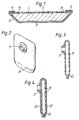
- the diaper in Figure l comprises a backsheet l of a melt extruded film of HB polymer composition, a permeable, non-woven, top sheet 2 and an absorbent pad 3 of cellulosic or other suitable material.
- the backsheet l is melt sealed to the top sheet along each side, and across the ends, as shown at 4 and 5, and is melt sealed to the absorbent pad along three longitudinal strips, as shown at 6, 7 and 8.
- the ostomy bag in Figures 2 and 3 comprises a film 9 formed into a pouch and melt sealed around its facing edges 10 and melt sealed to an ostomy fitting 11.
- the film 9 is laminated to an outer layer 12.
- this outer layer 12 may be a water-degradable non-woven fabric.
- it may be a reinforcing film and layers 9 and l2 may be reversed so that layer 12 is inside layer 9 and it may then comprise, for instance, a layer of polyvinylidene chloride film, for instance coated on the inner surface with EVA so as to promote adhesion of the facing surfaces of the layer 12.
- bags shown in Figures 3 and 4 may be formed from two separate sheets that may be bonded to one another around their entire periphery.
- a composition of about 98% of a copolymer of 83% hydroxy butyrate and 17% hydroxy valerate is extruded with ethylene vinyl acetate copolymer containing about 3% vinyl acetate as described in U.S. 4,379,117, especially Figure 3.
- the extrusion dye had a diameter of about 100mm and provided, at the point of extrusion, a tubular laminate of 0.9mm EVA, 1.2mm HB polymer and 0.9 mm EVA.
- the extrusion temperature was about 10 to 200C above the melting point of the composition.
- the tube was inflated to a diameter of about 400mm so as to stretch it laterally fourfold and was stretched longitudinally by adjusting the take-off speed at up to 40 metres per minute, the resultant film thickness being about 25 ⁇ m. After ageing overnight the film was slit longitudinal and the EVA layers separated from the HB polymer composition layer. The resultant film was labelled A.
- the process was repeated using a similarly pure composition but based on a copolymer of 78% hydroxy butyrate and 22% hydroxy valerate.
- the resultant film was labelled B.
- the process was repeated but using a copolymer of 82% hydroxy butyrate and l8% hydroxy valerate in a composition containing about lO% cell debris.
- the film was labelled C.
- films A, B and C were recorded. As comparisons, the corresponding properties were recorded of film D, biaxially oriented polypropylene about 2O ⁇ m thick and of film E which is film D, perforated with holes about O.4mm diameter. The results are shown in the table below in which, for comparison, typical values for polyvinylidene chloride film, F, are shown.
- O2 transmission is recorded in ml/25 ⁇ m.m2.day,bar at 23°C.
- MVT moisture vapour transmission
- Modulus and TS tensile strength
- TPR toear propogation resistance
- the results demonstrate the excellent combination of oxygen and moisture vapour transmission properties of the films according to the invention (A, B and C) compared to the prior art films (D and F) and the prior art perforated film (E).
- the results also demonstrate the satisfactory haze and gloss values that are obtained despite the presence of substantial amounts of cell debris impurities (C).
- Films A, B and C are suitable for use as the backsheet l in the diaper of Figure l or the pouch 9 in the ostomy bags of Figures 2 to 4.
- Films are produced by extrusion as in Example l of a composition of a blend of substantially pure HB polymer formed of 79 mole percent hydroxy butyric acid and 2l mole percent hydroxy valeric acid together with varying amounts of plasticiser.
- the plasticiser is N-ethyl-o,p-toluene sulphonamide (available from Monsanto under the trade name Santicizer 8) in an amount of 6O parts per lOO parts polymer.
- Example 2b the plasticiser is a blend of lO parts per lOO parts polymer of this sulphonamide and lO parts per lOO parts polymer of a dialkyl diether glutarate of molecular weight about 45O available from C.P.Hall as Hall 7O5O.
- the film is extruded to a final thickness of about 4O ⁇ m and in Example 2b it is extruded to a thickness of about 5O ⁇ m.
- the film of Example 2a is laminated with a l2 ⁇ m biaxially oriented polyvinylidene chloride film using a conventional two-component polyurethane adhesive supplied for laminating films, in particular 5g/m2 Adcote 7lO A & C supplied by Morton Thyocol.
- the resultant laminate is very flexible and soft and could be utilised as a diaper backsheet or an ostomy bag as illustrated or described with reference to any of the accompanying drawings.
- the laminated film has an oxygen permeability of 5Oml/.m2.day.bar at 23°C.
- Example 2b The film of Example 2b is laminated, using the same adhesive and the same general technique as in Example 3, with the polyvinylidene chloride surface of a laminate of lO ⁇ m polyvinylidene chloride and 3O ⁇ m ethylene vinyl acetate containing l8% vinyl acetate (the material from Dupont under the trade name Elvax 3l65), this laminate having been made by co-extrusion through a circular dye followed by hot blowing.
- the resultant laminate had an oxygen impermeability of l4cc/m2.day.bar and could be used as the backsheet in Figure l or as the laminate in Figure 4, with the HB polymer film either on the inside or the outside of the bag.
- Example 2b The film of Example 2b is laminated by the same general technique and using the same adhesive as is in Example 3 with a 3O ⁇ m film of polyethylene (containing 5% vinyl acetate).
- Example 4 can be repeated with different ethylene vinyl acetates having vinyl acetate contents ranging from 5 to 25% and mfi of O.5 to 7 and can also be repeated using a laminate in which there is an ethylene vinyl acetate layer on the side of the polyvinylidene chloride facing the layer of HB polymer.
- Coextrusion is conducted using method and apparatus as described in U.S. 4,379,ll7, especially Figure 3, but modified to provide four films instead of three.
- the materials that are extruded are, in sequence, polyvinyl alcohol, polyethylene oxide, HB polymer composition consisting of about 98% of a copolymer of 83% hydroxy butyrate and l7% hydroxy valerate, and ethylene vinyl acetate containing about 3% vinyl acetate.
- the extrusion dye has a diameter of about lOOmm and provides, at the point of extrusion, a tubular laminate of O.6mm polyvinyl alcohol, O.3mm polyethylene oxide, l.2mm HB polymer and O.9mm EVA.
- the extrusion temperature is lO to 2O%C above the melting point of the highest melting component of the laminate, namely l4O°C.
- the tube is inflated to a width of about 4OOmm so as to stretch it laterally fourfold and is stretched longitudinally by adjusting the take-off speed at up to 4O metres per minute.
- the resultant laminate consists of films of polyvinyl alcohol l3 ⁇ m thick, polyethylene oxide 6 ⁇ m thick and HB polymer composition about 25 ⁇ m thick. After ageing overnight the film is slit longitudinally and the EVA layer separated.
Landscapes
- Health & Medical Sciences (AREA)
- Chemical & Material Sciences (AREA)
- Engineering & Computer Science (AREA)
- Chemical Kinetics & Catalysis (AREA)
- Manufacturing & Machinery (AREA)
- Animal Behavior & Ethology (AREA)
- General Health & Medical Sciences (AREA)
- Public Health (AREA)
- Veterinary Medicine (AREA)
- Life Sciences & Earth Sciences (AREA)
- Epidemiology (AREA)
- Materials Engineering (AREA)
- Polymers & Plastics (AREA)
- Medicinal Chemistry (AREA)
- Organic Chemistry (AREA)
- Hematology (AREA)
- Laminated Bodies (AREA)
- Materials For Medical Uses (AREA)
- Manufacture Of Macromolecular Shaped Articles (AREA)
- Absorbent Articles And Supports Therefor (AREA)
- Polyesters Or Polycarbonates (AREA)
- Biological Depolymerization Polymers (AREA)
- Orthopedics, Nursing, And Contraception (AREA)
Claims (22)
- Film- bzw. Folienmaterial, welches einen Film aus einer HB-Polymermasse umfaßt, wobei das HB-Polymere ein biozersetzbares Polymeres ist, das aus sich wiederholenden Einheiten, nämlich aus 50 bis 100 mol-% Einheiten der Formel 1:
-OCnH2nCO-,
worin n 3, 4 oder 5 bedeutet, gebildet worden ist und wobei die KB-Polymermasse 50 bis 100% des HB-Polymeren und 0 bis 50% Verdünnungsadditive enthält, dadurch gekennzeichnet, daß der Film ein Film ist, der durch Schmelzextrusion bis zu einer Dicke von 5 bis 200 µm hergestellt worden ist. - Material nach Anspruch 1, dadurch gekennzeichnet, daß das HB-Polymere aus sich wiederholenden Einheiten gebildet worden ist, wovon 50 bis 100 mol-% die Formel la aufweisen:
-OCH(CmH2m+1)CH₂CO-,
worin m ausgewählt wird unter 1, 2 und 3,
und 0 bis 50 mol-% die Formel 2 aufweisen:
-OCR¹R²(CR³R⁴)pCO-,
worin p Null oder eine ganze Zahl bedeutet und R¹, R², R³ und R⁴ je Wasserstoff, Kohlenwasserstoff, halosubstituierter Kohlenwasserstoff, hydroxysubstituierter Kohlenwasserstoff, Hydroxyl oder Halogen sein können, mit der Maßgabe, daß die Werte von R¹, R², R³, R⁴ und p nicht so gewählt werden, daß die Einheit der Formel 2 eine Einheit der Formel 1 ist. - Material nach Anspruch 1, dadurch gekennzeichnet, daß das HB-Polymere ausgewählt wird unter ß-Hydroxybuttersäure-Homopolymeren und -Copolymeren mit bis zu 50%, bevorzugt 10 bis 30%, ß-Hydroxyvaleriansäure.
- Material nach einem der vorhergehenden Ansprüche, dadurch gekennzeichnet, daß das Verdünnungsadditiv ausgewählt wird unter Nebenprodukten der Biosynthese des Polymeren, Füllstoffen, anderen Polymeren, Weichmachern, Stabilisatoren und Schlagadditiven.
- Material nach einem der vorhergehenden Ansprüche, dadurch gekennzeichnet, daß der Film aus HBPolymermasse eine Dicke von 10 bis 100 µm aufweist.
- Material nach einem der vorhergehenden Ansprüche, dadurch gekennzeichnet, daß der Film aus HB-Polymermasse eine Feuchtigkeits-Dampfdurchlässigkeit von 30 bis 200 g/25µm.m².Tag bei 38°C aufweist.
- Material nach einem der vorhergehenden Ansprüche, dadurch gekennzeichnet, daß der Film aus HBPolymermasse einen Sauerstoff-Durchlässigkeitswert von 10 bis 200 ml/25µm.m².Tag.bar bei 23°S aufweist.
- Material nach einem der vorhergehenden Ansprüche, dadurch gekennzeichnet, daß der Film aus HB-Polymermasse eine Dicke von 20 bis 80 µm, eine Feuchtigkeits-Dampfdurchlässigkeit von 40 bis 150 g/25µm.m².Tag bei 38°C und eine Sauerstoff-Durchlässigkeit von 80 bis 200 ml/25µm.m².Tag.bar bei 23°C aufweist.
- Material nach einem der vorhergehenden Ansprüche, dadurch gekennzeichnet, daß der Film einen Trübungswert, bestimmt gemäß ASTM-D 1003, von unter 20% und einen Glanzwert, bestimmt gemäß ASTM-D 2457, von mindestens 88 aufweist.
- Material nach einem der vorhergehenden Ansprüche, dadurch gekennzeichnet, daß die HB-Polymermasse 5 bis 20 Gew. -% Nebenprodukt-Verunreinigungen einschließlich Zelltrümmer enthält und eine Trübung von 10 bis 20%, bestimmt gemäß ASTM-D 1003, aufweist.
- Material nach einem der vorhergehenden Ansprüche, dadurch gekennzeichnet, daß die KB-Polymermasse 5 bis 40 Gew. -% Weichmacher enthält.
- Material nach einem der vorhergehenden Ansprüche, dadurch gekennzeichnet, daß der Film aus HBPolymermasse permanent mit einem Folienmaterial, ausgewählt unter nichtgewebten Flächengebilden bzw. Textilmaterialien, wasserlöslichen Filmen und wasserunlöslichen Filmen, laminiert ist.
- Material nach Anspruch 12, dadurch gekennzeichnet, daß die HB-Polymermasse 5 bis 40% Weichmacher enthält, der Film aus HB-Polymermasse 10 bis 100 µm dick ist und der Film an einen wasserunlöslichen Film, ausgewählt unter Polyethylen, Ethylen/Vinylacetat-Copolymeren, Polyvinylidenchlorid und Laminaten, welche Polyvinylidenchlorid enthalten, laminiert ist.
- Material nach Anspruch 12, dadurch gekennzeichnet, daß es ein Laminat aus einem Film aus HB-Polymermasse mit einem Film aus Polyvinylalkohol aufweist.
- Material nach Anspruch 12, dadurch gekennzeichnet, daß es ein Laminat aus dem Film aus HB-Polymermasse mit einem wasserzersetzbaren, nichtgewebten Flächengebilde bzw. Textilmaterial aufweist.
- Material nach einem der vorhergehenden Ansprüche, dadurch gekennzeichnet, daß der Film aus HB-Polymermasse mit einer Oberfläche, bevorzugt einem schmelzextrudierten Film aus HB-Polymermasse, ohne dazwischenliegende Verbindungsschicht schmelzversiegelt ist.
- Material nach Anspruch 16 in Form einer Windel oder eines Ostomiebeutels.
- Material nach einem der Ansprüche 13 bis 15 in Form eines Ostomiebeutels oder einer Windelunterseite.
- Verfahren zur Herstellung eines Film- bzw. Folienmaterials nach Anspruch 1, dadurch gekennzeichnet, daß ein laminierter Schlauch aus einer schlauchförmigen Schicht aus der HB-Polymermasse in geschmolzener Form und einer schlauchförmigen Schicht aus geschmolzenem Thermoplast schmelzextrudiert wird, wobei das Material im wesentlichen bei der Verfestigung nicht klebend ist, und das extrudierte Laminat gedehnt und verfestigt wird.
- Verfahren nach Anspruch 19, dadurch gekennzeichnet, daß der laminierte Schlauch ein Laminat aus einer schlauchförmigen Schicht aus geschmolzener HB-Polymermasse zwischen schlauchförmigen Schichten aus geschmolzenem Thermoplast enthält, wobei jede Thermoplastschicht im wesentlichen bei der Verfestigung nicht klebrig ist.
- Verfahren nach Anspruch 19, dadurch gekennzeichnet, daß der Film durch Aufblasen des schlauchförmigen Laminats gedehnt wird und daß das Laminat dann flach hingelegt bzw. gedrückt und geschnitten wird.
- Verfahren nach Anspruch 19, dadurch gekennzeichnet, daß der Film aus HB-Polymermasse kristallisieren kann, nachdem das Laminat verfestigt ist, und daß die thermoplastische Schicht oder die Schichten oder eine von diesen dann von dem Film abgestreift wird.
Priority Applications (1)
| Application Number | Priority Date | Filing Date | Title |
|---|---|---|---|
| AT86309586T ATE66685T1 (de) | 1985-12-09 | 1986-12-09 | Polymere produkte und deren herstellung. |
Applications Claiming Priority (12)
| Application Number | Priority Date | Filing Date | Title |
|---|---|---|---|
| GB8530327 | 1985-12-09 | ||
| GB8530326 | 1985-12-09 | ||
| GB8530329 | 1985-12-09 | ||
| GB858530328A GB8530328D0 (en) | 1985-12-09 | 1985-12-09 | Laminated products |
| GB8530328 | 1985-12-09 | ||
| GB858530325A GB8530325D0 (en) | 1985-12-09 | 1985-12-09 | Polymeric products |
| GB8530325 | 1985-12-09 | ||
| GB858530329A GB8530329D0 (en) | 1985-12-09 | 1985-12-09 | Polymeric products |
| GB858530326A GB8530326D0 (en) | 1985-12-09 | 1985-12-09 | Laminated products |
| GB858530324A GB8530324D0 (en) | 1985-12-09 | 1985-12-09 | Polymeric products |
| GB8530324 | 1985-12-09 | ||
| GB858530327A GB8530327D0 (en) | 1985-12-09 | 1985-12-09 | Laminated products |
Publications (2)
| Publication Number | Publication Date |
|---|---|
| EP0226439A1 EP0226439A1 (de) | 1987-06-24 |
| EP0226439B1 true EP0226439B1 (de) | 1991-08-28 |
Family
ID=27546921
Family Applications (1)
| Application Number | Title | Priority Date | Filing Date |
|---|---|---|---|
| EP19860309586 Expired - Lifetime EP0226439B1 (de) | 1985-12-09 | 1986-12-09 | Polymere Produkte und deren Herstellung |
Country Status (12)
| Country | Link |
|---|---|
| US (2) | US4880592A (de) |
| EP (1) | EP0226439B1 (de) |
| JP (1) | JPH0674340B2 (de) |
| AR (1) | AR245159A1 (de) |
| AT (1) | ATE66685T1 (de) |
| AU (1) | AU603076B2 (de) |
| BR (1) | BR8605989A (de) |
| CA (1) | CA1288922C (de) |
| DE (1) | DE3681135D1 (de) |
| ES (1) | ES2024430B3 (de) |
| GR (1) | GR3002778T3 (de) |
| MX (1) | MX169228B (de) |
Cited By (1)
| Publication number | Priority date | Publication date | Assignee | Title |
|---|---|---|---|---|
| US7517846B2 (en) | 1991-05-14 | 2009-04-14 | Ecolab Inc. | Solid, two part chemical concentrate |
Families Citing this family (175)
| Publication number | Priority date | Publication date | Assignee | Title |
|---|---|---|---|---|
| US4930942A (en) * | 1986-12-22 | 1990-06-05 | E. R. Squibb & Sons, Inc. | Method of disposal of articles by flushing |
| US4830187A (en) * | 1986-12-22 | 1989-05-16 | E. R. Squibb & Sons, Inc. | Means for disposal of articles by flushing and ostomy pouches particularly suited for such disposal |
| GB8630863D0 (en) * | 1986-12-24 | 1987-02-04 | Grace W R & Co | Laminated articles |
| US5502158A (en) * | 1988-08-08 | 1996-03-26 | Ecopol, Llc | Degradable polymer composition |
| JPH02227438A (ja) * | 1989-02-28 | 1990-09-10 | Chuko Kasei Kogyo Kk | 生分解性フィルム |
| US5009648A (en) * | 1989-03-22 | 1991-04-23 | E. R. Squibb & Sons, Inc. | Starch containing film ostomy pouches |
| JP2731588B2 (ja) * | 1989-04-26 | 1998-03-25 | 中興化成工業株式会社 | 生分解性移植用ポット |
| US5098202A (en) * | 1989-05-11 | 1992-03-24 | Baxter International Inc. | Multi-layer web of film having a gas barrier |
| US5193913A (en) * | 1989-05-11 | 1993-03-16 | Baxter International Inc. | RF energy sealable web of film |
| US4983171A (en) * | 1989-07-14 | 1991-01-08 | W. R. Grace & Co.-Conn. | Comfortable ostomy pouch |
| JPH0623260B2 (ja) * | 1989-11-08 | 1994-03-30 | 工業技術院長 | 微生物崩壊性熱可塑性樹脂成形物及びその製造方法 |
| GB2243327A (en) * | 1990-02-16 | 1991-10-30 | Procter & Gamble | Biodegradable, liquid-impervious sheet laminate |
| JP2592284Y2 (ja) * | 1990-02-26 | 1999-03-17 | 大日本印刷株式会社 | 包装材料 |
| US5326477A (en) * | 1990-05-07 | 1994-07-05 | Bio-Sep, Inc. | Process for digesting solid waste |
| US5171309A (en) * | 1990-05-11 | 1992-12-15 | E. I. Du Pont De Nemours And Company | Polyesters and their use in compostable products such as disposable diapers |
| US5219646A (en) * | 1990-05-11 | 1993-06-15 | E. I. Du Pont De Nemours And Company | Polyester blends and their use in compostable products such as disposable diapers |
| US6406797B1 (en) | 1990-05-17 | 2002-06-18 | Cryovac, Inc. | Coextruded packaging film |
| JPH0437541A (ja) * | 1990-06-01 | 1992-02-07 | Unitika Ltd | 多層シート |
| US5076983A (en) * | 1990-07-16 | 1991-12-31 | E. I. Du Pont De Nemours And Company | Polyhydroxy acid films |
| DE69132548T2 (de) * | 1990-11-30 | 2001-06-28 | Eastman Chemical Co., Kingsport | Aliphatisch-aromatische Copolyester |
| US5061424A (en) * | 1991-01-22 | 1991-10-29 | Becton, Dickinson And Company | Method for applying a lubricious coating to an article |
| DE4102170A1 (de) * | 1991-01-25 | 1992-08-06 | Danubia Petrochem Deutschland | Mischung aus vorwiegend einem polyhydroxyalkanoat und einer verbindung, die mindestens zwei reaktive gruppen wie saeure- und/oder alkoholgruppen enthaelt und ein durch schmelzen der mischung hergestelltes polymerisat |
| NZ242597A (en) * | 1991-05-14 | 1995-07-26 | Grace W R & Co | Co-extruded water soluble laminated polymeric film and methods of extruding it |
| US5316688A (en) * | 1991-05-14 | 1994-05-31 | Ecolab Inc. | Water soluble or dispersible film covered alkaline composition |
| PL169131B1 (pl) * | 1991-06-26 | 1996-06-28 | Procter & Gamble | Wyrób chlonny ulegajacy rozkladowi biologicznemu PL PL PL |
| SK147693A3 (en) * | 1991-06-26 | 1994-09-07 | Procter & Gamble | Biodegradable, liquid impervious film |
| US5217803A (en) * | 1991-06-26 | 1993-06-08 | Tredegar Industries, Inc. | Disposable absorbent articles with biodegradable backsheets |
| US5254607A (en) * | 1991-06-26 | 1993-10-19 | Tredegar Industries, Inc. | Biodegradable, liquid impervious films |
| ZA92308B (en) | 1991-09-11 | 1992-10-28 | Kimberly Clark Co | Thin absorbent article having rapid uptake of liquid |
| US5409772A (en) * | 1991-09-27 | 1995-04-25 | Toppan Printing Co., Ltd. | Composite laminate |
| TW211030B (de) * | 1991-10-01 | 1993-08-11 | Du Pont | |
| WO1993007199A1 (en) * | 1991-10-01 | 1993-04-15 | E.I. Du Pont De Nemours And Company | Sulfonated polyesters and their use in compostable products such as disposable diapers |
| GB9123997D0 (en) * | 1991-11-12 | 1992-01-02 | Ici Plc | Structure having controlled water resistance |
| US5496295A (en) * | 1991-12-18 | 1996-03-05 | Minnesota Mining And Manufacturing Company | Multilayered barrier structures |
| CA2123809A1 (en) * | 1991-12-18 | 1993-06-24 | Debra L. Wilfong | Multilayered barrier structures |
| FI920703A7 (fi) * | 1992-02-19 | 1993-08-20 | Borealis As | Menetelmä laminaatin valmistamiseksi |
| GB9204275D0 (en) * | 1992-02-28 | 1992-04-08 | Ici Plc | Polymer blends and compatibilisers |
| JP2589908B2 (ja) * | 1992-05-13 | 1997-03-12 | 昭和高分子株式会社 | ポリエステル製不織布 |
| US5281691A (en) * | 1992-06-19 | 1994-01-25 | Eastman Kodak Company | Poly(3-hydroxyalkanoates) |
| US5939467A (en) * | 1992-06-26 | 1999-08-17 | The Procter & Gamble Company | Biodegradable polymeric compositions and products thereof |
| CA2138121C (en) * | 1992-06-26 | 1999-02-23 | Andrew Julian Wnuk | Biodegradable, liquid impervious monolayer film compositions |
| AU681589B2 (en) * | 1992-06-26 | 1997-09-04 | Procter & Gamble Company, The | Biodegradable, liquid impervious multilayer film compositions |
| NZ248977A (en) * | 1992-11-09 | 1995-06-27 | Squibb & Sons Inc | Pressure-sensitive adhesive comprising a polyurethane having excess hydroxyl functionality; medical articles comprising a layer of such adhesive |
| JPH07114779B2 (ja) * | 1992-11-13 | 1995-12-13 | アイセロ化学株式会社 | 汚物処理袋 |
| GB9300554D0 (en) * | 1993-01-13 | 1993-03-03 | Zeneca Ltd | Film formation |
| US6313202B1 (en) * | 1993-05-28 | 2001-11-06 | Eastman Chemical Company | Cellulose ester blends |
| US5480962A (en) * | 1993-07-22 | 1996-01-02 | Eastman Chemical Company | Copolyesters having repeat units derived from succinic acid |
| CN1129005A (zh) * | 1993-08-10 | 1996-08-14 | 行星聚合物技术股份有限公司 | 可生物降解的、可堆肥的塑料及其制法 |
| GB9324512D0 (en) * | 1993-11-30 | 1994-01-19 | Zeneca Ltd | Film |
| CN1103607C (zh) * | 1993-12-20 | 2003-03-26 | 普罗克特和甘保尔公司 | 生物降解性增强的ph-改性聚合物组合物 |
| AU703156B2 (en) * | 1994-01-28 | 1999-03-18 | Procter & Gamble Company, The | Biodegradable copolymers and plastic articles comprising biodegradable copolymers of 3-hydroxyhexanoate |
| ZA95627B (en) * | 1994-01-28 | 1995-10-05 | Procter & Gamble | Biodegradable copolymers and plastic articles comprising biodegradable copolymers |
| ID23491A (id) * | 1994-01-28 | 1995-09-07 | Procter & Gamble | Kopolimer-kopolimer yang dapat dibiodegradasi dan baha-bahan plastik yang terdiri dari kopolimer-kopolimer yang dapat dibiodegradasi |
| SG49096A1 (en) * | 1994-01-28 | 1998-05-18 | Procter & Gamble | Biodegradable 3-polyhydtoxybuyrate/3- polyhydroxyhexanoate copolymer films |
| US6037039A (en) * | 1994-01-31 | 2000-03-14 | Daiwa Seiko, Inc. | Biodegradable article |
| DE4416357C2 (de) * | 1994-05-09 | 1997-09-18 | Buna Sow Leuna Olefinverb Gmbh | Wundauflage |
| US5417677A (en) * | 1994-05-24 | 1995-05-23 | Hollister Incorporated | Flushable pH-sensitive ostomy pouch containing its own pH-modifier |
| DE69513889T2 (de) * | 1994-06-21 | 2000-07-27 | The B.F. Goodrich Co., Brecksville | Degradierbare Mischungszusammensetzung |
| GB2290712B (en) * | 1994-07-01 | 1998-03-25 | Welland Medical Ltd | Ostomy bag filters |
| GB2290968B (en) * | 1994-07-01 | 1998-06-03 | Welland Medical Ltd | Ostomy Bags and Laminates for Use therein. |
| GB2290713B (en) * | 1994-07-01 | 1998-07-08 | Welland Medical Ltd | Ostomy bag liner |
| US6579814B1 (en) | 1994-12-30 | 2003-06-17 | 3M Innovative Properties Company | Dispersible compositions and articles of sheath-core microfibers and method of disposal for such compositions and articles |
| EP0800455B1 (de) * | 1994-12-30 | 2002-02-27 | Kimberly-Clark Worldwide, Inc. | Mit wasser wegspülbarer film |
| US5472518A (en) * | 1994-12-30 | 1995-12-05 | Minnesota Mining And Manufacturing Company | Method of disposal for dispersible compositions and articles |
| EP0736563A1 (de) * | 1995-04-07 | 1996-10-09 | SAFTA S.p.A. | Verfahren zur Herstellung von vollständigen abbaubaren Filmen mit verbesserten mechanischen Eigenschaften und erhaltene Produkte |
| GB9526165D0 (en) * | 1995-12-21 | 1996-02-21 | Zeneca Ltd | Oriented polyester |
| US6143947A (en) * | 1996-01-29 | 2000-11-07 | The Procter & Gamble Company | Fibers, nonwoven fabrics and absorbent articles comprising a biodegradable polyhydroxyalkanoate comprising 3-hydroxybutyrate and 3-hydroxyhexanoate |
| CA2250165A1 (en) | 1996-03-26 | 1997-10-02 | Gunze Limited | Biodegradable card base |
| US5912059A (en) * | 1996-08-16 | 1999-06-15 | Minnesota Mining And Manufacturing Company | Ostomy pouch having non-tacky fastener system |
| US6309509B1 (en) | 1996-10-11 | 2001-10-30 | Eastman Chemical Company | Composition and paper comprising cellulose ester, alkylpolyglycosides, and cellulose |
| JP3537274B2 (ja) * | 1996-10-29 | 2004-06-14 | 鐘淵化学工業株式会社 | 生分解性を有する積層体 |
| WO1998029506A1 (en) | 1996-12-31 | 1998-07-09 | Kimberly-Clark Worldwide, Inc. | Water-responsive polymer compositions and method of making the same |
| GB9708783D0 (en) * | 1997-04-30 | 1997-06-25 | Smiths Industries Plc | Medico-surgical bags |
| US6610764B1 (en) * | 1997-05-12 | 2003-08-26 | Metabolix, Inc. | Polyhydroxyalkanoate compositions having controlled degradation rates |
| US6867248B1 (en) | 1997-05-12 | 2005-03-15 | Metabolix, Inc. | Polyhydroxyalkanoate compositions having controlled degradation rates |
| DE69840594D1 (de) | 1997-07-22 | 2009-04-09 | Metabolix Inc | Polyhydroxyalkanoat formmassen |
| DE69834726T2 (de) | 1997-07-25 | 2007-06-06 | Metabolix, Inc., Cambridge | Pha-zusammensetzungen und deren verwendung zur herstellung von pha-filmen |
| EP0998381B2 (de) * | 1997-07-25 | 2010-05-05 | Metabolix, Inc. | Verfahren zur hestellung von beschichtungen aus polyhydroxyalkanoat |
| US6552162B1 (en) | 1997-07-31 | 2003-04-22 | Kimberly-Clark Worldwide, Inc. | Water-responsive, biodegradable compositions and films and articles comprising a blend of polylactide and polyvinyl alcohol and methods for making the same |
| US6828357B1 (en) | 1997-07-31 | 2004-12-07 | Metabolix, Inc. | Polyhydroxyalkanoate compositions having controlled degradation rates |
| US6420625B1 (en) | 1997-09-12 | 2002-07-16 | Kimberly-Clark Worldwide, Inc. | Breathable, liquid-impermeable, apertured film/nonwoven laminate and process for making same |
| DE69841061D1 (de) | 1997-10-31 | 2009-09-24 | Metabolix Inc | Verwendung von organischen Phosphon- oder Phosphinsäuren, oder von Metall-oxiden oder -hydroxiden, oder von Carbonsäuresalzen eines Metalls als Hitzestabilisatoren für Polyhydroxyalkanoate |
| ES2281147T3 (es) | 1997-12-22 | 2007-09-16 | Metabolix, Inc. | Composiciones de polihidroxialcanoato con tasas controladas de degradacion. |
| US6429285B2 (en) | 1998-01-09 | 2002-08-06 | Metabolix, Inc. | Polymer compositions providing low residue levels and methods of use thereof |
| US7455999B2 (en) * | 1998-01-22 | 2008-11-25 | Metabolix, Inc. | Transgenic systems for the manufacture of poly (3-hydroxy-butyrate-co-3-hydroxyhexanoate) |
| EP0963760A1 (de) * | 1998-06-09 | 1999-12-15 | The Procter & Gamble Company | Niedrigviskose thermoplastische Zusammensetzungen für feuchtigkeitsdurchlässige Strukturen |
| US6193841B1 (en) | 1998-11-30 | 2001-02-27 | Eastman Chemical Company | Shaped, plastic articles comprising a cellulose fiber, a cellulose ester, and a non-ionic surfactant |
| US6160199A (en) * | 1998-12-21 | 2000-12-12 | The Procter & Gamble Company | Absorbent articles comprising biodegradable PHA copolymers |
| US6077931A (en) * | 1998-12-21 | 2000-06-20 | The Procter & Gamble Company | Biodegradable PHA copolymers |
| US6174990B1 (en) | 1998-12-21 | 2001-01-16 | The Procter & Gamble Company | Films comprising biodegradable PHA copolymers |
| US6514515B1 (en) | 1999-03-04 | 2003-02-04 | Tepha, Inc. | Bioabsorbable, biocompatible polymers for tissue engineering |
| AU778081B2 (en) * | 1999-03-25 | 2004-11-11 | Tepha, Inc. | Medical devices and applications of polyhydroxyalkanoate polymers |
| JP4524463B2 (ja) * | 1999-07-27 | 2010-08-18 | 三井化学株式会社 | ガスバリア性ポリウレタン樹脂及びこれを含むガスバリア性フィルム |
| US6794023B1 (en) | 1999-10-28 | 2004-09-21 | The Procter & Gamble Company | Polymer products comprising soft and elastic biodegradable polyhydroxyalkanoate copolymer compositions and methods of preparing such polymer products |
| US6821612B1 (en) | 1999-10-28 | 2004-11-23 | The Procter & Gamble Company | Methods for preparing soft and elastic biodegradable polyhydroxyalkanoate copolymer compositions and polymer products comprising such compositions |
| US6767961B1 (en) | 2000-06-19 | 2004-07-27 | Kimberly-Clark Worldwide, Inc. | Blends of poly (vinyl alcohol) and poly (ethylene oxide) and articles made therewith |
| US6958371B1 (en) | 2000-06-19 | 2005-10-25 | Kimberly-Clark Worldwide, Inc. | Method of making blends of poly(vinyl alcohol) and poly(ethylene oxide) |
| WO2002006368A2 (en) | 2000-07-14 | 2002-01-24 | Metabolix, Inc. | Polyurethanes obtained from hydroxyalkanoates and isocyanates |
| US6359050B1 (en) | 2000-07-28 | 2002-03-19 | Eastman Chemical Company | Polyethylene compositions and films formed therefrom having improved moisture vapor transmission rates |
| EP1307508B1 (de) | 2000-07-28 | 2010-04-07 | Westlake Longview Corporation | Polyethylenezusammensetzungen und folien daraus mit verbesserter dampfdurchlässigkeit |
| US6780911B2 (en) | 2000-08-23 | 2004-08-24 | Metabolix, Inc. | Low molecular weight polyhydroxyalkanoate molding compositions |
| US20020077269A1 (en) * | 2000-10-27 | 2002-06-20 | Whitehouse Robert S. | Alkanoic acid ester monomer compositions and methods of making same |
| ATE510898T1 (de) | 2000-10-27 | 2011-06-15 | Metabolix Inc | Zusammensetzungen enthaltend polyhydroxyalkanoate und reaktive monomere |
| AU2002231290B2 (en) * | 2000-12-21 | 2005-06-09 | The Procter & Gamble Company | Method for making biodegradable polyhydroxyalkanoate copolymers having improved crystallization properties |
| BR0116437A (pt) * | 2000-12-21 | 2004-02-03 | Procter & Gamble | Copolìmeros biodegradáveis de polihidroxialcanoato com propiedades melhoradas de cristalização |
| US6500897B2 (en) | 2000-12-29 | 2002-12-31 | Kimberly-Clark Worldwide, Inc. | Modified biodegradable compositions and a reactive-extrusion process to make the same |
| US7053151B2 (en) | 2000-12-29 | 2006-05-30 | Kimberly-Clark Worldwide, Inc. | Grafted biodegradable polymer blend compositions |
| US6579934B1 (en) | 2000-12-29 | 2003-06-17 | Kimberly-Clark Worldwide, Inc. | Reactive extrusion process for making modifiied biodegradable compositions |
| US6552124B2 (en) | 2000-12-29 | 2003-04-22 | Kimberly-Clark Worldwide, Inc. | Method of making a polymer blend composition by reactive extrusion |
| US6890989B2 (en) | 2001-03-12 | 2005-05-10 | Kimberly-Clark Worldwide, Inc. | Water-responsive biodegradable polymer compositions and method of making same |
| US6703115B2 (en) | 2001-05-01 | 2004-03-09 | Eastman Chemical Company | Multilayer films |
| DK174694B1 (da) * | 2001-05-21 | 2003-09-15 | Coloplast As | Stomipose med et dække af porøst materiale |
| US6713140B2 (en) | 2001-12-21 | 2004-03-30 | Kimberly-Clark Worldwide, Inc. | Latently dispersible barrier composite material |
| US6783826B2 (en) * | 2001-12-21 | 2004-08-31 | Kimberly-Clark Worldwide, Inc. | Flushable commode liner |
| US20030116575A1 (en) * | 2001-12-21 | 2003-06-26 | Ellingson Daniel L. | Disposable container with a spill prevention mechanism |
| JP4484418B2 (ja) * | 2002-03-25 | 2010-06-16 | 恵和株式会社 | 防水シート及びこれを用いた使捨用袋 |
| US6740131B2 (en) * | 2002-04-03 | 2004-05-25 | 3M Innovative Properties Company | Apparatus for automatically fabricating fuel cell |
| US20040126585A1 (en) * | 2002-12-27 | 2004-07-01 | Kerins John E. | Water dispersible commode/bedpan liner |
| CA2518892A1 (en) | 2003-03-12 | 2004-09-23 | Avery Dennison Corporation | Reusable closures for packages and methods of making and using the same |
| PT1638615E (pt) | 2003-05-08 | 2015-02-04 | Tepha Inc | Fibras e tecidos médicos de polihidroxialcanoato |
| JP2007528853A (ja) * | 2003-07-08 | 2007-10-18 | テファ, インコーポレイテッド | 徐放性薬物送達のためのポリ−4−ヒドロキシブチレートマトリックス |
| EP1663017A1 (de) * | 2003-08-22 | 2006-06-07 | Tepha, Inc. | Polyhydroxyalkanoat-nervenregenerationsvorrichtungen |
| AU2004284922B2 (en) * | 2003-10-21 | 2010-02-25 | Hollister Incorporated | Flushable body waste collection pouch, pouch-in-pouch appliance using the same, and method relating thereto |
| WO2005041828A2 (en) * | 2003-10-21 | 2005-05-12 | Hollister Incorporated | Peelable and flushable ostomy pouch and method of use |
| US7888405B2 (en) | 2004-01-30 | 2011-02-15 | E. I. Du Pont De Nemours And Company | Aliphatic-aromatic polyesters, and articles made therefrom |
| US20050203208A1 (en) * | 2004-03-15 | 2005-09-15 | Ruiz Frank A. | Biologically and photochemically degradable polymeric compositions and film |
| US7819849B2 (en) * | 2004-06-04 | 2010-10-26 | Hollister Incorporated | Laminated material and body wearable pouch formed therefrom |
| ES2395464T3 (es) | 2004-08-03 | 2013-02-12 | Tepha, Inc. | Suturas de polihidroxialcanoato no rizadas |
| US7582690B2 (en) * | 2004-11-19 | 2009-09-01 | Eastman Chemical Company | Stabilized aliphatic polyester compositions |
| US20070094966A1 (en) * | 2004-11-23 | 2007-05-03 | Certainteed Corporation | Insulation Batt Having Integral Baffle Vent |
| US20060177513A1 (en) * | 2005-01-28 | 2006-08-10 | Tepha, Inc. | Embolization using poly-4-hydroxybutyrate particles |
| US7968164B2 (en) * | 2005-03-02 | 2011-06-28 | Eastman Chemical Company | Transparent polymer blends and articles prepared therefrom |
| US7955533B2 (en) | 2005-03-02 | 2011-06-07 | Eastman Chemical Company | Process for the preparation of transparent shaped articles |
| US7959998B2 (en) | 2005-03-02 | 2011-06-14 | Eastman Chemical Company | Transparent, oxygen-scavenging compositions containing polyesters comprising a cyclobutanediol and articles prepared therefrom |
| US7955674B2 (en) | 2005-03-02 | 2011-06-07 | Eastman Chemical Company | Transparent polymer blends containing polyesters comprising a cyclobutanediol and articles prepared therefrom |
| US7786252B2 (en) * | 2005-03-02 | 2010-08-31 | Eastman Chemical Company | Preparation of transparent multilayered articles |
| US7985827B2 (en) | 2005-06-17 | 2011-07-26 | Eastman Chemical Company | Polyester compositions which comprise cyclobutanediol having certain cis/trans ratios |
| US20060199871A1 (en) * | 2005-03-02 | 2006-09-07 | Hale Wesley R | Multilayered, transparent articles and a process for their preparation |
| US7462684B2 (en) * | 2005-03-02 | 2008-12-09 | Eastman Chemical Company | Preparation of transparent, multilayered articles containing polyesters comprising a cyclobutanediol and homogeneous polyamide blends |
| US7964258B2 (en) * | 2005-03-02 | 2011-06-21 | Eastman Chemical Company | Transparent, oxygen-scavenging compositions and articles prepared therefrom |
| US7959836B2 (en) * | 2005-03-02 | 2011-06-14 | Eastman Chemical Company | Process for the preparation of transparent, shaped articles containing polyesters comprising a cyclobutanediol |
| US7704605B2 (en) | 2006-03-28 | 2010-04-27 | Eastman Chemical Company | Thermoplastic articles comprising cyclobutanediol having a decorative material embedded therein |
| US8193302B2 (en) | 2005-10-28 | 2012-06-05 | Eastman Chemical Company | Polyester compositions which comprise cyclobutanediol and certain phosphate thermal stabilizers, and/or reaction products thereof |
| MX2008005531A (es) | 2005-10-28 | 2008-10-17 | Eastman Chem Co | Composiciones de poliester que contienen ciclobutanodiol que tienen alta temperatura de transicion vitrea y articulos hechos a partir de las misma. |
| DE602006009691D1 (de) * | 2005-10-28 | 2009-11-19 | Eastman Chem Co | Aus 2,2,4,4-tetramethyl-1,3-cyclobutandiol und 1,4-cyclohexandimethanol gebildete polyesterzusammensetzungen umfassendes restaurantgeschirr |
| US9598533B2 (en) | 2005-11-22 | 2017-03-21 | Eastman Chemical Company | Polyester compositions containing cyclobutanediol having a certain combination of inherent viscosity and moderate glass transition temperature and articles made therefrom |
| WO2007079290A2 (en) * | 2005-11-28 | 2007-07-12 | Hollister Incorporated | Flushable body collection pouches, pouch- in- pouch appliances using the same, and methods of making the same |
| US7737246B2 (en) | 2005-12-15 | 2010-06-15 | Eastman Chemical Company | Polyester compositions which comprise cyclobutanediol, cyclohexanedimethanol, and ethylene glycol and manufacturing processes therefor |
| CA2636615A1 (en) * | 2006-02-10 | 2007-08-16 | Coloplast A/S | Biodegradable barrier film |
| US9169388B2 (en) | 2006-03-28 | 2015-10-27 | Eastman Chemical Company | Polyester compositions which comprise cyclobutanediol and certain thermal stabilizers, and/or reaction products thereof |
| US8715816B2 (en) | 2006-04-14 | 2014-05-06 | Biotec Biologische Naturverpackungen Gmbh & Co. Kg | Multilayer film and method for manufacturing same |
| US7943683B2 (en) | 2006-12-01 | 2011-05-17 | Tepha, Inc. | Medical devices containing oriented films of poly-4-hydroxybutyrate and copolymers |
| US8501287B2 (en) | 2007-11-21 | 2013-08-06 | Eastman Chemical Company | Plastic baby bottles, other blow molded articles, and processes for their manufacture |
| KR101895184B1 (ko) | 2007-11-21 | 2018-09-04 | 이스트만 케미칼 컴파니 | 플라스틱 젖병, 다른 취입 성형된 제품, 및 이들의 제조 방법 |
| US20090286090A1 (en) * | 2008-05-19 | 2009-11-19 | Ting Yuan-Ping R | Enhance performance on current renewable film using functional polymer coatings |
| US8147639B2 (en) * | 2008-05-22 | 2012-04-03 | Tripartisan Technologies, Llc | Process for manufacturing free standing thermoplastic polymeric films |
| US8198371B2 (en) | 2008-06-27 | 2012-06-12 | Eastman Chemical Company | Blends of polyesters and ABS copolymers |
| US8895654B2 (en) | 2008-12-18 | 2014-11-25 | Eastman Chemical Company | Polyester compositions which comprise spiro-glycol, cyclohexanedimethanol, and terephthalic acid |
| US20100159176A1 (en) | 2008-12-18 | 2010-06-24 | Eastman Chemical Company | Miscible blends of terephthalate polyesters containing 1,4-cyclohexanedimethanol and 2,2,4,4-tetramethylcyclobutane-1,3-diol |
| US20100229462A1 (en) * | 2010-05-26 | 2010-09-16 | Cerowa, Lp | Degradable and Compostable Plastic Films for Agriculture |
| CN103282593B (zh) | 2010-12-03 | 2016-01-20 | 3G穆尔门公司 | 近红外反射组合物及掺有所述组合物的建筑开口用覆盖物 |
| US8394997B2 (en) | 2010-12-09 | 2013-03-12 | Eastman Chemical Company | Process for the isomerization of 2,2,4,4-tetraalkylcyclobutane-1,3-diols |
| US8420869B2 (en) | 2010-12-09 | 2013-04-16 | Eastman Chemical Company | Process for the preparation of 2,2,4,4-tetraalkylcyclobutane-1,3-diols |
| US8420868B2 (en) | 2010-12-09 | 2013-04-16 | Eastman Chemical Company | Process for the preparation of 2,2,4,4-tetraalkylcyclobutane-1,3-diols |
| GB201105455D0 (en) | 2011-03-31 | 2011-05-18 | British American Tobacco Co | Blends of a polylactic acid and a water soluble polymer |
| GB201112402D0 (en) | 2011-07-19 | 2011-08-31 | British American Tobacco Co | Cellulose acetate compositions |
| US9273206B2 (en) | 2012-07-09 | 2016-03-01 | Eastman Chemical Company | Ternary blends of terephthalate or isophthalate polyesters containing EG, CHDM and TMCD |
| US9925095B2 (en) * | 2014-01-16 | 2018-03-27 | Livedo Usa, Inc. | Absorbent article having liquid-permeable second sheet |
| US10500303B2 (en) | 2014-08-15 | 2019-12-10 | Tepha, Inc. | Self-retaining sutures of poly-4-hydroxybutyrate and copolymers thereof |
| US10626521B2 (en) | 2014-12-11 | 2020-04-21 | Tepha, Inc. | Methods of manufacturing mesh sutures from poly-4-hydroxybutyrate and copolymers thereof |
| EP3230500B1 (de) | 2014-12-11 | 2025-06-18 | Tepha, Inc. | Verfahren zum orientieren von multifilamentgarn und monofilamente aus poly-4-hydroxybutyrat und copolymere davon |
| NL2020819B1 (en) | 2018-04-24 | 2019-10-31 | Cochise Tech Llc | A co to co2 combustion promoter |
| DE102021100783A1 (de) * | 2021-01-15 | 2022-07-21 | Lts Lohmann Therapie-Systeme Ag. | Mehrschichtiger oraler dünnfilm |
| KR20230169136A (ko) | 2021-03-12 | 2023-12-15 | 데니머 아이피씨오 엘엘씨 | 가정용 퇴비화 가능하고 분해 가능한 압출 코팅된 기판 |
| US20220290003A1 (en) * | 2021-03-12 | 2022-09-15 | Meredian, Inc. | Home compostable and degradable extrusion coated substrates |
Family Cites Families (17)
| Publication number | Priority date | Publication date | Assignee | Title |
|---|---|---|---|---|
| US4048428A (en) * | 1961-12-05 | 1977-09-13 | W. R. Grace & Co. | Method for preparing a film of vinylidene chloride polymer |
| US4379117A (en) * | 1961-12-05 | 1983-04-05 | W. R. Grace & Co. | Method for preparing a film of vinylidene chloride polymer |
| US3337665A (en) * | 1964-10-12 | 1967-08-22 | Union Carbide Corp | Method for the production of thermoplastic film |
| US3322870A (en) * | 1965-04-06 | 1967-05-30 | Union Carbide Corp | Method of producing clear, crystalline, high-gloss thermoplastic film |
| DE2114065C2 (de) * | 1971-03-23 | 1982-08-19 | Heinrich Pannenbecker | Verfahren zur Herstellung von Folien aus thermoplastischen Kunststoffen mit Klebereigenschaft |
| US4019505A (en) * | 1974-09-30 | 1977-04-26 | Norman S. Blodgett | Method of forming an orthopedic cast |
| US4140741A (en) * | 1976-01-14 | 1979-02-20 | Agroferm A.G. | Use of cyclic carbonic acid esters as solvents for poly-(β-hydroxybutyric acid) |
| JPS5913213B2 (ja) * | 1979-04-28 | 1984-03-28 | ゼンミ株式会社 | 生理用ナプキン |
| US4360488A (en) * | 1979-08-13 | 1982-11-23 | Imperial Chemical Industries Limited | Removal of solvent from gels of poly(hydroxybutyrate) and shaped articles formed therefrom |
| US4391766A (en) * | 1979-08-13 | 1983-07-05 | Imperial Chemical Industries Plc | Extraction of poly(β-hydroxybutyric acid) |
| US4289727A (en) * | 1979-12-19 | 1981-09-15 | Mobil Oil Corporation | Method for extrusion of tubular films |
| EP0078609B1 (de) * | 1980-04-30 | 1987-05-06 | Imperial Chemical Industries Plc | 3-Hydroxybuttersäure-Polymere |
| US4372311A (en) * | 1980-09-12 | 1983-02-08 | Union Carbide Corporation | Disposable articles coated with degradable water insoluble polymers |
| EP0052460B1 (de) * | 1980-11-18 | 1985-02-06 | Imperial Chemical Industries Plc | Polymerzusammensetzungen |
| AU565262B2 (en) * | 1982-06-02 | 1987-09-10 | Du Pont Canada Inc. | Pouches of copolymer film |
| DE3374698D1 (en) * | 1982-08-27 | 1988-01-07 | Ici Plc | 3-hydroxybutyrate polymers |
| GB8330414D0 (en) * | 1983-11-15 | 1983-12-21 | Ici Plc | Disposable bags |
-
1986
- 1986-12-02 AU AU66012/86A patent/AU603076B2/en not_active Ceased
- 1986-12-05 MX MX004553A patent/MX169228B/es unknown
- 1986-12-05 BR BR8605989A patent/BR8605989A/pt unknown
- 1986-12-08 JP JP29062486A patent/JPH0674340B2/ja not_active Expired - Lifetime
- 1986-12-08 CA CA 524744 patent/CA1288922C/en not_active Expired - Lifetime
- 1986-12-08 US US06/939,375 patent/US4880592A/en not_active Expired - Lifetime
- 1986-12-09 AT AT86309586T patent/ATE66685T1/de active
- 1986-12-09 EP EP19860309586 patent/EP0226439B1/de not_active Expired - Lifetime
- 1986-12-09 ES ES86309586T patent/ES2024430B3/es not_active Expired - Lifetime
- 1986-12-09 AR AR30612186A patent/AR245159A1/es active
- 1986-12-09 DE DE8686309586T patent/DE3681135D1/de not_active Expired - Lifetime
-
1987
- 1987-08-13 US US07/085,037 patent/US4826493A/en not_active Expired - Lifetime
-
1991
- 1991-09-23 GR GR91401401T patent/GR3002778T3/el unknown
Cited By (1)
| Publication number | Priority date | Publication date | Assignee | Title |
|---|---|---|---|---|
| US7517846B2 (en) | 1991-05-14 | 2009-04-14 | Ecolab Inc. | Solid, two part chemical concentrate |
Also Published As
| Publication number | Publication date |
|---|---|
| US4880592A (en) | 1989-11-14 |
| BR8605989A (pt) | 1987-09-15 |
| ATE66685T1 (de) | 1991-09-15 |
| MX169228B (es) | 1993-06-25 |
| DE3681135D1 (de) | 1991-10-02 |
| CA1288922C (en) | 1991-09-17 |
| ES2024430B3 (es) | 1992-03-01 |
| JPH0674340B2 (ja) | 1994-09-21 |
| AU6601286A (en) | 1987-06-11 |
| AR245159A1 (es) | 1993-12-30 |
| US4826493A (en) | 1989-05-02 |
| GR3002778T3 (en) | 1993-01-25 |
| EP0226439A1 (de) | 1987-06-24 |
| JPS62209144A (ja) | 1987-09-14 |
| AU603076B2 (en) | 1990-11-08 |
Similar Documents
| Publication | Publication Date | Title |
|---|---|---|
| US4880592A (en) | Manufacture of polymeric products | |
| US4210686A (en) | Multi-layered plastic sheeting having high clarity, strength, and resistance to water vapor transmission | |
| EP0229715B1 (de) | Mehrschichtiger schrumpfbarer Polyolefinfilm mit hoher Schrumpfung und niedriger Schrumpfkraft | |
| EP0723859B1 (de) | Mehrschichtiger Film und daraus hergestellte Auffangbeutel | |
| JP3539846B2 (ja) | 樹脂組成物およびその積層体 | |
| CA2037321C (en) | Polymer blends for packaging films | |
| EP3197675B1 (de) | Elastische polyolefinfolienstrukturen, laminate und verfahren dafür | |
| EP0444671A2 (de) | Verfahren zur Herstellung von Propylenpolymerfilmen und Verbundstoffen und Produkte davon | |
| CA2413278A1 (en) | High moisture barrier films | |
| AU2001268665A1 (en) | High moisture barrier films | |
| CZ216292A3 (en) | Multilayer foil with enhanced barrier effect for gases and process for producing such foil | |
| EP0293074A2 (de) | Polymer-Mischung für Verpackungsfilm, -folie oder -laminat | |
| US6136394A (en) | Tube comprising at least three layers | |
| EP0213698B1 (de) | Polymere Zusammensetzung für Verpackungsfilme | |
| JP3345896B2 (ja) | 積層フィルム | |
| JP2996531B2 (ja) | 包装用積層フィルム | |
| JP2000094604A (ja) | 包装用多層フイルム | |
| US5536806A (en) | Substantially crystalline poly(alkylene carbonates), laminate and methods of making | |
| JPH07329260A (ja) | ヒートシーラブル延伸積層フィルム | |
| JPH11348201A (ja) | 多層容器の製造方法 | |
| EP1022127A2 (de) | Abbaubare Sperrfolie für Ostomiebeutel | |
| JP3383000B2 (ja) | エチレン−酢酸ビニル共重合体ケン化物及びその用途 | |
| JP3114786B2 (ja) | 積層フィルム | |
| JPH06927A (ja) | 積層フィルム | |
| JP3841942B2 (ja) | 樹脂組成物の製造法 |
Legal Events
| Date | Code | Title | Description |
|---|---|---|---|
| PUAI | Public reference made under article 153(3) epc to a published international application that has entered the european phase |
Free format text: ORIGINAL CODE: 0009012 |
|
| AK | Designated contracting states |
Kind code of ref document: A1 Designated state(s): AT BE CH DE ES FR GB GR IT LI LU NL SE |
|
| 17P | Request for examination filed |
Effective date: 19871127 |
|
| RAP1 | Party data changed (applicant data changed or rights of an application transferred) |
Owner name: W.R. GRACE & CO.-CONN. (A CONNECTICUT CORP.) |
|
| 17Q | First examination report despatched |
Effective date: 19890824 |
|
| GRAA | (expected) grant |
Free format text: ORIGINAL CODE: 0009210 |
|
| AK | Designated contracting states |
Kind code of ref document: B1 Designated state(s): AT BE CH DE ES FR GB GR IT LI LU NL SE |
|
| REF | Corresponds to: |
Ref document number: 66685 Country of ref document: AT Date of ref document: 19910915 Kind code of ref document: T |
|
| REF | Corresponds to: |
Ref document number: 3681135 Country of ref document: DE Date of ref document: 19911002 |
|
| ITF | It: translation for a ep patent filed | ||
| ET | Fr: translation filed | ||
| REG | Reference to a national code |
Ref country code: ES Ref legal event code: FG2A Ref document number: 2024430 Country of ref document: ES Kind code of ref document: B3 |
|
| PLBE | No opposition filed within time limit |
Free format text: ORIGINAL CODE: 0009261 |
|
| STAA | Information on the status of an ep patent application or granted ep patent |
Free format text: STATUS: NO OPPOSITION FILED WITHIN TIME LIMIT |
|
| 26N | No opposition filed | ||
| REG | Reference to a national code |
Ref country code: GR Ref legal event code: FG4A Free format text: 3002778 |
|
| EPTA | Lu: last paid annual fee | ||
| EAL | Se: european patent in force in sweden |
Ref document number: 86309586.5 |
|
| REG | Reference to a national code |
Ref country code: GB Ref legal event code: 732E |
|
| REG | Reference to a national code |
Ref country code: FR Ref legal event code: TP |
|
| PGFP | Annual fee paid to national office [announced via postgrant information from national office to epo] |
Ref country code: SE Payment date: 19991207 Year of fee payment: 14 |
|
| PGFP | Annual fee paid to national office [announced via postgrant information from national office to epo] |
Ref country code: GB Payment date: 19991208 Year of fee payment: 14 Ref country code: FR Payment date: 19991208 Year of fee payment: 14 |
|
| PGFP | Annual fee paid to national office [announced via postgrant information from national office to epo] |
Ref country code: DE Payment date: 19991210 Year of fee payment: 14 Ref country code: CH Payment date: 19991210 Year of fee payment: 14 |
|
| PGFP | Annual fee paid to national office [announced via postgrant information from national office to epo] |
Ref country code: LU Payment date: 19991213 Year of fee payment: 14 |
|
| PGFP | Annual fee paid to national office [announced via postgrant information from national office to epo] |
Ref country code: AT Payment date: 19991220 Year of fee payment: 14 |
|
| PGFP | Annual fee paid to national office [announced via postgrant information from national office to epo] |
Ref country code: ES Payment date: 19991221 Year of fee payment: 14 |
|
| PGFP | Annual fee paid to national office [announced via postgrant information from national office to epo] |
Ref country code: NL Payment date: 19991228 Year of fee payment: 14 |
|
| PGFP | Annual fee paid to national office [announced via postgrant information from national office to epo] |
Ref country code: GR Payment date: 19991229 Year of fee payment: 14 |
|
| REG | Reference to a national code |
Ref country code: CH Ref legal event code: PUE Owner name: W. R. GRACE & CO.-CONN. (A CONNECTICUT CORP.) -DAN |
|
| NLS | Nl: assignments of ep-patents |
Owner name: CRYOVAC, INC |
|
| PGFP | Annual fee paid to national office [announced via postgrant information from national office to epo] |
Ref country code: BE Payment date: 20000217 Year of fee payment: 14 |
|
| PG25 | Lapsed in a contracting state [announced via postgrant information from national office to epo] |
Ref country code: LU Free format text: LAPSE BECAUSE OF NON-PAYMENT OF DUE FEES Effective date: 20001209 Ref country code: GB Free format text: LAPSE BECAUSE OF NON-PAYMENT OF DUE FEES Effective date: 20001209 Ref country code: AT Free format text: LAPSE BECAUSE OF NON-PAYMENT OF DUE FEES Effective date: 20001209 |
|
| PG25 | Lapsed in a contracting state [announced via postgrant information from national office to epo] |
Ref country code: SE Free format text: LAPSE BECAUSE OF NON-PAYMENT OF DUE FEES Effective date: 20001210 |
|
| PG25 | Lapsed in a contracting state [announced via postgrant information from national office to epo] |
Ref country code: LI Free format text: LAPSE BECAUSE OF NON-PAYMENT OF DUE FEES Effective date: 20001231 Ref country code: GR Free format text: LAPSE BECAUSE OF NON-PAYMENT OF DUE FEES Effective date: 20001231 Ref country code: CH Free format text: LAPSE BECAUSE OF NON-PAYMENT OF DUE FEES Effective date: 20001231 Ref country code: BE Free format text: LAPSE BECAUSE OF NON-PAYMENT OF DUE FEES Effective date: 20001231 |
|
| BERE | Be: lapsed |
Owner name: CRYOVAC INC. Effective date: 20001231 |
|
| PG25 | Lapsed in a contracting state [announced via postgrant information from national office to epo] |
Ref country code: NL Free format text: LAPSE BECAUSE OF NON-PAYMENT OF DUE FEES Effective date: 20010701 |
|
| GBPC | Gb: european patent ceased through non-payment of renewal fee |
Effective date: 20001209 |
|
| EUG | Se: european patent has lapsed |
Ref document number: 86309586.5 |
|
| REG | Reference to a national code |
Ref country code: CH Ref legal event code: PL |
|
| PG25 | Lapsed in a contracting state [announced via postgrant information from national office to epo] |
Ref country code: FR Free format text: LAPSE BECAUSE OF NON-PAYMENT OF DUE FEES Effective date: 20010831 |
|
| NLV4 | Nl: lapsed or anulled due to non-payment of the annual fee |
Effective date: 20010701 |
|
| REG | Reference to a national code |
Ref country code: FR Ref legal event code: ST |
|
| PG25 | Lapsed in a contracting state [announced via postgrant information from national office to epo] |
Ref country code: DE Free format text: LAPSE BECAUSE OF NON-PAYMENT OF DUE FEES Effective date: 20011002 |
|
| PG25 | Lapsed in a contracting state [announced via postgrant information from national office to epo] |
Ref country code: ES Free format text: LAPSE BECAUSE OF NON-PAYMENT OF DUE FEES Effective date: 20011210 |
|
| REG | Reference to a national code |
Ref country code: ES Ref legal event code: FD2A Effective date: 20020112 |
|
| PG25 | Lapsed in a contracting state [announced via postgrant information from national office to epo] |
Ref country code: IT Free format text: LAPSE BECAUSE OF NON-PAYMENT OF DUE FEES;WARNING: LAPSES OF ITALIAN PATENTS WITH EFFECTIVE DATE BEFORE 2007 MAY HAVE OCCURRED AT ANY TIME BEFORE 2007. THE CORRECT EFFECTIVE DATE MAY BE DIFFERENT FROM THE ONE RECORDED. Effective date: 20051209 |