EP0226732A2 - Dispositif pour enregistrer photogrammétriquement la tête humaine - Google Patents
Dispositif pour enregistrer photogrammétriquement la tête humaine Download PDFInfo
- Publication number
- EP0226732A2 EP0226732A2 EP86113822A EP86113822A EP0226732A2 EP 0226732 A2 EP0226732 A2 EP 0226732A2 EP 86113822 A EP86113822 A EP 86113822A EP 86113822 A EP86113822 A EP 86113822A EP 0226732 A2 EP0226732 A2 EP 0226732A2
- Authority
- EP
- European Patent Office
- Prior art keywords
- camera
- head
- projector
- carrier
- ear
- Prior art date
- Legal status (The legal status is an assumption and is not a legal conclusion. Google has not performed a legal analysis and makes no representation as to the accuracy of the status listed.)
- Granted
Links
Images

Classifications
-
- A—HUMAN NECESSITIES
- A61—MEDICAL OR VETERINARY SCIENCE; HYGIENE
- A61B—DIAGNOSIS; SURGERY; IDENTIFICATION
- A61B5/00—Measuring for diagnostic purposes; Identification of persons
- A61B5/0059—Measuring for diagnostic purposes; Identification of persons using light, e.g. diagnosis by transillumination, diascopy, fluorescence
- A61B5/0062—Arrangements for scanning
- A61B5/0064—Body surface scanning
-
- A—HUMAN NECESSITIES
- A61—MEDICAL OR VETERINARY SCIENCE; HYGIENE
- A61B—DIAGNOSIS; SURGERY; IDENTIFICATION
- A61B5/00—Measuring for diagnostic purposes; Identification of persons
- A61B5/103—Measuring devices for testing the shape, pattern, colour, size or movement of the body or parts thereof, for diagnostic purposes
- A61B5/107—Measuring physical dimensions, e.g. size of the entire body or parts thereof
- A61B5/1077—Measuring of profiles
-
- G—PHYSICS
- G02—OPTICS
- G02C—SPECTACLES; SUNGLASSES OR GOGGLES INSOFAR AS THEY HAVE THE SAME FEATURES AS SPECTACLES; CONTACT LENSES
- G02C13/00—Assembling; Repairing; Cleaning
- G02C13/003—Measuring during assembly or fitting of spectacles
-
- G—PHYSICS
- G03—PHOTOGRAPHY; CINEMATOGRAPHY; ANALOGOUS TECHNIQUES USING WAVES OTHER THAN OPTICAL WAVES; ELECTROGRAPHY; HOLOGRAPHY
- G03B—APPARATUS OR ARRANGEMENTS FOR TAKING PHOTOGRAPHS OR FOR PROJECTING OR VIEWING THEM; APPARATUS OR ARRANGEMENTS EMPLOYING ANALOGOUS TECHNIQUES USING WAVES OTHER THAN OPTICAL WAVES; ACCESSORIES THEREFOR
- G03B15/00—Special procedures for taking photographs; Apparatus therefor
Definitions
- the invention relates to a device for photogrammetric detection of the human head according to the preamble of claim 1.
- a device with the features of the preamble of claim 1 is known (SPIE Vol. 166 Applications of Human Biostereometrices (NATO) (1978), pages 235 to 243).
- SPIE Vol. 166 Applications of Human Biostereometrices (NATO) (1978) pages 235 to 243.
- the front of a person's head ie essentially his face, his temples and his ears, can be photographed, while a suitable pattern image is projected onto the face.
- Two images are taken simultaneously from different directions, the evaluation of which enables the geometry of the recorded area of the head to be recorded three-dimensionally.
- the known device is used to measure average profiles of nose profiles and average distances such as, for example, average eye distances, average distances of the nose roots from the ear roots in side view, average ear roots distances and the like, in order to determine the dimensions of spectacle frames on the basis of this data.
- a prerequisite for an accurate photogrammetric measurement of the type described above is that the object, ie the front of the head, is in a certain known object plane and thus object distance relative to the camera device and the projector.
- this is achieved in that the camera device and the projector are aligned with the object plane and the object distance is adjusted and in that the person whose head is to be measured has to be oriented so that his face is as precisely as possible in the object plane.
- This process requires willingness to cooperate on the part of the person and also a relatively large amount of time.
- aligning the head sometimes leads to a tense and unnatural posture, which in turn is reflected in the expression of the face and may lead to facial distortions that prevent accurate measurement.
- the object of the invention is to design the generic device in such a way that it enables photogrammetric measurements with as little effort as possible for the person whose head is to be measured and for the operator of the device.
- the measurement should be carried out quickly on the one hand and a relaxed, natural facial expression on the other.
- a device carrier which carries both the camera device and the projector and, together with these, forms a unit which is also referred to below as the optical head.
- This optical head can be moved horizontally relative to the substructure fixed to the device and also horizontally at least in one direction, this direction coinciding essentially with the optical axis of the camera device.
- the training according to the invention makes it possible to proceed in photogrammetry in such a way that the person whose head is to be measured takes a seat and then takes a comfortable sitting posture with an essentially upright upper body and a straight head posture.
- the person With this positioning of the person it is not necessary to take care that their face lies in a certain plane; rather, the person should and can take a comfortable and relaxed posture, the level and the location in the room, in or at which the front area of the head of the person is located, depending on the individual characteristics of the person.
- the optical head is then moved to such a height and at such a distance from the face due to the mobility according to the invention that the front area of the head or face is in the object plane set on the camera device and the projector and the Field of view of the camera device is located.
- the at least one photogrammetric recording can be carried out.
- the person whose head is to be measured is asked for nothing more than to sit comfortably upright. The operator only needs to move the optical head in the manner mentioned and does not have to manually align the face himself, nor does he instruct the person to move his head into a specific, predetermined position.
- the camera device is preferably able to take two pictures simultaneously from two different directions, which is possible, for example, with two cameras whose fields of view at least overlap. Each of these two cameras has its own optical axis; In this case, for example, an optical axis of the camera device can be viewed as an axis running in the middle between the optical axes of the two cameras.
- the essential mobility for the device according to the invention is given in one horizontal direction if the optical head of the device can be moved to and away from the human head to be measured while the human head is in the field of view of the camera device.
- the movability in the one horizontal direction is also given if the movement in the horizontal direction is superimposed on a transverse component, ie at the same time, for example, a downward or Upward movement takes place.
- a transverse component ie at the same time, for example, a downward or Upward movement takes place.
- the device carrier can be moved in a second horizontal direction, which is essentially perpendicular to the first horizontal direction. This makes it easier to move the face into the given field of view and the given object plane of the camera device by moving the optical head even when the person is sitting on the seat inclined significantly to the side.
- electromotive drive devices are provided for the movements of the device carrier or optical head in the movement directions possible for it.
- the pattern image projected by the projector can be finely adjustable when the optical head is at rest, which can be achieved by pivoting the projector and rotating a slide in the projector which carries the template for the pattern image .
- This design makes it possible in a simple manner to bring the sample image into a specific spatial association with certain features of the face, which facilitates the evaluation of the two recordings.
- a hood with two side walls, a bottom wall, an upper wall and a front wall is fastened to the device carrier, the front wall being provided with an opening for the head and being approximately at a distance from the device carrier, which has the head from the device carrier during the measurement, and the hood darkens the space between the camera device and the projector on the one hand and the front wall on the other.
- a distance measuring device, an orbital lighting device and a calibration object are preferably arranged in the hood.
- the distance measuring device which is preferably formed by two light barriers, measures the state that the head to be measured is at the desired distance from the camera device, ie is located in the predetermined, specific object plane to which the camera device and the projector are set.
- the orbital lighting device has proven to be expedient in order to prevent excessive shading of the orbits and a consequent poor contrast of the images in the area of the orbits.
- the calibration object is of particular advantage, which is preferably movable between a rest position and a calibration position and is indirectly fixedly connected to the device carrier or the optical head by the arrangement in the hood. This ensures, on the one hand, that the calibration object is available for calibration purposes at any time if necessary and, on the other hand, assumes a highly reproducible position with respect to the camera device in its calibration position.
- the device described above is particularly suitable for measuring the human head in the area of the nose, the eye sockets, the brows, the cheekbones, the temples and the ears, in order in this way to obtain individual, precise data for the manufacture of glasses. If the device according to the invention is used for this purpose, it is advantageous if, at the same time as measuring the face in the above-mentioned area, the areas between the two ears and the skull of the head are adequately detected by measurement.
- two ear buttons which can each be placed on the area between one of the ears and the skull of the head, and are provided with marks that are visible with the front of the head when the ear button is applied, and a parallel guide device for each the ear button can be provided, which enables a parallel displacement of the respective ear button in the vertical direction in the first horizontal direction.
- the two parallel guide devices of the ear buttons are also arranged in the hood and attached to it.
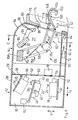
- the first embodiment of the device shown in FIGS. 1, 2, 6, 7 and 8 comprises a box-shaped base 2, which stands on a table 4.
- a seat 6 is arranged in the form of a high-back chair, on which the person can take a seat, whose head 8 is to be recorded photogrammetrically.
- the seat 6 carries an adjustable headrest 10 at the upper end of its backrest.
- An optical head 12 and a chamber unit 14 are arranged above the substructure 2 fixed to the device.
- the optical head 12 and the chamber unit 14 are firmly connected to one another and can be moved together relative to the substructure 2 in the vertical direction and in a horizontal direction, as is indicated by the double arrow X for the vertical direction and by the double arrow Y for the horizontal direction in FIG. 1 and 2 is indicated.
- the optical head 12 and the chamber unit 14 will first be explained in more detail below with reference to FIGS. 6 to 8.
- the optical head 12 comprises a plurality of optical devices and a device carrier 16 which carries the optical devices.
- the optical devices are a lower camera 18 designed as a video camera, an upper camera 20 designed as a video camera, a projector 22, an observation object 24 and a lens arrangement 26 associated therewith.
- the device carrier 16 comprises a self-supporting, Rigid housing with a front wall 28 on the right in FIG. 6, an upper wall 30 and further walls not shown in the figures and with holders for the optical devices.
- These brackets are a first bracket 32, which is connected in a manner not shown to the rest of the device carrier 16 and to which the lower camera 18 is detachably and interchangeably attached.
- the brackets also include a second bracket 34 to which the upper camera 20 is detachably and interchangeably attached.
- the second holder 34 is attached to the rest of the device carrier 16 in such a way that this holder and thus the upper camera 20 carried by it can be pivoted both about a bearing 36 in the drawing plane of FIG. 6 and about one in the drawing plane of FIG. 6 Axis extending perpendicular to the optical axis of the upper camera 20 is rotatable.
- This pivotability and rotatability serves to align the optical axis of the upper camera 20 such that the field of view of the upper camera 20 overlaps with the field of view of the lower camera 18 to the desired and required extent.
- the second holder 34 is fixed in its position.
- the two cameras 18 and 20 form the camera device the device.
- video cameras are preferred, especially digital cameras that enable real-time processing and editing.
- Video cameras in CCD circuit technology, CID circuit technology and CMOS circuit technology come into question here.
- Digital video cameras have proven to be superior in particular with regard to the accuracy of the photogrammetric evaluation of the camera signals.
- the camera device can also consist of only one camera or three cameras. In the case of three cameras that take three pictures, a certain object point is still recognizable and identifiable even if this can only be seen in two of the pictures, but not in the third.
- the camera device comprises only one camera, this camera can be provided with a device which simultaneously generates two images of the object in the image plane of the camera, namely two images which differ by different observation directions. Such a device can be formed, for example, by a mirror arrangement.
- the holders of the device carrier 16 also include a third holder 38 on which the projector 22 is detachably and interchangeably attached.
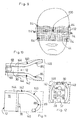
- the projector 22 has a lens 40 and carries a slide 42, which in turn carries the template for a sample image 44 to be projected by means of the projector 22, which is shown schematically in FIG. 9 and is, for example, the image of a rectangular grid.
- An actuator 46 is attached to the holder 38 for the projector 22, by means of which the slide 42 in the projector 22 can be rotated about its optical axis in a manner not shown in detail, so that in this way the sample image 44 also rotates one to the drawing plane of FIG 9 vertical axis can be rotated.
- the holder 38 for the projector 22 can be pivoted about an axis 48 lying in the drawing plane of FIG. 6 and running through the main plane of the objective 40. This pivoting is effected by means of a second actuator 50, which acts on the holder 38 in a manner which is only shown schematically.
- the pattern image 44 projected by the projector 22 can be shifted sideways, i.e. to the right or left in Fig. 9.
- a measuring plane 52 which is indicated by dash-dotted lines in FIG.
- the measurement object to be examined namely the front area of the head 8 is to be located in this measurement plane 52, so that the measurement object is arranged in the depth of field area of the two cameras 18 and 20 and of the projector 22. Accordingly, both the objective 40 of the projector 22 and the objectives 54 and 56 of the camera 18 and 20 are focused on this measurement plane 52. Furthermore, the measurement object in the measurement plane 52 should assume a certain position so that it is approximately in the center of vision fields of the two cameras 18 and 20 is located. This position of the measurement object in the measurement plane 52 is referred to as the measurement position.
- the optical axes of the two lenses 56 and 54 are now aligned in such a way that the measurement object in the measurement position can be recorded sharply from directions that differ from one another by means of the two cameras 18 and 20.
- the focus state of the two cameras 18 and 20 and the projector 22 and the orientation of the two cameras 18 and 20 are not changed during operation, so that the position of the measuring plane 52 and the required measuring position of the head 8 relative to the optical by the set focusing states and orientations Head 12 fixed.
- One of the peculiarities of the device described here is that not the head 8 is actively moved into the measuring position, but the optical head 12 - together with the elements firmly connected to it - is moved in the vertical direction and horizontally until the head 8 Assumes measuring position.
- the horizontal shift takes place in the drawing plane of FIG. 6, in which the optical axes of the two cameras 18 and 20 also lie.
- the flat front wall 28 of the equipment carrier 16 has three openings 58, 60 and 62 which are arranged vertically one above the other in the middle of the front wall 28.
- the lens 56 of the upper camera 20 is arranged behind the opening 58
- the lens 40 of the projector 22 is arranged behind the opening 60
- the lens 54 of the lower camera 18 is arranged behind the opening 62.
- the openings 58, 60 and 62 are dimensioned such that they do not impair the field of view of the two cameras and the projector.
- the front wall 28 has a further opening in which the lens arrangement 26 is fastened.
- the lens arrangement 26 and the observation object 24 are arranged and formed in the optical head 12 such that when the head 8 assumes its measurement position, the person sees the observation object 24 by means of the lens arrangement 26 at infinity or at least at such a great distance that one Near-point fixation of the person's eyes is avoided.
- the chamber unit 14 is fixedly connected to the optical head 12.
- This includes a hood which, through an upper wall 14 which adjoins the upper wall 30 of the device carrier 16, has a front wall arranged on the right in FIG. 6, two side walls 68 and 70 and is formed by a bottom wall 72.
- a large opening 74 is formed in the front wall, which is of such a size that, when the head 10 is in the measuring position, all areas thereof which are to be recorded by means of the cameras 18 and 20 are visible to the latter.
- the hood designed in the manner described above encloses a chamber 77 and darkens the space between the front wall 28 of the device carrier 16 and the front wall 66 or the measurement object, so that the measurements are not influenced by stray light.
- the front wall 66 is located close to the measuring plane 52 and carries an edge bead 76 which surrounds the opening 74 and is made of soft plastic material, which should prevent any injury to the head 8 if there should be an unintentional contact between the head and the chamber unit 14.
- the device has an orbital lighting device.
- this comprises two light sources 82, which are arranged below an intermediate floor 80 of the chamber unit 14.
- Each of the two light sources 82 emits a light beam directed to the right in FIG. 6, which strikes a mirror 84 which deflects the light beam obliquely upwards and directs it through an opening 86 in the intermediate floor 80 to the eye sockets of the head in the measuring position.
- a light source 82, a mirror 84 and an opening 86 are provided for each of the two eye sockets.
- the device is also provided with a distance measuring device which serves to determine whether the measurement object is at the required distance from the optical head 12, ie whether the measurement object has reached its measurement position.
- this distance measuring device comprises two light barriers, each with an optoelectronic receiver and an associated transmitter, the two light barriers running essentially horizontally across the optical axes of the cameras 18 and 20.
- the optoelectronic receivers and transmitters mentioned above only one is 88 in Fig. 6 can be seen, which is arranged in the bead 76 and is thus carried by the hood of the chamber unit 14. To the right of the receiver 88, a further receiver is arranged in the edge bead 76, but this further receiver in FIG.
- each pair of an optoelectronic receiver and a transmitter forms a light barrier, the locations of the light barriers being determined in such a way that when one of the two light barriers is interrupted by the measurement object, but the other is not, the measurement object assumes its measurement position.
- the electrical connections and the evaluation circuit of the distance measuring device described are not shown in the figures.
- a calibration object 90 Arranged within the chamber 77 is a calibration object 90 which has a specific, known shape and is used to obtain the information required for the calibration of the entire device. However, since the photogrammetric measuring method is not the subject of the invention, the actual calibration is not further explained here.
- the calibration object 90 is fastened to a U-shaped bracket 92 which has two legs 94 which are pivotally mounted with their free ends on the side walls 68 and 70 of the hood.
- the calibration object 90 is between a rest position shown in FIG. 6, in which it has a clear view of the two cameras 18 and 20 and the projector 22 of the measurement object not hindered, and movable to a calibration position in which the measurement object 90 is arranged in the measurement plane 52. Stops 96 on the front wall 66 of the hood ensure precise positioning of the calibration object 90.
- the calibration object 90 is under spring tension, which is applied to the bracket 92 by a spring 98.
- the calibration object 90 has a plurality of flat surfaces which have different orientations in space and are provided with calibration marks.
- One of the flat surfaces of the calibration object 90 faces the camera device in its calibration position and is preferably oriented exactly perpendicularly (i.e. to the center of the earth) during calibration, so that the calibration object in its calibration creation specifies an absolute alignment of the calibration object in space that is independent of the device .
- the calibration object is preferably permanently or directly attached to the optical head 12, it can also be detachable from it, for example only being attached to the optical head 12 or the chamber unit 14 for the purpose of calibration and otherwise separated from the device carrier 16 .
- An ear button 100 can be seen in FIG. 6, specifically the ear button for the person's left ear.
- This ear button has a substantially horizontally extending section 148 and at its right end in FIG. 6 a crescent-shaped section 102, which consists of a soft, band-shaped material and approximately the course of the area between is modeled on a person's ear and skull.
- This soft section 102 is firmly connected at its upper end to the horizontal section 148 of the ear button 100 and is held at its lower end by a stiffer, also crescent-shaped section 104, which should not be in contact with the ear or the skull.
- the above-described ear button 100 is connected in an articulated manner to a parallel guide device 106, which in the exemplary embodiment shown consists of two parallelogram guides 112 and 150 coupled to one another, one end of the parallel guide device 106 being fastened to the side wall 70 by means of a block 108.
- the upper parallelogram guide 150 comprises two struts 152 which run parallel to one another and which are pivotally articulated on the block 108 with their upper ends.
- the two lower ends of the struts 152 are connected in an articulated manner to a plate 154, the four articulation points of the two struts 152 being arranged at the corners of a parallelogram.
- the lower parallelogram guide 112 also comprises two struts 156 which run parallel to one another and which on the one hand are articulated with their ends at the plate 154 and on the other hand are articulated at their other ends with the ear button 100, the four articulation points of the struts 156 at the corners of a parallelogram.
- the upper parallelogram guide 150 is preferably arranged in such a way that the struts 152 run essentially vertically while forming a rectangle, whereas the struts 156 of the lower parallelogram guide 112 preferably form a rectangle if they run essentially horizontally.
- An ear switch 100 and a parallel guide Device 106 are also provided for the right ear, as can be seen in FIG. 7, the two ear buttons and the two parallel guide devices being designed symmetrically to one another.
- Each parallel guide device 106 is provided with a spring 110 which attempts to pull the respective ear button 100 to the left in FIG. 6.
- the parallel guide device 106 enables the respective ear button 100 to be shifted parallel to itself upwards and downwards and to the front and back, ie to the left and right in FIG. 6, and in this way into contact with the groove between the ear cup and the Skull stands.
- Each ear button is provided with three marks only shown in FIG.
- the joints of the lower parallelogram guide 112 of the parallel guide device 106 are preferably designed as ball joints, so that the ear button can also rotate within certain limits about the longitudinal axis of its straight, horizontally running section.
- the parallel guide devices 106 of the two ear buttons 100 are on the chamber unit 14 and thus indirectly on the device carrier 16 of the optical head 12 brought.
- the two parallel guiding devices can also be attached to the seat 6 or preferably to the headrest 10 thereof, in which case the ear buttons 100 are applied to the ears from behind and pressed instead of the ear buttons being pulled forward by their parallel guiding devices 106, as is the case here is the case in the illustrated embodiment.
- the optical head 12 and the chamber unit 14 can be moved together relative to the substructure 2 fixed in the device in the vertical direction and in the horizontal direction defined by the optical axes of the cameras 18 and 20.
- a carriage not shown, in the substructure 2, which can be moved in the horizontal direction mentioned and to which an electromotive drive device, also not shown, is assigned.
- a slot 116 is formed in the top of the substructure 2, in the direction of and below which the carriage, not shown, is moved.
- the free area of the slot 116 is covered by a blind 118.
- the carriage, not shown, carries a guide device for guiding the device carrier 16 on the carriage during its vertical movement. Of this guide device, only two vertical guide rods 120 can be seen in FIG.
- the device described above works in the following manner.
- a person whose face is to be measured takes a seat on the seat 6 and is asked to take a comfortable, upright sitting position while keeping the head essentially straight and looking straight ahead, ie into the opening 74.
- the headrest 10 is placed against the head 8 from behind in order to make it easier for the person to hold the head 8 in the taken up position.
- the electromotive actuators for the horizontal movement and vertical movement of the optical are then controlled by means of a control device, not shown Head 12 actuated such that the optical head 12 is moved horizontally and / or vertically until the head 8 assumes its measuring position.
- an arrow-shaped mark image 130 is already on a screen arrangement, not shown, on which the images recorded by the two cameras 18 and 20 are displayed to recognize whose template is preferably on the slide 42 such that it lies on the optical axis of the lens 40 of the projector 22.
- the optical head 12 is then moved to a height such that the mark image 130 is projected onto the bridge of the nose at the level of the bridge of the nose, as shown in FIG. 9.
- the two ear buttons 100 are pulled out of the chamber 77 in which they were previously stored so far that the soft sections 102 can be placed from behind into the groove between the ear cups and the skull with little pressure.
- the optical head 12 is moved further towards the measurement object or face until it assumes its measurement position.
- the distance measuring device responds in the form of the two light barriers, whereupon the forward movement of the optical head 12 together with the chamber unit 14 is ended either manually or automatically. If this should be necessary, the vertical position of the optical head 12 is then corrected until the mark image 130 has the desired height explained above.
- the actuator 22 is then pivoted about the axis 48 by means of the actuator 50 until the brand image 130 lies centrally on the bridge of the nose, unless this has already been the case.
- slide 42 is rotated until a reference line 132 of the pattern image 44 has a desired target position, for example touching the outer iris edge of both eyes, as shown in FIG. 9.
- the two images can be taken simultaneously by means of the camera device consisting of cameras 18 and 20, which are then subjected to a photogrammetric evaluation.
- the camera device consisting of cameras 18 and 20, which are then subjected to a photogrammetric evaluation.
- a projected sample image 44 and a projected brand image as well as with the ear buttons 100 removed and the lamps 78 switched on, it is also possible, for example, to take a further picture of the face by means of the camera 18, which is intended to provide a comparison image.
- the optical head 12 and the chamber unit 14 are then moved away from the head 8 and, if necessary, brought into a rest position with respect to the substructure 2.
- the transverse positioning is carried out by pivoting the projector about the axis 48. It goes without saying that this transverse positioning could be brought about solely or additionally by the fact that the optical head 12 together with the chamber unit 14 in a second horizontal direction relative to the device-fixed Substructure 2 is moved, which is perpendicular to the first horizontal direction.
- the vertical positioning takes place exclusively by moving the optical head 12 in the vertical direction.
- provision could additionally be made for the pattern image 44 and the brand image 130 in FIG. 9 in by appropriate movement of the projector 22 or the slide 42 be shifted in the vertical direction.
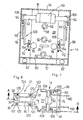
- the second embodiment of the device shown in FIGS. 3, 4 and 5 does not differ in terms of the design of the optical head 12 and the chamber unit 14 from the embodiment described above, for which reason the explanations in this regard are not given again.
- two vertical columns 132 and 134 are fastened to the plate-shaped substructure 2 and are connected to one another at their upper ends by a yoke 136.
- a carriage 138 is guided in a vertically displaceable manner and is driven in its vertical movement by means of an electromotive drive device, not shown.
- the carriage 138 carries the optical head 12 such that the device carrier 16 of the optical head 12 can be moved on the carriage 138 in the first horizontal direction, this movement being effected by means of an electromotive drive device, not shown.
- the third embodiment shown in FIGS. 10, 11 and 12 differs from the first embodiment essentially in the absence of the chamber unit 14 of the first embodiment.
- the optical head 12 of the third embodiment has the same configuration as the optical heads of the first and second embodiments, and therefore it will not be explained again.
- the optical head 12 of the third embodiment can either have the substructure as in the first or in the second embodiment connected and supported by it.
- the substructure and the devices connecting the optical head 12 to the substructure are not shown for the third embodiment.
- the parallel guide devices of the ear buttons are attached to the seat, not shown in FIGS. 10, 11 and 12.
- an arm 140 and a second arm 142 are fastened on the upper wall 30 of the device carrier 16.
- the two arms 140 and 142 are formed symmetrically to the longitudinal center plane of the optical head 12.
- Each of the two arms has a straight section 144 fastened directly to the equipment carrier, the bracket 92 with the calibration object 90 being pivotably mounted on the two straight sections 144.
- each arm 140 extends from section 144 to the locations of the transmitters or receivers of the light barriers forming the distance measuring device, and in addition to the receiver 88, the receiver 89 arranged next to it can also be seen in FIG. 11 because it is not covered by the head 8 in FIG. 11.
- the associated transmitters are located in arm 142 at the locations corresponding to receivers 88 and 89.
- the two arms 140 and 142 run underneath the transmitter or receiver of the light barriers in an arc shape in the direction of the optical head 12 and finally have a free end.
- the elements of the orbital lighting device, in front of which only the openings 86 can be seen in FIG. 10, are arranged in the arms 140 and 142 near the free ends.
- the embodiment according to FIGS. 10 to 12 has the advantage that the person whose head is to be measured is not irritated by the relatively large chamber unit 14 with the dark opening 74 of the first embodiment, while the optical head 12 and the chamber unit 14 be moved forward.
- the embodiment according to FIGS. 10 to 12 is particularly suitable if the lighting conditions in the room in which the device is installed ensure that the photogrammetry is not impaired by stray light.
- a cover 146 shown in dashed lines can be provided for this embodiment, which has approximately the shape of the hood of the first embodiment and also darkens its interior. The cover 146 can be put on and taken off in a simple manner and is used when the above-mentioned requirement with regard to the influence of stray light is not met.
Landscapes
- Health & Medical Sciences (AREA)
- Life Sciences & Earth Sciences (AREA)
- Physics & Mathematics (AREA)
- General Health & Medical Sciences (AREA)
- Veterinary Medicine (AREA)
- Biophysics (AREA)
- Pathology (AREA)
- Engineering & Computer Science (AREA)
- Biomedical Technology (AREA)
- Heart & Thoracic Surgery (AREA)
- Medical Informatics (AREA)
- Molecular Biology (AREA)
- Surgery (AREA)
- Animal Behavior & Ethology (AREA)
- General Physics & Mathematics (AREA)
- Public Health (AREA)
- Dentistry (AREA)
- Oral & Maxillofacial Surgery (AREA)
- Nuclear Medicine, Radiotherapy & Molecular Imaging (AREA)
- Ophthalmology & Optometry (AREA)
- Optics & Photonics (AREA)
- Radiology & Medical Imaging (AREA)
- Length Measuring Devices By Optical Means (AREA)
- Electrophonic Musical Instruments (AREA)
- Measurement Of The Respiration, Hearing Ability, Form, And Blood Characteristics Of Living Organisms (AREA)
- Optical Recording Or Reproduction (AREA)
- Dental Tools And Instruments Or Auxiliary Dental Instruments (AREA)
- Eye Examination Apparatus (AREA)
- Magnetic Resonance Imaging Apparatus (AREA)
- Dot-Matrix Printers And Others (AREA)
Priority Applications (1)
| Application Number | Priority Date | Filing Date | Title |
|---|---|---|---|
| AT86113822T ATE49307T1 (de) | 1985-12-23 | 1986-10-06 | Vorrichtung zum fotogrammetrischen erfassen des menschlichen kopfes. |
Applications Claiming Priority (2)
| Application Number | Priority Date | Filing Date | Title |
|---|---|---|---|
| DE19853545875 DE3545875A1 (de) | 1985-12-23 | 1985-12-23 | Vorrichtung zum fotogrammetrischen erfassen des menschlichen kopfes |
| DE3545875 | 1985-12-23 |
Publications (3)
| Publication Number | Publication Date |
|---|---|
| EP0226732A2 true EP0226732A2 (fr) | 1987-07-01 |
| EP0226732A3 EP0226732A3 (en) | 1987-12-16 |
| EP0226732B1 EP0226732B1 (fr) | 1990-01-03 |
Family
ID=6289437
Family Applications (1)
| Application Number | Title | Priority Date | Filing Date |
|---|---|---|---|
| EP86113822A Expired - Lifetime EP0226732B1 (fr) | 1985-12-23 | 1986-10-06 | Dispositif pour enregistrer photogrammétriquement la tête humaine |
Country Status (7)
| Country | Link |
|---|---|
| US (2) | US4805638A (fr) |
| EP (1) | EP0226732B1 (fr) |
| AT (1) | ATE49307T1 (fr) |
| BR (1) | BR8606409A (fr) |
| DE (2) | DE3545875A1 (fr) |
| ES (1) | ES2012040B3 (fr) |
| GR (1) | GR3000353T3 (fr) |
Cited By (3)
| Publication number | Priority date | Publication date | Assignee | Title |
|---|---|---|---|---|
| WO1996008805A1 (fr) * | 1994-09-16 | 1996-03-21 | OHI, Hiroki | Procede pour la reproduction en volume d'objets a trois dimensions, dispositif pour la mise en oeuvre de ce procede et objets ainsi obtenus |
| DE10049926A1 (de) * | 2000-10-07 | 2002-04-11 | Robert Massen | Kamera zur kostengünstigen Erfassung der Raumform von Körpern |
| WO2017167983A1 (fr) * | 2016-03-31 | 2017-10-05 | Skinlabs | Systeme de prise de vue du visage d'un patient |
Families Citing this family (31)
| Publication number | Priority date | Publication date | Assignee | Title |
|---|---|---|---|---|
| DE3545875A1 (de) * | 1985-12-23 | 1987-07-02 | Anger Wilhelm | Vorrichtung zum fotogrammetrischen erfassen des menschlichen kopfes |
| DE3914137C1 (fr) * | 1989-04-28 | 1990-03-29 | Eyemetrics-Systems Ag, Chur, Ch | |
| DE4240940A1 (de) * | 1992-12-06 | 1994-06-09 | Robert Prof Dr Ing Massen | Automatisierte Kreation von individualisierten Puppen und Masken |
| US5499457A (en) * | 1993-10-15 | 1996-03-19 | Olympic Medical Group | Infant length and weight measuring apparatus |
| DE9403971U1 (de) * | 1994-03-09 | 1994-05-26 | Vierte Art GmbH Computer Animation, 80799 München | Gerät zur Messung von Bewegungen im Gesicht eines Menschen |
| US5967979A (en) * | 1995-11-14 | 1999-10-19 | Verg, Inc. | Method and apparatus for photogrammetric assessment of biological tissue |
| DE29610052U1 (de) * | 1996-06-07 | 1996-08-22 | Fa. Carl Zeiss, 89518 Heidenheim | Video-Beratungssystem |
| US5960099A (en) * | 1997-02-25 | 1999-09-28 | Hayes, Jr.; Carl Douglas | System and method for creating a digitized likeness of persons |
| US6873340B2 (en) | 1997-05-15 | 2005-03-29 | Visimatix, Inc. | Method and apparatus for an automated reference indicator system for photographic and video images |
| US5927973A (en) * | 1997-12-10 | 1999-07-27 | Hanebaum; Allen | Apparatus and method for measuring the position of the occlusal plane of the mouth |
| USD427243S (en) * | 1997-12-15 | 2000-06-27 | Visimatix, Inc. | Reference indicator patch for use in an automated reference indicator system for photographic and video images |
| DE19757773A1 (de) * | 1997-12-24 | 1999-07-01 | Bernward Maehner | Verfahren zur dreidimensionalen, detaillierten Simulation plastischer Veränderungen an menschlichen Körperpartien |
| US6427022B1 (en) | 1998-11-10 | 2002-07-30 | Western Research Company, Inc. | Image comparator system and method for detecting changes in skin lesions |
| US6792401B1 (en) * | 2000-10-31 | 2004-09-14 | Diamond Visionics Company | Internet-based modeling kiosk and method for fitting and selling prescription eyeglasses |
| JP3983469B2 (ja) * | 2000-11-14 | 2007-09-26 | 富士フイルム株式会社 | 画像処理装置、方法及び記録媒体 |
| US6937745B2 (en) * | 2001-12-31 | 2005-08-30 | Microsoft Corporation | Machine vision system and method for estimating and tracking facial pose |
| US20050148313A1 (en) * | 2004-01-06 | 2005-07-07 | Chee Bill T.C. | Headset cord retainer |
| US20060207117A1 (en) * | 2004-12-27 | 2006-09-21 | Wendy Sobol | Posture monitoring and correcting device, system and method |
| KR20080064155A (ko) | 2005-10-14 | 2008-07-08 | 어플라이드 리써치 어쏘시에이츠 뉴질랜드 리미티드 | 표면 특징을 모니터링하는 방법 및 장치 |
| US7712052B2 (en) | 2006-07-31 | 2010-05-04 | Microsoft Corporation | Applications of three-dimensional environments constructed from images |
| US20080027985A1 (en) * | 2006-07-31 | 2008-01-31 | Microsoft Corporation | Generating spatial multimedia indices for multimedia corpuses |
| US7764849B2 (en) * | 2006-07-31 | 2010-07-27 | Microsoft Corporation | User interface for navigating through images |
| GB201107225D0 (en) * | 2011-04-29 | 2011-06-15 | Peira Bvba | Stereo-vision system |
| US9179844B2 (en) | 2011-11-28 | 2015-11-10 | Aranz Healthcare Limited | Handheld skin measuring or monitoring device |
| DE102012007831B4 (de) * | 2012-04-19 | 2016-02-04 | Rodenstock Gmbh | Vorrichtung und Verfahren zur Bestimmung der individuellen Parameter eines Brillenträgers |
| US10058670B2 (en) * | 2013-12-05 | 2018-08-28 | Fisher & Paykel Healthcare Limited | Interface sizing tool and method |
| US10013527B2 (en) | 2016-05-02 | 2018-07-03 | Aranz Healthcare Limited | Automatically assessing an anatomical surface feature and securely managing information related to the same |
| US11116407B2 (en) | 2016-11-17 | 2021-09-14 | Aranz Healthcare Limited | Anatomical surface assessment methods, devices and systems |
| US11903723B2 (en) | 2017-04-04 | 2024-02-20 | Aranz Healthcare Limited | Anatomical surface assessment methods, devices and systems |
| CN110558988B (zh) * | 2018-06-05 | 2022-07-12 | 北京远见医疗技术发展有限责任公司 | 一种头面全身参数测量方法和设备 |
| US12039726B2 (en) | 2019-05-20 | 2024-07-16 | Aranz Healthcare Limited | Automated or partially automated anatomical surface assessment methods, devices and systems |
Family Cites Families (18)
| Publication number | Priority date | Publication date | Assignee | Title |
|---|---|---|---|---|
| US1564339A (en) * | 1923-04-23 | 1925-12-08 | Chelsea C Fraser | Measuring chair |
| US2339657A (en) * | 1941-03-20 | 1944-01-18 | Folmer Graflex Corp | Photographic identification equipment unit |
| US2780004A (en) * | 1954-03-25 | 1957-02-05 | Facial Graph Corp | Means for measuring facial proportions |
| DE1263347B (de) * | 1965-12-20 | 1968-03-14 | Haag Streit A G | Vorrichtung zur Feineinstellung optischer Instrumente |
| GB1257034A (fr) * | 1968-03-25 | 1971-12-15 | ||
| US4135498A (en) * | 1977-04-13 | 1979-01-23 | Mcgee George L | Device for making body measurements of a patient or the like |
| DE2948010C2 (de) * | 1979-11-29 | 1983-12-29 | Ulrich M. 4520 Melle Landwehr | Verfahren und Vorrichtung zur Ermittlung der Abmessungen eines Gegenstandes auf photographischem Wege |
| FR2491323A1 (fr) * | 1980-10-03 | 1982-04-09 | Boixel Emile | Procede d'enregistrement morphologique |
| SU923522A1 (ru) * | 1980-10-15 | 1982-04-30 | Московский Ордена Трудового Красного Знамени Научно-Исследовательский Рентгено-Радиологический Институт | Устройство дл построени контура тела |
| DE3102275A1 (de) * | 1981-01-24 | 1982-08-19 | Pfister Gmbh, 8900 Augsburg | Verfahren und vorrichtung zur durchfuehrung von reihenmessungen, insbesondere von koerpermassen und/oder koerperproportionen menschlicher koerper |
| NL8202443A (nl) * | 1982-06-16 | 1984-01-16 | Ignatius Maria Valk | Werkwijze ter bepaling van de lichaamslengte, werkwijze voor het bepalen van een groeicurve en inrichting voor het uitvoeren van een dergelijke meting. |
| US4662079A (en) * | 1983-05-10 | 1987-05-05 | Graf Peter M | Process and apparatus for forming customized footwear |
| JPS60142838A (ja) * | 1983-10-28 | 1985-07-29 | 吉澤 徹 | 脊柱側彎症の検診方法及びその装置 |
| FR2565481B1 (fr) * | 1984-06-06 | 1988-11-18 | Oreal | Procede pour apprecier les variations, dans le temps, de caracteristiques d'une zone ou de l'ensemble d'une personne, installation pour la mise en oeuvre de ce procede et applications d'un tel procede |
| US4538353A (en) * | 1984-12-21 | 1985-09-03 | Interco, Incorporated | Electronic foot measuring apparatus and method |
| US4604807A (en) * | 1984-12-21 | 1986-08-12 | Interco, Incorporated | Electronic foot measuring apparatus and method |
| DE3518215A1 (de) * | 1985-05-21 | 1985-10-03 | Günter 8000 München Hankiewicz | Mess- und anpasssystem fuer brillen |
| DE3545875A1 (de) * | 1985-12-23 | 1987-07-02 | Anger Wilhelm | Vorrichtung zum fotogrammetrischen erfassen des menschlichen kopfes |
-
1985
- 1985-12-23 DE DE19853545875 patent/DE3545875A1/de active Granted
-
1986
- 1986-10-06 AT AT86113822T patent/ATE49307T1/de not_active IP Right Cessation
- 1986-10-06 EP EP86113822A patent/EP0226732B1/fr not_active Expired - Lifetime
- 1986-10-06 ES ES86113822T patent/ES2012040B3/es not_active Expired - Lifetime
- 1986-10-06 DE DE8686113822T patent/DE3668076D1/de not_active Expired - Lifetime
- 1986-11-21 US US06/933,580 patent/US4805638A/en not_active Expired - Fee Related
- 1986-12-23 BR BR8606409A patent/BR8606409A/pt unknown
-
1988
- 1988-10-11 US US07/255,493 patent/US4996994A/en not_active Expired - Fee Related
-
1990
- 1990-02-19 GR GR90400091T patent/GR3000353T3/el unknown
Cited By (6)
| Publication number | Priority date | Publication date | Assignee | Title |
|---|---|---|---|---|
| WO1996008805A1 (fr) * | 1994-09-16 | 1996-03-21 | OHI, Hiroki | Procede pour la reproduction en volume d'objets a trois dimensions, dispositif pour la mise en oeuvre de ce procede et objets ainsi obtenus |
| FR2724738A1 (fr) * | 1994-09-16 | 1996-03-22 | Pascal Eric Pierre Gauchet | Procede pour la reproduction en volume d'objets a trois dimensions dispositif pour la mise en oeuvre de ce procede et objets ainsi obtenus |
| DE10049926A1 (de) * | 2000-10-07 | 2002-04-11 | Robert Massen | Kamera zur kostengünstigen Erfassung der Raumform von Körpern |
| US7095886B2 (en) | 2000-10-07 | 2006-08-22 | Corpus.E Ag | Arrangement and method for producing photogrammetric image records |
| WO2017167983A1 (fr) * | 2016-03-31 | 2017-10-05 | Skinlabs | Systeme de prise de vue du visage d'un patient |
| FR3049728A1 (fr) * | 2016-03-31 | 2017-10-06 | Skinlabs | Systeme de prise de vue du visage d'un patient |
Also Published As
| Publication number | Publication date |
|---|---|
| BR8606409A (pt) | 1987-10-13 |
| GR3000353T3 (en) | 1991-06-07 |
| EP0226732B1 (fr) | 1990-01-03 |
| US4805638A (en) | 1989-02-21 |
| US4996994A (en) | 1991-03-05 |
| DE3668076D1 (de) | 1990-02-08 |
| ES2012040B3 (es) | 1990-03-01 |
| ATE49307T1 (de) | 1990-01-15 |
| DE3545875C2 (fr) | 1989-11-30 |
| DE3545875A1 (de) | 1987-07-02 |
| EP0226732A3 (en) | 1987-12-16 |
Similar Documents
| Publication | Publication Date | Title |
|---|---|---|
| EP0226732B1 (fr) | Dispositif pour enregistrer photogrammétriquement la tête humaine | |
| DE3930022C2 (de) | Panoramaröntgenaufnahmevorrichtung zum wahlweisen Herstellen von Dental-Panoramaaufnahmen und von Schädelaufnahmen | |
| AT394459B (de) | Verfahren zum gewinnen von bildern zur verwendung beim darstellen eines dreidimensionalen scheinbildes und bildaufzeichnungstraeger, auf dem erste und zweite gruppen von serien derartiger bilder gespeichert sind | |
| EP0053680A1 (fr) | Dispositif d'évaluation subjective et objective de la réfraction | |
| DE4114646A1 (de) | Ophthalmoskopie-vorsatz fuer operationsmikroskop | |
| EP0523261A1 (fr) | Appareil de projection et de rétroprojection de diapositives | |
| DE19501415C2 (de) | Sehtestgerät | |
| DE2411251A1 (de) | Reproduktionsgeraet | |
| DE3142477A1 (de) | "roentgenvorrichtung" | |
| DE4023783C2 (de) | Kamera mit einem getrennt vom Aufnahmeobjektiv angeordneten Sucher | |
| DE4436528A1 (de) | Optische Vergrößerungsvorrichtung | |
| EP3997504A1 (fr) | Stéréomicroscope destiné à être utilisé lors d'interventions microchirurgicales chez le patient et procédé de commande du stéréomicroscope | |
| DE19549412C2 (de) | Scharfstellverfahren einer Fachkamera | |
| EP0262522A1 (fr) | Appareil de radiodiagnostic dentaire | |
| DE8536363U1 (de) | Vorrichtung zum fotogrammetrischen Erfassen des menschlichen Kopfes | |
| EP1192894A1 (fr) | Appareil de périmétrie du champ visuel | |
| DE20302798U1 (de) | System zum Bestimmen von Zentrierdaten für Brillengläser | |
| DE102023114945B3 (de) | Computerimplementiertes Bildgebungsverfahren und optisches Beobachtungsgerät | |
| DE968042C (de) | Auswertegeraet mit stereoskopischem Betrachtungssystem fuer die photogrammetrische Auswertung zweier Bildplatten mit beliebig gerichteten Aufnahmeachsen | |
| DE2729024C2 (de) | Photometermikroskop mit einer Einrichtung zur mikrophotometrischen Abtastung feiner Objektstrukturen | |
| DE890751C (de) | Für Aufnahmegeräte mit auswechselbaren Objektiven bestimmter Sucher | |
| DE2616445A1 (de) | Tragbares augenpruefgeraet zur messung willkuerlicher und unwillkuerlicher augenbewegungen | |
| DE2200816B2 (de) | Lichtvisieranordnung zur Justierung einer Strahlenquelle oder Strahlenmeßsonde | |
| DE757079C (de) | Optische Einrichtung fuer photographische oder kinematographische Aufnahmen | |
| DE360680C (de) | Vorrichtung zum Auftragen der aus zwei Bildplatten zu entnehmenden Oberflaeche einesraeumlichen Gebildes |
Legal Events
| Date | Code | Title | Description |
|---|---|---|---|
| PUAI | Public reference made under article 153(3) epc to a published international application that has entered the european phase |
Free format text: ORIGINAL CODE: 0009012 |
|
| AK | Designated contracting states |
Kind code of ref document: A2 Designated state(s): AT BE CH DE ES FR GB GR IT LI LU NL SE |
|
| 17P | Request for examination filed |
Effective date: 19870603 |
|
| PUAL | Search report despatched |
Free format text: ORIGINAL CODE: 0009013 |
|
| AK | Designated contracting states |
Kind code of ref document: A3 Designated state(s): AT BE CH DE ES FR GB GR IT LI LU NL SE |
|
| 17Q | First examination report despatched |
Effective date: 19880630 |
|
| RAP1 | Party data changed (applicant data changed or rights of an application transferred) |
Owner name: EYEMETRICS-SYSTEMS AG |
|
| GRAA | (expected) grant |
Free format text: ORIGINAL CODE: 0009210 |
|
| AK | Designated contracting states |
Kind code of ref document: B1 Designated state(s): AT BE CH DE ES FR GB GR IT LI LU NL SE |
|
| PG25 | Lapsed in a contracting state [announced via postgrant information from national office to epo] |
Ref country code: GR Free format text: LAPSE BECAUSE OF FAILURE TO SUBMIT A TRANSLATION OF THE DESCRIPTION OR TO PAY THE FEE WITHIN THE PRESCRIBED TIME-LIMIT Effective date: 19900103 |
|
| REF | Corresponds to: |
Ref document number: 49307 Country of ref document: AT Date of ref document: 19900115 Kind code of ref document: T |
|
| REF | Corresponds to: |
Ref document number: 3668076 Country of ref document: DE Date of ref document: 19900208 |
|
| GBT | Gb: translation of ep patent filed (gb section 77(6)(a)/1977) | ||
| ITF | It: translation for a ep patent filed | ||
| ET | Fr: translation filed | ||
| REG | Reference to a national code |
Ref country code: GR Ref legal event code: FG4A Free format text: 3000353 |
|
| PGFP | Annual fee paid to national office [announced via postgrant information from national office to epo] |
Ref country code: GB Payment date: 19900920 Year of fee payment: 5 |
|
| PGFP | Annual fee paid to national office [announced via postgrant information from national office to epo] |
Ref country code: ES Payment date: 19901016 Year of fee payment: 5 |
|
| PGFP | Annual fee paid to national office [announced via postgrant information from national office to epo] |
Ref country code: FR Payment date: 19901018 Year of fee payment: 5 |
|
| PGFP | Annual fee paid to national office [announced via postgrant information from national office to epo] |
Ref country code: CH Payment date: 19901022 Year of fee payment: 5 |
|
| PGFP | Annual fee paid to national office [announced via postgrant information from national office to epo] |
Ref country code: SE Payment date: 19901025 Year of fee payment: 5 |
|
| PLBE | No opposition filed within time limit |
Free format text: ORIGINAL CODE: 0009261 |
|
| STAA | Information on the status of an ep patent application or granted ep patent |
Free format text: STATUS: NO OPPOSITION FILED WITHIN TIME LIMIT |
|
| PGFP | Annual fee paid to national office [announced via postgrant information from national office to epo] |
Ref country code: LU Payment date: 19901029 Year of fee payment: 5 |
|
| ITTA | It: last paid annual fee | ||
| PG25 | Lapsed in a contracting state [announced via postgrant information from national office to epo] |
Ref country code: LU Free format text: LAPSE BECAUSE OF NON-PAYMENT OF DUE FEES Effective date: 19901031 |
|
| PGFP | Annual fee paid to national office [announced via postgrant information from national office to epo] |
Ref country code: NL Payment date: 19901031 Year of fee payment: 5 Ref country code: AT Payment date: 19901031 Year of fee payment: 5 |
|
| PGFP | Annual fee paid to national office [announced via postgrant information from national office to epo] |
Ref country code: BE Payment date: 19901113 Year of fee payment: 5 |
|
| 26N | No opposition filed | ||
| EPTA | Lu: last paid annual fee | ||
| PG25 | Lapsed in a contracting state [announced via postgrant information from national office to epo] |
Ref country code: GB Effective date: 19911006 Ref country code: AT Effective date: 19911006 |
|
| PG25 | Lapsed in a contracting state [announced via postgrant information from national office to epo] |
Ref country code: SE Effective date: 19911007 Ref country code: ES Free format text: LAPSE BECAUSE OF EXPIRATION OF PROTECTION Effective date: 19911007 |
|
| PG25 | Lapsed in a contracting state [announced via postgrant information from national office to epo] |
Ref country code: LI Effective date: 19911031 Ref country code: CH Effective date: 19911031 Ref country code: BE Effective date: 19911031 |
|
| BERE | Be: lapsed |
Owner name: EYEMETRICS-SYSTEMS A.G. Effective date: 19911031 |
|
| PG25 | Lapsed in a contracting state [announced via postgrant information from national office to epo] |
Ref country code: NL Effective date: 19920501 |
|
| GBPC | Gb: european patent ceased through non-payment of renewal fee | ||
| NLV4 | Nl: lapsed or anulled due to non-payment of the annual fee | ||
| PG25 | Lapsed in a contracting state [announced via postgrant information from national office to epo] |
Ref country code: FR Effective date: 19920630 |
|
| REG | Reference to a national code |
Ref country code: CH Ref legal event code: PL |
|
| REG | Reference to a national code |
Ref country code: FR Ref legal event code: ST |
|
| REG | Reference to a national code |
Ref country code: GR Ref legal event code: MM2A Free format text: 3000353 |
|
| EUG | Se: european patent has lapsed |
Ref document number: 86113822.0 Effective date: 19920510 |
|
| REG | Reference to a national code |
Ref country code: ES Ref legal event code: FD2A Effective date: 19990601 |
|
| PGFP | Annual fee paid to national office [announced via postgrant information from national office to epo] |
Ref country code: DE Payment date: 19991129 Year of fee payment: 14 |
|
| PG25 | Lapsed in a contracting state [announced via postgrant information from national office to epo] |
Ref country code: DE Free format text: LAPSE BECAUSE OF NON-PAYMENT OF DUE FEES Effective date: 20010703 |
|
| PG25 | Lapsed in a contracting state [announced via postgrant information from national office to epo] |
Ref country code: IT Free format text: LAPSE BECAUSE OF NON-PAYMENT OF DUE FEES;WARNING: LAPSES OF ITALIAN PATENTS WITH EFFECTIVE DATE BEFORE 2007 MAY HAVE OCCURRED AT ANY TIME BEFORE 2007. THE CORRECT EFFECTIVE DATE MAY BE DIFFERENT FROM THE ONE RECORDED. Effective date: 20051006 |