EP0226971A2 - Doublier - Google Patents
Doublier Download PDFInfo
- Publication number
- EP0226971A2 EP0226971A2 EP86117299A EP86117299A EP0226971A2 EP 0226971 A2 EP0226971 A2 EP 0226971A2 EP 86117299 A EP86117299 A EP 86117299A EP 86117299 A EP86117299 A EP 86117299A EP 0226971 A2 EP0226971 A2 EP 0226971A2
- Authority
- EP
- European Patent Office
- Prior art keywords
- idler
- ribs
- weft
- fabric
- fabric according
- Prior art date
- Legal status (The legal status is an assumption and is not a legal conclusion. Google has not performed a legal analysis and makes no representation as to the accuracy of the status listed.)
- Withdrawn
Links
- 239000004744 fabric Substances 0.000 title claims abstract description 83
- 239000000463 material Substances 0.000 claims abstract description 15
- 239000005871 repellent Substances 0.000 claims abstract description 12
- 230000015572 biosynthetic process Effects 0.000 claims description 8
- -1 polyethylene Polymers 0.000 claims description 4
- 229920000742 Cotton Polymers 0.000 claims description 2
- 239000004698 Polyethylene Substances 0.000 claims description 2
- 239000004743 Polypropylene Substances 0.000 claims description 2
- 229920000297 Rayon Polymers 0.000 claims description 2
- 229920000728 polyester Polymers 0.000 claims description 2
- 229920000573 polyethylene Polymers 0.000 claims description 2
- 229920001155 polypropylene Polymers 0.000 claims description 2
- 239000002964 rayon Substances 0.000 claims description 2
- 238000004804 winding Methods 0.000 description 11
- 239000007789 gas Substances 0.000 description 4
- 125000006850 spacer group Chemical group 0.000 description 4
- 238000009941 weaving Methods 0.000 description 3
- 230000000694 effects Effects 0.000 description 2
- 238000004519 manufacturing process Methods 0.000 description 2
- 230000007704 transition Effects 0.000 description 2
- 150000001252 acrylic acid derivatives Chemical class 0.000 description 1
- 235000013351 cheese Nutrition 0.000 description 1
- 238000004049 embossing Methods 0.000 description 1
- 239000011888 foil Substances 0.000 description 1
- 238000000034 method Methods 0.000 description 1
- 239000004033 plastic Substances 0.000 description 1
- 229920003023 plastic Polymers 0.000 description 1
- 229920000642 polymer Polymers 0.000 description 1
- 229920001296 polysiloxane Polymers 0.000 description 1
- 238000000926 separation method Methods 0.000 description 1
- 230000006641 stabilisation Effects 0.000 description 1
- 238000011105 stabilization Methods 0.000 description 1
- 238000003860 storage Methods 0.000 description 1
- 239000000126 substance Substances 0.000 description 1
- 238000009423 ventilation Methods 0.000 description 1
- 239000004636 vulcanized rubber Substances 0.000 description 1
- 230000037303 wrinkles Effects 0.000 description 1
Images
Classifications
-
- D—TEXTILES; PAPER
- D03—WEAVING
- D03D—WOVEN FABRICS; METHODS OF WEAVING; LOOMS
- D03D1/00—Woven fabrics designed to make specified articles
-
- D—TEXTILES; PAPER
- D03—WEAVING
- D03D—WOVEN FABRICS; METHODS OF WEAVING; LOOMS
- D03D15/00—Woven fabrics characterised by the material, structure or properties of the fibres, filaments, yarns, threads or other warp or weft elements used
- D03D15/50—Woven fabrics characterised by the material, structure or properties of the fibres, filaments, yarns, threads or other warp or weft elements used characterised by the properties of the yarns or threads
-
- D—TEXTILES; PAPER
- D03—WEAVING
- D03D—WOVEN FABRICS; METHODS OF WEAVING; LOOMS
- D03D13/00—Woven fabrics characterised by the special disposition of the warp or weft threads, e.g. with curved weft threads, with discontinuous warp threads, with diagonal warp or weft
- D03D13/004—Woven fabrics characterised by the special disposition of the warp or weft threads, e.g. with curved weft threads, with discontinuous warp threads, with diagonal warp or weft with weave pattern being non-standard or providing special effects
-
- D—TEXTILES; PAPER
- D03—WEAVING
- D03D—WOVEN FABRICS; METHODS OF WEAVING; LOOMS
- D03D15/00—Woven fabrics characterised by the material, structure or properties of the fibres, filaments, yarns, threads or other warp or weft elements used
- D03D15/40—Woven fabrics characterised by the material, structure or properties of the fibres, filaments, yarns, threads or other warp or weft elements used characterised by the structure of the yarns or threads
- D03D15/43—Woven fabrics characterised by the material, structure or properties of the fibres, filaments, yarns, threads or other warp or weft elements used characterised by the structure of the yarns or threads with differing diameters
-
- D—TEXTILES; PAPER
- D10—INDEXING SCHEME ASSOCIATED WITH SUBLASSES OF SECTION D, RELATING TO TEXTILES
- D10B—INDEXING SCHEME ASSOCIATED WITH SUBLASSES OF SECTION D, RELATING TO TEXTILES
- D10B2201/00—Cellulose-based fibres, e.g. vegetable fibres
- D10B2201/01—Natural vegetable fibres
- D10B2201/02—Cotton
-
- D—TEXTILES; PAPER
- D10—INDEXING SCHEME ASSOCIATED WITH SUBLASSES OF SECTION D, RELATING TO TEXTILES
- D10B—INDEXING SCHEME ASSOCIATED WITH SUBLASSES OF SECTION D, RELATING TO TEXTILES
- D10B2201/00—Cellulose-based fibres, e.g. vegetable fibres
- D10B2201/20—Cellulose-derived artificial fibres
- D10B2201/22—Cellulose-derived artificial fibres made from cellulose solutions
- D10B2201/24—Viscose
-
- D—TEXTILES; PAPER
- D10—INDEXING SCHEME ASSOCIATED WITH SUBLASSES OF SECTION D, RELATING TO TEXTILES
- D10B—INDEXING SCHEME ASSOCIATED WITH SUBLASSES OF SECTION D, RELATING TO TEXTILES
- D10B2321/00—Fibres made from polymers obtained by reactions only involving carbon-to-carbon unsaturated bonds
- D10B2321/02—Fibres made from polymers obtained by reactions only involving carbon-to-carbon unsaturated bonds polyolefins
- D10B2321/021—Fibres made from polymers obtained by reactions only involving carbon-to-carbon unsaturated bonds polyolefins polyethylene
-
- D—TEXTILES; PAPER
- D10—INDEXING SCHEME ASSOCIATED WITH SUBLASSES OF SECTION D, RELATING TO TEXTILES
- D10B—INDEXING SCHEME ASSOCIATED WITH SUBLASSES OF SECTION D, RELATING TO TEXTILES
- D10B2321/00—Fibres made from polymers obtained by reactions only involving carbon-to-carbon unsaturated bonds
- D10B2321/02—Fibres made from polymers obtained by reactions only involving carbon-to-carbon unsaturated bonds polyolefins
- D10B2321/022—Fibres made from polymers obtained by reactions only involving carbon-to-carbon unsaturated bonds polyolefins polypropylene
-
- D—TEXTILES; PAPER
- D10—INDEXING SCHEME ASSOCIATED WITH SUBLASSES OF SECTION D, RELATING TO TEXTILES
- D10B—INDEXING SCHEME ASSOCIATED WITH SUBLASSES OF SECTION D, RELATING TO TEXTILES
- D10B2331/00—Fibres made from polymers obtained otherwise than by reactions only involving carbon-to-carbon unsaturated bonds, e.g. polycondensation products
- D10B2331/04—Fibres made from polymers obtained otherwise than by reactions only involving carbon-to-carbon unsaturated bonds, e.g. polycondensation products polyesters, e.g. polyethylene terephthalate [PET]
-
- D—TEXTILES; PAPER
- D10—INDEXING SCHEME ASSOCIATED WITH SUBLASSES OF SECTION D, RELATING TO TEXTILES
- D10B—INDEXING SCHEME ASSOCIATED WITH SUBLASSES OF SECTION D, RELATING TO TEXTILES
- D10B2505/00—Industrial
- D10B2505/10—Packaging, e.g. bags
Definitions
- the invention relates to an idler fabric made from gimmi-repellent material as an intermediate layer in the formation of a roll with a rubber and / or rubber sheet.
- Non-vulcanized rubber and / or rubber sheets tend to react with each other over time.
- such surfaces must be separated from one another by sheet-like spacers when stacked on top of one another or when rolled up on a roll. This prevents the G / K fabric from sticking together.
- sheet-like structures made of foils or fabrics which either have a rubber-repellent finish or are themselves rubber-repellent due to their material properties.
- an idler fabric made of rubber-repellent work is advantageously used in the prior art Substances used, which is usually wound up with the G / K fabric on a roll, which is then unwound again in use, the idler fabric is separated from the structure and wound up for the next use.
- Such coils consisting of the idler fabric and the G / K flat structure, can only be produced precisely at relatively low winding speeds, since if the winding speeds are too high there is a risk that air will be trapped when the winding or the package is built up. This leads to bubbles / corrugations in the G / K fabric, which is highly undesirable.
- gases of this type can also be produced by the reaction of rubber and / or rubber which has not fully reacted, which likewise lead to warping in the winding.
- irregularly corrugated fabrics are pulled off the roll, which lead to a high material output.
- idler fabrics with a canvas structure are usually used, which have a relatively low transverse stability.
- wrinkles can form in the fabric, which in turn leads to an impression in the G / K fabric. This is particularly the case when pulling apart and when winding the texiles Component to fear, which is a hindrance to the re-use of the idler tissue.
- a fabric web which is to be used as a tire cord fabric web.
- this fabric web has a tightly woven, stable tee, which has at least one woven-in weft thread, with which a width stabilization of the tee is ensured.
- Such fabric webs reinforced only in the end area are not suitable for use as idler fabrics.
- the invention is therefore based on the object of developing the idler fabric of the type mentioned at the outset in such a way that the formation of bubbles or imprints does not occur in the wrap consisting of G / K flat structures and idler fabric.
- the problem is solved by a plurality of ribs provided at certain intervals in the weft and / or warp direction of the idler fabric.
- the idler fabric according to the invention initially has the advantage that the surface structure of the fabric has, at certain intervals, transverse ribs which raise the adjacent G / K flat structure by a small amount compared to the area surrounding the ribs. This lifting creates a space in the area of the transition from the raised rib into the smooth surface, on which the structure no longer abuts. As a result, this space forms a channel that runs across the entire tissue at the front and rear ends of each rib. Inclusions of air can be prevented by this channel, so that a regular winding can initially be produced even at high winding speeds.
- the G / K flat structures lying on top of each other are lifted off from the regions to be regarded as flat, so that largely tight adhesion of the flat structure to the fabric is prevented.
- the arrangement of the ribs on the idler fabric is advantageously such that the adhesion of the G / K fabric is essentially limited to the ribs themselves, so that this results in an even easier separation from the fabric during processing of the G / K fabric.
- the ribs also stiffen the idler fabric, even if it is made in a modified plain weave. This has the advantage that the transverse stability is thereby considerably improved, so that the tendency of the fabric according to the invention to form folds is substantially less than is the case with the prior art.
- the idler fabric according to the invention advantageously has ribs running in the weft direction, these ribs being formed at regular intervals.
- Such a rib is formed by combining several weft threads of the same diameter per warp lifting or lowering. Such ribs are then usually followed by areas in which only one weft thread is inserted per warp lifting or lowering, which has the same diameter as the weft threads that form the rib.
- the rib can also be formed from at least one thick weft thread, while the surrounding areas are formed from thinner weft threads.
- rib formation in the weft direction natural Lich also according to the invention, if this appears advantageous, a rib formation in the warp direction can be provided, with several warp threads are combined. A combination of the ribs in the weft and warp direction is also possible. However, as explained above, rib formation in the weft direction is preferred.
- the spacing of the ribs is chosen according to the invention in such a way that the rubber layers lying on the idler fabric do not undergo any embossing or wave formation during winding.
- a relatively narrow rib area adjoins a relatively wide area, in which only one weft thread is provided per warp raising or lowering. If one examines such a tissue in cross-section, ribs with a relatively small width a alternate with flat areas of a relatively large width b in a regular sequence (see FIG. 3).
- the ribs are substantially wider than the areas of relatively small cross-section.
- channel-shaped recesses run in the latter areas of relatively small cross-section or thickness in the tissue.
- channel-like areas with a small cross-section and a small width are regularly connected to relatively wide areas with a large cross-section.
- the rib area and the normal area have different heights (thicknesses).
- the thickness d 1 of the normal area and the thickness d 2 of the rib area are in a ratio of 1: 1.3 to 1: 3, preferably 1: 1.5 to 1: 2.
- the rib structure of the idler fabric is designed in such a way that no impressions can form in the G / K fabric roll.
- both the distance between the ribs and the rib height, which results from the thickness, are decisive.
- the distance between the ribs is advantageously longer, the smaller the thickness of a rib.
- the ribs of the spacer fabric advantageously extend across the entire width, i.e. in the weft direction. Furthermore, as mentioned above, the ribs are distributed substantially uniformly over the entire width (warp direction), so that the rib regions alternate with normal regions or channel-shaped depressions in a regular sequence.
- the materials for producing the spacer fabric according to the invention have a rubber-repellent property.
- This equipment is based either directly on the materials used or on a subsequent finishing of the materials.
- materials which have this rubber-repellent property are rubber-repellent polymers, in particular polyethylene and polypropylene.
- materials can also be used which have only a relatively low rubber-repellent property, provided that these materials are or are made to be rubber-repellent.
- cotton, rayon or polyester can be impregnated, for example with silicone materials or acrylates.
- the threads used according to the invention can have the same thickness in the weft and / or warp direction. In this respect, only a single material is used to manufacture the idler fabric according to the invention.
- - threads of different thicknesses can also be used in the weft and / or warp direction.
- thicker threads can be used to produce the ribs than to produce the normal range.
- two bobbins are required to insert the weft threads if the rib region is made with a thick thread and the normal region with a thin thread.
- the type of weave of the idler fabric is chosen according to the purpose.
- Modified basic weave types are usually used, for example plain weave, twill weave, cross twill weave, satin weave or Oxford weave.
- the modified plain weave is preferred because, on the one hand, it is sufficiently cross-stable due to the rib weave and, on the other hand, it can also be produced cheaply on the usual dobby weaving machines.
- modified basic binding type is the use of a common basic binding with the entry of several shots and / or to understand warp threads in the rib area, the adjacent areas being provided with the usual basic weave.
- weaves can also be made with threads of different thicknesses in the warp and weft directions, wherein threads in the warp and weft directions are advantageously used in a range from 500 to 2000 dtex.
- a first example of an idler fabric according to the invention is produced as follows:
- a thread with 530 dtex is used in the chain, while a thread with 650 dtex is used in the weft direction.
- the fabric itself is made in a modified plain weave. 4 - 7 shots per warp increase or decrease are entered for each rib. In the normal range, one weft thread is inserted for each warp elevation or reduction, it being possible for 2 to 8 adjacent wefts in the normal range to follow the rib region.
- ribbon-like material with 650 dtex in the warp direction and 550 dtex in the weft direction is used.
- the fabric is again made in a modified plain weave, with 3 - 5 wefts in the rib area, each with 1 warp raising or lowering, and in the normal range, one weft thread per warp lifting or lowering is provided, with this normal area only 1 - 2 weft threads next to each other the rib areas.
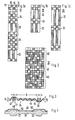
- FIG. 1a shows a first idler fabric 10 which only shows four warp threads, the weft threads being shown indirectly by the black / white representation.
- this idler fabric 10 has four warp threads 12-20, which each pass through two areas in the detail shown in FIG there is, further wefts connect laterally to this weft.
- this normal region 24 has eight weft threads lying next to one another.
- the checkerboard-like representation also shows that this follower fabric 10 is made in a modified plain weave.
- the ribs 22 are each formed from four weft threads, each of which is inserted into a warp raising / lowering.
- the warp thread 12 has four weft threads lying above it at the lower end, with one weft thread alternatingly at the top or at the bottom.
- the second rib 22, which lies further up in FIG. 1a, has the warp thread 12 lying on the top, so that the four weft threads lie below.
- FIG. 1b shows a further embodiment of an idler fabric 26, again only four warp threads being shown.
- the same reference numerals are used as in Fig. 1a.
- the ribs 22 are in turn formed from four weft threads, which are alternately above or below the warp thread according to the plain weave used.
- the normal region 24 is designed such that only two weft threads lying next to one another are provided between the regions having the ribs 22. As a result, this embodiment is considerably shorter in its normal range than the embodiment according to FIG. 1a.
- FIG. 1c A third embodiment of an idler fabric 28 in a modified plain weave is shown in FIG. 1c, the same reference numerals being used for the same parts.
- the rib has seven wefts, during the normal range accordingly the embodiment according to FIG. 1b also only has two weft threads lying next to one another.
- an idler fabric 30 is shown in the known cross-twill weave. It repeats in the transverse direction, i.e. towards the weft, every four warp threads 32-38 the binding.
- FIG. 3 shows a cross section through the idler fabric according to FIG. 1a in an enlarged view. From this, both the width ratios between the rib areas 22 and the flat areas 24 from the widths a and b as well as the thickness ratios from the thicknesses of the flat areas 24 (d 1) and the rib areas 22 (d 2) can be seen.
- the warp thread 12 extends through the areas 22 and 24, which each have the weft threads 42 and 44, respectively.
- FIG. 4 shows a cross section through the idler fabric according to FIG. 1a in an enlarged representation, a G / K flat structure 46 being provided above this fabric. From this it can be seen that these fabrics 46 each touch the tip 48 of the rib 22 and then falls into the area 24, 24 channels 50 being formed at the transition between the rib 22 and the normal area, through which the gases generated or the trapped air can escape.
- the idler fabrics according to the invention can advantageously be used directly in the tire, rubber, rubber or plastics industry.
Landscapes
- Engineering & Computer Science (AREA)
- Textile Engineering (AREA)
- Woven Fabrics (AREA)
- Treatment Of Fiber Materials (AREA)
- Laminated Bodies (AREA)
Applications Claiming Priority (2)
| Application Number | Priority Date | Filing Date | Title |
|---|---|---|---|
| DE3545174A DE3545174C1 (de) | 1985-12-20 | 1985-12-20 | Mitlaeufergewebe |
| DE3545174 | 1985-12-20 |
Publications (2)
| Publication Number | Publication Date |
|---|---|
| EP0226971A2 true EP0226971A2 (fr) | 1987-07-01 |
| EP0226971A3 EP0226971A3 (fr) | 1988-06-08 |
Family
ID=6288988
Family Applications (1)
| Application Number | Title | Priority Date | Filing Date |
|---|---|---|---|
| EP86117299A Withdrawn EP0226971A3 (fr) | 1985-12-20 | 1986-12-11 | Doublier |
Country Status (2)
| Country | Link |
|---|---|
| EP (1) | EP0226971A3 (fr) |
| DE (1) | DE3545174C1 (fr) |
Cited By (3)
| Publication number | Priority date | Publication date | Assignee | Title |
|---|---|---|---|---|
| EP0498253A1 (fr) * | 1991-02-07 | 1992-08-12 | Spanset Inter Ag | Sangle de levage en textile |
| EP0636722A1 (fr) * | 1993-07-29 | 1995-02-01 | Societe De Tissage De Gerardmer Garnier Thiebaut | Tissu chaîne et trame comportant un dessin Jacquard |
| EP3580074B1 (fr) * | 2017-02-09 | 2023-03-29 | Hübner GmbH & Co. KG | Structure plane multicouche possédant au moins un tissu porteur, élément de transition possédant une telle structure plane multicouche, ainsi que véhicule, passerelle ou escalier pour passagers d'avion muni d'un tel élément de transition |
Families Citing this family (3)
| Publication number | Priority date | Publication date | Assignee | Title |
|---|---|---|---|---|
| DE19910389C2 (de) * | 1999-03-09 | 2001-09-27 | Dlw Ag | Trägerloses Linoleum-Flächengebilde und Verfahren zu dessen Herstellung |
| DE102008022577A1 (de) * | 2008-05-07 | 2009-11-12 | Wilhelm Karmann Gmbh | Cabriolet-Fahrzeug mit einem Dachbezug |
| DE102008022579B4 (de) * | 2008-05-07 | 2023-02-09 | Valmet Automotive Oy | Cabriolet-Fahrzeug mit einem Dachbezug |
Family Cites Families (6)
| Publication number | Priority date | Publication date | Assignee | Title |
|---|---|---|---|---|
| AT194348B (de) * | 1955-12-29 | 1958-01-10 | Klepper Werke Kg | Futter für Bekleidungsstücke |
| DE1535634A1 (de) * | 1965-12-21 | 1970-05-14 | Sanders & Soehne J B | Schwergewebe mit Gewebeverstaerkung |
| DE1988192U (de) * | 1968-01-07 | 1968-06-20 | Produktionsgenossenschaft Des | Gewebebahn mit in schussrichtung eingearbeiteten rippen od. dgl. |
| DE2136323A1 (de) * | 1971-07-21 | 1973-02-08 | Adolf Pensler | Webverfahren zur herstellung von anzug, kleider, decken- und moebelstoffen mit luftzirkulationsrippen |
| DE2825537A1 (de) * | 1978-06-10 | 1979-12-20 | Olbo Textilwerke Gmbh | Gewebebahn |
| FR2473567A1 (fr) * | 1979-12-21 | 1981-07-17 | Brochier & Fils | Materiau tisse complexe et articles stratifies realises a partir de ce materiau |
-
1985
- 1985-12-20 DE DE3545174A patent/DE3545174C1/de not_active Expired
-
1986
- 1986-12-11 EP EP86117299A patent/EP0226971A3/fr not_active Withdrawn
Cited By (6)
| Publication number | Priority date | Publication date | Assignee | Title |
|---|---|---|---|---|
| EP0498253A1 (fr) * | 1991-02-07 | 1992-08-12 | Spanset Inter Ag | Sangle de levage en textile |
| US5238278A (en) * | 1991-02-07 | 1993-08-24 | Spanset Inter Ag | Textile lifting sling |
| EP0636722A1 (fr) * | 1993-07-29 | 1995-02-01 | Societe De Tissage De Gerardmer Garnier Thiebaut | Tissu chaîne et trame comportant un dessin Jacquard |
| FR2708633A1 (fr) * | 1993-07-29 | 1995-02-10 | Gerardmer Garnier Thiebaut Tis | Tissu chaîne et trame comportant un dessin jacquard. |
| EP3580074B1 (fr) * | 2017-02-09 | 2023-03-29 | Hübner GmbH & Co. KG | Structure plane multicouche possédant au moins un tissu porteur, élément de transition possédant une telle structure plane multicouche, ainsi que véhicule, passerelle ou escalier pour passagers d'avion muni d'un tel élément de transition |
| US11691469B2 (en) | 2017-02-09 | 2023-07-04 | HÜBNER GmbH & Co. KG | Multi-layered sheet material comprising at least one supporting woven fabric, crossway element comprising such a multi-layered sheet material, and vehicle, air passenger bridge or staircase comprising such a crossway element |
Also Published As
| Publication number | Publication date |
|---|---|
| EP0226971A3 (fr) | 1988-06-08 |
| DE3545174C1 (de) | 1987-05-27 |
Similar Documents
| Publication | Publication Date | Title |
|---|---|---|
| EP0224276B1 (fr) | Toile pour la partie humide d'une machine à papier | |
| DE3224187C2 (de) | Verband-Gewebe als Bespannung für den Blattbildungsbereich einer Papiermaschine | |
| EP0442147B1 (fr) | Ruban tissé à filaments creux | |
| EP0264001B1 (fr) | Toile à deux couches pour machine à papier comprenant un côté machine à structure grosse et un côté papier à structure fine | |
| DE102011084336B4 (de) | Gurtband und Verfahren zur Herstellung eines Gurtbands | |
| EP0050374B1 (fr) | Procédé de fabrication d'une bande de tamisage constituée de spirales bourrées en matière synthétique et bande de tamisage produite de cette manière | |
| DE2540490B2 (de) | Sieb für Papiermaschinen | |
| DE2520209B2 (de) | Langsieb für Langsiebpapiermaschinen | |
| DE2419751A1 (de) | Flaechige gebilde als drahtgliedergurt | |
| DE3529418C1 (en) | Blind web of a slatted blind and method of manufacturing it | |
| DE2735750A1 (de) | Papiermachergewebe | |
| EP4355963A1 (fr) | Dispositif de recouvrement pour bassin de natation et bassin de natation | |
| DE1475569C3 (de) | Schlauch mit Verstarkungseinlagen sowie Verfahren zu seiner Herstellung | |
| EP0116916A2 (fr) | Boucle et lanière ou bride réalisées à partir de cette boucle | |
| DE2747160A1 (de) | Papiermaschinentuch | |
| DE2659789A1 (de) | Gewebtes gurtband fuer sicherheitsgurte | |
| DE3147115A1 (de) | Spiralgliederband und verfahren zu dessen herstellung | |
| DE69829463T2 (de) | Abstandhalteranordnung für webblattzahne | |
| DE3914533A1 (de) | Band fuer papiermaschinen | |
| EP0590288A1 (fr) | Toile de presse à plusieurs couches pour la presse humide d'une machine à papier | |
| DE69908697T2 (de) | Wellpappenmaschine mit einem mit polymeren Harzmaterial beschichtetem Gurt | |
| DE2263476B2 (de) | Gewebe für Papiermaschinensiebe | |
| DE69609340T2 (de) | Gewebe | |
| EP0226971A2 (fr) | Doublier | |
| EP2019159B1 (fr) | Ruban pour rideau plissé |
Legal Events
| Date | Code | Title | Description |
|---|---|---|---|
| PUAI | Public reference made under article 153(3) epc to a published international application that has entered the european phase |
Free format text: ORIGINAL CODE: 0009012 |
|
| AK | Designated contracting states |
Kind code of ref document: A2 Designated state(s): DE ES FR IT LU |
|
| PUAL | Search report despatched |
Free format text: ORIGINAL CODE: 0009013 |
|
| AK | Designated contracting states |
Kind code of ref document: A3 Designated state(s): DE ES FR IT LU |
|
| STAA | Information on the status of an ep patent application or granted ep patent |
Free format text: STATUS: THE APPLICATION IS DEEMED TO BE WITHDRAWN |
|
| 18D | Application deemed to be withdrawn |
Effective date: 19881209 |
|
| RIN1 | Information on inventor provided before grant (corrected) |
Inventor name: HAENISCH, KAROLA Inventor name: NEIDHARDT, HELMUT, DR. |