EP0227031A2 - Beisszange - Google Patents
Beisszange Download PDFInfo
- Publication number
- EP0227031A2 EP0227031A2 EP86117592A EP86117592A EP0227031A2 EP 0227031 A2 EP0227031 A2 EP 0227031A2 EP 86117592 A EP86117592 A EP 86117592A EP 86117592 A EP86117592 A EP 86117592A EP 0227031 A2 EP0227031 A2 EP 0227031A2
- Authority
- EP
- European Patent Office
- Prior art keywords
- handle
- legs
- area
- pliers
- grip
- Prior art date
- Legal status (The legal status is an assumption and is not a legal conclusion. Google has not performed a legal analysis and makes no representation as to the accuracy of the status listed.)
- Granted
Links
Images

Classifications
-
- B—PERFORMING OPERATIONS; TRANSPORTING
- B25—HAND TOOLS; PORTABLE POWER-DRIVEN TOOLS; MANIPULATORS
- B25G—HANDLES FOR HAND IMPLEMENTS
- B25G1/00—Handle constructions
- B25G1/10—Handle constructions characterised by material or shape
- B25G1/102—Handle constructions characterised by material or shape the shape being specially adapted to facilitate handling or improve grip
-
- B—PERFORMING OPERATIONS; TRANSPORTING
- B25—HAND TOOLS; PORTABLE POWER-DRIVEN TOOLS; MANIPULATORS
- B25B—TOOLS OR BENCH DEVICES NOT OTHERWISE PROVIDED FOR, FOR FASTENING, CONNECTING, DISENGAGING, OR HOLDING
- B25B7/00—Pliers; Other hand-held gripping tools with jaws on pivoted limbs; Details applicable generally to pivoted-limb hand tools
Definitions
- the invention relates to a pair of pliers, the handle legs of which are connected to one another via a joint and each form a jaw in the working area and are designed to be gripped in the area of their opposite free ends.
- Such pliers are used for pulling nails, pens or the like. as well as for cutting metal objects, e.g. Wires, used.
- a corresponding clamping force For the function of pulling, a corresponding clamping force must first be introduced via the two handle legs. The actual pulling process is then carried out by applying force perpendicular to the handle legs, which can take place in the direction of the rounded gripping jaws by a rolling process or perpendicularly to this by tilting the jaws on the drawing base. Often, rolling movements are also encountered in a plane on both sides away from the longitudinal axis of the object to be drawn within a pulling process. The required forces are then directed either against the wrist and middle of the finger or against the middle hand and end of the finger. With conventional Biting pliers apply both the clamping forces and the forces in connection with the pulling of grip legs which are rectangular or approximately rectangular in grip cross section and which are generally too small in size. Extreme pressure peaks in the palm and fingers are the result.
- pulling operations also occur parallel to the longitudinal axis of the pliers if, due to space restrictions or concern about the sensitive surface, no support options are possible on the drawing base.
- the invention has for its object to design a pair of pliers in such a way that its handling for the user is improved and thus more pleasant. In particular, the strain on the hand should be reduced.
- the grip legs have a grip area in the region of their free end, in which they have approximately the shape of an ellipse or an oval when viewed on the broad side, and also have the shape of a shape when viewed in the narrow side view Have an ellipse or an oval, the outer contour of a cross section through both legs being part of an ellipse or an oval.
- the advantage of the invention is that the novel design of the hand side of the pliers, the two handle legs are adapted to the anatomy and anthropometry of the human hand.
- the starting point here is that the pliers are operated by hand gripping.
- a natural curvature through the hand skeleton is provided both on the wrist and in the area of the finger joint. This is taken into account by appropriate shaping of the handle legs.
- the two handle legs represent the pointed ends of an ellipse.
- the side flanks of the handle legs are also curved so that when the force is applied, they also correspond to the natural curvature of the palm, transverse to the closing movement.
- there is a favorable contact surface for the hand closure for all activities that occur with the pliers e.g. Clamping, levering perpendicular to the pliers axis and pulling along the pliers axis.
- the grip area is clearly separated from the rest of the grip leg. This can be done, for example, by changing the width, or also by changing the thickness or, if appropriate, also by changing the arrangement of the grip legs. Combinations are also possible. This clear separation between the grip area and the rest of the area enables the user to automatically get into the grip area with his hand without looking.
- the grip area is separated from the rest of the grip leg by an indentation in the outer contour of the grip leg. The user automatically slides into the grip area with his hand.
- the leg distance in the area of the free end of the handle area is smaller than in the area of the opposite end of the handle area.
- the grip legs are offset parallel to one another at least in the grip area.
- the direction of the displacement is chosen such that the handle leg assigned to the four fingers is offset from the palm. This takes into account the fact that when the hand is closed, the finger limbs do not move directly in the direction of the counter bearing formed by the area of the carpal root.
- the width of the legs in the handle area is greater than in the rest of the handle legs. This also results in a clear separation of the grip area from the remaining area of the pliers.
- the pliers shown in Fig. 1 consists of two handle legs 11, 12 which are connected to each other via a joint 13. Due to the connection with the joint 13, the two legs 11, 12 can be pivoted about the axis formed by the joint 13. On one side, the upper side in FIG. 1, of the joint 13, the grip arms 11, 12 each form a jaw 14, 15. On the opposite side of the joint 13, the grip arms 11, 12 have a grip area 17, which differs from the free end 16 of the handle legs 11, 12 extends for about a hand width and is separated from the rest of the handle legs 11, 12 by an indentation 18.
- the opposing grip legs 11, 12 are designed such that their outer sides follow approximately the shape of an ellipse or an oval in the broadside view shown, which is indicated by the dash-dotted line 19.
- the large axis of the ellipse or oval 19 extends in the longitudinal direction of the handle legs and is approximately 100 mm, while the axis perpendicular to it is approximately 50 mm.
- the distance between the outer sides of the handle legs 11, 12 at the free The end 16 of the grip area 17 is slightly smaller than the distance between the outer sides of the grip legs 11, 12 in the area of the opposite end of the grip area 17.
- the outer periphery of the handle legs 11, 12 in the grip area 17 has approximately the shape of an elongated ellipse, the major axis of which is also approximately 100 mm , whose small axis has an amount of about 25 mm.
- Fig. 3 now shows a cross section approximately along line III-III in Fig. 1, i.e. approximately at the level of the small axis of the ellipse indicated by line 19.
- the outer surface 20 of the handle leg 11 and the outer surface 21 of the handle leg 12 are both in an ellipse 22 and 23, respectively, both ellipses being of the same design but being laterally displaced so that their major axes remain parallel to one another.
- the outer surfaces 20, 21 of the handle legs 11, 12 each lie in the area of the apex of the ellipse.
- the large axis of the ellipse 22 or 23 runs from the outside 20 of one grip leg 11 towards the outside 21 of the other grip leg 12, which is not intended to be offset.
- the large axis 24 and the small axis 25 of the ellipse are shown in the narrow side view of the grip area 17.
- the dimensions are identical to the embodiment according to FIG. 2, the only difference from the embodiment according to FIGS. 1 to 3 is that the handle legs 11, 12 are not laterally offset in their handle area 17. 5, the two ellipses 22, 23 also coincide.
- the handling for the user of a pair of pliers with two handle legs and one jaw each, which are operatively connected via a joint, is optimized and improved by an ergonomic design of the handle legs.
- the advantage of this design of the hand side of the pliers is that the handle legs are optimally adapted to the anatomy and anthropometry of the human hand for all applications.
Landscapes
- Engineering & Computer Science (AREA)
- Mechanical Engineering (AREA)
- Gripping Jigs, Holding Jigs, And Positioning Jigs (AREA)
- Harvester Elements (AREA)
- Scissors And Nippers (AREA)
- Harvesting Machines For Specific Crops (AREA)
- Dental Tools And Instruments Or Auxiliary Dental Instruments (AREA)
Abstract
Description
- Die Erfindung betrifft eine Beißzange, deren über ein Gelenk miteinander verbundene Griffschenkel im Arbeitsbereich je einen Backen bilden und im Bereich ihrer gegenüberliegenden freien Enden zum Anfassen ausgebildet sind.
- Derartige Beißzangen werden sowohl zum Ziehen von Nägeln, Stiften o.dgl. als auch zum Ablängen von metallischen Gegenständen, wie z.B. Drähten, verwendet.
- Für die Funktion des Ziehens muß zunächst eine entsprechende Klemmkraft über die beiden Griffschenkel eingeleitet werden. Der eigentliche Ziehvorgang erfolgt dann durch Krafteinleitung senkrecht zu den Griffschenkeln, wobei diese in Richtung der abgerundeten Greifbacken durch einen Abrollvorgang oder senkrecht dazu durch Verkanten der Backen auf dem Ziehgrund erfolgen kann. Häufig werden auch innerhalb eines Ziehvorgangs Abrollbewegungen in einer Ebene nach beiden Seiten weg von der Längsachse des zu ziehenden Gegenstands angetroffen. Die erforderlichen Kräfte richten sich dabei dann entweder gegen Handwurzel und Fingermittelglieder oder gegen Mittelhand und Fingerendglieder. Bei herkömmlichen Beißzangen werden sowohl die Klemmkräfte als auch die Kräfte im Zusammenhang mit dem Ziehen von im Griffquerschnitt rechteckigen oder angenähert rechteckigen Griffschenkeln mit in der Regel zu kleinen Abmessungen aufgebracht. Extreme Druckspitzen im Innenhand- und Fingerbereich sind dabei die Folge.
- Teilweise kommen auch Ziehvorgänge parallel zur Beißzangenlängsachse vor, wenn aufgrund von Platzrestriktionen oder aber der Sorge um den empfindlichen Untergrund keine Abstützmöglichkeiten am Ziehgrund möglich sind. Hier erfolgt eine rein reibschlüssige Kopplung für den Ziehvorgang an den in aller Regel parallel ausgerichteten Griffschenkeln, die für diese reibschlüssige Kopplung vollkommen ungeeignet sind.
- Ein weiterer Arbeitsvorgang mit der Beißzange betrifft das Ablängen von in aller Regel metallischen Werkstoffen. Hier muß die extrem hohe Schließkraft senkrecht zu den oben schon als ungeeignet definierten Griffschenkeln aufgebracht werden. Nachteile sind hier zum einen die zu geringen Querschnitte, die möglicherweise scharfkantige Form sowie die planparallele Ausbildung der Griffschenkel.
- Der Erfindung liegt die Aufgabe zugrunde, eine Beißzange derart zu gestalten, daß ihre Handhabung für den Benutzer verbessert und damit angenehmer wird. Insbesondere soll die Belastung der Hand vermindert werden.
- Zur Lösung dieser Aufgabe ist erfindungsgemäß vorgesehen, daß die Griffschenkel im Bereich ihres freien Endes einen Griffbereich aufweisen, in dem sie in Breitseitenansicht gesehen etwa die Form einer Ellipse oder eines Ovals aufweisen, in Schmalseitenansicht gesehen ebenfalls die Form einer Ellipse oder eines Ovals aufweisen, wobei die Außenkontur eines Querschnitts durch beide Schenkel Teil einer Ellipse oder eines Ovals ist.
- Der Vorteil der Erfindung liegt darin, daß durch die neuartige Gestaltung der Handseite der Beißzange die beiden Griffschenkel an die Anatomie und Anthropometrie der menschlichen Hand angepaßt werden. Ausgangspunkt hierbei ist, daß die Beißzange in der Greifart Hand-Zufassung betätigt wird. Sowohl an der Handwurzel als auch im Bereich des Fingerverbunds ist eine natürliche Wölbung durch das Handskelett vorgesehen. Dieser wird durch eine entsprechende Formgebung der Griffschenkel Rechnung getragen. Im Querschnitt stellen die beiden Griffschenkel die spitzen Enden einer Ellipse dar. Die Seitenflanken der Griffschenkel sind ebenfalls geschweift geformt, um bei Krafteinleitung quer zur Schließbewegung ebenfalls der natürlichen Wölbung der Innenhand zu entsprechen. Außerdem entsteht eine günstige Kontaktfläche für den Handschluß für alle mit der Beißzange vorkommenden Tätigkeiten, wie z.B. Klemmen, Hebeln senkrecht zur Zangenachse und Ziehen längs der Zangenachse.
- In Weiterbildung kann vorgesehen sein, daß der Griffbereich von dem übrigen Bereich der Griffschenkel deutlich getrennt ist. Dies kann beispielsweise durch eine Änderung der Breite, oder auch eine Änderung der Dicke oder ggf. auch durch eine Änderung der Anordnung der Griffschenkel geschehen. Es sind auch Kombinationen möglich. Diese deutliche Trennung zwischen Griffbereich und übrigem Bereich ermöglicht es, daß der Benutzer ohne hinzusehen mit seiner Hand automatisch in den Griffbereich gelangen kann.
- Beispielsweise ist es möglich, daß in Breitseitenansicht gesehen, der Griffbereich durch eine Einbuchtung im Außenumriß der Griffschenkel von dem übrigen Bereich der Griffschenkel getrennt ist. Damit gleitet der Benutzer mit seiner Hand automatisch in den Griffbereich.
- Erfindungsgemäß kann in Weiterbildung vorgesehen sein, daß der Schenkelabstand im Bereich des freien Endes des Griffbereichs kleiner ist als im Bereich des entgegengesetzten Endes des Griffbereichs. Hierdurch wird eine nochmals verbesserte Anpassung der Geometrie der Zange an die Geometrie der Hand erreicht, da bei halbgeschlossener Hand der Handinnendurchmesser bei dem Zeigefinger größer ist als der gleiche Durchmesser bei dem kleinen Finger.
- In Weiterbildung kann vorgesehen sein, daß die Griffschenkel mindestens im Griffbereich parallel zueinander versetzt sind. Dabei ist die Richtung der Versetzung derart gewählt, daß der den vier Fingern zugeordnete Griffschenkel von dem Handteller weg versetzt ist. Hierdurch wird der Tatsache Rechnung getragen, daß beim Schließen der Hand sich die Fingerglieder nicht direkt in Richtung auf das durch den Handwurzelbereich gebildete Gegenlager bewegen.
- In weiterer Ausgestaltung kann vorgesehen sein, daß in Schmalseitenansicht gesehen die Breite der Schenkel im Griffbereich größer ist als im übrigen Bereich der Griffschenkel. Auch hierdurch wird eine deutliche Trennung des Griffbereichs von dem übrigen Bereich der Beißzange erreicht.
- Weitere Merkmale, Einzelheiten und Vorzüge der Erfindung ergeben sich aus der folgenden Beschreibung zweier bevorzugter Ausführungsformen der Erfindung sowie anhand der Zeichnung. Hierbei zeigen:
- Fig. 1 eine Breitseitenansicht einer Beißzange;
- Fig. 2 eine Schmalseitenansicht der Zange der Fig. 1;
- Fig. 3 einen Schnitt längs Linie III-III in Fig. 1;
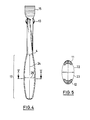
- Fig. 4 eine der Fig. 2 entsprechende Schmalseitenansicht einer zweiten Ausführungsform;
- Fig. 5. einen der Fig. 3 entsprechenden Schnitt durch die Ausführungsform nach Fig. 4.
- Die in Fig. 1 dargestellte Beißzange besteht aus zwei Griffschenkeln 11, 12, die über ein Gelenk 13 miteinander verbunden sind. Aufgrund der Verbindung mit dem Gelenk 13 sind die beiden Schenkel 11, 12 um die durch das Gelenk 13 gebildete Achse verschwenkbar. Auf der einen Seite, der in Fig. 1 oberen Seite, des Gelenks 13 bilden die Griffschenkel 11, 12 je einen Backen 14, 15. Auf der gegenüberliegenden Seite des Gelenks 13 weisen die Griffschenkel 11, 12 einen Griffbereich 17 auf, der sich von dem freien Ende 16 der Griffschenkel 11, 12 über etwa eine Handbreite erstreckt und von dem übrigen Bereich der Griffschenkel 11, 12 durch eine Einbuchtung 18 getrennt ist. Im Griffbereich 17 sind die sich gegenüberliegenden Griffschenkel 11, 12 derart ausgebildet, daß ihre Außenseiten in der dargestellten Breitseitenansicht etwa der Form einer Ellipse oder eines Ovals folgen, das durch die strichpunktierte Linie 19 angedeutet ist. Die große Achse der Ellipse bzw. des Ovals 19 verläuft in Längsrichtung der Griffschenkel und beträgt etwa 100 mm, während die senkrecht dazu stehende Achse etwa 50 mm beträgt. Der Abstand der Außenseiten der Griffschenkel 11, 12 am freien Ende 16 des Griffbereiches 17 ist etwas kleiner als der Abstand der Außenseiten der Griffschenkel 11, 12 im Bereich des gegenüberliegenden Endes des Griffbereichs 17.
- Aus der in Fig. 2 dargestellten Schmalseitenansicht der Beißzange in Fig. 1 von rechts ergibt sich, daß auch aus dieser Ansicht der Außenumfang der Griffschenkel 11, 12 im Griffbereich 17 etwa die Form einer langgestreckten Ellipse aufweist, deren große Achse ebenfalls etwa 100 mm beträgt, deren kleine Achse aber einen Betrag von etwa 25 mm aufweist.
- Fig. 3 zeigt nun einen Querschnitt etwa längs Linie III-III in Fig. 1, d.h. etwa in Höhe der kleinen Achse der durch die Linie 19 angedeuteten Ellipse. Die Außenfläche 20 des Griffschenkels 11 und die Außenfläche 21 des Griffschenkels 12 liegen beide in einer Ellipse 22 bzw. 23, wobei beide Ellipsen gleich ausgebildet, jedoch seitlich verschoben sind, so daß ihre großen Achsen zueinander parallel bleiben. Die Außenflächen 20, 21 der Griffschenkel 11, 12 liegen jeweils in der Ellipse im Bereich von deren Scheitel. Mit anderen Worten verläuft die große Achse der Ellipse 22 bzw. 23 von der Außenseite 20 des einen Griffschenkels 11 in Richtung auf die Außenseite 21 des anderen unversetzt gedachten Griffschenkels 12.
- Bei der Ausführungsform nach Fig. 4 ist in die Schmalseitenansicht des Griffbereichs 17 die große Achse 24 und die kleine Achse 25 der Ellipse eingezeichnet. Die Abmessungen sind identisch wie bei der Ausführungsform nach Fig. 2, der einzige Unterschied zu der Ausführungsform nach den Fig. 1 bis 3 besteht darin, daß die Griffschenkel 11, 12 in ihrem Griffbereich 17 nicht seitlich versetzt sind. Dementsprechend fallen bei dem Schnitt nach Fig. 5 auch die beiden Ellipsen 22, 23 zusammen.
- Durch die in den Ansprüchen, der Beschreibung und der Zeichnung dargestellten Maßnahmen wird die Handhabung der Zange sowohl im Hinblick auf die Zugkräfte in Richtung zu der Längsachse der Zange als auch für die Hebelkräfte quer zur Zangenlängsachse verbessert.
- Die Handhabung für den Benutzer einer Beißzange mit zwei Griffschenkeln und je einem Backen, die über ein Gelenk in Wirkverbindung stehen, wird durch eine ergonomische Gestaltung der Griffschenkel optimiert und verbessert. Dies wird dadurch erreicht, daß sich die Griffschenkel zueinander am unteren Ende ellipsenförmig gegenüberstehen, daß die Griffschenkel längs der Kopplungsflächen zur Hand und zu den Fingern ellipsenförmig ausgebildet sind und daß die Griffschenkel im Bereich der Kopplungsfläche zur Hand einen ellipsenförmigen Querschnitt aufweisen. Der Vorteil dieser Gestaltung der Handseite der Beißzange liegt darin, daß für alle Anwendungsfälle die Griffschenkel in optimaler Form an die Anatomie und Anthropometrie der menschlichen Hand angepaßt sind.
Claims (6)
Priority Applications (1)
| Application Number | Priority Date | Filing Date | Title |
|---|---|---|---|
| AT86117592T ATE64708T1 (de) | 1985-12-21 | 1986-12-17 | Beisszange. |
Applications Claiming Priority (2)
| Application Number | Priority Date | Filing Date | Title |
|---|---|---|---|
| DE3545755A DE3545755A1 (de) | 1985-12-21 | 1985-12-21 | Beisszange |
| DE3545755 | 1985-12-21 |
Publications (3)
| Publication Number | Publication Date |
|---|---|
| EP0227031A2 true EP0227031A2 (de) | 1987-07-01 |
| EP0227031A3 EP0227031A3 (en) | 1988-02-24 |
| EP0227031B1 EP0227031B1 (de) | 1991-06-26 |
Family
ID=6289371
Family Applications (1)
| Application Number | Title | Priority Date | Filing Date |
|---|---|---|---|
| EP86117592A Expired - Lifetime EP0227031B1 (de) | 1985-12-21 | 1986-12-17 | Beisszange |
Country Status (5)
| Country | Link |
|---|---|
| EP (1) | EP0227031B1 (de) |
| AT (1) | ATE64708T1 (de) |
| DE (2) | DE3545755A1 (de) |
| ES (1) | ES2023809B3 (de) |
| GR (1) | GR3002195T3 (de) |
Cited By (1)
| Publication number | Priority date | Publication date | Assignee | Title |
|---|---|---|---|---|
| EP0227032A3 (en) * | 1985-12-21 | 1988-06-22 | Swg Schraubenwerk Gaisbach Gmbh & Co. Kg | Rabitz-type pincers |
Family Cites Families (5)
| Publication number | Priority date | Publication date | Assignee | Title |
|---|---|---|---|---|
| US2507784A (en) * | 1946-08-13 | 1950-05-16 | Donat H Hamel | Pliers |
| US2618058A (en) * | 1947-04-02 | 1952-11-18 | Carl A Sundstrand | Sportsman's nipper |
| DE2756705C2 (de) * | 1977-12-20 | 1979-11-08 | Werner Moeller Gmbh & Co Kg, 5630 Remscheid | Griffausbildung an einem zangenförmigen Handwerkzeug, insbesondere Zange, Schneider, Schere o.dgl |
| DE3019734C2 (de) * | 1980-05-23 | 1986-03-27 | Werner Möller GmbH & Co KG, 5630 Remscheid | Griffausbildung an einem zangenförmigen Handwerkzeug, insbesondere Zange, Schneider, Schere o.dgl. |
| US4488460A (en) * | 1982-07-28 | 1984-12-18 | Easco Corporation | Ergonomic handle for hand tool |
-
1985
- 1985-12-21 DE DE3545755A patent/DE3545755A1/de not_active Withdrawn
-
1986
- 1986-12-17 EP EP86117592A patent/EP0227031B1/de not_active Expired - Lifetime
- 1986-12-17 DE DE8686117592T patent/DE3679965D1/de not_active Expired - Fee Related
- 1986-12-17 AT AT86117592T patent/ATE64708T1/de not_active IP Right Cessation
- 1986-12-17 ES ES86117592T patent/ES2023809B3/es not_active Expired - Lifetime
-
1991
- 1991-06-27 GR GR91400723T patent/GR3002195T3/el unknown
Cited By (1)
| Publication number | Priority date | Publication date | Assignee | Title |
|---|---|---|---|---|
| EP0227032A3 (en) * | 1985-12-21 | 1988-06-22 | Swg Schraubenwerk Gaisbach Gmbh & Co. Kg | Rabitz-type pincers |
Also Published As
| Publication number | Publication date |
|---|---|
| EP0227031A3 (en) | 1988-02-24 |
| EP0227031B1 (de) | 1991-06-26 |
| ES2023809B3 (es) | 1992-02-16 |
| DE3679965D1 (de) | 1991-08-01 |
| DE3545755A1 (de) | 1987-06-25 |
| ATE64708T1 (de) | 1991-07-15 |
| GR3002195T3 (en) | 1992-12-30 |
Similar Documents
| Publication | Publication Date | Title |
|---|---|---|
| DE3545411C2 (de) | ||
| EP3718180A1 (de) | Pressbacken, sowie presszange mit zwei zangenbacken | |
| DE29713150U1 (de) | Chirurgisches Instrument | |
| WO2019105704A1 (de) | Presszange | |
| WO2019207054A1 (de) | Zange | |
| WO2019224196A1 (de) | Medizinisches instrument | |
| EP0062270B1 (de) | Werkzeugheft | |
| DE8914582U1 (de) | Wundklammer, insbesondere chirurgischer Mikroclip | |
| DE8903079U1 (de) | Chirurgisches Instrument | |
| DE2844065A1 (de) | Handgeraet zum einsetzen von befestigungsmitteln | |
| EP0227031B1 (de) | Beisszange | |
| EP0228659B1 (de) | Handschere für schwere Arbeiten | |
| DE19653649C1 (de) | Pinzette | |
| DE2756705C2 (de) | Griffausbildung an einem zangenförmigen Handwerkzeug, insbesondere Zange, Schneider, Schere o.dgl | |
| DE102015106623A1 (de) | Werkzeug zum Schneiden und Verschließen eines Schlauches | |
| WO2024141333A1 (de) | Zangenartiges schneidwerkzeug | |
| DE2822706A1 (de) | Pinzette | |
| DE69405227T2 (de) | Präzisionszangen | |
| DE3545756A1 (de) | Rabitzzange | |
| DE2337595C2 (de) | Farbroller· oder Deckenbürstengriff | |
| DE102010016057B4 (de) | Zange | |
| DE10155585B4 (de) | Pinzette | |
| DE327547C (de) | Zange mit zwei gegeneinander gefuehrten Pressbacken | |
| DE7704068U1 (de) | Kneifzange | |
| DE2609308A1 (de) | Briefklammer |
Legal Events
| Date | Code | Title | Description |
|---|---|---|---|
| PUAI | Public reference made under article 153(3) epc to a published international application that has entered the european phase |
Free format text: ORIGINAL CODE: 0009012 |
|
| AK | Designated contracting states |
Kind code of ref document: A2 Designated state(s): AT BE CH DE ES FR GB GR IT LI LU NL SE |
|
| PUAL | Search report despatched |
Free format text: ORIGINAL CODE: 0009013 |
|
| AK | Designated contracting states |
Kind code of ref document: A3 Designated state(s): AT BE CH DE ES FR GB GR IT LI LU NL SE |
|
| 17P | Request for examination filed |
Effective date: 19880616 |
|
| RAP3 | Party data changed (applicant data changed or rights of an application transferred) |
Owner name: SWG SCHRAUBENWERK GAISBACH GMBH & CO. KG |
|
| 17Q | First examination report despatched |
Effective date: 19890802 |
|
| GRAA | (expected) grant |
Free format text: ORIGINAL CODE: 0009210 |
|
| AK | Designated contracting states |
Kind code of ref document: B1 Designated state(s): AT BE CH DE ES FR GB GR IT LI LU NL SE |
|
| REF | Corresponds to: |
Ref document number: 64708 Country of ref document: AT Date of ref document: 19910715 Kind code of ref document: T |
|
| REF | Corresponds to: |
Ref document number: 3679965 Country of ref document: DE Date of ref document: 19910801 |
|
| ET | Fr: translation filed | ||
| GBT | Gb: translation of ep patent filed (gb section 77(6)(a)/1977) | ||
| ITF | It: translation for a ep patent filed | ||
| REG | Reference to a national code |
Ref country code: ES Ref legal event code: FG2A Ref document number: 2023809 Country of ref document: ES Kind code of ref document: B3 |
|
| PLBE | No opposition filed within time limit |
Free format text: ORIGINAL CODE: 0009261 |
|
| STAA | Information on the status of an ep patent application or granted ep patent |
Free format text: STATUS: NO OPPOSITION FILED WITHIN TIME LIMIT |
|
| 26N | No opposition filed | ||
| REG | Reference to a national code |
Ref country code: GR Ref legal event code: FG4A Free format text: 3002195 |
|
| EPTA | Lu: last paid annual fee | ||
| EAL | Se: european patent in force in sweden |
Ref document number: 86117592.5 |
|
| PGFP | Annual fee paid to national office [announced via postgrant information from national office to epo] |
Ref country code: GB Payment date: 19991126 Year of fee payment: 14 |
|
| PGFP | Annual fee paid to national office [announced via postgrant information from national office to epo] |
Ref country code: ES Payment date: 19991214 Year of fee payment: 14 |
|
| PGFP | Annual fee paid to national office [announced via postgrant information from national office to epo] |
Ref country code: FR Payment date: 19991217 Year of fee payment: 14 |
|
| PGFP | Annual fee paid to national office [announced via postgrant information from national office to epo] |
Ref country code: SE Payment date: 19991220 Year of fee payment: 14 Ref country code: LU Payment date: 19991220 Year of fee payment: 14 Ref country code: CH Payment date: 19991220 Year of fee payment: 14 Ref country code: AT Payment date: 19991220 Year of fee payment: 14 |
|
| PGFP | Annual fee paid to national office [announced via postgrant information from national office to epo] |
Ref country code: GR Payment date: 19991222 Year of fee payment: 14 |
|
| PGFP | Annual fee paid to national office [announced via postgrant information from national office to epo] |
Ref country code: NL Payment date: 19991223 Year of fee payment: 14 Ref country code: BE Payment date: 19991223 Year of fee payment: 14 |
|
| PGFP | Annual fee paid to national office [announced via postgrant information from national office to epo] |
Ref country code: DE Payment date: 19991227 Year of fee payment: 14 |
|
| PG25 | Lapsed in a contracting state [announced via postgrant information from national office to epo] |
Ref country code: LU Free format text: LAPSE BECAUSE OF NON-PAYMENT OF DUE FEES Effective date: 20001217 Ref country code: GB Free format text: LAPSE BECAUSE OF NON-PAYMENT OF DUE FEES Effective date: 20001217 Ref country code: AT Free format text: LAPSE BECAUSE OF NON-PAYMENT OF DUE FEES Effective date: 20001217 |
|
| PG25 | Lapsed in a contracting state [announced via postgrant information from national office to epo] |
Ref country code: SE Free format text: LAPSE BECAUSE OF NON-PAYMENT OF DUE FEES Effective date: 20001218 |
|
| PG25 | Lapsed in a contracting state [announced via postgrant information from national office to epo] |
Ref country code: LI Free format text: LAPSE BECAUSE OF NON-PAYMENT OF DUE FEES Effective date: 20001231 Ref country code: GR Free format text: LAPSE BECAUSE OF NON-PAYMENT OF DUE FEES Effective date: 20001231 Ref country code: CH Free format text: LAPSE BECAUSE OF NON-PAYMENT OF DUE FEES Effective date: 20001231 Ref country code: BE Free format text: LAPSE BECAUSE OF NON-PAYMENT OF DUE FEES Effective date: 20001231 |
|
| BERE | Be: lapsed |
Owner name: SWG SCHRAUBENWERK GAISBACH G.M.B.H. & CO. K.G. Effective date: 20001231 |
|
| PG25 | Lapsed in a contracting state [announced via postgrant information from national office to epo] |
Ref country code: NL Free format text: LAPSE BECAUSE OF NON-PAYMENT OF DUE FEES Effective date: 20010701 |
|
| GBPC | Gb: european patent ceased through non-payment of renewal fee |
Effective date: 20001217 |
|
| EUG | Se: european patent has lapsed |
Ref document number: 86117592.5 |
|
| REG | Reference to a national code |
Ref country code: CH Ref legal event code: PL |
|
| PG25 | Lapsed in a contracting state [announced via postgrant information from national office to epo] |
Ref country code: FR Free format text: LAPSE BECAUSE OF NON-PAYMENT OF DUE FEES Effective date: 20010831 |
|
| NLV4 | Nl: lapsed or anulled due to non-payment of the annual fee |
Effective date: 20010701 |
|
| REG | Reference to a national code |
Ref country code: FR Ref legal event code: ST |
|
| PG25 | Lapsed in a contracting state [announced via postgrant information from national office to epo] |
Ref country code: DE Free format text: LAPSE BECAUSE OF NON-PAYMENT OF DUE FEES Effective date: 20011002 |
|
| PG25 | Lapsed in a contracting state [announced via postgrant information from national office to epo] |
Ref country code: ES Free format text: LAPSE BECAUSE OF NON-PAYMENT OF DUE FEES Effective date: 20011218 |
|
| REG | Reference to a national code |
Ref country code: ES Ref legal event code: FD2A Effective date: 20020112 |
|
| PG25 | Lapsed in a contracting state [announced via postgrant information from national office to epo] |
Ref country code: IT Free format text: LAPSE BECAUSE OF NON-PAYMENT OF DUE FEES;WARNING: LAPSES OF ITALIAN PATENTS WITH EFFECTIVE DATE BEFORE 2007 MAY HAVE OCCURRED AT ANY TIME BEFORE 2007. THE CORRECT EFFECTIVE DATE MAY BE DIFFERENT FROM THE ONE RECORDED. Effective date: 20051217 |