EP0227050A1 - Procédé pour la préparation de doses unitaires d'administration et les formes d'administration obtenues par ce procédé - Google Patents
Procédé pour la préparation de doses unitaires d'administration et les formes d'administration obtenues par ce procédé Download PDFInfo
- Publication number
- EP0227050A1 EP0227050A1 EP86117669A EP86117669A EP0227050A1 EP 0227050 A1 EP0227050 A1 EP 0227050A1 EP 86117669 A EP86117669 A EP 86117669A EP 86117669 A EP86117669 A EP 86117669A EP 0227050 A1 EP0227050 A1 EP 0227050A1
- Authority
- EP
- European Patent Office
- Prior art keywords
- formulation
- mass
- hollow
- blister
- mold
- Prior art date
- Legal status (The legal status is an assumption and is not a legal conclusion. Google has not performed a legal analysis and makes no representation as to the accuracy of the status listed.)
- Granted
Links
- 238000000034 method Methods 0.000 title claims abstract description 51
- 230000008569 process Effects 0.000 title claims abstract description 19
- 238000002360 preparation method Methods 0.000 title description 6
- 239000011888 foil Substances 0.000 claims abstract description 13
- 230000036760 body temperature Effects 0.000 claims abstract description 10
- 239000000654 additive Substances 0.000 claims abstract description 6
- 229920003023 plastic Polymers 0.000 claims abstract description 5
- 239000004033 plastic Substances 0.000 claims abstract description 5
- 239000000203 mixture Substances 0.000 claims description 43
- 239000002552 dosage form Substances 0.000 claims description 25
- 238000009472 formulation Methods 0.000 claims description 23
- 238000004519 manufacturing process Methods 0.000 claims description 15
- 239000013022 formulation composition Substances 0.000 claims description 14
- 239000003795 chemical substances by application Substances 0.000 claims description 8
- 230000001055 chewing effect Effects 0.000 claims description 8
- 238000007493 shaping process Methods 0.000 claims description 7
- XLYOFNOQVPJJNP-UHFFFAOYSA-N water Substances O XLYOFNOQVPJJNP-UHFFFAOYSA-N 0.000 claims description 7
- 239000004480 active ingredient Substances 0.000 claims description 6
- 238000001816 cooling Methods 0.000 claims description 6
- 210000004051 gastric juice Anatomy 0.000 claims description 6
- 229920001169 thermoplastic Polymers 0.000 claims description 4
- 239000012815 thermoplastic material Substances 0.000 claims description 4
- 239000004416 thermosoftening plastic Substances 0.000 claims description 4
- 229910052782 aluminium Inorganic materials 0.000 claims description 3
- XAGFODPZIPBFFR-UHFFFAOYSA-N aluminium Chemical compound [Al] XAGFODPZIPBFFR-UHFFFAOYSA-N 0.000 claims description 3
- 239000003086 colorant Substances 0.000 claims description 3
- 239000000796 flavoring agent Substances 0.000 claims description 3
- 235000019634 flavors Nutrition 0.000 claims description 3
- 235000003599 food sweetener Nutrition 0.000 claims description 3
- 230000002209 hydrophobic effect Effects 0.000 claims description 3
- 239000003921 oil Substances 0.000 claims description 3
- 239000003755 preservative agent Substances 0.000 claims description 3
- 239000003765 sweetening agent Substances 0.000 claims description 3
- 230000009471 action Effects 0.000 claims description 2
- 239000000314 lubricant Substances 0.000 claims description 2
- 239000000123 paper Substances 0.000 claims description 2
- 230000000979 retarding effect Effects 0.000 claims description 2
- 239000012730 sustained-release form Substances 0.000 claims description 2
- 239000000126 substance Substances 0.000 description 34
- 238000011049 filling Methods 0.000 description 23
- 239000000243 solution Substances 0.000 description 14
- 239000010408 film Substances 0.000 description 13
- 239000000463 material Substances 0.000 description 11
- 238000004806 packaging method and process Methods 0.000 description 10
- 239000007921 spray Substances 0.000 description 10
- PEDCQBHIVMGVHV-UHFFFAOYSA-N Glycerine Chemical compound OCC(O)CO PEDCQBHIVMGVHV-UHFFFAOYSA-N 0.000 description 9
- 239000003925 fat Substances 0.000 description 8
- 238000002844 melting Methods 0.000 description 7
- 239000013543 active substance Substances 0.000 description 6
- 238000000465 moulding Methods 0.000 description 6
- 239000007787 solid Substances 0.000 description 6
- 239000000829 suppository Substances 0.000 description 6
- 230000008901 benefit Effects 0.000 description 5
- 238000005266 casting Methods 0.000 description 5
- 230000008018 melting Effects 0.000 description 5
- 108010010803 Gelatin Proteins 0.000 description 4
- 239000000969 carrier Substances 0.000 description 4
- 239000003814 drug Substances 0.000 description 4
- 239000008273 gelatin Substances 0.000 description 4
- 229920000159 gelatin Polymers 0.000 description 4
- 239000007903 gelatin capsule Substances 0.000 description 4
- 235000019322 gelatine Nutrition 0.000 description 4
- 235000011852 gelatine desserts Nutrition 0.000 description 4
- 239000010410 layer Substances 0.000 description 4
- 239000007788 liquid Substances 0.000 description 4
- 238000004062 sedimentation Methods 0.000 description 4
- 238000003756 stirring Methods 0.000 description 4
- 239000003826 tablet Substances 0.000 description 4
- 102000004190 Enzymes Human genes 0.000 description 3
- 108090000790 Enzymes Proteins 0.000 description 3
- DNIAPMSPPWPWGF-UHFFFAOYSA-N Propylene glycol Chemical compound CC(O)CO DNIAPMSPPWPWGF-UHFFFAOYSA-N 0.000 description 3
- 229920002472 Starch Polymers 0.000 description 3
- 239000002775 capsule Substances 0.000 description 3
- KRKNYBCHXYNGOX-UHFFFAOYSA-N citric acid Chemical compound OC(=O)CC(O)(C(O)=O)CC(O)=O KRKNYBCHXYNGOX-UHFFFAOYSA-N 0.000 description 3
- 238000000576 coating method Methods 0.000 description 3
- 239000000499 gel Substances 0.000 description 3
- 238000002347 injection Methods 0.000 description 3
- 239000007924 injection Substances 0.000 description 3
- 229920001223 polyethylene glycol Polymers 0.000 description 3
- 235000019698 starch Nutrition 0.000 description 3
- QGZKDVFQNNGYKY-UHFFFAOYSA-N Ammonia Chemical compound N QGZKDVFQNNGYKY-UHFFFAOYSA-N 0.000 description 2
- 229920002134 Carboxymethyl cellulose Polymers 0.000 description 2
- FBPFZTCFMRRESA-FSIIMWSLSA-N D-Glucitol Natural products OC[C@H](O)[C@H](O)[C@@H](O)[C@H](O)CO FBPFZTCFMRRESA-FSIIMWSLSA-N 0.000 description 2
- 239000005913 Maltodextrin Substances 0.000 description 2
- 229920002774 Maltodextrin Polymers 0.000 description 2
- 229940069428 antacid Drugs 0.000 description 2
- 239000003159 antacid agent Substances 0.000 description 2
- 210000001124 body fluid Anatomy 0.000 description 2
- 235000010948 carboxy methyl cellulose Nutrition 0.000 description 2
- 230000008859 change Effects 0.000 description 2
- RNFNDJAIBTYOQL-UHFFFAOYSA-N chloral hydrate Chemical compound OC(O)C(Cl)(Cl)Cl RNFNDJAIBTYOQL-UHFFFAOYSA-N 0.000 description 2
- 229960002327 chloral hydrate Drugs 0.000 description 2
- 238000004040 coloring Methods 0.000 description 2
- 239000013039 cover film Substances 0.000 description 2
- 238000011161 development Methods 0.000 description 2
- DOIRQSBPFJWKBE-UHFFFAOYSA-N dibutyl phthalate Chemical compound CCCCOC(=O)C1=CC=CC=C1C(=O)OCCCC DOIRQSBPFJWKBE-UHFFFAOYSA-N 0.000 description 2
- 239000008298 dragée Substances 0.000 description 2
- 229940079593 drug Drugs 0.000 description 2
- 230000000694 effects Effects 0.000 description 2
- 239000000839 emulsion Substances 0.000 description 2
- 210000002468 fat body Anatomy 0.000 description 2
- 238000005429 filling process Methods 0.000 description 2
- 125000005456 glyceride group Chemical group 0.000 description 2
- 239000007902 hard capsule Substances 0.000 description 2
- 229910052500 inorganic mineral Inorganic materials 0.000 description 2
- 229940035034 maltodextrin Drugs 0.000 description 2
- 239000011159 matrix material Substances 0.000 description 2
- 239000011707 mineral Substances 0.000 description 2
- 210000004400 mucous membrane Anatomy 0.000 description 2
- 230000036961 partial effect Effects 0.000 description 2
- 239000002245 particle Substances 0.000 description 2
- 239000004014 plasticizer Substances 0.000 description 2
- -1 polyethylene Polymers 0.000 description 2
- 229920000036 polyvinylpyrrolidone Polymers 0.000 description 2
- 235000013855 polyvinylpyrrolidone Nutrition 0.000 description 2
- 239000000843 powder Substances 0.000 description 2
- 238000012545 processing Methods 0.000 description 2
- 239000002994 raw material Substances 0.000 description 2
- 230000009467 reduction Effects 0.000 description 2
- 239000007901 soft capsule Substances 0.000 description 2
- 239000002904 solvent Substances 0.000 description 2
- 239000000600 sorbitol Substances 0.000 description 2
- 238000005507 spraying Methods 0.000 description 2
- 239000008107 starch Substances 0.000 description 2
- 239000000725 suspension Substances 0.000 description 2
- 230000009747 swallowing Effects 0.000 description 2
- 239000006188 syrup Substances 0.000 description 2
- 235000020357 syrup Nutrition 0.000 description 2
- 238000012546 transfer Methods 0.000 description 2
- URAYPUMNDPQOKB-UHFFFAOYSA-N triacetin Chemical compound CC(=O)OCC(OC(C)=O)COC(C)=O URAYPUMNDPQOKB-UHFFFAOYSA-N 0.000 description 2
- 239000007966 viscous suspension Substances 0.000 description 2
- 239000001993 wax Substances 0.000 description 2
- JNYAEWCLZODPBN-JGWLITMVSA-N (2r,3r,4s)-2-[(1r)-1,2-dihydroxyethyl]oxolane-3,4-diol Chemical compound OC[C@@H](O)[C@H]1OC[C@H](O)[C@H]1O JNYAEWCLZODPBN-JGWLITMVSA-N 0.000 description 1
- GJCOSYZMQJWQCA-UHFFFAOYSA-N 9H-xanthene Chemical compound C1=CC=C2CC3=CC=CC=C3OC2=C1 GJCOSYZMQJWQCA-UHFFFAOYSA-N 0.000 description 1
- 244000215068 Acacia senegal Species 0.000 description 1
- QZCLKYGREBVARF-UHFFFAOYSA-N Acetyl tributyl citrate Chemical compound CCCCOC(=O)CC(C(=O)OCCCC)(OC(C)=O)CC(=O)OCCCC QZCLKYGREBVARF-UHFFFAOYSA-N 0.000 description 1
- 229920001817 Agar Polymers 0.000 description 1
- 102000009027 Albumins Human genes 0.000 description 1
- 108010088751 Albumins Proteins 0.000 description 1
- 108010076119 Caseins Proteins 0.000 description 1
- 229920000623 Cellulose acetate phthalate Polymers 0.000 description 1
- 229920002261 Corn starch Polymers 0.000 description 1
- FBPFZTCFMRRESA-JGWLITMVSA-N D-glucitol Chemical compound OC[C@H](O)[C@@H](O)[C@H](O)[C@H](O)CO FBPFZTCFMRRESA-JGWLITMVSA-N 0.000 description 1
- 239000001856 Ethyl cellulose Substances 0.000 description 1
- ZZSNKZQZMQGXPY-UHFFFAOYSA-N Ethyl cellulose Chemical compound CCOCC1OC(OC)C(OCC)C(OCC)C1OC1C(O)C(O)C(OC)C(CO)O1 ZZSNKZQZMQGXPY-UHFFFAOYSA-N 0.000 description 1
- 241000206672 Gelidium Species 0.000 description 1
- WQZGKKKJIJFFOK-GASJEMHNSA-N Glucose Natural products OC[C@H]1OC(O)[C@H](O)[C@@H](O)[C@@H]1O WQZGKKKJIJFFOK-GASJEMHNSA-N 0.000 description 1
- 229920000084 Gum arabic Polymers 0.000 description 1
- 206010019133 Hangover Diseases 0.000 description 1
- 229920002153 Hydroxypropyl cellulose Polymers 0.000 description 1
- 238000012369 In process control Methods 0.000 description 1
- CERQOIWHTDAKMF-UHFFFAOYSA-N Methacrylic acid Chemical compound CC(=C)C(O)=O CERQOIWHTDAKMF-UHFFFAOYSA-N 0.000 description 1
- 229920000881 Modified starch Polymers 0.000 description 1
- 108010064851 Plant Proteins Proteins 0.000 description 1
- 229920000034 Plastomer Polymers 0.000 description 1
- 239000004698 Polyethylene Substances 0.000 description 1
- 239000004372 Polyvinyl alcohol Substances 0.000 description 1
- 229920001328 Polyvinylidene chloride Polymers 0.000 description 1
- 229920002125 Sokalan® Polymers 0.000 description 1
- 229920002494 Zein Polymers 0.000 description 1
- 108010055615 Zein Proteins 0.000 description 1
- 238000010521 absorption reaction Methods 0.000 description 1
- 235000010489 acacia gum Nutrition 0.000 description 1
- 239000000205 acacia gum Substances 0.000 description 1
- 235000010419 agar Nutrition 0.000 description 1
- 238000004378 air conditioning Methods 0.000 description 1
- 229920000615 alginic acid Polymers 0.000 description 1
- 235000010443 alginic acid Nutrition 0.000 description 1
- 229910021529 ammonia Inorganic materials 0.000 description 1
- 239000007864 aqueous solution Substances 0.000 description 1
- 230000001174 ascending effect Effects 0.000 description 1
- 239000003212 astringent agent Substances 0.000 description 1
- 230000006399 behavior Effects 0.000 description 1
- 230000015572 biosynthetic process Effects 0.000 description 1
- 230000000740 bleeding effect Effects 0.000 description 1
- 239000010839 body fluid Substances 0.000 description 1
- 239000008376 breath freshener Substances 0.000 description 1
- 239000012267 brine Substances 0.000 description 1
- 239000000872 buffer Substances 0.000 description 1
- 239000007853 buffer solution Substances 0.000 description 1
- 239000011111 cardboard Substances 0.000 description 1
- 229940097217 cardiac glycoside Drugs 0.000 description 1
- 239000002368 cardiac glycoside Substances 0.000 description 1
- 239000005018 casein Substances 0.000 description 1
- BECPQYXYKAMYBN-UHFFFAOYSA-N casein, tech. Chemical compound NCCCCC(C(O)=O)N=C(O)C(CC(O)=O)N=C(O)C(CCC(O)=N)N=C(O)C(CC(C)C)N=C(O)C(CCC(O)=O)N=C(O)C(CC(O)=O)N=C(O)C(CCC(O)=O)N=C(O)C(C(C)O)N=C(O)C(CCC(O)=N)N=C(O)C(CCC(O)=N)N=C(O)C(CCC(O)=N)N=C(O)C(CCC(O)=O)N=C(O)C(CCC(O)=O)N=C(O)C(COP(O)(O)=O)N=C(O)C(CCC(O)=N)N=C(O)C(N)CC1=CC=CC=C1 BECPQYXYKAMYBN-UHFFFAOYSA-N 0.000 description 1
- 235000021240 caseins Nutrition 0.000 description 1
- 229940081734 cellulose acetate phthalate Drugs 0.000 description 1
- 229920003086 cellulose ether Polymers 0.000 description 1
- 239000011248 coating agent Substances 0.000 description 1
- 239000000470 constituent Substances 0.000 description 1
- 238000011109 contamination Methods 0.000 description 1
- 238000013270 controlled release Methods 0.000 description 1
- 235000014510 cooky Nutrition 0.000 description 1
- 230000010485 coping Effects 0.000 description 1
- 239000008120 corn starch Substances 0.000 description 1
- 230000001419 dependent effect Effects 0.000 description 1
- 238000013461 design Methods 0.000 description 1
- 239000000645 desinfectant Substances 0.000 description 1
- PCYQQSKDZQTOQG-NXEZZACHSA-N dibutyl (2r,3r)-2,3-dihydroxybutanedioate Chemical compound CCCCOC(=O)[C@H](O)[C@@H](O)C(=O)OCCCC PCYQQSKDZQTOQG-NXEZZACHSA-N 0.000 description 1
- 235000005911 diet Nutrition 0.000 description 1
- 230000000378 dietary effect Effects 0.000 description 1
- ZZVUWRFHKOJYTH-UHFFFAOYSA-N diphenhydramine Chemical compound C=1C=CC=CC=1C(OCCN(C)C)C1=CC=CC=C1 ZZVUWRFHKOJYTH-UHFFFAOYSA-N 0.000 description 1
- 229960000520 diphenhydramine Drugs 0.000 description 1
- BNIILDVGGAEEIG-UHFFFAOYSA-L disodium hydrogen phosphate Chemical compound [Na+].[Na+].OP([O-])([O-])=O BNIILDVGGAEEIG-UHFFFAOYSA-L 0.000 description 1
- 229910000397 disodium phosphate Inorganic materials 0.000 description 1
- 235000019800 disodium phosphate Nutrition 0.000 description 1
- 239000003995 emulsifying agent Substances 0.000 description 1
- 238000005516 engineering process Methods 0.000 description 1
- IINNWAYUJNWZRM-UHFFFAOYSA-L erythrosin B Chemical compound [Na+].[Na+].[O-]C(=O)C1=CC=CC=C1C1=C2C=C(I)C(=O)C(I)=C2OC2=C(I)C([O-])=C(I)C=C21 IINNWAYUJNWZRM-UHFFFAOYSA-L 0.000 description 1
- 229940011411 erythrosine Drugs 0.000 description 1
- 235000012732 erythrosine Nutrition 0.000 description 1
- 239000004174 erythrosine Substances 0.000 description 1
- BEFDCLMNVWHSGT-UHFFFAOYSA-N ethenylcyclopentane Chemical compound C=CC1CCCC1 BEFDCLMNVWHSGT-UHFFFAOYSA-N 0.000 description 1
- 235000019325 ethyl cellulose Nutrition 0.000 description 1
- 229920001249 ethyl cellulose Polymers 0.000 description 1
- 239000000945 filler Substances 0.000 description 1
- 235000011389 fruit/vegetable juice Nutrition 0.000 description 1
- 210000001156 gastric mucosa Anatomy 0.000 description 1
- 239000003349 gelling agent Substances 0.000 description 1
- 239000008103 glucose Substances 0.000 description 1
- 150000004676 glycans Chemical class 0.000 description 1
- 239000001087 glyceryl triacetate Substances 0.000 description 1
- 235000013773 glyceryl triacetate Nutrition 0.000 description 1
- 238000010438 heat treatment Methods 0.000 description 1
- 239000001863 hydroxypropyl cellulose Substances 0.000 description 1
- 235000010977 hydroxypropyl cellulose Nutrition 0.000 description 1
- 229920003132 hydroxypropyl methylcellulose phthalate Polymers 0.000 description 1
- 229940031704 hydroxypropyl methylcellulose phthalate Drugs 0.000 description 1
- 229940071676 hydroxypropylcellulose Drugs 0.000 description 1
- 230000000147 hypnotic effect Effects 0.000 description 1
- 238000010965 in-process control Methods 0.000 description 1
- 230000000968 intestinal effect Effects 0.000 description 1
- 238000004898 kneading Methods 0.000 description 1
- 239000000787 lecithin Substances 0.000 description 1
- 235000010445 lecithin Nutrition 0.000 description 1
- 150000004668 long chain fatty acids Chemical class 0.000 description 1
- 239000007937 lozenge Substances 0.000 description 1
- 229940126601 medicinal product Drugs 0.000 description 1
- 229910052751 metal Inorganic materials 0.000 description 1
- 239000002184 metal Substances 0.000 description 1
- 125000005397 methacrylic acid ester group Chemical group 0.000 description 1
- 229920000609 methyl cellulose Polymers 0.000 description 1
- 235000010981 methylcellulose Nutrition 0.000 description 1
- 239000001923 methylcellulose Substances 0.000 description 1
- 244000005700 microbiome Species 0.000 description 1
- 238000002156 mixing Methods 0.000 description 1
- 238000012986 modification Methods 0.000 description 1
- 230000004048 modification Effects 0.000 description 1
- 235000019426 modified starch Nutrition 0.000 description 1
- 238000012544 monitoring process Methods 0.000 description 1
- 210000002200 mouth mucosa Anatomy 0.000 description 1
- 230000007935 neutral effect Effects 0.000 description 1
- 235000014593 oils and fats Nutrition 0.000 description 1
- 239000003605 opacifier Substances 0.000 description 1
- 239000006186 oral dosage form Substances 0.000 description 1
- LPMXVESGRSUGHW-HBYQJFLCSA-N ouabain Chemical compound O[C@@H]1[C@H](O)[C@@H](O)[C@H](C)O[C@H]1O[C@@H]1C[C@@]2(O)CC[C@H]3[C@@]4(O)CC[C@H](C=5COC(=O)C=5)[C@@]4(C)C[C@@H](O)[C@@H]3[C@@]2(CO)[C@H](O)C1 LPMXVESGRSUGHW-HBYQJFLCSA-N 0.000 description 1
- 230000003647 oxidation Effects 0.000 description 1
- 238000007254 oxidation reaction Methods 0.000 description 1
- 238000012856 packing Methods 0.000 description 1
- 239000011087 paperboard Substances 0.000 description 1
- 235000010603 pastilles Nutrition 0.000 description 1
- 235000010987 pectin Nutrition 0.000 description 1
- 239000001814 pectin Substances 0.000 description 1
- 229920001277 pectin Polymers 0.000 description 1
- 235000021118 plant-derived protein Nutrition 0.000 description 1
- 239000004584 polyacrylic acid Substances 0.000 description 1
- 229920000573 polyethylene Polymers 0.000 description 1
- 229920000642 polymer Polymers 0.000 description 1
- 229920001282 polysaccharide Polymers 0.000 description 1
- 239000005017 polysaccharide Substances 0.000 description 1
- 229920001296 polysiloxane Polymers 0.000 description 1
- 229920002689 polyvinyl acetate Polymers 0.000 description 1
- 239000011118 polyvinyl acetate Substances 0.000 description 1
- 229940075065 polyvinyl acetate Drugs 0.000 description 1
- 229940100467 polyvinyl acetate phthalate Drugs 0.000 description 1
- 229920002451 polyvinyl alcohol Polymers 0.000 description 1
- 229940068984 polyvinyl alcohol Drugs 0.000 description 1
- 239000005033 polyvinylidene chloride Substances 0.000 description 1
- 239000001267 polyvinylpyrrolidone Substances 0.000 description 1
- 239000011241 protective layer Substances 0.000 description 1
- 239000003531 protein hydrolysate Substances 0.000 description 1
- 238000005086 pumping Methods 0.000 description 1
- 238000011084 recovery Methods 0.000 description 1
- 230000002829 reductive effect Effects 0.000 description 1
- 230000000717 retained effect Effects 0.000 description 1
- 150000003839 salts Chemical class 0.000 description 1
- 238000007789 sealing Methods 0.000 description 1
- 238000000926 separation method Methods 0.000 description 1
- 150000004760 silicates Chemical class 0.000 description 1
- RMAQACBXLXPBSY-UHFFFAOYSA-N silicic acid Chemical compound O[Si](O)(O)O RMAQACBXLXPBSY-UHFFFAOYSA-N 0.000 description 1
- 235000012239 silicon dioxide Nutrition 0.000 description 1
- HPALAKNZSZLMCH-UHFFFAOYSA-M sodium;chloride;hydrate Chemical compound O.[Na+].[Cl-] HPALAKNZSZLMCH-UHFFFAOYSA-M 0.000 description 1
- 239000007909 solid dosage form Substances 0.000 description 1
- 229940075582 sorbic acid Drugs 0.000 description 1
- 235000010199 sorbic acid Nutrition 0.000 description 1
- 239000004334 sorbic acid Substances 0.000 description 1
- 238000010186 staining Methods 0.000 description 1
- 229930002534 steroid glycoside Natural products 0.000 description 1
- 210000002784 stomach Anatomy 0.000 description 1
- 238000013517 stratification Methods 0.000 description 1
- 230000008961 swelling Effects 0.000 description 1
- 239000000454 talc Substances 0.000 description 1
- 229910052623 talc Inorganic materials 0.000 description 1
- 238000012360 testing method Methods 0.000 description 1
- 229960002622 triacetin Drugs 0.000 description 1
- 150000003626 triacylglycerols Chemical class 0.000 description 1
- 238000009966 trimming Methods 0.000 description 1
- 210000001835 viscera Anatomy 0.000 description 1
- 239000011782 vitamin Substances 0.000 description 1
- 229940088594 vitamin Drugs 0.000 description 1
- 229930003231 vitamin Natural products 0.000 description 1
- 235000013343 vitamin Nutrition 0.000 description 1
- 150000003722 vitamin derivatives Chemical class 0.000 description 1
- 238000005303 weighing Methods 0.000 description 1
- 229920001285 xanthan gum Polymers 0.000 description 1
- 239000005019 zein Substances 0.000 description 1
- 229940093612 zein Drugs 0.000 description 1
Images


Classifications
-
- A—HUMAN NECESSITIES
- A61—MEDICAL OR VETERINARY SCIENCE; HYGIENE
- A61J—CONTAINERS SPECIALLY ADAPTED FOR MEDICAL OR PHARMACEUTICAL PURPOSES; DEVICES OR METHODS SPECIALLY ADAPTED FOR BRINGING PHARMACEUTICAL PRODUCTS INTO PARTICULAR PHYSICAL OR ADMINISTERING FORMS; DEVICES FOR ADMINISTERING FOOD OR MEDICINES ORALLY; BABY COMFORTERS; DEVICES FOR RECEIVING SPITTLE
- A61J3/00—Devices or methods specially adapted for bringing pharmaceutical products into particular physical or administering forms
- A61J3/06—Devices or methods specially adapted for bringing pharmaceutical products into particular physical or administering forms into the form of pills, lozenges or dragees
-
- A—HUMAN NECESSITIES
- A61—MEDICAL OR VETERINARY SCIENCE; HYGIENE
- A61K—PREPARATIONS FOR MEDICAL, DENTAL OR TOILETRY PURPOSES
- A61K9/00—Medicinal preparations characterised by special physical form
- A61K9/20—Pills, tablets, discs, rods
- A61K9/2072—Pills, tablets, discs, rods characterised by shape, structure or size; Tablets with holes, special break lines or identification marks; Partially coated tablets; Disintegrating flat shaped forms
-
- A—HUMAN NECESSITIES
- A61—MEDICAL OR VETERINARY SCIENCE; HYGIENE
- A61J—CONTAINERS SPECIALLY ADAPTED FOR MEDICAL OR PHARMACEUTICAL PURPOSES; DEVICES OR METHODS SPECIALLY ADAPTED FOR BRINGING PHARMACEUTICAL PRODUCTS INTO PARTICULAR PHYSICAL OR ADMINISTERING FORMS; DEVICES FOR ADMINISTERING FOOD OR MEDICINES ORALLY; BABY COMFORTERS; DEVICES FOR RECEIVING SPITTLE
- A61J1/00—Containers specially adapted for medical or pharmaceutical purposes
- A61J1/03—Containers specially adapted for medical or pharmaceutical purposes for pills or tablets
- A61J1/035—Blister-type containers
Definitions
- the invention relates to a process for the production of individually dosed dosage forms, a formulation composition containing plastic, active ingredients and conventional additives at elevated temperature being placed on a stationary or moving support or introduced into blisters or hollow forms made of foils and the formulation composition thereby and with cooling into a dosage form is transferred, and thereafter available dosage forms.
- Tablets, dragees, soft and hard gelatin capsules are essentially known as conventional, widespread, solid dosage forms for the application of medicaments, dietetics and the like. All of the dosage forms mentioned require, in a first step of shaping and in a second step, product-specific packaging that meets both the requirements of the product (e.g. stability) as well as consumer wishes (e.g. attractiveness).
- DE-AS 1 017 322 focuses on a method in which a combined casting mold and packaging for casting and shipping ready-to-use and ready-to-use moldings made from medicaments and similar substances, such as suppositories, pastilles or the like, are used.
- two or more articulated parts are required in each case, each of which must have more than half the thickness of the later cast part in order to be effective in the sense of the known proposal. It is not possible to separate a packaged single dose.
- DE-AS 1 017 322 also mentions the filling of the molded parts with the aid of a pouring frame which is intended to enable the molds to be filled to the brim. Material that protrudes after casting and then solidifies can be scraped off and reused. This process of filling can solely because of its inaccuracy in dosage, it is not a pharmaceutically relevant procedure that results in drugs that meet today's requirements.
- DE-OS 27 10 307 describes a process for the production and packaging of solid pharmaceutical dosage units which are produced in tablet form, which can be achieved in that the mixture is applied to a continuous belt of different material which has tablet-shaped depressions .
- Fats are used as carriers. Fat mixtures, other lipoid substances and lipoid components mentioned, the melting point of which should be above 37 ° C., preferably above 43 ° C.
- the for the present invention actually important statement of DE-OS 27 10 307 lies in the sentence that the molten mixture of carrier substance and active component is "poured" into the recesses with or without a measuring device. This can only mean that it is a low-viscosity, liquefied mixture of substances that can still be poured, but which therefore entails the risk of sedimentation of solids and limits itself in the use of the carriers.
- DE-OS 27 10 307 does not go beyond the use of relatively low-melting fats and waxes, which serve as a matrix for the active ingredient (s). It remains open how these bodies can be removed from the depressions of the foils without breaking, how they taste as fat bodies and what release rates can be expected. At least to date, no product has become known that would have gained market recognition.
- the invention is based on the object of further developing it so that other, more advantageous matrix materials than those described in DE-OS 27 10 307, which are highly viscous even at temperatures above body temperature and have viscosity values of more than 3,000 mPa.s, can be processed in a simple and economical manner into high-quality, individually dosed dosage forms without the disadvantageous tendency to sedimentation of suspended constituents mentioned to appear.
- this object is achieved in that the formulation mass is based on a sol / gel relationship with a softening range above body temperature and heated to above body temperature, and is metered in with a viscosity of more than 3,000 mPa.s under the action of pressure.
- the formulation mass to be dosed has a softening range which is above body temperature.
- the formulation composition metered according to the invention thus has the character of a thermoplastic or a plastomer. It is therefore a question of materials which are essentially not permanently deformable at ordinary temperature. It can therefore be hard or even brittle materials at ordinary temperature, which then soften reversibly when heat is applied and become mechanically relatively easily deformable, in order to finally change to a viscous mass at higher temperatures. In any case, the requirement of the invention must be met that the formulation mass has a softening range above body temperature. It goes without saying for the person skilled in the art that this requirement or the characteristic of the thermoplastic is essentially determined by the carrier mass described in more detail below.
- the minimum viscosity of the carrier mass is 3,000 mPa.s. This viscosity value can be far exceeded, so it is more than 50,000 mPa.s or even more than 100,000 mPa.s and up to 500,000 mPa.s.
- the process according to the invention can be carried out with particular success with metering devices which are capable of coping with viscosities of 500,000 mPa.s, since simple pumping and pouring processes are no longer an option.
- heatable units operating at high pressure can be used as metering devices build up a uniformly high pressure against the piston or gear pumps. By opening the valves for a limited period of time, a constant amount of the recipe mass to be filled is dispensed. Built-in nozzles or filling needles ensure that the hollow molds and blisters are filled properly or that they are applied precisely to documents.
- the pressure at which dosing is carried out is generally above 2 bar and depends on the viscosity of the heated formulation mass to be dosed. It is advantageously between 10 and 70 bar, in particular between 35 and 55 bar.
- valve opening and closing cycles calculated in milliseconds are effected, with the same mass being discharged in front of the valve at the same pressure and opening times depending on the pressure present.
- Any thread formation of the masses to be sprayed can be countered by different nozzle sizes and temperature changes on the dosing heads.
- nozzles designed as injection needles, cone nozzles, double and multiple nozzles and surface nozzles can also be used.
- a control and control electronics 6 ensures the monitoring and compliance with predetermined values for pressure and temperature.
- the speed of the gear pumps and the speed of a belt carrying the molds can be adjusted by means of a synchronization circuit.
- the dosing accuracy of the individual spray heads can be checked by moving them out of the filling line separately and by spraying them separately into a weighing dish. With an output of 70,000 filled deep-drawing molds per hour with a filling weight of 500 mg, a dosing accuracy of ⁇ 2% and a relative standard deviation of ⁇ 1% were found. Laetus devices, which monitor every form for exact filling, are suitable for ongoing control during the filling process. In addition, the finished sealed strips can also be passed through a ⁇ balance.
- dosage forms which in the simplest case can be placed on a base without any molding tool - either cooled, at room temperature or above warmed up, either at rest or moved - to be injected.
- the viscosity and temperature of the masses to be processed then determine the shape of the desired body. In this way, one obtains either flat "cookies" with a tablet-like appearance or more cone-shaped products.
- the base such as a conveyor belt
- the z. B. can take the form of internal organs, such as the heart or stomach, and in this way indicate the area of indication of the product produced. (Fig. 1).
- a further embodiment of the method proceeds in such a way that so-called blister packs are filled. Then blisters or "wells" are drawn from films of various types, which are filled and sealed with a cover film, which usually consists of coated aluminum. The enclosed recipe mass is pressed through the cover film and is therefore available.
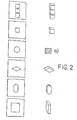
- many dosage forms that differ in shape and size can also be produced (FIG. 2). It is advisable to give the bowls a slightly conical shape in order to make it easier for the product to be pressed out.
- the most elegant application of the method according to the invention is the filling of hollow molds, that is to say molds of all sizes and shapes except for a filling funnel.
- deformable and sealable films can be used, provided that they are compatible with the content to be introduced.
- Thermoplastic materials such as preferably polyethylene-coated PVC, PP or PVDC films, but also plastic-coated aluminum films, are particularly suitable for this purpose, provided that they can be shaped into the desired hollow shape. Papers coated with thermoplastics are also suitable. Special coloring or Coatings of the foils can give the enclosed product protection from light, moisture or oxidation.
- the foils can be printed or identified in some other way for better identification of the product.
- the term foils is intended to cover all materials that can serve the aforementioned purpose of forming hollow molds from foils, i.e. in addition to plastic foils also metal foils, coated paper and cardboard materials etc.
- the hollow molds can be produced in a variety of ways. The methods described below are therefore intended to give only preferred examples. With the help of molding tools, symmetrical or asymmetrical semi-hollow shapes can be drawn from two foils, which must be tightly welded at their edges. In the upper part of the hollow form, a funnel-shaped opening initially remains, through which the recipe composition mentioned is introduced. The filling opening is sealed in the usual way after the filling process. An all-round tight pack is created. The molding and the filling can each be carried out in such a way that the individual hollow molds are connected to form several “strips” from which the consumer can separate a single dose. The product placed in the hollow mold is exposed by tearing apart the foils.
- the films have a small, unsealed area in which one film projects a few millimeters above the other. This overlap makes handling easier when separating the foils.
- the individual molds can be z. B. also provided with constrictions that a later division, d. H. Allow portioning of the product, e.g. B. for a children's dose or for portions of a full body as a gift "3 times a day” (Fig. 3).
- FIG. 1 gives some examples of various dosage forms obtained according to the invention or their hollow forms for explanation.
- suitable substances for basic formulations according to the method according to the invention can e.g. B. be raw materials that belong to the gel formers. Together with water, other solvents and / or plasticizers, these form brine in the heat.
- the gel formers can be dissolved at temperatures above 100 ° C. Additional auxiliaries and active ingredients can be incorporated into the cooled solution, usually by kneading. The viscosity reaches values between 50,000 and 800,000 mPA's. at room temperature.
- the bodies obtained with the aid of the dosing devices described are elastic, unbreakable and suitable for swallowing, sucking, chewing or for buccal or perlingual use. They are designed in such a way that they do not melt at body temperature like the fat masses, but deliberately disintegrate or dissolve more or less quickly in the body fluids. If water was used for the preparation, this can either remain in the recipes or the body, e.g. B. in climatic cabinets, dry to a certain moisture content, which can be used to control hardness and elasticity.
- Products that are supposed to be enteric-resistant represent a special dosage form available according to the invention.
- substances or mixtures of substances that do not dissolve in gastric juice into the basic formulations or by exclusively using such substances or mixtures of substances, products are obtained which withstand the test of the pharmacopoeia for gastric juice resistance.
- the dosage forms according to the invention also make it possible to produce products in which the initial dose and the sustained release form are in one dose.
- the sleep aid chloral hydrate is given, which is a fast, but also short-acting hypnotic.
- two or three formulations containing chloral hydrate with different releases are therefore formulated. These are injected one after the other into the mold. The product then looks layered as shown in FIG. 3a, the layering being able to be clarified, for example by coloring the individual recipes.
- Products suitable for buccal or sublingual administration can be produced in a variety of forms and compositions according to the basic principle of the present invention.
- spherical bodies with a small surface area or elongated strips with a large surface area can be formed.
- easily soluble or almost insoluble substances or mixtures can be used to form the medicinal product.
- a great advantage of the invention lies in the fact that mucous substances can be processed which adhere to the oral mucosa for a long time and thus allow the active ingredient to be applied to be in close contact with the mucous membranes.
- Another possibility of using the present invention is the production of chewing and sucking bodies, the solubility of which can vary between fast and "chewing gum-like".
- Embed substances known as mouth and throat disinfectants or astringents or as breath fresheners.
- insoluble substances can be embedded in the basic recipe, which have a certain abrasive effect and are used to clean teeth when chewing.
- Chewable antacids which cling to the gastric mucosa as a viscous suspension to form a film, are a further area of application within the wide range of applications of the chewing bodies obtainable according to the invention.
- the superiority of the dosage forms of the present invention is particularly clear.
- chewable antacids have been used in tablets that crumble as a result of the chewing process.
- the individual particles irritate throat and throat, which gives rise to unpleasant clearing of the throat.
- a viscous suspension is formed in the mouth, which can be swallowed without irritating the mucous membranes.
- emulsions for example of the W / O or O / W type, which disintegrate into finely dispersed drops in the presence of bodily fluids and thus facilitate the absorption of oils and fats and any substances dissolved therein.
- emulsions for example of the W / O or O / W type, which disintegrate into finely dispersed drops in the presence of bodily fluids and thus facilitate the absorption of oils and fats and any substances dissolved therein.
- they have to Solidify emulsions below about 40 ° C to be able to take them out of the hollow molds.
- the invention further allows substances to be added to the dosage forms to be produced which are necessary to maintain or to achieve a specific pH or HLB value.
- the substances can e.g. Buffer mixtures or emulsifiers with a certain HLB value.
- gelatin capsules in which the filling with enzymes is problematic, these can be easily processed in the products obtainable according to the invention, since neither shells nor auxiliary substances have to be used which are attacked by the enzymes and thus reduce the enzyme activity.
- Another advantage of the present invention is that the processing of oily substances, which is usually reserved for soft gelatin capsules, is easily possible by drawing the oil onto a carrier. This mixture is then injected together with a gelling agent into forms which have no tendency to "bleed” or leak. In this way, aqueous solutions can also be processed, an unthinkable process for hard and soft capsule fillings.
- Substances and representatives of substance classes or as carrier masses which can be used for the processes and fields of application shown are in particular: albumins, gelatin, casein, plant proteins, zein, lecithins, agar agar, gum arabic, pectins, alginates, Xanthan, natural and modified starches, maltodextrin, methyl cellulose, ethyl cellulose, cellulose ether polysaccharides, carboxymethyl celluloses, etherified carboxymethyl celluloses, hydroxypropyl cellulose, hydroxypropyl methyl cellulose phthalate, cellulose acetate phthalate, polyvinyl acetate, polyvinyl acetate phthalate, polyvinyl alcohol, polyvinyl pyrrolidone, polyacrylic acid, polymers of methacrylic acid and methacrylic acid esters, polyethylene glycols, poloxalkoles, triglycerides, partial glyceride mixtures, ethoxylated partial
- Plasticizers include e.g. Glycerol, propylene glycol, polyethylene glycols, acetyltributyl citrate, triacetin, dibutyl tartrate, dibutyl phthalate, sorbitol, sorbitan mixtures, glucose syrup etc.
- the products obtainable according to the invention also contain additives, e.g. Opacifiers, colorants, flavors, sweeteners, preservatives and the like can be added.
- additives e.g. Opacifiers, colorants, flavors, sweeteners, preservatives and the like can be added.
- the above-mentioned materials for the preparation of a formulation composition are coordinated so that the adhesion between the solidified formulation composition and the inner surface of the hollow mold is reduced to a minimum.
- the common thermoplastic materials as well as carrier masses or formulation masses allow a clean separation. If this is not possible in individual cases, then the invention offers further advantageous aids for this, which will be discussed below.
- the hollow molds can be provided with separating layers before being filled with the formulation composition in order to prevent sticking or sticking between the film surface and the formulation composition or to reduce them to a minimum.
- the formulations / release agent pairings have the affinity pairing lipophilic / lipophobic or hydrophilic / hydrophobic.
- Preferred substances for this purpose are, for example, talc, starches and the like.
- atomize or atomize release agents such as oils, greases or silicones in the hollow form.
- such substances can also be used with brush-like, rotating tools that spread within the hollow shape, are applied to the inner wall. The same applies to thermoformed packs.
- release agent may be applied to one side of the starting film before the mold is formed, this prepared side later representing the inner surface of the mold.
- coatings can also be placed on the inner wall of the hollow mold that do not act as a separating medium, but rather serve as a carrier layer for lubricants or for colorants, flavors, sweeteners, preservatives and the like, and among other things. favorably influence the application of the product.
- This backing layer combines with the introduced formulation mass and wraps itself around the full body like a coat. In this way it is achieved that only the outer layer of the product z. B. is colored or flavored, which leads to a significant reduction in the corrigents, which would otherwise have to be homogeneously distributed in a substantially larger amount throughout the packing.
- the invention offers numerous advantages.
- it enables the cost-saving and environmentally conscious production of orally administrable dosage forms, whereby the disadvantages mentioned at the outset in the preparation of important dosage forms are largely avoided, in particular inexpensive products can be offered that can be mass-produced without difficulty, with an almost unlimited number
- Incompatible substances can also be presented in a single dosage form without reacting with each other.
- Auxiliary substances influencing the solubility of an active substance such as, for example, solid and liquid substances, can also be processed side by side and in large numbers, so that targeted release of active substance is achieved.
- the shaping process which is mandatory for many dosage forms, can be omitted because the packaging also represents the shaping element. From this it follows as an important finding that there can be no packaging problems with regard to the feeding of the objects to the packaging machines or with regard to wide-ranging dimensional tolerances that cannot be avoided today, for example with soft gelatin capsules.
- the so dreaded mixing of "foreign bodies", such as foreign dragees or foreign capsules, as can occur in previous processes during manufacture or during packaging, is completely ruled out, since the product is introduced into the packaging in a liquid state and seals the filling opening or sealed. Thanks to the special design of the film, shape and content, the products can be given an unmistakable image.
- the invention allows an extraordinarily large number of substances to be processed, whether as auxiliaries or as active substances, whether they are solid and liquid substances side by side. This diversity can lead to products with controlled release of active substances within wide limits, as well as to enteric-coated preparations. In this way, chewing and sucking bodies can also be produced.
- the invention also offers significant advantages from an economic point of view. This eliminates the separate step of shaping, which alone is a decisive reduction in price compared to the previously used processes.
- the high output of filled and at the same time packaged forms per unit of time and the easy-to-install on-line in-process controls represent a further cost-saving rationalization.
- the process is suitable as a replacement for conventional capsule production methods, the costs for complex air conditioning systems and systems for the recovery of solvents including follow-up costs are also eliminated. Since - again in contrast to capsule production - no raw material is wasted (network share in soft capsule production approx. 50% and trimmings in hard capsule production approx. 30% of the gelatin used), there is also considerable savings.
- the method according to the invention can be carried out without polluting the environment.
- the gelatin is dissolved in the solution of sorbic acid in water at 70 ° C. under vacuum. Aroma, sugar color, sorbitol solution and protein hydrolyzate are worked into this solution one after the other. The mixture is deaerated in the heat. The mass is sprayed at 56 ° C. and 48 bar onto a 10 ° C. cooled surface in piles of 1,300 mg each. It is at 20% r. F. and room temperature so long dry net until each single dose weighs 1,090 mg.
- the melted poloxalcol kept at 60 ° C., is introduced into the PEG heated to 60 ° C. with moderate stirring.
- the cardiac glycoside solution in the softigen heated to 45 ° C, is stirred homogeneously into the first solution.
- the mass, cooled to 45 ° C, is injected at 200 mg at 22 bar into oval-shaped hollow molds cooled to 10 ° C.
- the filled forms can be sealed immediately.
- the homogeneous powder mixture of gelatin and HP 55 is added quickly and with stirring to the mixture of water and ammonia. It is important that all powder particles are wetted evenly. After a swelling time of 12 min at room temperature, the crumbly mass is melted in a vacuum at 90 ° C. The glycerol heated to 40 ° C. is stirred into the viscous mass obtained in this way. The cooled mass forms a basic body for a gastric juice-resistant dosage form by staining the mass during manufacture, e.g. B.
- metered portions are resistant to artificial gastric juice (0.1N HCl) for 2 hours without bleeding, while after transfer into a buffer solution (0.2 m Na2HPO4 solution 773 ml + 0 , 1 m citric acid solution 227 ml; pH 6.8) dissolve evenly and without residue within 26 min.
- a buffer solution 0.2 m Na2HPO4 solution 773 ml + 0 , 1 m citric acid solution 227 ml; pH 6.8 dissolve evenly and without residue within 26 min.
- filler materials e.g. As corn starch, gastric juice resistance is retained in the basic recipe, while the solubility in artificial intestinal juice can be controllably extended to several hours.
Landscapes
- Health & Medical Sciences (AREA)
- Chemical & Material Sciences (AREA)
- Medicinal Chemistry (AREA)
- Pharmacology & Pharmacy (AREA)
- Life Sciences & Earth Sciences (AREA)
- Animal Behavior & Ethology (AREA)
- General Health & Medical Sciences (AREA)
- Public Health (AREA)
- Veterinary Medicine (AREA)
- Epidemiology (AREA)
- Medicinal Preparation (AREA)
Applications Claiming Priority (2)
| Application Number | Priority Date | Filing Date | Title |
|---|---|---|---|
| DE3545090A DE3545090C1 (de) | 1985-12-19 | 1985-12-19 | Verfahren zur Herstellung einzeln dosierter Darreichungsformen |
| DE3545090 | 1985-12-19 |
Publications (2)
| Publication Number | Publication Date |
|---|---|
| EP0227050A1 true EP0227050A1 (fr) | 1987-07-01 |
| EP0227050B1 EP0227050B1 (fr) | 1991-04-10 |
Family
ID=6288946
Family Applications (2)
| Application Number | Title | Priority Date | Filing Date |
|---|---|---|---|
| EP87900718A Expired - Lifetime EP0250578B1 (fr) | 1985-12-19 | 1986-12-12 | Procede de production de formes propres a l'administration de doses individuelles et formes ainsi obtenues |
| EP86117669A Expired - Lifetime EP0227050B1 (fr) | 1985-12-19 | 1986-12-18 | Procédé pour la préparation de doses unitaires d'administration et les formes d'administration obtenues par ce procédé |
Family Applications Before (1)
| Application Number | Title | Priority Date | Filing Date |
|---|---|---|---|
| EP87900718A Expired - Lifetime EP0250578B1 (fr) | 1985-12-19 | 1986-12-12 | Procede de production de formes propres a l'administration de doses individuelles et formes ainsi obtenues |
Country Status (9)
| Country | Link |
|---|---|
| EP (2) | EP0250578B1 (fr) |
| JP (1) | JPH0778018B2 (fr) |
| AU (1) | AU577213B2 (fr) |
| CA (1) | CA1289074C (fr) |
| DE (2) | DE3545090C1 (fr) |
| DK (1) | DK165728C (fr) |
| ES (1) | ES2021274B3 (fr) |
| GR (1) | GR3002266T3 (fr) |
| WO (1) | WO1987003805A1 (fr) |
Cited By (5)
| Publication number | Priority date | Publication date | Assignee | Title |
|---|---|---|---|---|
| DE3914170C1 (en) * | 1989-04-28 | 1990-11-22 | Capsoid Pharma Gmbh, 7128 Lauffen, De | Pastille prepn. contg. vitamin(s) etc. - by dosing concave mould with liq. sol or gel mixt. contg. active ingredient, gelatin and water |
| EP0641560A1 (fr) * | 1993-09-01 | 1995-03-08 | So.Ge.Val S.A. | Comprimé vétérinaire plus spécialement destiné aux chats |
| EP0916333A3 (fr) * | 1997-11-14 | 1999-07-07 | Cetoni Umweltechnologie-entwicklungsgesellschaft mbH | Comprimé et/ou emballage pour utilisation médicale et/ou pour soins de santé |
| WO2012163937A3 (fr) * | 2011-05-30 | 2013-05-16 | 2LUTION GmbH | Solutions solides de polyphénols |
| WO2023025437A1 (fr) * | 2021-08-25 | 2023-03-02 | Guido Knobel | Dispositif de préparation d'un produit pharmaceutique, d'un complément alimentaire ou d'un produit cosmétique |
Families Citing this family (6)
| Publication number | Priority date | Publication date | Assignee | Title |
|---|---|---|---|---|
| GB9101502D0 (en) * | 1991-01-23 | 1991-03-06 | Controlled Therapeutics Sct | Controlled release compositions |
| JPH06190020A (ja) * | 1992-12-25 | 1994-07-12 | Nippon Chemiphar Co Ltd | 包装医薬品 |
| DE4415999A1 (de) * | 1994-05-06 | 1995-11-09 | Bolder Arzneimittel Gmbh | Magensäurebindende Kaupastillen |
| DE102012221900A1 (de) | 2012-11-29 | 2014-06-05 | 2LUTION GmbH | Feste Lösungen von Coffein |
| FI125947B (en) | 2013-07-05 | 2016-04-29 | Ravintoraisio Oy | Blood cholesterol lowering composition |
| SG11201605817XA (en) * | 2014-03-03 | 2016-09-29 | Raisio Nutrition Ltd | Serum cholesterol lowering edible product |
Citations (4)
| Publication number | Priority date | Publication date | Assignee | Title |
|---|---|---|---|---|
| CH284791A (de) * | 1949-09-27 | 1952-08-15 | Toms Lab As | Maschine zum Spritzgiessen von Figuren aus plastischer Masse. |
| FR2179044A1 (fr) * | 1972-04-03 | 1973-11-16 | Scherer Corp R P | |
| FR2343473A1 (fr) * | 1976-03-10 | 1977-10-07 | Aco Laekemedel Ab | Fabrication et emballage de doses de produits pharmaceutiques sous forme de comprimes |
| FR2530421A1 (fr) * | 1982-11-17 | 1984-01-27 | Lami Lutti | Procede pour produire des articles de confiserie en gomme moulee et produit ainsi obtenu |
Family Cites Families (1)
| Publication number | Priority date | Publication date | Assignee | Title |
|---|---|---|---|---|
| DE7411652U (de) * | 1974-07-04 | Berthold + Sutter | Vorrichtung zum Aufbereiten und Bereitstellen einer Packungsmasse |
-
1985
- 1985-12-19 DE DE3545090A patent/DE3545090C1/de not_active Expired
-
1986
- 1986-12-12 JP JP62500777A patent/JPH0778018B2/ja not_active Expired - Lifetime
- 1986-12-12 WO PCT/EP1986/000740 patent/WO1987003805A1/fr not_active Ceased
- 1986-12-12 DE DE8787900718T patent/DE3678719D1/de not_active Expired - Lifetime
- 1986-12-12 EP EP87900718A patent/EP0250578B1/fr not_active Expired - Lifetime
- 1986-12-12 AU AU68416/87A patent/AU577213B2/en not_active Ceased
- 1986-12-18 EP EP86117669A patent/EP0227050B1/fr not_active Expired - Lifetime
- 1986-12-18 ES ES86117669T patent/ES2021274B3/es not_active Expired - Lifetime
- 1986-12-18 CA CA000525681A patent/CA1289074C/fr not_active Expired - Lifetime
-
1987
- 1987-07-29 DK DK396787A patent/DK165728C/da not_active IP Right Cessation
-
1991
- 1991-07-05 GR GR91400958T patent/GR3002266T3/el not_active IP Right Cessation
Patent Citations (4)
| Publication number | Priority date | Publication date | Assignee | Title |
|---|---|---|---|---|
| CH284791A (de) * | 1949-09-27 | 1952-08-15 | Toms Lab As | Maschine zum Spritzgiessen von Figuren aus plastischer Masse. |
| FR2179044A1 (fr) * | 1972-04-03 | 1973-11-16 | Scherer Corp R P | |
| FR2343473A1 (fr) * | 1976-03-10 | 1977-10-07 | Aco Laekemedel Ab | Fabrication et emballage de doses de produits pharmaceutiques sous forme de comprimes |
| FR2530421A1 (fr) * | 1982-11-17 | 1984-01-27 | Lami Lutti | Procede pour produire des articles de confiserie en gomme moulee et produit ainsi obtenu |
Cited By (6)
| Publication number | Priority date | Publication date | Assignee | Title |
|---|---|---|---|---|
| DE3914170C1 (en) * | 1989-04-28 | 1990-11-22 | Capsoid Pharma Gmbh, 7128 Lauffen, De | Pastille prepn. contg. vitamin(s) etc. - by dosing concave mould with liq. sol or gel mixt. contg. active ingredient, gelatin and water |
| EP0641560A1 (fr) * | 1993-09-01 | 1995-03-08 | So.Ge.Val S.A. | Comprimé vétérinaire plus spécialement destiné aux chats |
| FR2709420A1 (fr) * | 1993-09-01 | 1995-03-10 | Sogeval | Comprimé vétérinaire plus spécialement destiné aux chats. |
| EP0916333A3 (fr) * | 1997-11-14 | 1999-07-07 | Cetoni Umweltechnologie-entwicklungsgesellschaft mbH | Comprimé et/ou emballage pour utilisation médicale et/ou pour soins de santé |
| WO2012163937A3 (fr) * | 2011-05-30 | 2013-05-16 | 2LUTION GmbH | Solutions solides de polyphénols |
| WO2023025437A1 (fr) * | 2021-08-25 | 2023-03-02 | Guido Knobel | Dispositif de préparation d'un produit pharmaceutique, d'un complément alimentaire ou d'un produit cosmétique |
Also Published As
| Publication number | Publication date |
|---|---|
| AU6841687A (en) | 1987-07-15 |
| EP0250578A1 (fr) | 1988-01-07 |
| EP0250578B1 (fr) | 1991-04-10 |
| AU577213B2 (en) | 1988-09-15 |
| DK396787A (da) | 1987-07-29 |
| WO1987003805A1 (fr) | 1987-07-02 |
| DK396787D0 (da) | 1987-07-29 |
| JPS63502430A (ja) | 1988-09-14 |
| CA1289074C (fr) | 1991-09-17 |
| DE3678719D1 (de) | 1991-05-16 |
| GR3002266T3 (en) | 1992-12-30 |
| EP0227050B1 (fr) | 1991-04-10 |
| ES2021274B3 (es) | 1991-11-01 |
| DE3545090C1 (de) | 1987-06-25 |
| DK165728B (da) | 1993-01-11 |
| DK165728C (da) | 1993-06-07 |
| JPH0778018B2 (ja) | 1995-08-23 |
Similar Documents
| Publication | Publication Date | Title |
|---|---|---|
| US5229164A (en) | Process for producing individually dosed administration forms | |
| DE69103538T2 (de) | Zweifach unterschichtetes kapselartiges Medikament. | |
| TW544317B (en) | Chewable soft capsules having improved administration properties and process for producing the same | |
| DE60317967T2 (de) | Umhüllte feste Darreichungsform | |
| DE69934831T2 (de) | MULTIPLEXES, FüR DIE ORALE VERBABREICHUNG GEEIGNETES MEDIKAMENTENABGABESYSTEM | |
| DE69817010T2 (de) | Spheroide, verfahren zu ihrer herstellung und diese enthaltende arzneiformen | |
| DE69028433T2 (de) | Kapselähnliches beschichtetes Arzneimittel-Placebo | |
| DE4018247C2 (fr) | ||
| DE69710460T2 (de) | Bikonvexe, rasch desintegrierende verabreichungsformen | |
| DE60319355T2 (de) | Kaubare weichkapsel | |
| EP0701815B1 (fr) | Procédé de préparation de poudres, granules ou pellets renfermant une substance active et ayant une structure composée de macromolécules hydrophiles, ainsi que leur utilisation | |
| EP0227050B1 (fr) | Procédé pour la préparation de doses unitaires d'administration et les formes d'administration obtenues par ce procédé | |
| DD269124A5 (de) | Vorrichtung zur kontrollierten freigabe einer aktiven substanz | |
| EP2042165A1 (fr) | Capsules molles remplies avec un excipient thermofusible | |
| EP3609350A1 (fr) | Produit de gélatine pourvu d'un composant central et procede de fabrication | |
| DE3509743C2 (de) | Abgabevorrichtung zur Freisetzung eines Wirkstoffs | |
| DE69014092T2 (de) | Kombination einer Kapsel und Kaplet. | |
| KR100732199B1 (ko) | 저작성 캡슐 및 그 제조 방법 | |
| JP2000302654A (ja) | 歯磨組成物の製造法 | |
| DE112010005235B4 (de) | Dragiermittel zum Dragieren von Arzneimitteln und Lebensmitteln | |
| CA2585444A1 (fr) | Formes posologiques a surface en microrelief et procedes et appareil d'obtention de celles-ci | |
| JPH0952850A (ja) | グミ製剤 | |
| DE2105110A1 (de) | Neuartiges Medikament | |
| EP1075253B1 (fr) | Preparation orale ou mucosique contenant un principe actif, a liberation regulable du principe actif et son utilisation | |
| DE4314705A1 (de) | Lactulose-Pastillen |
Legal Events
| Date | Code | Title | Description |
|---|---|---|---|
| PUAI | Public reference made under article 153(3) epc to a published international application that has entered the european phase |
Free format text: ORIGINAL CODE: 0009012 |
|
| AK | Designated contracting states |
Kind code of ref document: A1 Designated state(s): AT BE CH DE ES FR GB GR IT LI LU NL SE |
|
| RBV | Designated contracting states (corrected) |
Designated state(s): ES GR |
|
| 17P | Request for examination filed |
Effective date: 19871204 |
|
| 17Q | First examination report despatched |
Effective date: 19890712 |
|
| GRAA | (expected) grant |
Free format text: ORIGINAL CODE: 0009210 |
|
| AK | Designated contracting states |
Kind code of ref document: B1 Designated state(s): ES GR |
|
| PLBE | No opposition filed within time limit |
Free format text: ORIGINAL CODE: 0009261 |
|
| STAA | Information on the status of an ep patent application or granted ep patent |
Free format text: STATUS: NO OPPOSITION FILED WITHIN TIME LIMIT |
|
| 26N | No opposition filed | ||
| REG | Reference to a national code |
Ref country code: GR Ref legal event code: FG4A Free format text: 3002266 |
|
| PGFP | Annual fee paid to national office [announced via postgrant information from national office to epo] |
Ref country code: GR Payment date: 20041223 Year of fee payment: 19 |
|
| PGFP | Annual fee paid to national office [announced via postgrant information from national office to epo] |
Ref country code: ES Payment date: 20051227 Year of fee payment: 20 |
|
| PG25 | Lapsed in a contracting state [announced via postgrant information from national office to epo] |
Ref country code: ES Free format text: LAPSE BECAUSE OF EXPIRATION OF PROTECTION Effective date: 20061219 |
|
| REG | Reference to a national code |
Ref country code: ES Ref legal event code: FD2A Effective date: 20061219 |
|
| PG25 | Lapsed in a contracting state [announced via postgrant information from national office to epo] |
Ref country code: GR Free format text: LAPSE BECAUSE OF NON-PAYMENT OF DUE FEES Effective date: 19910410 |