EP0227197B1 - Oxydation von Kohle und Schlacken - Google Patents
Oxydation von Kohle und Schlacken Download PDFInfo
- Publication number
- EP0227197B1 EP0227197B1 EP19860202366 EP86202366A EP0227197B1 EP 0227197 B1 EP0227197 B1 EP 0227197B1 EP 19860202366 EP19860202366 EP 19860202366 EP 86202366 A EP86202366 A EP 86202366A EP 0227197 B1 EP0227197 B1 EP 0227197B1
- Authority
- EP
- European Patent Office
- Prior art keywords
- char
- coal
- flyash
- fluidized bed
- slag
- Prior art date
- Legal status (The legal status is an assumption and is not a legal conclusion. Google has not performed a legal analysis and makes no representation as to the accuracy of the status listed.)
- Expired
Links
- 239000002893 slag Substances 0.000 title claims description 52
- 230000003647 oxidation Effects 0.000 title description 8
- 238000007254 oxidation reaction Methods 0.000 title description 8
- 239000003245 coal Substances 0.000 claims description 53
- 239000007789 gas Substances 0.000 claims description 41
- 238000002309 gasification Methods 0.000 claims description 37
- 238000000034 method Methods 0.000 claims description 28
- 239000010881 fly ash Substances 0.000 claims description 26
- 239000000463 material Substances 0.000 claims description 23
- 230000015572 biosynthetic process Effects 0.000 claims description 19
- 238000003786 synthesis reaction Methods 0.000 claims description 19
- 239000007787 solid Substances 0.000 claims description 14
- XLYOFNOQVPJJNP-UHFFFAOYSA-N water Substances O XLYOFNOQVPJJNP-UHFFFAOYSA-N 0.000 claims description 13
- QVGXLLKOCUKJST-UHFFFAOYSA-N atomic oxygen Chemical compound [O] QVGXLLKOCUKJST-UHFFFAOYSA-N 0.000 claims description 11
- 239000001301 oxygen Substances 0.000 claims description 11
- 229910052760 oxygen Inorganic materials 0.000 claims description 11
- 238000005243 fluidization Methods 0.000 claims description 10
- 238000001816 cooling Methods 0.000 claims description 7
- 239000012535 impurity Substances 0.000 claims description 7
- 230000004927 fusion Effects 0.000 claims description 6
- 229910052500 inorganic mineral Inorganic materials 0.000 claims description 6
- 239000011707 mineral Substances 0.000 claims description 6
- 230000001590 oxidative effect Effects 0.000 claims description 6
- 238000010791 quenching Methods 0.000 claims description 6
- 230000000171 quenching effect Effects 0.000 claims description 4
- 239000011343 solid material Substances 0.000 claims description 2
- 238000001035 drying Methods 0.000 description 14
- 239000002245 particle Substances 0.000 description 13
- OKTJSMMVPCPJKN-UHFFFAOYSA-N Carbon Chemical compound [C] OKTJSMMVPCPJKN-UHFFFAOYSA-N 0.000 description 9
- 229910052799 carbon Inorganic materials 0.000 description 9
- 238000000926 separation method Methods 0.000 description 5
- IJGRMHOSHXDMSA-UHFFFAOYSA-N Atomic nitrogen Chemical compound N#N IJGRMHOSHXDMSA-UHFFFAOYSA-N 0.000 description 4
- 239000000446 fuel Substances 0.000 description 4
- VYPSYNLAJGMNEJ-UHFFFAOYSA-N Silicium dioxide Chemical compound O=[Si]=O VYPSYNLAJGMNEJ-UHFFFAOYSA-N 0.000 description 3
- 239000000567 combustion gas Substances 0.000 description 3
- 238000002485 combustion reaction Methods 0.000 description 3
- 239000003077 lignite Substances 0.000 description 3
- 238000004519 manufacturing process Methods 0.000 description 3
- 238000007711 solidification Methods 0.000 description 3
- 230000008023 solidification Effects 0.000 description 3
- 239000013589 supplement Substances 0.000 description 3
- MYMOFIZGZYHOMD-UHFFFAOYSA-N Dioxygen Chemical compound O=O MYMOFIZGZYHOMD-UHFFFAOYSA-N 0.000 description 2
- -1 e.g. Substances 0.000 description 2
- 238000010438 heat treatment Methods 0.000 description 2
- 229910052757 nitrogen Inorganic materials 0.000 description 2
- 239000013618 particulate matter Substances 0.000 description 2
- 239000000047 product Substances 0.000 description 2
- 238000011084 recovery Methods 0.000 description 2
- PNEYBMLMFCGWSK-UHFFFAOYSA-N aluminium oxide Inorganic materials [O-2].[O-2].[O-2].[Al+3].[Al+3] PNEYBMLMFCGWSK-UHFFFAOYSA-N 0.000 description 1
- RHZUVFJBSILHOK-UHFFFAOYSA-N anthracen-1-ylmethanolate Chemical compound C1=CC=C2C=C3C(C[O-])=CC=CC3=CC2=C1 RHZUVFJBSILHOK-UHFFFAOYSA-N 0.000 description 1
- 239000003830 anthracite Substances 0.000 description 1
- 239000002802 bituminous coal Substances 0.000 description 1
- 239000003054 catalyst Substances 0.000 description 1
- 238000006243 chemical reaction Methods 0.000 description 1
- 230000000295 complement effect Effects 0.000 description 1
- 238000010908 decantation Methods 0.000 description 1
- 239000003344 environmental pollutant Substances 0.000 description 1
- 239000011261 inert gas Substances 0.000 description 1
- 238000009434 installation Methods 0.000 description 1
- 238000002844 melting Methods 0.000 description 1
- 230000008018 melting Effects 0.000 description 1
- 239000000203 mixture Substances 0.000 description 1
- 239000012768 molten material Substances 0.000 description 1
- JTJMJGYZQZDUJJ-UHFFFAOYSA-N phencyclidine Chemical class C1CCCCN1C1(C=2C=CC=CC=2)CCCCC1 JTJMJGYZQZDUJJ-UHFFFAOYSA-N 0.000 description 1
- 231100000719 pollutant Toxicity 0.000 description 1
- 239000010453 quartz Substances 0.000 description 1
- 238000004064 recycling Methods 0.000 description 1
- 239000000377 silicon dioxide Substances 0.000 description 1
- 238000004513 sizing Methods 0.000 description 1
- 238000003860 storage Methods 0.000 description 1
- 239000002918 waste heat Substances 0.000 description 1
Images
Classifications
-
- C—CHEMISTRY; METALLURGY
- C10—PETROLEUM, GAS OR COKE INDUSTRIES; TECHNICAL GASES CONTAINING CARBON MONOXIDE; FUELS; LUBRICANTS; PEAT
- C10J—PRODUCTION OF PRODUCER GAS, WATER-GAS, SYNTHESIS GAS FROM SOLID CARBONACEOUS MATERIAL, OR MIXTURES CONTAINING THESE GASES; CARBURETTING AIR OR OTHER GASES
- C10J3/00—Production of combustible gases containing carbon monoxide from solid carbonaceous fuels
- C10J3/72—Other features
- C10J3/82—Gas withdrawal means
- C10J3/84—Gas withdrawal means with means for removing dust or tar from the gas
-
- C—CHEMISTRY; METALLURGY
- C10—PETROLEUM, GAS OR COKE INDUSTRIES; TECHNICAL GASES CONTAINING CARBON MONOXIDE; FUELS; LUBRICANTS; PEAT
- C10J—PRODUCTION OF PRODUCER GAS, WATER-GAS, SYNTHESIS GAS FROM SOLID CARBONACEOUS MATERIAL, OR MIXTURES CONTAINING THESE GASES; CARBURETTING AIR OR OTHER GASES
- C10J3/00—Production of combustible gases containing carbon monoxide from solid carbonaceous fuels
- C10J3/46—Gasification of granular or pulverulent flues in suspension
- C10J3/48—Apparatus; Plants
- C10J3/482—Gasifiers with stationary fluidised bed
-
- C—CHEMISTRY; METALLURGY
- C10—PETROLEUM, GAS OR COKE INDUSTRIES; TECHNICAL GASES CONTAINING CARBON MONOXIDE; FUELS; LUBRICANTS; PEAT
- C10J—PRODUCTION OF PRODUCER GAS, WATER-GAS, SYNTHESIS GAS FROM SOLID CARBONACEOUS MATERIAL, OR MIXTURES CONTAINING THESE GASES; CARBURETTING AIR OR OTHER GASES
- C10J3/00—Production of combustible gases containing carbon monoxide from solid carbonaceous fuels
- C10J3/46—Gasification of granular or pulverulent flues in suspension
- C10J3/48—Apparatus; Plants
- C10J3/485—Entrained flow gasifiers
-
- C—CHEMISTRY; METALLURGY
- C10—PETROLEUM, GAS OR COKE INDUSTRIES; TECHNICAL GASES CONTAINING CARBON MONOXIDE; FUELS; LUBRICANTS; PEAT
- C10J—PRODUCTION OF PRODUCER GAS, WATER-GAS, SYNTHESIS GAS FROM SOLID CARBONACEOUS MATERIAL, OR MIXTURES CONTAINING THESE GASES; CARBURETTING AIR OR OTHER GASES
- C10J3/00—Production of combustible gases containing carbon monoxide from solid carbonaceous fuels
- C10J3/46—Gasification of granular or pulverulent flues in suspension
- C10J3/48—Apparatus; Plants
- C10J3/52—Ash-removing devices
- C10J3/526—Ash-removing devices for entrained flow gasifiers
-
- C—CHEMISTRY; METALLURGY
- C10—PETROLEUM, GAS OR COKE INDUSTRIES; TECHNICAL GASES CONTAINING CARBON MONOXIDE; FUELS; LUBRICANTS; PEAT
- C10J—PRODUCTION OF PRODUCER GAS, WATER-GAS, SYNTHESIS GAS FROM SOLID CARBONACEOUS MATERIAL, OR MIXTURES CONTAINING THESE GASES; CARBURETTING AIR OR OTHER GASES
- C10J3/00—Production of combustible gases containing carbon monoxide from solid carbonaceous fuels
- C10J3/46—Gasification of granular or pulverulent flues in suspension
- C10J3/54—Gasification of granular or pulverulent fuels by the Winkler technique, i.e. by fluidisation
-
- C—CHEMISTRY; METALLURGY
- C10—PETROLEUM, GAS OR COKE INDUSTRIES; TECHNICAL GASES CONTAINING CARBON MONOXIDE; FUELS; LUBRICANTS; PEAT
- C10J—PRODUCTION OF PRODUCER GAS, WATER-GAS, SYNTHESIS GAS FROM SOLID CARBONACEOUS MATERIAL, OR MIXTURES CONTAINING THESE GASES; CARBURETTING AIR OR OTHER GASES
- C10J3/00—Production of combustible gases containing carbon monoxide from solid carbonaceous fuels
- C10J3/72—Other features
- C10J3/721—Multistage gasification, e.g. plural parallel or serial gasification stages
-
- C—CHEMISTRY; METALLURGY
- C10—PETROLEUM, GAS OR COKE INDUSTRIES; TECHNICAL GASES CONTAINING CARBON MONOXIDE; FUELS; LUBRICANTS; PEAT
- C10J—PRODUCTION OF PRODUCER GAS, WATER-GAS, SYNTHESIS GAS FROM SOLID CARBONACEOUS MATERIAL, OR MIXTURES CONTAINING THESE GASES; CARBURETTING AIR OR OTHER GASES
- C10J3/00—Production of combustible gases containing carbon monoxide from solid carbonaceous fuels
- C10J3/72—Other features
- C10J3/78—High-pressure apparatus
-
- C—CHEMISTRY; METALLURGY
- C10—PETROLEUM, GAS OR COKE INDUSTRIES; TECHNICAL GASES CONTAINING CARBON MONOXIDE; FUELS; LUBRICANTS; PEAT
- C10J—PRODUCTION OF PRODUCER GAS, WATER-GAS, SYNTHESIS GAS FROM SOLID CARBONACEOUS MATERIAL, OR MIXTURES CONTAINING THESE GASES; CARBURETTING AIR OR OTHER GASES
- C10J2300/00—Details of gasification processes
- C10J2300/09—Details of the feed, e.g. feeding of spent catalyst, inert gas or halogens
- C10J2300/0913—Carbonaceous raw material
- C10J2300/093—Coal
-
- C—CHEMISTRY; METALLURGY
- C10—PETROLEUM, GAS OR COKE INDUSTRIES; TECHNICAL GASES CONTAINING CARBON MONOXIDE; FUELS; LUBRICANTS; PEAT
- C10J—PRODUCTION OF PRODUCER GAS, WATER-GAS, SYNTHESIS GAS FROM SOLID CARBONACEOUS MATERIAL, OR MIXTURES CONTAINING THESE GASES; CARBURETTING AIR OR OTHER GASES
- C10J2300/00—Details of gasification processes
- C10J2300/09—Details of the feed, e.g. feeding of spent catalyst, inert gas or halogens
- C10J2300/0953—Gasifying agents
- C10J2300/0956—Air or oxygen enriched air
-
- C—CHEMISTRY; METALLURGY
- C10—PETROLEUM, GAS OR COKE INDUSTRIES; TECHNICAL GASES CONTAINING CARBON MONOXIDE; FUELS; LUBRICANTS; PEAT
- C10J—PRODUCTION OF PRODUCER GAS, WATER-GAS, SYNTHESIS GAS FROM SOLID CARBONACEOUS MATERIAL, OR MIXTURES CONTAINING THESE GASES; CARBURETTING AIR OR OTHER GASES
- C10J2300/00—Details of gasification processes
- C10J2300/09—Details of the feed, e.g. feeding of spent catalyst, inert gas or halogens
- C10J2300/0953—Gasifying agents
- C10J2300/0959—Oxygen
Definitions
- the invention relates to a process for the gasification of coal to produce synthesis gas comprising the steps of feeding particulate coal to a gasification zone, and partially oxidizing coal with oxygen in said gasification zone, producing a stream comprising synthesis gas and flyash, and producing bottom impurity solid materials which are collected in a water bath as char, fine slag, and coarse slag; quenching and cooling the said produced stream, and separating flyash from the said stream, producing a separated flyash; removing a material comprising char from said water bath; fluidizing removed char in a fluidized bed in a fluidization zone, and oxidizing said char in said fluidized bed with oxygen at a temperature below the fusion temperature of the mineral components of the char and the fluidized bed, producing a substantially carbon-free residue and heated gases.
- a process for gasification of coal characterized by utilization of heat values obtained from flyash, with concomitant reduction of material for disposal has already been proposed in the related European patent application No. 0227196.
- the present invention is complementary thereto, such that a common fluidized bed oxidation zone for heat energy recovery may be employed.
- the process of the invention is characterized in that the said removed char is oxidized at a temperature from 500°C to 1150°C and a pressure of about atmospheric or higher in the said fluidized bed concomitantly with at least part of the said separated flyash, which is injected into the said fluidized bed and oxidized, and utilizing outside the gasification zone the heat thus recovered to dry the coal to be fed to the gasification zone.
- US-A-4,508,542 discloses a slag separator for a coal gasification installation. This separator permits the classification of slag particles by decantation in a water bath, the precise selection of the desired grain of slag affording an advantage for the slag recycling. Further, US-A-2,633,416 discloses the gasification of carbonaceous solids wherein the slag is burned in a waste heat boiler by oxidation in a fluidized bed for recovering its energy as heating gas for drying the most coal before use.
- Pressures in the gasification zone may be varied widely, but will advantageously range from 10 to 100 atmospheres, more advantageously from 20 to 50 atmospheres, while pressures in the fluidization zone will range from atmospheric to 10 atmospheres or higher.
- a rough separation of char and fine slag from coarse slag may be made in the gasification zone, or char and fine slag and all or a portion of the coarse slag may both be sent to the fluidization zone.
- char refers to those materials, whether solid or molten, which remain in the gasifier upon production of synthesis gas, and have an average particle size (on solidification, if molten) of less than 250 microns in width.
- char and fine slag contain varying portions of residual carbon, e.g., form 5 per cent by weight to 90 per cent by weight of residual carbon, based on the total weight of the char or fine slag, while coarse slag, which is generally a vitreous type of material, contains less than 1 per cent by weight of residual carbon.
- the invention relates to a process for the gasification of coal to produce synthesis gas in which particulate coal is dried in at least one drying zone, the coal is fed from at least one drying zone to a gasification zone, and partially oxidized or combusted, as hereinbefore described, to produce synthesis gas, char, fine slag, and coarse slag, which is treated as described, and the heat generated by oxidizing the char or char and fine slag and at least part of the said separated flyash is utilized in drying coal in at least one drying zone.
- oxygen unless otherwise evident from the context where employed, is taken herein to include air, pure oxygen, air enriched with oxygen, and other oxygen-containing gases.
- the invention is particularly applicable to high pressure coal gasification slagging processes in which the coal is partially oxidized or combusted to produce, in addition to the synthesis gas, flyash, a bottom "char" material, fine slag and a vitreous or coarse slag which are collected in water bath in or associated with the gasification zone.
- the oxygen and coal flows are controlled so that little CO2 is produced in the gaseous product.
- these procedures are carried out by feeding coal, advantageously dry coal, e.g., coal having a moisture content of below about ten per cent by weight, entrained in a gas, such as an inert gas, into a gasification zone, and combusting or oxidizing the coal with oxygen.
- Flame temperatures may reach 3500 °C, with zone outlet temperatures advantageously from 1100 °C to 1800 °C.
- Pressures in these processes will range from 10 atmospheres to 100 atmospheres, advantageously from 20 atmospheres to 50 atmospheres.
- the synthesis gas and flyash are removed from the upper portion of the gasification zone, and the char, fine slag, and coarse slag are collected from the lower portion in a water bath.
- coals are suitable for use in the invention.
- anthracite, bituminous coal, lignite, and so-called brown coal may be used in the invention.
- a real advantage of the invention is the ability to use lower grade coals, such as lignite.
- the term "coal” is taken to include these inferior grade carbonaceous fuels, as well as the higher quality coals.
- the coal will advantageously be fed to the gasification zone in a particle size suitable for boiler furnace operation, e.g., 80 to 90 microns in diameter, although those skilled in the art may select the appropriate particle size, as desired.
- the invention is practised with "dry” coal, that is, coal having a moisture content of less than 10 per cent by weight, based on the weight of the moist coal.
- Synthesis gas and entrained matter which is known as, or becomes what is known as, flyash, is removed from the gasification zone and treated as described therein. Heavier solid particulate matter and molten matter remaining in the gasification zone are allowed to fall into the lower part of the reactor, and thence for example into a water bath, and are collected in the lower portion of the gasification zone.
- flyash a significant distinction between "flyash” and "char” is the density. Fine slag is somewhat denser, while coarse or vitreous slag has, as noted, little carbon content, and has a "glassy" appearance.
- bottoms material i.e., char, fine slag, and coarse slag
- all of the bottoms material i.e., char, fine slag, and coarse slag, be sent to the fluidization zone. If desired, the bottoms material may be crushed to ensure the desired size for fluidization.
- At least the char, and advantageously the fine slag are oxidized concomitantly with at least part of said separated flyash in a fluidization zone comprising at least one fluidized bed to remove the carbonaceous matter therein, producing a denser, more easily disposal of material.
- the heat liberated during oxidation is used either directly or indirectly to dry the coal to be fed to the gasifier.
- the amount of heat generated from the bottoms material will be insufficient to dry the large volume of coal needed for the process.
- the bottoms material is combined, as mentioned, with at least part of the said separated flyash, in the manner provided in the above-mentioned application.
- the type of fluidized bed or beds employed is a matter of choice. What is required, however, is that the bed or beds be operated at a temperature below the fusion temperature of the mineral matter in the bed, including that of a coal or fuel supplement.
- the mineral content of flyash comprises silica, alumina, and other inorganic components in varying quantities, and the melting point of the mixture may be determined routinely. Since these temperatures are normally above 1482 °C (although some may be less), problems with clogging will normally not be encountered if the bed is operated below this temperature.
- the fusion temperature or range of temperatures may be determined routinely for each flyash or fuel utilized, and the temperature in the fluidized bed may be controlled accordingly.
- the temperatures are operated well below the fusion temperature, e.g., from 500 °C to 1150 °C, more advantageously from about 650 °C to about 1120 °C.
- Pressures in the fluidization zone may be varied to the extent suitable for fluidized beds, but may be ranged from atmospheric to 10 atmospheres, for example from atmospheric pressure to 5 atmospheres.
- the fluidized bed or beds may be jacketed, or may have coils to absorb the heat produced by the oxidation.
- the bed may contain other particulate matter, including catalysts.
- the combustion gases generated are removed from the fluidization zone, and transfer their heat, either directly or indirectly, as desired, advantageously to the coal feed.
- the coal can be ground and dried in a combination procedure, and to allow conventional equipment to be used, a moderating gas, such as air, or nitrogen, at a temperature of, for example, 15 °C to 40 °C, is added to the combustion gases to lower the temperature to 200 °C to 500 °C.
- a moderating gas such as air, or nitrogen
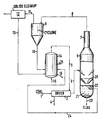
- reference numeral (1) designates a supply line from, for example, a storage vessel, not shown, in which coal having an average particle size diameter of 1.3 cm is fed to a drying zone (2) which contains a combination pulverizer-dryer wherein the coal is crushed to an average particle size of from 80 to 90 microns and dried by the gas stream in a line (3) to a moisture content of 10 per cent by weight, based on the weight of the moisture and the coal.
- the gas stream in the line (3) has a temperature of 250 °C, contacts the coal directly in the combination pulverizer-dryer, and exits the drying zone (2) via a line (4).
- the exit gas may be treated for control of pollutants, or utilized (not shown).
- dried particulate coal is removed from the drying zone (2) through a line (5) and forwarded to a gasifier (6).
- Means may be provided (not illustrated), for raising the pressure of the coal and entraining gas up to the level employed in the gasification zone.
- the coal is injected in an entraining gas, e.g. nitrogen, through nozzles and combusted in a reducing atmosphere or partially oxidized with pure oxygen at 25 atmospheres and at a flame temperature of 3400 °C to 3500 °C.
- Synthesis gas and impurity particles are removed overhead from the gasification zone at a temperature of 1400 °C, and sent to a quenching and cooling zone (7).
- Char and slag which are heavier impurity materials, fall downward into the gasifier, and are removed from the lower portion thereof.
- the quench and cooling zone (7) can be connected directly to the outlet of the gasifier (6).
- the synthesis gas can be first quenched and cooled with cold recycle gas.
- the temperature of the synthesis gas can be lowered to 900 °C, and molten impurities in the gas are solidified to what is known as flyash.
- the quenching and cooling sequence can be carried out in more than one stage, the final temperature before separation of the flyash being from 235 °C to 320 °C.
- the stream is forwared via a line (8) to a cyclone (9) (or the cooling zone may discharge directly thereto).
- the great bulk of the flyash is separated in the cyclone (9), and the flyash is removed from the cyclone (9) via a line (10).
- the gas stream is removed from the cyclone (9) via a line (11) and sent for further processing, such as for H2S removal, and for product use.
- a final solids cleanup stage (12) e.g., bag filters, is provided in the line (11). Solids are removed from a unit (12) via a line (13). Solids from the cyclone (9) and the solids removal stage (12) is utilized for energy recovery according to the invention.
- a sluice (22) is provided for removal of fine slag and char, and coarse slag may be removed from the bottom of the bath at a line (23).
- the material separated in the sluice (22) is passed via a line (24) to a fluidization zone (14), wherein it is treated, as described hereinafter.
- solids in the lines (10), (13) and (24) are injected into the fluidized bed (14), and are reacted with oxygen in excess from a line (15) at a temperature of 800 °C to 900 °C, which is well below the fusion temperature of the mineral components of the bed.
- the oxygen may serve as the fluidizing gas, or a separate fluidizing gas may be provided.
- the substantially carbon free residue may be removed via a line (16). Residence times of the solids will depend on the operating conditions, such as the temperatures, pressures, and specific equipment, and may be adjusted suitably by those skilled in the art.
- the combustion gas is removed from the bed (14) via the line (3), and is utilized as described previously.
- the total carbon present in the bottoms solids is insufficient to provide the required heat for drying the coal to the process.
- the bottoms material is combined with at least part of the separated flyash.
- additional carbon-containing materials such as coal fines, may be added to the fluidized bed (14) via a line (25).
- the sample was heated in a quartz dish for at least one hour in air at 750 °C in a muffle furnace.
- the sample weighed 69.11 grams and had a volume of about 82 ml.
- the sample weighed 61.2 grams, had a volume of about 55 ml.
- the loss on ignition was 11.4 per cent by weight, based on the weight of the original sample.
- zone includes, where suitable, the use of segmented equipment operated in series, or the division of one unit into multiple units to improve efficiency or overcome size constraints, etc.
- a series of cyclones may be employed, and the quench and cooling operations are preferably carried out in multiple units, utilizing different techniques.
- Parallel operation of units is, of course, well within the scope of the invention, and all equipment, such as pumps, valves, control units, etc. has not been illustrated.
Landscapes
- Chemical & Material Sciences (AREA)
- Engineering & Computer Science (AREA)
- Combustion & Propulsion (AREA)
- Oil, Petroleum & Natural Gas (AREA)
- Organic Chemistry (AREA)
- Fluidized-Bed Combustion And Resonant Combustion (AREA)
- Devices And Processes Conducted In The Presence Of Fluids And Solid Particles (AREA)
Claims (2)
- Ein Verfahren zur Vergasung von Kohle zwecks Herstellung eines Synthesegases, umfassend die folgenden Verfahrensstufen:
Einspeisen von teilchenförmiger Kohle in eine Vergasungszone und Teiloxidation der Kohle mit Sauerstoff in der genannten Vergasungszone, Herstellung eines Stroms ,umfassend Synthesegas und Flugasche, und Herstellung von Verunreinigungen als Feststoffmaterialien als Rückstand, die in einem Wasserbad als Kohle, feine Schlacke und grobkörnige Schlacke gesammelt werden;
Abschrecken und Abkühlen des genannten hergestellten Stroms, und Abtrennen der Flugasche aus dem genannten Strom, Herstellen einer abgetrennten Flugasche;
Entfernen eines Kohle umfassenden Materials aus dem genannten Wasserbad; Fluidisieren der entfernten Kohle in einem Wirbelschichtbett in einer Fluidisierungszone, und Oxidieren der genannten Kohle in dem genannten Wirbelschichtbett mit Sauerstoff bei einer Temperatur unterhalb der Schmelztemperatur der Mineralkomponenten der Kohle und des Wirbelschichtbettes, Herstellen eines im wesentlichen kohlenstofffreien Rückstandes und erhitzter Gase; dadurch gekennzeichnet, daß die entfernte Kohle bei einer Temperatur im Bereich von 500°C bis 1150°C und einem Druck im Bereich von atmosphärischen Druck oder höher in dem genannten Wirbelschichtbett zusammen mit mindestens einem Teil der genannten abgetrennten Flugasche oxidiert wird, welche in das genannte Wirbel schichtbett eingedüst und oxidiert wird, und Verwendung der so gewonnenen Wärme außerhalb der Vergasungszone zum Trocknen der in die Vergasungszone einzuspeisenden Kohle. - Das Verfahren, wie in Anspruch 1 beansprucht, dadurch gekennzeichnet, daß die Wärme in den genannten erhitzten Gasen genutzt wird, indem man feuchte Einspeisungskohle mit einem Feststoff oder Gas kontaktiert, welcher(s) direkt oder indirekt durch die genannten erhitzten Gase erhitzt wird.
Applications Claiming Priority (2)
| Application Number | Priority Date | Filing Date | Title |
|---|---|---|---|
| US81373585A | 1985-12-27 | 1985-12-27 | |
| US813735 | 1985-12-27 |
Publications (3)
| Publication Number | Publication Date |
|---|---|
| EP0227197A2 EP0227197A2 (de) | 1987-07-01 |
| EP0227197A3 EP0227197A3 (en) | 1988-01-27 |
| EP0227197B1 true EP0227197B1 (de) | 1991-02-13 |
Family
ID=25213237
Family Applications (1)
| Application Number | Title | Priority Date | Filing Date |
|---|---|---|---|
| EP19860202366 Expired EP0227197B1 (de) | 1985-12-27 | 1986-12-23 | Oxydation von Kohle und Schlacken |
Country Status (2)
| Country | Link |
|---|---|
| EP (1) | EP0227197B1 (de) |
| DE (1) | DE3677531D1 (de) |
Cited By (1)
| Publication number | Priority date | Publication date | Assignee | Title |
|---|---|---|---|---|
| US9074149B2 (en) | 2009-01-21 | 2015-07-07 | Lummus Technology Inc. | Methods and systems for treating a gasification slag product |
Families Citing this family (2)
| Publication number | Priority date | Publication date | Assignee | Title |
|---|---|---|---|---|
| EP0976807A1 (de) * | 1998-07-29 | 2000-02-02 | "Patelhold" Patentverwertungs-& Elektro-Holding AG | Methode und Einrichtung zur Herstellung eines Reingases aus einem Kohlenwasserstoff |
| US8821600B2 (en) * | 2011-11-30 | 2014-09-02 | Aerojet Rocketdyne Of De, Inc. | Dry bottom reactor vessel and method |
Family Cites Families (5)
| Publication number | Priority date | Publication date | Assignee | Title |
|---|---|---|---|---|
| US2633416A (en) * | 1947-12-03 | 1953-03-31 | Standard Oil Dev Co | Gasification of carbonaceous solids |
| DE2729764A1 (de) * | 1977-07-01 | 1979-01-04 | Davy Bamag Gmbh | Verfahren zur vergasung von kohlenstoffhaltigem material |
| DE2918859C2 (de) * | 1979-05-10 | 1983-12-01 | Carl Still Gmbh & Co Kg, 4350 Recklinghausen | Gasgenerator zum teilweisen Vergasen von Kohle |
| AU6255480A (en) * | 1979-09-21 | 1981-04-09 | Monsanto Company | Gasification of carbon-containing materials |
| US4508542A (en) * | 1981-02-02 | 1985-04-02 | Joseph Langhoff | Slag separator for a coal gasification installation |
-
1986
- 1986-12-23 EP EP19860202366 patent/EP0227197B1/de not_active Expired
- 1986-12-23 DE DE8686202366T patent/DE3677531D1/de not_active Expired - Lifetime
Cited By (1)
| Publication number | Priority date | Publication date | Assignee | Title |
|---|---|---|---|---|
| US9074149B2 (en) | 2009-01-21 | 2015-07-07 | Lummus Technology Inc. | Methods and systems for treating a gasification slag product |
Also Published As
| Publication number | Publication date |
|---|---|
| EP0227197A2 (de) | 1987-07-01 |
| EP0227197A3 (en) | 1988-01-27 |
| DE3677531D1 (de) | 1991-03-21 |
Similar Documents
| Publication | Publication Date | Title |
|---|---|---|
| US4929255A (en) | Method for gasifying or combusting solid carbonaceous material | |
| EP0384454B1 (de) | Vorrichtung zur Vergasung oder Verbrennung von festen kohlenstoffhaltigen Materialien | |
| US4145274A (en) | Pyrolysis with staged recovery | |
| US4806158A (en) | Process of reducing fine-grained iron-containing material by means of solid carbonaceous reducing agents | |
| US3890111A (en) | Transfer line burner system using low oxygen content gas | |
| US3957458A (en) | Gasifying coal or coke and discharging slag frit | |
| EP0227196B1 (de) | Oxydation von Flugasche | |
| US4336128A (en) | Combustion of pyrolyzed carbon containing solids in staged turbulent bed | |
| US3884649A (en) | Coal pretreater and ash agglomerating coal gasifier | |
| US2879148A (en) | Process for the production of carbon monoxide from a solid fuel | |
| WO2007128370A1 (en) | Process and plant for producing char and fuel gas | |
| US9175226B2 (en) | Process and plant for producing char and fuel gas | |
| EP0405632B1 (de) | Kohlenvergasungsverfahren und Reaktor | |
| CA2236523C (en) | Method of returning a finely-divided solid extracted from a reactor vessel using a gas | |
| US4263124A (en) | Process for minimizing solids contamination of liquids from coal pyrolysis | |
| US3847566A (en) | Fluidized bed gasification process with reduction of fines entrainment by utilizing a separate transfer line burner stage | |
| US2677603A (en) | Process and apparatus for the gasification of fine-grained carbonaceous substances | |
| US4118201A (en) | Production of low sulfur fuels from coal | |
| US4391612A (en) | Gasification of coal | |
| US2689786A (en) | Process for the gasification of solid fuels | |
| US6051048A (en) | Production of fuel gas | |
| GB2199843A (en) | Production of combustible gas and sulphur-containing gas | |
| CN1042347C (zh) | 生产铁的方法 | |
| US3957457A (en) | Gasifying coal or coke and discharging ash agglomerates | |
| EP0227197A2 (de) | Oxydation von Kohle und Schlacken |
Legal Events
| Date | Code | Title | Description |
|---|---|---|---|
| PUAI | Public reference made under article 153(3) epc to a published international application that has entered the european phase |
Free format text: ORIGINAL CODE: 0009012 |
|
| AK | Designated contracting states |
Kind code of ref document: A2 Designated state(s): DE GB IT NL |
|
| PUAL | Search report despatched |
Free format text: ORIGINAL CODE: 0009013 |
|
| AK | Designated contracting states |
Kind code of ref document: A3 Designated state(s): DE GB IT NL |
|
| 17P | Request for examination filed |
Effective date: 19880511 |
|
| 17Q | First examination report despatched |
Effective date: 19890424 |
|
| GRAA | (expected) grant |
Free format text: ORIGINAL CODE: 0009210 |
|
| AK | Designated contracting states |
Kind code of ref document: B1 Designated state(s): DE GB IT NL |
|
| ITF | It: translation for a ep patent filed | ||
| REF | Corresponds to: |
Ref document number: 3677531 Country of ref document: DE Date of ref document: 19910321 |
|
| PLBE | No opposition filed within time limit |
Free format text: ORIGINAL CODE: 0009261 |
|
| STAA | Information on the status of an ep patent application or granted ep patent |
Free format text: STATUS: NO OPPOSITION FILED WITHIN TIME LIMIT |
|
| 26N | No opposition filed | ||
| PGFP | Annual fee paid to national office [announced via postgrant information from national office to epo] |
Ref country code: GB Payment date: 19931101 Year of fee payment: 8 |
|
| PGFP | Annual fee paid to national office [announced via postgrant information from national office to epo] |
Ref country code: NL Payment date: 19931231 Year of fee payment: 8 |
|
| PGFP | Annual fee paid to national office [announced via postgrant information from national office to epo] |
Ref country code: DE Payment date: 19940107 Year of fee payment: 8 |
|
| PG25 | Lapsed in a contracting state [announced via postgrant information from national office to epo] |
Ref country code: GB Effective date: 19941223 |
|
| PG25 | Lapsed in a contracting state [announced via postgrant information from national office to epo] |
Ref country code: NL Effective date: 19950701 |
|
| GBPC | Gb: european patent ceased through non-payment of renewal fee |
Effective date: 19941223 |
|
| NLV4 | Nl: lapsed or anulled due to non-payment of the annual fee |
Effective date: 19950701 |
|
| PG25 | Lapsed in a contracting state [announced via postgrant information from national office to epo] |
Ref country code: DE Effective date: 19950901 |
|
| PG25 | Lapsed in a contracting state [announced via postgrant information from national office to epo] |
Ref country code: IT Free format text: LAPSE BECAUSE OF NON-PAYMENT OF DUE FEES;WARNING: LAPSES OF ITALIAN PATENTS WITH EFFECTIVE DATE BEFORE 2007 MAY HAVE OCCURRED AT ANY TIME BEFORE 2007. THE CORRECT EFFECTIVE DATE MAY BE DIFFERENT FROM THE ONE RECORDED. Effective date: 20051223 |