EP0227355A2 - Prodrugs of rapamycin - Google Patents
Prodrugs of rapamycin Download PDFInfo
- Publication number
- EP0227355A2 EP0227355A2 EP86309449A EP86309449A EP0227355A2 EP 0227355 A2 EP0227355 A2 EP 0227355A2 EP 86309449 A EP86309449 A EP 86309449A EP 86309449 A EP86309449 A EP 86309449A EP 0227355 A2 EP0227355 A2 EP 0227355A2
- Authority
- EP
- European Patent Office
- Prior art keywords
- rapamycin
- derivative
- substituent
- mono
- acid
- Prior art date
- Legal status (The legal status is an assumption and is not a legal conclusion. Google has not performed a legal analysis and makes no representation as to the accuracy of the status listed.)
- Granted
Links
Classifications
-
- C—CHEMISTRY; METALLURGY
- C07—ORGANIC CHEMISTRY
- C07H—SUGARS; DERIVATIVES THEREOF; NUCLEOSIDES; NUCLEOTIDES; NUCLEIC ACIDS
- C07H1/00—Processes for the preparation of sugar derivatives
-
- C—CHEMISTRY; METALLURGY
- C07—ORGANIC CHEMISTRY
- C07D—HETEROCYCLIC COMPOUNDS
- C07D498/00—Heterocyclic compounds containing in the condensed system at least one hetero ring having nitrogen and oxygen atoms as the only ring hetero atoms
- C07D498/12—Heterocyclic compounds containing in the condensed system at least one hetero ring having nitrogen and oxygen atoms as the only ring hetero atoms in which the condensed system contains three hetero rings
- C07D498/18—Bridged systems
-
- A—HUMAN NECESSITIES
- A61—MEDICAL OR VETERINARY SCIENCE; HYGIENE
- A61P—SPECIFIC THERAPEUTIC ACTIVITY OF CHEMICAL COMPOUNDS OR MEDICINAL PREPARATIONS
- A61P31/00—Antiinfectives, i.e. antibiotics, antiseptics, chemotherapeutics
- A61P31/04—Antibacterial agents
-
- A—HUMAN NECESSITIES
- A61—MEDICAL OR VETERINARY SCIENCE; HYGIENE
- A61P—SPECIFIC THERAPEUTIC ACTIVITY OF CHEMICAL COMPOUNDS OR MEDICINAL PREPARATIONS
- A61P43/00—Drugs for specific purposes, not provided for in groups A61P1/00-A61P41/00
Definitions
- This invention relates to water soluble prodrugs of rapamycin and in particular to certain acylamino derivatives of rapamycin such as, for example, the glycinate prodrugs of rapamycin, the propionate of rapamycin and the pyrrolidino butyrate prodrugs of rapamycin.
- Rapamycin is a known compound described and claimed in United States Letters Patent Nos. 3,929,992, issued December 30, 1975, and 3,993,749 issued November 23, 1976. Moreover, certain of its acyl derivatives are disclosed and claimed in United States Letters Patent No. 4,316,885, issued February 23, 1982.
- Rapamycin has been disclosed and claimed as useful in the treatment of tumors in Belgian Patent No. 877,700. Rapamycin is, however, only very slightly soluble in water, i.e. 20 micrograms per milliliter, and special injectable formulations have been developed for administration to patients, such as those described and claimed in European Patent Number EP 41,795. These formulations are not altogether satisfactory for a number of reasons including toxicity of the carrier. Accordingly, there is a need in the art for a rapamycin derivative or prodrug which is relatively soluble in water so as to form a safe injectable solution and which is as effective as rapamycin in the treatment of tumors.
- prodrugs of rapamycin can be synthesized which decompose into products including rapamycin in the presence of human plasma and animal tissue homogenates. Such prodrugs of rapamycin provide a component of a valuable pharmaceutical injectable composition for the treatment of tumor in humans.
- the water soluble prodrugs of this invention comprise mono-substituted derivatives at position 28 and disubstituted derivatives at positions 28 and 43 of the rapamycin structure.
- the assignments are based on a structural elucidation published by Findlay et al in Can. J. of Chem. 58, 579 (1980). This structure is shown below:
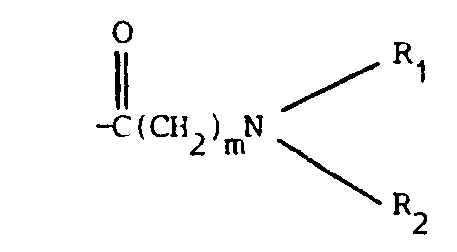
- the mono-substituted derivatives include those having a substituent at position 28 of the rapamycin structure having the following configuration. wherein m is an integer from 1 to 3, wherein R 1 and R 2 are each hydrogen or an alkyl radical having from one to three carbon atoms or wherein R 1 and R 2 together with the nitrogen atom to which they are attached form a saturated heterocyclic ring having four to five carbon atoms.
- R 1 and R 2 are each an alkyl radical of one to three carbon atoms are preferred.
- R 1 and R 2 are methyl and ethyl.
- Examples of m are 1 and 2.
- the di-substituted derivatives include those having substituents at both positions 28 and 43 of the rapamycin structure having the same configuration as the substituent for the mono-substituted derivative.
- This invention also provides processes for preparing the mono-and di-substituted water soluble prodrugs of rapamycin.
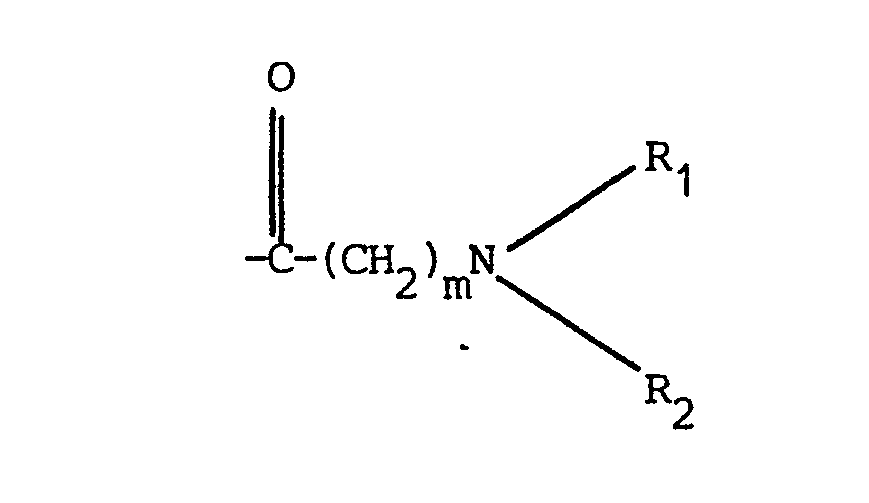
- this invention provides a process for preparing a water-soluble rapamycin derivative mono-substituted at position 28 or disubstituted at positions 28 and 43 by an acylamino substituent having the configuration wherein m, R 1 and R 2 are as defined above which comprises acylating rapamycin with an acylating agent containing the said acylamino substituent having the configuration
- the acylation may be carried out by standard acylation procedures which preferrably foster neutral conditions.
- the acylating agent may be the acid, the acid halide (i.e. the chloride or bromide), the acid annhydride or an activated ester of said acylamino substituent.
- the acid form of the acylamino substituent is preferred as an acylating agent in the presence of a suitable coupling agent.
- the particular coupling agent may be most effective in the presence of a catalyst and/or an acid scavenger.
- Examples of preferred coupling agents are N,N'-dicyclohexylcarbodiimide, 1,1'-earbon- yldiimidazole, diethylazodicarboxylate, 2,2'-dithiopyridine annd N,N-diisopropylcarbodiimide. Diethylazodicarboxylate and 2,2'-dithiopyridine require the use of a catalyst such as triphenylphosphine. With these two coupling agents and triphenylphosphine as a catalyst a non-chlorinated solvent, such as an annyhdrous ether, for example tetrahydrofuran, is preferrable.
- a non-chlorinated solvent such as an annyhdrous ether, for example tetrahydrofuran
- an acid scavenger such as 4-dimethylaminoyridine or 4-pyrolidinopyridine
- a solvent such as anhydrous methylene chloride or chloroform may be used.
- a tertiary amine such as pyridine or triethylamine is preferred as an acid scavenger type catalyst and a solvent such as anhydrous methylene chloride or chloroform may be used.
- the acylation is carried out by reacting rapamycin with an acid of formula in the presence of a coupling agent, e.g. a carbodiimide (such as dicyclohexylcarbodiimide or diisopropylcarbodiimide) or carbonyldiimidazole.
- a coupling agent e.g. a carbodiimide (such as dicyclohexylcarbodiimide or diisopropylcarbodiimide) or carbonyldiimidazole.
- a catalyst such as 4-dimethylaminopyridine or 4-pyrrolidino- pyridine is preferred for use with such coupling agents.
- Coupling agents including carbodiimides and methods using them are well known in the art since they are extensively used in peptide chemistry - see for example E. Schroder and K. Lubke “The Peptides” Vol. 1, A cadamic Press, New York and London 1965 and Mr. Bodanszky & M.A.Ondetti, Peptide Synthesis 1966 Interscience USA.
- R 1 and R 2 are hydrogen
- protection of the amine function of the acylating agent by a protecting group which is removable under neutral conditions is preferred.
- the amine function of such acylating agent may be protected by using the acid chloride hydrochloride of the acylamino substituent as the acylating agent.
- the acid chloride hydrochloride acylating agent may be made in a known manner by reacting the acid form of the acylating agent with one equivalent of hydrogen chloride gas then, with one equivalent phosphorous pentachloride. These reactions may be carried out in anhydrous methylene chloride.
- the product acid chloride hydrochloride may be recovered as a precipitate from toluene, hexane or cyclohexane.
- the acylation using said acid chloride hydrochloride may be carried out in a known manner using a weak base such as pyridine urea, dimethylaniline or trimethylamine as an acid scavenger.
- Rat plasma was obtained from Sprague-Dawley male albino rats and was used within several days. Human plasma was obtained from the Lawrence Memorial Hospital in Lawrence, Kansas. The plasma studies were done at three prodrug concentrations: 200, 100 and 50 ug/ml of prodrug.
- the experimental procedure was as follows: The compound to be tested was taken from a stock aqueous solution of 5mg/ml and added to the plasma to give the desired prodrug concentration. Samples of 200 ⁇ l were removed at predetermined times and added to 200 ⁇ l of 10% metaphosphoric acid to quench the reaction. Before centrifugation 200 ⁇ l of methanol was added to further precipitate the plasma proteins. The results are expressed in half-lives in hours.
- liver homogenate studies were done using livers freshly obtained from male albino Sprague-Dawley rats. A 20% liver homogenate was prepared in Sorensen's buffer at pH 7.4. Chemical stability studies of rapamycin and the two prodrugs of Examples 2 and 3 were carried out at concentrations of 20, 50 and 50 ⁇ g/ml respectively, at 37.5C.
- Rapamycin hydrolysis data in buffers, plasma and in rat liver homogenate are shown in the following table:
- This invention also provides an injectable pharmaceutical composition
- a pharmaceutically acceptable carrier e.g. distilled water, water containing 5% by weight dextrose or a physiologically acceptable salt solution.
- physiologically acceptable salt solution should have a pH in the neutral range, as for example, normal saline or Lactate Ringers solutions.
- a thin layer chromatogram (TLC) of the reaction (solvent system 1:1 acetone:methylene chloride) was taken and indicated the reaction to be complete.
- the Rf of the monoglycinate prodrug was 0.32.
- Some bisglycinate was also present at a R f of 0.09.
- the reaction was worked-up by first filtering off the dicyclohexylurea (DCU). The solvent was removed on the rotovapor to give a white solid.
- the crude product was chromatographed on 18 gm of silica gel using 300 mL of ethyl acetate to elute rapamycin plus residual DCU. The product was eluted with 1:1 methylene chloride:acetone to give 1.67 g of product, yield 55%.
- the prodrug can be reconstituted with either water for injection or distilled water containing 5% by weight dextrose (D5W).
- D5W dextrose
- the solutions should be freshly prepared and used immediately ( ⁇ 1 hr if possible).
- the prodrug appears to discolor upon prolonged exposure to light. Precaution should be taken to prevent this.
- the vessel was placed under a nitrogen atmosphere and 25 mL of anhydrous methylene chloride (dried over P 2 0 5 ) was added followed by 15 mg of 4-dimethylaminopyridine. The reaction was stirred overnight at room temperature. The next day a TLC of the reaction (solvent system: ethyl acetate) on silanized silica gel plate was taken and indicated the reaction to be complete.
- the R f of the monopropionate hydrochloride salt of rapamycin was 0.34 and 0.01 for the bispropionate hydrochloride salt which was also formed in the reaction.
- the dicyclohexylurea was filtered from the reaction and the solvent removed on the rotovapor.
- the prodrug can be reconstituted with either water for injection or D5W.
- the solutions should be freshly prepared and used immediately ( ⁇ 1 hr if possible).
- the prodrug appears to discolor upon prolonged exposure to light. Precaution should be taken to prevent this.
- the prodrug can be reconstituted with either water for injection or D5 W.
- the solutions should be freshly prepared and used immediately ( ⁇ 1 hr if possible).
- the prodrug appears to discolor upon prolonged exposure to light. Precaution should be taken to prevent this.
Landscapes
- Chemical & Material Sciences (AREA)
- Organic Chemistry (AREA)
- Health & Medical Sciences (AREA)
- General Health & Medical Sciences (AREA)
- Life Sciences & Earth Sciences (AREA)
- Medicinal Chemistry (AREA)
- Veterinary Medicine (AREA)
- Nuclear Medicine, Radiotherapy & Molecular Imaging (AREA)
- General Chemical & Material Sciences (AREA)
- Pharmacology & Pharmacy (AREA)
- Chemical Kinetics & Catalysis (AREA)
- Animal Behavior & Ethology (AREA)
- Engineering & Computer Science (AREA)
- Public Health (AREA)
- Bioinformatics & Cheminformatics (AREA)
- Communicable Diseases (AREA)
- Oncology (AREA)
- Biochemistry (AREA)
- Biotechnology (AREA)
- Genetics & Genomics (AREA)
- Molecular Biology (AREA)
- Nitrogen And Oxygen Or Sulfur-Condensed Heterocyclic Ring Systems (AREA)
- Pharmaceuticals Containing Other Organic And Inorganic Compounds (AREA)
- Medicinal Preparation (AREA)
- Preparation Of Compounds By Using Micro-Organisms (AREA)
Abstract
Description
- This invention relates to water soluble prodrugs of rapamycin and in particular to certain acylamino derivatives of rapamycin such as, for example, the glycinate prodrugs of rapamycin, the propionate of rapamycin and the pyrrolidino butyrate prodrugs of rapamycin.
- Rapamycin is a known compound described and claimed in United States Letters Patent Nos. 3,929,992, issued December 30, 1975, and 3,993,749 issued November 23, 1976. Moreover, certain of its acyl derivatives are disclosed and claimed in United States Letters Patent No. 4,316,885, issued February 23, 1982.
- Rapamycin has been disclosed and claimed as useful in the treatment of tumors in Belgian Patent No. 877,700. Rapamycin is, however, only very slightly soluble in water, i.e. 20 micrograms per milliliter, and special injectable formulations have been developed for administration to patients, such as those described and claimed in European Patent Number EP 41,795. These formulations are not altogether satisfactory for a number of reasons including toxicity of the carrier. Accordingly, there is a need in the art for a rapamycin derivative or prodrug which is relatively soluble in water so as to form a safe injectable solution and which is as effective as rapamycin in the treatment of tumors.
- It has now been found that water soluble prodrugs of rapamycin can be synthesized which decompose into products including rapamycin in the presence of human plasma and animal tissue homogenates. Such prodrugs of rapamycin provide a component of a valuable pharmaceutical injectable composition for the treatment of tumor in humans.
- The water soluble prodrugs of this invention comprise mono-substituted derivatives at position 28 and disubstituted derivatives at positions 28 and 43 of the rapamycin structure. The assignments are based on a structural elucidation published by Findlay et al in Can. J. of Chem. 58, 579 (1980). This structure is shown below:

- The mono-substituted derivatives include those having a substituent at position 28 of the rapamycin structure having the following configuration.

- Compounds in which R1 and R2 are each an alkyl radical of one to three carbon atoms are preferred.
- The di-substituted derivatives include those having substituents at both positions 28 and 43 of the rapamycin structure having the same configuration as the substituent for the mono-substituted derivative.
- This invention also provides processes for preparing the mono-and di-substituted water soluble prodrugs of rapamycin.
- Accordingly this invention provides a process for preparing a water-soluble rapamycin derivative mono-substituted at position 28 or disubstituted at positions 28 and 43 by an acylamino substituent having the configuration

- The acylation may be carried out by standard acylation procedures which preferrably foster neutral conditions. The acylating agent may be the acid, the acid halide (i.e. the chloride or bromide), the acid annhydride or an activated ester of said acylamino substituent. The acid form of the acylamino substituent is preferred as an acylating agent in the presence of a suitable coupling agent. The particular coupling agent may be most effective in the presence of a catalyst and/or an acid scavenger. Examples of preferred coupling agents are N,N'-dicyclohexylcarbodiimide, 1,1'-earbon- yldiimidazole, diethylazodicarboxylate, 2,2'-dithiopyridine annd N,N-diisopropylcarbodiimide. Diethylazodicarboxylate and 2,2'-dithiopyridine require the use of a catalyst such as triphenylphosphine. With these two coupling agents and triphenylphosphine as a catalyst a non-chlorinated solvent, such as an annyhdrous ether, for example tetrahydrofuran, is preferrable. With the other coupling agents the use of an acid scavenger, such as 4-dimethylaminoyridine or 4-pyrolidinopyridine, is commonly preferred. With these coupling agents and catalysts a solvent such as anhydrous methylene chloride or chloroform may be used.
- With the acid halide (preferrably the acid chloride) a tertiary amine such as pyridine or triethylamine is preferred as an acid scavenger type catalyst and a solvent such as anhydrous methylene chloride or chloroform may be used.
- In a preferred embodiment the acylation is carried out by reacting rapamycin with an acid of formula

- A catalyst such as 4-dimethylaminopyridine or 4-pyrrolidino- pyridine is preferred for use with such coupling agents. Coupling agents including carbodiimides and methods using them are well known in the art since they are extensively used in peptide chemistry - see for example E. Schroder and K. Lubke "The Peptides" Vol. 1, Acadamic Press, New York and London 1965 and Mr. Bodanszky & M.A.Ondetti, Peptide Synthesis 1966 Interscience USA.
- Where one or both of R1 and R2 is hydrogen, protection of the amine function of the acylating agent by a protecting group which is removable under neutral conditions is preferred. For example, where one or both of R1 and R2 is hydrogen, the amine function of such acylating agent may be protected by using the acid chloride hydrochloride of the acylamino substituent as the acylating agent.
- The acid chloride hydrochloride acylating agent may be made in a known manner by reacting the acid form of the acylating agent with one equivalent of hydrogen chloride gas then, with one equivalent phosphorous pentachloride. These reactions may be carried out in anhydrous methylene chloride. The product acid chloride hydrochloride may be recovered as a precipitate from toluene, hexane or cyclohexane. The acylation using said acid chloride hydrochloride may be carried out in a known manner using a weak base such as pyridine urea, dimethylaniline or trimethylamine as an acid scavenger.
- The preparation of typical water soluble prodrugs of rapamycin of this invention is illustrated in the Examples which were carried out using the following procedures.
- In the examples, chemical stability studies for rapamycin and the prodrugs were done at 20µg/ml with an ionic strength of 0.5. Stabilities at pH 3.3 (0.05 M acetate buffer) and pH 7.4 (0.05 M phosphate buffer) were studied at 25 and 37.5°C. No antioxidants were added and the buffers were not deoxygenated.
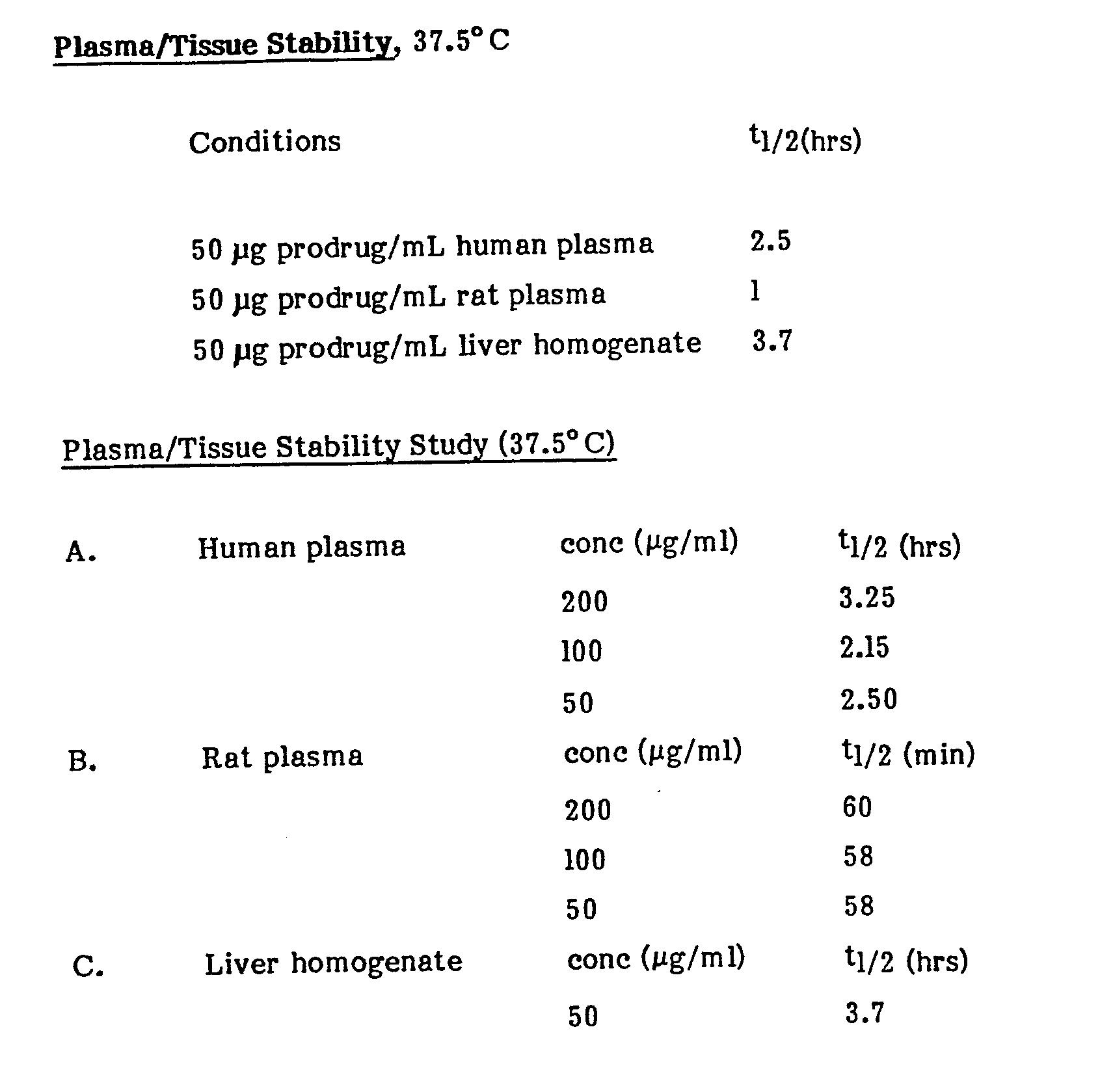
- The plasma studies were conducted at 37.5°C for rat and human plasma. Rat plasma was obtained from Sprague-Dawley male albino rats and was used within several days. Human plasma was obtained from the Lawrence Memorial Hospital in Lawrence, Kansas. The plasma studies were done at three prodrug concentrations: 200, 100 and 50 ug/ml of prodrug. The experimental procedure was as follows: The compound to be tested was taken from a stock aqueous solution of 5mg/ml and added to the plasma to give the desired prodrug concentration. Samples of 200 µl were removed at predetermined times and added to 200 µl of 10% metaphosphoric acid to quench the reaction. Before centrifugation 200 µl of methanol was added to further precipitate the plasma proteins. The results are expressed in half-lives in hours.
- The chemical and plasma studies were followed by HPLC using a RP C-18 column (150 mm) and a precolumn (50 mm). The mobile phase was 87:13 methanol: phosphate buffer (0.025 M, pH 3.4). The detector was set at 254 nm and the flow rate was 1 ml/min for rapamycin studies and 1.5 ml/min for rapamycin studies and 1.5 ml/min for the prodrug studies. Chart speed was 1 inch/10 minutes.
- The liver homogenate studies were done using livers freshly obtained from male albino Sprague-Dawley rats. A 20% liver homogenate was prepared in Sorensen's buffer at pH 7.4. Chemical stability studies of rapamycin and the two prodrugs of Examples 2 and 3 were carried out at concentrations of 20, 50 and 50 µg/ml respectively, at 37.5C.
- Rapamycin hydrolysis data in buffers, plasma and in rat liver homogenate are shown in the following table:

- In all the prodrug studies, the disappearance of the prodrug peak appeared to result in the formation of a peak with a retention time nearly equal to rapamycin. Analysis of the plasma and homogenate studies by thin layer chromatography (TLC) tended to suggest that rapamycin initially formed but then it further degraded to other decomposition products, as does rapamycin itself in these studies.
- This invention also provides an injectable pharmaceutical composition comprising a water-soluble derivative of rapamycin as defined above or a pharmaceutically acceptable salt thereof and a pharmaceutically acceptable carrier. Water or any water-based carrier known in art can be used, e.g. distilled water, water containing 5% by weight dextrose or a physiologically acceptable salt solution. Such physiologically acceptable salt solution should have a pH in the neutral range, as for example, normal saline or Lactate Ringers solutions.
- In a dry 100 mL round bottom flask was placed 2.80 g(3.07 X 10' 3 moles) of rapamycin, 0.616 g (5.98 X 10⁻³ moles) of N,N-dimethyl glycine and 1.40 g (6.80 x 10⁻³ moles) of dicyclohexylcarbodiimide. The flask was placed under a nitrogen atmosphere and 60 mL of anhydrous methylene chloride (dried over P205) was added followed by 60 mg of 4-dimethylaminopyridine. The reaction was stirred overnight at room temperature. A thin layer chromatogram (TLC) of the reaction (solvent system 1:1 acetone:methylene chloride) was taken and indicated the reaction to be complete. The Rf of the monoglycinate prodrug was 0.32. Some bisglycinate was also present at a Rf of 0.09. The reaction was worked-up by first filtering off the dicyclohexylurea (DCU). The solvent was removed on the rotovapor to give a white solid. The crude product was chromatographed on 18 gm of silica gel using 300 mL of ethyl acetate to elute rapamycin plus residual DCU. The product was eluted with 1:1 methylene chloride:acetone to give 1.67 g of product, yield 55%. This material was found difficult to recrystallize. NMR (300 MHZ, solvent CDC13) indicated the spectrum of the prodrug to be practically identical to that of rapamycin except for the two singlets arising from the glycinate group. The N,N dimethyl protons appeared as a singlet at 0 2.32. The methylene group of the glycinate was found at δ 3.16 as a singlet.
- In a dry 100 mL round bottom flask was placed 3.00 g (3.10 X 10⁻³ moles) of mono N,N-dimethylglycinate prodrug of rapamycin. This was dissolved in 15 mL of anhydrous methylene chloride (distilled from P205). To this was added 2.71 X 10⁻³ moles) of a stock solution of methanesulfonic acid dissolved in diethyl ether. The solvent was immediately removed to give a white solid, wt. 3.25 g, yield 99%. This compound was also found difficult to recrystallize. The salt form of this compound was found to be unstable to long stirring times. Even in the crystalline form long exposures to light resulted in a slow discoloration of the material.
- Data with respect to mono-(28)-N,N-dimethylglycinate methanesulfonic acid salt-prodrug of rapamycin are shown in the following table:


- The prodrug can be reconstituted with either water for injection or distilled water containing 5% by weight dextrose (D5W). The solutions should be freshly prepared and used immediately (<1 hr if possible). The prodrug appears to discolor upon prolonged exposure to light. Precaution should be taken to prevent this.
- In a dry 100 mL round bottom flask was placed 1.00 g (1.09 X 10⁻³ moles) of rapamycin, 0.34 g (2.16 X 10⁻³ moles) N,N-diethylaminopropionic acid hydrochloride salt and 0.50 g (2.43 X 10⁻³ moles) of dicyclohexylcarbodiimide.
- The vessel was placed under a nitrogen atmosphere and 25 mL of anhydrous methylene chloride (dried over P205) was added followed by 15 mg of 4-dimethylaminopyridine. The reaction was stirred overnight at room temperature. The next day a TLC of the reaction (solvent system: ethyl acetate) on silanized silica gel plate was taken and indicated the reaction to be complete. The Rf of the monopropionate hydrochloride salt of rapamycin was 0.34 and 0.01 for the bispropionate hydrochloride salt which was also formed in the reaction. The dicyclohexylurea was filtered from the reaction and the solvent removed on the rotovapor. The crude product was chromatographed on 12 g of silanized silica gel. The column was first developed with 200 mL of ethyl acetate to remove any rapamycin and also residual dicyclohexylurea. The product was eluted with ethyl acetate to give 0.61 g of product, yield 53%. This compound was found difficult to recrystallize and unstable to prolonged exposure to light. NMR (300 MHz, solvent CDCL3) indicated the spectrum of the prodrug to be practically identical with that of rapamycin. The propionate group did not give sharp easily interpreted resonances as was the case with the glycinate prodrug. This is the result of the resonances being multiplets resulting from the ethyl groups which are not as easily seen among the other resonances from rapamycin. Broad peaks did appear around S1.2 and δ 1.5 which were not found in rapamycin.
- Data with respect to mono-(28)-N,N-diethylaminopropionate hydrochloride salt - prodrug of rapamycin are shown in the following table:

- The prodrug can be reconstituted with either water for injection or D5W. The solutions should be freshly prepared and used immediately (<1 hr if possible). The prodrug appears to discolor upon prolonged exposure to light. Precaution should be taken to prevent this.
- In a dry 100 mL round bottom flask was placed 3.50 g (3.83 x 10⁻³ moles) of rapamycin, 1.48 g (7.66 x 10⁻³ moles) of 4-pyrrolidino-butyric acid hydrochloride salt and 50 mL of anhydrous methylene chloride (distilled from P205). The reaction was placed under a nitrogen atmosphere and 2.50 g (1.21 x 10 -2 moles) of dicyclohexylcarbodiimide and 15 mg of 4-N,N-dimethylaminopyridine. The reaction was stirred overnight at room temperature. The following day the dicyclohexylurea was filtered from the reaction and the filtrate adsorbed onto 5 g of silanized silica gel. This was loaded onto a 12 g column of silanized silica gel and was developed with 75:25 ethyl acetate: hexane to remove the starting material. The product was eluted with ethylacetate to give 3.24 g of a white solid, yield 78%.
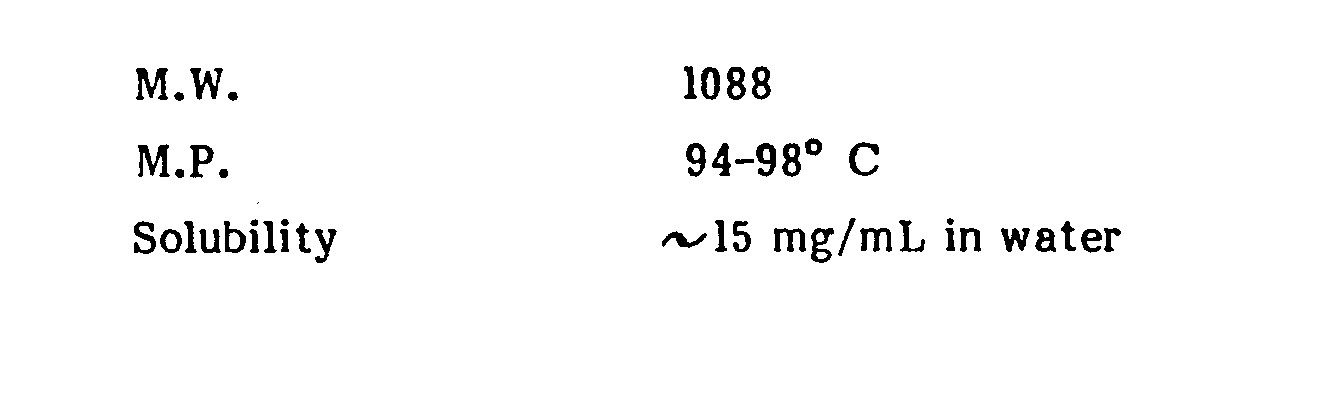
- Data with respect to the mono-(28)-4'-(pyrrolidino)butyrate hydrochloride salt-prodrug of rapamycin are shown below:
-
- The prodrug can be reconstituted with either water for injection or D5W. The solutions should be freshly prepared and used immediately (<1 hr if possible). The prodrug appears to discolor upon prolonged exposure to light. Precaution should be taken to prevent this.
- a) The bis-glycinate prodrug of rapamycin substituted at positions 28 and 43 of the rapamycin structure was synthesized by the addition of 1 eq. of rapamycin, 3 eq. of N,N-dimethylglycine, 3.3 eq. of dicyclohexylcarbodiimide and 0.16 eq. of 4-N,N-dimethylaminopyridine. After purification on silica gel, 64% of bis-glycinate was obtained. NMR confirmed the product with two 6 proton singlets for the methyl groups of the two glycinate groups.
- The formation of the methane sulfonic acid salt of the bis-glycinate was accomplished by the addition of 1.95 eq. of methane sulfonic acid. The use of two equivalents caused the decomposition of the prodrug. This gave 92% yield of the bis-glycinate prodrug of rapamycin.
- The studies carried out using fresh human plasma and fresh rat plasma indicate that the half life of the prodrug of Example 3 was the shortest, i.e. that half of the prodrug decomposed into products including mainly rapamycin within two and one-half hours with rapamycin being the only observed product of hydrolysis.
- b) Similarly as in Example 1, other water soluble derivatives of rapamycin can be prepared using as a reagent instead of N,N-dimethyl glycine, glycine, N,N-diethylglycine, N,N-diisopropylglycine, N-propylglycine, 3-aminopropionic acid, N-ethyl-3-aminopropionic acid, 4-aminobutyric acid, N-ethyl-4-amino butyric acid, N,N-dipropyl-4-aminobutyric acid, 2-{N-pyrrolidino) acetic acid, and 3-{N-piperidino) propionic acid and using appropriate protecting groups where necessary.
Claims (14)


Priority Applications (1)
| Application Number | Priority Date | Filing Date | Title |
|---|---|---|---|
| AT86309449T ATE74134T1 (en) | 1985-12-06 | 1986-12-04 | RAPAMYCIN PRECURSORS. |
Applications Claiming Priority (2)
| Application Number | Priority Date | Filing Date | Title |
|---|---|---|---|
| US06/806,152 US4650803A (en) | 1985-12-06 | 1985-12-06 | Prodrugs of rapamycin |
| US806152 | 1991-12-11 |
Related Child Applications (1)
| Application Number | Title | Priority Date | Filing Date |
|---|---|---|---|
| EP91200118.7 Division-Into | 1986-12-04 |
Publications (3)
| Publication Number | Publication Date |
|---|---|
| EP0227355A2 true EP0227355A2 (en) | 1987-07-01 |
| EP0227355A3 EP0227355A3 (en) | 1988-10-12 |
| EP0227355B1 EP0227355B1 (en) | 1992-03-25 |
Family
ID=25193443
Family Applications (1)
| Application Number | Title | Priority Date | Filing Date |
|---|---|---|---|
| EP86309449A Expired - Lifetime EP0227355B1 (en) | 1985-12-06 | 1986-12-04 | Prodrugs of rapamycin |
Country Status (16)
| Country | Link |
|---|---|
| US (1) | US4650803A (en) |
| EP (1) | EP0227355B1 (en) |
| JP (2) | JPH0670066B2 (en) |
| KR (2) | KR940004072B1 (en) |
| AT (1) | ATE74134T1 (en) |
| AU (1) | AU583439B2 (en) |
| CA (2) | CA1273920A (en) |
| DE (1) | DE3684574D1 (en) |
| DK (2) | DK169409B1 (en) |
| ES (1) | ES2032750T3 (en) |
| GB (1) | GB2183647A (en) |
| GR (1) | GR3004530T3 (en) |
| HU (1) | HU198054B (en) |
| IE (1) | IE64506B1 (en) |
| PT (1) | PT83843B (en) |
| ZA (1) | ZA869181B (en) |
Cited By (11)
| Publication number | Priority date | Publication date | Assignee | Title |
|---|---|---|---|---|
| WO1988001615A1 (en) * | 1986-08-26 | 1988-03-10 | Hans Bundgaard | Prodrug derivatives of carboxylic acid drugs |
| WO1989005304A1 (en) * | 1987-12-09 | 1989-06-15 | Fisons Plc | Macrocyclic compounds |
| EP0427680A1 (en) * | 1989-11-09 | 1991-05-15 | Sandoz Ltd. | Heteroatoms-containing tricyclic compounds |
| WO1992021341A1 (en) * | 1991-05-31 | 1992-12-10 | Pfizer Inc. | Use of rapamycin prodrugs as immunosuppressant agents |
| WO1993010122A1 (en) * | 1991-11-18 | 1993-05-27 | American Home Products Corporation | Rapamycin pyrazoles |
| US5258389A (en) * | 1992-11-09 | 1993-11-02 | Merck & Co., Inc. | O-aryl, O-alkyl, O-alkenyl and O-alkynylrapamycin derivatives |
| US5310903A (en) * | 1993-03-05 | 1994-05-10 | Merck & Co., Inc. | Imidazolidyl rapamycin derivatives |
| US5310901A (en) * | 1993-03-05 | 1994-05-10 | Merck & Co., Inc. | O-heteroaryl, O-alkylheteroaryl, O-alkenylheteroaryl and O-alkynlheteroarylrapamycin derivatives |
| US5352671A (en) * | 1989-11-09 | 1994-10-04 | Sandoz Ltd. | Heteroatoms-containing tricyclic compounds |
| US5376663A (en) * | 1987-12-09 | 1994-12-27 | Fisons Plc | Macrocyclic compounds |
| USRE44768E1 (en) | 1994-04-18 | 2014-02-18 | Wyeth Llc | Rapamycin hydroxyesters |
Families Citing this family (213)
| Publication number | Priority date | Publication date | Assignee | Title |
|---|---|---|---|---|
| US2420367A (en) * | 1943-11-09 | 1947-05-13 | Celanese Corp | Fluffing up artificial staple fibers |
| US5206018A (en) * | 1978-11-03 | 1993-04-27 | Ayerst, Mckenna & Harrison, Inc. | Use of rapamycin in treatment of tumors |
| DK520482A (en) * | 1982-11-23 | 1984-05-24 | Jacobsen P E B | HEALTH MATTRESS |
| EP0378318A1 (en) * | 1989-01-11 | 1990-07-18 | Merck & Co. Inc. | Process for synthesis of FK-506 and tricarbonyl intermediates |
| US4960790A (en) * | 1989-03-09 | 1990-10-02 | University Of Kansas | Derivatives of taxol, pharmaceutical compositions thereof and methods for the preparation thereof |
| US5100899A (en) * | 1989-06-06 | 1992-03-31 | Roy Calne | Methods of inhibiting transplant rejection in mammals using rapamycin and derivatives and prodrugs thereof |
| US5208228A (en) * | 1989-11-13 | 1993-05-04 | Merck & Co., Inc. | Aminomacrolides and derivatives having immunosuppressive activity |
| JPH04230389A (en) * | 1990-07-16 | 1992-08-19 | American Home Prod Corp | Rapamycin derivative |
| US5023264A (en) * | 1990-07-16 | 1991-06-11 | American Home Products Corporation | Rapamycin oximes |
| US5120726A (en) * | 1991-03-08 | 1992-06-09 | American Home Products Corporation | Rapamycin hydrazones |
| US5023263A (en) * | 1990-08-09 | 1991-06-11 | American Home Products Corporation | 42-oxorapamycin |
| US5023262A (en) * | 1990-08-14 | 1991-06-11 | American Home Products Corporation | Hydrogenated rapamycin derivatives |
| US5358944A (en) * | 1990-09-19 | 1994-10-25 | American Home Products Corporation | Rapamycin esters for treating transplantation rejection |
| US5130307A (en) * | 1990-09-28 | 1992-07-14 | American Home Products Corporation | Aminoesters of rapamycin |
| PT98990A (en) * | 1990-09-19 | 1992-08-31 | American Home Prod | PROCESS FOR THE PREPARATION OF CARBOXYLIC ACID ESTERS OF RAPAMICIN |
| US5378696A (en) * | 1990-09-19 | 1995-01-03 | American Home Products Corporation | Rapamycin esters |
| US5221670A (en) * | 1990-09-19 | 1993-06-22 | American Home Products Corporation | Rapamycin esters |
| US5143918A (en) * | 1990-10-11 | 1992-09-01 | Merck & Co., Inc. | Halomacrolides and derivatives having immunosuppressive activity |
| US5233036A (en) * | 1990-10-16 | 1993-08-03 | American Home Products Corporation | Rapamycin alkoxyesters |
| US5120842A (en) * | 1991-04-01 | 1992-06-09 | American Home Products Corporation | Silyl ethers of rapamycin |
| US5100883A (en) * | 1991-04-08 | 1992-03-31 | American Home Products Corporation | Fluorinated esters of rapamycin |
| US5118678A (en) * | 1991-04-17 | 1992-06-02 | American Home Products Corporation | Carbamates of rapamycin |
| NO921449L (en) * | 1991-04-17 | 1992-10-19 | American Home Prod | CARBAMATES OF RAPAMYCIN |
| US5194447A (en) * | 1992-02-18 | 1993-03-16 | American Home Products Corporation | Sulfonylcarbamates of rapamycin |
| US5147877A (en) * | 1991-04-18 | 1992-09-15 | Merck & Co. Inc. | Semi-synthetic immunosuppressive macrolides |
| US5091389A (en) * | 1991-04-23 | 1992-02-25 | Merck & Co., Inc. | Lipophilic macrolide useful as an immunosuppressant |
| US5138051A (en) * | 1991-08-07 | 1992-08-11 | American Home Products Corporation | Rapamycin analogs as immunosuppressants and antifungals |
| US5102876A (en) * | 1991-05-07 | 1992-04-07 | American Home Products Corporation | Reduction products of rapamycin |
| US5162334A (en) * | 1991-05-13 | 1992-11-10 | Merck & Co., Inc. | Amino O-alkyl, O-alkenyl and O-alkynlmacrolides having immunosuppressive activity |
| US5565560A (en) * | 1991-05-13 | 1996-10-15 | Merck & Co., Inc. | O-Aryl,O-alkyl,O-alkenyl and O-alkynylmacrolides having immunosuppressive activity |
| US5776943A (en) * | 1991-05-14 | 1998-07-07 | American Home Products Corporation | Rapamycin metabolites |
| US5118677A (en) * | 1991-05-20 | 1992-06-02 | American Home Products Corporation | Amide esters of rapamycin |
| EP0516347A1 (en) * | 1991-05-29 | 1992-12-02 | American Home Products Corporation | Rapamycin derivatives |
| ZA924953B (en) * | 1991-07-25 | 1993-04-28 | Univ Louisville Res Found | Method of treating ocular inflammation |
| US5189042A (en) * | 1991-08-22 | 1993-02-23 | Merck & Co. Inc. | Fluoromacrolides having immunosuppressive activity |
| US5208241A (en) * | 1991-09-09 | 1993-05-04 | Merck & Co., Inc. | N-heteroaryl, n-alkylheteroaryl, n-alkenylheteroaryl and n-alkynylheteroarylmacrolides having immunosuppressive activity |
| US5162333A (en) * | 1991-09-11 | 1992-11-10 | American Home Products Corporation | Aminodiesters of rapamycin |
| US5151413A (en) * | 1991-11-06 | 1992-09-29 | American Home Products Corporation | Rapamycin acetals as immunosuppressant and antifungal agents |
| US5262424A (en) * | 1992-02-18 | 1993-11-16 | American Home Products Corporation | Composition of sulfonylcarbamates of rapamycin and method of treating diseases requiring immunosuppression therewith |
| MX9301188A (en) * | 1992-03-05 | 1994-07-29 | American Home Prod | NEW SULPHONATES AND 42- (N-CARBOALCOXI) SULPHAMATES IN POSITION 42 OF RAPAMICINE, PROCEDURE FOR ITS PREPARATION AND PHARMACEUTICAL COMPOSITION THAT INCLUDES THEM. |
| JP2741285B2 (en) * | 1992-05-22 | 1998-04-15 | 千寿製薬株式会社 | Glaucoma treatment |
| ZA935111B (en) * | 1992-07-17 | 1994-02-04 | Smithkline Beecham Corp | Rapamycin derivatives |
| US5256790A (en) * | 1992-08-13 | 1993-10-26 | American Home Products Corporation | 27-hydroxyrapamycin and derivatives thereof |
| CA2106034A1 (en) * | 1992-09-24 | 1994-03-25 | Ralph J. Russo | 21-norrapamycin |
| US5480989A (en) * | 1992-10-13 | 1996-01-02 | American Home Products Corporation | Carbamates of rapamycin |
| DE69333995T2 (en) * | 1992-10-13 | 2006-10-19 | Wyeth | Carbamates of rapamycin |
| US5434260A (en) * | 1992-10-13 | 1995-07-18 | American Home Products Corporation | Carbamates of rapamycin |
| US5489680A (en) * | 1992-10-13 | 1996-02-06 | American Home Products Corporation | Carbamates of rapamycin |
| US5302584A (en) * | 1992-10-13 | 1994-04-12 | American Home Products Corporation | Carbamates of rapamycin |
| US5480988A (en) * | 1992-10-13 | 1996-01-02 | American Home Products Corporation | Carbamates of rapamycin |
| US5262423A (en) * | 1992-10-29 | 1993-11-16 | American Home Products Corporation | Rapamycin arylcarbonyl and alkoxycarbonyl carbamates as immunosuppressive and antifungal agents |
| US5260300A (en) * | 1992-11-19 | 1993-11-09 | American Home Products Corporation | Rapamycin carbonate esters as immuno-suppressant agents |
| US5349060A (en) * | 1993-01-07 | 1994-09-20 | American Home Products Corporation | Rapamycin 31-ester with N,N-dimethylglycine derivatives useful as immunosuppressive agents |
| US5252579A (en) * | 1993-02-16 | 1993-10-12 | American Home Products Corporation | Macrocyclic immunomodulators |
| GB9307491D0 (en) | 1993-04-08 | 1993-06-02 | Sandoz Ltd | Organic compounds |
| USRE40596E1 (en) * | 1993-04-08 | 2008-12-02 | Novartis Ag | Rapamycin assay |
| US7279561B1 (en) * | 1993-04-23 | 2007-10-09 | Wyeth | Anti-rapamycin monoclonal antibodies |
| EP1181938B1 (en) | 1993-04-23 | 2007-11-14 | Wyeth | Rapamycin conjugates and antibodies |
| US5504091A (en) * | 1993-04-23 | 1996-04-02 | American Home Products Corporation | Biotin esters of rapamycin |
| USRE37421E1 (en) | 1993-07-16 | 2001-10-23 | Smithkline Beecham Corporation | Rapamycin derivatives |
| US5387680A (en) * | 1993-08-10 | 1995-02-07 | American Home Products Corporation | C-22 ring stabilized rapamycin derivatives |
| US5373014A (en) * | 1993-10-08 | 1994-12-13 | American Home Products Corporation | Rapamycin oximes |
| US5378836A (en) * | 1993-10-08 | 1995-01-03 | American Home Products Corporation | Rapamycin oximes and hydrazones |
| US5391730A (en) * | 1993-10-08 | 1995-02-21 | American Home Products Corporation | Phosphorylcarbamates of rapamycin and oxime derivatives thereof |
| US5527907A (en) * | 1993-11-19 | 1996-06-18 | Abbott Laboratories | Macrolide immunomodulators |
| US5385910A (en) * | 1993-11-22 | 1995-01-31 | American Home Products Corporation | Gem-distributed esters of rapamycin |
| US5385908A (en) * | 1993-11-22 | 1995-01-31 | American Home Products Corporation | Hindered esters of rapamycin |
| US5385909A (en) * | 1993-11-22 | 1995-01-31 | American Home Products Corporation | Heterocyclic esters of rapamycin |
| US5389639A (en) * | 1993-12-29 | 1995-02-14 | American Home Products Company | Amino alkanoic esters of rapamycin |
| US5362735A (en) * | 1994-02-23 | 1994-11-08 | Smithkline Beecham Corporation | Rapamycin derivatives |
| US5525610A (en) * | 1994-03-31 | 1996-06-11 | American Home Products Corporation | 42-Epi-rapamycin and pharmaceutical compositions thereof |
| US5463048A (en) * | 1994-06-14 | 1995-10-31 | American Home Products Corporation | Rapamycin amidino carbamates |
| US5693648A (en) * | 1994-09-30 | 1997-12-02 | Merck & Co., Inc. | O-aryl, O-alkyl, O-alkenyl and O-alkynyl-macrolides having immunosuppressive activity |
| US5491231A (en) * | 1994-11-28 | 1996-02-13 | American Home Products Corporation | Hindered N-oxide esters of rapamycin |
| US5563145A (en) * | 1994-12-07 | 1996-10-08 | American Home Products Corporation | Rapamycin 42-oximes and hydroxylamines |
| US5780462A (en) * | 1995-12-27 | 1998-07-14 | American Home Products Corporation | Water soluble rapamycin esters |
| US5922730A (en) * | 1996-09-09 | 1999-07-13 | American Home Products Corporation | Alkylated rapamycin derivatives |
| US20030129215A1 (en) | 1998-09-24 | 2003-07-10 | T-Ram, Inc. | Medical devices containing rapamycin analogs |
| US6890546B2 (en) * | 1998-09-24 | 2005-05-10 | Abbott Laboratories | Medical devices containing rapamycin analogs |
| US20060198867A1 (en) * | 1997-09-25 | 2006-09-07 | Abbott Laboratories, Inc. | Compositions and methods of administering rapamycin analogs using medical devices for long-term efficacy |
| US6015815A (en) * | 1997-09-26 | 2000-01-18 | Abbott Laboratories | Tetrazole-containing rapamycin analogs with shortened half-lives |
| US7399480B2 (en) | 1997-09-26 | 2008-07-15 | Abbott Laboratories | Methods of administering tetrazole-containing rapamycin analogs with other therapeutic substances using medical devices |
| US8394398B2 (en) * | 1997-09-26 | 2013-03-12 | Abbott Laboratories | Methods of administering rapamycin analogs with anti-inflammatories using medical devices |
| US8257725B2 (en) * | 1997-09-26 | 2012-09-04 | Abbott Laboratories | Delivery of highly lipophilic agents via medical devices |
| US7378105B2 (en) * | 1997-09-26 | 2008-05-27 | Abbott Laboratories | Drug delivery systems, kits, and methods for administering zotarolimus and paclitaxel to blood vessel lumens |
| US8257726B2 (en) * | 1997-09-26 | 2012-09-04 | Abbott Laboratories | Compositions, systems, kits, and methods of administering rapamycin analogs with paclitaxel using medical devices |
| US7357942B2 (en) * | 1997-09-26 | 2008-04-15 | Abbott Laboratories | Compositions, systems, and kits for administering zotarolimus and paclitaxel to blood vessel lumens |
| US8057816B2 (en) * | 1997-09-26 | 2011-11-15 | Abbott Laboratories | Compositions and methods of administering paclitaxel with other drugs using medical devices |
| US6015809A (en) * | 1998-08-17 | 2000-01-18 | American Home Products Corporation | Photocyclized rapamycin |
| US7960405B2 (en) * | 1998-09-24 | 2011-06-14 | Abbott Laboratories | Compounds and methods for treatment and prevention of diseases |
| US8257724B2 (en) * | 1998-09-24 | 2012-09-04 | Abbott Laboratories | Delivery of highly lipophilic agents via medical devices |
| US7455853B2 (en) * | 1998-09-24 | 2008-11-25 | Abbott Cardiovascular Systems Inc. | Medical devices containing rapamycin analogs |
| US20060240070A1 (en) * | 1998-09-24 | 2006-10-26 | Cromack Keith R | Delivery of highly lipophilic agents via medical devices |
| US6331547B1 (en) | 1999-08-18 | 2001-12-18 | American Home Products Corporation | Water soluble SDZ RAD esters |
| US20070032853A1 (en) * | 2002-03-27 | 2007-02-08 | Hossainy Syed F | 40-O-(2-hydroxy)ethyl-rapamycin coated stent |
| US7807211B2 (en) * | 1999-09-03 | 2010-10-05 | Advanced Cardiovascular Systems, Inc. | Thermal treatment of an implantable medical device |
| US6790228B2 (en) | 1999-12-23 | 2004-09-14 | Advanced Cardiovascular Systems, Inc. | Coating for implantable devices and a method of forming the same |
| US6277983B1 (en) | 2000-09-27 | 2001-08-21 | American Home Products Corporation | Regioselective synthesis of rapamycin derivatives |
| US6670355B2 (en) | 2000-06-16 | 2003-12-30 | Wyeth | Method of treating cardiovascular disease |
| ATE278421T1 (en) | 2000-08-11 | 2004-10-15 | Wyeth Corp | METHOD FOR TREATING ESTROGEN RECEPTOR POSITIVE CARCINOMA |
| JP2004509898A (en) | 2000-09-19 | 2004-04-02 | ワイス | Water-soluble rapamycin ester |
| US6399625B1 (en) | 2000-09-27 | 2002-06-04 | Wyeth | 1-oxorapamycins |
| US6399626B1 (en) | 2000-10-02 | 2002-06-04 | Wyeth | Hydroxyesters of 7-desmethylrapamycin |
| US6440991B1 (en) | 2000-10-02 | 2002-08-27 | Wyeth | Ethers of 7-desmethlrapamycin |
| US20040018228A1 (en) * | 2000-11-06 | 2004-01-29 | Afmedica, Inc. | Compositions and methods for reducing scar tissue formation |
| US7754208B2 (en) | 2001-01-17 | 2010-07-13 | Trubion Pharmaceuticals, Inc. | Binding domain-immunoglobulin fusion proteins |
| US7829084B2 (en) * | 2001-01-17 | 2010-11-09 | Trubion Pharmaceuticals, Inc. | Binding constructs and methods for use thereof |
| US20040022853A1 (en) * | 2001-04-26 | 2004-02-05 | Control Delivery Systems, Inc. | Polymer-based, sustained release drug delivery system |
| BR0209198A (en) * | 2001-04-26 | 2004-06-08 | Control Delivery Sys Inc | Synthesis methods of phenol-containing compounds |
| US20040137066A1 (en) * | 2001-11-26 | 2004-07-15 | Swaminathan Jayaraman | Rationally designed therapeutic intravascular implant coating |
| US6641611B2 (en) | 2001-11-26 | 2003-11-04 | Swaminathan Jayaraman | Therapeutic coating for an intravascular implant |
| US20080145402A1 (en) * | 2001-09-10 | 2008-06-19 | Abbott Cardiovascular Systems Inc. | Medical Devices Containing Rapamycin Analogs |
| IN2014DN10834A (en) * | 2001-09-17 | 2015-09-04 | Psivida Inc | |
| US7682387B2 (en) * | 2002-04-24 | 2010-03-23 | Biosensors International Group, Ltd. | Drug-delivery endovascular stent and method for treating restenosis |
| US6939376B2 (en) | 2001-11-05 | 2005-09-06 | Sun Biomedical, Ltd. | Drug-delivery endovascular stent and method for treating restenosis |
| US20040024450A1 (en) * | 2002-04-24 | 2004-02-05 | Sun Biomedical, Ltd. | Drug-delivery endovascular stent and method for treating restenosis |
| RU2344821C2 (en) * | 2002-07-30 | 2009-01-27 | Уайт | Rapamycine hydroxy ethers-containing parenteral compositions |
| CN100349627C (en) | 2002-09-06 | 2007-11-21 | 艾博特公司 | Medical devices containing rapamycin analogs |
| US7601332B2 (en) * | 2003-01-27 | 2009-10-13 | Endocyte, Inc. | Vitamin receptor binding drug delivery conjugates |
| US7160867B2 (en) * | 2003-05-16 | 2007-01-09 | Isotechnika, Inc. | Rapamycin carbohydrate derivatives |
| US20050118344A1 (en) | 2003-12-01 | 2005-06-02 | Pacetti Stephen D. | Temperature controlled crimping |
| US8173840B2 (en) * | 2003-07-29 | 2012-05-08 | Signature R&D Holdings, Llc | Compounds with high therapeutic index |
| US7589233B2 (en) * | 2003-07-29 | 2009-09-15 | Signature R&D Holdings, Llc | L-Threonine derivatives of high therapeutic index |
| JP2007510621A (en) * | 2003-07-29 | 2007-04-26 | シグニチャー アールアンドディー ホールディングス,エルエルシー. | Amino acid prodrug |
| JP2007505932A (en) * | 2003-09-18 | 2007-03-15 | マクサイト, インコーポレイテッド | Transscleral delivery |
| TW200517114A (en) | 2003-10-15 | 2005-06-01 | Combinatorx Inc | Methods and reagents for the treatment of immunoinflammatory disorders |
| US7220755B2 (en) | 2003-11-12 | 2007-05-22 | Biosensors International Group, Ltd. | 42-O-alkoxyalkyl rapamycin derivatives and compositions comprising same |
| US8431145B2 (en) | 2004-03-19 | 2013-04-30 | Abbott Laboratories | Multiple drug delivery from a balloon and a prosthesis |
| EP2301619B1 (en) * | 2004-03-19 | 2017-05-10 | Abbott Laboratories | Multiple drug delivery from a balloon and a prosthesis |
| US20070027523A1 (en) * | 2004-03-19 | 2007-02-01 | Toner John L | Method of treating vascular disease at a bifurcated vessel using coated balloon |
| US20100030183A1 (en) * | 2004-03-19 | 2010-02-04 | Toner John L | Method of treating vascular disease at a bifurcated vessel using a coated balloon |
| KR20070015544A (en) | 2004-04-14 | 2007-02-05 | 와이어쓰 | Location-specific Synthesis of Rapamycin 42-ester Derivatives |
| PL1735321T3 (en) * | 2004-04-14 | 2009-04-30 | Wyeth Corp | Process for preparing rapamycin 42-esters and fk-506 32-esters with dicarboxylic acid, precursors for rapamycin conjugates and antibodies |
| CN1946852A (en) * | 2004-04-27 | 2007-04-11 | 惠氏公司 | Labeling of rapamycin using rapamycin-specific methylases |
| WO2006080951A2 (en) * | 2004-07-01 | 2006-08-03 | Yale University | Targeted and high density drug loaded polymeric materials |
| CN101098854B (en) | 2004-07-23 | 2012-12-05 | 恩多塞特公司 | Bivalent linkers and conjugates thereof |
| US7901451B2 (en) | 2004-09-24 | 2011-03-08 | Biosensors International Group, Ltd. | Drug-delivery endovascular stent and method for treating restenosis |
| EP1804779A1 (en) * | 2004-10-28 | 2007-07-11 | Wyeth | Use of an mtor inhibitor in treatment of uterine leiomyoma |
| CA2597590A1 (en) | 2005-02-09 | 2006-08-17 | Macusight, Inc. | Formulations for ocular treatment |
| US8663639B2 (en) * | 2005-02-09 | 2014-03-04 | Santen Pharmaceutical Co., Ltd. | Formulations for treating ocular diseases and conditions |
| GB0503936D0 (en) | 2005-02-25 | 2005-04-06 | San Raffaele Centro Fond | Method |
| CN101175757B (en) * | 2005-03-16 | 2012-11-14 | 恩多塞特公司 | Synthesis and purification of pteroic acid and conjugates thereof |
| EP2327429B1 (en) | 2005-03-23 | 2014-09-17 | Abbott Laboratories | Delivery of highly lipophilic agents via medical devices |
| JP5242374B2 (en) | 2005-03-23 | 2013-07-24 | アボット・ラボラトリーズ | Composition and method of administering rapamycin analogs using medical devices for long-term efficacy |
| AU2006272555B2 (en) * | 2005-07-25 | 2012-03-08 | Aptevo Research And Development Llc | B-cell reduction using CD37-specific and CD20-specific binding molecules |
| RU2470668C2 (en) * | 2005-08-19 | 2012-12-27 | Эндосайт, Инк. | Conjugates of ligand and drugs |
| EP3488866A1 (en) | 2005-11-04 | 2019-05-29 | Wyeth LLC | Antineoplastic combinations with mtor inhibitor, herceptin, and/or hki-272 |
| US8067433B2 (en) | 2005-11-09 | 2011-11-29 | Zalicus Inc. | Methods, compositions, and kits for the treatment of ophthalmic disorders |
| JP2009520818A (en) * | 2005-12-20 | 2009-05-28 | ワイス | Control of CCI-779 formulation stability by controlling drug substance impurities |
| KR101478164B1 (en) | 2006-02-09 | 2014-12-31 | 산텐 세이야꾸 가부시키가이샤 | Stable formulations and methods of making and using them |
| US7622477B2 (en) * | 2006-02-28 | 2009-11-24 | Cordis Corporation | Isomers and 42-epimers of rapamycin alkyl ether analogs, methods of making and using the same |
| US20070203169A1 (en) * | 2006-02-28 | 2007-08-30 | Zhao Jonathon Z | Isomers and 42-epimers of rapamycin ester analogs, methods of making and using the same |
| US7678901B2 (en) | 2006-02-28 | 2010-03-16 | Wyeth | Rapamycin analogs containing an antioxidant moiety |
| AU2007230964B2 (en) | 2006-03-23 | 2012-07-19 | Santen Pharmaceutical Co., Ltd. | Formulations and methods for vascular permeability-related diseases or conditions |
| US20080051691A1 (en) * | 2006-08-28 | 2008-02-28 | Wyeth | Implantable shunt or catheter enabling gradual delivery of therapeutic agents |
| US7867988B2 (en) | 2006-09-13 | 2011-01-11 | Elixir Medical Corporation | Macrocyclic lactone compounds and methods for their use |
| JP2010504974A (en) | 2006-09-28 | 2010-02-18 | フォリカ,インコーポレーテッド | Methods, kits, and compositions for generating new hair follicles and growing hair |
| US8067055B2 (en) * | 2006-10-20 | 2011-11-29 | Biosensors International Group, Ltd. | Drug-delivery endovascular stent and method of use |
| US20080097591A1 (en) | 2006-10-20 | 2008-04-24 | Biosensors International Group | Drug-delivery endovascular stent and method of use |
| US20080103584A1 (en) * | 2006-10-25 | 2008-05-01 | Biosensors International Group | Temporal Intraluminal Stent, Methods of Making and Using |
| US10265407B2 (en) | 2007-02-15 | 2019-04-23 | Yale University | Modular nanodevices for smart adaptable vaccines |
| US20100104626A1 (en) | 2007-02-16 | 2010-04-29 | Endocyte, Inc. | Methods and compositions for treating and diagnosing kidney disease |
| WO2008109347A2 (en) * | 2007-03-02 | 2008-09-12 | Yale University | Methods for ex vivo administration of drugs to grafts using polymeric nanoparticles |
| CN104127878A (en) | 2007-03-14 | 2014-11-05 | 恩多塞特公司 | Binding ligand linked drug delivery conjugates of tubulysins |
| TW200901989A (en) | 2007-04-10 | 2009-01-16 | Wyeth Corp | Anti-tumor activity of CCI-779 in papillary renal cell cancer |
| US20080265343A1 (en) * | 2007-04-26 | 2008-10-30 | International Business Machines Corporation | Field effect transistor with inverted t shaped gate electrode and methods for fabrication thereof |
| US9877965B2 (en) | 2007-06-25 | 2018-01-30 | Endocyte, Inc. | Vitamin receptor drug delivery conjugates for treating inflammation |
| BRPI0812970A2 (en) | 2007-06-25 | 2019-09-24 | Endocyte Inc | conjugates containing hydrophilic spacers |
| WO2009023386A2 (en) * | 2007-07-06 | 2009-02-19 | Trubion Pharmaceuticals, Inc. | Binding peptides having a c-terminally disposed specific binding domain |
| CA2705764C (en) | 2007-11-14 | 2016-08-02 | Biosensors International Group, Ltd. | Automated stent coating apparatus and method |
| US20100048524A1 (en) | 2008-03-14 | 2010-02-25 | Angela Brodie | Novel C-17-Heteroaryl Steroidal CYP17 Inhibitors/Antiandrogens;Synthesis In Vitro Biological Activities, Pharmacokinetics and Antitumor Activity |
| CA2719134C (en) | 2008-03-21 | 2015-06-30 | The University Of Chicago | Treatment with opioid antagonists and mtor inhibitors |
| US20090253733A1 (en) * | 2008-04-02 | 2009-10-08 | Biointeractions, Ltd. | Rapamycin carbonate esters |
| NZ603059A (en) * | 2008-04-11 | 2014-07-25 | Emergent Product Dev Seattle | Cd37 immunotherapeutic and combination with bifunctional chemotherapeutic thereof |
| EP2352459A4 (en) * | 2008-10-03 | 2013-09-25 | Elixir Medical Corp | MACROCYCLIC LACTONE COMPOUNDS AND METHODS OF USE |
| EP2393827B1 (en) | 2009-02-05 | 2015-10-07 | Tokai Pharmaceuticals, Inc. | Novel prodrugs of steroidal cyp17 inhibitors/antiandrogens |
| WO2010118419A2 (en) | 2009-04-10 | 2010-10-14 | Haiyan Qi | Novel anti-aging agents and methods to identify them |
| PH12012500809A1 (en) | 2009-10-30 | 2012-11-26 | Ariad Pharma Inc | Methods and compositions for treating cancer |
| US20110130711A1 (en) * | 2009-11-19 | 2011-06-02 | Follica, Inc. | Hair growth treatment |
| US8951595B2 (en) * | 2009-12-11 | 2015-02-10 | Abbott Cardiovascular Systems Inc. | Coatings with tunable molecular architecture for drug-coated balloon |
| US8480620B2 (en) * | 2009-12-11 | 2013-07-09 | Abbott Cardiovascular Systems Inc. | Coatings with tunable solubility profile for drug-coated balloon |
| US20110144577A1 (en) * | 2009-12-11 | 2011-06-16 | John Stankus | Hydrophilic coatings with tunable composition for drug coated balloon |
| WO2011109833A2 (en) | 2010-03-05 | 2011-09-09 | President And Fellows Of Harvard College | Induced dendritic cell compositions and uses thereof |
| EP2532740A1 (en) | 2011-06-11 | 2012-12-12 | Michael Schmück | Antigen-specific CD4+ and CD8+ central-memory T cell preparations for adoptive T cell therapy |
| WO2013126797A1 (en) | 2012-02-24 | 2013-08-29 | Purdue Research Foundation | Cholecystokinin b receptor targeting for imaging and therapy |
| US20140080175A1 (en) | 2012-03-29 | 2014-03-20 | Endocyte, Inc. | Processes for preparing tubulysin derivatives and conjugates thereof |
| WO2013163176A1 (en) | 2012-04-23 | 2013-10-31 | Allertein Therapeutics, Llc | Nanoparticles for treatment of allergy |
| CN104203959B (en) | 2012-06-08 | 2017-09-15 | 百多力股份公司 | The O cyclic hydrocarbons ester of rapamycin 40, composition and method |
| EA201590622A1 (en) | 2012-10-16 | 2015-10-30 | Эндосайт, Инк. | CONJUGATES FOR DELIVERY OF MEDICINES CONTAINING NOT MEETING IN THE NATURE OF AMINO ACID AND METHODS OF APPLICATION |
| WO2014068070A1 (en) | 2012-10-31 | 2014-05-08 | INSERM (Institut National de la Santé et de la Recherche Médicale) | Methods for preventing antiphospholipid syndrome (aps) |
| CA2904170A1 (en) | 2013-03-14 | 2014-09-25 | University Of Maryland, Baltimore | Androgen receptor down-regulating agents and uses thereof |
| CA2907915C (en) | 2013-04-03 | 2023-03-07 | Allertein Therapeutics, Llc | Immunomodulatory nanoparticle compositions comprising a plurality of nanoparticles comprising biodegradable or biocompatible polymers and hydrophilic and hydrophobic cellular components |
| KR20160058774A (en) | 2013-08-12 | 2016-05-25 | 토카이 파마슈티컬, 아이엔씨. | Biomarkers for treatment of neoplastic disorders using androgen-targeted therapies |
| CN105461738B (en) * | 2014-06-03 | 2019-03-08 | 中国人民解放军军事医学科学院毒物药物研究所 | A kind of rapamycin derivative, its preparation method, its pharmaceutical composition and use |
| EP3193902A4 (en) | 2014-09-11 | 2018-03-28 | The Regents of The University of California | mTORC1 INHIBITORS |
| WO2017029391A1 (en) | 2015-08-20 | 2017-02-23 | INSERM (Institut National de la Santé et de la Recherche Médicale) | New method for treating cancer |
| CN109843301B (en) | 2016-04-14 | 2022-05-27 | 斯宾纳克生物科学公司 | Porous silica materials containing metal silicates for delivery of therapeutic agents |
| EP3644997A1 (en) | 2017-06-26 | 2020-05-06 | INSERM (Institut National de la Santé et de la Recherche Médicale) | Methods and pharmaceutical compositions for the treatment of olmsted syndrome |
| EP3652306A1 (en) | 2017-07-13 | 2020-05-20 | INSERM (Institut National de la Santé et de la Recherche Médicale) | Methods for increasing expansion and immunosuppressive capacity of a population of cd8+cd45rclow/-tregs |
| UY37900A (en) | 2017-09-26 | 2019-04-30 | Novartis Ag | NEW DERIVATIVES OF RAPAMYCIN |
| EP3788050B1 (en) | 2018-05-01 | 2024-08-28 | Revolution Medicines, Inc. | C26-linked rapamycin analogs as mtor inhibitors |
| PL3788049T3 (en) | 2018-05-01 | 2023-06-19 | Revolution Medicines, Inc. | C40-, c28-, and c-32-linked rapamycin analogs as mtor inhibitors |
| AU2019310040A1 (en) | 2018-07-23 | 2021-02-11 | Enclear Therapies, Inc. | Methods of treating neurological disorders |
| EP3826649A4 (en) | 2018-07-23 | 2022-07-20 | Enclear Therapies, Inc. | METHODS OF TREATMENT OF NEUROLOGICAL DISORDERS |
| EP3849545A1 (en) | 2018-09-10 | 2021-07-21 | Institut National de la Santé et de la Recherche Médicale (INSERM) | Methods for the treatment of neurofibromatosis |
| LT3898637T (en) | 2018-12-18 | 2025-03-10 | Novartis Ag | Rapamycin derivatives |
| US12594275B2 (en) | 2019-02-07 | 2026-04-07 | The Regents Of The University Of California | Immunophilin binding agents and uses thereof |
| KR20260115158A (en) | 2019-03-26 | 2026-07-23 | 노파르티스 아게 | Isothiazolidine 1,1-dioxide and 1,4-butan sultone containing rapamycin derivatives and uses thereof |
| KR20220011123A (en) | 2019-04-11 | 2022-01-27 | 엔클리어 테라피스, 인크. | Cerebrospinal fluid improvement method and device and system therefor |
| JP2023543868A (en) | 2020-09-29 | 2023-10-18 | エンクリアー セラピーズ, インク. | Subarachnoid fluid management methods and systems |
| EP4531859A4 (en) | 2022-05-25 | 2026-05-27 | Revolution Medicines Inc | METHOD FOR TREATING CANCER WITH AN MTOR INSHIBITOR |
| WO2024008799A1 (en) | 2022-07-06 | 2024-01-11 | Institut National de la Santé et de la Recherche Médicale | Methods for the treatment of proliferative glomerulonephritis |
| US20260060969A1 (en) | 2022-08-04 | 2026-03-05 | Institut National de la Santé et de la Recherche Médicale | Methods for the treatment of lymphoproliferative disorders |
Family Cites Families (3)
| Publication number | Priority date | Publication date | Assignee | Title |
|---|---|---|---|---|
| BE877700A (en) * | 1978-11-03 | 1980-01-14 | Ayerst Mckenna & Harrison | PHARMACEUTICAL COMPOSITIONS BASED ON RAPAMYCIN FOR THE TREATMENT OF CARCINOGENIC TUMORS |
| AU543727B2 (en) * | 1980-06-02 | 1985-05-02 | Ayerst Mckenna & Harrison Inc. | Injectable composition of rapamycin |
| US4316885A (en) * | 1980-08-25 | 1982-02-23 | Ayerst, Mckenna And Harrison, Inc. | Acyl derivatives of rapamycin |
-
1985
- 1985-12-06 US US06/806,152 patent/US4650803A/en not_active Expired - Lifetime
-
1986
- 1986-12-02 PT PT83843A patent/PT83843B/en not_active IP Right Cessation
- 1986-12-03 CA CA000524469A patent/CA1273920A/en not_active Expired - Lifetime
- 1986-12-04 JP JP61289750A patent/JPH0670066B2/en not_active Expired - Lifetime
- 1986-12-04 ES ES198686309449T patent/ES2032750T3/en not_active Expired - Lifetime
- 1986-12-04 DE DE8686309449T patent/DE3684574D1/en not_active Expired - Lifetime
- 1986-12-04 ZA ZA869181A patent/ZA869181B/en unknown
- 1986-12-04 KR KR1019860010339A patent/KR940004072B1/en not_active Expired - Fee Related
- 1986-12-04 EP EP86309449A patent/EP0227355B1/en not_active Expired - Lifetime
- 1986-12-04 GB GB08628994A patent/GB2183647A/en active Granted
- 1986-12-04 AT AT86309449T patent/ATE74134T1/en not_active IP Right Cessation
- 1986-12-04 AU AU66080/86A patent/AU583439B2/en not_active Ceased
- 1986-12-05 HU HU865042Q patent/HU198054B/en unknown
- 1986-12-05 IE IE319886A patent/IE64506B1/en not_active IP Right Cessation
- 1986-12-05 DK DK584886A patent/DK169409B1/en not_active IP Right Cessation
-
1990
- 1990-08-24 CA CA000615850A patent/CA1312076C/en not_active Expired - Lifetime
-
1991
- 1991-12-04 KR KR1019910022103A patent/KR940004073B1/en not_active Expired - Fee Related
-
1992
- 1992-05-07 GR GR920400868T patent/GR3004530T3/el unknown
-
1993
- 1993-03-25 DK DK034793A patent/DK170750B1/en not_active IP Right Cessation
- 1993-12-03 JP JP5303867A patent/JPH0747593B2/en not_active Expired - Lifetime
Cited By (15)
| Publication number | Priority date | Publication date | Assignee | Title |
|---|---|---|---|---|
| US5073641A (en) * | 1986-08-26 | 1991-12-17 | Hans Bundgaard | Prodrug derivatives of carboxylic acid drugs |
| WO1988001615A1 (en) * | 1986-08-26 | 1988-03-10 | Hans Bundgaard | Prodrug derivatives of carboxylic acid drugs |
| WO1989005304A1 (en) * | 1987-12-09 | 1989-06-15 | Fisons Plc | Macrocyclic compounds |
| EP0323042A1 (en) * | 1987-12-09 | 1989-07-05 | FISONS plc | Process to macrocyclic compounds |
| US5376663A (en) * | 1987-12-09 | 1994-12-27 | Fisons Plc | Macrocyclic compounds |
| US5352671A (en) * | 1989-11-09 | 1994-10-04 | Sandoz Ltd. | Heteroatoms-containing tricyclic compounds |
| EP0427680A1 (en) * | 1989-11-09 | 1991-05-15 | Sandoz Ltd. | Heteroatoms-containing tricyclic compounds |
| US5912238A (en) * | 1989-11-09 | 1999-06-15 | Novartis Ag | Heteroatoms-containing tricyclic compounds |
| WO1992021341A1 (en) * | 1991-05-31 | 1992-12-10 | Pfizer Inc. | Use of rapamycin prodrugs as immunosuppressant agents |
| US5432183A (en) * | 1991-05-31 | 1995-07-11 | Pfizer Inc. | Use of rapamycin prodrugs as immunosuppressant agents |
| WO1993010122A1 (en) * | 1991-11-18 | 1993-05-27 | American Home Products Corporation | Rapamycin pyrazoles |
| US5258389A (en) * | 1992-11-09 | 1993-11-02 | Merck & Co., Inc. | O-aryl, O-alkyl, O-alkenyl and O-alkynylrapamycin derivatives |
| US5310901A (en) * | 1993-03-05 | 1994-05-10 | Merck & Co., Inc. | O-heteroaryl, O-alkylheteroaryl, O-alkenylheteroaryl and O-alkynlheteroarylrapamycin derivatives |
| US5310903A (en) * | 1993-03-05 | 1994-05-10 | Merck & Co., Inc. | Imidazolidyl rapamycin derivatives |
| USRE44768E1 (en) | 1994-04-18 | 2014-02-18 | Wyeth Llc | Rapamycin hydroxyesters |
Also Published As
| Publication number | Publication date |
|---|---|
| CA1312076C (en) | 1992-12-29 |
| GB8628994D0 (en) | 1987-01-14 |
| ZA869181B (en) | 1988-07-27 |
| KR940004073B1 (en) | 1994-05-11 |
| DK170750B1 (en) | 1996-01-08 |
| JPH0747593B2 (en) | 1995-05-24 |
| PT83843A (en) | 1987-01-01 |
| US4650803A (en) | 1987-03-17 |
| HU198054B (en) | 1989-07-28 |
| EP0227355A3 (en) | 1988-10-12 |
| DK34793D0 (en) | 1993-03-25 |
| GB2183647B (en) | 1989-10-18 |
| AU583439B2 (en) | 1989-04-27 |
| EP0227355B1 (en) | 1992-03-25 |
| DK584886A (en) | 1987-06-07 |
| AU6608086A (en) | 1987-06-11 |
| KR870006072A (en) | 1987-07-09 |
| JPH0670066B2 (en) | 1994-09-07 |
| KR940004072B1 (en) | 1994-05-11 |
| DK169409B1 (en) | 1994-10-24 |
| JPS62215592A (en) | 1987-09-22 |
| DE3684574D1 (en) | 1992-04-30 |
| GR3004530T3 (en) | 1993-04-28 |
| IE64506B1 (en) | 1995-08-09 |
| GB2183647A (en) | 1987-06-10 |
| ATE74134T1 (en) | 1992-04-15 |
| JPH06263765A (en) | 1994-09-20 |
| DK34793A (en) | 1993-03-25 |
| PT83843B (en) | 1989-01-17 |
| CA1273920A (en) | 1990-09-11 |
| DK584886D0 (en) | 1986-12-05 |
| IE863198L (en) | 1987-06-06 |
| ES2032750T3 (en) | 1993-03-01 |
Similar Documents
| Publication | Publication Date | Title |
|---|---|---|
| CA1273920A (en) | Prodrugs of rapamycin | |
| US4308269A (en) | Maytansinoids, pharmaceutical compositions thereof and method of use thereof | |
| US5059699A (en) | Water soluble derivatives of taxol | |
| US4309437A (en) | Pyrrolo-benzodiazepine compounds and anti-tumor composition thereof | |
| US5278324A (en) | Water soluble derivatives of taxol | |
| Peng et al. | Potential central nervous system antitumor agents. Hydantoin derivatives | |
| GB2158440A (en) | 4,5,6,7-Tetrahydroimidazo[4,5-c]pyridine derivatives | |
| US5637703A (en) | Derivatives of genistein | |
| EP0429436A2 (en) | Prodrugs of rapamycin | |
| US4780560A (en) | Nitrate derivatives and vasodilators containing the same | |
| US4293700A (en) | 2,6-Dimethyl-1,4-dihydropyridine-3,5-dicarboxylic acid esters and method for preparing same | |
| US4430347A (en) | Cystamine derivatives suitable for use as medicaments | |
| JP2000503666A (en) | Camptothecin isolated from Mappia foetida-backbone compounds and their use as synthons for novel pharmaceutical and therapeutic agents | |
| IE51771B1 (en) | Novel process and intermediates useful in the preparation of sympathomimetic amines | |
| KR970004044B1 (en) | Aromatic acid intermediates | |
| US4086343A (en) | Acylated hydrazinopyridazine antihypertensives | |
| CA1087193A (en) | 2- (dimethylamino)(3-pyridyl)methyl -cyclohexanol and related compounds | |
| SU839222A1 (en) | Aminoalkyl-alpha-diazoketones as semiproducts for synthesis of compounds having antitumoral effect | |
| US3647785A (en) | Novel 3-indolylaliphatic acid anhydrides | |
| EP0273357B1 (en) | Fluorine-containing macrolide compounds, pharmaceutical compositions comprising the same and their use for the manufacture of medicaments | |
| KR940010294B1 (en) | New pyrrolidine derivatives | |
| KR940010293B1 (en) | Novel Pyrrolidine Derivatives | |
| EP0119500B1 (en) | Novel isoprenylic acid amide derivatives, processes for their preparation and pharmaceutical compositions containing them | |
| SU803351A1 (en) | Acetylaminoalkyl-alpha-diazoketones having antitumoral effect | |
| KR810001776B1 (en) | Process for preparing hydrazinopyridazine derivatives |
Legal Events
| Date | Code | Title | Description |
|---|---|---|---|
| PUAI | Public reference made under article 153(3) epc to a published international application that has entered the european phase |
Free format text: ORIGINAL CODE: 0009012 |
|
| AK | Designated contracting states |
Kind code of ref document: A2 Designated state(s): AT BE CH DE ES FR GR IT LI LU NL SE |
|
| PUAL | Search report despatched |
Free format text: ORIGINAL CODE: 0009013 |
|
| AK | Designated contracting states |
Kind code of ref document: A3 Designated state(s): AT BE CH DE ES FR GR IT LI LU NL SE |
|
| 17P | Request for examination filed |
Effective date: 19890322 |
|
| 17Q | First examination report despatched |
Effective date: 19890803 |
|
| GRAA | (expected) grant |
Free format text: ORIGINAL CODE: 0009210 |
|
| AK | Designated contracting states |
Kind code of ref document: B1 Designated state(s): AT BE CH DE ES FR GR IT LI LU NL SE |
|
| REF | Corresponds to: |
Ref document number: 74134 Country of ref document: AT Date of ref document: 19920415 Kind code of ref document: T |
|
| XX | Miscellaneous (additional remarks) |
Free format text: TEILANMELDUNG 91200118.7 EINGEREICHT AM 04/12/86. |
|
| REF | Corresponds to: |
Ref document number: 3684574 Country of ref document: DE Date of ref document: 19920430 |
|
| ITF | It: translation for a ep patent filed | ||
| ET | Fr: translation filed | ||
| REG | Reference to a national code |
Ref country code: GR Ref legal event code: FG4A Free format text: 3004530 |
|
| PLBE | No opposition filed within time limit |
Free format text: ORIGINAL CODE: 0009261 |
|
| STAA | Information on the status of an ep patent application or granted ep patent |
Free format text: STATUS: NO OPPOSITION FILED WITHIN TIME LIMIT |
|
| REG | Reference to a national code |
Ref country code: ES Ref legal event code: FG2A Ref document number: 2032750 Country of ref document: ES Kind code of ref document: T3 |
|
| 26N | No opposition filed | ||
| EPTA | Lu: last paid annual fee | ||
| EAL | Se: european patent in force in sweden |
Ref document number: 86309449.6 |
|
| PGFP | Annual fee paid to national office [announced via postgrant information from national office to epo] |
Ref country code: LU Payment date: 20050927 Year of fee payment: 20 |
|
| PGFP | Annual fee paid to national office [announced via postgrant information from national office to epo] |
Ref country code: GR Payment date: 20051024 Year of fee payment: 20 |
|
| PGFP | Annual fee paid to national office [announced via postgrant information from national office to epo] |
Ref country code: AT Payment date: 20051104 Year of fee payment: 20 |
|
| PGFP | Annual fee paid to national office [announced via postgrant information from national office to epo] |
Ref country code: NL Payment date: 20051109 Year of fee payment: 20 |
|
| PGFP | Annual fee paid to national office [announced via postgrant information from national office to epo] |
Ref country code: FR Payment date: 20051201 Year of fee payment: 20 |
|
| PGFP | Annual fee paid to national office [announced via postgrant information from national office to epo] |
Ref country code: SE Payment date: 20051202 Year of fee payment: 20 |
|
| PGFP | Annual fee paid to national office [announced via postgrant information from national office to epo] |
Ref country code: ES Payment date: 20051215 Year of fee payment: 20 |
|
| PGFP | Annual fee paid to national office [announced via postgrant information from national office to epo] |
Ref country code: CH Payment date: 20051216 Year of fee payment: 20 |
|
| PGFP | Annual fee paid to national office [announced via postgrant information from national office to epo] |
Ref country code: IT Payment date: 20051222 Year of fee payment: 20 |
|
| PGFP | Annual fee paid to national office [announced via postgrant information from national office to epo] |
Ref country code: DE Payment date: 20051230 Year of fee payment: 20 |
|
| PGFP | Annual fee paid to national office [announced via postgrant information from national office to epo] |
Ref country code: BE Payment date: 20060113 Year of fee payment: 20 |
|
| PG25 | Lapsed in a contracting state [announced via postgrant information from national office to epo] |
Ref country code: NL Free format text: LAPSE BECAUSE OF EXPIRATION OF PROTECTION Effective date: 20061204 |
|
| PG25 | Lapsed in a contracting state [announced via postgrant information from national office to epo] |
Ref country code: ES Free format text: LAPSE BECAUSE OF EXPIRATION OF PROTECTION Effective date: 20061205 |
|
| REG | Reference to a national code |
Ref country code: CH Ref legal event code: PL |
|
| NLV7 | Nl: ceased due to reaching the maximum lifetime of a patent |
Effective date: 20061204 |
|
| EUG | Se: european patent has lapsed | ||
| REG | Reference to a national code |
Ref country code: ES Ref legal event code: FD2A Effective date: 20061205 |
|
| BE20 | Be: patent expired |
Owner name: THE *UNIVERSITY OF KANSAS Effective date: 20061204 |