EP0227430A1 - Konservierungszusammensetzungen - Google Patents
Konservierungszusammensetzungen Download PDFInfo
- Publication number
- EP0227430A1 EP0227430A1 EP86309869A EP86309869A EP0227430A1 EP 0227430 A1 EP0227430 A1 EP 0227430A1 EP 86309869 A EP86309869 A EP 86309869A EP 86309869 A EP86309869 A EP 86309869A EP 0227430 A1 EP0227430 A1 EP 0227430A1
- Authority
- EP
- European Patent Office
- Prior art keywords
- emulsion
- oil
- water
- agent
- hydrophobic
- Prior art date
- Legal status (The legal status is an assumption and is not a legal conclusion. Google has not performed a legal analysis and makes no representation as to the accuracy of the status listed.)
- Granted
Links
Images
Classifications
-
- A—HUMAN NECESSITIES
- A01—AGRICULTURE; FORESTRY; ANIMAL HUSBANDRY; HUNTING; TRAPPING; FISHING
- A01N—PRESERVATION OF BODIES OF HUMANS OR ANIMALS OR PLANTS OR PARTS THEREOF; BIOCIDES, e.g. AS DISINFECTANTS, AS PESTICIDES OR AS HERBICIDES; PEST REPELLANTS OR ATTRACTANTS; PLANT GROWTH REGULATORS
- A01N25/00—Biocides, pest repellants or attractants, or plant growth regulators, characterised by their forms, or by their non-active ingredients or by their methods of application, e.g. seed treatment or sequential application; Substances for reducing the noxious effect of the active ingredients to organisms other than pests
- A01N25/02—Biocides, pest repellants or attractants, or plant growth regulators, characterised by their forms, or by their non-active ingredients or by their methods of application, e.g. seed treatment or sequential application; Substances for reducing the noxious effect of the active ingredients to organisms other than pests containing liquids as carriers, diluents or solvents
-
- A—HUMAN NECESSITIES
- A01—AGRICULTURE; FORESTRY; ANIMAL HUSBANDRY; HUNTING; TRAPPING; FISHING
- A01N—PRESERVATION OF BODIES OF HUMANS OR ANIMALS OR PLANTS OR PARTS THEREOF; BIOCIDES, e.g. AS DISINFECTANTS, AS PESTICIDES OR AS HERBICIDES; PEST REPELLANTS OR ATTRACTANTS; PLANT GROWTH REGULATORS
- A01N25/00—Biocides, pest repellants or attractants, or plant growth regulators, characterised by their forms, or by their non-active ingredients or by their methods of application, e.g. seed treatment or sequential application; Substances for reducing the noxious effect of the active ingredients to organisms other than pests
- A01N25/30—Biocides, pest repellants or attractants, or plant growth regulators, characterised by their forms, or by their non-active ingredients or by their methods of application, e.g. seed treatment or sequential application; Substances for reducing the noxious effect of the active ingredients to organisms other than pests characterised by the surfactants
-
- B—PERFORMING OPERATIONS; TRANSPORTING
- B01—PHYSICAL OR CHEMICAL PROCESSES OR APPARATUS IN GENERAL
- B01F—MIXING, e.g. DISSOLVING, EMULSIFYING OR DISPERSING
- B01F23/00—Mixing according to the phases to be mixed, e.g. dispersing or emulsifying
- B01F23/40—Mixing liquids with liquids; Emulsifying
- B01F23/41—Emulsifying
- B01F23/4105—Methods of emulsifying
-
- B—PERFORMING OPERATIONS; TRANSPORTING
- B01—PHYSICAL OR CHEMICAL PROCESSES OR APPARATUS IN GENERAL
- B01F—MIXING, e.g. DISSOLVING, EMULSIFYING OR DISPERSING
- B01F23/00—Mixing according to the phases to be mixed, e.g. dispersing or emulsifying
- B01F23/40—Mixing liquids with liquids; Emulsifying
- B01F23/41—Emulsifying
- B01F23/414—Emulsifying characterised by the internal structure of the emulsion
- B01F23/4145—Emulsions of oils, e.g. fuel, and water
-
- B—PERFORMING OPERATIONS; TRANSPORTING
- B01—PHYSICAL OR CHEMICAL PROCESSES OR APPARATUS IN GENERAL
- B01F—MIXING, e.g. DISSOLVING, EMULSIFYING OR DISPERSING
- B01F23/00—Mixing according to the phases to be mixed, e.g. dispersing or emulsifying
- B01F23/40—Mixing liquids with liquids; Emulsifying
- B01F23/43—Mixing liquids with liquids; Emulsifying using driven stirrers
-
- B—PERFORMING OPERATIONS; TRANSPORTING
- B01—PHYSICAL OR CHEMICAL PROCESSES OR APPARATUS IN GENERAL
- B01F—MIXING, e.g. DISSOLVING, EMULSIFYING OR DISPERSING
- B01F27/00—Mixers with rotary stirring devices in fixed receptacles; Kneaders
- B01F27/27—Mixers with stator-rotor systems, e.g. with intermeshing teeth or cylinders or having orifices
- B01F27/271—Mixers with stator-rotor systems, e.g. with intermeshing teeth or cylinders or having orifices with means for moving the materials to be mixed radially between the surfaces of the rotor and the stator
- B01F27/2711—Mixers with stator-rotor systems, e.g. with intermeshing teeth or cylinders or having orifices with means for moving the materials to be mixed radially between the surfaces of the rotor and the stator provided with intermeshing elements
-
- B—PERFORMING OPERATIONS; TRANSPORTING
- B01—PHYSICAL OR CHEMICAL PROCESSES OR APPARATUS IN GENERAL
- B01F—MIXING, e.g. DISSOLVING, EMULSIFYING OR DISPERSING
- B01F33/00—Other mixers; Mixing plants; Combinations of mixers
- B01F33/80—Mixing plants; Combinations of mixers
- B01F33/81—Combinations of similar mixers, e.g. with rotary stirring devices in two or more receptacles
- B01F33/811—Combinations of similar mixers, e.g. with rotary stirring devices in two or more receptacles in two or more consecutive, i.e. successive, mixing receptacles or being consecutively arranged
-
- B—PERFORMING OPERATIONS; TRANSPORTING
- B01—PHYSICAL OR CHEMICAL PROCESSES OR APPARATUS IN GENERAL
- B01F—MIXING, e.g. DISSOLVING, EMULSIFYING OR DISPERSING
- B01F27/00—Mixers with rotary stirring devices in fixed receptacles; Kneaders
-
- B—PERFORMING OPERATIONS; TRANSPORTING
- B27—WORKING OR PRESERVING WOOD OR SIMILAR MATERIAL; NAILING OR STAPLING MACHINES IN GENERAL
- B27K—PROCESSES, APPARATUS OR SELECTION OF SUBSTANCES FOR IMPREGNATING, STAINING, DYEING, BLEACHING OF WOOD OR SIMILAR MATERIALS, OR TREATING OF WOOD OR SIMILAR MATERIALS WITH PERMEANT LIQUIDS, NOT OTHERWISE PROVIDED FOR; CHEMICAL OR PHYSICAL TREATMENT OF CORK, CANE, REED, STRAW OR SIMILAR MATERIALS
- B27K2200/00—Wooden materials to be treated
- B27K2200/10—Articles made of particles or fibres consisting of wood or other lignocellulosic material
-
- B—PERFORMING OPERATIONS; TRANSPORTING
- B27—WORKING OR PRESERVING WOOD OR SIMILAR MATERIAL; NAILING OR STAPLING MACHINES IN GENERAL
- B27K—PROCESSES, APPARATUS OR SELECTION OF SUBSTANCES FOR IMPREGNATING, STAINING, DYEING, BLEACHING OF WOOD OR SIMILAR MATERIALS, OR TREATING OF WOOD OR SIMILAR MATERIALS WITH PERMEANT LIQUIDS, NOT OTHERWISE PROVIDED FOR; CHEMICAL OR PHYSICAL TREATMENT OF CORK, CANE, REED, STRAW OR SIMILAR MATERIALS
- B27K3/00—Impregnating wood, e.g. impregnation pretreatment, for example puncturing; Wood impregnation aids not directly involved in the impregnation process
- B27K3/34—Organic impregnating agents
- B27K3/44—Tar; Mineral oil
- B27K3/46—Coal tar
Definitions
- the present invention concerns stable emulsions particularly useful for preserving timber, and for the treatment of other substrates.
- the invention also relates to methods of preparing these emulsions and to apparatus for manufacturing the emulsions. More particularly, the present invention concerns stable emulsions of oil and water, where the oil may be a petroleum oil, or high temperature creosote, for example.
- the method of manufacturing these stable emulsions involves emulsifying the components under conditions of ultra high shear simultaneously with the bringing together of the prepared water and oil phases.
- This method can be conducted in a novel emulsifying apparatus of the Ultra-Turrax or Dispax-Reactor type having a specially modified inlet, so that the prepared oil and water phases are separately and simultaneously introduced into the dispersing chamber of the high speed emulsifier.
- compositions to protect wood and other substrates are well known in the art.
- One composition for preserving wood in use for over the last 300 years is creosote, as evidenced by the English Patent No. 214 which was issued to Becker and Serle in 1681. Creosote has mainly been used to preserve wood and fabric, but is also utilised in the fields of medicine, pharmacy, dyes, chemicals, carbon blacks and fuels.
- Creosote has mainly been used to preserve wood and fabric, but is also utilised in the fields of medicine, pharmacy, dyes, chemicals, carbon blacks and fuels.
- problems in the use of creosote primarily with handling the substance itself, and handling articles which have been coated or treated with it, particularly due to its odour, and skin irritation caused by coming in contact with it.
- oils such as petroleum oil and vegetable oil, sometimes mixed with one or more biologically active ingredient, have been used in preserving wood and related substances.
- oils such as creosote and mineral oil for preserving timber and other substances in recent times are those of heating costs in plant use, flammability, odour, pollution, and unacceptable oily, tarry or "crud” deposits coated on the surface of the treated substance. These disadvantages limit the use of oils, and creosote in particular, to the treatment of timber which is unlikely to come into contact with people or livestock.
- the present invention is directed to stable emulsions containing creosote or other oils to preserve lignocellulosic and other substrates in a variety of formulations and treatments and minimising the disadvantages of prior known preservative compositions leaving a black, easily removed, surface deposit, not fully drying, bleeding, staining, irritating skin, producing an unpleasant odour, having excessive flammability, and causing pollution, as well as the high energy costs involved.
- the potential benefits inherent in a cleaner creosote or other oil based preservative for timber and other substances are far reaching and extremely diverse.
- the present invention concerns stable emulsions produced under conditions of ultra high shear and containing oils such as creosote or petroleum or mineral oil, for example, and water, together with other ingredients, which exhibit special qualities.
- the emulsions may be cationic, non-ionic, acid tolerant, anionic and/or amphoteric in nature. These qualities confer unique drying characteristics to timber, or other substrates treated with the composition.
- the means of treatment may be by soaking, dipping, brushing, spraying, or pressure impregnation.
- the pressure impregnation can be carried out under various conditions including Rüping, Lowry or Bethell schedule treatments.
- the emulsions of the present invention have very good stability in storage and in use, even under hostile conditions of pH, temperature, pressure, shear, flow, vacuum and contamination.
- the emulsions of the invention can be used on a variety of substrates in addition to wood, and result in rapid and permanent surface drying, without bleeding or the formation of undesirable surface deposits or crud. These emulsions exhibit reduced vapour pressure and odour. The odour dissipates rapidly upon drying of the treated articles and as well there is substantial fixation of the components within the treated substrate.
- the composition can be used to treat such materials as wood, wood fibre, composite wood products, masonry, iron or steel and so on.
- One aspect of the invention concerns a stable emulsion of water and at least one oil, produced by simultaneously bringing together and emulsifying said water and said oil under conditions of ultra high shear, wherein said emulsion also contains: at least one cationic non-ionic and/or amphoteric emulsifying agent, which emulsifies said emulsion without a chemically antagonistic reaction occurring, preferably at least one cation tolerant rheology structuring agent, and preferably at least one polar chemical and/or biologically active ingredient, and preferably wherein said emulsion has a pH between 9 and 2.
- the emulsion may also contain at least one hydrophobic agent and/or structuring agent introduced mixed and reacted with the oil.
- the composition may include one or more of pigments, fillers, extenders or bridging agents.
- an acid or base may need to be added to adjust the pH of the composition within a pH range of 9 to 2.
- Another aspect of the invention concerns a process for the manufacture of the stable emulsion of water and at least one oil, said process comprising the steps of:
- the process may include the additional steps of:
- the process may optionally also include the steps of:
- Yet another embodiment of the invention concerns an apparatus for ultra high shear emulsification of hydrophobic and hydrophilic phases, of the "Dispax-Reactor” or “Ultra-Turrax” type, said apparatus characterised by its inlet being modified so as to allow the hydrophobic and hydrophilic phases the minimum possible residence time in contact with one another prior to said emulsification; the modification comprising means for separately and substantially simultaneously introducing said phases into the emulsification chamber.
- the preferred means for separately and substantially simultaneously introducing the phases into the emulsification chamber is to locate the inlet lines for the two separate phases immediately adjacent to the inlet to the "Dispax-Reactor" or "Ultra-Turrax" emulsification chamber. When each phase is fed at controlled rates into the chamber, they will first come in contact with each other in the chamber.
- the flow rate of each phase is preferably precisely controlled according to the relative amounts in the phases required for the desired product; whether a water-in-oil or oil-in-water emulsion is required.
- the flow rates may be controlled by using proportional controller valves on each inlet line.
- the stable emulsions of the invention are highly effective in treating and preserving wood, masonry such as reinforced concrete, steel and similar materials.
- Micronized pigments may or may not be included in the emulsions as a means of enhancing substantial fixing of the chemical and/or biologically active ingredients in or on the treated article.
- the pigments may also include fillers or extenders or additional colouring agents.
- the emulsions include at least one oil.
- the oil may be creosote which contains a complex mixture of organic compounds and which is obtained from wood, coal, coal tars or petroleum feed stock.
- the oil may also be a petroleum oil, a petroleum oil fraction, or blends thereof. Vegetable oil may also be used if desired. If creosote is used, high temperature creosote (HTC) is preferred.
- HTC high temperature creosote
- the preferred amount of oil in the stable emulsion is from 5 to 95 weight percent.
- Mixtures of oils can be used, such as a mixture of creosote with a petroleum oil fraction, and/or a vegetable oil.
- the stable emulsion also includes a water phase.
- the water used to create the emulsion does not contain very many dissolved salts, and if hard water is used, it is preferred to have the water softened prior to use.
- Preferably from 5 to 95% by weight of the emulsion may be water.
- the stable emulsion of the invention also includes a cationic non-ionic and/or amphoteric emulsifying agent.
- emulsifying agent relates to those surfactants and emulsifiers which assist in dispersing a hydrophobic and hydrophilic mixture of substances without the chemically antagonistic reaction which would normally occur when such substances are mixed.
- the total of substituents x, y and z may be between 3 and 100, preferably between 3 and 43 and most preferably may be 3 or 12.
- Substituent R is preferably tallow.
- the preferred ethoxylated diamines of the type described above exhibit good surfactant properties and are stable towards heat and compatible both with cations and anions. This is particularly useful where cationic toxicants and/or fire retardants are included in the emulsions.
- Other cationic, non-ionic and/or amphoteric emulsifiers are alkyl quaternary ammonium chlorides, imidazoline based compounds, and N-alkyl-amino-propionic acids.
- emulsifiers are those sold under the trade names "Dinoramox” (ethoxylated diamine) or “Stabiram”. Both are manufactured by CECA, Prochinor Division, France.
- the emulsifier should be included in the emulsion in an amount from a trace to 10% by weight.
- the emulsion of the invention may also include at least one cation tolerant rheology structuring agent.
- the cation tolerant rheology structuring agents are hydrophilic substances which thicken, suspend and stabilise water based systems. Such agents in solution can prevent fine solid particles from settling, or oil drops from rising and assist in bridging the density gap between the water phase and the oil phase.
- a preferred rheology structuring agent is "Polyox" which is a high molecular weight, water soluble polymer of ethylene oxide, of the type: -(O-CH2-CH2) where n is from about 2,000 to about 100,000. Polyox is stable in acid solutions, and its use is preferred in the compositions of the present invention.
- the structuring agent is preferably present in the composition in an amount from a trace to 2.5% by weight.
- Another rheology structuring agent which may be used is that sold under the trade mark “Kelzan” by the Kelco Company of the United States, which is a xanthan gum. Swelling clays such as "Premium Gel” may also be used. Examples of other rheology structuring agents are marketed under the trade names of "Carbopol", which comprise carboxy vinyl polymers, as well as “Cabosil”, comprising fumed silicon dioxide.
- the emulsion compositions of the present invention are non-ionic amphoteric and/or cationic in nature.
- the preferred formulations may involve the addition of an organic or inorganic acid to both react with the ethoxylated diamine to render it an emulsifier and or control pH in the final emulsion.
- the inorganic acid are phosphoric acid, orthophosphoric acid and hydrochloric acid which are added in an amount necessary to neutralise the ethoxylated diamine according to the number of ethylene oxide molecules condensed on the amine and to control the pH of the emulsion to between 1 and 9, preferably between 2 and 6.
- the organic acid are glacial acetic acid, stearic acid, linoleic acid and oleic acid.
- the amount of acid utilized over and above that necessary to neutralize the ethoxylated diamine can be important when a metal oxide or hydroxide or mixture constitutes the pigment incorporated in the emulsion.
- the amount of acid to achieve the desired pH of the emulsion will be governed by the desired stability of the final emulsion concomitant with the isolectric point(s) of the pigment system and oil or water droplets embodied in and in regard to behaviour of the emulsion.
- the emulsion may also include at least one polar chemical and/or biologically active ingredient.
- a polar active ingredient is a substance which interacts with the structure of the substrate upon which it confers chemical and/or biological protection, or with which it reacts integral to the emulsion chemistry.
- a highly acidic, metal cation rich, polar complex which is also an oxidising agent.
- the preferred such substance is a copper-chromium- arsenic paste or liquid sold under such trade names as "Tanalith”, “Celcure” and Boliden”.
- Other polar active ingredients are water soluble boron compounds, water soluble fluorine compounds and so on, or these are substituted in the copper-chromium compounds above, for example.
- the polar active ingredient is preferably present in an amount of a trace to 25% by weight.
- the ingredients may also include one or more bridging agents.
- a bridging agent is a compound which is soluble in both phases, and which reduces the mutual repellent nature of the individual phases comprising the emulsion.
- the preferred bridging agent is a glycol, most preferably hexylene glycol. If used, the bridging agent should be present in an amount from a trace to 30% by weight.
- the pigment may be an amphoteric, nonionic or cationic pigment. Pigments includes fillers, extending and colouring agents. A preferred pigment is titanium dioxide. More than one micronized pigment can be used. These pigments may be precoated and activated with one or more cationic or amphoteric surfactants to allow the pigment to be easily dispersed in the aqueous and/or oil phase and to be electrically active. If a precoated pigment is used, it is preferably included in an amount from 0.5 to 7.5 weight percent.
- the micronized pigments may be predispersed in an amphoteric, nonionic or cationic medium in a concentration of up to 75 weight percent, and this solution incorporated in the composition of the invention so that the pigment comprises from 0.5 to 30 weight percent.
- pigment In whatever way the pigment is pretreated or incorporated in the composition, if present it is preferably in an amount from 0.5 to 30 weight percent. More preferably, it is present in an amount less than 25 weight percent.
- Other pigments incorporated in the specification may be organic pigments or metallic pigments, such as bronze powder or aluminum paste, and various types of fillers such as talc, silicon dioxide and calcites.
- hydrophobic and lipophilic agent which is reacted in the oil phase prior to emulsification.
- a hydrophobic agent is a compound which chemically activates the organic phase to enhance its water repellency and assist in protecting it from the hostile nature of the water phase.
- a preferred hydrophobic agent is a long chain aliphatic amine. These amines have the advantage of conferring corrosion resistance on the surfaces of machinery and apparatus used to produce the protective compositions, and onto the surfaces of metal substrates treated with compositions for example. These amines also are bactericides and algicides.
- the hydrophobic agent chosen should be cation tolerant and a preferred such amine is diamine dioleate of the type:
- R1 is a long chain fatty acid preferably tallow or oleyl and R2 is preferably derived from oleic acid, or similar acids.
- Preferred hydrophobic agents are those sold under the trade names "Inipol 002" or Inipol S02". Both compounds are manufactured by CECA, Prochinor Division, France.
- the hydrophobic agent is preferably present in the composition in amount from a trace to 10% by weight, and preferably from 0.2 to 1.0% by weight.
- One or more predispersed micronised pigments may be dispersed into the oil phase. These pigments are preferably included in an amount of from 0.5 to 7.5% by weight.
- compositions of the invention are capable of continuous use under normal and adverse conditions of temperature and pressure and are able to withstand significant contamination by inert materials, opposing ions and chemicals and acid extractives from the timber substrates.
- Desirable optional components in the composition of the invention are pre-treated and/or pre-coated micronized pigments or extenders or inert fillers capable of reaction within the emulsion and on or within the structure of the substrate to produce special effects.
- Either the oil phase, and/or the water phase can be modified chemically or fortified by the addition of water and/or oil soluble toxicants, and/or phase-dispersed insoluble toxicants to provide insecticidal and termiticidal efficacy concomitant with a clean non-polluting and aesthetically pleasing treated substrate.
- Other ingredients can also be added to the composition to confer the broad spectrum of activities required in the building industry field.
- Paraffin waxes of various melting point specification from 47°C through 127°C, beeswax (crude or refined), water soluble waxes of various grading and molecular weight may be added to the emulsions of the invention in proportion of up to 10% by weight of final emulsion. These waxes can be added individually or in combination dictated by finished emulsion and its desirable inherent qualities.
- the waxes can be added in the form of crude petroleum wax. The waxes are added to provide enhanced water-proofing.
- Fillers which may be useful in the emulsions of the invention are e.g. Reynolds (USA) sodium aluminate powder, talc, diatomaceous earth, calcite, barytes, and silicates.
- Dyes useful in the emulsions of the invention are oil soluble dyes which are used alone or in conjunction with pigments to heighten colour upon ageing, or upon initial application and to protect the finished product by deflecting some specific wavelengths light, inhibit u.v. effects and prevent tar-like exudate formation or inhibit oxidation. Dyes can be used in the compositions of the invention in a sacrificial mode to screen out u.v. and/or i.r. radiation in initial stages of exposure of painted or treated surfaces so that fading occurs to heighten pigment colouration and precludes any tar formation or darkening.
- Suitable dyes are INTERACETYL RED, INTERACETYL GREY, KCA oil yellow 2G, KCA oil orange E, KCA oil red A, CHROMOFINE orange 2R550, CHROMOFINE red B750, SEIKAFAST yellow M35, CHROMOFINE GREEN 2G550D and CHROMOFINE BLUE 5275.
- the metallic pigments have found excellent use in imparting a "metallic" and lustrous finish alone or in conjunction with other colourants. This function of the compositions of the invention not only relies upon penetration of, and preservative value of, the creosote but provides added mechanical protection to surfaces for areas of exposure to severe conditions of environmental hazards such as dust, water, salt, fall-out, salt spray, chemical attack, etc.
- Suitable metallic pigments are e.g. bronze powders and aluminium pastes. The pastes may be used in amounts of up to 10% alone or in combination with pigments and/or dyes.
- Vegetable oils used additionally in the emulsions of the invention are oils derived from natural products and used as emulsion stabilisers, drying aids, extenders and solution aids for specific high resin additions. These oils are used to ensure compatability of some non-aromatic ingredients wherein long storage life is expected. They have been used to change vapour pressure characteristics of finished emulsion which is subsequently used in livestock areas or high density housing and population areas. They are used to assist in forming metal soaps.
- Some examples of these vegetable oils are tall oil, tallow fatty acids, fatty acid pitch, crude linseed oil, boiled linseed oil, polymerised linseed oil, soya bean oil, rapeseed oil, wood oils, stand oils, castor oil, stearic fatty acids and coconut fatty acids.
- oils may additionally be added in amounts up to 10% of the finished emulsion and for specific purposes up to 25% of the finished emulsion.
- Mineral oils may be useful as additives in the emulsions of the invention to reduce the aromatic content of the emulsion or to enable specific formulation and difficult resin additions to be made.
- mineral oils are mineral turpentine, paraffin oil, low aromatic oils, liquid paraffins, modified process oils, diesel fractions (kerosene cuts), process oils. These oils may additionally be added in amounts up to 10% of finished emulsion and to higher percentages for specific extender or solution aid uses.
- the emulsions of the invention may be applied to porous substrates, by impregnation at ambient or elevated pressures and at ambient or elevated temperatures.
- the emulsions may also be applied to surfaces by spraying, brushing or rolling.
- the viscosity of the emulsion may be adjusted so that the compositions have the consistency of a fluid-paste, wax or gel.
- the emulsions When the emulsions are in those forms they may also be applied to surfaces by rubbing, trowelling, pumping and so on.
- the invention provides an ultra stable emulsion which can be modified by addition of inert fillers, specialised chemicals and non-flammable organic liquids and complex solutions, colloids and/or other emulsions to impart fire retardancy to the treated timber.
- inert fillers specialised chemicals and non-flammable organic liquids and complex solutions, colloids and/or other emulsions
- colloids and/or other emulsions to impart fire retardancy to the treated timber.
- Especially significant is the range of fire retardant organic liquids which can be dissolved in and/or emulsified with the creosote to produce a fire retardant preservative with none of the vapour problems associated with some of the organic liquids alone.
- Some fire retardant chemicals which can be emulsified in the invention do exhibit inherent preservative efficacy and would complement the compositions of the invention.
- One method of preparing the composition involves dissolving the cation tolerant rheology agent in water with continuous gentle agitation and allowing the resulting solution to solvate for at least 24 hours. At the end of this period, the cationic non-ionic and/or amphoteric emulsifier is added to the solution, with continuous agitation and letting it react for a minimum of one hour.
- the water phase is agitated continuously during this period.
- a bridging agent When a bridging agent is used, it is added to the water phase and ideally allowed to mix for about one hour. If a pigment is required, it is added to the solution so as to avoid foaming. Ideally the mixture is allowed to react for 2 hours prior to the addition of the polar chemical and/or biologically active ingredient.
- the completed aqueous phase solution should preferably be allowed to age for at least four hours, before being mixed with the oil based phase.
- the oil based phase is prepared separately comprising at least one oil.
- the oil may be a petroleum oil, or creosote, or a mixture of these, for example.
- the hydrophobic agent if included, may be dissolved and reacted in the oil, preferably in hot oil at a temperature of 40 to 50°C. If a pigment is desired, it is dispersed in the oil phase prior to ageing.
- the resulting oil based phase should ideally be allowed to age for at least four hours, before emulsification.
- the other ingredients may be added to the oil or aqueous phases at this stage, depending on whether they are hydrophobic or hydrophilic.
- the emulsion is prepared by simultaneously bringing together and emulsifying the aqueous and oil phases under conditions of ultra high shear.
- the ultra high shear conditions may be produced using a Dispax-reactor or an Ultra-turrax reactor, having an inlet which has been modified so that the two phases are mixed together for an absolute minimum time prior to actual emulsification. This is preferably done by only bringing together the two different phases at the actual time when emulsification occurs, by means of two separate pipes bringing each phase straight into the suction of the reactor inlet.
- the ultra high shear may be carried out by any means known in the art for such a purpose.
- the ultra high shear emulsification is preferably carried out using a novel apparatus in accordance with one embodiment of the present invention.
- the apparatus is generally of the Dispax-Reactor or Ultra-turrax type with modifications to allow the separate and simultaneous introduction of the prepared hydrophilic and hydrophobic phases into the dispersing chamber of the apparatus.
- the Dispax and Ultra-turrax apparatus are based on the effect of mechanical high-frequency on stator/rotor systems at high peripheral speeds.
- Their dispersing chambers, where the stable emulsions are produced generally contain slotted cylinders, the slots arranged parallel to the axis of rotation. The cylinders are closely spaced to the walls of the chambers, and rotate at very high speeds.
- the means for introducing the two different phases into the central space of the cylinders may be a jet arrangement, or preferably two separate input conduits meeting at the entrance to the dispersing chamber, or other means.
- Example 1-6 The formulations produced in Examples 1-6 were subjected to seven cycles of freezing at -18°C for 16 hours followed by thawing for 8 hours. The emulsions remained stable visually. Prior to freeze/thaw a quantity of emulsion was removed from Examples 1-6. Those samples were heated up to 100°C for seven days then cooled to ambient temperature. The emulsions remained stable visually.
- a 500kg batch of emulsion with the following components (parts by weight) was manufactured in an emulsifying pilot plant using a modified Dispax Reactor in accordance with the invention.
- This emulsion at an initial pH of 3.2 was used to treat hardwood pole stubs and sawn timber. Twenty treatment charges were carried out and the emulsion was heated to temperatures of up to 73°C and hydraulic pressures of up to 1400kPa were used. The pH, surface tension, specific gravity, moisture content and pigment content of the emulsion used in each charge was analysed. After 20 charges, despite slight increases in the pH and pigment values, the emulsion was still stable based on detailed analyses, macroscopic and microscopic observations.
- a 300kg batch of emulsion of the following compositions was manufactured using the pilot emulsion plant.
- the final pH of the completed emulsion was 4.2.
- Five treatment charges of hardwood pole stubs were treated with this completed emulsion. At the end of this, the emulsion was still stable, according to analytical and microscopical results.
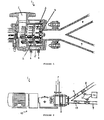
- a reactor 1 having an emulsifying or dispersing chamber 2.
- the dispersing chamber 2 contains stators 3 and rotors 4.
- There is a heating or cooling jacket 5 having inlet and outlet ports 6 surrounding the chamber.
- the apparatus 1 has an inlet 8 for the hydrophobic phase and an inlet 9 for the hydrophilic phase, the phases mixing and forming the stable emulsion in the dispersing chamber 2.
- the residence time of the hydrophobic and hydrophilic phases, once mixed, is kept to a minimum prior to entering the dispersing chamber.
- the two phases are mechanically sheared by the rotor 4/stator 3 arrangement inside the chamber 2.
- the rotor 4 rotates up to 8,000 rpm and the circumferential speed of the rotor/stator system is up to 23 m/sec.
- the two phases entering the chamber 2 via inlet conduit 8 and conduit 9 are pumped so that the mixture is forced to pass through the three rotor/stator generators in series, (from coarse to fine), to produce the stable emulsion of the invention.
- Figure 2 shows a more complete version of the Dispax-Reactor of Figure 1.
- the features of the modified Dispax-Reactor in Figure 2 are numbered the same as in Figure 1.
- the apparatus also shows the electric motor 10 which powers the stator/rotor assembly.
- the electric motor 10 which powers the stator/rotor assembly.
- Figure 2 shows how the flow rates may be adjusted using control valves 11 connected to a proportional controller 12, which is used to govern the actual flow rate.
- Non-return valves 13 are preferably installed in the input conduits 8 and 9 to prevent backflow and mixing of one phase with the other.
- the phases are pumped simultaneously through the generator chamber at high speeds so that each of the oil and water phases is mixed together for the minimum amount of time prior to emulsification.
- the two phases are not kept separate prior to emulsification, but are allowed to intermingle for some relatively long period of time.
- the normal Dispax-Reactor does not produce as stable an emulsion as the apparatus as herein described.
Landscapes
- Chemical & Material Sciences (AREA)
- Chemical Kinetics & Catalysis (AREA)
- Life Sciences & Earth Sciences (AREA)
- General Health & Medical Sciences (AREA)
- Health & Medical Sciences (AREA)
- Plant Pathology (AREA)
- Wood Science & Technology (AREA)
- Pest Control & Pesticides (AREA)
- Environmental Sciences (AREA)
- Toxicology (AREA)
- Engineering & Computer Science (AREA)
- Dentistry (AREA)
- Agronomy & Crop Science (AREA)
- Zoology (AREA)
- Oil, Petroleum & Natural Gas (AREA)
- Paints Or Removers (AREA)
- Colloid Chemistry (AREA)
- Agricultural Chemicals And Associated Chemicals (AREA)
- Food Preservation Except Freezing, Refrigeration, And Drying (AREA)
Priority Applications (1)
| Application Number | Priority Date | Filing Date | Title |
|---|---|---|---|
| AT86309869T ATE65447T1 (de) | 1985-12-17 | 1986-12-17 | Konservierungszusammensetzungen. |
Applications Claiming Priority (4)
| Application Number | Priority Date | Filing Date | Title |
|---|---|---|---|
| AUPH390285 | 1985-12-17 | ||
| AU3902/85 | 1985-12-17 | ||
| AUPH429286 | 1986-01-21 | ||
| AU4292/86 | 1986-01-21 |
Publications (2)
| Publication Number | Publication Date |
|---|---|
| EP0227430A1 true EP0227430A1 (de) | 1987-07-01 |
| EP0227430B1 EP0227430B1 (de) | 1991-07-24 |
Family
ID=25643032
Family Applications (1)
| Application Number | Title | Priority Date | Filing Date |
|---|---|---|---|
| EP86309869A Expired - Lifetime EP0227430B1 (de) | 1985-12-17 | 1986-12-17 | Konservierungszusammensetzungen |
Country Status (7)
| Country | Link |
|---|---|
| EP (1) | EP0227430B1 (de) |
| AT (1) | ATE65447T1 (de) |
| AU (1) | AU604471B2 (de) |
| CA (1) | CA1306663C (de) |
| ES (1) | ES2025064B3 (de) |
| NZ (1) | NZ218652A (de) |
| WO (1) | WO1987003783A1 (de) |
Cited By (9)
| Publication number | Priority date | Publication date | Assignee | Title |
|---|---|---|---|---|
| EP0761724A3 (de) * | 1995-08-30 | 1997-06-04 | Dow Corning Toray Silicone | Verfahren zur kontinuierlichen Herstellung von Organopolysiloxanemulsionen |
| WO1999048656A1 (en) * | 1998-03-20 | 1999-09-30 | John Bernard Watkins | Composition for impregnating porous materials, preparation and use thereof |
| WO2000002716A1 (de) * | 1998-07-12 | 2000-01-20 | Lonza Ag | Mittel und verfahren zur schutzbehandlung von holz |
| EP0998897A1 (de) * | 1998-10-14 | 2000-05-10 | Goldwell Aktiengesellschaft | Verfahren zur Herstellung von stabilen wässrigen Haarfärbeemulsionen |
| WO2001030158A1 (en) * | 1999-10-28 | 2001-05-03 | Research Association For Improvement Of Wood Quality | Creosote oil emulsion and process for producing the same |
| WO2001076837A1 (en) * | 2000-04-07 | 2001-10-18 | Exxonmobil Oil Corporation | Timber preservative |
| RU2218275C2 (ru) * | 1998-07-12 | 2003-12-10 | Лонца Аг | Средства и способ обработки для защиты древесины |
| KR100455103B1 (ko) * | 2001-07-20 | 2004-11-06 | 최운성 | 믹싱장치 |
| EP2344273A4 (de) * | 2008-11-07 | 2013-01-09 | Hrd Corp | Verfahren mit hoher scherung zur herstellung mikronisierter wachse |
Families Citing this family (26)
| Publication number | Priority date | Publication date | Assignee | Title |
|---|---|---|---|---|
| EP0527865A4 (en) * | 1990-05-07 | 1993-11-18 | Emoleum (Australia) Limited | Improved bitumen emulsions |
| US5192360A (en) * | 1990-05-15 | 1993-03-09 | Hughes Aircraft Company | Water-soluble flux for cored solder |
| US5198038A (en) * | 1990-05-15 | 1993-03-30 | Hughes Aircraft Company | Foaming flux for automatic soldering process |
| US5190208A (en) * | 1990-05-15 | 1993-03-02 | Hughes Aircraft Company | Foaming flux for automatic soldering process |
| US6348089B1 (en) * | 1998-07-12 | 2002-02-19 | Lonza Ag | Compositions and process for the protective treatment of wood |
| FR2796272B1 (fr) | 1999-07-15 | 2003-09-19 | Oreal | Composition sans cire structuree sous forme rigide par un polymere |
| FR2796271B1 (fr) | 1999-07-15 | 2002-01-11 | Oreal | Composition sans cire structuree sous forme rigide par un polymere |
| FR2804018B1 (fr) | 2000-01-24 | 2008-07-11 | Oreal | Composition sans transfert structuree sous forme rigide par un polymere |
| US7276547B2 (en) | 2000-12-12 | 2007-10-02 | L'oreal S.A. | Compositions comprising heteropolymers and at least one oil-soluble polymers chosen from alkyl celluloses and alkylated guar gums |
| US20030082126A9 (en) * | 2000-12-12 | 2003-05-01 | Pinzon Carlos O. | Cosmetic compositions containing heteropolymers and oil-soluble cationic surfactants and methods of using same |
| WO2002047624A1 (en) | 2000-12-12 | 2002-06-20 | L'oreal Sa | Cosmetic compositions containing at least one heteropolymer and at least one gelling agent and methods of using the same |
| US6835399B2 (en) | 2000-12-12 | 2004-12-28 | L'ORéAL S.A. | Cosmetic composition comprising a polymer blend |
| WO2002047623A1 (en) | 2000-12-12 | 2002-06-20 | L'oreal Sa | Composition comprising at least one heteropolymer and at least one inert filler and methods for use |
| FR2817739B1 (fr) | 2000-12-12 | 2005-01-07 | Oreal | Composition cosmetique coloree transparente ou translucide |
| WO2002047626A1 (en) | 2000-12-12 | 2002-06-20 | L'oreal Sa | Cosmetic composition comprising heteropolymers and a solid substance and method of using same |
| EP1343458B1 (de) | 2000-12-12 | 2008-02-13 | L'oreal | Kosmetische zusammensetzung mit einem polymergemisch |
| AUPR211400A0 (en) | 2000-12-15 | 2001-01-25 | Koppers-Hickson Timber Protection Pty Limited | Material and method for treatment of timber |
| FR2819399B1 (fr) | 2001-01-17 | 2003-02-21 | Oreal | Composition cosmetique contenant un polymere et une huile fluoree |
| US7025953B2 (en) | 2001-01-17 | 2006-04-11 | L'oreal S.A. | Nail polish composition comprising a polymer |
| US6716420B2 (en) | 2001-10-05 | 2004-04-06 | L′Oreal | Methods of use and of making a mascara comprising at least one coloring agent and at least one heteropolymer |
| US7008629B2 (en) | 2002-07-22 | 2006-03-07 | L'ORéAL S.A. | Compositions comprising at least one heteropolymer and fibers, and methods of using the same |
| WO2006047819A1 (en) * | 2004-11-02 | 2006-05-11 | Koppers Arch Wood Protection (Aust) Pty Limited | Timber impregnation |
| WO2014140854A1 (en) | 2013-03-14 | 2014-09-18 | Stella-Jones Inc. | Compositions comprising unsaturated fatty esters and uses thereof |
| US9808955B2 (en) * | 2014-03-14 | 2017-11-07 | Stella-Jones Inc. | Low odor creosote-based compositions and uses thereof |
| NZ734108A (en) * | 2015-02-04 | 2020-02-28 | Arch Wood Protection Pty Ltd | A method and formulation for the treatment of timber |
| CN106582358B (zh) * | 2015-10-19 | 2019-05-28 | 上海弗鲁克科技发展有限公司 | 混合分散设备 |
Citations (6)
| Publication number | Priority date | Publication date | Assignee | Title |
|---|---|---|---|---|
| GB421519A (en) * | 1933-09-28 | 1934-12-21 | Pfersee Chem Fab | Process for the production of aqueous, positively charged emulsions |
| GB1099283A (en) * | 1964-08-04 | 1968-01-17 | Bayer Ag | Process for the preparation of reverse emulsions |
| US4155657A (en) * | 1978-03-10 | 1979-05-22 | Chemed Corporation | Continuous mixer for preparing emulsions |
| GB2084038A (en) * | 1980-09-11 | 1982-04-07 | Matsuoka Mitsutoshi | Apparatus for preparing dispersions |
| AT376145B (de) * | 1982-01-15 | 1984-10-10 | Bockwoldt Hans Peter | Vorrichtung zur herstellung von oel-, wie schweroel- oder leichten heizoel-wasser-, insbesondere seewasser-emulsionen |
| WO1985000040A1 (en) * | 1983-06-17 | 1985-01-03 | Koppers Australia Pty. Limited | Preservative composition |
Family Cites Families (7)
| Publication number | Priority date | Publication date | Assignee | Title |
|---|---|---|---|---|
| US1638440A (en) * | 1924-01-23 | 1927-08-09 | Grasselli Chemical Co | Wood preservation |
| US2158374A (en) * | 1936-01-27 | 1939-05-16 | Union Oil Co | Soluble oils |
| GB1151508A (en) * | 1965-10-06 | 1969-05-07 | Hickson S Timber Impregnation | Wood-Treatment Compositions |
| US3635834A (en) * | 1969-12-22 | 1972-01-18 | Squibb & Sons Inc | Process for preparing semisolid emulsions |
| AT332351B (de) * | 1970-06-30 | 1976-09-27 | Pfersee Chem Fab | Verfahren zur herstellung von emulsionen von organopolysiloxanen, die an silicium gebundene wasserstoffatome enthalten |
| US3650792A (en) * | 1970-08-07 | 1972-03-21 | Ppg Industries Inc | Method for producing pigments of improved dispersibility |
| AU514897B2 (en) * | 1976-08-31 | 1981-03-05 | Koppers Australia Pty. Limited | Pigmented creosote preservative |
-
1986
- 1986-12-16 AU AU66626/86A patent/AU604471B2/en not_active Expired
- 1986-12-16 NZ NZ218652A patent/NZ218652A/en unknown
- 1986-12-17 EP EP86309869A patent/EP0227430B1/de not_active Expired - Lifetime
- 1986-12-17 AT AT86309869T patent/ATE65447T1/de not_active IP Right Cessation
- 1986-12-17 CA CA000525559A patent/CA1306663C/en not_active Expired - Lifetime
- 1986-12-17 WO PCT/US1986/002737 patent/WO1987003783A1/en not_active Ceased
- 1986-12-17 ES ES86309869T patent/ES2025064B3/es not_active Expired - Lifetime
Patent Citations (6)
| Publication number | Priority date | Publication date | Assignee | Title |
|---|---|---|---|---|
| GB421519A (en) * | 1933-09-28 | 1934-12-21 | Pfersee Chem Fab | Process for the production of aqueous, positively charged emulsions |
| GB1099283A (en) * | 1964-08-04 | 1968-01-17 | Bayer Ag | Process for the preparation of reverse emulsions |
| US4155657A (en) * | 1978-03-10 | 1979-05-22 | Chemed Corporation | Continuous mixer for preparing emulsions |
| GB2084038A (en) * | 1980-09-11 | 1982-04-07 | Matsuoka Mitsutoshi | Apparatus for preparing dispersions |
| AT376145B (de) * | 1982-01-15 | 1984-10-10 | Bockwoldt Hans Peter | Vorrichtung zur herstellung von oel-, wie schweroel- oder leichten heizoel-wasser-, insbesondere seewasser-emulsionen |
| WO1985000040A1 (en) * | 1983-06-17 | 1985-01-03 | Koppers Australia Pty. Limited | Preservative composition |
Cited By (14)
| Publication number | Priority date | Publication date | Assignee | Title |
|---|---|---|---|---|
| EP0761724A3 (de) * | 1995-08-30 | 1997-06-04 | Dow Corning Toray Silicone | Verfahren zur kontinuierlichen Herstellung von Organopolysiloxanemulsionen |
| EP1064126A4 (de) * | 1998-03-20 | 2007-05-02 | Univ Monash | Zusammensetzung zur imprägnierung poröser materialien, ihre herstellung und verwendung |
| RU2205749C2 (ru) * | 1998-03-20 | 2003-06-10 | Монаш Юниверсити | Состав для пропитки пористых материалов, его получение и применение |
| WO1999048656A1 (en) * | 1998-03-20 | 1999-09-30 | John Bernard Watkins | Composition for impregnating porous materials, preparation and use thereof |
| WO2000002716A1 (de) * | 1998-07-12 | 2000-01-20 | Lonza Ag | Mittel und verfahren zur schutzbehandlung von holz |
| RU2218275C2 (ru) * | 1998-07-12 | 2003-12-10 | Лонца Аг | Средства и способ обработки для защиты древесины |
| CZ299917B6 (cs) * | 1998-07-12 | 2008-12-29 | Lonza Ag | Prostredek pro ochranné ošetrení dreva |
| EP0998897A1 (de) * | 1998-10-14 | 2000-05-10 | Goldwell Aktiengesellschaft | Verfahren zur Herstellung von stabilen wässrigen Haarfärbeemulsionen |
| WO2001030158A1 (en) * | 1999-10-28 | 2001-05-03 | Research Association For Improvement Of Wood Quality | Creosote oil emulsion and process for producing the same |
| WO2001076837A1 (en) * | 2000-04-07 | 2001-10-18 | Exxonmobil Oil Corporation | Timber preservative |
| KR100455103B1 (ko) * | 2001-07-20 | 2004-11-06 | 최운성 | 믹싱장치 |
| EP2344273A4 (de) * | 2008-11-07 | 2013-01-09 | Hrd Corp | Verfahren mit hoher scherung zur herstellung mikronisierter wachse |
| US8450539B2 (en) | 2008-11-07 | 2013-05-28 | H R D Corporation | High shear process for producing micronized waxes |
| US8669401B2 (en) | 2008-11-07 | 2014-03-11 | H R D Corporation | High shear process for producing micronized waxes |
Also Published As
| Publication number | Publication date |
|---|---|
| ATE65447T1 (de) | 1991-08-15 |
| NZ218652A (en) | 1992-09-25 |
| ES2025064B3 (es) | 1992-03-16 |
| EP0227430B1 (de) | 1991-07-24 |
| AU6662686A (en) | 1987-06-18 |
| AU604471B2 (en) | 1990-12-20 |
| WO1987003783A1 (en) | 1987-07-02 |
| CA1306663C (en) | 1992-08-25 |
Similar Documents
| Publication | Publication Date | Title |
|---|---|---|
| EP0227430B1 (de) | Konservierungszusammensetzungen | |
| EP0149625B1 (de) | Schutzzusammensetzung | |
| EP0538555B1 (de) | Wässrige, Organosiliciumverbindungen enthaltende Emulsionen zum Imprägnieren von anorganischen Materialien, insbesondere von Baumaterialien | |
| CN102704330B (zh) | 纸箱防水涂料 | |
| DE69109401T2 (de) | Wässrige Zusammensetzungen zur Behandlung von porösen Substraten. | |
| DE19904496A1 (de) | Wäßrige Cremes von Organosiliciumverbindungen | |
| AU2916299A (en) | Composition for impregnating porous materials, preparation and use thereof | |
| EP0130521A1 (de) | Siliconharz-Emulsion | |
| US5224990A (en) | Surfactant-modified bituminous emulsions | |
| DE19634500A1 (de) | Zusammensetzungen für die wasser- und ölabweisende Behandlung saugfähiger Materialien | |
| EP0548789A1 (de) | Pflegemittel für harte Oberflächen | |
| EP0791566B1 (de) | Selbstgrundierende Baustoffbeschichtungen | |
| DE3414244A1 (de) | Holzschutzanstrichmittel, vorzugsweise holzschutzfarbe | |
| DE102015217551A1 (de) | Verfahren zur kontinuierlichen Herstellung von stabilen Siliconemulsionen | |
| DE1644942B2 (de) | Stabile, thixotrope emulsion und verfahren zur herstellung derselben | |
| US5977189A (en) | C7 -C12 diol and diol alkoxylates as coupling agents for surfactant formulations | |
| JPS63501723A (ja) | 防腐剤 | |
| DE102012213377A1 (de) | Nicht-filmbildende Formulierungen auf Basis von Organosiliciumverbindungen | |
| DE4421500C1 (de) | Wäßrige, siliciumorganische Verbindungen enthaltende Zusammensetzungen | |
| EP1160305B1 (de) | Verfahren zur Herstellung eines Feuerschutzmittels für brennbare Materialien | |
| NZ509289A (en) | Compostion for the protective treatment of wood comprises coal-tar oil and a quateranry ammonium compound with water | |
| NZ537908A (en) | A process for forming an oil-in-water emulsion of lanolin | |
| DE102023121695B3 (de) | Holzschutzmittel | |
| EP3115427B1 (de) | Verfahren zur herstellung einer pigmentzusammensetzung für holz sowie verwendung der pigmentzusammensetzung | |
| DE1255218B (de) | UEberzugsmittel auf Bitumenbasis |
Legal Events
| Date | Code | Title | Description |
|---|---|---|---|
| PUAI | Public reference made under article 153(3) epc to a published international application that has entered the european phase |
Free format text: ORIGINAL CODE: 0009012 |
|
| AK | Designated contracting states |
Kind code of ref document: A1 Designated state(s): AT BE CH DE ES FR GB GR IT LI LU NL SE |
|
| 17P | Request for examination filed |
Effective date: 19871230 |
|
| 17Q | First examination report despatched |
Effective date: 19890320 |
|
| GRAA | (expected) grant |
Free format text: ORIGINAL CODE: 0009210 |
|
| AK | Designated contracting states |
Kind code of ref document: B1 Designated state(s): AT BE CH DE ES FR GB GR IT LI LU NL SE |
|
| PG25 | Lapsed in a contracting state [announced via postgrant information from national office to epo] |
Ref country code: LI Effective date: 19910724 Ref country code: GR Free format text: LAPSE BECAUSE OF FAILURE TO SUBMIT A TRANSLATION OF THE DESCRIPTION OR TO PAY THE FEE WITHIN THE PRESCRIBED TIME-LIMIT Effective date: 19910724 Ref country code: CH Effective date: 19910724 |
|
| REF | Corresponds to: |
Ref document number: 65447 Country of ref document: AT Date of ref document: 19910815 Kind code of ref document: T |
|
| ITF | It: translation for a ep patent filed | ||
| REF | Corresponds to: |
Ref document number: 3680495 Country of ref document: DE Date of ref document: 19910829 |
|
| ET | Fr: translation filed | ||
| REG | Reference to a national code |
Ref country code: CH Ref legal event code: PL |
|
| PG25 | Lapsed in a contracting state [announced via postgrant information from national office to epo] |
Ref country code: LU Free format text: LAPSE BECAUSE OF NON-PAYMENT OF DUE FEES Effective date: 19911231 |
|
| REG | Reference to a national code |
Ref country code: ES Ref legal event code: FG2A Ref document number: 2025064 Country of ref document: ES Kind code of ref document: B3 |
|
| PLBE | No opposition filed within time limit |
Free format text: ORIGINAL CODE: 0009261 |
|
| STAA | Information on the status of an ep patent application or granted ep patent |
Free format text: STATUS: NO OPPOSITION FILED WITHIN TIME LIMIT |
|
| 26N | No opposition filed | ||
| EAL | Se: european patent in force in sweden |
Ref document number: 86309869.5 |
|
| PGFP | Annual fee paid to national office [announced via postgrant information from national office to epo] |
Ref country code: AT Payment date: 19951213 Year of fee payment: 10 |
|
| PGFP | Annual fee paid to national office [announced via postgrant information from national office to epo] |
Ref country code: SE Payment date: 19951215 Year of fee payment: 10 |
|
| PGFP | Annual fee paid to national office [announced via postgrant information from national office to epo] |
Ref country code: ES Payment date: 19951219 Year of fee payment: 10 |
|
| PGFP | Annual fee paid to national office [announced via postgrant information from national office to epo] |
Ref country code: DE Payment date: 19951222 Year of fee payment: 10 |
|
| PGFP | Annual fee paid to national office [announced via postgrant information from national office to epo] |
Ref country code: NL Payment date: 19951230 Year of fee payment: 10 |
|
| PGFP | Annual fee paid to national office [announced via postgrant information from national office to epo] |
Ref country code: BE Payment date: 19960130 Year of fee payment: 10 |
|
| PG25 | Lapsed in a contracting state [announced via postgrant information from national office to epo] |
Ref country code: AT Effective date: 19961217 |
|
| PG25 | Lapsed in a contracting state [announced via postgrant information from national office to epo] |
Ref country code: SE Effective date: 19961218 Ref country code: ES Free format text: LAPSE BECAUSE OF THE APPLICANT RENOUNCES Effective date: 19961218 |
|
| PG25 | Lapsed in a contracting state [announced via postgrant information from national office to epo] |
Ref country code: BE Effective date: 19961231 |
|
| BERE | Be: lapsed |
Owner name: THE COMMONWEALTH SCIENTIFIC AND INDUSTRIAL RESEAR Effective date: 19961231 Owner name: KOPPERS AUSTRALIA PTY. LTD Effective date: 19961231 |
|
| PG25 | Lapsed in a contracting state [announced via postgrant information from national office to epo] |
Ref country code: NL Effective date: 19970701 |
|
| NLV4 | Nl: lapsed or anulled due to non-payment of the annual fee |
Effective date: 19970701 |
|
| PG25 | Lapsed in a contracting state [announced via postgrant information from national office to epo] |
Ref country code: DE Effective date: 19970902 |
|
| EUG | Se: european patent has lapsed |
Ref document number: 86309869.5 |
|
| REG | Reference to a national code |
Ref country code: ES Ref legal event code: FD2A Effective date: 20010402 |
|
| PGFP | Annual fee paid to national office [announced via postgrant information from national office to epo] |
Ref country code: GB Payment date: 20011219 Year of fee payment: 16 |
|
| REG | Reference to a national code |
Ref country code: GB Ref legal event code: IF02 |
|
| PG25 | Lapsed in a contracting state [announced via postgrant information from national office to epo] |
Ref country code: GB Free format text: LAPSE BECAUSE OF NON-PAYMENT OF DUE FEES Effective date: 20021217 |
|
| GBPC | Gb: european patent ceased through non-payment of renewal fee |
Effective date: 20021217 |
|
| PGFP | Annual fee paid to national office [announced via postgrant information from national office to epo] |
Ref country code: FR Payment date: 20051208 Year of fee payment: 20 |
|
| PG25 | Lapsed in a contracting state [announced via postgrant information from national office to epo] |
Ref country code: IT Free format text: LAPSE BECAUSE OF NON-PAYMENT OF DUE FEES;WARNING: LAPSES OF ITALIAN PATENTS WITH EFFECTIVE DATE BEFORE 2007 MAY HAVE OCCURRED AT ANY TIME BEFORE 2007. THE CORRECT EFFECTIVE DATE MAY BE DIFFERENT FROM THE ONE RECORDED. Effective date: 20051217 |