EP0227601A2 - Novel pyridine compounds and their use as herbicides - Google Patents
Novel pyridine compounds and their use as herbicides Download PDFInfo
- Publication number
- EP0227601A2 EP0227601A2 EP86810591A EP86810591A EP0227601A2 EP 0227601 A2 EP0227601 A2 EP 0227601A2 EP 86810591 A EP86810591 A EP 86810591A EP 86810591 A EP86810591 A EP 86810591A EP 0227601 A2 EP0227601 A2 EP 0227601A2
- Authority
- EP
- European Patent Office
- Prior art keywords
- compound
- formula
- oxide
- pyridinesulfonamide
- alkyl
- Prior art date
- Legal status (The legal status is an assumption and is not a legal conclusion. Google has not performed a legal analysis and makes no representation as to the accuracy of the status listed.)
- Withdrawn
Links
- 0 CC(*)(C=C)C=N Chemical compound CC(*)(C=C)C=N 0.000 description 1
Classifications
-
- C—CHEMISTRY; METALLURGY
- C07—ORGANIC CHEMISTRY
- C07D—HETEROCYCLIC COMPOUNDS
- C07D213/00—Heterocyclic compounds containing six-membered rings, not condensed with other rings, with one nitrogen atom as the only ring hetero atom and three or more double bonds between ring members or between ring members and non-ring members
- C07D213/02—Heterocyclic compounds containing six-membered rings, not condensed with other rings, with one nitrogen atom as the only ring hetero atom and three or more double bonds between ring members or between ring members and non-ring members having three double bonds between ring members or between ring members and non-ring members
- C07D213/89—Heterocyclic compounds containing six-membered rings, not condensed with other rings, with one nitrogen atom as the only ring hetero atom and three or more double bonds between ring members or between ring members and non-ring members having three double bonds between ring members or between ring members and non-ring members with hetero atoms directly attached to the ring nitrogen atom
-
- A—HUMAN NECESSITIES
- A01—AGRICULTURE; FORESTRY; ANIMAL HUSBANDRY; HUNTING; TRAPPING; FISHING
- A01N—PRESERVATION OF BODIES OF HUMANS OR ANIMALS OR PLANTS OR PARTS THEREOF; BIOCIDES, e.g. AS DISINFECTANTS, AS PESTICIDES OR AS HERBICIDES; PEST REPELLANTS OR ATTRACTANTS; PLANT GROWTH REGULATORS
- A01N43/00—Biocides, pest repellants or attractants, or plant growth regulators containing heterocyclic compounds
- A01N43/34—Biocides, pest repellants or attractants, or plant growth regulators containing heterocyclic compounds having rings with one nitrogen atom as the only ring hetero atom
- A01N43/40—Biocides, pest repellants or attractants, or plant growth regulators containing heterocyclic compounds having rings with one nitrogen atom as the only ring hetero atom six-membered rings
Definitions
- This invention relates to substituted 2-pyridinesulfonamide 1-oxides, synthesis thereof, intermediates therefor, and the use of the compounds for the control of weeds.
- n is preferably zero or one, more preferably zero.
- t is preferably zero, one, two or three; more preferably zero, one or two; most preferably zero or one.
- any of the substituents R l , R 2 , X, Y or Z is or comprises halogen
- such halogen is conveniently selected from bromo, chloro and fluoro.
- R 1 is unsubstituted or halogenated C 1-8 alkyl, such alkyl has preferably 1 to 5, more preferably 1 to 3 C atoms.
- R is unsubstituted or halogenated C 2-8 alkenyl
- such alkenyl has e .g. 3 to 5, preferably 3 or 4 C-atoms.
- R is alkynyl it comprises e.g. 3 to 5, preferably 3 C-atoms.
- R is halogenated C 1-8 alkyl or C 2-8 alkenyl, it comprises preferably 1 to 3, e.g. 1 or 2 halogen atoms.
- R is C 2-l0 alkoxyalkyl, it is preferably C 1-5 alkoxy-C 1-5 alkyl, e.g. CH 2 OCH 3 .
- R 1 is C 2-10 alkylthioalkyl, it is preferably C 1-5 alkylthio-C 1-5 alkyl.
- R is C 1-8 alkyl it has preferably 1 to 5 C-atoms.
- X is unsubstituted or halogenated C 1-8 alkyl, it comprises preferably 1 to 5, e.g. 1 C-atom.
- X is halogenated C 1-8 alkyl it comprises preferably from 1 to 3 halogens.
- An example of a preferred haloalkyl significance of X is CF 3 .
- X is C 1-8 alkoxy it has preferably from 1 to 5 C-atoms.
- Y and Z is unsubstituted or halogenated C 1-8 alkyl, it comprises preferably from 1 to 5, more preferably 1 or 2 C-atoms.
- any of Y and Z is halogenated C 1-8 alkyl, it comprises preferably from 1 to 3 halogens.
- Y or Z An example of a preferred haloalkyl significance of Y or Z is CF 3 .
- Y and Z is unsubstituted or halogenated C 1-8 alkoxy it comprises preferably from 1 to 5, particularly 1 or 2 carbon atoms.
- any of Y and Z is halogenated C 1-8 alkoxy it comprises preferably from 1 to 4 halogen atoms.
- Y and Z is C 1-8 alkylthio, it comprises preferably from 1 to 5 C-atoms.
- Y and Z is halogen, it is preferably F or Cl.
- Y and Z is C 2-8 alkoxycarbonyl, it is preferably (C 1-5 alkoxy)-carbonyl.
- R 1 is preferably C 1-5 alkyl, C 2-5 alkenyl or C 2-5 alkynyl.
- R 2 is preferably hydrogen.
- X is preferably hydrogen or halogen.
- Y is preferably C 1-5 alkyl, CF 3 , nitro or halogen.
- Z is preferably C 1-5 alkyl, CF 3 , halogen, or di- or trifluorinated C 1-5 alkoxy.
- At least one of W and W 1 is CH; more preferably W and W 1 are both CH.
- a preferred sub-group of the present invention is represented by the following formula (A') wherein n is zero or one;
- a particularly preferred sub-group within the class of the compounds of the present invention of formula A' is one in which n is zero, t is zero, R 1 is methyl or ethyl, each of W and W 1 is CH, X is hydrogen, fluoro or chloro in the 5-position, and Z is in the 2-position and is fluoro, trifluoromethyl, difluoromethoxy or 2,2,2-trifluoro-ethoxy.
- Another particularly preferred sub-group of compounds of formula A' is one in which n is zero, t is one, R is methyl or ethyl, each of W and W 1 is CH, X is hydrogen or chloro in the 5-position, Y is chloro or fluoro, and Z is in the 2-position and is fluoro, trifluoromethyl, difluoromethoxy or 2,2,2-trifluoroethoxy.
- the invention also comprises processes of preparing a compound of formula A, comprising:
- the N-oxidation of the 2-pyridylsulfonyl group of a compound of formula I may be carried out according to processes and conditions known in the art of oxidation of pyridine compounds.
- a suitable oxidizing agent is peracetic acid, for example in the form of the commercially available aqueous 40% solution.
- a suitable reaction temperature is room temperature or moderately above, e.g. 20° to 50°C.
- reaction of formulae III & IV may be effected under the conditions known for the preparation of sulfonamides starting from the corresponding sulfonyl halides and amines.
- the reaction is conveniently carried out in a solvent which is inert under the reaction conditions, such as methylene chloride or benzene.
- a suitable reaction temperature is room temperature or below, e.g. -10° to 20°C.
- N-alkylation of a compound of formula A where R is H may be carried out under processes and conditions known in the art of alkylation of amino compounds.
- compound A is preferably as a salt, e.g. the sodium salt (i.e. R is N a).
- the compounds of formula A may be recovered from the reaction mixture in which they are formed by working up by established procedures.
- the starting materials are known or, in cases where they are novel, can be produced and purified in accordance with known processes or in a manner analogous to processes described herein or to known processes.
- novel compounds of formula A are useful as herbicides for the control of weed plants, using pre- and/or postemergent treatments.
- Herbicide refers to an active ingredient which modifies the growth of plants because of phytotoxic or plant growth regulating properties so as to retard the growth of the plant or to damage the plant sufficiently to kill it.
- plants it is meant germinating seeds, emerging seedlings and established vegetation including underground portions. While some activity is shown when weeds are treated postemergence, the compounds of the present invention generally are more effective when used as preemergent herbicides.
- a compound of the present invention is made according to conventional procedure to the weed or its locus using an herbicidally effective amount of the compound, usually from about one-half or less to ten pounds per acre.
- the application of a compound of the present invention to the "locus" of the weed plant includes application to the seeds, the plant or parts of the plant, or the soil.
- the compounds of formula A When applied at an appropriate application rate, the compounds of formula A are relatively less toxic toward broadleaf crops, including cotton, soybeans, sugar beets and peanuts, than towards weeds.
- the compounds of formula A are therefore useful as selective herbicides in a broadleaf crop locus.
- the amount to be applied to attain the desired effect will vary depending on the particular crop, if employed for selective use, and other standard variables such as the compound employed, mode of application, conditions of treatment and the like.
- the appropriate application rates can be determined by routine procedures by those skilled in the art, or by comparing the activity of the compounds of the invention with standards for which the application rate is known, e.g. in greenhouse tests.
- satisfactory results are usually obtained when the compound is applied at a rate in the range of from about 0.03 to 5.0 kg/ha, preferably from about 0.5 to 4 kg/ha, and more particularly from about 1.0 to 3.0 kg/ha, the application being repeated as necessary.
- the compounds of formula A may be and preferably are employed as herbicidal compositions in association with agriculturally acceptable diluent(s).
- suitable formulations contain from 0.01% to 99% by weight of active ingredient, from 0 to 20% surfactant and from 1 to 99.99% solid or liquid diluent(s). Higher ratios of surfactant to active ingredient are sometimes desirable and are achieved by incorporation into the formulation or by tank mixing.
- Application forms of a composition generally contain between 0.01 and 25% by weight of active ingredient. Lower or higher levels of active ingredient can, of course, be present depending on the intended use, the physical properties of the compound and the mode of application.
- Concentrate forms of a composition intended to be diluted before use generally contain between 2 and 90%, preferably between 10 and 82% by weight of active ingredient.
- Useful formulations of the compounds of formula A include dusts, granules, suspension concentrates, wettable powders, emulsifiable concentrates, flowables and the like. They are obtained by conventional manner, e.g. by mixing a compound of formula A with the diluent(s) and optionally with other ingredients.
- the compounds of formula A may be used in micro-encapsulated form.
- Agriculturally acceptable additives may be employed in the herbicidal compositions to improve the performance of the active ingredient and to reduce foaming, caking and corrosion, for example.
- surfactant as used herein means an agriculturally acceptable material which imparts emulsifiability, spreading, wetting, dispersibility or other surface-modifying properties.
- surfactants are sodium lignin sulphonate and lauryl sulphate.
- Dusts or granules means a liquid or solid agriculturally acceptable material used to dilute a concentrated material to a usable or desirable strength.
- talc kaolin or diatomaceous earth
- liquid concentrate forms for example a hydrocarbon such as xylene or an alcohol such as isopropanol, and for liquid application forms i.a. water or diesel oil.
- compositions of this invention can also comprise other compounds having biological activity, e.g. compounds having similar or complementary herbicidal activity or compounds having antidotal, fungicidal or insecticidal activity.
- herbicidal compositions will now be described. Parts are percent by weight.
- VEEGUM R colloidal magnesium aluminium silicate
- MARASPERSE C21 purified calcium ligno sulfonate
- SURFYNOL R TGE acetylenic glycol blend in propylene glycol
- N-methyl-N-(2,3-dichlorophenyl)-2-pyridinesulfonamide (1.7 g, 5.3 mmol) is treated with 40% peracetic acid (approx. 12 ml) at 35-45° under N 2 for 14 hours. The excess peracetic acid is removed under vacuum, and the residue is diluted with methylene chloride, poured into water, neutralized with aq. sodium bicarbonate, washed with brine, dried and evaporated to dryness to give, after purification, the title compound (compound 1, Table A).
- N-methyl-N-(3,5-dichloro-2-pyridyl)-2-pyridinesulfonamide is oxidized with 40% peracetic acid to give the title compound, MS m/e 334.00 (M , ).
- Example 5 The title compound of Example 5 above is reacted with methyl iodide (0.6g, 0.26 ml, 4.2 mmol) to give N-methyl-N-(2-chloro-3-pyridyl)-2-pyridine-sulfonamide 1-oxide, MS m/e 300.00 (M + + 1).
- Pre-emergent herbicidal activity of compounds of the present invention of Formula A was determined as follows: Seeds of selected weeds were planted and the soil was drenched with a solution of the test compound (11.5 mg) in acetone (5.0 ml) and water (15.0 ml), at a rate equivalent to 10 lb/acre. Scoring was made two weeks after treatment. The grasses (GR) green foxtail, watergrass, shattercane and wild oats and the broadleafs (BL) annual morning glory, mustard, nightshade and velvetleaf were treated. The compounds of Formula A demonstrated herbicidal activity.
- 2-Pyridinesulfonyl chloride (46.0 mmol) is dissolved in cold methylene chloride and added dropwise at 0° to 2,3-dichloro-N-methylaniline (8.2 g, 4 6 . 0 mmol). The mixture is stirred at -10° for approx. 4 hours, then allowed to warm to RT. It is diluted with methylene chloride, washed with aqueous sodium bicarbonate and with brine, dried and evaporated to dryness to give, following purification, N-methyl-N-(2,3-dichlorophenyl)-2-pyridinesulfonamide.
Landscapes
- Life Sciences & Earth Sciences (AREA)
- Organic Chemistry (AREA)
- Chemical & Material Sciences (AREA)
- Dentistry (AREA)
- Health & Medical Sciences (AREA)
- Engineering & Computer Science (AREA)
- Plant Pathology (AREA)
- General Health & Medical Sciences (AREA)
- Wood Science & Technology (AREA)
- Zoology (AREA)
- Environmental Sciences (AREA)
- Pest Control & Pesticides (AREA)
- Agronomy & Crop Science (AREA)
- Agricultural Chemicals And Associated Chemicals (AREA)
- Pyridine Compounds (AREA)
Abstract
Substituted 2-pyridinesulfonamide 1-oxide, synthesis thereof, intermediates therefor, and the use of said compounds for the control of weeds.
Description
- This invention relates to substituted 2-pyridinesulfonamide 1-oxides, synthesis thereof, intermediates therefor, and the use of the compounds for the control of weeds.
- More particularly, the compounds of the present invention are represented by the following formula (A):

- t is zero, one, two, three or four;
- R1 is hydrogen, unsubstituted or halogenated C1-8alkyl, unsubstituted or halogenated C2-8alkenyl, C2-8alkynyl, C2-10alkoxyalkyl or C2-10alkylthioalkyl;
- R is hydrogen or C1-8alkyl;
- W is CH or N;
- W1 is CH or N; whereby when either of W or Wl is CH, it can be independently substituted by Y or Z;
- X is hydrogen, unsubstituted or halogenated C1-8alkyl, C1-8alkoxy or halogen;
- Y is unsubstituted or halogenated C1-8alkyl, unsubstituted or halogenated C1-8alkoxy, C1-8alkylthio, C2-8alkoxycarbonyl, nitro, cyano or halogen; and
- Z is hydrogen or independently selected from the values of Y.
- In the practice of the present invention, n is preferably zero or one, more preferably zero.
- t is preferably zero, one, two or three; more preferably zero, one or two; most preferably zero or one.
- Where any of the substituents Rl, R2, X, Y or Z is or comprises halogen, such halogen is conveniently selected from bromo, chloro and fluoro.
- Where R1 is unsubstituted or halogenated C1-8alkyl, such alkyl has preferably 1 to 5, more preferably 1 to 3 C atoms.
- Where R is unsubstituted or halogenated C2-8alkenyl, such alkenyl has e.g. 3 to 5, preferably 3 or 4 C-atoms.
- Where R is alkynyl it comprises e.g. 3 to 5, preferably 3 C-atoms.
- Where R is halogenated C1-8alkyl or C2-8alkenyl, it comprises preferably 1 to 3, e.g. 1 or 2 halogen atoms.
- Where R is C2-l0alkoxyalkyl, it is preferably C1-5alkoxy-C1-5alkyl, e.g. CH2OCH3.
- Where R1 is C2-10alkylthioalkyl, it is preferably C1-5alkylthio-C1-5alkyl.
- Where R is C1-8alkyl it has preferably 1 to 5 C-atoms.
- Where X is unsubstituted or halogenated C1-8alkyl, it comprises preferably 1 to 5, e.g. 1 C-atom.
- Where X is halogenated C1-8alkyl it comprises preferably from 1 to 3 halogens. An example of a preferred haloalkyl significance of X is CF3.
- Where X is C1-8alkoxy it has preferably from 1 to 5 C-atoms.
- Where any of Y and Z is unsubstituted or halogenated C1-8alkyl, it comprises preferably from 1 to 5, more preferably 1 or 2 C-atoms.
- Where any of Y and Z is halogenated C1-8alkyl, it comprises preferably from 1 to 3 halogens.
- An example of a preferred haloalkyl significance of Y or Z is CF3.
- Where any of Y and Z is unsubstituted or halogenated C1-8alkoxy it comprises preferably from 1 to 5, particularly 1 or 2 carbon atoms.
- Where any of Y and Z is halogenated C1-8alkoxy it comprises preferably from 1 to 4 halogen atoms.
- Where any of Y and Z is C1-8alkylthio, it comprises preferably from 1 to 5 C-atoms.
- Where any of Y and Z is halogen, it is preferably F or Cl.
- Where any of Y and Z is C2-8alkoxycarbonyl, it is preferably (C1-5alkoxy)-carbonyl.
- R1 is preferably C1-5alkyl, C2-5alkenyl or C2-5alkynyl.
- R 2 is preferably hydrogen.
- X is preferably hydrogen or halogen.
- Y is preferably C1-5alkyl, CF3, nitro or halogen.
- Z is preferably C1-5alkyl, CF3, halogen, or di- or trifluorinated C1-5alkoxy.
- It is preferred that at least one of W and W1 is CH; more preferably W and W1 are both CH.
- A preferred sub-group of the present invention is represented by the following formula (A') wherein n is zero or one;

- t is zero or one;
- R1 is C1-5alkyl, C3-5alkenyl, mono- or dihalogenated C3-5alkenyl, C3-5alkynyl or C1-5alkoxy-C1-5alkyl;
- X is hydrogen, C1-5alkyl or halogen;
- Y is C1-5alkyl, halogen, CF3, or di- or trihalogenated C1-5alkoxy;
- and Z is hydrogen; C1-5alkyl; halogen; CF3; di-, tri- or tetrahalo- genated C1-5-alkoxy; (C1-5alkoxy)carbonyl; CN; or NO2.
- A particularly preferred sub-group within the class of the compounds of the present invention of formula A' is one in which n is zero, t is zero, R 1 is methyl or ethyl, each of W and W1 is CH, X is hydrogen, fluoro or chloro in the 5-position, and Z is in the 2-position and is fluoro, trifluoromethyl, difluoromethoxy or 2,2,2-trifluoro-ethoxy.
- Another particularly preferred sub-group of compounds of formula A'is one in which n is zero, t is one, R is methyl or ethyl, each of W and W1 is CH, X is hydrogen or chloro in the 5-position, Y is chloro or fluoro, and Z is in the 2-position and is fluoro, trifluoromethyl, difluoromethoxy or 2,2,2-trifluoroethoxy.
- The invention also comprises processes of preparing a compound of formula A, comprising:
- a) N-oxidizing the 2-pyridylsulfonyl group of a compound of formula I


- wherein R1 a is unsubstituted or halogenated C1-8alkyl, unsubstituted or halogenated C2-8alkenyl, C2-8alkynyl, C2-10alkoxyalkyl or C2-10alkylthioalkyl, and
- Hal is halogen,
or a reactive functional derivative of a compound of formula II; or - b) N-sulfonating an amine of formula III

with a compound of formula IV
and Q is halogen,
followed, where desired, by N-alkylating a thus obtained compound of formula A wherein R1 is H with a compound of formula II
or a reactive functional derivative of a compound of formula II. - The N-oxidation of the 2-pyridylsulfonyl group of a compound of formula I (process a) may be carried out according to processes and conditions known in the art of oxidation of pyridine compounds. A suitable oxidizing agent is peracetic acid, for example in the form of the commercially available aqueous 40% solution. A suitable reaction temperature is room temperature or moderately above, e.g. 20° to 50°C.
- The reaction of formulae III & IV (process b) may be effected under the conditions known for the preparation of sulfonamides starting from the corresponding sulfonyl halides and amines. The reaction is conveniently carried out in a solvent which is inert under the reaction conditions, such as methylene chloride or benzene. A suitable reaction temperature is room temperature or below, e.g. -10° to 20°C.
- The optional N-alkylation of a compound of formula A where R is H may be carried out under processes and conditions known in the art of alkylation of amino compounds. In the process, compound A is preferably as a salt, e.g. the sodium salt (i.e. R is Na).
- The compounds of formula A may be recovered from the reaction mixture in which they are formed by working up by established procedures.
- The starting materials are known or, in cases where they are novel, can be produced and purified in accordance with known processes or in a manner analogous to processes described herein or to known processes.
- The novel compounds of formula A are useful as herbicides for the control of weed plants, using pre- and/or postemergent treatments. "Herbicide", as used herein, refers to an active ingredient which modifies the growth of plants because of phytotoxic or plant growth regulating properties so as to retard the growth of the plant or to damage the plant sufficiently to kill it. By "plants" it is meant germinating seeds, emerging seedlings and established vegetation including underground portions. While some activity is shown when weeds are treated postemergence, the compounds of the present invention generally are more effective when used as preemergent herbicides. Application of a compound of the present invention is made according to conventional procedure to the weed or its locus using an herbicidally effective amount of the compound, usually from about one-half or less to ten pounds per acre. The application of a compound of the present invention to the "locus" of the weed plant includes application to the seeds, the plant or parts of the plant, or the soil.
- While the compounds of formula A have activity on broadleaf (dicotyledoneous) plants, the compounds in general demonstrate a higher level of herbicidal activity on the grassy (monocotyledoneous) plants and the sedges when applied pre- or postemergence, as shown by greenhouse tests with test dosages equivalent to an application rate of from 0.03 to 10 kg/ha after pre- or postemergence application. Particularly, the compounds of the present invention show relatively greater activity at lower dosage rates when pre-emergent application is utilized.
- When applied at an appropriate application rate, the compounds of formula A are relatively less toxic toward broadleaf crops, including cotton, soybeans, sugar beets and peanuts, than towards weeds. The compounds of formula A are therefore useful as selective herbicides in a broadleaf crop locus.
- For general herbicidal as well as for selective herbicidal use of compounds of formula A, the amount to be applied to attain the desired effect will vary depending on the particular crop, if employed for selective use, and other standard variables such as the compound employed, mode of application, conditions of treatment and the like. The appropriate application rates can be determined by routine procedures by those skilled in the art, or by comparing the activity of the compounds of the invention with standards for which the application rate is known, e.g. in greenhouse tests. However, in general, satisfactory results are usually obtained when the compound is applied at a rate in the range of from about 0.03 to 5.0 kg/ha, preferably from about 0.5 to 4 kg/ha, and more particularly from about 1.0 to 3.0 kg/ha, the application being repeated as necessary.
- The compounds of formula A may be and preferably are employed as herbicidal compositions in association with agriculturally acceptable diluent(s). Suitable formulations contain from 0.01% to 99% by weight of active ingredient, from 0 to 20% surfactant and from 1 to 99.99% solid or liquid diluent(s). Higher ratios of surfactant to active ingredient are sometimes desirable and are achieved by incorporation into the formulation or by tank mixing. Application forms of a composition generally contain between 0.01 and 25% by weight of active ingredient. Lower or higher levels of active ingredient can, of course, be present depending on the intended use, the physical properties of the compound and the mode of application. Concentrate forms of a composition intended to be diluted before use generally contain between 2 and 90%, preferably between 10 and 82% by weight of active ingredient.
- Useful formulations of the compounds of formula A include dusts, granules, suspension concentrates, wettable powders, emulsifiable concentrates, flowables and the like. They are obtained by conventional manner, e.g. by mixing a compound of formula A with the diluent(s) and optionally with other ingredients.
- Alternatively, the compounds of formula A may be used in micro-encapsulated form.
- Agriculturally acceptable additives may be employed in the herbicidal compositions to improve the performance of the active ingredient and to reduce foaming, caking and corrosion, for example.
- "Surfactant" as used herein means an agriculturally acceptable material which imparts emulsifiability, spreading, wetting, dispersibility or other surface-modifying properties. Examples of surfactants are sodium lignin sulphonate and lauryl sulphate.
- "Diluent" as used herein means a liquid or solid agriculturally acceptable material used to dilute a concentrated material to a usable or desirable strength. For dusts or granules it can be e.g. talc, kaolin or diatomaceous earth, for liquid concentrate forms for example a hydrocarbon such as xylene or an alcohol such as isopropanol, and for liquid application forms i.a. water or diesel oil.
- The compositions of this invention can also comprise other compounds having biological activity, e.g. compounds having similar or complementary herbicidal activity or compounds having antidotal, fungicidal or insecticidal activity.
- Specific non-limiting Examples of herbicidal compositions will now be described. Parts are percent by weight.
- 0.6 Parts of colloidal magnesium aluminium silicate (VEEGUMR) is dispersed in 41.3 parts of water. 52.0 Parts of a compound of formula A, 6.0 parts of purified calcium ligno sulfonate (MARASPERSE C21) and 0.1 part of acetylenic glycol blend in propylene glycol (SURFYNOLR TGE) are added, and the mixture is wet-milled until a medium particle size of 3-4 microns is obtained.
- 82.0 Parts of a compound of formula A are mixed and milled with sodium lignin sulfonate (POLYFONRH), 1.0 part of sodium dialkylnaphthalene sulfonate (SELLOGENR HR) and 13.0 parts of kaolin.
- The following examples are provided to illustrate the practice of the present invention. Temperature is given in degrees centigrade. "RT" means room temperature.
- N-methyl-N-(2,3-dichlorophenyl)-2-pyridinesulfonamide (1.7 g, 5.3 mmol) is treated with 40% peracetic acid (approx. 12 ml) at 35-45° under N2 for 14 hours. The excess peracetic acid is removed under vacuum, and the residue is diluted with methylene chloride, poured into water, neutralized with aq. sodium bicarbonate, washed with brine, dried and evaporated to dryness to give, after purification, the title compound (compound 1, Table A).
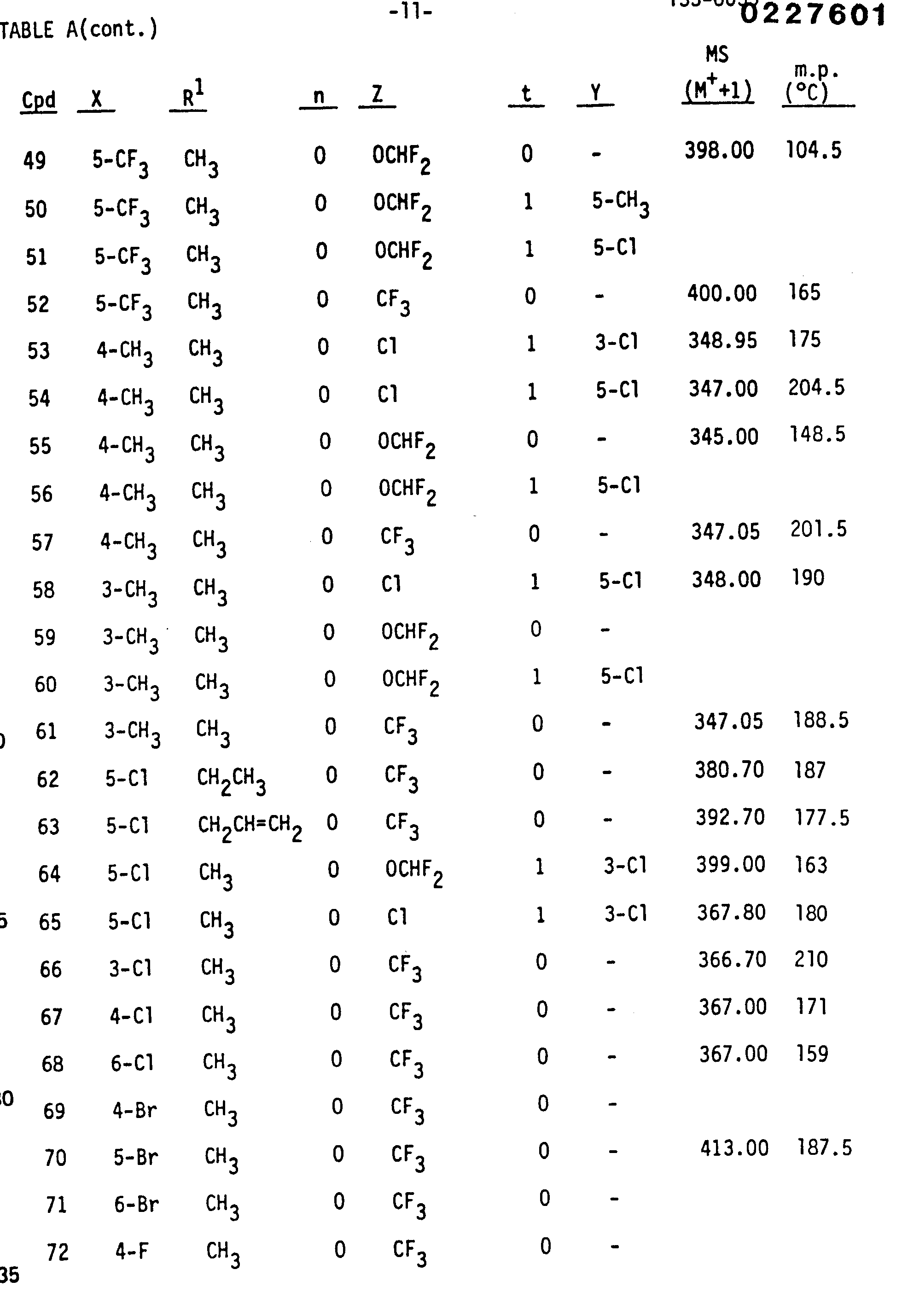
nmr (CDCl3)τ 6.37 (s, 3H), 2.63 (m, 5H), 2.15 (dd, 1H) and 1.69 ppm (dd, 1H). - Following the procedure of Example 1, each of the 2-pyridinesulfonamide 1-oxides of formula A" under Table A is prepared.




- To N-(2-trifluoromethylphenyl)-2-pyridinesulfonamide ]-oxide (compound 129, Table A) (1.0 g, 3.0 mmol) in 10 ml of DMF is added NaH (0.30 g, 6.2 mmol) under N29 and the mixture is stirred at RT for 30 minutes. Allyl bromide (0.82g, 0.59 ml, 6.8 mmol) is added dropwise, and the mixture is stirred at RT for 48 hours. It is then worked up and purified to give the title compound (compound 37, Table A). (DMF is dimethylformamide; RT is room temperature).
nmr (CDCl3)τ 5.67-3.95 (m, 5H), 2.54 (m, 6H), 2.14 (dd, 1H, 8Hz) and 1.64 ppm (dd, 1H, 8Hz). - Following the procedures of Example 1, N-methyl-N-(3,5-dichloro-2-pyridyl)-2-pyridinesulfonamide is oxidized with 40% peracetic acid to give the title compound, MS m/e 334.00 (M,).
- Following the procedure of Example 1, 3-amino-2-chloropyridine (3.0 g, 24.0 mmol) is reacted with 2-pyridinesulfonyl chloride 1-oxide (24.0 mmol) is reacted with 2-pyridinesulfonyl chloride 1-oxide (24.0 mmol) to give the title compound.
- The title compound of Example 5 above is reacted with methyl iodide (0.6g, 0.26 ml, 4.2 mmol) to give N-methyl-N-(2-chloro-3-pyridyl)-2-pyridine-sulfonamide 1-oxide, MS m/e 300.00 (M+ + 1).
- Pre-emergent herbicidal activity of compounds of the present invention of Formula A was determined as follows: Seeds of selected weeds were planted and the soil was drenched with a solution of the test compound (11.5 mg) in acetone (5.0 ml) and water (15.0 ml), at a rate equivalent to 10 lb/acre. Scoring was made two weeks after treatment. The grasses (GR) green foxtail, watergrass, shattercane and wild oats and the broadleafs (BL) annual morning glory, mustard, nightshade and velvetleaf were treated. The compounds of Formula A demonstrated herbicidal activity.
- 2-Pyridinesulfonyl chloride (46.0 mmol) is dissolved in cold methylene chloride and added dropwise at 0° to 2,3-dichloro-N-methylaniline (8.2 g, 46.0 mmol). The mixture is stirred at -10° for approx. 4 hours, then allowed to warm to RT. It is diluted with methylene chloride, washed with aqueous sodium bicarbonate and with brine, dried and evaporated to dryness to give, following purification, N-methyl-N-(2,3-dichlorophenyl)-2-pyridinesulfonamide.
Claims (9)
1. A compound of the following formula (A):

wherein n is zero or one;
t is zero, one, two, three or four;
R1 is hydrogen, unsubstituted or halogenated C1-8alkyl, unsubstituted or halogenated C2-8alkenyl, C2-8alkynyl, C2-10alkoxyalkyl or C2-10- alkylthioalkyl;
R 2 is hydrogen or C1-8alkyl;
W is CH or N;
W1 is CH or N; whereby when either of W or W1 is CH, it can be independently substituted by Y or Z,
X is hydrogen, unsubstituted or halogenated C1-8alkyl, C1-8alkoxy or halogen;
Y is unsubstituted or halogenated C1-8alkyl, unsubstituted or halogenated C1-8alkoxy, C1-8alkylthio, C2-8alkoxycarbonyl, nitro, cyano or halogen; and
Z is hydrogen or independently selected from the values of Y.
2. A compound according to Claim 1 wherein
R I is C1-5alkyl, C2-5alkenyl or C2-5alkynyl,
n is zero,
t is zero or one,
X is hydrogen or halogen,
Z is in the 2-position (see formula (A) and is C1-5alkyl, CF3, halogen, or di- or trifluorinated C1-5alkoxy,
Y is C1-5alkyl, CF3, nitro or halogen
and W and W1 are CH, whereby one of these CH-groups may be substituted by Y when t is one.
3. A compound according to Claim 2, wherein Z is fluoro, trifluoromethyl, difluoromethoxy or 2,2,2-trifluoroethoxy and Y is fluoro or chloro (when t is one).
4. A compound according to Claim 2 or 3, wherein X is hydrogen or fluoro or chloro in the 5-position and Y is in the 6-position (when t is one).
5. A compound according to Claim 4 selected from
a) N-methyl-N-(2-trifluoromethylphenyl)-2-pyridinesulfonamide 1-oxide,
b) N-methyl-N-(2-trifluoromethylphenyl)-5-chloro-2-pyridinesulfonamide 1-oxide,
c) N-ethyl-N-(2-trifluoromethylphenyl)-2-pyridinesulfonamide 1-oxide,
d) N-ethyl-N-(2-trifluoromethylphenyl)-5-chloro-2-pyridinesulfonamide 1-oxide,
e) N-ethyl-N-(2-difluoromethoxyphenyl)-5-chloro-2-pyridinesulfonamide 1-oxide,
f) N-methyl-N-[2-(2,2,2-trifluoroethoxy)phenyl]-5-chloro-2-pyridinesulfonamide 1-oxide,
g) N-ethyl-N-(2,6-difluorophenyl)-5-chloro-2-pyridinesulfonamide 1-oxide.
6. A compound of Claim 4 selected from
a) N-methyl-N-(2,6-difluorophenyl)-5-fluoro-2-pyridinesulfonamide 1-oxide,
b) N-methyl-(2-fluoro-6-chlorophenyl)-5-fluoro-2-pyridinesulfonamide 1-oxide,
c) N-methyl-(2-fluoromethoxyphenyl)-5-fluoro-2-pyridinesulfonamide 1-oxide,
d) N-methyl-[2(2,2,2-trifluoroethoxy)phenyl]-5-fluoro-2-pyridine sulfonamide 1-oxide.
7. A process for preparing a compound of Claim 1 to 6 which comprises
a) N-oxidizing the 2-pyridylsulfonyl group of a compound of formula I

where X, Rl, R2, n, W, Wl, Z, Y and t are as defined above, with an oxidizing agent, followed, where desired, by N-alkylating a thus obtained compound of formula A wherein R is H with a compound of formula II

wherein R1 a is unsubstituted or halogenated C1-8alkyl, unsubstituted or halogenated C2-8alkenyl, C2-8alkynyl, C2-10alkoxyalkyl or C2-10alkylthioalkyl, and
Hal is halogen, or a reactive functional derivative of a compound of formula II; or
Hal is halogen, or a reactive functional derivative of a compound of formula II; or
b) N-sulfonating an amine of formula III

wherein R1, R2, n, W, W1, Z, Y and t are as defined above, with a compound of formula IV

where X is as defined above,
and Q is halogen,
followed, where desired, by N-alkylating a thus obtained compound of formula A wherein R1 is H with a compound of formula II 
where R1 a and Hal are as defined above, or a reactive functional derivative of a compound of formula II.
and Q is halogen,
followed, where desired, by N-alkylating a thus obtained compound of formula A wherein R1 is H with a compound of formula II
8. A herbicidal composition comprising a compound as defined in any one one of Claims 1 to 6 and an agriculturally acceptable diluent.
9. A method of combatting weeds which comprises applying to the weeds or the locus thereof a herbicidally effective amount of a compound of formula (A) as defined in any one of Claims 1 to 6.
Applications Claiming Priority (4)
| Application Number | Priority Date | Filing Date | Title |
|---|---|---|---|
| US81208885A | 1985-12-23 | 1985-12-23 | |
| US812088 | 1985-12-23 | ||
| US87965886A | 1986-06-27 | 1986-06-27 | |
| US879658 | 1986-06-27 |
Publications (1)
| Publication Number | Publication Date |
|---|---|
| EP0227601A2 true EP0227601A2 (en) | 1987-07-01 |
Family
ID=27123564
Family Applications (1)
| Application Number | Title | Priority Date | Filing Date |
|---|---|---|---|
| EP86810591A Withdrawn EP0227601A2 (en) | 1985-12-23 | 1986-12-16 | Novel pyridine compounds and their use as herbicides |
Country Status (6)
| Country | Link |
|---|---|
| EP (1) | EP0227601A2 (en) |
| CN (1) | CN86108624A (en) |
| AU (1) | AU6682886A (en) |
| DK (1) | DK625186A (en) |
| HU (1) | HUT42445A (en) |
| IL (1) | IL81057A0 (en) |
Cited By (1)
| Publication number | Priority date | Publication date | Assignee | Title |
|---|---|---|---|---|
| EP0433001A1 (en) * | 1989-12-15 | 1991-06-19 | Imperial Chemical Industries Plc | Insecticidal compounds |
Families Citing this family (2)
| Publication number | Priority date | Publication date | Assignee | Title |
|---|---|---|---|---|
| CN110024779A (en) * | 2019-05-24 | 2019-07-19 | 苏农(广德)生物科技有限公司 | A kind of fenoxapropPethyl aqueous emulsion and its preparation process |
| CN116635367A (en) * | 2020-10-13 | 2023-08-22 | Fxi有限公司 | Method for converting disulfides into conversion products and method for producing cysteine |
-
1986
- 1986-12-16 EP EP86810591A patent/EP0227601A2/en not_active Withdrawn
- 1986-12-22 IL IL81057A patent/IL81057A0/en unknown
- 1986-12-22 DK DK625186A patent/DK625186A/en not_active Application Discontinuation
- 1986-12-22 AU AU66828/86A patent/AU6682886A/en not_active Abandoned
- 1986-12-22 CN CN198686108624A patent/CN86108624A/en active Pending
- 1986-12-22 HU HU865402A patent/HUT42445A/en unknown
Cited By (2)
| Publication number | Priority date | Publication date | Assignee | Title |
|---|---|---|---|---|
| EP0433001A1 (en) * | 1989-12-15 | 1991-06-19 | Imperial Chemical Industries Plc | Insecticidal compounds |
| US5137886A (en) * | 1989-12-15 | 1992-08-11 | Imperial Chemical Industries Plc | Insecticidal compounds |
Also Published As
| Publication number | Publication date |
|---|---|
| DK625186A (en) | 1987-06-24 |
| IL81057A0 (en) | 1987-03-31 |
| AU6682886A (en) | 1987-06-25 |
| DK625186D0 (en) | 1986-12-22 |
| HUT42445A (en) | 1987-07-28 |
| CN86108624A (en) | 1987-07-29 |
Similar Documents
| Publication | Publication Date | Title |
|---|---|---|
| KR100229087B1 (en) | Carboxamide derivatives as herbicides, their preparation and herbicidal compositions containing them | |
| DE68920963T2 (en) | Aralkylamine derivatives, their preparation and fungicidal compositions containing them. | |
| EP0097460B1 (en) | Pyridyl(oxy/thio)phenoxy compounds, herbicidal compositions and methods | |
| JP6905521B2 (en) | New pyridadinone herbicide | |
| EP0353187A2 (en) | Herbicides | |
| CS228525B2 (en) | Herbicide and a method for the production its effective agents | |
| WO1998042698A1 (en) | Pyrazole derivatives as herbicides | |
| EP0219451B1 (en) | Semicarbazones and thiosemicarbazones | |
| JPH05194492A (en) | Salts of pyridylsulfonylurea compounds as herbicides or plant growth retardants, their production and method of using them | |
| EP0338465B1 (en) | 1-chloropyrimidinyl-1h-1,2,4-triazole-3-sulfonamides, process for their preparation and their use as agents with herbicidal activity | |
| EP0272594A1 (en) | Bicyclic imides, process for their preparation and their use in crop protection | |
| CZ204090A3 (en) | Derivatives of heterocyclic dione, process of its preparation and herbicidal agent containing thereof | |
| US4179276A (en) | Novel imidazothiazine-1,3 (2H)-diones | |
| US4308053A (en) | Certain 2-pyridinyloxy-N-lower-alkane-sulfonyl benzamides and their use as herbicides | |
| EP0303573B1 (en) | Pyrrolidine-2,5 diones and 4,5,6,7-tetrahydroiso-indole-1,3 diones | |
| DE69018404T2 (en) | Herbicidal acrylonitrile derivatives. | |
| EP0258182A1 (en) | Semicarbazones and thiosemicarbazones | |
| US4722749A (en) | Pyridinesulfonamides and their use as herbicidal agents | |
| JPH05213882A (en) | Weeding picoline amide derivative | |
| EP0298029B1 (en) | Substituted imidazolones with a herbicidal activity | |
| US4741767A (en) | 2H-Imidazo(1',2':1,2)pyrrolo(3,4-B)pyridine compounds, and their use as herbicidal agents | |
| DE3818958A1 (en) | 4-BENZOYL-PYRANE, -THIOPYRANE AND -PIPERIDINE-3,5-DIONE, THEIR PRODUCTION AND USE AS AN HERBICIDE | |
| WO1982000401A1 (en) | Certain 2-(4-((5-trifluoromethyl)-2-pyridinyl)oxy)phenoxy)-n-pyridinyl propanamide and derivatives thereof and a method for selectively controlling grassy weeds in rice | |
| DE3633485A1 (en) | Substituted 2-pyri(mi)dyl-2'-pyridyl (thio)ethers | |
| CS195736B2 (en) | Herbicide and process for preparing effective compound thereof |
Legal Events
| Date | Code | Title | Description |
|---|---|---|---|
| PUAI | Public reference made under article 153(3) epc to a published international application that has entered the european phase |
Free format text: ORIGINAL CODE: 0009012 |
|
| 17P | Request for examination filed |
Effective date: 19861218 |
|
| AK | Designated contracting states |
Kind code of ref document: A2 Designated state(s): AT BE CH DE ES FR GB GR IT LI NL SE |
|
| STAA | Information on the status of an ep patent application or granted ep patent |
Free format text: STATUS: THE APPLICATION HAS BEEN WITHDRAWN |
|
| 18W | Application withdrawn |
Withdrawal date: 19880310 |
|
| RIN1 | Information on inventor provided before grant (corrected) |
Inventor name: LEE, SHY-FUH |