EP0227628A1 - Procédé et dispositif pour extraire des liquides d'agrégats et de mélanges gaz/vapeur - Google Patents
Procédé et dispositif pour extraire des liquides d'agrégats et de mélanges gaz/vapeur Download PDFInfo
- Publication number
- EP0227628A1 EP0227628A1 EP86870162A EP86870162A EP0227628A1 EP 0227628 A1 EP0227628 A1 EP 0227628A1 EP 86870162 A EP86870162 A EP 86870162A EP 86870162 A EP86870162 A EP 86870162A EP 0227628 A1 EP0227628 A1 EP 0227628A1
- Authority
- EP
- European Patent Office
- Prior art keywords
- stream
- expansion
- liquid
- nozzle
- condensate
- Prior art date
- Legal status (The legal status is an assumption and is not a legal conclusion. Google has not performed a legal analysis and makes no representation as to the accuracy of the status listed.)
- Withdrawn
Links
- 239000007788 liquid Substances 0.000 title claims abstract description 61
- 238000000034 method Methods 0.000 title claims abstract description 40
- 230000008569 process Effects 0.000 title claims abstract description 37
- 239000000203 mixture Substances 0.000 title claims description 23
- 239000007789 gas Substances 0.000 claims abstract description 34
- 238000009833 condensation Methods 0.000 claims abstract description 33
- 230000005494 condensation Effects 0.000 claims abstract description 33
- 239000012159 carrier gas Substances 0.000 claims abstract description 30
- 230000006835 compression Effects 0.000 claims abstract description 25
- 238000007906 compression Methods 0.000 claims abstract description 25
- 238000000926 separation method Methods 0.000 claims abstract description 22
- 230000000694 effects Effects 0.000 claims abstract description 10
- 238000001704 evaporation Methods 0.000 claims abstract description 9
- 230000008020 evaporation Effects 0.000 claims abstract description 9
- 238000010438 heat treatment Methods 0.000 claims abstract description 9
- 238000001816 cooling Methods 0.000 claims abstract description 8
- 238000007599 discharging Methods 0.000 claims abstract description 8
- 230000000717 retained effect Effects 0.000 claims abstract description 8
- 238000009834 vaporization Methods 0.000 claims abstract description 8
- 230000008016 vaporization Effects 0.000 claims abstract description 8
- 239000012530 fluid Substances 0.000 claims description 13
- 239000000126 substance Substances 0.000 claims description 11
- 238000000605 extraction Methods 0.000 claims description 8
- 238000011084 recovery Methods 0.000 claims description 8
- 239000008246 gaseous mixture Substances 0.000 claims description 6
- 230000005855 radiation Effects 0.000 claims description 6
- 238000009792 diffusion process Methods 0.000 claims description 4
- 238000005054 agglomeration Methods 0.000 claims description 3
- 230000002776 aggregation Effects 0.000 claims description 3
- 230000003071 parasitic effect Effects 0.000 claims description 3
- 238000001035 drying Methods 0.000 description 13
- XLYOFNOQVPJJNP-UHFFFAOYSA-N water Chemical compound O XLYOFNOQVPJJNP-UHFFFAOYSA-N 0.000 description 12
- RAHZWNYVWXNFOC-UHFFFAOYSA-N Sulphur dioxide Chemical compound O=S=O RAHZWNYVWXNFOC-UHFFFAOYSA-N 0.000 description 10
- 239000000470 constituent Substances 0.000 description 6
- 230000003534 oscillatory effect Effects 0.000 description 5
- 238000002485 combustion reaction Methods 0.000 description 4
- 230000036961 partial effect Effects 0.000 description 4
- QTBSBXVTEAMEQO-UHFFFAOYSA-N Acetic acid Chemical compound CC(O)=O QTBSBXVTEAMEQO-UHFFFAOYSA-N 0.000 description 3
- 241000209219 Hordeum Species 0.000 description 3
- 235000007340 Hordeum vulgare Nutrition 0.000 description 3
- KRKNYBCHXYNGOX-UHFFFAOYSA-N citric acid Chemical compound OC(=O)CC(O)(C(O)=O)CC(O)=O KRKNYBCHXYNGOX-UHFFFAOYSA-N 0.000 description 3
- 238000005265 energy consumption Methods 0.000 description 3
- 239000003546 flue gas Substances 0.000 description 3
- 239000000463 material Substances 0.000 description 3
- 230000007246 mechanism Effects 0.000 description 3
- MWUXSHHQAYIFBG-UHFFFAOYSA-N nitrogen oxide Inorganic materials O=[N] MWUXSHHQAYIFBG-UHFFFAOYSA-N 0.000 description 3
- 230000002829 reductive effect Effects 0.000 description 3
- 239000004291 sulphur dioxide Substances 0.000 description 3
- 235000010269 sulphur dioxide Nutrition 0.000 description 3
- 206010011968 Decreased immune responsiveness Diseases 0.000 description 2
- 241001417527 Pempheridae Species 0.000 description 2
- 230000009471 action Effects 0.000 description 2
- 239000003245 coal Substances 0.000 description 2
- 230000014509 gene expression Effects 0.000 description 2
- 230000000155 isotopic effect Effects 0.000 description 2
- 239000007791 liquid phase Substances 0.000 description 2
- VNWKTOKETHGBQD-UHFFFAOYSA-N methane Chemical compound C VNWKTOKETHGBQD-UHFFFAOYSA-N 0.000 description 2
- 239000012071 phase Substances 0.000 description 2
- 239000002516 radical scavenger Substances 0.000 description 2
- 230000002000 scavenging effect Effects 0.000 description 2
- 230000001052 transient effect Effects 0.000 description 2
- 239000002699 waste material Substances 0.000 description 2
- 241000219310 Beta vulgaris subsp. vulgaris Species 0.000 description 1
- 241000196324 Embryophyta Species 0.000 description 1
- 235000021536 Sugar beet Nutrition 0.000 description 1
- 239000002253 acid Substances 0.000 description 1
- 238000004378 air conditioning Methods 0.000 description 1
- 239000011111 cardboard Substances 0.000 description 1
- 230000008859 change Effects 0.000 description 1
- 238000006243 chemical reaction Methods 0.000 description 1
- 239000000567 combustion gas Substances 0.000 description 1
- 238000010981 drying operation Methods 0.000 description 1
- 239000000446 fuel Substances 0.000 description 1
- 239000000295 fuel oil Substances 0.000 description 1
- 239000003502 gasoline Substances 0.000 description 1
- 238000009776 industrial production Methods 0.000 description 1
- 238000011044 inertial separation Methods 0.000 description 1
- 238000009434 installation Methods 0.000 description 1
- 239000003077 lignite Substances 0.000 description 1
- 230000000670 limiting effect Effects 0.000 description 1
- 239000011344 liquid material Substances 0.000 description 1
- 238000004519 manufacturing process Methods 0.000 description 1
- 230000002211 methanization Effects 0.000 description 1
- 239000008267 milk Substances 0.000 description 1
- 235000013336 milk Nutrition 0.000 description 1
- 210000004080 milk Anatomy 0.000 description 1
- 239000003345 natural gas Substances 0.000 description 1
- 230000006911 nucleation Effects 0.000 description 1
- 238000010899 nucleation Methods 0.000 description 1
- 239000011087 paperboard Substances 0.000 description 1
- 239000002245 particle Substances 0.000 description 1
- 239000003415 peat Substances 0.000 description 1
- 239000011505 plaster Substances 0.000 description 1
- 230000002265 prevention Effects 0.000 description 1
- 239000000047 product Substances 0.000 description 1
- 238000005086 pumping Methods 0.000 description 1
- 239000012495 reaction gas Substances 0.000 description 1
- 230000009467 reduction Effects 0.000 description 1
- 230000002441 reversible effect Effects 0.000 description 1
- 229920006395 saturated elastomer Polymers 0.000 description 1
- 230000035939 shock Effects 0.000 description 1
- 239000007787 solid Substances 0.000 description 1
- 239000000725 suspension Substances 0.000 description 1
- 230000001131 transforming effect Effects 0.000 description 1
- 239000002912 waste gas Substances 0.000 description 1
- 239000002918 waste heat Substances 0.000 description 1
- 239000002023 wood Substances 0.000 description 1
- 210000002268 wool Anatomy 0.000 description 1
Images
Classifications
-
- B—PERFORMING OPERATIONS; TRANSPORTING
- B01—PHYSICAL OR CHEMICAL PROCESSES OR APPARATUS IN GENERAL
- B01D—SEPARATION
- B01D53/00—Separation of gases or vapours; Recovering vapours of volatile solvents from gases; Chemical or biological purification of waste gases, e.g. engine exhaust gases, smoke, fumes, flue gases, aerosols
- B01D53/26—Drying gases or vapours
- B01D53/265—Drying gases or vapours by refrigeration (condensation)
Definitions
- the present invention relates to a process and an apparatus for extracting, in an open or closed circuit, at least partially a liquid from an aggregate, by evaporation in a stream of carrier gas, followed by separation of at least part of said evaporated liquid from said stream of carrier gas, in which the source of energy providing substantially the separation work is the pressure increase of the carrier gas provided by mechanical means driving the carrier gas against all head losses throughout the complete circuit.
- Said separation comprises expanding the high moisture contents stream to a lower pressure so as to effect cooling and resulting liquid condensation, separating resulting liquid condensate from the gas stream, recompressing the cold stream with retained latent heat of vaporization and thereby further heating said stream, and discharging the resulting heated stream with the lowered moisture content at an appropriate section of the circuit.
- the invention relates to the way of putting at work the driving energy which provides the separative work, and of carrying out said separation.
- the word evaporation has a very broad meaning which includes the production of vapor within the carrier gas by any mechanism, for instance a chemical reaction such as combustion.
- the word aggregate has a very broad meaning which includes not only materials soaked with a liquid, such as wet wool, wet barley, waste sugar beet pulp, paste of paper or cardboard, plaster, or wet or liquid materials to be dryed such as wood, milk, ... , but also materials reacting with a gas, f.i. by combustion, thus forming a vapor which is a constituent of said reaction gas mixture.
- the aggregate may thus be for instance methanization gas, natural gas, burnable waste products, fuel oil, coal, peat, brown coal, burning in air. It may also be for instance living materials such as plants growing in a greenhouse, or machinery from which seeping liquids are leaking under liquid or vapor form.
- exergy exergetic
- exergetic relate to that fraction of the heat which is convertible in a reversible way into mechanical work, as opposed to anergy, anergetic, which relate to that fraction of the heat which is not convertible into mechanical work.
- the calorific energy of a substance is the sum of its exergy and its anergy.
- exergy used herein also may mean mechanical work or any other energy which is convertible into mechanical work without being subject to the limitation imposed by Carnot's principle.
- acoustic condensation relates to the process of transient additional condensation of vapor which occurs within the flow of a gas/vapor mixture undergoing an adiabatic quasi-isentropic expansion when the flowing fluid is submitted to a high intensity acoustic radiation.
- a first main application of the invention is the drying of wet products, and mainly industrial drying, wherein it allows to recover water vapor and its latent heat from air/vapor mixtures, using robust, cheap and compact equipment with low energy consumption, i. e. a blower and a thermodynamic separator, or a combined blower/separator, instead of delicate and expensive apparatus such as the known types of heat pumps.
- a second main application of the invention is the abatement of acid gases, such as sulphur dioxide and nitrogen oxides, from flue gases produced by combustion in boilers, furnaces, incinerators, through condensation of associated water vapor, using said robust, cheap and compact equipment, the energy consumption of which is small and more than offset by the recovery of the latent heat of condensation of the water vapor.
- a third main application of the invention is the extraction and upgrading of the latent heat of condensation of a vapor in a gas/vapor mixture, using said robust, cheap and compact equipment.
- Said application includes heating, ventilating and air conditioning processes and installations.
- a fourth main application of the invention is the extraction, for recovery or disposal or any other purpose, of valuable and/or polluting gases and vapors contained in process or waste gases, including used air rejected in the atmosphere by industrial production plants, by gasoline refilling stations for cars, and the like, and also including automobile exhaust gases.
- U. S. Patent 3 854 300 describes a method of reducing the high moisture contents of a stream of gases by expanding said stream to a lower pressure such as to effect cooling and resulting water vapor condensation, then separating resulting water condensate from the gas stream, then recompressing the cold stream with retained latent heat of vaporization and thereby further heating said stream, and then discharging the resulting heated stream with the lowered moisture content to the atmosphere.
- said moisture containing gas stream may be expanded in a turbine type expansion means providing power therefrom and such power is then utilized in the recompression of the gas stream.
- European Patent Application 0 162 509 shows a drying process (and corresponding apparatus) which is substantially a particular application with waste heat recovery of the method described in U. S. Patent 3 854 300.
- the expansion and most of the recompression of the stream of gases take place in an aerodynamic separator having no moving part, composed of a convergent-divergent subsonic nozzle in which inertial separation of the condensate takes place at or near the throat region of said nozzle.
- the driving energy required by this aerodynamic separator is supplied to the process by a blower which moves the main gaseous stream against all head losses throughout the complete circuit.
- Auxiliary means may be provided in the inlet plenum of the nozzle in order to initiate and enhance the condensation process.
- the expansion of the gaseous stream includes a steady component and an oscillatory component, the latter being obtained by the action, within the flowing fluid, of very intense sonic or ultrasonic waves.
- the effect of said oscillatory component of the expansion is, on one hand, to induce acoustic agglomeration of the droplets of condensate, on the other hand, to cause transient additional condensation by the particular mechanism described in lines 8 to 13, page 12 of the specification of said application. In the present specification, said mechanism is called "acoustic condensation".
- the required acoustic energy is generated mechanically either by the flowing stream itself, or by appropriate transducers, or by the blower supplying the driving energy required by the process.
- the amount of the acoustic energy radiated by the sonic wave only represents a minor fraction of the driving energy required by the process, and the latter energy itself only represents a minor fraction of the mechanical energy produced by the expanding fluid in the convergent part of the nozzle.
- the drying process (and corresponding apparatus) described in the abovereferred European Patent Application has thus the following inherent limitations : - the maximum pressure ratio of the steady state component of the expansion in the aerodynamic separator cannot exceed an upper limit at which the velocity of sound is reached in the throat of the nozzle; for atmospheric air, said limit is about 1.6 and is not sufficient for enabling per se the self-initiation of condensation during the phase of expansion of the incoming stream; - when expanding air nearly saturated with water vapor, at pressure ratios not exceeding the latter limit, auxiliary means are required to enable the condensation in the throat region to reach a level close to thermodynamic equilibrium; - the temperature increase which can be achieved by the process between the outlet and the inlet of the air in the dryer chamber cannot exceed an upper limit of 25 to 30°C, and the condensate quantity which can be extracted by the process cannot exceed 10 to 12 gr H2O per kg dry air when acoustic condensation is not used; - acoustic condensation may raise said quantity of condensate at the expense of the additional energy consumption required to provide adequate
- a carrier gas entering an open circuit, or running in a closed circuit is used to extract a liquid substance from an aggregate, by evaporation of said substance in said carrier gas.
- the mixture of said vapor with said carrier gas is then driven through a thermodynamic separator wherein the driving energy supplying the separative work is provided by mechanical means causing a pressure increase of the gas/vapor mixture within the separator.
- Said separator causes the main stream of carrier gas to lose a part of said vapor substance it contained, while the stream diverted by the separator is substantially said substance in liquid form.
- Said separation comprises expanding the high moisture contents stream to a lower pressure such as to effect cooling and resulting liquid condensation, separating resulting liquid condensate from the gas stream, recompressing the cold stream with retained latent heat of vaporization and thereby further heating said stream, and discharging the resulting heated stream with the lowered moisture content at a section of the circuit where it is recycled or where it is rejected to the atmosphere without or after substantial recovery of its heat.
- Both said expansion and said compression are performed substantially adiabatically and at least partly in rotating machinery means wherein the expansion work is used to provide part of the compression work.
- At least part of said expansion takes place in a turbine or other rotating machine having the same performances and at least part of said compression takes place in a turbocompressor or other rotating machine having the same performances.
- the gaseous stream which leaves the turbine contains liquid condensate under the form of fine droplets and nucleation centers. Said stream is driven to a convergent/divergent nozzle having collecting means for extracting the liquid condensate in or near the throat region of the nozzle.
- the last part of said expansion and the first part of said compression are performed, as well as the extraction of the liquid condensate resulting from the expansion.
- the gaseous stream leaving said nozzle is driven for recompression to the inlet of said rotating machinery means.
- At least part of said expansion and part of said compression take place, in one of several steps, in a wave pressure exchanger.
- the liquid condensate is extracted by inertial diffusion through the main stream and separated by collecting means, and the main stream is then driven to the next step of said expansion, or after completion of the expansion and liquid condensate extraction, to the first step of said compression. If said expansion and compression are not fully performed in said rotating machinery means, the last part of said expansion and the first part of said compression are performed, as well as the extraction of the quantity of liquid condensate resulting from the expansion, in a convergent/divergent nozzle as mentioned hereabove.
- the invention brings the following specific advantages.
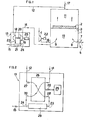
- Figure 1 shows an application of the invention to industrial drying in closed circuit, using turbine-like means for partly expanding the higher moisture gas/vapor stream and turbocompressor-like means for partly compressing the lower moisture gas/vapor stream and a convergent/divergent nozzle separator for completing said partial expansion and said partial compression and for extracting the liquid condensate resulting from the total expansion.
- Figure 2 shows for the same application as Figure 1 a thermodynamic separator using a wave pressure exchanger with one step of compression and expansion instead of the turbine-like and turbocompressor-like means shown in Figure 1.
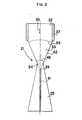
- Figure 3 shows in more details a convergent/divergent nozzle separator as referred to in Figures 1 and 2.
- drying takes place in an enclosure 1 in which an aggregate, for instance wet germinated barley 2, stays on a tray 3.
- the blower 4 operates together with the burner 5 which is fed with combustion air 6 and fuel 7, producing combustion gases 8 which are mixed with the drying air 9.
- the burner 5 is controlled so as to maintain in the lower part 10 of the enclosure 1 the drying air temperature at the required level.
- thermodynamic separator 13 separates the incoming stream of moist air into an outgoing main stream 14 of hot air with reduced moisture content and an outgoing diverted stream 15, composed essentially of cold water which is then rejected for disposal.
- the main stream is driven through the duct 14 up to location 9 where it runs again along the drying circuit.
- the blower 4 driven by motor 22 injects fresh air at location 9 through duct 16 in order to compensate for leaks, losses and rejects of air to the outside atmosphere.
- the aerodynamic separator 13 performs said separation as follows.
- the higher moisture stream coming in through duct 12 undergoes an adiabatic expansion in turbine 18 connected by shaft 20 to turbocompressor 19.
- the cooled stream at low pressure, containing liquid condensate, leaves the turbine at 23 to enter an aerodynamic separator 21 consisting in a convergent/divergent nozzle without moving part wherein said liquid is extracted, according to the following steps:
- the hot lower moisture stream leaving the aerodynamic separator 21 at 24 enters the turbocompressor 19 where it is compressed to the pressure level required to enable the hot stream to be reinjected through duct 14 at location 9.
- an electric motor 25 provides the required additional mechanical work.
- the aerodynamic separator 21 is of a type described in European Patent Application 0 162 509, which normally requires auxiliary means to initiate and enhance the condensation process in the nozzle. As used herein, said auxiliary means are not required, because the stream entering said aerodynamic separator already contains droplets of liquid condensate and other condensation nuclei resulting from the partial expansion of the stream in turbine 18.
- separator is shown in more detail in Figure 3, where the separator enclosure 42 has the general shape of an axisymmetric nozzle comprizing a cylindrical chamber 32, a convergent truncated cone 33, a throat 34 and a divergent 35. As shown in Figure 3 these elements are linked in such a way as to avoid angular points in the axial cross-section of the nozzle.
- the general direction of the moist air flowing into the nozzle is shown by the arrow 36.
- the moist air entering the chamber 32 may be submitted in this chamber to an acoustic radiation generated from the annular enclosure 37 by generators of sonic waves of any known type, so that at the inlet section of the air in the convergent part 33, the wave front has the shape of a spherical surface 38 of which the geometric center is located at a point 39 which is on the axis of the nozzle, downstream the minimal section of its throat 34.
- droplets are then collected in a hollow cylindrical collector 41, having a small diameter, and located along the axis of the divergent part 35 of the nozzle, and of which the circular inlet cross-section is centered at point 39 or slightly behind this point along the direction of the flow.
- the air stream from which the droplets were thus swept away in the region of the throat of the nozzle enters the divergent part 35 where it undergoes an adiabatic, quasi-isentropic recompression transforming into enthalpy the kinetic energy it has in the throat of the nozzle.
- thermodynamic separator 13 performs its function as follows.
- the higher moisture stream coming in through duct 12 undergoes an adiabatic expansion in wave pressure exchanger 26 connected by shaft 20 to motor 25.
- Said stream enters said exchanger through port 27 and leaves it through port 28, cooled and at low pressure, and containing liquid condensate, to enter at 23 the aerodynamic separator 29 which is similar to separator 21 described above except that it enables acoustic condensation in addition to the condensation resulting from steady state expansion.
- the hot lower moisture stream leaving the aerodynamic separator 29 at 24 enters the wave pressure exchanger 26 through port 30 and leaves through port 31 after having been recompressed to the pressure level required to enable the hot stream to be reinjected through duct 14 at location 9.
- the electric motor 25 provides through shaft 20 the additional mechanical work required.
- the aerodynamic separator 29 is of a type described in European Patent Application 0 162 509, which normally requires auxiliary means to initiate and enhance the condensation process in the nozzle, and to create acoustic radiation for performing acoustic agglomeration and acoustic condensation.
- said auxiliary means are not required, because the stream entering said aerodynamic separator already contains droplets of liquid condensate and other condensation nuclei resulting from the partial expansion of the stream in wave pressure exchanger 26, and also contains very intense acoustic radiation which is a result of the wave pressure exchange process.
- An important factor in the energetic efficiency of wave pressure exchangers is impedance matching of the driver and driven gases.
- An impedance matched interface between two gases allows a sound or a shock wave to proceed from one gas into the other without any wave reflections at the interface.
- this requirement means that the product of density and sound speed, as well as the specific heat ratio k , must be the same on each side of the interface.
- a dry gas/vapor mixture where only the gas phase is present
- a wet gas/vapor mixture where both gas and liquid phases are present
- Such prevention is possible, due to the existence of a time lag between the sudden expansion of a gas/vapor mixture and the actual condensation. Said time lag varies with factors which include the pressure ratio of the expansion. Therefore it is important to keep the pressure ratio of each expansion step in the wave pressure exchanger below the critical value above which condensation would occur at locations where it would cause parasitic wave reflections with corresponding energy losses.
- each step of the expansion of the main stream in the wave pressure exchanger is followed by a separation of the liquid condensate resulting from said expansion step.
- said separation may be performed in a curved duct by inertial diffusion of the droplets of condensate through said stream up to collecting means intersecting the paths of said droplets, said duct and said stream following a substantially helical path around the axis of the rotor of the wave pressure exchanger, said helical path having an angle equal or close to the angle of said stream at the outlet port of said exchanger.
- composition of the condensate thus obtained results from the composition of the gaseous mixture which is processed.
- the condensate will not be pure water, but a solution in water of one or several constituents of said flue gases, such as SO2, NO, NO2, CO2, ... .
- This particular feature enables to separate easily, not only condensable vapors, but also gases difficult to condense, provided they are soluble in the condensate of easily condensable vapors. Said vapors can thus have a sweeper or scavenger action.
- scavenging vapor into the carrier gas is insufficient to sweep out of said carrier gas specific gases to be separated, or if its scavenging capacity is insufficient, one may add to the mixture to be separated, before processing it, an additional constituent under gaseous and/or liquid and/or solid form (droplets or particles in suspension), which is able to act as a sweeper or scavenger of said specific gases.
- an additional constituent under gaseous and/or liquid and/or solid form droplets or particles in suspension
- sulphur dioxide SO2 can be absorbed very easily by added citric acid, or acetic acid of which the vapor is easily condensed, and easily absorbed by the condensate of water vapor. Said sulphur dioxide can thus be integrally swept out, and recovered by processing the separated liquid by any known means.
- the range of vapors and gases which can be extracted by the process and apparatus according to the embodiment of the invention shown in Figure 2 is very wide, as the ratio between the initial pressure of the gaseous mixture to be processed and the minimal instantaneous pressure within the flowing mixture may be very high. Indeed this ratio is the product of the pressure ratio of the steady component of the expansion and the pressure ratio of the oscillatory component of the the expansion. The greater the global pressure ratio thus obtained, the greater is the enthalpy drop after expansion, the greater is the corresponding temperature drop, and the more efficient is the separation achieved by condensation.
- the invention is applicable without any restriction to the extraction of any liquid from an aggregate.
- Said aggregate may be a mixture or a combination of different chemical or isotopic components in any proportions.
- the liquid to be extracted can be a simple substance or a mixture or a combination of different chemical or isotopic components in any proportion.
- the carrier gas can be composed of any constituents in any proportions.
- the expressions convergent/divergent nozzle, convergent part, divergent part, throat, throat region, places which intersect the paths of the droplets, duct, as used in this specification and in the appended claims, must be understood in a broad sense which not only applies to Venturi-like nozzle separators, but also to other types of separators which may or maynot be axisymmetrical, with or without a rectilinear or curved axis, wherein the cross section of the stream is progressively reduced to cause said stream to accelerate, then kept constant along some lengths, then progressively increased again to cause said stream to decelerate.
- Such a separator may consist in an enclosure having a cylindrical outer wall with a constant circular cross section and a rectilinear axis, a circular cross section at the inlet and outlet of the fluid stream, and within which an axisymmetrical body centered along the same axis causes for the fluid stream to change from circular to progressively reduced annular cross section, then a constant annular cross section for some length (throat and throat region) then a progressively increasing annular cross section becoming again circular towards the outlet of the separator.
- Such separator may have means causing the flow to follow helical paths only within said throat region. Paths of the droplets must also be understood as including the streamlines of liquid condensate flow resulting from the grouping of the droplets.
- turbine and compressors are also to be understood not only as single units, but also as groups of such units in series or in parallel.
Landscapes
- Chemical & Material Sciences (AREA)
- Physics & Mathematics (AREA)
- Thermal Sciences (AREA)
- Engineering & Computer Science (AREA)
- Analytical Chemistry (AREA)
- General Chemical & Material Sciences (AREA)
- Oil, Petroleum & Natural Gas (AREA)
- Chemical Kinetics & Catalysis (AREA)
- Vaporization, Distillation, Condensation, Sublimation, And Cold Traps (AREA)
- Engine Equipment That Uses Special Cycles (AREA)
Applications Claiming Priority (2)
| Application Number | Priority Date | Filing Date | Title |
|---|---|---|---|
| LU86156A LU86156A1 (fr) | 1985-11-12 | 1985-11-12 | Procede et dispositif pour extraire des liquides d'agregate et de melanges gaz-vapeur |
| LU86156 | 1985-11-12 |
Publications (1)
| Publication Number | Publication Date |
|---|---|
| EP0227628A1 true EP0227628A1 (fr) | 1987-07-01 |
Family
ID=19730581
Family Applications (1)
| Application Number | Title | Priority Date | Filing Date |
|---|---|---|---|
| EP86870162A Withdrawn EP0227628A1 (fr) | 1985-11-12 | 1986-11-05 | Procédé et dispositif pour extraire des liquides d'agrégats et de mélanges gaz/vapeur |
Country Status (5)
| Country | Link |
|---|---|
| US (1) | US4860547A (fr) |
| EP (1) | EP0227628A1 (fr) |
| JP (1) | JPS62114601A (fr) |
| CA (1) | CA1280889C (fr) |
| LU (1) | LU86156A1 (fr) |
Cited By (3)
| Publication number | Priority date | Publication date | Assignee | Title |
|---|---|---|---|---|
| EP0297200A1 (fr) * | 1986-04-04 | 1989-01-04 | Hernandez de Los Angeles, Manuel | Procédé et appareil éolien-solaire pour l'obtention directe de l'eau par condensation de celle contenue dans la vapeur d'eau de l'air atmosphérique |
| RU2230600C1 (ru) * | 2002-11-11 | 2004-06-20 | Общество с ограниченной ответственностью "Корпорация Уралтехнострой" | Устройство для подготовки газа |
| WO2010104238A1 (fr) * | 2009-03-13 | 2010-09-16 | 주식회사 에이앤디코퍼레이션 | Appareil de traitement de substrat utilisant un processeur à haute pression et procédé de recyclage de gaz de processeur à haute pression |
Families Citing this family (10)
| Publication number | Priority date | Publication date | Assignee | Title |
|---|---|---|---|---|
| AU7049200A (en) | 1999-04-26 | 2000-11-21 | Advanced Research And Technology Institute, Inc. | Wave rotor detonation engine |
| WO2002004794A2 (fr) | 2000-07-06 | 2002-01-17 | Advanced Research & Technology Institute | Chambre de combustion multicanaux compartimentee |
| US6540917B1 (en) | 2000-11-10 | 2003-04-01 | Purolator Facet Inc. | Cyclonic inertial fluid cleaning apparatus |
| AU2002356501A1 (en) | 2001-07-06 | 2003-03-24 | Advanced Research And Technology Institute | Rotary ejector enhanced pulsed detonation system and method |
| KR101174537B1 (ko) * | 2004-12-29 | 2012-08-16 | 조온파 죠조쇼 유겐가이샤 | 용액의 초음파 분리방법과 이 방법에 사용되는 초음파분리장치 |
| JP4758846B2 (ja) * | 2005-11-18 | 2011-08-31 | 東京エレクトロン株式会社 | 乾燥装置、乾燥方法、及び乾燥プログラム、並びに、これらを有する基板処理装置、基板処理方法、及び基板処理プログラム |
| JP5787310B2 (ja) * | 2011-03-15 | 2015-09-30 | ナノミストテクノロジーズ株式会社 | 分離装置、分離方法 |
| JP6371738B2 (ja) * | 2015-05-28 | 2018-08-08 | 株式会社東芝 | 成膜装置 |
| WO2019209127A1 (fr) * | 2018-04-27 | 2019-10-31 | Bicafé - Torrefecção E Comércio De Café, Lda. | Système d'extraction d'une poudre riche en caféine |
| KR102809757B1 (ko) * | 2021-03-09 | 2025-05-20 | 코오롱인더스트리 주식회사 | 연료전지용 가습기 |
Citations (1)
| Publication number | Priority date | Publication date | Assignee | Title |
|---|---|---|---|---|
| US3854300A (en) * | 1973-06-08 | 1974-12-17 | Universal Oil Prod Co | Water vapor removal from vent gas systems |
Family Cites Families (44)
| Publication number | Priority date | Publication date | Assignee | Title |
|---|---|---|---|---|
| GB553208A (fr) * | ||||
| BE514256A (fr) * | ||||
| GB190602818A (en) * | 1906-02-05 | 1907-02-05 | Ludwik Knauff | Improved Process of and Apparatus for Converting the Pressure or Gas Energy liberated by the Heating or Cooling of Gases or Vapours or by the Explosion of Gases or Vapours into Mechanical Work. |
| GB190608273A (en) * | 1906-04-05 | 1907-03-14 | Ludwik Knauff | Improved Method of and Means for Converting the Internal Energy of Gases and Vapours into Mechanical Work and Vice Versa. |
| GB290669A (en) * | 1927-05-20 | 1928-10-04 | Francois Lebre | Method and apparatus for compressing fluids |
| DE485386C (de) * | 1928-07-22 | 1929-11-02 | Hans Burghard Dipl Ing | Verfahren zur Verdichtung von Gasen |
| US2399394A (en) * | 1940-12-07 | 1946-04-30 | Bbc Brown Boveri & Cie | Pressure exchanger |
| US2461186A (en) * | 1942-02-20 | 1949-02-08 | Bbc Brown Boveri & Cie | Gas turbine installation |
| US2453923A (en) * | 1946-08-20 | 1948-11-16 | Douglas Aircraft Co Inc | Aircraft cooling by air turbine means |
| BE486957A (fr) * | 1948-01-26 | |||
| US2716289A (en) * | 1952-07-19 | 1955-08-30 | Smith Corp A O | Method and apparatus for the slow drying of stored material |
| NL87758C (fr) * | 1954-06-30 | |||
| US2832665A (en) * | 1954-12-23 | 1958-04-29 | Cornell Aeronautical Labor Inc | Method and apparatus for carrying out gas phase reactions which require a high temperature to promote the reaction and rapid cooling to preserve the reaction product |
| GB843912A (en) * | 1955-06-30 | 1960-08-10 | Ronald Denzil Pearson | Improvements in pressure exchangers |
| BE559713A (fr) * | 1955-10-05 | |||
| US2902337A (en) * | 1956-12-20 | 1959-09-01 | Cornell Aeronautical Labor Inc | Process for heating and cooling gases and apparatus therefor |
| GB859607A (en) * | 1958-06-25 | 1961-01-25 | John Macbean Neil | Improvements in devices for the removal of undesired solids in suspense from gases, vapours or liquids |
| US3109721A (en) * | 1958-11-21 | 1963-11-05 | Union Carbide Corp | Method and apparatus for separating a fluid mixture by sonic energy |
| US3026966A (en) * | 1959-03-09 | 1962-03-27 | Macrosonics Corp | Ultrasonic demister |
| US3258895A (en) * | 1962-10-19 | 1966-07-05 | Joy Mfg Co | Device for separating solids from a gaseous medium |
| US3230923A (en) * | 1962-11-21 | 1966-01-25 | Sonic Dev Corp | Sonic pressure wave generator |
| US3226948A (en) * | 1964-10-07 | 1966-01-04 | Ingersoll Rand Co | Dehumidifying apparatus |
| US3384117A (en) * | 1966-02-01 | 1968-05-21 | Sun Oil Co | Fluid transfer in wave reactors and the like |
| US3616616A (en) * | 1968-03-11 | 1971-11-02 | Tech Dev Inc | Particle separator especially for use in connection with jet engines |
| US3528217A (en) * | 1968-05-20 | 1970-09-15 | Exxon Production Research Co | Supersonic flow separator with film flow collector |
| GB1283587A (en) * | 1969-08-04 | 1972-07-26 | Mobil Oil Corp | Separation of components from gaseous streams |
| US3788038A (en) * | 1972-01-12 | 1974-01-29 | Mobil Oil Corp | Process for separating uranium isotopes |
| US3771286A (en) * | 1972-02-04 | 1973-11-13 | Chubb Ind Ltd | Method of coagulating aerosols |
| US3839846A (en) * | 1972-05-03 | 1974-10-08 | Teller Environmental Systems | Process and apparatus for treatment of jet engine exhaust |
| US3832666A (en) * | 1973-07-27 | 1974-08-27 | Itt | Electric fuse |
| US3998711A (en) * | 1975-11-28 | 1976-12-21 | Mathematical Sciences Northwest, Inc. | Method for continuously carrying out a gas phase reaction and apparatus therefor |
| US3977850A (en) * | 1976-02-17 | 1976-08-31 | Combustion Engineering, Inc. | Centrifugal separator |
| US4021215A (en) * | 1976-05-03 | 1977-05-03 | United Technologies Corporation | Dual combined cycle air-conditioning system |
| US4198359A (en) * | 1976-07-26 | 1980-04-15 | Todd John J | Apparatus for gasification of liquids |
| US4311494A (en) | 1977-09-26 | 1982-01-19 | Facet Enterprises, Inc. | Axial flow gas cleaning device |
| US4134216A (en) * | 1977-11-18 | 1979-01-16 | Stevens Robert D | Product drying apparatus |
| FR2444882A1 (fr) * | 1978-12-18 | 1980-07-18 | Pipeline Service Sa | Procede de sechage et de mise en gaz sous vide de canalisations |
| US4447965A (en) * | 1980-06-04 | 1984-05-15 | General Electric Company | Process and apparatus for drying with latent heat recovery |
| FR2535445B1 (fr) * | 1982-10-28 | 1987-10-16 | Conditionair Sa | Installation de sechage |
| US4504285A (en) * | 1983-04-15 | 1985-03-12 | Modisette Incorporated | Separation of condensible vapors from gas mixtures |
| BE898745A (fr) * | 1984-01-24 | 1984-07-24 | Rech S Et De Dev Ind S A En Ab | Procede et appareillage pour separer un melange de fluides |
| LU85708A1 (fr) * | 1984-12-21 | 1986-07-17 | Belgonucleaire Sa | Procede et dispositif d'extraction |
| LU85336A1 (fr) * | 1984-04-25 | 1985-11-27 | Belgonucleaire Sa | Procede et dispositif d'extraction |
| EP0162509B1 (fr) * | 1984-04-25 | 1989-02-01 | S.A. Separgaz | Procédé et dispositif d'extraction de liquides d'agrégats et de mélanges gaz/vapeur |
-
1985
- 1985-11-12 LU LU86156A patent/LU86156A1/fr unknown
-
1986
- 1986-11-05 EP EP86870162A patent/EP0227628A1/fr not_active Withdrawn
- 1986-11-12 JP JP61270835A patent/JPS62114601A/ja active Pending
- 1986-11-12 US US06/930,149 patent/US4860547A/en not_active Expired - Fee Related
- 1986-11-12 CA CA000522718A patent/CA1280889C/fr not_active Expired - Lifetime
Patent Citations (1)
| Publication number | Priority date | Publication date | Assignee | Title |
|---|---|---|---|---|
| US3854300A (en) * | 1973-06-08 | 1974-12-17 | Universal Oil Prod Co | Water vapor removal from vent gas systems |
Cited By (3)
| Publication number | Priority date | Publication date | Assignee | Title |
|---|---|---|---|---|
| EP0297200A1 (fr) * | 1986-04-04 | 1989-01-04 | Hernandez de Los Angeles, Manuel | Procédé et appareil éolien-solaire pour l'obtention directe de l'eau par condensation de celle contenue dans la vapeur d'eau de l'air atmosphérique |
| RU2230600C1 (ru) * | 2002-11-11 | 2004-06-20 | Общество с ограниченной ответственностью "Корпорация Уралтехнострой" | Устройство для подготовки газа |
| WO2010104238A1 (fr) * | 2009-03-13 | 2010-09-16 | 주식회사 에이앤디코퍼레이션 | Appareil de traitement de substrat utilisant un processeur à haute pression et procédé de recyclage de gaz de processeur à haute pression |
Also Published As
| Publication number | Publication date |
|---|---|
| JPS62114601A (ja) | 1987-05-26 |
| US4860547A (en) | 1989-08-29 |
| CA1280889C (fr) | 1991-03-05 |
| LU86156A1 (fr) | 1987-06-26 |
Similar Documents
| Publication | Publication Date | Title |
|---|---|---|
| US4860547A (en) | Process and apparatus for extracting liquids from aggregates and from gas/vapor mixtures | |
| US4078390A (en) | Removal and recovery of sulfur dioxide from stack gases | |
| US8104259B2 (en) | Method and system for reducing power plant emissions | |
| US3877218A (en) | Brayton cycle system with refrigerated intake and condensed water injection | |
| US5590519A (en) | Combined combustion and exhaust gas cleansing plant | |
| US6530979B2 (en) | Flue gas cleaner | |
| RU2619312C2 (ru) | Способ и устройство для отделения со2 при охлаждении с использованием сопла лаваля | |
| US7985278B2 (en) | Method of separating CO2 from a gas flow, CO2 separating device for carrying out the method, swirl nozzle for a CO2 separating device | |
| US5647221A (en) | Pressure exchanging ejector and refrigeration apparatus and method | |
| US5517978A (en) | Pollution control system for an internal combustion engine | |
| US20040103637A1 (en) | Power system and method | |
| US8221514B2 (en) | Ecologically clean method and apparatus for water harvesting from air | |
| US5553591A (en) | Engine power enhancement/pollution control system utilizing vortex air separator | |
| JP2011508139A (ja) | 気化性液体供給装置を採用するガスタービン・システム及び方法 | |
| US3854300A (en) | Water vapor removal from vent gas systems | |
| KR20130069651A (ko) | 연소 스트림에서의 co2 배출의 감소 방법 및 이를 이용하는 산업적 플랜트 | |
| US5137681A (en) | Method and apparatus for recycling turbine exhaust steam in electrical power generation | |
| US9283502B2 (en) | Inertial extraction system | |
| US20110094196A1 (en) | Ecologically clean method and apparatus for water harvesting from air | |
| EP0162509B1 (fr) | Procédé et dispositif d'extraction de liquides d'agrégats et de mélanges gaz/vapeur | |
| JPH0868501A (ja) | 湿分分離装置及び方法 | |
| US2175163A (en) | Method and apparatus for producing refrigeration | |
| Horlock | The evaporative gas turbine [EGT] cycle | |
| US4991408A (en) | Adiabatic separator | |
| SU1441139A1 (ru) | Установка дл производства тепла,холода и диоксида углерода |
Legal Events
| Date | Code | Title | Description |
|---|---|---|---|
| PUAI | Public reference made under article 153(3) epc to a published international application that has entered the european phase |
Free format text: ORIGINAL CODE: 0009012 |
|
| AK | Designated contracting states |
Kind code of ref document: A1 Designated state(s): AT BE CH DE ES FR GB GR IT LI LU NL SE |
|
| 17P | Request for examination filed |
Effective date: 19870602 |
|
| RAP1 | Party data changed (applicant data changed or rights of an application transferred) |
Owner name: S.A. SEPARGAZ |
|
| 17Q | First examination report despatched |
Effective date: 19881118 |
|
| STAA | Information on the status of an ep patent application or granted ep patent |
Free format text: STATUS: THE APPLICATION IS DEEMED TO BE WITHDRAWN |
|
| 18D | Application deemed to be withdrawn |
Effective date: 19911008 |
|
| RIN1 | Information on inventor provided before grant (corrected) |
Inventor name: MALDAGUE, PIERRE |