EP0227823B1 - Photographisches farbübertragungsverfahren und produkt - Google Patents
Photographisches farbübertragungsverfahren und produkt Download PDFInfo
- Publication number
- EP0227823B1 EP0227823B1 EP86904612A EP86904612A EP0227823B1 EP 0227823 B1 EP0227823 B1 EP 0227823B1 EP 86904612 A EP86904612 A EP 86904612A EP 86904612 A EP86904612 A EP 86904612A EP 0227823 B1 EP0227823 B1 EP 0227823B1
- Authority
- EP
- European Patent Office
- Prior art keywords
- alkyl
- light
- filter agent
- optical filter
- hydrogen
- Prior art date
- Legal status (The legal status is an assumption and is not a legal conclusion. Google has not performed a legal analysis and makes no representation as to the accuracy of the status listed.)
- Expired
Links
- 238000000034 method Methods 0.000 title claims abstract description 43
- 230000008569 process Effects 0.000 title claims abstract description 32
- 230000003287 optical effect Effects 0.000 claims abstract description 39
- 238000009792 diffusion process Methods 0.000 claims abstract description 18
- 239000000203 mixture Substances 0.000 claims description 70
- SIKJAQJRHWYJAI-UHFFFAOYSA-N Indole Chemical compound C1=CC=C2NC=CC2=C1 SIKJAQJRHWYJAI-UHFFFAOYSA-N 0.000 claims description 60
- -1 silver halide Chemical class 0.000 claims description 45
- 239000003795 chemical substances by application Substances 0.000 claims description 43
- PZOUSPYUWWUPPK-UHFFFAOYSA-N indole Natural products CC1=CC=CC2=C1C=CN2 PZOUSPYUWWUPPK-UHFFFAOYSA-N 0.000 claims description 37
- RKJUIXBNRJVNHR-UHFFFAOYSA-N indolenine Natural products C1=CC=C2CC=NC2=C1 RKJUIXBNRJVNHR-UHFFFAOYSA-N 0.000 claims description 37
- 229910052709 silver Inorganic materials 0.000 claims description 30
- 239000004332 silver Substances 0.000 claims description 30
- 125000000217 alkyl group Chemical group 0.000 claims description 27
- UKOVZLWSUZKTRL-UHFFFAOYSA-N naphthalid Chemical compound C1=CC(C(=O)OC2)=C3C2=CC=CC3=C1 UKOVZLWSUZKTRL-UHFFFAOYSA-N 0.000 claims description 23
- WNZQDUSMALZDQF-UHFFFAOYSA-N 2-benzofuran-1(3H)-one Chemical compound C1=CC=C2C(=O)OCC2=C1 WNZQDUSMALZDQF-UHFFFAOYSA-N 0.000 claims description 16
- 239000000839 emulsion Substances 0.000 claims description 14
- 229910052739 hydrogen Inorganic materials 0.000 claims description 14
- 239000001257 hydrogen Substances 0.000 claims description 14
- 239000000049 pigment Substances 0.000 claims description 14
- GWEVSGVZZGPLCZ-UHFFFAOYSA-N Titan oxide Chemical group O=[Ti]=O GWEVSGVZZGPLCZ-UHFFFAOYSA-N 0.000 claims description 12
- 239000003153 chemical reaction reagent Substances 0.000 claims description 12
- 125000002877 alkyl aryl group Chemical group 0.000 claims description 11
- 125000003710 aryl alkyl group Chemical group 0.000 claims description 11
- 125000003118 aryl group Chemical group 0.000 claims description 11
- 230000005540 biological transmission Effects 0.000 claims description 10
- 125000004432 carbon atom Chemical group C* 0.000 claims description 8
- SJJCQDRGABAVBB-UHFFFAOYSA-N 1-hydroxy-2-naphthoic acid Chemical compound C1=CC=CC2=C(O)C(C(=O)O)=CC=C21 SJJCQDRGABAVBB-UHFFFAOYSA-N 0.000 claims description 7
- 229910052736 halogen Inorganic materials 0.000 claims description 6
- 150000002367 halogens Chemical class 0.000 claims description 6
- 239000004408 titanium dioxide Substances 0.000 claims description 6
- 125000004435 hydrogen atom Chemical group [H]* 0.000 claims description 5
- 239000007864 aqueous solution Substances 0.000 claims description 4
- 150000008044 alkali metal hydroxides Chemical class 0.000 claims description 3
- 230000020477 pH reduction Effects 0.000 claims description 3
- 230000005855 radiation Effects 0.000 claims description 3
- 150000002431 hydrogen Chemical class 0.000 claims 8
- UFHFLCQGNIYNRP-UHFFFAOYSA-N Hydrogen Chemical compound [H][H] UFHFLCQGNIYNRP-UHFFFAOYSA-N 0.000 claims 1
- 238000001429 visible spectrum Methods 0.000 abstract description 14
- AFJYOUBTIAOUQI-UHFFFAOYSA-N 1h-indole-6-sulfonamide Chemical compound NS(=O)(=O)C1=CC=C2C=CNC2=C1 AFJYOUBTIAOUQI-UHFFFAOYSA-N 0.000 abstract description 3
- 239000010410 layer Substances 0.000 description 85
- OKKJLVBELUTLKV-UHFFFAOYSA-N Methanol Chemical compound OC OKKJLVBELUTLKV-UHFFFAOYSA-N 0.000 description 57
- YMWUJEATGCHHMB-UHFFFAOYSA-N Dichloromethane Chemical compound ClCCl YMWUJEATGCHHMB-UHFFFAOYSA-N 0.000 description 54
- 239000000975 dye Substances 0.000 description 37
- 239000000243 solution Substances 0.000 description 35
- 239000000463 material Substances 0.000 description 24
- HEDRZPFGACZZDS-UHFFFAOYSA-N Chloroform Chemical compound ClC(Cl)Cl HEDRZPFGACZZDS-UHFFFAOYSA-N 0.000 description 20
- HEMHJVSKTPXQMS-UHFFFAOYSA-M Sodium hydroxide Chemical compound [OH-].[Na+] HEMHJVSKTPXQMS-UHFFFAOYSA-M 0.000 description 18
- 239000000543 intermediate Substances 0.000 description 17
- 150000001875 compounds Chemical group 0.000 description 15
- 238000006243 chemical reaction Methods 0.000 description 14
- 239000007787 solid Substances 0.000 description 14
- 238000004809 thin layer chromatography Methods 0.000 description 13
- LFQSCWFLJHTTHZ-UHFFFAOYSA-N Ethanol Chemical compound CCO LFQSCWFLJHTTHZ-UHFFFAOYSA-N 0.000 description 12
- VYPSYNLAJGMNEJ-UHFFFAOYSA-N Silicium dioxide Chemical compound O=[Si]=O VYPSYNLAJGMNEJ-UHFFFAOYSA-N 0.000 description 12
- 230000002829 reductive effect Effects 0.000 description 12
- XLYOFNOQVPJJNP-UHFFFAOYSA-N water Substances O XLYOFNOQVPJJNP-UHFFFAOYSA-N 0.000 description 12
- HZNVUJQVZSTENZ-UHFFFAOYSA-N 2,3-dichloro-5,6-dicyano-1,4-benzoquinone Chemical compound ClC1=C(Cl)C(=O)C(C#N)=C(C#N)C1=O HZNVUJQVZSTENZ-UHFFFAOYSA-N 0.000 description 11
- QTBSBXVTEAMEQO-UHFFFAOYSA-N Acetic acid Chemical compound CC(O)=O QTBSBXVTEAMEQO-UHFFFAOYSA-N 0.000 description 10
- 239000000047 product Substances 0.000 description 10
- ZMANZCXQSJIPKH-UHFFFAOYSA-N Triethylamine Chemical compound CCN(CC)CC ZMANZCXQSJIPKH-UHFFFAOYSA-N 0.000 description 9
- VLKZOEOYAKHREP-UHFFFAOYSA-N n-Hexane Chemical compound CCCCCC VLKZOEOYAKHREP-UHFFFAOYSA-N 0.000 description 8
- 230000003595 spectral effect Effects 0.000 description 7
- 238000000967 suction filtration Methods 0.000 description 7
- RYHBNJHYFVUHQT-UHFFFAOYSA-N 1,4-Dioxane Chemical compound C1COCCO1 RYHBNJHYFVUHQT-UHFFFAOYSA-N 0.000 description 6
- CSCPPACGZOOCGX-UHFFFAOYSA-N Acetone Chemical compound CC(C)=O CSCPPACGZOOCGX-UHFFFAOYSA-N 0.000 description 6
- 238000010521 absorption reaction Methods 0.000 description 6
- 229910052799 carbon Inorganic materials 0.000 description 6
- HLHDIWAOQIRETC-UHFFFAOYSA-N 8-formylnaphthalene-1-carboxylic acid Chemical compound C1=CC(C=O)=C2C(C(=O)O)=CC=CC2=C1 HLHDIWAOQIRETC-UHFFFAOYSA-N 0.000 description 5
- 239000002253 acid Substances 0.000 description 5
- 239000005457 ice water Substances 0.000 description 5
- 229920000642 polymer Polymers 0.000 description 5
- 230000000717 retained effect Effects 0.000 description 5
- 239000000741 silica gel Substances 0.000 description 5
- 229910002027 silica gel Inorganic materials 0.000 description 5
- 125000006850 spacer group Chemical group 0.000 description 5
- JOXIMZWYDAKGHI-UHFFFAOYSA-N toluene-4-sulfonic acid Chemical compound CC1=CC=C(S(O)(=O)=O)C=C1 JOXIMZWYDAKGHI-UHFFFAOYSA-N 0.000 description 5
- VEXZGXHMUGYJMC-UHFFFAOYSA-N Hydrochloric acid Chemical compound Cl VEXZGXHMUGYJMC-UHFFFAOYSA-N 0.000 description 4
- BAVYZALUXZFZLV-UHFFFAOYSA-N Methylamine Chemical compound NC BAVYZALUXZFZLV-UHFFFAOYSA-N 0.000 description 4
- DTQVDTLACAAQTR-UHFFFAOYSA-N Trifluoroacetic acid Chemical compound OC(=O)C(F)(F)F DTQVDTLACAAQTR-UHFFFAOYSA-N 0.000 description 4
- 229960000583 acetic acid Drugs 0.000 description 4
- DSXJPIYYUPFUFP-UHFFFAOYSA-N n-methyl-1h-indole-5-sulfonamide Chemical compound CNS(=O)(=O)C1=CC=C2NC=CC2=C1 DSXJPIYYUPFUFP-UHFFFAOYSA-N 0.000 description 4
- JFJZUXBRSGEOTE-UHFFFAOYSA-N n-methyl-1h-indole-6-sulfonamide Chemical compound CNS(=O)(=O)C1=CC=C2C=CNC2=C1 JFJZUXBRSGEOTE-UHFFFAOYSA-N 0.000 description 4
- 239000011541 reaction mixture Substances 0.000 description 4
- 238000010992 reflux Methods 0.000 description 4
- 239000000126 substance Substances 0.000 description 4
- OIWYTLGEGLWGIV-UHFFFAOYSA-N 5-bromo-n-methyl-1h-indole-6-sulfonamide Chemical compound C1=C(Br)C(S(=O)(=O)NC)=CC2=C1C=CN2 OIWYTLGEGLWGIV-UHFFFAOYSA-N 0.000 description 3
- WFDIJRYMOXRFFG-UHFFFAOYSA-N Acetic anhydride Chemical compound CC(=O)OC(C)=O WFDIJRYMOXRFFG-UHFFFAOYSA-N 0.000 description 3
- IAZDPXIOMUYVGZ-UHFFFAOYSA-N Dimethylsulphoxide Chemical compound CS(C)=O IAZDPXIOMUYVGZ-UHFFFAOYSA-N 0.000 description 3
- YXFVVABEGXRONW-UHFFFAOYSA-N Toluene Chemical compound CC1=CC=CC=C1 YXFVVABEGXRONW-UHFFFAOYSA-N 0.000 description 3
- 238000001816 cooling Methods 0.000 description 3
- 230000007613 environmental effect Effects 0.000 description 3
- 229910052751 metal Inorganic materials 0.000 description 3
- 239000002184 metal Substances 0.000 description 3
- HLHGMCHARQAMND-UHFFFAOYSA-N n-(1h-indol-7-yl)hexadecane-1-sulfonamide Chemical compound CCCCCCCCCCCCCCCCS(=O)(=O)NC1=CC=CC2=C1NC=C2 HLHGMCHARQAMND-UHFFFAOYSA-N 0.000 description 3
- 125000001424 substituent group Chemical group 0.000 description 3
- 239000000725 suspension Substances 0.000 description 3
- KEQGZUUPPQEDPF-UHFFFAOYSA-N 1,3-dichloro-5,5-dimethylimidazolidine-2,4-dione Chemical compound CC1(C)N(Cl)C(=O)N(Cl)C1=O KEQGZUUPPQEDPF-UHFFFAOYSA-N 0.000 description 2
- AZQWKYJCGOJGHM-UHFFFAOYSA-N 1,4-benzoquinone Chemical compound O=C1C=CC(=O)C=C1 AZQWKYJCGOJGHM-UHFFFAOYSA-N 0.000 description 2
- RNTCWULFNYNFGI-UHFFFAOYSA-N 1-(2,3-dihydroindol-1-yl)ethanone Chemical compound C1=CC=C2N(C(=O)C)CCC2=C1 RNTCWULFNYNFGI-UHFFFAOYSA-N 0.000 description 2
- NMLHNSZQOBHRSE-UHFFFAOYSA-N 1-acetyl-5-bromo-n-methyl-2,3-dihydroindole-6-sulfonamide Chemical compound C1=C(Br)C(S(=O)(=O)NC)=CC2=C1CCN2C(C)=O NMLHNSZQOBHRSE-UHFFFAOYSA-N 0.000 description 2
- CBFKYLBXAGYDRS-UHFFFAOYSA-N 1-formyl-2,3-dihydroindole-5-sulfonyl chloride Chemical compound ClS(=O)(=O)C1=CC=C2N(C=O)CCC2=C1 CBFKYLBXAGYDRS-UHFFFAOYSA-N 0.000 description 2
- CAVPJWAAVGVJAN-UHFFFAOYSA-N 1-formyl-n-methyl-2,3-dihydroindole-5-sulfonamide Chemical compound CNS(=O)(=O)C1=CC=C2N(C=O)CCC2=C1 CAVPJWAAVGVJAN-UHFFFAOYSA-N 0.000 description 2
- KJCVRFUGPWSIIH-UHFFFAOYSA-N 1-naphthol Chemical compound C1=CC=C2C(O)=CC=CC2=C1 KJCVRFUGPWSIIH-UHFFFAOYSA-N 0.000 description 2
- RYMYQAMZUWJAEO-UHFFFAOYSA-N 1h-indole-2-sulfonamide Chemical compound C1=CC=C2NC(S(=O)(=O)N)=CC2=C1 RYMYQAMZUWJAEO-UHFFFAOYSA-N 0.000 description 2
- IVBXJRHIMBPNKD-UHFFFAOYSA-N 5-bromo-n-methyl-2,3-dihydro-1h-indole-6-sulfonamide Chemical compound C1=C(Br)C(S(=O)(=O)NC)=CC2=C1CCN2 IVBXJRHIMBPNKD-UHFFFAOYSA-N 0.000 description 2
- IJGRMHOSHXDMSA-UHFFFAOYSA-N Atomic nitrogen Chemical compound N#N IJGRMHOSHXDMSA-UHFFFAOYSA-N 0.000 description 2
- WKBOTKDWSSQWDR-UHFFFAOYSA-N Bromine atom Chemical compound [Br] WKBOTKDWSSQWDR-UHFFFAOYSA-N 0.000 description 2
- RTZKZFJDLAIYFH-UHFFFAOYSA-N Diethyl ether Chemical compound CCOCC RTZKZFJDLAIYFH-UHFFFAOYSA-N 0.000 description 2
- ROSDSFDQCJNGOL-UHFFFAOYSA-N Dimethylamine Chemical compound CNC ROSDSFDQCJNGOL-UHFFFAOYSA-N 0.000 description 2
- 108010010803 Gelatin Proteins 0.000 description 2
- HCUARRIEZVDMPT-UHFFFAOYSA-N Indole-2-carboxylic acid Chemical compound C1=CC=C2NC(C(=O)O)=CC2=C1 HCUARRIEZVDMPT-UHFFFAOYSA-N 0.000 description 2
- KFZMGEQAYNKOFK-UHFFFAOYSA-N Isopropanol Chemical compound CC(C)O KFZMGEQAYNKOFK-UHFFFAOYSA-N 0.000 description 2
- KDLHZDBZIXYQEI-UHFFFAOYSA-N Palladium Chemical compound [Pd] KDLHZDBZIXYQEI-UHFFFAOYSA-N 0.000 description 2
- 239000004372 Polyvinyl alcohol Substances 0.000 description 2
- BQCADISMDOOEFD-UHFFFAOYSA-N Silver Chemical compound [Ag] BQCADISMDOOEFD-UHFFFAOYSA-N 0.000 description 2
- PMZURENOXWZQFD-UHFFFAOYSA-L Sodium Sulfate Chemical compound [Na+].[Na+].[O-]S([O-])(=O)=O PMZURENOXWZQFD-UHFFFAOYSA-L 0.000 description 2
- FAPWRFPIFSIZLT-UHFFFAOYSA-M Sodium chloride Chemical compound [Na+].[Cl-] FAPWRFPIFSIZLT-UHFFFAOYSA-M 0.000 description 2
- WYURNTSHIVDZCO-UHFFFAOYSA-N Tetrahydrofuran Chemical compound C1CCOC1 WYURNTSHIVDZCO-UHFFFAOYSA-N 0.000 description 2
- 239000006096 absorbing agent Substances 0.000 description 2
- 239000003377 acid catalyst Substances 0.000 description 2
- 239000003513 alkali Substances 0.000 description 2
- 239000012670 alkaline solution Substances 0.000 description 2
- 125000004397 aminosulfonyl group Chemical group NS(=O)(=O)* 0.000 description 2
- 230000003466 anti-cipated effect Effects 0.000 description 2
- GDTBXPJZTBHREO-UHFFFAOYSA-N bromine Substances BrBr GDTBXPJZTBHREO-UHFFFAOYSA-N 0.000 description 2
- 229910052794 bromium Inorganic materials 0.000 description 2
- 125000003178 carboxy group Chemical group [H]OC(*)=O 0.000 description 2
- 239000003054 catalyst Substances 0.000 description 2
- 150000001768 cations Chemical class 0.000 description 2
- XTHPWXDJESJLNJ-UHFFFAOYSA-N chlorosulfonic acid Substances OS(Cl)(=O)=O XTHPWXDJESJLNJ-UHFFFAOYSA-N 0.000 description 2
- 239000011248 coating agent Substances 0.000 description 2
- 238000000576 coating method Methods 0.000 description 2
- 230000000536 complexating effect Effects 0.000 description 2
- 229920000159 gelatin Polymers 0.000 description 2
- 239000008273 gelatin Substances 0.000 description 2
- 235000019322 gelatine Nutrition 0.000 description 2
- 235000011852 gelatine desserts Nutrition 0.000 description 2
- 239000012362 glacial acetic acid Substances 0.000 description 2
- 238000004128 high performance liquid chromatography Methods 0.000 description 2
- 150000002475 indoles Chemical class 0.000 description 2
- 239000011229 interlayer Substances 0.000 description 2
- HXKOIZBLCHKMBW-UHFFFAOYSA-N n-methyl-2,3-dihydro-1h-indole-5-sulfonamide Chemical compound CNS(=O)(=O)C1=CC=C2NCCC2=C1 HXKOIZBLCHKMBW-UHFFFAOYSA-N 0.000 description 2
- 230000003647 oxidation Effects 0.000 description 2
- 238000007254 oxidation reaction Methods 0.000 description 2
- 125000001997 phenyl group Chemical group [H]C1=C([H])C([H])=C(*)C([H])=C1[H] 0.000 description 2
- 229920002451 polyvinyl alcohol Polymers 0.000 description 2
- 239000002244 precipitate Substances 0.000 description 2
- 150000003839 salts Chemical class 0.000 description 2
- 230000035945 sensitivity Effects 0.000 description 2
- 238000000926 separation method Methods 0.000 description 2
- 229910052938 sodium sulfate Inorganic materials 0.000 description 2
- 235000011152 sodium sulphate Nutrition 0.000 description 2
- 239000002904 solvent Substances 0.000 description 2
- WQKQAIXOTCPWFE-UHFFFAOYSA-N 1-(5-bromo-2,3-dihydroindol-1-yl)ethanone Chemical compound BrC1=CC=C2N(C(=O)C)CCC2=C1 WQKQAIXOTCPWFE-UHFFFAOYSA-N 0.000 description 1
- IHNBWFJSLLIAPD-UHFFFAOYSA-N 1-acetyl-5-bromo-2,3-dihydroindole-6-sulfonyl chloride Chemical compound BrC1=C(S(Cl)(=O)=O)C=C2N(C(=O)C)CCC2=C1 IHNBWFJSLLIAPD-UHFFFAOYSA-N 0.000 description 1
- MQUFDEJKQUQLKB-UHFFFAOYSA-N 1-acetyl-5-bromo-3,4-dihydro-2h-indole-5-sulfonyl chloride Chemical compound C1=CC(Br)(S(Cl)(=O)=O)CC2=C1N(C(=O)C)CC2 MQUFDEJKQUQLKB-UHFFFAOYSA-N 0.000 description 1
- 150000004782 1-naphthols Chemical class 0.000 description 1
- 238000005160 1H NMR spectroscopy Methods 0.000 description 1
- DGCIPHNRGLERLO-UHFFFAOYSA-N 2,3-dihydroindole-1-carbaldehyde Chemical compound C1=CC=C2N(C=O)CCC2=C1 DGCIPHNRGLERLO-UHFFFAOYSA-N 0.000 description 1
- WKZRPPBUMLPCRF-UHFFFAOYSA-N 2-(1h-indol-2-yl)phenol Chemical compound OC1=CC=CC=C1C1=CC2=CC=CC=C2N1 WKZRPPBUMLPCRF-UHFFFAOYSA-N 0.000 description 1
- FECNOIODIVNEKI-UHFFFAOYSA-N 2-[(2-aminobenzoyl)amino]benzoic acid Chemical class NC1=CC=CC=C1C(=O)NC1=CC=CC=C1C(O)=O FECNOIODIVNEKI-UHFFFAOYSA-N 0.000 description 1
- DYNFCHNNOHNJFG-UHFFFAOYSA-N 2-formylbenzoic acid Chemical compound OC(=O)C1=CC=CC=C1C=O DYNFCHNNOHNJFG-UHFFFAOYSA-N 0.000 description 1
- 125000000094 2-phenylethyl group Chemical group [H]C1=C([H])C([H])=C(C([H])=C1[H])C([H])([H])C([H])([H])* 0.000 description 1
- 125000000590 4-methylphenyl group Chemical group [H]C1=C([H])C(=C([H])C([H])=C1*)C([H])([H])[H] 0.000 description 1
- AUQPRGXQTZCZQY-UHFFFAOYSA-N 5-hexadecyl-1h-indole-2-sulfonamide Chemical compound CCCCCCCCCCCCCCCCC1=CC=C2NC(S(N)(=O)=O)=CC2=C1 AUQPRGXQTZCZQY-UHFFFAOYSA-N 0.000 description 1
- SNRUBQQJIBEYMU-UHFFFAOYSA-N Dodecane Natural products CCCCCCCCCCCC SNRUBQQJIBEYMU-UHFFFAOYSA-N 0.000 description 1
- XEKOWRVHYACXOJ-UHFFFAOYSA-N Ethyl acetate Chemical compound CCOC(C)=O XEKOWRVHYACXOJ-UHFFFAOYSA-N 0.000 description 1
- 239000004354 Hydroxyethyl cellulose Substances 0.000 description 1
- 229920000663 Hydroxyethyl cellulose Polymers 0.000 description 1
- 241000735284 Irena Species 0.000 description 1
- DWAQJAXMDSEUJJ-UHFFFAOYSA-M Sodium bisulfite Chemical compound [Na+].OS([O-])=O DWAQJAXMDSEUJJ-UHFFFAOYSA-M 0.000 description 1
- HCHKCACWOHOZIP-UHFFFAOYSA-N Zinc Chemical compound [Zn] HCHKCACWOHOZIP-UHFFFAOYSA-N 0.000 description 1
- 238000002835 absorbance Methods 0.000 description 1
- 239000011358 absorbing material Substances 0.000 description 1
- 238000000862 absorption spectrum Methods 0.000 description 1
- DPXJVFZANSGRMM-UHFFFAOYSA-N acetic acid;2,3,4,5,6-pentahydroxyhexanal;sodium Chemical compound [Na].CC(O)=O.OCC(O)C(O)C(O)C(O)C=O DPXJVFZANSGRMM-UHFFFAOYSA-N 0.000 description 1
- 150000007513 acids Chemical class 0.000 description 1
- 230000009471 action Effects 0.000 description 1
- 125000003545 alkoxy group Chemical group 0.000 description 1
- 150000008064 anhydrides Chemical group 0.000 description 1
- 125000001204 arachidyl group Chemical group [H]C([*])([H])C([H])([H])C([H])([H])C([H])([H])C([H])([H])C([H])([H])C([H])([H])C([H])([H])C([H])([H])C([H])([H])C([H])([H])C([H])([H])C([H])([H])C([H])([H])C([H])([H])C([H])([H])C([H])([H])C([H])([H])C([H])([H])C([H])([H])[H] 0.000 description 1
- DCBDOYDVQJVXOH-UHFFFAOYSA-N azane;1h-indole Chemical compound N.C1=CC=C2NC=CC2=C1 DCBDOYDVQJVXOH-UHFFFAOYSA-N 0.000 description 1
- 125000001797 benzyl group Chemical group [H]C1=C([H])C([H])=C(C([H])=C1[H])C([H])([H])* 0.000 description 1
- 230000008033 biological extinction Effects 0.000 description 1
- 230000015572 biosynthetic process Effects 0.000 description 1
- 125000001246 bromo group Chemical group Br* 0.000 description 1
- 229910052793 cadmium Inorganic materials 0.000 description 1
- BDOSMKKIYDKNTQ-UHFFFAOYSA-N cadmium atom Chemical compound [Cd] BDOSMKKIYDKNTQ-UHFFFAOYSA-N 0.000 description 1
- 239000001768 carboxy methyl cellulose Substances 0.000 description 1
- 150000001732 carboxylic acid derivatives Chemical class 0.000 description 1
- 125000001309 chloro group Chemical group Cl* 0.000 description 1
- OAIVIYSBZFEOIU-UHFFFAOYSA-N chloroform;propan-2-one Chemical compound CC(C)=O.ClC(Cl)Cl OAIVIYSBZFEOIU-UHFFFAOYSA-N 0.000 description 1
- 239000003086 colorant Substances 0.000 description 1
- 230000000295 complement effect Effects 0.000 description 1
- 238000005859 coupling reaction Methods 0.000 description 1
- 239000012043 crude product Substances 0.000 description 1
- 239000013078 crystal Substances 0.000 description 1
- 125000004093 cyano group Chemical group *C#N 0.000 description 1
- 125000003438 dodecyl group Chemical group [H]C([H])([H])C([H])([H])C([H])([H])C([H])([H])C([H])([H])C([H])([H])C([H])([H])C([H])([H])C([H])([H])C([H])([H])C([H])([H])C([H])([H])* 0.000 description 1
- 125000006575 electron-withdrawing group Chemical group 0.000 description 1
- 125000001495 ethyl group Chemical group [H]C([H])([H])C([H])([H])* 0.000 description 1
- 239000000706 filtrate Substances 0.000 description 1
- 239000012530 fluid Substances 0.000 description 1
- 239000007789 gas Substances 0.000 description 1
- 125000004051 hexyl group Chemical group [H]C([H])([H])C([H])([H])C([H])([H])C([H])([H])C([H])([H])C([H])([H])* 0.000 description 1
- 229920006158 high molecular weight polymer Polymers 0.000 description 1
- 125000000687 hydroquinonyl group Chemical group C1(O)=C(C=C(O)C=C1)* 0.000 description 1
- 235000019447 hydroxyethyl cellulose Nutrition 0.000 description 1
- 125000004464 hydroxyphenyl group Chemical group 0.000 description 1
- 230000003100 immobilizing effect Effects 0.000 description 1
- 239000004615 ingredient Substances 0.000 description 1
- 125000001449 isopropyl group Chemical group [H]C([H])([H])C([H])(*)C([H])([H])[H] 0.000 description 1
- 150000002596 lactones Chemical group 0.000 description 1
- 230000000670 limiting effect Effects 0.000 description 1
- 239000007788 liquid Substances 0.000 description 1
- 125000002496 methyl group Chemical group [H]C([H])([H])* 0.000 description 1
- FJYACARVIOXIAK-UHFFFAOYSA-N n'-hydroxyprop-2-enimidamide Chemical compound C=CC(N)=NO FJYACARVIOXIAK-UHFFFAOYSA-N 0.000 description 1
- LXERGGFBZYAJFB-UHFFFAOYSA-N n,n-dimethyl-1h-indole-5-sulfonamide Chemical compound CN(C)S(=O)(=O)C1=CC=C2NC=CC2=C1 LXERGGFBZYAJFB-UHFFFAOYSA-N 0.000 description 1
- MEWQFKSUHJZGCA-UHFFFAOYSA-N n-(1h-indol-7-yl)methanesulfonamide Chemical compound CS(=O)(=O)NC1=CC=CC2=C1NC=C2 MEWQFKSUHJZGCA-UHFFFAOYSA-N 0.000 description 1
- 125000004108 n-butyl group Chemical group [H]C([H])([H])C([H])([H])C([H])([H])C([H])([H])* 0.000 description 1
- 125000001624 naphthyl group Chemical group 0.000 description 1
- 229910052757 nitrogen Inorganic materials 0.000 description 1
- 125000002347 octyl group Chemical group [H]C([*])([H])C([H])([H])C([H])([H])C([H])([H])C([H])([H])C([H])([H])C([H])([H])C([H])([H])[H] 0.000 description 1
- 150000002923 oximes Chemical class 0.000 description 1
- 229910052763 palladium Inorganic materials 0.000 description 1
- 125000000913 palmityl group Chemical group [H]C([*])([H])C([H])([H])C([H])([H])C([H])([H])C([H])([H])C([H])([H])C([H])([H])C([H])([H])C([H])([H])C([H])([H])C([H])([H])C([H])([H])C([H])([H])C([H])([H])C([H])([H])C([H])([H])[H] 0.000 description 1
- 239000002245 particle Substances 0.000 description 1
- 125000005506 phthalide group Chemical group 0.000 description 1
- 229920000139 polyethylene terephthalate Polymers 0.000 description 1
- 239000005020 polyethylene terephthalate Substances 0.000 description 1
- 239000000843 powder Substances 0.000 description 1
- 230000002028 premature Effects 0.000 description 1
- 239000011241 protective layer Substances 0.000 description 1
- 150000003254 radicals Chemical class 0.000 description 1
- 238000006479 redox reaction Methods 0.000 description 1
- 238000000985 reflectance spectrum Methods 0.000 description 1
- 230000004044 response Effects 0.000 description 1
- 229920006395 saturated elastomer Polymers 0.000 description 1
- 239000010802 sludge Substances 0.000 description 1
- 239000002002 slurry Substances 0.000 description 1
- 235000019812 sodium carboxymethyl cellulose Nutrition 0.000 description 1
- 229920001027 sodium carboxymethylcellulose Polymers 0.000 description 1
- 239000011780 sodium chloride Substances 0.000 description 1
- 235000010267 sodium hydrogen sulphite Nutrition 0.000 description 1
- 230000003381 solubilizing effect Effects 0.000 description 1
- 238000001228 spectrum Methods 0.000 description 1
- 230000007480 spreading Effects 0.000 description 1
- 239000007858 starting material Substances 0.000 description 1
- 125000004079 stearyl group Chemical group [H]C([*])([H])C([H])([H])C([H])([H])C([H])([H])C([H])([H])C([H])([H])C([H])([H])C([H])([H])C([H])([H])C([H])([H])C([H])([H])C([H])([H])C([H])([H])C([H])([H])C([H])([H])C([H])([H])C([H])([H])C([H])([H])[H] 0.000 description 1
- 125000005420 sulfonamido group Chemical group S(=O)(=O)(N*)* 0.000 description 1
- 125000000542 sulfonic acid group Chemical group 0.000 description 1
- 125000000472 sulfonyl group Chemical group *S(*)(=O)=O 0.000 description 1
- 239000002344 surface layer Substances 0.000 description 1
- 230000008961 swelling Effects 0.000 description 1
- 230000002194 synthesizing effect Effects 0.000 description 1
- 125000000999 tert-butyl group Chemical group [H]C([H])([H])C(*)(C([H])([H])[H])C([H])([H])[H] 0.000 description 1
- YLQBMQCUIZJEEH-UHFFFAOYSA-N tetrahydrofuran Natural products C=1C=COC=1 YLQBMQCUIZJEEH-UHFFFAOYSA-N 0.000 description 1
- 229910052723 transition metal Inorganic materials 0.000 description 1
- 238000003828 vacuum filtration Methods 0.000 description 1
- 238000005406 washing Methods 0.000 description 1
- 229910052725 zinc Inorganic materials 0.000 description 1
- 239000011701 zinc Substances 0.000 description 1
Images


Classifications
-
- C—CHEMISTRY; METALLURGY
- C07—ORGANIC CHEMISTRY
- C07D—HETEROCYCLIC COMPOUNDS
- C07D405/00—Heterocyclic compounds containing both one or more hetero rings having oxygen atoms as the only ring hetero atoms, and one or more rings having nitrogen as the only ring hetero atom
- C07D405/14—Heterocyclic compounds containing both one or more hetero rings having oxygen atoms as the only ring hetero atoms, and one or more rings having nitrogen as the only ring hetero atom containing three or more hetero rings
-
- G—PHYSICS
- G03—PHOTOGRAPHY; CINEMATOGRAPHY; ANALOGOUS TECHNIQUES USING WAVES OTHER THAN OPTICAL WAVES; ELECTROGRAPHY; HOLOGRAPHY
- G03C—PHOTOSENSITIVE MATERIALS FOR PHOTOGRAPHIC PURPOSES; PHOTOGRAPHIC PROCESSES, e.g. CINE, X-RAY, COLOUR, STEREO-PHOTOGRAPHIC PROCESSES; AUXILIARY PROCESSES IN PHOTOGRAPHY
- G03C8/00—Diffusion transfer processes or agents therefor; Photosensitive materials for such processes
- G03C8/42—Structural details
- G03C8/44—Integral units, i.e. the image-forming section not being separated from the image-receiving section
- G03C8/48—Integral units, i.e. the image-forming section not being separated from the image-receiving section characterised by substances used for masking the image-forming section
Definitions
- This invention relates to photography, and more particularly, it relates to photographic processes performed in ambient light and to photographic products useful in such processes.
- diffusion transfer processes for producing photographic images in both black-and-white and in color are now well known.
- diffusion transfer processes wherein the image-receiving layer carrying the transfer image is not separated from the developed photosensitive layer(s) after processing but both components are retained together as a permanent laminate.
- a layer of a light-reflecting material preferably titanium dioxide, positioned between the image-carrying layer and the developed photosensitive layer(s).
- the light-reflecting layer separating the image-carrying and photosensitive components provides a white background for the transfer image and masks the developed photosensitive layer(s).
- the laminate usually includes dimensionally stable outer layers or supports, at least one of which is transparent so that the resulting transfer image may be viewed by reflection against the background provided by the light-reflecting layer.
- Diffusion transfer processes forforming images viewable without separation of the photosensitive and image-receiving components and film units useful in such processes are described, for example, in U.S. Patents Nos. 3,415,644, 3,415,645 and 3,415,646 issued December 10, 1968 to Edwin H. Land.
- U.S. Patent No. 3,647,437 issued March 7, 1972 to Edwin H. Land also is concerned with diffusion transfer processes wherein the resulting photograph comprises the developed photosensitive layer(s) retained with the image-receiving layer as part of a permanent laminate.
- a photographic film unit comprising a photosensitive element is developed in ambient light but further undesired exposure during processing is prevented by a light-absorbing material or optical filter agent which is retained in the processed film unit.
- the optical filter agent is a pH-sensitive dye, i.e., a dye possessing spectral absorption characteristics that are reversibly alterable in response to changes in environmental pH and particularly, a pH-sensitive dye having a colored or light-absorbing form above a given alky- line pH and colorless or non-light-absorbing form below said pH.
- the film unit is of the type described in aforementioned U.S. Patent No. 3,415,644 and comprises a first sheet-like component comprising an opaque support carrying a silver halide emulsion layer(s) and a second sheet-like component comprising a transparent support carrying an image-receiving layer which are in fixed relationship prior to exposure, which relationship is maintained after processing.
- an aqueous alkaline processing composition is distributed in a thin layer between said components.
- the processing composition contains a light-reflecting pigment and at least one pH-sensitive dye which is in its colored form at the initial pH of said aqueous alkaline processing composition and which, after at least the initial stages of processing, is converted to its colorless form by reducing the environmental pH, for example, by including an acid-reacting layer as part of the film unit.
- concentrations of the light-reflecting pigment and light-absorbing optical filter agent required to provide adequate protection of the photosensitive layer(s) will vary with the process being performed and the anticipated conditions, e.g., light intensity and dark time.
- the concentrations of these materials are such that the processing composition layer containing the pigment and optical filter agent will have a transmission density of at least 6 but a reflection density not greater than 1.
- pH-sensitive dyes have been disclosed as light-absorbing optical filter agents for protecting a selectively exposed photosensitive material from post-exposure fogging in the presence of extraneous incident light.
- pH-sensitive dyes that have been found particularly useful are the phthaleins, i.e., the "mixed" indole/naphthol-(phenol)phthaleins disclosed in US-D-456869, the phthalide and naphthalide dyes derived from 1-naphthols disclosed in U.S. Patent No. 3,702,245 issued November 7,1972 to Myron S. Simon and David P. Waller and the phthalide and naphthalide dyes derived from indoles disclosed in U.S. Patent No.
- U.S. Patent No. 4,456,674 issued June 26, 1984 to Leon D. Cerankowski, Gary S. LaPointe and Neil C. Mattucci discloses enhanced opacification systems employing metal cations for complexing with the phthalein optical filter agents and in one embodiment discloses the use of certain bivalent transition metal cations, such as, zinc and cadmium for complexing with the carboxyindole phthalein to increase opacification in the green region of the visible spectrum (500-600 nm).
- these bivalent metal cations bind with the indole nitrogen of the carboxyindole phthalein to produce a spectral shift in dye ⁇ max from the mid-400 nm range to over 500 nm thereby increasing the transmission density of the pigmented processing composition layer in the spectral region where opacification failures first manifest themselves due to thin spots in reagent spreading or using lesser quantities of processing composition, i.e., thinner layers of reagent.
- the 7-sulfonamido/6-sulfamoyl and 7-sulfonamido/5-sulfamoyl indole phthaleins of the present invention possess a broader absorption spectrum extending further into the green region of the visible spectrum and absorb incident radiation more strongly in the green region as evidenced by their higher Epsilons (extinction coefficient).
- the subject indole phthalein optical filter agents allow the use of thinner layers of pigmented reagent and/or more efficient use, i.e., lesser concentrations of optical filter agent without requiring the addition of metal salts or other material to give added protection in the green region of the visible spectrum.
- the primary object of the present invention to provide diffusion transfer photographic products and processes, employing as the processing composition an aqueous alkaline solution of a light-reflecting pigment and a 7-sulfonamido/5-sulfamoyl or a 7-sulfonamido/6-sulfamoyl indole phthalein as at least one light-absorbing pH-sensitive optical filter agent.
- the invention accordingly comprises the processes involving the several steps and the relation and order of one or more of such steps with respect to each of the others, and the products possessing the features, properties and relation of elements which are exemplified in the following detailed disclosure, and the scope of the application of which will be indicated in the claims.
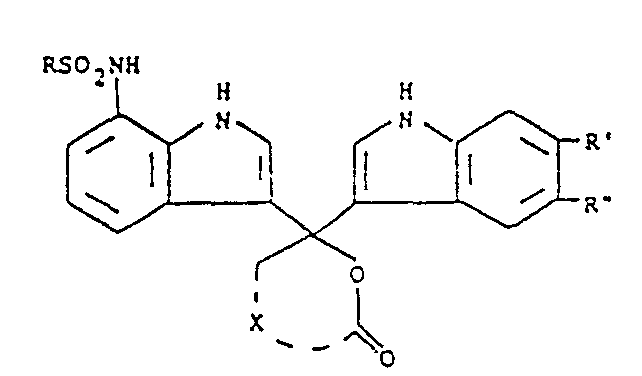
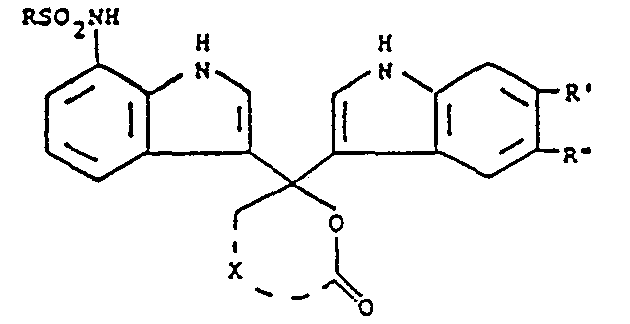
- indole phthaleins may be represented by the formula wherein R is selected from alkyl, aryl, aralkyl and alkaryl, R' and R" each are selected from hydrogen, halogen and -S0 2 NR' R 2 provided one of said R' and R" is said -SO Z NR'R 2 , R' and R 2 each are selected from hydrogen, alkyl, aryl, aralkyl and alkaryl, and X represents the carbon atoms necessary to complete phthalide or naphthalide.
- the respective phthalide and naphthalide moieties are represented by the following formulae:
- X completes naphthalide.
- Suitable R, R' and R 2 substituents include branched or straight chain alkyl usually containing 1 to 20 carbon atoms, e.g., methyl, ethyl, isopropyl, n-butyl, t-butyl, hexyl, octyl, dodecyl, hexadecyl, octadecyl and eicosanyl; e.g., phenyl and naphthyl; alkaryl, e.g., alkyl-substituted phenyl wherein the alkyl usually contains 1 to 20 carbon atoms, such as, p-methylphenyl and p-dodecylphenyl; and aralkyl, e.g., phenyl-substituted alkyl wherein the alkyl usually contains 1 to 20 carbon atoms, such as, benzyl, phenethyl and phenyl
- At least one of R, R' and R 2 comprises a long chain substituent, preferably, a long chain alkyl.
- R' or R" is halogen, it is usually bromo or chloro.
- the subject compounds may be substituted with solubilizing groups, such as, carboxy, hydroxy or sulfonyl to enhance the solubility of the compound in the processing composition or substituted with additional immobilizing groups, such as, long chain alkoxy or alkyl or other groups as may be desired which do not interfere with its photographic function as an optical filter agent.
- solubilizing groups such as, carboxy, hydroxy or sulfonyl to enhance the solubility of the compound in the processing composition
- additional immobilizing groups such as, long chain alkoxy or alkyl or other groups as may be desired which do not interfere with its photographic function as an optical filter agent.
- the subject indole phthaleins may be prepared using any of the various methods previously disclosed for synthesizing phthalides and na- phthalides. A preferred method isdescribed in U.S. Patent No. 3,931,228 issued January 6, 1976 to Alain L.
- Borror and comprises reacting a 7-sulfonamido (or 5- or 6-sulfamoyl) indole with phthalaldehydic or naphthaldehydic acid in the presence of a mild acid catalyst, e.g., toluene-p-sulfonic acid to yield the corresponding phthalidyl- or naphthalidylindole intermediate which is oxidized by treating with, for example, 2,3-dichloro-5,6-dicyano-1,4-benzoquinone.
- a mild acid catalyst e.g., toluene-p-sulfonic acid
- the oxidized intermediate is then reacted with a 5- or 6-sulfamoyl indole (or 7-sulfonamido indole) in the presence of an acid catalyst to yield the desired phthalein product.
- a 5- or 6-sulfamoyl indole or 7-sulfonamido indole
- the 7-sulfonamido indoles employed in the above described method are known and may be prepared according to the procedure disclosed in U.S. Patent No. 3,772,329 issued November 13,1973 to Paul S. Huyffer.
- the procedure described therein for sulfamoyl- substituted indoles can be used for preparing 6-sulfamoyl indoles.
- the 6-methylsulfamoylindole employed above was prepared as follows:
- the 5-methylsulfamoylindole used above was prepared as follows:
- Example 1 The compound of Example 1 also was synthesized using the foregoing procedure by reacting 6-methylsulfamoylindole with the naphthaldehydic acid.
- 3-(7-n-hexadecylsulfonamidoindol-3-yl)-3-(5-dimethylsulfamoylindol-3-yl) naphthalide having the formula was prepared according to the procedure given in Example 2 except that the sulfamoylindole reacted with the oxidized naphthalidyl-indole intermediate was 5-dimethylsulfamoylindole. This indole was prepared in the same manner as 5-methylsulfamoylindole using dimethylamine.
- 3-(7-methylsulfonamidoindol-3-yl)-3-(5-n-hexadecylsulfamoylindol-3-yl) naphthalide having the formula was prepared according to the procedure given in Example 2 above except that 5-n-hexadecyl- sulfamoylindole was reacted with an oxidized naphthalidyl-indole intermediate synthesized from 7-methylsulfonamidoindole.
- the present invention is particularly adapted for facilitating processing outside of a camera of diffusion transfer units which are maintained as a permanent integral laminate after processing, the final transfer image being viewed through one face of the laminate.
- a light-reflecting layer is disposed between the developed photosensitive layers and the layer carrying the transfer dye image.
- These essential layers preferably are confined between a pair of dimensionally stable outer supports, at least one of which is transparent to permit viewing of the transfer dye image by reflection againstthe background provided by the reflecting layer.
- Image dye-providing materials which may be employed generally may be characterized as either (1) initially soluble or diffusible in the processing composition but are selectively rendered non-diffusible in an imagewise pattern as a function of development; or (2) initially insoluble or non-diffusible in the processing composition but which are selectively rendered diffusion or provide a diffusible product in an imagewise distribution as a function of development.
- These materials may be complete dyes or dye intermediates, e.g.. color couplers.
- the requisite differential in mobility or solubility may, for example, be obtained by a chemical action such as a redox reaction or a coupling reaction.
- a particularly useful system for forming color images by diffusion transfer is that described in U.S. Patent No. 2,983,606, employing dye developers (dyes which are also silver halide developing agents) as the image dye-providing materials.
- a photosensitive element comprising at least one silver halide layer having a dye developer associated therewith (in the same or in an adjacent layer) is developed by applying an aqueous alkaline processing composition.
- color transfer images are obtained by exposing a photosensitive element, sometimes referred to as a "negative component", comprising at least a light-sensitive layer, e.g., a gelatino silver halide emulsion layer, having an image dye-providing material associated therewith in the same or in an adjacent layer, to form a developable image; developing this exposed element with a processing composition to form an imagewise distribution of a diffusible image dye-providing material; and transferring this imagewise distribution, at least in part, by diffusion, to a superposed image-receiving layer, sometimes referred to as a "positive component", comprising at least a dyeable stratum to provide a color transfer image.
- a photosensitive element sometimes referred to as a "negative component”
- a light-sensitive layer e.g., a gelatino silver halide emulsion layer
- an image dye-providing material associated therewith in the same or in an adjacent layer
- the negative and positive components initially may be carried on separate supports which are brought together during processing and thereafter retained together as the final integral negative-positive reflection print, or they may initially comprise a unitary structure, e.g., integral negative-positive film units of the type described in aforementioned U.S. Patent No. 3,415,644 wherein the negative and positive components are physically retained together in superposed relationship prior to, during and after image formation.
- a unitary structure e.g., integral negative-positive film units of the type described in aforementioned U.S. Patent No. 3,415,644 wherein the negative and positive components are physically retained together in superposed relationship prior to, during and after image formation.
- Processdures for forming such film units wherein the positive and negative components are temporarily laminated together prior to exposure are described, for example, in U.S. Patent No. 3,652,281 to Albert J. Bachelder and Frederick J. Binda and in U.S. Patent No. 3,652,282 to Edwin H. Land, both issued March 28, 1972.
- Film units intended to provide multicolor images comprise two or more selectively sensitized silver halide layers each having associated therewith an appropriate image dye-providing material providing an image dye having spectral absorption characteristics substantially complementary to the light by which the associated silver halide is exposed.
- the most commonly employed negative components for forming multicolor images are of the tripack structure and contain blue-, green- and red-sensitive silver halide layers each having associated therewith in the same or in a contiguous layer a yellow, a magenta and a cyan image dye-providing material respectively.
- Interlayers or spacer layers may be provided between the respective silver halide layers and associated image dye-providing materials or between other layers.
- a light-reflecting spacer layer disposed between a silver halide layer and the associated layer of image dye-providing material may be used to increase effective film speed as a result of the reflection of light back to the silver halide.
- Particularly suitable light-reflecting spacer layers comprise a light-reflecting pigment dispersed with inert polymeric particles which are substantially non-swelling in alkali and substantially non- film-forming. Such layers form the subject matter of published European Patent Application No. 0066341 published December 8, 1982.
- such film units further include means for providing a reflecting layer between the dyeable stratum and the negative component in order to mask effectively the silver image or images formed as a function of development of the silver halide layer or layers and also to mask image dye-providing material which is not transferred, thereby providing a background, preferably white, for viewing the color image formed in the dyeable stratum, without separation, by reflected light.
- this reflecting layer is provided by including the reflecting agent in the processing composition. The dye transfer image is then viewable against the reflecting layer through a dimensionally stable protective layer or support.
- a rupturable container of known description contains the requisite processing composition and is adapted upon application of pressure to release its contents for development of the exposed film unit, e.g., by distributing the processing composition in a substantially uniform layer between the negative and positive components.
- the dye developers are preferably selected for their ability to provide colors that are useful in carrying out subtractive color photography, that is, the previously mentioned cyan, magenta and yellow. They may be incorporated in the respective silver halide emulsion or, in the preferred embodiment, in a separate layer behind the respective silver halide emulsion.
- a dye developer may, for example, be in a coating or layer behind the respective silver halide emulsion and such a layer of dye developer may be applied by use of a coating solution containing the respective dye developer distributed, in a concentration calculated to give the desired coverage of dye developer per unit area, in a film-forming natural, or synthetic, polymer, for example, gelatin or polyvinyl alcohol, adapted to be permeated by the processing composition.
- Dye developers are compounds which contain the chromophoric system of a dye and also a silver halide developing function.
- a silver halide developing function is meant a grouping adapted to develop exposed silver halide.
- a preferred silver halide development function is a hydroquinonyl group.
- Other suitable developing functions include ortho-dihydroxyphenyl and ortho- and para-amino substituted hydroxyphenyl groups.
- the development function includes a benzenoid developing function, that is, an aromatic developing group which forms qui- nonoid or quinone substances when oxidized.
- the image-receiving layer may comprise any of the materials known in the art, such as polyvinyl alcohol or gelatin, preferably containing a mordant for the transferred image dye(s). If the color of the transferred image dye(s) is affected by changes in pH, the pH of the image layer may be adjusted to provide a pH affording the desired color.
- polymeric acids may be polymers which contain acid groups, e.g., carboxylic acid and sulfonic acid groups, which are capable of forming salts with alkali; or potentially acid-yielding groups such as anhydrides or lactones.
- the acid polymer contains free carboxyl groups.
- the acid-reacting reagent may be in a layer adjacent the silver halide most distant from the image-receiving layer, as disclosed in U.S. Patent No.3,573,043 issued March 30,1971 to Edwin H. Land. Another system for providing an acid-reacting reagent is disclosed in U.S. Patent No. 3,576,625 issued April 27,1971 to Edwin H. Land.
- An inert interlayer or spacer layer may be used in association with the polymeric acid layer to control or "time" the pH reduction so that it is not premature and interfere with the development process.
- Suitable spacer or "timing" layers useful for this purpose are described with particularity in U.S. Patents Nos. 3,362,819; 3,419,389; 3,421,893; 3,455,686 and 3,575,701.
- the liquid processing composition referred to for effecting multicolor diffusion transfer processes comprises at least an aqueous solution of an alkaline material and possesses a pH of at least 12.
- the alkaline material employed in the subject invention is an alkali metal hydroxide.
- the processing composition also preferably includes a viscosity-imparting reagent constituting a film-forming material of the type which, when the composition is spread and dried, forms a relatively firm and relatively stable film.
- This reagent may be a cellulosic polymer, for example, hydroxyethyl cellulose or sodium carboxymethyl cellulose; an oxime polymer, for example, polydiacetone acrylamide oxime; or other alkali-stable high molecular weight polymer.
- the viscosity-imparting reagent is preferably contained in the processing composition in such suitable quantities as to impart to the composition a viscosity in excess of 0,1 Pa' s at a temperature of 24° C and preferably in the order of 10 2 Pa - s to 2.10 2 Pa - s at that temperature.
- a light-absorbing pH-sensitive optical filter agent which absorbs in the longer wavelength range of the visible spectrum, usually, a carboxynaphthol phthalein is used in combination with the subject indole phthaleins to provide further protection throughout the visible spectrum.
- carboxynaphthol phthalein is intended to include both 3,3-di-(4'-hydroxy-l'-naphthyl)-phthalides and 3,3-di-(4'-hydroxy-1'-naphthyl)-napthalides wherein at least one of said 3,3-substituents is a 3'-carboxy-4'-hydroxy-1 '-naphthyt moiety such as the phthaleins disclosed in aforementioned U.S. Patent No. 3,702,245.
- the pH-sensitive phthalein dye(s) employed as the light-absorbing optical filter agents preferably are initially contained in the processing composition in their colored form together with the light-reflecting material, for example, titanium dioxide.
- the concentration of phthalein dye is selected to provide the optical transmission density required, in combination with the other layers intermediate the silver halide emulsion layer(s) and the incident radiation, to prevent nonimage- wise exposure, i.e., fogging by incident actinic light during performance of the particular photographic process.
- the transmission density and the concentration of phthalein dye necessary to provide the requisite protection from incident light may be readily determined for any photographic process by routine experimentation, as a function of film speed or sensitivity, thickness of the opacification layer processing time and anticipated incident light intensity, as described in said U.S.
- Patent No. 3,647,437 It will be recognized that a particular transmission density may not be required for all portions of the spectrum, lesser density being sufficient in wavelength regions corresponding to lesser sensitivities of the particular photosensitive material. As indicated above, it will be recognized that a mixture of phthalein dyes may be used to obtain absorption in all critical areas of the visible and near-visible by which the silver halide emulsions being used are exposable.
- an image-receiving component having a surface layer adapted to decolorize the optical filter agent adjacent the interface between said component and the layer of processing composition.
- Suitable decolorizing layers are described in U.S. Patent No. 4,298,674 of Edwin H. Land, Leon D. Cerankowski and Neil C. Mattucci, in U.S. Patent No. 4,294,907 of Irena Bronstein-Bonte, Edward P. Lindholm and Lloyd D. Taylor and in U.S. Patent 4,367,277 of Charles K. Chiklis and Neil C. Mattucci.
- the indole phthaleins of the present invention as compared to the 7-carboxy/7-sulfonamido indole phthalein absorb more strongly in the green region of the visible spectrum.
- the ⁇ max and Epsilon measured at the ⁇ max were 533 (32,200), 533 (30,860) and 530 (31,100) for the compounds of Examples 1, 2 and 3, respectively, as compared to 467 (15,300) for the 7-carboxy-7-sulfonamido compound.
- the transmission densities measured for the compounds of Examples 4 and 5 under the same conditions had a ⁇ max and Epsilon at the ⁇ max of 532 (30,020) and 532 (34,450), respectively.
- the ⁇ max and Epsilon for the compounds of Examples 1 through 5 were 518 (25,150), 512 (25,250), 526 (26,200), 525 (22,750) and 525 (30,470), respectively, whereas the ⁇ max and Epsilon for the 7-carboxy/7-sulfonamido compound was 466-467 (12,600).
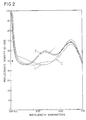
- Curves C and C' represent pigmented processing composition layers containing 3-(7-carboxyindol-3-yl)-3-(7-n-hexadecylsulfonamidoindol-3-yl)naphthalide and 3-(7-n-hexadecylsulfonamidoindol-3-yl)-3-(7-methylsulfamoylindol-3-yl)naphthalide, respectively.
- Curves 2 and 3 represent pigmented processing composition layers containing the compounds of Examples 2 and 3, respectively, and Curve C represents a pigmented processing composition layer containing 3-(7-carboxylindol-3-yl)-3-(7-n-hexadecylsulfonamidoindol-3-yl)naphthalide:
- the aqueous alkaline processing composition comprised a viscous aqueous solution of an alkali metal hydroxide containing titanium dioxide as the light-reflecting pigment and the carboxynaphthol phthalein of the following formula as the optical filter agent for absorbing in the longer wavelength range of the visible spectrum.
- the respective processing compositions were spread between two transparent sheets of polyethylene terephthalate in a layer 0,07 mm thick and the reflectance density of each layerwasmeasured over the wavelength range of 380 to 700 nm.
- the transfer image may be positive or negative with respect to the photographic subject matter as a function of the particular image-forming system and that the silver halide emulsion may be negative-working or positive- working.
- the image-receiving layer or layers of the negative and positive components may vary as appropriate for a given process.
Landscapes
- Chemical & Material Sciences (AREA)
- Organic Chemistry (AREA)
- Engineering & Computer Science (AREA)
- Architecture (AREA)
- Structural Engineering (AREA)
- Physics & Mathematics (AREA)
- General Physics & Mathematics (AREA)
- Indole Compounds (AREA)
Claims (29)


Applications Claiming Priority (4)
| Application Number | Priority Date | Filing Date | Title |
|---|---|---|---|
| US75244485A | 1985-07-03 | 1985-07-03 | |
| US752444 | 1985-07-03 | ||
| US821074 | 1986-01-21 | ||
| US06/821,074 US4615966A (en) | 1985-07-03 | 1986-01-21 | Color transfer photographic processes and products with indole phthalein filter dyes |
Publications (2)
| Publication Number | Publication Date |
|---|---|
| EP0227823A1 EP0227823A1 (de) | 1987-07-08 |
| EP0227823B1 true EP0227823B1 (de) | 1989-03-22 |
Family
ID=27115593
Family Applications (1)
| Application Number | Title | Priority Date | Filing Date |
|---|---|---|---|
| EP86904612A Expired EP0227823B1 (de) | 1985-07-03 | 1986-07-01 | Photographisches farbübertragungsverfahren und produkt |
Country Status (5)
| Country | Link |
|---|---|
| US (1) | US4615966A (de) |
| EP (1) | EP0227823B1 (de) |
| CA (1) | CA1266051A (de) |
| DE (1) | DE3662566D1 (de) |
| WO (1) | WO1987000307A1 (de) |
Families Citing this family (7)
| Publication number | Priority date | Publication date | Assignee | Title |
|---|---|---|---|---|
| US5244771A (en) * | 1991-08-20 | 1993-09-14 | Polaroid Corporation | Photographic products and processes |
| JP3720395B2 (ja) | 1994-09-20 | 2005-11-24 | 京都薬品工業株式会社 | 新規ヘテロ環誘導体、その製造方法およびその医薬用途 |
| US5858608A (en) * | 1997-10-16 | 1999-01-12 | Polaroid Corporation | Diffusion transfer photosensitive film unit for silver transfer image |
| EP1632491A1 (de) * | 2004-08-30 | 2006-03-08 | Laboratorios Del Dr. Esteve, S.A. | Substituierte indol-verbindungen und deren verwendung als modulatoren des 5-ht6 rezeptors |
| US9733789B2 (en) | 2011-08-04 | 2017-08-15 | Eyesight Mobile Technologies Ltd. | Interfacing with a device via virtual 3D objects |
| CA2957566C (en) | 2014-08-12 | 2023-08-01 | Daniel Paul Becker | Indoline sulfonamide inhibitors of dape and ndm-1 and use of the same |
| CN121794313A (zh) | 2023-09-15 | 2026-04-03 | 富士胶片株式会社 | 化合物、组合物、功能性材料、卤化银照相感光材料及扩散转印型卤化银照相感光材料 |
Citations (1)
| Publication number | Priority date | Publication date | Assignee | Title |
|---|---|---|---|---|
| USB456869I5 (de) * | 1971-11-26 | 1976-03-09 |
Family Cites Families (7)
| Publication number | Priority date | Publication date | Assignee | Title |
|---|---|---|---|---|
| US3415645A (en) * | 1967-03-10 | 1968-12-10 | Polaroid Corp | Opaque permeable polymeric layer in photo-sensitive element |
| US3415644A (en) * | 1967-03-10 | 1968-12-10 | Polaroid Corp | Novel photographic products and processes |
| US3415646A (en) * | 1967-05-16 | 1968-12-10 | Polaroid Corp | Novel photographic products and processes |
| US3647646A (en) * | 1968-03-04 | 1972-03-07 | Eastman Kodak Co | Method and apparatus for electroplating cylindrical objects |
| US3702245A (en) * | 1970-06-05 | 1972-11-07 | Polaroid Corp | Photographic diffusion-transfer processes and elements utilizing ph-sensitive optical filter agents to prevent fogging by extraneous actinic radiation during development |
| US3702244A (en) * | 1971-01-21 | 1972-11-07 | Polaroid Corp | Diffusion transfer photographic processes and elements utilizing ph-sensitive agents to prevent fogging by extraneous actinic radiation during development |
| US4456674A (en) * | 1982-11-01 | 1984-06-26 | Polaroid Corporation | Color transfer photographic processes and products |
-
1986
- 1986-01-21 US US06/821,074 patent/US4615966A/en not_active Expired - Lifetime
- 1986-07-01 DE DE8686904612T patent/DE3662566D1/de not_active Expired
- 1986-07-01 WO PCT/US1986/001403 patent/WO1987000307A1/en not_active Ceased
- 1986-07-01 EP EP86904612A patent/EP0227823B1/de not_active Expired
- 1986-07-02 CA CA000512866A patent/CA1266051A/en not_active Expired - Fee Related
Patent Citations (1)
| Publication number | Priority date | Publication date | Assignee | Title |
|---|---|---|---|---|
| USB456869I5 (de) * | 1971-11-26 | 1976-03-09 |
Also Published As
| Publication number | Publication date |
|---|---|
| WO1987000307A1 (en) | 1987-01-15 |
| US4615966A (en) | 1986-10-07 |
| EP0227823A1 (de) | 1987-07-08 |
| DE3662566D1 (en) | 1989-04-27 |
| CA1266051A (en) | 1990-02-20 |
Similar Documents
| Publication | Publication Date | Title |
|---|---|---|
| US6103912A (en) | Photographic products and processes | |
| US3833615A (en) | Naphthalides and phthalides | |
| US4345017A (en) | Photographic products and processes with a pH sensitive xanthene light screening dye | |
| US4139381A (en) | Photographic products and processes employing pH sensitive filter dyes | |
| CA1157863A (en) | Xanthene compounds and photographic products and processes employing the same | |
| US4290955A (en) | 3,6-Di(alkyl/phenyl)amino-9-carboxamidophenyl-xanthenes | |
| EP0227823B1 (de) | Photographisches farbübertragungsverfahren und produkt | |
| US4304833A (en) | Photographic products and processes employing triarylmethane compounds | |
| US4886733A (en) | Photographic products and processes | |
| US4304834A (en) | Novel xanthene compounds and photographic products and processes employing the same | |
| US4290951A (en) | 3,6-Di(N-indolinyl)-9-sulfonamidophenyl-xanthenes | |
| US4891298A (en) | Photographic products and processes | |
| US3779753A (en) | Photographic processes and products employing aminomethyl-substituted phenolic phthaleins as optical filter agents | |
| US3932455A (en) | Carbazole phthaleins | |
| CA1174239A (en) | Photographic products and processes employing triarylmethane compounds | |
| US4056539A (en) | Naphthalide indicator dyes | |
| US3862128A (en) | Naphthalide indicator dyes | |
| US3929829A (en) | PH sensitive dyes containing a phenolate group | |
| US4186001A (en) | Photographic products and processes employing a 3,3 disubstituted sulfam(na)phthalein filter dye | |
| US4429142A (en) | Xanthene compounds | |
| US4001277A (en) | 3,3-disubstituted phthalides and naphthalides | |
| US3976659A (en) | PH Sensitive dyes containing a phenolate group | |
| US3779752A (en) | Photographic processes and products employing benzindole phthaleins as optical filter agents | |
| US4010168A (en) | Naphthalide indicator dyes | |
| US3933849A (en) | 3,3-Disubstituted phthalides and naphthalides |
Legal Events
| Date | Code | Title | Description |
|---|---|---|---|
| PUAI | Public reference made under article 153(3) epc to a published international application that has entered the european phase |
Free format text: ORIGINAL CODE: 0009012 |
|
| AK | Designated contracting states |
Kind code of ref document: A1 Designated state(s): DE FR GB NL |
|
| 17P | Request for examination filed |
Effective date: 19870713 |
|
| 17Q | First examination report despatched |
Effective date: 19871113 |
|
| GRAA | (expected) grant |
Free format text: ORIGINAL CODE: 0009210 |
|
| AK | Designated contracting states |
Kind code of ref document: B1 Designated state(s): DE FR GB NL |
|
| REF | Corresponds to: |
Ref document number: 3662566 Country of ref document: DE Date of ref document: 19890427 |
|
| ET | Fr: translation filed | ||
| PLBE | No opposition filed within time limit |
Free format text: ORIGINAL CODE: 0009261 |
|
| STAA | Information on the status of an ep patent application or granted ep patent |
Free format text: STATUS: NO OPPOSITION FILED WITHIN TIME LIMIT |
|
| 26N | No opposition filed | ||
| PGFP | Annual fee paid to national office [announced via postgrant information from national office to epo] |
Ref country code: FR Payment date: 19970613 Year of fee payment: 12 |
|
| PGFP | Annual fee paid to national office [announced via postgrant information from national office to epo] |
Ref country code: GB Payment date: 19970620 Year of fee payment: 12 |
|
| PGFP | Annual fee paid to national office [announced via postgrant information from national office to epo] |
Ref country code: NL Payment date: 19970630 Year of fee payment: 12 |
|
| PGFP | Annual fee paid to national office [announced via postgrant information from national office to epo] |
Ref country code: DE Payment date: 19980629 Year of fee payment: 13 |
|
| PG25 | Lapsed in a contracting state [announced via postgrant information from national office to epo] |
Ref country code: GB Free format text: LAPSE BECAUSE OF NON-PAYMENT OF DUE FEES Effective date: 19980701 |
|
| PG25 | Lapsed in a contracting state [announced via postgrant information from national office to epo] |
Ref country code: NL Free format text: LAPSE BECAUSE OF NON-PAYMENT OF DUE FEES Effective date: 19990201 |
|
| GBPC | Gb: european patent ceased through non-payment of renewal fee |
Effective date: 19980701 |
|
| PG25 | Lapsed in a contracting state [announced via postgrant information from national office to epo] |
Ref country code: FR Free format text: LAPSE BECAUSE OF NON-PAYMENT OF DUE FEES Effective date: 19990331 |
|
| NLV4 | Nl: lapsed or anulled due to non-payment of the annual fee |
Effective date: 19990201 |
|
| REG | Reference to a national code |
Ref country code: FR Ref legal event code: ST |
|
| PG25 | Lapsed in a contracting state [announced via postgrant information from national office to epo] |
Ref country code: DE Free format text: LAPSE BECAUSE OF NON-PAYMENT OF DUE FEES Effective date: 20000503 |