EP0228043A2 - Novel dye salts, process for their manufacture and their use - Google Patents
Novel dye salts, process for their manufacture and their use Download PDFInfo
- Publication number
- EP0228043A2 EP0228043A2 EP86117722A EP86117722A EP0228043A2 EP 0228043 A2 EP0228043 A2 EP 0228043A2 EP 86117722 A EP86117722 A EP 86117722A EP 86117722 A EP86117722 A EP 86117722A EP 0228043 A2 EP0228043 A2 EP 0228043A2
- Authority
- EP
- European Patent Office
- Prior art keywords
- cation
- formula
- divalent
- compound according
- anion
- Prior art date
- Legal status (The legal status is an assumption and is not a legal conclusion. Google has not performed a legal analysis and makes no representation as to the accuracy of the status listed.)
- Withdrawn
Links
- 150000003839 salts Chemical class 0.000 title claims abstract description 61
- 238000000034 method Methods 0.000 title claims description 25
- 238000004519 manufacturing process Methods 0.000 title description 2
- -1 iron cation Chemical class 0.000 claims abstract description 82
- 238000004043 dyeing Methods 0.000 claims abstract description 41
- 150000001875 compounds Chemical class 0.000 claims abstract description 36
- 125000002091 cationic group Chemical group 0.000 claims abstract description 26
- 150000001450 anions Chemical class 0.000 claims abstract description 20
- SOIFLUNRINLCBN-UHFFFAOYSA-N ammonium thiocyanate Chemical compound [NH4+].[S-]C#N SOIFLUNRINLCBN-UHFFFAOYSA-N 0.000 claims abstract description 17
- 150000001768 cations Chemical class 0.000 claims abstract description 16
- 229910052717 sulfur Chemical group 0.000 claims abstract description 14
- XEEYBQQBJWHFJM-UHFFFAOYSA-N iron Substances [Fe] XEEYBQQBJWHFJM-UHFFFAOYSA-N 0.000 claims abstract description 13
- 229910052751 metal Inorganic materials 0.000 claims abstract description 13
- 239000002184 metal Substances 0.000 claims abstract description 13
- 229910052742 iron Inorganic materials 0.000 claims abstract description 12
- 239000007864 aqueous solution Substances 0.000 claims abstract description 11
- 229910052783 alkali metal Inorganic materials 0.000 claims abstract description 10
- 150000001340 alkali metals Chemical class 0.000 claims abstract description 10
- 229910052784 alkaline earth metal Inorganic materials 0.000 claims abstract description 10
- 150000001342 alkaline earth metals Chemical class 0.000 claims abstract description 10
- 229920001577 copolymer Polymers 0.000 claims abstract description 8
- 238000006243 chemical reaction Methods 0.000 claims abstract description 6
- 239000007900 aqueous suspension Substances 0.000 claims abstract description 5
- 125000004430 oxygen atom Chemical group O* 0.000 claims abstract description 5
- 229920002239 polyacrylonitrile Polymers 0.000 claims abstract description 5
- VMQMZMRVKUZKQL-UHFFFAOYSA-N Cu+ Chemical compound [Cu+] VMQMZMRVKUZKQL-UHFFFAOYSA-N 0.000 claims abstract description 3
- YWMAPNNZOCSAPF-UHFFFAOYSA-N Nickel(1+) Chemical compound [Ni+] YWMAPNNZOCSAPF-UHFFFAOYSA-N 0.000 claims abstract description 3
- PTFCDOFLOPIGGS-UHFFFAOYSA-N Zinc dication Chemical compound [Zn+2] PTFCDOFLOPIGGS-UHFFFAOYSA-N 0.000 claims abstract description 3
- 239000010941 cobalt Substances 0.000 claims abstract description 3
- 229910017052 cobalt Inorganic materials 0.000 claims abstract description 3
- 229940006444 nickel cation Drugs 0.000 claims abstract description 3
- 125000004434 sulfur atom Chemical group 0.000 claims abstract description 3
- 229940006486 zinc cation Drugs 0.000 claims abstract description 3
- 239000000975 dye Substances 0.000 claims description 61
- NLHHRLWOUZZQLW-UHFFFAOYSA-N Acrylonitrile Chemical compound C=CC#N NLHHRLWOUZZQLW-UHFFFAOYSA-N 0.000 claims description 9
- QYTOONVFPBUIJG-UHFFFAOYSA-N azane;cyanic acid Chemical compound [NH4+].[O-]C#N QYTOONVFPBUIJG-UHFFFAOYSA-N 0.000 claims description 4
- 239000003086 colorant Substances 0.000 claims description 2
- XCJYREBRNVKWGJ-UHFFFAOYSA-N copper(II) phthalocyanine Chemical compound [Cu+2].C12=CC=CC=C2C(N=C2[N-]C(C3=CC=CC=C32)=N2)=NC1=NC([C]1C=CC=CC1=1)=NC=1N=C1[C]3C=CC=CC3=C2[N-]1 XCJYREBRNVKWGJ-UHFFFAOYSA-N 0.000 claims 2
- RBTKNAXYKSUFRK-UHFFFAOYSA-N heliogen blue Chemical group [Cu].[N-]1C2=C(C=CC=C3)C3=C1N=C([N-]1)C3=CC=CC=C3C1=NC([N-]1)=C(C=CC=C3)C3=C1N=C([N-]1)C3=CC=CC=C3C1=N2 RBTKNAXYKSUFRK-UHFFFAOYSA-N 0.000 claims 2
- XLJMAIOERFSOGZ-UHFFFAOYSA-M cyanate Chemical compound [O-]C#N XLJMAIOERFSOGZ-UHFFFAOYSA-M 0.000 abstract description 5
- ZMXDDKWLCZADIW-UHFFFAOYSA-N N,N-Dimethylformamide Chemical compound CN(C)C=O ZMXDDKWLCZADIW-UHFFFAOYSA-N 0.000 description 51
- 239000000243 solution Substances 0.000 description 31
- 125000000217 alkyl group Chemical group 0.000 description 30
- XLYOFNOQVPJJNP-UHFFFAOYSA-N water Substances O XLYOFNOQVPJJNP-UHFFFAOYSA-N 0.000 description 30
- CSCPPACGZOOCGX-UHFFFAOYSA-N Acetone Chemical compound CC(C)=O CSCPPACGZOOCGX-UHFFFAOYSA-N 0.000 description 20
- 229910052757 nitrogen Inorganic materials 0.000 description 20
- FXHOOIRPVKKKFG-UHFFFAOYSA-N N,N-Dimethylacetamide Chemical compound CN(C)C(C)=O FXHOOIRPVKKKFG-UHFFFAOYSA-N 0.000 description 16
- 229910052739 hydrogen Inorganic materials 0.000 description 16
- 125000001997 phenyl group Chemical group [H]C1=C([H])C([H])=C(*)C([H])=C1[H] 0.000 description 14
- 125000003545 alkoxy group Chemical group 0.000 description 13
- VAYGXNSJCAHWJZ-UHFFFAOYSA-N dimethyl sulfate Chemical compound COS(=O)(=O)OC VAYGXNSJCAHWJZ-UHFFFAOYSA-N 0.000 description 13
- 238000009987 spinning Methods 0.000 description 13
- XLOMVQKBTHCTTD-UHFFFAOYSA-N Zinc monoxide Chemical compound [Zn]=O XLOMVQKBTHCTTD-UHFFFAOYSA-N 0.000 description 12
- 229910052801 chlorine Inorganic materials 0.000 description 11
- 125000001424 substituent group Chemical group 0.000 description 11
- 239000000460 chlorine Substances 0.000 description 10
- 229920000642 polymer Polymers 0.000 description 10
- 239000002904 solvent Substances 0.000 description 10
- 229910052725 zinc Inorganic materials 0.000 description 10
- 239000011701 zinc Substances 0.000 description 10
- ZAMOUSCENKQFHK-UHFFFAOYSA-N Chlorine atom Chemical compound [Cl] ZAMOUSCENKQFHK-UHFFFAOYSA-N 0.000 description 9
- 125000004093 cyano group Chemical group *C#N 0.000 description 9
- QGZKDVFQNNGYKY-UHFFFAOYSA-O ammonium group Chemical group [NH4+] QGZKDVFQNNGYKY-UHFFFAOYSA-O 0.000 description 8
- 125000003118 aryl group Chemical group 0.000 description 8
- 125000004432 carbon atom Chemical group C* 0.000 description 8
- QTBSBXVTEAMEQO-UHFFFAOYSA-N Acetic acid Chemical compound CC(O)=O QTBSBXVTEAMEQO-UHFFFAOYSA-N 0.000 description 7
- ZOIORXHNWRGPMV-UHFFFAOYSA-N acetic acid;zinc Chemical compound [Zn].CC(O)=O.CC(O)=O ZOIORXHNWRGPMV-UHFFFAOYSA-N 0.000 description 7
- 125000002947 alkylene group Chemical group 0.000 description 7
- 125000000664 diazo group Chemical group [N-]=[N+]=[*] 0.000 description 7
- 239000000203 mixture Substances 0.000 description 7
- 239000004246 zinc acetate Substances 0.000 description 7
- 150000005840 aryl radicals Chemical class 0.000 description 6
- 125000001797 benzyl group Chemical group [H]C1=C([H])C([H])=C(C([H])=C1[H])C([H])([H])* 0.000 description 6
- 230000015572 biosynthetic process Effects 0.000 description 6
- 238000005859 coupling reaction Methods 0.000 description 6
- RAXXELZNTBOGNW-UHFFFAOYSA-N imidazole Natural products C1=CNC=N1 RAXXELZNTBOGNW-UHFFFAOYSA-N 0.000 description 6
- 150000003254 radicals Chemical class 0.000 description 6
- 239000011787 zinc oxide Substances 0.000 description 6
- WKBOTKDWSSQWDR-UHFFFAOYSA-N Bromine atom Chemical compound [Br] WKBOTKDWSSQWDR-UHFFFAOYSA-N 0.000 description 5
- 0 C[C@@](C(*1C2)NC3C=CC(N**(**)N)=*C3)C(*)=NC12*=C Chemical compound C[C@@](C(*1C2)NC3C=CC(N**(**)N)=*C3)C(*)=NC12*=C 0.000 description 5
- JUJWROOIHBZHMG-UHFFFAOYSA-N Pyridine Chemical compound C1=CC=NC=C1 JUJWROOIHBZHMG-UHFFFAOYSA-N 0.000 description 5
- ZMZDMBWJUHKJPS-UHFFFAOYSA-M Thiocyanate anion Chemical class [S-]C#N ZMZDMBWJUHKJPS-UHFFFAOYSA-M 0.000 description 5
- 125000005236 alkanoylamino group Chemical group 0.000 description 5
- GDTBXPJZTBHREO-UHFFFAOYSA-N bromine Substances BrBr GDTBXPJZTBHREO-UHFFFAOYSA-N 0.000 description 5
- 229910052794 bromium Inorganic materials 0.000 description 5
- 125000003917 carbamoyl group Chemical group [H]N([H])C(*)=O 0.000 description 5
- 230000008878 coupling Effects 0.000 description 5
- 238000010168 coupling process Methods 0.000 description 5
- 229910052736 halogen Inorganic materials 0.000 description 5
- 150000002367 halogens Chemical group 0.000 description 5
- 125000000623 heterocyclic group Chemical group 0.000 description 5
- 125000002887 hydroxy group Chemical group [H]O* 0.000 description 5
- 125000000449 nitro group Chemical group [O-][N+](*)=O 0.000 description 5
- 239000000049 pigment Substances 0.000 description 5
- 238000003786 synthesis reaction Methods 0.000 description 5
- 125000002023 trifluoromethyl group Chemical group FC(F)(F)* 0.000 description 5
- KLSJWNVTNUYHDU-UHFFFAOYSA-N Amitrole Chemical compound NC1=NC=NN1 KLSJWNVTNUYHDU-UHFFFAOYSA-N 0.000 description 4
- PAYRUJLWNCNPSJ-UHFFFAOYSA-N Aniline Chemical compound NC1=CC=CC=C1 PAYRUJLWNCNPSJ-UHFFFAOYSA-N 0.000 description 4
- IAZDPXIOMUYVGZ-UHFFFAOYSA-N Dimethylsulphoxide Chemical compound CS(C)=O IAZDPXIOMUYVGZ-UHFFFAOYSA-N 0.000 description 4
- OKKJLVBELUTLKV-UHFFFAOYSA-N Methanol Chemical compound OC OKKJLVBELUTLKV-UHFFFAOYSA-N 0.000 description 4
- YNAVUWVOSKDBBP-UHFFFAOYSA-N Morpholine Chemical compound C1COCCN1 YNAVUWVOSKDBBP-UHFFFAOYSA-N 0.000 description 4
- NQRYJNQNLNOLGT-UHFFFAOYSA-N Piperidine Chemical compound C1CCNCC1 NQRYJNQNLNOLGT-UHFFFAOYSA-N 0.000 description 4
- UIIMBOGNXHQVGW-UHFFFAOYSA-M Sodium bicarbonate Chemical compound [Na+].OC([O-])=O UIIMBOGNXHQVGW-UHFFFAOYSA-M 0.000 description 4
- CIUQDSCDWFSTQR-UHFFFAOYSA-N [C]1=CC=CC=C1 Chemical compound [C]1=CC=CC=C1 CIUQDSCDWFSTQR-UHFFFAOYSA-N 0.000 description 4
- 239000000395 magnesium oxide Substances 0.000 description 4
- CPLXHLVBOLITMK-UHFFFAOYSA-N magnesium oxide Inorganic materials [Mg]=O CPLXHLVBOLITMK-UHFFFAOYSA-N 0.000 description 4
- AXZKOIWUVFPNLO-UHFFFAOYSA-N magnesium;oxygen(2-) Chemical compound [O-2].[Mg+2] AXZKOIWUVFPNLO-UHFFFAOYSA-N 0.000 description 4
- 125000002496 methyl group Chemical group [H]C([H])([H])* 0.000 description 4
- 125000004433 nitrogen atom Chemical group N* 0.000 description 4
- 239000003960 organic solvent Substances 0.000 description 4
- GKKCIDNWFBPDBW-UHFFFAOYSA-M potassium cyanate Chemical compound [K]OC#N GKKCIDNWFBPDBW-UHFFFAOYSA-M 0.000 description 4
- 238000005406 washing Methods 0.000 description 4
- UHOVQNZJYSORNB-UHFFFAOYSA-N Benzene Chemical compound C1=CC=CC=C1 UHOVQNZJYSORNB-UHFFFAOYSA-N 0.000 description 3
- 229960000583 acetic acid Drugs 0.000 description 3
- 125000003277 amino group Chemical group 0.000 description 3
- 125000004397 aminosulfonyl group Chemical group NS(=O)(=O)* 0.000 description 3
- 125000003710 aryl alkyl group Chemical group 0.000 description 3
- 150000001555 benzenes Chemical class 0.000 description 3
- 238000005345 coagulation Methods 0.000 description 3
- 230000015271 coagulation Effects 0.000 description 3
- 229910052802 copper Inorganic materials 0.000 description 3
- 239000010949 copper Substances 0.000 description 3
- ARUVKPQLZAKDPS-UHFFFAOYSA-L copper(II) sulfate Chemical compound [Cu+2].[O-][S+2]([O-])([O-])[O-] ARUVKPQLZAKDPS-UHFFFAOYSA-L 0.000 description 3
- 229910000366 copper(II) sulfate Inorganic materials 0.000 description 3
- 239000000835 fiber Substances 0.000 description 3
- 125000004435 hydrogen atom Chemical group [H]* 0.000 description 3
- 230000007062 hydrolysis Effects 0.000 description 3
- 238000006460 hydrolysis reaction Methods 0.000 description 3
- 238000002955 isolation Methods 0.000 description 3
- 150000002739 metals Chemical class 0.000 description 3
- 150000002790 naphthalenes Chemical class 0.000 description 3
- 125000002924 primary amino group Chemical group [H]N([H])* 0.000 description 3
- 125000000467 secondary amino group Chemical group [H]N([*:1])[*:2] 0.000 description 3
- 238000003860 storage Methods 0.000 description 3
- 239000000725 suspension Substances 0.000 description 3
- 125000001302 tertiary amino group Chemical group 0.000 description 3
- 238000002166 wet spinning Methods 0.000 description 3
- FFRBMBIXVSCUFS-UHFFFAOYSA-N 2,4-dinitro-1-naphthol Chemical compound C1=CC=C2C(O)=C([N+]([O-])=O)C=C([N+]([O-])=O)C2=C1 FFRBMBIXVSCUFS-UHFFFAOYSA-N 0.000 description 2
- SMZOUWXMTYCWNB-UHFFFAOYSA-N 2-(2-methoxy-5-methylphenyl)ethanamine Chemical compound COC1=CC=C(C)C=C1CCN SMZOUWXMTYCWNB-UHFFFAOYSA-N 0.000 description 2
- OEPOKWHJYJXUGD-UHFFFAOYSA-N 2-(3-phenylmethoxyphenyl)-1,3-thiazole-4-carbaldehyde Chemical compound O=CC1=CSC(C=2C=C(OCC=3C=CC=CC=3)C=CC=2)=N1 OEPOKWHJYJXUGD-UHFFFAOYSA-N 0.000 description 2
- 125000000094 2-phenylethyl group Chemical group [H]C1=C([H])C([H])=C(C([H])=C1[H])C([H])([H])C([H])([H])* 0.000 description 2
- OIFBSDVPJOWBCH-UHFFFAOYSA-N Diethyl carbonate Chemical compound CCOC(=O)OCC OIFBSDVPJOWBCH-UHFFFAOYSA-N 0.000 description 2
- PXGOKWXKJXAPGV-UHFFFAOYSA-N Fluorine Chemical compound FF PXGOKWXKJXAPGV-UHFFFAOYSA-N 0.000 description 2
- VEXZGXHMUGYJMC-UHFFFAOYSA-N Hydrochloric acid Chemical compound Cl VEXZGXHMUGYJMC-UHFFFAOYSA-N 0.000 description 2
- NHNBFGGVMKEFGY-UHFFFAOYSA-N Nitrate Chemical compound [O-][N+]([O-])=O NHNBFGGVMKEFGY-UHFFFAOYSA-N 0.000 description 2
- WTKZEGDFNFYCGP-UHFFFAOYSA-O Pyrazolium Chemical compound C1=CN[NH+]=C1 WTKZEGDFNFYCGP-UHFFFAOYSA-O 0.000 description 2
- NRCMAYZCPIVABH-UHFFFAOYSA-N Quinacridone Chemical compound N1C2=CC=CC=C2C(=O)C2=C1C=C1C(=O)C3=CC=CC=C3NC1=C2 NRCMAYZCPIVABH-UHFFFAOYSA-N 0.000 description 2
- GWEVSGVZZGPLCZ-UHFFFAOYSA-N Titan oxide Chemical compound O=[Ti]=O GWEVSGVZZGPLCZ-UHFFFAOYSA-N 0.000 description 2
- XTXRWKRVRITETP-UHFFFAOYSA-N Vinyl acetate Chemical compound CC(=O)OC=C XTXRWKRVRITETP-UHFFFAOYSA-N 0.000 description 2
- 150000001242 acetic acid derivatives Chemical class 0.000 description 2
- 239000002585 base Substances 0.000 description 2
- 125000003739 carbamimidoyl group Chemical group C(N)(=N)* 0.000 description 2
- 229910052799 carbon Inorganic materials 0.000 description 2
- 239000003795 chemical substances by application Substances 0.000 description 2
- 125000001309 chloro group Chemical group Cl* 0.000 description 2
- KTVIXTQDYHMGHF-UHFFFAOYSA-L cobalt(2+) sulfate Chemical compound [Co+2].[O-]S([O-])(=O)=O KTVIXTQDYHMGHF-UHFFFAOYSA-L 0.000 description 2
- 229910000335 cobalt(II) sulfate Inorganic materials 0.000 description 2
- 125000001495 ethyl group Chemical group [H]C([H])([H])C([H])([H])* 0.000 description 2
- 238000001914 filtration Methods 0.000 description 2
- 229910052731 fluorine Inorganic materials 0.000 description 2
- 239000011737 fluorine Substances 0.000 description 2
- 239000012362 glacial acetic acid Substances 0.000 description 2
- 229940093915 gynecological organic acid Drugs 0.000 description 2
- 150000004820 halides Chemical class 0.000 description 2
- 125000005843 halogen group Chemical group 0.000 description 2
- 238000010438 heat treatment Methods 0.000 description 2
- 125000005842 heteroatom Chemical group 0.000 description 2
- 125000000717 hydrazino group Chemical group [H]N([*])N([H])[H] 0.000 description 2
- 125000004356 hydroxy functional group Chemical group O* 0.000 description 2
- RBTARNINKXHZNM-UHFFFAOYSA-K iron trichloride Chemical compound Cl[Fe](Cl)Cl RBTARNINKXHZNM-UHFFFAOYSA-K 0.000 description 2
- BAUYGSIQEAFULO-UHFFFAOYSA-L iron(2+) sulfate (anhydrous) Chemical compound [Fe+2].[O-]S([O-])(=O)=O BAUYGSIQEAFULO-UHFFFAOYSA-L 0.000 description 2
- 229910000359 iron(II) sulfate Inorganic materials 0.000 description 2
- NYGZLYXAPMMJTE-UHFFFAOYSA-M metanil yellow Chemical group [Na+].[O-]S(=O)(=O)C1=CC=CC(N=NC=2C=CC(NC=3C=CC=CC=3)=CC=2)=C1 NYGZLYXAPMMJTE-UHFFFAOYSA-M 0.000 description 2
- 150000007522 mineralic acids Chemical class 0.000 description 2
- FWAWELGQRMERND-UHFFFAOYSA-N n'-ethyl-n,n-dimethyl-n'-phenylethane-1,2-diamine Chemical compound CN(C)CCN(CC)C1=CC=CC=C1 FWAWELGQRMERND-UHFFFAOYSA-N 0.000 description 2
- 229910052759 nickel Inorganic materials 0.000 description 2
- PXHVJJICTQNCMI-UHFFFAOYSA-N nickel Substances [Ni] PXHVJJICTQNCMI-UHFFFAOYSA-N 0.000 description 2
- QJGQUHMNIGDVPM-UHFFFAOYSA-N nitrogen group Chemical group [N] QJGQUHMNIGDVPM-UHFFFAOYSA-N 0.000 description 2
- 230000003287 optical effect Effects 0.000 description 2
- 150000007524 organic acids Chemical class 0.000 description 2
- 235000005985 organic acids Nutrition 0.000 description 2
- 125000004193 piperazinyl group Chemical group 0.000 description 2
- 238000001556 precipitation Methods 0.000 description 2
- UMJSCPRVCHMLSP-UHFFFAOYSA-N pyridine Natural products COC1=CC=CN=C1 UMJSCPRVCHMLSP-UHFFFAOYSA-N 0.000 description 2
- 125000001453 quaternary ammonium group Chemical group 0.000 description 2
- 229910000030 sodium bicarbonate Inorganic materials 0.000 description 2
- 235000017557 sodium bicarbonate Nutrition 0.000 description 2
- SZHIIIPPJJXYRY-UHFFFAOYSA-M sodium;2-methylprop-2-ene-1-sulfonate Chemical compound [Na+].CC(=C)CS([O-])(=O)=O SZHIIIPPJJXYRY-UHFFFAOYSA-M 0.000 description 2
- 239000011550 stock solution Substances 0.000 description 2
- 125000000547 substituted alkyl group Chemical group 0.000 description 2
- 239000011593 sulfur Substances 0.000 description 2
- 150000003467 sulfuric acid derivatives Chemical class 0.000 description 2
- 125000001425 triazolyl group Chemical group 0.000 description 2
- 125000000391 vinyl group Chemical group [H]C([*])=C([H])[H] 0.000 description 2
- NWONKYPBYAMBJT-UHFFFAOYSA-L zinc sulfate Chemical compound [Zn+2].[O-]S([O-])(=O)=O NWONKYPBYAMBJT-UHFFFAOYSA-L 0.000 description 2
- 229910000368 zinc sulfate Inorganic materials 0.000 description 2
- 229960001763 zinc sulfate Drugs 0.000 description 2
- QLAJNZSPVITUCQ-UHFFFAOYSA-N 1,3,2-dioxathietane 2,2-dioxide Chemical compound O=S1(=O)OCO1 QLAJNZSPVITUCQ-UHFFFAOYSA-N 0.000 description 1
- OSSNTDFYBPYIEC-UHFFFAOYSA-N 1-ethenylimidazole Chemical compound C=CN1C=CN=C1 OSSNTDFYBPYIEC-UHFFFAOYSA-N 0.000 description 1
- RUFPHBVGCFYCNW-UHFFFAOYSA-N 1-naphthylamine Chemical compound C1=CC=C2C(N)=CC=CC2=C1 RUFPHBVGCFYCNW-UHFFFAOYSA-N 0.000 description 1
- HYZJCKYKOHLVJF-UHFFFAOYSA-N 1H-benzimidazole Chemical compound C1=CC=C2NC=NC2=C1 HYZJCKYKOHLVJF-UHFFFAOYSA-N 0.000 description 1
- BAXOFTOLAUCFNW-UHFFFAOYSA-N 1H-indazole Chemical compound C1=CC=C2C=NNC2=C1 BAXOFTOLAUCFNW-UHFFFAOYSA-N 0.000 description 1
- HYVGFUIWHXLVNV-UHFFFAOYSA-N 2-(n-ethylanilino)ethanol Chemical compound OCCN(CC)C1=CC=CC=C1 HYVGFUIWHXLVNV-UHFFFAOYSA-N 0.000 description 1
- LJJPQCFMNPGTLQ-UHFFFAOYSA-M 2-(n-ethylanilino)ethyl-trimethylazanium;chloride Chemical compound [Cl-].C[N+](C)(C)CCN(CC)C1=CC=CC=C1 LJJPQCFMNPGTLQ-UHFFFAOYSA-M 0.000 description 1
- MAAWLGRQUWBBPZ-UHFFFAOYSA-N 2-[diethylamino(methyl)amino]-N,N-dimethylaniline Chemical compound CN(C)C1=C(N(C)N(CC)CC)C=CC=C1 MAAWLGRQUWBBPZ-UHFFFAOYSA-N 0.000 description 1
- GOJUJUVQIVIZAV-UHFFFAOYSA-N 2-amino-4,6-dichloropyrimidine-5-carbaldehyde Chemical group NC1=NC(Cl)=C(C=O)C(Cl)=N1 GOJUJUVQIVIZAV-UHFFFAOYSA-N 0.000 description 1
- FCYVWWWTHPPJII-UHFFFAOYSA-N 2-methylidenepropanedinitrile Chemical compound N#CC(=C)C#N FCYVWWWTHPPJII-UHFFFAOYSA-N 0.000 description 1
- XEEYSDHEOQHCDA-UHFFFAOYSA-N 2-methylprop-2-ene-1-sulfonic acid Chemical compound CC(=C)CS(O)(=O)=O XEEYSDHEOQHCDA-UHFFFAOYSA-N 0.000 description 1
- JBIJLHTVPXGSAM-UHFFFAOYSA-N 2-naphthylamine Chemical compound C1=CC=CC2=CC(N)=CC=C21 JBIJLHTVPXGSAM-UHFFFAOYSA-N 0.000 description 1
- 125000003903 2-propenyl group Chemical group [H]C([*])([H])C([H])=C([H])[H] 0.000 description 1
- KGIGUEBEKRSTEW-UHFFFAOYSA-N 2-vinylpyridine Chemical compound C=CC1=CC=CC=N1 KGIGUEBEKRSTEW-UHFFFAOYSA-N 0.000 description 1
- SLRMQYXOBQWXCR-UHFFFAOYSA-N 2154-56-5 Chemical compound [CH2]C1=CC=CC=C1 SLRMQYXOBQWXCR-UHFFFAOYSA-N 0.000 description 1
- BCHZICNRHXRCHY-UHFFFAOYSA-N 2h-oxazine Chemical compound N1OC=CC=C1 BCHZICNRHXRCHY-UHFFFAOYSA-N 0.000 description 1
- MAGFQRLKWCCTQJ-UHFFFAOYSA-N 4-ethenylbenzenesulfonic acid Chemical compound OS(=O)(=O)C1=CC=C(C=C)C=C1 MAGFQRLKWCCTQJ-UHFFFAOYSA-N 0.000 description 1
- SPWPAFQLIZTXFN-UHFFFAOYSA-M 4-methoxy-n-methyl-n-[(1,3,3-trimethylindol-1-ium-2-yl)methylideneamino]aniline;methyl sulfate Chemical compound COS([O-])(=O)=O.C1=CC(OC)=CC=C1N(C)\N=C\C1=[N+](C)C2=CC=CC=C2C1(C)C SPWPAFQLIZTXFN-UHFFFAOYSA-M 0.000 description 1
- KZHGPDSVHSDCMX-UHFFFAOYSA-N 6-methoxy-1,3-benzothiazol-2-amine Chemical compound COC1=CC=C2N=C(N)SC2=C1 KZHGPDSVHSDCMX-UHFFFAOYSA-N 0.000 description 1
- PZASAAIJIFDWSB-CKPDSHCKSA-N 8-[(1S)-1-[8-(trifluoromethyl)-7-[4-(trifluoromethyl)cyclohexyl]oxynaphthalen-2-yl]ethyl]-8-azabicyclo[3.2.1]octane-3-carboxylic acid Chemical compound FC(F)(F)C=1C2=CC([C@@H](N3C4CCC3CC(C4)C(O)=O)C)=CC=C2C=CC=1OC1CCC(C(F)(F)F)CC1 PZASAAIJIFDWSB-CKPDSHCKSA-N 0.000 description 1
- QTBSBXVTEAMEQO-UHFFFAOYSA-M Acetate Chemical compound CC([O-])=O QTBSBXVTEAMEQO-UHFFFAOYSA-M 0.000 description 1
- NLXLAEXVIDQMFP-UHFFFAOYSA-N Ammonium chloride Substances [NH4+].[Cl-] NLXLAEXVIDQMFP-UHFFFAOYSA-N 0.000 description 1
- VHUUQVKOLVNVRT-UHFFFAOYSA-N Ammonium hydroxide Chemical compound [NH4+].[OH-] VHUUQVKOLVNVRT-UHFFFAOYSA-N 0.000 description 1
- HYYXWGGJNQWJLF-UHFFFAOYSA-N CCN(C)c(cc1)ccc1/N=N\C1=N[N](C)(C)C(C)=CN1C Chemical compound CCN(C)c(cc1)ccc1/N=N\C1=N[N](C)(C)C(C)=CN1C HYYXWGGJNQWJLF-UHFFFAOYSA-N 0.000 description 1
- QQIWVAIPHXYWOK-UHFFFAOYSA-N Cc1ccc2N=C(c(cc3)ccc3N)S(C)c2c1 Chemical compound Cc1ccc2N=C(c(cc3)ccc3N)S(C)c2c1 QQIWVAIPHXYWOK-UHFFFAOYSA-N 0.000 description 1
- VEXZGXHMUGYJMC-UHFFFAOYSA-M Chloride anion Chemical compound [Cl-] VEXZGXHMUGYJMC-UHFFFAOYSA-M 0.000 description 1
- RYGMFSIKBFXOCR-UHFFFAOYSA-N Copper Chemical compound [Cu] RYGMFSIKBFXOCR-UHFFFAOYSA-N 0.000 description 1
- VGGSQFUCUMXWEO-UHFFFAOYSA-N Ethene Chemical compound C=C VGGSQFUCUMXWEO-UHFFFAOYSA-N 0.000 description 1
- 239000005977 Ethylene Substances 0.000 description 1
- KRHYYFGTRYWZRS-UHFFFAOYSA-N Fluorane Chemical compound F KRHYYFGTRYWZRS-UHFFFAOYSA-N 0.000 description 1
- DGAQECJNVWCQMB-PUAWFVPOSA-M Ilexoside XXIX Chemical compound C[C@@H]1CC[C@@]2(CC[C@@]3(C(=CC[C@H]4[C@]3(CC[C@@H]5[C@@]4(CC[C@@H](C5(C)C)OS(=O)(=O)[O-])C)C)[C@@H]2[C@]1(C)O)C)C(=O)O[C@H]6[C@@H]([C@H]([C@@H]([C@H](O6)CO)O)O)O.[Na+] DGAQECJNVWCQMB-PUAWFVPOSA-M 0.000 description 1
- RAXXELZNTBOGNW-UHFFFAOYSA-O Imidazolium Chemical compound C1=C[NH+]=CN1 RAXXELZNTBOGNW-UHFFFAOYSA-O 0.000 description 1
- 229910021577 Iron(II) chloride Inorganic materials 0.000 description 1
- 229910021578 Iron(III) chloride Inorganic materials 0.000 description 1
- CERQOIWHTDAKMF-UHFFFAOYSA-N Methacrylic acid Chemical compound CC(=C)C(O)=O CERQOIWHTDAKMF-UHFFFAOYSA-N 0.000 description 1
- JLTDJTHDQAWBAV-UHFFFAOYSA-N N,N-dimethylaniline Chemical group CN(C)C1=CC=CC=C1 JLTDJTHDQAWBAV-UHFFFAOYSA-N 0.000 description 1
- WHNWPMSKXPGLAX-UHFFFAOYSA-N N-Vinyl-2-pyrrolidone Chemical compound C=CN1CCCC1=O WHNWPMSKXPGLAX-UHFFFAOYSA-N 0.000 description 1
- 229910002651 NO3 Inorganic materials 0.000 description 1
- CBCKQZAAMUWICA-UHFFFAOYSA-N Nc(cc1)ccc1N Chemical compound Nc(cc1)ccc1N CBCKQZAAMUWICA-UHFFFAOYSA-N 0.000 description 1
- 229910019142 PO4 Inorganic materials 0.000 description 1
- ZLMJMSJWJFRBEC-UHFFFAOYSA-N Potassium Chemical compound [K] ZLMJMSJWJFRBEC-UHFFFAOYSA-N 0.000 description 1
- 241000872198 Serjania polyphylla Species 0.000 description 1
- UIIMBOGNXHQVGW-DEQYMQKBSA-M Sodium bicarbonate-14C Chemical compound [Na+].O[14C]([O-])=O UIIMBOGNXHQVGW-DEQYMQKBSA-M 0.000 description 1
- QAOWNCQODCNURD-UHFFFAOYSA-L Sulfate Chemical compound [O-]S([O-])(=O)=O QAOWNCQODCNURD-UHFFFAOYSA-L 0.000 description 1
- NINIDFKCEFEMDL-UHFFFAOYSA-N Sulfur Chemical compound [S] NINIDFKCEFEMDL-UHFFFAOYSA-N 0.000 description 1
- 229910021626 Tin(II) chloride Inorganic materials 0.000 description 1
- BZHJMEDXRYGGRV-UHFFFAOYSA-N Vinyl chloride Chemical compound ClC=C BZHJMEDXRYGGRV-UHFFFAOYSA-N 0.000 description 1
- 239000005083 Zinc sulfide Substances 0.000 description 1
- YUDRVAHLXDBKSR-UHFFFAOYSA-N [CH]1CCCCC1 Chemical compound [CH]1CCCCC1 YUDRVAHLXDBKSR-UHFFFAOYSA-N 0.000 description 1
- 238000010521 absorption reaction Methods 0.000 description 1
- 125000002777 acetyl group Chemical group [H]C([H])([H])C(*)=O 0.000 description 1
- 125000003668 acetyloxy group Chemical group [H]C([H])([H])C(=O)O[*] 0.000 description 1
- 239000002253 acid Substances 0.000 description 1
- 230000002378 acidificating effect Effects 0.000 description 1
- NIXOWILDQLNWCW-UHFFFAOYSA-N acrylic acid group Chemical group C(C=C)(=O)O NIXOWILDQLNWCW-UHFFFAOYSA-N 0.000 description 1
- 125000004442 acylamino group Chemical group 0.000 description 1
- 125000004390 alkyl sulfonyl group Chemical group 0.000 description 1
- 125000006356 alkylene carbonyl group Chemical group 0.000 description 1
- 125000005529 alkyleneoxy group Chemical group 0.000 description 1
- 125000006294 amino alkylene group Chemical group 0.000 description 1
- QGZKDVFQNNGYKY-UHFFFAOYSA-N ammonia Natural products N QGZKDVFQNNGYKY-UHFFFAOYSA-N 0.000 description 1
- 235000011114 ammonium hydroxide Nutrition 0.000 description 1
- 125000002490 anilino group Chemical group [H]N(*)C1=C([H])C([H])=C([H])C([H])=C1[H] 0.000 description 1
- PYKYMHQGRFAEBM-UHFFFAOYSA-N anthraquinone Natural products CCC(=O)c1c(O)c2C(=O)C3C(C=CC=C3O)C(=O)c2cc1CC(=O)OC PYKYMHQGRFAEBM-UHFFFAOYSA-N 0.000 description 1
- 239000001000 anthraquinone dye Substances 0.000 description 1
- 150000004056 anthraquinones Chemical class 0.000 description 1
- 238000013459 approach Methods 0.000 description 1
- 125000001691 aryl alkyl amino group Chemical group 0.000 description 1
- 125000004391 aryl sulfonyl group Chemical group 0.000 description 1
- QVGXLLKOCUKJST-UHFFFAOYSA-N atomic oxygen Chemical compound [O] QVGXLLKOCUKJST-UHFFFAOYSA-N 0.000 description 1
- 239000000987 azo dye Substances 0.000 description 1
- 125000000751 azo group Chemical group [*]N=N[*] 0.000 description 1
- 239000000981 basic dye Substances 0.000 description 1
- DZBUGLKDJFMEHC-UHFFFAOYSA-N benzoquinolinylidene Natural products C1=CC=CC2=CC3=CC=CC=C3N=C21 DZBUGLKDJFMEHC-UHFFFAOYSA-N 0.000 description 1
- IOJUPLGTWVMSFF-UHFFFAOYSA-N benzothiazole Chemical compound C1=CC=C2SC=NC2=C1 IOJUPLGTWVMSFF-UHFFFAOYSA-N 0.000 description 1
- 125000000440 benzylamino group Chemical group [H]N(*)C([H])([H])C1=C([H])C([H])=C([H])C([H])=C1[H] 0.000 description 1
- 230000000740 bleeding effect Effects 0.000 description 1
- 125000001246 bromo group Chemical group Br* 0.000 description 1
- MKUWVMRNQOOSAT-UHFFFAOYSA-N but-3-en-2-ol Chemical compound CC(O)C=C MKUWVMRNQOOSAT-UHFFFAOYSA-N 0.000 description 1
- 125000001951 carbamoylamino group Chemical group C(N)(=O)N* 0.000 description 1
- 239000006229 carbon black Substances 0.000 description 1
- 150000004649 carbonic acid derivatives Chemical class 0.000 description 1
- 125000002915 carbonyl group Chemical group [*:2]C([*:1])=O 0.000 description 1
- 239000003054 catalyst Substances 0.000 description 1
- 230000000052 comparative effect Effects 0.000 description 1
- 238000011109 contamination Methods 0.000 description 1
- JZCCFEFSEZPSOG-UHFFFAOYSA-L copper(II) sulfate pentahydrate Chemical compound O.O.O.O.O.[Cu+2].[O-]S([O-])(=O)=O JZCCFEFSEZPSOG-UHFFFAOYSA-L 0.000 description 1
- 230000007797 corrosion Effects 0.000 description 1
- 238000005260 corrosion Methods 0.000 description 1
- 239000013078 crystal Substances 0.000 description 1
- 125000000753 cycloalkyl group Chemical group 0.000 description 1
- 125000001511 cyclopentyl group Chemical group [H]C1([H])C([H])([H])C([H])([H])C([H])(*)C1([H])[H] 0.000 description 1
- 239000001002 diarylmethane dye Substances 0.000 description 1
- 239000012954 diazonium Substances 0.000 description 1
- 150000001989 diazonium salts Chemical class 0.000 description 1
- 238000010790 dilution Methods 0.000 description 1
- 239000012895 dilution Substances 0.000 description 1
- XXBDWLFCJWSEKW-UHFFFAOYSA-N dimethylbenzylamine Chemical compound CN(C)CC1=CC=CC=C1 XXBDWLFCJWSEKW-UHFFFAOYSA-N 0.000 description 1
- PPSZHCXTGRHULJ-UHFFFAOYSA-N dioxazine Chemical compound O1ON=CC=C1 PPSZHCXTGRHULJ-UHFFFAOYSA-N 0.000 description 1
- 238000009826 distribution Methods 0.000 description 1
- 238000000578 dry spinning Methods 0.000 description 1
- UIWXSTHGICQLQT-UHFFFAOYSA-N ethenyl propanoate Chemical compound CCC(=O)OC=C UIWXSTHGICQLQT-UHFFFAOYSA-N 0.000 description 1
- 125000002573 ethenylidene group Chemical group [*]=C=C([H])[H] 0.000 description 1
- 125000001301 ethoxy group Chemical group [H]C([H])([H])C([H])([H])O* 0.000 description 1
- 238000000605 extraction Methods 0.000 description 1
- 239000002657 fibrous material Substances 0.000 description 1
- XUCNUKMRBVNAPB-UHFFFAOYSA-N fluoroethene Chemical compound FC=C XUCNUKMRBVNAPB-UHFFFAOYSA-N 0.000 description 1
- 238000000265 homogenisation Methods 0.000 description 1
- 229910000040 hydrogen fluoride Inorganic materials 0.000 description 1
- ZCQWOFVYLHDMMC-UHFFFAOYSA-O hydron;1,3-oxazole Chemical compound C1=COC=[NH+]1 ZCQWOFVYLHDMMC-UHFFFAOYSA-O 0.000 description 1
- SMWDFEZZVXVKRB-UHFFFAOYSA-O hydron;quinoline Chemical compound [NH+]1=CC=CC2=CC=CC=C21 SMWDFEZZVXVKRB-UHFFFAOYSA-O 0.000 description 1
- 150000004679 hydroxides Chemical class 0.000 description 1
- 238000009434 installation Methods 0.000 description 1
- 125000003010 ionic group Chemical group 0.000 description 1
- NMCUIPGRVMDVDB-UHFFFAOYSA-L iron dichloride Chemical compound Cl[Fe]Cl NMCUIPGRVMDVDB-UHFFFAOYSA-L 0.000 description 1
- KFJBRJOPXNCARV-UHFFFAOYSA-L iron(2+);sulfate;dihydrate Chemical compound O.O.[Fe+2].[O-]S([O-])(=O)=O KFJBRJOPXNCARV-UHFFFAOYSA-L 0.000 description 1
- RUTXIHLAWFEWGM-UHFFFAOYSA-H iron(3+) sulfate Chemical compound [Fe+3].[Fe+3].[O-]S([O-])(=O)=O.[O-]S([O-])(=O)=O.[O-]S([O-])(=O)=O RUTXIHLAWFEWGM-UHFFFAOYSA-H 0.000 description 1
- 229910000360 iron(III) sulfate Inorganic materials 0.000 description 1
- 239000007788 liquid Substances 0.000 description 1
- 239000006224 matting agent Substances 0.000 description 1
- FQPSGWSUVKBHSU-UHFFFAOYSA-N methacrylamide Chemical class CC(=C)C(N)=O FQPSGWSUVKBHSU-UHFFFAOYSA-N 0.000 description 1
- 125000005397 methacrylic acid ester group Chemical group 0.000 description 1
- 125000001434 methanylylidene group Chemical group [H]C#[*] 0.000 description 1
- 125000005528 methosulfate group Chemical group 0.000 description 1
- 125000000956 methoxy group Chemical group [H]C([H])([H])O* 0.000 description 1
- 230000004048 modification Effects 0.000 description 1
- 238000012986 modification Methods 0.000 description 1
- 239000000178 monomer Substances 0.000 description 1
- DAZXVJBJRMWXJP-UHFFFAOYSA-N n,n-dimethylethylamine Chemical compound CCN(C)C DAZXVJBJRMWXJP-UHFFFAOYSA-N 0.000 description 1
- ZYWBYRRGYPCDEY-UHFFFAOYSA-N n-(2-chlorophenyl)-n'-ethyl-n'-phenylethane-1,2-diamine Chemical compound C=1C=CC=CC=1N(CC)CCNC1=CC=CC=C1Cl ZYWBYRRGYPCDEY-UHFFFAOYSA-N 0.000 description 1
- MZYHMUONCNKCHE-UHFFFAOYSA-N naphthalene-1,2,3,4-tetracarboxylic acid Chemical compound C1=CC=CC2=C(C(O)=O)C(C(=O)O)=C(C(O)=O)C(C(O)=O)=C21 MZYHMUONCNKCHE-UHFFFAOYSA-N 0.000 description 1
- 125000005184 naphthylamino group Chemical group C1(=CC=CC2=CC=CC=C12)N* 0.000 description 1
- LGQLOGILCSXPEA-UHFFFAOYSA-L nickel sulfate Chemical compound [Ni+2].[O-]S([O-])(=O)=O LGQLOGILCSXPEA-UHFFFAOYSA-L 0.000 description 1
- RRIWRJBSCGCBID-UHFFFAOYSA-L nickel sulfate hexahydrate Chemical compound O.O.O.O.O.O.[Ni+2].[O-]S([O-])(=O)=O RRIWRJBSCGCBID-UHFFFAOYSA-L 0.000 description 1
- 229910000363 nickel(II) sulfate Inorganic materials 0.000 description 1
- YCWSUKQGVSGXJO-NTUHNPAUSA-N nifuroxazide Chemical group C1=CC(O)=CC=C1C(=O)N\N=C\C1=CC=C([N+]([O-])=O)O1 YCWSUKQGVSGXJO-NTUHNPAUSA-N 0.000 description 1
- 229910052760 oxygen Inorganic materials 0.000 description 1
- 239000001301 oxygen Substances 0.000 description 1
- FVDOBFPYBSDRKH-UHFFFAOYSA-N perylene-3,4,9,10-tetracarboxylic acid Chemical compound C=12C3=CC=C(C(O)=O)C2=C(C(O)=O)C=CC=1C1=CC=C(C(O)=O)C2=C1C3=CC=C2C(=O)O FVDOBFPYBSDRKH-UHFFFAOYSA-N 0.000 description 1
- 125000000286 phenylethyl group Chemical group [H]C1=C([H])C([H])=C(C([H])=C1[H])C([H])([H])C([H])([H])* 0.000 description 1
- 235000021317 phosphate Nutrition 0.000 description 1
- 150000003013 phosphoric acid derivatives Chemical class 0.000 description 1
- IEQIEDJGQAUEQZ-UHFFFAOYSA-N phthalocyanine Chemical compound N1C(N=C2C3=CC=CC=C3C(N=C3C4=CC=CC=C4C(=N4)N3)=N2)=C(C=CC=C2)C2=C1N=C1C2=CC=CC=C2C4=N1 IEQIEDJGQAUEQZ-UHFFFAOYSA-N 0.000 description 1
- 239000001007 phthalocyanine dye Substances 0.000 description 1
- 229910052700 potassium Inorganic materials 0.000 description 1
- 239000011591 potassium Substances 0.000 description 1
- 239000000843 powder Substances 0.000 description 1
- 239000002244 precipitate Substances 0.000 description 1
- 239000000047 product Substances 0.000 description 1
- 125000002572 propoxy group Chemical group [*]OC([H])([H])C(C([H])([H])[H])([H])[H] 0.000 description 1
- 125000004805 propylene group Chemical group [H]C([H])([H])C([H])([*:1])C([H])([H])[*:2] 0.000 description 1
- JUJWROOIHBZHMG-UHFFFAOYSA-O pyridinium Chemical compound C1=CC=[NH+]C=C1 JUJWROOIHBZHMG-UHFFFAOYSA-O 0.000 description 1
- IZMJMCDDWKSTTK-UHFFFAOYSA-N quinoline yellow Chemical compound C1=CC=CC2=NC(C3C(C4=CC=CC=C4C3=O)=O)=CC=C21 IZMJMCDDWKSTTK-UHFFFAOYSA-N 0.000 description 1
- 239000011541 reaction mixture Substances 0.000 description 1
- 238000010992 reflux Methods 0.000 description 1
- 238000000926 separation method Methods 0.000 description 1
- 229910052708 sodium Inorganic materials 0.000 description 1
- 239000011734 sodium Substances 0.000 description 1
- VGTPCRGMBIAPIM-UHFFFAOYSA-M sodium thiocyanate Chemical compound [Na+].[S-]C#N VGTPCRGMBIAPIM-UHFFFAOYSA-M 0.000 description 1
- 239000007787 solid Substances 0.000 description 1
- 235000011150 stannous chloride Nutrition 0.000 description 1
- 238000003756 stirring Methods 0.000 description 1
- 239000000126 substance Substances 0.000 description 1
- 125000003107 substituted aryl group Chemical group 0.000 description 1
- 125000000020 sulfo group Chemical group O=S(=O)([*])O[H] 0.000 description 1
- 125000000472 sulfonyl group Chemical group *S(*)(=O)=O 0.000 description 1
- 125000003831 tetrazolyl group Chemical group 0.000 description 1
- 239000001016 thiazine dye Substances 0.000 description 1
- ANRHNWWPFJCPAZ-UHFFFAOYSA-M thionine Chemical compound [Cl-].C1=CC(N)=CC2=[S+]C3=CC(N)=CC=C3N=C21 ANRHNWWPFJCPAZ-UHFFFAOYSA-M 0.000 description 1
- OBBXFSIWZVFYJR-UHFFFAOYSA-L tin(2+);sulfate Chemical compound [Sn+2].[O-]S([O-])(=O)=O OBBXFSIWZVFYJR-UHFFFAOYSA-L 0.000 description 1
- AXZWODMDQAVCJE-UHFFFAOYSA-L tin(II) chloride (anhydrous) Chemical compound [Cl-].[Cl-].[Sn+2] AXZWODMDQAVCJE-UHFFFAOYSA-L 0.000 description 1
- 229910000375 tin(II) sulfate Inorganic materials 0.000 description 1
- 239000004408 titanium dioxide Substances 0.000 description 1
- 125000005208 trialkylammonium group Chemical group 0.000 description 1
- 239000001003 triarylmethane dye Substances 0.000 description 1
- ZMANZCXQSJIPKH-UHFFFAOYSA-O triethylammonium ion Chemical compound CC[NH+](CC)CC ZMANZCXQSJIPKH-UHFFFAOYSA-O 0.000 description 1
- GETQZCLCWQTVFV-UHFFFAOYSA-N trimethylamine Chemical compound CN(C)C GETQZCLCWQTVFV-UHFFFAOYSA-N 0.000 description 1
- 229920002554 vinyl polymer Polymers 0.000 description 1
- 238000004065 wastewater treatment Methods 0.000 description 1
- 239000001018 xanthene dye Substances 0.000 description 1
- 229910052984 zinc sulfide Inorganic materials 0.000 description 1
- DRDVZXDWVBGGMH-UHFFFAOYSA-N zinc;sulfide Chemical compound [S-2].[Zn+2] DRDVZXDWVBGGMH-UHFFFAOYSA-N 0.000 description 1
Classifications
-
- C—CHEMISTRY; METALLURGY
- C09—DYES; PAINTS; POLISHES; NATURAL RESINS; ADHESIVES; COMPOSITIONS NOT OTHERWISE PROVIDED FOR; APPLICATIONS OF MATERIALS NOT OTHERWISE PROVIDED FOR
- C09B—ORGANIC DYES OR CLOSELY-RELATED COMPOUNDS FOR PRODUCING DYES, e.g. PIGMENTS; MORDANTS; LAKES
- C09B69/00—Dyes not provided for by a single group of this subclass
- C09B69/02—Dyestuff salts, e.g. salts of acid dyes with basic dyes
- C09B69/06—Dyestuff salts, e.g. salts of acid dyes with basic dyes of cationic dyes with organic acids or with inorganic complex acids
-
- Y—GENERAL TAGGING OF NEW TECHNOLOGICAL DEVELOPMENTS; GENERAL TAGGING OF CROSS-SECTIONAL TECHNOLOGIES SPANNING OVER SEVERAL SECTIONS OF THE IPC; TECHNICAL SUBJECTS COVERED BY FORMER USPC CROSS-REFERENCE ART COLLECTIONS [XRACs] AND DIGESTS
- Y10—TECHNICAL SUBJECTS COVERED BY FORMER USPC
- Y10S—TECHNICAL SUBJECTS COVERED BY FORMER USPC CROSS-REFERENCE ART COLLECTIONS [XRACs] AND DIGESTS
- Y10S8/00—Bleaching and dyeing; fluid treatment and chemical modification of textiles and fibers
- Y10S8/92—Synthetic fiber dyeing
- Y10S8/927—Polyacrylonitrile fiber
Definitions
- the present invention is in the field of basic dyes.
- Dyes with one or more cationic groups are said to be suitable for the spin dyeing of acid-modified polyacrylonitrile and acid-modified copolymers of acrylonitrile with other monomers (hereinafter generally referred to as PAC), for example very good solubility in the organic, usually in the Spinning dyeing process used solvents and still have the lowest possible water solubility so that they can be separated from the synthesis batches as quantitatively and moreover as salt-free; because even slight contamination of inorganic salts can cause undesirable blockages and damage to the spinneret system and accordingly require the installation of additional filtration devices.
- these dye salts should have a perfect storage stability and their solubility must not deteriorate even after a long storage time. Such properties are not only a function of the dye cation, but are very decisively influenced by the anion of the color salt.
- cationic dyes known from the literature for dyeing PAC from an aqueous dyebath in the form of their halides, sulfates, methosulfates, phosphates, tetrachlorozincates or acetates do not meet these requirements, since they are usually difficult and not free from inorganic accompanying salts from the Synthesis approaches can be deposited. Furthermore, their solubility in the organic solvents customary for spin dyeing processes of PAC, such as dimethyl form amide, dimethylacetamide, dimethyl sulfoxide, diethyl carbonate and acetone, often too low.
- cationic dyes with the tetrafluoroborate anion are described as being particularly suitable for spin dyeing (see British Patent No. 1,514,263 and European Patent Application Publications No. 0 055 221 A, 0 055 222 A, 0 055 223 A and 0 055 224 A).
- these dye salts have the disadvantage that the tetrafluoroborate anion is unstable, which is why the formation of hydrogen fluoride can be observed after only a few weeks of storage; Corrosion in the spinning units includes the consequence.
- the hydrolysis of the tetrafluoroborate anion also leads to a decrease in the solubility of the dyes in the solvents used for the spin dyeing of PAC.
- Table 46 of US Pat. No. 4,607,071 describes a cationic dye with the rhadanide anion for the spin dyeing of PAC.
- dye rhodanides can only be used to a limited extent in spin dyeing because of their low solubility in the usual solvents, including in acetone.
- many cationic dyes cannot be separated from aqueous solution as crystalline rhodanide salts or only incompletely.
- This object was achieved with the present invention by converting the dyes into color salts with rhodanometalate or cyanatometallate complexes as anions.
- the present invention thus relates to new color salts of mono- or polycationic, such as bis- or triskationische, dyes with the anion according to a general formula (1) or (2) [Me (XCN) 4] 2 (-) (1) [Me (SCN) 6] n (-) (2) in which Me in formula (1) is the divalent zinc cation, the divalent iron cation, the divalent cobalt cation, the divalent tin cation or the divalent copper cation and Me in formula (2) stands for the divalent iron cation, the divalent nickel cation or the trivalent iron cation, X represents a sulfur or oxygen atom and n is the number 4 or 3 depending on the valency of the corresponding metal cation.
- the tetrarhodano-zincate anion is preferred.
- the new color salts according to the invention with the anions corresponding to the general formula (1) or (2) are almost without exception solid, generally crystalline compounds which, as such, are easily accessible from synthesis. They can be used with particular advantage as dyes which are sparingly soluble in water, but readily soluble in the solvents customary for spin dyeing of PAC, for dyeing PAC in spin dyeing.
- the present invention also relates to the production of these new dye salts or the isolation and extraction of cationic dyes in pure form by conversion into the dye salts according to the invention.
- the process is characterized in that a cationic dye with a conventional anion in aqueous solution or suspension with a compound capable of delivering a metal cation Me as defined above and an alkali metal, alkaline earth metal or ammonium rhodanide or alkali metal, alkaline earth metal or Ammonium cyanate, preferably sodium, potassium or ammonium rhodanide or cyanate, at a temperature between 0 ° C and 100 ° C, preferably between 0 ° C and 60 ° C, and at a pH between 2 and 6, preferably at a pH of 2.5 and 4.5.
- Anions in the starting color salts are, for example, the usual anions of inorganic or organic acids or conventional metal complex anions, such as are present in particular in the synthesis of the cationic dyes or in their isolation, such as the anions recognizable from the literature mentioned above, such as, for example. the chloride, sulfate, acetate, methosulfate, nitrate, rhodanide, cyanate and chlorozincate anions.
- Compounds which contain and are able to release a metal cation Me are in particular the customary salts of these metals from inorganic or organic acids, such as the carbonates, halides, sulfates and acetates of these metals, or else the oxides and hydroxides of these metals.
- Compounds which give off metal cations are, for example, zinc oxide, zinc acetate, zinc sulfate, copper (II) sulfate, iron (II) sulfate, nickel (II) sulfate, cobalt (II) sulfate, iron (III) chloride, iron (III ) sulfate, tin (II) chloride, tin (II) sulfate, iron (II) chloride and cobalt (II) sulfate.
- the process according to the invention can be carried out particularly advantageously if cationic dyes with the tetrachlorozincate anion are used and reacted with the alkali metal, alkaline earth metal or ammonium rhodanide or cyanate within the stated temperature range. It is not necessary to additionally use a compound which gives off the metal cation in the reaction mixture, since the tetrachlorozincate anion of the starting color salt takes over this function. In this way, the colored salt according to the invention is immediately obtained in an elegant manner.
- the new color salts can generally be separated from the reaction batches of the process according to the invention in high yield due to their predominantly very low water solubility and can be obtained after their isolation by washing with water in an almost salt-free form, so that complex procedural measures for separating inorganic accompanying salts from the aprotic Spinning liquids containing solvents can be omitted.
- Suitable dye cations are those of mono-, bis- and polycationic dyes; they have been described in large numbers in the literature, for example in the state of the art mentioned at the beginning, and can be of the most varied types belong to chemical dye classes. Particularly noteworthy are monoazo, disazo and polyazo dyes, methine, polymethine, azamethine and azacyanine dyes, diaryl and triarylmethane dyes, anthraquinone dyes, phthalocyanine dyes, azine, oxazine and thiazine dyes, naphthostyryl dyes, acridine dioxins, cyanine dyes Benzothiazinophenoxazine, quinophthalone, quinacridone and xanthene dyes.
- the cationic groups in the cationic dyes are quaternary ammonium groups, the primary ammonium group itself and protonated ammonium groups with up to two substituents, the substituents being alkyl groups of 1 to 6 carbon atoms, preferably 1 to 4 carbon atoms, and these alkyl groups being substituted can, such as by hydroxy, cyano, carbamoyl and phenyl, and wherein one of these substituents can also be a phenyl radical.
- the quaternary groups of the dye cation can be part of the chromophore, for example as substituents on the aromatic part of the chromophoric system or in the form of cyclammonium structures; the quaternary groups and the protonated ammonium groups can also be bound to the chromophore system additionally or exclusively via side chains.
- Quaternary groups are, for example, trialkylammonium groups with lower alkyl radicals, which may optionally be substituted, furthermore N, N-dialkyl-N-aryl-ammonium groups with optionally substituted lower alkyl radicals, N, N-dialkyl-N-aralkyl-ammonium Groups with lower, optionally substituted alkyl groups and N-monoalkyl-N-aryl-N-aralkyl-ammonium groups with a lower, optionally substituted alkyl group.
- These ammonium groups can be attached to the aromatic part of the chromophoric system, such as a benzene or naphthalene nucleus.
- Preferred cationic dyes are those in which the cationic charges in the form of cyclammonium structures are part of the chromophore.
- These quaternary cyclammonium radicals are, in particular, 5- or 6-membered rings which may also contain further heteroatoms, such as oxygen, sulfur and / or nitrogen atoms, these heterocycles also being linked to aromatic, carbocyclic radicals, such as a benzene nucleus or naphthalene nucleus. can be directly bound or fused.
- the cationic charge of the cyclammonium structures is in delocalized form, which can be expressed by various mesomeric boundary structures.
- Cyclammonium radicals and their derivatives are preferably pyridinium, pyrazolium, imidazolium, triazolium, tetrazolium, oxazolium, thiazolium, oxdiazolium, thiadiazolium, quinolinium, indazolium, benzimidazolium, benzothiazolium, benzisiazoxium, benzisiazothiumolium, benzidiazolium, benzidiazolium, benzidiazolium, benzidiazolium, benzis or oxothiazolium, benz or thiazolium, benzidiazolium, benzidiazolium, benzidiazolium, benzidiazolium, benzidiazolium, benzis or oxothiazolium, benzis or oxothiazolium , wherein these radicals in the heterocycles can preferably be substituted by lower, optionally substituted alkyl radicals, by aralkyl,
- Basic groups are, for example, primary, secondary or tertiary amino groups, hydrazino or amidino groups, and furthermore heterocyclic, nitrogen-containing rings, such as, for example, the pyridine, imidazole, morpholine, piperidine or piperazine ring.
- Nonionic groups are, for example, halogen atoms, such as chlorine and bromine atoms, lower, optionally substituted ized alkyl groups, lower alkoxy groups, the nitro group, the carbamoyl or sulfamoyl group, a sulfamoyl or carbamoyl group substituted by lower alkyl, phenyl and / or benzyl, lower alkanoylamino and lower alkylsulfone groups, the cyan and trifluoromethyl groups.
- halogen atoms such as chlorine and bromine atoms
- lower optionally substituted ized alkyl groups, lower alkoxy groups, the nitro group, the carbamoyl or sulfamoyl group, a sulfamoyl or carbamoyl group substituted by lower alkyl, phenyl and / or benzyl, lower alkanoylamino and lower alkylsulfone groups, the cyan
- strongly basic groups such as primary, secondary or tertiary amino groups, hydrazino or amidino groups, are also suitable, these containing nitrogen Groups can also be part of a heterocyclic ring, for example the pyridine, imidazole, morpholine, piperidine or piperazine ring.
- Secondary amino groups are preferably lower monoalkylamino groups, phenyl or aralkylamino groups, such as, for example, the methylamino, ethylamino or iso-propylamino group or the phenylamino or benzylamino group.
- Tertiary amino groups are, for example, the dimethylamino, diethylamino, N-methylaniline or N-methyl-benzylamino group.
- heteroatoms and smaller atomic groups via which the amino or ammonium groups can be bonded to the chromophoric system as bridge members, are, for example, groups of the formula -O-, -NH-, -N (lower alkyl) -, -CO-, -SO2-, -CH2-, -CH2-CH2-, -CH2CH2CH2-, -CH2CH (OH) CH2- and combinations thereof.
- lower means that the alkyl or alkylene radical or alkenyl radical contained in this group or this radical consists of 1 to 4 carbon atoms;
- substituted alkyl radical means that the alkyl is substituted by one or two, preferably a substituent from the group of hydroxyl, acetoxy, lower alkyloxy, cyano, lower carbalkoxy, chlorine, phenyl and carbamoyl, the phenyl also being substituted by halogen, such as Chlorine, bromine or fluorine, lower alkyl, lower alkoxy, nitro, acylamino, sulfamoyl and / or carbamoyl can be substituted and the carbamoyl can also be mono- or disubstituted by lower alkyl, a phenyl group or a benzyl radical, the substituted alkyl radical being, for example, one is ⁇ -hydroxyethyl, ⁇ -cyanoethy
- Lower alkyl groups are in particular the methyl and ethyl group, lower alkoxy groups in particular the methoxy and ethoxy group.
- Aralkyl radicals are in particular the benzyl and phenethyl groups.
- Lower, substituted alkyl radicals which are bonded to a nitrogen atom with the alkyl radical are preferably alkyl groups of 1 to 4 carbon atoms which are substituted by a hydroxyl, lower alkoxy, cyano or phenyl group, such as, for example, the ⁇ -hydroxyethyl , ⁇ -cyanoethyl, ⁇ -methoxyethyl, the benzyl or phenethyl group.
- Quaternary ammonium groups are preferably the trimethylammonium, the triethylammonium, the dimethylethylammonium, the benzyldimethylammonium and the phenyldimethylammonium group.
- Alk is a lower alkyl group, one or two of which may be substituted by a hydroxy, cyano, carbamoyl or phenyl group;
- D (+) is a benzothiazolium radical, the quaternary nitrogen atom of which contains a lower alkyl group or a benzyl group and the aromatic carbocyclic radical by a methoxy, ethoxy or methyl group or ⁇ -trialkylammonio-ethoxy group with alkyl radicals of 1 to 4 carbon atoms may be substituted, or is a triazolium, pyrazolium, thiazolium or benzimidazolium radical which is substituted by phenyl, benzyl and / or lower alkyl radicals, or is a phenyl radical which, directly or via a lower alkylene, Alkyleneoxy, alkylenecarbonyl, alkylenesulfonyl or alkylenesulfonamido group, which
- the color salts according to the invention are suitable, for example, for dyeing PAC in the form of fiber material or in bulk. Surprisingly, they generally have a high solubility in the known solvents used for the spin dyeing of polymers and copolymers, such as, for example, dimethylformamide, dimethylacetamide, dimethyl sulfoxide, diethyl carbonate and acetone. This is particularly true for the dye-tetrarhodanozincate salts according to the invention. It is therefore possible to use these solvents to prepare high-percentage dye stock solutions at room temperature which, depending on the dye structure, contain up to 50% by weight of dye, the solubility being increased by increasing the temperature.
- the new dye salts can be added to the spinning solutions dissolved in the polymer in the form of these stock solutions with the abovementioned solvents used to dissolve the polymer, but can also be added directly to these spinning solutions and dissolved therein.
- the spinning solution now containing the color salt is spun according to the invention analogously to a procedure of a known wet spinning process or dry spinning process; the fibers thus obtained are post-treated as usual.
- the present invention therefore also relates to the use of the dye salts according to the invention in the bulk spinning dyeing of PAC, particularly advantageously in the spin dyeing according to the wet spinning processes, or a Process for the spin dyeing of PAC, preferably by the wet spinning method, in which a dye salt according to the invention is used as the colorant soluble in the solvent for PAC and the spinning solution containing the dye salt according to the invention is used to prepare spun-dyed PAC threads in accordance with conventional spin dyeing methods.
- the spinning-mass-soluble cationic color salts according to the invention completely transparent, speck-free spinning solutions are obtained which do not cause mechanical wear of the spinnerets or blockage. Due to the predominantly molecularly disperse distribution of the color salts according to the invention, the fibers or threads obtained after spinning show no signs of matting, as occurs when color pigments are used. Due to the lack of dye aggregates on the fiber surface, as they occur in contrast to this with spin dyeing with colored pigments, the dyed, spun threads have excellent dry and wet rub fastness.
- the color salts according to the invention can be combined with one another in any desired manner to give a wide variety of color and shade settings.
- the color salts according to the invention can optionally be used together with organic or inorganic color pigments, such as, for example, with monoazo, disazo, phthalocyanine, anthraquinone, dioxazine, naphthalenetetracarboxylic acid, perylene tetracarboxylic acid, quinacridone pigments and fluorescent pigments, also with carbon black with the agents commonly used for matting polymers, such as with zinc oxide, zinc sulfide or titanium dioxide, which gives the possibility of controlling the gloss of the spun threads as required by appropriate metering in of matting agents.
- organic or inorganic color pigments such as, for example, with monoazo, disazo, phthalocyanine, anthraquinone, dioxazine, naphthalenetetracarboxylic acid, perylene tetracarboxylic acid, quinacridone pigments and fluorescent pigments, also with carbon black with the agents commonly used for matting polymers, such as with zinc
- the PAC polymers are well known and described.
- copolymers of acrylonitrile with other vinyl compounds such as e.g. Vinyl chloride, vinylidene chloride, vinyl fluoride, vinylidene cyanide, vinyl acetate, vinyl propionate, vinyl pyridine, vinyl imidazole, vinyl pyrrolidone, vinyl ethanol, acrylic or methacrylic acid, acrylic or methacrylic acid esters, acrylic or methacrylic acid amides into consideration, these copolymers at least 50% by weight, preferably at least 85 % By weight contain acrylonitrile.
- the polymers of acrylonitrile or its copolymers are preferably acid-modified; they contain acidic groups which act as end groups, e.g. Sulfo or sulfato groups, introduced into the polymer by means of a catalyst or comonomers containing acid groups, such as e.g. Styrene-4-sulfonic acid, vinyl, allyl or methallylsulfonic acid were polymerized.
- a 50 to 60 ° C warm solution of 107 parts of the dye of the formula (described as CI Basic Yellow 28) in 1500 parts of water and 5 parts of glacial acetic acid are run into a mixture of 200 parts of bis and a solution prepared from 800 parts of water, 158 parts of a 20% strength aqueous zinc acetate solution and 65 parts of potassium cyanate.
- the batch is heated to 50 ° C. and stirred at this temperature for about 90 minutes.
- the crystalline precipitated compound is suction filtered at 50 ° C, washed in portions with water and dried at 50 ° C under reduced pressure.
- the solution of the quaternary azo dye with the methosulfate anion is prepared as described above, but with the modification that no zinc oxide is used as the basic agent, but the equivalent amount of magnesium oxide or sodium bicarbonate, and the quaternary dye obtained from the solution is tried as rhodanide. Separate salt by adding the appropriate amount of ammonium rhodanide. Only part of the dye is obtained in the form of an oily product, which does not crystallize through later either.
- the diazonium salt solution of 2-chloro-4-trimethylammonium aniline is prepared in accordance with Example 5 and an aqueous solution of 24.5 parts of N-ethyl-N- ( ⁇ -trimethylammonioethyl) aniline chloride is added. After the coupling reaction has ended, the batch is slowly let into a solution run in from 92 parts of a 20% aqueous zinc acetate solution and 38 parts of ammonium rhodanide in 200 parts of water.
- the disazo compound of the formula can be prepared by coupling diazotized 3-amino-1,2,4-triazole to N- (2-chlorophenyl) -N ⁇ -ethyl-N ⁇ -phenyl-1,2-diamino-ethane) in the presence of zinc oxide mid 132, 4 parts of dimethyl sulfate methylated and quaternized. After hydrolysis of excess dimethyl sulfate, the solution is clarified and an aqueous solution of 62 parts of ammonium rhodanide is slowly added at a pH between 5 and 6 and a temperature of about 35 ° C.
- the compound according to the invention is crystalline. It is isolated in the usual way.
- 55 parts of the disazo compound obtainable by coupling diazotized 3-amino-1,2,4-triazole to N, N ⁇ -diethyl-N, N ⁇ -diphenyl-1,2-diamino-ethane is prepared in the usual manner in the presence of 55 parts of sodium hydrogen carbonate methylated and quaternized in 200 parts of water with 116.5 parts of dimethyl sulfate; Excess dimethyl sulfate is then hydrolyzed at 70 to 75 ° C.
- the solution of this quaternary disazo dye is first treated with zinc sulfate and then with an aqueous sodium rhodanide solution at 35 to 40 ° C., stirred at 55 to 60 ° C.
- Example 9 To prepare a dye salt according to the invention, the procedure of Example 9 is followed, but using 18.8 parts of iron (II) sulfate dihydrate instead of copper (II) sulfate and 38 parts of ammonium rhodanide instead of potassium cyanate.
- the isolated compound of the invention has the formula
- aqueous solution of 53.5 parts of ammonium rhodanide is allowed to run in at a temperature of about 20 ° C., the mixture is initially stirred at about 20 ° C. for about 1 hour and then at 40 to 50 ° C. for two hours, the precipitated compound according to the invention is suctioned off and washed add water and dry them.
- 123 parts of the azo compound from 2-amino-6-methoxy-benzothiazole as the diazo component and N-ethyl-N- ( ⁇ -hydroxyethyl) aniline as the coupling component are in water in the presence of 20 parts of sodium hydrogen carbonate at 30 to 45 ° C with 84 parts Dimethyl sulfate quaternized in the usual way within about 3 hours. After hydrolysis of the excess dimethyl sulfate, the batch with the quaternary compound dissolved is slowly stirred into a solution of 158.2 parts of a 20% strength aqueous zinc acetate solution and 78.7 parts of ammonium rhodanide in 1000 parts of water, to which 800 parts of ice had been added.
- the resulting dye suspension is stirred for about 1 hour at about 10 ° C and then at 45 to 50 ° C for two hours, the precipitated compound of the invention is filtered off, washed with water until salt-free and dried. It has the formula and is about 13% soluble in dimethylformamide, about 11% in dimethylacetamide, and about 6% soluble in acetone. In the spin dyeing of PAC, it provides threads of a clear blue shade with good fastness properties.
- Example 12 To prepare a compound according to the invention, the procedure of Example 12 is followed, but the equivalent amount of copper (II) sulfate is used instead of zinc acetate.
- the copper tetrarhodano salt according to the invention of the dye cation specified in Example 12 is obtained. It provides good fastness properties in the spin dyeing of PAC threads with clear blue tones.
- Example 12 To prepare a compound according to the invention, the procedure is as in Example 12, but the equivalent amount of iron (II) sulfate is used instead of zinc acetate.
- the iron tetrarhodano salt according to the invention of the dye cation specified in Example 12 is obtained. It provides good fastness properties in the spin dyeing of PAC threads with clear blue tones.
- color salts according to the invention are described, which in particular are able to dye PAC in the mass spinning dyeing in the shades specified in the respective table example. Their bleeding behavior in the coagulation, stretching and washing baths is very low.
- These color salts according to the invention can be prepared in the manner according to the invention from the corresponding quaternary compounds with other anions by reaction with a corresponding metal-donating compound and with a cyanate or rhodanide salt and, as water-insoluble or very sparingly soluble rhodanometallate or cyanatometallate salts, are practically free from others Isolate accompanying salts.
Landscapes
- Chemical & Material Sciences (AREA)
- Inorganic Chemistry (AREA)
- Organic Chemistry (AREA)
- Coloring (AREA)
Abstract
Farbsalz eines mono- oder polykationischen Farbstoffes mit dem Anion entsprechend einer allgemeinen Formel (1) oder (2)
[Me (XCN)₄]2(-) (1)
[Me (SCN)₆]n(-) (2)
in welchen
Me in Formel (1) das zweiwertige Zink-Kation, das zweiwertige Eisen-Kation, das zweiwertige Kobalt-Kation, das zweiwertige Zinn-Kation oder das zweiwertige Kupfer-Kation ist und
Me in Formel (2) für das zweiwertige Eisen-Kation, das zweiwertige Nickel-Kation oder das dreiwertige Eisen-Kation steht,
X ein Sauerstoffatom oder ein Schwefelatom ist und
n abhängig von der Wertigkeit des entsprechenden Metall-Kations die Zahl 4 oder 3 bedeutet.Color salt of a mono- or polycationic dye with the anion according to a general formula (1) or (2)
[Me (XCN) ₄] 2 (-) (1)
[Me (SCN) ₆] n (-) (2)
in which
Me in formula (1) is the divalent zinc cation, the divalent iron cation, the divalent cobalt cation, the divalent tin cation or the divalent copper cation and
Me in formula (2) stands for the divalent iron cation, the divalent nickel cation or the trivalent iron cation,
X is an oxygen atom or a sulfur atom and
n is the number 4 or 3 depending on the valency of the corresponding metal cation.
Die neuen Farbsalze können beispielsweise aus wäßriger Lösung oder Suspension durch Umsetzung mit dem entsprechenden kationischen Farbstoff, der ein übliches Anion besitzt, mit einer ein Metallkation Me abgebenden Verbindung und mit einem Alkali-, Erdalkali- oder Ammoniumrhodanid bzw. -cyanat gewonnen werden. Sie dienen insbesondere in der Spinnfärbung von sauer modifiziertem Polyacrylnitril und dessen Mischpolymeren. The new color salts can be obtained, for example, from aqueous solution or suspension by reaction with the corresponding cationic dye, which has a customary anion, with a compound which gives off a metal cation Me and with an alkali metal, alkaline earth metal or ammonium rhodanide or cyanate. They are used in particular in the spin dyeing of acid-modified polyacrylonitrile and its copolymers.
Description
Die vorliegende Erfindung liegt auf dem Gebiet der basischen Farbstoffe.The present invention is in the field of basic dyes.
Farbstoffe mit einer oder mehreren kationischen Gruppen sollen, damit sie sich für die Spinnfärbung von sauer modifiziertem Polyacrylnitril und sauer modifizierten Mischpolymeren des Acrylnitrils mit anderen Monomeren (im nachfolgenden allgemein als PAC bezeichnet) eignen, beispielsweise eine sehr gute Löslichkeit in den organischen, üblicherweise bei den Spinnfärbeverfahren eingesetzten Solventien verfügen und weiterhin eine möglichst geringe Wasserlöslichkeit besitzen, damit sie aus den Syntheseansätzen möglichst quantitativ und darüberhinaus salzfrei abgeschieden werden können; denn bereits geringe Verunreinigungen an anorganischen Salzen können unerwünschte Verstopfungen und Beschädigungen des Spinndüsensystems verursachen und demgemäß den Einbau zusätzlicher Filtrationsvorrichtungen erforderlich machen. Weiterhin sollen diese Farbstoffsalze über eine einwandfreie Lagerstabilität verfügen, und ihre Löslichkeit darf sich auch bei langer Lagerzeit nicht verschlechtern. Solche Eigenschaften sind nicht nur eine Funktion des Farbstoffkations, sondern werden ganz entscheidend vom Anion des Farbsalzes beeinflußt.Dyes with one or more cationic groups are said to be suitable for the spin dyeing of acid-modified polyacrylonitrile and acid-modified copolymers of acrylonitrile with other monomers (hereinafter generally referred to as PAC), for example very good solubility in the organic, usually in the Spinning dyeing process used solvents and still have the lowest possible water solubility so that they can be separated from the synthesis batches as quantitatively and moreover as salt-free; because even slight contamination of inorganic salts can cause undesirable blockages and damage to the spinneret system and accordingly require the installation of additional filtration devices. Furthermore, these dye salts should have a perfect storage stability and their solubility must not deteriorate even after a long storage time. Such properties are not only a function of the dye cation, but are very decisively influenced by the anion of the color salt.
Die aus der Literatur zum Färben von PAC aus wäßrigem Färbebad bekannten kationischen Farbstoffe in Form ihrer Halogenide, Sulfate, Methosulfate, Phosphate, Tetrachlorzinkate oder Acetate erfüllen diese Anforderungen nicht, da sie wegen ihrer guten Wasserlöslichkeit meist nur schwierig und nicht frei von anorganischen Begleitsalzen aus den Syntheseansätzen abgeschieden werden können. Desweiteren ist ihre Löslichkeit in den für Spinnfärbeverfahren von PAC gebräuchlichen organischen Lösemitteln, wie Dimethylform amid, Dimethylacetamid, Dimethylsulfoxid, Diethylcarbonat und Aceton, vielfach zu gering.The cationic dyes known from the literature for dyeing PAC from an aqueous dyebath in the form of their halides, sulfates, methosulfates, phosphates, tetrachlorozincates or acetates do not meet these requirements, since they are usually difficult and not free from inorganic accompanying salts from the Synthesis approaches can be deposited. Furthermore, their solubility in the organic solvents customary for spin dyeing processes of PAC, such as dimethyl form amide, dimethylacetamide, dimethyl sulfoxide, diethyl carbonate and acetone, often too low.
Diese Nachteile gelten auch für kationische Farbstoffe mit dem Nitratanion, die in der US-PS 4 100 131 speziell zum Spinnfärben von PAC eingesetzt werden.These disadvantages also apply to cationic dyes with the nitrate anion, which are used in US Pat. No. 4,100,131 especially for spin dyeing PAC.
Weiterhin werden kationische Farbstoffe mit dem Tetrafluoroborat-Anion als speziell für die Spinnfärbung geeignet beschrieben (s. die britische Patentschrift Nr. 1 514 263 und die europäischen Patentanmeldung-Veröffentlichungen Nrs. 0 055 221 A, 0 055 222 A, 0 055 223 A und 0 055 224 A). Diese Farbstoffsalze haben jedoch den Nachteil, daß das Tetrafluoroborat-Anion instabil ist, weswegen bereits nach Lagerzeiten von wenigen Wochen die Bildung von Fluorwasserstoff beobachtet werden kann; Korrosionen in den Spinnaggregaten sind u.a. die Folge. Die Hydrolyse des Tetrafluoroborat-Anions führt zudem zu einer Abnahme der Löslichkeit der Farbstoffe in den zum Spinnfärben von PAC gebräuchlichen Lösemitteln.Furthermore, cationic dyes with the tetrafluoroborate anion are described as being particularly suitable for spin dyeing (see British Patent No. 1,514,263 and European Patent Application Publications No. 0 055 221 A, 0 055 222 A, 0 055 223 A and 0 055 224 A). However, these dye salts have the disadvantage that the tetrafluoroborate anion is unstable, which is why the formation of hydrogen fluoride can be observed after only a few weeks of storage; Corrosion in the spinning units includes the consequence. The hydrolysis of the tetrafluoroborate anion also leads to a decrease in the solubility of the dyes in the solvents used for the spin dyeing of PAC.
Weiterhin ist mit dem Tabellenbeispiel 46 der US-PS 4 607 071 ein kationischer Farbstoff mit dem Rhadanid-Anion für die Spinnfärbung von PAC beschrieben. Aber auch Farbstoff-Rhodanide sind wegen ihrer teilweise geringen Löslichkeit in den üblichen Solventien, auch in Aceton, nur in eingeschränktem Maße in der Spinnfärbung einsetzbar. Zudem können viele kationische Farbstoffe aus wäßriger Lösung nicht als kristalline Rhodanidsalze oder nur unvollständig abgeschieden werden.Furthermore, Table 46 of US Pat. No. 4,607,071 describes a cationic dye with the rhadanide anion for the spin dyeing of PAC. However, dye rhodanides can only be used to a limited extent in spin dyeing because of their low solubility in the usual solvents, including in acetone. In addition, many cationic dyes cannot be separated from aqueous solution as crystalline rhodanide salts or only incompletely.
Die oben erwähnten Nachteile kommen noch stärker zum Vorschein bei den an und für sich wertvollen kationischen Farbstoffen mit zwei quartären Gruppen, wie sie beispielsweise aus den US-Patentschriften Nrs. 3 271 383, 3 291 788, 4 607 071 und 4 344 879 bekannt sind. Denn aufgrund ihrer durch zwei kationische Zentren bedingten sehr guten Wasserlöslichkeit ist die salzfreie Abscheidung biskationischer Farbstoffe besonders schwierig, weshalb bisher Ausbeuteverluste und eine aufwendige Abwasserreinigung in Kauf genommen werden mußten.The disadvantages mentioned above are even more apparent in the inherently valuable cationic dyes with two quaternary groups, such as those from US Pat. Nos. 3,271,383, 3,291,788, 4,607,071 and 4,344,879 are known. Because Due to their very good water solubility due to two cationic centers, the salt-free separation of biscationic dyes is particularly difficult, which is why previously losses in yield and complex wastewater treatment had to be accepted.
Es bestand daher die Aufgabe, Farbsalze von kationischen Farbstoffen aufzufinden, die diese Nachteile der bisher bekannten Farbsalze nicht oder in nur geringfügigem Maße besitzen.It was therefore the task of finding color salts of cationic dyes which do not have these disadvantages of the previously known color salts or only have them to a minor extent.
Diese Aufgabe wurde mit der vorliegenden Erfindung durch Überführung der Farbstoffe in Farbsalze mit Rhodanometallat- oder Cyanatometallat-Komplexen als Anionen gelöst.This object was achieved with the present invention by converting the dyes into color salts with rhodanometalate or cyanatometallate complexes as anions.
Die vorliegende Erfindung betrifft somit neue Farbsalze von mono- oder polykationischen, wie bis- oder triskationischen, Farbstoffen mit dem Anion entsprechend einer allgemeinen Formel (1) oder (2)
[Me (XCN)₄]2(-) (1)
[Me (SCN)₆]n(-) (2)
in welchen
Me in Formel (1) das zweiwertige Zink-Kation, das zweiwertige Eisen-Kation, das zweiwertige Kobalt-Kation, das zweiwertige Zinn-Kation oder das zweiwertige Kupfer-Kation ist und
Me in Formel (2) für das zweiwertige Eisen-Kation, das zweiwertige Nickel-Kation oder das dreiwertige Eisen-Kation steht,
X für ein Schwefel- oder Sauerstoffatom steht und
n abhängig von der Wertigkeit des entsprechenden Metall-Kations die Zahl 4 oder 3 bedeutet.The present invention thus relates to new color salts of mono- or polycationic, such as bis- or triskationische, dyes with the anion according to a general formula (1) or (2)
[Me (XCN) ₄] 2 (-) (1)
[Me (SCN) ₆] n (-) (2)
in which
Me in formula (1) is the divalent zinc cation, the divalent iron cation, the divalent cobalt cation, the divalent tin cation or the divalent copper cation and
Me in formula (2) stands for the divalent iron cation, the divalent nickel cation or the trivalent iron cation,
X represents a sulfur or oxygen atom and
n is the number 4 or 3 depending on the valency of the corresponding metal cation.
Bevorzugt ist hiervon das Tetrarhodano-Zincat-Anion.Of these, the tetrarhodano-zincate anion is preferred.
Die erfindungsgemäßen, neuen Farbsalze mit den Anionen entsprechend der allgemeinen Formel (1) oder (2) sind fast ausnahmslos feste, in der Regel kristalline Verbindungen, die als solche aus der Synthese leicht zugänglich sind. Sie können mit besonderem Vorteil als in Wasser schwer lösliche, jedoch in den für die Spinnfärbung von PAC üblichen Solventien gut lösliche Farbstoffe zum Färben von PAC in der Spinnfärbung eingesetzt werden.The new color salts according to the invention with the anions corresponding to the general formula (1) or (2) are almost without exception solid, generally crystalline compounds which, as such, are easily accessible from synthesis. They can be used with particular advantage as dyes which are sparingly soluble in water, but readily soluble in the solvents customary for spin dyeing of PAC, for dyeing PAC in spin dyeing.
Die vorliegende Erfindung betrifft ebenso die Herstellung dieser neuen Farbsalze bzw. die Isolierung und Gewinnung von kationischen Farbstoffen in reiner Form durch Überführung in die erfindungsgemäßen Farbsalze. Das Verfahren ist dadurch gekennzeichnet, daß man einen kationischen Farbstoff mit einem üblichen Anion in wäßriger Lösung oder Suspension mit einer Verbindung, die ein Metallkation Me oben definierter Bedeutung abzugeben vermag, und einem Alkalimetall-, Erdalkalimetall- oder Ammoniumrhodanid bzw. Alkalimetall-, Erdalkalimetall oder Ammoniumcyanat, vorzugsweise Natrium-, Kalium- oder Ammoniumrhodanid bzw. -cyanat, bei einer Temperatur zwischen 0°C und 100°C, vorzugsweise zwischen 0°C und 60°C, und bei einem pH-Wert zwischen 2 und 6, vorzugsweise bei einem pH-Wert von 2,5 und 4,5, umsetzt.The present invention also relates to the production of these new dye salts or the isolation and extraction of cationic dyes in pure form by conversion into the dye salts according to the invention. The process is characterized in that a cationic dye with a conventional anion in aqueous solution or suspension with a compound capable of delivering a metal cation Me as defined above and an alkali metal, alkaline earth metal or ammonium rhodanide or alkali metal, alkaline earth metal or Ammonium cyanate, preferably sodium, potassium or ammonium rhodanide or cyanate, at a temperature between 0 ° C and 100 ° C, preferably between 0 ° C and 60 ° C, and at a pH between 2 and 6, preferably at a pH of 2.5 and 4.5.
Anionen in den Ausgangs-Farbsalzen sind beispielsweise die üblichen Anionen von anorganischen oder organischen Säuren oder üblichen Metallkomplex-Anionen, wie sie insbesondere bei der Synthese der kationischen Farbstoffe oder bei deren Isolierung vorliegen, so die aus der oben erwähnten Literatur erkenntlichen Anionen, wie bspw. die Chlorid-, Sulfat-, Acetat-, Methosulfat-, Nitrat-, Rhodanid-, Cyanat- und Chlorzincat-Anionen.Anions in the starting color salts are, for example, the usual anions of inorganic or organic acids or conventional metal complex anions, such as are present in particular in the synthesis of the cationic dyes or in their isolation, such as the anions recognizable from the literature mentioned above, such as, for example. the chloride, sulfate, acetate, methosulfate, nitrate, rhodanide, cyanate and chlorozincate anions.
Verbindungen, die ein Metallkation Me enthalten und abzugeben vermögen, sind insbesondere die üblichen Salze dieser Metalle von anorganischen oder organischen Säuren, wie die Carbonate, Halogenide, Sulfate und Acetate dieser Metalle, oder auch die Oxide und Hydroxide dieser Metalle. Solche Metallkationen abgebenden Verbindungen sind beispielsweise Zinkoxid, Zinkacetat, Zinksulfat, Kupfer(II)-sulfat, Eisen(II)-sulfat, Nickel(II)-sulfat, Kobalt(II)-sulfat, Eisen(III)-chlorid, Eisen(III)-sulfat, Zinn (II)-chlorid, Zinn(II)-sulfat, Eisen(II)-chlorid und Kobalt(II)-sulfat.Compounds which contain and are able to release a metal cation Me are in particular the customary salts of these metals from inorganic or organic acids, such as the carbonates, halides, sulfates and acetates of these metals, or else the oxides and hydroxides of these metals. Compounds which give off metal cations are, for example, zinc oxide, zinc acetate, zinc sulfate, copper (II) sulfate, iron (II) sulfate, nickel (II) sulfate, cobalt (II) sulfate, iron (III) chloride, iron (III ) sulfate, tin (II) chloride, tin (II) sulfate, iron (II) chloride and cobalt (II) sulfate.
Das erfindungsgemäße Verfahren kann besonders vorteilhaft durchgeführt werden, wenn man von kationischen Farbstoffen mit dem Tetrachlorozincat-Anion ausgeht und mit dem Alkalimetall-, Erdalkalimetall- oder Ammoniumrhodanid bzw. -cyanat innerhalb des genannten Temperaturbereiches umsetzt. Hierbei ist es nicht erforderlich, zusätzlich eine das Metallkation abgebende Verbindung in den Reaktionsansatz einzusetzen, da das Tetrachlorozincat-Anion des Ausgangs-Farbsalzes diese Funktion übernimmt. Man kommt hierdurch auf elegante Weise sogleich zum erfindungsgemäßen Farbsalz.The process according to the invention can be carried out particularly advantageously if cationic dyes with the tetrachlorozincate anion are used and reacted with the alkali metal, alkaline earth metal or ammonium rhodanide or cyanate within the stated temperature range. It is not necessary to additionally use a compound which gives off the metal cation in the reaction mixture, since the tetrachlorozincate anion of the starting color salt takes over this function. In this way, the colored salt according to the invention is immediately obtained in an elegant manner.
Die neuen Farbsalze lassen sich in der Regel aus den Reaktionsansätzen des erfindungsgemäßen Verfahrens aufgrund ihrer überwiegend sehr geringen Wasserlöslichkeit in hoher Ausbeute abscheiden und nach ihrer Isolierung durch Nachwaschen mit Wasser in nahezu salzfreier Form gewinnen, so daß aufwendige verfahrenstechnische Maßnahmen zur Abtrennung anorganischer Begleitsalze aus den aprotische Lösemittel enthaltenden Spinnflüssigkeiten unterbleiben können.The new color salts can generally be separated from the reaction batches of the process according to the invention in high yield due to their predominantly very low water solubility and can be obtained after their isolation by washing with water in an almost salt-free form, so that complex procedural measures for separating inorganic accompanying salts from the aprotic Spinning liquids containing solvents can be omitted.
Als Farbstoffkationen kommen solche von mono-, bis- und polykationischen Farbstoffen in Betracht; sie sind zahlreich in der Literatur beschrieben, bspw. in dem anfangs genannten Stand der Technik, und können den verschiedensten chemischen Farbstoffklassen angehören. Besonders hervorzuheben sind Monoazo-, Disazo- und Polyazofarbstoffe, Methin-, Polymethin-, Azamethin- und Azacyaninfarbstoffe, Diaryl- und Triarylmethanfarbstoffe, Anthrachinonfarbstoffe, Phthalocyaninfarbstoffe, Azin-, Oxazin- und Thiazinfarbstoffe, Naphthostyrylfarbstoffe, Acridin-, Cyanin-, Dioxazin-, Benzothiazinophenoxazin-, Chinophthalon-, Chinacridon- und Xanthenfarbstoffe.Suitable dye cations are those of mono-, bis- and polycationic dyes; they have been described in large numbers in the literature, for example in the state of the art mentioned at the beginning, and can be of the most varied types belong to chemical dye classes. Particularly noteworthy are monoazo, disazo and polyazo dyes, methine, polymethine, azamethine and azacyanine dyes, diaryl and triarylmethane dyes, anthraquinone dyes, phthalocyanine dyes, azine, oxazine and thiazine dyes, naphthostyryl dyes, acridine dioxins, cyanine dyes Benzothiazinophenoxazine, quinophthalone, quinacridone and xanthene dyes.
Die kationischen Gruppen in den kationischen Farbstoffen sind quartäre Ammoniumgruppen, die primäre Ammoniumgruppe selbst und protonierte Ammoniumgruppen mit bis zu zwei Substituenten, wobei die Substituenten Alkylgruppen von 1 bis 6 C-Atomen, bevorzugt 1 bis 4 C-Atomen, sind und diese Alkylgruppen substituiert sein können, wie beispielsweise durch Hydroxy, Cyano, Carbamoyl und Phenyl, und wobei einer dieser Substituenten auch ein Phenylrest sein kann.The cationic groups in the cationic dyes are quaternary ammonium groups, the primary ammonium group itself and protonated ammonium groups with up to two substituents, the substituents being alkyl groups of 1 to 6 carbon atoms, preferably 1 to 4 carbon atoms, and these alkyl groups being substituted can, such as by hydroxy, cyano, carbamoyl and phenyl, and wherein one of these substituents can also be a phenyl radical.
Die quartären Gruppen des Farbstoffkations können Bestandteil des Chromophors sein, beispielsweise als Substituenten am aromatischen Teil des chromophoren Systems oder in Form von Cyclammoniumstrukturen; die quartären Gruppen sowie die protonierten Ammoniumgruppen können aber auch zusätzlich oder ausschließlich über Seitenketten an das chromophore System gebunden sein. Quartäre Gruppen sind beispielsweise Trialkylammonium-Gruppen mit niederen Alkylresten, die gegebenenfalls substituiert sein können, des weiteren N,N-Dialkyl-N-aryl-ammonium-Gruppen mit gegebenenfalls substituierten niederen Alkylresten, N,N-Dialkyl-N-aralkyl-ammonium-Gruppen mit niederen, gegebenenfalls substituierten Alkylgruppen sowie N-Monoalkyl-N-aryl-N-aralkyl-ammonium-Gruppen mit einer niederen, gegebenenfalls substituierten Alkylgruppe. Diese Ammoniumgruppen können direkt oder über einen gegebenenfalls mit Heteroatomen und/oder kleinen Atomgruppen verbundenen aliphatischen Rest an den aromatischen Teil des chromophoren Systems gebunden sein, wie beispielsweise an einen Benzol- oder Naphthalinkern.The quaternary groups of the dye cation can be part of the chromophore, for example as substituents on the aromatic part of the chromophoric system or in the form of cyclammonium structures; the quaternary groups and the protonated ammonium groups can also be bound to the chromophore system additionally or exclusively via side chains. Quaternary groups are, for example, trialkylammonium groups with lower alkyl radicals, which may optionally be substituted, furthermore N, N-dialkyl-N-aryl-ammonium groups with optionally substituted lower alkyl radicals, N, N-dialkyl-N-aralkyl-ammonium Groups with lower, optionally substituted alkyl groups and N-monoalkyl-N-aryl-N-aralkyl-ammonium groups with a lower, optionally substituted alkyl group. These ammonium groups can be attached to the aromatic part of the chromophoric system, such as a benzene or naphthalene nucleus.
Bevorzugte kationische Farbstoffe sind solche, bei denen die kationischen Ladungen in Form von Cyclammoniumstrukturen Bestandteil des Chromophors sind. Diese quartären Gruppen enthaltenden Cyclammoniumreste sind insbesondere 5- oder 6-gliedrige Ringe, die noch weitere Heteroatome, wie Sauerstoff-, Schwefel- und/oder Stickstoffatome, enthalten können, wobei diese Heterocyclen auch an aromatische, carbocyclische Reste, wie einen Benzolkern oder Naphthalinkern, direkt gebunden oder ankondensiert sein können. Die kationische Ladung der Cyclammoniumstrukturen liegt in delokalisierter Form vor, was durch verschiedene mesomere Grenzstrukturen formelmäßig ausgedrückt werden kann.Preferred cationic dyes are those in which the cationic charges in the form of cyclammonium structures are part of the chromophore. These quaternary cyclammonium radicals are, in particular, 5- or 6-membered rings which may also contain further heteroatoms, such as oxygen, sulfur and / or nitrogen atoms, these heterocycles also being linked to aromatic, carbocyclic radicals, such as a benzene nucleus or naphthalene nucleus. can be directly bound or fused. The cationic charge of the cyclammonium structures is in delocalized form, which can be expressed by various mesomeric boundary structures.
Cyclammoniumreste und deren Derivate sind vorzugsweise Pyridinium-, Pyrazolium-, Imidazolium-, Triazolium-, Tetrazolium-, Oxazolium-, Thiazolium-, Oxdiazolium, Thiadiazolium-, Chinolinium-, Indazolium-, Benzimidazolium-, Benzthiazolium-, Benzisothiazolium- oder Benzoxazolium-Strukturen, wobei diese Reste in den Heterocyclen bevorzugt durch niedere, gegebenenfalls substituierte Alkylreste, durch Aralkyl-, Aryl- und/oder Cycloalkyl-Reste substituiert sein können und in den aromatischen carbocyclischen Teilen durch kationische, wie beispielsweise die oben erwähnten, durch basische und/oder nicht-ionogene Gruppen substituiert sein können. Basische Gruppen sind beispielsweise primäre, sekundäre oder tertiäre Aminogruppen, Hydrazino- oder Amidinogruppen, weiterhin heterocyclische, stickstoffhaltige Ringe, wie beispielsweise der Pyridin-, Imidazol-, Morpholin-, Piperidin- oder Piperazin-Ring. Nichtionogene Gruppen sind beispielsweise Halogenatome, wie Chlor- und Bromatome, niedere, gegebenenfalls substitu ierte Alkylgruppen, niedere Alkoxygruppen, die Nitrogruppe, die Carbamoyl- oder Sulfamoylgruppe, eine durch niederes Alkyl, Phenyl und/oder Benzyl substituierte Sulfamoyl- oder Carbamoylgruppe, niedere Alkanoylamino- und niedere Alkylsulfongruppen, die Cyan- und die Trifluormethylgruppe.Cyclammonium radicals and their derivatives are preferably pyridinium, pyrazolium, imidazolium, triazolium, tetrazolium, oxazolium, thiazolium, oxdiazolium, thiadiazolium, quinolinium, indazolium, benzimidazolium, benzothiazolium, benzisiazoxium, benzisiazothiumolium, benzidiazolium, benzidiazolium, benzidiazolium, benzidiazolium, benzis or oxothiazolium, benz or thiazolium, benzidiazolium, benzidiazolium, benzidiazolium, benzidiazolium, benzidiazolium, benzis or oxothiazolium, benzis or oxothiazolium , wherein these radicals in the heterocycles can preferably be substituted by lower, optionally substituted alkyl radicals, by aralkyl, aryl and / or cycloalkyl radicals and in the aromatic carbocyclic parts by cationic, such as those mentioned above, by basic and / or non-ionic groups can be substituted. Basic groups are, for example, primary, secondary or tertiary amino groups, hydrazino or amidino groups, and furthermore heterocyclic, nitrogen-containing rings, such as, for example, the pyridine, imidazole, morpholine, piperidine or piperazine ring. Nonionic groups are, for example, halogen atoms, such as chlorine and bromine atoms, lower, optionally substituted ized alkyl groups, lower alkoxy groups, the nitro group, the carbamoyl or sulfamoyl group, a sulfamoyl or carbamoyl group substituted by lower alkyl, phenyl and / or benzyl, lower alkanoylamino and lower alkylsulfone groups, the cyan and trifluoromethyl groups.
Neben den Ammoniumgruppen, die, wie bereits erwähnt, direkt oder über Brückenglieder an den aromatischen Teil des chromophoren Systems gebunden sind, kommen auch stark basische Gruppen, wie beispielsweise primäre, sekundäre oder tertiäre Aminogruppen, Hydrazino- oder Amidinogruppen, in Frage, wobei diese stickstoffhaltigen Gruppen auch Teil eines heterocyclischen Ringes sein können, so beispielsweise des Pyridin-, Imidazol-, Morpholin- Piperidin- oder Piperazinringes. Sekundäre Aminogruppen sind bevorzugt niedere Monoalkylaminogruppen, Phenyl- oder Aralkylaminogruppen, wie beispielsweise die Methylamino-, Ethylamino- oder iso-Propylaminogruppe oder die Phenylamino- oder Benzylaminogruppe. Tertiäre Aminogruppen sind beispielsweise die Dimethylamino-, Diethylamino-, N-Methylanilin- oder N-Methyl-benzylaminogruppe.In addition to the ammonium groups, which, as already mentioned, are bonded directly or via bridge members to the aromatic part of the chromophoric system, strongly basic groups, such as primary, secondary or tertiary amino groups, hydrazino or amidino groups, are also suitable, these containing nitrogen Groups can also be part of a heterocyclic ring, for example the pyridine, imidazole, morpholine, piperidine or piperazine ring. Secondary amino groups are preferably lower monoalkylamino groups, phenyl or aralkylamino groups, such as, for example, the methylamino, ethylamino or iso-propylamino group or the phenylamino or benzylamino group. Tertiary amino groups are, for example, the dimethylamino, diethylamino, N-methylaniline or N-methyl-benzylamino group.
Die vorstehend genannten Heteroatome und kleineren Atomgruppen, über die als Brückenglieder die Amino- oder Ammoniumgruppen an das chromophore System gebunden sein können, sind beispielsweise Gruppen der Formel -O- , -NH- , -N(niederes Alkyl)- , -CO- , -SO₂- , -CH₂-, -CH₂-CH₂- , -CH₂CH₂CH₂- , -CH₂CH(OH)CH₂- sowie Kombinationen davon.The abovementioned heteroatoms and smaller atomic groups, via which the amino or ammonium groups can be bonded to the chromophoric system as bridge members, are, for example, groups of the formula -O-, -NH-, -N (lower alkyl) -, -CO-, -SO₂-, -CH₂-, -CH₂-CH₂-, -CH₂CH₂CH₂-, -CH₂CH (OH) CH₂- and combinations thereof.
Sind in den erfindungsgemäßen Farbstoffen zwei oder mehr quartäre Gruppen enthalten, so können diese zueinander gleich oder voneinander verschieden sein.If two or more quaternary groups are present in the dyes according to the invention, these can be identical to or different from one another.
Die vorstehenden oder nachfolgenden Bezeichnungen "nieder", "Aryl" etc. haben folgende Bedeutung:The above or following terms "Nieder", "Aryl" etc. have the following meaning:
Die Angabe "nieder" bedeutet, daß der in dieser Gruppe oder diesem Rest enthaltene Alkyl- oder Alkylenrest oder Alkenylrest aus 1 bis 4 C-Atomen besteht;
die Angabe "substituierter Alkylrest" bedeutet, daß das Alkyl durch einen oder zwei, bevorzugt einen Substituenten aus der Gruppe Hydroxy, Acetoxy, niederes Alkyloxy, Cyan, niederes Carbalkoxy, Chlor, Phenyl und Carbamoyl substituiert ist, wobei das Phenyl noch durch Halogen, wie Chlor, Brom oder Fluor, niederes Alkyl, niederes Alkoxy, Nitro, Acylamino, Sulfamoyl und/oder Carbamoyl substituiet sein kann und das Carbamoyl noch durch niederes Alkyl, eine Phenylgruppe oder einen Benzylrest mono- oder disubstituiert sein kann, wobei der substituierte Alkylrest beispielsweise eine β-Hydroxyethyl-, β-Cyanethyl-, β-Acetoxyethyl-, γ-Hydroxypropyl-, β-Methoxyethyl-, Benzyl- oder Phenylethylgruppe ist;
die Angabe "Aryl" bedeutet einen Arylrest, insbesondere einen Phenyl- oder Naphthylrest, der noch durch die oben angegebenen basischen, kationischen und/oder nichtionogenen Gruppen substituiert sein kann;
nicht-ionogene Substituenten, von denen bevorzugt 1 bis 3 in dem Arylrest enthalten sein können, sind insbesondere Halogen, wie Chlor oder Brom, niederes Alkyl, wie Methyl oder Ethyl, niederes Alkoxy, wie Methoxy, Ethoxy oder Propoxy, Nitro, niederes Alkylsulfon und Trifluormethyl;
die Angabe "Aralkyl" bedeutet einen niederen Alkylrest, der durch einen Arylrest substituiert ist, wobei der Arylrest die obengenannte Bedeutung hat; bevorzugt ist der Arylrest im "Aralkyl" ein Phenylrest, der durch 1 oder 2 Substituenten aus der Gruppe niederes Alkyl, niederes Alkoxy und Chlor substituiert sein kann;
die Angabe "Cycloalkyl" bedeutet einen Cycloalkylrest von 4 bis 12 C-Atomen, wie der Cyclopentyl- oder Cyclohexylrest, die noch durch 1 bis 3 niedere Alkylgruppen, wie Methylgruppen, substituiert sein können.The expression "lower" means that the alkyl or alkylene radical or alkenyl radical contained in this group or this radical consists of 1 to 4 carbon atoms;
the term "substituted alkyl radical" means that the alkyl is substituted by one or two, preferably a substituent from the group of hydroxyl, acetoxy, lower alkyloxy, cyano, lower carbalkoxy, chlorine, phenyl and carbamoyl, the phenyl also being substituted by halogen, such as Chlorine, bromine or fluorine, lower alkyl, lower alkoxy, nitro, acylamino, sulfamoyl and / or carbamoyl can be substituted and the carbamoyl can also be mono- or disubstituted by lower alkyl, a phenyl group or a benzyl radical, the substituted alkyl radical being, for example, one is β-hydroxyethyl, β-cyanoethyl, β-acetoxyethyl, γ-hydroxypropyl, β-methoxyethyl, benzyl or phenylethyl;
the term "aryl" means an aryl radical, in particular a phenyl or naphthyl radical, which can also be substituted by the basic, cationic and / or nonionic groups indicated above;
Non-ionic substituents, of which 1 to 3 can preferably be contained in the aryl radical, are in particular halogen, such as chlorine or bromine, lower alkyl, such as methyl or ethyl, lower alkoxy, such as methoxy, ethoxy or propoxy, nitro, lower alkyl sulfone and Trifluoromethyl;
the term "aralkyl" means a lower alkyl radical which is substituted by an aryl radical, the aryl radical having the abovementioned meaning; the aryl radical in the "aralkyl" is preferably a phenyl radical which can be substituted by 1 or 2 substituents from the group consisting of lower alkyl, lower alkoxy and chlorine;
the term "cycloalkyl" means a cycloalkyl radical of 4 to 12 carbon atoms, such as the cyclopentyl or cyclohexyl radical, which can also be substituted by 1 to 3 lower alkyl groups, such as methyl groups.
Niedere Alkylgruppen (Alkylreste) sind insbesondere die Methyl- und Ethylgruppe, niedere Alkoxygruppen insbesondere die Methoxy- und Ethoxygruppe. Aralkylreste sind insbesondere die Benzyl- und Phenethylgruppe. Niedere, substituierte Alkylreste, die mit dem Alkylrest an ein Stickstoffatom gebunden sind, sind bevorzugt Alkylgruppen von 1 bis 4 C-Atomen, die durch eine Hydroxy-, niedere Alkoxy-, Cyan- oder Phenylgruppe substituiert sind, wie beispielsweise die β-Hydroxyethyl-, β-Cyanethyl-, β-Methoxyethyl-, die Benzyl- oder Phenethylgruppe.Lower alkyl groups (alkyl radicals) are in particular the methyl and ethyl group, lower alkoxy groups in particular the methoxy and ethoxy group. Aralkyl radicals are in particular the benzyl and phenethyl groups. Lower, substituted alkyl radicals which are bonded to a nitrogen atom with the alkyl radical are preferably alkyl groups of 1 to 4 carbon atoms which are substituted by a hydroxyl, lower alkoxy, cyano or phenyl group, such as, for example, the β-hydroxyethyl , β-cyanoethyl, β-methoxyethyl, the benzyl or phenethyl group.
Quartäre Ammoniumgruppen sind bevorzugt die Trimethylammonium-, die Triethylammonium-, die Dimethyl-ethyl-ammonium-, die Benzyl-dimethyl-ammonium- und die Phenyl-dimethylammonium-Gruppe.Quaternary ammonium groups are preferably the trimethylammonium, the triethylammonium, the dimethylethylammonium, the benzyldimethylammonium and the phenyldimethylammonium group.
Von den erfindungsgemäßen Farbsalzen können beispielsweise solche hervorgehoben werden, deren Farbstoffkationen den allgemeinen Formeln (3) bis (13) entsprechen:
D(+) ― N = N - K ―
D - N = N - K -
D(+) ― N = N - K (5)


D (+) - N = N - K -
D - N = N - K -
D (+) - N = N - K (5)
In diesen Formeln bedeuten:
Alk ist eine niedere Alkylgruppe, wobei eine oder zwei davon durch eine Hydroxy-, Cyano-, Carbamoyl- oder Phenylgruppe substituiert sein kann;
D(+) ist ein Benzthiazoliumrest, dessen quarternäres Stickstoffatom eine niedere Alkylgruppe oder eine Benzylgruppe gebunden enthält und dessen aromatischer carbocyclischer Rest durch eine Methoxy-, Ethoxy- oder Methylgruppe oder β-Trialkylammonio-ethoxy-Gruppe mit Alkylresten von 1 bis 4 C-Atomen substituiert sein kann, oder ist ein Triazolium-, Pyrazolium-, Thiazolium- oder Benzimidazolium-Rest, der durch Phenyl-, Benzyl- und/oder niedere Alkylreste substituiert ist, oder ist ein Phenylrest, der, direkt oder über eine niedere Alkylen-, Alkylenoxy-, Alkylencarbonyl-, Alkylensulfonyl- oder Alkylensulfonamido-Gruppe gebunden, die oben definierte Ammoniumgruppe -N(+)(Alk)₃ enthält und noch durch Chlor, Brom, Methoxy, Methyl und/oder Nitro substituiert sein kann;
D ist eine heterocyclische oder carbocyclische Diazokomponente, wie insbesondere ein Phenylrest, der durch 1 oder 2 Substituenten aus der Gruppe niederes Alkyl, niederes Alkoxy, Halogen, wie Chlor und Brom, Trifluormethyl, Nitro, Cyano, niederes Alkylsulfonyl und Arylsulfonyl substituiert sein kann;
K ist als Rest einer Kupplungskomponente der Rest des Anilins oder des 1-Amino- oder 2-Amino-naphthalins, dessen N-Atom noch durch niedere, gegebenenfalls substituierte Alkylreste oder durch gegebenenfalls substituierte Arylreste mono- oder disubstituiert sein kann, wobei die gegebenenfalls substituierten Alkylreste bevorzugt hydroxy-, amino-, cyan- oder phenylsubstituierte Alkylreste und die Arylreste bevorzugt Phenylreste sind, wobei in Formel (3) und (5) die Ammoniumgruppe an einen Alkyl- oder Aralkylrest von K gebunden ist und wobei die aromatischen Kerne des Anilin- und Naphthylamin-Restes durch 1 oder 2 Substituenten aus der Gruppe niederes Alkyl, niederes Alkoxy, Halogen, wie insbesondere Chlor, niederes Alkanoylamino, Ureido und Phenylureido substituiert sein können;
der Benzolkern a oder b oder beide können in zueinander gleicher oder voneinander verschiedener Weise, durch 1 oder 2 Substituenten aus der Gruppe niederes Alkyl, niederes Alkoxy, Halogen, wie Fluor, Brom und insbesondere chlor, Trifluormethyl und niederes Alkanoylamino substituiert sein;
Q ist eine niedere Alkylengruppe, wie beispielsweise die Ethylen- oder Propylengruppe oder eine niedere Alkylenoxyalkylengruppe, wie beispielsweise eine Ethylenoxyethylengruppe, oder eine niedere Alkylenaminoalkylengruppe, wie beispielsweise die Diethylenaminogruppe, wobei die Aminogruppe gegebenenfalls noch durch eine niedere Alkylgruppe, die durch Hydroxy, Cyano oder Phenyl substituiert sein kann, substituiert ist, oder ist eine Alkylengruppe von 2 bis 8 C-Atomen, die durch 2 Aminogruppen, die durch niederes Alkyl oder hydroxy-, cyano- oder phenylsubstituiertes niederes Alkyl substituiert sein können, oder durch 2 Sauerstoffatome unterbrochen ist, oder ist eine Alkylengruppe von 2 bis 8 C-Atomen, die durch einen Phenylenrest unterbrochen ist;
R₁ und R₂ sind zueinander gleich oder voneinander verschieden und jedes bedeutet ein Wasserstoffatom oder eine niedere Alkylgruppe, die gegebenenfalls substituiert ist, wie insbesondere durch eine Hydroxy-, Cyano- oder Phenylgruppe;
A ist ein Benzolkern, ein Naphthalinkern oder der Azobenzol-Rest, die durch 1 oder 2 Substituenten aus der Gruppe niederes Alkyl, niederes Alkoxy, Chlor, Trifluormethyl, niederes Alkanoylamino, Benzoylamino, durch niederes Alkyl disubstituiertes Amino, N-(niederes Alkyl)-N-phenyl-amino und N-(niederes Alkyl)-N-benzyl-amino oder durch 1 niedere ω-Dialkoxyamino-alkoxy- oder 1 niedere ω-Trialkylammonio-alkoxy-Gruppe substituiert sein kön nen, wobei die Alkylreste dieser disubstituierten Aminogruppen noch durch Hydroxy, Carbonamido oder Cyano substituiert sein können;
R₃ ist ein niederer Alkylrest, der durch eine Hydroxy-, niedere Alkanoylamino-, niedere Alkoxy-, Cyano- oder Phenylgruppe substituiert sein kann;
R₄ und R₅ sind zueinander gleich oder voneinander verschieden und jedes bedeutet ein Wasserstoffatom oder eine niedere Alkylgruppe, die substituiert sein kann, wie bspw. durch eine Hydroxy-, Cyano- oder Phenylgruppe;
Z bedeutet ein Wasserstoffatom oder ein Halogenatom, wie ein Chloratom, eine niedere Alkylgruppe, eine niedere Alkoxygruppe oder eine niedere Carbalkoxygruppe;
B ist ein Phenylenrest oder ein Rest der allgemeinen Formel

alk eine niedere Alkylengruppe bedeutet und
R₁, R₂ und Z die obengenannten Bedeutungen, oder
B ist ein Rest der allgemeinen Formel

Alk is a lower alkyl group, one or two of which may be substituted by a hydroxy, cyano, carbamoyl or phenyl group;
D (+) is a benzothiazolium radical, the quaternary nitrogen atom of which contains a lower alkyl group or a benzyl group and the aromatic carbocyclic radical by a methoxy, ethoxy or methyl group or β-trialkylammonio-ethoxy group with alkyl radicals of 1 to 4 carbon atoms may be substituted, or is a triazolium, pyrazolium, thiazolium or benzimidazolium radical which is substituted by phenyl, benzyl and / or lower alkyl radicals, or is a phenyl radical which, directly or via a lower alkylene, Alkyleneoxy, alkylenecarbonyl, alkylenesulfonyl or alkylenesulfonamido group, which contains the above-defined ammonium group -N (+) (alk) ₃ and can also be substituted by chlorine, bromine, methoxy, methyl and / or nitro;
D is a heterocyclic or carbocyclic diazo component, such as in particular a phenyl radical, which can be substituted by 1 or 2 substituents from the group consisting of lower alkyl, lower alkoxy, halogen, such as chlorine and bromine, trifluoromethyl, nitro, cyano, lower alkylsulfonyl and arylsulfonyl;
As the residue of a coupling component, K is the residue of the aniline or the 1-amino- or 2-amino-naphthalene, the N-atom of which may be mono- or disubstituted by lower, optionally substituted alkyl radicals or by optionally substituted aryl radicals, the optionally substituted ones Alkyl radicals are preferably hydroxy, amino, cyano or phenyl-substituted alkyl radicals and the aryl radicals are preferably phenyl radicals, the formula (3) and (5) having the ammonium group bonded to an alkyl or aralkyl radical of K and the aromatic nuclei of the aniline and naphthylamine residue by 1 or 2 substituents from the group lower Alkyl, lower alkoxy, halogen, such as in particular chlorine, lower alkanoylamino, ureido and phenylureido can be substituted;
the benzene nucleus a or b or both can be substituted in the same or different manner by 1 or 2 substituents from the group lower alkyl, lower alkoxy, halogen, such as fluorine, bromine and in particular chlorine, trifluoromethyl and lower alkanoylamino;
Q is a lower alkylene group, such as, for example, the ethylene or propylene group, or a lower alkyleneoxyalkylene group, such as, for example, an ethyleneoxyethylene group, or a lower alkylene aminoalkylene group, such as, for example, the diethylene amino group, where the amino group may also be replaced by a lower alkyl group which may be substituted by hydroxyl, cyano or phenyl may be substituted, is substituted, or is an alkylene group of 2 to 8 carbon atoms which is interrupted by 2 amino groups which may be substituted by lower alkyl or hydroxy-, cyano- or phenyl-substituted lower alkyl, or by 2 oxygen atoms, or is an alkylene group of 2 to 8 carbon atoms which is interrupted by a phenylene radical;
R₁ and R₂ are the same as or different from one another and each represents a hydrogen atom or a lower alkyl group which is optionally substituted, such as in particular by a hydroxy, cyano or phenyl group;
A is a benzene nucleus, a naphthalene nucleus or the azobenzene radical which is substituted by 1 or 2 substituents from the group lower alkyl, lower alkoxy, chlorine, trifluoromethyl, lower alkanoylamino, benzoylamino, amino disubstituted by lower alkyl, N- (lower alkyl) - N-phenyl-amino and N- (lower alkyl) -N-benzyl-amino or substituted by 1 lower ω-dialkoxyamino-alkoxy or 1 lower ω-trialkylammonio-alkoxy group nen, where the alkyl radicals of these disubstituted amino groups can also be substituted by hydroxy, carbonamido or cyano;
R₃ is a lower alkyl radical which can be substituted by a hydroxyl, lower alkanoylamino, lower alkoxy, cyano or phenyl group;
R₄ and R₅ are the same or different from each other and each represents a hydrogen atom or a lower alkyl group which may be substituted, such as by a hydroxy, cyano or phenyl group;
Z represents a hydrogen atom or a halogen atom such as a chlorine atom, a lower alkyl group, a lower alkoxy group or a lower carbalkoxy group;
B is a phenylene radical or a radical of the general formula
alk represents a lower alkylene group and
R₁, R₂ and Z have the meanings given above, or
B is a radical of the general formula
Die erfindungsgemäßen Farbsalze eignen sich beispielsweise zum Färben von PAC in Form von Fasermaterial oder in der Masse. Sie besitzen überraschenderweise in der Regel eine hohe Löslichkeit in den zum Spinnfärben von Polymeren und Mischpolymeren verwendeten bekannten Lösemitteln, wie beispielsweise Dimethylformamid, Dimethylacetamid, Dimethylsulfoxid, Diethylcarbonat und Aceton. Dies gilt in ganz besonderem Maße für die erfindungsgemäßen Farbstoff-Tetrarhodanozincat-Salze. Man kann deshalb mit diesen Solventien bereits bei Raumtemperatur hochprozentige Farbstoffstammlösungen herstellen, die in Abhängigkeit von der Farbstoffstruktur bis zu 50 Gew.-% Farbstoff enthalten, wobei durch Temperaturerhöhung die Löslichkeit gesteigert werden kann. Die neuen Farbsalze können den das Polymer gelösten Spinnlösungen in Form dieser Stammlösungen mit den oben genannten, zum Lösen des Polymers verwendeten Lösemitteln zugesetzt werden, aber auch diesen Spinnlösungen direkt zugesetzt und darin gelöst werden. Nach Homogenisierung wird die nun das Farbsalz enthaltende Spinnlösung erfindungsgemäß analog einer Verfahrensweise eines bekannten Naßspinnverfahrens oder Trockenspinnverfahrens versponnen; die so erhaltenen Fasern werden wie üblich nachbehandelt.The color salts according to the invention are suitable, for example, for dyeing PAC in the form of fiber material or in bulk. Surprisingly, they generally have a high solubility in the known solvents used for the spin dyeing of polymers and copolymers, such as, for example, dimethylformamide, dimethylacetamide, dimethyl sulfoxide, diethyl carbonate and acetone. This is particularly true for the dye-tetrarhodanozincate salts according to the invention. It is therefore possible to use these solvents to prepare high-percentage dye stock solutions at room temperature which, depending on the dye structure, contain up to 50% by weight of dye, the solubility being increased by increasing the temperature. The new dye salts can be added to the spinning solutions dissolved in the polymer in the form of these stock solutions with the abovementioned solvents used to dissolve the polymer, but can also be added directly to these spinning solutions and dissolved therein. After homogenization, the spinning solution now containing the color salt is spun according to the invention analogously to a procedure of a known wet spinning process or dry spinning process; the fibers thus obtained are post-treated as usual.
Die vorliegende Erfindung betrifft deshalb auch die Verwendung der erfindungsgemäßen Farbsalze in der Massespinnfärbung von PAC, insbesondere vorteilhaft in der Spinnfärbung gemäß den Naßspinnverfahrensweisen, bzw. ein Verfahren zum Spinnfärben von PAC, bevorzugt nach der Naßspinnmethode, bei welchem man als im Solvens für PAC lösliches Farbmittel ein erfindungsgemäßes Farbsalz einsetzt und man mit der das erfindungsgemäße Farbsalz enthaltenden Spinnlösung die Herstellung von spinngefärbten PAC-Fäden nach einer üblichen Spinnfärbeweise durchführt.The present invention therefore also relates to the use of the dye salts according to the invention in the bulk spinning dyeing of PAC, particularly advantageously in the spin dyeing according to the wet spinning processes, or a Process for the spin dyeing of PAC, preferably by the wet spinning method, in which a dye salt according to the invention is used as the colorant soluble in the solvent for PAC and the spinning solution containing the dye salt according to the invention is used to prepare spun-dyed PAC threads in accordance with conventional spin dyeing methods.
Mit den erfindungsgemäßen spinnmassenlöslichen kationischen Farbsalzen werden völlig transparente, stippenfreie Spinnlösungen erhalten, die keine mechanische Abnutzung der Spinndüsen oder Verstopfung verursachen. Die nach dem Verspinnen erhaltenen Fasern bzw. Fäden zeigen durch die überwiegend molekular-disperse Verteilung der erfindungsgemäßen Farbsalze keine Mattierungserscheinungen, wie sie bei Einsatz von Farbpigmenten auftreten. Durch das Fehlen von Farbstoffaggregaten an der Faseroberfläche, wie sie im Gegensatz hierzu beim Spinnfärben mit Farbpigmenten auftreten, besitzen die gefärbten, versponnenen Fäden eine ausgezeichnete Trocken- und Naßreibechtheit. Die erfindungsgemäßen Farbsalze können untereinander beliebig zu den verschiedensten Farb- und Nuanceneinstellungen kombiniert werden.With the spinning-mass-soluble cationic color salts according to the invention completely transparent, speck-free spinning solutions are obtained which do not cause mechanical wear of the spinnerets or blockage. Due to the predominantly molecularly disperse distribution of the color salts according to the invention, the fibers or threads obtained after spinning show no signs of matting, as occurs when color pigments are used. Due to the lack of dye aggregates on the fiber surface, as they occur in contrast to this with spin dyeing with colored pigments, the dyed, spun threads have excellent dry and wet rub fastness. The color salts according to the invention can be combined with one another in any desired manner to give a wide variety of color and shade settings.
Die erfindungsgemäßen Farbsalze können gegebenenfalls zusammen mit organischen oder anorganischen Farbpigmenten, wie z.B. mit Monoazo-, Disazo-, Phthalocyanin-, Anthrachinon-, Dioxazin-, Naphthalintetracarbonsäure-, Perylentetracarbonsäure-, Chinacridon-Pigmenten sowie Fluoreszenzpigmenten, ebenso mit Ruß eingesetzt werden, weiterhin zusammen mit den üblicherweise zum Mattieren von Polymeren verwendeten Mitteln, wie z.B. mit Zinkoxid, Zinksulfid oder Titandioxid, wodurch sich die Möglichkeit ergibt, den Glanz der gesponnenen Fäden durch entsprechende Zudosierung an Mattierungsmitteln nach Bedarf gezielt zu steuern.The color salts according to the invention can optionally be used together with organic or inorganic color pigments, such as, for example, with monoazo, disazo, phthalocyanine, anthraquinone, dioxazine, naphthalenetetracarboxylic acid, perylene tetracarboxylic acid, quinacridone pigments and fluorescent pigments, also with carbon black with the agents commonly used for matting polymers, such as with zinc oxide, zinc sulfide or titanium dioxide, which gives the possibility of controlling the gloss of the spun threads as required by appropriate metering in of matting agents.
Die PAC-Polymere sind zahlreich bekannt und beschrieben. Neben den Polymeren des Acrylnitrils kommen als zu verspinnende Substrate Mischpolymerisate des Acrylnitrils mit anderen Vinylverbindungen, wie z.B. Vinylchlorid, Vinylidenchlorid, Vinylfluorid, Vinylidencyanid, Vinylacetat, Vinylpropionat, Vinylpyridin, Vinylimidazol, Vinylpyrrolidon, Vinyläthanol, Acryl- oder Methacrylsäure, Acryl- oder Methacrylsäureester, Acryl- oder Methacrylsäureamide in Betracht, wobei diese Mischpolymerisate mindestens 50 Gew.-%, vorzugsweise mindestens 85 Gew.-% Acrylnitril enthalten. Die Polymere des Acrylnitrils oder dessen Mischpolymerisate sind bevorzugt sauer modifiziert; sie enthalten saure Gruppen, die als Endgruppen, wie z.B. Sulfo- oder Sulfatogruppen, mittels eines Katalysators in das Polymere eingeführt oder als saure Gruppen enthaltende Comonomere, wie z.B. Styrol-4-sulfonsäure, Vinyl-, Allyl- oder Methallylsulfonsäure, einpolymerisiert wurden.The PAC polymers are well known and described. In addition to the polymers of acrylonitrile, copolymers of acrylonitrile with other vinyl compounds, such as e.g. Vinyl chloride, vinylidene chloride, vinyl fluoride, vinylidene cyanide, vinyl acetate, vinyl propionate, vinyl pyridine, vinyl imidazole, vinyl pyrrolidone, vinyl ethanol, acrylic or methacrylic acid, acrylic or methacrylic acid esters, acrylic or methacrylic acid amides into consideration, these copolymers at least 50% by weight, preferably at least 85 % By weight contain acrylonitrile. The polymers of acrylonitrile or its copolymers are preferably acid-modified; they contain acidic groups which act as end groups, e.g. Sulfo or sulfato groups, introduced into the polymer by means of a catalyst or comonomers containing acid groups, such as e.g. Styrene-4-sulfonic acid, vinyl, allyl or methallylsulfonic acid were polymerized.
Die nachstehenden Beispiele dienen zur Erläuterung der Erfindung. Die angegebenen Teile und Prozentangaben sind Gewichtsteile und Gewichtsprozente, sofern nicht anders vermerkt.
Die in den Beispielen für die erfindungsgemäßen Farbsalze angegebenen Absorptionsmaxima (λmax -Werte) im sichtbaren Bereich wurden in Dimethylformamid als Lösemittel bestimmt.The following examples serve to illustrate the invention. The parts and percentages given are parts by weight and percentages by weight, unless stated otherwise.
The absorption maxima (λ max values) given in the examples for the color salts according to the invention in the visible range were determined in dimethylformamide as solvent.
In eine Lösung von etwa 60°C von 169,5 Teilen der Carbinolbase der Formel

Es wird das Farbstoffsalz der Formel

(λmax = 449 nm).
Analyse (berechnet auf ein Molgewicht von 470,69 gemäß der Summenformel C₂₂H₂₄N₅OS₂Zn0,5 ):
ber.: C 56,1 %, H 5,1 %, N 14,9 %, S 13,6 %, Zn 6,95 %;
gef.: C 56,2 %, H 5,05 %, N 14,8 %, S 13,3 %, Zn 7,0 %.It becomes the dye salt of the formula
(λ max = 449 nm).
Analysis (calculated on the basis of a molecular weight of 470.69 according to the empirical formula C₂₂H₂₄N₅OS₂Zn 0.5 ):
calc .: C 56.1%, H 5.1%, N 14.9%, S 13.6%, Zn 6.95%;
Found: C 56.2%, H 5.05%, N 14.8%, S 13.3%, Zn 7.0%.
Eine 50 bis 60°C warme Lösung von 107 Teilen des Farbstoffes der Formel

Die erfingungsgemäße Verbindung der Formel
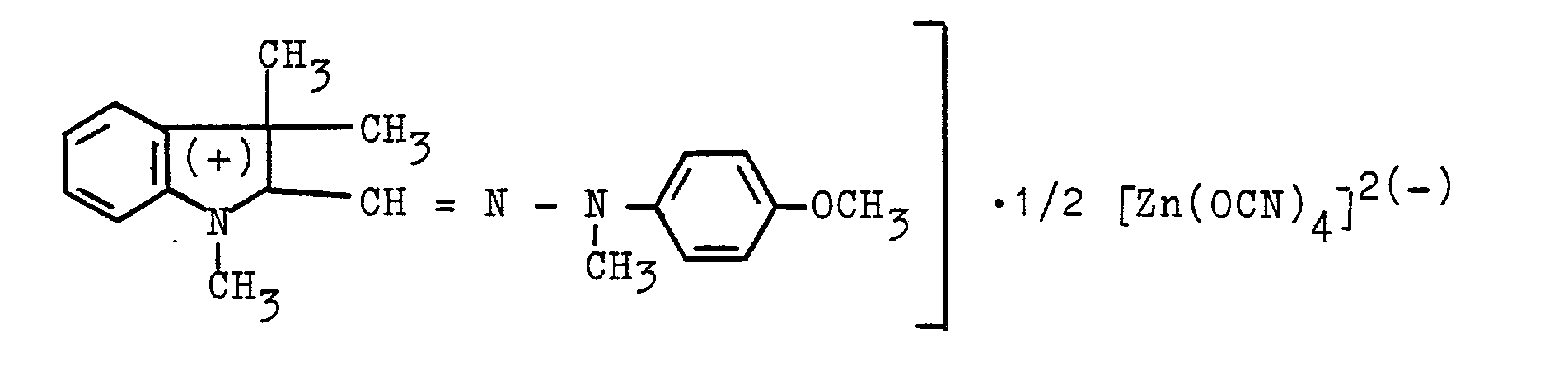
Analyse (MG = 438,7; C₂₂H₂₄N₅OS₂Zn0,5):
ber.: C 60,2 %, H 5,0 %, N 15,96 %, Zn 7,45 %;
gef.: C 59,7 %, H 5,0 %, N 16,2 %, Zn 7,4 %.Analysis (MW = 438.7; C₂₂H₂₄N₅OS₂Zn 0.5 ):
calc .: C 60.2%, H 5.0%, N 15.96%, Zn 7.45%;
Found: C 59.7%, H 5.0%, N 16.2%, Zn 7.4%.
28,7 Teile der Azoverbindung aus 3-Amino-1,2,4-triazol als Diazokomponente und N-Ethyl-N-(β-dimethylamino-ethyl)-anilin werden mit 8,4 Teilen Zinkoxid und 2,4 Teilen Magnesiumoxid in 50 Teilen Wasser suspendiert und mittels 66,5 Teilen Dimethylsulfat bei 35 bis 45°C methyliert und quaterniert. Der Ansatz wird noch 2 Stunden weitergerührt, und überschüssiges Dimethylsulfat wird nach Verdünnen des Ansatzes mit 125 Teilen Wasser bei 70°C während 2 bis 3 Stunden hydrolysiert. Die Lösung der quartären Azoverbindung wird sodann geklärt, mittels Eis auf 35 bis 40°C abgekühlt und mit wäßriger Ammoniaklösung auf einen pH-Wert von 3 bis 4,5 eingestellt. 31,5 Teile Ammoniumrhodanid werden innerhalb von 2 Stunden bei 35 bis 40°C hinzugegeben. Die entstandene Suspension des erfindungsgemäßen Farbstoffsalzes wird noch 2 bis 3 Stunden bei etwa 50°C nachgerührt, die erfindungsgemäße Verbindung sodann bei 35°C abgesaugt und portionsweise mit Wasser nachgewaschen und getrocknet.28.7 parts of the azo compound from 3-amino-1,2,4-triazole as the diazo component and N-ethyl-N- (β-dimethylamino-ethyl) -aniline are mixed in with 8.4 parts of zinc oxide and 2.4 parts of magnesium oxide 50 parts of water suspended and methylated using 66.5 parts of dimethyl sulfate at 35 to 45 ° C and quaternized. The mixture is stirred for a further 2 hours, and excess dimethyl sulfate is hydrolyzed after dilution of the mixture with 125 parts of water at 70 ° C. for 2 to 3 hours. The solution of the quaternary azo compound is then clarified, cooled to 35 to 40 ° C. using ice and adjusted to a pH of 3 to 4.5 with aqueous ammonia solution. 31.5 parts of ammonium rhodanide are added at 35 to 40 ° C within 2 hours. The resulting suspension of the dye salt according to the invention is stirred for a further 2 to 3 hours at about 50 ° C., the compound according to the invention is then suction filtered at 35 ° C. and washed in portions with water and dried.
Es wird die erfindungsgemäße Verbindung der Formel

Analyse (MG = 628,38; C₂₁H₂₉N₁₁S₄Zn):
ber.: C 40,1 %, H 4,62 %, N 24,5 %, S 20,4 %, Zn 10,4 %;
gef.: C 39,75%, H 4,6 %, N 23,8 %, S 20,6 %, Zn 10,3 %.Analysis (MW = 628.38; C₂₁H₂₉N₁₁S₄Zn):
calc .: C 40.1%, H 4.62%, N 24.5%, S 20.4%, Zn 10.4%;
Found: C 39.75%, H 4.6%, N 23.8%, S 20.6%, Zn 10.3%.
In der Spinnfärbung von PAC werden glänzende, leuchtend rot gefärbte Fäden mit hervorrangenden Echtheiten erhalten.PAC's spin dyeing process produces shiny, bright red threads with excellent fastness properties.
Man stellt die Lösung des Quartär-Azofarbstoffes mit dem Methosulfatanion wie oben beschrieben her, jedoch mit der Abänderung, daß kein Zinkoxid als basisches Mittel, sondern die äquivalente Menge an Magnesiumoxid oder Natriumbicarbonat verwendet wird, und versucht den erhaltenen Quartärfarbstoff aus der Lösung als Rhodanid-Salz durch Zugabe der entsprechenden Menge von Ammoniumrhodanid abzuscheiden. Es wird hierbei nur ein Teil des Farbstoffes in Form eines öligen Produktes erhalten, das auch später nicht durchkristallisiert.The solution of the quaternary azo dye with the methosulfate anion is prepared as described above, but with the modification that no zinc oxide is used as the basic agent, but the equivalent amount of magnesium oxide or sodium bicarbonate, and the quaternary dye obtained from the solution is tried as rhodanide. Separate salt by adding the appropriate amount of ammonium rhodanide. Only part of the dye is obtained in the form of an oily product, which does not crystallize through later either.
Man verfährt zur Synthese eines erfindungsgemäßen Farbsalzes wie im Beispiel 3 beschrieben, setzt jedoch anstelle von Ammoniumrhodanid 33,7 Teile Kaliumcyanat ein. Das zunächst schmierig anfallende Farbstoffsalz kristallisiert langsam durch. Die erhaltene kristalline Verbindung der Formel

Analyse (MG = 564,38; C₂₁H₂₉N₁₁O₄Zn):
ber.: C 44,65 %, H 5,1 %, N 27,28 %, Zn 11,58 %;
gef.: C 44,3 %, H 5,2 %, N 27,1 %, Zn 11,3 %.Analysis (MW = 564.38; C₂₁H₂₉N₁₁O₄Zn):
calc .: C 44.65%, H 5.1%, N 27.28%, Zn 11.58%;
Found: C 44.3%, H 5.2%, N 27.1%, Zn 11.3%.
18,45 Teile 2-Chlor-4-amino-acetanilid werden in Gegenwart von 7,6 Teilen Magnesiumoxid in wäßriger Suspension bei 50 bis 60°C mit 50,6 Teilen Dimethylsulfat methyliert und quarterniert; anschließend wird die Acetylgruppe durch zweistündiges Erhitzen unter Rückfluß mit 32%iger Salzsäure hydrolytisch abgespalten, wobei auch überschüssiges Dimethylsulfat zerstört wird. Die quarternierte Diazokomponente wird sodann in üblicher Weise diazotiert und mit 13,4 Teilen N,Nʹ-Diethyl-N,Nʹ-diphenyl-1,2-diamino-ethan gekuppelt. Zu dieser Lösung der quartären Disazoverbindung gibt man 46 Teile einer 20%igen wäßrigen Zinkacetatlösung hinzu, anschließend bei 20 bis 25°C und bei einem pH-Wert von 3 allmählich eine wäßrige Lösung von 38 Teilen Ammoniumrhodanid. Man rührt zunächst bei etwa 20°C, sodann bei 35 bis 40°C jeweils noch eine Stunde nach und isoliert das grob ausgefallene erfindungsgemäße Farbsalz der Formel

Die erfindungsgemäße Verbindung zeigt sehr gute Eigenschaften für die Spinnfärbung von PAC und liefert hierbei hochechte orange Färbungen. In Dimethylformamid ist sie zu 26%, in Dimethylacetamid zu etwa 22 % und in aceton zu etwa 10 % löslich. (λmax = 475 nm).The compound according to the invention shows very good properties for the spin dyeing of PAC and in this case provides highly authentic orange dyeings. It is 26% soluble in dimethylformamide, about 22% in dimethylacetamide and about 10% soluble in acetone. (λ max = 475 nm).
Man stellt gemäß Beispiel 5 die Diazoniumsalzlösung von 2-Chlor-4-trimethylammonium-anilin her und versetzt sie mit einer wäßrigen Lösung von 24,5 Teilen N-Ethyl-N-(β-trimethylammonio-ethyl)-anilin-chlorid. Nach beendeter Kupplungsreaktion läßt man den Ansatz langsam in eine Lösung aus 92 Teilen einer 20%igen wäßrigen Zinkacetatlösung und 38 Teilen Ammoniumrhodanid in 200 Teilen Wasser einlaufen. Das abgeschiedene erfindungsgemäße Farbsalz der Formel

90 Teile der Disazoverbindung der Formel


55 Teile der durch Kupplung von diazotiertem 3-Amino-1,2,4-triazol auf N,Nʹ-Diethyl-N,Nʹ-diphenyl-1,2-diamino-ethan erhältliche Disazoverbindung wird in üblicher Weise in Gegenwart von 55 Teilen Natriumhydrogencarbonat in 200 Teilen Wasser mit 116,5 Teilen Dimethylsulfat methyliert und quaterniert; überschüssiges Dimethylsulfat wird anschließend bei 70 bis 75°C hydrolisiert. Zur Herstellung der erfindungsgemäßen Verbindung versetzt man die Lösung dieses quartären Disazofarbstoffes zunächst mit Zinksulfat und sodann mit einer wäßrigen Natriumrhodanidlösung bei 35 bis 40°C, rührt bei 55 bis 60°C noch einige Zeit nach und saugt die ausgefallene erfindungsgemäße Verbindung bei dieser Temperatur ab, wäscht sie gut mit Wasser mehrmals nach und trocknet sie. Sie besitzt die Formel

68 Teile der im Beispiel 1 formelmäßig angegebenen Carbinolbase werden in verdünnter wäßriger Essigsäure gelöst und mit 28,7 Teilen Kupfer(II)-sulfat-pentahydrat versetzt. Die Lösung läßt man in eine Lösung von 53 Teilen Kaliumcyanat in 1000 Teilen Wasser unter Rühren einlaufen. Die sich bildende Suspension wird allmählich auf 50°C erwärmt und bei dieser Temperatur noch 1 Stunde nachgerührt. Das in groben Kristallen ausgefallene erfindungsgemäße Farbsalz der Formel

Analyse (MG = 437,8; C₂₂H₂₄N₅O₃Cu0,5):
ber.: C 60,3 %, H 5,48 %, N 16,0 %, Cu 7,3 %;
gef.: C 59,9 %, H 5,4 %, N 16,05 %, Cu 7,5 %.Analysis (MW = 437.8; C₂₂H₂₄N₅O₃Cu 0.5 ):
calc .: C 60.3%, H 5.48%, N 16.0%, Cu 7.3%;
Found: C 59.9%, H 5.4%, N 16.05%, Cu 7.5%.
Zur Herstellung eines erfindungsgemäßen Farbstoffsalzes verfährt man gemäß der Verfahrensweise des Beispieles 9, setzt jedoch anstelle von Kupfer(II)-sulfat 18,8 Teile Eisen(II)-sulfat-Dihydrat und anstelle von Kaliumcyanat 38 Teile Ammoniumrhodanid ein. Die isolierte erfindungsgemäße Verbindung besitzt die Formel

Sie löst sich zu etwa 15 % in Dimethylformamid, zu etwa 13 % in Dimethylacetamid und zu etwa 4 % in Aceton und färbt in der Spinnfärbung PAC in rotstichig gelben Nuancen. (λmax = 449 nm).
Analyse (MG = 465,9; C₂₂H₂₄N₅OS₂Fe0,5):
ber.: C 56,7 %, H 5,15 %, N 15,0 %, S 13,7 %, Fe 5,99 %;
gef.: C 56,9 %, H 5,2 %, N 15,05 %, S 13,3 %, Fe 5,88 %.It dissolves to about 15% in dimethylformamide, about 13% in dimethylacetamide and about 4% in acetone and dyes PAC in reddish-yellow shades in the spin dyeing. (λ max = 449 nm).
Analysis (MW = 465.9; C₂₂H₂₄N₅OS₂Fe 0.5 ):
calc .: C 56.7%, H 5.15%, N 15.0%, S 13.7%, Fe 5.99%;
Found: C 56.9%, H 5.2%, N 15.05%, S 13.3%, Fe 5.88%.
28,7 Teile einer Azoverbindung aus 3-Amino-1,2,4-triazol als Diazokomponente und N-Ethyl-N-(β-dimethylamino-ethyl)-anilin als Kupplungskomponente werden in Gegenwart von Magnesiumoxid mit Dimethylsulfat bei 35 bis 45°C methyliert und quarterniert. Nach Zugabe des Dimethylsulfats wird der Ansatz noch 2 Stunden bei 35 bis 45°C weitergerührt, überschüssiges Dimethylsulfat sodann bei 70°C hydrolysiert. Es wird danach ein pH-Wert von 3 eingestellt und der Ansatz mit einer wäßrigen Lösung von 30,3 Teilen Nickel(II)-sulfat-Hexahydrat versetzt. Bei einer Temperatur von etwa 20°C läßt man eine wäßrige Lösung von 53,5 Teilen Ammoniumrhodanid hinzulaufen, rührt zunächst bei etwa 20°C etwa 1 Stunde sodann bei 40 bis 50°C zwei Stunden nach, saugt die ausgefallene erfindungsgemäße Verbindung ab, wäscht sie mit Wasser nach und trocknet sie.28.7 parts of an azo compound from 3-amino-1,2,4-triazole as the diazo component and N-ethyl-N- (β-dimethylamino-ethyl) -aniline as the coupling component are in the presence of magnesium oxide with dimethyl sulfate at 35 to 45 ° C methylated and quaternized. After the addition of the dimethyl sulfate, the mixture is stirred for a further 2 hours at 35 to 45 ° C., excess dimethyl sulfate is then hydrolyzed at 70 ° C. A pH of 3 is then set and the batch is mixed with an aqueous solution of 30.3 parts of nickel (II) sulfate hexahydrate. An aqueous solution of 53.5 parts of ammonium rhodanide is allowed to run in at a temperature of about 20 ° C., the mixture is initially stirred at about 20 ° C. for about 1 hour and then at 40 to 50 ° C. for two hours, the precipitated compound according to the invention is suctioned off and washed add water and dry them.
Die erfindungsgemäße Verbindung der Formel

Analyse (MG = 534,35; C₂₀H₂₉N₁₀S₃Ni0,5):
ber.: C 44,9 %, H 5,43 %, N 26,2 %, S 17,97 %, Ni 5,49 %;
gef.: C 44,5 %, H 5,5 %, N 25,8 %, S 17,8 %, Ni 5,4 %.Analysis (MW = 534.35; C₂₀H₂₉N₁₀S₃Ni 0.5 ):
calc .: C 44.9%, H 5.43%, N 26.2%, S 17.97%, Ni 5.49%;
Found: C 44.5%, H 5.5%, N 25.8%, S 17.8%, Ni 5.4%.
123 Teile der Azoverbindung aus 2-Amino-6-methoxy-benzthiazol als Diazokomponente und N-Ethyl-N-(β-hydroxyethyl)-anilin als Kupplungskomponente werden in Wasser in Gegenwart von 20 Teilen Natriumhydrogencarbonat bei 30 bis 45°C mit 84 Teilen Dimethylsulfat innerhalb von etwa 3 Stunden in üblicher Weise quaterniert. Nach der Hydrolyse des überschüssigen Dimethylsulfats wird der Ansatz mit der gelösten Quartärverbindung langsam in eine Lösung aus 158,2 Teilen einer 20%igen wäßrigen Zinkacetatlösung und 78,7 Teilen Ammoniumrhodanid in 1000 Teilen Wasser, der noch 800 Teile Eis zugegeben waren, eingerührt. Man rührt die entstandene Farbstoffsuspension noch etwa 1 Stunde bei etwa 10°C und anschließend bei 45 bis 50°C noch zwei Stunden nach, saugt die ausgefallene erfindungsgemäße Verbindung ab, wäscht sie mit Wasser salzfrei und trocknet sie. Sie besitzt die Formel

Analyse (MG = 519,69; C₂₁H₂₃N₆O₂S₃Zn0,5):
ber.: C 48,5 %, H 4,43 %, N 16,16 %, S 18,47 %, Zn 6,3 %;
gef.: C 48,3 %, H 4,5 %, N 16,0 %, S 18,1 %, Zn 16,1 %.Analysis (MW = 519.69; C₂₁H₂₃N₆O₂S₃Zn 0.5 ):
calc .: C 48.5%, H 4.43%, N 16.16%, S 18.47%, Zn 6.3%;
Found: C 48.3%, H 4.5%, N 16.0%, S 18.1%, Zn 16.1%.
Zur Herstellung einer erfindungsgemäßen Verbindung verfährt man gemäß der Herstellungsweise des Beispieles 12, setzt jedoch anstelle von Zinkacetat die äquivalente Menge an Kupfer(II)-sulfat ein. Man erhält das erfindungsgemäße Kupfer-tetrarhodano-Salz des in Beispiel 12 formelmäßig angegebenen Farbstoffkations. Es liefert in der Spinnfärbung von PAC Fäden mit klaren blauen Tönen in guten Echtheiten.To prepare a compound according to the invention, the procedure of Example 12 is followed, but the equivalent amount of copper (II) sulfate is used instead of zinc acetate. The copper tetrarhodano salt according to the invention of the dye cation specified in Example 12 is obtained. It provides good fastness properties in the spin dyeing of PAC threads with clear blue tones.
Zur Herstellung einer erfindungsgemäßen Verbindung verfährt man gemäß der Herstellungsweise des Beispieles 12, setzt jedoch anstelle von Zinkacetat die äquivalente Menge an Eisen(II)-sulfat ein. Man erhält das erfindungsgemäße Eisen-tetrarhodano-Salz des in Beispiel 12 formelmäßig angegebenen Farbstoffkations. Es liefert in der Spinnfärbung von PAC Fäden mit klaren blauen Tönen in guten Echtheiten.To prepare a compound according to the invention, the procedure is as in Example 12, but the equivalent amount of iron (II) sulfate is used instead of zinc acetate. The iron tetrarhodano salt according to the invention of the dye cation specified in Example 12 is obtained. It provides good fastness properties in the spin dyeing of PAC threads with clear blue tones.
In den nachfolgenden Tabellenbeispielen sind weitere erfindungsgemäße Farbsalze beschrieben, die insbesondere PAC in der Massespinnfärbung in den in dem jeweiligen Tabellenbeispiel angegebenen Nuancen zu färben vermögen. Ihr Ausblutverhalten in die Koagulations-, Streck- und Waschbäder ist sehr gering. Diese erfindungsgemäßen Farbsalze lassen sich in erfindungsgemäßer Weise aus den entsprechenden Quartärverbindungen mit anderen Anionen durch Umsetzung mit einer entsprechenden metallabgebenden Verbindung und mit einem Cyanat- oder Rhodanidsalz herstellen und als in Wasser unlösliche oder sehr schwer lösliche Rhodanometallat- bzw. Cyanatometallat-Salze praktisch frei von anderen Begleitsalzen isolieren.


5 Teile einer 5 %igen Lösung des erfindungsgemäßen Farbsalzes von Beispiel 3 in Dimethylformamid werden mit einer 25 %igen Lösung eines Polymers aus 59 % Acrylnitril, 40 % Vinylidenchlorid und 1 % Natriummethallylsulfonat homogen vermischt. Die rote Spinnlösung wird nach Erwärmen auf 50°C in ein Koagulationsbad aus 65 Vol.-% Dimethylformamid und 35 Vol.-% Wasser versponnen, in einem Streckbad aus 35 Vol.-% Dimethylformamid und 65 Vol.-% Wasser bei einer Temperatur von 80°C verstreckt und anschließend in 90°C heißem Wasser gewaschen. Die Anfärbung des Fällbades beträgt 0,066, die des Streckbades 0,01 und die des Waschbades 0,006 (jeweils optische Dichte). Es werden glänzende leuchtend rot gefärbte Fäden mit hervorragenden Echtheiten erhalten.5 parts of a 5% solution of the color salt according to the invention from Example 3 in dimethylformamide are homogeneously mixed with a 25% solution of a polymer composed of 59% acrylonitrile, 40% vinylidene chloride and 1% sodium methallyl sulfonate. After heating to 50 ° C., the red spinning solution is spun in a coagulation bath composed of 65 vol.% Dimethylformamide and 35 vol.% Water, in a drawing bath composed of 35 vol.% Dimethylformamide and 65 vol.% Water at a temperature of Stretched 80 ° C and then washed in 90 ° C hot water. The dyeing of the precipitation bath is 0.066, that of the stretching bath 0.01 and that of the washing bath 0.006 (in each case optical density). Shiny, bright red colored threads with excellent fastness properties are obtained.
100 Teile einer 26 %igen Lösung eines Polymers aus 85 % Acrylnitril, 14,5 % Vinylacetat und 0,5 % Natriummethallylsulfonat in Dimethylacetamid werden bei 70 bis 80°C mit 2 Teilen einer 10%igen Lösung des erfindungsgemäßen Farbsalzes von Beispiel 7 homogen vermischt. Diese Spinnmasse wird über eine 100-Loch-Spinndüse mit einem Lochdurchmesser von 100 µm in ein Koagulationsbad aus 70 % Dimethylacetamid und 30 % Wasser versponnen, danach in einem Streckbad aus 30 % Dimethylacetamid und 70 % Wasser bei 80°C verstreckt und in 85 bis 90°C heißem Wasser gewaschen. Die Anfärbung des Fällbades beträgt 0,06, die des Streckbades 0,009 und die des Waschbades 0,005 (jeweils optische Dichte). Es werden rot gefärbte Fäden mit hohem Glanz erhalten, die ein sehr gutes Echtheitsniveau aufweisen.100 parts of a 26% solution of a polymer of 85% acrylonitrile, 14.5% vinyl acetate and 0.5% sodium methallylsulfonate in dimethylacetamide are mixed homogeneously at 70 to 80 ° C. with 2 parts of a 10% solution of the color salt according to the invention from Example 7 . This spinning mass is spun through a 100-hole spinneret with a hole diameter of 100 µm into a coagulation bath made of 70% dimethylacetamide and 30% water, then drawn in a drawing bath made of 30% dimethylacetamide and 70% water at 80 ° C and in 85 to Washed at 90 ° C hot water. The dyeing of the precipitation bath is 0.06, that of the stretching bath 0.009 and that of the washing bath 0.005 (in each case optical density). Red dyed threads with a high gloss are obtained which have a very good fastness level.
Claims (18)
[Me (XCN)₄]2(-) (1)
[Me (SCN)₆]n(-)(2)
in welchen
Me in Formel (1) das zweiwertige Zink-Kation, das zweiwertige Eisen-Kation, das zweiwertige Kobalt-Kation, das zweiwertige Zinn-Kation oder das zweiwertige Kupfer-Kation ist und
Me in Formel (2) für das zweiwertige Eisen-Kation, das zweiwertige Nickel-Kation oder das dreiwertige Eisen-Kation steht,
X ein Sauerstoffatom oder ein Schwefelatom ist und
n abhängig von der Wertigkeit des entsprechenden Metall-Kations die Zahl 4 oder 3 bedeutet.1. Color salt of a mono- or polycationic dye with the anion according to a general formula (1) or (2)
[Me (XCN) ₄] 2 (-) (1)
[Me (SCN) ₆] n (-) (2)
in which
Me in formula (1) is the divalent zinc cation, the divalent iron cation, the divalent cobalt cation, the divalent tin cation or the divalent copper cation and
Me in formula (2) stands for the divalent iron cation, the divalent nickel cation or the trivalent iron cation,
X is an oxygen atom or a sulfur atom and
n is the number 4 or 3 depending on the valency of the corresponding metal cation.



Applications Claiming Priority (2)
| Application Number | Priority Date | Filing Date | Title |
|---|---|---|---|
| DE19853546294 DE3546294A1 (en) | 1985-12-28 | 1985-12-28 | NEW COLOR SALTS, METHOD FOR THEIR PRODUCTION AND THEIR USE |
| DE3546294 | 1985-12-28 |
Publications (2)
| Publication Number | Publication Date |
|---|---|
| EP0228043A2 true EP0228043A2 (en) | 1987-07-08 |
| EP0228043A3 EP0228043A3 (en) | 1990-06-06 |
Family
ID=6289667
Family Applications (1)
| Application Number | Title | Priority Date | Filing Date |
|---|---|---|---|
| EP86117722A Withdrawn EP0228043A3 (en) | 1985-12-28 | 1986-12-19 | Novel dye salts, process for their manufacture and their use |
Country Status (5)
| Country | Link |
|---|---|
| US (1) | US4732573A (en) |
| EP (1) | EP0228043A3 (en) |
| JP (1) | JPS62158765A (en) |
| DD (1) | DD260077A5 (en) |
| DE (1) | DE3546294A1 (en) |
Families Citing this family (5)
| Publication number | Priority date | Publication date | Assignee | Title |
|---|---|---|---|---|
| US5376151A (en) * | 1993-04-16 | 1994-12-27 | North Carolina State University | Environmentally friendly method for producing lightfast black shades on natural and synthetic substrates |
| EP1342411A1 (en) * | 2002-03-05 | 2003-09-10 | Luisi & Clement GmbH | Antimicrobacterial composite material |
| US7179530B2 (en) * | 2001-12-03 | 2007-02-20 | Rebac Gmbh | Antimicrobial composite material |
| DE60212874T2 (en) * | 2001-12-03 | 2007-02-01 | Luisi & Clement Gmbh | ANTIMICROBIAL COMPOSITE MATERIAL |
| WO2007131875A1 (en) * | 2006-05-11 | 2007-11-22 | Ciba Holding Inc. | High capacity optical storage media comprising metallized, heterocyclic ions pairs |
Family Cites Families (12)
| Publication number | Priority date | Publication date | Assignee | Title |
|---|---|---|---|---|
| US3271383A (en) * | 1963-06-11 | 1966-09-06 | Mitsubishi Chem Ind | Disazo dyes containing an nu-substituted benzothiazolyl group |
| US3291788A (en) * | 1965-09-27 | 1966-12-13 | Mitsubishi Chem Ind | Cationic triazole disazo dyestuffs |
| BE754714A (en) * | 1969-08-28 | 1971-01-18 | Du Pont | PROCESS FOR DYING POLYAMIDE FIBERS WITH CATIONIC DYES |
| FR2260659B1 (en) * | 1974-02-08 | 1976-11-26 | Ugine Kuhlmann | |
| DE2433233C3 (en) * | 1974-07-11 | 1980-03-06 | Hoechst Ag, 6000 Frankfurt | Process for spin-dyeing polymers or copolymers of acrylonitrile |
| US4607071A (en) * | 1978-05-26 | 1986-08-19 | Hoechst Aktiengesellschaft | Process for spin-dyeing of acid-modified polymers of copolymers of acrylonitrile using rapid-fixing di-quaternary cationic dyes |
| DE2822913C2 (en) * | 1978-05-26 | 1982-08-19 | Hoechst Ag, 6000 Frankfurt | Process for spin dyeing polymers or copolymers of acrylonitrile |
| DE2945028A1 (en) * | 1979-11-08 | 1981-05-21 | Hoechst Ag, 6000 Frankfurt | QUARTERS AND BASIC AZAMETHINE COMPOUNDS, METHOD FOR THE PRODUCTION THEREOF AND THEIR USE AS A COLORANT |
| EP0055221A3 (en) * | 1980-12-24 | 1983-06-15 | Ciba-Geigy Ag | Monocationic dyestuff salts |
| DD207226A5 (en) * | 1980-12-24 | 1984-02-22 | Ciba Geigy | PROCESS FOR SPINNING POLYMERS OF ACRYLNITRILE |
| US4382801A (en) * | 1980-12-24 | 1983-05-10 | Ciba-Geigy Corporation | Process for spin dyeing polymers or copolymers of acrylonitrile with quaternized heterocyclic diazo dye and tetrafluoro-borate anion |
| US4367334A (en) * | 1980-12-24 | 1983-01-04 | Ciba-Geigy Corporation | Borontetrafluoride salts of basic oxazine dyes |
-
1985
- 1985-12-28 DE DE19853546294 patent/DE3546294A1/en not_active Withdrawn
-
1986
- 1986-12-19 EP EP86117722A patent/EP0228043A3/en not_active Withdrawn
- 1986-12-23 US US06/945,761 patent/US4732573A/en not_active Expired - Fee Related
- 1986-12-23 DD DD86298296A patent/DD260077A5/en not_active IP Right Cessation
- 1986-12-25 JP JP61308073A patent/JPS62158765A/en active Pending
Also Published As
| Publication number | Publication date |
|---|---|
| DD260077A5 (en) | 1988-09-14 |
| DE3546294A1 (en) | 1987-07-02 |
| US4732573A (en) | 1988-03-22 |
| EP0228043A3 (en) | 1990-06-06 |
| JPS62158765A (en) | 1987-07-14 |
Similar Documents
| Publication | Publication Date | Title |
|---|---|---|
| DE2822913C2 (en) | Process for spin dyeing polymers or copolymers of acrylonitrile | |
| EP0034725B1 (en) | Dyestuffs containing imidazolylethylene groups and their use | |
| EP0029136B1 (en) | Quaternary and basic azomethine compounds, process for their preparation and their use as dyestuffs | |
| DE4128490A1 (en) | New cationic thiazole azo dyestuff cpds. - used on polyacrylonitrile or paper or keratinous material, prepd. from methyl amino carbo-methoxy-thiazolyl-acetate and tert. aniline | |
| DE2557555C2 (en) | Disazo compounds, process for their preparation and their use as pigments | |
| DE2822912A1 (en) | Whitening of polyacrylonitrile spinning compsns. - by addn. of cationic or basic dyes resistant to migration | |
| DE3026948A1 (en) | METHOD FOR DYEING FIBER GOODS FROM WET-WOVEN ACRYLNITRILE POLYMERISATES IN A GEL STATE | |
| DE3017070A1 (en) | METHOD FOR PRODUCING LOW-SALT, WATER-SOLUBLE DYES | |
| DE1069313B (en) | ||
| DE3301822A1 (en) | METHOD FOR PRODUCING DISAZO DYES | |
| DE2015351C3 (en) | Water-insoluble monoazo compounds, process for their preparation and their use for dyeing | |
| DE3546294A1 (en) | NEW COLOR SALTS, METHOD FOR THEIR PRODUCTION AND THEIR USE | |
| DD203738A5 (en) | PROCESS FOR PREPARING COLORED SALTS | |
| EP0265828B1 (en) | Water soluble disazo compounds, process for their preparation and their use as dyestuffs | |
| CH663216A5 (en) | Azo pigment dye mixtures. | |
| DE2022624A1 (en) | Basic disazo dye and method for making the same | |
| EP0258806A1 (en) | Water soluble disazo compounds, process for their preparation and their use as dyestuffs | |
| DE3501199A1 (en) | Azo pigment dyes | |
| DE2013791A1 (en) | Yellow basic hydrazone dyes for polyacry-lonitrile etc | |
| EP0036505B1 (en) | Process for the preparation of cationic dyestuffs and their use in dyeing acid-modified synthetic fibres | |
| DE1544345A1 (en) | Process for the preparation of new benzothiazolyl monoazo dyes | |
| EP0055221A2 (en) | Monocationic dyestuff salts | |
| DE1544343C3 (en) | Benzthiazolylazonaphthol dyes, process for their preparation and use | |
| DE1806582A1 (en) | Monoazo dyes containing sulphonylbetaine groups for - cellulose acetate polamide polyurethane or poly- | |
| DE2631669A1 (en) | AZO-BENZOTHIAZOLIUM DYES, METHOD FOR MANUFACTURING AND USING them |
Legal Events
| Date | Code | Title | Description |
|---|---|---|---|
| PUAI | Public reference made under article 153(3) epc to a published international application that has entered the european phase |
Free format text: ORIGINAL CODE: 0009012 |
|
| AK | Designated contracting states |
Kind code of ref document: A2 Designated state(s): CH DE FR GB IT LI |
|
| PUAL | Search report despatched |
Free format text: ORIGINAL CODE: 0009013 |
|
| AK | Designated contracting states |
Kind code of ref document: A3 Designated state(s): CH DE FR GB IT LI |
|
| 17P | Request for examination filed |
Effective date: 19900807 |
|
| STAA | Information on the status of an ep patent application or granted ep patent |
Free format text: STATUS: THE APPLICATION HAS BEEN WITHDRAWN |
|
| 18W | Application withdrawn |
Withdrawal date: 19910614 |
|
| R18W | Application withdrawn (corrected) |
Effective date: 19910614 |
|
| R18W | Application withdrawn (corrected) |
Effective date: 19910614 |
|
| RIN1 | Information on inventor provided before grant (corrected) |
Inventor name: MISCHKE, PETER, DR. Inventor name: TEIGE, WOLFGANG Inventor name: HOHMANN, KURT |