EP0228090A2 - Gel de silice rendu partiellement hydrophyle et procédé pour sa production - Google Patents
Gel de silice rendu partiellement hydrophyle et procédé pour sa production Download PDFInfo
- Publication number
- EP0228090A2 EP0228090A2 EP86118093A EP86118093A EP0228090A2 EP 0228090 A2 EP0228090 A2 EP 0228090A2 EP 86118093 A EP86118093 A EP 86118093A EP 86118093 A EP86118093 A EP 86118093A EP 0228090 A2 EP0228090 A2 EP 0228090A2
- Authority
- EP
- European Patent Office
- Prior art keywords
- silica gel
- groups
- group
- hydrophobic
- external surface
- Prior art date
- Legal status (The legal status is an assumption and is not a legal conclusion. Google has not performed a legal analysis and makes no representation as to the accuracy of the status listed.)
- Granted
Links
Images


Classifications
-
- B—PERFORMING OPERATIONS; TRANSPORTING
- B01—PHYSICAL OR CHEMICAL PROCESSES OR APPARATUS IN GENERAL
- B01J—CHEMICAL OR PHYSICAL PROCESSES, e.g. CATALYSIS OR COLLOID CHEMISTRY; THEIR RELEVANT APPARATUS
- B01J21/00—Catalysts comprising the elements, oxides, or hydroxides of magnesium, boron, aluminium, carbon, silicon, titanium, zirconium, or hafnium
- B01J21/06—Silicon, titanium, zirconium or hafnium; Oxides or hydroxides thereof
- B01J21/08—Silica
-
- B—PERFORMING OPERATIONS; TRANSPORTING
- B01—PHYSICAL OR CHEMICAL PROCESSES OR APPARATUS IN GENERAL
- B01J—CHEMICAL OR PHYSICAL PROCESSES, e.g. CATALYSIS OR COLLOID CHEMISTRY; THEIR RELEVANT APPARATUS
- B01J20/00—Solid sorbent compositions or filter aid compositions; Sorbents for chromatography; Processes for preparing, regenerating or reactivating thereof
- B01J20/02—Solid sorbent compositions or filter aid compositions; Sorbents for chromatography; Processes for preparing, regenerating or reactivating thereof comprising inorganic material
- B01J20/10—Solid sorbent compositions or filter aid compositions; Sorbents for chromatography; Processes for preparing, regenerating or reactivating thereof comprising inorganic material comprising silica or silicate
- B01J20/103—Solid sorbent compositions or filter aid compositions; Sorbents for chromatography; Processes for preparing, regenerating or reactivating thereof comprising inorganic material comprising silica or silicate comprising silica
-
- B—PERFORMING OPERATIONS; TRANSPORTING
- B01—PHYSICAL OR CHEMICAL PROCESSES OR APPARATUS IN GENERAL
- B01J—CHEMICAL OR PHYSICAL PROCESSES, e.g. CATALYSIS OR COLLOID CHEMISTRY; THEIR RELEVANT APPARATUS
- B01J20/00—Solid sorbent compositions or filter aid compositions; Sorbents for chromatography; Processes for preparing, regenerating or reactivating thereof
- B01J20/30—Processes for preparing, regenerating, or reactivating
- B01J20/32—Impregnating or coating ; Solid sorbent compositions obtained from processes involving impregnating or coating
- B01J20/3231—Impregnating or coating ; Solid sorbent compositions obtained from processes involving impregnating or coating characterised by the coating or impregnating layer
- B01J20/3242—Layers with a functional group, e.g. an affinity material, a ligand, a reactant or a complexing group
-
- B—PERFORMING OPERATIONS; TRANSPORTING
- B01—PHYSICAL OR CHEMICAL PROCESSES OR APPARATUS IN GENERAL
- B01J—CHEMICAL OR PHYSICAL PROCESSES, e.g. CATALYSIS OR COLLOID CHEMISTRY; THEIR RELEVANT APPARATUS
- B01J20/00—Solid sorbent compositions or filter aid compositions; Sorbents for chromatography; Processes for preparing, regenerating or reactivating thereof
- B01J20/30—Processes for preparing, regenerating, or reactivating
- B01J20/32—Impregnating or coating ; Solid sorbent compositions obtained from processes involving impregnating or coating
- B01J20/3231—Impregnating or coating ; Solid sorbent compositions obtained from processes involving impregnating or coating characterised by the coating or impregnating layer
- B01J20/3242—Layers with a functional group, e.g. an affinity material, a ligand, a reactant or a complexing group
- B01J20/3285—Coating or impregnation layers comprising different type of functional groups or interactions, e.g. different ligands in various parts of the sorbent, mixed mode, dual zone, bimodal, multimodal, ionic or hydrophobic, cationic or anionic, hydrophilic or hydrophobic
-
- B—PERFORMING OPERATIONS; TRANSPORTING
- B01—PHYSICAL OR CHEMICAL PROCESSES OR APPARATUS IN GENERAL
- B01J—CHEMICAL OR PHYSICAL PROCESSES, e.g. CATALYSIS OR COLLOID CHEMISTRY; THEIR RELEVANT APPARATUS
- B01J31/00—Catalysts comprising hydrides, coordination complexes or organic compounds
- B01J31/02—Catalysts comprising hydrides, coordination complexes or organic compounds containing organic compounds or metal hydrides
- B01J31/0272—Catalysts comprising hydrides, coordination complexes or organic compounds containing organic compounds or metal hydrides containing elements other than those covered by B01J31/0201 - B01J31/0255
- B01J31/0274—Catalysts comprising hydrides, coordination complexes or organic compounds containing organic compounds or metal hydrides containing elements other than those covered by B01J31/0201 - B01J31/0255 containing silicon
-
- C—CHEMISTRY; METALLURGY
- C09—DYES; PAINTS; POLISHES; NATURAL RESINS; ADHESIVES; COMPOSITIONS NOT OTHERWISE PROVIDED FOR; APPLICATIONS OF MATERIALS NOT OTHERWISE PROVIDED FOR
- C09C—TREATMENT OF INORGANIC MATERIALS, OTHER THAN FIBROUS FILLERS, TO ENHANCE THEIR PIGMENTING OR FILLING PROPERTIES ; PREPARATION OF CARBON BLACK ; PREPARATION OF INORGANIC MATERIALS WHICH ARE NO SINGLE CHEMICAL COMPOUNDS AND WHICH ARE MAINLY USED AS PIGMENTS OR FILLERS
- C09C3/00—Treatment in general of inorganic materials, other than fibrous fillers, to enhance their pigmenting or filling properties
- C09C3/04—Physical treatment, e.g. grinding or treatment with ultrasonic vibrations
- C09C3/048—Treatment with a plasma
-
- C—CHEMISTRY; METALLURGY
- C01—INORGANIC CHEMISTRY
- C01P—INDEXING SCHEME RELATING TO STRUCTURAL AND PHYSICAL ASPECTS OF SOLID INORGANIC COMPOUNDS
- C01P2004/00—Particle morphology
- C01P2004/60—Particles characterised by their size
- C01P2004/61—Micrometer sized, i.e. from 1-100 micrometer
-
- C—CHEMISTRY; METALLURGY
- C01—INORGANIC CHEMISTRY
- C01P—INDEXING SCHEME RELATING TO STRUCTURAL AND PHYSICAL ASPECTS OF SOLID INORGANIC COMPOUNDS
- C01P2006/00—Physical properties of inorganic compounds
- C01P2006/12—Surface area
-
- C—CHEMISTRY; METALLURGY
- C01—INORGANIC CHEMISTRY
- C01P—INDEXING SCHEME RELATING TO STRUCTURAL AND PHYSICAL ASPECTS OF SOLID INORGANIC COMPOUNDS
- C01P2006/00—Physical properties of inorganic compounds
- C01P2006/16—Pore diameter
-
- C—CHEMISTRY; METALLURGY
- C01—INORGANIC CHEMISTRY
- C01P—INDEXING SCHEME RELATING TO STRUCTURAL AND PHYSICAL ASPECTS OF SOLID INORGANIC COMPOUNDS
- C01P2006/00—Physical properties of inorganic compounds
- C01P2006/22—Rheological behaviour as dispersion, e.g. viscosity, sedimentation stability
-
- C—CHEMISTRY; METALLURGY
- C01—INORGANIC CHEMISTRY
- C01P—INDEXING SCHEME RELATING TO STRUCTURAL AND PHYSICAL ASPECTS OF SOLID INORGANIC COMPOUNDS
- C01P2006/00—Physical properties of inorganic compounds
- C01P2006/80—Compositional purity
- C01P2006/82—Compositional purity water content
-
- C—CHEMISTRY; METALLURGY
- C01—INORGANIC CHEMISTRY
- C01P—INDEXING SCHEME RELATING TO STRUCTURAL AND PHYSICAL ASPECTS OF SOLID INORGANIC COMPOUNDS
- C01P2006/00—Physical properties of inorganic compounds
- C01P2006/90—Other properties not specified above
Definitions
- the present invention relates to partially hydrophilicized silica gel in which the pore inside is hydrophobicized and the external surface has silanol groups or hydrophilic organic groups, and to a process for producing the same.
- silica gel has found a variety of uses as adsorbent, drying agent, catalyst carrier, etc. by virtue of its porosity and the active silanol groups present on its surface. In the field of analysis, it is used as a carrier or packing for liquid chromatography.
- silica gel In liquid chromatography, silica gel is generally used as a carrier for normal phase chromatography. Silica gel strongly adsorbs water and other polar solvents and ionic compounds such as amino acids because there are silanol groups on its surface as mentioned above; therefore, it is necessary to protect the silanol groups where such polar solvents are used and highly ionic compounds are to be separated. The protection of silanol groups has been accomplished by introducing an alkylsilyl group, particularly octadecylsilyl group, into them.. Silica gel with an alkyl group is used for reversed phase chromatography that employs a polar solvent.
- the silica gel into which a hydrophobic alkyl group is introduced is characterized by that the entire surface including the pore inside is hydrophobicized by the introduction of an alkyl group. There has been no silica gel in which the hydrophobic group is introduced into a part of the entire surface or the hydrophobic group is introduced into a part of the surface and the hydrophilic organic group is introduced into the rest of the surface.
- the silica gel of the present invention has many- applications as an adsorbent and catalyst carrier by virtue of the hydrophobic group and silanol group or hydrophilic organic group which are coexistent with each other. It is also effectively used as a packing for reverse phase chromatography for the analysis of components coexistent with proteins.
- the present inventors carried out an extensive studies on the improvement of the characteristic properties of silica gel, particularly the one into which hydrophobic groups such as octadecylsilyl group have been introduced.
- hydrophobic groups such as octadecylsilyl group
- the plasma-treated silica gel which has hydrophobic groups on the pore inside and silanol groups or hydrophilic organic groups on the external surface, differs from the conventional silica gel having silanol groups on the entire surface thereof or the modified silica gel having hydrophobic group such as octadecylsilyl group on the entire surface including the pore inside.
- the hydrophobicized pore inside and the active silanol groups or hydrophilic organic groups on the external surface it has both the hydrophilic property and the hydrophobic property.
- the silica gel with hydrophobic groups on the pore inside and with hydrophilic groups on the external surface does not adsorb nor precipitates proteins; therefore, it can be used as a packing for chromatography for the analysis of components coexistent with proteins.
- the silica gel adsorbs the components to be analyzed but permits proteins to flow freely through the column.
- the present invention provides a partially hydrophilicized silica gel which has hydrophobic groups on the pore inside and silanol groups on the external surface, and also provides a process for producing such silica gel by performing plasma treatment on silica gel having a hydrophobic group on the entire surface including the pore inside, whereby eliminating the hydrophobic groups on the external surface and causing the silanol groups to appear.
- the partially hydrophilicized silica gel is effectively used as an adsorbent, catalyst carrier, and analysis'carrier by virtue of the hydrophobicized pore inside and active silanol group on the external surface. It can also be used for the production of new silica gel in which a hydrophilic organic group is introduced to the silanol group.
- the present invention also provides a partially hydrophilicized silica gel which has hydrophobic groups on the pore inside and hydrophilic organic groups on the external surface, and also provides a process for producing such silica gel by reacting silica gel having hydrophobic groups on the pore inside and silanol group on the external surface, with a compound having a linking group reactive with the silanol group and a hydrophilic group or an organic group which can be made hydrophilic, and making the organic group hydrophilic.
- the partially hydrophilicized silica gel of the present invention which is produced by introducing an hydrophilic organic group into a silanol group is effectively used as an adsorbent, catalyst carrier, and analysis carrier by virtue of the hydrophobic group introduced into the pore inside and the hydrophilic organic group on the external surface, which are coexistent with each other. It is advantageously used as a separating agent or condensing agent for the analysis of components coexistent with proteins.
- the silica gel of the present invention which has hydrophobic groups on the pore inside and hydrophilic organic groups on the external surface, does not react with proteins, nor does it cause adsorption and precipitation of proteins.
- the silica gel of the present invention can be used for the analysis of a trace amount of components coexistent with proteins. Proteins are completely separated by simply passing a sample through a column filled with the silica gel, and yet the trace components are retained by the silica gel. This procedure obviates the complex time-consuming pretreatment for the precipitation and centrifugal removal of proteins from the sample. Because of these characteristic properties, the silica gel of the invention can be advantageously used for the purification of proteins.
- the partially hydrophilicized silica gel of the present invention has hydrophobic groups on the pore inside and silanol groups on the external surface.
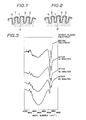
- This silica gel is schematically shown in Fig. 1, in which there are shown silica gel (a), pores (b), pore inside (c), external surface (d), and hydrophobic groups (e) introduced into pore inside (c).
- Silanol groups (f) on the external surface (d) originate from silica gel (a).
- the silica gel (a') schematically shown in Fig. 2 has hydrophobic groups on the pore inside and hydrophilic organic groups on the external surface.
- This silica gel is formed by introducing hydrophilic groups (g) into the silanol groups (f) in the silica gel (a) shown in Fig. 1.
- the hydrophobic group is properly selected according to the application for which the silica gel of the invention is used. If the silica gel is to be used as a packing for liquid column chromatography, the hydrophobic group includes, for example, alkyl groups having 1 to 24 carbon atoms such as propyl, octyl, and octadecyl groups, cyanoalkyl groups having 1 to 24 carbon atoms in the alkyl groups such as cyanopropyl group, and aminoalkyl groups having 1 to 24 carbon atoms in the alkyl groups such as aminopropyl group.
- the hydrophilic organic group is also properly selected according to the application for which the silica gel of the invention is used. It is an organic residue containing one or more than one hydroxyl group, carboxyl group, acidamide group, amino group, imino group, polyether group, thiol group, or sulfone group.
- the number of the hydrophilic groups is not specifically limited.
- the residue of a silicon compound is preferable.
- the silica gel of the invention is not limited in its particulate shape; it may be of spherical shape or irregular shape. Also, the particle diameter, pore size, and surface area of the silica gel are properly selected according to the application for which the silica gel of the invention is used, although the particle diameter is preferably in the range of 1 ⁇ m to 3 mm, the pore size is preferably in the ragne of 10 to 4000 A, and the surface area is preferably in the range of 20 to 2000 m 2 /g.
- the above-mentioned partially hydrophilicized silica gel of the invention as shown in Fig. 1, in which the hydrophobic groups are on the pore inside and the silanol groups are on the external surface, is efficiently produced by performing plasma treatment on silica gel in which the hydrophobic groups are introduced to the entire surface including the pore inside.
- the plasma treatment eliminates the hydrophobic groups on the external surface, causing the silanol groups originating from silica gel to appear on the surface.
- the plasma treatment is carried out preferably by low-temperature plasma.
- the low-temperature plasma hardly heats silica gel having hydrophobic groups on the entire surface, and yet-it can treat the external surface alone.
- the plasma treatment can be carried out under the following conditions. Pressure: 0.1 to 2 Torr, particularly about 0.5 Torr; Power: 10 to 150 W, particularly about 80 W; Time: 10 to 500 minutes, particularly about 200 minutes.
- Reagent gas inorganic gas such as oxygen, moisture vapor, air, argon, helium, and carbon _dioxide gas. Oxygen is preferable.
- silica gel having hydrophobic groups on the entire surface can be produced according to the known process, and any commercial product can also be used.
- the partially hydrophilicized silica gel shown in Fig. 2 in which the hydrophobic groups are on the pore inside and the hydrophilic organic groups are on the external surface is produced by reacting silica gel having hydrophobic groups on the pore inside and silanol groups on the external surface, with a compound having a chemical linking group reactive with silanol groups and a hydrophilic organic group or an organic group which becomes a hydrophilic organic group upon hydrolysis and hydrophilicizing the organic group, whereby introducing the hydrophilic organic group into the silanol group.
- Examples of the compound include B-(3,4-epoxycyclohexyl)ethyltrimethoxysilane, Y-glycidoxypropyltrimethoxysilane, Y-glycidoxypropylmethyldiethoxysilane, Y-glycidoxypropyldimethyl- methoxysilane, Y-glycidoxypropyldimethylchlorosilane, and cyanopropyltrichlorosilane.
- reaction of these compounds with silica gel having hydrophobic groups and silanol groups and the optional reaction to hydrophilicize the organic group are performed under proper conditions selected according to the individual compounds.
- the silica gel having hydrophobic groups and silanol groups is suspended in an organic solvent and/or water and then the compound having a chemical linking group reactive with silanol groups and a hydrophilic group or an organic group which can be made hydrophilic is added to the silica gel suspended solution to react the chemical linking groups with the silanol groups.
- the reaction may be carried out at 0 to 200°C for 0.5 to 48 hours.
- a 50-ml eggplant-shape flask was placed about 0.8 g of silica gel (5 ⁇ m in average particle diameter and 60 A in pore size) having octadecylsilyl groups on the entire surface including the pore inside.
- the flask was evacuated to about 10- 2 Torr using a vacuum pump, and then the pressure was adjusted to 0.45 Torr by introducing oxygen gas.
- the flask was positioned between two opposed copper electrode plates a certain distance apart. With the flask rotating, a high frequency (13.56 MHz) at an effective power of 80 W was applied across the electrode plates, so that an oxygen plasma is generated in the flask. In this way, the silica gel was treated with oxygen plasma for 60 minutes.
- the surface of the silica gel changed with time as the result of plasma treatment. This change was measured by means of infrared absorption spectrum (KBr disk method). The results are shown in Fig. 3. The elemental analysis of the silica gel was carried out before and after plasma treatment. The results are shown in Table 1.
- Fig. 3 indicate that when the silica gel having octadecylsilyl group on the entire surface undergoes plasma treatment, the absorption due to methylene group at about 2900 cm- 1 decreases and the absorption due to hydroxyl group at 3400 cm- 1 increases as the plasma treatment proceeds.
- Table 1 indicate that the content of carbon and hydrogen decreases after plasma treatment.
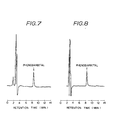
- the performance of the silica gel treated with oxygen plasma was evaluated as follows: The silica gel was filled in a column measuring 4.6 mm ⁇ x 30 mm to form a stationary phase. A mobile phase, 75% aqueous solution of CH 3 0H, was passed at a flow rate of 0.5 ml/min. As a sample, 5 ⁇ l of methanol solution containing 1000 ppm of benzene and 20 ppm of biphenyl was injected into the mobile phase. The liquid which had passed the stationary phase was examined by UV spectrometry at a wavelength of 254 nm and a sensitivity of 0.32 AUFS. The same procedure as above was also repeated using untreated silica gel.
- Figs. 4 and 5 indicate that the plasma-treated silica gel is slightly poorer than the untreated silica gel in the resolution of benzene and biphenyl but is capable of separating benzene and biphenyl, which are non-polar.
- silica gel having silanol groups on the entire surface does not adsorb and separate nonpolar benzene and biphenyl when used as a packing for liquid chromatography, it is apparent that the silica gel having octadecylsilyl groups is partially hydrophilicized by the plasma treatment.
- Silica gel having octadecylsilyl groups on the entire surface including the pore inside (100 A in pore size) was treated with plasma (water vapor plasma) in the same manner as in Example 1, except that oxygen gas was replaced by water vapor, the pressure in the flask was adjusted to 0.3 Torr, the effective power of high frequency was 50 W, and the duration of plasma treatment was reduced to 30 minutes.
- plasma water vapor plasma
- the treated silica gel was examined by the infrared adsorption spectrometry and elemental analysis in the same manner as in Example 1. The results indicate that the external surface of the silica gel was changed into silanol groups as in Example 1.
- Silica gel having octadecylsilyl groups on the entire surface including the pore inside was treated with plasma in the same manner as in Example 1, except that oxygen gas was replaced by helium gas, the pressure in the flask was adjusted to 0.6 Torr, the effective power of high frequency was 70 W, and the duration of plasma treatment was reduced to 40 minutes.
- the treated silica gel was examined by the infrared adsorption spectrometry and elemental analysis in the same manner as in Example 1. The results indicate that the external surface of the silica gel was changed into silanol groups as in Example 1.
- Example 2 The partially hydrophilicized silica gel obtained in Example 1, which has octadecylsilyl groups on the pore inside and silanol groups on the external surface, was changed into partially hydrophilicized silica gel having octadecylsilyl groups on the pore inside and substituted siloxy groups on the external surface.
- the raw material silica gel (0.8 g) was suspended in 5 ml of toluene solution containing 3 mg of triethylamine. After the addition of water (10 mg) and Y-glycidoxytri- methylsilane (0.37 g), reaction was carried out for 17 hours with refluxing. The solid phase was separated by suction filtration, washed with toluene and then acetone, and dried. The dry solids were suspended in an aqueous solution of ca. 10- 4 N H 2 SO 4 , and hydrolysis was carried out for 2 hours with refluxing. The reaction product was separated, washed and dried at 80°C. Thus the OH group in the silanol group was changed into the substituted siloxy group.
- the partially hydrophilicized silica gel having substituted siloxy groups obtained as mentioned above was used as a packing for a concentration column in experiments described in the following.
- Fig. 6 there are shown the first six-way valve (1), the sample loop (2), the second six-way valve (3), the concentration column (4), and the analysis column (5).
- a sample solution is introduced into the sample inlet (6) of the first six-way valve (1), with the six-way valve (1) positioned so that the passages are established as indicated by solid lines in the figure.
- the sample solution passes through the first passage port (1a), the sample loop (2), the fourth passage port (1d), and the third passage port (1c), and is discharged from the drain (7). While the sample solution passes through this route, a predetermined amount of sample solution is taken by the sample loop (2).
- the first six-way valve is turned so that the passages are established as indicated by broken lines in the figure
- the second six-way valve (3) is turned so that the passages are established as indicated by solid lines in the figure.
- the pump (8) is started and the concentration carrier is introduced from the storage (8) into fifth passage port (1e).
- the carrier passes through the fourth passage port (1d) and pushes out the sample solution in the sample loop (2).
- the sample solution passes through the first passage port (1a), the sixth passage port (1f), and the first passage port (3a) and the sixth passage port (3f) of the second six-way valve (3), and finally enters the concentration column (4).
- the sample solution is concentrated in the concentration solution (4) while it passes through it.
- the solution leaving the column (4) passes through the third passage port (3c) and the second passage port (3b) and is discharged from the drain (10). Subsequently, the second six-way valve (3) is turned so that the passages are established as indicated by broken lines.
- the pump 11 is started and the eluent is introduced from the storage (12) into the fourth passage inlet (3d) of the second six-way valve (3).
- the eluent passes through the third passage port (3c), the concentration column (4), the sixth passage port (3f), and the fifth passage port (3e), and finally enters the analysis column (5).
- the concentrated sample is eluted from the column (4).
- the sample is introduced from the analysis column (5) to the detector (13).
- bypass resistance loop (14) and three-way joints (15) and (16) in Fig. 6.
- a portion of the carrier is diverted to the bypass resistance loop (14) through the three-way joint (15).
- the diverted carrier joins, at the three-way joint (16), the sample solution flowing from the sixth passage port (1f) of the first six-way valve (1) to the first passage port (3a) of the second six-way valve (2).
- the sample solution is properly diluted.
- a solution of cattle serum albumin (50 to 500 ppm) was passed through a column filled with the partially hydrophilicized silica gel having substituted siloxy groups on the external surface obtained by the above procedure and a column filled with silica gel having octadecylsilyl groups on the entire surface.
- the amount of cattle serum albumin was determined as follows:
Landscapes
- Chemical & Material Sciences (AREA)
- Organic Chemistry (AREA)
- Chemical Kinetics & Catalysis (AREA)
- Analytical Chemistry (AREA)
- Engineering & Computer Science (AREA)
- Materials Engineering (AREA)
- Physics & Mathematics (AREA)
- Plasma & Fusion (AREA)
- Inorganic Chemistry (AREA)
- Solid-Sorbent Or Filter-Aiding Compositions (AREA)
Applications Claiming Priority (4)
| Application Number | Priority Date | Filing Date | Title |
|---|---|---|---|
| JP29916085A JPS62158112A (ja) | 1985-12-27 | 1985-12-27 | 部分親水化シリカゲル及びその製造方法 |
| JP29916185A JPS62158113A (ja) | 1985-12-27 | 1985-12-27 | 部分親水化シリカゲル及びその製造方法 |
| JP299160/85 | 1985-12-27 | ||
| JP299161/85 | 1985-12-27 |
Publications (3)
| Publication Number | Publication Date |
|---|---|
| EP0228090A2 true EP0228090A2 (fr) | 1987-07-08 |
| EP0228090A3 EP0228090A3 (en) | 1988-01-27 |
| EP0228090B1 EP0228090B1 (fr) | 1991-12-11 |
Family
ID=26561815
Family Applications (1)
| Application Number | Title | Priority Date | Filing Date |
|---|---|---|---|
| EP86118093A Expired - Lifetime EP0228090B1 (fr) | 1985-12-27 | 1986-12-29 | Gel de silice rendu partiellement hydrophyle et procédé pour sa production |
Country Status (3)
| Country | Link |
|---|---|
| US (1) | US4694092A (fr) |
| EP (1) | EP0228090B1 (fr) |
| DE (1) | DE3682886D1 (fr) |
Cited By (4)
| Publication number | Priority date | Publication date | Assignee | Title |
|---|---|---|---|---|
| WO1999016545A1 (fr) * | 1997-09-29 | 1999-04-08 | Merck Patent Gmbh | Materiaux poreux a surface exterieure hydrophile electroneutre modifies chimiquement |
| EP1059267A1 (fr) * | 1999-06-10 | 2000-12-13 | Dow Corning Corporation | Procédé de préparation de gels hydrophiles de silice à volume poreux élevé |
| WO2002016267A1 (fr) * | 2000-08-25 | 2002-02-28 | Universite Laval | Formation de sites hydrophiles dans de la silice a matrice micelle partiellement silylee |
| EP3227393A4 (fr) * | 2014-12-05 | 2018-12-19 | Velox Flow, Llc | Particules super-hydrophobes multifonctionnelles pour adhérence chimique et efflorescence |
Families Citing this family (9)
| Publication number | Priority date | Publication date | Assignee | Title |
|---|---|---|---|---|
| US4806665A (en) * | 1987-11-05 | 1989-02-21 | Nalco Chemical Company | Preparation of silica sol |
| JP2874297B2 (ja) * | 1989-12-18 | 1999-03-24 | 東ソー株式会社 | 逆相クロマトグラフィー用充填剤及びその製造方法 |
| DE4130475A1 (de) * | 1991-09-13 | 1993-03-18 | Merck Patent Gmbh | Modifizierte chromatographische traegermaterialien |
| US5859277A (en) * | 1997-06-25 | 1999-01-12 | Wisconsin Alumni Research Foundation | Silicon-containing solid support linker |
| EP1291080A3 (fr) * | 2001-09-10 | 2004-05-19 | Tosoh Corporation | Procédé pour la production d'adsorbants partiellement hydrophilisés |
| SI22048A (sl) * | 2005-06-02 | 2006-12-31 | Institut "Jozef Stefan" | Metoda in naprava za lokalno funkcionalizacijo polimernih materialov |
| EP2411450B1 (fr) * | 2009-03-23 | 2018-12-26 | Cabot Corporation | Particule contenant une zone hydrophobe et une zone hydrophile et ses procédés de fabrication |
| JP2013511362A (ja) | 2009-11-23 | 2013-04-04 | スリーエム イノベイティブ プロパティズ カンパニー | 処理された多孔質粒子を含む吸収性物品、及び処理された多孔質粒子を使用する乾燥方法 |
| CN113600144A (zh) * | 2021-07-19 | 2021-11-05 | 宁波方太厨具有限公司 | 甲醛吸附材料的制备方法 |
Family Cites Families (7)
| Publication number | Priority date | Publication date | Assignee | Title |
|---|---|---|---|---|
| US29948A (en) * | 1860-09-11 | Improvement in hay-elevating forks | ||
| US2531427A (en) * | 1946-05-03 | 1950-11-28 | Ernst A Hauser | Modified gel-forming clay and process of producing same |
| US3839389A (en) * | 1963-12-06 | 1974-10-01 | Laporte Industries Ltd | Organophilic swelling clays |
| US3941871A (en) | 1973-11-02 | 1976-03-02 | Mobil Oil Corporation | Crystalline silicates and method of preparing the same |
| US4298500A (en) * | 1980-05-05 | 1981-11-03 | Varian Associates, Inc. | Mixed phase chromatographic compositions |
| DE3427923A1 (de) * | 1984-07-28 | 1986-01-30 | Merck Patent Gmbh, 6100 Darmstadt | Trennmaterial fuer die duennschichtchromatographie |
| US4544485A (en) * | 1984-08-31 | 1985-10-01 | Purdue Research Foundation | Chromatographic method and means |
-
1986
- 1986-12-24 US US06/946,078 patent/US4694092A/en not_active Expired - Lifetime
- 1986-12-29 EP EP86118093A patent/EP0228090B1/fr not_active Expired - Lifetime
- 1986-12-29 DE DE8686118093T patent/DE3682886D1/de not_active Expired - Fee Related
Cited By (6)
| Publication number | Priority date | Publication date | Assignee | Title |
|---|---|---|---|---|
| WO1999016545A1 (fr) * | 1997-09-29 | 1999-04-08 | Merck Patent Gmbh | Materiaux poreux a surface exterieure hydrophile electroneutre modifies chimiquement |
| EP1059267A1 (fr) * | 1999-06-10 | 2000-12-13 | Dow Corning Corporation | Procédé de préparation de gels hydrophiles de silice à volume poreux élevé |
| WO2002016267A1 (fr) * | 2000-08-25 | 2002-02-28 | Universite Laval | Formation de sites hydrophiles dans de la silice a matrice micelle partiellement silylee |
| EP3227393A4 (fr) * | 2014-12-05 | 2018-12-19 | Velox Flow, Llc | Particules super-hydrophobes multifonctionnelles pour adhérence chimique et efflorescence |
| US10640521B2 (en) | 2014-12-05 | 2020-05-05 | Velox Flow, Llc | Multifunctional superhydrophobic particles for chemical adhesion and blooming |
| US11046718B2 (en) | 2014-12-05 | 2021-06-29 | Velox Flow, Llc | Multifunctional superhydrophobic particles for chemical adhesion and blooming |
Also Published As
| Publication number | Publication date |
|---|---|
| US4694092A (en) | 1987-09-15 |
| DE3682886D1 (de) | 1992-01-23 |
| EP0228090A3 (en) | 1988-01-27 |
| EP0228090B1 (fr) | 1991-12-11 |
Similar Documents
| Publication | Publication Date | Title |
|---|---|---|
| EP0228090B1 (fr) | Gel de silice rendu partiellement hydrophyle et procédé pour sa production | |
| US4131544A (en) | Macroencapsulated sorbent element and process for using the same | |
| US5457316A (en) | Method and apparatus for the detection and identification of trace gases | |
| Mackey | Metal-organic complexes in seawater—An investigation of naturally occurring complexes of Cu, Zn, Fe, Mg, Ni, Cr, Mn and Cd using high-performance liquid chromatography with atomic fluorescence detection | |
| Zhai et al. | Selective determination of trace mercury (II) after preconcentration with 4-(2-pyridylazo)-resorcinol-modified nanometer-sized SiO2 particles from sample solutions | |
| KR100839162B1 (ko) | 가스 분리장치 | |
| KR100290757B1 (ko) | 액체크로마토그래피및컬럼충진제 | |
| Cao et al. | Nanofibers mat as sampling module of direct analysis in real time mass spectrometry for sensitive and high-throughput screening of illegally adulterated sulfonylureas in antidiabetic health-care teas | |
| CN101871920A (zh) | 用于生物样本中多氯联苯类化合物快速前处理与纯化的多级改进柱 | |
| Serrano et al. | Fullerenes as sorbent materials for benzene, toluene, ethylbenzene, and xylene isomers preconcentration | |
| Takeuchi et al. | Application of ultra-micro high-performance liquid chromatography to trace analysis | |
| Zhao et al. | Determination of gold-based antiarthritis drugs and their metabolites in urine by reversed-phase ion-pair chromatography with ICP-MS detection | |
| JPH0338891B2 (fr) | ||
| Anspach et al. | Affinity chromatography with triazine dyes immobilized onto activated non-porous monodisperse silicas | |
| Gómez‐Ariza et al. | Pretreatment procedure for selenium speciation in shellfish using high‐performance liquid chromatography–microwave‐assisted digestion–hydride generation‐atomic fluorescence spectrometry | |
| JPH0468244B2 (fr) | ||
| JPH0461809B2 (fr) | ||
| BRPI0615797A2 (pt) | material de carga para uma coluna de microadsorção para secagem e/ou purificação de componentes de análise orgánicos ou biológicos dissolvidos e coluna de microadsorção e uso dos mesmos | |
| CN111380984A (zh) | 蔬菜样品前处理及同时检测其中多种双酚类化合物的方法 | |
| JP2792038B2 (ja) | 水溶性高分子物質と低分子成分とが共存する試料の分析方法及び前処理方法並びにクロマトグラフイー用充填剤 | |
| Jönsson et al. | Method for the biological monitoring of hexahydrophthalic anhydride by the determination of hexahydrophthalic acid in urine using gas chromatography and selected-ion monitoring | |
| CN105301152B (zh) | 一种适用于盐酸克仑特罗的生物相容性固相萃取方法 | |
| CN117443363B (zh) | 膨胀氧化石墨烯作为固定相材料的应用 | |
| CN120334437B (zh) | 一种血清液相色谱-串联质谱分析的前处理方法 | |
| Zhang et al. | Fast simultaneous detection of three diterpenoids in Herba Siegesbeckiae using solid phase extraction followed by HPLC-UV with a core–shell particle column |
Legal Events
| Date | Code | Title | Description |
|---|---|---|---|
| PUAI | Public reference made under article 153(3) epc to a published international application that has entered the european phase |
Free format text: ORIGINAL CODE: 0009012 |
|
| AK | Designated contracting states |
Kind code of ref document: A2 Designated state(s): DE FR GB |
|
| PUAL | Search report despatched |
Free format text: ORIGINAL CODE: 0009013 |
|
| AK | Designated contracting states |
Kind code of ref document: A3 Designated state(s): DE FR GB |
|
| 17P | Request for examination filed |
Effective date: 19880718 |
|
| 17Q | First examination report despatched |
Effective date: 19890614 |
|
| GRAA | (expected) grant |
Free format text: ORIGINAL CODE: 0009210 |
|
| AK | Designated contracting states |
Kind code of ref document: B1 Designated state(s): DE FR GB |
|
| REF | Corresponds to: |
Ref document number: 3682886 Country of ref document: DE Date of ref document: 19920123 |
|
| ET | Fr: translation filed | ||
| PLBE | No opposition filed within time limit |
Free format text: ORIGINAL CODE: 0009261 |
|
| STAA | Information on the status of an ep patent application or granted ep patent |
Free format text: STATUS: NO OPPOSITION FILED WITHIN TIME LIMIT |
|
| 26N | No opposition filed | ||
| REG | Reference to a national code |
Ref country code: FR Ref legal event code: CD Ref country code: FR Ref legal event code: CA |
|
| REG | Reference to a national code |
Ref country code: GB Ref legal event code: IF02 |
|
| PGFP | Annual fee paid to national office [announced via postgrant information from national office to epo] |
Ref country code: FR Payment date: 20031128 Year of fee payment: 18 |
|
| PGFP | Annual fee paid to national office [announced via postgrant information from national office to epo] |
Ref country code: GB Payment date: 20031215 Year of fee payment: 18 |
|
| PGFP | Annual fee paid to national office [announced via postgrant information from national office to epo] |
Ref country code: DE Payment date: 20031219 Year of fee payment: 18 |
|
| PG25 | Lapsed in a contracting state [announced via postgrant information from national office to epo] |
Ref country code: GB Free format text: LAPSE BECAUSE OF NON-PAYMENT OF DUE FEES Effective date: 20041229 |
|
| PG25 | Lapsed in a contracting state [announced via postgrant information from national office to epo] |
Ref country code: DE Free format text: LAPSE BECAUSE OF NON-PAYMENT OF DUE FEES Effective date: 20050701 |
|
| GBPC | Gb: european patent ceased through non-payment of renewal fee |
Effective date: 20041229 |
|
| PG25 | Lapsed in a contracting state [announced via postgrant information from national office to epo] |
Ref country code: FR Free format text: LAPSE BECAUSE OF NON-PAYMENT OF DUE FEES Effective date: 20050831 |
|
| REG | Reference to a national code |
Ref country code: FR Ref legal event code: ST |