EP0228259A2 - Immobilisierte Enzym-Membrane für einen Halbleiterdetektor und deren Herstellungsverfahren - Google Patents
Immobilisierte Enzym-Membrane für einen Halbleiterdetektor und deren Herstellungsverfahren Download PDFInfo
- Publication number
- EP0228259A2 EP0228259A2 EP86309931A EP86309931A EP0228259A2 EP 0228259 A2 EP0228259 A2 EP 0228259A2 EP 86309931 A EP86309931 A EP 86309931A EP 86309931 A EP86309931 A EP 86309931A EP 0228259 A2 EP0228259 A2 EP 0228259A2
- Authority
- EP
- European Patent Office
- Prior art keywords
- enzyme
- membrane
- immobilized membrane
- semiconductor
- sensor
- Prior art date
- Legal status (The legal status is an assumption and is not a legal conclusion. Google has not performed a legal analysis and makes no representation as to the accuracy of the status listed.)
- Granted
Links
Images




Classifications
-
- C—CHEMISTRY; METALLURGY
- C12—BIOCHEMISTRY; BEER; SPIRITS; WINE; VINEGAR; MICROBIOLOGY; ENZYMOLOGY; MUTATION OR GENETIC ENGINEERING
- C12Q—MEASURING OR TESTING PROCESSES INVOLVING ENZYMES, NUCLEIC ACIDS OR MICROORGANISMS; COMPOSITIONS OR TEST PAPERS THEREFOR; PROCESSES OF PREPARING SUCH COMPOSITIONS; CONDITION-RESPONSIVE CONTROL IN MICROBIOLOGICAL OR ENZYMOLOGICAL PROCESSES
- C12Q1/00—Measuring or testing processes involving enzymes, nucleic acids or microorganisms; Compositions therefor; Processes of preparing such compositions
- C12Q1/001—Enzyme electrodes
- C12Q1/002—Electrode membranes
-
- C—CHEMISTRY; METALLURGY
- C12—BIOCHEMISTRY; BEER; SPIRITS; WINE; VINEGAR; MICROBIOLOGY; ENZYMOLOGY; MUTATION OR GENETIC ENGINEERING
- C12N—MICROORGANISMS OR ENZYMES; COMPOSITIONS THEREOF; PROPAGATING, PRESERVING, OR MAINTAINING MICROORGANISMS; MUTATION OR GENETIC ENGINEERING; CULTURE MEDIA
- C12N11/00—Carrier-bound or immobilised enzymes; Carrier-bound or immobilised microbial cells; Preparation thereof
- C12N11/02—Enzymes or microbial cells immobilised on or in an organic carrier
- C12N11/08—Enzymes or microbial cells immobilised on or in an organic carrier the carrier being a synthetic polymer
- C12N11/082—Enzymes or microbial cells immobilised on or in an organic carrier the carrier being a synthetic polymer obtained by reactions only involving carbon-to-carbon unsaturated bonds
-
- C—CHEMISTRY; METALLURGY
- C12—BIOCHEMISTRY; BEER; SPIRITS; WINE; VINEGAR; MICROBIOLOGY; ENZYMOLOGY; MUTATION OR GENETIC ENGINEERING
- C12N—MICROORGANISMS OR ENZYMES; COMPOSITIONS THEREOF; PROPAGATING, PRESERVING, OR MAINTAINING MICROORGANISMS; MUTATION OR GENETIC ENGINEERING; CULTURE MEDIA
- C12N11/00—Carrier-bound or immobilised enzymes; Carrier-bound or immobilised microbial cells; Preparation thereof
- C12N11/02—Enzymes or microbial cells immobilised on or in an organic carrier
- C12N11/08—Enzymes or microbial cells immobilised on or in an organic carrier the carrier being a synthetic polymer
- C12N11/089—Enzymes or microbial cells immobilised on or in an organic carrier the carrier being a synthetic polymer obtained otherwise than by reactions only involving carbon-to-carbon unsaturated bonds
- C12N11/091—Phenol resins; Amino resins
-
- C—CHEMISTRY; METALLURGY
- C12—BIOCHEMISTRY; BEER; SPIRITS; WINE; VINEGAR; MICROBIOLOGY; ENZYMOLOGY; MUTATION OR GENETIC ENGINEERING
- C12N—MICROORGANISMS OR ENZYMES; COMPOSITIONS THEREOF; PROPAGATING, PRESERVING, OR MAINTAINING MICROORGANISMS; MUTATION OR GENETIC ENGINEERING; CULTURE MEDIA
- C12N11/00—Carrier-bound or immobilised enzymes; Carrier-bound or immobilised microbial cells; Preparation thereof
- C12N11/02—Enzymes or microbial cells immobilised on or in an organic carrier
- C12N11/08—Enzymes or microbial cells immobilised on or in an organic carrier the carrier being a synthetic polymer
- C12N11/098—Enzymes or microbial cells immobilised on or in an organic carrier the carrier being a synthetic polymer formed in the presence of the enzymes or microbial cells
-
- Y—GENERAL TAGGING OF NEW TECHNOLOGICAL DEVELOPMENTS; GENERAL TAGGING OF CROSS-SECTIONAL TECHNOLOGIES SPANNING OVER SEVERAL SECTIONS OF THE IPC; TECHNICAL SUBJECTS COVERED BY FORMER USPC CROSS-REFERENCE ART COLLECTIONS [XRACs] AND DIGESTS
- Y10—TECHNICAL SUBJECTS COVERED BY FORMER USPC
- Y10S—TECHNICAL SUBJECTS COVERED BY FORMER USPC CROSS-REFERENCE ART COLLECTIONS [XRACs] AND DIGESTS
- Y10S435/00—Chemistry: molecular biology and microbiology
- Y10S435/817—Enzyme or microbe electrode
Definitions
- the present invention relates generally to enzyme immobilized membranes and a method for producing the same, and more specifically, to a semiconductor enzyme sensor utilizing such enzyme immobilized membranes.
- enzymes have been industrially utilized as catalists particularly in the fermentation industry, and the like.
- enzymes were dissolved or dispersed in aqueous solutions for promoting various chemical reactions and, after completion of the reactions, the enzymes were not recovered from the solutions but discarded uselessly each time respective reactions had been finished.
- enzyme immobilization techniques have been developed which enable repeated use of enzymes in a stable state, whereby areas of utilization of enzymes have been rapidly expanded, for example, to a field of measuring various items of chemical substances in addition to traditional fields of fermentation, syntheses of chemical substances, and the like.
- an enzyme immobilized membrane was physically or chemically adhered to a sensitive portion of an enzyme sensor which is adapted to convert physical or chemical quantities such as temperature, ion concentration, gas concentration or the like into electrical signals.
- an enzyme immobilized membrane In order to measure chemical quantities of a substance, an enzyme immobilized membrane is suited which has a thin thickness and a limited area.
- Biosensors are typical examples of sensors utilizing enzyme immobilized membranes for measurements of chemical substances.
- a biosensor comprises an enzyme immobilized membrane, and a transducer adapted to detect substances consumed or produced in the membrane and generate electrical signals upon detection of such substances.
- the enzyme immobilized membrane serves to discriminate a specific chemical substance to be measured, and cause a change in quantity of a material which corresponds to a change in the chemical substance and which is able to be detected by the transducer.
- biosensors there are known those which employ a combination of a glucose immobilized membrane and an oxygen electrode, a combination of a glucose-oxydase immobilized membrane and a hydrogen peroxide electrode, a combination of glucose-oxidase enzyme immobilized membrane and a pH electrode, or the like.
- Glucose oxidase acts to decompose the glucose in an enzyme immobilized membrane into gluconic acid and hydrogen peroxide according to the following reaction equation:
- a water soluble photosensitive resin such as, for example, photosensitive polyvinyl alcohol (PVA) is subject to a photolithographic process.
- Figs. lA through 1C show a series of procedures in a conventional method for forming an enzyme immobilized membrane from a photosensitive resin by means of photolithography.
- reference numeral 1 designates a base or substrate such as, for example, a silicon wafer having a thermally grown oxidized film or membrane, a base board having amino groups introduced therein through a silane coupling agent, a transducer, a semiconductor sensor or the like.
- an enzyme membrane 3 formed of a water soluble photosensitive resin containing an enzyme 2 such as glucose oxidase dissolved therein, as illustrated in Fig. lA. Then, the enzyme membrane 3 thus formed is irradiated by ultraviolet light or visible light 6 through an appropriate photomask or filter 5 so that only a specific portion 4 of the enzyme membrane 3 or a sensitive portion 4 of the substrate 1 is subject to the irradiation of the light to provide photo crosslinking therein (see Fig. 1B). Thereafter, the remaining portion of the enzyme membrane 3, not irradiated by the lihght 6 and having no photo crosslinking, is developed and washed with water (see Fig. 1C).
- FIG. 2 is an imaginary view showing a glucose-oxidase immobilized membrane formed on a base or transducer 1 having amino groups introduced thereinto by a silane coupling agent.
- an enzyme 2 in the form of glucose oxidase and bovine serum albumin 7 are dissolved into an aqueous solution, and then mixed with a solution containing an appropriate concentration of glutaraldehyde 8.
- the mixture thus formed is coated on the base 1 and kept in this state so that chemical crosslinking is produced between enzyme 2 - enzyme 2, enzyme 2 - bovine serum albumin 7, bovine serum albumin 7 - bovine serum albumin 7, and enzyme 2 - amino groups on the surface of the base 1, bovine serum albumin 7 - amino groups on the base surface under the action of glutaraldehyde.
- the enzyme 2 is captured in a three-dimensional polymer membrane, as illustrated in Fig. 2, and thus becomes unsoluble in water and immobilized.
- the conventional glucose-oxidase immobilized membranes are produced from the above-mentioned finely machinable materials in accordance with the above methods, but involve a problem in that it is impossible to form enzyme immobilized membranes having limited areas with good reproduceability.
- the present invention is intended to solve the above-described problems of the prior art.
- a primary object of the present invention is to provide a novel and improved glucose-oxidase immobilized membrane and a method for producing the same in which the portion of an enzyme membrane having phote crosslinking, even if containing an excessive amount of an enzyme, does not peel off from a sensitive portion of an enzyme sensor, and in which elution of the enzyme from the enzyme membrane can be effectively prevented, and in which an enzyme immobilized membrane having a limited area and high mechanical strength can be produced with good reproduceability.
- Another object of the present invention is to provide a novel and improved semiconductor enzyme sensor and a method for producing the same in which an enzyme immobilized membrane can be directly formed on an ion-sensitive surface of a hydrogen ion-sensitive field effect transistor (hereinafter referred to as pH-ISFET), thereby making it easy to miniaturize the entire sensor, and which can be manufactured in an easy and efficient manner, and which has high sensitivity.
- pH-ISFET hydrogen ion-sensitive field effect transistor
- a further object of the present invention is to provide a novel and improved semiconductor enzyme sensor and a method for producing the same in which a plurality of enzyme immobilized membranes can be directly formed on the respective ion-sensitive surfaces of plural pH-ISFETs, thereby making it easy to produce a multiple-enzyme sensor in a simple way, and which has high sensitivity.
- an enzyme immobilized membrane comprising:
- the enzyme immobilized membrane is particularly useful in cases where it contains a limited amount of enzyme.
- the enzyme immobilized membrane further comprise glutaraldehyde, and a material adapted to cooperate with glutaraldehyde to form chemical crosslinking for improved mechanical strength.
- the enzyme is selected from the group consisting of glucose oxidase, ureaze and lipase.
- the material adapted to cooperate with glutaraldehyde to form chemical crosslinking is selected from the group consisting of bovine serum albumin, polyamino acid, and polyamino acid copolymer.
- the polyvinyl pyrrolidone having a molecular weight of tens of thousands to hundreds of thousands is 2 - 20 weight %; and the 2, 5-bis (4'-azide-2'-sulfobenzal) cyclopentanone sodium salt is 0.5 - 1.5 weight %; and the enzyme comprises glucose oxidase of 5.0 - 7.5 weight %. Also, the enzyme immobilized membrane further comprises bovine serum albumin of 5 - 10 weight %.
- a method for producing an enzyme immobilized membrane which comprises the steps of:
- the enzyme immobilized membrane after having been irradiated by the ultraviolet light, may be dipped into an aqueous solution of glutaraldehyde so as to form chemical crosslinking.
- proteins in the enzyme immobilized membrane are chemically crosslinked with each other under the action of glutaraldehyde whereby the mechanical strength of the enzyme immobilized membrane is markedly increased, thus preventing elution of the enzyme.
- the glucose-oxidase immobilized membrane is washed away by a buffer solution, dipped into an aqueous solution of glycine, and again washed away by a buffer solution for removal of the residual glutaraldehyde.
- a semiconductor enzyme sensor comprising:
- the semiconductor enzyme sensor may further comprise a third pH-ISFET having a second enzyme immobilized membrane connected thereto, the second membrane being composed of a second water soluble photosensitive resin including polyvinyl pyrrolidone having a molecular weight of tens of thousands to hundreds of thousands and 2, 5-bis (4'-azide-2'-sulfobenzal) cyclopentanone sodium salt, and a second enzyme.
- a third pH-ISFET having a second enzyme immobilized membrane connected thereto, the second membrane being composed of a second water soluble photosensitive resin including polyvinyl pyrrolidone having a molecular weight of tens of thousands to hundreds of thousands and 2, 5-bis (4'-azide-2'-sulfobenzal) cyclopentanone sodium salt, and a second enzyme.
- the first and/or second enzyme immobilized membrane may be directly coated and hardened on the respective pH-ISFETs so that it becomes easy to miniaturize and manufacture the entire semiconductor enzyme sensor.
- the sensor thus formed has an extended satisfactory life in service.
- the above photesensitive resin is by far durable against H 2 0 2 which necessarily results as a by-produced during production of a glucose snsor, as compared with conventional photosensitive resins such as PVT.
- the above photesensitive resin is easy to synthesize or prepare, able to have a great amount of enzyme dissolved therein, highly sensitive, and can provide an enzyme immobilized membrane at low costs.
- PVA conventionally used is sensitive to lights of relatively large wavelength so that when a mask is fitted to a covering layer of PVA before subjected to exposure, such a PVA covering layer often causes partial crosslinking. To prevent this, an exposure device is required to take a special measure. In contrast, the photosensitive resin of the present invention requires no such measure or any other adjustments.
- each of the first and second enzyme immobilized membranes are formed by coating on a pH-ISFET an aqueous solution containing a water soluble photosensitive resin, glucose oxidase, bovine serum albumin, and hardening the aqueous solution thus coated by irradiation of ultraviolet light.
- These enzyme immobilized membranes may be dipped into a glutaraldehyde solution to form chemical crosslinking for improved mechanical strength.
- the first and second enzyme immobilized membranes be formed through patterning on the ion-sensitive surfaces of the respective pH-ISFETs by means of photolithography.
- each of the enzyme immobilized membranes can be readily and efficiently connected or bonded through a water soluble photosensitive resin to only the specific ion-sensitive surface as required of each ph-ISFET which can be very limited in size (for example, several mm in length and width).
- a multiple enzyme sensor having having a plurality of sensing portions can be obtained in an easy and efficient manner which is sensitive to a plurality of different materials.
- This multiple sensor is independently usable by itself, or can be formed into an intelligent sensor which has an information processing circuit adapted to receive outputs of the various sensing portions for making comprehensive judgement.
- the semiconductor enzyme sensor may further include one or more pH-ISFETs each having a further enzyme immobilized membrane connected thereto.
- the further membrane is preferably composed of a further water soluble photosensitive resin including polyvinyl pyrrolidone having a molecular weight of tens of thousands to hundreds of thousands and 2, 5-bis (4'-azide-2'-sulfobenzal) cyclopentanone sodium salt, and a further enzyme.
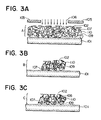
- Figs. 3A, 3B and 3C schematically illustrate a series of processes in a method for producing enzyme immobilized membrane according to the present invention.
- the enzyme immobilized membrane in the form of a glucose-oxidase immobilized membrane of the invention is formed on a base 101 and comprises an enzyme 102 in the form of glucose oxidase, gultaraldehyde 108, a material 107 in the form of bovine serum albumin adapted to cooperate with glutaraldehyde to form chemical crosslinking, and a water soluble photosensitive resin including polyvinyl pyrrolidone 109 and 2, 5-bis (4'-azide-2'-sulfobenzal) cyclopentanone sodium salt 110.
- an aqueous solution A containing glucose oxidase 102, the water soluble photosensitive resin and bovine serum albumin 107 is first coated on the surface of the base 101, and dried to provide a covering layer or membrane of which a specified portion is then irradiated by ultraviolet light 106 so as to form photo crosslinking therebetween, as pictured in Fig. 3A. Subsequently, the covering layer thus formed on the base 101 is developed by water to obtain a glucose-oxidase immobilized membrane B (Fig. 3B) which is further treated by glutaraldehyde 108 to form chemical crosslinking for increased mechanical strength thereof.
- Futher where the glucose-oxidase immobilized membrane is formed on the entire surface of the base 1, it is preferable to use an aqueous solution containing glutaraldehyde of 10 - 25 weight percent.
- an aqueous solution containing glutaraldehyde of 10 - 25 weight percent.
- ultraviolet light 6 is irradiated on only the specific portion of the base 1 and then developed by a 1 - 5% glutaraldehyde solution so as form chemical crosslinking in the photo crosslinked portion thereof while dissolving the remaining portion thereof having no photo crosslinking for removal.
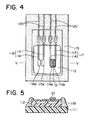
- Figs. 4 and 5 show a semiconductor enzyme sensor which includes two pH-ISFETs having an enzyme immobilized membrane fabricated in accordance with the present invention.
- the sensor illustrated has a pH-ISFET chip or element 112 firmly or integrally mounted on an epoxy resin board 111 by means of an epoxy resin covering layer 119.
- the pH-ISFET chip 112 is provided on its one side surface with a first pH-ISFET 117 and a second pH-ISFET 118.
- the first pH-ISFET 117 has a first source electrode 113 and a first drain electrode 114 extending in a spaced parallel relation with each other, and the second pH-ISFET 118 has a second source electrode 115 and a second drain electrode 116 extending in a spaced parallel relation with each other. These first and second source and drain electrodes 113 through 116 are electrically connected to a measuring circuit (not shown) via respective leads 120.
- the first pH-ISFET 117 has a pair of first spaced ion-sensitive portions 113a, 114a formed integrally with the first source and drain electrodes 113, 114 at their distal ends.
- An enzyme immobilized membrane 121 is formed on the first ion-sensitive portions 113a, 114a of the first pH-ISFET 117 in accordance with the method of the invention as described in the foregoing with reference to Figs. 3A through 3C.
- the second pH-ISFET 118 has a pair of second spaced ion-sensitive portions 115a, 116a formed integrally with the second source and drain electrodes 115, 116 at their distal ends, the second ion-sensitive portions 115a, 116a being provided with no enzyme immobilized membrane and thus exposed outwards.
- a reference or pseude electrode such as, for example, a known silver-silver chloride electrode is usually required.
- the semiconductor enzyme sensor is comprised of the first pH-ISFET 117 provided with the enzyme immobilized membrane 121, the second ph-ISFET 118 having no enzyme immobilized membrane, and the reference electrode (not shown).
- Fig. 6 shows another pH-ISFET chip or element 112' for a semiconductor enzyme sensor in accordance with the invention
- Fig. 7 shows a substrate from which the pH-ISFET chip is formed.
- the composite pH-ISFET chip 112' comprises a first pH-ISFET 117 including a first source electrode 113 and a first drain electrode 114, a second pH-ISFET 118 including a second source electrode 115 and a second drain electrode 116, and a reference or pseude electrode 122.
- the composite pH-ISFET chip 112 can be fabricated in accordance with a known method for producing a usual metallic oxide type field effect transistor.
- the first and second pH-ISFETs 117 and 118 are sensitive to hydrogen ions independently of each other so that they can measure the pH of a solution by measuring the current flowing between the source and drain electrodes 113 and 114 or 115 and 116 of the first or second pH-ISFET 117 or 118 when a predetermined voltage is applied between the source and drain electrodes, or alternately by measuring a source voltage required to be imposed between the source and drain electrodes for causing a predetermined level of current to flow across the spurce and drain electrodes.
- the first source and drain electrodes 113 and 114 of the first pH-ISFET 117 have a pair of spaced opposite ion-sensitive porions 113a and 114a integrally formed with their distal ends.
- a membrane 121 containing an immobilized enzyme Provided on a specified portion of the surface of the pH-ISFET chip 112 is a membrane 121 containing an immobilized enzyme, the ion concentration in the enzyme being adapted to change in accordance with the amount of reaction thereof with a substrate solution.
- the enzyme immobilized membrane 121 is secured to the surface of the pH-ISFET chip so as to cover the ion-sensitive portions 113a and 114a of the first pH-ISFET.
- the second source and drain electrodes 115 and 116 of the second pH-ISFET 118 have no enzyme immobilized membrane connected therewith.
- the enzyme sensor acts to measure the respective source voltages required to cause a predetermined level of current flow from the sources 113, 115 to the drains 114a, 116a of the first and second pH-ISFETs, and then amplify a differential output between the measured source voltages of the pH-ISFETs so as to measure the concentration of the substrate in the sample solution.
- Fig. 9 shows a semiconductor multiple-enzyme sensor having a plurality (three in the illustrated embodiment) of pH-ISFETs 217, 218 and 224 each having a source electrode 213, 215 or 225 and a drain electrode 214, 216 or 226, and a reference or pseude electrode 222 fabricated in accordance with the present invention.
- Each of the pH-ISFETs 217, 218 and 224 has a pair of spaced opposite ion-sensitive portions 213a, 214a; 215a, 216a; or 225a, 226a integrally formed with the source and drain electrodes 213, 214; 215, 216; or 225, 226, respectively.
- the multiple-enzyme sensor has a plurality (two in the illustrated embodiment) of enzyme immobilized membranes 221, 227 which are formed on the ion-sensitive portions 213a, 214a of the pH-ISFET 217, and on the ion-sensitive portions 225a, 226a of the pH-ISFET 227, respectively.
- These enzyme immobilized membranes 221 and 227 can be formed in the same manner as described with reference to the one shown in Figs. 4 and 5 or Figs. 6 and 7.
- the membranes 221 and 227 are different from each other and reactable with different kinds of substrates so that they can measure concentrations of such different substrate solutions.
- the multiple-enzyme sensor may further include one or more pH-ISFETs each having an enzyme reactable with a corresponding substrate solution.
- aqueous solution of a water soluble photosensitive polymer was prepared by dissolving a 2, 5-bis (4'-azide-2'-sulfobenzal) cyclopentanone sodium salt (Tokyo Ohkakogyo Co., Ltd.) in a 10 weight percent polyvinyl pyrrodidone solution having a molecular weight of about three hundred and sixty thousand at a concentration of 10 weight percent.
- a glucose oxidase was dissolved as an enzyme to form a homogeneous solution which was then widely coated on a specific portion of the surface of the ph-ISFET chip 112, as illustrated in Fig.
- the layer of the solution thus coated was made into an even or uniform membrane by the use of a spinner (not shown), and then dried. The dried membrane was subsequently exposed to UV irradiation with a 250 W superhigh voltage mercury-arc lamp for 2 minutes to form a glucose-oxidase immobilized membrane 121.
- the glucose-oxidase immobilized membrane 121 was immersed in a 25 % glutaraldehyde solution for 10 minutes whereby protein molecules in the bovine serum albumin were chemically crosslinked with each other through chemical bondings for increased mechanical strength.
- the membrane thus treated was then washed with a buffer solution, immersed in a 0.1 M glycine solution for 15 minutes for the purpose of removing the residual glutaraldehyde, and again washed with a buffer solution. In this manner, a glucose sensor having a glucose-oxidase immobilized membrane was obtained.
- the glucose sensor thus fabricated was measured in terms of response characteristic. The measurement was carried out at a glucose concentration in the range of 0 to 5.5 mM using a 0.01 M acetic acid buffer solution at pH 5.5.
- the response curve of the glucose sensor at a 1.67 mM glucose concentration is shown in Fig. 10 in which an arrow indicates a sample pouring point in time. From Fig. 10, it is clear that the response of the glucose sensor is fast.
- Fig. 11 shows a calibration curve of the glucose sensor from which it is seen that the sensor response is linear with respect to the glucose concentration in the range of 0 to 1.7 mM.
- the lifetime of the glucose sensor was 60 days, sufficiently long for practical use.
- a glucose-oxidase immobilized enzyme membrane 121' was formed on only a part of the ion-sensitive portions. The light irradiation was carried out with the same device and conditions as those in
- the glucose-oxidase immobilized membrane was immersed in a 25 % glutaraldehyde solution for 10 minutes whereby protein molecules in the bovine serum albumin were chemically crosslinked with each other through chemical bondings for increased mechanical strength.
- the glucose-oxidase immobilized membrane thus treated was then washed with a buffer solution, immersed in a 0.1 M glycine solution for 15 minutes for the purpose of removing the residual glutaraldehyde, and again washed with a buffer solution.
- the enzyme membrane A was irradiated by ultraviolet light, of which less than 300 nm wavelengths were cut, through a photomask 105 for 180 seconds to form chemical crosslinking so as to provide an enzyme immobilized membrane B (see Fig. 3B).
- the enzyme immobilized membrane B thus obtained was developed by aqueous solutions containing glutaraldehyde of various concentrations, the aqueous solutions being adapted to form chemical bondings with glucose oxidase and bovine serum albumin.
- the pattern of the residual enzyme immobilized membrane C formed by the development was then observed and the results obtanined were as follows:
- An enzyme solution prepared in the same manner as described in Example 5, was spin coated on the surface of a silicon wafer which has a thermally grown silicon oxide film of 0 about 5000 A thickness with amino groups being introduced on the surface thereof by using r-aminopropyltriethoxysilane.
- the coating of the enzyme solution was effected by the use of a spinner (not shown) at 2000 rpm for 2 minutes to provide an enzyme membrane.
- the enzyme membrane was irradiated by ultraviolet light emitted from a 250 W superhigh voltage mercury-arc lamp, and then immersed in a 25 % glutaraldehyde solution for 5 minutes.
- the unreacted aldehyde groups in the enzyme membrane were reacted with a 0.1 M glycine solution for 15 minutes to provide a glucose-oxidase immobilized membrane.
- the membrane thus obtanied had an average thickness of 2 pm and thus was of a very thin film though there were many irregularities formed on the surface thereof.
- An enzyme solution prepared in the same manner as described in Example 5, was spin coated on the surface of a silicon wafer which has a thermally grown silicon oxide film of about 5000 A thickness with amino groups being introduced on the surface thereof by using r-aminopropyltriethoxysilane.
- the coating of the enzyme solution was effected by a spinner (not shown) at 2000 rpm for 2 minutes to provide an enzyme membrane.
- a spinner not shown
- ultraviolet light was irradiated through an appropriate photomask on a specified portion of the surface of a pH-ISFET chip so that only a portion of the enzyme membrane on the pH-ISFET chip surface was phote-set (see Fig. 3A).
- a glucose-oxidase immobilized enzyme membrane of a limited area was obtained (see Fig. 3B).
- the glucose-oxidase immobilized membrane was then treated with a 25 % alutaraldehyde solution for 5 minutes so as to form chemical crossinking for increased mechanical strenth (see Fig. 3C).
- the membrane thus formed was immersed in a 0.1 M glycine solution for 15 minutes for reaction of the unreacted aldehyde groups in the glutaraldehyde.
- An enzyme solution prepared in the same manner as described in Example 5, was coated on the surface of a silicon wafer which has a thermally grown silicon oxide film of about 0 5000 A thickness with amino groups being introduced on the surface thereof by using -aminopropyltriethoxysilane, as in Example 6.
- the enzyme solution was then spin coated by a spinner (not shown) at 2000 rpm for 2 minutes to provide an enzyme membrane A in Fig. 3A.
- a spinner not shown
- only a specified portion of the enzyme membrane A was irradiated by ultraviolet light emitted from a 250 W superhigh voltage mercury-arc lamp through an appropriate photomask so as to be phote-set (Fig. 3A).
- the silicon wafer with the photo-set enzyme membrane was then immersed in a 2 % glutaraldehyde solution whereby the unset portion B of the membrane was dissolved for removal, as shown Fig. 3B, and at the same time, chemical crosslinking was formed in the phote-set portion of the membrane to provide a glucose-oxidase immobilized membrane C of a limited area (Fig. 3C).
- the unreacted aldehyde groups in the glutaraldehyde solution were immersed in a 0.1 M glycine solution for 15 minutes for reaction therewith. It was possible to reduce the size of the glucose-oxidase immobilized enzyme membrane thus obtained such that it had a line and space pattern with a pitch or interval of 100 ⁇ m between adjacent lines or spaces, though the width of the membrane became slightly thick.
- a silicon wafer was processed in the same manner as in Example 8, and after being developed with a 2 % glutaraldehyde solution, it was immersed in a 25 % glutaraldehyde solution for 5 minutes so that further chemical crosslinking was produced in an enzyme membrane once chemically crosslinked for further increase in mechanical strength to provide a glucose-oxidase immobilized membrane.
- pH-ISFETs each in the form of a silicon wafer having amino groups introduced into the surface thereof were used, the present invention can be likewise applicable to a transducer.
- a first enzyme immobilized membrane was formed on a hydrogen ion-sensitive portion of a pH-ISFET in the same manner as in Example 5 so as to provide a test piece of a semiconductor enzyme sensor of the invention.
- a comparative semiconductor enzyme sensor was produced which had a second enzyme immobilized membrane formed on a hydrogen ion-sensitive portion of another pH-ISFET in the same manner as in Example 5. The operations of the above two sensors were examined in the following manner.
- the semiconductor enzyme sensor having a pH-ISFET is described, the present invention is likewise applicable to a semiconductor oxygen sensor, a semiconductor hydrogen peroxide sensor, or the like with the same effects.
- a multiple-enzyme sensor was produced in which an enzyme in the form of glucose oxidase and another enzyme in the form of lipase were used for detecting glucose and neutral lipide, respectively.
- 2 mg lipase was dissolved in a 0.2 ml of a water soluble photosensitive solution as prepared in the same manner as in Example 1.
- the solution thus formed was coated on a pH-ISFET chip by means of a spinner (not shown) and dried to provide a membrane which was then irradiated by light emitted from an exposure device through an appropriate photomask for 1 minute so as to phote-set only a portion of the membrane.
- glucose oxidase was subjected to the same processes as described above with respect to lipase so as to provide a glucose-oxidase immobilized membrane which was secured to a portion of the pH-ISFET chip.
- a water soluble photosensitive resin solution containing glucose oxidase similar in composition to that in Example 2, was subjected to the same processes as in the above-described water soluble photosensitive resin solution so as to form a glucose-oxidase immobilized membrane on a specific portion of the surface of the pH-ISFET chip. Subsequently, both of the enzyme immobilized membranes thus obtained were immersed in a 25 % glutaraldehyde solution for 10 minutes so that the proteins in the enzyme immobilized membrane were crosslinked with each other through chemical bondings.
- the enzyme immobilized membranes were further immersed in a 0.1 M glycine for removal of the residual glutaraldehyde, and then washed again with a buffer solution. In this manner, a multiple-enzyme sensor was produced.
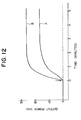
- Fig. 12 illustrates an example of the output power of the sensor in which a sample pouring point in time is designated by an arrow.
- the output power of the sensor examined was measured by using a 2 mM tris-maleic acid buffer solution (pH 7) containing 1.67 mM glucose and 3 mM triolein.
- curve A represents a differential output between the pH-ISFET having a lipase immobilized membrane and the pH-ISFET without any enzyme immobilized membrane.
- Triolein was hydrolyzed into oleic acid according to the following reaction (2) to provide the output curve A.
- curve B in Fig. 12 represents a differential output between the pH-ISFET having a glucose-oxidase immoblized membrane and the pH-ISFET without any enzyme immobilized membrane.
- Glucose was changed to gluconic acid, as shown in the above reaction (1), so that pH of the enzyme immobilized membrane was accordingly reduced to provide the output curve B.
- the measurement by the multiple sensor was possible in a glucose concentration ranging from 0 to 3 mM and at an triolein concentration ranging from 0 to 4 mM.
- a pseude reference electrode in the form of a thin membrane of a novel metal was used to provide gate voltage
- a stable reference electrode such as a silver-silver chloride electrode may be employed.
- glucose oxidase and lipase were used for enzymes, but instead by the use of other kinds of enzymes, it is possible to produce a semiconductor sensor or a multiple-enzyme sensor, which is sensitive to various substrates.
- the mixture of PVP and bis-azide compound is used for a water soluble photosensitive resin
- other types of water soluble photosensitive resins such as photosensitive polyvinyl alcohols each having, as a pendant, a stilbazolium group.
- enzymes are not limited to glucose oxidase or lipase but other kinds of enzymes such as urease can be used.
- bovine serum albumin and an enzyme with glutaraldehyde there may be employed any combination of general reagents which are usable with water soluble immobilized enzymes which are able to easily form chemical crosslinking therewith.
- poly-L-lysine or copolymers of polyamino acid and poly-L-lysine can be used in place of bovine serum albumin, and a polyfuctional reagent having a plurality of aldehyde groups can be used in place of glutaraldehyde.
Landscapes
- Chemical & Material Sciences (AREA)
- Life Sciences & Earth Sciences (AREA)
- Organic Chemistry (AREA)
- Zoology (AREA)
- Engineering & Computer Science (AREA)
- Health & Medical Sciences (AREA)
- Wood Science & Technology (AREA)
- Bioinformatics & Cheminformatics (AREA)
- Genetics & Genomics (AREA)
- Biotechnology (AREA)
- Microbiology (AREA)
- Biochemistry (AREA)
- General Engineering & Computer Science (AREA)
- General Health & Medical Sciences (AREA)
- Biomedical Technology (AREA)
- Proteomics, Peptides & Aminoacids (AREA)
- Analytical Chemistry (AREA)
- Biophysics (AREA)
- Physics & Mathematics (AREA)
- Immunology (AREA)
- Molecular Biology (AREA)
- Immobilizing And Processing Of Enzymes And Microorganisms (AREA)
- Apparatus Associated With Microorganisms And Enzymes (AREA)
Applications Claiming Priority (6)
| Application Number | Priority Date | Filing Date | Title |
|---|---|---|---|
| JP60283056A JPS62144060A (ja) | 1985-12-18 | 1985-12-18 | 半導体バイオセンサの固定化酵素膜形成法 |
| JP283056/85 | 1985-12-18 | ||
| JP13902/86 | 1986-01-27 | ||
| JP61013900A JPS62171684A (ja) | 1986-01-27 | 1986-01-27 | グルコ−スオキシダ−ゼ固定化酵素膜とその製造方法 |
| JP61013902A JPS62172255A (ja) | 1986-01-27 | 1986-01-27 | 半導体酵素センサ |
| JP13900/86 | 1986-01-27 |
Publications (3)
| Publication Number | Publication Date |
|---|---|
| EP0228259A2 true EP0228259A2 (de) | 1987-07-08 |
| EP0228259A3 EP0228259A3 (en) | 1989-07-12 |
| EP0228259B1 EP0228259B1 (de) | 1993-02-17 |
Family
ID=27280444
Family Applications (1)
| Application Number | Title | Priority Date | Filing Date |
|---|---|---|---|
| EP86309931A Expired - Lifetime EP0228259B1 (de) | 1985-12-18 | 1986-12-18 | Immobilisierte Enzym-Membrane für einen Halbleiterdetektor und deren Herstellungsverfahren |
Country Status (3)
| Country | Link |
|---|---|
| US (1) | US4894339A (de) |
| EP (1) | EP0228259B1 (de) |
| DE (1) | DE3687790T2 (de) |
Cited By (10)
| Publication number | Priority date | Publication date | Assignee | Title |
|---|---|---|---|---|
| EP0328108A3 (en) * | 1988-02-10 | 1990-04-25 | Nec Corporation | Electrochemical sensor facilitating repeated measurement |
| EP0326081A3 (en) * | 1988-01-25 | 1990-05-30 | Kanzaki Paper Manufacturing Co., Ltd. | Enzyme electrode |
| US5200051A (en) * | 1988-11-14 | 1993-04-06 | I-Stat Corporation | Wholly microfabricated biosensors and process for the manufacture and use thereof |
| FR2705148A1 (fr) * | 1993-05-12 | 1994-11-18 | Lyon Ecole Centrale | Capteur électrochimique de dosage enzymatique de type ENFET et dispositif de dosage le mettant en Óoeuvre. |
| WO1997010356A1 (en) * | 1995-09-12 | 1997-03-20 | Cygnus, Inc. | Chemical signal-impermeable mask |
| EP0707064A3 (de) * | 1994-10-05 | 1997-07-30 | Avl Medical Instr Ag | Verfahren zur Immobilisierung biologischer Komponenten in einer Polymermatrix sowie Biosensoren unter Verwendung derartiger Immobilisate |
| US6306594B1 (en) | 1988-11-14 | 2001-10-23 | I-Stat Corporation | Methods for microdispensing patterened layers |
| WO2012012135A3 (en) * | 2010-06-30 | 2012-04-12 | Edwards Lifesciences Corporation | Analyte sensor |
| EP2329255A4 (de) * | 2008-08-27 | 2014-04-09 | Edwards Lifesciences Corp | Analytsensor |
| CN105829545A (zh) * | 2013-12-23 | 2016-08-03 | 威里利生命科学有限责任公司 | 两层分析物传感器 |
Families Citing this family (53)
| Publication number | Priority date | Publication date | Assignee | Title |
|---|---|---|---|---|
| DE3806955A1 (de) * | 1987-03-03 | 1988-09-15 | Res Ass Bio Tech Chem | Glucoseempfindlicher fet-sensor und verfahren zu seiner herstellung |
| US5212050A (en) * | 1988-11-14 | 1993-05-18 | Mier Randall M | Method of forming a permselective layer |
| US5063081A (en) * | 1988-11-14 | 1991-11-05 | I-Stat Corporation | Method of manufacturing a plurality of uniform microfabricated sensing devices having an immobilized ligand receptor |
| US5262035A (en) * | 1989-08-02 | 1993-11-16 | E. Heller And Company | Enzyme electrodes |
| JP2646848B2 (ja) * | 1990-11-30 | 1997-08-27 | 日本電気株式会社 | グルコースセンサの測定方法 |
| DE69217461T2 (de) * | 1991-11-08 | 1997-10-23 | Nippon Electric Co | Immobilisierte Enzym-Membran, immobilisierte Protein-Membran und Verfahren zu ihrer Herstellung |
| US5283186A (en) * | 1991-12-31 | 1994-02-01 | Abbott Laboratories | Preparation of a compressed membrane containing immobilized biologically acting material |
| US5310469A (en) * | 1991-12-31 | 1994-05-10 | Abbott Laboratories | Biosensor with a membrane containing biologically active material |
| WO1993013408A1 (en) * | 1991-12-31 | 1993-07-08 | Abbott Laboratories | Composite membrane |
| EP0567661A1 (de) * | 1992-04-25 | 1993-11-03 | Societe Des Produits Nestle S.A. | Modifizierte Lipase, Verfahren zur Modifizierung und Verwendungen |
| EP0730760A1 (de) * | 1993-11-25 | 1996-09-11 | Technobiochip | Potentiometrischer biosensor,regelung und anwendung |
| US5505747A (en) * | 1994-01-13 | 1996-04-09 | Minnesota Mining And Manufacturing Company | Method of making an abrasive article |
| US6699667B2 (en) | 1997-05-14 | 2004-03-02 | Keensense, Inc. | Molecular wire injection sensors |
| US7220550B2 (en) * | 1997-05-14 | 2007-05-22 | Keensense, Inc. | Molecular wire injection sensors |
| US6060327A (en) | 1997-05-14 | 2000-05-09 | Keensense, Inc. | Molecular wire injection sensors |
| US6103033A (en) * | 1998-03-04 | 2000-08-15 | Therasense, Inc. | Process for producing an electrochemical biosensor |
| US6096172A (en) * | 1998-10-19 | 2000-08-01 | Motorola, Inc. | Method of bonding bio-molecules to a test site |
| JP3306506B2 (ja) * | 1999-08-23 | 2002-07-24 | 独立行政法人産業技術総合研究所 | 非環状ペプチドを用いたイオンセンサ |
| US6405066B1 (en) * | 2000-03-17 | 2002-06-11 | The Regents Of The University Of California | Implantable analyte sensor |
| US6657003B2 (en) * | 2000-08-10 | 2003-12-02 | Tripath Imaging, Inc. | Cell adhesion solution |
| US7374905B2 (en) * | 2000-11-08 | 2008-05-20 | Oxyrase, Inc. | Medium composition, method and device for selectively enhancing the isolation of anaerobic microorganisms contained in a mixed sample with facultative microorganisms |
| US6653653B2 (en) | 2001-07-13 | 2003-11-25 | Quantum Logic Devices, Inc. | Single-electron transistors and fabrication methods in which a projecting feature defines spacing between electrodes |
| US6483125B1 (en) | 2001-07-13 | 2002-11-19 | North Carolina State University | Single electron transistors in which the thickness of an insulating layer defines spacing between electrodes |
| DE10151020A1 (de) * | 2001-10-16 | 2003-04-30 | Infineon Technologies Ag | Schaltkreis-Anordnung, Sensor-Array und Biosensor-Array |
| US6749887B1 (en) * | 2001-11-28 | 2004-06-15 | Lifescan, Inc. | Solution drying system |
| US20050106587A1 (en) * | 2001-12-21 | 2005-05-19 | Micronas Gmbh | Method for determining of nucleic acid analytes |
| JP3818265B2 (ja) * | 2002-03-04 | 2006-09-06 | 株式会社豊田中央研究所 | 微小物体の光固定化方法、微小物体固定化担体及び微小物体の観察方法 |
| US6673717B1 (en) | 2002-06-26 | 2004-01-06 | Quantum Logic Devices, Inc. | Methods for fabricating nanopores for single-electron devices |
| US6852996B2 (en) * | 2002-09-25 | 2005-02-08 | Stmicroelectronics, Inc. | Organic semiconductor sensor device |
| US20040256227A1 (en) * | 2003-02-11 | 2004-12-23 | Jungwon Shin | Electrochemical urea sensors and methods of making the same |
| DE10309349B4 (de) * | 2003-03-03 | 2005-11-10 | Micronas Holding Gmbh | Vorrichtung zur Untersuchung eines Analyten |
| US7920906B2 (en) | 2005-03-10 | 2011-04-05 | Dexcom, Inc. | System and methods for processing analyte sensor data for sensor calibration |
| US9247900B2 (en) | 2004-07-13 | 2016-02-02 | Dexcom, Inc. | Analyte sensor |
| US20050241959A1 (en) * | 2004-04-30 | 2005-11-03 | Kenneth Ward | Chemical-sensing devices |
| US8792955B2 (en) | 2004-05-03 | 2014-07-29 | Dexcom, Inc. | Transcutaneous analyte sensor |
| US20070045902A1 (en) * | 2004-07-13 | 2007-03-01 | Brauker James H | Analyte sensor |
| US8989833B2 (en) | 2004-07-13 | 2015-03-24 | Dexcom, Inc. | Transcutaneous analyte sensor |
| US20080312859A1 (en) * | 2004-09-03 | 2008-12-18 | Novo Nordisk A/S | Method of Calibrating a System for Measuring the Concentration of Substances in Body and an Apparatus for Exercising the Method |
| GB2422197B (en) * | 2005-05-17 | 2007-08-08 | Bio Nano Sensium Technologies | Sensor calibration |
| DK2540225T3 (en) * | 2007-05-30 | 2015-10-12 | Bayer Healthcare Llc | A process for producing a multilayer coating |
| JP4400668B2 (ja) * | 2007-11-01 | 2010-01-20 | 株式会社豊田中央研究所 | 微小物体が固定化された固相体の製造方法及びその利用 |
| US20100072062A1 (en) * | 2008-05-05 | 2010-03-25 | Edwards Lifesciences Corporation | Membrane For Use With Amperometric Sensors |
| CN102256546B (zh) * | 2008-10-31 | 2014-08-06 | 爱德华兹生命科学公司 | 带有非工作电极层的分析物传感器 |
| US20110054284A1 (en) * | 2009-08-28 | 2011-03-03 | Edwards Lifesciences Corporation | Anti-Coagulant Calibrant Infusion Fluid Source |
| US8889373B2 (en) | 2010-08-12 | 2014-11-18 | Eastman Chemical Company | Enzyme catalyst immobilized on porous fluoropolymer support |
| US8642371B2 (en) * | 2011-04-06 | 2014-02-04 | Shamsoddin Mohajerzadeh | Method and system for fabricating ion-selective field-effect transistor (ISFET) |
| US9169367B2 (en) | 2012-09-20 | 2015-10-27 | Dow Global Technologies Llc | Radiation cured membranes derived from polymers that are co-reactive with azide crosslinking agent(s) |
| CA2975171A1 (en) | 2015-01-27 | 2016-08-04 | Dow Global Technologies Llc | Separation of hydrocarbons using regenerable macroporous alkylene-bridged adsorbent |
| US10661219B2 (en) | 2015-01-27 | 2020-05-26 | DDP Specialty Electronic Materials US, Inc. | Separation of nitrogen from hydrocarbon gas using pyrolyzed sulfonated macroporous ion exchange resin |
| US10436736B2 (en) * | 2015-12-08 | 2019-10-08 | Endress+Hauser Conducta Gmbh + Co. Kg | Measurement device for measuring a property of a fluid |
| CN109781989A (zh) * | 2017-11-10 | 2019-05-21 | 上海瀚联医疗技术股份有限公司 | 血糖测试的方法及生物传感器 |
| CN113584112A (zh) * | 2020-04-30 | 2021-11-02 | 浙江荷清柔性电子技术有限公司 | 葡萄糖传感器及其酶固定方法 |
| US20220397545A1 (en) * | 2021-06-15 | 2022-12-15 | Laxmi Therapeutic Devices, Inc. | Photochemical-based method for enzyme immobilization on biosensor electrodes |
Family Cites Families (5)
| Publication number | Priority date | Publication date | Assignee | Title |
|---|---|---|---|---|
| US4464468A (en) * | 1968-03-29 | 1984-08-07 | Agence Nationale De Valorisation De La Recherche (Anvar) | Immobilization of active protein by cross-linking to inactive protein |
| JPS5334984A (en) * | 1976-09-09 | 1978-03-31 | Agency Of Ind Science & Technol | Immobilization of enzyme by light irradiation |
| JPS5523941A (en) * | 1978-08-09 | 1980-02-20 | Agency Of Ind Science & Technol | Immobilization of enzyme using water-soluble photo- crosslinkable resin |
| JPS5963554A (ja) * | 1982-10-04 | 1984-04-11 | Hitachi Ltd | ウレア−ゼ固定化尿素電極およびその製造方法 |
| US4631249A (en) * | 1984-01-16 | 1986-12-23 | Rohm & Haas Company | Process for forming thermally stable negative images on surfaces utilizing polyglutarimide polymer in photoresist composition |
-
1986
- 1986-12-17 US US06/942,797 patent/US4894339A/en not_active Expired - Fee Related
- 1986-12-18 EP EP86309931A patent/EP0228259B1/de not_active Expired - Lifetime
- 1986-12-18 DE DE8686309931T patent/DE3687790T2/de not_active Expired - Fee Related
Cited By (23)
| Publication number | Priority date | Publication date | Assignee | Title |
|---|---|---|---|---|
| EP0326081A3 (en) * | 1988-01-25 | 1990-05-30 | Kanzaki Paper Manufacturing Co., Ltd. | Enzyme electrode |
| US5034330A (en) * | 1988-01-25 | 1991-07-23 | Kanzaki Paper Mfg. Co., Ltd. | Preparation of a selectively permeable membrane for an enzyme electrode |
| EP0328108A3 (en) * | 1988-02-10 | 1990-04-25 | Nec Corporation | Electrochemical sensor facilitating repeated measurement |
| US5837446A (en) * | 1988-11-14 | 1998-11-17 | I-Stat Corporation | Process for the manufacture of wholly microfabricated biosensors |
| US5200051A (en) * | 1988-11-14 | 1993-04-06 | I-Stat Corporation | Wholly microfabricated biosensors and process for the manufacture and use thereof |
| US7074610B2 (en) | 1988-11-14 | 2006-07-11 | I-Stat Corporation | System and method of microdispensing and arrays of biolayers provided by same |
| US6306594B1 (en) | 1988-11-14 | 2001-10-23 | I-Stat Corporation | Methods for microdispensing patterened layers |
| WO1994026871A1 (fr) * | 1993-05-12 | 1994-11-24 | Ecole Centrale De Lyon | Capteur electrochimique de dosage enzymatique de type enfet |
| FR2705148A1 (fr) * | 1993-05-12 | 1994-11-18 | Lyon Ecole Centrale | Capteur électrochimique de dosage enzymatique de type ENFET et dispositif de dosage le mettant en Óoeuvre. |
| EP0707064A3 (de) * | 1994-10-05 | 1997-07-30 | Avl Medical Instr Ag | Verfahren zur Immobilisierung biologischer Komponenten in einer Polymermatrix sowie Biosensoren unter Verwendung derartiger Immobilisate |
| US6141573A (en) * | 1995-09-12 | 2000-10-31 | Cygnus, Inc. | Chemical signal-impermeable mask |
| US5735273A (en) * | 1995-09-12 | 1998-04-07 | Cygnus, Inc. | Chemical signal-impermeable mask |
| US6201979B1 (en) | 1995-09-12 | 2001-03-13 | Cygnus, Inc. | Chemical signal-impermeable mask |
| WO1997010356A1 (en) * | 1995-09-12 | 1997-03-20 | Cygnus, Inc. | Chemical signal-impermeable mask |
| US6370410B2 (en) | 1995-09-12 | 2002-04-09 | Cygnus, Inc. | Methods of producing an assembly for use in a monitoring device |
| US6529755B2 (en) | 1995-09-12 | 2003-03-04 | Cygnus, Inc. | Chemical signal-impermeable mask |
| US6771995B2 (en) | 1995-09-12 | 2004-08-03 | Cygnus, Inc. | Chemical signal-impermeable mask |
| US5827183A (en) * | 1995-09-12 | 1998-10-27 | Cygnus, Inc. | Method of measuring chemical concentration iontophoretically using impermeable mask |
| EP2329255A4 (de) * | 2008-08-27 | 2014-04-09 | Edwards Lifesciences Corp | Analytsensor |
| WO2012012135A3 (en) * | 2010-06-30 | 2012-04-12 | Edwards Lifesciences Corporation | Analyte sensor |
| CN105829545A (zh) * | 2013-12-23 | 2016-08-03 | 威里利生命科学有限责任公司 | 两层分析物传感器 |
| EP3087195A4 (de) * | 2013-12-23 | 2017-06-14 | Verily Life Sciences LLC | Zweischichtiger analytsensor |
| US9834805B2 (en) | 2013-12-23 | 2017-12-05 | Verily Life Sciences Llc | Two-layer analyte sensor |
Also Published As
| Publication number | Publication date |
|---|---|
| DE3687790T2 (de) | 1993-06-09 |
| US4894339A (en) | 1990-01-16 |
| EP0228259B1 (de) | 1993-02-17 |
| DE3687790D1 (de) | 1993-03-25 |
| EP0228259A3 (en) | 1989-07-12 |
Similar Documents
| Publication | Publication Date | Title |
|---|---|---|
| EP0228259B1 (de) | Immobilisierte Enzym-Membrane für einen Halbleiterdetektor und deren Herstellungsverfahren | |
| US5445920A (en) | Fabrication process of biosensor | |
| Van der Schoot et al. | ISFET based enzyme sensors | |
| EP0286118B1 (de) | Glukose-Elektrode und Verfahren zur Bestimmung von Glukose | |
| Nakamoto et al. | A lift-off method for patterning enzyme-immobilized membranes in multi-biosensors | |
| CA1061230A (en) | Method for studying enzymatic and other biochemical reactions | |
| Hendji et al. | Sensitive detection of pesticides using a differential ISFET-based system with immobilized cholinesterases | |
| US5387328A (en) | Bio-sensor using ion sensitive field effect transistor with platinum electrode | |
| EP0121385A1 (de) | Konduktometrische biologische Messverfahren | |
| Hanazato et al. | Glucose sensor based on a field-effect transistor with a photolithographically patterned glucose oxidase membrane | |
| MXPA94006538A (en) | Immunoassayo de complementacion enzimaticaelectroquim | |
| Suzuki et al. | Fabrication of an oxygen electrode using semiconductor technology | |
| JPH01203960A (ja) | 電気化学センサ | |
| Anzai et al. | Penicillin sensors based on an ion-sensitive field effect transistor coated with stearic acid Langmuir-Blodgett membrane | |
| CN104919310A (zh) | 生物传感器及其制造方法 | |
| JPS6188135A (ja) | 半導体バイオセンサの製造方法 | |
| JPH102875A (ja) | 酵素反応センサー及びその製造方法 | |
| Gotoh et al. | Micro-FET biosensors using polyvinylbutyral membrane | |
| JPS6366454A (ja) | 酵素センサ−およびその製造方法 | |
| JPS61153559A (ja) | 半導体酵素センサ | |
| JPH09210955A (ja) | タンパク質センサ | |
| JPH0365866B2 (de) | ||
| JPS6029657A (ja) | グルコースセンサの製造方法 | |
| Shiono et al. | Advances in enzymatically coupled field effect transistors | |
| JPS6232351A (ja) | 酵素センサ− |
Legal Events
| Date | Code | Title | Description |
|---|---|---|---|
| PUAI | Public reference made under article 153(3) epc to a published international application that has entered the european phase |
Free format text: ORIGINAL CODE: 0009012 |
|
| AK | Designated contracting states |
Kind code of ref document: A2 Designated state(s): DE FR GB |
|
| RIN1 | Information on inventor provided before grant (corrected) |
Inventor name: YAMADA, SATOSHI C/O CHUO KENKYUSHO MISUBISHI Inventor name: NAKAKO MAMIKOPAR.C/O CHUO KENKYUSHOPAR.MITSUBISHI Inventor name: SHIONO, SATORU C/O CHUO KENKYUSHO MISUBISHI Inventor name: HANAZATO, YOSHIO CHUO KENKYUSHO OF MITSUBISHI |
|
| PUAL | Search report despatched |
Free format text: ORIGINAL CODE: 0009013 |
|
| AK | Designated contracting states |
Kind code of ref document: A3 Designated state(s): DE FR GB |
|
| 17P | Request for examination filed |
Effective date: 19891130 |
|
| 17Q | First examination report despatched |
Effective date: 19901105 |
|
| GRAA | (expected) grant |
Free format text: ORIGINAL CODE: 0009210 |
|
| AK | Designated contracting states |
Kind code of ref document: B1 Designated state(s): DE FR GB |
|
| REF | Corresponds to: |
Ref document number: 3687790 Country of ref document: DE Date of ref document: 19930325 |
|
| ET | Fr: translation filed | ||
| REG | Reference to a national code |
Ref country code: GB Ref legal event code: 727 |
|
| REG | Reference to a national code |
Ref country code: GB Ref legal event code: 727A |
|
| REG | Reference to a national code |
Ref country code: GB Ref legal event code: 727D |
|
| PLBE | No opposition filed within time limit |
Free format text: ORIGINAL CODE: 0009261 |
|
| STAA | Information on the status of an ep patent application or granted ep patent |
Free format text: STATUS: NO OPPOSITION FILED WITHIN TIME LIMIT |
|
| 26N | No opposition filed | ||
| REG | Reference to a national code |
Ref country code: GB Ref legal event code: SP |
|
| PGFP | Annual fee paid to national office [announced via postgrant information from national office to epo] |
Ref country code: GB Payment date: 19950601 Year of fee payment: 9 |
|
| PGFP | Annual fee paid to national office [announced via postgrant information from national office to epo] |
Ref country code: FR Payment date: 19950627 Year of fee payment: 9 |
|
| PGFP | Annual fee paid to national office [announced via postgrant information from national office to epo] |
Ref country code: DE Payment date: 19950629 Year of fee payment: 9 |
|
| REG | Reference to a national code |
Ref country code: GB Ref legal event code: 732E |
|
| REG | Reference to a national code |
Ref country code: FR Ref legal event code: TP |
|
| PG25 | Lapsed in a contracting state [announced via postgrant information from national office to epo] |
Ref country code: GB Effective date: 19951218 |
|
| GBPC | Gb: european patent ceased through non-payment of renewal fee |
Effective date: 19951218 |
|
| PG25 | Lapsed in a contracting state [announced via postgrant information from national office to epo] |
Ref country code: FR Effective date: 19960830 |
|
| PG25 | Lapsed in a contracting state [announced via postgrant information from national office to epo] |
Ref country code: DE Effective date: 19960903 |
|
| REG | Reference to a national code |
Ref country code: FR Ref legal event code: ST |