EP0228705A2 - Trenmittel für Polyurethanformteile - Google Patents
Trenmittel für Polyurethanformteile Download PDFInfo
- Publication number
- EP0228705A2 EP0228705A2 EP86118073A EP86118073A EP0228705A2 EP 0228705 A2 EP0228705 A2 EP 0228705A2 EP 86118073 A EP86118073 A EP 86118073A EP 86118073 A EP86118073 A EP 86118073A EP 0228705 A2 EP0228705 A2 EP 0228705A2
- Authority
- EP
- European Patent Office
- Prior art keywords
- weight
- fatty acids
- release agent
- salts
- isostearic acid
- Prior art date
- Legal status (The legal status is an assumption and is not a legal conclusion. Google has not performed a legal analysis and makes no representation as to the accuracy of the status listed.)
- Granted
Links
Classifications
-
- C—CHEMISTRY; METALLURGY
- C10—PETROLEUM, GAS OR COKE INDUSTRIES; TECHNICAL GASES CONTAINING CARBON MONOXIDE; FUELS; LUBRICANTS; PEAT
- C10M—LUBRICATING COMPOSITIONS; USE OF CHEMICAL SUBSTANCES EITHER ALONE OR AS LUBRICATING INGREDIENTS IN A LUBRICATING COMPOSITION
- C10M173/00—Lubricating compositions containing more than 10% water
- C10M173/02—Lubricating compositions containing more than 10% water not containing mineral or fatty oils
-
- B—PERFORMING OPERATIONS; TRANSPORTING
- B29—WORKING OF PLASTICS; WORKING OF SUBSTANCES IN A PLASTIC STATE IN GENERAL
- B29C—SHAPING OR JOINING OF PLASTICS; SHAPING OF MATERIAL IN A PLASTIC STATE, NOT OTHERWISE PROVIDED FOR; AFTER-TREATMENT OF THE SHAPED PRODUCTS, e.g. REPAIRING
- B29C33/00—Moulds or cores; Details thereof or accessories therefor
- B29C33/56—Coatings, e.g. enameled or galvanised; Releasing, lubricating or separating agents
- B29C33/60—Releasing, lubricating or separating agents
-
- C—CHEMISTRY; METALLURGY
- C08—ORGANIC MACROMOLECULAR COMPOUNDS; THEIR PREPARATION OR CHEMICAL WORKING-UP; COMPOSITIONS BASED THEREON
- C08K—Use of inorganic or non-macromolecular organic substances as compounding ingredients
- C08K5/00—Use of organic ingredients
- C08K5/04—Oxygen-containing compounds
- C08K5/09—Carboxylic acids; Metal salts thereof; Anhydrides thereof
- C08K5/098—Metal salts of carboxylic acids
-
- C—CHEMISTRY; METALLURGY
- C10—PETROLEUM, GAS OR COKE INDUSTRIES; TECHNICAL GASES CONTAINING CARBON MONOXIDE; FUELS; LUBRICANTS; PEAT
- C10M—LUBRICATING COMPOSITIONS; USE OF CHEMICAL SUBSTANCES EITHER ALONE OR AS LUBRICATING INGREDIENTS IN A LUBRICATING COMPOSITION
- C10M129/00—Lubricating compositions characterised by the additive being an organic non-macromolecular compound containing oxygen
- C10M129/02—Lubricating compositions characterised by the additive being an organic non-macromolecular compound containing oxygen having a carbon chain of less than 30 atoms
- C10M129/04—Hydroxy compounds
- C10M129/06—Hydroxy compounds having hydroxy groups bound to acyclic or cycloaliphatic carbon atoms
-
- C—CHEMISTRY; METALLURGY
- C10—PETROLEUM, GAS OR COKE INDUSTRIES; TECHNICAL GASES CONTAINING CARBON MONOXIDE; FUELS; LUBRICANTS; PEAT
- C10M—LUBRICATING COMPOSITIONS; USE OF CHEMICAL SUBSTANCES EITHER ALONE OR AS LUBRICATING INGREDIENTS IN A LUBRICATING COMPOSITION
- C10M129/00—Lubricating compositions characterised by the additive being an organic non-macromolecular compound containing oxygen
- C10M129/02—Lubricating compositions characterised by the additive being an organic non-macromolecular compound containing oxygen having a carbon chain of less than 30 atoms
- C10M129/26—Carboxylic acids; Salts thereof
- C10M129/28—Carboxylic acids; Salts thereof having carboxyl groups bound to acyclic or cycloaliphatic carbon atoms
- C10M129/30—Carboxylic acids; Salts thereof having carboxyl groups bound to acyclic or cycloaliphatic carbon atoms having 7 or less carbon atoms
- C10M129/32—Carboxylic acids; Salts thereof having carboxyl groups bound to acyclic or cycloaliphatic carbon atoms having 7 or less carbon atoms monocarboxylic
-
- C—CHEMISTRY; METALLURGY
- C10—PETROLEUM, GAS OR COKE INDUSTRIES; TECHNICAL GASES CONTAINING CARBON MONOXIDE; FUELS; LUBRICANTS; PEAT
- C10M—LUBRICATING COMPOSITIONS; USE OF CHEMICAL SUBSTANCES EITHER ALONE OR AS LUBRICATING INGREDIENTS IN A LUBRICATING COMPOSITION
- C10M2201/00—Inorganic compounds or elements as ingredients in lubricant compositions
- C10M2201/02—Water
-
- C—CHEMISTRY; METALLURGY
- C10—PETROLEUM, GAS OR COKE INDUSTRIES; TECHNICAL GASES CONTAINING CARBON MONOXIDE; FUELS; LUBRICANTS; PEAT
- C10M—LUBRICATING COMPOSITIONS; USE OF CHEMICAL SUBSTANCES EITHER ALONE OR AS LUBRICATING INGREDIENTS IN A LUBRICATING COMPOSITION
- C10M2207/00—Organic non-macromolecular hydrocarbon compounds containing hydrogen, carbon and oxygen as ingredients in lubricant compositions
- C10M2207/02—Hydroxy compounds
- C10M2207/021—Hydroxy compounds having hydroxy groups bound to acyclic or cycloaliphatic carbon atoms
-
- C—CHEMISTRY; METALLURGY
- C10—PETROLEUM, GAS OR COKE INDUSTRIES; TECHNICAL GASES CONTAINING CARBON MONOXIDE; FUELS; LUBRICANTS; PEAT
- C10M—LUBRICATING COMPOSITIONS; USE OF CHEMICAL SUBSTANCES EITHER ALONE OR AS LUBRICATING INGREDIENTS IN A LUBRICATING COMPOSITION
- C10M2207/00—Organic non-macromolecular hydrocarbon compounds containing hydrogen, carbon and oxygen as ingredients in lubricant compositions
- C10M2207/10—Carboxylix acids; Neutral salts thereof
- C10M2207/12—Carboxylix acids; Neutral salts thereof having carboxyl groups bound to acyclic or cycloaliphatic carbon atoms
- C10M2207/125—Carboxylix acids; Neutral salts thereof having carboxyl groups bound to acyclic or cycloaliphatic carbon atoms having hydrocarbon chains of eight up to twenty-nine carbon atoms, i.e. fatty acids
-
- C—CHEMISTRY; METALLURGY
- C10—PETROLEUM, GAS OR COKE INDUSTRIES; TECHNICAL GASES CONTAINING CARBON MONOXIDE; FUELS; LUBRICANTS; PEAT
- C10M—LUBRICATING COMPOSITIONS; USE OF CHEMICAL SUBSTANCES EITHER ALONE OR AS LUBRICATING INGREDIENTS IN A LUBRICATING COMPOSITION
- C10M2207/00—Organic non-macromolecular hydrocarbon compounds containing hydrogen, carbon and oxygen as ingredients in lubricant compositions
- C10M2207/10—Carboxylix acids; Neutral salts thereof
- C10M2207/12—Carboxylix acids; Neutral salts thereof having carboxyl groups bound to acyclic or cycloaliphatic carbon atoms
- C10M2207/129—Carboxylix acids; Neutral salts thereof having carboxyl groups bound to acyclic or cycloaliphatic carbon atoms having hydrocarbon chains of thirty or more carbon atoms
-
- C—CHEMISTRY; METALLURGY
- C10—PETROLEUM, GAS OR COKE INDUSTRIES; TECHNICAL GASES CONTAINING CARBON MONOXIDE; FUELS; LUBRICANTS; PEAT
- C10M—LUBRICATING COMPOSITIONS; USE OF CHEMICAL SUBSTANCES EITHER ALONE OR AS LUBRICATING INGREDIENTS IN A LUBRICATING COMPOSITION
- C10M2209/00—Organic macromolecular compounds containing oxygen as ingredients in lubricant compositions
- C10M2209/10—Macromolecular compoundss obtained otherwise than by reactions only involving carbon-to-carbon unsaturated bonds
- C10M2209/103—Polyethers, i.e. containing di- or higher polyoxyalkylene groups
- C10M2209/104—Polyethers, i.e. containing di- or higher polyoxyalkylene groups of alkylene oxides containing two carbon atoms only
-
- C—CHEMISTRY; METALLURGY
- C10—PETROLEUM, GAS OR COKE INDUSTRIES; TECHNICAL GASES CONTAINING CARBON MONOXIDE; FUELS; LUBRICANTS; PEAT
- C10M—LUBRICATING COMPOSITIONS; USE OF CHEMICAL SUBSTANCES EITHER ALONE OR AS LUBRICATING INGREDIENTS IN A LUBRICATING COMPOSITION
- C10M2211/00—Organic non-macromolecular compounds containing halogen as ingredients in lubricant compositions
- C10M2211/04—Organic non-macromolecular compounds containing halogen as ingredients in lubricant compositions containing carbon, hydrogen, halogen, and oxygen
- C10M2211/044—Acids; Salts or esters thereof
-
- C—CHEMISTRY; METALLURGY
- C10—PETROLEUM, GAS OR COKE INDUSTRIES; TECHNICAL GASES CONTAINING CARBON MONOXIDE; FUELS; LUBRICANTS; PEAT
- C10M—LUBRICATING COMPOSITIONS; USE OF CHEMICAL SUBSTANCES EITHER ALONE OR AS LUBRICATING INGREDIENTS IN A LUBRICATING COMPOSITION
- C10M2211/00—Organic non-macromolecular compounds containing halogen as ingredients in lubricant compositions
- C10M2211/06—Perfluorinated compounds
-
- C—CHEMISTRY; METALLURGY
- C10—PETROLEUM, GAS OR COKE INDUSTRIES; TECHNICAL GASES CONTAINING CARBON MONOXIDE; FUELS; LUBRICANTS; PEAT
- C10M—LUBRICATING COMPOSITIONS; USE OF CHEMICAL SUBSTANCES EITHER ALONE OR AS LUBRICATING INGREDIENTS IN A LUBRICATING COMPOSITION
- C10M2219/00—Organic non-macromolecular compounds containing sulfur, selenium or tellurium as ingredients in lubricant compositions
- C10M2219/04—Organic non-macromolecular compounds containing sulfur, selenium or tellurium as ingredients in lubricant compositions containing sulfur-to-oxygen bonds, i.e. sulfones, sulfoxides
- C10M2219/044—Sulfonic acids, Derivatives thereof, e.g. neutral salts
-
- C—CHEMISTRY; METALLURGY
- C10—PETROLEUM, GAS OR COKE INDUSTRIES; TECHNICAL GASES CONTAINING CARBON MONOXIDE; FUELS; LUBRICANTS; PEAT
- C10N—INDEXING SCHEME ASSOCIATED WITH SUBCLASS C10M RELATING TO LUBRICATING COMPOSITIONS
- C10N2010/00—Metal present as such or in compounds
- C10N2010/02—Groups 1 or 11
-
- C—CHEMISTRY; METALLURGY
- C10—PETROLEUM, GAS OR COKE INDUSTRIES; TECHNICAL GASES CONTAINING CARBON MONOXIDE; FUELS; LUBRICANTS; PEAT
- C10N—INDEXING SCHEME ASSOCIATED WITH SUBCLASS C10M RELATING TO LUBRICATING COMPOSITIONS
- C10N2040/00—Specified use or application for which the lubricating composition is intended
-
- C—CHEMISTRY; METALLURGY
- C10—PETROLEUM, GAS OR COKE INDUSTRIES; TECHNICAL GASES CONTAINING CARBON MONOXIDE; FUELS; LUBRICANTS; PEAT
- C10N—INDEXING SCHEME ASSOCIATED WITH SUBCLASS C10M RELATING TO LUBRICATING COMPOSITIONS
- C10N2040/00—Specified use or application for which the lubricating composition is intended
- C10N2040/30—Refrigerators lubricants or compressors lubricants
-
- C—CHEMISTRY; METALLURGY
- C10—PETROLEUM, GAS OR COKE INDUSTRIES; TECHNICAL GASES CONTAINING CARBON MONOXIDE; FUELS; LUBRICANTS; PEAT
- C10N—INDEXING SCHEME ASSOCIATED WITH SUBCLASS C10M RELATING TO LUBRICATING COMPOSITIONS
- C10N2040/00—Specified use or application for which the lubricating composition is intended
- C10N2040/32—Wires, ropes or cables lubricants
-
- C—CHEMISTRY; METALLURGY
- C10—PETROLEUM, GAS OR COKE INDUSTRIES; TECHNICAL GASES CONTAINING CARBON MONOXIDE; FUELS; LUBRICANTS; PEAT
- C10N—INDEXING SCHEME ASSOCIATED WITH SUBCLASS C10M RELATING TO LUBRICATING COMPOSITIONS
- C10N2040/00—Specified use or application for which the lubricating composition is intended
- C10N2040/34—Lubricating-sealants
-
- C—CHEMISTRY; METALLURGY
- C10—PETROLEUM, GAS OR COKE INDUSTRIES; TECHNICAL GASES CONTAINING CARBON MONOXIDE; FUELS; LUBRICANTS; PEAT
- C10N—INDEXING SCHEME ASSOCIATED WITH SUBCLASS C10M RELATING TO LUBRICATING COMPOSITIONS
- C10N2040/00—Specified use or application for which the lubricating composition is intended
- C10N2040/36—Release agents or mold release agents
-
- C—CHEMISTRY; METALLURGY
- C10—PETROLEUM, GAS OR COKE INDUSTRIES; TECHNICAL GASES CONTAINING CARBON MONOXIDE; FUELS; LUBRICANTS; PEAT
- C10N—INDEXING SCHEME ASSOCIATED WITH SUBCLASS C10M RELATING TO LUBRICATING COMPOSITIONS
- C10N2040/00—Specified use or application for which the lubricating composition is intended
- C10N2040/38—Conveyors or chain belts
-
- C—CHEMISTRY; METALLURGY
- C10—PETROLEUM, GAS OR COKE INDUSTRIES; TECHNICAL GASES CONTAINING CARBON MONOXIDE; FUELS; LUBRICANTS; PEAT
- C10N—INDEXING SCHEME ASSOCIATED WITH SUBCLASS C10M RELATING TO LUBRICATING COMPOSITIONS
- C10N2040/00—Specified use or application for which the lubricating composition is intended
- C10N2040/40—Generators or electric motors in oil or gas winning field
-
- C—CHEMISTRY; METALLURGY
- C10—PETROLEUM, GAS OR COKE INDUSTRIES; TECHNICAL GASES CONTAINING CARBON MONOXIDE; FUELS; LUBRICANTS; PEAT
- C10N—INDEXING SCHEME ASSOCIATED WITH SUBCLASS C10M RELATING TO LUBRICATING COMPOSITIONS
- C10N2040/00—Specified use or application for which the lubricating composition is intended
- C10N2040/42—Flashing oils or marking oils
-
- C—CHEMISTRY; METALLURGY
- C10—PETROLEUM, GAS OR COKE INDUSTRIES; TECHNICAL GASES CONTAINING CARBON MONOXIDE; FUELS; LUBRICANTS; PEAT
- C10N—INDEXING SCHEME ASSOCIATED WITH SUBCLASS C10M RELATING TO LUBRICATING COMPOSITIONS
- C10N2040/00—Specified use or application for which the lubricating composition is intended
- C10N2040/44—Super vacuum or supercritical use
-
- C—CHEMISTRY; METALLURGY
- C10—PETROLEUM, GAS OR COKE INDUSTRIES; TECHNICAL GASES CONTAINING CARBON MONOXIDE; FUELS; LUBRICANTS; PEAT
- C10N—INDEXING SCHEME ASSOCIATED WITH SUBCLASS C10M RELATING TO LUBRICATING COMPOSITIONS
- C10N2040/00—Specified use or application for which the lubricating composition is intended
- C10N2040/50—Medical uses
-
- C—CHEMISTRY; METALLURGY
- C10—PETROLEUM, GAS OR COKE INDUSTRIES; TECHNICAL GASES CONTAINING CARBON MONOXIDE; FUELS; LUBRICANTS; PEAT
- C10N—INDEXING SCHEME ASSOCIATED WITH SUBCLASS C10M RELATING TO LUBRICATING COMPOSITIONS
- C10N2050/00—Form in which the lubricant is applied to the material being lubricated
- C10N2050/01—Emulsions, colloids, or micelles
Definitions
- the invention relates to a release agent to be applied to the inner wall of the mold for the production of molded parts based on polyurethane containing alkali metal salts of fatty acids.
- the external release agents are mostly used in the form of a solution or a dispersion, the active constituent of the release agents being waxes, paraffins, fatty acid esters, fatty acid amides, silicones or salts of higher fatty acids.
- DE-AS 20 12 514 describes a release agent for preventing integral molded parts made of polyurethane from adhering to molds, which is characterized in that it contains 0.5 to 1.5% by weight aluminum tristearate, that the solvent is a liquid chlorinated Is hydrocarbon and that 0.2 to 0.8 wt .-% magnesium oleate are added to this solution.
- the use of metal salts of unsaturated or saturated fatty acids as release agents is described in a large number of other publications, reference being made only to, for example, DE-OS 27 02 930, DE-OS 26 37 919 and US Pat. No. 4,038,088.
- saturated or unsaturated carboxylic acids with 10 to 22 carbon atoms have been found to be useful. These carboxylic acids, which are also used in the form of their alkali, alkaline earth, zinc or aluminum salts, can be dissolved in chlorinated hydrocarbons or in alcohol / water mixtures.
- the release agents known from the prior art cannot meet all the requirements. It goes without saying that the separating effect of the products should be high.
- the active constituents of the release agents should be as soluble as possible in water / alcohol mixtures with a high water content in order to reduce the flammability of the solvent mixture and to keep the environmental impact of alcohol low.
- the release agents should be as low-viscosity as possible so that they can be sprayed onto the inner wall of the mold in order to run as thin, uniform films as possible without the formation of drops.
- the thin films that form should form a uniform and dense layer.
- the release agent film should be easy to polish and should not build up any residues on the formed polyurethane part.
- the surface of the demolded parts must have no pores or sink marks.
- the release agents should be washable with aqueous detergent solutions both from the molded parts and from the inner walls of the mold.
- release agents of the prior art it can frequently be observed that they greatly thicken water / alcohol mixtures or that organic solvents are necessary for the preparation of solutions.
- high viscosity affects the formation of thin release agent layers and the good flow of the applied release agents. Residue formation in the form of white crystalline deposits is frequently observed both on the inner wall of the mold and on the formed parts. the formation of flawless surfaces of the demolded parts can also be impaired.
- an external release agent has the required combination of properties if, according to the invention, it contains, as alkali metal salts of fatty acids, those with a content of at least 70% by weight of isostearic acid.
- Isostearic acid is the common name for 16-methyl-heptadecanoic acid.
- the aqueous-alkaline solution of the alkali salts of isostearic acid is of low viscosity and runs on the inner walls of the mold to form thin, smooth but uniformly dense layers.
- the sodium salt of isostearic acid is preferably used as the alkali salt. It has been found to be particularly favorable with regard to the separation properties if the alkali salt of isostearic acid contains up to 10% by weight, preferably up to 5% by weight, in particular up to 3% by weight, of free isostearic acid.
- the low content of free isostearic acid favors the separation properties as well as the safe formation of perfect and clean surfaces.
- Alcohols with 4 to 6 carbon atoms are suitable as leveling agents.
- a release agent with a content of 2-5% by weight of butanol is preferred.
- Water-soluble polyoxyalkylene-polysiloxane block copolymers can also advantageously be used as leveling agents with separation-enhancing properties.
- the wetting of the mold inner wall by the release agent according to the invention can be improved by adding small amounts of a water-soluble wetting agent.
- the release agent according to the invention should preferably contain 0.1 to 0.5% by weight of such a wetting agent.
- the nonionic addition products of ethylene oxide with aliphatic alcohols or alkylphenols are particularly suitable as wetting agents. Suitable aliphatic, optionally branched, alcohols are those with 6 to 18 carbon atoms, in particular with 8 to 13 carbon atoms. Octyl- or nonylphenols are particularly suitable as alkylphenols.
- Other particularly suitable wetting agents are the addition products of ethylene oxide with perfluorinated alcohols or the water-soluble salts of perfluorinated carboxylic acids. Such wetting agents are known to the person skilled in the art and are commercially available in large numbers.
- release agents according to the invention can be found in the following table.
- the wetting agent 1 is the alkali salt of a perfluorocarboxylic acid.
- the wetting agent 2 is a commercially available surfactant based on organosilicon compounds.
- the wetting agent 3 is the sodium salt of dodecylbenzenesulfonic acid.
- the release agents according to the invention meet the requirements set out at the beginning and show the required combination of properties. It was not foreseeable that the alkali salts of isostearic acid would differ in this way from the properties of the straight-chain fatty acid used up to now.
- the blind test was carried out without a release agent.
- the mold had to be opened violently after foaming, the foam body being destroyed.
- the comparison substances A and B were commercial products.
- Product B consists of a 4% by weight Na myristinate solution in 75% by weight water and 21% by weight isopropanol.
Landscapes
- Chemical & Material Sciences (AREA)
- Chemical Kinetics & Catalysis (AREA)
- Organic Chemistry (AREA)
- General Chemical & Material Sciences (AREA)
- Oil, Petroleum & Natural Gas (AREA)
- Engineering & Computer Science (AREA)
- Mechanical Engineering (AREA)
- Health & Medical Sciences (AREA)
- Medicinal Chemistry (AREA)
- Polymers & Plastics (AREA)
- Moulds For Moulding Plastics Or The Like (AREA)
- Separation, Recovery Or Treatment Of Waste Materials Containing Plastics (AREA)
Abstract
Description
- Die Erfindung betrifft ein auf die Forminnenwand aufzubringendes Trennmittel für die Herstellung von Formteilen auf Polyurethanbasis mit einem Gehalt an Alkalisalzen von Fettsäuren.
- Bei der Herstellung von Formteilen auf Polyurethanbasis durch Reaktion von Polyisocyanaten mit Polyolen in einer geschlos- senen Form ist es zur Vermeidung des Anhaftens der gebildeten Polyurethanformteile notwendig, Trennmittel zu verwenden. Man unterscheidet dabei interne Trennmittel, die dem aus Polyisocyanat und Polyol bestehenden Reaktionsgemisch zugesetzt und gegebenenfalls reaktiv eingebaut werden, und externe Trennmittel, welche auf die Innenwandungen der geöffneten Form vor der Reaktion der Polyurethan bildenden Komponente aufgebracht werden. Dabei ist es durchaus üblich, sowohl interne als auch externe Trennmittel nebeneinander zu verwenden. Die vorliegende Erfindung betrifft externe Trennmittel.
- Die externen Trennmittel werden meist in Form einer Lösung oder einer Dispersion verwendet, wobei der wirksame Bestandteil der Trennmittel Wachse, Paraffine, Fettsäureester, Fettsäureamide, Silicone oder Salze höherer Fettsäuren sind.
- In der DE-AS 20 12 514 ist ein Trennmittel zum Verhindern des Anhaftens von Integralformteilen aus Polyurethan an Formen beschrieben, welches dadurch gekennzeichnet ist, daß es 0,5 bis 1,5 Gew.-% Aluminiumtristearat enthält, daß das Lösungsmittel ein flüssiger chlorierter Kohlenwasserstoff ist und daß dieser Lösung 0,2 bis 0,8 Gew.-% Magnesiumoleat zugegeben sind. Die Verwendung von Metallsalzen ungesättigter oder gesättigter Fettsäuren als Trennmittel ist in einer großen Zahl weiterer Veröffentlichungen beschrieben, wobei nur beispielsweise auf die DE-OS 27 02 930, DE-OS 26 37 919 und die US-PS 4 038 088 hingewiesen wird. Dabei haben sich ganz allgemein gesättigte oder ungesättigte Carbonsäuren mit 10 bis 22 Kohlenstoffatomen als brauchbar gezeigt. Diese Carbonsäuren, welche auch in Form ihrer Alkali-, Erdalkali-, Zink- oder Aluminiumsalze verwendet werden, können in chlorierten Kohlenwasserstoffen oder in Alkohol/Wasser-Gemischen gelöst werden.
- Es hat sich jedoch gezeigt, daß die aus dem Stand der Technik bekannten Trennmittel nicht alle Anforderungen erfüllen können. Sebstverständlich ist zunächst, daß die Trennwirkung der Produkte hoch sein soll. Neben dieser Voraussetzung sollen die wirksamen Bestandteile der Trennmittel möglichst in Wasser/Alkohol-Gemischen mit hohem Wassergehalt löslich sein, um die Entflammbarkeit des Lösungsmittelsgemisches herabzusetzen und die Umweltbelastung mit Alkohol niedrig zu halten. Die Trennmittel sollen möglichst niedrigviskos sein, damit sie auf die Forminnenwand aufgespritzt werden können, um dort zu möglichst dünnen, gleichmäßigen Filmen ohne Tropfenbildung zu verlaufen. Die sich dabei bildenden dünnen Filme sollen eine gleichmäßige und dichte Schicht ausbilden. Der Trennmittelfilm soll gut polierbar sein und auf dem gebildeten Polyurethanformteil keine Rückstände aufbauen. Die Oberfläche der entformten Teile darf keine Poren oder Sinkmarkierungen aufweisen. Die Trennmittel sollen sowohl von den Formteilen sowie von den Forminnenwandungen mit wäßrigen Waschmittel lösungen abwaschbar sein.
- Bei den Trennmitteln des Standes der Technik ist jedoch häufig zu beobachten, daß sie Wasser/Alkohol-Gemische stark verdicken oder daß zur Herstellung von Lösungen organische Lösungsmittel notwendig sind. Hohe Viskosität beeinträchtigt aber die Ausbildung dünner Trennmittelschichten sowie den guten Verlauf der aufgebrachten Trennmittel. Häufig wird sowohl auf der Forminnenwandung wie auf den gebildeten Formteilen eine Rückstandsbildung in Form weißer kristalliner Abscheidungen beobachtet, wobei auch die Ausbildung einwandfreier Oberflächen der entformten Teile beeinträchtigt sein kann.
- Es besteht deshalb noch immer ein Bedarf an externen TrennmittEln für die Herstellung von Formteilen auf Polyurethanbasis, welche alle vorgenannten Forderungen erfüllen. Dabei ist es schwierig, die Wirkung und Eignung anderer Substanzen als Trenmittel für den vorgenannten Zweck vorherzusagen, da die Eigenschaftsanforderung zu komplex und die Wirkungsweise der Produkte noch nicht völlig aufgeklärt ist. Die Auswahl geeigneter Produkte wird außerdem dadurch eingeschränkt, daß die Trennmittel die Reaktion der Polyisocyanate mit den Polyolen nicht beeinträchtigen dürfen.
- Der Erfindung liegt die überraschende Erkenntnis zugrunde, daß ein externes Trennmittel die geforderte Kombination von Eigenschaften aufweist, wenn es erfindungsgemäß als Alkalisalze von Fettsäuren solche mit einem Gehalt von mindestens 70 Gew.-% Isostearinsäure enthält.
- Isostearinsäure ist die im Handel übliche Bezeichnung für 16-Methyl-heptadecansäure.
- Die wäßrig-alkalische Lösung der Alkalisalze der Isostearinsäure ist niedrigviskos und verläuft auf den Forminnenwandungen zu dünnen, glatten, aber gleichmäßig dichten Schichten. Vorzugsweise verwendet man als Alkalisalz das Natriumsalz der Isostearinsäure. Es hat sich dabei als besonders günstig in bezug auf die Trenneigenschaften herausgestellt, wenn das Alkalisalz der Isostearinsäure bis zu 10 Gew.-%, vorzugsweise bis zu 5 Gew.-%, insbesondere bis zu 3 Gew.-% freie Isostearinsäure enthält. Der geringe Gehalt freier Isostearinsäure begünstigt die Trenneigenschaften wie auch die sichere Bildung einwandfreier und sauberer Oberflächen.
- Die besten Trennergebnisse werden erhalten, wenn man die Alkalisalze reiner Isostearinsäure verwendet. Geringe Mengen von bis zu 30 Gew.-% Salze natürlicher Fettsäuren, insbesondere mit 14 bis 20, vorzugsweise 16 bis 18 Kohlenstoffatomen können bei geringer Verminderung des Trennvermögens toleriert werden. Ein höherer Gehalt an Salzen natürlicher Fettsäuren ist jedoch zu vermeiden, da sich die Trenneigenschaften und die Eigenschaften des Filmes auf der Forminnenwandung verschlechtern.
- Besonders bevorzugt ist ein erfindungsgemäßes Trennmittel, das aus 2 - 15 Gew.-%, vorzugsweise 2 - 5 Gew.-%, Alkalisalzen von Fettsäuren mit einem Gehalt von = 70 Gew.-%, bezogen auf Fettsäuren, Isostearinsäure, 0 - 5 Gew.-% eines Verlaufmittels, 0 - 0,5 Gew.-% eines Netzmittels, Rest auf 100 Gew.-% eines Gemisches aus Wasser und Alkohol im Gewichtsverhältnis 80 : 20 bis 60 : 40 mit Ethanol oder Propanol als Alkohol besteht.
- Als Verlaufmittel eignen sich Alkohole mit 4 - 6 Kohlenstoffatomen, vorzugsweise Butanol. Bevorzugt ist ein Trennmittel mit einem Gehalt von 2 - 5 Gew.-% Butanol. Als Verlaufmittel mit trennverstärkenden Eigenschaften können vorteilhaft auch wasserlösliche Polyoxyalkylen-Polysiloxan-Blockmischpolymerisate eingesetzt werden.
- Die Benetzung der Forminnenwand durch das erfindungsgemäße Trennmittel kann durch den Zusatz geringer Mengen eines wasserlöslichen Netzmittels verbessert werden. Vorzugsweise soll das erfindungsgemäße Trennmittel 0,1 bis 0,5 Gew.-% eines solchen Netzmittels enthalten. Als Netzmittel kommen insbesondere die nichtionogenen Anlagerungsprodukte von Ethylenoxid an aliphatische Alkohole oder Alkylphenole in Frage. Geeignete aliphatische, gegebenenfalls verzweigte, Alkohole sind solche mit 6 bis 18 C-Atomen, insbesondere mit 8 bis 13 C-Atomen. Als Alkylphenole kommen insbesondere Octyl- oder Nonylphenole in Frage. Weitere besonders geeignete Netzmittel sind die Anlagerungsprodukte von Ethylenoxid an perfluorierte Alkohole oder die wasserlöslichen Salze von perfluorierten Carbonsäuren. Derartige Netzmittel sind dem Fachmann bekannt und in großer Zahl im Handel erhältlich.
- Beispiele von erfindungsgemäßen Trennmitteln können der folgenden Tabelle entnommen werden.

- Das Netzmittel 1 ist das Alkalisalz einer Perfluorcarbonsäure. Das Netzmittel 2 ist ein handelsübliches Tensid auf der Basis siliciumorganischer Verbindungen. Das Netzmittel 3 ist das Natriumsalz der Dodecylbenzolsulfonsäure.
- Die erfindungsgemäßen Trennmittel erfüllen die eingangs gestellten Anforderungen und zeigen die geforderte Eigenschaftskombination. Dabei war es nicht vorherzusehen, daß die Alkalisalze der Isostearinsäure sich in dieser Weise von den Eigenschaften der bisher verwendeten geradkettigen Fettsäure unterscheiden würden.
- In dem folgenden Beispiel wird die gute Brauchbarkeit der erfindungsgemäßen Trennmittel näher erläutert:
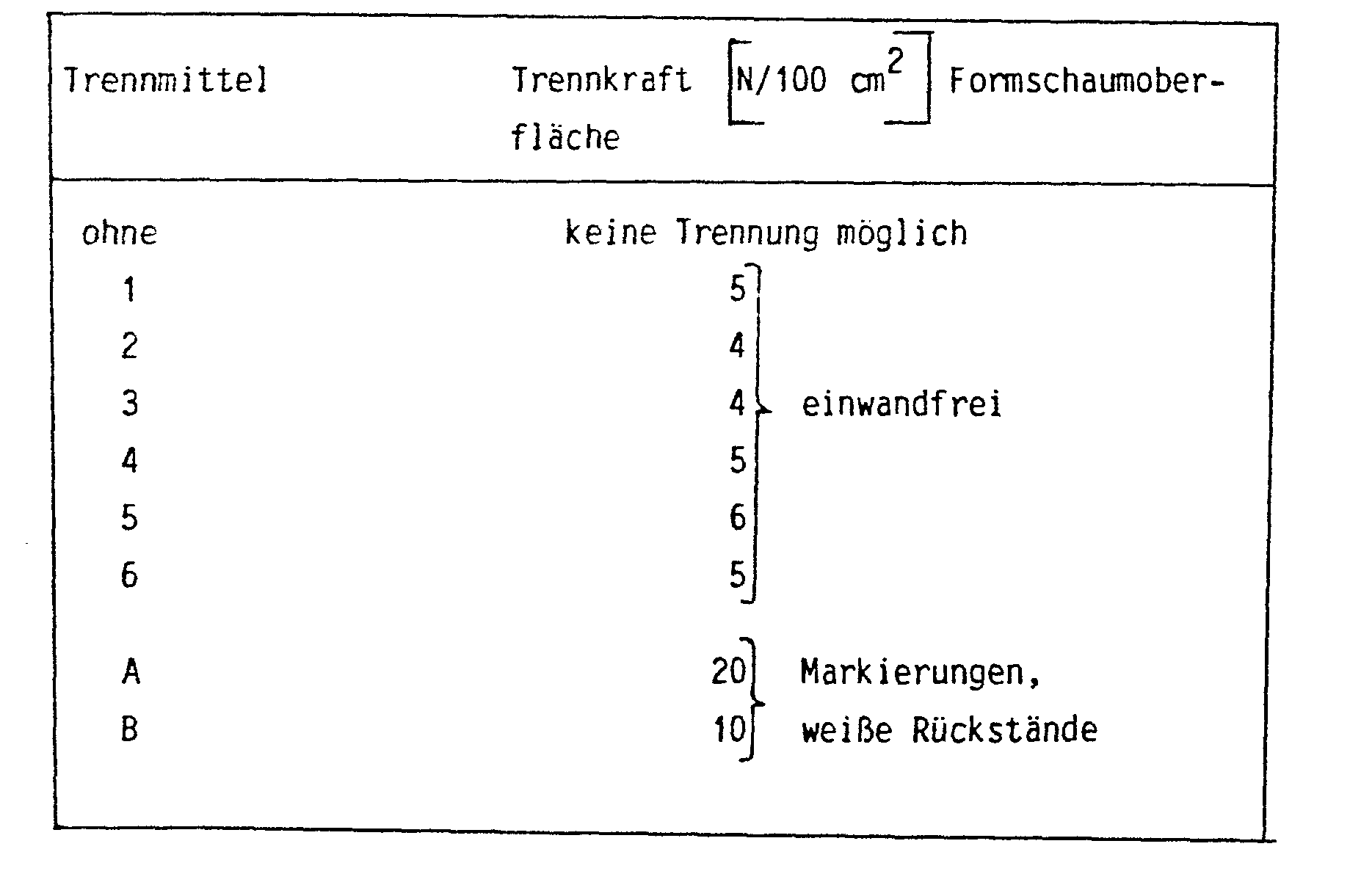
- Zur Überprüfung der Trennkräfte wird eine Testform aus Aluminium verwendet, die mit einem separaten Deckel mit Schraubzwingen geschlossen werden kann. Die Form wird auf eine Temperatur von 60 °C vorgewärmt. Die zu prüfende Trennmittelzubereitung wird mit einem Airless-Gerät auf die Innenfläche der Testform und des Deckels gesprüht, so daß ein zusammenhängender Film entsteht. Nach ca. 30 Sekunden ist dieser Film griffest aufgetrocknet. Das Isocyanat/Polyol-Reaktionsgemisch wird wie folgt hergestellt: Für die Polyolkomponente werden 100 Gew.-Teile eines Polyetherpolyols mit der OH-Zahl 27, das durch Anlagerung von Propylenoxid an Trimethylolpropan und anschließendes Anlagern von Ethylenoxid hergestellt worden war, mit 28 Gew.-Teilen Ethylenglykol, 0,35 Gew.-Teilen Triethylendiamin, 0,02 Gew.-Teilen Dibutylzinndilaurat vermischt. Als Isocyanatkomponente wird ein durch Umsetzung von 4,4-Diisocyanatodiphenylmethan mit Tripropylenglykol erhaltenes Produkt mit einem NCO-Gehalt von 23 % verwendet. Jeweils 100 Gew.-Teile der Polyolkomponente werden mit 127 Gew.-Teilen der Isocyanatkomponente durch intensives Rühren mit einem Laborrührer mit 2500 Umdrehungen in 7 Sekunden vermischt. Das noch flüssig vorliegende Reaktionsgemisch wird in die bereits vorbereitete Aluminiumform gegossen, der Deckel aufgelegt und mit Schraubzwingen verschlossen. Nach einer Standzeit von 4 Minuten wird der Deckel entfernt. Es werden die hierfür notwendigen Zugkräfte mit einer Federwaage gemessen.
- Der Blindversuch wurde ohne Trennmittel durchgeführt. Die Form mußte nach der Verschäumung gewaltsam geöffnet werden, wobei der Schaumkörper zerstört wurde. Die Vergleichssubstanzen A und B waren Produkte des Handels. Das Produkt B besteht aus einer 4 Gew.-%igen Na-Myristinatlösung in 75 Gew.-% Wasser und 21 Gew.-% Isopropanol.
Claims (4)
Applications Claiming Priority (2)
| Application Number | Priority Date | Filing Date | Title |
|---|---|---|---|
| DE3600368 | 1986-01-09 | ||
| DE3600368A DE3600368C1 (de) | 1986-01-09 | 1986-01-09 | Trennmittel fuer Polyurethanformteile |
Publications (3)
| Publication Number | Publication Date |
|---|---|
| EP0228705A2 true EP0228705A2 (de) | 1987-07-15 |
| EP0228705A3 EP0228705A3 (en) | 1988-01-13 |
| EP0228705B1 EP0228705B1 (de) | 1989-07-26 |
Family
ID=6291538
Family Applications (1)
| Application Number | Title | Priority Date | Filing Date |
|---|---|---|---|
| EP86118073A Expired EP0228705B1 (de) | 1986-01-09 | 1986-12-24 | Trenmittel für Polyurethanformteile |
Country Status (3)
| Country | Link |
|---|---|
| EP (1) | EP0228705B1 (de) |
| DE (2) | DE3600368C1 (de) |
| ES (1) | ES2009781B3 (de) |
Cited By (3)
| Publication number | Priority date | Publication date | Assignee | Title |
|---|---|---|---|---|
| US5399274A (en) * | 1992-01-10 | 1995-03-21 | Marcus; R. Steven | Metal working lubricant |
| EP0917505A4 (de) * | 1995-12-04 | 2001-08-16 | Michael J Stevenson | Verbesserte oberflächenzusammensetzung für kunststofformteile und verwendung dieser zusammensetzung |
| US12544423B2 (en) | 2018-01-15 | 2026-02-10 | Complement Therapeutics Limited | C3b binding polypeptide |
Families Citing this family (1)
| Publication number | Priority date | Publication date | Assignee | Title |
|---|---|---|---|---|
| DE102007037571A1 (de) | 2007-08-09 | 2009-02-12 | Evonik Goldschmidt Gmbh | Wässriges Trennmittel und seine Verwendung bei der Herstellung von Polyurethan-Formkörpern |
Family Cites Families (4)
| Publication number | Priority date | Publication date | Assignee | Title |
|---|---|---|---|---|
| US3992502A (en) * | 1972-04-28 | 1976-11-16 | The Goodyear Tire & Rubber Company | Method for using mold release |
| US4038088A (en) * | 1975-03-10 | 1977-07-26 | The Goodyear Tire & Rubber Company | Mold release agent |
| DE2702930A1 (de) * | 1977-01-25 | 1978-07-27 | Alois Stankiewicz Chemische Er | Trennmittel fuer formen |
| NL171815B (nl) * | 1977-12-18 | 1982-12-16 | Nautamix Bv | Werkwijze ter bereiding van droge, poedervormige mengsels uit polyvinylchloride, glijmiddelen en stabilisatoren en werkwijze ter vervaardiging van voorwerpen daaruit. |
-
1986
- 1986-01-09 DE DE3600368A patent/DE3600368C1/de not_active Expired
- 1986-12-24 EP EP86118073A patent/EP0228705B1/de not_active Expired
- 1986-12-24 DE DE8686118073T patent/DE3664593D1/de not_active Expired
- 1986-12-24 ES ES86118073T patent/ES2009781B3/es not_active Expired
Cited By (3)
| Publication number | Priority date | Publication date | Assignee | Title |
|---|---|---|---|---|
| US5399274A (en) * | 1992-01-10 | 1995-03-21 | Marcus; R. Steven | Metal working lubricant |
| EP0917505A4 (de) * | 1995-12-04 | 2001-08-16 | Michael J Stevenson | Verbesserte oberflächenzusammensetzung für kunststofformteile und verwendung dieser zusammensetzung |
| US12544423B2 (en) | 2018-01-15 | 2026-02-10 | Complement Therapeutics Limited | C3b binding polypeptide |
Also Published As
| Publication number | Publication date |
|---|---|
| EP0228705A3 (en) | 1988-01-13 |
| DE3600368C1 (de) | 1987-04-02 |
| DE3664593D1 (en) | 1989-08-31 |
| ES2009781B3 (es) | 1989-10-16 |
| EP0228705B1 (de) | 1989-07-26 |
Similar Documents
| Publication | Publication Date | Title |
|---|---|---|
| DE2533074C3 (de) | Verfahren zur Herstellung von hochelastischen Polyurethanweichschäumen | |
| EP2017053B1 (de) | Lösungsmittelfreies Trennmittel und seine Verwendung bei der Herstellung von Polyurethan-Formkörpern | |
| DE3011304A1 (de) | Schaumdaempfungsmittel und dessen verwendung in kunstharz-, lack- und farbdispersionen | |
| DE69330631T2 (de) | Trennmittel | |
| DE3837351C1 (de) | ||
| EP0068281A1 (de) | Verwendung von Poly-N,N-hydroxyalkyl-amiden mehrwertiger Carbonsäuren als Zellöffner bei der Herstellung elastischer Polyurethanschaumstoffe | |
| DE3600402C2 (de) | ||
| EP0381204A1 (de) | Phosphornitridchloride enthaltende Zusammensetzungen | |
| EP0228705B1 (de) | Trenmittel für Polyurethanformteile | |
| DE2229574C3 (de) | Bei Raumtemperatur vulkanisierbare, in Abwesenheit von Feuchtigkeit beständige, unter Einwirkung von Feuchtigkeit härtbare Polysiloxanformmasse | |
| EP1785252B1 (de) | Wässriges Trennmittel und seine Verwendung bei der Herstellung von Polyurethan-Formkörpern | |
| DE2321935A1 (de) | Formabloesemittel und verfahren zur anwendung | |
| DE4020036C2 (de) | ||
| EP1785251B1 (de) | Wässriges Trennmittel und seine Verwendung bei der Herstellung von Polyurethan-Formkörpern | |
| DE19738192C1 (de) | Trennmittel für Formen zur Herstellung von Formkörpern aus Kunststoffen | |
| DE3122790C2 (de) | Verfahren zur Herstellung von formstabilen Polyurethanschaumstoffen | |
| EP1785250B1 (de) | Wässriges Trennmittel und seine Verwendung bei der Herstellung von Polyurethan-Formkörpern | |
| DE3509810C1 (de) | Verfahren zur Herstellung von Polyurethanformteilen | |
| EP0597347B1 (de) | Trennmittel für Formen zur Herstellung von Formkörpern aus Kunststoffen | |
| DE2547125C3 (de) | Verfahren zur Herstellung von kalthärtenden weichen Polyurethanschäumen | |
| DE69829265T2 (de) | Giessverfahren für Polyurethane unter Verwendung eines internen Formtrennmittels und daraus hergestellte Formkörper | |
| DE2719091C3 (de) | Trennmittel für Polyurethanformmassen und Verfahren zu ihrer Herstellung | |
| DE19650076C1 (de) | Trennmittel für Formen zur Herstellung von Formkörpern aus Kunststoffen | |
| EP1795322A1 (de) | Trennmittel und seine Verwendung bei der Herstellung von Polyurethan-Formkörpern | |
| EP0452632A2 (de) | Zusammensetzungen mit dichlorpentafluorpropanen |
Legal Events
| Date | Code | Title | Description |
|---|---|---|---|
| PUAI | Public reference made under article 153(3) epc to a published international application that has entered the european phase |
Free format text: ORIGINAL CODE: 0009012 |
|
| 17P | Request for examination filed |
Effective date: 19870107 |
|
| AK | Designated contracting states |
Kind code of ref document: A2 Designated state(s): BE DE ES FR GB IT NL |
|
| PUAL | Search report despatched |
Free format text: ORIGINAL CODE: 0009013 |
|
| AK | Designated contracting states |
Kind code of ref document: A3 Designated state(s): BE DE ES FR GB IT NL |
|
| 17Q | First examination report despatched |
Effective date: 19880330 |
|
| ITF | It: translation for a ep patent filed | ||
| GRAA | (expected) grant |
Free format text: ORIGINAL CODE: 0009210 |
|
| AK | Designated contracting states |
Kind code of ref document: B1 Designated state(s): BE DE ES FR GB IT NL |
|
| GBT | Gb: translation of ep patent filed (gb section 77(6)(a)/1977) | ||
| REF | Corresponds to: |
Ref document number: 3664593 Country of ref document: DE Date of ref document: 19890831 |
|
| ET | Fr: translation filed | ||
| PLBE | No opposition filed within time limit |
Free format text: ORIGINAL CODE: 0009261 |
|
| STAA | Information on the status of an ep patent application or granted ep patent |
Free format text: STATUS: NO OPPOSITION FILED WITHIN TIME LIMIT |
|
| 26N | No opposition filed | ||
| ITTA | It: last paid annual fee | ||
| PGFP | Annual fee paid to national office [announced via postgrant information from national office to epo] |
Ref country code: FR Payment date: 19921209 Year of fee payment: 7 |
|
| PGFP | Annual fee paid to national office [announced via postgrant information from national office to epo] |
Ref country code: GB Payment date: 19921214 Year of fee payment: 7 |
|
| PGFP | Annual fee paid to national office [announced via postgrant information from national office to epo] |
Ref country code: DE Payment date: 19921217 Year of fee payment: 7 |
|
| PGFP | Annual fee paid to national office [announced via postgrant information from national office to epo] |
Ref country code: ES Payment date: 19921223 Year of fee payment: 7 |
|
| PGFP | Annual fee paid to national office [announced via postgrant information from national office to epo] |
Ref country code: NL Payment date: 19921231 Year of fee payment: 7 |
|
| PGFP | Annual fee paid to national office [announced via postgrant information from national office to epo] |
Ref country code: BE Payment date: 19930127 Year of fee payment: 7 |
|
| PG25 | Lapsed in a contracting state [announced via postgrant information from national office to epo] |
Ref country code: GB Effective date: 19931224 |
|
| PG25 | Lapsed in a contracting state [announced via postgrant information from national office to epo] |
Ref country code: BE Effective date: 19931231 |
|
| BERE | Be: lapsed |
Owner name: TH. GOLDSCHMIDT A.G. Effective date: 19931231 |
|
| PG25 | Lapsed in a contracting state [announced via postgrant information from national office to epo] |
Ref country code: NL Effective date: 19940701 |
|
| NLV4 | Nl: lapsed or anulled due to non-payment of the annual fee | ||
| GBPC | Gb: european patent ceased through non-payment of renewal fee |
Effective date: 19931224 |
|
| PG25 | Lapsed in a contracting state [announced via postgrant information from national office to epo] |
Ref country code: FR Effective date: 19940831 |
|
| PG25 | Lapsed in a contracting state [announced via postgrant information from national office to epo] |
Ref country code: DE Effective date: 19940901 |
|
| REG | Reference to a national code |
Ref country code: FR Ref legal event code: ST |
|
| PG25 | Lapsed in a contracting state [announced via postgrant information from national office to epo] |
Ref country code: ES Free format text: LAPSE BECAUSE OF NON-PAYMENT OF DUE FEES Effective date: 19941225 |
|
| REG | Reference to a national code |
Ref country code: ES Ref legal event code: FD2A Effective date: 19950112 |
|
| PG25 | Lapsed in a contracting state [announced via postgrant information from national office to epo] |
Ref country code: IT Free format text: LAPSE BECAUSE OF NON-PAYMENT OF DUE FEES;WARNING: LAPSES OF ITALIAN PATENTS WITH EFFECTIVE DATE BEFORE 2007 MAY HAVE OCCURRED AT ANY TIME BEFORE 2007. THE CORRECT EFFECTIVE DATE MAY BE DIFFERENT FROM THE ONE RECORDED. Effective date: 20051224 |