EP0228839B1 - Fibres biconstituantes en céramique - Google Patents
Fibres biconstituantes en céramique Download PDFInfo
- Publication number
- EP0228839B1 EP0228839B1 EP19860309611 EP86309611A EP0228839B1 EP 0228839 B1 EP0228839 B1 EP 0228839B1 EP 19860309611 EP19860309611 EP 19860309611 EP 86309611 A EP86309611 A EP 86309611A EP 0228839 B1 EP0228839 B1 EP 0228839B1
- Authority
- EP
- European Patent Office
- Prior art keywords
- fiber
- fibers
- ceramic
- bicomponent
- refractory
- Prior art date
- Legal status (The legal status is an assumption and is not a legal conclusion. Google has not performed a legal analysis and makes no representation as to the accuracy of the status listed.)
- Expired - Lifetime
Links
Images

Classifications
-
- C—CHEMISTRY; METALLURGY
- C04—CEMENTS; CONCRETE; ARTIFICIAL STONE; CERAMICS; REFRACTORIES
- C04B—LIME, MAGNESIA; SLAG; CEMENTS; COMPOSITIONS THEREOF, e.g. MORTARS, CONCRETE OR LIKE BUILDING MATERIALS; ARTIFICIAL STONE; CERAMICS; REFRACTORIES; TREATMENT OF NATURAL STONE
- C04B35/00—Shaped ceramic products characterised by their composition; Ceramics compositions; Processing powders of inorganic compounds preparatory to the manufacturing of ceramic products
- C04B35/622—Forming processes; Processing powders of inorganic compounds preparatory to the manufacturing of ceramic products
- C04B35/62227—Forming processes; Processing powders of inorganic compounds preparatory to the manufacturing of ceramic products obtaining fibres
- C04B35/62231—Forming processes; Processing powders of inorganic compounds preparatory to the manufacturing of ceramic products obtaining fibres based on oxide ceramics
-
- C—CHEMISTRY; METALLURGY
- C03—GLASS; MINERAL OR SLAG WOOL
- C03C—CHEMICAL COMPOSITION OF GLASSES, GLAZES OR VITREOUS ENAMELS; SURFACE TREATMENT OF GLASS; SURFACE TREATMENT OF FIBRES OR FILAMENTS MADE FROM GLASS, MINERALS OR SLAGS; JOINING GLASS TO GLASS OR OTHER MATERIALS
- C03C13/00—Fibre or filament compositions
- C03C13/06—Mineral fibres, e.g. slag wool, mineral wool, rock wool
-
- B—PERFORMING OPERATIONS; TRANSPORTING
- B22—CASTING; POWDER METALLURGY
- B22F—WORKING METALLIC POWDER; MANUFACTURE OF ARTICLES FROM METALLIC POWDER; MAKING METALLIC POWDER; APPARATUS OR DEVICES SPECIALLY ADAPTED FOR METALLIC POWDER
- B22F1/00—Metallic powder; Treatment of metallic powder, e.g. to facilitate working or to improve properties
- B22F1/06—Metallic powder characterised by the shape of the particles
- B22F1/062—Fibrous particles
-
- C—CHEMISTRY; METALLURGY
- C04—CEMENTS; CONCRETE; ARTIFICIAL STONE; CERAMICS; REFRACTORIES
- C04B—LIME, MAGNESIA; SLAG; CEMENTS; COMPOSITIONS THEREOF, e.g. MORTARS, CONCRETE OR LIKE BUILDING MATERIALS; ARTIFICIAL STONE; CERAMICS; REFRACTORIES; TREATMENT OF NATURAL STONE
- C04B35/00—Shaped ceramic products characterised by their composition; Ceramics compositions; Processing powders of inorganic compounds preparatory to the manufacturing of ceramic products
-
- D—TEXTILES; PAPER
- D01—NATURAL OR MAN-MADE THREADS OR FIBRES; SPINNING
- D01F—CHEMICAL FEATURES IN THE MANUFACTURE OF ARTIFICIAL FILAMENTS, THREADS, FIBRES, BRISTLES OR RIBBONS; APPARATUS SPECIALLY ADAPTED FOR THE MANUFACTURE OF CARBON FILAMENTS
- D01F9/00—Artificial filaments or the like of other substances; Manufacture thereof; Apparatus specially adapted for the manufacture of carbon filaments
- D01F9/08—Artificial filaments or the like of other substances; Manufacture thereof; Apparatus specially adapted for the manufacture of carbon filaments of inorganic material
-
- D—TEXTILES; PAPER
- D04—BRAIDING; LACE-MAKING; KNITTING; TRIMMINGS; NON-WOVEN FABRICS
- D04H—MAKING TEXTILE FABRICS, e.g. FROM FIBRES OR FILAMENTARY MATERIAL; FABRICS MADE BY SUCH PROCESSES OR APPARATUS, e.g. FELTS, NON-WOVEN FABRICS; COTTON-WOOL; WADDING ; NON-WOVEN FABRICS FROM STAPLE FIBRES, FILAMENTS OR YARNS, BONDED WITH AT LEAST ONE WEB-LIKE MATERIAL DURING THEIR CONSOLIDATION
- D04H1/00—Non-woven fabrics formed wholly or mainly of staple fibres or like relatively short fibres
- D04H1/40—Non-woven fabrics formed wholly or mainly of staple fibres or like relatively short fibres from fleeces or layers composed of fibres without existing or potential cohesive properties
- D04H1/42—Non-woven fabrics formed wholly or mainly of staple fibres or like relatively short fibres from fleeces or layers composed of fibres without existing or potential cohesive properties characterised by the use of certain kinds of fibres insofar as this use has no preponderant influence on the consolidation of the fleece
- D04H1/4209—Inorganic fibres
-
- D—TEXTILES; PAPER
- D04—BRAIDING; LACE-MAKING; KNITTING; TRIMMINGS; NON-WOVEN FABRICS
- D04H—MAKING TEXTILE FABRICS, e.g. FROM FIBRES OR FILAMENTARY MATERIAL; FABRICS MADE BY SUCH PROCESSES OR APPARATUS, e.g. FELTS, NON-WOVEN FABRICS; COTTON-WOOL; WADDING ; NON-WOVEN FABRICS FROM STAPLE FIBRES, FILAMENTS OR YARNS, BONDED WITH AT LEAST ONE WEB-LIKE MATERIAL DURING THEIR CONSOLIDATION
- D04H1/00—Non-woven fabrics formed wholly or mainly of staple fibres or like relatively short fibres
- D04H1/40—Non-woven fabrics formed wholly or mainly of staple fibres or like relatively short fibres from fleeces or layers composed of fibres without existing or potential cohesive properties
- D04H1/42—Non-woven fabrics formed wholly or mainly of staple fibres or like relatively short fibres from fleeces or layers composed of fibres without existing or potential cohesive properties characterised by the use of certain kinds of fibres insofar as this use has no preponderant influence on the consolidation of the fleece
- D04H1/4382—Stretched reticular film fibres; Composite fibres; Mixed fibres; Ultrafine fibres; Fibres for artificial leather
- D04H1/43825—Composite fibres
- D04H1/43832—Composite fibres side-by-side
-
- D—TEXTILES; PAPER
- D04—BRAIDING; LACE-MAKING; KNITTING; TRIMMINGS; NON-WOVEN FABRICS
- D04H—MAKING TEXTILE FABRICS, e.g. FROM FIBRES OR FILAMENTARY MATERIAL; FABRICS MADE BY SUCH PROCESSES OR APPARATUS, e.g. FELTS, NON-WOVEN FABRICS; COTTON-WOOL; WADDING ; NON-WOVEN FABRICS FROM STAPLE FIBRES, FILAMENTS OR YARNS, BONDED WITH AT LEAST ONE WEB-LIKE MATERIAL DURING THEIR CONSOLIDATION
- D04H1/00—Non-woven fabrics formed wholly or mainly of staple fibres or like relatively short fibres
- D04H1/40—Non-woven fabrics formed wholly or mainly of staple fibres or like relatively short fibres from fleeces or layers composed of fibres without existing or potential cohesive properties
- D04H1/42—Non-woven fabrics formed wholly or mainly of staple fibres or like relatively short fibres from fleeces or layers composed of fibres without existing or potential cohesive properties characterised by the use of certain kinds of fibres insofar as this use has no preponderant influence on the consolidation of the fleece
- D04H1/4382—Stretched reticular film fibres; Composite fibres; Mixed fibres; Ultrafine fibres; Fibres for artificial leather
- D04H1/43838—Ultrafine fibres, e.g. microfibres
-
- D—TEXTILES; PAPER
- D04—BRAIDING; LACE-MAKING; KNITTING; TRIMMINGS; NON-WOVEN FABRICS
- D04H—MAKING TEXTILE FABRICS, e.g. FROM FIBRES OR FILAMENTARY MATERIAL; FABRICS MADE BY SUCH PROCESSES OR APPARATUS, e.g. FELTS, NON-WOVEN FABRICS; COTTON-WOOL; WADDING ; NON-WOVEN FABRICS FROM STAPLE FIBRES, FILAMENTS OR YARNS, BONDED WITH AT LEAST ONE WEB-LIKE MATERIAL DURING THEIR CONSOLIDATION
- D04H1/00—Non-woven fabrics formed wholly or mainly of staple fibres or like relatively short fibres
- D04H1/40—Non-woven fabrics formed wholly or mainly of staple fibres or like relatively short fibres from fleeces or layers composed of fibres without existing or potential cohesive properties
- D04H1/42—Non-woven fabrics formed wholly or mainly of staple fibres or like relatively short fibres from fleeces or layers composed of fibres without existing or potential cohesive properties characterised by the use of certain kinds of fibres insofar as this use has no preponderant influence on the consolidation of the fleece
- D04H1/4391—Non-woven fabrics formed wholly or mainly of staple fibres or like relatively short fibres from fleeces or layers composed of fibres without existing or potential cohesive properties characterised by the use of certain kinds of fibres insofar as this use has no preponderant influence on the consolidation of the fleece characterised by the shape of the fibres
- D04H1/43918—Non-woven fabrics formed wholly or mainly of staple fibres or like relatively short fibres from fleeces or layers composed of fibres without existing or potential cohesive properties characterised by the use of certain kinds of fibres insofar as this use has no preponderant influence on the consolidation of the fleece characterised by the shape of the fibres nonlinear fibres, e.g. crimped or coiled fibres
-
- D—TEXTILES; PAPER
- D04—BRAIDING; LACE-MAKING; KNITTING; TRIMMINGS; NON-WOVEN FABRICS
- D04H—MAKING TEXTILE FABRICS, e.g. FROM FIBRES OR FILAMENTARY MATERIAL; FABRICS MADE BY SUCH PROCESSES OR APPARATUS, e.g. FELTS, NON-WOVEN FABRICS; COTTON-WOOL; WADDING ; NON-WOVEN FABRICS FROM STAPLE FIBRES, FILAMENTS OR YARNS, BONDED WITH AT LEAST ONE WEB-LIKE MATERIAL DURING THEIR CONSOLIDATION
- D04H1/00—Non-woven fabrics formed wholly or mainly of staple fibres or like relatively short fibres
- D04H1/40—Non-woven fabrics formed wholly or mainly of staple fibres or like relatively short fibres from fleeces or layers composed of fibres without existing or potential cohesive properties
- D04H1/42—Non-woven fabrics formed wholly or mainly of staple fibres or like relatively short fibres from fleeces or layers composed of fibres without existing or potential cohesive properties characterised by the use of certain kinds of fibres insofar as this use has no preponderant influence on the consolidation of the fleece
- D04H1/4391—Non-woven fabrics formed wholly or mainly of staple fibres or like relatively short fibres from fleeces or layers composed of fibres without existing or potential cohesive properties characterised by the use of certain kinds of fibres insofar as this use has no preponderant influence on the consolidation of the fleece characterised by the shape of the fibres
- D04H1/43912—Non-woven fabrics formed wholly or mainly of staple fibres or like relatively short fibres from fleeces or layers composed of fibres without existing or potential cohesive properties characterised by the use of certain kinds of fibres insofar as this use has no preponderant influence on the consolidation of the fleece characterised by the shape of the fibres fibres with noncircular cross-sections
-
- Y—GENERAL TAGGING OF NEW TECHNOLOGICAL DEVELOPMENTS; GENERAL TAGGING OF CROSS-SECTIONAL TECHNOLOGIES SPANNING OVER SEVERAL SECTIONS OF THE IPC; TECHNICAL SUBJECTS COVERED BY FORMER USPC CROSS-REFERENCE ART COLLECTIONS [XRACs] AND DIGESTS
- Y10—TECHNICAL SUBJECTS COVERED BY FORMER USPC
- Y10T—TECHNICAL SUBJECTS COVERED BY FORMER US CLASSIFICATION
- Y10T428/00—Stock material or miscellaneous articles
- Y10T428/29—Coated or structually defined flake, particle, cell, strand, strand portion, rod, filament, macroscopic fiber or mass thereof
- Y10T428/2913—Rod, strand, filament or fiber
- Y10T428/2922—Nonlinear [e.g., crimped, coiled, etc.]
- Y10T428/2924—Composite
-
- Y—GENERAL TAGGING OF NEW TECHNOLOGICAL DEVELOPMENTS; GENERAL TAGGING OF CROSS-SECTIONAL TECHNOLOGIES SPANNING OVER SEVERAL SECTIONS OF THE IPC; TECHNICAL SUBJECTS COVERED BY FORMER USPC CROSS-REFERENCE ART COLLECTIONS [XRACs] AND DIGESTS
- Y10—TECHNICAL SUBJECTS COVERED BY FORMER USPC
- Y10T—TECHNICAL SUBJECTS COVERED BY FORMER US CLASSIFICATION
- Y10T428/00—Stock material or miscellaneous articles
- Y10T428/29—Coated or structually defined flake, particle, cell, strand, strand portion, rod, filament, macroscopic fiber or mass thereof
- Y10T428/2913—Rod, strand, filament or fiber
- Y10T428/2929—Bicomponent, conjugate, composite or collateral fibers or filaments [i.e., coextruded sheath-core or side-by-side type]
- Y10T428/2931—Fibers or filaments nonconcentric [e.g., side-by-side or eccentric, etc.]
-
- Y—GENERAL TAGGING OF NEW TECHNOLOGICAL DEVELOPMENTS; GENERAL TAGGING OF CROSS-SECTIONAL TECHNOLOGIES SPANNING OVER SEVERAL SECTIONS OF THE IPC; TECHNICAL SUBJECTS COVERED BY FORMER USPC CROSS-REFERENCE ART COLLECTIONS [XRACs] AND DIGESTS
- Y10—TECHNICAL SUBJECTS COVERED BY FORMER USPC
- Y10T—TECHNICAL SUBJECTS COVERED BY FORMER US CLASSIFICATION
- Y10T428/00—Stock material or miscellaneous articles
- Y10T428/29—Coated or structually defined flake, particle, cell, strand, strand portion, rod, filament, macroscopic fiber or mass thereof
- Y10T428/2913—Rod, strand, filament or fiber
- Y10T428/2933—Coated or with bond, impregnation or core
- Y10T428/294—Coated or with bond, impregnation or core including metal or compound thereof [excluding glass, ceramic and asbestos]
-
- Y—GENERAL TAGGING OF NEW TECHNOLOGICAL DEVELOPMENTS; GENERAL TAGGING OF CROSS-SECTIONAL TECHNOLOGIES SPANNING OVER SEVERAL SECTIONS OF THE IPC; TECHNICAL SUBJECTS COVERED BY FORMER USPC CROSS-REFERENCE ART COLLECTIONS [XRACs] AND DIGESTS
- Y10—TECHNICAL SUBJECTS COVERED BY FORMER USPC
- Y10T—TECHNICAL SUBJECTS COVERED BY FORMER US CLASSIFICATION
- Y10T428/00—Stock material or miscellaneous articles
- Y10T428/29—Coated or structually defined flake, particle, cell, strand, strand portion, rod, filament, macroscopic fiber or mass thereof
- Y10T428/2913—Rod, strand, filament or fiber
- Y10T428/2933—Coated or with bond, impregnation or core
- Y10T428/294—Coated or with bond, impregnation or core including metal or compound thereof [excluding glass, ceramic and asbestos]
- Y10T428/2942—Plural coatings
- Y10T428/2949—Glass, ceramic or metal oxide in coating
-
- Y—GENERAL TAGGING OF NEW TECHNOLOGICAL DEVELOPMENTS; GENERAL TAGGING OF CROSS-SECTIONAL TECHNOLOGIES SPANNING OVER SEVERAL SECTIONS OF THE IPC; TECHNICAL SUBJECTS COVERED BY FORMER USPC CROSS-REFERENCE ART COLLECTIONS [XRACs] AND DIGESTS
- Y10—TECHNICAL SUBJECTS COVERED BY FORMER USPC
- Y10T—TECHNICAL SUBJECTS COVERED BY FORMER US CLASSIFICATION
- Y10T428/00—Stock material or miscellaneous articles
- Y10T428/29—Coated or structually defined flake, particle, cell, strand, strand portion, rod, filament, macroscopic fiber or mass thereof
- Y10T428/2913—Rod, strand, filament or fiber
- Y10T428/2973—Particular cross section
-
- Y—GENERAL TAGGING OF NEW TECHNOLOGICAL DEVELOPMENTS; GENERAL TAGGING OF CROSS-SECTIONAL TECHNOLOGIES SPANNING OVER SEVERAL SECTIONS OF THE IPC; TECHNICAL SUBJECTS COVERED BY FORMER USPC CROSS-REFERENCE ART COLLECTIONS [XRACs] AND DIGESTS
- Y10—TECHNICAL SUBJECTS COVERED BY FORMER USPC
- Y10T—TECHNICAL SUBJECTS COVERED BY FORMER US CLASSIFICATION
- Y10T442/00—Fabric [woven, knitted, or nonwoven textile or cloth, etc.]
- Y10T442/30—Woven fabric [i.e., woven strand or strip material]
- Y10T442/3065—Including strand which is of specific structural definition
- Y10T442/3089—Cross-sectional configuration of strand material is specified
-
- Y—GENERAL TAGGING OF NEW TECHNOLOGICAL DEVELOPMENTS; GENERAL TAGGING OF CROSS-SECTIONAL TECHNOLOGIES SPANNING OVER SEVERAL SECTIONS OF THE IPC; TECHNICAL SUBJECTS COVERED BY FORMER USPC CROSS-REFERENCE ART COLLECTIONS [XRACs] AND DIGESTS
- Y10—TECHNICAL SUBJECTS COVERED BY FORMER USPC
- Y10T—TECHNICAL SUBJECTS COVERED BY FORMER US CLASSIFICATION
- Y10T442/00—Fabric [woven, knitted, or nonwoven textile or cloth, etc.]
- Y10T442/30—Woven fabric [i.e., woven strand or strip material]
- Y10T442/3065—Including strand which is of specific structural definition
- Y10T442/3089—Cross-sectional configuration of strand material is specified
- Y10T442/3114—Cross-sectional configuration of the strand material is other than circular
-
- Y—GENERAL TAGGING OF NEW TECHNOLOGICAL DEVELOPMENTS; GENERAL TAGGING OF CROSS-SECTIONAL TECHNOLOGIES SPANNING OVER SEVERAL SECTIONS OF THE IPC; TECHNICAL SUBJECTS COVERED BY FORMER USPC CROSS-REFERENCE ART COLLECTIONS [XRACs] AND DIGESTS
- Y10—TECHNICAL SUBJECTS COVERED BY FORMER USPC
- Y10T—TECHNICAL SUBJECTS COVERED BY FORMER US CLASSIFICATION
- Y10T442/00—Fabric [woven, knitted, or nonwoven textile or cloth, etc.]
- Y10T442/60—Nonwoven fabric [i.e., nonwoven strand or fiber material]
- Y10T442/608—Including strand or fiber material which is of specific structural definition
- Y10T442/609—Cross-sectional configuration of strand or fiber material is specified
- Y10T442/611—Cross-sectional configuration of strand or fiber material is other than circular
Definitions
- This invention relates to bicomponent, non-vitreous ceramic fibers wherein the component fibers are in a continuous, longitudinally extending, side-by-side configuration. In another aspect, it relates to a process for preparing bicomponent ceramic fibers from two distinct precursor liquids. In a further aspect, the bicomponent ceramic fibers can be converted to cermet/cermet or ceramic/cermet fibers.
- Bicomponent fibers are known in the textile art. Typical bicomponent polymer textiles are disclosed in U.S. Patent Nos. 4,118,534 and 4,278,634. Generally, polymer bicomponent systems relate to two polymers of the same class, e.g., two polyester polymers, or two acrylonitrile polymers. Usually different polymers in a bicomponent system will split after spinning.
- Blown-microfibers (3 to 5 micrometer diameter) comprising bicomponent systems, i.e., polyester-polypropylene have been disclosed, for example, in U.S. Patent No. 4,547,420. Blowing such fibers requires use of a Naval Research Laboratories dual feed die.
- U.S. Patent No. 2,313,296 teaches concentrically disposed fibers or filaments of glass. These fibers do not crimp.
- alumina-silica fibers are disclosed in U.S. Patent No. 4,047,965; alumina-boria-silica fibers are taught in U.S. Patent No. 3,795,524; titanium dioxide fibers are disclosed in U.S. Patent No. 4,166,147; zirconia-silica fibers are disclosed in U.S. Patent No. 3,709,706.
- the present invention provides a continuous, bicomponent, non-vitreous ceramic fiber wherein the components exist in a longitudinal side-by-side relationship and each of the components is derived from a different fiber-forming precursor liquid.
- a spinning process for forming a bicomponent ceramic fiber wherein two fiber-forming ceramic liquid precursor systems of different composition are extruded together through the same spinnerette orifice to form a single continuous fiber comprising two conjugate, contiguous ceramic phases in the length of the spun fiber.
- the continuous two phase fiber of the present invention preferably comprises a first phase having a different composition from a second phase.
- the two components (two phases) are contiguous in a side by side array to form a single ceramic fiber or filament.
- the present invention can provide a high strength carrier component for a low strength component of special characteristics, for example, magnetic or catalytic components.
- the ceramic bicomponent fibers of the present invention are made by a non-melt process comprising shaping viscous concentrates of two precursor liquids into a fiber form and then dehydratively or evaporatively gelling or hydrolyizing the drawn or spun fibers. These fibers can subsequently be dried to result in a "green" or non-refractory amorphous fiber. Heating and firing the shaped green fiber removes water, decomposes and volatilizes undesired fugitive constituents, and converts it into the refractory fiber of the invention.
- ceramic means inorganic nonmetallic material consolidated by the action of heat, such as metal and nonmetal oxides, carbides, nitrides, sulfides, etc.
- ceramic means a mixture of ceramic and metallic materials
- bicomponent fiber means physically joining together along the length of the fibers two components derived from compatible precursor liquids of different compositions convertible to ceramic materials;
- non-vitreous means not formed from a melt
- polycrystalline means a phase which gives a discernible X-ray powder diffraction pattern. Crystallite size will affect the line width of the X-ray diffraction pattern. The smaller the crystallite size (below approximately 1 micrometer), the broader the lines will become. This affects the resolution of the X-ray pattern: fine features such as lines of weak intensity or the ability to separate closely-spaced lines may be lost. An overall pattern remains however and is indicative of the crystal structure;
- microcrystalline means a crystalline phase having a crystallite or grain size of about 50 ⁇ to 1000 ⁇ (5 ⁇ 10 _9 to 1 ⁇ 10 _7 m) and sometimes larger, but always less than 10,000 ⁇ (1 ⁇ 10 _6 m).
- Such a microscrystalline structure may be transparent, providing the material itself is not opaque or contains opaque fillers, large pores, gross aeras of inhomogeneity, and the like.
- Many microscrystalline ceramics are transparent or translucent;
- amorphous means a material having a diffuse X-ray diffraction pattern without definite lines to indicate the presence of a crystalline component
- dehydrative gelling or "evaporative gelling” mean that sufficient water and volatile material are removed from the shaped green fibers so that the form or shape of the fiber is sufficiently rigid to permit handling or processing without significant loss or distortion of the desired fibrous form or shape. Therefore, all the water in the shaped fiber need not be removed. Thus, in a sense, this step can be called partial dehydrative gelling.
- the shaped fibers in their green form are generally transparent to visible light and clear (or perhaps slightly hazy) under an optical microscope.
- green refers to the ceramic articles which are unfired, that is, not in their ceramic form
- phase means a component that exists as distinct and separate portions distributed throughout a heterogeneous system
- ком ⁇ онент means the precursor liquid comprises at least partially miscible components
- the ceramic bicomponent fiber of the present invention can be self-crimping.
- the degree of crimping may be varied from a minimal amount to a large amount to provide a high loft curly fibrous mat.
- Selection of the sol compositions for final differential densification/shrinkage during the firing process controls the amount of crimping.
- the components of the bicomponent fiber are non-vitreous ceramics of different compositions.
- the bicomponent fiber can comprise two components of identical final ceramic compositions which were derived from different precursor concentrations.
- the components of the extruded fiber (green) can be 1) a first component derived from a first fiberizing batch containing 35 weight percent equivalent oxide, and 2) a second component derived from a second fiberizing batch containing 25 weight percent equivalent oxide.
- the difference in weight percent equivalent oxide is made up by fugitive organic materials. Upon firing, these organic materials will be differentially removed, resulting in greater shrinkage of one component to give a crimped fiber.
- the two components of the final bicomponent fiber have essentially identical ceramic compositions.
- Bicomponent fibers are used to produce refractory fibers known in the art.
- Bicomponent fibers can be made from precusor liquids such as from zirconia, silica, alumina, titania, chromia, and thoria, as individual sols, or in combination, for example, as alumina-boria-silica, as well as comprising precursor liquids with additives such as copper, iron, manganese, tin, cobalt, calcium, nickel, tungsten, molybdenum, platinum, and magnetic precursors such as barium titanate.
- the starting material used to prepare the refractory fibers of this invention can be prepared where, for example, one component comprises an alumina-silica precursor liquid.
- An aqueous silica sol is admixed with a compatible aqueous solution or dispersion of an aluminum compound and, where used, other oxide precursors, such as the boron and phosphorous compounds, to obtain a uniform dispersion without formation of a gel.
- this dispersion will be clear though sometimes it may be hazy.
- the pH of the dispersion will be inherently on the acid side, e.g., below 6, and is preferably 3 to 5.
- a compatible heat fugitive acid such as acetic or nitric acid
- acetic or nitric acid can be added to the silica sol to acidify the same prior to use and prevent premature gelling.
- Compatible heat fugitive organic agents can be incorported as adjuvants in the fiber starting material to improve shelf-life of the subsequently concentrated dispersion or to improve the fiberizing nature of the latter.
- organic agents representatively include polyvinylpyrrolidone, polyvinyl alcohol, lactic acid, dextrose/glucose (e.g. corn syrup), and mixtures thereof, these additives being oxidized and removed during the firing of the green fibers produced from such systems.
- aqueous solutions or dispersions (precursor liquids) which are used to make the refractory fibers of this invention optionally can also contain various other water-soluble metal compounds (calcinable to metal oxide) which will impart additional desired properties to the refractory fibers.
- an optional compound can be used to reduce weight loss, adjust refractive index or dielectric properties, or to impart, without sacrifice of clarity, internal color to the final refractory upon being converted or oxidized to the corresponding metal oxide.
- Cr2O3 can be used together with P2O5 to minimize weight loss otherwise resulting from the latter.
- Ferric nitrate can be added to impart an orange to gold color, chromium formate, acetate, or trioxide to impart to the fibers a green color, cobalt acetate or nitrate to impart a blue or lavender color, vanadyl sulfate to impart a yellow color, nickel acetate to impart a light green to blue color, and manganese nitrate or acetate to impart a tan to brown color.
- uch colored refractory fibers which can be mono- or bi-colored, are useful for color coding refractory articles).
- the ferric oxide-containing refractory can be reduced in a hydrogen atmosphere, the resulting reduced iron oxide or iron imparting a black color to the refractory and making it attractive to a magnet but not electrically conductive.
- Other optional compounds are the water soluble nitrates, formates, acetates, citrates, lactates, tartrates, or oxalates of lithium, sodium, potassium, magnesium, calcium, strontium, barium, yttrium, titanium, zirconium, chromium, manganese, iron, cobalt, nickel, copper, zinc, tin, antimony, lanthanum, and vanadium as vanadyl sulfate.
- the amount of such other optional metal oxide in the refractory component can vary, depending upon the property effect desired, e.g., the tone of the color or hue desired, but generally will be an amount in the range of as low as 0.05 to 0.5 to as much as 25 weight percent or more, based on the total weight of the component in the refractory fiber.
- Some fiber systems can accomodate these higher amounts of metal compounds, e.g., the alumina-boria-silica system.
- the larger amounts of optional metal oxide additive may cause the fibers to become friable or give rise to contamination problems when the fibers are used in a particular environment.
- the precursors of the other metal oxides should be other than chlorides if they are used in significant amounts since the combination of boric acid and high chloride levels (which can be determined empirically) in the starting material generally results in frangible fibers.
- cermet/cermet fibers comprising reducible metal oxides can be further fired in a reducing atmosphere, preferably hydrogen, to provide a cermet/cermet fiber or a ceramic/cermet fiber wherein the cermet component is of graded composition.
- the cermet component has a graded ceramic/metal content, the metal component decreasing from the periphery towards the center of the fiber component with a predominant amount of the metal on the surface, the metal being in the form of discrete, nodular, preferably spheroidal metal particles which can protrude from the surface of the component and are separated from each other so as to provide an electrically nonconductive cermet.
- a “graded cermet component” means one in which the ratio of ceramic/metal is controlled and varied over the thickness of the component; such a cermet may exhibit a graded or gradual change from less than 100 weight percent metal content, preferably in the range of 10 to 95 weight percent metal content, on the outer surface (those surfaces in contact with the reducing atmosphere) to 0 weight percent metal content on the innermost portions of the component.
- Each of the fiber precursor materials will be a relatively dilute liquid, generally containing about 10 to 30 weight percent equivalent oxide, carbide, or nitride solids or combinations thereof, which can be calculated from a knowledge of the equivalent solids in the raw materials and the amounts thereof used, or determined by calcining samples of the raw materials or component starting material.
- the concentration slep can be carried out by techniques known in the art, e.g., see U.S. Pat. No.
- two spinning precursor liquids which can be aqueous or organic solutions/sols, or mixtures thereof, are separately prepared as is known in the art.
- the separate precursor liquids are spun together through the same orifice of a spinnerette assembly.
- the continuous fibers are spun from the dies, which can have about 1 to 21 orifices per centimeter, into a drying lower from which they are collected and fired.
- the process is well described above and in U.S. Patent No. 3,760,049.
- the orifices of the apparatus are in a row of side-by-side configuration.
- the feed cavity of the die can be optionally fitted with a baffle plate.
- no baffle plate is used.
- the individual sols, solutions, or mixture thereof, of essentially equivalent rheological properties, particularly viscosity are pressured in laminar flow and comingle with only interface mixing at the entrance of the orifice in such a manner as to unite into a single fiber of essentially equal volume proportions.
- bicomponent fibers can be prepared by a method described in U.S. Patent No. 4,101,615 in which the green fibers are spun from fiberizable organic solutions, followed by hydrolysis, and subsequent calcination to the ceramic form.
- these side-by-side, continuous, bicomponent fibers it is preferable to provide essentially equal proportions of the two precursor liquids making up the fiber components. Some degree of variation may be made by adjustments in viscosities which affects the flow rate of the laminar flow sols, or proper orifice entry design adjustments in flow can be made by pressure. It is generally preferred for making side-by-side bicomponent ceramic fibers that the spinning liquids entering the orifice should be in essentially a 50: 50 volume ratio, preferably 40: 60, although a broad range of compositions, for example, 10: 90 can be useful.
- the viscous concentrates can be extruded through a plurality of orifices (e.g., total of 10 to 400) from a stationary head and the resulting green fibers allowed to fall in air by the force of gravity or drawn mechanically in air by means of drawing rolls or a drum or winding device rotating at a speed faster than the rate of extrusion.
- a plurality of orifices e.g., total of 10 to 400
- the concentrate can also be extruded through orifices from a stationary or rotating head and at the orifice exit blown by parallel, oblique of tangential streams of air, such as in the making of cotton candy, the resulting blown green fibers being in staple form or short form with lengths generally 25 cm or less (rather than filament form) and collected on a screen or the like in the form of a mal.
- Any of these forces exerted on the extruded, green fibers e.g., gravity, drawing, or air streams, cause attenuation or stretching of the fibers, reducing their diameter by about 50 to 90 percent or more and increasing their length by about 300 to 10,000 percent or more and serving to hasten or aid the drying of the green fibers.
- the dehydrative gelling of the green fibers can be carried out in ambient air, or heated air can be used if desirable or necessary to obtain fast drying.
- the drying rate assists in controlling of the shape of the fiber.
- the relative humidity of such air should be controlled since large amounts of moisture will cause the gelled or shaped green fibers to stick together, and excessively dry atmosphere can lead to fiber breakage.
- air with relative humidity in the range of 20 to 60 percent can be used, at temperatures of 15° to 30°C, though such air, can be heated subsquently to about 70°C or higher.
- the fibers or strand can be treated with a size to prevent the fibers from sticking together.
- the bicomponent fibers in their green or unfired gel form generally comprise about 25 to 60 weight percent equivalent oxide, nitride, or carbide solids (as determined by calcining a sample) and are dry in the sense that they do not adhere or stick to one another or other substrates and feel dry to the touch. But the "dry” fibers still contain substantial amounts of water, organic, and other fugitive material, e.g., 40 to 75 weight percent altogether, and it is necessary to calcine or fire the green fibers in order to remove further water and organic material and convert the fibers into refractory fibers.
- dehydrative gelling (or “evaporative gelling”), are used herein, therefore does not mean that all the water in the green fibers is removed.
- this step can be called partial dehydrative gelling.
- the green fibers are transparent and clear under an optical microscope and, unless coloring additives are included in the viscous concentrate, they appear to look like colorless glass fiber.
- the green fibers are relatively strong enough for further processing and can be collected and fired without significant breakage.
- the green bicomponent fibers In order to remove the balance of water and organic material from the green bicomponent fibers and convert them to refractory fibers, they are calcined in a furnace or kiln (preferably an electric resistance furnace), this heating being carried out usually in air or other oxidizing atmosphere at temperatures below the fusion or melting point of the ceramic mixture and usually up to about 800-1000°C, or in certain cases [e.g., alumina-silica (mullite)] up to 1400°C.
- a furnace or kiln preferably an electric resistance furnace
- Calcination can be accomplished in a number of ways, for example by heating in a single step from a low or room temperature to a desired elevated temperature (e.g., from room temperture to 1000°C in 20-60 minutes or more) or by heating in a series of steps at progressively higher temperatures, with or without cooling or storage between steps.
- a desired elevated temperature e.g., from room temperture to 1000°C in 20-60 minutes or more
- the green bicomponent fibers can be calcined in a batch or continuous manner in an oriented form, such as strands or continuous yarn (a plurality of untwisted or slightly twisted parallel-aligned, virtually endless, continuous fibers) or hanks (continuous fibers or strands in coiled form), or tows (group of continuous fibers without definite twist and collected in loose form) or calcined in an irregular or random order, such as a mat of intermeshed, mechanically interlocked of handled fibers, or calcined in the form of staple fiber.
- an oriented form such as strands or continuous yarn (a plurality of untwisted or slightly twisted parallel-aligned, virtually endless, continuous fibers) or hanks (continuous fibers or strands in coiled form), or tows (group of continuous fibers without definite twist and collected in loose form) or calcined in an irregular or random order, such as a mat of intermeshed, mechanically interlocked of handled fibers, or calcine
- the green fibers In firing the green fibers, care should be exercised to avoid ignition of combustible material in or evolved from the fibers, for example, by controlling the firing atmosphere or by starting out at low temperature, e.g., room temperature, and then elevating the temperature at a slow rate, since such ignition may cause the formation of opaque, fragile fibers. If the green fibers are not to be fired completely in one operation or are not to be fired immediately or soon after their formation, it may be desirable or necessary to store the green fibers in a relatively dry or protective atmosphere to prevent them from picking up moisture or contaminants and deteriorating or sticking together.
- low temperature e.g., room temperature
- the green fibers in their continuous form may be gathered or collected in the form of a strand, the strand then accumulated in a relaxed, loose, unrestrained configuration of offset or superimposed loops (as in a "figure 8") on a substrate and calcined in that configuration.
- the calcining step volatilizes the balance of the water, decomposes and volatilizes organic material, and burns of carbon, the resultant refractory being an essentially carbon-free ceramic refractory.
- This calcining heating step also causes some shrinkage which is generally about 50 percent or more. Shrinkage of one component to a greater extent than the other results in crimping. However, the shape of the fibers during firing when so fired are still of essentially continuous length even though they have a high degree of crimp and loft.
- the refractory material resulting from firing the green fibers at about 900° to 1000°C comprises crystalline material discernible by X-ray powder diffraction.
- the refractory bicomponent fibers of this invention are transparent, glossy, smooth, dense, round, stable, inert, colorless (unless colorant metal oxide additives are incorporated in the fiber precursor liquid). They can have relatively low weight loss (e.g., less than about 2 weight percent) and shrinkage (e.g., less than 2.5 linear percent) when heated or used up to 1100, and some fibers such as alumina-silica, to 1400°C. They have useful strength, high resistance to fracturing, and are flexible, and can be handled without essentially any breakage. By flexible is meant the continuous fibers can be bent by hand around a rod, e.g., with a diameter of 1.5 mm or a radius or curvature of 0.75 mm, without breaking. The properties of the bicomponent fibers are generally weighted averages of the components.
- each component has at least one microcrystalline phase or can be amorphous and convertible to at least one microcrystalline phase on further firing.
- the component fibers of this invention may also be polycrystalline and contain amorphous species.
- the fibers of this invention which have diameters in the range of about 1 to 50 micrometers, preferably 5 to 20 micrometers, and for high loft insulation applications preferably 1 to 5 micrometers, have properties which enable their use in many environments. These fibers may be exposed to high temperatures (e.g., 1000°C and in certain cases 1400°C depending upon composition) and may remain strong, flexible and continuous.
- the fired fibers are continuous, uniformly round or oval, rod-like (elongated ovoid), or ribbon-like, strong, flexible, smooth, glossy, refractory, polycrystalline, or amorphous fibers.
- the fibers are useful in making refractory textile fabric or as fillers or reinforcement for plastic composites.
- the solvents i.e., (1) water or water miscible or (2) nonpolar organic solvents such as benzene, dioxane, diethyleter, toluene, ethyl n-propyl ether, ethyl isopropyl ether, tetrahydrofuran, and xylene, or a mixture thereof
- solvents i.e., (1) water or water miscible or (2) nonpolar organic solvents such as benzene, dioxane, diethyleter, toluene, ethyl n-propyl ether, ethyl isopropyl ether, tetrahydrofuran, and xylene, or a mixture thereof
- other sol components require a degree of compatibility to ensure the formation of a good adhesion interface between the two fiber components.
- the apparatus 10 and procedure to make bicomponent fibers 26 of the invention used a single line of spinnerette holes 12, 152 or 76 micrometer (6 or 3 mil) in diameter and twenty in number.
- Two precursor spinning liquids 22 and 24 were adjusted to about the same viscosity, for example, 50,000 cps. The preferred viscosity was about 50,000 to 100,000 cps.
- the spinning precursor liquids 22 and 24 were then placed in the spinnerette cup 14.
- the interface line 28 between the two liquids occurred at the centerline of the spinnerette orifices 12.
- Precursor liquids 22 and 24 meet at interface line 28 but do not mix because of their high viscosities.
- Bicomponent fibers are highly desirable for many uses because such fibers can be made to be self-crimping and provide woven and nonwoven fabrics or webs of desirable bulk. These properties and others result from the different physical properties of the two spinning precursor systems which have good adhesion to one another as spun.
- the fibers are particularly useful for high temperature, stable, high loft insulation, as catalyst supports, as an open substrate to be infiltrated by resins, glasses, or metals, or mixed with ceramics in a composite.
- the first stream can comprise a single metal oxide sol, a blend of two or more major component sols, or any combination of minor additives to provide, for example, color.
- the second stream can comprise any of the same combinations.
- a wide range of combinations are available to impart a wide range of properties to meet specially needs of ceramic fibers.
- a blend of high modulus with lower modulus base sol provides a bicomponent fiber with reduced friability; that is, the fiber can withstand the flex and bends of textile weaving yet provide a higher strength fabric.
- Bicolor fibers can be provided for applications requiring color coding.
- Ceramic fibers which are magnetic or attractive to a magnet are highly desirable, for example, as magnetic filter media to remove iron particulate contaminants in high purity ceramic slurries.
- High surface area, low pressure-drop fiber catalyst systems are highly desirable, for example, as catalytic distillation sections in distillation colums. When sols of these catalytic and magnetic type materials are spun into fibers, they are often two weak and friable to be converted into useful forms. The bicomponent fiber provides an unusual opportunity to develop these fiber product systems.
- Strong fibers e.g., alumina-boria-silica 3-1-2 or alumina-silica (mullite) fibers provide a good carrier for the low strength magnetic fibers (e.g., barium titanate), cyatalytic fibers (e.g., platinum cermet), non-magnetic fibers (e.g., tungsten cermet), or magnetic attractive fibers (e.g., nickel).
- low strength magnetic fibers e.g., barium titanate
- cyatalytic fibers e.g., platinum cermet
- non-magnetic fibers e.g., tungsten cermet
- magnetic attractive fibers e.g., nickel
- a sol consisting of 200 g basic aluminium acetate in 400 mL water and 86 g aqueous colloidal silica dispersion resulting in an oxide equivalent of 3Al2O3 ⁇ 1B2O3 ⁇ 2SiO2 was cospun with a like sol containing 1 weight percent Fe2O3 to provide a color source as an aid to identify the dual composition fiber.
- the two sols were placed in a spinnerette cup having 127 micrometer (5 mil) orifices arranged in a straight line. Each spinning sol was placed on opposite sides of the orifice line in the spinnerette cup.
- the spinnerette unit was assembled and nitrogen gas pressure at 14.7 kPa (100 psi) was applied.
- the formed fibers were collected on a wood stick at the bottom of the spinning tower which was equipped with heat lamps to dry the falling fibers.
- the collected fibers were fired from room temperature (RT) to 800°C in about two hours.
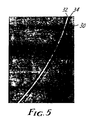
- the fibers were then observed under a microscope showing a single fiber, part white and part black as shown in the black and white photo, Fig. 5. Because the spinning sols were essentially of the same composition, there was virtually no crimping.
- Al2O3 sol was co-spun with a 50: 50 Al2O3-ZrO2 sol.
- the alumina sol was prepared by adding 68 g lactic acid to 1100 g aluminium formoacetate and concentrating the sol to the spinning sol viscosity.
- the 1: 1 Al2O3: ZrO2 sol was prepared by mixing 492 g zirconium acetate into 1122 g aluminum formoacetate with a further addition of 70 g lactic acid. The sol precursor was concentrated to the spinning viscosity.
- the fibers were fired to 700°C and held for 0.5 hour. As observed in an optical microscope, bicomponent fibers were formed; the shrinkage was minimal and low crimping was seen.
- Example 9 basic sol with additives as one component fiber
- a sol consisting of 70% by weight A-B-S 3-1-2 and 30% by weight Ni was prepared as follows (about 8.5 weight percent oxides)
- the total mixture was filtered through a 0.3 micrometer BalstonTM filter tube (Balston, Inc., Lexington, MA) cartridge filter, then concentrated in a RotovaporTM-R rotating evacuated flasck (Buchi, Switzerland) to a viscous sol of about 50,000 centipoise.
- This sol was readily spun using 29.4 kPa (200 psi) N2 pressure and a 30 hole, 76 micrometer (3 mil) spinnerette.
- the fiber was light green in color.
- This sol was co-spun with A-B-S 3-1-2 which when heated in a hydrogen atmosphere resulted in a fiber which was attractive to a magnet.
- the mixture was prepared by mixing the above materials in the order (1 + 2 + 3 + 4).
- the resulting mixture was filtered through a 0.3 BalstonTM cartridge (Balston, Inc., Lexington, MA) and 1 MilliporeTM filters into a round bottomed flask to be concentrated in a Rotavapor-R (water bath was 32-35°C) to a viscous sol of about 86,000 centipoise viscosity.
- FIGS 3, 4, and 5 show an air dried and hydrogen fired bicomponent fiber 30, with component fibers 32 and 34 being in laminated longitudinally extended configuration.
- a magnetic bicomponent fiber was prepared by co-spinning an A-B-S 3-1-2 sol with a barium titanate precursor sol.
- the barium titanate precursor sol was prepared from a water solution of barium acetate plus anhydrous ferrous acetate in a mole ratio of 1Ba: 12Fe.
- a second bicomponent fiber was prepared as described immediately above except that instead of ferrous acetate, FeCl3 ⁇ 6H2O was precipitated with NH4OH in an aqueous solution.
- High loft webs of these fibers can be used to remove iron contaminants from a ceramic slurry.
Landscapes
- Engineering & Computer Science (AREA)
- Chemical & Material Sciences (AREA)
- Textile Engineering (AREA)
- Ceramic Engineering (AREA)
- Manufacturing & Machinery (AREA)
- Organic Chemistry (AREA)
- Inorganic Chemistry (AREA)
- Chemical Kinetics & Catalysis (AREA)
- General Chemical & Material Sciences (AREA)
- Materials Engineering (AREA)
- Structural Engineering (AREA)
- Nanotechnology (AREA)
- Life Sciences & Earth Sciences (AREA)
- General Life Sciences & Earth Sciences (AREA)
- Geochemistry & Mineralogy (AREA)
- Inorganic Fibers (AREA)
- Multicomponent Fibers (AREA)
- Nonwoven Fabrics (AREA)
- Woven Fabrics (AREA)
- Hard Magnetic Materials (AREA)
- Artificial Filaments (AREA)
Claims (11)
Applications Claiming Priority (2)
| Application Number | Priority Date | Filing Date | Title |
|---|---|---|---|
| US809065 | 1985-12-13 | ||
| US06/809,065 US4707399A (en) | 1985-12-13 | 1985-12-13 | Bicomponent ceramic fibers |
Publications (3)
| Publication Number | Publication Date |
|---|---|
| EP0228839A2 EP0228839A2 (fr) | 1987-07-15 |
| EP0228839A3 EP0228839A3 (en) | 1989-05-10 |
| EP0228839B1 true EP0228839B1 (fr) | 1991-06-12 |
Family
ID=25200461
Family Applications (1)
| Application Number | Title | Priority Date | Filing Date |
|---|---|---|---|
| EP19860309611 Expired - Lifetime EP0228839B1 (fr) | 1985-12-13 | 1986-12-10 | Fibres biconstituantes en céramique |
Country Status (7)
| Country | Link |
|---|---|
| US (1) | US4707399A (fr) |
| EP (1) | EP0228839B1 (fr) |
| JP (1) | JPS62223320A (fr) |
| KR (1) | KR940002026B1 (fr) |
| AU (1) | AU583957B2 (fr) |
| CA (1) | CA1276761C (fr) |
| DE (1) | DE3679797D1 (fr) |
Families Citing this family (31)
| Publication number | Priority date | Publication date | Assignee | Title |
|---|---|---|---|---|
| US5017316A (en) * | 1986-02-18 | 1991-05-21 | Minnesota Mining And Manufacturing Company | Internally modified ceramic fiber |
| EP0332789B1 (fr) * | 1988-03-17 | 1994-02-23 | Societe Des Ceramiques Techniques | Membrane de filtration et procédé de fabrication |
| US4942020A (en) * | 1988-06-27 | 1990-07-17 | W.R. Grace & Co.-Conn. | Converter for removing pollutants from a gas stream |
| US5375474A (en) * | 1992-08-12 | 1994-12-27 | The United States Of America As Represented By The United States National Aeronautics And Space Administration | Compensated high temperature strain gage |
| US5270268A (en) * | 1992-09-23 | 1993-12-14 | Aluminum Company Of America | Aluminum borate devitrification inhibitor in low dielectric borosilicate glass |
| EP0678128B1 (fr) * | 1993-01-07 | 1996-09-25 | Minnesota Mining And Manufacturing Company | Mat non tisse souple |
| US6017835A (en) * | 1993-11-05 | 2000-01-25 | Owens Corning Fiberglas Technology, Inc. | Glass compositions for producing dual-glass fibers |
| US5431992A (en) * | 1993-11-05 | 1995-07-11 | Houpt; Ronald A. | Dual-glass fibers and insulation products therefrom |
| US5470656A (en) * | 1994-07-05 | 1995-11-28 | E. I. Du Pont De Nemours And Company | Moisture-stable flexible structural adhesive strand |
| US5885390A (en) * | 1994-09-21 | 1999-03-23 | Owens-Corning Fiberglas Technology Inc. | Processing methods and products for irregularly shaped bicomponent glass fibers |
| US5980680A (en) * | 1994-09-21 | 1999-11-09 | Owens Corning Fiberglas Technology, Inc. | Method of forming an insulation product |
| US5523265A (en) * | 1995-05-04 | 1996-06-04 | Owens-Corning Fiberglas Technology, Inc. | Glass compositions and fibers therefrom |
| US5576252A (en) * | 1995-05-04 | 1996-11-19 | Owens-Corning Fiberglas Technology, Inc. | Irregularly-shaped glass fibers and insulation therefrom |
| US5622903A (en) * | 1995-05-04 | 1997-04-22 | Owens-Corning Fiberglas Technology, Inc. | Irregularly shaped glass fibers and insulation therefrom |
| IL122843A (en) * | 1998-01-02 | 2001-01-11 | Ceramight Composites Ltd | Metal-ceramic laminar-band composite |
| US6080216A (en) | 1998-04-22 | 2000-06-27 | 3M Innovative Properties Company | Layered alumina-based abrasive grit, abrasive products, and methods |
| US6228134B1 (en) | 1998-04-22 | 2001-05-08 | 3M Innovative Properties Company | Extruded alumina-based abrasive grit, abrasive products, and methods |
| CA2357713A1 (fr) * | 1999-01-06 | 2000-07-13 | Ceramight Composites Ltd. | Composite a bandes laminaires en metal-ceramique |
| US6815383B1 (en) | 2000-05-24 | 2004-11-09 | Kimberly-Clark Worldwide, Inc. | Filtration medium with enhanced particle holding characteristics |
| JP4552019B2 (ja) * | 2005-02-08 | 2010-09-29 | 国立大学法人群馬大学 | 炭化ケイ素系ナノ繊維の製造方法 |
| US7282462B1 (en) * | 2005-04-12 | 2007-10-16 | Mjd Innovations, Llc | Body armor strand structure, method and performance |
| WO2007030669A2 (fr) * | 2005-09-07 | 2007-03-15 | The University Of Akron | Fibres de ceramique souples et leur procede de production |
| US7824602B2 (en) * | 2006-03-31 | 2010-11-02 | Massachusetts Institute Of Technology | Ceramic processing and shaped ceramic bodies |
| US20110169182A1 (en) * | 2008-10-23 | 2011-07-14 | Honeywell International Inc. | Methods of forming bulk absorbers |
| US20100213002A1 (en) * | 2009-02-26 | 2010-08-26 | Honeywell International Inc. | Fibrous materials, noise suppression materials, and methods of manufacturing noise suppression materials |
| US10058808B2 (en) | 2012-10-22 | 2018-08-28 | Cummins Filtration Ip, Inc. | Composite filter media utilizing bicomponent fibers |
| CN109851336B (zh) * | 2019-01-23 | 2021-09-24 | 中南大学 | 一种高模量致密连续莫来石纳米陶瓷纤维及其制备方法 |
| CN112725710A (zh) * | 2020-12-18 | 2021-04-30 | 苏州欧美克合金工具有限公司 | 一种混合型金属陶瓷材料的加工工艺 |
| CN119998506A (zh) * | 2022-10-04 | 2025-05-13 | 株式会社村田制作所 | 复合纤维 |
| CN116377606B (zh) * | 2023-04-25 | 2024-03-22 | 武汉纺织大学 | 一种螺旋形抗菌纳米纤维及其制备方法和应用 |
| CN117000039B (zh) * | 2023-09-07 | 2025-01-24 | 重庆市畜牧科学院 | 一种光催化滤网及其制备方法、应用 |
Family Cites Families (23)
| Publication number | Priority date | Publication date | Assignee | Title |
|---|---|---|---|---|
| BE423831A (fr) * | 1936-09-30 | |||
| US2968622A (en) * | 1958-12-30 | 1961-01-17 | Owens Corning Fiberglass Corp | Magnetic ceramic fibers and method of making same |
| US3082099A (en) * | 1960-02-26 | 1963-03-19 | Horizons Inc | Inorganic fibers and method of preparation |
| US3311689A (en) * | 1963-01-17 | 1967-03-28 | Horizons Inc | Preparation of inorganic oxide monofilaments |
| US3385915A (en) * | 1966-09-02 | 1968-05-28 | Union Carbide Corp | Process for producing metal oxide fibers, textiles and shapes |
| US3565749A (en) * | 1967-02-27 | 1971-02-23 | Fmc Corp | High temperature resistant structures |
| US3663182A (en) * | 1968-03-29 | 1972-05-16 | Union Carbide Corp | Metal oxide fabrics |
| GB1287288A (en) * | 1968-12-27 | 1972-08-31 | Universal Oil Prod Co | Refractory inorganic oxide fibers |
| US3632709A (en) * | 1968-12-27 | 1972-01-04 | Universal Oil Prod Co | Making alumina fibers from a mixture of alumina sol and hexamethylenetetramine |
| US3793041A (en) * | 1969-05-16 | 1974-02-19 | Minnesota Mining & Mfg | Refractory fibers of zirconia and silica mixtures |
| CA1097469A (fr) * | 1969-10-17 | 1981-03-17 | Gerhard Winter | Obtention de fibres inorganiques |
| US3652749A (en) * | 1970-01-26 | 1972-03-28 | Universal Oil Prod Co | Continuous drawing of fibers from a mixture containing an inorgani oxide sol covered by a protective fluid |
| US3795524A (en) * | 1971-03-01 | 1974-03-05 | Minnesota Mining & Mfg | Aluminum borate and aluminum borosilicate articles |
| US3760049A (en) * | 1971-03-01 | 1973-09-18 | Minnesota Mining & Mfg | Method of firing dry spun refractory oxide fibers |
| GB1425934A (en) * | 1972-03-15 | 1976-02-25 | Ici Ltd | Alumina |
| US4166147A (en) * | 1973-04-16 | 1979-08-28 | Minnesota Mining And Manufacturing Company | Shaped and fired articles of tio2 |
| NL178586C (nl) * | 1973-07-05 | 1986-04-16 | Minnesota Mining & Mfg | Werkwijze voor het vervaardigen van vuurvaste vezels. |
| US3909278A (en) * | 1973-12-28 | 1975-09-30 | Minnesota Mining & Mfg | High density thoria-silica-metal (III) oxide fibers |
| US4071594A (en) * | 1974-09-03 | 1978-01-31 | Aluminum Company Of America | Production of continuous ceramic fibers |
| US4047965A (en) * | 1976-05-04 | 1977-09-13 | Minnesota Mining And Manufacturing Company | Non-frangible alumina-silica fibers |
| US4118534A (en) * | 1977-05-11 | 1978-10-03 | E. I. Du Pont De Nemours And Company | Crimped bicomponent-filament yarn with randomly reversing helical filament twist |
| US4287254A (en) * | 1978-02-13 | 1981-09-01 | Monsanto Company | Conjugate filaments and films |
| US4278634A (en) * | 1980-08-18 | 1981-07-14 | American Cyanamid Company | Biconstituent acrylic fibers by melt spinning |
-
1985
- 1985-12-13 US US06/809,065 patent/US4707399A/en not_active Expired - Fee Related
-
1986
- 1986-11-13 CA CA 522849 patent/CA1276761C/fr not_active Expired - Lifetime
- 1986-11-20 AU AU65538/86A patent/AU583957B2/en not_active Ceased
- 1986-12-10 DE DE8686309611T patent/DE3679797D1/de not_active Expired - Lifetime
- 1986-12-10 EP EP19860309611 patent/EP0228839B1/fr not_active Expired - Lifetime
- 1986-12-12 JP JP61296488A patent/JPS62223320A/ja active Pending
- 1986-12-12 KR KR1019860010626A patent/KR940002026B1/ko not_active Expired - Lifetime
Also Published As
| Publication number | Publication date |
|---|---|
| KR870005919A (ko) | 1987-07-07 |
| AU583957B2 (en) | 1989-05-11 |
| CA1276761C (fr) | 1990-11-27 |
| KR940002026B1 (ko) | 1994-03-14 |
| EP0228839A3 (en) | 1989-05-10 |
| EP0228839A2 (fr) | 1987-07-15 |
| JPS62223320A (ja) | 1987-10-01 |
| DE3679797D1 (de) | 1991-07-18 |
| AU6553886A (en) | 1987-06-18 |
| US4707399A (en) | 1987-11-17 |
Similar Documents
| Publication | Publication Date | Title |
|---|---|---|
| EP0228839B1 (fr) | Fibres biconstituantes en céramique | |
| EP0233776B1 (fr) | Fibre céramique modifiée à l'intérieur | |
| US5017316A (en) | Internally modified ceramic fiber | |
| US4824623A (en) | A method of making bicomponent green and ceramic fibers | |
| CA1046537A (fr) | Fibres refractaires d'oxyde d'alumine-chrome-metal (iv) a phase microcristalline | |
| US3709706A (en) | Refractory fibers and other articles of zirconia and silica mixtures | |
| US4166147A (en) | Shaped and fired articles of tio2 | |
| US3793041A (en) | Refractory fibers of zirconia and silica mixtures | |
| CA1078414A (fr) | Fibres d'alumine et de silice non frangibles | |
| KR940010098B1 (ko) | 내화성의 상변환 서미트 성형품 및 그 제조 방법 | |
| CA1302738C (fr) | Composites a matrice metallique renforcee de fibres | |
| EP0227374B1 (fr) | Corps microcristallin en spinelle d'oxyde de métal transitoire | |
| US4937212A (en) | Zirconium oxide fibers and process for their preparation | |
| CN115262032A (zh) | 一种氧化铝柔性纤维及其制备方法 | |
| US3909278A (en) | High density thoria-silica-metal (III) oxide fibers | |
| EP0273391A2 (fr) | Nappe de fibres d'alumine résistant à la chaleur | |
| US4929578A (en) | Refractory fibers of alumina and organic residue | |
| US4801562A (en) | Refractory fibers of alumina and amorphous phosphorus pentoxide | |
| AU622246B2 (en) | Refractory fibers of amorphous alumina and organic residue | |
| JPH09241918A (ja) | 複合チタン酸金属塩繊維を含有する繊維状組成物及びその製造方法 | |
| CN114773070B (zh) | 一种以羧酸铝溶胶为前驱体的氧化铝连续纤维的制备方法 |
Legal Events
| Date | Code | Title | Description |
|---|---|---|---|
| PUAI | Public reference made under article 153(3) epc to a published international application that has entered the european phase |
Free format text: ORIGINAL CODE: 0009012 |
|
| AK | Designated contracting states |
Kind code of ref document: A2 Designated state(s): DE FR GB IT NL SE |
|
| PUAL | Search report despatched |
Free format text: ORIGINAL CODE: 0009013 |
|
| AK | Designated contracting states |
Kind code of ref document: A3 Designated state(s): DE FR GB IT NL SE |
|
| 17P | Request for examination filed |
Effective date: 19890711 |
|
| 17Q | First examination report despatched |
Effective date: 19900417 |
|
| GRAA | (expected) grant |
Free format text: ORIGINAL CODE: 0009210 |
|
| ITF | It: translation for a ep patent filed | ||
| AK | Designated contracting states |
Kind code of ref document: B1 Designated state(s): DE FR GB IT NL SE |
|
| REF | Corresponds to: |
Ref document number: 3679797 Country of ref document: DE Date of ref document: 19910718 |
|
| ET | Fr: translation filed | ||
| PLBE | No opposition filed within time limit |
Free format text: ORIGINAL CODE: 0009261 |
|
| STAA | Information on the status of an ep patent application or granted ep patent |
Free format text: STATUS: NO OPPOSITION FILED WITHIN TIME LIMIT |
|
| 26N | No opposition filed | ||
| PGFP | Annual fee paid to national office [announced via postgrant information from national office to epo] |
Ref country code: FR Payment date: 19931109 Year of fee payment: 8 |
|
| PGFP | Annual fee paid to national office [announced via postgrant information from national office to epo] |
Ref country code: SE Payment date: 19931117 Year of fee payment: 8 |
|
| PGFP | Annual fee paid to national office [announced via postgrant information from national office to epo] |
Ref country code: DE Payment date: 19931124 Year of fee payment: 8 |
|
| PGFP | Annual fee paid to national office [announced via postgrant information from national office to epo] |
Ref country code: NL Payment date: 19931231 Year of fee payment: 8 |
|
| PG25 | Lapsed in a contracting state [announced via postgrant information from national office to epo] |
Ref country code: SE Effective date: 19941211 |
|
| EAL | Se: european patent in force in sweden |
Ref document number: 86309611.1 |
|
| PG25 | Lapsed in a contracting state [announced via postgrant information from national office to epo] |
Ref country code: NL Effective date: 19950701 |
|
| PG25 | Lapsed in a contracting state [announced via postgrant information from national office to epo] |
Ref country code: FR Effective date: 19950831 |
|
| NLV4 | Nl: lapsed or anulled due to non-payment of the annual fee |
Effective date: 19950701 |
|
| PG25 | Lapsed in a contracting state [announced via postgrant information from national office to epo] |
Ref country code: DE Effective date: 19950901 |
|
| EUG | Se: european patent has lapsed |
Ref document number: 86309611.1 |
|
| REG | Reference to a national code |
Ref country code: FR Ref legal event code: ST |
|
| PGFP | Annual fee paid to national office [announced via postgrant information from national office to epo] |
Ref country code: GB Payment date: 19991118 Year of fee payment: 14 |
|
| PG25 | Lapsed in a contracting state [announced via postgrant information from national office to epo] |
Ref country code: GB Free format text: LAPSE BECAUSE OF NON-PAYMENT OF DUE FEES Effective date: 20001210 |
|
| GBPC | Gb: european patent ceased through non-payment of renewal fee |
Effective date: 20001210 |
|
| PG25 | Lapsed in a contracting state [announced via postgrant information from national office to epo] |
Ref country code: IT Free format text: LAPSE BECAUSE OF NON-PAYMENT OF DUE FEES;WARNING: LAPSES OF ITALIAN PATENTS WITH EFFECTIVE DATE BEFORE 2007 MAY HAVE OCCURRED AT ANY TIME BEFORE 2007. THE CORRECT EFFECTIVE DATE MAY BE DIFFERENT FROM THE ONE RECORDED. Effective date: 20051210 |