EP0228902A2 - Acid or acid salt wash of a metal chloride layer of an ion selective electrode - Google Patents
Acid or acid salt wash of a metal chloride layer of an ion selective electrode Download PDFInfo
- Publication number
- EP0228902A2 EP0228902A2 EP86310115A EP86310115A EP0228902A2 EP 0228902 A2 EP0228902 A2 EP 0228902A2 EP 86310115 A EP86310115 A EP 86310115A EP 86310115 A EP86310115 A EP 86310115A EP 0228902 A2 EP0228902 A2 EP 0228902A2
- Authority
- EP
- European Patent Office
- Prior art keywords
- acid
- layer
- metal
- electrode
- metal chloride
- Prior art date
- Legal status (The legal status is an assumption and is not a legal conclusion. Google has not performed a legal analysis and makes no representation as to the accuracy of the status listed.)
- Granted
Links
- 239000002253 acid Substances 0.000 title claims abstract description 35
- 150000003839 salts Chemical class 0.000 title claims abstract description 27
- 150000002500 ions Chemical class 0.000 title claims abstract description 11
- 229910001510 metal chloride Inorganic materials 0.000 title claims abstract description 10
- 238000000034 method Methods 0.000 claims abstract description 18
- 238000005406 washing Methods 0.000 claims abstract description 8
- VEXZGXHMUGYJMC-UHFFFAOYSA-M Chloride anion Chemical compound [Cl-] VEXZGXHMUGYJMC-UHFFFAOYSA-M 0.000 claims abstract description 6
- 150000007522 mineralic acids Chemical class 0.000 claims abstract description 6
- 150000007524 organic acids Chemical class 0.000 claims abstract description 6
- KDCGOANMDULRCW-UHFFFAOYSA-N 7H-purine Chemical compound N1=CNC2=NC=NC2=C1 KDCGOANMDULRCW-UHFFFAOYSA-N 0.000 claims description 32
- 229910052709 silver Inorganic materials 0.000 claims description 13
- 239000004332 silver Substances 0.000 claims description 12
- 229910052751 metal Inorganic materials 0.000 claims description 11
- 239000002184 metal Substances 0.000 claims description 11
- XLYOFNOQVPJJNP-UHFFFAOYSA-N water Substances O XLYOFNOQVPJJNP-UHFFFAOYSA-N 0.000 claims description 11
- 229910001868 water Inorganic materials 0.000 claims description 10
- BUIQRTDBPCHRIR-UHFFFAOYSA-L O[Cr](Cl)(=O)=O Chemical compound O[Cr](Cl)(=O)=O BUIQRTDBPCHRIR-UHFFFAOYSA-L 0.000 claims description 8
- 150000001768 cations Chemical class 0.000 claims description 7
- 229920002678 cellulose Polymers 0.000 claims description 7
- 230000001590 oxidative effect Effects 0.000 claims description 4
- 239000007864 aqueous solution Substances 0.000 claims description 2
- PEBPTQFCMJWPGZ-UHFFFAOYSA-M potassium;trioxochromium;chloride Chemical compound [Cl-].[K+].O=[Cr](=O)=O PEBPTQFCMJWPGZ-UHFFFAOYSA-M 0.000 claims description 2
- 150000007513 acids Chemical class 0.000 abstract description 9
- 229910021607 Silver chloride Inorganic materials 0.000 description 24
- HKZLPVFGJNLROG-UHFFFAOYSA-M silver monochloride Chemical compound [Cl-].[Ag+] HKZLPVFGJNLROG-UHFFFAOYSA-M 0.000 description 24
- 238000012360 testing method Methods 0.000 description 15
- LEHOTFFKMJEONL-UHFFFAOYSA-N Uric Acid Chemical compound N1C(=O)NC(=O)C2=C1NC(=O)N2 LEHOTFFKMJEONL-UHFFFAOYSA-N 0.000 description 10
- TVWHNULVHGKJHS-UHFFFAOYSA-N Uric acid Natural products N1C(=O)NC(=O)C2NC(=O)NC21 TVWHNULVHGKJHS-UHFFFAOYSA-N 0.000 description 10
- FDGQSTZJBFJUBT-UHFFFAOYSA-N hypoxanthine Chemical compound O=C1NC=NC2=C1NC=N2 FDGQSTZJBFJUBT-UHFFFAOYSA-N 0.000 description 10
- 229940116269 uric acid Drugs 0.000 description 10
- BQCADISMDOOEFD-UHFFFAOYSA-N Silver Chemical compound [Ag] BQCADISMDOOEFD-UHFFFAOYSA-N 0.000 description 9
- 239000012530 fluid Substances 0.000 description 8
- 150000003212 purines Chemical class 0.000 description 8
- 230000000052 comparative effect Effects 0.000 description 6
- VWDWKYIASSYTQR-UHFFFAOYSA-N sodium nitrate Chemical compound [Na+].[O-][N+]([O-])=O VWDWKYIASSYTQR-UHFFFAOYSA-N 0.000 description 6
- UGQMRVRMYYASKQ-UHFFFAOYSA-N Hypoxanthine nucleoside Natural products OC1C(O)C(CO)OC1N1C(NC=NC2=O)=C2N=C1 UGQMRVRMYYASKQ-UHFFFAOYSA-N 0.000 description 5
- 229920002301 cellulose acetate Polymers 0.000 description 5
- -1 e.g. Chemical compound 0.000 description 5
- 230000000694 effects Effects 0.000 description 5
- 239000007788 liquid Substances 0.000 description 5
- VEXZGXHMUGYJMC-UHFFFAOYSA-N Hydrochloric acid Chemical compound Cl VEXZGXHMUGYJMC-UHFFFAOYSA-N 0.000 description 4
- GRYLNZFGIOXLOG-UHFFFAOYSA-N Nitric acid Chemical compound O[N+]([O-])=O GRYLNZFGIOXLOG-UHFFFAOYSA-N 0.000 description 4
- NBIIXXVUZAFLBC-UHFFFAOYSA-N Phosphoric acid Chemical compound OP(O)(O)=O NBIIXXVUZAFLBC-UHFFFAOYSA-N 0.000 description 4
- UIIMBOGNXHQVGW-UHFFFAOYSA-M Sodium bicarbonate Chemical compound [Na+].OC([O-])=O UIIMBOGNXHQVGW-UHFFFAOYSA-M 0.000 description 4
- FAPWRFPIFSIZLT-UHFFFAOYSA-M Sodium chloride Chemical compound [Na+].[Cl-] FAPWRFPIFSIZLT-UHFFFAOYSA-M 0.000 description 4
- 229910017604 nitric acid Inorganic materials 0.000 description 4
- 239000000243 solution Substances 0.000 description 4
- CPELXLSAUQHCOX-UHFFFAOYSA-M Bromide Chemical compound [Br-] CPELXLSAUQHCOX-UHFFFAOYSA-M 0.000 description 3
- 230000032683 aging Effects 0.000 description 3
- 239000000523 sample Substances 0.000 description 3
- 235000010344 sodium nitrate Nutrition 0.000 description 3
- LRFVTYWOQMYALW-UHFFFAOYSA-N 9H-xanthine Chemical compound O=C1NC(=O)NC2=C1NC=N2 LRFVTYWOQMYALW-UHFFFAOYSA-N 0.000 description 2
- QAOWNCQODCNURD-UHFFFAOYSA-N Sulfuric acid Chemical compound OS(O)(=O)=O QAOWNCQODCNURD-UHFFFAOYSA-N 0.000 description 2
- 229910000147 aluminium phosphate Inorganic materials 0.000 description 2
- 238000013459 approach Methods 0.000 description 2
- 239000007844 bleaching agent Substances 0.000 description 2
- RYYVLZVUVIJVGH-UHFFFAOYSA-N caffeine Chemical compound CN1C(=O)N(C)C(=O)C2=C1N=CN2C RYYVLZVUVIJVGH-UHFFFAOYSA-N 0.000 description 2
- ZCCIPPOKBCJFDN-UHFFFAOYSA-N calcium nitrate Chemical compound [Ca+2].[O-][N+]([O-])=O.[O-][N+]([O-])=O ZCCIPPOKBCJFDN-UHFFFAOYSA-N 0.000 description 2
- 238000010276 construction Methods 0.000 description 2
- JVTAAEKCZFNVCJ-UHFFFAOYSA-N lactic acid Chemical compound CC(O)C(O)=O JVTAAEKCZFNVCJ-UHFFFAOYSA-N 0.000 description 2
- BDAGIHXWWSANSR-UHFFFAOYSA-N methanoic acid Natural products OC=O BDAGIHXWWSANSR-UHFFFAOYSA-N 0.000 description 2
- 239000000203 mixture Substances 0.000 description 2
- 230000035699 permeability Effects 0.000 description 2
- 238000002360 preparation method Methods 0.000 description 2
- 239000012266 salt solution Substances 0.000 description 2
- 239000011734 sodium Substances 0.000 description 2
- 235000017557 sodium bicarbonate Nutrition 0.000 description 2
- 229910000030 sodium bicarbonate Inorganic materials 0.000 description 2
- 239000011780 sodium chloride Substances 0.000 description 2
- ZFXYFBGIUFBOJW-UHFFFAOYSA-N theophylline Chemical compound O=C1N(C)C(=O)N(C)C2=C1NC=N2 ZFXYFBGIUFBOJW-UHFFFAOYSA-N 0.000 description 2
- HVSKLHZMTXBGOE-UHFFFAOYSA-N 3,7-dihydropurin-6-one;7h-purine Chemical compound C1=NC=C2NC=NC2=N1.O=C1N=CNC2=C1NC=N2 HVSKLHZMTXBGOE-UHFFFAOYSA-N 0.000 description 1
- OSWFIVFLDKOXQC-UHFFFAOYSA-N 4-(3-methoxyphenyl)aniline Chemical compound COC1=CC=CC(C=2C=CC(N)=CC=2)=C1 OSWFIVFLDKOXQC-UHFFFAOYSA-N 0.000 description 1
- 208000010444 Acidosis Diseases 0.000 description 1
- 208000009304 Acute Kidney Injury Diseases 0.000 description 1
- GFFGJBXGBJISGV-UHFFFAOYSA-N Adenine Chemical compound NC1=NC=NC2=C1N=CN2 GFFGJBXGBJISGV-UHFFFAOYSA-N 0.000 description 1
- 229930024421 Adenine Natural products 0.000 description 1
- 208000020576 Adrenal disease Diseases 0.000 description 1
- BVKZGUZCCUSVTD-UHFFFAOYSA-M Bicarbonate Chemical compound OC([O-])=O BVKZGUZCCUSVTD-UHFFFAOYSA-M 0.000 description 1
- LPHGQDQBBGAPDZ-UHFFFAOYSA-N Isocaffeine Natural products CN1C(=O)N(C)C(=O)C2=C1N(C)C=N2 LPHGQDQBBGAPDZ-UHFFFAOYSA-N 0.000 description 1
- 206010028980 Neoplasm Diseases 0.000 description 1
- 208000001647 Renal Insufficiency Diseases 0.000 description 1
- 208000033626 Renal failure acute Diseases 0.000 description 1
- VMHLLURERBWHNL-UHFFFAOYSA-M Sodium acetate Chemical compound [Na+].CC([O-])=O VMHLLURERBWHNL-UHFFFAOYSA-M 0.000 description 1
- 238000010306 acid treatment Methods 0.000 description 1
- 230000007950 acidosis Effects 0.000 description 1
- 208000026545 acidosis disease Diseases 0.000 description 1
- 201000011040 acute kidney failure Diseases 0.000 description 1
- 208000012998 acute renal failure Diseases 0.000 description 1
- 229960000643 adenine Drugs 0.000 description 1
- OFCNXPDARWKPPY-UHFFFAOYSA-N allopurinol Chemical compound OC1=NC=NC2=C1C=NN2 OFCNXPDARWKPPY-UHFFFAOYSA-N 0.000 description 1
- 229960003459 allopurinol Drugs 0.000 description 1
- 239000013060 biological fluid Substances 0.000 description 1
- QCUOBSQYDGUHHT-UHFFFAOYSA-L cadmium sulfate Chemical compound [Cd+2].[O-]S([O-])(=O)=O QCUOBSQYDGUHHT-UHFFFAOYSA-L 0.000 description 1
- 229910000369 cadmium(II) sulfate Inorganic materials 0.000 description 1
- 229960001948 caffeine Drugs 0.000 description 1
- VJEONQKOZGKCAK-UHFFFAOYSA-N caffeine Natural products CN1C(=O)N(C)C(=O)C2=C1C=CN2C VJEONQKOZGKCAK-UHFFFAOYSA-N 0.000 description 1
- 201000011510 cancer Diseases 0.000 description 1
- 238000010668 complexation reaction Methods 0.000 description 1
- 229910052802 copper Inorganic materials 0.000 description 1
- 230000003247 decreasing effect Effects 0.000 description 1
- 239000008367 deionised water Substances 0.000 description 1
- 229910021641 deionized water Inorganic materials 0.000 description 1
- 230000001627 detrimental effect Effects 0.000 description 1
- 238000002474 experimental method Methods 0.000 description 1
- 235000019253 formic acid Nutrition 0.000 description 1
- 229910052737 gold Inorganic materials 0.000 description 1
- 235000011167 hydrochloric acid Nutrition 0.000 description 1
- BAUYGSIQEAFULO-UHFFFAOYSA-L iron(2+) sulfate (anhydrous) Chemical compound [Fe+2].[O-]S([O-])(=O)=O BAUYGSIQEAFULO-UHFFFAOYSA-L 0.000 description 1
- 229910000359 iron(II) sulfate Inorganic materials 0.000 description 1
- 201000006370 kidney failure Diseases 0.000 description 1
- 239000004310 lactic acid Substances 0.000 description 1
- 235000014655 lactic acid Nutrition 0.000 description 1
- 208000032839 leukemia Diseases 0.000 description 1
- 238000005259 measurement Methods 0.000 description 1
- 239000002207 metabolite Substances 0.000 description 1
- 229910052759 nickel Inorganic materials 0.000 description 1
- 239000007800 oxidant agent Substances 0.000 description 1
- 230000003647 oxidation Effects 0.000 description 1
- 238000007254 oxidation reaction Methods 0.000 description 1
- 239000013610 patient sample Substances 0.000 description 1
- 235000011007 phosphoric acid Nutrition 0.000 description 1
- KMUONIBRACKNSN-UHFFFAOYSA-N potassium dichromate Chemical compound [K+].[K+].[O-][Cr](=O)(=O)O[Cr]([O-])(=O)=O KMUONIBRACKNSN-UHFFFAOYSA-N 0.000 description 1
- 210000002966 serum Anatomy 0.000 description 1
- 239000001632 sodium acetate Substances 0.000 description 1
- 235000017281 sodium acetate Nutrition 0.000 description 1
- 229960000278 theophylline Drugs 0.000 description 1
- 229940075420 xanthine Drugs 0.000 description 1
Classifications
-
- G—PHYSICS
- G01—MEASURING; TESTING
- G01N—INVESTIGATING OR ANALYSING MATERIALS BY DETERMINING THEIR CHEMICAL OR PHYSICAL PROPERTIES
- G01N27/00—Investigating or analysing materials by the use of electric, electrochemical, or magnetic means
- G01N27/26—Investigating or analysing materials by the use of electric, electrochemical, or magnetic means by investigating electrochemical variables; by using electrolysis or electrophoresis
- G01N27/28—Electrolytic cell components
- G01N27/30—Electrodes, e.g. test electrodes; Half-cells
- G01N27/333—Ion-selective electrodes or membranes
- G01N27/3335—Ion-selective electrodes or membranes the membrane containing at least one organic component
-
- G—PHYSICS
- G01—MEASURING; TESTING
- G01N—INVESTIGATING OR ANALYSING MATERIALS BY DETERMINING THEIR CHEMICAL OR PHYSICAL PROPERTIES
- G01N27/00—Investigating or analysing materials by the use of electric, electrochemical, or magnetic means
- G01N27/26—Investigating or analysing materials by the use of electric, electrochemical, or magnetic means by investigating electrochemical variables; by using electrolysis or electrophoresis
- G01N27/28—Electrolytic cell components
- G01N27/30—Electrodes, e.g. test electrodes; Half-cells
- G01N27/333—Ion-selective electrodes or membranes
Definitions
- This invention relates to a process of forming an ion selective electrode. It more particularly concerns a method for forming a chloride electrode.
- Ion selective electrodes hereinafter ISE's have become a significant part of the clinical chemists' arsenal in analyzing for analytes in biological fluids. Such ISE's allow for the activity determination of ionic analytes such as Cl ⁇ , Na ⁇ , K ⁇ and HCO3 ⁇ . These ionic analytes are useful in diagnosing, e.g., various acidosis conditions, and in the case of Cl ⁇ , adrenal disease and renal failure.
- Cl ⁇ ISE useful electrode constructions and preparations are described in U.S. Patent Nos. 4,214,968, issued July 29, 1980, and 4,199,411, issued April 22, 1980.
- Such Cl ⁇ ISE is preferably prepared by forming a layer of silver on a suitable support, and thereafter converting a surface portion of the silver layer to silver chloride by treating the silver layer with a chlorochromate bath or wash.
- a chlorochromate bath or wash Useful examples of such a bath or wash are described in the aforesaid patents.
- the most preferred construction of the Cl ⁇ ISE is one in which a thin overlayer, preferably of a cellulose ester, is formed on the silver chloride layer, as described in the aforesaid '411 patent.
- a thin overlayer preferably of a cellulose ester
- Uric acid is an endogenous purine that can be found as a natural metabolite in human body liquids.
- a process for making an ion selective electrode selective for chloride comprising the steps of a) forming a layer of metal on a support, and b) oxidizing a surface portion of the metal layer with a bath comprising a chlorochromate, to form metal chloride, characterized in the use of a further step, after step b) of washing the electrode in an organic acid, inorganic acid, or aqueous solution of a salt of the organic or inorganic acid, provided that
- purine negative biases noted above are deemed to be “reduced” if there is at least at 10% reduction in the negative bias that occurs for an identical electrode prepared without using the invention, and when testing with a purine interference that creates a negative bias in the absence of the invention.
- purine interference means interference that actually alters the expected reading in the absence of the invention (which is not the case for just uric acid when using an ISE having a cellulose acetate overcoat.)
- the present invention is particularly described with reference to a preferred Cl ⁇ ISE prepared with a cellulose ester overcoat on a silver chloride layer formed on a silver conductive metal layer.
- it is also useful in reducing negative purine biases for such Cl ⁇ ISE's lacking such overcoats, and regardless of the conductive metal selected. That is, the process can be applied to a layer of MCl, where M is a conductive metal such as Ag, Ni, Cu and Au. If no cellulose ester overcoat is present, then the wash step is effective even against uric acid as the purine.
- negative bias refers to an increased positive ISE potential that represents an increase in Ag ⁇ activity. The net effect is to predict a lower Cl ⁇ concentration than is actually the case.
- the preferred oxidizing step to form the AgCl employs a chlorochromate bath at a temperature of 23 ⁇ 2°C.
- a chlorochromate bath can comprise a chlorochromate of any cation, e.g., Na ⁇ or K ⁇ .
- the preferred bath features the K ⁇ form, in a concentration of from about 0.002 M to about 0.2 M .
- the most preferred composition of such a bath comprises 0.15 M HCl, 0.2 M KCl, and 0.034 M K2Cr2O7.
- the silver layer passes through the bath at 3-9 m/minute to convert about 25-40 weight % of the silver to silver chloride, at the surface.
- An optional, but preferred, final step is the overcoating of the silver halide layer with a layer of cellulose ester, e.g., cellulose acetate as noted above.
- a layer of cellulose ester e.g., cellulose acetate as noted above.
- Such an overcoat and its preparation are amply described in the aforesaid '411 patent. It is because of such overlayer that the reduction in negative bias achieved by the invention is apparent for purines other than uric acid. That is, the overcoat itself is significantly effective in preventing a bias due to uric acid. Of course, if the overcoat is omitted, then the invention will demonstrate a reduction in negative bias, compared to an untreated ISE, even for uric acid interference.
- the silver halide layer of the electrode is treated with a selected inorganic or organic acid, or a salt thereof having certain required properties, in a concentration and for a time effective to reduce the negative bias.
- the acids that are useful for this purpose have a pKa of less than 4.0, and do not dissolve silver chloride, that is, have a silver solubility product less than 10.0, e.g., nitric acid, sulfuric acid, phosphoric acid, hydrochloric acid, formic acid, lactic acid and the like, as well as mixtures of these. If the pKa is > 4.0, then the acid is too weak to have an effect. If the pK sp is > 10.0, then it will dissolve silver chloride, which is unacceptable. Of these acids, the most preferred are those having a silver complexation constant K c ⁇ 100, e.g., nitric acid and phosphoric acid.
- the order in which the silver chloride layer is treated with this acid or salt is not particularly critical. That is, the treatment can occur either immediately after the oxidation step used to convert the surface of the silver layer to silver chloride, e.g., while, it is still wet. Alternatively, the electrode so converted can be dried, aged, and thereafter treated. In any event, the treatment comes before the electrode is overcoated, if at all, with the cellulose ester overcoat described above. It may, of course, be necessary to adjust treatment conditions to ensure that the AgCl layer is not significantly dissolved during the treatment.
- AgCl layers that have been dried and aged (but not yet overcoated) require and also tolerate a greater acid strength, for a given residence time, to produce the same reduction in purine negative bias as is achieved when the AgCl layer is treated fresh and wet, out of the oxidizing bath.
- the concentration of the acid or salt as well as the time of residence of the electrode within the acid or salt will vary. Selection of the appropriate values depend primarily upon a) the acid or salt selected and b) whether the treatment is to a fresh AgCl surface, or one that is aged. Selection of an appropriate concentration and residence time within these guidelines is well within the skill of the skilled artisan.
- the concentration of the acid or salt can be between 0.001 M and 1.0 M , for a residence time of between about 2000 sec and about 30 sec, respectively.
- the concentration is between about 0.01 M and about 1.0 M for a residence time of the electrode that is between about 300 sec and about 30 sec, respectively.
- the concentration is no less than about 0.05 M with a residence time no greater than about 120 sec.
- the residence time is preferably much shorter than these figures, or the HNO3 concentration considerably weaker, if the treatment is applied to a wet, freshly formed AgCl layer.
- concentration and residence time will also depend upon the purine interference that is contemplated. That is, if the acid or salt concentration is selected to ensure, e.g, a 10% reduction in observed purine bias, the necessary concentration of acid or salt for a given residence time varies somewhat, depending on the identity of the purine and its test concentration, used for the test.
- the purine selected was hypoxanthine at 2 m M .
- the following is a simplified test to determine whether a particular acid or salt is useful in this invention:
- the electrode with its metal chloride layer already formed, and aged at least 1 month, is washed with the candidate acid at the selected strength and for the selected time.
- An identical electrode having metal chloride of the same age is washed with water as a control, for the same time period.
- the two electrodes are then checked in the following cell: ⁇ Orion F ISE/100 ⁇ l of sample/M/MCl ⁇ , where M is the metal of the electrode, and the sample liquid comprises 115 m M NaCl, 25 m M NaHCO3 , 10 m M KF in H2O, and 2 m M hypoxanthine.
- the cell is read between 1 and 20 sec after spotting, the same read time being made on the control electrode. If at least a 10% reduction is found in the negative bias, compared to the control electrode washed only with water, then the acid or salt, its strength, and its wash time are appropriate.
- the selection of a variety of acids or salts for the treatment can also require additional steps. For example, if HCl is used, it is preferred that an H2O wash step be used thereafter, which may not be needed for the other acids. The reason of course is to remove Cl ⁇ ions from the AgCl surface and thus to avoid an artificially high Cl ⁇ blank being sensed by the reference liquid on the reference side of the differential measurement.
- test cell was the following: ⁇ Orion F ISE/100 ⁇ l of sample/Ag/AgCl ⁇ .
- the control fluid comprised 115 m M NaCl, 25 m M NaHCO3, and 10 m M KF in H2O.
- the purine fluid was the control fluid plus 2 m M hypoxanthine (purine) dissolved therein.
- the AgCl layer of the ISE's was prepared using the above-described potassium chlorochromate bleach, and thereafter dried. After some aging, which varied from example to example, the electrode was dipped into a bath of the stated acid for the stated time. (The control in each example was selected to be exactly the same age as the examples against which it was compared, and was washed only in water.) After the treatment time, they were blotted with filter paper and oven-dried at 50°C for 5 minutes. No cellulose acetate overcoat was applied. The test in the cell described above was then run, after the time indicated to determine whether the acid treatment produced at least a 20% reduction in the positive ⁇ mV value noted for the control. The results appear in Table I.
- Example 1 was repeated, but for these examples, the concentrations and residence times were those listed in Table II.
- the two Comparative Examples 3 and 4 were unsuccessful because of an improper combination of acid concentration and residence time. In the case of Comparative Example 3, the residence time was insufficient, whereas it was too long for Comparative Example 4. It is believed in the latter case that there was detrimental removal of the AgCl layer and possibly of the Ag layer.
- Example 10 Conversely, the strength of the acid in Example 10 was not too strong, even through greater in absolute value than the strength of the acid in Comparative Example 4. The reason was that the electrode in Example 10 was much older than the one in Comparative Example 4 (greater than 24 months versus less than 3 months, respectively). The greater aging made Example 10 more tolerant of the greater acid strength.
- Example 1 The procedure of Example 1 was repeated, except as follows:
- the acid wash was applied to a freshly prepared AgCl layer while the latter was still wet, using the same process line as for the bleach bath.
- an overcoat of cellulose acetate of a thickness of 10-20 ⁇ m was prepared as described in the aforesaid U.S. Patent No. 4,199,411.
- the testing of the electrodes was done using a human serum pool spiked with 0.455 m M hypoxanthine. The control was the same, but without the hypoxanthine.
- the measuring cell was the "Ektachem Cl ⁇ "TM test element prepared using the noted ISE, read on the "Ektachem 400”TM analyzer manufactured by Eastman Kodak Co., with electrometer readings being taken after 3 minutes.
- the "Ektachem” reference fluid was used on the reference side of the test. All electrometer readings were converted to Cl ⁇ concentrations via previously measured calibration lines.
- Example 16 The procedure of Example 16 was repeated, except salts of acids were used to prepare the wash solution, instead of acids.
- the wash time was the same for the control (no acid salts present, just deionized water) and the salt solutions, namely 3 min.
- the test fluids and the control fluids were the same as for Ex. 16. The tests were run after an aging period of 1 month, while stored at the temperature indicated in Table IV.
- the sodium acetate, comparative ex. #5 was selected because it has an aqueous pH above 7.0. It was unsatisfactory, as shown in Table IV:
- Example 18 The procedure of Example 18 was repeated, except the salt solution of the wash was 0.015 M NaNO3. The ISE was stored at 24°C for two days, and at -13°C for a short period, prior to testing. The results appear in Table V:
Landscapes
- Chemical & Material Sciences (AREA)
- Life Sciences & Earth Sciences (AREA)
- Health & Medical Sciences (AREA)
- Physics & Mathematics (AREA)
- Chemical Kinetics & Catalysis (AREA)
- Electrochemistry (AREA)
- Molecular Biology (AREA)
- Analytical Chemistry (AREA)
- Biochemistry (AREA)
- General Health & Medical Sciences (AREA)
- General Physics & Mathematics (AREA)
- Immunology (AREA)
- Pathology (AREA)
- Measuring Or Testing Involving Enzymes Or Micro-Organisms (AREA)
- Electrochromic Elements, Electrophoresis, Or Variable Reflection Or Absorption Elements (AREA)
Abstract
Description
- This invention relates to a process of forming an ion selective electrode. It more particularly concerns a method for forming a chloride electrode.
- Ion selective electrodes, hereinafter ISE's have become a significant part of the clinical chemists' arsenal in analyzing for analytes in biological fluids. Such ISE's allow for the activity determination of ionic analytes such as Cl⊖, Na ⊕, K ⊕ and HCO₃⊖. These ionic analytes are useful in diagnosing, e.g., various acidosis conditions, and in the case of Cl⊖, adrenal disease and renal failure.
- For the Cl⊖ ISE, useful electrode constructions and preparations are described in U.S. Patent Nos. 4,214,968, issued July 29, 1980, and 4,199,411, issued April 22, 1980. Such Cl⊖ ISE is preferably prepared by forming a layer of silver on a suitable support, and thereafter converting a surface portion of the silver layer to silver chloride by treating the silver layer with a chlorochromate bath or wash. Useful examples of such a bath or wash are described in the aforesaid patents.
- The most preferred construction of the Cl⊖ ISE is one in which a thin overlayer, preferably of a cellulose ester, is formed on the silver chloride layer, as described in the aforesaid '411 patent. Although such an overlayer is not essential, it is useful in those occasional instances in which there is a potential for significant uric acid interference in the biological liquid being analyzed. That is, such overlayer has been found to be effective in reducing such interference (as well as interference from e.g., bromide ions). Uric acid, as is well known, is an endogenous purine that can be found as a natural metabolite in human body liquids.
- Although such an overcoated Cl⊖ ISE has been found to be very effective and useful, there have been a few instances in which the ISE was found to produce a large negative bias, representing a falsely reduced Cl⊖ concentration, when used with test samples containing purines other than uric acid, e.g., hypoxanthine, allopurinol, caffeine, adenine, xanthine, theophylline and the like. These results are reported in, e.g., Clin. Chem., Vol. 30, p. 1113-1114 (1984). Such purines can occur in the patient sample from, e.g., treatment for cancer such as leukemia, when there is also acute renal failure.
- Thus, prior to this invention the problem has been to provide a way of reducing the bias in the Cl⊖ ISE that can be caused by purines other than uric acid. This had not been a facile problem to resolve, for the following reasons:
- One approach was to form the AgCl layer by an alternative method different from the chlorochromate wash noted above. In such cases, the purines, noted above do not create the bias problem. However, this solution is not particularly desirable, because the use of chlorochromate oxidizing agents appears to be more effective than the noted alternatives, in reducing interference from bromide ions.
- Another approach that was considered was a decrease in the permeability of the cellulose ester overcoat so as to hinder the other purines, as well as uric acid, from reaching the AgCl surface. However, this is unsatisfactory because such a decreased permeability renders the ISE less able to be operative within the desired read time, e.g., about three minutes.
- This problem is overcome by the invention which provides a method for making a chloride ISE in which the purine bias is reduced.
- In accord with an aspect of the invention there is provided a process for making an ion selective electrode selective for chloride, comprising the steps of a) forming a layer of metal on a support, and b) oxidizing a surface portion of the metal layer with a bath comprising a chlorochromate, to form metal chloride, characterized in the use of a further step, after step b) of washing the electrode in an organic acid, inorganic acid, or aqueous solution of a salt of the organic or inorganic acid, provided that
- a) the acid has a pKa < 4.0 and a metal solubility product pKsp < 10.0, and is used in a concentration and for a length of time effective to reduce negative biases created by purine interferences when using an electrode prepared without the further step; and
- b) the salt:
- i) is soluble in water at ≧ 0.001 M,
- ii) yields an aqueous pH of ≦ 7.0, and
- iii) comprises ions that do not dissolve the metal chloride, the cations being univalent or divalent cations only.
- As used herein, the purine negative biases noted above are deemed to be "reduced" if there is at least at 10% reduction in the negative bias that occurs for an identical electrode prepared without using the invention, and when testing with a purine interference that creates a negative bias in the absence of the invention. Thus, "purine interference" means interference that actually alters the expected reading in the absence of the invention (which is not the case for just uric acid when using an ISE having a cellulose acetate overcoat.)
- Thus, it is an advantageous feature of the invention that a Cl⊖ ISE is provided with a reduced or no negative bias in the presence of purines, compared to what would be the case without using the invention.
- It is a related advantageous feature of the invention that such an ISE is provided without sacrificing its ability to avoid biases created by bromide interference.
- It is another related, advantageous feature of the invention that such an ISE is provided from which ion activity values can be read after 3 minutes of contact with a biological liquid.
- The present invention is particularly described with reference to a preferred Cl⊖ ISE prepared with a cellulose ester overcoat on a silver chloride layer formed on a silver conductive metal layer. In addition, it is also useful in reducing negative purine biases for such Cl⊖ ISE's lacking such overcoats, and regardless of the conductive metal selected. That is, the process can be applied to a layer of MCl, where M is a conductive metal such as Ag, Ni, Cu and Au. If no cellulose ester overcoat is present, then the wash step is effective even against uric acid as the purine.
- As used herein, "negative bias" refers to an increased positive ISE potential that represents an increase in Ag⊕ activity. The net effect is to predict a lower Cl⊖ concentration than is actually the case.
- The conventional steps of preparing the Cl⊖ ISE are, as noted above, described in the aforesaid two U.S. patents. For the reasons noted, the preferred oxidizing step to form the AgCl employs a chlorochromate bath at a temperature of 23 ± 2°C. Such a bath can comprise a chlorochromate of any cation, e.g., Na⊕ or K⊕. The preferred bath features the K⊕ form, in a concentration of from about 0.002 M to about 0.2 M. The most preferred composition of such a bath comprises 0.15 M HCl, 0.2 M KCl, and 0.034 M K₂Cr₂O₇. In the most preferred use of this bath, the silver layer passes through the bath at 3-9 m/minute to convert about 25-40 weight % of the silver to silver chloride, at the surface.
- An optional, but preferred, final step is the overcoating of the silver halide layer with a layer of cellulose ester, e.g., cellulose acetate as noted above. Such an overcoat and its preparation are amply described in the aforesaid '411 patent. It is because of such overlayer that the reduction in negative bias achieved by the invention is apparent for purines other than uric acid. That is, the overcoat itself is significantly effective in preventing a bias due to uric acid. Of course, if the overcoat is omitted, then the invention will demonstrate a reduction in negative bias, compared to an untreated ISE, even for uric acid interference.
- In accord with the invention, the silver halide layer of the electrode is treated with a selected inorganic or organic acid, or a salt thereof having certain required properties, in a concentration and for a time effective to reduce the negative bias. The acids that are useful for this purpose have a pKa of less than 4.0, and do not dissolve silver chloride, that is, have a silver solubility product less than 10.0, e.g., nitric acid, sulfuric acid, phosphoric acid, hydrochloric acid, formic acid, lactic acid and the like, as well as mixtures of these. If the pKa is > 4.0, then the acid is too weak to have an effect. If the pKsp is > 10.0, then it will dissolve silver chloride, which is unacceptable. Of these acids, the most preferred are those having a silver complexation constant Kc < 100, e.g., nitric acid and phosphoric acid.
- It has also been found that certain acid salts are useful as an alternative to the above-noted acids, namely those in which the salt:
- i) is soluble in water at ≧ 0.001 M,
- ii) yields an aqueous pH of ≦ 7.0, and
- iii) comprises ions that do not dissolve the silver chloride, the cations being univalent or divalent cations only. Salts that fail to provide these conditions are unsatisfactory; thus not all acid salts can be used. (For example, mercuric salts and salts of Br⊖ and I⊖ tend to dissolve the AgCl.) A solution of the following salts is highly preferred: NaNO₃, Ca(NO₃)₂, CdSO₄ or FeSO₄ used at a concentration of at least 0.015 M, and for a length of time of between about 0.5 min and about 5 min.
- It has been found that the order in which the silver chloride layer is treated with this acid or salt is not particularly critical. That is, the treatment can occur either immediately after the oxidation step used to convert the surface of the silver layer to silver chloride, e.g., while, it is still wet. Alternatively, the electrode so converted can be dried, aged, and thereafter treated. In any event, the treatment comes before the electrode is overcoated, if at all, with the cellulose ester overcoat described above. It may, of course, be necessary to adjust treatment conditions to ensure that the AgCl layer is not significantly dissolved during the treatment. Furthermore, AgCl layers that have been dried and aged (but not yet overcoated) require and also tolerate a greater acid strength, for a given residence time, to produce the same reduction in purine negative bias as is achieved when the AgCl layer is treated fresh and wet, out of the oxidizing bath.
- Thus, as will be readily apparent, the concentration of the acid or salt as well as the time of residence of the electrode within the acid or salt will vary. Selection of the appropriate values depend primarily upon a) the acid or salt selected and b) whether the treatment is to a fresh AgCl surface, or one that is aged. Selection of an appropriate concentration and residence time within these guidelines is well within the skill of the skilled artisan. By way of example, for treatment with nitric acid, using an electrode having a dried and aged silver chloride layer, the concentration of the acid or salt can be between 0.001 M and 1.0 M, for a residence time of between about 2000 sec and about 30 sec, respectively. Preferably the concentration is between about 0.01 M and about 1.0 M for a residence time of the electrode that is between about 300 sec and about 30 sec, respectively. Most preferably, the concentration is no less than about 0.05 M with a residence time no greater than about 120 sec.
- However, the residence time is preferably much shorter than these figures, or the HNO₃ concentration considerably weaker, if the treatment is applied to a wet, freshly formed AgCl layer.
- The selection of concentration and residence time will also depend upon the purine interference that is contemplated. That is, if the acid or salt concentration is selected to ensure, e.g, a 10% reduction in observed purine bias, the necessary concentration of acid or salt for a given residence time varies somewhat, depending on the identity of the purine and its test concentration, used for the test. For the purpose of the examples hereinafter described, the purine selected was hypoxanthine at 2 mM.
- The following is a simplified test to determine whether a particular acid or salt is useful in this invention: The electrode with its metal chloride layer already formed, and aged at least 1 month, is washed with the candidate acid at the selected strength and for the selected time. An identical electrode having metal chloride of the same age is washed with water as a control, for the same time period. The two electrodes are then checked in the following cell: ⊕Orion F ISE/100 µl of sample/M/MCl⊖, where M is the metal of the electrode, and the sample liquid comprises 115 mM NaCl, 25 mM NaHCO₃ , 10 mM KF in H₂O, and 2 mM hypoxanthine. (All mM amounts are expressed per liter, as is conventional.) The cell is read between 1 and 20 sec after spotting, the same read time being made on the control electrode. If at least a 10% reduction is found in the negative bias, compared to the control electrode washed only with water, then the acid or salt, its strength, and its wash time are appropriate.
- The selection of a variety of acids or salts for the treatment can also require additional steps. For example, if HCl is used, it is preferred that an H₂O wash step be used thereafter, which may not be needed for the other acids. The reason of course is to remove Cl⊖ ions from the AgCl surface and thus to avoid an artificially high Cl⊖ blank being sensed by the reference liquid on the reference side of the differential measurement.
- The following examples further illustrate the scope of the invention.
- In the following examples, except where otherwise stated, the test cell was the following:
⊕Orion F ISE/100 µl of sample/Ag/AgCl⊖.
The control fluid comprised 115 mM NaCl, 25 mM NaHCO₃, and 10 mM KF in H₂O. The purine fluid was the control fluid plus 2 mM hypoxanthine (purine) dissolved therein. The difference in potentials ΔmV, wherein
ΔmV = V purine fluid ⁻ Vcontrol fluid
was measured at the time stated, after metering. It will be appreciated, however, that such attempts to make a single point reading in time are only rough estimates of what is essentially a non-equilibrium condition. Therefore, the same read time was used within a given set of experiments. - Because this test cell is of opposite polarity than in the case of the commercial analyzer test, the sign of the ΔmV data in Tables I and II has been reversed to be consistent with the commercial case in Table III (+ΔmV ≃ -percent Cl⊖ bias). In both instances, the purine compounds caused a negative bias on chloride ISE's.
- In each example, the AgCl layer of the ISE's was prepared using the above-described potassium chlorochromate bleach, and thereafter dried. After some aging, which varied from example to example, the electrode was dipped into a bath of the stated acid for the stated time. (The control in each example was selected to be exactly the same age as the examples against which it was compared, and was washed only in water.) After the treatment time, they were blotted with filter paper and oven-dried at 50°C for 5 minutes. No cellulose acetate overcoat was applied. The test in the cell described above was then run, after the time indicated to determine whether the acid treatment produced at least a 20% reduction in the positive ΔmV value noted for the control. The results appear in Table I.

- Example 1 was repeated, but for these examples, the concentrations and residence times were those listed in Table II.
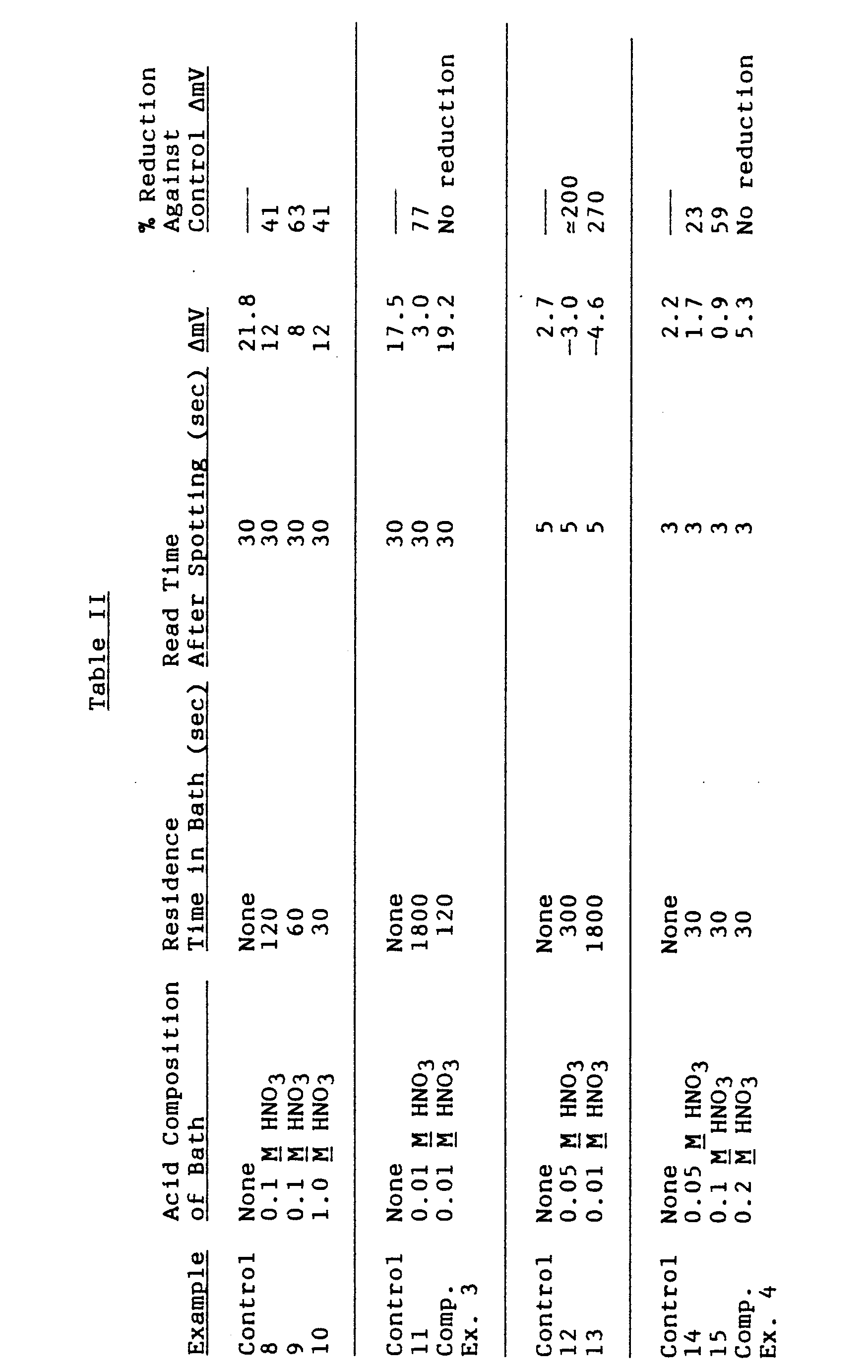
- Conversely, the strength of the acid in Example 10 was not too strong, even through greater in absolute value than the strength of the acid in Comparative Example 4. The reason was that the electrode in Example 10 was much older than the one in Comparative Example 4 (greater than 24 months versus less than 3 months, respectively). The greater aging made Example 10 more tolerant of the greater acid strength.
- The procedure of Example 1 was repeated, except as follows:
- The acid wash was applied to a freshly prepared AgCl layer while the latter was still wet, using the same process line as for the bleach bath. After the treatment in the acid noted in Table III, an overcoat of cellulose acetate of a thickness of 10-20 µm was prepared as described in the aforesaid U.S. Patent No. 4,199,411. The testing of the electrodes was done using a human serum pool spiked with 0.455 mM hypoxanthine. The control was the same, but without the hypoxanthine. The measuring cell was the "Ektachem Cl⊖ "™ test element prepared using the noted ISE, read on the "Ektachem 400"™ analyzer manufactured by Eastman Kodak Co., with electrometer readings being taken after 3 minutes. The "Ektachem" reference fluid was used on the reference side of the test. All electrometer readings were converted to Cl⊖ concentrations via previously measured calibration lines.

- The procedure of Example 16 was repeated, except salts of acids were used to prepare the wash solution, instead of acids. The wash time was the same for the control (no acid salts present, just deionized water) and the salt solutions, namely 3 min. The test fluids and the control fluids were the same as for Ex. 16. The tests were run after an aging period of 1 month, while stored at the temperature indicated in Table IV.
- The sodium acetate, comparative ex. #5, was selected because it has an aqueous pH above 7.0. It was unsatisfactory, as shown in Table IV:

- The procedure of Example 18 was repeated, except the salt solution of the wash was 0.015M NaNO₃. The ISE was stored at 24°C for two days, and at -13°C for a short period, prior to testing. The results appear in Table V:

Claims (5)
a) forming a layer of metal on a support, and
b) oxidizing a surface portion of the metal layer with a bath comprising a chlorochromate, to form metal chloride;
characterized in the use of a further step, after step b), of washing said electrode in an organic acid, inorganic acid, or aqueous solution of a salt of said organic or inorganic acid, provided that
i) is soluble in water at ≧ 0.001 M,
ii) yields an aqueous pH of ≦ 7,0, and
iii) comprises ions that do not dissolve said metal chloride, the cations being univalent or divalent cations only.
Applications Claiming Priority (4)
| Application Number | Priority Date | Filing Date | Title |
|---|---|---|---|
| US81316285A | 1985-12-24 | 1985-12-24 | |
| US813162 | 1985-12-24 | ||
| US911560 | 1986-09-25 | ||
| US06/911,560 US4695362A (en) | 1985-12-24 | 1986-09-25 | Acid or acid salt wash of a metal chloride layer of an ion selective electrode |
Publications (3)
| Publication Number | Publication Date |
|---|---|
| EP0228902A2 true EP0228902A2 (en) | 1987-07-15 |
| EP0228902A3 EP0228902A3 (en) | 1988-01-07 |
| EP0228902B1 EP0228902B1 (en) | 1991-03-27 |
Family
ID=27123696
Family Applications (1)
| Application Number | Title | Priority Date | Filing Date |
|---|---|---|---|
| EP86310115A Expired EP0228902B1 (en) | 1985-12-24 | 1986-12-23 | Acid or acid salt wash of a metal chloride layer of an ion selective electrode |
Country Status (4)
| Country | Link |
|---|---|
| US (1) | US4695362A (en) |
| EP (1) | EP0228902B1 (en) |
| JP (1) | JPH0713605B2 (en) |
| DE (1) | DE3678413D1 (en) |
Families Citing this family (1)
| Publication number | Priority date | Publication date | Assignee | Title |
|---|---|---|---|---|
| US8594764B2 (en) * | 2003-03-07 | 2013-11-26 | Jon Rice | Device and method for assessing the electrical potential of cells and method for manufacture of same |
Family Cites Families (9)
| Publication number | Priority date | Publication date | Assignee | Title |
|---|---|---|---|---|
| US3111478A (en) * | 1958-03-03 | 1963-11-19 | Beckman Instruments Inc | Molded metal-metal salt reference electrode |
| US3617101A (en) * | 1969-06-13 | 1971-11-02 | Engelhard Min & Chem | Reference electrode for cathodic protection systems |
| US3856649A (en) * | 1973-03-16 | 1974-12-24 | Miles Lab | Solid state electrode |
| US4031606A (en) * | 1975-02-24 | 1977-06-28 | Honeywell Inc. | Method of making a combination ion responsive and reference electrode |
| US4214968A (en) * | 1978-04-05 | 1980-07-29 | Eastman Kodak Company | Ion-selective electrode |
| US4199411A (en) * | 1978-10-31 | 1980-04-22 | Eastman Kodak Company | Halide ion-selective devices and methods of determining halides |
| US4263343A (en) * | 1979-08-13 | 1981-04-21 | Eastman Kodak Company | Reference elements for ion-selective membrane electrodes |
| US4259164A (en) * | 1979-08-13 | 1981-03-31 | Eastman Kodak Company | Silver/silver halide electrodes comprising chromium or nickel |
| JPS58156848A (en) * | 1982-03-15 | 1983-09-17 | Fuji Photo Film Co Ltd | Ion selective electrode and its manufacture |
-
1986
- 1986-09-25 US US06/911,560 patent/US4695362A/en not_active Expired - Lifetime
- 1986-12-23 DE DE8686310115T patent/DE3678413D1/en not_active Expired - Lifetime
- 1986-12-23 EP EP86310115A patent/EP0228902B1/en not_active Expired
- 1986-12-23 JP JP30554986A patent/JPH0713605B2/en not_active Expired - Lifetime
Also Published As
| Publication number | Publication date |
|---|---|
| US4695362A (en) | 1987-09-22 |
| JPS62184344A (en) | 1987-08-12 |
| EP0228902B1 (en) | 1991-03-27 |
| DE3678413D1 (en) | 1991-05-02 |
| EP0228902A3 (en) | 1988-01-07 |
| JPH0713605B2 (en) | 1995-02-15 |
Similar Documents
| Publication | Publication Date | Title |
|---|---|---|
| Hansen et al. | Selectrode®—The universal ion-selective solid-state electrode: Part II. Comparison of copper (II) electrodes in metal buffers and compleximetric titrations | |
| Babcock et al. | Effect of Anions on the Sodium‐Calcium Exchange in Soils | |
| Johansson et al. | Studies of copper (II) sulphide ion-selective electrodes | |
| Troll et al. | Rapid determination of fluoride in mineral and rock samples using an ion-selective electrode | |
| Cukrowski et al. | Formation constant calculation for non-labile complexes based on a labile part of the metal-ligand system. A differential pulse polarographic study at fixed ligand to metal ratio and varied pH: application to polarographically inactive complexes | |
| EP0228902B1 (en) | Acid or acid salt wash of a metal chloride layer of an ion selective electrode | |
| Ozeki et al. | Study of errors in determination of hydrogen ion concentrations in rainwater samples using glass electrode method | |
| DE69119399T2 (en) | REAGENTS AND METHODS FOR SERUM IRON SAMPLES | |
| Wang et al. | Variable selectivity of the Hitachi chemistry analyzer chloride ion-selective electrode toward interfering ions | |
| Daly et al. | Copper toxicity to Paratya australiensis: III. Influence of dissolved organic matter | |
| Daniele et al. | The formation of proton and alkali-metal complexes with ligands of biological interest in aqueous solution. Thermodynamics of H+, Na+ and K+—oxalate complexes | |
| Van Loon | Determination of chloride in chloride-containing materials with a chloride membrane electrode | |
| CA1285832C (en) | Acid wash of a metal chloride layer of an ion selective electrode | |
| Ciszewski et al. | Determination of thallium in lead salts by differential pulse anodic-stripping voltammetry | |
| Siska et al. | Potentiometric determination of tetraphenylborate ions with silver nitrate. Determination of silver, potassium and thallium (I) | |
| Daniele et al. | Studies on sulphate complexes. Part I. Potentiometric investigation of Li+, Na+, K+, Rb+ and Cs+ complexes at 37° C and 0.03⩽ I⩽ 0.5 | |
| Dinnin | Ultraviolet spectrophotometric determination of tantalum with pyrogallol | |
| US4505801A (en) | Overcoat compositions and ion-selective electrodes for ionic analyte determinations | |
| US4002428A (en) | Deductive method for measuring ion concentration electrically | |
| Steininger et al. | ORP sensor response in chlorinated water | |
| Reed et al. | Direct determination of arsenite by differential pulse polarography in the presence of lead (II) and thallium (I) | |
| Kaufman et al. | Ion effects in measurement of ionized calcium with a calcium-selective electrode. | |
| Panteghini et al. | Evaluation of the direct potentiometric method for serum chloride determination—comparison with the most commonly employed methodologies | |
| DE69212998T2 (en) | SELECTIVE STABILIZATION OF THE LACTATE DEHYDROGENASE ISOENZYME LD1 BY HIGH MOLECULAR POLYOLS | |
| Frohliger et al. | Analytical applications of second order electrodes |
Legal Events
| Date | Code | Title | Description |
|---|---|---|---|
| PUAI | Public reference made under article 153(3) epc to a published international application that has entered the european phase |
Free format text: ORIGINAL CODE: 0009012 |
|
| AK | Designated contracting states |
Kind code of ref document: A2 Designated state(s): CH DE FR GB IT LI SE |
|
| PUAL | Search report despatched |
Free format text: ORIGINAL CODE: 0009013 |
|
| AK | Designated contracting states |
Kind code of ref document: A3 Designated state(s): CH DE FR GB IT LI SE |
|
| 17P | Request for examination filed |
Effective date: 19880621 |
|
| 17Q | First examination report despatched |
Effective date: 19891212 |
|
| GRAA | (expected) grant |
Free format text: ORIGINAL CODE: 0009210 |
|
| AK | Designated contracting states |
Kind code of ref document: B1 Designated state(s): CH DE FR GB IT LI SE |
|
| ITF | It: translation for a ep patent filed | ||
| REF | Corresponds to: |
Ref document number: 3678413 Country of ref document: DE Date of ref document: 19910502 |
|
| ET | Fr: translation filed | ||
| PLBE | No opposition filed within time limit |
Free format text: ORIGINAL CODE: 0009261 |
|
| STAA | Information on the status of an ep patent application or granted ep patent |
Free format text: STATUS: NO OPPOSITION FILED WITHIN TIME LIMIT |
|
| 26N | No opposition filed | ||
| EAL | Se: european patent in force in sweden |
Ref document number: 86310115.0 |
|
| PGFP | Annual fee paid to national office [announced via postgrant information from national office to epo] |
Ref country code: SE Payment date: 19951218 Year of fee payment: 10 |
|
| REG | Reference to a national code |
Ref country code: GB Ref legal event code: 732E |
|
| PG25 | Lapsed in a contracting state [announced via postgrant information from national office to epo] |
Ref country code: SE Effective date: 19961224 |
|
| EUG | Se: european patent has lapsed |
Ref document number: 86310115.0 |
|
| PGFP | Annual fee paid to national office [announced via postgrant information from national office to epo] |
Ref country code: FR Payment date: 20001212 Year of fee payment: 15 |
|
| PGFP | Annual fee paid to national office [announced via postgrant information from national office to epo] |
Ref country code: DE Payment date: 20001218 Year of fee payment: 15 |
|
| PGFP | Annual fee paid to national office [announced via postgrant information from national office to epo] |
Ref country code: GB Payment date: 20001220 Year of fee payment: 15 |
|
| PGFP | Annual fee paid to national office [announced via postgrant information from national office to epo] |
Ref country code: CH Payment date: 20001222 Year of fee payment: 15 |
|
| PG25 | Lapsed in a contracting state [announced via postgrant information from national office to epo] |
Ref country code: GB Free format text: LAPSE BECAUSE OF NON-PAYMENT OF DUE FEES Effective date: 20011223 |
|
| PG25 | Lapsed in a contracting state [announced via postgrant information from national office to epo] |
Ref country code: LI Free format text: LAPSE BECAUSE OF NON-PAYMENT OF DUE FEES Effective date: 20011231 Ref country code: CH Free format text: LAPSE BECAUSE OF NON-PAYMENT OF DUE FEES Effective date: 20011231 |
|
| REG | Reference to a national code |
Ref country code: GB Ref legal event code: IF02 |
|
| PG25 | Lapsed in a contracting state [announced via postgrant information from national office to epo] |
Ref country code: DE Free format text: LAPSE BECAUSE OF NON-PAYMENT OF DUE FEES Effective date: 20020702 |
|
| GBPC | Gb: european patent ceased through non-payment of renewal fee |
Effective date: 20011223 |
|
| REG | Reference to a national code |
Ref country code: CH Ref legal event code: PL |
|
| PG25 | Lapsed in a contracting state [announced via postgrant information from national office to epo] |
Ref country code: FR Free format text: LAPSE BECAUSE OF NON-PAYMENT OF DUE FEES Effective date: 20020830 |
|
| REG | Reference to a national code |
Ref country code: FR Ref legal event code: ST |
|
| PG25 | Lapsed in a contracting state [announced via postgrant information from national office to epo] |
Ref country code: IT Free format text: LAPSE BECAUSE OF NON-PAYMENT OF DUE FEES;WARNING: LAPSES OF ITALIAN PATENTS WITH EFFECTIVE DATE BEFORE 2007 MAY HAVE OCCURRED AT ANY TIME BEFORE 2007. THE CORRECT EFFECTIVE DATE MAY BE DIFFERENT FROM THE ONE RECORDED. Effective date: 20051223 |