EP0228920A1 - Nouveau dérivé du thiochromanne, son procédé de préparation et les compositions pharmaceutiques qui le contiennent - Google Patents
Nouveau dérivé du thiochromanne, son procédé de préparation et les compositions pharmaceutiques qui le contiennent Download PDFInfo
- Publication number
- EP0228920A1 EP0228920A1 EP86402180A EP86402180A EP0228920A1 EP 0228920 A1 EP0228920 A1 EP 0228920A1 EP 86402180 A EP86402180 A EP 86402180A EP 86402180 A EP86402180 A EP 86402180A EP 0228920 A1 EP0228920 A1 EP 0228920A1
- Authority
- EP
- European Patent Office
- Prior art keywords
- formula
- compound
- hydroxy
- ppm
- tert
- Prior art date
- Legal status (The legal status is an assumption and is not a legal conclusion. Google has not performed a legal analysis and makes no representation as to the accuracy of the status listed.)
- Granted
Links
- 238000000034 method Methods 0.000 title claims description 6
- 238000002360 preparation method Methods 0.000 title claims description 6
- 230000008569 process Effects 0.000 title claims description 3
- 239000008194 pharmaceutical composition Substances 0.000 title description 5
- WPWNEKFMGCWNPR-UHFFFAOYSA-N 3,4-dihydro-2h-thiochromene Chemical class C1=CC=C2CCCSC2=C1 WPWNEKFMGCWNPR-UHFFFAOYSA-N 0.000 title description 4
- 150000001875 compounds Chemical class 0.000 claims description 19
- ATUOYWHBWRKTHZ-UHFFFAOYSA-N Propane Chemical compound CCC ATUOYWHBWRKTHZ-UHFFFAOYSA-N 0.000 claims description 6
- 150000003839 salts Chemical class 0.000 claims description 6
- 229910052500 inorganic mineral Inorganic materials 0.000 claims description 5
- 239000011707 mineral Substances 0.000 claims description 5
- 150000007522 mineralic acids Chemical class 0.000 claims description 5
- 150000007524 organic acids Chemical class 0.000 claims description 5
- 239000001294 propane Substances 0.000 claims description 3
- YBRBMKDOPFTVDT-UHFFFAOYSA-N tert-butylamine Chemical compound CC(C)(C)N YBRBMKDOPFTVDT-UHFFFAOYSA-N 0.000 claims description 3
- 230000009471 action Effects 0.000 claims description 2
- UORVGPXVDQYIDP-UHFFFAOYSA-N borane Chemical compound B UORVGPXVDQYIDP-UHFFFAOYSA-N 0.000 claims description 2
- 229910010277 boron hydride Inorganic materials 0.000 claims description 2
- 150000007944 thiolates Chemical class 0.000 claims description 2
- 230000003287 optical effect Effects 0.000 claims 1
- KFZMGEQAYNKOFK-UHFFFAOYSA-N Isopropanol Chemical compound CC(C)O KFZMGEQAYNKOFK-UHFFFAOYSA-N 0.000 abstract description 13
- 239000003814 drug Substances 0.000 abstract 1
- 229940079593 drug Drugs 0.000 abstract 1
- 230000000694 effects Effects 0.000 description 15
- 229960003352 tertatolol Drugs 0.000 description 15
- HTWFXPCUFWKXOP-UHFFFAOYSA-N Tertatalol Chemical compound C1CCSC2=C1C=CC=C2OCC(O)CNC(C)(C)C HTWFXPCUFWKXOP-UHFFFAOYSA-N 0.000 description 14
- YMWUJEATGCHHMB-UHFFFAOYSA-N Dichloromethane Chemical compound ClCCl YMWUJEATGCHHMB-UHFFFAOYSA-N 0.000 description 12
- OKKJLVBELUTLKV-UHFFFAOYSA-N Methanol Chemical compound OC OKKJLVBELUTLKV-UHFFFAOYSA-N 0.000 description 12
- JWZZKOKVBUJMES-UHFFFAOYSA-N (+-)-Isoprenaline Chemical compound CC(C)NCC(O)C1=CC=C(O)C(O)=C1 JWZZKOKVBUJMES-UHFFFAOYSA-N 0.000 description 10
- 239000000203 mixture Substances 0.000 description 10
- AQHHHDLHHXJYJD-UHFFFAOYSA-N propranolol Chemical compound C1=CC=C2C(OCC(O)CNC(C)C)=CC=CC2=C1 AQHHHDLHHXJYJD-UHFFFAOYSA-N 0.000 description 10
- RTZKZFJDLAIYFH-UHFFFAOYSA-N Diethyl ether Chemical compound CCOCC RTZKZFJDLAIYFH-UHFFFAOYSA-N 0.000 description 8
- 239000005557 antagonist Substances 0.000 description 8
- 229960001317 isoprenaline Drugs 0.000 description 7
- WEVYAHXRMPXWCK-UHFFFAOYSA-N Acetonitrile Chemical compound CC#N WEVYAHXRMPXWCK-UHFFFAOYSA-N 0.000 description 6
- 239000002876 beta blocker Substances 0.000 description 5
- 239000000047 product Substances 0.000 description 5
- 239000000556 agonist Substances 0.000 description 4
- 229940097320 beta blocking agent Drugs 0.000 description 4
- 238000000338 in vitro Methods 0.000 description 4
- 238000012360 testing method Methods 0.000 description 4
- QTBSBXVTEAMEQO-UHFFFAOYSA-M Acetate Chemical compound CC([O-])=O QTBSBXVTEAMEQO-UHFFFAOYSA-M 0.000 description 3
- 239000002775 capsule Substances 0.000 description 3
- 231100000673 dose–response relationship Toxicity 0.000 description 3
- GNOIPBMMFNIUFM-UHFFFAOYSA-N hexamethylphosphoric triamide Chemical compound CN(C)P(=O)(N(C)C)N(C)C GNOIPBMMFNIUFM-UHFFFAOYSA-N 0.000 description 3
- 229940039009 isoproterenol Drugs 0.000 description 3
- 230000008018 melting Effects 0.000 description 3
- 238000002844 melting Methods 0.000 description 3
- 230000000144 pharmacologic effect Effects 0.000 description 3
- IOLCXVTUBQKXJR-UHFFFAOYSA-M potassium bromide Chemical compound [K+].[Br-] IOLCXVTUBQKXJR-UHFFFAOYSA-M 0.000 description 3
- 229960003712 propranolol Drugs 0.000 description 3
- 230000033764 rhythmic process Effects 0.000 description 3
- 239000002904 solvent Substances 0.000 description 3
- 239000000126 substance Substances 0.000 description 3
- FJNCXZZQNBKEJT-UHFFFAOYSA-N 8beta-hydroxymarrubiin Natural products O1C(=O)C2(C)CCCC3(C)C2C1CC(C)(O)C3(O)CCC=1C=COC=1 FJNCXZZQNBKEJT-UHFFFAOYSA-N 0.000 description 2
- QTBSBXVTEAMEQO-UHFFFAOYSA-N Acetic acid Chemical compound CC(O)=O QTBSBXVTEAMEQO-UHFFFAOYSA-N 0.000 description 2
- CSCPPACGZOOCGX-UHFFFAOYSA-N Acetone Chemical compound CC(C)=O CSCPPACGZOOCGX-UHFFFAOYSA-N 0.000 description 2
- IJGRMHOSHXDMSA-UHFFFAOYSA-N Atomic nitrogen Chemical compound N#N IJGRMHOSHXDMSA-UHFFFAOYSA-N 0.000 description 2
- BRLQWZUYTZBJKN-UHFFFAOYSA-N Epichlorohydrin Chemical compound ClCC1CO1 BRLQWZUYTZBJKN-UHFFFAOYSA-N 0.000 description 2
- VEXZGXHMUGYJMC-UHFFFAOYSA-N Hydrochloric acid Chemical compound Cl VEXZGXHMUGYJMC-UHFFFAOYSA-N 0.000 description 2
- 206010020772 Hypertension Diseases 0.000 description 2
- WYURNTSHIVDZCO-UHFFFAOYSA-N Tetrahydrofuran Chemical compound C1CCOC1 WYURNTSHIVDZCO-UHFFFAOYSA-N 0.000 description 2
- 239000002253 acid Substances 0.000 description 2
- 150000007513 acids Chemical class 0.000 description 2
- 230000002908 adrenolytic effect Effects 0.000 description 2
- 230000008485 antagonism Effects 0.000 description 2
- 238000006243 chemical reaction Methods 0.000 description 2
- 230000002057 chronotropic effect Effects 0.000 description 2
- 230000002860 competitive effect Effects 0.000 description 2
- 230000001186 cumulative effect Effects 0.000 description 2
- 238000006073 displacement reaction Methods 0.000 description 2
- 230000002526 effect on cardiovascular system Effects 0.000 description 2
- 238000011156 evaluation Methods 0.000 description 2
- 210000002837 heart atrium Anatomy 0.000 description 2
- BWHMMNNQKKPAPP-UHFFFAOYSA-L potassium carbonate Chemical compound [K+].[K+].[O-]C([O-])=O BWHMMNNQKKPAPP-UHFFFAOYSA-L 0.000 description 2
- 238000001953 recrystallisation Methods 0.000 description 2
- 238000010992 reflux Methods 0.000 description 2
- 230000004044 response Effects 0.000 description 2
- 210000005245 right atrium Anatomy 0.000 description 2
- 238000005406 washing Methods 0.000 description 2
- VHUUQVKOLVNVRT-UHFFFAOYSA-N Ammonium hydroxide Chemical compound [NH4+].[OH-] VHUUQVKOLVNVRT-UHFFFAOYSA-N 0.000 description 1
- 206010002383 Angina Pectoris Diseases 0.000 description 1
- 238000012935 Averaging Methods 0.000 description 1
- OKTJSMMVPCPJKN-UHFFFAOYSA-N Carbon Chemical compound [C] OKTJSMMVPCPJKN-UHFFFAOYSA-N 0.000 description 1
- 229920002261 Corn starch Polymers 0.000 description 1
- 206010020850 Hyperthyroidism Diseases 0.000 description 1
- GUBGYTABKSRVRQ-QKKXKWKRSA-N Lactose Natural products OC[C@H]1O[C@@H](O[C@H]2[C@H](O)[C@@H](O)C(O)O[C@@H]2CO)[C@H](O)[C@@H](O)[C@H]1O GUBGYTABKSRVRQ-QKKXKWKRSA-N 0.000 description 1
- FYYHWMGAXLPEAU-UHFFFAOYSA-N Magnesium Chemical compound [Mg] FYYHWMGAXLPEAU-UHFFFAOYSA-N 0.000 description 1
- QXKHYNVANLEOEG-UHFFFAOYSA-N Methoxsalen Chemical group C1=CC(=O)OC2=C1C=C1C=COC1=C2OC QXKHYNVANLEOEG-UHFFFAOYSA-N 0.000 description 1
- 229920000168 Microcrystalline cellulose Polymers 0.000 description 1
- GOOHAUXETOMSMM-UHFFFAOYSA-N Propylene oxide Chemical compound CC1CO1 GOOHAUXETOMSMM-UHFFFAOYSA-N 0.000 description 1
- 241000700159 Rattus Species 0.000 description 1
- 241000700157 Rattus norvegicus Species 0.000 description 1
- VYPSYNLAJGMNEJ-UHFFFAOYSA-N Silicium dioxide Chemical compound O=[Si]=O VYPSYNLAJGMNEJ-UHFFFAOYSA-N 0.000 description 1
- HEDRZPFGACZZDS-MICDWDOJSA-N Trichloro(2H)methane Chemical compound [2H]C(Cl)(Cl)Cl HEDRZPFGACZZDS-MICDWDOJSA-N 0.000 description 1
- 229960000583 acetic acid Drugs 0.000 description 1
- 239000004480 active ingredient Substances 0.000 description 1
- 150000001412 amines Chemical class 0.000 description 1
- 239000000908 ammonium hydroxide Substances 0.000 description 1
- 206010003119 arrhythmia Diseases 0.000 description 1
- QVGXLLKOCUKJST-UHFFFAOYSA-N atomic oxygen Chemical compound [O] QVGXLLKOCUKJST-UHFFFAOYSA-N 0.000 description 1
- WPYMKLBDIGXBTP-UHFFFAOYSA-N benzoic acid group Chemical group C(C1=CC=CC=C1)(=O)O WPYMKLBDIGXBTP-UHFFFAOYSA-N 0.000 description 1
- 230000015572 biosynthetic process Effects 0.000 description 1
- 230000002213 calciumantagonistic effect Effects 0.000 description 1
- 229910052799 carbon Inorganic materials 0.000 description 1
- 125000004432 carbon atom Chemical group C* 0.000 description 1
- 239000008119 colloidal silica Substances 0.000 description 1
- 230000000295 complement effect Effects 0.000 description 1
- 238000009833 condensation Methods 0.000 description 1
- 230000005494 condensation Effects 0.000 description 1
- 239000008120 corn starch Substances 0.000 description 1
- 230000017858 demethylation Effects 0.000 description 1
- 238000010520 demethylation reaction Methods 0.000 description 1
- 239000002934 diuretic Substances 0.000 description 1
- 230000001882 diuretic effect Effects 0.000 description 1
- 239000008298 dragée Substances 0.000 description 1
- 238000000921 elemental analysis Methods 0.000 description 1
- 238000001704 evaporation Methods 0.000 description 1
- 230000008020 evaporation Effects 0.000 description 1
- 238000002474 experimental method Methods 0.000 description 1
- 238000000605 extraction Methods 0.000 description 1
- 238000001914 filtration Methods 0.000 description 1
- 239000012362 glacial acetic acid Substances 0.000 description 1
- 150000003944 halohydrins Chemical class 0.000 description 1
- 238000002329 infrared spectrum Methods 0.000 description 1
- 230000005764 inhibitory process Effects 0.000 description 1
- 230000003993 interaction Effects 0.000 description 1
- JEIPFZHSYJVQDO-UHFFFAOYSA-N iron(III) oxide Inorganic materials O=[Fe]O[Fe]=O JEIPFZHSYJVQDO-UHFFFAOYSA-N 0.000 description 1
- 239000008101 lactose Substances 0.000 description 1
- 239000011777 magnesium Substances 0.000 description 1
- 229910052749 magnesium Inorganic materials 0.000 description 1
- 238000001819 mass spectrum Methods 0.000 description 1
- 238000005259 measurement Methods 0.000 description 1
- 230000007246 mechanism Effects 0.000 description 1
- 235000019813 microcrystalline cellulose Nutrition 0.000 description 1
- 239000008108 microcrystalline cellulose Substances 0.000 description 1
- 229940016286 microcrystalline cellulose Drugs 0.000 description 1
- 208000031225 myocardial ischemia Diseases 0.000 description 1
- 229910052757 nitrogen Inorganic materials 0.000 description 1
- 231100000252 nontoxic Toxicity 0.000 description 1
- 230000003000 nontoxic effect Effects 0.000 description 1
- 210000000056 organ Anatomy 0.000 description 1
- 239000012074 organic phase Substances 0.000 description 1
- 150000002924 oxiranes Chemical class 0.000 description 1
- 239000001301 oxygen Substances 0.000 description 1
- 229910052760 oxygen Inorganic materials 0.000 description 1
- 239000000546 pharmaceutical excipient Substances 0.000 description 1
- 239000000825 pharmaceutical preparation Substances 0.000 description 1
- ISWSIDIOOBJBQZ-UHFFFAOYSA-N phenol group Chemical group C1(=CC=CC=C1)O ISWSIDIOOBJBQZ-UHFFFAOYSA-N 0.000 description 1
- 229910000027 potassium carbonate Inorganic materials 0.000 description 1
- 239000002244 precipitate Substances 0.000 description 1
- 150000003141 primary amines Chemical class 0.000 description 1
- 238000000425 proton nuclear magnetic resonance spectrum Methods 0.000 description 1
- 230000009467 reduction Effects 0.000 description 1
- 230000000894 saliuretic effect Effects 0.000 description 1
- 229910000033 sodium borohydride Inorganic materials 0.000 description 1
- 239000012279 sodium borohydride Substances 0.000 description 1
- NQHKCHWQDDWQJR-UHFFFAOYSA-M sodium;propane-2-thiolate Chemical compound [Na+].CC(C)[S-] NQHKCHWQDDWQJR-UHFFFAOYSA-M 0.000 description 1
- 230000003595 spectral effect Effects 0.000 description 1
- 230000006641 stabilisation Effects 0.000 description 1
- 238000011105 stabilization Methods 0.000 description 1
- 238000003756 stirring Methods 0.000 description 1
- 239000000829 suppository Substances 0.000 description 1
- 230000002195 synergetic effect Effects 0.000 description 1
- 239000003826 tablet Substances 0.000 description 1
- 239000000454 talc Substances 0.000 description 1
- 229910052623 talc Inorganic materials 0.000 description 1
- -1 tert-butylamino-3 hydroxy-2 propyloxy Chemical group 0.000 description 1
- YLQBMQCUIZJEEH-UHFFFAOYSA-N tetrahydrofuran Natural products C=1C=COC=1 YLQBMQCUIZJEEH-UHFFFAOYSA-N 0.000 description 1
- 238000002560 therapeutic procedure Methods 0.000 description 1
- 238000005303 weighing Methods 0.000 description 1
Images


Classifications
-
- C—CHEMISTRY; METALLURGY
- C07—ORGANIC CHEMISTRY
- C07D—HETEROCYCLIC COMPOUNDS
- C07D335/00—Heterocyclic compounds containing six-membered rings having one sulfur atom as the only ring hetero atom
- C07D335/04—Heterocyclic compounds containing six-membered rings having one sulfur atom as the only ring hetero atom condensed with carbocyclic rings or ring systems
- C07D335/06—Benzothiopyrans; Hydrogenated benzothiopyrans
-
- A—HUMAN NECESSITIES
- A61—MEDICAL OR VETERINARY SCIENCE; HYGIENE
- A61P—SPECIFIC THERAPEUTIC ACTIVITY OF CHEMICAL COMPOUNDS OR MEDICINAL PREPARATIONS
- A61P9/00—Drugs for disorders of the cardiovascular system
-
- A—HUMAN NECESSITIES
- A61—MEDICAL OR VETERINARY SCIENCE; HYGIENE
- A61P—SPECIFIC THERAPEUTIC ACTIVITY OF CHEMICAL COMPOUNDS OR MEDICINAL PREPARATIONS
- A61P9/00—Drugs for disorders of the cardiovascular system
- A61P9/12—Antihypertensives
Definitions
- the present invention relates to a new thiochroman derivative, its preparation process and the pharmaceutical compositions containing them.
- Certain derivatives of 1-alkylamino (8 thiochromannyl-oxy) -3 propanol are known, which have interesting pharmacological properties, in particular tert-butylamino-1 (thiochromannyl-8 oxy) -3 propanol-2 described in French patent No. 71.11445. and in British Patent No. 1,561,153.
- Tert-butylamino-1 (thiochromannyl-8 oxy) -3 propanol-2 or (tert-butylamino-3 hydroxy-2 propyloxy) -8 thiochroman or tertatolol belongs to the class of beta-blocking agents and has cardiovascular properties used in especially in the treatment of high blood pressure.
- the Applicant has now discovered a new beta-blocker derived from tert-butylamino-1 (thiochromannyl-8 oxy) -3 propanol having a chemical structure very close to tertatolol and having a beta-adrenolytic activity twice that of tertatolol.
- the present invention more particularly relates to a thiochroman derivative, tert-butylamino-1 (4-hydroxy-thiochromannyl-8 oxy) -3 propanol-2, which has the following chemical formula:
- This derivative has two asymmetric carbon atoms, and it therefore exists in racemic form and of diasteroisomers which are therefore part of the invention.
- the invention also relates to the addition salts of the compound of formula I, to a pharmaceutically acceptable mineral or organic acid.
- acids used for the formation of these salts mention may be made of phosphoric, hydrochloric, sulfuric, acetic, propionic, citric, oxalic, benzoic etc. acids.
- the present invention also relates to the process for the preparation of the compound of general formula I, characterized in that the 8-methoxy-thiochromannone-4 of formula II is reduced: with a boron hydride in methoxy-8 thiochromannol-4 of formula III: which is then demethylated, using a thiolate to obtain the hydroxy-8 thiochromannol-4 of formula IV: on which the 1-chloro-2,3-epoxy propane is reacted to form the (4-hydroxy-thiochromannyl-8 oxy) -3 1,2-epoxy propane of formula V: and which is condensed with tert-butylamine to obtain the compound of general formula I, and then it is possible to form its addition salts by the action of a pharmaceutically acceptable mineral or organic acid, or to separate it from its diastereoisomers which in turn can be salified.
- Methoxy-8 thiochromannone-4 can be prepared using the method described by F. Kollpfeiffer et Col., (Ber. (1925), 58 , 1654-1676).
- the reduction of thiochromannone to thiochromannol and the demethylation of the phenolic ether oxide are carried out by methods already known in the literature and described respectively in Vogel's Textbook of Practical organic chemistry Editions Longman (1978) London, New York, 4edition, p .353-356 and Tetrahedron (1982), 38 , 2721-2724 (L. Testaferri et al.).
- the reaction of hydroxy-8 thiochromannol-4 with chloro-1 epoxy-2,3 propane and the condensation of the product resulting from this reaction with a primary amine are described in French patent No. 2,092,004.
- beta-blocking properties of the compound of the invention therefore allow its application in the treatment of hypertension, angina, myocardial ischemia, cardiac arrhythmias and cardiovascular manifestations of hyperthyroidism.
- the invention also extends to pharmaceutical compositions containing as active ingredient the compound of formula I, one of its diastereoisomers or one of its addition salts with a pharmaceutically compatible mineral or organic acid in combination with an inert excipient , non-toxic and suitable.
- compositions thus obtained are advantageously presented in various forms such as for example, tablets, dragees, capsules, glossettes or other galenical preparations suitable for sublingual administration, suppositories, injectable or drinkable solutions.
- compositions according to the invention may also contain another active principle of complementary or synergistic action.
- a diuretic and in particular a saliuretic or calcium antagonistic substances.
- the dosage can vary widely depending on the age, weight of the patient, the nature and severity of the condition and the route of administration.
- the preferred route of administration is the oral or parenteral route.
- the unit dosage will range between 0.1 and 5 mg and the daily dosage, usable in human therapy, between 0.1 and 5 mg.
- the melting points are determined at the Köfler block.
- the beta-blocking properties of the compound of formula I and more specifically the intensity of the beta1-adrenolytic activity in vitro was evaluated on the inhibition of the chronotropic responses of the right rat atrium stimulated to isoprenaline. The effects of this compound have been compared with those of tertatolol and propanolol, the latter being a benchmark beta-blocker.
- the studies are carried out on the right atrium taken from male Wistar rats weighing 300 to 400 g. After sacrifice, the heart is removed and the right atrium is quickly dissected and then placed in an insulated organ tank, containing a physiological solution thermostatically controlled at 37 ° C and oxygenated by a mixture of 95% oxygen and 5% dioxide carbon.
- the headset is connected to a mechanical-electric sensor.
- a concentration of the compound of formula I, of tertatolol or of propanolol is added to the bath, 10 minutes before the addition of the cumulative doses of isoprenaline (10 -9 M, 3.10 -8 M ...) Only one concentration of antagonist is tested per preparation.
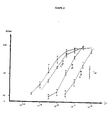
- FIG. 1 represents the dose-response curves of isoprenaline in the presence and in the absence of propranolol.
- C AN antagonist concentrations
- FIG. 2 represents the dose-response curves of isoprenaline in the presence and in the absence of tertatolol.
- C AN antagonist concentrations
- FIG. 3 represents the dose-response curves of isoprenaline in the presence and in the absence of the compound of formula I.
- C AN antagonist concentrations
- the calculation of pA2, making it possible to quantitatively evaluate a competitive antagonism (Guidicelli JFJPharmacol. (Paris) 1971, 2 (3), 373) is applied to the three products.
- the pA2 represents the cologarithm of the molar concentration of the antagonist which requires the doubling of the agonist concentration, so that a response of the same intensity as that recorded with the agonist used alone is found.
- pAx represents the cologarithm of the molar concentration of the antagonist.
- x represents the displacement in mm of the curve. (value of log (x-1) given by Van Rossum's table). Student tests (paired series) are performed to authorize the averaging of the control curves and test curves. Tables 1, 2 and 3 summarize the pA2 values evaluated for propanolol, tertatolol and the compound of formula I respectively, during the various tests.
- the experimental model used the evaluation of the pA2s of propanolol of tertatolol and of the compound of formula I. This measurement, in vitro, of the "potency" of the antagonists indicates their own potentiality.
- p 2 corresponding is 9.04 ⁇ 0.118.
- the compound of formula I very close to tertatolol, has a beta-antagonist activity 2 times greater than that of tertatolol.
- the P 2 obtained is 9.24 ⁇ 0.087.
Landscapes
- Organic Chemistry (AREA)
- Chemical & Material Sciences (AREA)
- Health & Medical Sciences (AREA)
- Medicinal Chemistry (AREA)
- General Chemical & Material Sciences (AREA)
- Cardiology (AREA)
- Chemical Kinetics & Catalysis (AREA)
- Life Sciences & Earth Sciences (AREA)
- Pharmacology & Pharmacy (AREA)
- Nuclear Medicine, Radiotherapy & Molecular Imaging (AREA)
- Engineering & Computer Science (AREA)
- Bioinformatics & Cheminformatics (AREA)
- Heart & Thoracic Surgery (AREA)
- Animal Behavior & Ethology (AREA)
- General Health & Medical Sciences (AREA)
- Public Health (AREA)
- Veterinary Medicine (AREA)
- Pharmaceuticals Containing Other Organic And Inorganic Compounds (AREA)
- Acyclic And Carbocyclic Compounds In Medicinal Compositions (AREA)
- Saccharide Compounds (AREA)
- Heterocyclic Compounds Containing Sulfur Atoms (AREA)
- Heterocyclic Carbon Compounds Containing A Hetero Ring Having Oxygen Or Sulfur (AREA)
- Organic Low-Molecular-Weight Compounds And Preparation Thereof (AREA)
Abstract
Description
- La présente invention concerne un nouveau dérivé du thiochromanne, son procédé de préparation et les compositions pharmaceutiques les renfermant.
- On connait certains dérivés du alkylamino-1 (thiochromannyl-8 oxy)-3 propanol possédant d'intéressantes propriétés pharmacologiques, notamment le tert-butylamino-1 (thiochromannyl-8 oxy)-3 propanol-2 décrit dans le brevet français No. 71.11445 et dans le brevet britannique N° 1.561.153. Le tert-butylamino-1 (thiochromannyl-8 oxy)-3 propanol-2 ou (tert-butylamino-3 hydroxy-2 propyloxy)-8 thiochromanne ou tertatolol appartient à la classe des agents bêta-bloquants et possède des propriétés cardiovasculaires utilisées en particulier dans le traitement de l'hypertension artérielle. La demanderesse a maintenant découvert un nouveau bêta-bloquant dérivé de tert-butylamino-1 (thiochromannyl-8 oxy)-3 propanol possédant une structure chimique très proche du tertatolol et possédant une activité bêta₁-adrénolytique deux fois supérieure à celle du tertatolol.
- La présente invention a plus particulièrement pour objet un dérivé du thiochromanne, le tert-butylamino-1 (hydroxy-4 thiochromannyl-8 oxy)-3 propanol-2, qui a la formule chimique suivante:

- Ce dérivé présente deux atomes de carbone asymétrique, et il existe donc sous forme racémique et de diastéroisomères qui font à ce titre partie de l'invention.
- L'invention se rapporte également aux sels d'addition du composé de formula I, à un acide minéral ou organique pharmaceutiquement acceptable. Parmi les acides utilisés pour la formation de ces sels, on peut citer les acides phosphorique, chlorhydrique, sulfurique, acétique, propionique, citrique, oxalique, benzoïque etc.
- La présente invention a également pour objet le procédé de préparation du composé de formule générale I, caractérisé en ce que l'on réduit le méthoxy-8 thiochromannone-4 de formule II:


- La méthoxy-8 thiochromannone-4 peut-être préparée en utilisant le procédé décrit par F. Kollpfeiffer et Col., (Ber. (1925), 58, 1654-1676). La réduction de la thiochromannone en thiochromannol et la déméthylation de l'éther-oxyde phénolique sont effectuées par des méthodes déjà connues dans la littérature et décrites respectivement dans Vogel's Textbook of Practical organic chemistry Editions Longman (1978) London, New York, 4edition, p.353-356 et Tetrahedron (1982), 38,2721-2724 (L.Testaferri et al.). La réaction de l'hydroxy-8 thiochromannol-4 avec le chloro-1 époxy-2,3 propane et la condensation du produit issu de cette réaction avec une amine primaire sont décrites dans le brevet français N° 2.092.004.
- Le composé de formule I étant très proche du tertatolol, ses propriétés bêta-bloquantes étaient prévisibles. Par contre, il était inattendu que ce composé possède une activité bêta₁-adrénolytique deux fois supérieure à celle du tertatolol. En effet, les essais pharmacologiques in vitro ont montré que le tert-butylamino-1 (hydroxy-4 thiochromannyl-8 oxy)-3 propanol-2 est doué d'une activité bêta-₁ adrénolytique très importante.
- Les propriétés bêta-bloquantes du composé de l'invention permettent donc son application dans le traitement de l'hypertension, de l'angor, de l'ischemie myocardique, des troubles du rythme cardiaque et des manifestations cardio-vasculaires des hyperthyroïdies.
- L'invention s'étend aussi aux compositions pharmaceutiques renfermant comme principe actif le composé de formule I, l'un de ses diastéréoisomères ou l'un de ses sels d'addition avec un acide minéral ou organique pharmaceutiquement compatible en association avec un excipient inerte, non toxique et approprié.
- Les compositions pharmaceutiques ainsi obtenues sont présentées avantageusement sous des formes diverses telles que par exemple, comprimés, dragées, gélules, glossettes ou autres préparations galéniques appropriées pour une administration sublinguale, suppositoires, solutions injectables ou buvables.
- Les compositions pharmaceutiques selon l'invention peuvent en outre contenir un autre principe actif d'action complémentaire ou synergique.
- Parmi ces derniers principes actifs, on pourra citer un diurétique et notamment, un saliurétique ou des substances antagonistes calciques.
- La posologie peut varier largement en fonction de l'âge, du poids du patient, de la nature et de la sévérité de l'affection ainsi que de la voie d'administration. La voie d'administration préférée est la voie buccale ou parentérale. D'une manière générale, la posologie unitaire s'échelonnera entre 0,1 et 5mg et la posologie journalière, utilisable en thérapeutique humaine,entre 0,1 et 5mg.
- Les exemples suivants, donnés à titre non limitatif, illustrent l'invention. Les points de fusion sont déterminés au bloc-Köfler.
- On dissout 89 mmol de méthoxy-8 thiochromannone-4 dans 70ml d'un mélange de méthanol et de tétrahydrofuranne(3/4). On ajoute 134 mmoles de borohydrure de sodium en solution dans 50 ml de méthanol aqueux (50%). Après 1 heure d'agitation à température ambiante puis extraction au dichlorométhane, le produit obtenu est recristallisé dans un mélange de méthanol et d'éther éthylique(1/10).
Rendement 87%.
Point de fusion du produit obtenu 91-93°C. - On chauffe à 120°C une solution de 25 mmol de méthoxy-8 thiochromannol-4 obtenu précédemment dans 50 ml d'hexaméthylphosphorotriamide (HMPT). On ajoute à chaud 2,5 équivalents d'isopropanethiolate de sodium et on agite pendant 1 heure 30 à 120°C sous azote.
Le mélange refroidi est versé dans 150 ml d'acide chlorhydrique N et extrait par du dichlorométhane. Après lavage de la phase organique jusqu'à disparition de l'HMPT et évaporation du solvant, on recristallise dans un mélange de dichlorométhane et d'éther éthylique (1/1).
On obtient 4,2 g d'hydroxy-8 thiochromannol-4. Rendement 85%. - On dissout 48,2 g d'hydroxy-8 thiochromannol-4 dans 150 ml d'acétone. On ajoute 104 ml de chloro-1 époxy-2,3 propane puis 109 g de carbonate de potassium. On porte à reflux pendant 8 heures. On filtre et on évapore jusqu'à poids constant à 50°C sous pression réduite (12mm Hg). On obtient 58 g de mélange d'époxyde et d'halohydrine. On engage 48 g de ce mélange avec 180 ml de tert-butylamine dans 100 ml d'isopropanol.
On porte à reflux 7 heures. Après évaporation de l'amine et du solvent, on reprend le résidu huileux par du dichlorométhane et on lave à l'hydroxyde d'ammonium N.
Après éliminattion du solvant à 40°C sous pression réduite, on obtient du tert-butylamino-1 (hydroxy-4 thiochromannyl-8 oxy)-3 propanol-2 sous form d'huile.
Rendement 50%. - Les caractéristiques spectrales du tert-butylamino-1 (hydroxy-4 thiochromannyl-8 oxy)-3 propanol-2 sous forme de base sont les suivantes:
- A. Spectre infra rouge. obtenu avec le produit dispersé dans le bromure de potassium :
VS OH et NH entre 3000 cm-1 et 3700 cm-1 ;
VS C=C 1570 cm-1 ;
VS C-O-C 1260 cm-1 et 1035 cm-1. - B. Spectre de résonnance magnétique nucléaire du proton enregistré en 200 MHz en solution dans le deuterochloroforme : 1,2 ppm s 9H ; 2,0 ppm m 1H ; 2,4 ppm m 1H ; 3,0 ppm m 3H ; 3,25 ppm m 1H ; 4,0 ppm m 3H ; 5,8 ppm m 1H ; 6,75 ppm m 3H ; 7 ppm m 3H (3H échangeables par D₂O entre 6,75 et 7 ppm).
- C. Spectre de masse enregistré à 80eV, en impact électronique (m/z) : 311(M+3,12%), 296(6,06%), 267(10,82%), 182(10,39%), 164(5,11%), 163(6,41%), 114(6,75%), 86 (100%).
- L'acétate du tert-butylamino-1 (hydroxy-4 thiochromannyl-8 oxy)-3 propanol-2 est obtenu après addition de 12ml d'acide acétique glacial à une solution de l'huile obtenue précédemment dans 1 litre d'éther éthylique. Après filtration du précipité formé, lavage à chaud à l'acétonitrile et recristallisation dans un mélange d'acétonitrile et de méthanol (10/1), on obtient 41 g d'acétate. Point de fusion 130-135°C.
- Analyse élémentaire de l'acétate(C₁₈H₂₉NO₅S)
Théorie : C58,19% ; H 7,86 ; N 3,77 ; S8,63
Trouvé : C58,18% ; H 7,58 ; N 3,80 ; S8,76. - Les propriétés bêta-bloquantes du composé de formule I et plus précisément l'intensité de l'activité bêta₁-adrénolytique in vitro a été évaluée sur l'inhibition des réponses chronotropes de l'oreillette droite de rat stimulée à l'isoprénaline. Les effets de ce composé ont été comparés à ceux du tertatolol et du propanolol, ce dernier étant un bêta-bloquant de référence.
Les études sont réalisées sur l'oreillette droite prélevée sur des rats Wistar mâles de 300 à 400 g. Après sacrifice, le coeur est prélevé et l'oreillette droite est rapidement disséquée puis placée dans une cuve à organe isolé, contenant une solution physiologique thermostatée à 37°C et oxygénée par un mélange de 95 % d'oxygène et 5 % de dioxyde de carbone. L'oreillette est reliée à un capteur mécano-électrique. Une tension initiale de 400 mg est appliquée. La fréquence cardiaque de l'oreillette est recueillie à travers un amplificateur-intégrateur. Après une période de stabilisation de 40 mn, dans un premier temps, afin d'établir une courbe contrôle de l'agoniste seul, des doses cumulatives d'isoprénaline (3.10-10M, 10-9M, 3.10-9 M...) sont ajoutées au bain toutes les 3 mn, jusqu'à l'obtention de l'effet chronotrope maximal. Dans un second temps, afin d'établir la courbe d'intéraction agoniste/antagoniste, une concentration du composé de formule I, de tertatolol ou de propanolol est ajoutée au bain, 10 mn avant l'adjonction des doses cumulatives d'isoprénaline (10-9M,3.10-8M...) Une seule concentration d'antagoniste est testée par préparation. - La figure 1 représente les courbes dose-réponse de l'isoprénaline en présence et en absence du propranolol.
[ A ] = la concentration molaire d'ISOPROTERENOL(échelle logarythmique)
Effet = le pourcentage d'effet par rapport à l'effet maximum sur rythme(b.p.m.)
CAN = concentrations d'antagoniste - La figure 2 représente les courbes dose-réponse de l'isoprénaline en présence et en absence du tertatolol.
[ A ] = la concentration molaire d'ISOPROTERENOL(échelle logarythmique)
Effet = le pourcentage d'effet par rapport à l'effet maximum sur rythme(b.p.m.).
CAN = concentrations d'antagoniste - La figure 3 représente les courbes dose-réponse de l'isoprénaline en présence et en absence du composé de formule I.
[ A ] = la concentration molaire d'ISOPROTERENOL(échelle logarythmique)
Effet = le pourcentage d'effet par rapport à l'effet maximum sur rythme(b.p.m.).
CAN = concentrations d'antagoniste - Le calcul des pA₂, permettant d'évaluer quantitativement un antagonisme compétitif (Guidicelli J.F. J.Pharmacol.(Paris) 1971, 2(3),373) est appliqué aux trois produits. Le pA₂ représente le cologarithme de la concentration molaire de l'antagoniste qui nécessite le doublement de la concentration d'agoniste, pour qu'une réponse de même intensité que celle enregistrée avec l'agoniste utilisé seul soit retrouvée.
Pour chaque expérience, le pA₂ est évalué selon la méthode de Van Rossum (Arch. Int. Pharmacodyn (1963)143,299) et en applicant l'équation pA₂=pAx + log(x-1).
pAx : représente la cologarithme de la concentration molaire de l'antagoniste.
x : représente le déplacement en mm de la courbe. (valeur de log (x-1) donné par la table de Van Rossum).
Des tests de Student (series appariées) sont réalisés pour autoriser le moyennage des courbes contrôles et des courbes tests.
Les tableaux 1, 2 et 3 résument les valeurs de pA₂ évaluées pour le propanolol, le tertatolol et le composé de formule I respectivement, lors des différents essais.

- Le modèle expérimental utilisé l'évaluation des pA₂ du propanolol du tertatolol et du composé de formule I. Cette mesure, in vitro, de la "puissance" des antagonistes indique leur propre potentialité.
- Le propranolol a servi de molécule de référence; le p₂ obtenu est de 8,28 ± 0,089, valeur proche de celle donnée dans la littérature. Les courbes obtenues avec le tertatolol et le composé de formule I, (simple déplacement vers la droite) permettent d'affirmer que l'antagonisme isoprénaline-tertatolol ou isoprénaline composé de formule I est de type compétitif et donc qu'un seul type de récepteur est mis en jeu dans ce mécanisme.

- Pour le tertatolol, le p₂ correspondant est de 9,04 ± 0,118. Ce composé ayant une structure très différente du propranolol, se révèle donc être 6 fois plus puissant que ce dernier bêta-bloquant. Par contre, d'une manière fort surprenante, le composé de formule I, très proche du tertatolol, a une activité bêta₁-antagoniste 2 fois supérieure à celle du tertatolol.

Le p₂ obtenu est de 9,24 ± 0,087.
- Tert-butylamino-1 (hydroxy-4 thiochromannyl-8 oxy)-3 propanol-2 0,0050 g
Amidon de maïs 0,0320 g
Cellulose microcristalline 0,0262 g
Lactose 0,0720 g
Silice colloïdale 0,0003 g
Stérate de magnésium 0,0015 g
Talc 0,0030 g
pour une gélule blanche taille n°3.
Claims (6)

caractérisé en ce que l'on réduit le méthoxy-8 thiochromannone-4 de formule II:


ou de le séparer à ses diastéréoisomères qui à leur tour peuvent être salifiés.
Priority Applications (1)
| Application Number | Priority Date | Filing Date | Title |
|---|---|---|---|
| AT86402180T ATE42743T1 (de) | 1985-10-04 | 1986-10-03 | Thiochromanderivat, verfahren zu seiner herstellung und dieses enthaltende pharmazeutische zusammensetzungen. |
Applications Claiming Priority (2)
| Application Number | Priority Date | Filing Date | Title |
|---|---|---|---|
| FR8514755 | 1985-10-04 | ||
| FR8514755A FR2588260B1 (fr) | 1985-10-04 | 1985-10-04 | Nouveau derive du thiochromanne, son procede de preparation et les compositions pharmaceutiques qui le contiennent |
Publications (2)
| Publication Number | Publication Date |
|---|---|
| EP0228920A1 true EP0228920A1 (fr) | 1987-07-15 |
| EP0228920B1 EP0228920B1 (fr) | 1989-05-03 |
Family
ID=9323549
Family Applications (1)
| Application Number | Title | Priority Date | Filing Date |
|---|---|---|---|
| EP86402180A Expired EP0228920B1 (fr) | 1985-10-04 | 1986-10-03 | Nouveau dérivé du thiochromanne, son procédé de préparation et les compositions pharmaceutiques qui le contiennent |
Country Status (13)
| Country | Link |
|---|---|
| US (1) | US4703057A (fr) |
| EP (1) | EP0228920B1 (fr) |
| JP (1) | JPS62161779A (fr) |
| AT (1) | ATE42743T1 (fr) |
| CA (1) | CA1260485A (fr) |
| DE (1) | DE3663141D1 (fr) |
| DK (1) | DK164165C (fr) |
| ES (1) | ES2002019A6 (fr) |
| FR (1) | FR2588260B1 (fr) |
| GR (1) | GR862499B (fr) |
| IE (1) | IE58845B1 (fr) |
| PT (1) | PT83491B (fr) |
| ZA (1) | ZA867568B (fr) |
Families Citing this family (3)
| Publication number | Priority date | Publication date | Assignee | Title |
|---|---|---|---|---|
| US5202347A (en) * | 1984-03-14 | 1993-04-13 | Bodor Nicholas S | Soft β-adrenergic blocking agents |
| US5334601A (en) * | 1984-03-14 | 1994-08-02 | Bodor Nicholas S | Soft β-adrenergic blocking agents |
| CN103819464B (zh) * | 2014-03-11 | 2015-10-07 | 南京工业大学 | 硫色满类化合物及其合成方法和制备抗真菌药物的应用 |
Citations (4)
| Publication number | Priority date | Publication date | Assignee | Title |
|---|---|---|---|---|
| FR4161M (fr) * | 1963-07-30 | 1966-05-16 | ||
| GB1561153A (en) * | 1976-08-23 | 1980-02-13 | Science Union & Cie | Process for the preparation of thiochroman derivatives |
| FR2498930A1 (fr) * | 1981-01-30 | 1982-08-06 | Science Union & Cie | Nouvelles compositions pharmaceutiques a proprietes hemobiologiques contenant du 8- (3-(terbutylamino) 2-hydroxy propoxy) thiachromanne |
| GB2124082A (en) * | 1982-07-29 | 1984-02-15 | Adir | Pharmaceutical vasodilator compositions containing aminoalkoxy-thiochroman compounds |
Family Cites Families (1)
| Publication number | Priority date | Publication date | Assignee | Title |
|---|---|---|---|---|
| GB1308191A (en) * | 1970-04-06 | 1973-02-21 | Science Union & Cie | Thiochroman derivatives and a process for preparing them |
-
1985
- 1985-10-04 FR FR8514755A patent/FR2588260B1/fr not_active Expired
-
1986
- 1986-09-30 US US06/913,351 patent/US4703057A/en not_active Expired - Fee Related
- 1986-10-02 JP JP61233418A patent/JPS62161779A/ja active Granted
- 1986-10-03 GR GR862499A patent/GR862499B/el unknown
- 1986-10-03 EP EP86402180A patent/EP0228920B1/fr not_active Expired
- 1986-10-03 ES ES8602392A patent/ES2002019A6/es not_active Expired
- 1986-10-03 ZA ZA867568A patent/ZA867568B/xx unknown
- 1986-10-03 PT PT83491A patent/PT83491B/pt not_active IP Right Cessation
- 1986-10-03 AT AT86402180T patent/ATE42743T1/de not_active IP Right Cessation
- 1986-10-03 DE DE8686402180T patent/DE3663141D1/de not_active Expired
- 1986-10-03 DK DK473886A patent/DK164165C/da not_active IP Right Cessation
- 1986-10-03 IE IE262186A patent/IE58845B1/en not_active IP Right Cessation
- 1986-10-03 CA CA000519735A patent/CA1260485A/fr not_active Expired
Patent Citations (4)
| Publication number | Priority date | Publication date | Assignee | Title |
|---|---|---|---|---|
| FR4161M (fr) * | 1963-07-30 | 1966-05-16 | ||
| GB1561153A (en) * | 1976-08-23 | 1980-02-13 | Science Union & Cie | Process for the preparation of thiochroman derivatives |
| FR2498930A1 (fr) * | 1981-01-30 | 1982-08-06 | Science Union & Cie | Nouvelles compositions pharmaceutiques a proprietes hemobiologiques contenant du 8- (3-(terbutylamino) 2-hydroxy propoxy) thiachromanne |
| GB2124082A (en) * | 1982-07-29 | 1984-02-15 | Adir | Pharmaceutical vasodilator compositions containing aminoalkoxy-thiochroman compounds |
Also Published As
| Publication number | Publication date |
|---|---|
| FR2588260A1 (fr) | 1987-04-10 |
| DK473886D0 (da) | 1986-10-03 |
| US4703057A (en) | 1987-10-27 |
| CA1260485A (fr) | 1989-09-26 |
| ATE42743T1 (de) | 1989-05-15 |
| DK473886A (da) | 1987-04-05 |
| FR2588260B1 (fr) | 1987-11-20 |
| ZA867568B (en) | 1987-06-24 |
| DE3663141D1 (en) | 1989-06-08 |
| JPH0558636B2 (fr) | 1993-08-27 |
| EP0228920B1 (fr) | 1989-05-03 |
| ES2002019A6 (es) | 1988-07-01 |
| IE862621L (en) | 1987-04-04 |
| DK164165B (da) | 1992-05-18 |
| PT83491A (fr) | 1986-11-01 |
| GR862499B (en) | 1987-02-03 |
| DK164165C (da) | 1992-10-12 |
| PT83491B (pt) | 1989-05-31 |
| JPS62161779A (ja) | 1987-07-17 |
| IE58845B1 (en) | 1993-11-17 |
Similar Documents
| Publication | Publication Date | Title |
|---|---|---|
| EP0562956B1 (fr) | Nouvelles naphtylalkylamines leur procédé de préparation et les compositions pharmaceutiques qui les contiennent | |
| EP0370901B1 (fr) | Nouveaux dérivés du chromanne actifs sur le système nerveux central, leur procédé de préparation et les compositions pharmaceutiques en contenant | |
| EP0213006B1 (fr) | Nouveaux dérivés du dihydro-2,3 benzofuranne, leurs procédés de préparation et les compositions pharmaceutiques qui les contiennent | |
| EP0286515B1 (fr) | Nouvelles amines tricycliques dérivées du tétrahydro-5,6,7,8 naphto [2,3b] dihydro-2,3 furanne, et du tétrahydro-6,7,8,9 5H-benzocyclohepta [2,3b] dihydro-2,3 furanne, leurs procédés de préparation et les compositions pharmaceutiques qui les contiennent | |
| EP1255757B1 (fr) | Derives d'aminoacides et leurs utilisation en tant qu'inhibiteurs de la nep, l' ace et l' ece | |
| FR2460287A1 (fr) | 9-aminoalkylfluorenes, leur preparation et leur utilisation therapeutique | |
| EP0077427B1 (fr) | Dérivés de pipéridine, leur procédé de préparation et leur application en thérapeutique | |
| EP0228920B1 (fr) | Nouveau dérivé du thiochromanne, son procédé de préparation et les compositions pharmaceutiques qui le contiennent | |
| EP0671397B1 (fr) | Nouveaux composés alkylaminoindanes, leurs procédés de préparation et les compositions pharmaceutiques qui les contiennent | |
| EP0063084B1 (fr) | Dérivés de phénéthanolamine, leur préparation et leur application en thérapeutique | |
| MC1357A1 (fr) | Derives de 2,3-indoledione | |
| FR2772765A1 (fr) | Nouveaux derives de l'acronycine, leur procede de preparation et les compositions pharmaceutiques qui les contiennent | |
| EP1687312B1 (fr) | Molecules duales contenant un derive peroxydique, leur synthese et leurs applications therapeutiques | |
| FR2567126A1 (fr) | Derives de pyrrolo(1,2,3-de) benzoxazine et benzothiazine, leur preparation et leur application en therapeutique | |
| EP0138684B1 (fr) | 2-(N-pyrrolidino)-3-isobutoxy-N-phenyl substitué N-benzyl propylamines, leur préparation et leur application pharmaceutique | |
| EP0043811B1 (fr) | Nouvelles indolonaphtyridines et leur utilisation en tant que médicaments | |
| EP0173585A1 (fr) | Médicaments à base de dérivés de la pipéridine, nouveaux dérivés de la pipéridine et leurs procédés de préparation | |
| EP0082058A1 (fr) | Ethers d'oximes de pyridyl-1 pentanone-3, leur procédé de préparation et leur utilisation comme médicament | |
| EP1038863A2 (fr) | Nouveaux dérivés dimériques substitués, leur procédé de préparation et les compositions pharmaceutiques qui les contiennent | |
| EP0035925A1 (fr) | Nouveaux dérivés de la chloro-3 quinoléine, procédés pour leur préparation, et médicaments les contenant | |
| EP0686637A1 (fr) | Nouveaux dérivés tétracycliques de la 1,4-oxazine, leur procédé de préparation et les compositions pharmaceutiques les contenant | |
| EP0982308B1 (fr) | Dérivés de 8H-(2,3-b)-pyrrolizine-8-one, leur procédé de préparation et les compositions pharmaceutiques qui les contiennent | |
| EP0709371A1 (fr) | O-arylméthyl N-(thio)acyl hydroxylamines comme ligands des récepteurs de la mélatonine, leurs procédés de préparation et les compositions pharmaceutiques qui les contiennent | |
| EP0037777A1 (fr) | Procédé de préparation de cycloalcoyl propanol amines utiles comme médicaments | |
| EP0226475A1 (fr) | Nouveaux dérivés de la diphénoxyethylamine, leur procédé d'obtention et les compositions pharmaceutiques en renfermant |
Legal Events
| Date | Code | Title | Description |
|---|---|---|---|
| PUAI | Public reference made under article 153(3) epc to a published international application that has entered the european phase |
Free format text: ORIGINAL CODE: 0009012 |
|
| 17P | Request for examination filed |
Effective date: 19861009 |
|
| AK | Designated contracting states |
Kind code of ref document: A1 Designated state(s): AT BE CH DE FR GB IT LI LU NL SE |
|
| 17Q | First examination report despatched |
Effective date: 19881011 |
|
| GRAA | (expected) grant |
Free format text: ORIGINAL CODE: 0009210 |
|
| AK | Designated contracting states |
Kind code of ref document: B1 Designated state(s): AT BE CH DE FR GB IT LI LU NL SE |
|
| REF | Corresponds to: |
Ref document number: 42743 Country of ref document: AT Date of ref document: 19890515 Kind code of ref document: T |
|
| ITF | It: translation for a ep patent filed | ||
| REF | Corresponds to: |
Ref document number: 3663141 Country of ref document: DE Date of ref document: 19890608 |
|
| GBT | Gb: translation of ep patent filed (gb section 77(6)(a)/1977) | ||
| PLBE | No opposition filed within time limit |
Free format text: ORIGINAL CODE: 0009261 |
|
| STAA | Information on the status of an ep patent application or granted ep patent |
Free format text: STATUS: NO OPPOSITION FILED WITHIN TIME LIMIT |
|
| 26N | No opposition filed | ||
| EPTA | Lu: last paid annual fee | ||
| ITTA | It: last paid annual fee | ||
| EAL | Se: european patent in force in sweden |
Ref document number: 86402180.3 |
|
| PGFP | Annual fee paid to national office [announced via postgrant information from national office to epo] |
Ref country code: SE Payment date: 19950814 Year of fee payment: 10 |
|
| PGFP | Annual fee paid to national office [announced via postgrant information from national office to epo] |
Ref country code: AT Payment date: 19950821 Year of fee payment: 10 |
|
| PGFP | Annual fee paid to national office [announced via postgrant information from national office to epo] |
Ref country code: GB Payment date: 19950925 Year of fee payment: 10 |
|
| PGFP | Annual fee paid to national office [announced via postgrant information from national office to epo] |
Ref country code: LU Payment date: 19951001 Year of fee payment: 10 |
|
| PGFP | Annual fee paid to national office [announced via postgrant information from national office to epo] |
Ref country code: FR Payment date: 19951012 Year of fee payment: 10 |
|
| PGFP | Annual fee paid to national office [announced via postgrant information from national office to epo] |
Ref country code: CH Payment date: 19951016 Year of fee payment: 10 |
|
| PGFP | Annual fee paid to national office [announced via postgrant information from national office to epo] |
Ref country code: DE Payment date: 19951027 Year of fee payment: 10 Ref country code: BE Payment date: 19951027 Year of fee payment: 10 |
|
| PGFP | Annual fee paid to national office [announced via postgrant information from national office to epo] |
Ref country code: NL Payment date: 19951031 Year of fee payment: 10 |
|
| PG25 | Lapsed in a contracting state [announced via postgrant information from national office to epo] |
Ref country code: LU Free format text: LAPSE BECAUSE OF NON-PAYMENT OF DUE FEES Effective date: 19961003 Ref country code: GB Effective date: 19961003 Ref country code: AT Effective date: 19961003 |
|
| PG25 | Lapsed in a contracting state [announced via postgrant information from national office to epo] |
Ref country code: SE Effective date: 19961004 |
|
| PG25 | Lapsed in a contracting state [announced via postgrant information from national office to epo] |
Ref country code: LI Effective date: 19961031 Ref country code: CH Effective date: 19961031 Ref country code: BE Effective date: 19961031 |
|
| BERE | Be: lapsed |
Owner name: ADIR ET CIE Effective date: 19961031 |
|
| PG25 | Lapsed in a contracting state [announced via postgrant information from national office to epo] |
Ref country code: NL Effective date: 19970501 |
|
| GBPC | Gb: european patent ceased through non-payment of renewal fee |
Effective date: 19961003 |
|
| REG | Reference to a national code |
Ref country code: CH Ref legal event code: PL |
|
| PG25 | Lapsed in a contracting state [announced via postgrant information from national office to epo] |
Ref country code: FR Effective date: 19970630 |
|
| NLV4 | Nl: lapsed or anulled due to non-payment of the annual fee |
Effective date: 19970501 |
|
| PG25 | Lapsed in a contracting state [announced via postgrant information from national office to epo] |
Ref country code: DE Effective date: 19970701 |
|
| EUG | Se: european patent has lapsed |
Ref document number: 86402180.3 |
|
| REG | Reference to a national code |
Ref country code: FR Ref legal event code: ST |
|
| PG25 | Lapsed in a contracting state [announced via postgrant information from national office to epo] |
Ref country code: IT Free format text: LAPSE BECAUSE OF NON-PAYMENT OF DUE FEES;WARNING: LAPSES OF ITALIAN PATENTS WITH EFFECTIVE DATE BEFORE 2007 MAY HAVE OCCURRED AT ANY TIME BEFORE 2007. THE CORRECT EFFECTIVE DATE MAY BE DIFFERENT FROM THE ONE RECORDED. Effective date: 20051003 |