EP0229221A2 - Verfahren und Vorrichtung zum Giessen wärmehärtender Harze sowie Verfahrensprodukt - Google Patents
Verfahren und Vorrichtung zum Giessen wärmehärtender Harze sowie Verfahrensprodukt Download PDFInfo
- Publication number
- EP0229221A2 EP0229221A2 EP86112353A EP86112353A EP0229221A2 EP 0229221 A2 EP0229221 A2 EP 0229221A2 EP 86112353 A EP86112353 A EP 86112353A EP 86112353 A EP86112353 A EP 86112353A EP 0229221 A2 EP0229221 A2 EP 0229221A2
- Authority
- EP
- European Patent Office
- Prior art keywords
- blend
- accordance
- zone
- mixing
- pressurization
- Prior art date
- Legal status (The legal status is an assumption and is not a legal conclusion. Google has not performed a legal analysis and makes no representation as to the accuracy of the status listed.)
- Granted
Links
Images

Classifications
-
- B—PERFORMING OPERATIONS; TRANSPORTING
- B29—WORKING OF PLASTICS; WORKING OF SUBSTANCES IN A PLASTIC STATE IN GENERAL
- B29C—SHAPING OR JOINING OF PLASTICS; SHAPING OF MATERIAL IN A PLASTIC STATE, NOT OTHERWISE PROVIDED FOR; AFTER-TREATMENT OF THE SHAPED PRODUCTS, e.g. REPAIRING
- B29C67/00—Shaping techniques not covered by groups B29C39/00 - B29C65/00, B29C70/00 or B29C73/00
- B29C67/24—Shaping techniques not covered by groups B29C39/00 - B29C65/00, B29C70/00 or B29C73/00 characterised by the choice of material
- B29C67/242—Moulding mineral aggregates bonded with resin, e.g. resin concrete
- B29C67/243—Moulding mineral aggregates bonded with resin, e.g. resin concrete for making articles of definite length
-
- B—PERFORMING OPERATIONS; TRANSPORTING
- B29—WORKING OF PLASTICS; WORKING OF SUBSTANCES IN A PLASTIC STATE IN GENERAL
- B29C—SHAPING OR JOINING OF PLASTICS; SHAPING OF MATERIAL IN A PLASTIC STATE, NOT OTHERWISE PROVIDED FOR; AFTER-TREATMENT OF THE SHAPED PRODUCTS, e.g. REPAIRING
- B29C48/00—Extrusion moulding, i.e. expressing the moulding material through a die or nozzle which imparts the desired form; Apparatus therefor
- B29C48/25—Component parts, details or accessories; Auxiliary operations
- B29C48/36—Means for plasticising or homogenising the moulding material or forcing it through the nozzle or die
- B29C48/395—Means for plasticising or homogenising the moulding material or forcing it through the nozzle or die using screws surrounded by a cooperating barrel, e.g. single screw extruders
-
- C—CHEMISTRY; METALLURGY
- C08—ORGANIC MACROMOLECULAR COMPOUNDS; THEIR PREPARATION OR CHEMICAL WORKING-UP; COMPOSITIONS BASED THEREON
- C08J—WORKING-UP; GENERAL PROCESSES OF COMPOUNDING; AFTER-TREATMENT NOT COVERED BY SUBCLASSES C08B, C08C, C08F, C08G or C08H
- C08J3/00—Processes of treating or compounding macromolecular substances
- C08J3/24—Crosslinking, e.g. vulcanising, of macromolecules
-
- B—PERFORMING OPERATIONS; TRANSPORTING
- B29—WORKING OF PLASTICS; WORKING OF SUBSTANCES IN A PLASTIC STATE IN GENERAL
- B29C—SHAPING OR JOINING OF PLASTICS; SHAPING OF MATERIAL IN A PLASTIC STATE, NOT OTHERWISE PROVIDED FOR; AFTER-TREATMENT OF THE SHAPED PRODUCTS, e.g. REPAIRING
- B29C2791/00—Shaping characteristics in general
- B29C2791/004—Shaping under special conditions
- B29C2791/008—Using vibrations during moulding
-
- B—PERFORMING OPERATIONS; TRANSPORTING
- B29—WORKING OF PLASTICS; WORKING OF SUBSTANCES IN A PLASTIC STATE IN GENERAL
- B29C—SHAPING OR JOINING OF PLASTICS; SHAPING OF MATERIAL IN A PLASTIC STATE, NOT OTHERWISE PROVIDED FOR; AFTER-TREATMENT OF THE SHAPED PRODUCTS, e.g. REPAIRING
- B29C37/00—Component parts, details, accessories or auxiliary operations, not covered by group B29C33/00 or B29C35/00
- B29C37/006—Degassing moulding material or draining off gas during moulding
-
- B—PERFORMING OPERATIONS; TRANSPORTING
- B29—WORKING OF PLASTICS; WORKING OF SUBSTANCES IN A PLASTIC STATE IN GENERAL
- B29C—SHAPING OR JOINING OF PLASTICS; SHAPING OF MATERIAL IN A PLASTIC STATE, NOT OTHERWISE PROVIDED FOR; AFTER-TREATMENT OF THE SHAPED PRODUCTS, e.g. REPAIRING
- B29C48/00—Extrusion moulding, i.e. expressing the moulding material through a die or nozzle which imparts the desired form; Apparatus therefor
-
- B—PERFORMING OPERATIONS; TRANSPORTING
- B29—WORKING OF PLASTICS; WORKING OF SUBSTANCES IN A PLASTIC STATE IN GENERAL
- B29C—SHAPING OR JOINING OF PLASTICS; SHAPING OF MATERIAL IN A PLASTIC STATE, NOT OTHERWISE PROVIDED FOR; AFTER-TREATMENT OF THE SHAPED PRODUCTS, e.g. REPAIRING
- B29C48/00—Extrusion moulding, i.e. expressing the moulding material through a die or nozzle which imparts the desired form; Apparatus therefor
- B29C48/03—Extrusion moulding, i.e. expressing the moulding material through a die or nozzle which imparts the desired form; Apparatus therefor characterised by the shape of the extruded material at extrusion
- B29C48/09—Articles with cross-sections having partially or fully enclosed cavities, e.g. pipes or channels
-
- B—PERFORMING OPERATIONS; TRANSPORTING
- B29—WORKING OF PLASTICS; WORKING OF SUBSTANCES IN A PLASTIC STATE IN GENERAL
- B29K—INDEXING SCHEME ASSOCIATED WITH SUBCLASSES B29B, B29C OR B29D, RELATING TO MOULDING MATERIALS OR TO MATERIALS FOR MOULDS, REINFORCEMENTS, FILLERS OR PREFORMED PARTS, e.g. INSERTS
- B29K2067/00—Use of polyesters or derivatives thereof, as moulding material
- B29K2067/06—Unsaturated polyesters
-
- B—PERFORMING OPERATIONS; TRANSPORTING
- B29—WORKING OF PLASTICS; WORKING OF SUBSTANCES IN A PLASTIC STATE IN GENERAL
- B29K—INDEXING SCHEME ASSOCIATED WITH SUBCLASSES B29B, B29C OR B29D, RELATING TO MOULDING MATERIALS OR TO MATERIALS FOR MOULDS, REINFORCEMENTS, FILLERS OR PREFORMED PARTS, e.g. INSERTS
- B29K2101/00—Use of unspecified macromolecular compounds as moulding material
- B29K2101/10—Thermosetting resins
-
- B—PERFORMING OPERATIONS; TRANSPORTING
- B29—WORKING OF PLASTICS; WORKING OF SUBSTANCES IN A PLASTIC STATE IN GENERAL
- B29K—INDEXING SCHEME ASSOCIATED WITH SUBCLASSES B29B, B29C OR B29D, RELATING TO MOULDING MATERIALS OR TO MATERIALS FOR MOULDS, REINFORCEMENTS, FILLERS OR PREFORMED PARTS, e.g. INSERTS
- B29K2105/00—Condition, form or state of moulded material or of the material to be shaped
- B29K2105/0002—Condition, form or state of moulded material or of the material to be shaped monomers or prepolymers
-
- B—PERFORMING OPERATIONS; TRANSPORTING
- B29—WORKING OF PLASTICS; WORKING OF SUBSTANCES IN A PLASTIC STATE IN GENERAL
- B29K—INDEXING SCHEME ASSOCIATED WITH SUBCLASSES B29B, B29C OR B29D, RELATING TO MOULDING MATERIALS OR TO MATERIALS FOR MOULDS, REINFORCEMENTS, FILLERS OR PREFORMED PARTS, e.g. INSERTS
- B29K2105/00—Condition, form or state of moulded material or of the material to be shaped
- B29K2105/0005—Condition, form or state of moulded material or of the material to be shaped containing compounding ingredients
- B29K2105/0014—Catalysts
-
- B—PERFORMING OPERATIONS; TRANSPORTING
- B29—WORKING OF PLASTICS; WORKING OF SUBSTANCES IN A PLASTIC STATE IN GENERAL
- B29K—INDEXING SCHEME ASSOCIATED WITH SUBCLASSES B29B, B29C OR B29D, RELATING TO MOULDING MATERIALS OR TO MATERIALS FOR MOULDS, REINFORCEMENTS, FILLERS OR PREFORMED PARTS, e.g. INSERTS
- B29K2105/00—Condition, form or state of moulded material or of the material to be shaped
- B29K2105/06—Condition, form or state of moulded material or of the material to be shaped containing reinforcements, fillers or inserts
- B29K2105/16—Fillers
-
- B—PERFORMING OPERATIONS; TRANSPORTING
- B29—WORKING OF PLASTICS; WORKING OF SUBSTANCES IN A PLASTIC STATE IN GENERAL
- B29K—INDEXING SCHEME ASSOCIATED WITH SUBCLASSES B29B, B29C OR B29D, RELATING TO MOULDING MATERIALS OR TO MATERIALS FOR MOULDS, REINFORCEMENTS, FILLERS OR PREFORMED PARTS, e.g. INSERTS
- B29K2503/00—Use of resin-bonded materials as filler
- B29K2503/04—Inorganic materials
- B29K2503/08—Mineral aggregates, e.g. sand, clay or the like
Definitions
- the invention relates to processes for casting dense and highly stain resistant unsaturated thermosetting resins and, more particularly, to processes for casting filled unsaturated thermosetting resins to produce simulated stone such as synthetic marble and onyx and the dense stain resistant products made therefrom. Furthermore, the invention relates to a process for the continuous casting of unsaturated thermosetting resins to produce dense and stain resistant products and equipment for performing the continuous process. The invention also relates to products made by these processes.
- Patent 4,473,673 produces a product marketed under the trademark QUINTESSA® which is covered by Patent 4,473,673.
- This product utilizes an unsaturated polyester resin which is crosslinked with styrene monomer and which is filled with alumina trihydrate.
- This product is made by a batch process which includes a final step of vibrating the deaerated matrix to reincorporate monomer volatilized in a preceding deaerating step of simultaneously applied vacuum, shearing and vibration.
- This final step of vibration produces a dense and highly stain resistant product which is void free and therefore capable of being cut, sanded, shaped and otherwise machined in much the same manner as wood.
- the present invention is an improvement of the process disclosed in United States Patent No. 4,473,673 and produces a product of at least comparable stain resistance to the product disclosed therein. Moreover, the present invention may be practiced as a continuous process or a batch process. Furthermere, the invention is a dense and highly stain resistant product produced by the process disclosed herein. Finally, the invention is an apparatus for implementing the continuous process disclosed herein.
- the process of the present invention is an improvement over the batch process disclosed in U.S. Patent 4,473,673 by reincorporating volatilized monomer with a pressurization step which may be implemented in the same apparatus used for performing the prior process steps of evacuating, shearing and vibrating. All the process steps prior to reincorporation of volatilized monomer are identical to those described in U.S. Patent 4,473,673.
- the replacement of the final vibration step by a pressurization step to reincorporate volatilized monomer permits the use of a wider range of resin viscosities and filler compositions without incurring stratification and the attendant warping and internal stresses in the product. This in turn makes possible (1) the use of more economical combinations of resin and filler and (2) the manufacture of other products not possible with the use only of vibration.
- the process of the present invention is implementable in a continuous system which permits a more efficient manufacturing operation than is possible with using the batch process.
- the entire sequence of processing steps, i.e. mixing, deaeration and reincorporation of volatilized monomer, before casting may be implemented in a device having separate mixing, deaeration and compression zones which eliminates the requirement for separate processing equipment as described in U.S. Patent 4,473,673. While the mixing, deaeration and compression zones are preferably implemented with a single barrel and screw, the invention may utilize separate screws and barrels each separately driven.
- a process for producing a castable unsaturated thermosetting resin further in accordance with the invention includes the steps of formulating a mixture of liquid thermosetting resin, including cross-linking monomer, and catalyst to form a uniform blend; subjecting the blend to a vacuum of a predetermined time and magnitude while concurrently shearing the blend to deaerate the uniform blend of entrapped air bubbles; and subjecting the blend after the completion of the applied vacuum and shearing step to a pressurization at a pressure above atmospheric pressure for a time sufficient to cause reincorporation of monomer volatilized during the vacuum and shearing step to form a matrix capable of setting and curing to dense and stain resistant castings.
- the pressurization may be set to approximately at least 1.7 atmospheres for a period of at least five minutes to produce detectable densification of the blend by reincorporation of the monomer volatilized during the previous step of application of vacuum and shearing. Higher pressures expedite the reincorporation of volatilized monomer and may produce a more densified product than otherwise possible. To expedite the completion of the reincorporation of volatilized monomer, vibration may also be applied to the blend. Maintaining the temperature in a controlled elevated range such as between 80° to 110° expedites the reincorporation of volatilized monomer.
- thermosetting resin cross-linking monomer and catalyst
- suitable known fillers having a wide range of sizes including, but not limited to, particles of a size range which remain in a-uniform suspension if the blend is subjected to vibration sufficient to cause reincorporation of volatilized monomer as disclosed in U.S. Patent No. 4,473,673.
- a continuous process for producing a castable thermosetting resin further in accordance with the present invention is performed within an apparatus having a mixing zone for mixing the resin to form a uniform blend which is connected to a deaeration zone for deaerating the blend which is connected to a pressurization zone for pressurizing the blend to reincorporate volatilized monomer_back into the blend.
- the process in the apparatus described, supra includes the steps of formulating a mixture of the liquid unsaturated thermosetting resin including at least a cross-linking monomer and catalyst to form a uniform blend within the mixing zone while the blend is transported through the mixing zone; transporting the uniform blend to the deaeration zone where vacuum and shearing is applied to the blend of a magnitude sufficient to deaerate the blend of entrapped air bubbles while the blend is transported through the deaeration zone; and transporting the deaerated blend to the pressurization zone where pressurization is applied to the deaerated blend while passing through the pressurization zone of a magnitude sufficient to cause reincorporation of monomer volatilized during processing in the deaeration zone to form a matrix capable of setting and curing to form a dense and stain resistant casting.
- a further process in accordance with the invention for producing a castable unsaturated thermosetting resin within a mixing apparatus having a mixing zone for mixing the resin to form a uniform blend which is continuously transported during mixing to a connected deaeration zone for deaerating the blend includes the steps of formulating a mixture of liquid unsaturated thermosetting resin including cross-linking monomer and catalyst to form a blend while being transported through the mixing zone; subjecting the blend to a vacuum of a predetermined time and magnitude while concurrently shearing the blend of entrapped air bubbles while being transported through the deaerating zone; and subjecting the deaerated blend to vibration for a time sufficient to cause reincorporation of monomer volatilized during the vacuum and shearing step to form a matrix capable of setting and curing in a non-porous machinable casting.
- the mixing apparatus within which this process is performed may perform mixing and deaeration within the same zone.
- Fig. 1 illustrates a block diagram of the prior art process disclosed in U.S. Patent No. 4,473,673.
- a uniformly mixed blend of unsaturated thermosetting resin, cross-linking monomer, catalyst and other additives is prepared.
- the uniformly prepared blend is transferred to a vessel where at point 16 simultaneously vacuum, shearing and vibration is applied to the blend contained in the vessel.
- the purpose of the process at point 16 is to deaerate the blend of air bubbles which are entrapped in the blend.
- the deaerated blend is transferred to a container such as a mold where vibration is applied to the blend contained therein.
- Patent 4,473,673 it is disclosed that the application of a vacuum to the blend at point 6 causes the volatilization of monomer coincident with the degassing of air.- Without a subsequent step to remove the volatilized monomer, the resultant cast product will have an unacceptable amount of voids or porosity caused by the curing of the resin without the reincorporation of the volatilized monomer which lessens stain resistance in the cross-section.
- the present invention is an improvement of the process of Fig. 1 by replacing the vibration step illustrated at point 21 with a pressurization step which also performs the function of reincorporation of any monomer or other component volatilized at point 16.
- the replacement of the vibration step 21 with a pressurization step has advantages.
- the pressurization step may be performed in a batch process in the same vessel used for the evacuating, shearing and vibrating step 16.
- pressurization improves the versatility of the process by extending the range of fillers and resins that may be used. As described previously, vibration limits the maximum size range of the filler particles and the viscosity of the resin which may be used without stratification occurring.
- Fig. 2 illustrates a sequence of steps in a batch process in accordance with the present invention which is an improvement of the process of Fig. 1.
- the same reference numerals are used in Fig. 2 to identify steps common to Fig. 1.
- the pressurization step 22 is a direct replacement for the vibration step 21 of Fig. 1.
- pressurization may be used alone or in combination with vibration to cause a reincorporation of volatiles into the blend.
- the pressurization step may be implemented in the same vessel used for the simultaneous evacuation, shearing and vibration step 16. If vibration is also to be used to expedite devolatilization in combination with pressurization, it can most easily be applied after pressurization by the application of the vibrations to molds used for casting product. However, the combination of vibration and pressurization may be performed either concurrently or sequentially.
- the purpose of the pressurization step 22 is to force volatilized components back into solution in order to eliminate those voids in the final product caused by the presence of volatiles at the time of cure or hardening of the matrix.
- it is necessary to apply a pressure above atmospheric pressure for a time sufficient to cause reincorporation of components volatilized during the evacuating, shearing and vibrating step 16. It is highly desirable to perform the reincorporation of volatiles in the fastest possible time to increase the efficiency of the process.
- a pressure of approximately 1.7 atmospheres and a time of 5 minutes were found to be the minimal conditions at which a detectable reduction in-porosity occurred.
- Fig. 3 illustrates the sequence of steps for implementing the invention in a continuous process in an apparatus such as a barrel containing a rotating screw similar in design to an extruder typically employed for the extrusion of thermoplastic materials.
- the barrel and screw contains three principal zones.
- the first zone is the mixing zone 24 in which blending of the components takes place. These components are the same as those mixed at the blending step 21 of Figs. 1 and 2.
- the constituents will include the resin containing a cross-linking monomer, a catalyst, a surfactant and a filler such as alumina trihydrate or calcium carbonate, but not limited to these fillers.
- the second principal zone 26 is for venting or deaeration where entrapped air is removed by the simultaneous application of shearing and venting to the atmosphere without applied vacuum or with applied vacuum. The degree of venting or vacuum necessary is determined empirically for the materials being used.
- the function of this section is identical to the evacuating, shearing and vibrating step 16 of Figs. 1 and -2.
- the continuous process requires no vibration because of the more intensive shearing and the higher surface to volume ratio that is feasible. These two factors also make possible the removal of air in a shorter residence time than is possible in the batch process.
- the vacuum required is a function of the temperature at which the system is operated as well as the physical design and efficiency of this particular section. A vacuum in excess of 15 inches probably will be required.
- the third zone 28 pressurizes the mix to dissolve or reincorporate all volatiles resulting from the deaeration stage 26.
- a screw designed to achieve the requisite pressurization is an implementation which may be readily used in a commercial process but the process is not limited thereto.
- the processing zones 24, 26 and 28 of Fig. 3 may be implemented in a single barrel containing a rotating screw comprised of several sections, each of which contains flights designed to perform specific functions.
- the screw contains flights specifically designed in accordance with accepted and well-known design principles to induce intensive and thorough mixing of the components to produce a homogeneous blend.
- the homogeneous blend is continuously transported from the mixing zone to the vented zone 26 where intensive shearing takes place within deep flights, thus exposing and rupturing entrapped air bubbles which are aspirated away thru a vent designed in accordance with well known and accepted principles as practiced in the extrusion of thermoplastics.
- the residence time, the intensity of shear and the vacuum employed are all interrelated.
- the pressurization zone 28 contains shallow flights to increase the pressure on the mix by reducing the cross-sectional area of flow.
- the amount of volatilized material in the mix entering the pressurization zone is a function of the conditions prevailing in the vented zone 26. Therefore, it is necessary that the pressurization zone be designed with adequate residence time and capability for pressures that will enable reincorporation of volatiles at all reasonable conditions under which the vented section will be operated. In addition to those conditions, parameters effecting the functioning of this zone are primarily temperature and apparent viscosity of the mix.
- Fig. 4 illustrates a modification of the process of Fig. 3.
- Like reference numerals identify like steps in Figs. 3 and 4.
- the difference between Fig. 4 and Fig. 3 is that in Fig. 4 vibration is used to reincorporate monomer volatilized at the venting and shearing zone 26 instead of a pressurization zone 28 as in Fig. 3.
- the vibration-is applied after the deaerated blend produced by step 26 has been placed in a container such as the mold used to form the cast product.
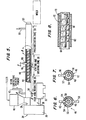
- FIG. 5 illustrates one form of an apparatus in accordance with the invention for implementing the continuous process.
- the apparatus of Fig. 5 has four principal zones which are the feed zone 30, and the previously described serial mixing zone 24, vented zone 26 and pressurization zone 28.
- a motor 32 drives a gear train 36 which is connected to the worm 38.
- the choice of the motor 32 and the design of the gear train 36 are matters of conventional expedience which will not be described herein.
- a hopper 40 is provided thru which suitable fillers, such as alumina trihydrate or limestone, are added to achieve a desired degree of filling in the resultant cast product.
- suitable fillers such as alumina trihydrate or limestone
- Port 42 is used for adding resin, surfactant, catalyst, pigment and other additives which may be necessary to make the resultant cast product.
- Port 42 may be either a single port as illustrated or it may be multiple ports depending on the feasibility of introducing individually or in combination the several components.
- the details of the cross-section 6-6 through the port 42 are illustrated in Fig. 6 as described, infra.
- the flights 44 of the worm 38 in the mixing zone 24 are designed to perform uniform blending of the ingredients added in the feed zone 30 by the time the blend passes into the vented zone 26.
- the barrel 46 contains a jacket of circulating coolant 4& which is illustrated in the sectional views of Figs. 6 and 7 described, infra.
- the function of the cooling jacket 48 is to maintain the desired processing temperatures for most effective reincorporation of volatiles and for controlling the rate of reaction.
- the detailed design of the cooling system including direction of flow of the coolant, sectionalizing of the jacket and the other features commonly known and practiced in the industry will be as required to maintain the requisite temperature profile along the barrel.
- a nozzle 53 is attached to the barrel at the end of the pressurization zone 28 with a quick-disconnect mounting (not illustrated) to permit ready access for cleaning as is common practice with thermoset resins.
- the material which exits the nozzle is placed in molds for forming the desired cast products.
- Fig. 6 illustrates a sectional view of the apparatus taken along section line 6-6. Coolant is circulated in the annulus 48 formed by concentric cylinders 52 and 54 which respectively define the exterior and the interior of the barrel. The port 42 communicates with the interior of the barrel 56 to permit the addition of resin, surfactant, catalyst, pigments and other additives as described above with regard to Fig. 5. Coolant.51 is introduced into and flows from the cooling jacket 48 thru fluid ports 50.
- Fig. 7 illustrates a sectional view of the apparatus of Fig. 5 taken along section lines 7 - 7.
- the vent 66 communicates with the interior of the barrel 56 to permit the aspiration of air which has been freed by the shearing action of the flights 62.
- the design of the flights 44 in barrel 56 in the vented zone 26 may be in accordance' with United States Patent 3,633,880. It should be understood that the actual configuration of the vent 66 is not limited to the form illustrated.
- Fig. 8 illustrates an expanded view of the apparatus of Fig. 5 at the transition zone 8 between the vented zone 26 and the pressurization zone 28.
- the diameter of the shaft varies smoothly between a smaller diameter 62 in the vented zone thru a smooth transition 68 to a larger diameter 70 within the pressurization zone 28.
- the increase in diameter of the shaft between the vented zone 26 and the pressurization zone 28 and a corresponding decrease in the depth of the flights from the deeper flights 64 to the shallower flights 72 causes pressurization of the blend to reincorporate residual components volatilized in the vented zone 26 during deaeration of the blend.
- the diameters and configurations of the shaft 58, 62 and 70, respectively, in the mixing zone 24, vented zone 26 and pressurization zone 28 are determined empirically as a function of the unsaturated thermosetting resin being processed. However, in order to achieve sufficient pressurization for reincorporation of volatiles in the pressurization zone 28, it is necessary that the diameter of the shaft 70 be larger than the diameter of the shaft 62 in the vented zone 26 as illustrated in Fig. 8. A substantial pressurization of several atmospheres may be achieved in the pressurization zone 28 without excessive heating due to the cooling jacket 48. If higher pressures are found desirable, additional cooling may be obtained by using a hollow shaft and circulating coolant through it as well.
- the configuration and the slope of the flights in the respective zones may be varied from those as illustrated to accomplish the specific processing functions to be performed therein. While the flight design in the venting and shearing zone 26 and the pressurization zone 28 may be in accordance with United States Patent 3,633,880, it should be understood that other designs, as known in the art, may be utilized to achieve sequential deaeration and pressurization.
- Density (absence of porosity) in the cured product, as determined by resistance to staining, is superior to Example 1 but inferior to Example 2.
- the present invention is applicable to all types of liquid unsaturated thermosetting resins which are subject to void formation on casting. Furthermore, it should be understood that variation of the resin base, viscosity, filler content, and the physical design of the batch processing equipment used to implement the process of Fig. 2 and the continuous processing equipment used to implement the processes of Figs. 3 and 4 will determine processing parameters such as temperature, applied vacuum, and pressurization. Once a particular resin composition is chosen to be used, each of these parameters may be identified by suitable experimentation.
Landscapes
- Engineering & Computer Science (AREA)
- Mechanical Engineering (AREA)
- Chemical & Material Sciences (AREA)
- Chemical Kinetics & Catalysis (AREA)
- Health & Medical Sciences (AREA)
- Structural Engineering (AREA)
- Ceramic Engineering (AREA)
- Medicinal Chemistry (AREA)
- Polymers & Plastics (AREA)
- Organic Chemistry (AREA)
- Casting Or Compression Moulding Of Plastics Or The Like (AREA)
- Processing And Handling Of Plastics And Other Materials For Molding In General (AREA)
- Laminated Bodies (AREA)
Priority Applications (1)
| Application Number | Priority Date | Filing Date | Title |
|---|---|---|---|
| AT86112353T ATE99591T1 (de) | 1985-09-09 | 1986-09-06 | Verfahren und vorrichtung zum giessen waermehaertender harze sowie verfahrensprodukt. |
Applications Claiming Priority (2)
| Application Number | Priority Date | Filing Date | Title |
|---|---|---|---|
| US773580 | 1985-09-09 | ||
| US06/773,580 US4652596A (en) | 1985-09-09 | 1985-09-09 | Thermosetting resin casting process, product and device |
Publications (3)
| Publication Number | Publication Date |
|---|---|
| EP0229221A2 true EP0229221A2 (de) | 1987-07-22 |
| EP0229221A3 EP0229221A3 (en) | 1989-10-18 |
| EP0229221B1 EP0229221B1 (de) | 1994-01-05 |
Family
ID=25098715
Family Applications (1)
| Application Number | Title | Priority Date | Filing Date |
|---|---|---|---|
| EP86112353A Expired - Lifetime EP0229221B1 (de) | 1985-09-09 | 1986-09-06 | Verfahren und Vorrichtung zum Giessen wärmehärtender Harze sowie Verfahrensprodukt |
Country Status (10)
| Country | Link |
|---|---|
| US (1) | US4652596A (de) |
| EP (1) | EP0229221B1 (de) |
| JP (1) | JPH0671737B2 (de) |
| AT (1) | ATE99591T1 (de) |
| AU (1) | AU601159B2 (de) |
| CA (1) | CA1279758C (de) |
| DE (1) | DE3689516T2 (de) |
| ES (1) | ES2001656A6 (de) |
| IN (1) | IN168036B (de) |
| NZ (1) | NZ217479A (de) |
Cited By (4)
| Publication number | Priority date | Publication date | Assignee | Title |
|---|---|---|---|---|
| WO1998053968A1 (en) * | 1997-05-27 | 1998-12-03 | Vidaurre-Miller, Francisca | Method and apparatus for producing gas occlusion-free and void-free compounds and composites |
| US6143219A (en) * | 1997-05-27 | 2000-11-07 | Mardela International Inc. S.A. | Method and apparatus for producing gas occlusion-free and void-free compounds and composites |
| US6218458B1 (en) * | 1997-05-27 | 2001-04-17 | Mardela International, Inc. S.A. | Method and apparatus for producing gas occlusion-free and void-free compounds and composites |
| WO2015091318A1 (de) | 2013-12-19 | 2015-06-25 | Evonik Industries Ag | Hochsiedendes reaktives bindemittel zur herstellung von künstlichen steinen |
Families Citing this family (10)
| Publication number | Priority date | Publication date | Assignee | Title |
|---|---|---|---|---|
| DE3818003A1 (de) * | 1988-05-27 | 1989-11-30 | Kwm Kunststoffmaschinen Gmbh | Vorrichtung zum kontinuierlichen entgasen eines gemisches aus polymeren bindemitteln und fuellstoffen und/oder fasern |
| US5407627A (en) * | 1992-08-03 | 1995-04-18 | Polycryl Enterprises Inc. | Process and apparatus for forming stress-free thermosetting resin products |
| US5820799A (en) * | 1996-02-05 | 1998-10-13 | Barnett; Stephen | Methods for making cast marble objects having superior depth characteristics and color separation |
| US5789032A (en) * | 1996-09-20 | 1998-08-04 | Excelstone International, Inc. | Moldless coated board |
| US7001660B2 (en) | 2001-07-16 | 2006-02-21 | Gilbert Garitano | Images in solids surfaces |
| US6884283B2 (en) * | 2001-12-19 | 2005-04-26 | Novartis Ag | Process for removing bubbles from viscous polymer solutions |
| US20040207121A1 (en) * | 2003-04-18 | 2004-10-21 | Schiller Paul R. | Process and apparatus for forming stress-free thermosetting resin products in one mold |
| KR100633695B1 (ko) * | 2004-12-08 | 2006-10-11 | 제일모직주식회사 | 초대입경 마블칩을 함유한 인조 대리석의 제조방법 |
| FR2914579B1 (fr) * | 2007-04-05 | 2009-07-10 | Inoplast Sa | Piece de carrosserie de vehicule automobile, notamment calandre pour poids lourd |
| EP2353826A1 (de) * | 2010-01-28 | 2011-08-10 | Siemens Aktiengesellschaft | Verfahren und Anordnung zur Verbesserung der Herstellung einer Schaufel |
Family Cites Families (7)
| Publication number | Priority date | Publication date | Assignee | Title |
|---|---|---|---|---|
| US3524222A (en) * | 1968-05-13 | 1970-08-18 | Egan Machinery Co | Extruder screw devolatilizing and mixing section |
| US3633880A (en) * | 1970-01-08 | 1972-01-11 | Gen Electric | Extrusion device |
| CH507793A (de) * | 1970-09-14 | 1971-05-31 | Sprecher & Schuh Ag | Verfahren zur Herstellung eines Giessharzkörpers, insbesondere eines hohlzylindrischen elektrischen Isolierkörpers |
| IT956225B (it) * | 1971-04-21 | 1973-10-10 | El Said Issam | Perfezionamenti relativi alla formazione di articoli colati a freddo di resina poliestere rigida |
| GB1467045A (en) * | 1973-08-15 | 1977-03-16 | Mitsubishi Rayon Co | Process for removal of volatile component form methacrylate polymer composition |
| DE2422888A1 (de) * | 1974-05-11 | 1975-12-11 | Bayer Ag | Verfahren zur herstellung rissfreier und massgerechter formkoerper |
| US4473673A (en) * | 1983-05-09 | 1984-09-25 | Wildon Industries, Inc. | Cast polyester resin process and product |
-
1985
- 1985-09-09 US US06/773,580 patent/US4652596A/en not_active Expired - Lifetime
-
1986
- 1986-09-04 ES ES8601620A patent/ES2001656A6/es not_active Expired
- 1986-09-05 NZ NZ217479A patent/NZ217479A/xx unknown
- 1986-09-06 DE DE3689516T patent/DE3689516T2/de not_active Expired - Fee Related
- 1986-09-06 AT AT86112353T patent/ATE99591T1/de not_active IP Right Cessation
- 1986-09-06 EP EP86112353A patent/EP0229221B1/de not_active Expired - Lifetime
- 1986-09-08 AU AU62492/86A patent/AU601159B2/en not_active Ceased
- 1986-09-08 CA CA000517659A patent/CA1279758C/en not_active Expired - Fee Related
- 1986-09-08 IN IN720/MAS/86A patent/IN168036B/en unknown
- 1986-09-09 JP JP61210814A patent/JPH0671737B2/ja not_active Expired - Fee Related
Cited By (6)
| Publication number | Priority date | Publication date | Assignee | Title |
|---|---|---|---|---|
| WO1998053968A1 (en) * | 1997-05-27 | 1998-12-03 | Vidaurre-Miller, Francisca | Method and apparatus for producing gas occlusion-free and void-free compounds and composites |
| US6046267A (en) * | 1997-05-27 | 2000-04-04 | Tecinomet S.A. | Method and apparatus for producing gas occlusion-free and void-free compounds and composites |
| US6143219A (en) * | 1997-05-27 | 2000-11-07 | Mardela International Inc. S.A. | Method and apparatus for producing gas occlusion-free and void-free compounds and composites |
| US6218458B1 (en) * | 1997-05-27 | 2001-04-17 | Mardela International, Inc. S.A. | Method and apparatus for producing gas occlusion-free and void-free compounds and composites |
| EP1151837A1 (de) * | 1997-05-27 | 2001-11-07 | Vidaurre-Miller, Francisca | Verfahren zum blasenfreien Herstellung von Mischungen und Verbundmaterialien |
| WO2015091318A1 (de) | 2013-12-19 | 2015-06-25 | Evonik Industries Ag | Hochsiedendes reaktives bindemittel zur herstellung von künstlichen steinen |
Also Published As
| Publication number | Publication date |
|---|---|
| NZ217479A (en) | 1989-01-27 |
| ATE99591T1 (de) | 1994-01-15 |
| AU601159B2 (en) | 1990-09-06 |
| CA1279758C (en) | 1991-02-05 |
| JPS62116115A (ja) | 1987-05-27 |
| DE3689516D1 (de) | 1994-02-17 |
| EP0229221B1 (de) | 1994-01-05 |
| IN168036B (de) | 1991-01-26 |
| ES2001656A6 (es) | 1988-06-01 |
| EP0229221A3 (en) | 1989-10-18 |
| US4652596A (en) | 1987-03-24 |
| AU6249286A (en) | 1987-03-12 |
| DE3689516T2 (de) | 1994-05-19 |
| JPH0671737B2 (ja) | 1994-09-14 |
Similar Documents
| Publication | Publication Date | Title |
|---|---|---|
| EP0229221B1 (de) | Verfahren und Vorrichtung zum Giessen wärmehärtender Harze sowie Verfahrensprodukt | |
| US4473673A (en) | Cast polyester resin process and product | |
| DE60102826T2 (de) | Schnelle verdichtung von porösen formteilen mit hochviskösen harzen oder pechen durch harzinjektionsverfahren | |
| JP4173566B2 (ja) | 軽量で多孔質の鉱物性断熱板 | |
| JP3266201B2 (ja) | 架橋押出しポリマー生成物の製法及びその装置 | |
| US5698152A (en) | Resin tablet for sealing semiconductor | |
| JP3973625B2 (ja) | 成型品を製造する方法 | |
| US6218458B1 (en) | Method and apparatus for producing gas occlusion-free and void-free compounds and composites | |
| US3754071A (en) | Process for impregnating bodies with a casting resin composition | |
| US6009635A (en) | Method and apparatus for producing gas occlusion-free and void-free compounds and composites | |
| DE1502649A1 (de) | Verfahren und Vorrichtung zur Herstellung von Schleifwerkzeugen | |
| US4999396A (en) | Method for making low resin content polymer concrete | |
| RU2049752C1 (ru) | Полимербетонная смесь | |
| CN113683862A (zh) | 一种适用于深海的低密度固体浮力材料及其制备方法 | |
| KR100467295B1 (ko) | 원심력을 이용한 수지 콘크리트관의 제조방법 및 그제조장치 | |
| CN1020079C (zh) | 在真空中形成砌块的方法及其设备 | |
| MXPA04002054A (es) | Metodo y aparato para estabilizar las propiedades fisicas materiales de parachoques reciclables. | |
| DE68916767T2 (de) | Kugelförmige Siliconkautschukzellenmikroteilchen und Verfahren zu ihrer Herstellung. | |
| KR200260606Y1 (ko) | 원심력을 이용한 수지 콘크리트관의 제조장치 | |
| US5670233A (en) | Acoustic window and method for making the same | |
| JP2583336B2 (ja) | 混練スラリーの脱泡・圧送方法 | |
| KR100602454B1 (ko) | 인조대리석용 칩의 제조방법 | |
| FR2559944A1 (fr) | Procede de solidification d'un solvant radioactif residuaire | |
| JPH032045B2 (de) | ||
| CN121004707A (zh) | 离心机中具备聚四氟乙烯衬层部件的制备方法 |
Legal Events
| Date | Code | Title | Description |
|---|---|---|---|
| PUAI | Public reference made under article 153(3) epc to a published international application that has entered the european phase |
Free format text: ORIGINAL CODE: 0009012 |
|
| AK | Designated contracting states |
Kind code of ref document: A2 Designated state(s): AT BE CH DE FR GB LI LU NL SE |
|
| PUAL | Search report despatched |
Free format text: ORIGINAL CODE: 0009013 |
|
| AK | Designated contracting states |
Kind code of ref document: A3 Designated state(s): AT BE CH DE FR GB LI LU NL SE |
|
| 17P | Request for examination filed |
Effective date: 19900410 |
|
| 17Q | First examination report despatched |
Effective date: 19911112 |
|
| GRAA | (expected) grant |
Free format text: ORIGINAL CODE: 0009210 |
|
| AK | Designated contracting states |
Kind code of ref document: B1 Designated state(s): AT BE CH DE FR GB LI LU NL SE |
|
| REF | Corresponds to: |
Ref document number: 99591 Country of ref document: AT Date of ref document: 19940115 Kind code of ref document: T |
|
| REF | Corresponds to: |
Ref document number: 3689516 Country of ref document: DE Date of ref document: 19940217 |
|
| ET | Fr: translation filed | ||
| PG25 | Lapsed in a contracting state [announced via postgrant information from national office to epo] |
Ref country code: LU Free format text: LAPSE BECAUSE OF NON-PAYMENT OF DUE FEES Effective date: 19940930 Ref country code: LI Effective date: 19940930 Ref country code: CH Effective date: 19940930 |
|
| PLBE | No opposition filed within time limit |
Free format text: ORIGINAL CODE: 0009261 |
|
| STAA | Information on the status of an ep patent application or granted ep patent |
Free format text: STATUS: NO OPPOSITION FILED WITHIN TIME LIMIT |
|
| 26N | No opposition filed | ||
| EAL | Se: european patent in force in sweden |
Ref document number: 86112353.7 |
|
| REG | Reference to a national code |
Ref country code: GB Ref legal event code: 732E |
|
| REG | Reference to a national code |
Ref country code: CH Ref legal event code: PL |
|
| REG | Reference to a national code |
Ref country code: GB Ref legal event code: IF02 |
|
| PGFP | Annual fee paid to national office [announced via postgrant information from national office to epo] |
Ref country code: NL Payment date: 20040816 Year of fee payment: 19 |
|
| PGFP | Annual fee paid to national office [announced via postgrant information from national office to epo] |
Ref country code: AT Payment date: 20040819 Year of fee payment: 19 |
|
| PGFP | Annual fee paid to national office [announced via postgrant information from national office to epo] |
Ref country code: GB Payment date: 20040901 Year of fee payment: 19 |
|
| PGFP | Annual fee paid to national office [announced via postgrant information from national office to epo] |
Ref country code: FR Payment date: 20040920 Year of fee payment: 19 |
|
| PGFP | Annual fee paid to national office [announced via postgrant information from national office to epo] |
Ref country code: SE Payment date: 20040921 Year of fee payment: 19 |
|
| PGFP | Annual fee paid to national office [announced via postgrant information from national office to epo] |
Ref country code: BE Payment date: 20041021 Year of fee payment: 19 |
|
| PGFP | Annual fee paid to national office [announced via postgrant information from national office to epo] |
Ref country code: DE Payment date: 20041102 Year of fee payment: 19 |
|
| BECA | Be: change of holder's address |
Owner name: THE *DILLER CORP.C/O FORMACA CORPORATION, CHEMED C Effective date: 20050103 |
|
| REG | Reference to a national code |
Ref country code: GB Ref legal event code: 732E |
|
| PG25 | Lapsed in a contracting state [announced via postgrant information from national office to epo] |
Ref country code: GB Free format text: LAPSE BECAUSE OF NON-PAYMENT OF DUE FEES Effective date: 20050906 Ref country code: AT Free format text: LAPSE BECAUSE OF NON-PAYMENT OF DUE FEES Effective date: 20050906 |
|
| PG25 | Lapsed in a contracting state [announced via postgrant information from national office to epo] |
Ref country code: SE Free format text: LAPSE BECAUSE OF NON-PAYMENT OF DUE FEES Effective date: 20050907 |
|
| PG25 | Lapsed in a contracting state [announced via postgrant information from national office to epo] |
Ref country code: BE Free format text: LAPSE BECAUSE OF NON-PAYMENT OF DUE FEES Effective date: 20050930 |
|
| PG25 | Lapsed in a contracting state [announced via postgrant information from national office to epo] |
Ref country code: NL Free format text: LAPSE BECAUSE OF NON-PAYMENT OF DUE FEES Effective date: 20060401 Ref country code: DE Free format text: LAPSE BECAUSE OF NON-PAYMENT OF DUE FEES Effective date: 20060401 |
|
| EUG | Se: european patent has lapsed | ||
| GBPC | Gb: european patent ceased through non-payment of renewal fee |
Effective date: 20050906 |
|
| PG25 | Lapsed in a contracting state [announced via postgrant information from national office to epo] |
Ref country code: FR Free format text: LAPSE BECAUSE OF NON-PAYMENT OF DUE FEES Effective date: 20060531 |
|
| NLV4 | Nl: lapsed or anulled due to non-payment of the annual fee |
Effective date: 20060401 |
|
| REG | Reference to a national code |
Ref country code: FR Ref legal event code: ST Effective date: 20060531 |
|
| REG | Reference to a national code |
Ref country code: FR Ref legal event code: TP |
|
| BECA | Be: change of holder's address |
Owner name: THE *DILLER CORP.C/O FORMACA CORPORATION, CHEMED C Effective date: 20050103 |
|
| BERE | Be: lapsed |
Owner name: THE *DILLER CORP. Effective date: 20050930 |