EP0229245A2 - Verfahren, um Registerzuordnung und Zuweisungen zu optimieren - Google Patents
Verfahren, um Registerzuordnung und Zuweisungen zu optimieren Download PDFInfo
- Publication number
- EP0229245A2 EP0229245A2 EP86114964A EP86114964A EP0229245A2 EP 0229245 A2 EP0229245 A2 EP 0229245A2 EP 86114964 A EP86114964 A EP 86114964A EP 86114964 A EP86114964 A EP 86114964A EP 0229245 A2 EP0229245 A2 EP 0229245A2
- Authority
- EP
- European Patent Office
- Prior art keywords
- registers
- register
- graph
- variable
- memory
- Prior art date
- Legal status (The legal status is an assumption and is not a legal conclusion. Google has not performed a legal analysis and makes no representation as to the accuracy of the status listed.)
- Withdrawn
Links
Images

Classifications
-
- G—PHYSICS
- G06—COMPUTING OR CALCULATING; COUNTING
- G06F—ELECTRIC DIGITAL DATA PROCESSING
- G06F9/00—Arrangements for program control, e.g. control units
-
- G—PHYSICS
- G06—COMPUTING OR CALCULATING; COUNTING
- G06F—ELECTRIC DIGITAL DATA PROCESSING
- G06F8/00—Arrangements for software engineering
- G06F8/40—Transformation of program code
- G06F8/41—Compilation
- G06F8/44—Encoding
- G06F8/441—Register allocation; Assignment of physical memory space to logical memory space
Definitions
- This invention relates to a method for allocating and optimizing register assignments during compiling of source into machine-executable code in either a scalar or vector processor.
- a compiler Among the tasks that a compiler must perform are the allocation and assignment of computing resources so that the computation specified by a stream of source code instructions can be efficiently completed.
- resources include computational facilities such as an ALU, input/output, memory including registers, operating system elements, etc.
- the objectives of the optimization portion of the compiler are to (a) shrink the size of the code, (b) increase the speed of execution where possible, and (c) minimize costs through efficient resource allocation. A schedule of resource use or consumption pattern is then embedded in the code being compiled.
- a basic block is a sequence of consecutive statements. This sequence may be entered only at the beginning and when entered the statements are executed in sequence without halt or possibility of branch, except at the end thereof.
- a flow graph describes the flow of control among basic blocks.
- the flow graph would, for example, show the looping, branching, and nesting behavior among basic blocks necessary for iterative or recursive computation.
- Live variable analysis refers to a set of techniques for ascertaining whether a name has a value which may be subsequently used in a computation.
- a name is considered “live” coming into a block if the name is either used before re - definition within a basic block, or is “live” coming out of the block and is not “redefined” within the block.
- a value is computed in a register, and is presumably used within a basic block, it is not necessary to store that value if it is “dead” at the end of the block.
- all registers are full and another register is needed, assignment could be made to a register presently containing a "dead” value.
- the first compiler transformation consists of mapping strings of source code onto a flow graph, each of whose nodes are basic blocks and whose control and data path relationships are defined by the directed edges of the flow graph. Optimization in the allocation and assignment of resources can be considered first at the local or basic block level, and then at the global or flow graph level.
- each basic block is treated as a separate unit and optimized without regard to its content.
- a data dependence graph is built for the basic block, transformed, and used to generate the final machine code. It is then discarded and the next basic block considered.
- a computer includes memory, the fastest form of which is the most expensive.
- a finite number of physical registers store operands for immediate use for computation and control.
- Computer instructions operating register to register are the fastest executing. If a register is unavailable, an intermediate result must either be loaded to main memory where the bulk of programs and data are located, or loaded from said main memory into a register when a register becomes available. Loads and stores to registers from memory take a substantially longer time.
- one objective is to keep as many computational names or variables in the registers or to have a register available as needed.
- Register allocation involves identifying the names in the software stream which should reside in registers (i.e. the number of registers needed); while assignment is the step of assigning registers to nodes following an underlying scheme, rule, or model.
- assignment was to have the assignment fixed; that is, where specific types of quantities in an object program were assigned to certain registers. For instance, subroutine links could be assigned to a first register group, base addresses to a second register group, arithmetic computations to a third register group, runtime stackpointers to a fixed register, etc.
- the disadvantage of such fixed mapping is that register usage does not dynamically follow execution needs. This means that some registers are not used at all, are overused, or are underused.
- Global register allocation relates to the observation that most programs spend most of their time in inner loops.
- one approach to assignment is to keep a frequently used name in a fixed register throughout a loop. Therefore, one strategy might be to assign some fixed number of registers to hold the most active names in each innerloop. The selected names may differ in different loops. Other nondedicated registers may be used to hold values local to one block.
- This allocation and assignment has the drawback that no given number of registers is the universally right number to make available for global register allocation.
- Chaitin points out that it is intended to keep as many computations as possible in the registers, rather than in storage, since load and store instructions are more expensive than register-to-register instructions. Chaitin notes that it is the responsibility of code generation and optimization to take advantage of the unlimited number of registers, i.e. considered as a pool, allowed in the intermediate language in order to minimize the number of loads and stores in the program.
- register allocation can be analyzed as a graph-coloring problem.
- the coloring of a graph is an assignment of a color to each of its nodes in such a manner that if two nodes are adjacent (connected by an edge of the graph), they have different colors.
- the "chromatic number" of the graph is the minimal number of colors in any of its colorings.
- register allocation utilizes the construct termed a "register interference graph". Two computations or names which reside in machine registers are said to "interfere” with each other if they are "live” simultaneously at any point in the program.
- C haitin's graph-coloring method includes the steps of (a) building an interference graph from the names with reference to a specific text ordering of code; (b) ascertaining the chromatic number for the graph, and coloring (assigning registers to nodes) if the chromatic number does not exceed the number of available registers, otherwise reducing the graph by retiring a node (excising the node and its connecting edges) having the highest in/out degree; (c) repeating step (b) until the values converge, and (d) accounting for and managing the "spills" by embedding in the compiled code stream appropriate writes to and loads from memory.
- each basic block has statements defining computations.
- each processor comprises memory for storing sequences of executable code and data, and means for accessing said memory and executing any accessed code.
- the memory is mapped as a two-level model including a finite number p of registers and a comparably infinite internal memory.
- the registers have access times faster than that of internal memory.
- the inventive method comprises the processor- implemented steps of (a) ascertaining the data dependency graph attributes of a basic block, and (b) generating an allocation and assignment for q of the p registers with reference to all computations within the basic block by performing a "two-color pebbling game" heuristic over the ascertained data dependency graph utilizing the two-level memory model.
- a method for both local and global register optimization comprising the step, in addition to (a) and (b) above, of (c) performing live variable analysis, and responsively generating a global register allocation and assignment assuming that loops are the most significant optimization entity.
- a data dependency graph is invariant to textual ordering.
- the method of this invention partitions the allocation process into two steps. The first step is to obtain a good local allocation, and the second step is to use the local allocation to obtain the global one.
- the pebbling game heuristic played upon the data dependency graph ensures that spills within the basic blocks are minimized.
- the heuristic involves the exercise of a red-blue pebble game on the graphs corresponding to the basic blocks. Accesses to memory are modeled by way of placement of blue pebbles on the graph, while accesses to registers are modeled by way of placement of red pebbles on the graph. This model precisely controls spills.
- the same dependency graph always yields the same allocation.
- the second major step is that of performing global allocation using these registers to further reduce accesses to memory.
- the variables that are chosen for these global registers are selected so as to maximally reduce the number of load or store operations in the entire program.
- a pebbling game is a one-person game played on a DAG.
- the player is given two types of pebbles: red and blue.
- the number of blue pebbles is infinite, while the number of red pebbles is restricted to some number, say p.
- the DAG has all sources pebbled blue. The player is allowed to make any one of the following moves:
- rule (1) is a load from memory
- rule (2) is a write to memory
- rule (3) is a computation of a value into a new register
- rule (4) is the computation of a value into a register which previously held an operand used in the computation.
- the object of the game in the register allocation context is to minimize the number of spills, where a spill involves the use of rules (1) or (2).
- Pippenger Pebble games have been described in the prior art, as in Pippenger, "Pebbling", 5th IBM Symposium on the Mathematical Foundations of Computer Science, 26-28 May 1980, Hakone, Japan. Pippenger pointed out that pebbling has found a range of applications including compilers, and in particular, code generation and optimization.
- the game referenced by Pippenger is a one-color game, sometimes called the "black pebble game”.
- the "black pebble game” has been used for the study of space-time tradeoffs.
- a "space-time tradeoff” involves the consequences of varying the factors formed by the product of the number of available registers and the time it takes to perform the computation. The product is an amount proportional to the number of nodes in a data dependence graph. If only one color represents a register, then for any given computation, Pippenger asks "what is the minimum number of registers required in order to perform said computation?" However, Pippenger's one-color pebble game neither teaches nor suggests the inventive method.
- the invention treats an allocation and assignment of registers via two-color pebbling upon a D AG for local optimization and loop-based global optimization which together minimize the spills as compared to the prevailing graph-coloring method.
- the description will first treat the allocation and assignment of registers to achieve local optimization by way of a description of a pebble game heuristic algorithm, to be then followed by a discussion of global allocation.
- a "pebble game” heuristic is an intuitively- based, machine-implementable procedure or algorithm for achieving a prospectively near optimal result.
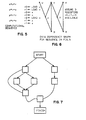
- node tl is dependent upon the sources x and y, while node q is dependent upon nodes y and z.
- the result v in turn depends upon tl and y.
- a dominator consisting of three nodes is chosen. The only possible dominator is the set [x,y,z]. Hence, this is dubbed the "promising" set.
- Nodes tl and q are successors of the dominating set chosen. For each node, the cover cost is computed.
- the cover cost of tl is (2,1) because two predecessors of tl are unpebbled and the minimum slide cost is 1 since x has only one uncomputed successor. The is similarly the case for q. Since the cover cost is the same for both tl and q, one node is chosen arbitrarily,' say tl.
- red pebbles must first be placed on x and y.
- slide x to tl because the slide cost of x is 1.
- node v can be computed by sliding the red pebble on tl to v.
- node q can be computed, after loading z, by sliding the pebble on y to q.
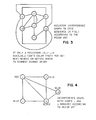
- Figures 3 and 4 there is shown a register interference graph according to the prior art Chaitin references of the computation sequence depicted in Figure 1.
- the Figure 3 graph is technically three- colorable. However, if only two registers were available (r0, rl), then it would not be possible to color the graph per se. It would be necessary to remove or retire nodes in highest-degree order.
- Figure 4 is an example of the prior art interference graph with nodes x and y removed. However, in order to be two-colorable, node z would also have to be removed. The retirement of three nodes indicates a substantial amount of spill code. In contrast, if one were to render only two registers available and assign them according to the data dependence graph in Figure 2, only three loads and one store- would be required by comparison.
- global optimization first involves performing local allocations for each basic block in the order that they appear in a flow graph using some fraction of the total number of available registers. Then, assuming that loops are the most critical entities, use the remaining registers for carrying global information.
- the global step examines the set of variables that are loaded and stored in each local allocation. For these variables, a count is made of the number of times the variable is loaded or stored. This count is biased by the so-called nesting level of the variable, which refers to the number of loops in the flow graph that surround the variable. From this list, the variable with the highest value is selected to reside in a global register. The process is repeated until no more global registers are available, or the list is empty.
- variables that are put into global registers are those that represent the largest live ranges in the flow graph corresponding to the local allocations. That is, the local allocations are substituted for the corresponding basic blocks in the input program. Then, live ranges are computed for all the variables that are not local to a basic block. Live ranges are used to determine which variable is allocated a global register with the number of uses and nesting level- breaking ties.
- the loop can be unrolled until no transfers are required or the number of transfers is below some predetermined threshold.
- the method of this invention can be used in a scalar processor of the IBM System/370 type, or used in vector machines as exemplified by the IBM 3090.
- vector processors it is desired to run a computation at top speed. This means that a computation should access memory as seldom as possible because memory access is very slow compared with the access to vector registers.
- the pebble game heuristic can be used to determine the number of vector registers as follows. First, select a starting number of vector registers and then run the heuristic on the data dependency graph DAG corresponding to the vector computation that is to be performed. Next, compute the total number of loads/stores performed for this fixed number of registers.
- Another extension of the invention is its use in machines where computations can be overlapped with loads and stores to memory. Since the heuristic attempts to compute as much as possible based on data currently in registers, it should provide a good overlap between computations and memory accesses.
- This invention can be conveniently executed when embedded in the optimizer portion of a high-level language compiler, such as that found in PL/I, FORTRAN, COBOL, etc., and executed on a system such as an IBM System/370 as described in Amdahl et al, USP 3,400,371, "Data Processing System", issued September 3, 1968, and in IBM S ystem/370 Principles of Operation, IBM Publication GA22-7000-6.
- a high-level language compiler such as that found in PL/I, FORTRAN, COBOL, etc.
Landscapes
- Engineering & Computer Science (AREA)
- Theoretical Computer Science (AREA)
- General Engineering & Computer Science (AREA)
- Software Systems (AREA)
- Physics & Mathematics (AREA)
- General Physics & Mathematics (AREA)
- Devices For Executing Special Programs (AREA)
- Complex Calculations (AREA)
Applications Claiming Priority (2)
| Application Number | Priority Date | Filing Date | Title |
|---|---|---|---|
| US809989 | 1985-12-17 | ||
| US06/809,989 US4782444A (en) | 1985-12-17 | 1985-12-17 | Compilation using two-colored pebbling register allocation method such that spill code amount is invariant with basic block's textual ordering |
Publications (2)
| Publication Number | Publication Date |
|---|---|
| EP0229245A2 true EP0229245A2 (de) | 1987-07-22 |
| EP0229245A3 EP0229245A3 (de) | 1990-03-21 |
Family
ID=25202684
Family Applications (1)
| Application Number | Title | Priority Date | Filing Date |
|---|---|---|---|
| EP86114964A Withdrawn EP0229245A3 (de) | 1985-12-17 | 1986-10-28 | Verfahren, um Registerzuordnung und Zuweisungen zu optimieren |
Country Status (8)
| Country | Link |
|---|---|
| US (1) | US4782444A (de) |
| EP (1) | EP0229245A3 (de) |
| JP (1) | JPH0776927B2 (de) |
| KR (1) | KR910009116B1 (de) |
| CN (1) | CN1003679B (de) |
| BR (1) | BR8605865A (de) |
| CA (1) | CA1264859A (de) |
| ES (1) | ES2004348A6 (de) |
Cited By (3)
| Publication number | Priority date | Publication date | Assignee | Title |
|---|---|---|---|---|
| EP0317080A3 (de) * | 1987-11-16 | 1991-01-16 | Hewlett-Packard Company | Veränderliche Bereiche anwendendes Verfahren und Gerät zum Stützen der symbolischen Fehlersuche von optimierten Kodes |
| EP0756231A1 (de) * | 1995-07-28 | 1997-01-29 | Nec Corporation | Verfahren zur Speicherzuteilung für Variabeln |
| US6609249B2 (en) * | 1999-06-08 | 2003-08-19 | Hewlett-Packard Development Company, L.P. | Determining maximum number of live registers by recording relevant events of the execution of a computer program |
Families Citing this family (108)
| Publication number | Priority date | Publication date | Assignee | Title |
|---|---|---|---|---|
| JPS6378231A (ja) * | 1986-09-22 | 1988-04-08 | Nec Corp | 部分的プログラム結合方式 |
| JPS6476322A (en) * | 1987-09-18 | 1989-03-22 | Hitachi Ltd | Program synthesizing method |
| JPS6481035A (en) * | 1987-09-22 | 1989-03-27 | Nec Corp | C compiler |
| US5121498A (en) * | 1988-05-11 | 1992-06-09 | Massachusetts Institute Of Technology | Translator for translating source code for selective unrolling of loops in the source code |
| US5129086A (en) * | 1988-11-29 | 1992-07-07 | International Business Machines Corporation | System and method for intercommunicating between applications and a database manager |
| US5070453A (en) * | 1989-04-10 | 1991-12-03 | At&T Bell Laboratories | System and method for scheduling data transfers among a plurality of data processing units to avoid conflicting data requests |
| US5193190A (en) * | 1989-06-26 | 1993-03-09 | International Business Machines Corporation | Partitioning optimizations in an optimizing compiler |
| US5274820A (en) * | 1989-08-14 | 1993-12-28 | International Business Machines Corporation | Method and system for eliminating operation codes from intermediate prolog instructions |
| JPH03150637A (ja) * | 1989-11-08 | 1991-06-27 | Oki Electric Ind Co Ltd | パイプライン対応のレジスタ割付け方式 |
| US5428793A (en) * | 1989-11-13 | 1995-06-27 | Hewlett-Packard Company | Method and apparatus for compiling computer programs with interproceduural register allocation |
| WO1991010954A1 (en) * | 1990-01-19 | 1991-07-25 | Alliant Computer Systems Corporation | A risc vectorization system |
| CA2010067C (en) * | 1990-02-14 | 1993-10-26 | Steven Murray Hoxey | Reducing pipeline delays in compilers by code hoisting |
| EP0453160A3 (en) * | 1990-04-20 | 1993-09-15 | Digital Equipment Corporation | A method and apparatus for analyzing the flow of data through a complex information exchange system |
| US5212794A (en) * | 1990-06-01 | 1993-05-18 | Hewlett-Packard Company | Method for optimizing computer code to provide more efficient execution on computers having cache memories |
| US5107418A (en) * | 1990-06-11 | 1992-04-21 | Supercomputer Systems Limited Partnership | Method for representing scalar data dependences for an optimizing compiler |
| US5202975A (en) * | 1990-06-11 | 1993-04-13 | Supercomputer Systems Limited Partnership | Method for optimizing instruction scheduling for a processor having multiple functional resources |
| JPH0816871B2 (ja) * | 1990-12-07 | 1996-02-21 | 富士ゼロックス株式会社 | プログラム翻訳装置およびプログラム翻訳方法 |
| US5511218A (en) * | 1991-02-13 | 1996-04-23 | Hughes Aircraft Company | Connectionist architecture for weapons assignment |
| JP3032031B2 (ja) * | 1991-04-05 | 2000-04-10 | 株式会社東芝 | ループ最適化方法及び装置 |
| JP3049814B2 (ja) * | 1991-04-09 | 2000-06-05 | 日本電気株式会社 | マイクロコンピュータの言語処理装置 |
| US5530866A (en) * | 1991-07-30 | 1996-06-25 | Tera Computer Company | Register allocation methods having upward pass for determining and propagating variable usage information and downward pass for binding; both passes utilizing interference graphs via coloring |
| US5339428A (en) * | 1991-09-04 | 1994-08-16 | Digital Equipment Corporation | Compiler allocating a register to a data item used between a use and store of another data item previously allocated to the register |
| JP2970785B2 (ja) * | 1991-10-18 | 1999-11-02 | 松下電器産業 株式会社 | 資源割り付け装置 |
| US5386562A (en) * | 1992-05-13 | 1995-01-31 | Mips Computer Systems, Inc. | Circular scheduling method and apparatus for executing computer programs by moving independent instructions out of a loop |
| US5418958A (en) * | 1992-07-15 | 1995-05-23 | Sun Microsystems, Inc. | Register allocation by decomposing, re-connecting and coloring hierarchical program regions |
| US5367651A (en) * | 1992-11-30 | 1994-11-22 | Intel Corporation | Integrated register allocation, instruction scheduling, instruction reduction and loop unrolling |
| US5469572A (en) * | 1992-12-01 | 1995-11-21 | Taylor; James M. | Post compile optimizer for linkable object code |
| AU5954194A (en) * | 1992-12-21 | 1994-07-19 | Apple Computer, Inc. | Method and apparatus for transforming an arbitrary topology collection of nodes into an acyclic directed graph |
| SE502733C2 (sv) * | 1993-06-11 | 1995-12-18 | Ellemtel Utvecklings Ab | Sätt att undvika ej önskvärd interferens mellan tjänster i ett telekommunikationssystem |
| CA2643234C (en) * | 1993-10-29 | 2012-05-15 | Microsoft Corporation | Method and system for generating a computer program |
| US5491823A (en) * | 1994-01-25 | 1996-02-13 | Silicon Graphics, Inc. | Loop scheduler |
| US5966539A (en) * | 1994-03-01 | 1999-10-12 | Digital Equipment Corporation | Link time optimization with translation to intermediate program and following optimization techniques including program analysis code motion live variable set generation order analysis, dead code elimination and load invariant analysis |
| US5590356A (en) * | 1994-08-23 | 1996-12-31 | Massachusetts Institute Of Technology | Mesh parallel computer architecture apparatus and associated methods |
| JP3606387B2 (ja) * | 1994-09-13 | 2005-01-05 | 松下電器産業株式会社 | コンパイル装置 |
| US5802375A (en) * | 1994-11-23 | 1998-09-01 | Cray Research, Inc. | Outer loop vectorization |
| CN1149476C (zh) * | 1995-03-16 | 2004-05-12 | 松下电器产业株式会社 | 资源分配装置 |
| US5659754A (en) * | 1995-03-31 | 1997-08-19 | Sun Microsystems, Inc. | Method and apparatus for an improved optimizing compiler |
| US5691897A (en) * | 1995-05-30 | 1997-11-25 | Roy-G-Biv Corporation | Motion control systems |
| US20100131081A1 (en) * | 1995-05-30 | 2010-05-27 | Brown David W | Systems and methods for motion control |
| US7137107B1 (en) | 2003-04-29 | 2006-11-14 | Roy-G-Biv Corporation | Motion control systems and methods |
| US7024666B1 (en) * | 2002-01-28 | 2006-04-04 | Roy-G-Biv Corporation | Motion control systems and methods |
| US7139843B1 (en) | 1995-05-30 | 2006-11-21 | Roy-G-Biv Corporation | System and methods for generating and communicating motion data through a distributed network |
| US20060206219A1 (en) * | 1995-05-30 | 2006-09-14 | Brown David W | Motion control systems and methods |
| US5761514A (en) * | 1995-08-31 | 1998-06-02 | International Business Machines Corporation | Register allocation method and apparatus for truncating runaway lifetimes of program variables in a computer system |
| US6135650A (en) * | 1995-12-22 | 2000-10-24 | Sun Microsystems, Inc. | Method and system for wrapper routine optimization |
| US5901317A (en) * | 1996-03-25 | 1999-05-04 | Sun Microsystems, Inc. | Method and system for register allocation using multiple interference graphs |
| US5946491A (en) * | 1996-06-06 | 1999-08-31 | International Business Machines Corporation | Register allocation method and apparatus for gernerating spill code as a function of register pressure compared to dual thresholds |
| US5901316A (en) * | 1996-07-01 | 1999-05-04 | Sun Microsystems, Inc. | Float register spill cache method, system, and computer program product |
| KR100186338B1 (ko) * | 1996-08-02 | 1999-05-15 | 문정환 | 교환법칙이 성립하는 연산기의 입력단수 저감방법 |
| WO1998006038A1 (en) * | 1996-08-07 | 1998-02-12 | Sun Microsystems, Inc. | Architectural support for software pipelining of loops |
| US6049864A (en) * | 1996-08-20 | 2000-04-11 | Intel Corporation | Method for scheduling a flag generating instruction and a subsequent instruction by executing the flag generating instruction in a microprocessor |
| US5937195A (en) * | 1996-11-27 | 1999-08-10 | Hewlett-Packard Co | Global control flow treatment of predicated code |
| US5890000A (en) * | 1996-12-04 | 1999-03-30 | International Business Machines Corporation | Cooperation of global and local register allocators for better handling of procedures |
| US6031994A (en) * | 1997-04-01 | 2000-02-29 | Intel Corporation | Method for determining the set of variables that may be ambiguously defined at a point in a computer program |
| US6151704A (en) * | 1997-04-01 | 2000-11-21 | Intel Corporation | Method for optimizing a loop in a computer program by speculatively removing loads from within the loop |
| US6029005A (en) * | 1997-04-01 | 2000-02-22 | Intel Corporation | Method for identifying partial redundancies in a new processor architecture |
| US6016398A (en) * | 1997-04-01 | 2000-01-18 | Intel Corporation | Method for using static single assignment to color out artificial register dependencies |
| US5991540A (en) * | 1997-04-01 | 1999-11-23 | Intel Corporation | Method for identifying partial redundancies in existing processor architectures |
| CA2205797C (en) * | 1997-05-22 | 2001-04-24 | Andrew Wilfred Macleod | A system for local context spilling for graph colouring register allocators |
| US6139200A (en) * | 1997-06-30 | 2000-10-31 | Sun Microsystems, Inc. | Register resource allocation feedback |
| US5987259A (en) * | 1997-06-30 | 1999-11-16 | Sun Microsystems, Inc. | Functional unit switching for the allocation of registers |
| US6009272A (en) * | 1997-06-30 | 1999-12-28 | Sun Microsystems, Inc. | Register allocation via selective spilling |
| US6314562B1 (en) | 1997-09-12 | 2001-11-06 | Microsoft Corporation | Method and system for anticipatory optimization of computer programs |
| US20010032278A1 (en) * | 1997-10-07 | 2001-10-18 | Brown Stephen J. | Remote generation and distribution of command programs for programmable devices |
| US6058265A (en) * | 1997-10-21 | 2000-05-02 | Hewlett Packard Company | Enabling troubleshooting of subroutines with greatest execution time/input data set size relationship |
| US6292938B1 (en) * | 1998-12-02 | 2001-09-18 | International Business Machines Corporation | Retargeting optimized code by matching tree patterns in directed acyclic graphs |
| US6954927B2 (en) * | 1999-02-17 | 2005-10-11 | Elbrus International | Hardware supported software pipelined loop prologue optimization |
| JP4041248B2 (ja) * | 1999-07-09 | 2008-01-30 | 松下電器産業株式会社 | コンパイラ装置、コンパイルプログラムが記録されたコンピュータ読み取り可能な記録媒体及びコンパイル方法 |
| US8032605B2 (en) | 1999-10-27 | 2011-10-04 | Roy-G-Biv Corporation | Generation and distribution of motion commands over a distributed network |
| US20100131078A1 (en) * | 1999-10-27 | 2010-05-27 | Brown David W | Event driven motion systems |
| US6885898B1 (en) | 2001-05-18 | 2005-04-26 | Roy-G-Biv Corporation | Event driven motion systems |
| CA2288614C (en) | 1999-11-08 | 2004-05-11 | Robert J. Blainey | Loop allocation for optimizing compilers |
| US6725218B1 (en) | 2000-04-28 | 2004-04-20 | Cisco Technology, Inc. | Computerized database system and method |
| JP3651774B2 (ja) * | 2000-09-12 | 2005-05-25 | インターナショナル・ビジネス・マシーンズ・コーポレーション | コンパイラ及びそのレジスタ割付方法 |
| US6912647B1 (en) | 2000-09-28 | 2005-06-28 | International Business Machines Corportion | Apparatus and method for creating instruction bundles in an explicitly parallel architecture |
| US6779106B1 (en) | 2000-09-28 | 2004-08-17 | International Business Machines Corporation | Apparatus and method for an enhanced integer divide in an IA64 architecture |
| US6886094B1 (en) | 2000-09-28 | 2005-04-26 | International Business Machines Corporation | Apparatus and method for detecting and handling exceptions |
| US6799262B1 (en) | 2000-09-28 | 2004-09-28 | International Business Machines Corporation | Apparatus and method for creating instruction groups for explicity parallel architectures |
| US6883165B1 (en) | 2000-09-28 | 2005-04-19 | International Business Machines Corporation | Apparatus and method for avoiding deadlocks in a multithreaded environment |
| US7904194B2 (en) | 2001-02-09 | 2011-03-08 | Roy-G-Biv Corporation | Event management systems and methods for motion control systems |
| WO2002071241A1 (en) | 2001-02-09 | 2002-09-12 | Roy-G-Biv Corporation | Event management systems and methods for the distribution of motion control commands |
| US7013460B2 (en) * | 2001-05-15 | 2006-03-14 | Hewlett-Packard Development Company, L.P. | Specifying an invariant property (range of addresses) in the annotation in source code of the computer program |
| US20030079210A1 (en) * | 2001-10-19 | 2003-04-24 | Peter Markstein | Integrated register allocator in a compiler |
| US7263694B2 (en) * | 2001-10-26 | 2007-08-28 | International Business Machines Corporation | Directed non-cyclic graph walking system for data processing and analysis in software application |
| US20030237080A1 (en) * | 2002-06-19 | 2003-12-25 | Carol Thompson | System and method for improved register allocation in an optimizing compiler |
| US7069548B2 (en) * | 2002-06-28 | 2006-06-27 | Intel Corporation | Inter-procedure global register allocation method |
| US20040025151A1 (en) * | 2002-07-31 | 2004-02-05 | Shan-Chyun Ku | Method for improving instruction selection efficiency in a DSP/RISC compiler |
| US7111287B2 (en) * | 2003-01-10 | 2006-09-19 | International Business Machines Corporation | Global processor resource assignment in an assembler |
| US7185329B1 (en) * | 2003-03-28 | 2007-02-27 | Applied Micro Circuits Corporation | Use of different color sequences for variables of different sizes and different semantics |
| US7207032B1 (en) * | 2003-03-28 | 2007-04-17 | Applied Micro Circuits Corporation | Expanding a software program by insertion of statements |
| US20060064503A1 (en) | 2003-09-25 | 2006-03-23 | Brown David W | Data routing systems and methods |
| US8027349B2 (en) * | 2003-09-25 | 2011-09-27 | Roy-G-Biv Corporation | Database event driven motion systems |
| US20100131077A1 (en) * | 2004-02-25 | 2010-05-27 | Brown David W | Data Collection Systems and Methods for Motion Control |
| US7469404B2 (en) * | 2004-06-30 | 2008-12-23 | Intel Corporation | Bank assignment for partitioned register banks |
| KR100597414B1 (ko) * | 2004-10-21 | 2006-07-05 | 삼성전자주식회사 | 데이터 처리 장치 및 이를 이용한 레지스터 할당 방법 |
| CN100337202C (zh) * | 2004-12-03 | 2007-09-12 | 中国科学院计算技术研究所 | 一种汇编代码热函数中的热路径搜寻方法 |
| US20060200811A1 (en) * | 2005-03-07 | 2006-09-07 | Cheng Stephen M | Method of generating optimised stack code |
| CN100414505C (zh) * | 2005-07-08 | 2008-08-27 | 中国科学院计算技术研究所 | 一种基于组合并算法的偏移量分配优化方法 |
| US7797692B1 (en) * | 2006-05-12 | 2010-09-14 | Google Inc. | Estimating a dominant resource used by a computer program |
| US8237726B2 (en) * | 2009-06-26 | 2012-08-07 | Intel Corporation | Register allocation for message sends in graphics processing pipelines |
| US8933954B2 (en) | 2011-03-23 | 2015-01-13 | Qualcomm Incorporated | Register allocation for graphics processing |
| CN103399741B (zh) * | 2013-07-24 | 2016-05-25 | 中国科学院声学研究所 | 一种汇编级静态路径剖析方法及装置 |
| US9619214B2 (en) | 2014-08-13 | 2017-04-11 | International Business Machines Corporation | Compiler optimizations for vector instructions |
| US10169014B2 (en) | 2014-12-19 | 2019-01-01 | International Business Machines Corporation | Compiler method for generating instructions for vector operations in a multi-endian instruction set |
| US9588746B2 (en) | 2014-12-19 | 2017-03-07 | International Business Machines Corporation | Compiler method for generating instructions for vector operations on a multi-endian processor |
| US9569190B1 (en) | 2015-08-04 | 2017-02-14 | International Business Machines Corporation | Compiling source code to reduce run-time execution of vector element reverse operations |
| US9880821B2 (en) | 2015-08-17 | 2018-01-30 | International Business Machines Corporation | Compiler optimizations for vector operations that are reformatting-resistant |
| KR20170047957A (ko) * | 2015-10-26 | 2017-05-08 | 삼성전자주식회사 | 반도체 장치의 동작 방법 및 반도체 시스템 |
Family Cites Families (12)
| Publication number | Priority date | Publication date | Assignee | Title |
|---|---|---|---|---|
| DE1250659B (de) * | 1964-04-06 | 1967-09-21 | International Business Machines Corporation, Armonk, NY (V St A) | Mikroprogrammgesteuerte Datenverarbeitungsanlage |
| US3921153A (en) * | 1973-08-02 | 1975-11-18 | Ibm | System and method for evaluating paging behavior |
| US4493020A (en) * | 1980-05-06 | 1985-01-08 | Burroughs Corporation | Microprogrammed digital data processor employing microinstruction tasking and dynamic register allocation |
| US4378590A (en) * | 1980-09-03 | 1983-03-29 | Burroughs Corporation | Register allocation apparatus |
| US4435753A (en) * | 1980-10-31 | 1984-03-06 | International Business Machines Corporation | Register allocation system using recursive queuing during source code compilation |
| US4571678A (en) * | 1982-11-05 | 1986-02-18 | International Business Machines Corporation | Register allocation and spilling via graph coloring |
| US4567574A (en) * | 1983-03-14 | 1986-01-28 | International Business Machines Corporation | Optimizing cobol object code instruction path length with respect to perform statements |
| JPS6140643A (ja) * | 1984-07-31 | 1986-02-26 | Hitachi Ltd | システムの資源割当て制御方式 |
| US4656583A (en) * | 1984-08-13 | 1987-04-07 | International Business Machines Corporation | Method for improving global common subexpression elimination and code motion in an optimizing compiler |
| US4667290A (en) * | 1984-09-10 | 1987-05-19 | 501 Philon, Inc. | Compilers using a universal intermediate language |
| US4656582A (en) * | 1985-02-04 | 1987-04-07 | International Business Machines Corporation | Generating storage reference instructions in an optimizing compiler |
| US4722071A (en) * | 1985-04-19 | 1988-01-26 | Pertron Controls, Corporation | Compiler for evaluating Boolean expressions |
-
1985
- 1985-12-17 US US06/809,989 patent/US4782444A/en not_active Expired - Lifetime
-
1986
- 1986-10-15 CA CA000520567A patent/CA1264859A/en not_active Expired - Lifetime
- 1986-10-28 EP EP86114964A patent/EP0229245A3/de not_active Withdrawn
- 1986-11-11 JP JP61266812A patent/JPH0776927B2/ja not_active Expired - Lifetime
- 1986-11-14 CN CN86107764.4A patent/CN1003679B/zh not_active Expired
- 1986-11-15 KR KR1019860009654A patent/KR910009116B1/ko not_active Expired
- 1986-12-01 BR BR8605865A patent/BR8605865A/pt not_active IP Right Cessation
- 1986-12-09 ES ES8603326A patent/ES2004348A6/es not_active Expired
Non-Patent Citations (5)
| Title |
|---|
| COMPUTER LANGUAGES, vol 16, 1981, pages 47-57, Pergamon Press Ltd, GB; G.J. CHAITIN et al.: "Register allocation via coloring" * |
| COMPUTERS AND ARTIFICIAL INTELLIGENCE, vol. 4, no. 3, 1985, pages 211-221; P. RUZICKA: "Two variants of the black-and-white pebble game" * |
| IBM JOURNAL OF RESEARCH AND DEVELOPMENT, vol. 18, no. 1, January 1974, pages 20-39, New York, US; J.C. BEATTY: "Register assignment algorithm for generation of highly optimized object code" * |
| IBM TECHNICAL DISCLOSURE BULLETIN, vol. 22, no. 12, May 1980, pages 5507-5511, New York, US; J. KIM: "Spill placement optimization using edge-block register allocation for compilers" * |
| W.M. WAITE et al.: "Compiler construction", 1984, pages 326-357, Spring-Verlag, New York, US; Chapter 13: "Optimization" * |
Cited By (4)
| Publication number | Priority date | Publication date | Assignee | Title |
|---|---|---|---|---|
| EP0317080A3 (de) * | 1987-11-16 | 1991-01-16 | Hewlett-Packard Company | Veränderliche Bereiche anwendendes Verfahren und Gerät zum Stützen der symbolischen Fehlersuche von optimierten Kodes |
| EP0756231A1 (de) * | 1995-07-28 | 1997-01-29 | Nec Corporation | Verfahren zur Speicherzuteilung für Variabeln |
| US6029003A (en) * | 1995-07-28 | 2000-02-22 | Nec Corporation | Method of assigning external variables to memories when compiling source program |
| US6609249B2 (en) * | 1999-06-08 | 2003-08-19 | Hewlett-Packard Development Company, L.P. | Determining maximum number of live registers by recording relevant events of the execution of a computer program |
Also Published As
| Publication number | Publication date |
|---|---|
| CN1003679B (zh) | 1989-03-22 |
| CA1264859A (en) | 1990-01-23 |
| KR910009116B1 (ko) | 1991-10-31 |
| EP0229245A3 (de) | 1990-03-21 |
| KR870006460A (ko) | 1987-07-11 |
| ES2004348A6 (es) | 1989-01-01 |
| US4782444A (en) | 1988-11-01 |
| JPS62144247A (ja) | 1987-06-27 |
| BR8605865A (pt) | 1987-08-25 |
| CN86107764A (zh) | 1987-07-01 |
| JPH0776927B2 (ja) | 1995-08-16 |
Similar Documents
| Publication | Publication Date | Title |
|---|---|---|
| US4782444A (en) | Compilation using two-colored pebbling register allocation method such that spill code amount is invariant with basic block's textual ordering | |
| Chow et al. | The priority-based coloring approach to register allocation | |
| US5530866A (en) | Register allocation methods having upward pass for determining and propagating variable usage information and downward pass for binding; both passes utilizing interference graphs via coloring | |
| US5093916A (en) | System for inserting constructs into compiled code, defining scoping of common blocks and dynamically binding common blocks to tasks | |
| Click | Global code motion/global value numbering | |
| Lam | Software pipelining: An effective scheduling technique for VLIW machines | |
| EP0214751B1 (de) | Verfahren zur Vektorisation und Objektkodekompilation | |
| US6408433B1 (en) | Method and apparatus for building calling convention prolog and epilog code using a register allocator | |
| US6446258B1 (en) | Interactive instruction scheduling and block ordering | |
| Havlak | Construction of thinned gated single-assignment form | |
| Membarth et al. | Generating device-specific GPU code for local operators in medical imaging | |
| Culler | Managing parallelism and resources in scientific dataflow programs | |
| US5890000A (en) | Cooperation of global and local register allocators for better handling of procedures | |
| JPH06161777A (ja) | コンパイラ用のコード割当て方法及びそのためのコードジェネレータ | |
| EP0442623A2 (de) | Verminderung von Pipelineverzögerung durch Kodehebung in Kompilern | |
| Johnson et al. | The RTL system: A framework for code optimization | |
| US20030079210A1 (en) | Integrated register allocator in a compiler | |
| Hank | Machine independent register allocation for the IMPACT-I C compiler | |
| Gheorghioiu | Statistically determining memory consumption of real-time java threads | |
| Ekanadham | Future scientific programming on parallel machines | |
| JPH08314727A (ja) | 資源割付装置 | |
| Hall et al. | Interprocedural compilation of Fortran D | |
| Cooper et al. | Compiler-Based Code-Improvement Techniques | |
| Williams et al. | Genetic compilers: A new technique for automatic parallelisation | |
| Shpeisman et al. | Just-In-Time Java™ Compilation for the Itanium® Processor |
Legal Events
| Date | Code | Title | Description |
|---|---|---|---|
| PUAI | Public reference made under article 153(3) epc to a published international application that has entered the european phase |
Free format text: ORIGINAL CODE: 0009012 |
|
| AK | Designated contracting states |
Kind code of ref document: A2 Designated state(s): BE CH DE FR GB IT LI NL SE |
|
| 17P | Request for examination filed |
Effective date: 19871023 |
|
| PUAL | Search report despatched |
Free format text: ORIGINAL CODE: 0009013 |
|
| AK | Designated contracting states |
Kind code of ref document: A3 Designated state(s): BE CH DE FR GB IT LI NL SE |
|
| 17Q | First examination report despatched |
Effective date: 19920624 |
|
| STAA | Information on the status of an ep patent application or granted ep patent |
Free format text: STATUS: THE APPLICATION IS DEEMED TO BE WITHDRAWN |
|
| 18D | Application deemed to be withdrawn |
Effective date: 19931013 |
|
| RIN1 | Information on inventor provided before grant (corrected) |
Inventor name: SCHIMPF, KARL MAX Inventor name: MUNSHI, ASHFAQ ABDULREHMAN |