EP0229246B1 - Méthode pour décoder des signaux numériques, décodeur Viterbi et applications - Google Patents
Méthode pour décoder des signaux numériques, décodeur Viterbi et applications Download PDFInfo
- Publication number
- EP0229246B1 EP0229246B1 EP86115101A EP86115101A EP0229246B1 EP 0229246 B1 EP0229246 B1 EP 0229246B1 EP 86115101 A EP86115101 A EP 86115101A EP 86115101 A EP86115101 A EP 86115101A EP 0229246 B1 EP0229246 B1 EP 0229246B1
- Authority
- EP
- European Patent Office
- Prior art keywords
- metric
- path
- bit
- output
- acs
- Prior art date
- Legal status (The legal status is an assumption and is not a legal conclusion. Google has not performed a legal analysis and makes no representation as to the accuracy of the status listed.)
- Expired - Lifetime
Links
- 238000000034 method Methods 0.000 title claims description 85
- 230000015654 memory Effects 0.000 claims description 72
- 230000008569 process Effects 0.000 claims description 46
- 238000010586 diagram Methods 0.000 claims description 22
- 239000000872 buffer Substances 0.000 claims description 11
- 101100388296 Arabidopsis thaliana DTX51 gene Proteins 0.000 claims description 10
- 239000011159 matrix material Substances 0.000 claims description 8
- 101100215626 Saccharomyces cerevisiae (strain ATCC 204508 / S288c) ADP1 gene Proteins 0.000 claims description 7
- 238000004364 calculation method Methods 0.000 claims description 5
- 230000002457 bidirectional effect Effects 0.000 claims description 4
- 238000006243 chemical reaction Methods 0.000 claims description 4
- 101100434459 Arabidopsis thaliana ADS1 gene Proteins 0.000 claims description 3
- 101100434460 Arabidopsis thaliana ADS2 gene Proteins 0.000 claims description 3
- 101100309714 Arabidopsis thaliana SD16 gene Proteins 0.000 claims description 3
- 101100316860 Autographa californica nuclear polyhedrosis virus DA18 gene Proteins 0.000 claims description 3
- 102100034033 Alpha-adducin Human genes 0.000 claims description 2
- 101000799076 Homo sapiens Alpha-adducin Proteins 0.000 claims description 2
- 101000629598 Rattus norvegicus Sterol regulatory element-binding protein 1 Proteins 0.000 claims description 2
- 230000009466 transformation Effects 0.000 claims description 2
- 230000001131 transforming effect Effects 0.000 claims description 2
- 230000001747 exhibiting effect Effects 0.000 claims 1
- 230000007704 transition Effects 0.000 description 11
- 238000012545 processing Methods 0.000 description 8
- 230000008901 benefit Effects 0.000 description 7
- 238000005516 engineering process Methods 0.000 description 6
- 230000006870 function Effects 0.000 description 6
- 238000011156 evaluation Methods 0.000 description 5
- 230000010354 integration Effects 0.000 description 5
- 238000007726 management method Methods 0.000 description 5
- 230000005540 biological transmission Effects 0.000 description 4
- 230000008859 change Effects 0.000 description 4
- 238000004891 communication Methods 0.000 description 4
- 238000012937 correction Methods 0.000 description 4
- 230000002441 reversible effect Effects 0.000 description 4
- 230000008878 coupling Effects 0.000 description 3
- 238000010168 coupling process Methods 0.000 description 3
- 238000005859 coupling reaction Methods 0.000 description 3
- 230000000694 effects Effects 0.000 description 3
- 230000010363 phase shift Effects 0.000 description 3
- 238000013139 quantization Methods 0.000 description 3
- 101100449076 Arabidopsis thaliana SHM3 gene Proteins 0.000 description 2
- 101100434411 Saccharomyces cerevisiae (strain ATCC 204508 / S288c) ADH1 gene Proteins 0.000 description 2
- 101150102866 adc1 gene Proteins 0.000 description 2
- 238000003491 array Methods 0.000 description 2
- 238000010276 construction Methods 0.000 description 2
- 230000001934 delay Effects 0.000 description 2
- 230000003111 delayed effect Effects 0.000 description 2
- 230000004048 modification Effects 0.000 description 2
- 238000012986 modification Methods 0.000 description 2
- 230000001360 synchronised effect Effects 0.000 description 2
- 102100030381 Acetyl-coenzyme A synthetase 2-like, mitochondrial Human genes 0.000 description 1
- 101000773358 Homo sapiens Acetyl-coenzyme A synthetase 2-like, mitochondrial Proteins 0.000 description 1
- 206010020400 Hostility Diseases 0.000 description 1
- 238000000429 assembly Methods 0.000 description 1
- 230000000712 assembly Effects 0.000 description 1
- 230000006399 behavior Effects 0.000 description 1
- 230000015572 biosynthetic process Effects 0.000 description 1
- 230000003139 buffering effect Effects 0.000 description 1
- 238000004422 calculation algorithm Methods 0.000 description 1
- 230000000295 complement effect Effects 0.000 description 1
- 230000001419 dependent effect Effects 0.000 description 1
- 238000009795 derivation Methods 0.000 description 1
- 238000013461 design Methods 0.000 description 1
- 238000001514 detection method Methods 0.000 description 1
- 238000011161 development Methods 0.000 description 1
- 230000007717 exclusion Effects 0.000 description 1
- 230000010365 information processing Effects 0.000 description 1
- 238000011835 investigation Methods 0.000 description 1
- 230000007246 mechanism Effects 0.000 description 1
- 239000000203 mixture Substances 0.000 description 1
- 230000007935 neutral effect Effects 0.000 description 1
- 230000002265 prevention Effects 0.000 description 1
- 238000012913 prioritisation Methods 0.000 description 1
- 230000000717 retained effect Effects 0.000 description 1
- 210000002023 somite Anatomy 0.000 description 1
- 239000013589 supplement Substances 0.000 description 1
- 230000002123 temporal effect Effects 0.000 description 1
Images



Classifications
-
- H—ELECTRICITY
- H03—ELECTRONIC CIRCUITRY
- H03M—CODING; DECODING; CODE CONVERSION IN GENERAL
- H03M13/00—Coding, decoding or code conversion, for error detection or error correction; Coding theory basic assumptions; Coding bounds; Error probability evaluation methods; Channel models; Simulation or testing of codes
- H03M13/37—Decoding methods or techniques, not specific to the particular type of coding provided for in groups H03M13/03 - H03M13/35
- H03M13/39—Sequence estimation, i.e. using statistical methods for the reconstruction of the original codes
- H03M13/41—Sequence estimation, i.e. using statistical methods for the reconstruction of the original codes using the Viterbi algorithm or Viterbi processors
Definitions
- the invention relates to a method for decoding binary signals prepared according to an error-correcting convolutional code, branch metrics being determined by binary operations and, in turn, path metrics being derived therefrom in accordance with Viterbi decoding for the reception probability of the source data binary signals formed on the encoder side.
- Error-correcting methods are often used when transmitting binary data signals. Such a method uses the Viterbi coding on the transmitting side and the corresponding Viterbi decoding on the receiving side.
- Viterbi coding / decoding is a so-called "forward error correction", which means that no feedback from the receiver to the transmitter is required. This is particularly advantageous for data transmission using satellites. If the message source does not provide any inherent signals with natural redundancy, a correction criterion in the form of artificial, temporal redundancy of the channel bits must be provided.
- Viterbi coding uses convolutional codes, which derive information sequences that depend on one another from one-time source signal processes. These information sequences are transmitted and decoded accordingly on the receiving side.
- the Viterbi decoding method is shown.
- a path through the trellis diagram is determined, which leads to a data sequence that is as similar as possible to the source data sequence.
- the 2 (K-1) k most probable paths are found through the trellis diagram (K: constraint length of the convolutional code; k: number of input data streams for the convolutional code), the metric for the received data sequence being calculated for each of these paths and a hypothetical source data channel is assigned for each of these possible paths of the Viterbi algorithm.
- each of the saved paths is extended by one branch.
- each of the stored paths is shortened by one branch (at the end of the data output). The starting date is taken from the most likely path.
- each new branch only one surviving path "survivor" is retained for a node in the trellis diagram. The consequence of this is that the hypothetical bit data of the respective surviving path overwrites that of the underlying path (G.C. Clark and J.B. Cain, "Error-Correction Coding for Digital Communications", Plenum Press, New York, London 1981, pages 258 to 263).
- a path metric is calculated for each path in the trellis diagram (IEEE Transactions on Communication Technology, Vol. COM-19, No. 5, October 1971, New York, J. Heller et al "Viterbi Decoding for Satellite and Space Communication", pages 835 to 840; US 4,240,156, in particular Fig. 2; National Telecommunications Conference, Vol. 3, 1981, New York, R. Orndorff et all "Viterbi Decoder VLSI Integrated Circuit for Bit Error Correction", pages E 1.7.1 to E 1.7.4, in particular Fig. 3; GB-A-2123654, in particular Fig. 4); where one extreme of the path metric is a pointer to the most likely path.
- the path metric is usually normalized regularly (US 4,240,156, in particular Fig. 2; GB-A-2123654, in particular Fig. 4);
- the decoders known from the aforementioned publications consist of networks with decision logic and arithmetic units for determining branch and path metrics according to the laws of Viterbi decoding, registers and buffer memories for temporarily storing path metric information and output units for delivering the decoded binary signals based on decision criteria (IEEE National Telecommunications Conference, see Figs. 1 and 3).
- the decoder known from the aforementioned publication there are many gate levels in the ACS (add-compare-select) network, which lead to long signal delays and corresponding delays.
- the decoders known from the other aforementioned documents also have such signal propagation times, with the result that the metric minimum is ambiguous and no real-time processing is possible.
- the object of the invention is to implement the method of the type mentioned at the beginning for a simple signal flow with processing that is as real-time as possible, i.e. simultaneous evaluation of the binary signal states per clock step.
- a Viterbi decoder is to be shown as well as a device for a Viterbi decoder for calculating the path metrics. Applications of this decoder or the device should also be shown. This object is achieved with respect to the method by the steps of claim 1.
- Claim 2 relates to a Viterbi decoder.
- Claim 3 specifies a development of such a decoder and
- Claim 4 deals with a device for a Viterbi decoder for calculating the path metrics.
- Claims 5 and 6 show applications.
- the invention has the following advantages: The structure of the signal processing is very clear and therefore easily cascadable in contrast to some of the implementation options mentioned at the beginning. A high-speed implementation is given. The signal processing is very slow.
- the decoder according to claim 2, or the device according to claim 4 also has advantages, in particular with regard to the use in already known decoding methods in terms of signal propagation times.
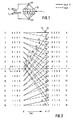
- FIG. 1 a convolutional encoder is shown schematically in FIG. 1.
- This encoder consists of the shift register SR with parallel data access to its individual cells.
- the source information Q is shifted from the left into this register SR.
- the data accessible in parallel are linked twice in the code described here according to certain laws, the so-called "generator polynomials”.
- the operation of the linkage in all convolutional codes is the modulo-two addition, represented schematically by the two adding stages AS1 and AS2, in the "Galios body" of the binary numbers.
- the more or less disturbed bit pairs reach the receiver via two channels, whereby it is often not clear because of the disturbances whether a binary "0" or a "1" was received in the individual case.
- the voltages associated with the data streams can therefore assume any intermediate values. This uncertainty is initially overcome with the help of "Soft decision” recorded. It initially understands the received signals as analog values, which are quantized in n steps using an A / D conversion. Here a quantization in 8 steps is provided, which means an A / D conversion with 3 bits per channel corresponds. Since each source bit has a bit pair on the channel, there is always the possibility of four combinations in one bit pair.
- the Viterbi coding / decoding is now based on the further processing of these four arithmetic variables in such a way that it lifts a longer information pattern consisting of many dibits from the disturbances by continuously adding up the variables and, after a sufficient number of summations, making a decision about the actual one Outputs source information.
- the law of the shift register applies and at the same time the above-mentioned modulo-two links exist (FIG. 1). Because of the number of cells, the law of the shift register naturally provides a greater variety of states than is the case with the dibit combination. 1: The four (or general: K-1) cells of the low-order bits define the so-called. "State" of the register.
- the reduced state definition window there are sixteen different states that can appear as start or end points.
- a line of symmetry at "8" is also drawn.
- the dibit combinations corresponding to the code used here are noted on the transition lines between the states. In fact, they are only related to the code used, i.e. with the described modulo-two coupling: There was no mention of them with the law of the shift register function.
- the dibit combinations are above all equally distributed, i.e. each of them only appears eight times on the total of 32 branches.
- the extreme value character of the assigned dibit code helps here: As an example, let's take the transition from “0” in the state window to "0". As you can see from the trellis diagram, the "0" can also have resulted from the "8”!
- path metric 0 is to be used from now on, which is also customary in the literature for this.
- path metric is to be used from now on, which is also customary in the literature for this.
- the path metric always has a greater weight than the current branch metric, it represents a preferred minimum sum from numerous "good” branch metrics of the past, that is to say an entire "path". This is precisely the ability of Viterbi coding / decoding to take advantage of artificial channel redundancy and to correct transmission errors that occur. So far we have only talked about the mechanism that selects the most probable from the transitions of the shift register function. It still has to be discussed how the transmitted source bit is ultimately obtained.
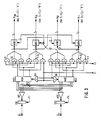
- the input section of the Viterbi decoder is shown in Fig. 3.
- This input section has the task of the known soft decision, cf. for example EP 52 463 A1, using A / D converters and switching the quantized dibits for synchronization purposes.
- the input signals Q1 and Q2, which were transmitted in parallel on the transmission path, first arrive at two clock-controlled sample and hold elements SH1 and SH2.
- An AD converter AD1 or AD2 connects to these sample-and-hold elements, each with 3-bit-wide outputs.
- the quantization is accordingly 8 steps in the exemplary embodiment presented. In the event of a carrier phase jump in a 4-PSK transmission, the conversion of the bits must be reversed.
- the two multiplexers MX1 and MX2 are controlled by the control signals C1 and C2 via an EX-OR gate EO1 or EO2, respectively. These control signals can be derived in a simple manner from the synchronous devices.
- the synchronizers not shown here, recognize the increase in the metric, i.e. Occurrence of illegal codes and phase jumps.
- the 3-bit wide outputs of each multiplexer are assigned once to the number of quantization stages on EX-OR gates G1, G2, G3, or G7, G8, G9, and once on EX-NOR gates G3, G4, G5 or G10, G11, G12.
- the gates G1 ... G12 are controlled via their control inputs, which are acted upon by the control signals C1 and C2.
- the control signals C1 and C2 have the effect that switchable non-inverters can be realized from the gates G1 ... G12, which are designed as inverters, and correspondingly from the non-inverted inverters.
- the outputs of the input section are connected to networks for adding and comparing the metrics.
- the construction principle of such networks is shown in FIG. 4.
- the addition and the comparison are carried out by transforming the arithmetic operation into the logical operation area, which is equivalent to a strict parallelization.
- the ACS (add-compare-select) process can therefore be carried out at high speed.
- Fast address decoders and multiplexers as well as fast priority encoders allow the representation of a binary number as the position of a logical state in a line of 2 n bits, where n is the number of digits of the binary number.
- Fig. 4 shows the principle of the method.
- the "Compare" operation Several binary bits, for example four bits wide, of the metrics M0 ... M15 are first represented as a bit position using the address decoders ADC1 ... ADCn. This can be, for example, a logical "0" in the middle of 15 logical "1" s.
- Each of the 16-bit arrays is then fed to the multi-AND gate M-AND, where all the bits are linked according to the AND function.
- the result is again a 16-bit array that has collected all logical "0" states with their positions.
- a priority encoder PRE connected in series, outputs the position of the LOWEST "0" as a binary number. Conversely, it corresponded to the lowest binary number at the input of the corresponding address decoder ADC1 ... ADCn.
- Priority encoders of this type can be constructed from standard modules, for example from 2 74F148 ICS.
- the "add" operation requires special blocks with a width of 16 bits at the logical level.
- this method is interesting, particularly with regard to the technique of "barrel" shift matrices.
- Such components are required by the adder, since it operates at high speed, i.e. asynchronously and without flip-flops, a 16-bit word must be able to be shifted by a maximum of 16 bits according to a 4-bit binary number.
- Such a component with 8-bit processing can be used in ECL technology.
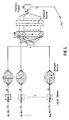
- the "barrel shift adding method” will now be explained with reference to FIG. 5. It represents a shorter signal flow path in the ACS plant and is therefore less runtime than a semi-arithmetic implementation.
- 5 shows the principle of metric evaluation using 16-bit shift matrices.
- the circuit described above for finding the minimal matrix is also already woven in. Again the example of the trellis branch transition "0-0" or alternatively "8-0" is used.
- the branch metrics R00 and R11 originating from the input section are at the top of two 16-bit shift matrices SH1, SH2 available at the same time. Both matrices receive their 16-bit arrays from two equally wide registers MR1 and MR2, which function here as logically transformed metric registers.
- the metric "MO" originating from the right-hand register is thus shifted by exactly R00 digits with the aid of the shift matrix and fed to the 16-fold AND element AND 16. The same happens with the metric of the left register, only that R11 now causes the digit shift.
- the resulting 16-bit array is now fed to two further stages: firstly, the already known multi-AND stage M-AND for determining the minimum matrix, and secondly another shift matrix SHM3 at the input of the metric register MR2, but which now has the task of shifting the bit pattern back by a certain amount.
- the ACS calculator of the Viterbi decoder developed here is therefore characterized in its way of working mainly by the fact that the arithmetic operations "add” and “subtract” are replaced by logical shift operations, whereby neutral characters - depending on the sign of the logic - are added at the shift-in location. Furthermore, it is characterized in that the determination of an extreme value (here in the example: minimum) in the logical area is carried out by simple AND or OR operations, depending on the sign of the logic.
- Both information bits are available 16 times in the case of a constraint length of 5 (5 cells in the transmitter-side decoder) described here, since there are a total of 16 ACS-S plants. They then have to be processed further in the Trellis Memory Management.
- a path decision bit detector DT1 is provided, which evaluates the input and output data of the AND16 stage.
- a data output call bit is output by the minimal metric detector DT2, which is supplied by the data in the feedback loop between the shift matrix SHM3 and the register MR2.
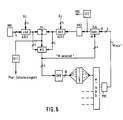
- FIG. 6 Another embodiment of the ACS-S networks is shown in FIG. 6.
- a network is constructed semi-arithmetically; that is, the "add” and “compare” operations are performed using arithmetic adders and comparison stages. Only the connection via the multi-AND level M-AND takes place in the logical operation area.
- the opposite branch metrics Rij and Rji are each fed to an addition stage ADS1 and ADS2.
- the 4-bit-wide outputs of these addition stages are connected to the two inputs of a comparison stage Vn as well as to the inputs of a metric selector MS.
- the comparison stage Vn determines which of the two opposite branch metrics is larger or whether there is equality. Its output controls the metric selector MS.
- the output of the metric selector MS is routed via a demultiplexer DMX to the input of the multi-AND stage M-AND.
- the multiplexer converts the arithmetic operation into a logical operation; ie it provides a 16-bit word that represents the metric as a bit position on one of the 16 lines.
- the 16 outputs of the DMX demultiplexer like the outputs of all ACS-S networks, are routed to the multi-AND stage M-AND.
- the minimum metric Mmin is available via the priority encoder PRE at the output of the M-AND stage and is subtracted from the selected path metric "M selected" in the subtracting stage Sub.
- the subtracting stage Sub feeds the metric register MR2 and the minimal metric detector DT2.
- Viterbi decoder With the structural determination of the path memory, the structure of the entire Viterbi decoder concept is largely fixed. That is also the reason why this should be dealt with first. Numerous other processes, such as addressing and data loading, are derived from the path memory structure, and so is the procedure that subsequently appears under the name "model process method" and which is essentially a speed-optimized addressing method. As already indicated, Viterbi decoding is primarily a signal flow-intensive process. Storage space in itself is less of a problem. The main reason for this lies in the fact that delayed decoding with a late decision is required when the source information is output. Added to this is the tree-like character of the 'trellis diagram', which increases rapidly as the number of lines in the encoder increases Has variety of states.
- path memory The complexity of realizing the path memory mainly depends on what information is to be stored there.
- There are basically two types of path memory: In the first, branch decisions are saved, ie it is only recorded whether a new state has arisen from an old one, which - in our example, K 5. was greater than "8" or the same, or whether it arose from such an assignment without occupying the MSB ("most significant bit"), that is less than "8". It is immediately evident that in such a method the information about the actual state has been lost and can only be recovered by a detour through a "traceback" to the current beginning. Apart from possible runtime losses in this method, there remains a relatively complicated signal flow system between the memory cells, which also grows in size with increasing constraint length.
- sample process method used in the following is based on the fact that the possible encoder-side states in this method are simulated in real time in each step and serve to address the Path- ⁇ memory lines. This is done with the help of the "sample process shift register" - address register AR1 ... AR16 - and the address processors ADP1 ... ADP16, which control various multiplexers, shown here as switching switches SK1 ... SK15. For various signals, these multiplexers connect a data channel corresponding to the address of the sample process to buffer memories PM1 ... PM16, hereinafter referred to as path memory.
- the signal HQD hyperthetical source data: It directly represents the stream of the information sequence which on the one hand feeds the head of the path memory PM1 ... PM16 and on the other hand of course supplies the sample process, ie the address registers AR1 ... AR16, with current data.
- the basic idea of this method should be briefly mentioned: Above, there was talk of the path memory lines having to be constantly saved if the "head" of the lines is assigned to fixed states.
- the header address is fundamentally variable, it changes in time with the statistically dependent sample processes controlled by reception, which saves having to be saved later because the data is immediately placed in the right place ("in-place computation").
- the path memory line is now designed as a FIFO ("first-in-first-out" storage), so that the remaining restoration of one bit each can take place with the aid of a single clock.
- the complex "trace back" has now been reduced to this operation.
- the term “FIFO” is by no means specified here. It can be both an elastic memory, in which the data entered above immediately up to End of the queue "fall through”, but only a fast, cascadable shift register can be used, which will be the case here because the elastic memories currently have too long throughput times.
- the signal DOC data output call
- Such a signal is assigned to each of the 16 path memory lines. It is also supplied via address switches SD1 ... SD16, which are each controlled by one of the address processors ADP1 ... ADP16. After the minimum metric has been determined, the (fixed) ACSS1 ... ACSS16 arithmetic unit issues an "alarm signal" at the appropriate point, which is to output the output of a source bit from the preferred memory section. So that this call also gets to the right place, it is necessary to go through the "switch" SD1 ... SD16.
- the way in which the path memory works can be described in that information sequences are stored linearly, that is to say in accordance with a FIFO procedure, and the "traceback" is only implemented by a 1-bit shift.
- the output of a decoded source bit is characterized in that it also takes place with the interposition of the pattern process addressing.
- the parallel solution is also offered in Fig. 7: With 16 always newly generated states, a maximum of 8 pairs can be formed.
- the pairing command is represented by the EQA signal. According to the model process, this signal is also addressed via multiplex switches SM1 ... SM16, which in this case, however, only require eight positions. It is then evaluated in the respective address processor. The result of this evaluation is in turn the positioning of other switching switches SP1 ... SP16. They can be seen under the path memory lines. Each bit in the FIFO is accessible in parallel and provided with one of the switching switches SP1 ... SP16. It is then possible to connect each bit of the path memory to each bit in pairs, in accordance with the EQA information, the direction of the data flow or its determining signals to be dealt with later.
- the way the path memory works can be characterized in that a branching in the trellis process is accompanied by a pairing of two information sequences. This pair formation is characterized in that all bits of a non-surviving sequence are overwritten by those of the associated, superior one.
- Such a process will be referred to as EQA, which means "equal access”.
- the implementation is characterized in that the EQA takes place on 2 K-2 addressable data buses BL1 ... BL8, where K is the constraint length of the encoder.
- the data buses BL1 ... BL8 are also addressed using the sample processes.
- the signal flow intensity of the path memory is particularly evident here, which is made clear not least by the presence of eight different data exchange buses across the entire width or length of the memory. If the implementation is logically quite simple and clearly structured, it is still spatially complex. The number of necessary bidirectional bus drivers far exceeds the number of memory (FIFO) hardware, which is why an integration of the entire path memory part is advantageous. As a chip, this part would form a similar unit to the long-established RAM's or EPROM's, especially since the technology of the Viterbi decoder is likely to be used more widely. At this point, the possibility of VLSI integration should therefore be expressly pointed out.
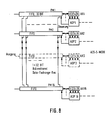
- An alternative realization of the path memory is characterized in that the EQA data exchange on a data bus takes place successively for each pair of memory lines and the time prioritization required for this is also derived from the sample processes.
- FIG. 8 shows this principle, which also has considerable advantages due to VLSI integration, in particular due to its speed gain.
- Both versions of the path memory can be fully cascaded. Their outputs can be connected to the inputs of other units, while the control signals such as EQA etc. are carried in parallel.
- This underlines the flexibility of this system, for example with regard to the use of so-called "punctured codes", in which a multiple of the path memory length must be activated.
- the interface between the "ACS-S-Werk" and “Path-Memory” modules already described does not cause any complications from a purely technical point of view. For this very reason, however, it represents a special feature as a logical unit.
- the "path decision bit" as the output signal of an ACSS plant is present 16 times in accordance with the 16 ACS-S units and, according to its logical state, indicates whether the current new state has arisen from an old one that was less than 8, or one with the quantity "greater than or equal to 8".
- This bit thus indicates the position of the old state above or below the line of symmetry according to FIG. 2.
- this output signal Output does not match what is required at the path memory input: A statement about the new state, namely whether it is even or odd, or in other words: whether a "0" or "1" is to be used as the hypothetical, new source data bit! As it turns out, this problem can be solved very easily if you consider certain marginal conditions.
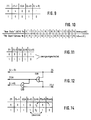
- Equal Access means in relation to the output of the ACS-S plant, that both an even and an odd unit claim the same past, that is, output logically the same states. If, for example, both “2S” and “2S + 1" output a "0", this means that both want to output to the address "less than 8" at the same time, again according to their parity, ie “2S "a” 0 "and” 2S + 1 "a” 1 ". 11 shows the two special cases for an EQA state in the system. First, the table according to FIG. 10 is to be used as the connection list. It is striking that the EQA signal is now "1" and thus defines such a state.
- the first line shows the above example: Two arithmetic units output the same status, whereby the output of "2S" (a "0") is suitable. You get directly to the address "less than 8".
- the output of "2S + 1", on the other hand, is wrong here: its meaning must be changed according to the requirements. If the meaning of a "pointer” still existed when leaving the ACS-S plant, it must now be switched over due to the meaning of a "data bit”, which is noted in the truth table. In this case the output is correct again: A date "0" from the ACS-S plant "2S” is sent to the address "less than 8", and the output of the unit "2S + 1" also reaches its correct destination: Q ( ⁇ 8) is now "1".
- the EX-NOR link EXN generates the EQA signal with the same output states, the forced switching is effected by the EX-OR element EXO. As described, only the "odd-numbered" channels are switched. The low-latency nature of the circuit is obvious.
- the interface of the ACS plants for supplying the path memory address processor with data can be characterized by converting data with path decision character into information with character in the sense of the hypothetical source information. It is also characterized in that this is done by recoding the information content "greater than or equal to 2 K-2 " and “less than 2 K-2 " into the information content "odd” and "even", the assignment of the meanings and the sign of the logic but should not be determined. K is the constraint length.
- “equal access” branching in the trellis diagram
- the respective bit of a parity is forcibly switched in order to then make the information content "even” and "odd” available in parallel.
- the interface is characterized in that it provides exactly 2 K-2 times an "equal access signal” as described above, which indicates the equality of the output signals of two ACS-S plants with an even and odd status assignment.
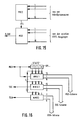
- the data output units DA1 ... DA16 can be easily combined in one module, cf. Fig. 15, as follows:
- a priority encoder PRED which can be constructed as before from 2 integrated circuits 74F148, receives the 16 DOC (data output call) signals of the address processors behind the corresponding switching switches.
- the priority encoder PREC with a 4-bit-wide output is connected to a multiplexer MUX, which connects one of the 16 serial FIFO outputs to the data output D-OUT of the decoder, depending on the output signal of the priority encoder PREC.
- FIG. 16 shows the address processors with "state registers" and the associated switching switches, which are now implemented as multiplexers MMX1 ... MMX3. Every cell of the "State" registers are each connected via a 4-bit line to control inputs of the three multiplexers MMX1 ... MMX3, with the multiplexer MMX3 only the first three of these lines being connected.
- the multiplexer MMX1 is provided for switching through the hypothetical source data channels (HQD signals), the multiplexer MMX2 for addressing the DOC rail, and the multiplexer MMX3 for addressing the EQA rail.
- Viterbi decoding The aim was to precisely define a high-speed process, the choice of technology depending on the respective needs. Furthermore, it was pointed out that VLSI integration is advantageous for reasons of space - and because of the runtimes it is also for reasons of speed.
- the method can be used for so-called “intelligent transponders” on board satellites.
Landscapes
- Physics & Mathematics (AREA)
- Probability & Statistics with Applications (AREA)
- Engineering & Computer Science (AREA)
- Theoretical Computer Science (AREA)
- Error Detection And Correction (AREA)
Claims (6)
- Procédé pour décoder des signaux binaires préparés selon un code de convolution correcteur d'erreurs, d'après lequel, par des opérations binaires, sont déterminées des métriques de branche et, à partir de celles-ci, des métriques de chemin selon le décodage Viterbi pour la probabilité de réception des signaux binaires de données de base formés côté codeur, avec application des étapes suivantes:- la métrique de chemin présentant une valeur extrême est amenée par transformation du domaine d'opération arithmétique dans le domaine d'opération logique du fait que l'information binaire de cette métrique de chemin est représentée comme position de bit dans un mot binaire à 2n lignes, où n = le nombre de chiffres ou positions du nombre binaire,- l'information ainsi préparée est combinée au moyen de portes logiques avec les autres métriques de chemin, ne présentant pas de valeur extrême, qui sont également soumises à une telle transformation, de manière que la métrique de chemin avec la valeur extrême soit déduite de chacune des métriques de chemin restantes,- tous les états de signal binaire possibles apparaissant côté codeur, sont reproduits en temps réel, c'est-à-dire en même temps pour chaque pas du rythme, et utilisés chaque fois pour l'adressage d'un canal de données de base hypothétiques, lequel est alimenté par les données de la décision de chemin,- à partir de chaque canal de données de base hypothétiques, sont actualisés simultanément à la fois les états de signal binaire possibles reproduits côté codeur pour l'adressage et, à chaque fois, une mémoire intermédiaire,- dans le cas d'une ramification dans le diagramme de Trellis du décodage Viterbi, les données des mémoires intermédiaires dont les chemins de Trellis correspondants ne survivent pas, sont recouvertes par les données des mémoires intermédiaires dont les chemins de Trellis correspondants survivent,- la délivrance des signaux binaires décodés, à partir des mémoires intermédiaires concernées, est effectuée dans la mesure de l'adressage exact par les états de signal binaire possibles, côté codeur, ou de leur actualisation, et- l'adressage s'opère sur 2K-1, où K = la longueur de contrainte du code de convolution, différents canaux d'ordre de délivrance dont seul celui coordonné à la valeur extrême de la métrique de chemin exécute chaque fois un ordre de délivrance.
- Décodeur Viterbi constitué d'une section d'entrée pour la mise à disposition de métriques de branche, qui contient un circuit de maintien avec une unité prévue à la suite pour la conversion A/N, des réseaux pour le calcul d'une métrique de chemin à partir des métriques de branche ainsi que des mémoires pour mémoriser la métrique de branche, ainsi que d'unités de délivrance de données, caractérisé par:- deux échantillonneurs-bloqueurs (SH1, SH2) suivis chacun d'un convertisseur A/N (AD1, AD2) pour la quantification de chaque paire de bits à l'entrée du décodeur, chaque fois un multiplexeur (MX1, MX2) pour l'interversion croisée des canaux de données à la sortie des deux convertisseurs AN (AD1, AD2), des portes logiques (G1, G2 ... G12), à chacune desquelles sont appliqués un signal de commande (C1, C2) et un signal de sortie des multiplexeurs (MX1, MX2), les portes logiques étant présentes quatre fois par largeur de mot binaire et étant réalisées pour chaque largeur de mot binaire deux fois avec des sorties non inverseuses et deux fois avec des sorties inverseuses, et quatre additionneurs complets (ADD1, ADD4) qui sont combinés aux sorties des portes logiques (G1, G2 ... G12) de manière que les métriques de branche selon le décodage Viterbi soient disponibles à leurs sorties,- la réalisation des réseaux (ACSS1, ... ACSS16) pour calculer les métriques de chemin et délivrer un bit de décision de chemin, ainsi que pour générer un ordre de délivrance (DOC) de données décodées par chaque fois un étage de comparaison (Vn; ET16) pour des métriques de branche contraires, avec des détecteurs de bit de décision de chemin (DT1) connectés aux sorties des étages de comparaison (Vn; ET16), des boucles de retour menant chaque fois des sorties des étages de comparaison (Vn; ET16) à des soustracteurs (Sub; SHM3) pour la combinaison logique avec une métrique de branche actuelle, ainsi que des détecteurs de métrique minimale (DT2) connectés aux boucles de retour pour la génération des ordres de délivrance (DOC),- un étage de conjonction ET multiple (M-ET) auquel sont amenées les métriques favorisées de tous les réseaux précités, un codeur de priorité (PRE) à la sortie de l'étage de conjonction ET multiple (M-ET) ainsi que des trajets de liaison menant de la sortie du codeur de priorité (PRE) aux soustracteurs (Sub; SHM3) des réseaux (ACSS1, ... ACSS16),- des processeurs d'adresse (ADP1, ... ADP16) avec des registres d'adresse (AR1, ... AR16) coordonnés pour l'actionnement de commutateurs (SK1, ... SK15) dans le canal de données de base hypothétiques concerné entre les réseaux (ACSS1, ... ACSS16) en vue de la comparaison des métriques de branche et des mémoires intermédiaires (PM1, ... PM16), réalisées comme des mémoires "premier entré-premier sortie" (FIFO) ou comme des registres à décalage pour les informations de métrique de chemin,- des bus d'échange de données bidirectionnels (BL1, ... BL8) pour la liaison parallèle par paire des mémoires intermédiaires (PM1, ... PM16) participant au recouvrement de données dans le cas d'une ramification de Trellis, les bus d'échange de données (BL1, ... BL8) étant commutables au moyen de commutateurs (SP1, ... SP16) commandés par des processeurs d'adresse (ADP1, ... ADP16),- des circuits d'interface (IF1, ... IF8) entre les sorties de chaque fois deux réseaux (ACSS1, ... ACSS16) et les processeurs d'adresse (ADP1, ... ADP16) pour le transcodage des bits de décision de chemin fournis par les détecteurs (DT1) en données de base binaires hypothétiques, apparaissant en même temps pour chaque pas du rythme et correspondant aux données apparaissant côté codeur, le transcodage s'effectuant dans le sens d'une décision entre "supérieur ou égal à 2K-2" et "inférieur à 2K-2", où K = la longueur de contrainte, l'adressage des mémoires intermédiaires (PM1, ... PM16) s'effectuant sur la base de cette décision et, dans le cas d'une ramification dans le diagramme de Trellis, un changement de valeur des bits de décision de chemin s'effectuant de manière que soient formées deux configurations binaires différentes, ainsi que- des unités de délivrance de données (DA1, ... DA16) pour les mémoires intermédiaires (PM1, ... PM16), unités qui sont commutables par les détecteurs de métrique minimale (DT2) au moyen de commutateurs (SD1, ... SD16) commandés par les processeurs d'adresse (ADP1, ... ADP16).
- Décodeur selon la revendication 2, caractérisé en ce que les réseaux pour comparer les métriques de branche (ACSS1, ... ACSS16) sont de structure semiarithmétique, que les entrées de chaque réseau pour les métriques de branche contraires sont reliées chaque fois à un étage d'addition (ADS1, ADS2), que les sorties de ces étages d'addition (ADS1, ADS2) sont connectées à des entrées de l'étage de comparaison (V1) et à des entrées d'un sélecteur de métrique (MS), que la sortie de l'étage de comparaison (Vn) est reliée à une autre entrée du sélecteur de métrique (MS), que le sélecteur de métrique (MS) est suivi d'un démultiplexeur (DMX) pour la transformation de la métrique en une position de bit et que les démultiplexeurs (DMX) de tous les réseaux (ACSS1, ... ACSS16) sont connectés à l'étage de conjonction ET multiple (M-ET).
- Dispositif destiné à un décodeur Viterbi pour calculer les métriques de chemin, dans lequel les réseaux (ACSS1, ... ACSS16) sont réalisés exclusivement avec des composants pour le domaine d'opération logique, c'est-à-dire avec des réseaux qui combinent logiquement entre elles, ligne par ligne, des informations binaires sous forme d'une position de bit dans un mot binaire à 2n lignes, où n = le nombre de chiffres ou positions du nombre binaire, que les métriques de branche contraires mènent chaque fois à une matrice de décalage (SH1, SH2) de largeur 2K-1, qu'un registre de métrique (MR1, MR2) est coordonné à chaque matrice de décalage (SH1, SH2), de manière que les informations de métrique déposées dans les registres de métrique (MR1, MR2) soient décalées chaque fois exactement du nombre de positions préfixé par la valeur de la métrique de branche entrante, que les sorties des deux matrices de décalage (SH1, SH2) mènent, bit par bit, à une porte de combinaison logique (ET16), que les sorties de toutes les portes de combinaison logique mènent à des entrées d'un étage de conjonction ET multiple (M-ET), et que le codeur de priorité (PRE) à la sortie de l'étage de conjonction ET multiple (M-ET) est relié à l'entrée de commande d'une autre matrice de décalage (SHM3), à l'entrée d'un des registres de métrique (MR2), de manière que l'information contenue dans ce registre de métrique (MR2) soit décalée en arrière exactement du nombre de positions correspondant à la valeur de la métrique minimale détectée par le codeur de priorité (PRE).
- Application du décodeur Viterbi selon la revendication 2 pour le procédé selon la revendication 1.
- Application du dispositif selon la revendication 4 pour le procédé selon la revendication 1.
Applications Claiming Priority (2)
| Application Number | Priority Date | Filing Date | Title |
|---|---|---|---|
| DE3600905 | 1986-01-15 | ||
| DE19863600905 DE3600905A1 (de) | 1986-01-15 | 1986-01-15 | Verfahren zum dekodieren von binaersignalen sowie viterbi-dekoder und anwendungen |
Publications (3)
| Publication Number | Publication Date |
|---|---|
| EP0229246A2 EP0229246A2 (fr) | 1987-07-22 |
| EP0229246A3 EP0229246A3 (en) | 1990-05-30 |
| EP0229246B1 true EP0229246B1 (fr) | 1993-08-04 |
Family
ID=6291846
Family Applications (1)
| Application Number | Title | Priority Date | Filing Date |
|---|---|---|---|
| EP86115101A Expired - Lifetime EP0229246B1 (fr) | 1986-01-15 | 1986-10-31 | Méthode pour décoder des signaux numériques, décodeur Viterbi et applications |
Country Status (5)
| Country | Link |
|---|---|
| US (1) | US4757506A (fr) |
| EP (1) | EP0229246B1 (fr) |
| JP (1) | JPH01117428A (fr) |
| CA (1) | CA1260615A (fr) |
| DE (2) | DE3600905A1 (fr) |
Cited By (24)
| Publication number | Priority date | Publication date | Assignee | Title |
|---|---|---|---|---|
| DE102004038754A1 (de) * | 2004-08-09 | 2006-02-23 | Micronas Gmbh | Decoder und Verfahren zum Durchführen eines Viterbi-Algorithmus |
| US8323651B2 (en) | 2008-05-09 | 2012-12-04 | Abbott Laboratories | Antibodies to receptor of advanced glycation end products (RAGE) and uses thereof |
| US8420083B2 (en) | 2009-10-31 | 2013-04-16 | Abbvie Inc. | Antibodies to receptor for advanced glycation end products (RAGE) and uses thereof |
| US8497072B2 (en) | 2005-11-30 | 2013-07-30 | Abbott Laboratories | Amyloid-beta globulomer antibodies |
| US8663980B2 (en) | 2007-10-26 | 2014-03-04 | Janssen Biotech, Inc. | Vectors, host cells, and methods of production and uses |
| US8691224B2 (en) | 2005-11-30 | 2014-04-08 | Abbvie Inc. | Anti-Aβ globulomer 5F7 antibodies |
| US8877190B2 (en) | 2006-11-30 | 2014-11-04 | Abbvie Inc. | Aβ conformer selective anti-Aβ globulomer monoclonal antibodies |
| US8895004B2 (en) | 2007-02-27 | 2014-11-25 | AbbVie Deutschland GmbH & Co. KG | Method for the treatment of amyloidoses |
| US8906864B2 (en) | 2005-09-30 | 2014-12-09 | AbbVie Deutschland GmbH & Co. KG | Binding domains of proteins of the repulsive guidance molecule (RGM) protein family and functional fragments thereof, and their use |
| US8962803B2 (en) | 2008-02-29 | 2015-02-24 | AbbVie Deutschland GmbH & Co. KG | Antibodies against the RGM A protein and uses thereof |
| US8987419B2 (en) | 2010-04-15 | 2015-03-24 | AbbVie Deutschland GmbH & Co. KG | Amyloid-beta binding proteins |
| US9062101B2 (en) | 2010-08-14 | 2015-06-23 | AbbVie Deutschland GmbH & Co. KG | Amyloid-beta binding proteins |
| US9102722B2 (en) | 2012-01-27 | 2015-08-11 | AbbVie Deutschland GmbH & Co. KG | Composition and method for the diagnosis and treatment of diseases associated with neurite degeneration |
| US9175075B2 (en) | 2009-12-08 | 2015-11-03 | AbbVie Deutschland GmbH & Co. KG | Methods of treating retinal nerve fiber layer degeneration with monoclonal antibodies against a retinal guidance molecule (RGM) protein |
| US9176150B2 (en) | 2003-01-31 | 2015-11-03 | AbbVie Deutschland GmbH & Co. KG | Amyloid beta(1-42) oligomers, derivatives thereof and antibodies thereto, methods of preparation thereof and use thereof |
| US9371374B2 (en) | 2013-03-14 | 2016-06-21 | Abbott Laboratories | HCV core lipid binding domain monoclonal antibodies |
| US10640563B2 (en) | 2016-06-08 | 2020-05-05 | Abbvie Inc. | Anti-B7-H3 antibodies and antibody drug conjugates |
| US11014982B2 (en) | 2017-02-07 | 2021-05-25 | Janssen Biotech, Inc. | Anti-TNF antibodies, compositions, and methods for the treatment of active ankylosing spondylitis |
| US11041020B2 (en) | 2017-01-30 | 2021-06-22 | Janssen Biotech, Inc. | Methods for the treatment of active Psoriatic Arthritis |
| US11208474B2 (en) | 2016-11-16 | 2021-12-28 | Janssen Biotech, Inc. | Method of treating psoriasis with anti-IL23 specific antibody |
| US11548941B2 (en) | 2018-11-20 | 2023-01-10 | Janssen Biotech, Inc. | Safe and effective method of treating psoriasis with anti-IL-23 specific antibody |
| US11759527B2 (en) | 2021-01-20 | 2023-09-19 | Abbvie Inc. | Anti-EGFR antibody-drug conjugates |
| US11780911B2 (en) | 2019-05-23 | 2023-10-10 | Janssen Biotech, Inc. | Method of treating inflammatory bowel disease with a combination therapy of antibodies to IL-23 and TNF alpha |
| US12258393B2 (en) | 2020-05-21 | 2025-03-25 | Janssen Biotech, Inc. | Method of treating inflammatory bowel disease with a combination therapy of antibodies to IL-23 and TNF alpha |
Families Citing this family (147)
| Publication number | Priority date | Publication date | Assignee | Title |
|---|---|---|---|---|
| JPS62233933A (ja) * | 1986-04-03 | 1987-10-14 | Toshiba Corp | ヴイタビ復号法 |
| FR2612025B1 (fr) * | 1987-03-06 | 1989-05-26 | Labo Electronique Physique | Dispositif de decodage de signaux codes en duobinaire |
| DE3721884A1 (de) * | 1987-07-02 | 1989-01-12 | Meyr Heinrich Prof Dr | Verfahren zur ausfuehrung des viterbi-algorithmus mit hilfe parallelverarbeitender strukturen |
| US4932029A (en) * | 1987-07-24 | 1990-06-05 | Ant Nachrichtentechnik Gmbh | Method and apparatus for correcting errors in convolutional code signals |
| DE3888589D1 (de) * | 1987-07-24 | 1994-04-28 | Ant Nachrichtentech | Aufbereitung von Steuersignalen zur Auflösung der Phasenmehrdeutigkeit bei n-PSK-Signalen. |
| DE3725655A1 (de) * | 1987-08-03 | 1989-02-16 | Ant Nachrichtentech | Verfahren zum auswerten von zweig- und pfadmetriken sowie anordnung |
| DE3724729A1 (de) * | 1987-07-25 | 1989-02-02 | Ant Nachrichtentech | Verfahren zur aufbereitung eines faltungscodes zur uebertragung sowie dessen empfangsseitige rueckwandlung sowie anordnung hierzu |
| US4975865A (en) * | 1989-05-31 | 1990-12-04 | Mitech Corporation | Method and apparatus for real-time control |
| EP0406507B1 (fr) * | 1989-07-07 | 1994-06-01 | International Business Machines Corporation | Schéma de codage en blocs pour la transmission de bits fractionnaires |
| CA2020899C (fr) * | 1989-08-18 | 1995-09-05 | Nambirajan Seshadri | Algorithmes de decodage viterbi generalises |
| US5208816A (en) * | 1989-08-18 | 1993-05-04 | At&T Bell Laboratories | Generalized viterbi decoding algorithms |
| FI84866C (fi) * | 1990-03-12 | 1992-01-27 | Nokia Mobile Phones Ltd | Foerbaettring av en viterbi-algoritm. |
| JP2594683B2 (ja) * | 1990-05-18 | 1997-03-26 | 三菱電機株式会社 | ヴィタビ・デコーダ |
| US5327441A (en) * | 1991-12-16 | 1994-07-05 | Nippon Telegraph And Telephone Corporation | Method and circuit for decoding convolutional codes |
| US5377133A (en) * | 1992-04-07 | 1994-12-27 | Digital Equipment Corporation | System for enhanced implementation of add-compare-select (ACS) functions |
| US5430744A (en) * | 1993-09-30 | 1995-07-04 | International Business Machines Corporation | Method and means for detecting partial response waveforms using a modified dynamic programming heuristic |
| GB2305827B (en) * | 1995-09-30 | 2000-01-19 | Motorola Ltd | Viterbi co-processor and method of operation therefor |
| US5970104A (en) * | 1997-03-19 | 1999-10-19 | Cadence Design Systems, Inc. | Method and apparatus for generating branch metrics and branch indices for convolutional code Viterbi decoders |
| US5828675A (en) * | 1997-06-06 | 1998-10-27 | National Semiconductor Corporation | Viterbi decoder circuit |
| US6212664B1 (en) | 1998-04-15 | 2001-04-03 | Texas Instruments Incorporated | Method and system for estimating an input data sequence based on an output data sequence and hard disk drive incorporating same |
| US6272661B1 (en) * | 1998-12-29 | 2001-08-07 | Texas Instruments Incorporated | Minimum memory implementation of high speed viterbi decoder |
| JP2001273313A (ja) * | 2000-01-19 | 2001-10-05 | Fuji Xerox Co Ltd | プロセス記述装置および方法ならびにプロセス分類方法 |
| UA81743C2 (uk) | 2000-08-07 | 2008-02-11 | Центокор, Инк. | МОНОКЛОНАЛЬНЕ АНТИТІЛО ЛЮДИНИ, ЩО СПЕЦИФІЧНО ЗВ'ЯЗУЄТЬСЯ З ФАКТОРОМ НЕКРОЗУ ПУХЛИН АЛЬФА (ФНПα), ФАРМАЦЕВТИЧНА КОМПОЗИЦІЯ, ЩО ЙОГО МІСТИТЬ, ТА СПОСІБ ЛІКУВАННЯ РЕВМАТОЇДНОГО АРТРИТУ |
| US6902734B2 (en) | 2000-08-07 | 2005-06-07 | Centocor, Inc. | Anti-IL-12 antibodies and compositions thereof |
| US7288390B2 (en) | 2000-08-07 | 2007-10-30 | Centocor, Inc. | Anti-dual integrin antibodies, compositions, methods and uses |
| AUPR679401A0 (en) * | 2001-08-03 | 2001-08-30 | Lucent Technologies Inc. | High speed add-compare-select processing |
| BRPI0214168B8 (pt) | 2001-11-14 | 2021-05-25 | Centocor Inc | anticorpos anti-il-6, moléculas de ácido nucleico codificando os mesmos, vetores compreendendo as referidas moléculas, composições e formulações compreendendo os referidos anticorpos, bem como métodos de produção dos mesmos |
| WO2003061594A2 (fr) * | 2002-01-23 | 2003-07-31 | The Regents Of The University Of California | Procedes et compositions destines a reduire le developpement de tolerance au medicament et/ou de dependance physique |
| US7225392B2 (en) * | 2002-03-04 | 2007-05-29 | Lucent Technologies Inc. | Error correction trellis coding with periodically inserted known symbols |
| US7170946B2 (en) * | 2002-03-04 | 2007-01-30 | Lucent Technologies Inc. | System and method for reviving catastrophic codes |
| CN100454764C (zh) * | 2002-10-30 | 2009-01-21 | 联发科技股份有限公司 | 存活路径存储器电路及使用该电路的维特比解码器 |
| TWI228654B (en) * | 2003-07-11 | 2005-03-01 | Mediatek Inc | Non-binary Viterbi data processing system and method |
| CN101036299B (zh) * | 2004-08-25 | 2012-11-14 | 阿苏克斯有限公司 | 用于实现可重构网格类型解码的方法和装置 |
| PA8672101A1 (es) | 2005-04-29 | 2006-12-07 | Centocor Inc | Anticuerpos anti-il-6, composiciones, métodos y usos |
| CA2613818C (fr) | 2005-06-30 | 2013-08-27 | Centocor, Inc. | Anticorps anti-il-23, compositions, methodes et utilisations |
| KR20140053410A (ko) | 2005-08-19 | 2014-05-07 | 아보트 러보러터리즈 | 이원 가변 도메인 면역글로불린 및 이의 용도 |
| EP2500353A3 (fr) | 2005-08-19 | 2012-10-10 | Abbott Laboratories | Immunoglobuline à double domaine variable et ses utilisations |
| US8285972B2 (en) | 2005-10-26 | 2012-10-09 | Analog Devices, Inc. | Lookup table addressing system and method |
| US8024551B2 (en) | 2005-10-26 | 2011-09-20 | Analog Devices, Inc. | Pipelined digital signal processor |
| US7728744B2 (en) * | 2005-10-26 | 2010-06-01 | Analog Devices, Inc. | Variable length decoder system and method |
| SI3219328T1 (sl) | 2005-12-29 | 2020-10-30 | Janssen Biotech, Inc. | Človeška protitelesa proti-IL-23, sestavki, postopki in uporabe |
| HUE052220T2 (hu) | 2006-09-08 | 2021-04-28 | Abbvie Bahamas Ltd | Interleukin-13 kötõfehérjék |
| US8301990B2 (en) * | 2007-09-27 | 2012-10-30 | Analog Devices, Inc. | Programmable compute unit with internal register and bit FIFO for executing Viterbi code |
| DE102007051345A1 (de) * | 2007-10-26 | 2009-04-30 | Fraunhofer-Gesellschaft zur Förderung der angewandten Forschung e.V. | Explosivstoffladung |
| EP2282769A4 (fr) | 2008-04-29 | 2012-04-25 | Abbott Lab | Immunoglobulines à double domaine variable et utilisations |
| KR20110016959A (ko) | 2008-06-03 | 2011-02-18 | 아보트 러보러터리즈 | 이원 가변 도메인 면역글로불린 및 이의 용도 |
| EP2297209A4 (fr) | 2008-06-03 | 2012-08-01 | Abbott Lab | Immunoglobulines à deux domaines variables et leurs utilisations |
| KR20110040886A (ko) | 2008-07-08 | 2011-04-20 | 아보트 러보러터리즈 | 프로스타글란딘 e2 결합 단백질 및 이의 용도 |
| US8030026B2 (en) | 2009-02-24 | 2011-10-04 | Abbott Laboratories | Antibodies to troponin I and methods of use thereof |
| AR080154A1 (es) | 2010-02-10 | 2012-03-14 | Immunogen Inc | Anticuerpos cd20 y su utilizacion |
| CN105777907B (zh) | 2010-02-24 | 2020-03-17 | 伊缪诺金公司 | 叶酸受体1抗体与免疫缀合物以及其用途 |
| PL2552961T3 (pl) | 2010-03-30 | 2018-04-30 | Janssen Biotech, Inc. | Humanizowane przeciwciała il-25 |
| US20120009196A1 (en) | 2010-07-08 | 2012-01-12 | Abbott Laboratories | Monoclonal antibodies against hepatitis c virus core protein |
| UY33492A (es) | 2010-07-09 | 2012-01-31 | Abbott Lab | Inmunoglobulinas con dominio variable dual y usos de las mismas |
| KR20130100118A (ko) | 2010-08-03 | 2013-09-09 | 아비에 인코포레이티드 | 이원 가변 도메인 면역글로불린 및 이의 용도 |
| ES2665954T3 (es) | 2010-08-19 | 2018-04-30 | Zoetis Belgium S.A. | Anticuerpos anti-NGF y su uso |
| MX2013007332A (es) | 2010-12-21 | 2014-01-23 | Abbvie Inc | Inmunoglobulinas de dominio variable doble biespecificas de il-1 alfa y beta y su uso. |
| WO2012092374A2 (fr) | 2010-12-31 | 2012-07-05 | Short Jay M | Humanisation express d'anticorps |
| SG10201505454SA (en) | 2011-07-13 | 2015-09-29 | Abbvie Inc | Methods and compositions for treating asthma using anti-il-13 antibodies |
| CN108424456B (zh) | 2011-11-23 | 2022-04-26 | 医学免疫有限责任公司 | 特异于her3的结合分子及其用途 |
| US8700961B2 (en) * | 2011-12-20 | 2014-04-15 | Sandisk Technologies Inc. | Controller and method for virtual LUN assignment for improved memory bank mapping |
| CA2866612C (fr) | 2012-03-08 | 2018-01-16 | Halozyme, Inc. | Anticorps recepteur du facteur de croissance epidermique conditionnement actif du variant cetuximab dependant du ph et methode d'utilisation associee |
| SG11201500938XA (en) | 2012-08-31 | 2015-04-29 | Immunogen Inc | Diagnostic assays and kits for detection of folate receptor 1 |
| US9550986B2 (en) | 2012-12-21 | 2017-01-24 | Abbvie Inc. | High-throughput antibody humanization |
| WO2014143342A1 (fr) | 2013-03-14 | 2014-09-18 | Abbott Laboratories | Antigènes recombinants ns3 de vhc et leurs mutants pour la détection d'anticorps améliorée |
| MX362075B (es) | 2013-03-14 | 2019-01-07 | Abbott Lab | Ensayo de combinación de antígeno-anticuerpo del virus de la hepatitis c (vhc) y métodos y composiciones para usarlo. |
| NZ717140A (en) | 2013-08-30 | 2022-05-27 | Immunogen Inc | Antibodies and assays for detection of folate receptor 1 |
| WO2015038984A2 (fr) | 2013-09-12 | 2015-03-19 | Halozyme, Inc. | Anticorps anti-récepteur du facteur de croissance épidermique modifiés et procédés pour les utiliser |
| AU2015244025B2 (en) | 2014-04-08 | 2019-03-21 | Boston Pharmaceuticals Inc. | Binding molecules specific for IL-21 and uses thereof |
| CA2943299A1 (fr) | 2014-04-11 | 2015-10-15 | Medimmune, Llc | Anticorps anti-her2 bispecifiques |
| RS62003B2 (sr) | 2014-11-10 | 2025-01-31 | Medimmune Ltd | Vezujući molekuli specifični za cd73 i njihove upotrebe |
| EP3789403A1 (fr) | 2014-11-11 | 2021-03-10 | MedImmune Limited | Combinaisons thérapeutiques contenant des anticorps anti-cd73 et des inhibiteurs du récepteur a2a et utilisations desdites combinaisons |
| SG11201705721WA (en) | 2015-01-14 | 2017-08-30 | Brigham & Womens Hospital Inc | Treatment of cancer with anti-lap monoclonal antibodies |
| JP6518917B2 (ja) | 2015-05-29 | 2019-05-29 | アッヴィ・インコーポレイテッド | 抗cd40抗体およびその使用 |
| SMT202100092T1 (it) | 2015-06-29 | 2021-03-15 | Immunogen Inc | Anticorpi anti-cd123 e loro coniugati e derivati |
| JP6259435B2 (ja) * | 2015-10-28 | 2018-01-10 | ファナック株式会社 | レーザ光を合波して出力するレーザ発振器 |
| PL3374398T3 (pl) | 2015-11-10 | 2020-08-24 | Medimmune, Llc | Cząsteczki wiążące swoiste dla ASCT2 i ich zastosowanie |
| CA3015277A1 (fr) | 2016-03-10 | 2017-09-14 | Acceleron Pharma Inc. | Proteines de liaison au recepteur de l'activine de type 2 et leurs utilisations |
| WO2017161206A1 (fr) | 2016-03-16 | 2017-09-21 | Halozyme, Inc. | Conjugués contenant des anticorps à activité conditionnelle ou des fragments de liaison à un antigène associés, et procédés d'utilisation |
| EP3436477A2 (fr) | 2016-03-29 | 2019-02-06 | Janssen Biotech, Inc. | Methode de traitement du psoriasis avec dosage intervalle augmenté d'anticorps anti-il12 et/ou -23 |
| JP7103950B2 (ja) | 2016-04-22 | 2022-07-20 | アクセレロン ファーマ インコーポレーテッド | Alk7結合性タンパク質及びその使用 |
| WO2017189805A1 (fr) | 2016-04-27 | 2017-11-02 | Abbvie Inc. | Méthodes de traitement de maladies dans lesquelles l'activité de l'il-13 est préjudiciable à l'aide d'anticorps anti-il-13 |
| RS62040B1 (sr) | 2016-06-02 | 2021-07-30 | Abbvie Inc | Agonist receptora glukokortikoida i njegovi imunokonjugati |
| JP2019526529A (ja) | 2016-06-08 | 2019-09-19 | アッヴィ・インコーポレイテッド | 抗b7−h3抗体及び抗体薬物コンジュゲート |
| CN109641962A (zh) | 2016-06-08 | 2019-04-16 | 艾伯维公司 | 抗b7-h3抗体和抗体药物偶联物 |
| GB201610198D0 (en) | 2016-06-10 | 2016-07-27 | Ucb Biopharma Sprl | Anti-ige antibodies |
| EP3519049B1 (fr) | 2016-09-30 | 2025-12-03 | Janssen Biotech, Inc. | Procédé sûr et efficace de traitement du psoriasis avec un anticorps spécifique contre l'il-23 |
| AU2017363309A1 (en) | 2016-11-23 | 2019-07-11 | Bioverativ Therapeutics Inc. | Mono- and bispecific antibodies binding to coagulation factor IX and coagulation factor X |
| TW201825515A (zh) | 2017-01-04 | 2018-07-16 | 美商伊繆諾金公司 | Met抗體以及其免疫結合物及用途 |
| US11680110B2 (en) | 2017-07-31 | 2023-06-20 | Hoffmann-La Roche Inc. | Three-dimensional structure-based humanization method |
| JP7604226B2 (ja) | 2017-09-05 | 2024-12-23 | イミュノジェン, インコーポレイテッド | 患者の試料中のヒト葉酸受容体1を検出するための方法 |
| TW201922780A (zh) | 2017-09-25 | 2019-06-16 | 美商健生生物科技公司 | 以抗il12/il23抗體治療狼瘡之安全且有效之方法 |
| WO2019075090A1 (fr) | 2017-10-10 | 2019-04-18 | Tilos Therapeutics, Inc. | Anticorps anti-lap et leurs utilisations |
| MX2020004716A (es) | 2017-11-06 | 2020-11-06 | Janssen Biotech Inc | Método seguro y eficaz para tratar la artritis psoriásica con el anticuerpo específico anti-il23. |
| EP3752195A4 (fr) | 2018-02-14 | 2021-11-17 | Viela Bio, Inc. | Anticorps dirigés contre le ligand du récepteur 3 de la tyrosine kinase 3 du sarcome de mcdonough félin (fms) (flt3l) et leurs utilisations pour le traitement de maladies auto-immunes et inflammatoires |
| JP7516250B2 (ja) | 2018-03-05 | 2024-07-16 | ヤンセン バイオテツク,インコーポレーテツド | 抗il-23特異的抗体を用いたクローン病の治療方法 |
| JP7269963B2 (ja) | 2018-06-08 | 2023-05-09 | クリスタル バイオサイエンス インコーポレイテッド | 同じ軽鎖iを有する多様な抗体を産生するためのトランスジェニック動物 |
| CA3102125A1 (fr) | 2018-06-13 | 2019-12-19 | Crystal Bioscience Inc. | Poulet transgenique stabilisant des anticorps a long cdr-h3s au moyen de multiples ponts disulfure et diversifies par conversion genique |
| JP7572861B2 (ja) | 2018-06-13 | 2024-10-24 | クリスタル バイオサイエンス インコーポレイテッド | 遺伝子変換による自律型重鎖可変ドメインの改変による抗体の産生 |
| WO2020014306A1 (fr) | 2018-07-10 | 2020-01-16 | Immunogen, Inc. | Anticorps anti-met, immunoconjugués et utilisations de ceux-ci |
| WO2020016838A2 (fr) | 2018-07-18 | 2020-01-23 | Janssen Biotech, Inc. | Prédicteurs de réponse prolongée après le traitement avec un anticorps spécifique anti-il23 |
| HUE063462T2 (hu) | 2018-09-24 | 2024-01-28 | Janssen Biotech Inc | A colitis ulcerosa kezelésének biztonságos és hatékony eljárása anti-IL12/IL23 antitesttel |
| EP3863722A2 (fr) | 2018-10-10 | 2021-08-18 | Tilos Theapeutics, Inc. | Variants d'anticorps anti-lap et leurs utilisations |
| JP7463366B2 (ja) | 2018-11-20 | 2024-04-08 | タケダ ワクチン,インコーポレイテッド | 新規の抗ジカウイルス抗体及びその使用 |
| WO2020128864A1 (fr) | 2018-12-18 | 2020-06-25 | Janssen Biotech, Inc. | Méthode sûre et efficace de traitement du lupus avec un anticorps anti-il12/il23 |
| EP3897117A1 (fr) | 2018-12-21 | 2021-10-27 | Compass Therapeutics LLC | Souris transgénique exprimant une chaîne légère humaine commune |
| US20220153827A1 (en) | 2019-01-15 | 2022-05-19 | Janssen Biotech, Inc. | Anti-TNF Antibody Compositions and Methods for the Treatment of Juvenile Idiopathic Arthritis |
| KR20210118878A (ko) | 2019-01-23 | 2021-10-01 | 얀센 바이오테크 인코포레이티드 | 건선성 관절염의 치료 방법에 사용하기 위한 항-tnf 항체 조성물 |
| MA55283A (fr) | 2019-03-14 | 2022-01-19 | Janssen Biotech Inc | Procédés de production de compositions d'anticorps anti-tnf |
| KR20210141990A (ko) | 2019-03-14 | 2021-11-23 | 얀센 바이오테크 인코포레이티드 | 항-il12/il23 항체 조성물을 생성하기 위한 제조 방법 |
| EP3938390A1 (fr) | 2019-03-14 | 2022-01-19 | Janssen Biotech, Inc. | Procédés de fabrication pour la production de compositions d'anticorps anti-tnf |
| CN113840837A (zh) | 2019-03-14 | 2021-12-24 | 詹森生物科技公司 | 用于产生抗tnf抗体组合物的方法 |
| MX2021011328A (es) | 2019-03-18 | 2021-12-10 | Janssen Biotech Inc | Método para tratar la psoriasis en sujetos pediátricos con anticuerpo anti-il12/il23. |
| MA56026A (fr) | 2019-06-03 | 2022-04-06 | Janssen Biotech Inc | Anticorps anti-tnf, compositions et méthodes pour le traitement de la spondylarthrite ankylosante active |
| JP2022536279A (ja) | 2019-06-03 | 2022-08-15 | ヤンセン バイオテツク,インコーポレーテツド | 乾癬性関節炎を治療するための抗tnf抗体組成物及び方法 |
| US20200385453A1 (en) | 2019-06-04 | 2020-12-10 | Janssen Biotech, Inc. | Safe and Effective Method of Treating Psoriatic Arthritis with Anti-IL23 Specific Antibody |
| KR20220137698A (ko) | 2020-02-05 | 2022-10-12 | 라리마 테라퓨틱스, 인코포레이티드 | Tat 펩티드 결합 단백질 및 이의 용도 |
| EP4132971A1 (fr) | 2020-04-09 | 2023-02-15 | Merck Sharp & Dohme LLC | Anticorps anti-lap à maturation d'affinité et leurs utilisations |
| CA3181949A1 (fr) | 2020-05-05 | 2021-11-11 | Janssen Biotech, Inc. | Procedes de traitement de la maladie de crohn au moyen d'un anticorps specifique anti-il23 |
| AU2021308574A1 (en) | 2020-07-13 | 2023-03-09 | Janssen Biotech, Inc. | Safe and effective method of treating psoriatic arthritis with anti-IL23 specific antibody |
| WO2022024065A1 (fr) | 2020-07-30 | 2022-02-03 | Janssen Biotech, Inc. | Méthode de traitement du psoriasis chez des sujets pédiatriques avec un anticorps anti-il12/il23 |
| CN116829592A (zh) | 2020-09-11 | 2023-09-29 | 免疫医疗有限公司 | 治疗性b7-h4结合分子 |
| KR20230066095A (ko) | 2020-09-12 | 2023-05-12 | 메디뮨 리미티드 | 항-b7h4 항체-약물 접합체 요법에 대한 점수산정 방법 |
| BR112023018353A2 (pt) | 2021-03-12 | 2024-02-06 | Janssen Biotech Inc | Método seguro e eficaz para tratamento da artrite psoriática com anticorpo específico anti-il23 |
| EP4305062A1 (fr) | 2021-03-12 | 2024-01-17 | Janssen Biotech, Inc. | Méthode de traitement de patients souffrant de polyarthrite psoriasique ayant une réponse inadéquate à une thérapie par tnf avec un anticorps spécifique anti-il23 |
| EP4308603A1 (fr) | 2021-03-17 | 2024-01-24 | Receptos Llc | Méthodes de traitement de la dermatite atopique avec des anticorps anti il-13 |
| EP4308607A2 (fr) | 2021-03-18 | 2024-01-24 | MedImmune Limited | Molécules de liaison thérapeutiques |
| US20240262893A1 (en) | 2021-05-12 | 2024-08-08 | Applied Biomedical Science Institute | Binding polypeptides against sars cov-2 and uses thereof |
| US20230038355A1 (en) | 2021-07-09 | 2023-02-09 | Janssen Biotech, Inc. | Manufacturing Methods for Producing Anti-IL12/IL23 Antibody Compositions |
| IL309996A (en) | 2021-07-09 | 2024-03-01 | Janssen Biotech Inc | Production methods for the production of anti-TNF antibody compositions |
| IL309997A (en) | 2021-07-09 | 2024-03-01 | Janssen Biotech Inc | Production methods for the production of anti-TNF antibody compositions |
| US11807685B2 (en) | 2021-08-05 | 2023-11-07 | The Uab Research Foundation | Anti-CD47 antibody and uses thereof |
| KR20240099352A (ko) | 2021-10-29 | 2024-06-28 | 얀센 바이오테크 인코포레이티드 | 항-il23 특이적 항체로 크론병을 치료하는 방법 |
| JP2024544555A (ja) | 2021-11-15 | 2024-12-03 | ヤンセン バイオテツク,インコーポレーテツド | 抗il23特異的抗体によるクローン病を処置する方法 |
| KR20240103043A (ko) | 2021-11-23 | 2024-07-03 | 얀센 바이오테크 인코포레이티드 | 항-il23 특이적 항체로 궤양성 결장염을 치료하는 방법 |
| TW202348252A (zh) | 2022-02-16 | 2023-12-16 | 英商梅迪繆思有限公司 | 用治療性結合分子治療癌症的組合療法 |
| JP2025512860A (ja) | 2022-03-30 | 2025-04-22 | ヤンセン バイオテツク,インコーポレーテツド | Il-23に特異的な抗体によって軽度から中等度の乾癬を治療する方法 |
| EP4526342A1 (fr) | 2022-05-18 | 2025-03-26 | Janssen Biotech, Inc. | Méthode d'évaluation et de traitement de l'arthrite psoriasique avec un anticorps il23 |
| AU2023383916A1 (en) | 2022-11-22 | 2025-07-10 | Janssen Biotech, Inc. | Method of treating ulcerative colitis with anti-il23 specific antibody |
| WO2024169990A1 (fr) | 2023-02-13 | 2024-08-22 | 浙江大学绍兴研究院 | Anticorps bispécifique et son utilisation |
| KR20260048598A (ko) | 2023-07-31 | 2026-04-10 | 아스트라제네카 아베 | Cd123 항체-약물 접합체 및 이의 사용 방법 |
| US20250361320A1 (en) | 2024-02-27 | 2025-11-27 | Bristol-Myers Squibb Company | Anti-ceacam5 antibodies and uses thereof |
| CA3249015A1 (en) | 2024-03-20 | 2025-10-31 | Janssen Biotech, Inc. | Methods of treating crohn’s disease with anti-il23 specific antibody |
| WO2025262604A1 (fr) | 2024-06-17 | 2025-12-26 | Janssen Biotech, Inc. | Méthodes de traitement de la maladie de crohn avec un anticorps spécifique anti-il23 |
| CA3258952A1 (fr) | 2024-06-27 | 2026-03-01 | Janssen Biotech, Inc. | Méthodes de traitement de la colite ulcéreuse au moyen d’un anticorps spécifique anti-il-23 |
| US20260144884A1 (en) | 2024-11-22 | 2026-05-28 | Bristol-Myers Squibb Company | Anti-lrrc15 antibody drug conjugates |
| US20260144885A1 (en) | 2024-11-22 | 2026-05-28 | Bristol-Myers Squibb Company | Anti-lrrc15 antibodies and uses thereof |
Family Cites Families (10)
| Publication number | Priority date | Publication date | Assignee | Title |
|---|---|---|---|---|
| US4240156A (en) * | 1979-03-29 | 1980-12-16 | Doland George D | Concatenated error correcting system |
| FR2477698B1 (fr) * | 1980-03-10 | 1986-11-21 | Sacomac | Conditionnement de douilles combustibles |
| NZ198844A (en) * | 1980-11-14 | 1984-05-31 | Plessey Overseas | Digital information transmission: two dimensional code |
| DE3066889D1 (en) * | 1980-12-23 | 1984-04-12 | Ibm | Method of transmitting binary data sequences and arrangement for enabling the rapid determination of the end of a transmitted binary data sequence |
| US4578800A (en) * | 1982-07-12 | 1986-03-25 | Yutaka Yasuda | Synchronization circuit for a Viterbi decoder |
| US4536878A (en) * | 1982-09-20 | 1985-08-20 | Sperry Corporation | Bit serial convolutional decoder for VLSI implementation |
| GB8315363D0 (en) * | 1983-06-03 | 1983-07-06 | Gordon J A | Decoding errorcorrecting codes |
| GB8327084D0 (en) * | 1983-10-11 | 1983-11-09 | Gordon J | Error correction decoder apparatus |
| JPS6081925A (ja) * | 1983-10-12 | 1985-05-10 | Nec Corp | 誤り訂正装置 |
| US4660214A (en) * | 1985-08-01 | 1987-04-21 | Infinet, Inc. | QANI Trellis-coded signal structure |
-
1986
- 1986-01-15 DE DE19863600905 patent/DE3600905A1/de not_active Withdrawn
- 1986-10-31 DE DE8686115101T patent/DE3688834D1/de not_active Expired - Fee Related
- 1986-10-31 EP EP86115101A patent/EP0229246B1/fr not_active Expired - Lifetime
-
1987
- 1987-01-09 US US07/001,866 patent/US4757506A/en not_active Expired - Fee Related
- 1987-01-13 CA CA000527182A patent/CA1260615A/fr not_active Expired
- 1987-01-16 JP JP62006307A patent/JPH01117428A/ja active Pending
Non-Patent Citations (2)
| Title |
|---|
| G.C. Clark, J.B. Cain, "Error-Correction Coding for Digital Communications", Plenum Press, New York, London, 1981, SS. 258-263 * |
| Hölzler, Holzwarth, "Pulstechnik", Band I, SS. 286-287 * |
Cited By (41)
| Publication number | Priority date | Publication date | Assignee | Title |
|---|---|---|---|---|
| US9176150B2 (en) | 2003-01-31 | 2015-11-03 | AbbVie Deutschland GmbH & Co. KG | Amyloid beta(1-42) oligomers, derivatives thereof and antibodies thereto, methods of preparation thereof and use thereof |
| DE102004038754A1 (de) * | 2004-08-09 | 2006-02-23 | Micronas Gmbh | Decoder und Verfahren zum Durchführen eines Viterbi-Algorithmus |
| US8906864B2 (en) | 2005-09-30 | 2014-12-09 | AbbVie Deutschland GmbH & Co. KG | Binding domains of proteins of the repulsive guidance molecule (RGM) protein family and functional fragments thereof, and their use |
| US10208109B2 (en) | 2005-11-30 | 2019-02-19 | Abbvie Inc. | Monoclonal antibodies against amyloid beta protein and uses thereof |
| US10538581B2 (en) | 2005-11-30 | 2020-01-21 | Abbvie Inc. | Anti-Aβ globulomer 4D10 antibodies |
| US10323084B2 (en) | 2005-11-30 | 2019-06-18 | Abbvie Inc. | Monoclonal antibodies against amyloid beta protein and uses thereof |
| US8497072B2 (en) | 2005-11-30 | 2013-07-30 | Abbott Laboratories | Amyloid-beta globulomer antibodies |
| US8691224B2 (en) | 2005-11-30 | 2014-04-08 | Abbvie Inc. | Anti-Aβ globulomer 5F7 antibodies |
| US9540432B2 (en) | 2005-11-30 | 2017-01-10 | AbbVie Deutschland GmbH & Co. KG | Anti-Aβ globulomer 7C6 antibodies |
| US9951125B2 (en) | 2006-11-30 | 2018-04-24 | Abbvie Inc. | Aβ conformer selective anti-Aβ globulomer monoclonal antibodies |
| US8877190B2 (en) | 2006-11-30 | 2014-11-04 | Abbvie Inc. | Aβ conformer selective anti-Aβ globulomer monoclonal antibodies |
| US9359430B2 (en) | 2006-11-30 | 2016-06-07 | Abbvie Inc. | Abeta conformer selective anti-Abeta globulomer monoclonal antibodies |
| US9394360B2 (en) | 2006-11-30 | 2016-07-19 | Abbvie Inc. | Aβ conformer selective anti-Aβ globulomer monoclonal antibodies |
| US8895004B2 (en) | 2007-02-27 | 2014-11-25 | AbbVie Deutschland GmbH & Co. KG | Method for the treatment of amyloidoses |
| US8980626B2 (en) | 2007-10-26 | 2015-03-17 | Janssen Biotech, Inc. | Vectors, host cells, and methods of production and uses |
| US8663980B2 (en) | 2007-10-26 | 2014-03-04 | Janssen Biotech, Inc. | Vectors, host cells, and methods of production and uses |
| US9206248B2 (en) | 2007-10-26 | 2015-12-08 | Janssen Biotech, Inc. | Vectors, host cells, and methods of production and uses |
| US8962803B2 (en) | 2008-02-29 | 2015-02-24 | AbbVie Deutschland GmbH & Co. KG | Antibodies against the RGM A protein and uses thereof |
| US9605069B2 (en) | 2008-02-29 | 2017-03-28 | AbbVie Deutschland GmbH & Co. KG | Antibodies against the RGM a protein and uses thereof |
| US9394363B2 (en) | 2008-05-09 | 2016-07-19 | AbbVie Deutschland GmbH & Co. KG | Antibodies to receptor of advanced glycation end products (RAGE) and uses thereof |
| US8323651B2 (en) | 2008-05-09 | 2012-12-04 | Abbott Laboratories | Antibodies to receptor of advanced glycation end products (RAGE) and uses thereof |
| US8420083B2 (en) | 2009-10-31 | 2013-04-16 | Abbvie Inc. | Antibodies to receptor for advanced glycation end products (RAGE) and uses thereof |
| US9175075B2 (en) | 2009-12-08 | 2015-11-03 | AbbVie Deutschland GmbH & Co. KG | Methods of treating retinal nerve fiber layer degeneration with monoclonal antibodies against a retinal guidance molecule (RGM) protein |
| US8987419B2 (en) | 2010-04-15 | 2015-03-24 | AbbVie Deutschland GmbH & Co. KG | Amyloid-beta binding proteins |
| US9062101B2 (en) | 2010-08-14 | 2015-06-23 | AbbVie Deutschland GmbH & Co. KG | Amyloid-beta binding proteins |
| US10047121B2 (en) | 2010-08-14 | 2018-08-14 | AbbVie Deutschland GmbH & Co. KG | Amyloid-beta binding proteins |
| US9365643B2 (en) | 2012-01-27 | 2016-06-14 | AbbVie Deutschland GmbH & Co. KG | Antibodies that bind to repulsive guidance molecule A (RGMA) |
| US9102722B2 (en) | 2012-01-27 | 2015-08-11 | AbbVie Deutschland GmbH & Co. KG | Composition and method for the diagnosis and treatment of diseases associated with neurite degeneration |
| US10106602B2 (en) | 2012-01-27 | 2018-10-23 | AbbVie Deutschland GmbH & Co. KG | Isolated monoclonal anti-repulsive guidance molecule A antibodies and uses thereof |
| US9371374B2 (en) | 2013-03-14 | 2016-06-21 | Abbott Laboratories | HCV core lipid binding domain monoclonal antibodies |
| US10640563B2 (en) | 2016-06-08 | 2020-05-05 | Abbvie Inc. | Anti-B7-H3 antibodies and antibody drug conjugates |
| US11208474B2 (en) | 2016-11-16 | 2021-12-28 | Janssen Biotech, Inc. | Method of treating psoriasis with anti-IL23 specific antibody |
| US11041020B2 (en) | 2017-01-30 | 2021-06-22 | Janssen Biotech, Inc. | Methods for the treatment of active Psoriatic Arthritis |
| US12122824B2 (en) | 2017-01-30 | 2024-10-22 | Janssen Biotech, Inc. | Anti-TNF antibodies, compositions, and methods for the treatment of active ankylosing spondylitis |
| US11014982B2 (en) | 2017-02-07 | 2021-05-25 | Janssen Biotech, Inc. | Anti-TNF antibodies, compositions, and methods for the treatment of active ankylosing spondylitis |
| US12291566B2 (en) | 2017-02-07 | 2025-05-06 | Janssen Biotech, Inc. | Anti-TNF antibodies, compositions, and methods for the treatment of active Ankylosing Spondylitis |
| US11548941B2 (en) | 2018-11-20 | 2023-01-10 | Janssen Biotech, Inc. | Safe and effective method of treating psoriasis with anti-IL-23 specific antibody |
| US12655207B2 (en) | 2018-11-20 | 2026-06-16 | Janssen Biotech, Inc. | Safe and effective method of treating psoriasis with anti-IL-23 specific antibody |
| US11780911B2 (en) | 2019-05-23 | 2023-10-10 | Janssen Biotech, Inc. | Method of treating inflammatory bowel disease with a combination therapy of antibodies to IL-23 and TNF alpha |
| US12258393B2 (en) | 2020-05-21 | 2025-03-25 | Janssen Biotech, Inc. | Method of treating inflammatory bowel disease with a combination therapy of antibodies to IL-23 and TNF alpha |
| US11759527B2 (en) | 2021-01-20 | 2023-09-19 | Abbvie Inc. | Anti-EGFR antibody-drug conjugates |
Also Published As
| Publication number | Publication date |
|---|---|
| DE3600905A1 (de) | 1987-07-16 |
| US4757506A (en) | 1988-07-12 |
| JPH01117428A (ja) | 1989-05-10 |
| EP0229246A3 (en) | 1990-05-30 |
| DE3688834D1 (de) | 1993-09-09 |
| EP0229246A2 (fr) | 1987-07-22 |
| CA1260615A (fr) | 1989-09-26 |
Similar Documents
| Publication | Publication Date | Title |
|---|---|---|
| EP0229246A2 (fr) | Méthode pour décoder des signaux numériques, décodeur Viterbi et applications | |
| EP0301161B1 (fr) | Méthode et appareil pour traiter un code convolutionnel pour la transmission et pour le décodage de ce code reçu | |
| DE60037963T2 (de) | Turbo-Dekodierung mit Soft-Output Viterbi Dekoder | |
| DE69420470T2 (de) | Echtzeitfaltungskodierer mit Blocksynchronisationsfunktion | |
| DE69212695T2 (de) | Decodierungseinrichtung | |
| DE69029542T2 (de) | Viterbidekodierer | |
| DE69212376T2 (de) | Dekodierungsverfahren für Maximalwahrscheinlichkeitsfaltungskoder, und Bewertung der Entscheidungen, und Dekoder dafür | |
| DE69231938T2 (de) | Iteratives Dekodierungsverfahren, Dekodierungsmodul und Dekoder dafür | |
| DE3910739C2 (fr) | ||
| EP0306713B1 (fr) | Procédé et dispositif pour le traitement de données | |
| DE3689819T2 (de) | Fehler-Korrektur-Koder/Dekoder. | |
| DE60028906T2 (de) | Viterbi Dekoder | |
| DE112004002008B4 (de) | Vereinheitlichter Viterbi/Turbo-Decoder für mobile Telekommunikationssysteme | |
| DE69431981T2 (de) | Fehlerkorrektursysteme mit veränderter Viterbidekodierung | |
| DE60108892T2 (de) | Modul, vorrichtung und verfahren zum hochbitratigen dekodieren eines verketteten codes | |
| WO2003071689A2 (fr) | Entrelaceur/desentrelaceur combine et turbo-decodeur comprenant un entrelaceur/desentrelaceur combine | |
| DE2816913A1 (de) | Decoder fuer konvolutinal codierte daten | |
| DE10196688B3 (de) | Ein Decodierer für eine trellis-basierte Kanalcodierung | |
| DE69305371T2 (de) | Verfahren zur Maximalwahrscheinlichkeitsdekodierung mit unterabgetastetem Dekodierungstrellis und entsprechende Dekodierungsvorrichtung | |
| DE69728255T2 (de) | Datenübertragungsverfahren und vorrichtung zur kodierung eines signals | |
| DE19542131B4 (de) | Viterbi-Decoder | |
| DE69130717T2 (de) | Maximalwahrscheinlichkeitssequenzdetektor | |
| EP0769853B1 (fr) | Bloc logique pour décodeur viterbi | |
| DE102005030563B4 (de) | Mehrkanal-Digital/Analog-Wandleranordnung | |
| DE19526555A1 (de) | Dekodierer zum Dekodieren eines kodierten, mehrwertigen Signals unter Verwendung eines Viterbi-Dekodierverfahrens |
Legal Events
| Date | Code | Title | Description |
|---|---|---|---|
| PUAI | Public reference made under article 153(3) epc to a published international application that has entered the european phase |
Free format text: ORIGINAL CODE: 0009012 |
|
| AK | Designated contracting states |
Kind code of ref document: A2 Designated state(s): DE FR GB IT |
|
| PUAL | Search report despatched |
Free format text: ORIGINAL CODE: 0009013 |
|
| AK | Designated contracting states |
Kind code of ref document: A3 Designated state(s): DE FR GB IT |
|
| 17P | Request for examination filed |
Effective date: 19900420 |
|
| 17Q | First examination report despatched |
Effective date: 19911107 |
|
| GRAA | (expected) grant |
Free format text: ORIGINAL CODE: 0009210 |
|
| ITF | It: translation for a ep patent filed | ||
| AK | Designated contracting states |
Kind code of ref document: B1 Designated state(s): DE FR GB IT |
|
| GBT | Gb: translation of ep patent filed (gb section 77(6)(a)/1977) |
Effective date: 19930810 |
|
| REF | Corresponds to: |
Ref document number: 3688834 Country of ref document: DE Date of ref document: 19930909 |
|
| ET | Fr: translation filed | ||
| PLBE | No opposition filed within time limit |
Free format text: ORIGINAL CODE: 0009261 |
|
| STAA | Information on the status of an ep patent application or granted ep patent |
Free format text: STATUS: NO OPPOSITION FILED WITHIN TIME LIMIT |
|
| REG | Reference to a national code |
Ref country code: GB Ref legal event code: 746 Effective date: 19940512 |
|
| 26N | No opposition filed | ||
| REG | Reference to a national code |
Ref country code: FR Ref legal event code: DL |
|
| PGFP | Annual fee paid to national office [announced via postgrant information from national office to epo] |
Ref country code: FR Payment date: 19961011 Year of fee payment: 11 |
|
| PGFP | Annual fee paid to national office [announced via postgrant information from national office to epo] |
Ref country code: GB Payment date: 19961019 Year of fee payment: 11 |
|
| PG25 | Lapsed in a contracting state [announced via postgrant information from national office to epo] |
Ref country code: GB Free format text: LAPSE BECAUSE OF NON-PAYMENT OF DUE FEES Effective date: 19971031 Ref country code: FR Free format text: THE PATENT HAS BEEN ANNULLED BY A DECISION OF A NATIONAL AUTHORITY Effective date: 19971031 |
|
| GBPC | Gb: european patent ceased through non-payment of renewal fee |
Effective date: 19971031 |
|
| REG | Reference to a national code |
Ref country code: FR Ref legal event code: ST |
|
| PGFP | Annual fee paid to national office [announced via postgrant information from national office to epo] |
Ref country code: DE Payment date: 20001023 Year of fee payment: 15 |
|
| PG25 | Lapsed in a contracting state [announced via postgrant information from national office to epo] |
Ref country code: DE Free format text: LAPSE BECAUSE OF NON-PAYMENT OF DUE FEES Effective date: 20020702 |
|
| PG25 | Lapsed in a contracting state [announced via postgrant information from national office to epo] |
Ref country code: IT Free format text: LAPSE BECAUSE OF NON-PAYMENT OF DUE FEES;WARNING: LAPSES OF ITALIAN PATENTS WITH EFFECTIVE DATE BEFORE 2007 MAY HAVE OCCURRED AT ANY TIME BEFORE 2007. THE CORRECT EFFECTIVE DATE MAY BE DIFFERENT FROM THE ONE RECORDED. Effective date: 20051031 |