EP0229325A2 - Verfahren zur Herstellung korrosionsbeständiger Werkstücke aus Stahl - Google Patents
Verfahren zur Herstellung korrosionsbeständiger Werkstücke aus Stahl Download PDFInfo
- Publication number
- EP0229325A2 EP0229325A2 EP86117233A EP86117233A EP0229325A2 EP 0229325 A2 EP0229325 A2 EP 0229325A2 EP 86117233 A EP86117233 A EP 86117233A EP 86117233 A EP86117233 A EP 86117233A EP 0229325 A2 EP0229325 A2 EP 0229325A2
- Authority
- EP
- European Patent Office
- Prior art keywords
- component
- effected
- oxidising
- layer
- oil
- Prior art date
- Legal status (The legal status is an assumption and is not a legal conclusion. Google has not performed a legal analysis and makes no representation as to the accuracy of the status listed.)
- Granted
Links
Images

Classifications
-
- C—CHEMISTRY; METALLURGY
- C21—METALLURGY OF IRON
- C21D—MODIFYING THE PHYSICAL STRUCTURE OF FERROUS METALS; GENERAL DEVICES FOR HEAT TREATMENT OF FERROUS OR NON-FERROUS METALS OR ALLOYS; MAKING METAL MALLEABLE, e.g. BY DECARBURISATION OR TEMPERING
- C21D9/00—Heat treatment, e.g. annealing, hardening, quenching or tempering, adapted for particular articles; Furnaces therefor
- C21D9/0068—Heat treatment, e.g. annealing, hardening, quenching or tempering, adapted for particular articles; Furnaces therefor for particular articles not mentioned below
-
- C—CHEMISTRY; METALLURGY
- C23—COATING METALLIC MATERIAL; COATING MATERIAL WITH METALLIC MATERIAL; CHEMICAL SURFACE TREATMENT; DIFFUSION TREATMENT OF METALLIC MATERIAL; COATING BY VACUUM EVAPORATION, BY SPUTTERING, BY ION IMPLANTATION OR BY CHEMICAL VAPOUR DEPOSITION, IN GENERAL; INHIBITING CORROSION OF METALLIC MATERIAL OR INCRUSTATION IN GENERAL
- C23C—COATING METALLIC MATERIAL; COATING MATERIAL WITH METALLIC MATERIAL; SURFACE TREATMENT OF METALLIC MATERIAL BY DIFFUSION INTO THE SURFACE, BY CHEMICAL CONVERSION OR SUBSTITUTION; COATING BY VACUUM EVAPORATION, BY SPUTTERING, BY ION IMPLANTATION OR BY CHEMICAL VAPOUR DEPOSITION, IN GENERAL
- C23C8/00—Solid state diffusion of only non-metal elements into metallic material surfaces; Chemical surface treatment of metallic material by reaction of the surface with a reactive gas, leaving reaction products of surface material in the coating, e.g. conversion coatings, passivation of metals
- C23C8/06—Solid state diffusion of only non-metal elements into metallic material surfaces; Chemical surface treatment of metallic material by reaction of the surface with a reactive gas, leaving reaction products of surface material in the coating, e.g. conversion coatings, passivation of metals using gases
- C23C8/08—Solid state diffusion of only non-metal elements into metallic material surfaces; Chemical surface treatment of metallic material by reaction of the surface with a reactive gas, leaving reaction products of surface material in the coating, e.g. conversion coatings, passivation of metals using gases only one element being applied
- C23C8/24—Nitriding
- C23C8/26—Nitriding of ferrous surfaces
-
- C—CHEMISTRY; METALLURGY
- C23—COATING METALLIC MATERIAL; COATING MATERIAL WITH METALLIC MATERIAL; CHEMICAL SURFACE TREATMENT; DIFFUSION TREATMENT OF METALLIC MATERIAL; COATING BY VACUUM EVAPORATION, BY SPUTTERING, BY ION IMPLANTATION OR BY CHEMICAL VAPOUR DEPOSITION, IN GENERAL; INHIBITING CORROSION OF METALLIC MATERIAL OR INCRUSTATION IN GENERAL
- C23C—COATING METALLIC MATERIAL; COATING MATERIAL WITH METALLIC MATERIAL; SURFACE TREATMENT OF METALLIC MATERIAL BY DIFFUSION INTO THE SURFACE, BY CHEMICAL CONVERSION OR SUBSTITUTION; COATING BY VACUUM EVAPORATION, BY SPUTTERING, BY ION IMPLANTATION OR BY CHEMICAL VAPOUR DEPOSITION, IN GENERAL
- C23C8/00—Solid state diffusion of only non-metal elements into metallic material surfaces; Chemical surface treatment of metallic material by reaction of the surface with a reactive gas, leaving reaction products of surface material in the coating, e.g. conversion coatings, passivation of metals
- C23C8/06—Solid state diffusion of only non-metal elements into metallic material surfaces; Chemical surface treatment of metallic material by reaction of the surface with a reactive gas, leaving reaction products of surface material in the coating, e.g. conversion coatings, passivation of metals using gases
- C23C8/34—Solid state diffusion of only non-metal elements into metallic material surfaces; Chemical surface treatment of metallic material by reaction of the surface with a reactive gas, leaving reaction products of surface material in the coating, e.g. conversion coatings, passivation of metals using gases more than one element being applied in more than one step
-
- C—CHEMISTRY; METALLURGY
- C23—COATING METALLIC MATERIAL; COATING MATERIAL WITH METALLIC MATERIAL; CHEMICAL SURFACE TREATMENT; DIFFUSION TREATMENT OF METALLIC MATERIAL; COATING BY VACUUM EVAPORATION, BY SPUTTERING, BY ION IMPLANTATION OR BY CHEMICAL VAPOUR DEPOSITION, IN GENERAL; INHIBITING CORROSION OF METALLIC MATERIAL OR INCRUSTATION IN GENERAL
- C23C—COATING METALLIC MATERIAL; COATING MATERIAL WITH METALLIC MATERIAL; SURFACE TREATMENT OF METALLIC MATERIAL BY DIFFUSION INTO THE SURFACE, BY CHEMICAL CONVERSION OR SUBSTITUTION; COATING BY VACUUM EVAPORATION, BY SPUTTERING, BY ION IMPLANTATION OR BY CHEMICAL VAPOUR DEPOSITION, IN GENERAL
- C23C8/00—Solid state diffusion of only non-metal elements into metallic material surfaces; Chemical surface treatment of metallic material by reaction of the surface with a reactive gas, leaving reaction products of surface material in the coating, e.g. conversion coatings, passivation of metals
- C23C8/80—After-treatment
Definitions
- This invention relates to corrosion resistant steel components and to a method of manufacture thereof.
- the first salt bath heat treatment is effected for about 2 hours at 580 0 C in a potassium cyanide/potassium cyanate bath.
- the second heat treatment is effected by quenching the components at 400 0 C for about 10 minutes in a second salt bath containing sodium hydroxide, potassium hydroxide, and sodium nitrate. This is followed by water quenching of the component. If it is important to restore the oxidized surface of the product to its original finish, it may be necessary to effect a lapping operation at this stage followed by re-treatment in the oxidizing bath for 20 minutes at about 400°C again followed by water quenching.
- a corrosion resistant, non-alloy steel component which has been manufactured by forming an epsilon iron nitride layer on the surface of the component by a gaseous heat treatment, with subsequent oxidation of the surface also by a gaseous treatment to provide an oxide-rich surface layer.
- a method of manufacturing a corrosion resistant non-alloy steel component comprising the steps of heat treating a non-alloy steel component in a nitriding gaseous atmosphere to produce an epsilon iron nitride surface layer thereon, and subsequently heat treating the component in an oxidizingatmosphere to provide an oxide-rich surface layer.
- this step is typically effected at a temperature in the range of 550 to 720 o C for up to 4 hours in an atmosphere of ammonia, ammonia and endothermic gas, ammonia and exothermic gas or ammonia and nitrogen, with the optional inclusion of at least one of carbon dioxide, carbon monoxide, air, water vapour and methane.
- ammonia, ammonia and endothermic gas, ammonia and exothermic gas or ammonia and nitrogen with the optional inclusion of at least one of carbon dioxide, carbon monoxide, air, water vapour and methane.
- exothermic gas and "endothermic gas” are well understood in the art.
- Carbon dioxide, carbon monoxide, air, water vapour and exothermic gas are oxidising gases.
- Carbon dioxide, methane and endothermic gas are carburizing gases.
- the epsilon iron nitride surface layer has a thickness of about 25 micrometres. Thicknesses greater than about 25 micrometre can lead to exfoliation or cracking of the surface layer. Typically, such a layer thickness of about 25 micrometres can be obtained by heat treatment at 660 0 C for 45 minutes. Such a layer thickness may also be produced by heat treatment of 570 0 C for 3 hours or at 610°C for 90 minutes. However, the heat treatment temperatures and times may be employed to produce layer thicknesses less than 25 micrometres, e.g. down to 15 micrometres. For example, heat treatment of 570°C for 2 hours can be employed to produce a layer thickness of 16 to 20 micrometres.
- the oxidation step is effected for at least two seconds by exposing the component to air or other oxidising atmosphere before quenching. It is preferred to limit the oxidation so that the depth of oxide penetration into the component does not exceed one micrometre. Oxidation penetration to greater depths can lead to oxide exfoliation in service.
- oxygen penetration into the component is to a depth of at least 0.2 micrometre, i.e. that the thickness of the oxide layer is at least 0.2 micrometre. More preferably, the oxide layer has a thickness of 0.2 to 0.7 micrometre, most preferably 0.5 micrometre.
- One way of controlling depth of oxygen penetration is to limit the exposure time of the component to the oxidising atmosphere. In the case where oxidation is effected by exposure to air, the exposure time typically does not exceed 120 seconds. Exposure times of greater than 120 seconds tend to produce an oxide layer exceeding one micrometre in thickness, thus increasing the risk of exfoliation of the surface layer in service.
- the exposure time of the component to air is 2 to 20 seconds.
- the component may cool to a temperature below 550 o C in a relatively short time. This is a factor which must be taken into consideration where good engineering properties are required of the component since it is important to ensure that nitrogen is retained in the ferritic matrix of the steel microstructure by quenching before the temperature falls below 550 0 C.
- Quenching is preferably effected into an oil/water emulsion.
- an aesthetically pleasing black finish is obtained. Quenching the component directly into an oil/water emulsion without the intermediate oxidation step does not give a black finish but a grey finish where the oxide layer is only 0.1 micrometres thick. However, quenching an already oxidised component into the oil/water emulsion does increase the degree of oxidation to a small extent and thereby darkens the colour.
- Quenching into the oil/water emulsion after oxidation produces a black surface with extremely good corrosion resistance and, by virtue of the residual oily film, improved bearing properties, if these are required.
- An oil-free or dry surface finish with a salt spray corrosion resistance in excess of 240 hours can be obtained by vapour degreasing the as-quenched component and then treating it with a hard film solvent-deposited corrosion preventive material, e.g. a hard wax. This treatment by either dipping or spraying can be effected at room temperature and can still give improved bearing properties, if such are required.
- a steel component after having had an epsilon iron nitride surface layer formed thereon by heat treatment at 570 0 C for about 2 hours in an atmosphere 50% ammonia and 50% endothermic gas mixture is exposed to ambient air for two seconds to effect surface oxidation and then immersed in a bath of an oil-in-water emulsion which, in this embodiment, is produced by mixing a soluble oil sold under the trade mark EVCOQUENCH GW with water in an oil:water volume ratio of 1:6.
- an oil-free or dry surface finish can be obtained by vapour degreasing the quenched component and then treating it with a hard (i.e. tack-free film), solvent-deposited corrosion preventative wax (e.g. CASTROL V425).
- a hard i.e. tack-free film
- solvent-deposited corrosion preventative wax e.g. CASTROL V425.
- Such a wax composition contains waxy aliphatic and branched chain hydrocarbons and Group 2a metal soaps, preferably calcium and/or barium soaps.
- the amount of wax coating on the component is preferably up to 7g/m2 of component surface. At coating weights greater than 7g/m2, the coated component tends to become tacky, whereas a tack-free finish is advantageous for ease of processing and handling.
- the wax coating weight is preferably a minimum of 2g/m 2.
- the oxide layer thickness may exceed one micrometre.
- avoidance of quenching into oil or an oil/water emulsion has the advantage that degreasing is not required before the component is coated with an oil-incompatible paint or a wax.
- wax coating it is preferred to use the same type of wax composition and coating weight therefor mentioned above with reference to components required to have good engineering properties. It is, however, within the scope of the invention to immerse the cooled oxidised component into oil in order to absorb oil into the surface to improve the salt spray corrosion resistance, to lower the coefficient of friction and/or to improve the aesthetic appearance of the component.
- the oxidation step is effected immediately after the heat treatment of the component in the nitriding gaseous atmosphere, i.e.
- the component after it has been heat treated in the nitriding gaseous atmosphere, it can be cooled by any desired method in a non-oxidising atmosphere and then subsequently re-heated in air or other oxidising atmosphere to 350 to 550 o C for a suitable period of time to provide the required oxide layer.
- the treatment time will depend upon the temperature, the lower the temperature, the longer the treatment time. For a treatment temperature range of 350 to 550 0 C, the typical time range will be 30 minutes to 2 minutes.
- the component may then be quenched or fast cooled as described above with reference to the two previous methods. Following this, the component may be provided with a wax coating in the manner described hereinabove, after degreasing if necessary.
- the component may, after being heat treated in the nitriding gaseous atmosphere, be cooled in any desired medium, and then subjected to a lapping or other mechanical surface finishing process to a surface roughness of, for example, not more than 0.2 micrometres Ra.
- This lapping or polishing process will remove any oxide film which may have formed on the component, depending upon the medium used for cooling.
- the component can then be oxidised at a temperature of 300 to 600 o C.
- the oxidising heat treatment is preferably effected at 350 to 450 0 C for about 15 to 5 minutes depending upon the temperature in unstripped exothermic gas.
- the component is preferably heat treated at 500 to 6000C, more preferably, 550 to 600 o C followed by quenching to retain nitrogen in solid solution in the ferritic matrix of the steel microstructure.
- unstripped exothermic gas another type of oxidising atmosphere may be employed such as steam, air or other mixture of oxygen and nitrogen carbon dioxide and nitrogen, or carbon dioxide alone or any mixture of these gases. It is possible to use these oxidising atmospheres in the previously described processes not involving lapping or polishing, as an alternative to air.
- components produced in accordance with the invention which have been cooled after exposure to the nitriding atmosphere, polished and then oxidised are more economical to manufacture than hard chromium plating which also suffers from the disadvantage of creating effluent disposal problems. Additionally the gaseous treatment is cheaper than the above-mentioned salt bath treatment, particularly since the latter requires the double oxidising step.
- Non-alloy steel components produced according to the present invention have a hard wear resistant layer and a surface having an extremely good resistance to humidity and salt spray corrosion. Such components also have a low coefficient of friction (similar to polished hard chromium plating) so that they are capable of being used in sliding applications. Further, such components possess a high surface tension which gives extremely low wettability which is of great help in a resisting humidity and salt spray corrosion attack and also have a pleasing aesthetic appearance (gloss blue/black according to the temperature employed in the oxidising treatment). Additionally, steel components which have been quenched from 550 0 C to keep nitrogen in solid solution also have good fatigue and yield strength properties.
- the method of the invention has the advantage that, being of an all gaseous nature, the effluent problems associated with the salt bath heat treatment process are avoided.
- the method of the invention can be performed by processors with modern gaseous atmosphere heat treatment plant without the requirement for further capital investment in plating or salt bath equipment.
- a corrosion resistant steel component having an epsilon iron nitride layer thereon, wherein, in a surface layer portion of the epsilon iron nitride layer, at least some of the nitrogen atoms have been displaced by oxygen atoms.
- the surface layer portion is substantially free of nitrogen atoms.
- the surface layer portion wherein substantially all of the nitrogen atoms have been displaced by oxygen atoms extends for a depth of at least 0.2, more preferably at least 0.3, micrometre.
- the resistance of the oxidised surface to corrosion is explained by the predominance of iron oxide, mainly in the form of Fe 3 0 4 down to a depth of at least 0.1 micrometre and sometimes down to more than 1 micrometre in depth. However, to avoid oxide exfoliation, it is preferred for iron oxide to be present down to a depth not exceeding 1 micrometre.
- the surface layer portion has a composition approaching that of Fe 3 0 4 in the part of the surface layer portion immediately under the surface whilst, as the depth increases, the composition has an increasing Fe0 content.
- a surface layer can be produced by exposing the component having the epsilon iron nitride layer thereon to air before quenching in water/oil emulsion.
- the part of the surface layer portion immediately below the surface has a composition approaching that of Fe 2 0 3 but, as the depth increases, the composition becomes progresssively closer to that of Fe 3 0 4 .
- Such composition can be produced by allowing the component having the epsilon iron nitride layer thereon to cool completely in air
- air cooling was used as a term of art to mean slow cooling and to distinguish the cooling process from oil quenching which is a fast cooling process.
- the "air cooling” is more accurately described as "gas cooling” since cooling was effected in the same gaseous nitriding atmosphere used during the heat treatment step to produce the epsilon layer. It is to be noted that the Paper states that all the experiments were conducted in a small, sealed quench furnace. In a sealed quench furnace, cooling is effected in a chamber which is connected with the furnace chamber and contained in the same enclosure as the furnace chamber so that ingress of air into both chambers is prevented.
- air cooling in the Paper, the samples were merely allowed to remain in the furnace to cool naturally without being quenched in the quenching oil. That cooling in air did not take place can also be deduced from Figure 2 in the Paper where the nitrogen content remains at a level consistent with epsilon iron nitride. Further indication of the true meaning of "air cooling” as used in the aforementioned Paper is given under the heading “Corrosion Resistance” where it is made clear that the term “air cooling” means no oil protection rather than the actual use of air to effect cooling.
- the oil quenched samples were first vapourdegreased and then all the test pieces were introduced into an Auger Electron Spectrometer which was evacuated down to a pressure of 1 x 10- 8 torr and allowed to remain under this reduced pressure overnight to remove any gases which had been absorbed into the surface of the samples.
- the heat treatment process to which the samples were subjected is one which produces an epsilon iron carbonitride layer to a depth well in excess of 20 micrometres.
- the epsilon iron carbonitride layer consists of a porous and a non-porous region, the porous region extending from the surface of the sample downwardly to a depth of about 10 micrometres, and the non-porous region underlying this At a depth of 20 micrometres, the epsilon iron carbonitride layer has a typical elemental composition of 92% by weight of iron, 7.4% by weight of nitrogen, 0.4% by weight of carbon and 0.2% by weight of oxygen.
- the elemental composition for the whole layer is consistent with the epsilon iron carbonitride region of the ternary iron-carbon-nitrogen system defined by Naumann and Langescheid (Eisenhetten- W esen 1965, 36,677).
- the layer of Sample 1 is also consistent with the idealized iron nitride formula Fe2Nl-x where x is 0 to 1, for the epsilon phase reported by Lightfoot and Jack in "Kinetics of Nitriding With and .Without White Layer Formation" (Proceedings of Heat Treatment Conference 1973 organised by Heat Treatment and Joint Committee of the Iron and Steel Institute), the nitrogen content being between 7.5 and 11% by weight.
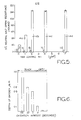
- Figures 1 to 4 are graphs plotting the iron and nitrogen, iron and oxygen, or iron, oxygen and nitrogen contents in a layer region of Samples 1 to 4 respectively.
- the layer region chosen is one which extends from 16 x 10- 9 metres to about 400 x 10- 9 metres from the surface.
- the first measurement plotted on the graph is that at 16 x 10- 9 metres, the samples having been subjected to an initial ion sputtering technique to remove foreign contaminants from the outer surface.
- oxidation of the Samples after heat treatment either solely in air or initially in air and followed by quenching in the oil/water emulsion results in displacement of nitrogen by oxygen.
- Displacement of nitrogen is total in the outermost surface layers portions (i.e. down to a depth which may vary between 0.1 micrometre and 1 micrometre,) depending upon the time of exposure to air while the sample is hot before quenching, and also on the cooling rate in the quench. Partial displacement of the nitrogen continues in some instances to depths in excess of 1 micrometre.
- Samples 2 and 3 were corrosion resistant becauseof the predominance of iron oxide mainly in the form of Fe 3 0 4 to depth of at least 0.1 micrometre and sometimes down to more than 1 micrometre in depth.
- the iron to oxygen ratio at the extreme surface indicates a composition approaching that of Fe 2 0 3 but as the depth increases into the layer, the composition becomes progressively closer to that of Fe 3 04.
- the iron to oxygen ratio suggests a structure close to Fe 3 0 4 in the outer surface layer portions but increasing in Fe0 on progression inwards.
- the wax coating composition employed comprised a mixture of waxy aliphatic and branched chain hydrocarbons, calcium soaps of oxidized petrolatum and calcium resinate to produce a wax of the requisite hardness at room temperture.
- the wax was contained in a mixture .of liquid petroleum hydrocarbons consisting of white spirits and Cg and C 10 aromatics
- the first four blocks relate to exposure of nitrocarburised component at above 550°C to air for the specified time, followed by quenching in a water/oil emulsion.
- the last block relates to quenching of a nitrocarburized component directly into oil without exposure to air.
- Steel components according to the present invention have a corrosion resistance which is superior even to components surface treated to produce an epsilon iron nitride surface layer, oil quenched, degreased (or slow cooled under a protective atmosphere) and then dipped in a de-watering oil so that the de-watering oil is absorbed into an absorbent outer portion of the epsilon iron nitride surface layer.
- Table 8 below compares the corrosion resistant properties of various types of steel component:-
- the salt spray resistance was evaluated in a salt spray test in accordance with ATSM Standard B117-64 in which the component is exposed in a salt spray chamber maintained at 95+2-3 0 F to a salt spray prepared by dissolving 5+/- 1 parts by weight of salt in 95 parts of distilled water and adjusting the pH of the solution such that, when atomised at 95 0 F, the collect solution has a pH in range of 6.5 to 7.2 After removal from the salt spray test, the components are washed under running water, dried and the incidence of red rusting is assessed. Components exhibiting any red rusting are deemed to have failed.
- the actual salt spray resistance figure depends upon the surface finish.
- the steel component treated is a shock absorber Piston rod with a final surface finish of 0.13 to 0.15 micrometres Ra. Such a component was found to have a salt spray resistance of 250 hours.
- the fatigue property was evaluated using an NPL-type two point loading rotary beam machine employing standard 0.30" (7.6mm) diameter NPL test pieces.
- a shock absorber piston rod having a length of 230mm, a diameter of 12.5 mm, and an initial surface roughness of 0.13 to 0.15 micrometres Ra was manufactured by machining a bar of low carbon steel (BS970-045M10) and was heat treated for two hours at 570°C in an atmosphere of 50% ammonia and 50% endothermic gas mixture (Carbon monoxide, carbon dioxide, nitrogen and hydrogen). The rod was then cooled slowly under the protection of the same atmosphere as used in the above mentioned heat treatment. The resultant rod had a 20 micrometre thick layer of epsilon iron nitride thereon and a surface roughness of 0.64 micrometres Ra.
- the rod was oxidised in an exothermic gas mixture containing its moisture of combustion for 10 minutes at 400 o C to produce a 0.5 micrometre thick oxide-rich surface layer.
- the piston rod was then cooled by water quenching.
- the piston rod was found to have a salt spray resistance of 250 hours according to the above described salt spray test.
- the rod was oxidised for 15 minutes at 400°C in the exothermic gas mixture, but during the last 5 minutes of the 15 minute cycle, sulphur dioxide was introduced into the furnace in an amount such as to give a concentration of 0.25% by volume in the furnace atmosphere.
- sulphur dioxide was introduced into the furnace in an amount such as to give a concentration of 0.25% by volume in the furnace atmosphere.
- the technique of sulphiding is not restricted to components in the form of damper rods and can be used in respect of any components on which it is desirable to have a black hard-wearing surface. With surface finishes greater than 0.25 micrometres Ra, it will be necessary to wax coat in order to produce the desired corrosion resistance.
- the S0 2 content in the oxidizing furnace may be up to 1% by volume and the temperature may be in the range of 3000C to 600°C. The S0 2 will normally be added to the furnace at some stage after the oxidizing heat treatment has started in order to convert some of the already formed iron oxide to iron sulphide.
- the invention is particularly applicable to non-alloy steels having a low carbon content, for example up to 0.5% carbon.
Landscapes
- Chemical & Material Sciences (AREA)
- Engineering & Computer Science (AREA)
- Materials Engineering (AREA)
- Mechanical Engineering (AREA)
- Metallurgy (AREA)
- Organic Chemistry (AREA)
- Chemical Kinetics & Catalysis (AREA)
- Physics & Mathematics (AREA)
- Thermal Sciences (AREA)
- Crystallography & Structural Chemistry (AREA)
- Solid-Phase Diffusion Into Metallic Material Surfaces (AREA)
Applications Claiming Priority (9)
| Application Number | Priority Date | Filing Date | Title |
|---|---|---|---|
| GB8131133 | 1981-10-15 | ||
| GB8138318 | 1981-12-18 | ||
| GB8205999 | 1982-02-26 | ||
| GB8131133 | 1982-07-15 | ||
| GB8220495 | 1982-07-15 | ||
| GB8220495 | 1982-07-15 | ||
| GB8205999 | 1982-07-15 | ||
| GB8138318 | 1982-07-15 | ||
| EP82305400A EP0077627B1 (de) | 1981-10-15 | 1982-10-11 | Bestandteile aus Korrosionsbeständigem Stahl und Verfahren zur Herstellung |
Related Parent Applications (1)
| Application Number | Title | Priority Date | Filing Date |
|---|---|---|---|
| EP82305400.2 Division | 1982-10-11 |
Publications (3)
| Publication Number | Publication Date |
|---|---|
| EP0229325A2 true EP0229325A2 (de) | 1987-07-22 |
| EP0229325A3 EP0229325A3 (en) | 1988-09-21 |
| EP0229325B1 EP0229325B1 (de) | 1995-01-04 |
Family
ID=27513236
Family Applications (1)
| Application Number | Title | Priority Date | Filing Date |
|---|---|---|---|
| EP86117233A Expired - Lifetime EP0229325B1 (de) | 1981-10-15 | 1982-10-11 | Verfahren zur Herstellung korrosionsbeständiger Werkstücke aus Stahl |
Country Status (1)
| Country | Link |
|---|---|
| EP (1) | EP0229325B1 (de) |
Cited By (10)
| Publication number | Priority date | Publication date | Assignee | Title |
|---|---|---|---|---|
| EP0733720A1 (de) * | 1995-03-22 | 1996-09-25 | August Bilstein GmbH | Oberflächenbehandelte Kolbenstange |
| GB2383800A (en) * | 2001-07-25 | 2003-07-09 | Nsk Europ Technology Co Ltd | Performance enhancement of steel auxiliary bearing components |
| EP1052306A4 (de) * | 1997-11-07 | 2004-09-08 | Xinhui Zhang | Gradientenkompositmaterial auf metallbasis mit guten schmier- und abriebswiderstandseigenschaften, herstellungsverfahren und verwendung |
| EP1215411A3 (de) * | 2000-12-18 | 2006-02-01 | Continental Teves AG & Co. oHG | Hydraulischer Kolben sowie Verfahren zu seiner Oberflächenbehandlung |
| US7520940B2 (en) | 2004-07-29 | 2009-04-21 | Caterpillar Inc. | Steam oxidation of powder metal parts |
| WO2010031702A1 (de) * | 2008-09-18 | 2010-03-25 | Schaeffler Kg | Gleitscheibe in einer klemmkörper-freilaufkupplung |
| RU2390582C2 (ru) * | 2008-07-28 | 2010-05-27 | Государственное образовательное учреждение высшего профессионального образования "Оренбургский государственный университет" | Способ химико-термической обработки стальных деталей |
| EP2053144A4 (de) * | 2006-08-09 | 2011-06-29 | Nihon Parkerizing | Verfahren zum abschrecken eines stahlbaulements, abgeschrecktes stahlbauelement und mittel zum schützen von abgeschreckter oberfläche |
| WO2014002120A1 (en) * | 2012-06-26 | 2014-01-03 | Cavina Fulvio Fabrizio | Process and plant for the anti-oxidising surface treatment of steel parts |
| EP4008803A1 (de) * | 2020-12-02 | 2022-06-08 | Linde GmbH | Verfahren und vorrichtung zur oxidativen nachbearbeitung eines nitrierten oder nitrocarburierten gegenstandes |
Families Citing this family (1)
| Publication number | Priority date | Publication date | Assignee | Title |
|---|---|---|---|---|
| DE102004025865A1 (de) * | 2004-05-27 | 2005-12-22 | Volkswagen Ag | Verfahren zur Herstellung einer Kolbenstange für einen Schwingungsdämpfer |
Family Cites Families (7)
| Publication number | Priority date | Publication date | Assignee | Title |
|---|---|---|---|---|
| US2343418A (en) * | 1941-01-02 | 1944-03-07 | Aviat Corp | Method of making propeller blades |
| GB693715A (en) * | 1950-02-06 | 1953-07-08 | Autoyre Company | Process for finishing steel articles |
| FR1157201A (fr) * | 1956-08-08 | 1958-05-28 | Renault | Procédé de durcissement superficiel des pièces cémentées et trempées |
| DE1179969B (de) * | 1956-10-22 | 1964-10-22 | Lasalle Steel Co | Verfahren zur Waermebehandlung und Verformung von Stahl |
| DD119822A1 (de) * | 1975-06-20 | 1976-05-12 | ||
| JPS52138027A (en) * | 1976-04-08 | 1977-11-17 | Nissan Motor | Ferrous member superior in initial fitting and wear resisting property and production process therefor |
| EP0061272A1 (de) * | 1981-03-23 | 1982-09-29 | LUCAS INDUSTRIES public limited company | Elektrischer Motor |
-
1982
- 1982-10-11 EP EP86117233A patent/EP0229325B1/de not_active Expired - Lifetime
Cited By (11)
| Publication number | Priority date | Publication date | Assignee | Title |
|---|---|---|---|---|
| EP0733720A1 (de) * | 1995-03-22 | 1996-09-25 | August Bilstein GmbH | Oberflächenbehandelte Kolbenstange |
| EP1052306A4 (de) * | 1997-11-07 | 2004-09-08 | Xinhui Zhang | Gradientenkompositmaterial auf metallbasis mit guten schmier- und abriebswiderstandseigenschaften, herstellungsverfahren und verwendung |
| EP1215411A3 (de) * | 2000-12-18 | 2006-02-01 | Continental Teves AG & Co. oHG | Hydraulischer Kolben sowie Verfahren zu seiner Oberflächenbehandlung |
| GB2383800A (en) * | 2001-07-25 | 2003-07-09 | Nsk Europ Technology Co Ltd | Performance enhancement of steel auxiliary bearing components |
| US7520940B2 (en) | 2004-07-29 | 2009-04-21 | Caterpillar Inc. | Steam oxidation of powder metal parts |
| EP2053144A4 (de) * | 2006-08-09 | 2011-06-29 | Nihon Parkerizing | Verfahren zum abschrecken eines stahlbaulements, abgeschrecktes stahlbauelement und mittel zum schützen von abgeschreckter oberfläche |
| RU2390582C2 (ru) * | 2008-07-28 | 2010-05-27 | Государственное образовательное учреждение высшего профессионального образования "Оренбургский государственный университет" | Способ химико-термической обработки стальных деталей |
| WO2010031702A1 (de) * | 2008-09-18 | 2010-03-25 | Schaeffler Kg | Gleitscheibe in einer klemmkörper-freilaufkupplung |
| WO2014002120A1 (en) * | 2012-06-26 | 2014-01-03 | Cavina Fulvio Fabrizio | Process and plant for the anti-oxidising surface treatment of steel parts |
| EP4008803A1 (de) * | 2020-12-02 | 2022-06-08 | Linde GmbH | Verfahren und vorrichtung zur oxidativen nachbearbeitung eines nitrierten oder nitrocarburierten gegenstandes |
| EP4008802A1 (de) * | 2020-12-02 | 2022-06-08 | Linde GmbH | Verfahren und vorrichtung zur oxidativen nachbearbeitung eines nitrierten oder nitrocarburierten gegenstandes |
Also Published As
| Publication number | Publication date |
|---|---|
| EP0229325B1 (de) | 1995-01-04 |
| EP0229325A3 (en) | 1988-09-21 |
Similar Documents
| Publication | Publication Date | Title |
|---|---|---|
| EP0077627B1 (de) | Bestandteile aus Korrosionsbeständigem Stahl und Verfahren zur Herstellung | |
| EP0217421B1 (de) | Korrosionsgeschützte Werkstücke aus Stahl und Verfahren zu ihrer Herstellung | |
| US3885995A (en) | Process for carburizing high alloy steels | |
| EP0229325B1 (de) | Verfahren zur Herstellung korrosionsbeständiger Werkstücke aus Stahl | |
| Flis et al. | Corrosion behaviour of stainless steels aner plasma and ammonia nitriding | |
| DE69202114T2 (de) | Behandlungsverfahren für Werkstoffe aus Eisen zur gleichzeitigen Verbesserung ihrer Korrosionsfestigkeit und ihrer Verschleisseigenschaften. | |
| Krastev | Improvement of corrosion resistance of steels by surface modification | |
| EP0534010A1 (de) | Thermochemische Behandlung von Maschinenteilen zur Verbesserung ihrer Korrosionsbeständigkeit | |
| JPS63502673A (ja) | 薄層表面硬化及び腐食防止方法 | |
| JP3388510B2 (ja) | 耐食、耐摩耗鋼及びその製造方法 | |
| US5514226A (en) | Salt bath composition based on alkali nitrates for oxidizing ferrous metal to improve its corrosion resistance | |
| JPH0146586B2 (de) | ||
| JPS5923869A (ja) | 構造部材の表面の熱処理方法 | |
| JP3083453B2 (ja) | 鉄金属部品の耐磨耗性及び耐蝕性の改良方法 | |
| Mordike | Laser gas alloying | |
| JP3695643B2 (ja) | 鉄系部品 | |
| EP0931849B1 (de) | Verfahren zum direktem Schutz gegen Verschleiss-Korrosion von metallischen Gegenständen | |
| JPH06184728A (ja) | 鋼材の表面処理方法 | |
| Zhukov et al. | Surface treatment by laser-melting induced self-propagating high temperature synthesis | |
| Kornmann et al. | Manganese diffusion coating of steels | |
| Papaphilippou et al. | Effects of CO2 laser surface hardening in the unlubricated wear of ductile cast iron against alumina | |
| Lee et al. | A study of the corrosion properties of plasma nitrocarburized and oxidized AISI 1020 steels | |
| Saif et al. | Improvement of the Thermal Fatigue Lifetime of Plasma Sprayed Coatings by Laser Treatment | |
| Easterday | Corrosion protection through salt bath nitriding | |
| WO1991000367A1 (en) | Carburising treatment of a steel with reduction of the hydrogen content in the carburized layer |
Legal Events
| Date | Code | Title | Description |
|---|---|---|---|
| PUAI | Public reference made under article 153(3) epc to a published international application that has entered the european phase |
Free format text: ORIGINAL CODE: 0009012 |
|
| 17P | Request for examination filed |
Effective date: 19861219 |
|
| AC | Divisional application: reference to earlier application |
Ref document number: 77627 Country of ref document: EP |
|
| AK | Designated contracting states |
Kind code of ref document: A2 Designated state(s): DE FR GB IT SE |
|
| PUAL | Search report despatched |
Free format text: ORIGINAL CODE: 0009013 |
|
| AK | Designated contracting states |
Kind code of ref document: A3 Designated state(s): DE FR GB IT SE |
|
| 17Q | First examination report despatched |
Effective date: 19931122 |
|
| GRAA | (expected) grant |
Free format text: ORIGINAL CODE: 0009210 |
|
| AC | Divisional application: reference to earlier application |
Ref document number: 77627 Country of ref document: EP |
|
| AK | Designated contracting states |
Kind code of ref document: B1 Designated state(s): DE FR GB IT SE |
|
| ITF | It: translation for a ep patent filed | ||
| REF | Corresponds to: |
Ref document number: 3280464 Country of ref document: DE Date of ref document: 19950216 |
|
| ET | Fr: translation filed | ||
| PLBI | Opposition filed |
Free format text: ORIGINAL CODE: 0009260 |
|
| 26 | Opposition filed |
Opponent name: DEGUSSA AG, FRANKFURT - ZWEIGNIEDERLASSUNG WOLFGAN Effective date: 19950929 |
|
| PLBF | Reply of patent proprietor to notice(s) of opposition |
Free format text: ORIGINAL CODE: EPIDOS OBSO |
|
| PLBO | Opposition rejected |
Free format text: ORIGINAL CODE: EPIDOS REJO |
|
| PLBN | Opposition rejected |
Free format text: ORIGINAL CODE: 0009273 |
|
| STAA | Information on the status of an ep patent application or granted ep patent |
Free format text: STATUS: OPPOSITION REJECTED |
|
| 27O | Opposition rejected |
Effective date: 19970623 |
|
| REG | Reference to a national code |
Ref country code: GB Ref legal event code: 732E |
|
| REG | Reference to a national code |
Ref country code: FR Ref legal event code: TP |
|
| REG | Reference to a national code |
Ref country code: FR Ref legal event code: CL |
|
| PGFP | Annual fee paid to national office [announced via postgrant information from national office to epo] |
Ref country code: SE Payment date: 20011005 Year of fee payment: 20 |
|
| PGFP | Annual fee paid to national office [announced via postgrant information from national office to epo] |
Ref country code: GB Payment date: 20011010 Year of fee payment: 20 Ref country code: FR Payment date: 20011010 Year of fee payment: 20 |
|
| PGFP | Annual fee paid to national office [announced via postgrant information from national office to epo] |
Ref country code: DE Payment date: 20011029 Year of fee payment: 20 |
|
| REG | Reference to a national code |
Ref country code: GB Ref legal event code: IF02 |
|
| PG25 | Lapsed in a contracting state [announced via postgrant information from national office to epo] |
Ref country code: GB Free format text: LAPSE BECAUSE OF EXPIRATION OF PROTECTION Effective date: 20021010 |
|
| REG | Reference to a national code |
Ref country code: GB Ref legal event code: PE20 Effective date: 20021010 |
|
| EUG | Se: european patent has lapsed |
Ref document number: 86117233.6 |