EP0229899A2 - Anstrichfarbe - Google Patents
Anstrichfarbe Download PDFInfo
- Publication number
- EP0229899A2 EP0229899A2 EP86115068A EP86115068A EP0229899A2 EP 0229899 A2 EP0229899 A2 EP 0229899A2 EP 86115068 A EP86115068 A EP 86115068A EP 86115068 A EP86115068 A EP 86115068A EP 0229899 A2 EP0229899 A2 EP 0229899A2
- Authority
- EP
- European Patent Office
- Prior art keywords
- water
- mixture
- weight
- paint
- surfactant
- Prior art date
- Legal status (The legal status is an assumption and is not a legal conclusion. Google has not performed a legal analysis and makes no representation as to the accuracy of the status listed.)
- Granted
Links
Classifications
-
- C—CHEMISTRY; METALLURGY
- C09—DYES; PAINTS; POLISHES; NATURAL RESINS; ADHESIVES; COMPOSITIONS NOT OTHERWISE PROVIDED FOR; APPLICATIONS OF MATERIALS NOT OTHERWISE PROVIDED FOR
- C09D—COATING COMPOSITIONS, e.g. PAINTS, VARNISHES OR LACQUERS; FILLING PASTES; CHEMICAL PAINT OR INK REMOVERS; INKS; CORRECTING FLUIDS; WOODSTAINS; PASTES OR SOLIDS FOR COLOURING OR PRINTING; USE OF MATERIALS THEREFOR
- C09D167/00—Coating compositions based on polyesters obtained by reactions forming a carboxylic ester link in the main chain; Coating compositions based on derivatives of such polymers
- C09D167/08—Polyesters modified with higher fatty oils or their acids, or with natural resins or resin acids
-
- C—CHEMISTRY; METALLURGY
- C09—DYES; PAINTS; POLISHES; NATURAL RESINS; ADHESIVES; COMPOSITIONS NOT OTHERWISE PROVIDED FOR; APPLICATIONS OF MATERIALS NOT OTHERWISE PROVIDED FOR
- C09D—COATING COMPOSITIONS, e.g. PAINTS, VARNISHES OR LACQUERS; FILLING PASTES; CHEMICAL PAINT OR INK REMOVERS; INKS; CORRECTING FLUIDS; WOODSTAINS; PASTES OR SOLIDS FOR COLOURING OR PRINTING; USE OF MATERIALS THEREFOR
- C09D7/00—Features of coating compositions, not provided for in group C09D5/00; Processes for incorporating ingredients in coating compositions
- C09D7/20—Diluents or solvents
Definitions
- the present invention relates to a paint containing at least one binder or binder mixture, a liquid mixture as the main component consisting of a water-insoluble organic chemical, low-volatility solvent or solvent mixture, preferably based on a liquid aliphatic and / or aromatic hydrocarbon and water, and a surfactant or Surfactant mixture and a water-soluble or water-insoluble pigment or pigment mixture and / or filler or filler mixture and / or dyes and optionally additives, preferably processing aids, siccatives and biocides.
- a surfactant or Surfactant mixture and a water-soluble or water-insoluble pigment or pigment mixture and / or filler or filler mixture and / or dyes and optionally additives, preferably processing aids, siccatives and biocides.
- Solvent resin emulsions with a continuous, oil-containing resin phase, emulsifiers, pigments and a coupling agent derived from titanium, namely pyrophosphatotitan, are already known for the production of enamel-like coatings (cf. DE-OS 32 44 590. These enamel-like emulsions must be prepared using the special coupling agents derived from titanium and are only suitable for enamel or enamel paints on a metal background.
- the aim and object of the present invention was to find a paint with improved properties.
- it should have good adhesion and / or water resistance and good penetration in wood, wood-based materials, cellulose material and other open-pore materials.
- the paint should have a blocking effect against mobile, in particular soluble wood constituents.
- the paint should also enable matt or silk matt shades or wood-colored grains to be achieved on the wood or used as an anti-corrosive paint.
- the solids content of the paint based on the total content of binders (calculated as solids), preferably alkyd resin, including the water-insoluble or water-insoluble pigments and / or fillers, is greater than 38% by weight, preferably greater than 44% by weight .
- the weight ratio of binder to pigment (s) and / or filler (s) is 1: 1 to 1: 3, preferably 1: 1.1 to 1: 2.3.
- the weight ratio of binder, preferably alkyd resin, to the organic chemical, low-volatility solvent or solvent mixture contained in the paint is 20: 1 to 1.8: 1, preferably 5: 1 to 2: 1
- the proportion by weight of surfactant or surfactant mixture is 0.1 to 3% by weight, preferably 0.6 to 2% by weight. Water and, if appropriate, other additives are preferred as the remaining constituents Processing aids, siccatives, thickeners, auxiliary solvents, biocides, included in the paint.
- the proportion by weight of water-insoluble or water-insoluble pigment (s) and / or water-insoluble or water-insoluble filler (s) in the paint is greater than 24% by weight, preferably greater than 29% by weight.
- the surfactant or surfactant mixture contained in the paint has a total HLB value of 7-18, preferably 8-17.
- the surfactant or surfactant mixture consists of at least one alkylarylsulfonate, a derivative of alkylarylsulfonic acid and / or a polyoxyethylene derivative and / or a polyalkylene or polyalkylglycol ether and / or one or more surface-active organic chemical compounds containing one or more polyoxyethylene groups and / or one or more fatty acid groups this to more than 65 parts by weight (based on 100 parts by weight of surfactant mixture used), preferably more than 80 parts by weight.
- the binder content (calculated as a solid) in the Paint is greater than 15% by weight, preferably greater than 17% by weight, and the binder preferably consists of at least one oil-soluble alkyd resin and / or at least one drying vegetable oil.
- HLB values of the surfactants are determined from "The Atlas HLB System” Specialty Chemicals Company of ICI Americas Inc., Wilminton, Delaware (1963) and from GE Petrowski and JR Vanatta, J.Am. Chem. Soc., Pages 284-289 (March 1973).
- the wood preservative paint or wood preservative contains a surfactant mixture which consists of a mixture of polyoxyethylene (30) nonylphenol and / or polyalkylene glycol ester and / or polyoxyethylene sorbitan oleate laurate or polyoxyethylene sorbitan oleate laurate and / or Isopropylamine dodecylbenzyl sulfonate and / or polyoxyethylene (10) and / or polyoxyethylene (2) oleyl alcohol.
- a surfactant mixture which consists of a mixture of polyoxyethylene (30) nonylphenol and / or polyalkylene glycol ester and / or polyoxyethylene sorbitan oleate laurate or polyoxyethylene (10) and / or polyoxyethylene (2) oleyl alcohol.
- Polyoxyethylene - (- 10) -oleyl alcohol is generally in a weight ratio of 5: 1 to 1: 5, preferably 2: 1 to 1: 2.
- the aromatic and / or aliphatic hydrocarbons or mixtures thereof known per se are used as water-insoluble, organic-chemical, low-volatility solvents or solvent mixtures.
- solvents or solvent mixtures are preferably used which has a surface tension of 16-37 mN / m, preferably 17 to 35 mN / m (measured at 20 ° C) and / or an electrical conductivity of 10- 10 - 10- 16 have ohms at 20 °.
- water-insoluble organic chemical solvents or solvent mixtures which are not highly volatile, have an evaporation number above 35 and a flash point above 323 K.
- solvents are corresponding mineral oils or their aromatic fractions, mineral oil-containing solvent mixtures, preferably white spirit and / or alkylbenzenes.
- solvent mixtures can also be used in which the low-volatility, organic solvent is replaced by a or several easily or moderately volatile solvents are replaced.
- the alkyd resin or alkyd resin mixture contained in the paint has an acid number (measured in accordance with DIN 53 402) between 1-45, preferably 2-20, an oil length of 30-75, preferably 40-70, and a phthalic acid content between 20- 40% by weight, preferably 25-35% by weight.
- oil length represents the oil content in the alkyd resin, preferably the proportion (content) of fatty acids, especially converted to triglyceride.
- the proportion by weight of the water-insoluble, organic-chemical, low-volatility oily or oily solvent or solvent mixture in the paint is less than the proportion by weight of water.
- the proportion by weight of the water in the paint is more than 2.5 times, preferably more than 3.5 times, more than the amounts by weight of the organochemical, water-insoluble, preferably oily or oily, contained in the composition (in the paint) organic chemical solvent or the solvent mixture.
- Pigments or dyes are the known inorganic metal oxide pigments and / or organic pigments or dyes, such as. B. phthalocyanines, monoazo pigments, carbon black and the like.
- the pigments and / or dyes per se or in their commercially available form, for. B. pourable or pasty preparations, pastes, powders and the like can be used.
- the agent according to the invention is temperature-stable in the range from T 233 K to T 318 K. Despite the presence of constituents which can be assigned to the oil or water phase, pigment flocculation occurs not a. When painting on wood, the paint has good penetration and adhesive strength.
- the paint contains 0.1 to 4% by weight, preferably 0.2 to 3% by weight, of at least one biocide or biocide mixture, preferably a fungicide or fungicide mixture.
- the water-insoluble or water-difficultly soluble pigments and / or fillers in the paint consist entirely or partially of anti-corrosion pigments or contain these in a mixture.
- the invention further relates to a method for producing the paint.
- the water-insoluble organochemical is or will be at a working or process temperature of 278 K-308 K, preferably 280 K-303 K, in a high-speed mixing unit, preferably a high-speed stirrer, dissolver, a colloid mill or a dispersant , non-volatile solvents or solvent mixtures including the components dissolved or soluble therein (oily phase) or one or more components of the oily phase with water or the components of the aqueous Phase is mixed, the surfactant and / or surfactant mixture being dissolved in one or in the two phases or being distributed homogeneously or almost homogeneously.
- the mixing is carried out at such a speed (taking into account the respective distance of the stirrer from the vessel wall, the radius of the stirrer and the like) and until the distribution of the emulsified resin particles has an average diameter in the range from 0.1-15 / ⁇ m, preferably 0.5 - 4 / ⁇ m.
- the mixing is carried out at an edge and / or peripheral speed of 10-40 m / sec., Preferably 15-30 m / sec.
- the water or the aqueous phase is, according to the process of the invention, at a feed rate of 10-100 l / min., Preferably 30-70 l / min. into the oily or oily phase (water-insoluble organic chemical solvent and components dissolved therein, which are placed in the mixing container).
- the oily phase consisting of alkyd resin, organic solvents, inorganic and / or organic pigments, drying agents and optionally paint additives, such as e.g. Anti-settling agents, dispersing aids, drying retardants, fungicides or insecticides are introduced and the surfactant and / or surfactant mixture is stirred into it with stirring.
- intensive stirring e.g. B. with the aid of a high-speed stirrer or dissolver, preferably at a peripheral speed of the stirring disk of 15-30 m / sec., The water at a feed speed of 30-70 l / min.
- the surfactant and / or surfactant mixture can be incorporated both in the oily and in the aqueous phase before being combined in the dispersing unit.
- the procedure is similar to that of the aforementioned method, but here the oily or aqueous phase is preferably combined by means of a metering device shortly before reaching the dispersing unit (grinding disks).
- the ratio of the oily to the aqueous phase should preferably be in the range from 2.5: 1 to 1: 2.5.
- the ratio is expediently 1.5: 1 to 1: 2.3, preferably 1.2: 1 to 1: 1.8.
- the "grinding" is carried out in accordance with the technology customary for these units (homogenization pressure: 100: 300 atm).
- the final product is preferred in this process assembled in a continuous process, that is to say uninterruptedly, while in the first-mentioned process a batch production is preferably carried out.
Landscapes
- Chemical & Material Sciences (AREA)
- Life Sciences & Earth Sciences (AREA)
- Engineering & Computer Science (AREA)
- Materials Engineering (AREA)
- Wood Science & Technology (AREA)
- Organic Chemistry (AREA)
- Oil, Petroleum & Natural Gas (AREA)
- Chemical Kinetics & Catalysis (AREA)
- Paints Or Removers (AREA)
- Nitrogen Condensed Heterocyclic Rings (AREA)
- Agricultural Chemicals And Associated Chemicals (AREA)
- Road Signs Or Road Markings (AREA)
- Materials For Medical Uses (AREA)
Abstract
Description
- Die vorliegende Erfindung betrifft eine Anstrichfarbe enthaltend mindestens ein Bindemittel oder Bindemittelgemisch, ein flüssiges Gemisch als Hauptbestandteil bestehend aus einem wasserunlöslichen organisch-chemischen, schwerflüchtigen Lösungsmittel oder Lösungsmittelgemisch, vorzugsweise auf der Basis eines flüssigen aliphatischen und/oder aromatischen Kohlenwasserstoffes und Wasser, sowie ein Tensid oder Tensidgemisch und ein wasserlösliches oder wasserunlösliches Pigment oder Pigmentgemisch und/oder Füllstoff oder Füllstoffgemisch und/oder Farbstoffe sowie ggf. Zusatzstoffe, vorzugsweise Verarbeitungshilfsmittel, Sikkative und Biozide.
- Lösungsmittelharzemulsionen mit einer kontinuierlichen, Harz enthaltenden Ölphase, Emulgatoren, Pigmenten und einem von Titan abgeleiteten Kupplungsmittel, nämlich Pyrophosphatotitan, sind bereits zur Herstellung von emailleähnlichen Überzügen bekannt (vgl. DE-OS 32 44 590. Diese emailleähnlichen Emulsionen müssen unter Verwendung der speziellen von Titan abgeleiteten Kupplungsmitteln hergestellt werden und sind nur für Emaille bzw. Emaillefarben auf Metalluntergrund geeignet.
- Ziel und Aufgabe der vorliegenden Erfindung war es, eine Anstrichfarbe mit verbesserten Eigenschaften zu finden. Sie sollte insbesondere eine gute Haft- und/ oder Wasserbeständigkeit sowie eine gute Penetration bei Holz, Holzwerkstoffen, Cellulosematerial sowie anderen offenporigen Materialien aufweisen. Weiterhin sollte die Anstrichfarbe eine absperrende Wirkung gegen mobile, insbesondere lösliche Holzinhaltsstoffe bewirken. Das Anstrichmittel sollte auch ermöglichen, matte oder seidenmatte Farbtöne oder holzfarbene Maserungen auf dem Holz zu erzielen oder als korrosionsschützende Farbe eingesetzt werden können.
- Erfindungsgemäß wurde festgestellt, daß diesen Zielen und Aufgaben eine Anstrichfarbe gerecht wird, enthaltend mindestens ein Bindemittel oder Bindemittelgemisch, ein flüssiges Gemisch als Hauptbestandteil bestehend aus einem wasserunlöslichen organisch-chemisehen, schwerflüchtigen Lösungsmittel oder Lösungsmittelgemisch, vorzugsweise auf der Basis eines flüssigen aliphatischen und/oder aromatischen Kohlenwasserstoffes, und Wasser, sowie ein Tensid oder Tensidgemisch und ein wasserunlösliches oder wasserschwerlösliches Pigment oder Pigmentgemisch und/oder Füllstoff oder Füllstoffgemisch und/oder Farbstoffe sowie ggf. Zusatzstoffe, vorzugsweise Verarbeitungshilfsmittel, Sikkative und Biozide. Gemäß der Erfindung ist der Festkörpergehalt der Anstrichfarbe, bezogen auf den Gesamtgehalt an Bindemitteln (berechnet als Feststoff), vorzugsweise Alkydharz, einschließlich der wasserunlöslichen oder wasserschwerlöslichen Pigmente und/oder Füllstoffe größer als 38 Gew.-%, vorzugsweise größer als 44 Gew.-%. Das Gewichtsverhältnis von Bindemittel zu Pigment(en) und/oder Füllstoff(en) beträgt 1 : 1 bis 1 : 3, vorzugsweise 1 : 1,1 bis 1 : 2,3. Das Gewichtsverhältnis von Bindemittel, vorzugsweise Alkydharz, zu dem in der Anstrichfarbe enthaltenden organisch-chemischen schwerflüchtigen Lösungsmittel oder Lösungsmittelgemisch (ausgenommen trocknende pflanzliche oder tierische Öle) ist 20 : 1 bis 1,8 : 1, vorzugsweise 5 : 1 bis 2 : 1. Der Gewichtsanteil an Tensid oder Tensidgemisch beträgt 0,1 bis 3 Gew.-%, vorzugsweise 0,6 bis 2 Gew.-%. Als Restbestandteile sind Wasser sowie ggf. andere Zusatzstoffe, vorzugsweise Verarbeitungshilfsmittel, Sikkative, Verdickungsmittel, Hilfslösemittel, Biozide, in der Anstrichfarbe enthalten.
- Der Gewichtsanteil an wasserunlöslichen oder wasserschwerlöslichen Pigment(en) und/oder wasserunlöslichen oder wassserschwerlöslichen Füllstoff(en) in der Anstrichfarbe ist größer als 24 Gew.-%, vorzugsweise größer als 29 Gew.-%.
- Das in der Anstrichfarbe enthaltende Tensid oder Tensidgemisch weist einen Gesamt-HLB-Wert von 7 - 18, vorzugsweise von 8 - 17, auf.
- Das Tensid oder Tensidgemisch besteht aus mindestens einem Alkylarylsulfonat, einem Derivat der Alkylarylsulfonsäure und/oder einem Polyoxyethylenderivat und/ oder einem Polyalkylen- oder Polyalkylglykoläther und/oder einer eine oder mehrere Polyoxyethylengruppen und/oder eine oder mehrere Fettsäuregruppen enthaltenden oberflächenaktiven organisch-chemischen Verbindung oder enthält diese(s) zu mehr als 65 Gew.-Teilen (bezogen auf 100 Gew.-Teile eingesetztes Tensidgemisch), vorzugsweise zu mehr als 80 Gew.-Teilen.
- Der Bindemittelgehalt (berechnet als Feststoff) in der Anstrichfarbe ist größer als 15 Gew.-%, vorzugsweise größer als 17 Gew.-%, und das Bindemittel besteht vorzugsweise mindestens aus einem öllöslichen Alkydharz und/oder mindestens einem trocknenden pflanzlichen Öl.
- Gemäß einer bevorzugten Ausführungsform ist eine Mischung von zwei oder mehreren Tensiden im Gewichtsverhältnis von 20 : 1 bis 1 : 20, vorzugsweise 5 : 1 bis 1 : 5, in der Anstrichfarbe enthalten.
- Den entsprechenden HLB-Wert weisen u. a. folgende Tenside allein oder im Gemisch auf:
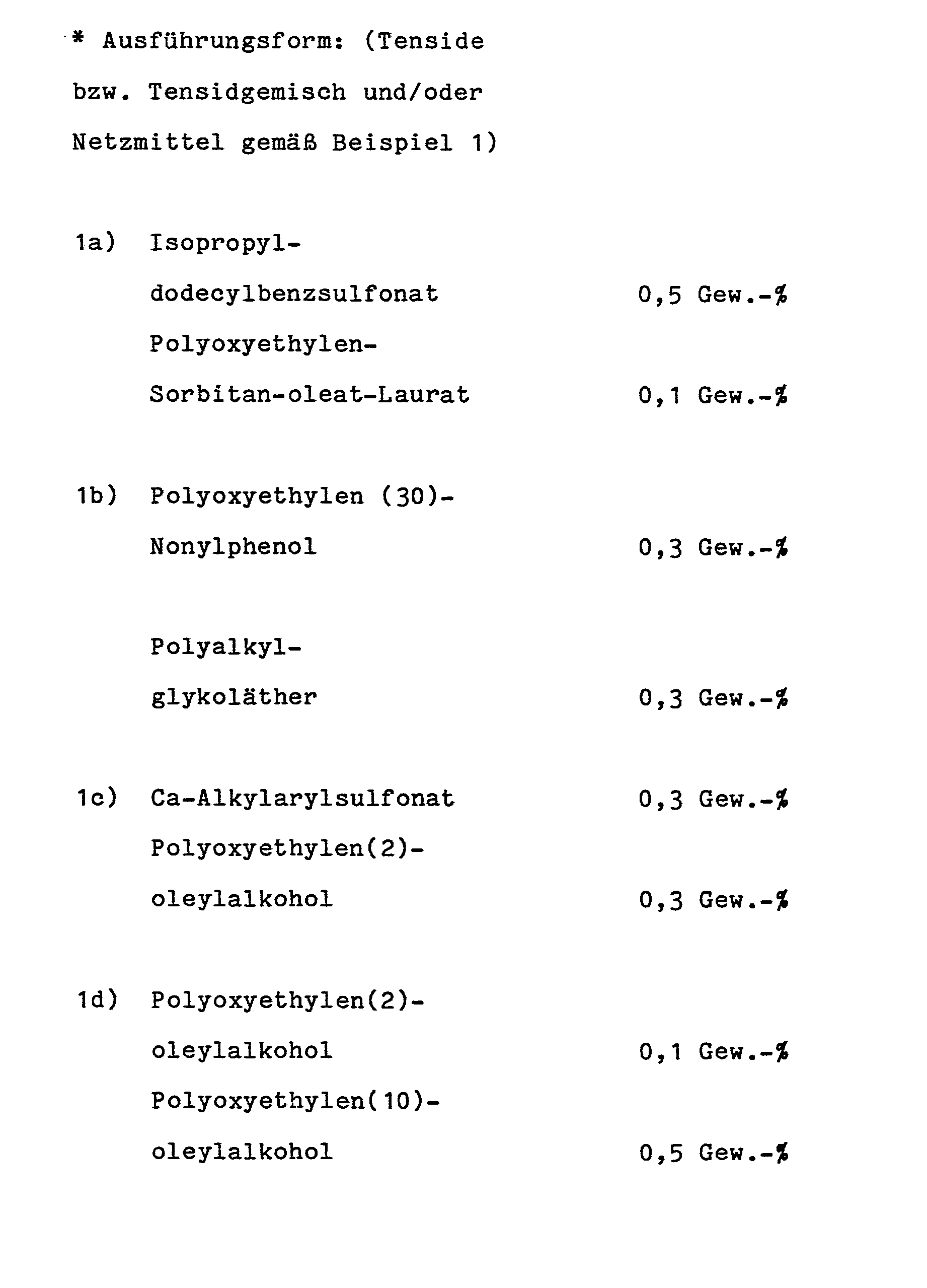
- Alkylarylsulfonat, Ca-Alkylarylsulfonat, Polyoxyäthylen (30)- Nonylphenol, Polyoxyäthylen-(2)- bzw. Polyoxyäthylen-(10)-Oleylalkohol, Polyoxyäthylen-Sorbitol-Oleat-Laurat, Polyoxyäthylen (20)-Sorbitan-Laurat, Polyoxyäthylen-Monooleat, Polyoxyäthylen-Monostearat, Polyalkylglykoläther, Sorbitan-Monolaurat, Isopropylamin-dodecylbenzyl-sulfonat allein oder in Abmischung untereinander.
- Die Bestimmung von HLB-Werten der Tenside ist aus "The Atlas HLB-System" Specialty Chemicals Company of ICI Americas Inc., Wilminton, Delaware (1963) und aus G.E. Petrowski und J.R. Vanatta, J.Am.Chem. Soc., Seiten 284 bis 289 (August 1973) ersichtlich.
- Nach einer bevorzugten Ausführungsform ist in dem Holzschutzanstrichmittel oder Holzkonservierungsmittel ein Tensidgemisch enthalten, das aus einem Gemisch von Polyoxyethylen(30)-Nonylphenol und/oder Polyalkylenglykolester und/oder Polyoxyäthylen-Sorbitan-Oleat-Laurat oder Polyoxyäthylen-Sorbitan-Oleat-Laurat und/ oder Isopropylamin-dodecylbenzylsulfonat und/oder Polyoxyäthylen-(10)- und/oder Polyoxyäthylen-(2)-Oleylalkohol, besteht. Bei einem Gemisch von Polyoxyethylen(30)-Nonylphenol und Polyalkylglykolester bzw. Polyoxyethylen-(2)- und. Polyoxyethylen-(-10)-Oleylalkohol wird im allgemeinen ein Gewichtsverhältnis 5 : 1 bis 1 : 5, vorzugsweise 2 : 1 bis 1 : 2, eingehalten.
- Bei einem Gemisch von Polyoxyethylen(30)-Nonylphenol und Polyalkylen- oder Polyalkylglykolester oder -äther und Isopropylamin-dodecylsulfonat ist zweckmäßig ein Gewichtsverhältnis 20 : 20 : 1 bis 1 : 1 : 5, vorzugsweise 10 : 10 : 1 bis 1 : 1 : 3, im Holzkonservierungsmittel oder der Anstrichfarbe enthalten.
- Nach einer anderen bevorzugten Ausführungsform besteht das Tensid aus einem Gemisch von Alkylarylsulfonat, vorzugsweise Ca-Alkylarylsulfonat und Isopropylamin-dodecylbenzylsulfonat. Bei diesem Gemisch wird ein Gewichtsverhältnis 10 : 1 bis 1 : 5, vorzugsweise 5 :
- 1 bis 2 : 1, eingehalten.
- Als wasserunlösliche organisch-chemische schwerflüchtige Lösungsmittel oder Lösungsmittelgemische werden die an sich bekannten aromatischen und/oder aliphatischen Kohlenwasserstoffe oder Gemische derselben eingesetzt. Bevorzugt werden solche Lösemittel oder Lösemittelgemische verwendet, die eine Oberflächenspannung von 16 bis 37 mN/m, vorzugsweise 17 bis 35 mN/m, (gemessen bei 20 °C) aufweisen und/oder die eine elektrische Leitfähigkeit von 10-10 - 10-16 ohm bei 20° besitzen.
- Bevorzugt werden wasserunlösliche organisch-chemische Lösungsmittel oder Lösungsmittelgemische eingesetzt, die schwerflüchtig sind, eine Verdunstungszahl über 35 und einen Flammpunkt oberhalb 323 K aufweisen. Beispiele für derartige Lösungsmittel sind entsprechende Mineralöle oder deren Aromatenfraktionen, mineralölhaltige Lösungsmittelgemische, vorzugsweise Testbenzin und/oder Alkylbenzole. Es können jedoch auch Lösungsmittelgemische eingesetzt werden, bei denen das schwerflüchtige, organische Lösungsmittel durch ein oder mehrere leicht oder mittelflüchtige Lösungsmittel ersetzt sind.
- Nach einer bevorzugten Ausführungsform weist das in der Anstrichfarbe enthaltende Alkydharz oder Alkydharzgemisch eine Säurezahl (gemessen nach DIN 53 402) zwischen 1 - 45, vorzugsweise 2 - 20, eine Öllänge von 30 - 75, vorzugsweise 40 - 70, und einen Phthalsäureanteil zwischen 20 - 40 Gew.-%, vorzugsweise 25 - 35 Gew.-% auf. Die Bezeichnung Öllänge gibt den Ölgehalt im Alkydharz wieder, vorzugsweise den Anteil (Gehalt) an Fettsäuren, umgerechnet insbesondere auf Triglycerid.
- Nach einer bevorzugten Ausführungsform ist der Gewichtsanteil des wasserunlöslichen organisch-chemischen schwerflüchtigen öligen oder ölartigen Lösungsmittels oder Lösungsmittelgemisches in der Anstrichfarbe kleiner ist als der Gewichtsanteil Wasser.
- Nach einer weiteren bevorzugten Ausführungsform beträgt das Gewichtsverhältnis der Gewichtsanteile des wasserunlöslichen organisch-chemischen schwerflüchtigen vorzugsweise öligen oder ölartigen Lösungsmittels oder Lösungsmittelgemisches, einschließlich des darin gelösten Alkydharzes und/oder trocknenden pflanzlichen Öles, zu den in der Anstrichfarbe enthaltenen Gewichtsanteil Wasser 1,5 : 1 bis 1 : 2,3, vorzugsweise 1,2 : 1 bis 1 : 1,8.
- Nach einer anderen bevorzugten Ausführungsform liegt der Gewichtsanteil des Wassers in der Anstrichfarbe um mehr als das 2,5fache, vorzugsweise mehr als das 3,5fache, über den Gewichtsmengen der im Mittel (in der Anstrichfarbe) enthaltenden organisch-chemischen, wasserunlöslichen vorzugsweise öligen oder ölartigen organisch-chemischen Lösungsmittel oder des Lösungsmittelgemisches.
- Als Pigmente oder Farbstoffe werden die an sich bekannten anorganischen Metalloxidpigmente und/oder organische Pigmente oder Farbstoffe, wie z. B. Phthalocyanine, Monoazopigmente, Ruß und dgl. eingesetzt, wobei die Pigmente und/oder Farbstoffe an sich oder in deren handelsüblichen Form, z. B. gießfähige oder pastöse Zubereitungen, Pasten, Pulvern und dgl. eingesetzt werden können.
- Das erfindungsgemäße Mittel ist temperaturstabil im Bereich von T 233 K bis T 318 K. Trotz des Vorhandenseins von Bestandteilen, die der Öl- oder Wasserphase zuzuordnen sind, tritt eine Pigmentflockulation nicht ein. Bei dem Anstrich auf Holz weist der Anstrich eine gute Eindringung und Haftfestigkeit auf.
- Nach einer Ausführungsform enthält die Anstrichfarbe 0,1 bis 4 Gew.-%, vorzugsweise 0,2 bis 3 Gew.-%, mindestens eines Biozides oder Biozidgemisches, vorzugsweise eines Fungizides oder Fungizidgemisches.
- Die wasserunlöslichen oder wasserschwerlöslichen Pigmente und/oder Füllstoffe in der Anstrichfarbe bestehen nach einer anderen Ausführungsform ganz oder teilweise aus Korrosionsschutzpigmenten oder enthalten diese im Gemisch.
- Die Erfindung betrifft weiterhin ein Verfahren zur Herstellung der Anstrichfarbe. Gemäß dem erfindungsgemäßen Verfahren wird bzw. werden bei einer Arbeits- bzw. Verfahrenstemperatur von 278 K- 308 K, vorzugsweise 280 K - 303 K, in einem schnellaufenden Mischaggregat, vorzugsweise einem Schnellrührer, Dissolver, einer Kolloidmühle oder einem Dispergator das wasserunlösliche organisch-chemische, schwerflüchtige Lösungsmittel oder Lösungsmittelgemisch einschließlich der darin gelösten oder löslichen Bestandteile (ölige Phase) oder ein oder mehrere Bestandteile der öligen Phase mit Wasser oder den Bestandteilen der wäßrigen Phase vermischt, wobei das Tensid und/oder Tensidgemisch in einer oder in den beiden Phasen gelöst oder homogen bzw. nahezu homogen verteilt wird.
- Die Durchmischung wird mit einer derartigen Geschwindigkeit (unter Berücksichtigung des jeweiligen Abstandes des Rührwerkes von der Kesselwand, dem Radius des Rührers und dgl.) und so lange durchgeführt, bis die Verteilung der emulgierten Harzteilchen einen mittleren Durchmesser im Bereich von 0,1 - 15 /um, vorzugsweise 0,5 - 4 /um, erreicht hat.
- Nach einer bevorzugten Ausführungsform wird die Durchmischung mit einer Rand- und/oder Umfangsgeschwindigkeit von 10 - 40 m/sec., vorzugsweise 15 - 30 m/sec., durchgeführt.
- Das Wasser oder die wäßrige Phase wird gemäß dem erfindungsgemäßen Verfahren mit einer Zuführungsgeschwindigkeit von 10 - 100 l/min., vorzugsweise 30 - 70 1/min. in die ölige oder ölartige Phase (wasserunlösliches organisch-chemisches Lösungsmittel und darin gelöste Bestandteile, die in dem Mischbehälter vorgelegt sind) eingeleitet.
- Der Durchmesser der Scheibe oder des Rührers beträgt zweckmäßig 1/4 d bis 3/4 d (d = Durchmesser des Mischbehälters bzw. Kessels), vorzugsweise 0,3 d - 0,4 d.
- Bei der Verwendung einer Kolloidmühle erfolgt die Zuleitung von zwei oder mehreren Bestandteilen der Anstrichfarbe oder der gesamten Anstrichfarbe über eine Dosierpumpe, wobei das Verhältnis der öligen Phase zu der wäßrigen Phase mit Tensid bzw. öligen Phase mit Tensid zu der wäßrigen PPPPPhase 20 : 1 bis 1 : 1, vorzugsweise 5 : 1 bis 2 : 1, beträgt.
- Nach einer vorteilhaften Ausführungsform des erfindungsgemäßen Verfahrens wird somit die ölige Phase, bestehend aus Alkydharz, organischen Lösemitteln, anorganischen und/oder organischen Pigmenten, Trockenstoffen und ggf. Lackadditiven, wie z.B. Antiabsetzmitteln, Dispergierhilfsmitteln, Trocknungsverzögerern, Fungizide oder Insektizide vorgelegt und darin das Tensid und/oder Tensidgemisch unter Rühren eingerührt. Nach Homogenisierung wird unter intensiven Rühren, z. B. mit Hilfe eines Schnellrührers oder Dissolvers, bei einer Randgeschwindigkeit der Rührscheibe vorzugsweise von 15 - 30 m/sec., das Wasser bei einer Zuführgeschwindigkeit vorzugsweise von 30 - 70 l/min., eingearbeitet.
- Die Arbeitstemperatur der beiden flüssigen Phasen soll vorzugsweise T = 280 K bis T = 303 K betragen. In diesem Temperaturbereich lassen sich innerhalb von 10 Minuten nach Beendigung der Wasserzufuhr Dispersionsfeinheiten im Bereich von 1 - 3 /um erreichen.
- Das Tensid und/oder Tensidgemisch kann sowohl in die ölige als auch in die wäßrige Phase vor der Vereinigung im Dispergieraggregat eingearbeitet werden.
- Nach einer anderen Ausführungsform des erfindungsgemäßen Verfahrens unter Verwendung einer Kolloidmühle oder eines Homogenisators erfolgt die Arbeitsweise ähnlich wie bei dem vorgenannten Verfahren, jedoch werden hier vorzugsweise die ölige oder wäßrige Phase mittels einer Dosiervorrichtung kurz vor dem Erreichen des Dispergierwerkes (Mahlscheiben) vereinigt. Das Verhältnis der öligen zu der wäßrigen Phase sollte vorzugsweise im Bereich von 2,5 : 1 bis 1 : 2,5 liegen. Zweckmäßig beträgt das Verhältnis 1,5 : 1 bis 1 : 2,3, vorzugsweise 1,2 : 1 bis 1 : 1,8. Die "Vermahlung" erfolgt entsprechend der bei diesen Aggregaten üblichen Technik (Homogenisierungsdruck : 100 : 300 atü).
- Bei diesem Verfahren wird das Endprodukt vorzugsweise in kontinuierlichem Verfahren, also ununterbrochen, konfektioniert, während bei dem erstgenannten Verfahren vorzugsweise eine diskontinuierliche Herstellung erfolgt.
- Beispiele für die erfindungsgemäße Anstrichfarbe
- 1. Beispiel:

- 2. Beispiel:


- 3. Beispiel:


- 4. Beispiel:


- 5. Beispiel:

- 6. Beispiel:

- 7. Beispiel:


- 8. Beispiel:


Claims (20)
größer als 24 Gew.-%, vorzugsweise größer als 29 Gew.-%, ist.
von 7 - 18, vorzugsweise von 8 - 17, aufweist.
Priority Applications (1)
| Application Number | Priority Date | Filing Date | Title |
|---|---|---|---|
| AT86115068T ATE64939T1 (de) | 1986-01-10 | 1986-10-30 | Anstrichfarbe. |
Applications Claiming Priority (2)
| Application Number | Priority Date | Filing Date | Title |
|---|---|---|---|
| DE3600503 | 1986-01-10 | ||
| DE19863600503 DE3600503A1 (de) | 1986-01-10 | 1986-01-10 | Anstrichfarbe |
Publications (3)
| Publication Number | Publication Date |
|---|---|
| EP0229899A2 true EP0229899A2 (de) | 1987-07-29 |
| EP0229899A3 EP0229899A3 (en) | 1988-10-12 |
| EP0229899B1 EP0229899B1 (de) | 1991-07-03 |
Family
ID=6291615
Family Applications (1)
| Application Number | Title | Priority Date | Filing Date |
|---|---|---|---|
| EP86115068A Expired - Lifetime EP0229899B1 (de) | 1986-01-10 | 1986-10-30 | Anstrichfarbe |
Country Status (6)
| Country | Link |
|---|---|
| EP (1) | EP0229899B1 (de) |
| AT (1) | ATE64939T1 (de) |
| DE (2) | DE3600503A1 (de) |
| ES (1) | ES2022802B3 (de) |
| GR (1) | GR3002244T3 (de) |
| HU (1) | HU202262B (de) |
Family Cites Families (8)
| Publication number | Priority date | Publication date | Assignee | Title |
|---|---|---|---|---|
| US2178474A (en) * | 1928-12-12 | 1939-10-31 | Ig Farbenindustrie Ag | Alkyd resin paint |
| US1885024A (en) * | 1930-02-24 | 1932-10-25 | Du Pont | Coating composition |
| US2178475A (en) * | 1930-03-27 | 1939-10-31 | Ig Farbenindustrie Ag | Coating composition |
| US2331544A (en) * | 1940-07-02 | 1943-10-12 | Interchem Corp | Undercoat composition and method of making same |
| US2379070A (en) * | 1941-03-14 | 1945-06-26 | Du Pont | Pigment dispersions |
| US3008847A (en) * | 1958-10-31 | 1961-11-14 | Du Pont | Primer paint composition and wood coated therewith |
| US4363887A (en) * | 1981-06-11 | 1982-12-14 | Seymour Of Sycamore, Inc. | Solvent resin emulsion enamel composition |
| DE3414244C2 (de) * | 1984-04-14 | 1994-02-10 | Desowag Materialschutz Gmbh | Holzschutzanstrichmittel, vorzugsweise Holzschutzfarbe |
-
1986
- 1986-01-10 DE DE19863600503 patent/DE3600503A1/de not_active Withdrawn
- 1986-10-30 ES ES86115068T patent/ES2022802B3/es not_active Expired - Lifetime
- 1986-10-30 DE DE8686115068T patent/DE3680087D1/de not_active Expired - Lifetime
- 1986-10-30 EP EP86115068A patent/EP0229899B1/de not_active Expired - Lifetime
- 1986-10-30 AT AT86115068T patent/ATE64939T1/de not_active IP Right Cessation
- 1986-12-10 HU HU865144A patent/HU202262B/hu not_active IP Right Cessation
-
1991
- 1991-07-04 GR GR90400948T patent/GR3002244T3/el unknown
Also Published As
| Publication number | Publication date |
|---|---|
| DE3680087D1 (de) | 1991-08-08 |
| ES2022802B3 (es) | 1991-12-16 |
| EP0229899A3 (en) | 1988-10-12 |
| HU202262B (en) | 1991-02-28 |
| GR3002244T3 (en) | 1992-12-30 |
| ATE64939T1 (de) | 1991-07-15 |
| HUT43101A (en) | 1987-09-28 |
| DE3600503A1 (de) | 1987-07-16 |
| EP0229899B1 (de) | 1991-07-03 |
Similar Documents
| Publication | Publication Date | Title |
|---|---|---|
| DE69434030T2 (de) | Verwendung einer Lösungsmittel-Zusammensetzung enthaltend ein Oxyisobuttersäureester als Lösemittel in Beschichtungen, Klebstoffen und Druckfarben | |
| DE2737737A1 (de) | Wasserdispergierbare trockenpigmentmassen und verfahren zu ihrer herstellung | |
| DE69109401T2 (de) | Wässrige Zusammensetzungen zur Behandlung von porösen Substraten. | |
| EP0395988A2 (de) | Pigmentzubereitungen und deren Verwendung | |
| DE3116653A1 (de) | "in wasser dispergierbares konzentrat fuer die verwendung als fungicid in anstrichsystemen auf wasserbasis" | |
| EP0198165B1 (de) | Holzkonservierungsmittel | |
| AT394676B (de) | Holzschutzanstrichmittel, vorzugsweise holzschutzfarbe | |
| EP3714011A1 (de) | Wässrige zusammensetzung und wässriges beschichtungsmittel | |
| EP0002252B1 (de) | Wässrige Dispersionen von als Überzugsmittel bzw. Lackbindemittel geeigneten Harzen | |
| DE1291041B (de) | Verbesserung der Eigenschaften von waessrigen Dispersionsanstrichmitteln oder -klebstoffen | |
| EP0002253A1 (de) | Wässrige Dispersionen von als Überzugsmittel bzw. Lackbindemittel geeigneten Harzen | |
| EP0507202B1 (de) | Universalfarbpaste | |
| WO2010069568A1 (de) | Wässriger beschichtungsstoff, verfahren zu seiner herstellung und seine verwendung | |
| EP0239832B1 (de) | Holzschutzmittel und Verfahren zu dessen Herstellung | |
| DE1519071C3 (de) | Verfahren zur Herstellung von Dispersionen aus hitzehärtbaren Acrylharzen und mit einer wäßrigen Phase benetzten Pigmenten | |
| EP0147726A2 (de) | Entschäumer für wässrige Dispersionen und Lösungen von Kunstharzen | |
| EP0229899B1 (de) | Anstrichfarbe | |
| DE3244590A1 (de) | Loesungsmittelharzemulsionsemail-zusammensetzung | |
| CH625824A5 (en) | Ink for the ink-jet printing process | |
| EP0149139B1 (de) | Entschäumer für wässrige Dispersionen und Lösungen von Kunstharzen | |
| WO2019243593A1 (de) | Konservierungsmittelfreie pigmentpaste | |
| EP1170342A1 (de) | Lösemittelhaltige UV-strahlenhärtende Beschichtungsstoffe | |
| DE3610189A1 (de) | Holzkonservierungsmittel | |
| AT396768B (de) | Holzimprägniermittel mit lasur für innenanstriche | |
| DE4008699C3 (de) | Tiefenwirksame Grundierung |
Legal Events
| Date | Code | Title | Description |
|---|---|---|---|
| PUAI | Public reference made under article 153(3) epc to a published international application that has entered the european phase |
Free format text: ORIGINAL CODE: 0009012 |
|
| 17P | Request for examination filed |
Effective date: 19861107 |
|
| AK | Designated contracting states |
Kind code of ref document: A2 Designated state(s): AT BE CH DE ES FR GB GR IT LI LU NL SE |
|
| PUAL | Search report despatched |
Free format text: ORIGINAL CODE: 0009013 |
|
| AK | Designated contracting states |
Kind code of ref document: A3 Designated state(s): AT BE CH DE ES FR GB GR IT LI LU NL SE |
|
| 17Q | First examination report despatched |
Effective date: 19900312 |
|
| RAP1 | Party data changed (applicant data changed or rights of an application transferred) |
Owner name: DESOWAG MATERIALSCHUTZ GMBH |
|
| ITF | It: translation for a ep patent filed | ||
| GRAA | (expected) grant |
Free format text: ORIGINAL CODE: 0009210 |
|
| AK | Designated contracting states |
Kind code of ref document: B1 Designated state(s): AT BE CH DE ES FR GB GR IT LI LU NL SE |
|
| REF | Corresponds to: |
Ref document number: 64939 Country of ref document: AT Date of ref document: 19910715 Kind code of ref document: T |
|
| REF | Corresponds to: |
Ref document number: 3680087 Country of ref document: DE Date of ref document: 19910808 |
|
| ET | Fr: translation filed | ||
| GBT | Gb: translation of ep patent filed (gb section 77(6)(a)/1977) | ||
| PLBE | No opposition filed within time limit |
Free format text: ORIGINAL CODE: 0009261 |
|
| STAA | Information on the status of an ep patent application or granted ep patent |
Free format text: STATUS: NO OPPOSITION FILED WITHIN TIME LIMIT |
|
| 26N | No opposition filed | ||
| REG | Reference to a national code |
Ref country code: GR Ref legal event code: FG4A Free format text: 3002244 |
|
| EPTA | Lu: last paid annual fee | ||
| EAL | Se: european patent in force in sweden |
Ref document number: 86115068.8 |
|
| PGFP | Annual fee paid to national office [announced via postgrant information from national office to epo] |
Ref country code: LU Payment date: 19960901 Year of fee payment: 11 |
|
| PGFP | Annual fee paid to national office [announced via postgrant information from national office to epo] |
Ref country code: AT Payment date: 19961009 Year of fee payment: 11 |
|
| PGFP | Annual fee paid to national office [announced via postgrant information from national office to epo] |
Ref country code: NL Payment date: 19961031 Year of fee payment: 11 |
|
| PGFP | Annual fee paid to national office [announced via postgrant information from national office to epo] |
Ref country code: SE Payment date: 19970625 Year of fee payment: 12 |
|
| PGFP | Annual fee paid to national office [announced via postgrant information from national office to epo] |
Ref country code: FR Payment date: 19970717 Year of fee payment: 12 |
|
| REG | Reference to a national code |
Ref country code: CH Ref legal event code: PUE Owner name: DESOWAG MATERIALSCHUTZ GMBH TRANSFER- DESOWAG GMBH |
|
| PGFP | Annual fee paid to national office [announced via postgrant information from national office to epo] |
Ref country code: CH Payment date: 19970911 Year of fee payment: 12 |
|
| PGFP | Annual fee paid to national office [announced via postgrant information from national office to epo] |
Ref country code: ES Payment date: 19971002 Year of fee payment: 12 |
|
| PGFP | Annual fee paid to national office [announced via postgrant information from national office to epo] |
Ref country code: GR Payment date: 19971017 Year of fee payment: 12 |
|
| PGFP | Annual fee paid to national office [announced via postgrant information from national office to epo] |
Ref country code: GB Payment date: 19971021 Year of fee payment: 12 |
|
| PGFP | Annual fee paid to national office [announced via postgrant information from national office to epo] |
Ref country code: BE Payment date: 19971028 Year of fee payment: 12 |
|
| PG25 | Lapsed in a contracting state [announced via postgrant information from national office to epo] |
Ref country code: LU Free format text: LAPSE BECAUSE OF NON-PAYMENT OF DUE FEES Effective date: 19971030 Ref country code: AT Free format text: LAPSE BECAUSE OF NON-PAYMENT OF DUE FEES Effective date: 19971030 |
|
| REG | Reference to a national code |
Ref country code: FR Ref legal event code: TP |
|
| NLS | Nl: assignments of ep-patents |
Owner name: DESOWAG GMBH |
|
| BECH | Be: change of holder |
Free format text: 970731 *DESOWAG G.M.B.H. |
|
| PG25 | Lapsed in a contracting state [announced via postgrant information from national office to epo] |
Ref country code: NL Free format text: LAPSE BECAUSE OF NON-PAYMENT OF DUE FEES Effective date: 19980501 |
|
| NLV4 | Nl: lapsed or anulled due to non-payment of the annual fee |
Effective date: 19980501 |
|
| PG25 | Lapsed in a contracting state [announced via postgrant information from national office to epo] |
Ref country code: GB Free format text: LAPSE BECAUSE OF NON-PAYMENT OF DUE FEES Effective date: 19981030 |
|
| PG25 | Lapsed in a contracting state [announced via postgrant information from national office to epo] |
Ref country code: SE Free format text: LAPSE BECAUSE OF NON-PAYMENT OF DUE FEES Effective date: 19981031 Ref country code: LI Free format text: LAPSE BECAUSE OF NON-PAYMENT OF DUE FEES Effective date: 19981031 Ref country code: GR Free format text: LAPSE BECAUSE OF NON-PAYMENT OF DUE FEES Effective date: 19981031 Ref country code: ES Free format text: LAPSE BECAUSE OF THE APPLICANT RENOUNCES Effective date: 19981031 Ref country code: CH Free format text: LAPSE BECAUSE OF NON-PAYMENT OF DUE FEES Effective date: 19981031 Ref country code: BE Free format text: LAPSE BECAUSE OF NON-PAYMENT OF DUE FEES Effective date: 19981031 |
|
| PGFP | Annual fee paid to national office [announced via postgrant information from national office to epo] |
Ref country code: DE Payment date: 19990123 Year of fee payment: 14 |
|
| BERE | Be: lapsed |
Owner name: DESOWAG G.M.B.H. Effective date: 19981031 |
|
| REG | Reference to a national code |
Ref country code: CH Ref legal event code: PL |
|
| GBPC | Gb: european patent ceased through non-payment of renewal fee |
Effective date: 19981030 |
|
| EUG | Se: european patent has lapsed |
Ref document number: 86115068.8 |
|
| PG25 | Lapsed in a contracting state [announced via postgrant information from national office to epo] |
Ref country code: FR Free format text: LAPSE BECAUSE OF NON-PAYMENT OF DUE FEES Effective date: 19990630 |
|
| REG | Reference to a national code |
Ref country code: FR Ref legal event code: ST |
|
| REG | Reference to a national code |
Ref country code: ES Ref legal event code: FD2A Effective date: 20001102 |
|
| PG25 | Lapsed in a contracting state [announced via postgrant information from national office to epo] |
Ref country code: DE Free format text: LAPSE BECAUSE OF NON-PAYMENT OF DUE FEES Effective date: 20010703 |
|
| PG25 | Lapsed in a contracting state [announced via postgrant information from national office to epo] |
Ref country code: IT Free format text: LAPSE BECAUSE OF NON-PAYMENT OF DUE FEES;WARNING: LAPSES OF ITALIAN PATENTS WITH EFFECTIVE DATE BEFORE 2007 MAY HAVE OCCURRED AT ANY TIME BEFORE 2007. THE CORRECT EFFECTIVE DATE MAY BE DIFFERENT FROM THE ONE RECORDED. Effective date: 20051030 |