EP0230231A2 - Verfahren zum Erhöhen der Milchgerinnungsaktivität vom thermolabilen Rhizomucor-Pusillus-Rennin - Google Patents
Verfahren zum Erhöhen der Milchgerinnungsaktivität vom thermolabilen Rhizomucor-Pusillus-Rennin Download PDFInfo
- Publication number
- EP0230231A2 EP0230231A2 EP87100172A EP87100172A EP0230231A2 EP 0230231 A2 EP0230231 A2 EP 0230231A2 EP 87100172 A EP87100172 A EP 87100172A EP 87100172 A EP87100172 A EP 87100172A EP 0230231 A2 EP0230231 A2 EP 0230231A2
- Authority
- EP
- European Patent Office
- Prior art keywords
- rennet
- activity
- anhydride
- milk
- enzyme
- Prior art date
- Legal status (The legal status is an assumption and is not a legal conclusion. Google has not performed a legal analysis and makes no representation as to the accuracy of the status listed.)
- Ceased
Links
Images
Classifications
-
- C—CHEMISTRY; METALLURGY
- C12—BIOCHEMISTRY; BEER; SPIRITS; WINE; VINEGAR; MICROBIOLOGY; ENZYMOLOGY; MUTATION OR GENETIC ENGINEERING
- C12N—MICROORGANISMS OR ENZYMES; COMPOSITIONS THEREOF; PROPAGATING, PRESERVING, OR MAINTAINING MICROORGANISMS; MUTATION OR GENETIC ENGINEERING; CULTURE MEDIA
- C12N9/00—Enzymes; Proenzymes; Compositions thereof; Processes for preparing, activating, inhibiting, separating or purifying enzymes
- C12N9/14—Hydrolases (3)
- C12N9/48—Hydrolases (3) acting on peptide bonds (3.4)
- C12N9/50—Proteinases, e.g. Endopeptidases (3.4.21-3.4.25)
- C12N9/58—Proteinases, e.g. Endopeptidases (3.4.21-3.4.25) derived from fungi
-
- C—CHEMISTRY; METALLURGY
- C12—BIOCHEMISTRY; BEER; SPIRITS; WINE; VINEGAR; MICROBIOLOGY; ENZYMOLOGY; MUTATION OR GENETIC ENGINEERING
- C12N—MICROORGANISMS OR ENZYMES; COMPOSITIONS THEREOF; PROPAGATING, PRESERVING, OR MAINTAINING MICROORGANISMS; MUTATION OR GENETIC ENGINEERING; CULTURE MEDIA
- C12N9/00—Enzymes; Proenzymes; Compositions thereof; Processes for preparing, activating, inhibiting, separating or purifying enzymes
- C12N9/96—Stabilising an enzyme by forming an adduct or a composition; Forming enzyme conjugates
-
- Y—GENERAL TAGGING OF NEW TECHNOLOGICAL DEVELOPMENTS; GENERAL TAGGING OF CROSS-SECTIONAL TECHNOLOGIES SPANNING OVER SEVERAL SECTIONS OF THE IPC; TECHNICAL SUBJECTS COVERED BY FORMER USPC CROSS-REFERENCE ART COLLECTIONS [XRACs] AND DIGESTS
- Y10—TECHNICAL SUBJECTS COVERED BY FORMER USPC
- Y10S—TECHNICAL SUBJECTS COVERED BY FORMER USPC CROSS-REFERENCE ART COLLECTIONS [XRACs] AND DIGESTS
- Y10S435/00—Chemistry: molecular biology and microbiology
- Y10S435/8215—Microorganisms
- Y10S435/911—Microorganisms using fungi
- Y10S435/931—Mucor
Definitions
- Calf rennet obtained from the fourth stomach of unweaned calves, has traditionally been used as the coagulant for milk in the production of cheese. More recently, an enzyme produced during the fermentation of certain fungi has, been found to be a suitable replacement for calf rennet, the supply of which is limited by the availability of calf stomachs.
- microbial rennet While the milk clotting enzyme obtained from fungi (typically referred to as microbial rennet) is quite suitable for making cheese, it has a higher degree of thermal stability than calf rennet. This property is disadvantageous because the rennet ends up in the whey during the cheese making process. Residual rennet activity in the whey is undesirable. This presents no difficulty when calf rennet is used because it is thermally deactivated at normal pasteurization temperatures. This is not the case, however, with microbial rennet because of its greater thermal stability. Cornelius reports in U.S. Patent No.
- Cornelius also reports in U.S. Patent No. 4,362,818 that the milk coagulating activity of the microbial enzyme obtained from R. pusiZZus can be increased by acylating the enzyme with selected acid anhydrides, including maleic anhydride. This acylation typically results in an increase of about 50% in the enzyme's activity although in one run there is reported a product having 221% of its original activity after treatment with maleic anhydride.
- the present invention is a method for increasing the milk coagulating activity and reducing the thermal stability of microbial rennet obtained from Rhizomucor pusillus.
- the method involves:
- microbial rennet prepared by the process set out above.
- the present invention provides a method for increasing the milk clotting activity and decreasing the thermal stability of R. p u siZZus rennet by oxidizing the enzyme with a methionine oxidizing agent followed by acylation with a dicarboxylic acid anhydride.
- R. pusillus rennet is produced by well established methods and is commercially available as an aqueous solution.
- the native coagulant is more heat stable than calf rennet and to produce a heat labile preparation, processes have been developed to chemically modify the enzyme. These processes utilize methionine oxidizing agents such as hydrogen peroxide, peroxyacids and alkali metal hypochlorites which oxidize some of the methionine residues in the enzyme to methionine sulfoxide. By varying the extent of this oxidation a greater or lesser degree of thermal lability can be produced. Unfortunately, this treatment often produces a decrease in milk clotting activity and some compromise has to be established between the degree of thermal lability and the loss of clotting activity.
- the oxidation conditions are not narrowly - critical; the process may be carried out using any of a number of oxidizing agents which oxidize methionine such as hydrogen peroxide, other organic peroxides, peroxyacids, e.g. peracetic acid and persulfuric acid, chlorine containing oxidizing agents, e.g. sodium hypochlorite and chloramine-T (sodium salt of N-chloro-p-toluenesulfonamide).
- Oxidation temperatures will typically range from about 0° to 40°C since at below 0°C the enzyme solution will tend to freeze and the enzyme may undergo some inactivation at temperatures above 40°C.
- the oxidation is preferably carried out at a temperature in the range of from about 5° to 15°C and is typically carried out at a pH in the range of 3 to 8 with a range of from about 4 to 6 being preferred.
- the oxidation is carried out for a period of time and with a concentration of oxidizing agent sufficient to provide the desired degree of thermal lability.
- the exact conditions required to achieve the desired degree of thermal destabilization will require some routine experimentation which can be conducted as follows:
- the extent of destabilization of the enzyme may be determined as follows:
- the enzyme is diluted in 0.2 M phosphate buffer, pH 5.5 and aliquots (2 ml) are dispensed into screw cap test tubes.
- the tubes are placed in a water bath at 60°C and then removed after 5, 10, 15 or 20 minutes, cooled in ice-water and assayed for residual milk-clotting activity as described below.
- An unheated sample of enzyme is used as a control (100% activity).
- Rennet activity is expressed in Rennet Units (R.U.) per milliliter when the enzyme is in a liquid form.
- Commercial rennets are usually supplied as "single strength" (90 R.U./mL) or “double strength” (180 R.U./mL).
- the acylation reaction may be carried out with any suitable dicarboxylic acid anhydride.
- an acid anhydride characterized by one of the following formulae is used:
- the acylation is carried out at a temperature in the range of from about 0° to 40°C preferably from 5° to 25°C.
- the pH of the reaction medium is typically maintained in the range of from 5 to 10 with a pH of from 6 to 8 being preferred.
- a range of anhydride concentration from about 0.1 to 2 percent (w/v anhydride to enzyme solution) is used with single strength rennet (90 Rennet Units per mL) or its equivalent.
- the degree of increase in milk clotting activity is dependent upon the above factors and on the nature of the anhydride used. Optimum reaction conditions may be determined by varying these parameters and monitoring the reaction using the tests described above.
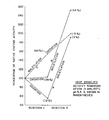
- line A represents acylation of a sample which was highly oxidized. Its heat stability was low (13% activity retained after 15 minutes at 60°, pH 5.5) and it had lost almost half of its original activity. Maleylation increased the activity to almost twice that of the native enzyme but thermal stability declined even further (3% activity retained). By comparison, calf rennet retains 56% activity after heating under these conditions.
- Line B represents a sample that was oxidized for only 5 hours with 1% hydrogen peroxide, pH 5.5, 4°C.
- the enzyme is contacted with H 2 0 2 at a temperature of from about 5° to 15° and at a pH of from about 4 to 6 for a time sufficient to oxidize it to an extent such that the heat stability of the final product after acylation is decreased to a level whereby it retains 50 to 60% of its milk clotting activity when heated to 60°C at pH 5.5 for 15 minutes and then acylated.
- Line C represents the reverse reaction order.
- R. pusillus rennet was maleylated as described in Example V. To a 20 ml sample of the maleylated enzyme was added 0.4 ml of 50% (w/v) hydrogen peroxide solution (to give a final concentration of 1% w/v) at pH 5.6 at 4°C with stirring. The solution was maintained at 4°C and samples were removed at intervals for assay. The results of this experiment are set out in Table VI.
- Heat stability (activity remaining after 15 minutes, 60°C, pH 5.5); Native R. pusiZZus rennet - 80%; Maleylated R. pusillus rennet - 66%; Oxidized (3 hrs.) maleylated R. pusiZZus rennet - 13%.
Landscapes
- Life Sciences & Earth Sciences (AREA)
- Health & Medical Sciences (AREA)
- Chemical & Material Sciences (AREA)
- Genetics & Genomics (AREA)
- Organic Chemistry (AREA)
- Zoology (AREA)
- Engineering & Computer Science (AREA)
- Bioinformatics & Cheminformatics (AREA)
- Wood Science & Technology (AREA)
- Molecular Biology (AREA)
- Biotechnology (AREA)
- Microbiology (AREA)
- Biomedical Technology (AREA)
- Medicinal Chemistry (AREA)
- Biochemistry (AREA)
- General Engineering & Computer Science (AREA)
- General Health & Medical Sciences (AREA)
- Mycology (AREA)
- Enzymes And Modification Thereof (AREA)
- Dairy Products (AREA)
- Micro-Organisms Or Cultivation Processes Thereof (AREA)
Applications Claiming Priority (2)
| Application Number | Priority Date | Filing Date | Title |
|---|---|---|---|
| US06/819,720 US4722900A (en) | 1986-01-17 | 1986-01-17 | Method for increasing the milk clotting activity of thermolabile rhizomucor pusillus rennet |
| US819720 | 1986-01-17 |
Publications (2)
| Publication Number | Publication Date |
|---|---|
| EP0230231A2 true EP0230231A2 (de) | 1987-07-29 |
| EP0230231A3 EP0230231A3 (de) | 1989-11-02 |
Family
ID=25228868
Family Applications (1)
| Application Number | Title | Priority Date | Filing Date |
|---|---|---|---|
| EP87100172A Ceased EP0230231A3 (de) | 1986-01-17 | 1987-01-09 | Verfahren zum Erhöhen der Milchgerinnungsaktivität vom thermolabilen Rhizomucor-Pusillus-Rennin |
Country Status (6)
| Country | Link |
|---|---|
| US (1) | US4722900A (de) |
| EP (1) | EP0230231A3 (de) |
| JP (1) | JPS62171682A (de) |
| AU (1) | AU573112B2 (de) |
| CA (1) | CA1282723C (de) |
| DK (1) | DK23387A (de) |
Cited By (2)
| Publication number | Priority date | Publication date | Assignee | Title |
|---|---|---|---|---|
| EP0536770A1 (de) * | 1991-10-11 | 1993-04-14 | Meito Sangyo Co., Ltd. | Protease mit niedriger Thermostabilität, verwandte Produkte und Verfahren zu deren Herstellung |
| US5888966A (en) * | 1994-05-03 | 1999-03-30 | Chr. Hansen A/S | Process for separating milk clotting enzymes, and stable rennet compositions |
Families Citing this family (2)
| Publication number | Priority date | Publication date | Assignee | Title |
|---|---|---|---|---|
| JP4628998B2 (ja) * | 2006-06-08 | 2011-02-09 | 花王株式会社 | α−アミラーゼの活性化方法 |
| JP5556450B2 (ja) | 2010-07-02 | 2014-07-23 | パナソニック株式会社 | 回転式圧縮機 |
Family Cites Families (7)
| Publication number | Priority date | Publication date | Assignee | Title |
|---|---|---|---|---|
| US4348482A (en) * | 1978-05-22 | 1982-09-07 | Miles Laboratories, Inc. | Process for decreasing the thermal stability of microbial rennet |
| US4255454A (en) * | 1978-12-28 | 1981-03-10 | Sven Branner-Jorgensen | Thermal destabilization of microbial rennet |
| DK145679A (da) * | 1979-04-09 | 1980-10-10 | Novo Industri As | Fremgangsmaade til termisk destabilisering af mikrobiel osteloebe |
| DK145779A (da) * | 1979-04-09 | 1980-10-10 | Novo Industri As | Fremgangsmaade til termisk destabilisering af mikrobiel osteloebe |
| US4362818A (en) * | 1981-02-17 | 1982-12-07 | Miles Laboratories, Inc. | Acylation of Mucor pusillus microbial rennet enzyme |
| JPS58175487A (ja) * | 1982-04-08 | 1983-10-14 | Meito Sangyo Kk | 改質微生物レンネツト及びその製法 |
| JPS61185186A (ja) * | 1985-02-09 | 1986-08-18 | Meito Sangyo Kk | 熱安定性の低下改善された改質微生物レンネツト及びその製法 |
-
1986
- 1986-01-17 US US06/819,720 patent/US4722900A/en not_active Expired - Fee Related
- 1986-12-23 CA CA000526200A patent/CA1282723C/en not_active Expired - Lifetime
-
1987
- 1987-01-09 EP EP87100172A patent/EP0230231A3/de not_active Ceased
- 1987-01-14 JP JP62005150A patent/JPS62171682A/ja active Pending
- 1987-01-16 AU AU67631/87A patent/AU573112B2/en not_active Ceased
- 1987-01-16 DK DK023387A patent/DK23387A/da not_active Application Discontinuation
Cited By (3)
| Publication number | Priority date | Publication date | Assignee | Title |
|---|---|---|---|---|
| EP0536770A1 (de) * | 1991-10-11 | 1993-04-14 | Meito Sangyo Co., Ltd. | Protease mit niedriger Thermostabilität, verwandte Produkte und Verfahren zu deren Herstellung |
| US5332668A (en) * | 1991-10-11 | 1994-07-26 | Meito Sangyo Co., Ltd. | Protease with low thermostability derived from Mucor pusillus |
| US5888966A (en) * | 1994-05-03 | 1999-03-30 | Chr. Hansen A/S | Process for separating milk clotting enzymes, and stable rennet compositions |
Also Published As
| Publication number | Publication date |
|---|---|
| AU6763187A (en) | 1987-07-23 |
| DK23387D0 (da) | 1987-01-16 |
| CA1282723C (en) | 1991-04-09 |
| EP0230231A3 (de) | 1989-11-02 |
| DK23387A (da) | 1987-07-18 |
| AU573112B2 (en) | 1988-05-26 |
| JPS62171682A (ja) | 1987-07-28 |
| US4722900A (en) | 1988-02-02 |
Similar Documents
| Publication | Publication Date | Title |
|---|---|---|
| Griffiths et al. | Thermostability of proteases and lipases from a number of species of psychrotrophic bacteria of dairy origin | |
| CA1135639A (en) | Method for thermal destabilization of microbial rennet | |
| JP2536086B2 (ja) | 長期常温保存可能な豆腐の製造法 | |
| US5747078A (en) | Longterm antimicrobial activity obtained by sustained release of hydrogen peroxide | |
| AU652279B2 (en) | Sustained release of hydrogen peroxide | |
| Aisaka et al. | Purification, crystallization and characterization of N-acetylneuraminate lyase from Escherichia coli | |
| SE430561B (sv) | Forfarande for framstellning av en enzymmodifierad ost | |
| US4722900A (en) | Method for increasing the milk clotting activity of thermolabile rhizomucor pusillus rennet | |
| US4357357A (en) | Thermal destabilization of microbial rennet | |
| Jauregui-Adell | Heat stability and reactivation of mare milk lysozyme | |
| US4255454A (en) | Thermal destabilization of microbial rennet | |
| EP0805866B1 (de) | Mikrobiell erzeugtes rennin mit verbesserter milchgerinnungsaktivität und verfahren zu dessen herstellung | |
| US4348482A (en) | Process for decreasing the thermal stability of microbial rennet | |
| US4766074A (en) | Thermostable Rhizomucor rennet having increased milk clotting activity | |
| HAARD | Atlantic cod gastric protease. Characterization with casein and milk substrate and influence of sepharose immobilization on salt activation, temperature characteristics and milk clotting reaction | |
| US2116089A (en) | Deproteinization of rubber latex | |
| GB2024828A (en) | Process for decreasing the thermal stability of microbial rennet | |
| US3616233A (en) | Removing esterase from microbial rennin | |
| JPH0218834B2 (de) | ||
| US4853329A (en) | Stabilization of microbial rennet | |
| US4362818A (en) | Acylation of Mucor pusillus microbial rennet enzyme | |
| EP0028044A1 (de) | Hitzeempfindliches mikrobielles Labferment und Verfahren zu seiner Herstellung | |
| Griffiths | Synergistic effects of various lipases and phospholipase C on milk fat | |
| EP0027813A1 (de) | Verfahren zum destabilisieren milchgerinnender enzyme | |
| Richardson et al. | Immobilized enzymes in milk systems |
Legal Events
| Date | Code | Title | Description |
|---|---|---|---|
| PUAI | Public reference made under article 153(3) epc to a published international application that has entered the european phase |
Free format text: ORIGINAL CODE: 0009012 |
|
| 17P | Request for examination filed |
Effective date: 19870109 |
|
| AK | Designated contracting states |
Kind code of ref document: A2 Designated state(s): AT BE CH DE ES FR GB IT LI LU NL SE |
|
| RAP1 | Party data changed (applicant data changed or rights of an application transferred) |
Owner name: MILES LABORATORIES, INC. |
|
| RAP1 | Party data changed (applicant data changed or rights of an application transferred) |
Owner name: MILES INC. |
|
| PUAL | Search report despatched |
Free format text: ORIGINAL CODE: 0009013 |
|
| AK | Designated contracting states |
Kind code of ref document: A3 Designated state(s): AT BE CH DE ES FR GB IT LI LU NL SE |
|
| RAP1 | Party data changed (applicant data changed or rights of an application transferred) |
Owner name: RHONE-POULENC INC. |
|
| 17Q | First examination report despatched |
Effective date: 19910819 |
|
| STAA | Information on the status of an ep patent application or granted ep patent |
Free format text: STATUS: THE APPLICATION HAS BEEN REFUSED |
|
| 18R | Application refused |
Effective date: 19930311 |
|
| RIN1 | Information on inventor provided before grant (corrected) |
Inventor name: HUMPHREYS, JOHN DAVID Inventor name: HAVERA, HERBERT JOHN |