EP0230397A2 - Neues Glucopyranosid - Google Patents
Neues Glucopyranosid Download PDFInfo
- Publication number
- EP0230397A2 EP0230397A2 EP87810015A EP87810015A EP0230397A2 EP 0230397 A2 EP0230397 A2 EP 0230397A2 EP 87810015 A EP87810015 A EP 87810015A EP 87810015 A EP87810015 A EP 87810015A EP 0230397 A2 EP0230397 A2 EP 0230397A2
- Authority
- EP
- European Patent Office
- Prior art keywords
- methanol
- cherry
- column
- water
- flies
- Prior art date
- Legal status (The legal status is an assumption and is not a legal conclusion. Google has not performed a legal analysis and makes no representation as to the accuracy of the status listed.)
- Granted
Links
- 241000167854 Bourreria succulenta Species 0.000 claims abstract description 22
- 235000019693 cherries Nutrition 0.000 claims abstract description 22
- OKKJLVBELUTLKV-UHFFFAOYSA-N Methanol Chemical compound OC OKKJLVBELUTLKV-UHFFFAOYSA-N 0.000 claims description 66
- 241000255925 Diptera Species 0.000 claims description 8
- 150000001875 compounds Chemical class 0.000 claims description 5
- 238000000034 method Methods 0.000 claims description 5
- 238000004809 thin layer chromatography Methods 0.000 claims description 5
- 241000157279 Rhagoletis cerasi Species 0.000 claims description 4
- 238000004440 column chromatography Methods 0.000 claims description 2
- 206010061217 Infestation Diseases 0.000 claims 1
- 238000011097 chromatography purification Methods 0.000 claims 1
- LFQSCWFLJHTTHZ-UHFFFAOYSA-N Ethanol Chemical compound CCO LFQSCWFLJHTTHZ-UHFFFAOYSA-N 0.000 description 18
- XLYOFNOQVPJJNP-UHFFFAOYSA-N water Substances O XLYOFNOQVPJJNP-UHFFFAOYSA-N 0.000 description 12
- WEVYAHXRMPXWCK-UHFFFAOYSA-N Acetonitrile Chemical compound CC#N WEVYAHXRMPXWCK-UHFFFAOYSA-N 0.000 description 9
- 239000000284 extract Substances 0.000 description 8
- 230000000694 effects Effects 0.000 description 6
- 239000011521 glass Substances 0.000 description 6
- XOAAWQZATWQOTB-UHFFFAOYSA-N taurine Chemical compound NCCS(O)(=O)=O XOAAWQZATWQOTB-UHFFFAOYSA-N 0.000 description 6
- 239000000243 solution Substances 0.000 description 5
- 238000004140 cleaning Methods 0.000 description 4
- 239000003480 eluent Substances 0.000 description 4
- 238000004811 liquid chromatography Methods 0.000 description 4
- QTBSBXVTEAMEQO-UHFFFAOYSA-N Acetic acid Chemical compound CC(O)=O QTBSBXVTEAMEQO-UHFFFAOYSA-N 0.000 description 3
- 239000000287 crude extract Substances 0.000 description 3
- 238000011161 development Methods 0.000 description 3
- 235000014113 dietary fatty acids Nutrition 0.000 description 3
- 235000013399 edible fruits Nutrition 0.000 description 3
- 235000013601 eggs Nutrition 0.000 description 3
- 238000010828 elution Methods 0.000 description 3
- 238000002474 experimental method Methods 0.000 description 3
- 238000000605 extraction Methods 0.000 description 3
- 239000000194 fatty acid Substances 0.000 description 3
- 229930195729 fatty acid Natural products 0.000 description 3
- 150000004665 fatty acids Chemical class 0.000 description 3
- 239000012634 fragment Substances 0.000 description 3
- 239000000203 mixture Substances 0.000 description 3
- BDERNNFJNOPAEC-UHFFFAOYSA-N n-propyl alcohol Natural products CCCO BDERNNFJNOPAEC-UHFFFAOYSA-N 0.000 description 3
- -1 palmityl glucopyranoside Chemical compound 0.000 description 3
- 239000013049 sediment Substances 0.000 description 3
- 239000011734 sodium Substances 0.000 description 3
- 238000001228 spectrum Methods 0.000 description 3
- 229960003080 taurine Drugs 0.000 description 3
- QGZKDVFQNNGYKY-UHFFFAOYSA-N Ammonia Chemical compound N QGZKDVFQNNGYKY-UHFFFAOYSA-N 0.000 description 2
- IJGRMHOSHXDMSA-UHFFFAOYSA-N Atomic nitrogen Chemical compound N#N IJGRMHOSHXDMSA-UHFFFAOYSA-N 0.000 description 2
- VVQNEPGJFQJSBK-UHFFFAOYSA-N Methyl methacrylate Chemical compound COC(=O)C(C)=C VVQNEPGJFQJSBK-UHFFFAOYSA-N 0.000 description 2
- LRHPLDYGYMQRHN-UHFFFAOYSA-N N-Butanol Chemical compound CCCCO LRHPLDYGYMQRHN-UHFFFAOYSA-N 0.000 description 2
- 238000005481 NMR spectroscopy Methods 0.000 description 2
- 229920005372 Plexiglas® Polymers 0.000 description 2
- FAPWRFPIFSIZLT-UHFFFAOYSA-M Sodium chloride Chemical compound [Na+].[Cl-] FAPWRFPIFSIZLT-UHFFFAOYSA-M 0.000 description 2
- 230000003542 behavioural effect Effects 0.000 description 2
- 230000004071 biological effect Effects 0.000 description 2
- 238000009395 breeding Methods 0.000 description 2
- 230000001488 breeding effect Effects 0.000 description 2
- 239000001913 cellulose Substances 0.000 description 2
- 229920002678 cellulose Polymers 0.000 description 2
- 238000010265 fast atom bombardment Methods 0.000 description 2
- 125000002887 hydroxy group Chemical group [H]O* 0.000 description 2
- NNPPMTNAJDCUHE-UHFFFAOYSA-N isobutane Chemical compound CC(C)C NNPPMTNAJDCUHE-UHFFFAOYSA-N 0.000 description 2
- 239000000463 material Substances 0.000 description 2
- 239000011159 matrix material Substances 0.000 description 2
- 238000006140 methanolysis reaction Methods 0.000 description 2
- 239000000047 product Substances 0.000 description 2
- 239000002994 raw material Substances 0.000 description 2
- 239000002904 solvent Substances 0.000 description 2
- LXMSZDCAJNLERA-ZHYRCANASA-N spironolactone Chemical compound C([C@@H]1[C@]2(C)CC[C@@H]3[C@@]4(C)CCC(=O)C=C4C[C@H]([C@@H]13)SC(=O)C)C[C@@]21CCC(=O)O1 LXMSZDCAJNLERA-ZHYRCANASA-N 0.000 description 2
- 239000000126 substance Substances 0.000 description 2
- NDVMCQUOSYOQMZ-UHFFFAOYSA-N 2,2-bis(trimethylsilyl)acetamide Chemical compound C[Si](C)(C)C(C(N)=O)[Si](C)(C)C NDVMCQUOSYOQMZ-UHFFFAOYSA-N 0.000 description 1
- JNRLEMMIVRBKJE-UHFFFAOYSA-N 4,4'-Methylenebis(N,N-dimethylaniline) Chemical compound C1=CC(N(C)C)=CC=C1CC1=CC=C(N(C)C)C=C1 JNRLEMMIVRBKJE-UHFFFAOYSA-N 0.000 description 1
- DCERHCFNWRGHLK-UHFFFAOYSA-N C[Si](C)C Chemical compound C[Si](C)C DCERHCFNWRGHLK-UHFFFAOYSA-N 0.000 description 1
- OKTJSMMVPCPJKN-UHFFFAOYSA-N Carbon Chemical compound [C] OKTJSMMVPCPJKN-UHFFFAOYSA-N 0.000 description 1
- 108010059892 Cellulase Proteins 0.000 description 1
- WQZGKKKJIJFFOK-GASJEMHNSA-N Glucose Natural products OC[C@H]1OC(O)[C@H](O)[C@@H](O)[C@@H]1O WQZGKKKJIJFFOK-GASJEMHNSA-N 0.000 description 1
- 241000238631 Hexapoda Species 0.000 description 1
- UFHFLCQGNIYNRP-UHFFFAOYSA-N Hydrogen Chemical compound [H][H] UFHFLCQGNIYNRP-UHFFFAOYSA-N 0.000 description 1
- DGAQECJNVWCQMB-PUAWFVPOSA-M Ilexoside XXIX Chemical compound C[C@@H]1CC[C@@]2(CC[C@@]3(C(=CC[C@H]4[C@]3(CC[C@@H]5[C@@]4(CC[C@@H](C5(C)C)OS(=O)(=O)[O-])C)C)[C@@H]2[C@]1(C)O)C)C(=O)O[C@H]6[C@@H]([C@H]([C@@H]([C@H](O6)CO)O)O)O.[Na+] DGAQECJNVWCQMB-PUAWFVPOSA-M 0.000 description 1
- 239000002202 Polyethylene glycol Substances 0.000 description 1
- 240000004808 Saccharomyces cerevisiae Species 0.000 description 1
- 241000565668 Ventridens cerinoideus Species 0.000 description 1
- 125000002777 acetyl group Chemical group [H]C([H])([H])C(*)=O 0.000 description 1
- 229910001413 alkali metal ion Inorganic materials 0.000 description 1
- 150000001408 amides Chemical class 0.000 description 1
- 229910021529 ammonia Inorganic materials 0.000 description 1
- 229910052799 carbon Inorganic materials 0.000 description 1
- 229940106157 cellulase Drugs 0.000 description 1
- 239000012185 ceresin wax Substances 0.000 description 1
- 238000000451 chemical ionisation Methods 0.000 description 1
- 239000003153 chemical reaction reagent Substances 0.000 description 1
- 108091008690 chemoreceptors Proteins 0.000 description 1
- 238000003776 cleavage reaction Methods 0.000 description 1
- 239000012141 concentrate Substances 0.000 description 1
- 238000011109 contamination Methods 0.000 description 1
- 238000009795 derivation Methods 0.000 description 1
- 238000001514 detection method Methods 0.000 description 1
- IJKVHSBPTUYDLN-UHFFFAOYSA-N dihydroxy(oxo)silane Chemical compound O[Si](O)=O IJKVHSBPTUYDLN-UHFFFAOYSA-N 0.000 description 1
- 238000010790 dilution Methods 0.000 description 1
- 239000012895 dilution Substances 0.000 description 1
- 238000002451 electron ionisation mass spectrometry Methods 0.000 description 1
- 238000004108 freeze drying Methods 0.000 description 1
- 239000007789 gas Substances 0.000 description 1
- 238000002290 gas chromatography-mass spectrometry Methods 0.000 description 1
- 239000008103 glucose Substances 0.000 description 1
- 150000002500 ions Chemical class 0.000 description 1
- 239000001282 iso-butane Substances 0.000 description 1
- 230000031700 light absorption Effects 0.000 description 1
- 238000004519 manufacturing process Methods 0.000 description 1
- 238000001819 mass spectrum Methods 0.000 description 1
- 239000000401 methanolic extract Substances 0.000 description 1
- 150000004702 methyl esters Chemical class 0.000 description 1
- PJUIMOJAAPLTRJ-UHFFFAOYSA-N monothioglycerol Chemical compound OCC(O)CS PJUIMOJAAPLTRJ-UHFFFAOYSA-N 0.000 description 1
- 229910052757 nitrogen Inorganic materials 0.000 description 1
- 125000004433 nitrogen atom Chemical group N* 0.000 description 1
- 230000003287 optical effect Effects 0.000 description 1
- 229920001223 polyethylene glycol Polymers 0.000 description 1
- XAEFZNCEHLXOMS-UHFFFAOYSA-M potassium benzoate Chemical compound [K+].[O-]C(=O)C1=CC=CC=C1 XAEFZNCEHLXOMS-UHFFFAOYSA-M 0.000 description 1
- 238000012545 processing Methods 0.000 description 1
- 238000000425 proton nuclear magnetic resonance spectrum Methods 0.000 description 1
- 239000000376 reactant Substances 0.000 description 1
- 108020003175 receptors Proteins 0.000 description 1
- 238000004366 reverse phase liquid chromatography Methods 0.000 description 1
- 230000005070 ripening Effects 0.000 description 1
- 230000007017 scission Effects 0.000 description 1
- 229910052708 sodium Inorganic materials 0.000 description 1
- 239000011780 sodium chloride Substances 0.000 description 1
- 239000006228 supernatant Substances 0.000 description 1
- 210000000457 tarsus Anatomy 0.000 description 1
- 238000012360 testing method Methods 0.000 description 1
- 238000002604 ultrasonography Methods 0.000 description 1
Classifications
-
- C—CHEMISTRY; METALLURGY
- C07—ORGANIC CHEMISTRY
- C07H—SUGARS; DERIVATIVES THEREOF; NUCLEOSIDES; NUCLEOTIDES; NUCLEIC ACIDS
- C07H15/00—Compounds containing hydrocarbon or substituted hydrocarbon radicals directly attached to hetero atoms of saccharide radicals
- C07H15/02—Acyclic radicals, not substituted by cyclic structures
- C07H15/04—Acyclic radicals, not substituted by cyclic structures attached to an oxygen atom of the saccharide radical
-
- A—HUMAN NECESSITIES
- A01—AGRICULTURE; FORESTRY; ANIMAL HUSBANDRY; HUNTING; TRAPPING; FISHING
- A01N—PRESERVATION OF BODIES OF HUMANS OR ANIMALS OR PLANTS OR PARTS THEREOF; BIOCIDES, e.g. AS DISINFECTANTS, AS PESTICIDES OR AS HERBICIDES; PEST REPELLANTS OR ATTRACTANTS; PLANT GROWTH REGULATORS
- A01N43/00—Biocides, pest repellants or attractants, or plant growth regulators containing heterocyclic compounds
- A01N43/02—Biocides, pest repellants or attractants, or plant growth regulators containing heterocyclic compounds having rings with one or more oxygen or sulfur atoms as the only ring hetero atoms
- A01N43/04—Biocides, pest repellants or attractants, or plant growth regulators containing heterocyclic compounds having rings with one or more oxygen or sulfur atoms as the only ring hetero atoms with one hetero atom
- A01N43/14—Biocides, pest repellants or attractants, or plant growth regulators containing heterocyclic compounds having rings with one or more oxygen or sulfur atoms as the only ring hetero atoms with one hetero atom six-membered rings
- A01N43/16—Biocides, pest repellants or attractants, or plant growth regulators containing heterocyclic compounds having rings with one or more oxygen or sulfur atoms as the only ring hetero atoms with one hetero atom six-membered rings with oxygen as the ring hetero atom
Definitions
- the extract was purified by means of multiple, alternating column and thin layer chromatography. Mixtures of methanol, ethanol, acetonitrile and water and the pure solvents were used as eluents.
Landscapes
- Chemical & Material Sciences (AREA)
- Life Sciences & Earth Sciences (AREA)
- General Health & Medical Sciences (AREA)
- Organic Chemistry (AREA)
- Health & Medical Sciences (AREA)
- Engineering & Computer Science (AREA)
- Environmental Sciences (AREA)
- Biochemistry (AREA)
- Wood Science & Technology (AREA)
- Zoology (AREA)
- Plant Pathology (AREA)
- Pest Control & Pesticides (AREA)
- Crystallography & Structural Chemistry (AREA)
- Dentistry (AREA)
- Biotechnology (AREA)
- Genetics & Genomics (AREA)
- Molecular Biology (AREA)
- Agronomy & Crop Science (AREA)
- Saccharide Compounds (AREA)
- Measuring Or Testing Involving Enzymes Or Micro-Organisms (AREA)
Abstract
Description
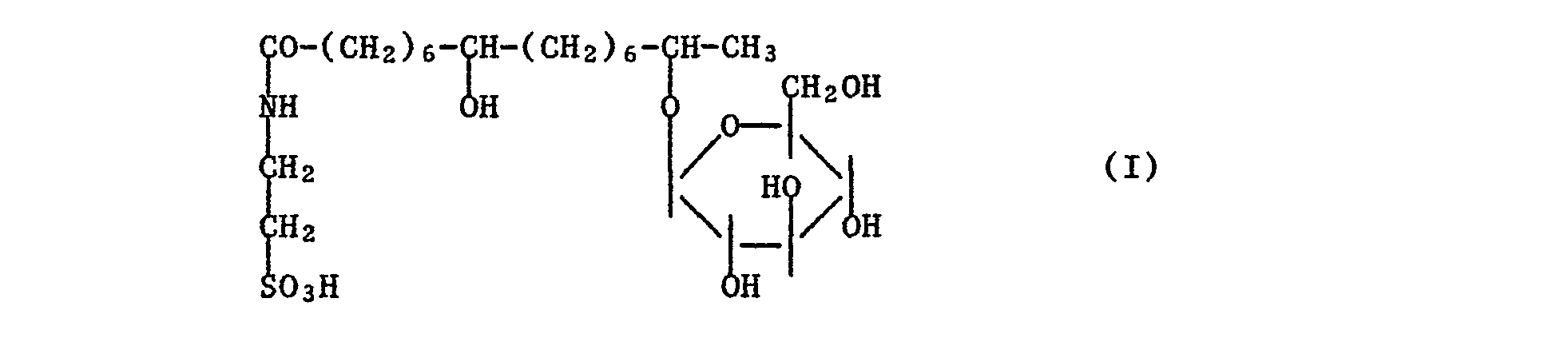
- Die vorliegende Erfindung betrifft ein neues Palmityl-glucopyranosid, ein Verfahren zu seiner Gewinnung, sowie seine Verwendung zum Schützen von Kirschen vor dem Befall durch Kirschenfliegen.
- Das erfindungsgemässe Palmityl-glucopyranosid entspricht der Formel I
- Die Weibchen der Kirschenfliege Rhagoletis cerasi legen ihre Eier in halbreife Kirschen. Bis zum Zeitpunkt des Pflückens der reifen Früchte entwickeln sich die Larven in den Kirschen und machen diese als Tafelobst unbrauchbar. Es war somit ein dringendes Bedürfnis, ein Mittel zu finden, mit dem die heranreifenden Früchte vor der Eiablage behandelt werden können, um so die Kirschenfliege an der Eiablage zu hindern.
- Auf Grund der Beobachtung, dass in der Regel in einer Kirsche nur eine einzige Larve zu finden ist, wurde die Oberfläche von befallenen Kirschen gereinigt. Der Reinigungsextrakt wurde auf heranwachsende Kirschen appliziert und eine Abnahme des Befalls durch Kirschenfliegen festgestellt.
- Zur Gewinnung grösserer Mengen des Markierungsstoffes der Kirschenfliegen wurden Zuchtkäfige aus Plexiglas verwendet. Nach 2 bis 4 Wochen nach Versuchsbeginn wurden die Exkremente der Fliegen von den Glaswänden abgestossen und mit Methanol extrahiert. Die braune Lösung wurde eingeengt und mit Aethanol verdünnt. Dieser Extrakt ist bei -20°C beliebig lange haltbar und wurde für die weitere Aufarbeitung verwendet.
- Die Reinigung des Extraktes erfolgte mittels mehrfacher, abwechslungsweiser Säulen- und Dünnschicht-Chromatographie. Als Laufmittel wurden Mischungen von Methanol, Aethanol, Acetonitril und Wasser sowie die reinen Lösungsmittel verwendet.
- Die Aktivität der einzelnen Fraktionen wurde im Verhaltensexperiment und elektrophysiologisch an der Kirschenfliege geprüft. Nach sechs Reinigungsoperationen war der Extrakt so rein, dass weder die FAB-Spektren noch die FD-Spektren auf wesentliche Verunreinigungen hinwiesen.
- Die eigentliche Strukturaufklärung erfolgte mit einem handelsüblichen HF-Massenspektrometer und einem ebenfalls handelsüblichen NMR-Spektrometer, wobei nach üblichen Methoden vorgegangen wurde. Die erhaltenen Signale wurden nach bekannten Methoden ausgewertet und bestätigten die Struktur der Formel I.
- Zur Gewinnung des Rohmaterials werden Zuchtkäfige aus Plexiglas (30x30x40 cm) verwendet, die mit Glasplatten ausgekleidet und zur Vergrösserung der Oberflächen mit weiteren Glasplatten senkrecht unterteilt sind. Diese Käfige werden mit einer Wasserquelle und Futter bestehend aus Hefehydrolysat und Zucker versehen. Die Kirschenfliegen (Rhagoletis cerasi) werden alsdann in diesen Käfigen zum Schlüpfen gebracht. Die auf den Glasplatten deponierten Exkremente der Kirschenfliegen werden nach 3 Wochen mit einer Rasierklinge abgestossen.
- 7,3 g dieser braunen, klebrigen Masse werden in 75 ml Methanol während 10 Minuten in einem Ultraschallbad aufgeschlämmt. Anschliessend wird bei 2°C während 4 Stunden mit einem Magnetrührer gerührt und 20 Minuten lang bei 12 000 g zentrifugiert. Der Bodensatz wird zwei weitere Male in 40 ml Methanol aufgeschlämmt und wie beschrieben extrahiert und zentrifugiert. Die vereinigten methanolischen Extrakte werden am Rotationsverdampfer auf 20 ml eingeengt und dann mit 20 ml Aethanol verdünnt (= 40 ml Rohextrakt).
- Ein Glasrohr 50/600 mm wird nach dem Schüttverfahren mit Cellulosepulver (123 A, Schleicher-Schüll, Dassel, BRD) in Methanol/Aethanol 1:1 auf eine Säulenhöhe von 400 mm gefüllt. 40 ml des unter (A) erhaltenen Rohextraktes werden auf diese Säule gegeben und bei einem Säulenfluss von 10-15 mlomin-1 zuerst mit 1400 ml Methanol/Aethanol 1:1 und dann mit 1000 ml Methanol/Wasser 1:1 eluiert.
- Elektrophysiologisch wird im Intervall zwischen 1100 ml und 2000 ml Elutionsvolumen Aktivität nachgewiesen. Diese 900 ml werden am Rotationsverdampfer auf 0,5 ml eingeengt und in 3,5 ml Methanol aufgenommen.
- 8 PSC-Celluloseplatten mit den Massen 200/200 mm und 0,5 mm Schichtdicke, ohne Fluoreszenzindikator (Merck, Darmstadt, BRD), werden zur Reinigung einmal mit Wasser und nach Trockenwerden einmal mit Methanol bis zum oberen Rande entwickelt. In trockenem Zustand werden auf jede Platte 0,5 ml des unter B.I erhaltenen methanolischen Konzentrates mit Hilfe eines Auftraggerätes aufgebracht. Die Entwicklung erfolgt mit Aethanol/Wasser 1:1. Nach beendeter Entwicklung wird das Schichtmaterial in Streifen von 0,1 Rf-Einheiten entfernt und wie folgt eluiert: Die Streifen werden in 15 ml Methanol aufgeschlämmt, 15 Minuten lang mit dem Magnetrührer extrahiert und anschliessend während 15 Minuten bei 3000 g zentrifugiert. Der Bodensatz wird nochmals mit 10 ml Methanol der gleichen Extraktion unterworfen. Die vereinigten methanolischen Lösungen werden am Rotationsverdampfer auf ein Volumen von 0,5 ml eingeengt. Elektrophysiologische Aktivität zeigt sich bei 0,9 und 1,0 Rf-Einheiten.
-
- Säulentyp : Ultrasphere-ODS (Altex, USA) 4,6x250 mm; Korngrösse 5 µ.
- Laufmittel: 20 % Methanol in Wasser bis 100 % Methanol bei einem Gradienten von 5 % Methanol·min-1 (steiler Gradient)
- Säulenfluss: 0,5 ml·min-1
- Fraktionsvolumen: 0,5 ml
- Der unter B.2 erhaltene Extrakt wird in Portionen von 0,1 ml auf die Säule gegeben.
- Elektrophysiologisch wird im Intervall zwischen 7,5 ml und 9 ml Elutionsvolumen Aktivität nachgewiesen. Die vereinigten aktiven Fraktionen werden am Vakuum auf 0,1 ml eingeengt und dann mit Methanol auf 0,5 ml verdünnt.
- Fluoreszenzindikator (Antec, Beinwil, CH) 5 Platten werden wie unter B.2 beschrieben gereinigt. Auf die gereinigten trockenen Platten wird je 0,1 ml des unter B.3 gewonnenen Extraktes mit einem Auftraggerät aufgebracht. Die Entwicklung der Platten erfolgt mit Methanol als Laufmittel. Nach beendeter Entwicklung wird das Schichtmaterial in Streifen von 0,1 Rf-Einheiten entfernt und wie folgt eluiert: Die Streifen werden je in 3 ml Methanol aufgeschlämmt und 15 Minuten lang mit einem Magnetrührer extrahiert und anschliessend während 20 Minuten bei 3000 g zentrifugiert. Die Bodensätze werden nochmals der gleichen Extraktion unterworfen und die entsprechenden Ueberstände vereinigt. Diese 10 Fraktionen werden einzeln am Rotationsverdampfer zur Trockne eingeengt und je in 0,3 ml Methanol/Acetonitril 1:1 aufgenommen.
- Elektrophysiologisch wird im Rf-Einheitenbereich 0,5-0,7 Aktivität nachgewiesen.
-
- Säulentyp : Lichrosorb NH2 (Merck, Darmstadt, BRD) 4x250 mm; Korngrösse 5 u.
- Laufmittel: 100 % Acetonitril bis 100 % Wasser bei einem Gradienten von 6 % Wasser·min-1
- Säulenfluss: 0,5 ml·min-1
- Fraktionsvolumen: 0,5 ml
- Die unter B.4 erhaltenen aktiven Extrakte werden in Portionen von 0,1 ml auf die Säule gegeben.
- Elektrophysiologisch wird im Intervall von 12,5 ml bis 15 ml Elutionsvolumen Aktivität nachgewiesen. In diesem Bereich wird das Wasser durch Lyophilisation entfernt und der Rückstand in 0,3 ml 40%igem Methanol/Wasser-Gemisch aufgenommen.
-
- Säulentyp : Ultrasphere-ODS (Altex, USA) 4,6x250 mm; Korngrösse 5 u.
- Laufmittel: 40 % Methanol in Wasser bis 100 % Methanol bei einem Gradienten von 2 % Methanol·min-1 (flacher Gradient)
- Säulenfluss: 0,5 ml·min-1
- Fraktionsvolumen: 0,5 ml
- Der unter B.5 erhaltene Extrakt wird in zwei Portionen von 0,15 ml auf die Säule gegeben. Jede der erhaltenen 50 Fraktionen wird am Rotationsverdampfer auf 0,1 ml und in einem Gefäss mit konischem Boden in einem leichten Stickstoffstrom zur Trockne eingeengt.
- Die Fraktionen Nr. 16 bis Nr. 22 zeigen biologische Aktivität. Der trockene Rückstand dieser Fraktionen bildet an der Gefässwand einen farblosen, lackartigen und nicht verdampfbaren Film von hoher Polarität und ohne Lichtabsorption im UV-Bereich.
- Jede der sieben aktiven Fraktionen wird in 50 pl Methanol aufgenommen. Die Fraktion Nr. 19 weist die höchste Konzentration auf und ist elektrophysiologisch bis zu einer 107 fachen Verdünnung nachzuweisen. Im labormässigen Verhaltensexperiment mit Kirschenfliegen an behandelten Ceresin-Wachsdomen (E. Boller und J. Hurter: Entomol.exp.appl. 39, 163-169, 1985) wird der elektrophysiologische Befund bestätigt.
- Die Prüfung auf biologische Aktivität der Fraktionen erfolgt mittels elektrophysiologischen Ableitungen von tarsalen Kontakt-Chemorezeptoren, wobei nach der von E. Städler beschriebenen Methode vorgegangen wird (E. Städler: Contract Chemoreception; Chemical Ecology of Insects, 1984, p. 3-35). Die zu messenden Proben bestehen aus 10 µl Fraktionslösung aufgelöst in 1 ml 10 mN Natriumchlorid-Lösung. 2 µl dieser verdünnten Lösung werden in eine Glas-Kapillarelektrode aufgesogen und zur Stimulierung von 4 bis 8 Rezeptoren des Prothorax tarsus einer weiblichen Kirschenfliege verwendet.
- Fast Atom Bombardment (FAB) einer Probe von B.6 liefert ein Massenspektrum, das intensive Signale für das protonierte Molekül [M + H]+ (m/z 558) sowie von Addukten des Moleküls mit Alkalimetallionen, z.B. [M + Na]+ (m/z 580) und [M + K]+ (m/z 596), zeigt. Als Matrix wird Thioglycerin verwendet. Eine Massenbestimmung unter Hochauflösungsbedingungen (Matrix:Polyäthylenglykol) ergibt für das [M + Na] + Ion 580,2778, was mit der Bruttoformel C24H47011NSNa (berechnete Masse 580,2764) gut übereinstimmt.
- Das 400 MHz 1H-NMR-Spektrum in CD30D zeigt das Vorhandensein einer Glucose an, die ß-glykosidisch mit dem w-1 Kohlenstoff eines geradkettigen Dihydroxyfettsäure-Derivates verknüpft ist. Die GC/MS-Analyse der mit Bis-trimethylsilyl-acetamid silylierten Methanolyseprodukte liefert die Information über die Kettenlänge der Dihydroxyfettsäure und die Position der freien OH-Gruppen in der Kette. Das EI-MS-Spektrum des Trimethylsilyl (TMS)-Derivates des Methylesters (M = 446, extrapoliert vom [M-CH3]+ -Fragment m/z = 431 und von [M + H]+-Ion m/z = 447, das durch chemische Ionisation mit Isobutan als Reaktandgas erhalten wird) zerfällt in charakteristischen a-Brüchen in die Fragmente TMS-O=CH(CH2)6COOCH3 m/z = 245; CH3CH(O-TMS)-(CH2)6-CH=TMS, m/z = 303; und CH3CH=0-TMS, m/z = 117. Aus diesen Fragmenten folgen die Hydroxylpositionen C-8 und C-15 und somit auch die Kettenabschnitte m=n=6.

- Bei der Methanolyse wird als weiteres Spaltprodukt von B.6 Taurin mit Hilfe der Dünnschichtchromatographie nachgewiesen (DC-Fertigplatten, Kieselgel 60 F 254; Laufmittel n-Butanol/99%ige Essigsäure/Wasser 8:3:1 und n-Propanol/25%iger Ammoniak 8:2; Nachweis- reagenz:Cl2/KJ/N,N,N',N'-Tetramethyl-4,4'-diaminodiphenylmethan).
- Die auf Grund der NMR-Signale postulierte Amid-Verknüpfung zwischen Fettsäure und Taurin steht mit der Nichtacetylierbarkeit des N-Atoms von B.6 in vollem Einklang.


- b.) Die Signale der fünf Acetylgruppen erscheinen als Singuletts bei 2.04, 2.01, 2.00 (2x) und 1.95 ppm.
- c.) Die Signale der (CH2)m- und (CH2)n-Gruppen absorbieren als Multipletts bei 1.60 und 1.45-1.25 ppm-für 1 sowie 1.65-1.50 und 1.45-1.25 ppm für la.
Claims (4)

Priority Applications (1)
| Application Number | Priority Date | Filing Date | Title |
|---|---|---|---|
| AT87810015T ATE88187T1 (de) | 1986-01-17 | 1987-01-12 | Neues glucopyranosid. |
Applications Claiming Priority (2)
| Application Number | Priority Date | Filing Date | Title |
|---|---|---|---|
| CH19286 | 1986-01-17 | ||
| CH192/86 | 1986-01-17 |
Publications (3)
| Publication Number | Publication Date |
|---|---|
| EP0230397A2 true EP0230397A2 (de) | 1987-07-29 |
| EP0230397A3 EP0230397A3 (en) | 1989-01-18 |
| EP0230397B1 EP0230397B1 (de) | 1993-04-14 |
Family
ID=4181347
Family Applications (1)
| Application Number | Title | Priority Date | Filing Date |
|---|---|---|---|
| EP87810015A Expired - Lifetime EP0230397B1 (de) | 1986-01-17 | 1987-01-12 | Neues Glucopyranosid |
Country Status (3)
| Country | Link |
|---|---|
| EP (1) | EP0230397B1 (de) |
| AT (1) | ATE88187T1 (de) |
| DE (1) | DE3785368D1 (de) |
Cited By (2)
| Publication number | Priority date | Publication date | Assignee | Title |
|---|---|---|---|---|
| EP0352230A3 (de) * | 1988-07-22 | 1991-04-10 | Ciba-Geigy Ag | Optische Isomere eines Palmitoylglucopyranosids, ein Verfahren zu deren Herstellung und deren Verwendung |
| EP0474590A3 (en) * | 1990-08-13 | 1993-04-21 | Ciba-Geigy Ag | Taurine derivatives, process for their preparation and their use |
-
1987
- 1987-01-12 AT AT87810015T patent/ATE88187T1/de not_active IP Right Cessation
- 1987-01-12 DE DE8787810015T patent/DE3785368D1/de not_active Expired - Fee Related
- 1987-01-12 EP EP87810015A patent/EP0230397B1/de not_active Expired - Lifetime
Non-Patent Citations (2)
| Title |
|---|
| EXPERIENTIA, Band 43, No. 2, Februar 1987, Seiten 157-164, Birkh{user Verlag, Basel, CH; J. HURTER et al.: "Oviposition-deterring pheromone in Rhagoletis cerasi L.: Purification and determination of the chemical constitution" * |
| Z. ANGEW. ENTOMOL, Band 80, 1976, Seiten 50-56, Verlag Paul Parey, Hamburg, Berlin, DE; J. HURTER et al.: "Beitrag zur Anreicherung und teilweisen Reinigung des eiablageverhindernden Pheromons der Kirschenfliege, Rhagoletis cerasi L. (Dipt., Trypetidae) * |
Cited By (2)
| Publication number | Priority date | Publication date | Assignee | Title |
|---|---|---|---|---|
| EP0352230A3 (de) * | 1988-07-22 | 1991-04-10 | Ciba-Geigy Ag | Optische Isomere eines Palmitoylglucopyranosids, ein Verfahren zu deren Herstellung und deren Verwendung |
| EP0474590A3 (en) * | 1990-08-13 | 1993-04-21 | Ciba-Geigy Ag | Taurine derivatives, process for their preparation and their use |
Also Published As
| Publication number | Publication date |
|---|---|
| DE3785368D1 (de) | 1993-05-19 |
| EP0230397B1 (de) | 1993-04-14 |
| EP0230397A3 (en) | 1989-01-18 |
| ATE88187T1 (de) | 1993-04-15 |
Similar Documents
| Publication | Publication Date | Title |
|---|---|---|
| Hurter et al. | Oviposition-deterring pheromone in Rhagoletis cerasi L.: purification and determination of the chemical constitution | |
| DE2510866C3 (de) | 4'-epi-Adriamycin a - und ß -Anomer, Verfahren zu deren Herstellung und diese enthaltende pharmazeutische Zusammensetzungen | |
| US8318146B1 (en) | Ascarosides as nematode sex pheromones | |
| Baer et al. | Synthesis of L-α-(Dioleoyl)-cephalin; with a Comment on the Stereochemical Designation of Glycerolphosphatides1 | |
| Geerdes et al. | Chromatographic separation of sugars with hydrocellulose | |
| EP0230397B1 (de) | Neues Glucopyranosid | |
| EP0270992A2 (de) | Zytostatisch wirksame Anthracyclinderivate | |
| Bittner et al. | Isolation and identification of a plant growth inhibitor from avocado | |
| DE3508356A1 (de) | Sialinsaeure-derivate und verfahren zu ihrer herstellung | |
| DE3629052C2 (de) | Antitumor-Antibiotika | |
| Camp et al. | Absorption and metabolism of carbaryl by several insect species | |
| Gnanasunderam et al. | Hiptagin and other aliphatic nitro esters in Lotus pedunculatus | |
| DE3219209A1 (de) | N-acetylneuraminsaeure-derivate | |
| US4032551A (en) | Method of obtaining neutral lipid material used as a hatching agent for sugar beet nematode | |
| EP0277310A1 (de) | Zytostatisch wirksame Anthracyclinderivate | |
| Charon et al. | Synthesis and in vitro activities of a spacer-containing glycophospholipid ligand of a lipopolysaccharide receptor involved in endotoxin tolerance | |
| DE69513293T2 (de) | D-mannose- oder xylito-ester und ihre verwenung als arzneimittel | |
| DE1643521C3 (de) | 4'-Demethyl-epipodophyllotoxin-ß-Dglucosidderivate sowie ein Verfahren zu ihrer Herstellung und Arzneimittel mit einem Gehalt dieser Verbindungen | |
| DE68920623T2 (de) | Dem Avermectin ähnliche antiparasitäre Derivate. | |
| Lynch et al. | The chemical nature of metacercarial cysts. II. Biochemical investigations on the cyst of Posthodiplostomum minimum | |
| Park et al. | Negative Ion Chemical Ionization Mass Spectrometric Method for Confirmation of Identity of Aflatoxin B: Collaborative Study | |
| JPH02111785A (ja) | スフインゴ糖脂質 | |
| DE69329148T2 (de) | Schnelle extraktion von ciguatoxin aus kontaminierten geweben | |
| Vijayalakshmi et al. | The nature of cottonseed phospholipids | |
| Bland et al. | Trilinolein identified as a sex-specific component of tergal glands in alates of Coptotermes formosanus |
Legal Events
| Date | Code | Title | Description |
|---|---|---|---|
| PUAI | Public reference made under article 153(3) epc to a published international application that has entered the european phase |
Free format text: ORIGINAL CODE: 0009012 |
|
| 17P | Request for examination filed |
Effective date: 19870115 |
|
| AK | Designated contracting states |
Kind code of ref document: A2 Designated state(s): AT CH DE FR IT LI |
|
| PUAL | Search report despatched |
Free format text: ORIGINAL CODE: 0009013 |
|
| AK | Designated contracting states |
Kind code of ref document: A3 Designated state(s): AT CH DE FR IT LI |
|
| 17Q | First examination report despatched |
Effective date: 19910911 |
|
| GRAA | (expected) grant |
Free format text: ORIGINAL CODE: 0009210 |
|
| AK | Designated contracting states |
Kind code of ref document: B1 Designated state(s): AT CH DE FR IT LI |
|
| REF | Corresponds to: |
Ref document number: 88187 Country of ref document: AT Date of ref document: 19930415 Kind code of ref document: T |
|
| ITF | It: translation for a ep patent filed | ||
| REF | Corresponds to: |
Ref document number: 3785368 Country of ref document: DE Date of ref document: 19930519 |
|
| ET | Fr: translation filed | ||
| PLBE | No opposition filed within time limit |
Free format text: ORIGINAL CODE: 0009261 |
|
| STAA | Information on the status of an ep patent application or granted ep patent |
Free format text: STATUS: NO OPPOSITION FILED WITHIN TIME LIMIT |
|
| 26N | No opposition filed | ||
| PGFP | Annual fee paid to national office [announced via postgrant information from national office to epo] |
Ref country code: FR Payment date: 19961125 Year of fee payment: 11 |
|
| PGFP | Annual fee paid to national office [announced via postgrant information from national office to epo] |
Ref country code: DE Payment date: 19961205 Year of fee payment: 11 |
|
| PGFP | Annual fee paid to national office [announced via postgrant information from national office to epo] |
Ref country code: AT Payment date: 19961211 Year of fee payment: 11 |
|
| PGFP | Annual fee paid to national office [announced via postgrant information from national office to epo] |
Ref country code: CH Payment date: 19961212 Year of fee payment: 11 |
|
| PG25 | Lapsed in a contracting state [announced via postgrant information from national office to epo] |
Ref country code: AT Free format text: LAPSE BECAUSE OF NON-PAYMENT OF DUE FEES Effective date: 19980112 |
|
| PG25 | Lapsed in a contracting state [announced via postgrant information from national office to epo] |
Ref country code: LI Free format text: LAPSE BECAUSE OF NON-PAYMENT OF DUE FEES Effective date: 19980131 Ref country code: FR Free format text: THE PATENT HAS BEEN ANNULLED BY A DECISION OF A NATIONAL AUTHORITY Effective date: 19980131 Ref country code: CH Free format text: LAPSE BECAUSE OF NON-PAYMENT OF DUE FEES Effective date: 19980131 |
|
| REG | Reference to a national code |
Ref country code: CH Ref legal event code: PL |
|
| PG25 | Lapsed in a contracting state [announced via postgrant information from national office to epo] |
Ref country code: DE Free format text: LAPSE BECAUSE OF NON-PAYMENT OF DUE FEES Effective date: 19981001 |
|
| REG | Reference to a national code |
Ref country code: FR Ref legal event code: ST |
|
| PG25 | Lapsed in a contracting state [announced via postgrant information from national office to epo] |
Ref country code: IT Free format text: LAPSE BECAUSE OF NON-PAYMENT OF DUE FEES;WARNING: LAPSES OF ITALIAN PATENTS WITH EFFECTIVE DATE BEFORE 2007 MAY HAVE OCCURRED AT ANY TIME BEFORE 2007. THE CORRECT EFFECTIVE DATE MAY BE DIFFERENT FROM THE ONE RECORDED. Effective date: 20050112 |