EP0230773B1 - Composés dipropargyloxybenzéniques et leur préparation - Google Patents
Composés dipropargyloxybenzéniques et leur préparation Download PDFInfo
- Publication number
- EP0230773B1 EP0230773B1 EP86310054A EP86310054A EP0230773B1 EP 0230773 B1 EP0230773 B1 EP 0230773B1 EP 86310054 A EP86310054 A EP 86310054A EP 86310054 A EP86310054 A EP 86310054A EP 0230773 B1 EP0230773 B1 EP 0230773B1
- Authority
- EP
- European Patent Office
- Prior art keywords
- group
- compound
- formula
- hydrogen atom
- alkyl group
- Prior art date
- Legal status (The legal status is an assumption and is not a legal conclusion. Google has not performed a legal analysis and makes no representation as to the accuracy of the status listed.)
- Expired - Lifetime
Links
- 0 CC(C(*C#C)C(C(*)C1)*#C)C1*=C Chemical compound CC(C(*C#C)C(C(*)C1)*#C)C1*=C 0.000 description 17
Classifications
-
- C—CHEMISTRY; METALLURGY
- C07—ORGANIC CHEMISTRY
- C07C—ACYCLIC OR CARBOCYCLIC COMPOUNDS
- C07C255/00—Carboxylic acid nitriles
-
- C—CHEMISTRY; METALLURGY
- C07—ORGANIC CHEMISTRY
- C07C—ACYCLIC OR CARBOCYCLIC COMPOUNDS
- C07C43/00—Ethers; Compounds having groups, groups or groups
- C07C43/02—Ethers
- C07C43/20—Ethers having an ether-oxygen atom bound to a carbon atom of a six-membered aromatic ring
- C07C43/215—Ethers having an ether-oxygen atom bound to a carbon atom of a six-membered aromatic ring having unsaturation outside the six-membered aromatic rings
-
- A—HUMAN NECESSITIES
- A01—AGRICULTURE; FORESTRY; ANIMAL HUSBANDRY; HUNTING; TRAPPING; FISHING
- A01N—PRESERVATION OF BODIES OF HUMANS OR ANIMALS OR PLANTS OR PARTS THEREOF; BIOCIDES, e.g. AS DISINFECTANTS, AS PESTICIDES OR AS HERBICIDES; PEST REPELLANTS OR ATTRACTANTS; PLANT GROWTH REGULATORS
- A01N31/00—Biocides, pest repellants or attractants, or plant growth regulators containing organic oxygen or sulfur compounds
- A01N31/08—Oxygen or sulfur directly attached to an aromatic ring system
- A01N31/16—Oxygen or sulfur directly attached to an aromatic ring system with two or more oxygen or sulfur atoms directly attached to the same aromatic ring system
-
- A—HUMAN NECESSITIES
- A01—AGRICULTURE; FORESTRY; ANIMAL HUSBANDRY; HUNTING; TRAPPING; FISHING
- A01N—PRESERVATION OF BODIES OF HUMANS OR ANIMALS OR PLANTS OR PARTS THEREOF; BIOCIDES, e.g. AS DISINFECTANTS, AS PESTICIDES OR AS HERBICIDES; PEST REPELLANTS OR ATTRACTANTS; PLANT GROWTH REGULATORS
- A01N35/00—Biocides, pest repellants or attractants, or plant growth regulators containing organic compounds containing a carbon atom having two bonds to hetero atoms with at the most one bond to halogen, e.g. aldehyde radical
- A01N35/04—Biocides, pest repellants or attractants, or plant growth regulators containing organic compounds containing a carbon atom having two bonds to hetero atoms with at the most one bond to halogen, e.g. aldehyde radical containing aldehyde or keto groups, or thio analogues thereof, directly attached to an aromatic ring system, e.g. acetophenone; Derivatives thereof, e.g. acetals
-
- A—HUMAN NECESSITIES
- A01—AGRICULTURE; FORESTRY; ANIMAL HUSBANDRY; HUNTING; TRAPPING; FISHING
- A01N—PRESERVATION OF BODIES OF HUMANS OR ANIMALS OR PLANTS OR PARTS THEREOF; BIOCIDES, e.g. AS DISINFECTANTS, AS PESTICIDES OR AS HERBICIDES; PEST REPELLANTS OR ATTRACTANTS; PLANT GROWTH REGULATORS
- A01N35/00—Biocides, pest repellants or attractants, or plant growth regulators containing organic compounds containing a carbon atom having two bonds to hetero atoms with at the most one bond to halogen, e.g. aldehyde radical
- A01N35/08—Biocides, pest repellants or attractants, or plant growth regulators containing organic compounds containing a carbon atom having two bonds to hetero atoms with at the most one bond to halogen, e.g. aldehyde radical at least one of the bonds to hetero atoms is to nitrogen
- A01N35/10—Biocides, pest repellants or attractants, or plant growth regulators containing organic compounds containing a carbon atom having two bonds to hetero atoms with at the most one bond to halogen, e.g. aldehyde radical at least one of the bonds to hetero atoms is to nitrogen containing a carbon-to-nitrogen double bond
-
- A—HUMAN NECESSITIES
- A01—AGRICULTURE; FORESTRY; ANIMAL HUSBANDRY; HUNTING; TRAPPING; FISHING
- A01N—PRESERVATION OF BODIES OF HUMANS OR ANIMALS OR PLANTS OR PARTS THEREOF; BIOCIDES, e.g. AS DISINFECTANTS, AS PESTICIDES OR AS HERBICIDES; PEST REPELLANTS OR ATTRACTANTS; PLANT GROWTH REGULATORS
- A01N37/00—Biocides, pest repellants or attractants, or plant growth regulators containing organic compounds containing a carbon atom having three bonds to hetero atoms with at the most two bonds to halogen, e.g. carboxylic acids
- A01N37/36—Biocides, pest repellants or attractants, or plant growth regulators containing organic compounds containing a carbon atom having three bonds to hetero atoms with at the most two bonds to halogen, e.g. carboxylic acids containing at least one carboxylic group or a thio analogue, or a derivative thereof, and a singly bound oxygen or sulfur atom attached to the same carbon skeleton, this oxygen or sulfur atom not being a member of a carboxylic group or of a thio analogue, or of a derivative thereof, e.g. hydroxy-carboxylic acids
- A01N37/38—Biocides, pest repellants or attractants, or plant growth regulators containing organic compounds containing a carbon atom having three bonds to hetero atoms with at the most two bonds to halogen, e.g. carboxylic acids containing at least one carboxylic group or a thio analogue, or a derivative thereof, and a singly bound oxygen or sulfur atom attached to the same carbon skeleton, this oxygen or sulfur atom not being a member of a carboxylic group or of a thio analogue, or of a derivative thereof, e.g. hydroxy-carboxylic acids having at least one oxygen or sulfur atom attached to an aromatic ring system
- A01N37/40—Biocides, pest repellants or attractants, or plant growth regulators containing organic compounds containing a carbon atom having three bonds to hetero atoms with at the most two bonds to halogen, e.g. carboxylic acids containing at least one carboxylic group or a thio analogue, or a derivative thereof, and a singly bound oxygen or sulfur atom attached to the same carbon skeleton, this oxygen or sulfur atom not being a member of a carboxylic group or of a thio analogue, or of a derivative thereof, e.g. hydroxy-carboxylic acids having at least one oxygen or sulfur atom attached to an aromatic ring system having at least one carboxylic group or a thio analogue, or a derivative thereof, and one oxygen or sulfur atom attached to the same aromatic ring system
-
- A—HUMAN NECESSITIES
- A01—AGRICULTURE; FORESTRY; ANIMAL HUSBANDRY; HUNTING; TRAPPING; FISHING
- A01N—PRESERVATION OF BODIES OF HUMANS OR ANIMALS OR PLANTS OR PARTS THEREOF; BIOCIDES, e.g. AS DISINFECTANTS, AS PESTICIDES OR AS HERBICIDES; PEST REPELLANTS OR ATTRACTANTS; PLANT GROWTH REGULATORS
- A01N43/00—Biocides, pest repellants or attractants, or plant growth regulators containing heterocyclic compounds
- A01N43/02—Biocides, pest repellants or attractants, or plant growth regulators containing heterocyclic compounds having rings with one or more oxygen or sulfur atoms as the only ring hetero atoms
- A01N43/24—Biocides, pest repellants or attractants, or plant growth regulators containing heterocyclic compounds having rings with one or more oxygen or sulfur atoms as the only ring hetero atoms with two or more hetero atoms
- A01N43/26—Biocides, pest repellants or attractants, or plant growth regulators containing heterocyclic compounds having rings with one or more oxygen or sulfur atoms as the only ring hetero atoms with two or more hetero atoms five-membered rings
- A01N43/28—Biocides, pest repellants or attractants, or plant growth regulators containing heterocyclic compounds having rings with one or more oxygen or sulfur atoms as the only ring hetero atoms with two or more hetero atoms five-membered rings with two hetero atoms in positions 1,3
-
- C—CHEMISTRY; METALLURGY
- C07—ORGANIC CHEMISTRY
- C07C—ACYCLIC OR CARBOCYCLIC COMPOUNDS
- C07C43/00—Ethers; Compounds having groups, groups or groups
- C07C43/02—Ethers
- C07C43/20—Ethers having an ether-oxygen atom bound to a carbon atom of a six-membered aromatic ring
- C07C43/225—Ethers having an ether-oxygen atom bound to a carbon atom of a six-membered aromatic ring containing halogen
-
- C—CHEMISTRY; METALLURGY
- C07—ORGANIC CHEMISTRY
- C07C—ACYCLIC OR CARBOCYCLIC COMPOUNDS
- C07C43/00—Ethers; Compounds having groups, groups or groups
- C07C43/02—Ethers
- C07C43/20—Ethers having an ether-oxygen atom bound to a carbon atom of a six-membered aromatic ring
- C07C43/23—Ethers having an ether-oxygen atom bound to a carbon atom of a six-membered aromatic ring containing hydroxy or O-metal groups
-
- C—CHEMISTRY; METALLURGY
- C07—ORGANIC CHEMISTRY
- C07C—ACYCLIC OR CARBOCYCLIC COMPOUNDS
- C07C43/00—Ethers; Compounds having groups, groups or groups
- C07C43/30—Compounds having groups
- C07C43/315—Compounds having groups containing oxygen atoms singly bound to carbon atoms not being acetal carbon atoms
-
- C—CHEMISTRY; METALLURGY
- C07—ORGANIC CHEMISTRY
- C07C—ACYCLIC OR CARBOCYCLIC COMPOUNDS
- C07C45/00—Preparation of compounds having >C = O groups bound only to carbon or hydrogen atoms; Preparation of chelates of such compounds
- C07C45/61—Preparation of compounds having >C = O groups bound only to carbon or hydrogen atoms; Preparation of chelates of such compounds by reactions not involving the formation of >C = O groups
- C07C45/67—Preparation of compounds having >C = O groups bound only to carbon or hydrogen atoms; Preparation of chelates of such compounds by reactions not involving the formation of >C = O groups by isomerisation; by change of size of the carbon skeleton
- C07C45/68—Preparation of compounds having >C = O groups bound only to carbon or hydrogen atoms; Preparation of chelates of such compounds by reactions not involving the formation of >C = O groups by isomerisation; by change of size of the carbon skeleton by increase in the number of carbon atoms
- C07C45/70—Preparation of compounds having >C = O groups bound only to carbon or hydrogen atoms; Preparation of chelates of such compounds by reactions not involving the formation of >C = O groups by isomerisation; by change of size of the carbon skeleton by increase in the number of carbon atoms by reaction with functional groups containing oxygen only in singly bound form
- C07C45/71—Preparation of compounds having >C = O groups bound only to carbon or hydrogen atoms; Preparation of chelates of such compounds by reactions not involving the formation of >C = O groups by isomerisation; by change of size of the carbon skeleton by increase in the number of carbon atoms by reaction with functional groups containing oxygen only in singly bound form being hydroxy groups
-
- C—CHEMISTRY; METALLURGY
- C07—ORGANIC CHEMISTRY
- C07C—ACYCLIC OR CARBOCYCLIC COMPOUNDS
- C07C47/00—Compounds having —CHO groups
- C07C47/52—Compounds having —CHO groups bound to carbon atoms of six—membered aromatic rings
- C07C47/575—Compounds having —CHO groups bound to carbon atoms of six—membered aromatic rings containing ether groups, groups, groups, or groups
-
- C—CHEMISTRY; METALLURGY
- C07—ORGANIC CHEMISTRY
- C07C—ACYCLIC OR CARBOCYCLIC COMPOUNDS
- C07C65/00—Compounds having carboxyl groups bound to carbon atoms of six—membered aromatic rings and containing any of the groups OH, O—metal, —CHO, keto, ether, groups, groups, or groups
- C07C65/21—Compounds having carboxyl groups bound to carbon atoms of six—membered aromatic rings and containing any of the groups OH, O—metal, —CHO, keto, ether, groups, groups, or groups containing ether groups, groups, groups, or groups
- C07C65/28—Compounds having carboxyl groups bound to carbon atoms of six—membered aromatic rings and containing any of the groups OH, O—metal, —CHO, keto, ether, groups, groups, or groups containing ether groups, groups, groups, or groups having unsaturation outside the aromatic rings
-
- C—CHEMISTRY; METALLURGY
- C07—ORGANIC CHEMISTRY
- C07D—HETEROCYCLIC COMPOUNDS
- C07D317/00—Heterocyclic compounds containing five-membered rings having two oxygen atoms as the only ring hetero atoms
- C07D317/08—Heterocyclic compounds containing five-membered rings having two oxygen atoms as the only ring hetero atoms having the hetero atoms in positions 1 and 3
- C07D317/10—Heterocyclic compounds containing five-membered rings having two oxygen atoms as the only ring hetero atoms having the hetero atoms in positions 1 and 3 not condensed with other rings
- C07D317/14—Heterocyclic compounds containing five-membered rings having two oxygen atoms as the only ring hetero atoms having the hetero atoms in positions 1 and 3 not condensed with other rings with substituted hydrocarbon radicals attached to ring carbon atoms
- C07D317/18—Radicals substituted by singly bound oxygen or sulfur atoms
- C07D317/22—Radicals substituted by singly bound oxygen or sulfur atoms etherified
Definitions
- This invention relates to dipropargyloxybenzene compounds and their production.
- Benzimidazole and thiophanate fungicides such as Benomyl (methyl 1-(butylcarbamoyl)benzimidazol-2-ylcarbamate), Fubelidazol (2-(2-furyl)benzimidazole), Thiabendazole (2-(4-thiazolyl)benzimidazole), Carbendazim (methyl benzimidazol-2-ylcarbamate), Thiophanate-methyl (1,2-bis(3-methoxycarbonyl-2-thioureido)benzene), Thiophanate (1,2-bis(3-ethoxycarbonyl-2-thioureido)benzene), 2-(O,S-dimethylphos- phorylamino)-1-(3'-methoxycarbonyl-2'-thioureido)benzene and 2-(0,0-dimethylthiophosphorylamino)-1-(3'-methoxycarbonyl-2'-thioureido
- Cyclic imide fungicides such as Procymidone (3-(3',5'-dichlorophenyl)-1,2-dimethylcyclopropane-1,2-dicarboximide), Iprodione (3-(3',5'dichlorophenyl)-1-isopropylcarbamoylimidazolidine-2,4-dione), Vinchlozolin (3-(3',5'-dichlorophenyl)-5-methyl-5-vinyloxazolidin-2,4-dione) and ethyl ⁇ RS)-3-(3',5'-dichlorophenyl)-5-methyl-2,4-dioxooxazolidine-5-carboxylate, which are effective against various plant diseases, particularly those caused by Botrytis cinerea, have the same defects as previously explained with respect to the benzimidazole or thiophanate fungicides.
- Procymidone 3-(3',5'
- DE 2156 920 discloses selective insecticides which also have some herbicidal activity which are represented by the general formula:- wherein R is alkynyl, R 1 is selected from alkynoxy, thioalkynoxy, haloalkenoxy or carboalkynoxy, and X is selected from hydrogen, alkyl, alkenyl, alkynyl, alkoxy, thioalkoxy, alkynoxy, halogen, cyano, carboalkoxy, carboalkynoxy, formyl or carbamyl and represents one or more substituents, which may be the same or different, at one or more positions on the ring. There is no suggestion however in DE 2156920 that compounds of this general type have any fungicidal activity.
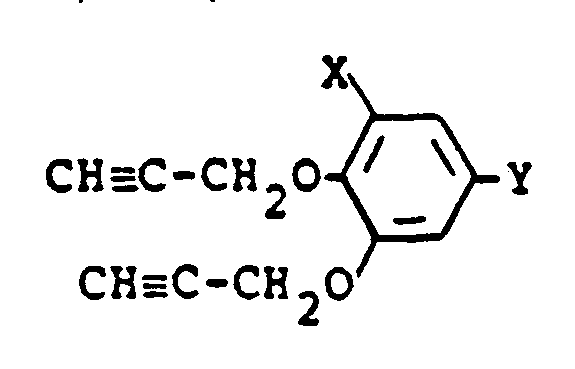
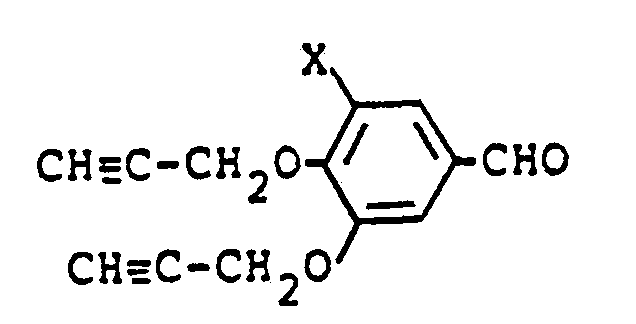
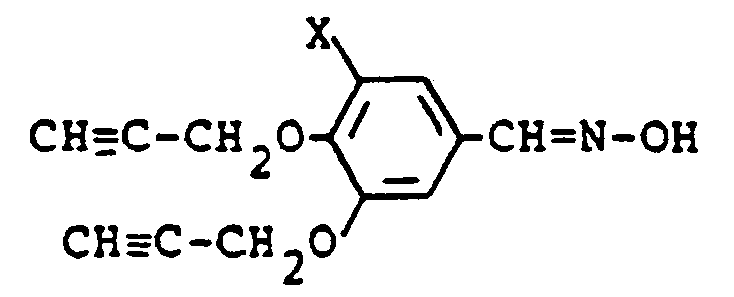
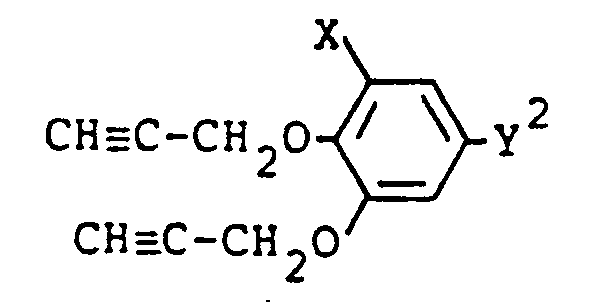
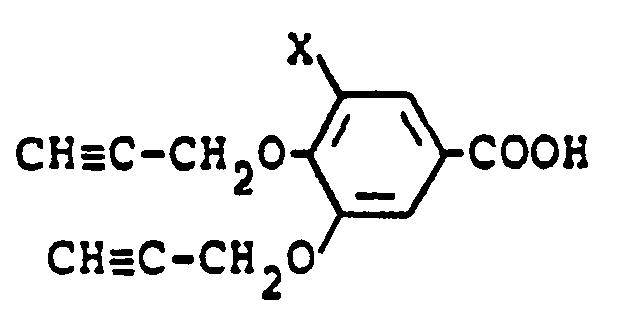
- dipropargyloxybenzene compounds of the formula: wherein X is a hydrogen atom, a halogen atom, a C l -C 3 alkyl group or a C l -C 3 alkoxy group and Y is a hydrogen atom, a halogen atom, a cyano group, a formyl group, an ethylene-dioxymethyl group, a hydroxyl group, a hydroxymethyl group or a group of either one of the formulas: ⁇ CH N ⁇ OR 1 , ⁇ COOR 2 , -CONH-R 2 or ⁇ CH(OR 3 ) 2 , in which R 1 is a hydrogen atom, a C l -C 3 alkyl group, a C 3 ⁇ C 5 alkenyl.
- R 2 is a hydrogen atom, a C 1 ⁇ C 3 alkyl group, a C 3 ⁇ C 5 alkenyl group or a C 3 ⁇ C 5 alkynyl group and R 3 is a C,-C 3 alkyl group, with the proviso that X and Y are not simultaneously hydrogen atoms show an excellent fungicidal activity against plant pathogenic fungi which have developed resistance to benzimidazole, thiophanate and/or cyclic imide fungicides.
- drug-resistant fungi or "drug-resistant strains”
- drug-sensitive fungi or “drug-sensitive strains”
- the dipropargyloxybenzene compounds (I) are fungicidally effective against a wide scope of plant pathogenic fungi, of which examples are as follows: Podosphaera leucotricha, Venturia inaequalis, Mycosphaerella pomi, Marssonina mali and Sclerotinia mali of apple, Phyllactinia kakicola and Gloeosporium kaki of persimmon, Cladosporium carpophilum and Phomopsis sp.
- fragariae of strawberry Botrytis alli of onion, Cercospora apii of celery, Phaeoisariopsis griseola of kidney bean, Erysiphe cichoracearum of tobacco, Diplocarpon rosae of rose, Elsinoe fawcetti, Penicillium italicum, Penicillium digitatum of orange, Botrytis cinerea of cucumber, eggplant, tomato, strawberry, pimiento, onion, lettuce, grape, orange, cyclamen, rose or hop, Sclerotinia sclerotiorum of cucumber, eggplant, pimiento, lettuce, celery, kidney bean, soybean, azuki bean, potato or sunflower, Sclerotinia cinerea of peach or cherry, Mycosphaerella melonis of cucumber or melon, etc.
- the dipropargyloxybenzene compounds (I) are highly effective in controlling the drug-resistant strains of said fungi. Besides, the dipropargyloxybenzene compounds (I) can also exert a significant antifungal activity against Pyricularia oryzae, Pseudoperonospora cubensis, Plasmopara, viticola, Phytophthora infestans, etc.
- the dipropargyloxybenzene compounds (I) are low toxic and have little detrimental actions on mammals, fishes and so on. Also, they may be applied to the agricultural field without causing any material toxicity to important crop plants.
- dipropargyloxybenzene compounds for use in the methods of controlling plant pathogenic fungi in accordance with another aspect of the invention can be prepared by various procedures, of which typical ones are shown below:
- the reaction is usually carried out in an inert solvent (e.g. N,N-dimethylformamide, methanol, ethanol, tetrahydrofuran, acetonitrile, chloroform, toluene, water, their mixtures) at a temperature from -60°C to the boiling point of the solvent within about 12 hours.
- an inert solvent e.g. N,N-dimethylformamide, methanol, ethanol, tetrahydrofuran, acetonitrile, chloroform, toluene, water, their mixtures
- the reaction is usually carried out in an inert solvent (e.g. N,N-dimethylformamide, methanol, ethanol, tetrahydrofuran, acetonitrile, chloroform, toluene, water, their mixtures) in the presence of a base at a temperature from 0 to 200°C, preferably from room temperature to 90°C, within about 12 hours.
- a base e.g. sodium hydride, triethylamine, pyridine, sodium hydroxide, potassium hydroxide, sodium carbonate, potassium carbonate, etc.
- a phase transfer catalyst e.g. tetra-n-butylammonium bromide may be used in the reaction, if desired.
- the compound (VII) may be allowed to react with a nitrite such as an alkali metal nitrite (e.g. sodium nitrite, potassium nitrite), an alkaline earth metal nitrite (e.g. barium nitrite) or an alkyl nitrite (e.g. methyl nitrite). Further, the reaction is carried out in the absence or presence of an inert solvent (e.g. water, dioxane, acetone, their mixtures) in the existence of an acid (e.g. hydrochloric acid, sulfuric acid, hydrobromic acid, formic acid, acetic acid).
- a nitrite such as an alkali metal nitrite (e.g. sodium nitrite, potassium nitrite), an alkaline earth metal nitrite (e.g. barium nitrite) or an alkyl nitrite (e.g. methyl nitrite).
- an inert solvent e.g.
- the decomposition proceeds in the presence of an alcohol (e.g. methanol, ethanol) or hydrophosphorus acid at a temperature of room temperature to 150°C with about 12 hours to give the compound (1-3) wherein Y 1 is hydrogen.
- an alcohol e.g. methanol, ethanol
- hydrophosphorus acid e.g. aric acid
- a copper halide e.g. copper chloride, copper bromide
- the use of copper cyanide gives the compound (1-3) wherein Y 1 is cyano
- sulfuric acid gives the compound (1-3) wherein Y 1 is hydroxyl.
- the compound (VII) is obtainable according to the procedure as described in Japanese Patent Publn. (unexamined) No. 83148/1986.
- the reaction is usually carried out in an inert solvent (e.g. N,N-dimethylformamide, tetrahydrofuran, acetonitrile, chloroform, toluene, water, their mixtures) in the presence of a base (e.g. sodium hydride, triethylamine, pyridine, sodium hydroxide, potassium hydroxide, sodium carbonate, potassium carbonate) at a temperature from 0 to 120°C, preferably from room temperature to 90°C, within about 12 hours.
- an inert solvent e.g. N,N-dimethylformamide, tetrahydrofuran, acetonitrile, chloroform, toluene, water, their mixtures
- a base e.g. sodium hydride, triethylamine, pyridine, sodium hydroxide, potassium hydroxide, sodium carbonate, potassium carbonate
- the compound (VIII) can be prepared according to the method as described in J. Chem. Soc., Perkin 1, 1015 (1973).
- the reaction is usually carried out in the absence or presence of an inert solvent (e.g. N,N-dimethylformamide, tetrahydrofuran, acetonitrile, chloroform, toluene, water, their mixtures) at a temperature from -10°C to the boiling point of the reaction mixture within about 12 hours.
- an inert solvent e.g. N,N-dimethylformamide, tetrahydrofuran, acetonitrile, chloroform, toluene, water, their mixtures
- a base e.g. N,N-diethylaniline, triethylamine, pyridine, sodium hydroxide, potassium hydroxide, sodium carbonate, potassium carbonate
- a base e.g. N,N-diethylaniline, triethylamine, pyridine, sodium hydroxide, potassium hydroxide, sodium carbonate, potassium carbonate
- the starting compound (IX) is obtainable by reacting a compound of the formula: wherein X is as defined above with a halogenating agent (e.g. thionyl chloride, thionyl bromide, phosgene) in the absence or presence of an inert solvent (e.g. benzene, toluene, hexane, tetrahydrofuran, their mixtures) at a temperature from room temperature to the boiling point of the reaction mixture within about 12 hours.
- a halogenating agent e.g. thionyl chloride, thionyl bromide, phosgene
- an inert solvent e.g. benzene, toluene, hexane, tetrahydrofuran, their mixtures
- the reaction is usually carried out in an inert solvent (e.g. N,N-dimethylformamide, tetrahydrofuran, acetonitrile, chloroform, toluene, water, their mixtures) in the presence of a base (e.g. sodium hydride, triethylamine, pyridine, sodium hydroxide, potassium hydroxide, sodium carbonate, potassium carbonate) at a temperature from 0 to 120°C, preferably from room temperature to 90°C, within about 12 hours.
- an inert solvent e.g. N,N-dimethylformamide, tetrahydrofuran, acetonitrile, chloroform, toluene, water, their mixtures
- a base e.g. sodium hydride, triethylamine, pyridine, sodium hydroxide, potassium hydroxide, sodium carbonate, potassium carbonate
- oxidizing agent examples include Jones reagent, manganese dioxide, potassium permanganate, pyridinium chlorochromate, etc.
- the reaction is usually carried out in an inert solvent (e.g. water, acetone, benzene, toluene, hexane, dichloromethane, carbon tetrachloride, their mixture) at a temperature of 0 to 100°C within about 12 hours.
- an inert solvent e.g. water, acetone, benzene, toluene, hexane, dichloromethane, carbon tetrachloride, their mixture
- the reaction is ordinarily carried out in the absence or presence of an inert solvent (e.g. methanol, ethanol, benzene, toluene, xylene, chloroform, carbon tetrachloride, their mixtures) at a temperature from 0°C to the boiling point of the reaction mixture for a period of about 15 minutes to 12 hours.
- an inert solvent e.g. methanol, ethanol, benzene, toluene, xylene, chloroform, carbon tetrachloride, their mixtures
- the reducing agent examples include sodium borohydride, lithium aluminium hydride, aluminium ethoxide, aluminium isopropoxide, etc.
- the reduction is performed in the presence of an inert solvent (e.g. water, methanol, ethanol, benzene, toluene, hexane, ethyl acetate, dioxane, tetrahydrofuran) at a temperature from -10 to 100°C within about 12 hours.
- an inert solvent e.g. water, methanol, ethanol, benzene, toluene, hexane, ethyl acetate, dioxane, tetrahydrofuran
- the compound (1-1) can have syn- and anti-isomers and represent such syn- or anti-isomer, or their mixture, inclusively.
- dipropargyloxybenzene compounds (I) as fungicides, they may be applied as such or in a formulation form such as dusts, wettable powders, oil sprays, emulsifiable concentrates, tablets, granules, fine granules, aerosols or flowables.
- a formulation form such as dusts, wettable powders, oil sprays, emulsifiable concentrates, tablets, granules, fine granules, aerosols or flowables.
- Such preparation form can be formulated in a conventional manner by mixing at least one of the dipropargyloxybenzene compounds (I) with an appropriate solid or liquid carrier(s) or diluent(s) and, if necessary, an appropriate adjuvant(s) (e.g. surfactants, adherents, dispersants, stabilizers) for improving the dispersibility and other properties of the active ingredients.
- an appropriate adjuvant(s) e.g. surfactants
- solid carriers or diluents examples include botanical materials (e.g. flour, tobacco stalk powder, soybean powder, walnut-shell powder, vegetable powder, saw dust, bran, bark powder, cellulose powder, vegetable extract residue), fibrous materials (e.g. paper, corrugated cardboard, old rags), synthetic plastic powders, clays (e.g. kaolin, bentonite, fuller's earth), talcs, other inorganic materials (e.g. pyrophyllite, sericite, pumice, sulfur powder, active carbon) and chemical fertilizers (e.g. ammonium sulfate, ammonium phosphate, ammonium nitrate, urea, ammonium chloride).
- botanical materials e.g. flour, tobacco stalk powder, soybean powder, walnut-shell powder, vegetable powder, saw dust, bran, bark powder, cellulose powder, vegetable extract residue
- fibrous materials e.g. paper, corrugated cardboard, old rags
- synthetic plastic powders e.g. paper,
- liquid carriers or diluents examples include water, alcohols (e.g. methanol, ethanol), ketones (e.g. acetone, methylethylketone), ethers (e.g. diethyl ether, dioxane, cellosolve, tetrahydrofuran), aromatic hydrocarbons (e.g. benzene, toluene, xylene, methyl naphthalene), aliphatic hydrocarbons (e.g. gasoline, kerosene, lamp oil), esters, nitriles, acid amides (e.g. dimethylformamide, dimethylacetamide), halogenated hydrocarbons (e.g. dichloroethane, carbon tetrachloride), etc.
- alcohols e.g. methanol, ethanol
- ketones e.g. acetone, methylethylketone
- ethers e.g. diethyl ether, diox
- surfactants are alkyl sulfuric esters, alkyl sulfonates, alkylaryl sulfonates, polyethylene glycol ethers, polyhydric alcohol esters, etc.
- adherents and dispersants may include casein, gelatin, starch powder, carboxymethyl cellulose, gum arabic, alginic acid, lignin, bentonite, molasses, polyvinyl alcohol, pine oil and agar.
- the stabilizers there may be used PAP (isopropyl acid phosphate mixture), tricresyl phosphate (TCP), tolu oil, epoxydized oil, various surfactants, various fatty acids and their esters, etc.
- the foregoing formulation generally contain at least one of the dipropargyloxybenzene compounds (I) in a concentration of about 1 to 95% by weight, preferably of 2.0 to 80% by weight.
- the dipropargyloxybenzene compounds (I) are generally applied in such amounts as 2 to 100 g per 10 are.
- the dipropargyloxybenzene compounds (I) may be used alone.
- the drug-sensitive strains are present together with the drug-resistant strains, their alternate use with benzimidazole, thiophanate and/or cyclic imide fungicides or their combined use with benzimidazole, thiophanate and/or cyclic imide fungicides is favorable.
- each active ingredient may be employed as such or in conventional agricultural formulation forms.
- the weight proportion of the dipropargyloxybenzene compound (I) and the benzimidazole, thiophanate and/or cyclic imide fungicide may be from about 1 : 0.1 to 1 : 10.0.
- dipropargyloxybenzene compounds (I) may be also used in admixture with other fungicides, herbicides, insecticides, miticides, fertilizers, etc.
- dipropargyloxybenzene compounds (I) When used as fungicides, they may be applied in such amounts as 2 to 100 grams per 10 are. However, this amount may vary depending upon formulation forms, application times, application methods, application sites, diseases, crops and so on, and therefore, they are not limited to said particular amounts.
- fungicidal composition according to the invention Some practical embodiments of the fungicidal composition according to the invention are illustratively shown in the following Examples wherein % and part(s) are by weight.
- the leaves examined were measured for a percentage of infected area and classified into the corresponding disease indices, 0, 0.5, 1, 2, 4:
- the disease severity was calculated according to the following equation:
- the prevention value was calculated according to the following equation:
Landscapes
- Chemical & Material Sciences (AREA)
- Organic Chemistry (AREA)
- Life Sciences & Earth Sciences (AREA)
- General Health & Medical Sciences (AREA)
- Plant Pathology (AREA)
- Health & Medical Sciences (AREA)
- Engineering & Computer Science (AREA)
- Dentistry (AREA)
- Agronomy & Crop Science (AREA)
- Wood Science & Technology (AREA)
- Zoology (AREA)
- Environmental Sciences (AREA)
- Pest Control & Pesticides (AREA)
- Chemical Kinetics & Catalysis (AREA)
- Agricultural Chemicals And Associated Chemicals (AREA)
- Organic Low-Molecular-Weight Compounds And Preparation Thereof (AREA)
Claims (26)











Applications Claiming Priority (14)
| Application Number | Priority Date | Filing Date | Title |
|---|---|---|---|
| JP29728285 | 1985-12-27 | ||
| JP297281/85 | 1985-12-27 | ||
| JP29728185 | 1985-12-27 | ||
| JP297282/85 | 1985-12-27 | ||
| JP299208/85 | 1985-12-28 | ||
| JP299209/85 | 1985-12-28 | ||
| JP29920885 | 1985-12-28 | ||
| JP29920985 | 1985-12-28 | ||
| JP47011/86 | 1986-03-04 | ||
| JP47008/86 | 1986-03-04 | ||
| JP4701186 | 1986-03-04 | ||
| JP4700886 | 1986-03-04 | ||
| JP4782086 | 1986-03-05 | ||
| JP47820/86 | 1986-03-05 |
Publications (2)
| Publication Number | Publication Date |
|---|---|
| EP0230773A1 EP0230773A1 (fr) | 1987-08-05 |
| EP0230773B1 true EP0230773B1 (fr) | 1990-05-23 |
Family
ID=27564656
Family Applications (1)
| Application Number | Title | Priority Date | Filing Date |
|---|---|---|---|
| EP86310054A Expired - Lifetime EP0230773B1 (fr) | 1985-12-27 | 1986-12-23 | Composés dipropargyloxybenzéniques et leur préparation |
Country Status (6)
| Country | Link |
|---|---|
| US (1) | US4946865A (fr) |
| EP (1) | EP0230773B1 (fr) |
| JP (1) | JPH0749379B2 (fr) |
| KR (1) | KR870005950A (fr) |
| DE (1) | DE3671426D1 (fr) |
| ES (1) | ES2016264B3 (fr) |
Cited By (1)
| Publication number | Priority date | Publication date | Assignee | Title |
|---|---|---|---|---|
| CN103501597A (zh) * | 2011-04-29 | 2014-01-08 | 巴斯夫欧洲公司 | 包含农药和缩醛溶剂的组合物 |
Families Citing this family (12)
| Publication number | Priority date | Publication date | Assignee | Title |
|---|---|---|---|---|
| US5340931A (en) * | 1988-03-15 | 1994-08-23 | Nippon Paint Co., Ltd. | Aromatic allene compounds of the formula (CH2 ═CH--O)n --R--(Am in which R is an aromatic group and preparation thereof |
| DE68928783T2 (de) * | 1988-11-21 | 1998-12-24 | Zeneca Ltd., London | Zwischenverbindungen zur Herstellung von Fungiziden |
| US5733935A (en) * | 1995-06-29 | 1998-03-31 | Nihon Nohyaku Co., Ltd. | Hydroxylamine derivatives and fungicides containing the same |
| JP2005520829A (ja) * | 2002-03-19 | 2005-07-14 | チバ スペシャルティ ケミカルズ ホールディング インコーポレーテッド | ベンジルアルコール誘導体 |
| JP2007145816A (ja) * | 2005-10-27 | 2007-06-14 | Sumitomo Chemical Co Ltd | アミド化合物及びその用途 |
| JP2007145817A (ja) * | 2005-10-27 | 2007-06-14 | Sumitomo Chemical Co Ltd | アミド化合物及びその用途 |
| DE602006008025D1 (de) | 2005-10-27 | 2009-09-03 | Sumitomo Chemical Co | Amidverbindungen und deren verwendung |
| JP2008291012A (ja) * | 2007-04-27 | 2008-12-04 | Sumitomo Chemical Co Ltd | アミド化合物ならびにその植物病害防除用途 |
| JP2008291023A (ja) * | 2007-04-27 | 2008-12-04 | Sumitomo Chemical Co Ltd | アミド化合物とその用途 |
| WO2008136385A1 (fr) * | 2007-04-27 | 2008-11-13 | Sumitomo Chemical Company, Limited | Composé amide et son utilisation |
| JP2008291013A (ja) * | 2007-04-27 | 2008-12-04 | Sumitomo Chemical Co Ltd | アミド化合物およびその植物病害防除用途 |
| US9585382B2 (en) | 2011-04-29 | 2017-03-07 | Basf Se | Composition comprising a pesticide and an acetal solvent |
Family Cites Families (17)
| Publication number | Priority date | Publication date | Assignee | Title |
|---|---|---|---|---|
| US3322813A (en) * | 1962-06-30 | 1967-05-30 | Meiji Seika Kaisha | Halopropargyl aryl ether compounds |
| US3338950A (en) * | 1963-07-23 | 1967-08-29 | Meiji Seika Kaisha | Iodopropargyl aralkyl ether compounds |
| US3288834A (en) * | 1963-12-26 | 1966-11-29 | Dow Chemical Co | 2-propynyl ester of substituted (2-propynyloxy) benzoic acids |
| US3340308A (en) * | 1963-12-26 | 1967-09-05 | Dow Chemical Co | 2-propynyloxy derivatives of substituted bisphenols |
| US3489805A (en) * | 1965-02-16 | 1970-01-13 | Hoffmann La Roche | 2,3-dihalophenyl-3-iodopropargyl ethers |
| US3862238A (en) * | 1969-12-09 | 1975-01-21 | Albrecht Mueller | 2-(2-butynyloxy)-phenol |
| AU3576571A (en) * | 1970-11-16 | 1973-05-24 | Stauffer Chemical Company | Aryl acetylene ethers |
| US3816541A (en) * | 1970-11-16 | 1974-06-11 | Stauffer Chemical Co | Aryl acetylene ethers |
| US3908000A (en) * | 1971-03-19 | 1975-09-23 | Hoffmann La Roche | Propynyl benzyl ethers as insecticidal agents |
| CH547059A (de) * | 1971-03-19 | 1974-03-29 | Hoffmann La Roche | Schaedlingsbekaempfungsmittel. |
| EP0005710A3 (fr) * | 1978-05-31 | 1980-04-16 | F. HOFFMANN-LA ROCHE & CO. Aktiengesellschaft | Un dérivé propynyloxyméthyle, sa préparation, un pesticide contenant ce dérivé ou un dérivé analogue et l'utilisation de ces deux produits comme pesticides |
| GB2023591B (en) * | 1978-06-21 | 1982-10-06 | Montedison Spa | Hydroquinone diethers having a juvenile hormonic and acaricide activity |
| EP0012157A1 (fr) * | 1978-08-28 | 1980-06-25 | Ciba-Geigy Ag | Composés 1-phénoxy-2-alkinyloxy éthaniques, méthode pour leur préparation, compositions les contenant et leur utilisation comme pesticides |
| US4388323A (en) * | 1980-03-28 | 1983-06-14 | Montedison S.P.A. | Acaricide compounds |
| DE3307636A1 (de) * | 1983-03-04 | 1984-09-06 | Basf Ag, 6700 Ludwigshafen | Phenoxyacetylene und verfahren zu ihrer herstellung |
| AU3022984A (en) * | 1983-07-15 | 1985-01-17 | Nippon Soda Co., Ltd. | Formamidoxime derivatives |
| FR2598408A1 (fr) * | 1986-05-12 | 1987-11-13 | Rhone Poulenc Agrochimie | Derives propargyloxybenzenes : leur preparation et compositions fongicides les contenant |
-
1986
- 1986-12-12 JP JP61297047A patent/JPH0749379B2/ja not_active Expired - Lifetime
- 1986-12-23 EP EP86310054A patent/EP0230773B1/fr not_active Expired - Lifetime
- 1986-12-23 DE DE8686310054T patent/DE3671426D1/de not_active Expired - Lifetime
- 1986-12-23 ES ES86310054T patent/ES2016264B3/es not_active Expired - Lifetime
- 1986-12-24 US US06/945,959 patent/US4946865A/en not_active Expired - Fee Related
- 1986-12-27 KR KR860011393A patent/KR870005950A/ko not_active Withdrawn
Cited By (2)
| Publication number | Priority date | Publication date | Assignee | Title |
|---|---|---|---|---|
| CN103501597A (zh) * | 2011-04-29 | 2014-01-08 | 巴斯夫欧洲公司 | 包含农药和缩醛溶剂的组合物 |
| CN103501597B (zh) * | 2011-04-29 | 2016-02-17 | 巴斯夫欧洲公司 | 包含农药和缩醛溶剂的组合物 |
Also Published As
| Publication number | Publication date |
|---|---|
| EP0230773A1 (fr) | 1987-08-05 |
| KR870005950A (ko) | 1987-07-08 |
| JPH0749379B2 (ja) | 1995-05-31 |
| JPS6327450A (ja) | 1988-02-05 |
| ES2016264B3 (es) | 1990-11-01 |
| US4946865A (en) | 1990-08-07 |
| DE3671426D1 (de) | 1990-06-28 |
Similar Documents
| Publication | Publication Date | Title |
|---|---|---|
| US4608385A (en) | Fungicidal N-phenylcarbamates | |
| EP0100615B1 (fr) | Anilides fongicides | |
| US4946865A (en) | Dipropargyloxybenzene compounds and their production | |
| US4501756A (en) | Fungicidal carbamates useful against fungi resistant to benzamidazole fungicides | |
| EP0063905B1 (fr) | N-Phénylcarbamates à activité fongicide | |
| US4672070A (en) | Fungicidal N-pyridinylamide derivatives | |
| EP0125901B1 (fr) | Dérivés d'aniline à activité fongicide | |
| CA1235708A (fr) | Derives fongicides d'aniline | |
| EP0116409B1 (fr) | Dérivés d'aniline à activité fongicide | |
| EP0117024B1 (fr) | Dérivés d'aniline à activité fongicide | |
| US4710514A (en) | Fungicidal carbamates and thiolcarbamates | |
| EP0100190B1 (fr) | N-phénylcarbamates à activité fongicide | |
| US4605668A (en) | Fungicidal carbamate compounds | |
| EP0257828B1 (fr) | Composés dipropargyloxybenzéniques et leur production | |
| EP0104070B1 (fr) | N-Phénylcarbamates à activité fongicide | |
| EP0123386B1 (fr) | Carbamates N-phényl condensés fongicides | |
| US4727083A (en) | Fungicidal composition employing nitrobenzene derivatives | |
| EP0093620B1 (fr) | N-phénylcarbamates fongicides | |
| US4474808A (en) | Pesticidally active novel N-sulphenylated biuret-N"-carboxylic acid esters | |
| US4123549A (en) | N-(3,5-dihalophenyl)-α-spirocycloalkanesuccinimides, and their preparation and use |
Legal Events
| Date | Code | Title | Description |
|---|---|---|---|
| PUAI | Public reference made under article 153(3) epc to a published international application that has entered the european phase |
Free format text: ORIGINAL CODE: 0009012 |
|
| AK | Designated contracting states |
Kind code of ref document: A1 Designated state(s): BE CH DE ES FR GB IT LI NL |
|
| 17P | Request for examination filed |
Effective date: 19871221 |
|
| 17Q | First examination report despatched |
Effective date: 19880912 |
|
| RAP3 | Party data changed (applicant data changed or rights of an application transferred) |
Owner name: SUMITOMO CHEMICAL COMPANY, LIMITED |
|
| GRAA | (expected) grant |
Free format text: ORIGINAL CODE: 0009210 |
|
| AK | Designated contracting states |
Kind code of ref document: B1 Designated state(s): BE CH DE ES FR GB IT LI NL |
|
| ITF | It: translation for a ep patent filed | ||
| ET | Fr: translation filed | ||
| REF | Corresponds to: |
Ref document number: 3671426 Country of ref document: DE Date of ref document: 19900628 |
|
| PGFP | Annual fee paid to national office [announced via postgrant information from national office to epo] |
Ref country code: CH Payment date: 19901116 Year of fee payment: 5 |
|
| PGFP | Annual fee paid to national office [announced via postgrant information from national office to epo] |
Ref country code: BE Payment date: 19901121 Year of fee payment: 5 |
|
| PGFP | Annual fee paid to national office [announced via postgrant information from national office to epo] |
Ref country code: GB Payment date: 19901207 Year of fee payment: 5 |
|
| PGFP | Annual fee paid to national office [announced via postgrant information from national office to epo] |
Ref country code: ES Payment date: 19901214 Year of fee payment: 5 |
|
| PGFP | Annual fee paid to national office [announced via postgrant information from national office to epo] |
Ref country code: FR Payment date: 19901221 Year of fee payment: 5 |
|
| ITTA | It: last paid annual fee | ||
| PGFP | Annual fee paid to national office [announced via postgrant information from national office to epo] |
Ref country code: NL Payment date: 19901231 Year of fee payment: 5 |
|
| PLBE | No opposition filed within time limit |
Free format text: ORIGINAL CODE: 0009261 |
|
| STAA | Information on the status of an ep patent application or granted ep patent |
Free format text: STATUS: NO OPPOSITION FILED WITHIN TIME LIMIT |
|
| 26N | No opposition filed | ||
| PG25 | Lapsed in a contracting state [announced via postgrant information from national office to epo] |
Ref country code: DE Effective date: 19910903 |
|
| PG25 | Lapsed in a contracting state [announced via postgrant information from national office to epo] |
Ref country code: GB Effective date: 19911223 |
|
| PG25 | Lapsed in a contracting state [announced via postgrant information from national office to epo] |
Ref country code: ES Free format text: LAPSE BECAUSE OF THE APPLICANT RENOUNCES Effective date: 19911224 |
|
| PG25 | Lapsed in a contracting state [announced via postgrant information from national office to epo] |
Ref country code: LI Effective date: 19911231 Ref country code: CH Effective date: 19911231 Ref country code: BE Effective date: 19911231 |
|
| BERE | Be: lapsed |
Owner name: SUMITOMO CHEMICAL CY LTD Effective date: 19911231 |
|
| PG25 | Lapsed in a contracting state [announced via postgrant information from national office to epo] |
Ref country code: NL Effective date: 19920701 |
|
| NLV4 | Nl: lapsed or anulled due to non-payment of the annual fee | ||
| GBPC | Gb: european patent ceased through non-payment of renewal fee | ||
| PG25 | Lapsed in a contracting state [announced via postgrant information from national office to epo] |
Ref country code: FR Effective date: 19920831 |
|
| REG | Reference to a national code |
Ref country code: CH Ref legal event code: PL |
|
| REG | Reference to a national code |
Ref country code: FR Ref legal event code: ST |
|
| REG | Reference to a national code |
Ref country code: ES Ref legal event code: FD2A Effective date: 20010402 |
|
| PG25 | Lapsed in a contracting state [announced via postgrant information from national office to epo] |
Ref country code: IT Free format text: LAPSE BECAUSE OF NON-PAYMENT OF DUE FEES Effective date: 20051223 |