EP0231900A2 - N-Benzoyl-N'-phenoxyphenylharnstoffe, Verfahren zu ihrer Herstellung und ihre Verwendung zur Bekämpfung von Schädlingen - Google Patents
N-Benzoyl-N'-phenoxyphenylharnstoffe, Verfahren zu ihrer Herstellung und ihre Verwendung zur Bekämpfung von Schädlingen Download PDFInfo
- Publication number
- EP0231900A2 EP0231900A2 EP87101293A EP87101293A EP0231900A2 EP 0231900 A2 EP0231900 A2 EP 0231900A2 EP 87101293 A EP87101293 A EP 87101293A EP 87101293 A EP87101293 A EP 87101293A EP 0231900 A2 EP0231900 A2 EP 0231900A2
- Authority
- EP
- European Patent Office
- Prior art keywords
- benzoyl
- preparation
- chlorine
- formula
- hydrogen
- Prior art date
- Legal status (The legal status is an assumption and is not a legal conclusion. Google has not performed a legal analysis and makes no representation as to the accuracy of the status listed.)
- Withdrawn
Links
- 0 Cc1cccc(*)c1* Chemical compound Cc1cccc(*)c1* 0.000 description 4
Classifications
-
- C—CHEMISTRY; METALLURGY
- C07—ORGANIC CHEMISTRY
- C07C—ACYCLIC OR CARBOCYCLIC COMPOUNDS
- C07C275/00—Derivatives of urea, i.e. compounds containing any of the groups, the nitrogen atoms not being part of nitro or nitroso groups
- C07C275/46—Derivatives of urea, i.e. compounds containing any of the groups, the nitrogen atoms not being part of nitro or nitroso groups containing any of the groups, X being a hetero atom, Y being any atom, e.g. acylureas
- C07C275/48—Y being a hydrogen or a carbon atom
- C07C275/54—Y being a carbon atom of a six-membered aromatic ring, e.g. benzoylureas
-
- A—HUMAN NECESSITIES
- A01—AGRICULTURE; FORESTRY; ANIMAL HUSBANDRY; HUNTING; TRAPPING; FISHING
- A01N—PRESERVATION OF BODIES OF HUMANS OR ANIMALS OR PLANTS OR PARTS THEREOF; BIOCIDES, e.g. AS DISINFECTANTS, AS PESTICIDES OR AS HERBICIDES; PEST REPELLANTS OR ATTRACTANTS; PLANT GROWTH REGULATORS
- A01N47/00—Biocides, pest repellants or attractants, or plant growth regulators containing organic compounds containing a carbon atom not being member of a ring and having no bond to a carbon or hydrogen atom, e.g. derivatives of carbonic acid
- A01N47/08—Biocides, pest repellants or attractants, or plant growth regulators containing organic compounds containing a carbon atom not being member of a ring and having no bond to a carbon or hydrogen atom, e.g. derivatives of carbonic acid the carbon atom having one or more single bonds to nitrogen atoms
- A01N47/28—Ureas or thioureas containing the groups >N—CO—N< or >N—CS—N<
- A01N47/34—Ureas or thioureas containing the groups >N—CO—N< or >N—CS—N< containing the groups, e.g. biuret; Thio analogues thereof; Urea-aldehyde condensation products
Definitions
- the invention relates to N-benzoyl-N'-phenoxyphenylureas, processes for their preparation and pesticides which contain these compounds as active ingredients.
- N-benzoyl-N'-phenoxyphenylureas can be used as insecticides (J. Agr. Food Chem. 21 , 348 (1973), DE-OS 2 537 413).
- German patent application does not disclose any compound of the formula I in which R3 is halogen and R4 is also hydrogen or halogen.
- 25 37 413 and 25 28 917 compounds of the formula A are known from the German patent applications in which R1 is chlorine, fluorine or bromine, R2 for hydrogen or fluorine, R3 for hydrogen, R4 for methyl or chlorine, R5 for hydrogen and R6 for nitro stands.
- Preferred N-benzoyl-N'-phenoxyphenylureas are compounds of the formula I in which R1 fluorine or chlorine, R2 fluorine, chlorine or hydrogen, R3 chlorine or bromine, R4 means hydrogen, chlorine or bromine.
- the N-benzoyl-N'-phenoxyphenylureas according to the invention fight pests much more effectively than the compounds of analogous constitution and mode of action described above from the prior art.
- the compounds according to the invention therefore represent an enrichment of the technology.
- N-benzoyl-N'-phenoxyphenylureas according to the invention are obtained, for example, by reacting a corresponding compound of the formula II with a corresponding benzoyl isocyanate of the formula III or a corresponding benzoic acid amide with a corresponding phenoxyphenyl isocyanate in a manner known per se.
- the compounds according to the invention are generally uniform, crystalline substances with a defined melting point.
- the benzoyl isocyanates III are known. They can be used according to the regulations in J. Org. Chem. 28 , 18O5-1811 (1963), J. Agr. Food Chem. 21 , 348 (1973) or European patent specification 143 3O2.
- the phenoxyanilines II can be prepared by generally customary processes, for example from an alkali phenolate and 1,2-dichloro-4-trifluoromethylbenzene, nitration of the reaction products and reduction: If one decides to react benzoic acid amides with phenoxyphenyl isocyanates, these can be obtained in a known manner from the anilines of formula II, for example by reaction with phosgene (cf., for example, EP 98 158).
- Step b
- 100 g of the standard nutrient medium for Heliothis are filled into 150 ml beakers and carefully mixed warm with the aqueous active ingredient preparation.
- each vessel is coated with 10 L 3 caterpillars (1.5-1.8 cm) and stored at 23 ° C. Pupation and hatching of the moths are assessed. Result:
- Young maize leaves are immersed in the aqueous active ingredient preparation for 5 seconds. After the coverings have dried briefly, the leaves are placed on a 9 cm round filter in petri dishes ( ⁇ 10 cm) and filled with 5 L 3 beads (1.5 - 1.8 cm) each.
- the dishes are stored at 23 ° C. After 3 days, the caterpillars are placed on untreated synthetic feed. Pupation and hatching of the moths are assessed. Result:
- 5O ml penicilling glasses serve as test vessels. These are loaded with 4.75 ml of nutrient slurry and mixed with 0.25 ml of aqueous active ingredient preparation.
- the finished test batch is covered with filter paper and stored at 23 - 24 ° C. Result:
- the tests are carried out in 100 ml plastic beakers on 40 g of a nutrient medium consisting of carrot powder and water 1: 3 with the addition of yeast.
- the active ingredient is stirred into the finished slurry as an aqueous preparation and inoculated with 1OO-2OO fresh eggs. It is important to ensure that the aqueous egg slurry is used very quickly, otherwise the larvae will hatch and die.
- the cups are kept closed at 24 - 26 ° C; after about a week the development can be assessed. Result:
- Potted bush beans are sprayed to runoff point in the spray booth on the turntable with the aqueous active ingredient preparation. After drying, you punch out sheet pieces of 25 mm through with a cork drill knife from the blades. They are placed on pieces of cellulose that hang on the sides in the water.
- the sheet punches are each occupied with 10 adult females.
- the evaluation is carried out after 10 days, the living larvae being counted. Result:
Landscapes
- Life Sciences & Earth Sciences (AREA)
- Organic Chemistry (AREA)
- Chemical & Material Sciences (AREA)
- Dentistry (AREA)
- Health & Medical Sciences (AREA)
- Engineering & Computer Science (AREA)
- Plant Pathology (AREA)
- General Health & Medical Sciences (AREA)
- Wood Science & Technology (AREA)
- Zoology (AREA)
- Environmental Sciences (AREA)
- Pest Control & Pesticides (AREA)
- Agronomy & Crop Science (AREA)
- Organic Low-Molecular-Weight Compounds And Preparation Thereof (AREA)
- Agricultural Chemicals And Associated Chemicals (AREA)
Abstract

R¹ Fluor oder Chlor
R² Fluor, Chlor oder Wasserstoff
R³ Halogen
R⁴ Wasserstoff oder Halogen bedeutet, Verfahren zu ihrer Herstellung und Verwendung zur Bekämpfung von Schadinsekten und Spinnentieren.
Description
- Die Erfindung betrifft N-Benzoyl-N′-phenoxyphenylharnstoffe, Verfahren zu ihrer Herstellung und Schädlingsbekämpfungsmittel, die diese Verbindungen als Wirkstoffe enthalten.
- Es ist bekannt, daß N-Benzoyl-N′-phenoxyphenylharnstoffe als Insektizide verwendet werden können (J. Agr. Food Chem. 21, 348 (1973), DE-OS 2 537 413).
- Aus der deutschen Offenlegungsschrift 25 37 413 sind N-Benzoyl-N′-phenoxyphenylharnstoffe der Formel A

R¹ für Wasserstoff, Chlor oder Fluor,
R² für Chlor oder Fluor,
R³, R⁴, R⁵ für Wasserstoff und
R⁶ für Trifluormethyl steht. - Die deutsche Offenlegungsschrift offenbart jedoch keine Verbindung der Formel I, in der R³ für Halogen und gleichzeitig R⁴ für Wasserstoff oder Halogen steht.
- Außerdem sind aus den deutschen Offenlegungsschriften 25 37 413 und 25 28 917 Verbindungen der Formel A bekannt, in der
R¹ für Chlor, Fluor oder Brom,
R² für Wasserstoff oder Fluor,
R³ für Wasserstoff,
R⁴ für Methyl oder Chlor,
R⁵ für Wasserstoff und
R⁶ für Nitro
steht. - Jedoch beschreiben diese Offenlegungsschriften keine Verbindungen der Formel I, bei denen Trifluormethyl im Phenoxyrest in 4-Stellung steht.
- Es wurden nun neue N-Benzoyl-N′-phenoxyphenylharnstoffe der Formel I gefunden

R¹ Fluor oder Chlor,
R² Fluor, Chlor oder Wasserstoff,
R³ Halogen,
R⁴ Wasserstoff oder Halogen bedeutet. Diese besitzen eine auffällig starke insektizide Wirkung. - Bevorzugte N-Benzoyl-N′-phenoxyphenylharnstoffe sind Verbindungen der Formel I, bei denen
R¹ Fluor oder Chlor,
R² Fluor, Chlor oder Wasserstoff,
R³ Chlor oder Brom,
R⁴ Wasserstoff, Chlor oder Brom bedeutet. - Überraschenderweise bekämpfen die erfindungsgemäßen N-Benzoyl-N′-phenoxyphenylharnstoffe Schädlinge wesentlich wirksamer als die aus dem Stand der Technik vorbeschriebenen Verbindungen analoger Konstitution und Wirkrichtung. Die erfindungsgemäßen Verbindungen stellen daher eine Bereicherung der Technik dar.
- Man erhält die erfindungsgemäßen N-Benzoyl-N′-phenoxyphenylharnstoffe z.B. durch Umsetzung von einer entsprechenden Verbindung der Formel II


- Die erfindungsgemäßen Verbindungen sind in der Regel einheitliche, kristalline Stoffe mit definiertem Schmelzpunkt.
- Wenn eine besondere Reinheit gefordert wird, können die üblichen Methoden zur Reinigung, z.B. Umkristallisation oder Chromatographie angewandt werden. Zu ihrer Charakterisierung dienen weiterhin Elementaranalyse, IR- und NMR-Spektrum.
- Die Benzoylisocyanate III sind bekannt. Man kann sie nach den Vorschriften in J. Org. Chem. 28, 18O5 - 1811 (1963), J. Agr. Food Chem. 21, 348 (1973) oder der europäischen Patentschrift 143 3O2 erhalten.
- Die Phenoxyaniline II können nach allgemein üblichen Verfahren hergestellt werden, beispielsweise aus einem Alkaliphenolat und 1,2-Dichlor-4-trifluormethylbenzol, Nitrierung der Reaktionsprodukte und Reduktion:

- 7.O g 2,5-Dichlor-4-(2-chlor-4-trifluormethylphenoxy)anilin werden bei Raumtemperatur in 5O ml wasserfreiem Toluol gelöst. Man gibt 1 Tropfen Triethylamin hinzu und tropft 3,3 g 2-Fluorbenzoylisocyanat in 1O ml wasserfreiem Toluol zu. Man rührt noch 3 Stunden bei Raumtemperatur nach, saugt ab und wäscht mit Pentan. Ausbeute 9,5 g mit einem Schmelzpunkt von 191 - 194°C
- 89 g 2,5-Dichlor-4-(2-chlor-4-trifluormethylphenoxy)anilin werden bei Raumtemperatur in 2OO ml wasserfreiem Acetonitril gelöst und 27,5 g 2,6-Difluorbenzoylisocyanat in 6O ml wasserfreiem Acetonitril zugesetzt. Man rührt 14 Stunden bei Raumtemperatur nach und saugt ab und trocknet. Ausbeute 53 g mit einem Schmelzpunkt von 175 - 18O°C.
- 1O,O g 2-Chlor-4-(3-chlor-4-trifluormethylphenoxy)anilin werden bei Raumtemperatur in 4O ml wasserfreiem Toluol gelöst. Man gibt 1 Tropfen Triethylamin hinzu und setzt eine Lösung von 6,9 g 2,6-Dichlorbenzoylisocyanat in 2O ml wasserfreiem Toluol zu. Man rührt 3 Stunden bei Raumtemperatur nach, zieht das Lösungsmittel im Rotationsverdampfer ab und chromatographiert mit Toluol/Aceton an Kieselgel. Nach dem Einengen erhält man 13 g der Titelverbindung mit einem Schmelzpunkt von 142 - 15O°C.
- Zu 2O1 g Kalium-2,5-dichlorphenolat in 8OO ml N-Methylpyrrolidon tropft man 43O g 1,2-Dichlor-4-trifluormethylbenzol und erhitzt 15 Stunden auf 16O°C. Man gießt auf 5 l Wasser, trennt die organische Phase ab, trocknet mit Magnesiumsulfat und destilliert unter vermindertem Druck (Ölpumpe). Man erhält 447 g 2,5-Dichlor-2′-chlor-4′-trifluormethyldiphenylether, Siedepunkt 125 - 135°C,1,5499.

- Zu 4O5 g des Diphenylethers in 6OO ml Essigsäureanhydrid tropft man bei O - 1O°C eine Mischung aus 123 ml 65 % Salpetersäure und 92 ml konz. Schwefelsäure. Man rührt 2 Stunden bei Raumtemperatur nach, gießt in 5 l Eiswasser und saugt ab. Nach Umkristallisation aus Isopropanol erhält man 463 g 2,5-Dichlor-4-nitro-2′-chlor-4′-trifluormethyl-diphenylether mit einem Schmelzpunkt von 88 - 95°C.
- Zu einer Suspension von 19,6 g Eisenpulver in einer siedenden Mischung von 25O g Methanol und 5O g Eisessig tropft man eine Lösung aus 38,7 g der Nitroverbindung in 19O ml Eisessig. Man hält weitere 2 Stunden am Rückfluß und gießt in 3 l Wasser. Die abgeschiedene ölige Flüssigkeit wird in Essigsäureethylester aufgenommen, mit Magnesiumsulfat getrocknet und eingeengt. Man erhält 35 g 2,5-Dichlor-4-(2-chlor-4-trifluormethylphenoxy)anilin mit einem Schmelzpunkt von 79 - 87°C.
- Die in der nachstehenden Tabelle mit ihren Schmelzpunkten angegebenen Verbindungen wurden auf entsprechende Weise hergestellt; die übrigen Verbindungen der Tabelle können unter entsprechender Abwandlung der Herstellvorschriften erhalten werden.


- Für die nachstehenden Anwendungsbeispiele wurden die folgenden Vergleichsmittel gewählt:

- Die Ergebnisse sind in den folgenden Tabellen aufgelistet.
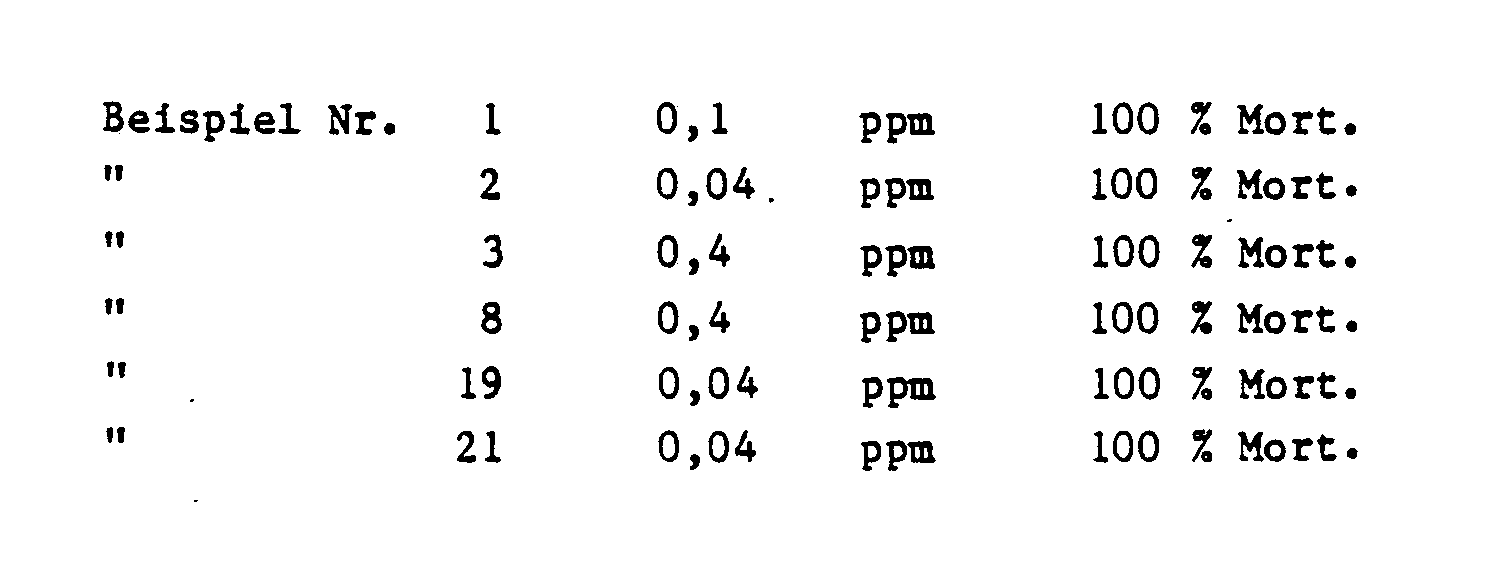
- Junge Maisblätter taucht man für 5 Sekunden in die wäßrige Wirkstoffaufbereitung. Nach kurzem Antrocknen der Beläge gibt man die Blätter auf einen 9 cm Rundfilter in Petrischalen (∅ 1O cm) und besetzt sie mit je 5 L 3-Raupen (1,5 - 1,8 cm).
Die Schalen lagern bei 23°C.
Nach 3 Tagen setzt man die Raupen auf unbehandeltes Kunstfutter. Beurteilt wird Verpuppung und Schlupf der Falter.
Ergebnis:

- 1OO g des Standard-Nährbodens für Heliothis werden in 15O ml-Becher gefüllt und warm mit der wäßrigen Wirkstoffaufbereitung sorgfältig gemischt.
- Nach Erkalten belegt man jedes Gefäß mit 1O L 3-Raupen (1,5 - 1,8 cm) und lagert sie bei 23°C. Beurteilt wird Verpuppung und Schlupf der Falter.
Ergebnis:

- Junge Maisblätter taucht man für 5 Sekunden in die wäßrige Wirkstoffaufbereitung. Nach kurzem Antrocknen der Beläge gibt man die Blätter auf einen 9 cm Rundfilter in Petrischalen (∅ 1O cm) und besetzt sie mit je 5 L 3-Raupen (1,5 - 1,8 cm).
- Die Schalen lagern bei 23°C.
Nach 3 Tagen setzt man die Raupen auf unbehandeltes Kunstfutter. Beurteilt wird Verpuppung und Schlupf der Falter.
Ergebnis:

- Als Versuchsgefäße dienen 5O ml Penicillingläser. Diese werden mit je 4,75 ml Nährbrei beschickt und mit O,25 ml wäßriger Wirkstoffaufbereitung versetzt.
- In einem Becherglas schwämmt man ca. 1O OOO einen Tag alte Fliegeneier in ca. 1OO ml Leitungswasser auf. Aus dieser Suspension überträgt man mittels einer Pipette je einen Tropfen in ein Glas.
- Der fertige Versuchsansatz wird mit einem Filterpapier abgedeckt und bei 23 - 24°C gelagert.
Ergebnis:

- Die Versuche werden in 1OO ml Plastik-Bechern auf 4O g eines Nährbodens aus Karottenpulver und Wasser 1 : 3 mit Hefezusatz durchgeführt.
- Der Wirkstoff wird als wäßrige Aufbereitung in den fertigen Brei eingerührt und dieser mit 1OO - 2OO frischen Eiern beimpft. Es ist darauf zu achten, daß die wäßrige Eier-Aufschlämmung sehr schnell verwendet wird, da sonst die Larven bereits schlüpfen und absterben.
- Die Becher werden bei 24 - 26°C geschlossen aufbewahrt; nach ca. einer Woche kann die Entwicklung beurteilt werden.
Ergebnis:

- 5O g Baumwollsaat werden für 24 Stunden in der wäßrigen Aufbereitung von 1O Gew.-% Wirkstoff und 9O Gew.-% eines Emulgatorgemisches aus 1O % ethoxyliertem Rizinusöl, 2O % ethoxyliertem Isooctylphenol und 7O % Cyclohexanon eingequollen. Die überstehende Flüssigkeit wird abgeschüttet.
- Es wird beobachtet, ob die Tiere
- a) überleben und
- b) sich zu Adulten häuten.
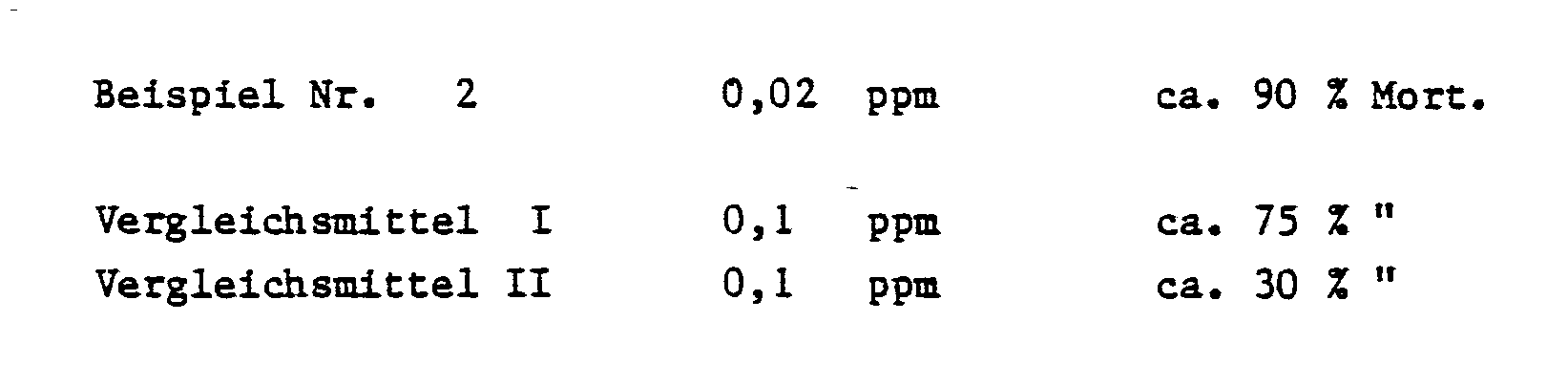
- Getopfte Buschbohnen werden in der Spritzkabine auf dem Drehteller mit der wäßrigen Wirkstoffaufbereitung tropfnaß gespritzt. Nach dem Abtrocknen stanzt man mit einem Korkbohrer Blattstücke von 25 mm Durch messer aus den Spreiten. Sie werden auf Zellstoffstücke gelegt, welche an den Seiten im Wasser hängen.
- Die Blattstanzstücke werden mit je 10 adulten Weibchen belegt. Nach 10 Tagen erfolgt die Auswertung, wobei die lebenden Larven ausgezählt werden.
Ergebnis:

Claims (2)

R¹ Fluor oder Chlor
R² Fluor, Chlor oder Wasserstoff
R³ Halogen
R⁴ Wasserstoff oder Halogen bedeutet.


Applications Claiming Priority (2)
| Application Number | Priority Date | Filing Date | Title |
|---|---|---|---|
| DE3603089 | 1986-02-01 | ||
| DE19863603089 DE3603089A1 (de) | 1986-02-01 | 1986-02-01 | N-benzoyl-n'-phenoxyphenylharnstoffe, verfahren zu ihrer herstellung und ihre verwendung zur bekaempfung von schaedlingen |
Publications (2)
| Publication Number | Publication Date |
|---|---|
| EP0231900A2 true EP0231900A2 (de) | 1987-08-12 |
| EP0231900A3 EP0231900A3 (de) | 1988-06-01 |
Family
ID=6293146
Family Applications (1)
| Application Number | Title | Priority Date | Filing Date |
|---|---|---|---|
| EP87101293A Withdrawn EP0231900A3 (de) | 1986-02-01 | 1987-01-30 | N-Benzoyl-N'-phenoxyphenylharnstoffe, Verfahren zu ihrer Herstellung und ihre Verwendung zur Bekämpfung von Schädlingen |
Country Status (3)
| Country | Link |
|---|---|
| EP (1) | EP0231900A3 (de) |
| JP (1) | JPS62185064A (de) |
| DE (1) | DE3603089A1 (de) |
Cited By (2)
| Publication number | Priority date | Publication date | Assignee | Title |
|---|---|---|---|---|
| WO1990006680A1 (en) * | 1988-12-21 | 1990-06-28 | E.I. Du Pont De Nemours And Company | Insecticidal use of a benzoylurea |
| WO1995013703A1 (en) * | 1993-11-18 | 1995-05-26 | Hoechst Schering Agrevo Gmbh | Use of benzoylureas for controlling house dust mites |
Family Cites Families (1)
| Publication number | Priority date | Publication date | Assignee | Title |
|---|---|---|---|---|
| CA1339745C (en) * | 1984-04-10 | 1998-03-17 | Martin Anderson | Pesticidal benzoylurea compounds |
-
1986
- 1986-02-01 DE DE19863603089 patent/DE3603089A1/de not_active Withdrawn
-
1987
- 1987-01-30 EP EP87101293A patent/EP0231900A3/de not_active Withdrawn
- 1987-01-30 JP JP1879587A patent/JPS62185064A/ja active Pending
Cited By (2)
| Publication number | Priority date | Publication date | Assignee | Title |
|---|---|---|---|---|
| WO1990006680A1 (en) * | 1988-12-21 | 1990-06-28 | E.I. Du Pont De Nemours And Company | Insecticidal use of a benzoylurea |
| WO1995013703A1 (en) * | 1993-11-18 | 1995-05-26 | Hoechst Schering Agrevo Gmbh | Use of benzoylureas for controlling house dust mites |
Also Published As
| Publication number | Publication date |
|---|---|
| DE3603089A1 (de) | 1987-08-06 |
| EP0231900A3 (de) | 1988-06-01 |
| JPS62185064A (ja) | 1987-08-13 |
Similar Documents
| Publication | Publication Date | Title |
|---|---|---|
| EP0077759B1 (de) | Phenylharnstoffe | |
| EP0023884B1 (de) | N-Phenyl-N'-benzoylharnstoffe, Verfahren zu ihrer Herstellung, diese Verbindungen enthaltende Mittel und ihre Verwendung zur Bekämpfung von Schädlingen | |
| EP0016729B1 (de) | Substituierte N-(p-Aminophenyl)-N'-benzoylharnstoffe, Verfahren zu ihrer Herstellung, diese Verbindungen enthaltende Mittel und ihre Verwendung zur Bekämpfung von Schädlingen; alkenylsubstituierte p-Amino-anilinderivate | |
| DE3033512C2 (de) | ||
| EP0235089B1 (de) | N-Benzoyl-N'-phenylharnstoffe, ihre Herstellung und Verwendung bei der Kontrolle von Schädlingen | |
| EP0038776B1 (de) | Phenylharnstoffe | |
| EP0004030A2 (de) | Substituierte N-Phenyl-N'-fluorbenzoylharnstoffe, Verfahren zu ihrer Herstellung und ihre Verwendung in der Schädlingsbekämpfung | |
| DE2928410A1 (de) | Acylharnstoffe, insektizide mittel enthaltend diese verbindungen sowie verfahren zu ihrer herstellung | |
| EP0040179B1 (de) | Phenylbenzoylharnstoffe | |
| EP0055213B1 (de) | Phenylharnstoffe | |
| EP0098800B1 (de) | Carbaminsäureester | |
| DE3046672A1 (de) | Acylharnstoffe, insektizide mittel enthaltend diese verbindungen sowie verfahren zu ihrer herstellung | |
| EP0014674B1 (de) | Substituierte N-Phenyl-N'-benzoylharnstoffe, Verfahren zu ihrer Herstellung, diese Verbindungen enthaltende Mittel und ihre Verwendung zur Bekämpfung von Schädlingen; substituierte 4-(Propenyloxy)-aniline | |
| EP0044278B1 (de) | Phenylharnstoffe | |
| EP0014675B1 (de) | Substituierte N-Phenyl-N'-benzoylharnstoffe, Verfahren zu ihrer Herstellung, diese Verbindungen enthaltende Mittel und ihre Verwendung zur Bekämpfung von Schädlingen | |
| EP0118392B1 (de) | Benzoylharnstoff-Verbindungen als Schädlingsbekämpfungsmittel | |
| EP0327504B1 (de) | N-Benzoyl-N'-trifluorphenylharnstoffe, ihre Herstellung und Verwendung bei der Kontrolle von Schädlingen | |
| EP0065487B1 (de) | Phenylharnstoffderivat | |
| DE3638631A1 (de) | Pyrazoline, ihre herstellung und ihre verwendung als mittel mit insektizider und akarizider wirkung | |
| DE3133009A1 (de) | N-pyridinyl-n'-benzoylharnstoffe | |
| EP0224219A1 (de) | N-Benzoyl-,N'-phenoxyphenylharnstoffe, Verfahren zu ihrer Herstellung und ihre Verwendung zur Bekämpfung von Schädlingen | |
| EP0014676A2 (de) | Substituierte N-Phenyl-N'-benzoylharnstoffe, Verfahren zu ihrer Herstellung, diese Verbindungen enthaltende Mittel und ihre Verwendung zur Bekämpfung von Schädlingen | |
| DE3832656A1 (de) | Substituierte carbamate | |
| EP0030518A1 (de) | Substituierte N-3-Trifluormethyl-N-benzoylharnstoffe, Verfahren zu ihrer Herstellung, diese Verbindungen enthaltende Mittel und ihre Verwendung zur Bekämpfung von Schädlingen | |
| EP0014372A1 (de) | Ammoniumsalze von 4-Hydroxy-3-(4-trifluormethylphenylcarbamoyl)-cumarin, Verfahren zu ihrer Herstellung, Mittel welche diese Salze enthalten und deren Verwendung zur Bekämpfung von Insekten |
Legal Events
| Date | Code | Title | Description |
|---|---|---|---|
| PUAI | Public reference made under article 153(3) epc to a published international application that has entered the european phase |
Free format text: ORIGINAL CODE: 0009012 |
|
| AK | Designated contracting states |
Kind code of ref document: A2 Designated state(s): AT BE CH DE FR GB IT LI NL |
|
| PUAL | Search report despatched |
Free format text: ORIGINAL CODE: 0009013 |
|
| AK | Designated contracting states |
Kind code of ref document: A3 Designated state(s): AT BE CH DE FR GB IT LI NL |
|
| 17P | Request for examination filed |
Effective date: 19880429 |
|
| 17Q | First examination report despatched |
Effective date: 19890213 |
|
| STAA | Information on the status of an ep patent application or granted ep patent |
Free format text: STATUS: THE APPLICATION HAS BEEN WITHDRAWN |
|
| 18W | Application withdrawn |
Withdrawal date: 19890322 |
|
| RIN1 | Information on inventor provided before grant (corrected) |
Inventor name: HOFMEISTER, PETER, DR. Inventor name: FREUND, WOLFGANG, DR. Inventor name: PARG, ADOLF, DR. Inventor name: ADOLPHI, HEINRICH, DR. |