EP0232105A2 - Détection continue de signaux de substances marquées radioactivement en électrophorèse et méthode à cet effet - Google Patents
Détection continue de signaux de substances marquées radioactivement en électrophorèse et méthode à cet effet Download PDFInfo
- Publication number
- EP0232105A2 EP0232105A2 EP19870300668 EP87300668A EP0232105A2 EP 0232105 A2 EP0232105 A2 EP 0232105A2 EP 19870300668 EP19870300668 EP 19870300668 EP 87300668 A EP87300668 A EP 87300668A EP 0232105 A2 EP0232105 A2 EP 0232105A2
- Authority
- EP
- European Patent Office
- Prior art keywords
- radiolabeled
- signals
- matrix
- passage
- bands
- Prior art date
- Legal status (The legal status is an assumption and is not a legal conclusion. Google has not performed a legal analysis and makes no representation as to the accuracy of the status listed.)
- Withdrawn
Links
- 238000001514 detection method Methods 0.000 title claims abstract description 50
- 238000001962 electrophoresis Methods 0.000 title claims abstract description 21
- 238000000034 method Methods 0.000 title claims description 29
- 239000011159 matrix material Substances 0.000 claims abstract description 66
- 239000007788 liquid Substances 0.000 claims abstract description 15
- 238000010791 quenching Methods 0.000 claims abstract description 7
- 230000000171 quenching effect Effects 0.000 claims abstract description 4
- 230000004888 barrier function Effects 0.000 claims description 14
- 239000000463 material Substances 0.000 claims description 14
- 239000007787 solid Substances 0.000 claims description 14
- 230000005012 migration Effects 0.000 claims description 11
- 238000013508 migration Methods 0.000 claims description 11
- 230000005855 radiation Effects 0.000 claims description 4
- 239000002184 metal Substances 0.000 claims description 3
- 229910052751 metal Inorganic materials 0.000 claims description 3
- 229920000936 Agarose Polymers 0.000 claims description 2
- RYGMFSIKBFXOCR-UHFFFAOYSA-N Copper Chemical compound [Cu] RYGMFSIKBFXOCR-UHFFFAOYSA-N 0.000 claims 1
- 230000000903 blocking effect Effects 0.000 claims 1
- 229910052802 copper Inorganic materials 0.000 claims 1
- 239000010949 copper Substances 0.000 claims 1
- 229920002401 polyacrylamide Polymers 0.000 claims 1
- 230000007246 mechanism Effects 0.000 description 7
- 238000000376 autoradiography Methods 0.000 description 6
- 238000012163 sequencing technique Methods 0.000 description 6
- 239000000126 substance Substances 0.000 description 6
- 238000004347 surface barrier Methods 0.000 description 6
- 239000004065 semiconductor Substances 0.000 description 5
- HRPVXLWXLXDGHG-UHFFFAOYSA-N Acrylamide Chemical compound NC(=O)C=C HRPVXLWXLXDGHG-UHFFFAOYSA-N 0.000 description 4
- 229920002799 BoPET Polymers 0.000 description 4
- 239000000872 buffer Substances 0.000 description 4
- 239000011521 glass Substances 0.000 description 4
- 102000039446 nucleic acids Human genes 0.000 description 4
- 108020004707 nucleic acids Proteins 0.000 description 4
- 150000007523 nucleic acids Chemical class 0.000 description 4
- 239000005041 Mylar™ Substances 0.000 description 3
- 229910000831 Steel Inorganic materials 0.000 description 3
- YXFVVABEGXRONW-UHFFFAOYSA-N Toluene Chemical compound CC1=CC=CC=C1 YXFVVABEGXRONW-UHFFFAOYSA-N 0.000 description 3
- 230000005684 electric field Effects 0.000 description 3
- 238000002474 experimental method Methods 0.000 description 3
- 239000000499 gel Substances 0.000 description 3
- 230000008569 process Effects 0.000 description 3
- 230000003068 static effect Effects 0.000 description 3
- 239000010959 steel Substances 0.000 description 3
- DHMQDGOQFOQNFH-UHFFFAOYSA-N Glycine Chemical compound NCC(O)=O DHMQDGOQFOQNFH-UHFFFAOYSA-N 0.000 description 2
- 229920005479 Lucite® Polymers 0.000 description 2
- 238000004458 analytical method Methods 0.000 description 2
- 238000013459 approach Methods 0.000 description 2
- 239000013078 crystal Substances 0.000 description 2
- 238000011161 development Methods 0.000 description 2
- 238000010828 elution Methods 0.000 description 2
- 239000012634 fragment Substances 0.000 description 2
- 239000000203 mixture Substances 0.000 description 2
- 239000004033 plastic Substances 0.000 description 2
- 229920003023 plastic Polymers 0.000 description 2
- 238000000926 separation method Methods 0.000 description 2
- 239000004925 Acrylic resin Substances 0.000 description 1
- 229920000178 Acrylic resin Polymers 0.000 description 1
- 238000001712 DNA sequencing Methods 0.000 description 1
- 239000004471 Glycine Substances 0.000 description 1
- 108060003951 Immunoglobulin Proteins 0.000 description 1
- 229920002472 Starch Polymers 0.000 description 1
- 239000007983 Tris buffer Substances 0.000 description 1
- 238000007792 addition Methods 0.000 description 1
- 238000003491 array Methods 0.000 description 1
- 229920001222 biopolymer Polymers 0.000 description 1
- 239000007853 buffer solution Substances 0.000 description 1
- 125000000524 functional group Chemical group 0.000 description 1
- 230000002068 genetic effect Effects 0.000 description 1
- 229910052732 germanium Inorganic materials 0.000 description 1
- GNPVGFCGXDBREM-UHFFFAOYSA-N germanium atom Chemical compound [Ge] GNPVGFCGXDBREM-UHFFFAOYSA-N 0.000 description 1
- 230000003100 immobilizing effect Effects 0.000 description 1
- 102000018358 immunoglobulin Human genes 0.000 description 1
- 229940072221 immunoglobulins Drugs 0.000 description 1
- 230000003116 impacting effect Effects 0.000 description 1
- 150000002500 ions Chemical class 0.000 description 1
- 238000004519 manufacturing process Methods 0.000 description 1
- 239000012528 membrane Substances 0.000 description 1
- 150000002739 metals Chemical class 0.000 description 1
- 239000000178 monomer Substances 0.000 description 1
- ZIUHHBKFKCYYJD-UHFFFAOYSA-N n,n'-methylenebisacrylamide Chemical compound C=CC(=O)NCNC(=O)C=C ZIUHHBKFKCYYJD-UHFFFAOYSA-N 0.000 description 1
- 239000002245 particle Substances 0.000 description 1
- 230000026731 phosphorylation Effects 0.000 description 1
- 238000006366 phosphorylation reaction Methods 0.000 description 1
- 229920003217 poly(methylsilsesquioxane) Polymers 0.000 description 1
- 229920000642 polymer Polymers 0.000 description 1
- 239000004926 polymethyl methacrylate Substances 0.000 description 1
- 108090000623 proteins and genes Proteins 0.000 description 1
- 102000004169 proteins and genes Human genes 0.000 description 1
- 230000002285 radioactive effect Effects 0.000 description 1
- 239000011347 resin Substances 0.000 description 1
- 229920005989 resin Polymers 0.000 description 1
- 230000004044 response Effects 0.000 description 1
- 108091008146 restriction endonucleases Proteins 0.000 description 1
- 235000019698 starch Nutrition 0.000 description 1
- 239000008107 starch Substances 0.000 description 1
- 230000002123 temporal effect Effects 0.000 description 1
- LENZDBCJOHFCAS-UHFFFAOYSA-N tris Chemical compound OCC(N)(CO)CO LENZDBCJOHFCAS-UHFFFAOYSA-N 0.000 description 1
Images


Classifications
-
- G—PHYSICS
- G01—MEASURING; TESTING
- G01N—INVESTIGATING OR ANALYSING MATERIALS BY DETERMINING THEIR CHEMICAL OR PHYSICAL PROPERTIES
- G01N27/00—Investigating or analysing materials by the use of electric, electrochemical, or magnetic means
- G01N27/26—Investigating or analysing materials by the use of electric, electrochemical, or magnetic means by investigating electrochemical variables; by using electrolysis or electrophoresis
- G01N27/416—Systems
- G01N27/447—Systems using electrophoresis
- G01N27/44704—Details; Accessories
- G01N27/44717—Arrangements for investigating the separated zones, e.g. localising zones
Definitions
- This invention relates to the field of chemical analysis. More specifically, this invention relates to the field of electrophoresis.
- electrophoresis involves the migration of a sample in a matrix in response to one or more electric fields.
- the matrix may be of homogeneous density and/or composition or it may be a gradient of increasing density and/or increasing buffer composition and/or variable pH.
- electrophoresis can be conducted in a gel-like matrix, in a semi-solid matrix such as a block of starch, a solid matrix such as paper or in a completely liquid matrix such as a cylinder of buffer solution.
- the sample to be electrophoresed is placed at one end of the matrix. Subsequently, the matrix is subjected to an electric field which field provides an energy source causing the samples to migrate through the matrix. When samples are migrating the matrix is said to be running.
- the individual monomeric units are separated according to size.
- the smallest components migrate more quickly through the matrix while the larger components migrate more slowly.
- the migrating components are separated from each other in space by the speed with which they move through the matrix.
- the resultant separate components are called electrophoretic bands or, simply, bands. Once separated, the bands are said to be resolved.
- Electrophoresis is conducted in a unit termed an electrophoretic chanber.
- a chamber is comprised of a plurality of parts frequently made from glass in traditional electrophoretic chambers. These parts provide support for the matrix and, if planer, are called electrophoretic plates. For instance, in a non-solid matrix the matrix is poured between at least two such plates and allowed to solidify. Samples, frequently tagged with radiolabeled signals (so termed because they emit a radiation signal), are placed at one end of the matrix and migrate towards the other end.
- the matrix is removed from the electrophoretic chamber of which it is a part and X-ray like film is placed over the matrix.
- the radiolabeled bands emit a signal which exposes an area of the film in juxtaposition to each band.
- Subsequent photographic development of the film reveals a dark line segment corresponding to the position of the radiolabeled band.
- autoradiography The latter portion of the electrophoretic sequencing process, involving the development of X-ray film, is termed autoradiography.
- Many of the limitations of electrophoretic sequencing derive from the autoradiography step.
- the nature of the autoradiography step is such that electrophoresis must be stopped so that no samples are running through the matrix. That is, the matrix is static because the matrix has been removed from the electrophoretic chamber and thus from the electric field which is the energy source responsible for movement of the sample. Additionally, many hours, sometimes as long as weeks, are required to expose the X-ray film so that the specific bands may be detected.
- the practical manifestations of these difficulties include the substantial time limitations of film exposing and the requirement for disassembly of the electrophoretic chamber to access the matrix.
- the instant invention revolutionizes the concept of electrophoresis by providing a device and method for executing electrophoretic sequencing without the need for autoradiography.
- this invention teaches an electrophoresis device and a method for conducting electrophoresis which may be used in a dynamic manner; that is, while the matrix is running and the bands are migrating. Consequently, the migration may continue to run until all components are resolved into electrophoretic bands.
- this invention does not require a dismantling of the electrophoretic chamber, eliminates much of the need for rerunning electrophoretic experiments to separate larger fragments, eliminates the need for long electrophoretic matrices to increase the spacing between bands and permits detection of migrating bands which are separated from each other by extremely small distances.
- At least one prior reference Beck and Pohl, 1984, DNA Sequencing With Direct Blotting Electrophoresis, EMBO.J., 3:2905, discloses an electrophoretic process involving movement. This process is a somewhat modified static electrophoretic system.
- the migrating components are permitted to migrate off the matrix and come into contact with an immobilizing blotting matrix.
- the functional groups contained in the bands are bound to the blotting matrix which is moving in a conveyer belt like arrangement.
- the temporal order of elution from the electrophoretic matrix is, therefore, changed to a geometric order on the moving blotting membrane.
- the Beck technique still requires standard autoradiographic techniques to uncover the sequence of the nucleic acid sample.
- this invention is the first electrophoretic device and method of sequencing which permits the detection of resolved, radiolabeled, electrophoretic bands during migration through a matrix.
- the apparatus comprises support means for supporting a matrix through which radiolabeled bands from a radiolabeled sample can migrate.
- the support means include passage means for directing the passage of radiolabeled signals emanating from the migrating radiolabeled bands through the support means. This occurs at a predetermined location on the support means and occurs without significant quenching of the radiolabeled signals while preventing the passage of liquids through the support means.
- the apparatus may contain a detection means mounted adjacent to or within the passage means for the purpose of detecting radiolabeled signals.
- the apparatus may comprise a scintillant material mounting means for mounting a scintillant adjacent to the passage means so as to produce a detectable signal corresponding to the radiolabeled signals.
- This apparatus additionally comprises an amplifier means for amplifying detectable signals.
- the amplifier means can be any means known in the art such as a photomultiplier means as exemplified by a photomultiplier tube. Detection in this embodiment may also occur with the use of a laser.
- the apparatus may have detection means which comprises solid state detector means for detecting the radiolabeled signals and producing an output corresponding to the signals.
- the solid state detector means may be any means capable of detecting the radiolabeled signal. However, preferred are semiconductor diode detector means or surface barrier detector means.
- a method for continuous detection of radiolabeled signals in an electrophoretic field comprises supporting a matrix of sufficient length in an electrophoretic field so that radiolabeled bands from a radiolabeled sample can migrate through the matrix and be resolved while providing detectable radiolabeled signals emanating from the migrating radiolabeled bands.
- the method may include detecting the radiolabeled signals emanating from the migrating bands and may include detecting the signals in a manner not limited by the rate of bands migration.
- This invention also discloses a method for continuous detection of radiolabeled signals in an electrophoretic field.
- the method comprises placing a radiolabeled sample which is to be electrophoresed onto a matrix of sufficient length for resolution of migrating electrophoretic bands from the sample.
- the matrix is supported by a plurality of supporting means which means permit the passage of radiolabeled signals while being impermeable to liquid.
- the method may further provide for detecting radiolabeled signals using a detection means placed closely proximate to the matrix wherein the detection means detects the radiolabeled signals emanating from the migrating electrophoretic bands.
- the apparatus comprises a support means for supporting a matrix through which radiolabeled bands from a radiolabeled sample can migrate.
- the support means includes passage means for directing the passage of radiolabeled signals emanating from the migrating bands through the support means at a predetermined location and without significant quenching of the radiolabeled signals while preventing the passage of liquids through the support means at the predetermined location.
- the apparatus may include a detection means associated with the passage means.
- the detection means may be mounted adjacent to the passage means or within the passage means for detecting the radiolabeled signals. If mounted adjacent, said detection means must be sufficiently proximate to the radiolabeled signal source to allow detection or said detection means can adjoin the passage means. This detection means may be capable of detecting said signals without being limited by the rate of migrating radiolabeled bands.
- a variety of detection means can be used.
- One example of such means comprises scintillant material mounting means for mounting a scintillant material adjacent to or within the passage means so as to produce a detectable signal corresponding to the radiolabeled signals.
- This detection means oftentimes comprises amplifier means such as photomultiplier means as exemplified by a photomultiplier tube for the purposes of amplifying the detectable signal. Detection with this detection means can also be accomplished using a laser.
- the solid state detector means may be any means sufficient to detect radiolabeled signals and produce a corresponding output.
- the solid state detector means are semiconductor diode detector means or surface-barrier detector means.
- a wide variety of detector means would be acceptable including a germanium crystal detector, ion implanted detectors, totally depleted detectors, gas filled detectors, ionization chamber detectors, as well as the aforementioned semiconductor diode detectors and surface barrier detectors.
- the means for supporting the matrix of this apparatus may comprise a plurality of electrophoretic plates. Oftentimes the passage means of these electrophoretic plates comprise an aperture extending through at least one of the electrophoretic plates and extending across the aperture a liquid impermeable means which does not significantly quench radiolabeled signals passing through the liquid impermeable means.
- the impermeable means can be comprised of a variety of materials such as glass, plastics, metals, resins or crystals. In a currently preferred embodiment the liquid impermeable means is Mylar * .
- the plurality of electrophoretic plates supporting means can be comprised of a variety of materials capable of supporting the matrix. Such materials include plastic, glass and acrylic resins such as Lucite * .
- the passage means of the electrophoretic apparatus may further comprise a barrier means.
- the barrier means may include a material of sufficient density to block radiolabeled signals and include a resolution window at a location corresponding to the predetermined location of the apparatus for permitting the passage of radiolabeled signals therethrough.
- This apparatus may include a detection means mounted adjacent to the passage means or within the passage means for detecting radiolabeled signals.
- the detection apparatus may include scintillant material mounting means for mounting a scintillant adjacent to the passage means so as to produce a detectable signal corresponding to the radiolabeled signals.
- the detection means may also be possible to have a detection means for the instant apparatus whereby the passage means includes a barrier means and whereby the detection means comprises solid state detector means for detecting the radiolabeled signals and producing an output corresponding to said signals.
- the passage may comprise an aperture and liquid impermeable means extending across the aperture which liquid impermeable means do not significantly quench radiolabeled signals.
- the barrier means including metal such as steel.
- the resolution window component of the barrier means may be in a variety of sizes so long as the window permits the passage of radiolabeled signals emanating from migrating bands without destroying the resolution of the resolved migrating bands.
- the resolution window size is preferably not greater than eight millimeters and even more preferably not greater than one millimeter.
- any embodiment of the apparatus may include a recording means for recording the output of any detection means.
- the matrix contained in the apparatus of this invention may be of any type sufficient to the manufacture so that the matrix is capable of withstanding an electrophoretic field of sufficient intensity to cause radiolabeled samples to migrate through the matrix resolving electrophoretic bands.
- Any radiolabel emitting signal is appropriate, but most desired are radiolabeled signals which emit beta radiation such as found from 32p, 14 C , 3 H or 35 S .
- a method for the continuous detection of radiolabeled signals in an electrophoretic field comprises supporting in an electrophoretic field a matrix of sufficient length so that radiolabeled bands from a radiolabeled sample can migrate through the matrix and be resolved.
- the method provides for detecting radiolabeled signals emanating from radiolabeled bands migrating through the matrix.
- the method may include detecting the radiolabeled signals using a detection mechanism.
- the detection mechanism may, among other components, include a photomultiplier, a laser or a solid state detector such as a semiconductor diode detector or a surface barrier detector as well as any other acceptable detector.
- the detecting of the radiolabeled bands need not be limited by the rate of band migration.
- the method described may support the matrix in a manner comprising mounting the matrix between a pair of electrophoretic plates.
- This method may further include passing the detectable radiolabeled signals through a predetermined area of at least one of the electrophoretic plates in such a manner as to prevent any liquid in the matrix from passing through at least one of the electrophoretic plates.
- the radiolabeled signals surrounding the predetermined area of at least one electrophoretic plate may be blocked.
- the detecting may include mounting a scintillant material adjacent to the predetermined location. Moreover, in addition to the scintillant material it is possible to add the step of amplifying the radiolabeled signals.
- a device for the continuous detection of radiolabeled signals in an electrophoretic field was used.
- the sample electrophoresed was pBR322 DNA digested with restriction enzymes Hinf-I.
- the DNA was labeled with gamma ATP - 32 P using direct phosphorylation. DNA was maintained in tris-borate buffer.
- the device shown in Figure 1, comprises electrophoretic plates made of Lucite® approximately 1/4 inch thick, 7 inches high and 7 1/4 inches wide.
- One of the electrophoretic plates has an aperture at a location towards the bottom of the plate to ensure proper band resolution.
- the aperture has dimensions comprising eight millimeters on its longitudinal axis and one millimeter on its latitudinal axis. It is understood, however, that any aperture dimension is appropriate so long as it is large enough to permit radiolabeled signals to pass therethrough.
- Spanning the matrix side of the aperture containing plate is a sheet of Mylar* about 0.0019 inch thick. Although Mylar® need not run the entire length of the plate, this is done to ensure a matrix of uniform and smooth surface and to allow for uniform movement of the bands without distortion.
- a material other than Mylar- would be satisfactory so long as it was liquid impermeable and did not significantly quench the radiolabeled signals which pass through it. It is understood that it is the ideal to minimize or eliminate any alternation or distortion of migrating bands.
- Adjacent to the M ylar * is a one millimeter thick barrier made of steel to block radiolabeled signals. The barrier covers the entire aperture except for a one by eight millimeter resolution window which permitted passage of the radiolabeled signals subsequent to passage of the signals through the Mylar® material.
- the matrix was comprised of acrylamide gel of sufficient length for resolution of migrating bands from electrophoresed samples. This length may vary but is most preferably about 14-45 centimeters.
- the matrix was 10% acrylamide with a ratio of acrylamide to methylene bisacrylamide of 80:1.
- the acrylamide concentration can be any concentration sufficient to promote the maximum number of resolved bands in the shortest period of time.
- the matrix further comprised various concentrations of buffers and the like to ensure proper migration and stability of the electrophoresed samples.
- the various additions to the matrix included a Tris/Glycine buffer.system. Power to run the gel was supplied'by a Model 1500 494 Electrophoresis Power Supply. Voltage was sufficient to ensure proper band migration for three hours at ambient temperature.
- Radiolabeled signals were detected by a surface-barrier detecting solid state detector from the Ortec Division of EG&G. Of course, other detection means such as semiconductor diode means are also appropriate.
- a negative electrical voltage was applied to the detector which resulted in the creation of an enhanced depletion region within the detector. Said detector quickly and efficiently collects the charged carrier produced by radioactive beta particles impacting the surface barrier detector. The resulting impulse is fed into a charge sensitive pre-amplifier.
- the pre-amplifier accepts this signal, magnifies it and feeds it into the amplifier which boosts the signal still further.
- the now amplified signal may be read or recorded by a variety of reading or recording means. For instance, an oscilliscope can be used to visualize the amplified signal.
- a counter such as a Model 1950A Digital Counter by John Fluke Mfg. Co. may be used to detect the signal.
- the final results may be recorded by any mechanism extant in the art such as a computer typed report or a strip chart recorder.
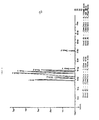
- the tabulation of the results from the pBR322 D NA sample is graphically shown in Figure 2.
- the barrier is a steel plate.
- the plate has approximately a one by eight millimeter slit that defines the resolution window.
- Covering the barrier and the resolution window is a scintillant mounting means defined by an upper and lower glass cover slip. These cover slips define an inner reservoir approximately 1/32 of an inch in diameter.
- the reservoir was filled with the scintillant toluene to a total amount of approximately 0.3 ml. It will be understood that any other scintillant such as Econoflor® would be acceptable.
- the signal is passed to a pre-amplifier, amplifier and recorded by a recording means.
Landscapes
- Health & Medical Sciences (AREA)
- Life Sciences & Earth Sciences (AREA)
- Molecular Biology (AREA)
- Chemical & Material Sciences (AREA)
- Chemical Kinetics & Catalysis (AREA)
- Electrochemistry (AREA)
- Physics & Mathematics (AREA)
- Analytical Chemistry (AREA)
- Biochemistry (AREA)
- General Health & Medical Sciences (AREA)
- General Physics & Mathematics (AREA)
- Immunology (AREA)
- Pathology (AREA)
- Investigating Or Analysing Biological Materials (AREA)
- Investigating, Analyzing Materials By Fluorescence Or Luminescence (AREA)
Applications Claiming Priority (2)
| Application Number | Priority Date | Filing Date | Title |
|---|---|---|---|
| US82289786A | 1986-01-27 | 1986-01-27 | |
| US822897 | 1997-03-24 |
Publications (1)
| Publication Number | Publication Date |
|---|---|
| EP0232105A2 true EP0232105A2 (fr) | 1987-08-12 |
Family
ID=25237274
Family Applications (1)
| Application Number | Title | Priority Date | Filing Date |
|---|---|---|---|
| EP19870300668 Withdrawn EP0232105A2 (fr) | 1986-01-27 | 1987-01-27 | Détection continue de signaux de substances marquées radioactivement en électrophorèse et méthode à cet effet |
Country Status (1)
| Country | Link |
|---|---|
| EP (1) | EP0232105A2 (fr) |
Cited By (1)
| Publication number | Priority date | Publication date | Assignee | Title |
|---|---|---|---|---|
| EP0271440A3 (fr) * | 1986-12-05 | 1990-05-02 | Genofit S.A. | procédé et dispositif pour l'analyse séquentielle de molécules très complexes, telles que des acides nucléiques |
-
1987
- 1987-01-27 EP EP19870300668 patent/EP0232105A2/fr not_active Withdrawn
Cited By (1)
| Publication number | Priority date | Publication date | Assignee | Title |
|---|---|---|---|---|
| EP0271440A3 (fr) * | 1986-12-05 | 1990-05-02 | Genofit S.A. | procédé et dispositif pour l'analyse séquentielle de molécules très complexes, telles que des acides nucléiques |
Similar Documents
| Publication | Publication Date | Title |
|---|---|---|
| US4707235A (en) | Electrophoresis method and apparatus having continuous detection means | |
| US6103533A (en) | Molecular imaging | |
| US5234559A (en) | Apparatus for direct blotting and automated electrophoresis, transfer and detection and processes utilizing the apparatus thereof | |
| US20120004138A1 (en) | Electrophoresis apparatus for simultaneous loading of multiple samples | |
| Ragland et al. | Fluorometric scanning of fluorescamine-labeled proteins in polyacrylamide gels | |
| WO1994012871B1 (fr) | Analyse utilisant la focalisation isoelectrique | |
| KR960031626A (ko) | 캐필러리 어레이 전기영동장치 | |
| JPS6162843A (ja) | 螢光検出型電気泳動装置 | |
| JPH02269935A (ja) | 光検出電気泳動装置 | |
| JP2804038B2 (ja) | 塩基配列決定方法 | |
| Pun et al. | Microelectrophoresis of brain and pineal proteins in polyacrylamide gel | |
| EP0232105A2 (fr) | Détection continue de signaux de substances marquées radioactivement en électrophorèse et méthode à cet effet | |
| US4019057A (en) | Device for determining the spatial distribution of radioactivity within an object | |
| JP2702965B2 (ja) | 遺伝子検出装置及び遺伝子検出方法 | |
| Chan et al. | On-line detection of DNA in gel electrophoresis by ultraviolet absorption utilizing a charge-coupled device imaging system | |
| JP2000298116A (ja) | サンプルローディングシート | |
| Andrus et al. | Polyacrylamide gel electrophoresis (PAGE) of synthetic nucleic acids | |
| EP0113674A3 (fr) | Dispositif de traitement d'un signal pour autoradiographie | |
| Smith | What's new?: The AMBIS beta scanning system | |
| JPS61294363A (ja) | ラジオクロマトグラフ解析方法およびラジオクロマトグラフ解析装置 | |
| JPS6111665A (ja) | 核酸塩基検出装置 | |
| Burdett | Isoelectric focusing in agarose: phosphoglucomutase (PGM locus 1) typing | |
| JP3186269B2 (ja) | Dna分離検出装置 | |
| JP2840586B2 (ja) | 光検出電気泳動装置 | |
| Jorgenson | Overview of electrophoresis |
Legal Events
| Date | Code | Title | Description |
|---|---|---|---|
| PUAI | Public reference made under article 153(3) epc to a published international application that has entered the european phase |
Free format text: ORIGINAL CODE: 0009012 |
|
| AK | Designated contracting states |
Kind code of ref document: A2 Designated state(s): CH DE FR GB LI NL SE |
|
| STAA | Information on the status of an ep patent application or granted ep patent |
Free format text: STATUS: THE APPLICATION IS DEEMED TO BE WITHDRAWN |
|
| 18D | Application deemed to be withdrawn |
Effective date: 19890201 |
|
| RIN1 | Information on inventor provided before grant (corrected) |
Inventor name: SHEPPARD, RICHARD D. |