EP0233145A1 - Polymerzusammensetzungen enthaltend einen gelösten Dibenzalaceton-Palladiumkomplex - Google Patents
Polymerzusammensetzungen enthaltend einen gelösten Dibenzalaceton-Palladiumkomplex Download PDFInfo
- Publication number
- EP0233145A1 EP0233145A1 EP87810046A EP87810046A EP0233145A1 EP 0233145 A1 EP0233145 A1 EP 0233145A1 EP 87810046 A EP87810046 A EP 87810046A EP 87810046 A EP87810046 A EP 87810046A EP 0233145 A1 EP0233145 A1 EP 0233145A1
- Authority
- EP
- European Patent Office
- Prior art keywords
- polymer
- oder
- photoresist
- complex
- hydrogen
- Prior art date
- Legal status (The legal status is an assumption and is not a legal conclusion. Google has not performed a legal analysis and makes no representation as to the accuracy of the status listed.)
- Granted
Links
- 239000000203 mixture Substances 0.000 title claims abstract description 57
- WTAPZWXVSZMMDG-UHFFFAOYSA-N 1,5-diphenylpenta-1,4-dien-3-one;palladium Chemical compound [Pd].C=1C=CC=CC=1C=CC(=O)C=CC1=CC=CC=C1 WTAPZWXVSZMMDG-UHFFFAOYSA-N 0.000 title claims description 7
- 229920000642 polymer Polymers 0.000 claims abstract description 78
- -1 Amino- Chemical class 0.000 claims abstract description 40
- 239000001257 hydrogen Substances 0.000 claims abstract description 16
- 229910052739 hydrogen Inorganic materials 0.000 claims abstract description 16
- UFHFLCQGNIYNRP-UHFFFAOYSA-N Hydrogen Chemical compound [H][H] UFHFLCQGNIYNRP-UHFFFAOYSA-N 0.000 claims abstract description 13
- 238000000454 electroless metal deposition Methods 0.000 claims abstract description 11
- 238000004519 manufacturing process Methods 0.000 claims abstract description 11
- 150000002431 hydrogen Chemical class 0.000 claims abstract description 7
- 125000000217 alkyl group Chemical group 0.000 claims abstract description 6
- 125000005843 halogen group Chemical group 0.000 claims abstract description 6
- 125000001997 phenyl group Chemical group [H]C1=C([H])C([H])=C(*)C([H])=C1[H] 0.000 claims abstract description 6
- 125000004432 carbon atom Chemical group C* 0.000 claims abstract description 5
- 125000003545 alkoxy group Chemical group 0.000 claims abstract description 4
- 125000004093 cyano group Chemical group *C#N 0.000 claims abstract description 3
- 125000000449 nitro group Chemical group [O-][N+](*)=O 0.000 claims abstract description 3
- 229920000620 organic polymer Polymers 0.000 claims abstract description 3
- 125000002924 primary amino group Chemical group [H]N([H])* 0.000 claims abstract description 3
- KDLHZDBZIXYQEI-UHFFFAOYSA-N palladium Substances [Pd] KDLHZDBZIXYQEI-UHFFFAOYSA-N 0.000 claims description 47
- 229920002120 photoresistant polymer Polymers 0.000 claims description 35
- 239000000758 substrate Substances 0.000 claims description 29
- 238000000034 method Methods 0.000 claims description 22
- 229920000647 polyepoxide Polymers 0.000 claims description 17
- 239000003822 epoxy resin Substances 0.000 claims description 14
- 238000001465 metallisation Methods 0.000 claims description 13
- 230000005855 radiation Effects 0.000 claims description 13
- 238000000576 coating method Methods 0.000 claims description 12
- 239000011248 coating agent Substances 0.000 claims description 10
- 239000003960 organic solvent Substances 0.000 claims description 10
- 238000010438 heat treatment Methods 0.000 claims description 9
- 229920003023 plastic Polymers 0.000 claims description 7
- 239000004033 plastic Substances 0.000 claims description 7
- 229920000915 polyvinyl chloride Polymers 0.000 claims description 7
- GYZLOYUZLJXAJU-UHFFFAOYSA-N diglycidyl ether Chemical group C1OC1COCC1CO1 GYZLOYUZLJXAJU-UHFFFAOYSA-N 0.000 claims description 6
- 239000004800 polyvinyl chloride Substances 0.000 claims description 6
- 229920002223 polystyrene Polymers 0.000 claims description 5
- 239000004642 Polyimide Substances 0.000 claims description 4
- 239000004793 Polystyrene Substances 0.000 claims description 4
- 230000003213 activating effect Effects 0.000 claims description 4
- WMKGGPCROCCUDY-PHEQNACWSA-N dibenzylideneacetone Chemical compound C=1C=CC=CC=1\C=C\C(=O)\C=C\C1=CC=CC=C1 WMKGGPCROCCUDY-PHEQNACWSA-N 0.000 claims description 4
- 238000007772 electroless plating Methods 0.000 claims description 4
- 229910052736 halogen Inorganic materials 0.000 claims description 4
- 150000002367 halogens Chemical class 0.000 claims description 4
- 229920001721 polyimide Polymers 0.000 claims description 4
- 229920002959 polymer blend Polymers 0.000 claims description 4
- 230000004913 activation Effects 0.000 claims description 3
- 229920000515 polycarbonate Polymers 0.000 claims description 3
- 229920001230 polyarylate Polymers 0.000 claims description 2
- 239000004417 polycarbonate Substances 0.000 claims description 2
- KIWSYRHAAPLJFJ-DNZSEPECSA-N n-[(e,2z)-4-ethyl-2-hydroxyimino-5-nitrohex-3-enyl]pyridine-3-carboxamide Chemical compound [O-][N+](=O)C(C)C(/CC)=C/C(=N/O)/CNC(=O)C1=CC=CN=C1 KIWSYRHAAPLJFJ-DNZSEPECSA-N 0.000 abstract description 2
- PXHVJJICTQNCMI-UHFFFAOYSA-N Nickel Chemical compound [Ni] PXHVJJICTQNCMI-UHFFFAOYSA-N 0.000 description 52
- 229920001577 copolymer Polymers 0.000 description 34
- 229910052759 nickel Inorganic materials 0.000 description 26
- 239000000243 solution Substances 0.000 description 24
- OKKJLVBELUTLKV-UHFFFAOYSA-N Methanol Chemical compound OC OKKJLVBELUTLKV-UHFFFAOYSA-N 0.000 description 18
- 229910052763 palladium Inorganic materials 0.000 description 16
- PPBRXRYQALVLMV-UHFFFAOYSA-N Styrene Chemical compound C=CC1=CC=CC=C1 PPBRXRYQALVLMV-UHFFFAOYSA-N 0.000 description 14
- 238000007747 plating Methods 0.000 description 13
- RYGMFSIKBFXOCR-UHFFFAOYSA-N Copper Chemical compound [Cu] RYGMFSIKBFXOCR-UHFFFAOYSA-N 0.000 description 11
- IISBACLAFKSPIT-UHFFFAOYSA-N bisphenol A Chemical compound C=1C=C(O)C=CC=1C(C)(C)C1=CC=C(O)C=C1 IISBACLAFKSPIT-UHFFFAOYSA-N 0.000 description 11
- 239000010949 copper Substances 0.000 description 11
- 150000001875 compounds Chemical class 0.000 description 10
- 229910052802 copper Inorganic materials 0.000 description 10
- 229910052751 metal Inorganic materials 0.000 description 10
- 239000002184 metal Substances 0.000 description 10
- 239000002904 solvent Substances 0.000 description 10
- 239000004593 Epoxy Substances 0.000 description 9
- YXFVVABEGXRONW-UHFFFAOYSA-N Toluene Chemical compound CC1=CC=CC=C1 YXFVVABEGXRONW-UHFFFAOYSA-N 0.000 description 9
- XKRFYHLGVUSROY-UHFFFAOYSA-N Argon Chemical compound [Ar] XKRFYHLGVUSROY-UHFFFAOYSA-N 0.000 description 8
- LNEPOXFFQSENCJ-UHFFFAOYSA-N haloperidol Chemical compound C1CC(O)(C=2C=CC(Cl)=CC=2)CCN1CCCC(=O)C1=CC=C(F)C=C1 LNEPOXFFQSENCJ-UHFFFAOYSA-N 0.000 description 7
- 229910001868 water Inorganic materials 0.000 description 7
- UHOVQNZJYSORNB-UHFFFAOYSA-N Benzene Chemical compound C1=CC=CC=C1 UHOVQNZJYSORNB-UHFFFAOYSA-N 0.000 description 6
- HEMHJVSKTPXQMS-UHFFFAOYSA-M Sodium hydroxide Chemical compound [OH-].[Na+] HEMHJVSKTPXQMS-UHFFFAOYSA-M 0.000 description 6
- JHIVVAPYMSGYDF-UHFFFAOYSA-N cyclohexanone Chemical compound O=C1CCCCC1 JHIVVAPYMSGYDF-UHFFFAOYSA-N 0.000 description 6
- 229920000058 polyacrylate Polymers 0.000 description 6
- 150000002739 metals Chemical class 0.000 description 5
- 125000002496 methyl group Chemical group [H]C([H])([H])* 0.000 description 5
- 150000002940 palladium Chemical class 0.000 description 5
- 238000005496 tempering Methods 0.000 description 5
- WYURNTSHIVDZCO-UHFFFAOYSA-N Tetrahydrofuran Chemical compound C1CCOC1 WYURNTSHIVDZCO-UHFFFAOYSA-N 0.000 description 4
- 238000000137 annealing Methods 0.000 description 4
- 229910052786 argon Inorganic materials 0.000 description 4
- 239000000460 chlorine Substances 0.000 description 4
- 239000011521 glass Substances 0.000 description 4
- 229910052737 gold Inorganic materials 0.000 description 4
- 239000010931 gold Substances 0.000 description 4
- BASFCYQUMIYNBI-UHFFFAOYSA-N platinum Substances [Pt] BASFCYQUMIYNBI-UHFFFAOYSA-N 0.000 description 4
- 229920001155 polypropylene Polymers 0.000 description 4
- 239000002243 precursor Substances 0.000 description 4
- 229920005989 resin Polymers 0.000 description 4
- 239000011347 resin Substances 0.000 description 4
- WFKWXMTUELFFGS-UHFFFAOYSA-N tungsten Chemical compound [W] WFKWXMTUELFFGS-UHFFFAOYSA-N 0.000 description 4
- 229910052721 tungsten Inorganic materials 0.000 description 4
- 239000010937 tungsten Substances 0.000 description 4
- XLYOFNOQVPJJNP-UHFFFAOYSA-N water Substances O XLYOFNOQVPJJNP-UHFFFAOYSA-N 0.000 description 4
- WSLDOOZREJYCGB-UHFFFAOYSA-N 1,2-Dichloroethane Chemical compound ClCCCl WSLDOOZREJYCGB-UHFFFAOYSA-N 0.000 description 3
- ZWEHNKRNPOVVGH-UHFFFAOYSA-N 2-Butanone Chemical compound CCC(C)=O ZWEHNKRNPOVVGH-UHFFFAOYSA-N 0.000 description 3
- CSCPPACGZOOCGX-UHFFFAOYSA-N Acetone Chemical compound CC(C)=O CSCPPACGZOOCGX-UHFFFAOYSA-N 0.000 description 3
- OKTJSMMVPCPJKN-UHFFFAOYSA-N Carbon Chemical compound [C] OKTJSMMVPCPJKN-UHFFFAOYSA-N 0.000 description 3
- ZAMOUSCENKQFHK-UHFFFAOYSA-N Chlorine atom Chemical compound [Cl] ZAMOUSCENKQFHK-UHFFFAOYSA-N 0.000 description 3
- QPLDLSVMHZLSFG-UHFFFAOYSA-N Copper oxide Chemical compound [Cu]=O QPLDLSVMHZLSFG-UHFFFAOYSA-N 0.000 description 3
- YMWUJEATGCHHMB-UHFFFAOYSA-N Dichloromethane Chemical compound ClCCl YMWUJEATGCHHMB-UHFFFAOYSA-N 0.000 description 3
- RTZKZFJDLAIYFH-UHFFFAOYSA-N Diethyl ether Chemical compound CCOCC RTZKZFJDLAIYFH-UHFFFAOYSA-N 0.000 description 3
- XEKOWRVHYACXOJ-UHFFFAOYSA-N Ethyl acetate Chemical compound CCOC(C)=O XEKOWRVHYACXOJ-UHFFFAOYSA-N 0.000 description 3
- IMNFDUFMRHMDMM-UHFFFAOYSA-N N-Heptane Chemical compound CCCCCCC IMNFDUFMRHMDMM-UHFFFAOYSA-N 0.000 description 3
- 101150003085 Pdcl gene Proteins 0.000 description 3
- BQCADISMDOOEFD-UHFFFAOYSA-N Silver Chemical compound [Ag] BQCADISMDOOEFD-UHFFFAOYSA-N 0.000 description 3
- 239000007983 Tris buffer Substances 0.000 description 3
- 239000000654 additive Substances 0.000 description 3
- 239000002318 adhesion promoter Substances 0.000 description 3
- 229910052782 aluminium Inorganic materials 0.000 description 3
- XAGFODPZIPBFFR-UHFFFAOYSA-N aluminium Chemical compound [Al] XAGFODPZIPBFFR-UHFFFAOYSA-N 0.000 description 3
- 239000002585 base Substances 0.000 description 3
- 229910052801 chlorine Inorganic materials 0.000 description 3
- LPIQUOYDBNQMRZ-UHFFFAOYSA-N cyclopentene Chemical compound C1CC=CC1 LPIQUOYDBNQMRZ-UHFFFAOYSA-N 0.000 description 3
- 150000002148 esters Chemical class 0.000 description 3
- 125000001495 ethyl group Chemical group [H]C([H])([H])C([H])([H])* 0.000 description 3
- 238000002474 experimental method Methods 0.000 description 3
- 125000004435 hydrogen atom Chemical group [H]* 0.000 description 3
- 239000000463 material Substances 0.000 description 3
- 239000000178 monomer Substances 0.000 description 3
- 239000005022 packaging material Substances 0.000 description 3
- 229910052697 platinum Inorganic materials 0.000 description 3
- 229920001200 poly(ethylene-vinyl acetate) Polymers 0.000 description 3
- 229920000573 polyethylene Polymers 0.000 description 3
- 229920000307 polymer substrate Polymers 0.000 description 3
- 229910052709 silver Inorganic materials 0.000 description 3
- 239000004332 silver Substances 0.000 description 3
- QTWJRLJHJPIABL-UHFFFAOYSA-N 2-methylphenol;3-methylphenol;4-methylphenol Chemical compound CC1=CC=C(O)C=C1.CC1=CC=CC(O)=C1.CC1=CC=CC=C1O QTWJRLJHJPIABL-UHFFFAOYSA-N 0.000 description 2
- NLHHRLWOUZZQLW-UHFFFAOYSA-N Acrylonitrile Chemical compound C=CC#N NLHHRLWOUZZQLW-UHFFFAOYSA-N 0.000 description 2
- 229910001316 Ag alloy Inorganic materials 0.000 description 2
- WKBOTKDWSSQWDR-UHFFFAOYSA-N Bromine atom Chemical compound [Br] WKBOTKDWSSQWDR-UHFFFAOYSA-N 0.000 description 2
- ZCIQIHUFMZIWRN-UHFFFAOYSA-N C(=C)Cl.C(=C)(Cl)Cl.C(=C)Cl Chemical compound C(=C)Cl.C(=C)(Cl)Cl.C(=C)Cl ZCIQIHUFMZIWRN-UHFFFAOYSA-N 0.000 description 2
- HEDRZPFGACZZDS-UHFFFAOYSA-N Chloroform Chemical compound ClC(Cl)Cl HEDRZPFGACZZDS-UHFFFAOYSA-N 0.000 description 2
- LFQSCWFLJHTTHZ-UHFFFAOYSA-N Ethanol Chemical compound CCO LFQSCWFLJHTTHZ-UHFFFAOYSA-N 0.000 description 2
- 125000003580 L-valyl group Chemical group [H]N([H])[C@]([H])(C(=O)[*])C(C([H])([H])[H])(C([H])([H])[H])[H] 0.000 description 2
- ZOKXTWBITQBERF-UHFFFAOYSA-N Molybdenum Chemical compound [Mo] ZOKXTWBITQBERF-UHFFFAOYSA-N 0.000 description 2
- 101100028920 Neurospora crassa (strain ATCC 24698 / 74-OR23-1A / CBS 708.71 / DSM 1257 / FGSC 987) cfp gene Proteins 0.000 description 2
- PNTWXEIQXBRCPS-CLKGFSLHSA-N Pd-II Natural products C1=CC(=O)OC2=C3[C@H](OC(=O)C(/C)=C/C)[C@H](OC(=O)C(\C)=C\C)C(C)(C)OC3=CC=C21 PNTWXEIQXBRCPS-CLKGFSLHSA-N 0.000 description 2
- 229920002367 Polyisobutene Polymers 0.000 description 2
- 239000004743 Polypropylene Substances 0.000 description 2
- VMHLLURERBWHNL-UHFFFAOYSA-M Sodium acetate Chemical compound [Na+].CC([O-])=O VMHLLURERBWHNL-UHFFFAOYSA-M 0.000 description 2
- 239000002253 acid Substances 0.000 description 2
- NIXOWILDQLNWCW-UHFFFAOYSA-N acrylic acid group Chemical group C(C=C)(=O)O NIXOWILDQLNWCW-UHFFFAOYSA-N 0.000 description 2
- 229920000800 acrylic rubber Polymers 0.000 description 2
- 229920000180 alkyd Polymers 0.000 description 2
- 229910045601 alloy Inorganic materials 0.000 description 2
- 239000000956 alloy Substances 0.000 description 2
- WGQKYBSKWIADBV-UHFFFAOYSA-N benzylamine Chemical compound NCC1=CC=CC=C1 WGQKYBSKWIADBV-UHFFFAOYSA-N 0.000 description 2
- GDTBXPJZTBHREO-UHFFFAOYSA-N bromine Substances BrBr GDTBXPJZTBHREO-UHFFFAOYSA-N 0.000 description 2
- 229910052794 bromium Inorganic materials 0.000 description 2
- QARVLSVVCXYDNA-UHFFFAOYSA-N bromobenzene Chemical compound BrC1=CC=CC=C1 QARVLSVVCXYDNA-UHFFFAOYSA-N 0.000 description 2
- 125000000484 butyl group Chemical group [H]C([*])([H])C([H])([H])C([H])([H])C([H])([H])[H] 0.000 description 2
- 229910052799 carbon Inorganic materials 0.000 description 2
- 238000005266 casting Methods 0.000 description 2
- 229920002301 cellulose acetate Polymers 0.000 description 2
- 229920003086 cellulose ether Polymers 0.000 description 2
- 238000006243 chemical reaction Methods 0.000 description 2
- 239000003795 chemical substances by application Substances 0.000 description 2
- MVPPADPHJFYWMZ-UHFFFAOYSA-N chlorobenzene Chemical compound ClC1=CC=CC=C1 MVPPADPHJFYWMZ-UHFFFAOYSA-N 0.000 description 2
- 239000011231 conductive filler Substances 0.000 description 2
- 229930003836 cresol Natural products 0.000 description 2
- 229920006037 cross link polymer Polymers 0.000 description 2
- 238000004132 cross linking Methods 0.000 description 2
- 239000013078 crystal Substances 0.000 description 2
- 238000000151 deposition Methods 0.000 description 2
- 230000008021 deposition Effects 0.000 description 2
- 150000001993 dienes Chemical class 0.000 description 2
- XXBDWLFCJWSEKW-UHFFFAOYSA-N dimethylbenzylamine Chemical compound CN(C)CC1=CC=CC=C1 XXBDWLFCJWSEKW-UHFFFAOYSA-N 0.000 description 2
- USIUVYZYUHIAEV-UHFFFAOYSA-N diphenyl ether Chemical compound C=1C=CC=CC=1OC1=CC=CC=C1 USIUVYZYUHIAEV-UHFFFAOYSA-N 0.000 description 2
- 238000005516 engineering process Methods 0.000 description 2
- ZINJLDJMHCUBIP-UHFFFAOYSA-N ethametsulfuron-methyl Chemical compound CCOC1=NC(NC)=NC(NC(=O)NS(=O)(=O)C=2C(=CC=CC=2)C(=O)OC)=N1 ZINJLDJMHCUBIP-UHFFFAOYSA-N 0.000 description 2
- 150000002170 ethers Chemical class 0.000 description 2
- 239000005038 ethylene vinyl acetate Substances 0.000 description 2
- PCHJSUWPFVWCPO-UHFFFAOYSA-N gold Chemical compound [Au] PCHJSUWPFVWCPO-UHFFFAOYSA-N 0.000 description 2
- XMBWDFGMSWQBCA-UHFFFAOYSA-N hydrogen iodide Chemical compound I XMBWDFGMSWQBCA-UHFFFAOYSA-N 0.000 description 2
- 125000001449 isopropyl group Chemical group [H]C([H])([H])C([H])(*)C([H])([H])[H] 0.000 description 2
- QSHDDOUJBYECFT-UHFFFAOYSA-N mercury Chemical compound [Hg] QSHDDOUJBYECFT-UHFFFAOYSA-N 0.000 description 2
- 229920000609 methyl cellulose Polymers 0.000 description 2
- 239000001923 methylcellulose Substances 0.000 description 2
- 235000010981 methylcellulose Nutrition 0.000 description 2
- 229910052750 molybdenum Inorganic materials 0.000 description 2
- 239000011733 molybdenum Substances 0.000 description 2
- 150000005673 monoalkenes Chemical class 0.000 description 2
- VLKZOEOYAKHREP-UHFFFAOYSA-N n-Hexane Chemical compound CCCCCC VLKZOEOYAKHREP-UHFFFAOYSA-N 0.000 description 2
- 229920003986 novolac Polymers 0.000 description 2
- 229920003055 poly(ester-imide) Polymers 0.000 description 2
- 229920001643 poly(ether ketone) Polymers 0.000 description 2
- 229920002492 poly(sulfone) Polymers 0.000 description 2
- 229920002239 polyacrylonitrile Polymers 0.000 description 2
- 229920002480 polybenzimidazole Polymers 0.000 description 2
- 229920000728 polyester Polymers 0.000 description 2
- 229920000570 polyether Polymers 0.000 description 2
- 229920006393 polyether sulfone Polymers 0.000 description 2
- 229920001601 polyetherimide Polymers 0.000 description 2
- 229920000139 polyethylene terephthalate Polymers 0.000 description 2
- 229920006254 polymer film Polymers 0.000 description 2
- 229920000193 polymethacrylate Polymers 0.000 description 2
- 229920002620 polyvinyl fluoride Polymers 0.000 description 2
- 229920002981 polyvinylidene fluoride Polymers 0.000 description 2
- 239000000047 product Substances 0.000 description 2
- 150000003254 radicals Chemical class 0.000 description 2
- NDVLTYZPCACLMA-UHFFFAOYSA-N silver oxide Chemical compound [O-2].[Ag+].[Ag+] NDVLTYZPCACLMA-UHFFFAOYSA-N 0.000 description 2
- 239000011734 sodium Substances 0.000 description 2
- 239000001632 sodium acetate Substances 0.000 description 2
- 235000017281 sodium acetate Nutrition 0.000 description 2
- 229920000638 styrene acrylonitrile Polymers 0.000 description 2
- 150000004763 sulfides Chemical class 0.000 description 2
- VZGDMQKNWNREIO-UHFFFAOYSA-N tetrachloromethane Chemical compound ClC(Cl)(Cl)Cl VZGDMQKNWNREIO-UHFFFAOYSA-N 0.000 description 2
- YLQBMQCUIZJEEH-UHFFFAOYSA-N tetrahydrofuran Natural products C=1C=COC=1 YLQBMQCUIZJEEH-UHFFFAOYSA-N 0.000 description 2
- HVLLSGMXQDNUAL-UHFFFAOYSA-N triphenyl phosphite Chemical compound C=1C=CC=CC=1OP(OC=1C=CC=CC=1)OC1=CC=CC=C1 HVLLSGMXQDNUAL-UHFFFAOYSA-N 0.000 description 2
- LENZDBCJOHFCAS-UHFFFAOYSA-N tris Chemical compound OCC(N)(CO)CO LENZDBCJOHFCAS-UHFFFAOYSA-N 0.000 description 2
- 125000000391 vinyl group Chemical group [H]C([*])=C([H])[H] 0.000 description 2
- 229920002554 vinyl polymer Polymers 0.000 description 2
- 229910052724 xenon Inorganic materials 0.000 description 2
- FHNFHKCVQCLJFQ-UHFFFAOYSA-N xenon atom Chemical compound [Xe] FHNFHKCVQCLJFQ-UHFFFAOYSA-N 0.000 description 2
- MUTGBJKUEZFXGO-OLQVQODUSA-N (3as,7ar)-3a,4,5,6,7,7a-hexahydro-2-benzofuran-1,3-dione Chemical compound C1CCC[C@@H]2C(=O)OC(=O)[C@@H]21 MUTGBJKUEZFXGO-OLQVQODUSA-N 0.000 description 1
- SCYULBFZEHDVBN-UHFFFAOYSA-N 1,1-Dichloroethane Chemical compound CC(Cl)Cl SCYULBFZEHDVBN-UHFFFAOYSA-N 0.000 description 1
- RMCLVYNUTRHDDI-UHFFFAOYSA-N 1,1-dichloroethene;ethenyl acetate Chemical compound ClC(Cl)=C.CC(=O)OC=C RMCLVYNUTRHDDI-UHFFFAOYSA-N 0.000 description 1
- RYHBNJHYFVUHQT-UHFFFAOYSA-N 1,4-Dioxane Chemical compound C1COCCO1 RYHBNJHYFVUHQT-UHFFFAOYSA-N 0.000 description 1
- DURPTKYDGMDSBL-UHFFFAOYSA-N 1-butoxybutane Chemical compound CCCCOCCCC DURPTKYDGMDSBL-UHFFFAOYSA-N 0.000 description 1
- RRQYJINTUHWNHW-UHFFFAOYSA-N 1-ethoxy-2-(2-ethoxyethoxy)ethane Chemical compound CCOCCOCCOCC RRQYJINTUHWNHW-UHFFFAOYSA-N 0.000 description 1
- AEQDJSLRWYMAQI-UHFFFAOYSA-N 2,3,9,10-tetramethoxy-6,8,13,13a-tetrahydro-5H-isoquinolino[2,1-b]isoquinoline Chemical compound C1CN2CC(C(=C(OC)C=C3)OC)=C3CC2C2=C1C=C(OC)C(OC)=C2 AEQDJSLRWYMAQI-UHFFFAOYSA-N 0.000 description 1
- ZQVHTTABFLHMPA-UHFFFAOYSA-N 2-(4-chlorophenoxy)-5-nitropyridine Chemical compound N1=CC([N+](=O)[O-])=CC=C1OC1=CC=C(Cl)C=C1 ZQVHTTABFLHMPA-UHFFFAOYSA-N 0.000 description 1
- JKFYKCYQEWQPTM-UHFFFAOYSA-N 2-azaniumyl-2-(4-fluorophenyl)acetate Chemical compound OC(=O)C(N)C1=CC=C(F)C=C1 JKFYKCYQEWQPTM-UHFFFAOYSA-N 0.000 description 1
- TXQJIMNDEHCONN-UHFFFAOYSA-N 3-(2-methoxyphenoxy)propanoic acid Chemical compound COC1=CC=CC=C1OCCC(O)=O TXQJIMNDEHCONN-UHFFFAOYSA-N 0.000 description 1
- PYSRRFNXTXNWCD-UHFFFAOYSA-N 3-(2-phenylethenyl)furan-2,5-dione Chemical compound O=C1OC(=O)C(C=CC=2C=CC=CC=2)=C1 PYSRRFNXTXNWCD-UHFFFAOYSA-N 0.000 description 1
- ZAMLGGRVTAXBHI-UHFFFAOYSA-N 3-(4-bromophenyl)-3-[(2-methylpropan-2-yl)oxycarbonylamino]propanoic acid Chemical compound CC(C)(C)OC(=O)NC(CC(O)=O)C1=CC=C(Br)C=C1 ZAMLGGRVTAXBHI-UHFFFAOYSA-N 0.000 description 1
- 125000004172 4-methoxyphenyl group Chemical group [H]C1=C([H])C(OC([H])([H])[H])=C([H])C([H])=C1* 0.000 description 1
- JDCCCHBBXRQRGU-UHFFFAOYSA-N 5-phenylpenta-2,4-dienenitrile Chemical compound N#CC=CC=CC1=CC=CC=C1 JDCCCHBBXRQRGU-UHFFFAOYSA-N 0.000 description 1
- ZCYVEMRRCGMTRW-UHFFFAOYSA-N 7553-56-2 Chemical compound [I] ZCYVEMRRCGMTRW-UHFFFAOYSA-N 0.000 description 1
- KWOLFJPFCHCOCG-UHFFFAOYSA-N Acetophenone Chemical compound CC(=O)C1=CC=CC=C1 KWOLFJPFCHCOCG-UHFFFAOYSA-N 0.000 description 1
- NIXOWILDQLNWCW-UHFFFAOYSA-M Acrylate Chemical compound [O-]C(=O)C=C NIXOWILDQLNWCW-UHFFFAOYSA-M 0.000 description 1
- 239000004925 Acrylic resin Substances 0.000 description 1
- 229920000178 Acrylic resin Polymers 0.000 description 1
- JBRZTFJDHDCESZ-UHFFFAOYSA-N AsGa Chemical compound [As]#[Ga] JBRZTFJDHDCESZ-UHFFFAOYSA-N 0.000 description 1
- 229920000049 Carbon (fiber) Polymers 0.000 description 1
- VEXZGXHMUGYJMC-UHFFFAOYSA-M Chloride anion Chemical compound [Cl-] VEXZGXHMUGYJMC-UHFFFAOYSA-M 0.000 description 1
- 229910000881 Cu alloy Inorganic materials 0.000 description 1
- XDTMQSROBMDMFD-UHFFFAOYSA-N Cyclohexane Chemical compound C1CCCCC1 XDTMQSROBMDMFD-UHFFFAOYSA-N 0.000 description 1
- XTHFKEDIFFGKHM-UHFFFAOYSA-N Dimethoxyethane Chemical compound COCCOC XTHFKEDIFFGKHM-UHFFFAOYSA-N 0.000 description 1
- BRLQWZUYTZBJKN-UHFFFAOYSA-N Epichlorohydrin Chemical compound ClCC1CO1 BRLQWZUYTZBJKN-UHFFFAOYSA-N 0.000 description 1
- VGGSQFUCUMXWEO-UHFFFAOYSA-N Ethene Chemical compound C=C VGGSQFUCUMXWEO-UHFFFAOYSA-N 0.000 description 1
- 239000005977 Ethylene Substances 0.000 description 1
- PXGOKWXKJXAPGV-UHFFFAOYSA-N Fluorine Chemical compound FF PXGOKWXKJXAPGV-UHFFFAOYSA-N 0.000 description 1
- WSFSSNUMVMOOMR-UHFFFAOYSA-N Formaldehyde Chemical compound O=C WSFSSNUMVMOOMR-UHFFFAOYSA-N 0.000 description 1
- 229910001218 Gallium arsenide Inorganic materials 0.000 description 1
- 229910003767 Gold(III) bromide Inorganic materials 0.000 description 1
- FBOZXECLQNJBKD-ZDUSSCGKSA-N L-methotrexate Chemical compound C=1N=C2N=C(N)N=C(N)C2=NC=1CN(C)C1=CC=C(C(=O)N[C@@H](CCC(O)=O)C(O)=O)C=C1 FBOZXECLQNJBKD-ZDUSSCGKSA-N 0.000 description 1
- 239000004425 Makrolon Substances 0.000 description 1
- 229910021205 NaH2PO2 Inorganic materials 0.000 description 1
- 229910000990 Ni alloy Inorganic materials 0.000 description 1
- 229910021586 Nickel(II) chloride Inorganic materials 0.000 description 1
- CTQNGGLPUBDAKN-UHFFFAOYSA-N O-Xylene Chemical compound CC1=CC=CC=C1C CTQNGGLPUBDAKN-UHFFFAOYSA-N 0.000 description 1
- 239000002033 PVDF binder Substances 0.000 description 1
- 229910001252 Pd alloy Inorganic materials 0.000 description 1
- ISWSIDIOOBJBQZ-UHFFFAOYSA-N Phenol Chemical compound OC1=CC=CC=C1 ISWSIDIOOBJBQZ-UHFFFAOYSA-N 0.000 description 1
- 229920003171 Poly (ethylene oxide) Polymers 0.000 description 1
- 239000004693 Polybenzimidazole Substances 0.000 description 1
- 239000004695 Polyether sulfone Substances 0.000 description 1
- 239000004697 Polyetherimide Substances 0.000 description 1
- 239000004698 Polyethylene Substances 0.000 description 1
- 239000004721 Polyphenylene oxide Substances 0.000 description 1
- 229920001328 Polyvinylidene chloride Polymers 0.000 description 1
- ZLMJMSJWJFRBEC-UHFFFAOYSA-N Potassium Chemical compound [K] ZLMJMSJWJFRBEC-UHFFFAOYSA-N 0.000 description 1
- XBDQKXXYIPTUBI-UHFFFAOYSA-N Propionic acid Chemical class CCC(O)=O XBDQKXXYIPTUBI-UHFFFAOYSA-N 0.000 description 1
- 108091006629 SLC13A2 Proteins 0.000 description 1
- 241000204914 Salmonella enterica subsp. enterica serovar Give Species 0.000 description 1
- XUIMIQQOPSSXEZ-UHFFFAOYSA-N Silicon Chemical compound [Si] XUIMIQQOPSSXEZ-UHFFFAOYSA-N 0.000 description 1
- 229910021612 Silver iodide Inorganic materials 0.000 description 1
- 229920000147 Styrene maleic anhydride Polymers 0.000 description 1
- UCKMPCXJQFINFW-UHFFFAOYSA-N Sulphide Chemical compound [S-2] UCKMPCXJQFINFW-UHFFFAOYSA-N 0.000 description 1
- ATJFFYVFTNAWJD-UHFFFAOYSA-N Tin Chemical compound [Sn] ATJFFYVFTNAWJD-UHFFFAOYSA-N 0.000 description 1
- 238000003848 UV Light-Curing Methods 0.000 description 1
- 229910021551 Vanadium(III) chloride Inorganic materials 0.000 description 1
- 229910021542 Vanadium(IV) oxide Inorganic materials 0.000 description 1
- QROGIFZRVHSFLM-QHHAFSJGSA-N [(e)-prop-1-enyl]benzene Chemical compound C\C=C\C1=CC=CC=C1 QROGIFZRVHSFLM-QHHAFSJGSA-N 0.000 description 1
- 229940081735 acetylcellulose Drugs 0.000 description 1
- 150000007513 acids Chemical class 0.000 description 1
- 150000001252 acrylic acid derivatives Chemical class 0.000 description 1
- 239000000853 adhesive Substances 0.000 description 1
- 230000001070 adhesive effect Effects 0.000 description 1
- 150000001299 aldehydes Chemical class 0.000 description 1
- 150000001338 aliphatic hydrocarbons Chemical class 0.000 description 1
- 229910052783 alkali metal Inorganic materials 0.000 description 1
- XYLMUPLGERFSHI-UHFFFAOYSA-N alpha-Methylstyrene Chemical compound CC(=C)C1=CC=CC=C1 XYLMUPLGERFSHI-UHFFFAOYSA-N 0.000 description 1
- 238000004458 analytical method Methods 0.000 description 1
- 150000008064 anhydrides Chemical class 0.000 description 1
- WKQKNPFAPBADII-UHFFFAOYSA-N anisole;oxolane Chemical compound C1CCOC1.COC1=CC=CC=C1 WKQKNPFAPBADII-UHFFFAOYSA-N 0.000 description 1
- 239000003963 antioxidant agent Substances 0.000 description 1
- 239000002216 antistatic agent Substances 0.000 description 1
- 239000007864 aqueous solution Substances 0.000 description 1
- 239000002152 aqueous-organic solution Substances 0.000 description 1
- 150000004945 aromatic hydrocarbons Chemical class 0.000 description 1
- QVGXLLKOCUKJST-UHFFFAOYSA-N atomic oxygen Chemical compound [O] QVGXLLKOCUKJST-UHFFFAOYSA-N 0.000 description 1
- OVHDZBAFUMEXCX-UHFFFAOYSA-N benzyl 4-methylbenzenesulfonate Chemical class C1=CC(C)=CC=C1S(=O)(=O)OCC1=CC=CC=C1 OVHDZBAFUMEXCX-UHFFFAOYSA-N 0.000 description 1
- 239000004841 bisphenol A epoxy resin Substances 0.000 description 1
- 229920001400 block copolymer Polymers 0.000 description 1
- 238000009835 boiling Methods 0.000 description 1
- 230000001680 brushing effect Effects 0.000 description 1
- KFJIKMQQWOUHGU-UHFFFAOYSA-N but-3-enoic acid;1,1-dichloroethene Chemical compound ClC(Cl)=C.OC(=O)CC=C KFJIKMQQWOUHGU-UHFFFAOYSA-N 0.000 description 1
- WMFJYFYTNMFICM-UHFFFAOYSA-N but-3-enoic acid;chloroethene Chemical compound ClC=C.OC(=O)CC=C WMFJYFYTNMFICM-UHFFFAOYSA-N 0.000 description 1
- 150000004648 butanoic acid derivatives Chemical class 0.000 description 1
- 239000006229 carbon black Substances 0.000 description 1
- 239000004917 carbon fiber Substances 0.000 description 1
- BVKZGUZCCUSVTD-UHFFFAOYSA-N carbonic acid Chemical class OC(O)=O BVKZGUZCCUSVTD-UHFFFAOYSA-N 0.000 description 1
- 238000010538 cationic polymerization reaction Methods 0.000 description 1
- 229920001727 cellulose butyrate Polymers 0.000 description 1
- 229920006218 cellulose propionate Polymers 0.000 description 1
- 239000000919 ceramic Substances 0.000 description 1
- HGAZMNJKRQFZKS-UHFFFAOYSA-N chloroethene;ethenyl acetate Chemical compound ClC=C.CC(=O)OC=C HGAZMNJKRQFZKS-UHFFFAOYSA-N 0.000 description 1
- 229910017052 cobalt Inorganic materials 0.000 description 1
- 239000010941 cobalt Substances 0.000 description 1
- GUTLYIVDDKVIGB-UHFFFAOYSA-N cobalt atom Chemical compound [Co] GUTLYIVDDKVIGB-UHFFFAOYSA-N 0.000 description 1
- NVIVJPRCKQTWLY-UHFFFAOYSA-N cobalt nickel Chemical compound [Co][Ni][Co] NVIVJPRCKQTWLY-UHFFFAOYSA-N 0.000 description 1
- 239000000470 constituent Substances 0.000 description 1
- 238000010276 construction Methods 0.000 description 1
- 239000013256 coordination polymer Substances 0.000 description 1
- ARUVKPQLZAKDPS-UHFFFAOYSA-L copper(II) sulfate Chemical compound [Cu+2].[O-][S+2]([O-])([O-])[O-] ARUVKPQLZAKDPS-UHFFFAOYSA-L 0.000 description 1
- 229910000366 copper(II) sulfate Inorganic materials 0.000 description 1
- LSXDOTMGLUJQCM-UHFFFAOYSA-M copper(i) iodide Chemical compound I[Cu] LSXDOTMGLUJQCM-UHFFFAOYSA-M 0.000 description 1
- 239000003431 cross linking reagent Substances 0.000 description 1
- 150000004292 cyclic ethers Chemical class 0.000 description 1
- 150000001925 cycloalkenes Chemical class 0.000 description 1
- 238000000354 decomposition reaction Methods 0.000 description 1
- 150000001991 dicarboxylic acids Chemical class 0.000 description 1
- 229940019778 diethylene glycol diethyl ether Drugs 0.000 description 1
- 238000001035 drying Methods 0.000 description 1
- 239000000975 dye Substances 0.000 description 1
- 229920001971 elastomer Polymers 0.000 description 1
- 238000010894 electron beam technology Methods 0.000 description 1
- 125000003700 epoxy group Chemical group 0.000 description 1
- BXOUVIIITJXIKB-UHFFFAOYSA-N ethene;styrene Chemical group C=C.C=CC1=CC=CC=C1 BXOUVIIITJXIKB-UHFFFAOYSA-N 0.000 description 1
- 238000001704 evaporation Methods 0.000 description 1
- 230000008020 evaporation Effects 0.000 description 1
- 239000003063 flame retardant Substances 0.000 description 1
- 229910052731 fluorine Inorganic materials 0.000 description 1
- 239000011737 fluorine Substances 0.000 description 1
- 239000008098 formaldehyde solution Substances 0.000 description 1
- 229910052732 germanium Inorganic materials 0.000 description 1
- GNPVGFCGXDBREM-UHFFFAOYSA-N germanium atom Chemical compound [Ge] GNPVGFCGXDBREM-UHFFFAOYSA-N 0.000 description 1
- 239000003365 glass fiber Substances 0.000 description 1
- 230000009477 glass transition Effects 0.000 description 1
- OVWPJGBVJCTEBJ-UHFFFAOYSA-K gold tribromide Chemical compound Br[Au](Br)Br OVWPJGBVJCTEBJ-UHFFFAOYSA-K 0.000 description 1
- DDYSHSNGZNCTKB-UHFFFAOYSA-N gold(3+);oxygen(2-) Chemical class [O-2].[O-2].[O-2].[Au+3].[Au+3] DDYSHSNGZNCTKB-UHFFFAOYSA-N 0.000 description 1
- 229920000578 graft copolymer Polymers 0.000 description 1
- 239000010439 graphite Substances 0.000 description 1
- 229910002804 graphite Inorganic materials 0.000 description 1
- 150000004820 halides Chemical class 0.000 description 1
- 150000008282 halocarbons Chemical class 0.000 description 1
- 125000003707 hexyloxy group Chemical group [H]C([H])([H])C([H])([H])C([H])([H])C([H])([H])C([H])([H])C([H])([H])O* 0.000 description 1
- 229920001519 homopolymer Polymers 0.000 description 1
- 125000002887 hydroxy group Chemical group [H]O* 0.000 description 1
- 229920002681 hypalon Polymers 0.000 description 1
- 238000003384 imaging method Methods 0.000 description 1
- 238000007654 immersion Methods 0.000 description 1
- 239000011630 iodine Substances 0.000 description 1
- 229910052740 iodine Inorganic materials 0.000 description 1
- 150000002500 ions Chemical class 0.000 description 1
- XEEYBQQBJWHFJM-UHFFFAOYSA-N iron Substances [Fe] XEEYBQQBJWHFJM-UHFFFAOYSA-N 0.000 description 1
- 229910052742 iron Inorganic materials 0.000 description 1
- 230000001678 irradiating effect Effects 0.000 description 1
- 150000002576 ketones Chemical class 0.000 description 1
- 239000004922 lacquer Substances 0.000 description 1
- 150000002596 lactones Chemical class 0.000 description 1
- 239000004611 light stabiliser Substances 0.000 description 1
- 125000000040 m-tolyl group Chemical group [H]C1=C([H])C(*)=C([H])C(=C1[H])C([H])([H])[H] 0.000 description 1
- 239000011159 matrix material Substances 0.000 description 1
- 229910052753 mercury Inorganic materials 0.000 description 1
- 150000002734 metacrylic acid derivatives Chemical class 0.000 description 1
- 150000002736 metal compounds Chemical class 0.000 description 1
- 229910001507 metal halide Inorganic materials 0.000 description 1
- 150000005309 metal halides Chemical class 0.000 description 1
- VNWKTOKETHGBQD-UHFFFAOYSA-N methane Chemical compound C VNWKTOKETHGBQD-UHFFFAOYSA-N 0.000 description 1
- 125000000956 methoxy group Chemical group [H]C([H])([H])O* 0.000 description 1
- NYBDEQVBEYXMHK-UHFFFAOYSA-N methyl prop-2-enoate;5-phenylpenta-2,4-dienenitrile Chemical compound COC(=O)C=C.N#CC=CC=CC1=CC=CC=C1 NYBDEQVBEYXMHK-UHFFFAOYSA-N 0.000 description 1
- 239000003595 mist Substances 0.000 description 1
- CWQXQMHSOZUFJS-UHFFFAOYSA-N molybdenum disulfide Chemical compound S=[Mo]=S CWQXQMHSOZUFJS-UHFFFAOYSA-N 0.000 description 1
- 125000004108 n-butyl group Chemical group [H]C([H])([H])C([H])([H])C([H])([H])C([H])([H])* 0.000 description 1
- 125000003136 n-heptyl group Chemical group [H]C([H])([H])C([H])([H])C([H])([H])C([H])([H])C([H])([H])C([H])([H])C([H])([H])* 0.000 description 1
- 125000001280 n-hexyl group Chemical group C(CCCCC)* 0.000 description 1
- 125000000740 n-pentyl group Chemical group [H]C([H])([H])C([H])([H])C([H])([H])C([H])([H])C([H])([H])* 0.000 description 1
- 125000004123 n-propyl group Chemical group [H]C([H])([H])C([H])([H])C([H])([H])* 0.000 description 1
- 229920005615 natural polymer Polymers 0.000 description 1
- QMMRZOWCJAIUJA-UHFFFAOYSA-L nickel dichloride Chemical compound Cl[Ni]Cl QMMRZOWCJAIUJA-UHFFFAOYSA-L 0.000 description 1
- 229910052758 niobium Inorganic materials 0.000 description 1
- 239000010955 niobium Substances 0.000 description 1
- GUCVJGMIXFAOAE-UHFFFAOYSA-N niobium atom Chemical compound [Nb] GUCVJGMIXFAOAE-UHFFFAOYSA-N 0.000 description 1
- 229910000510 noble metal Inorganic materials 0.000 description 1
- JFNLZVQOOSMTJK-KNVOCYPGSA-N norbornene Chemical compound C1[C@@H]2CC[C@H]1C=C2 JFNLZVQOOSMTJK-KNVOCYPGSA-N 0.000 description 1
- 125000003261 o-tolyl group Chemical group [H]C1=C([H])C(*)=C(C([H])=C1[H])C([H])([H])[H] 0.000 description 1
- 150000002894 organic compounds Chemical class 0.000 description 1
- 239000003791 organic solvent mixture Substances 0.000 description 1
- 125000002524 organometallic group Chemical group 0.000 description 1
- 239000001301 oxygen Substances 0.000 description 1
- 229910052760 oxygen Inorganic materials 0.000 description 1
- DUSYNUCUMASASA-UHFFFAOYSA-N oxygen(2-);vanadium(4+) Chemical compound [O-2].[O-2].[V+4] DUSYNUCUMASASA-UHFFFAOYSA-N 0.000 description 1
- 125000001037 p-tolyl group Chemical group [H]C1=C([H])C(=C([H])C([H])=C1*)C([H])([H])[H] 0.000 description 1
- 239000003973 paint Substances 0.000 description 1
- 229910003445 palladium oxide Inorganic materials 0.000 description 1
- PIBWKRNGBLPSSY-UHFFFAOYSA-L palladium(II) chloride Chemical compound Cl[Pd]Cl PIBWKRNGBLPSSY-UHFFFAOYSA-L 0.000 description 1
- JQPTYAILLJKUCY-UHFFFAOYSA-N palladium(ii) oxide Chemical compound [O-2].[Pd+2] JQPTYAILLJKUCY-UHFFFAOYSA-N 0.000 description 1
- 239000000123 paper Substances 0.000 description 1
- YHBDIEWMOMLKOO-UHFFFAOYSA-I pentachloroniobium Chemical compound Cl[Nb](Cl)(Cl)(Cl)Cl YHBDIEWMOMLKOO-UHFFFAOYSA-I 0.000 description 1
- RGSFGYAAUTVSQA-UHFFFAOYSA-N pentamethylene Natural products C1CCCC1 RGSFGYAAUTVSQA-UHFFFAOYSA-N 0.000 description 1
- 230000000737 periodic effect Effects 0.000 description 1
- 229920001568 phenolic resin Polymers 0.000 description 1
- 150000002989 phenols Chemical class 0.000 description 1
- KRIOVPPHQSLHCZ-UHFFFAOYSA-N phenyl propionaldehyde Natural products CCC(=O)C1=CC=CC=C1 KRIOVPPHQSLHCZ-UHFFFAOYSA-N 0.000 description 1
- SIBIBHIFKSKVRR-UHFFFAOYSA-N phosphanylidynecobalt Chemical compound [Co]#P SIBIBHIFKSKVRR-UHFFFAOYSA-N 0.000 description 1
- 239000000049 pigment Substances 0.000 description 1
- 229920001627 poly(4-methyl styrene) Polymers 0.000 description 1
- 229920001084 poly(chloroprene) Polymers 0.000 description 1
- 229920001515 polyalkylene glycol Polymers 0.000 description 1
- 229920001748 polybutylene Polymers 0.000 description 1
- 229920001707 polybutylene terephthalate Polymers 0.000 description 1
- 229920001225 polyester resin Polymers 0.000 description 1
- 239000004645 polyester resin Substances 0.000 description 1
- 239000005020 polyethylene terephthalate Substances 0.000 description 1
- 239000004848 polyfunctional curative Substances 0.000 description 1
- 229920006389 polyphenyl polymer Polymers 0.000 description 1
- 229920001451 polypropylene glycol Polymers 0.000 description 1
- 229920005996 polystyrene-poly(ethylene-butylene)-polystyrene Polymers 0.000 description 1
- 239000005033 polyvinylidene chloride Substances 0.000 description 1
- 229910052700 potassium Inorganic materials 0.000 description 1
- SCVFZCLFOSHCOH-UHFFFAOYSA-M potassium acetate Substances [K+].CC([O-])=O SCVFZCLFOSHCOH-UHFFFAOYSA-M 0.000 description 1
- 235000011056 potassium acetate Nutrition 0.000 description 1
- 239000000843 powder Substances 0.000 description 1
- 239000002244 precipitate Substances 0.000 description 1
- SCUZVMOVTVSBLE-UHFFFAOYSA-N prop-2-enenitrile;styrene Chemical compound C=CC#N.C=CC1=CC=CC=C1 SCUZVMOVTVSBLE-UHFFFAOYSA-N 0.000 description 1
- 125000001436 propyl group Chemical group [H]C([*])([H])C([H])([H])C([H])([H])[H] 0.000 description 1
- 239000012779 reinforcing material Substances 0.000 description 1
- 150000003839 salts Chemical class 0.000 description 1
- 238000007650 screen-printing Methods 0.000 description 1
- 125000002914 sec-butyl group Chemical group [H]C([H])([H])C([H])([H])C([H])(*)C([H])([H])[H] 0.000 description 1
- 239000004065 semiconductor Substances 0.000 description 1
- 238000000926 separation method Methods 0.000 description 1
- 229910052710 silicon Inorganic materials 0.000 description 1
- 239000010703 silicon Substances 0.000 description 1
- 239000010944 silver (metal) Substances 0.000 description 1
- 229940045105 silver iodide Drugs 0.000 description 1
- 229910001923 silver oxide Inorganic materials 0.000 description 1
- 239000001509 sodium citrate Substances 0.000 description 1
- NLJMYIDDQXHKNR-UHFFFAOYSA-K sodium citrate Chemical compound O.O.[Na+].[Na+].[Na+].[O-]C(=O)CC(O)(CC([O-])=O)C([O-])=O NLJMYIDDQXHKNR-UHFFFAOYSA-K 0.000 description 1
- 239000000176 sodium gluconate Substances 0.000 description 1
- 229940005574 sodium gluconate Drugs 0.000 description 1
- 235000012207 sodium gluconate Nutrition 0.000 description 1
- 239000011877 solvent mixture Substances 0.000 description 1
- 238000004528 spin coating Methods 0.000 description 1
- 239000007921 spray Substances 0.000 description 1
- 238000005507 spraying Methods 0.000 description 1
- 238000003756 stirring Methods 0.000 description 1
- 125000001424 substituent group Chemical group 0.000 description 1
- 230000008961 swelling Effects 0.000 description 1
- 239000000454 talc Substances 0.000 description 1
- 229910052623 talc Inorganic materials 0.000 description 1
- 229910052715 tantalum Inorganic materials 0.000 description 1
- GUVRBAGPIYLISA-UHFFFAOYSA-N tantalum atom Chemical compound [Ta] GUVRBAGPIYLISA-UHFFFAOYSA-N 0.000 description 1
- KKEYFWRCBNTPAC-UHFFFAOYSA-L terephthalate(2-) Chemical compound [O-]C(=O)C1=CC=C(C([O-])=O)C=C1 KKEYFWRCBNTPAC-UHFFFAOYSA-L 0.000 description 1
- BSGFBYZRPYAMRQ-UHFFFAOYSA-H tetrabromoplatinum(2+) dibromide Chemical compound Br[Pt](Br)(Br)(Br)(Br)Br BSGFBYZRPYAMRQ-UHFFFAOYSA-H 0.000 description 1
- 125000000383 tetramethylene group Chemical group [H]C([H])([*:1])C([H])([H])C([H])([H])C([H])([H])[*:2] 0.000 description 1
- 239000011135 tin Substances 0.000 description 1
- 229910052718 tin Inorganic materials 0.000 description 1
- YFNKIDBQEZZDLK-UHFFFAOYSA-N triglyme Chemical compound COCCOCCOCCOC YFNKIDBQEZZDLK-UHFFFAOYSA-N 0.000 description 1
- 229910052720 vanadium Inorganic materials 0.000 description 1
- GPPXJZIENCGNKB-UHFFFAOYSA-N vanadium Chemical compound [V]#[V] GPPXJZIENCGNKB-UHFFFAOYSA-N 0.000 description 1
- 239000002966 varnish Substances 0.000 description 1
- 238000009736 wetting Methods 0.000 description 1
- 239000002023 wood Substances 0.000 description 1
- 239000008096 xylene Substances 0.000 description 1
Classifications
-
- C—CHEMISTRY; METALLURGY
- C23—COATING METALLIC MATERIAL; COATING MATERIAL WITH METALLIC MATERIAL; CHEMICAL SURFACE TREATMENT; DIFFUSION TREATMENT OF METALLIC MATERIAL; COATING BY VACUUM EVAPORATION, BY SPUTTERING, BY ION IMPLANTATION OR BY CHEMICAL VAPOUR DEPOSITION, IN GENERAL; INHIBITING CORROSION OF METALLIC MATERIAL OR INCRUSTATION IN GENERAL
- C23C—COATING METALLIC MATERIAL; COATING MATERIAL WITH METALLIC MATERIAL; SURFACE TREATMENT OF METALLIC MATERIAL BY DIFFUSION INTO THE SURFACE, BY CHEMICAL CONVERSION OR SUBSTITUTION; COATING BY VACUUM EVAPORATION, BY SPUTTERING, BY ION IMPLANTATION OR BY CHEMICAL VAPOUR DEPOSITION, IN GENERAL
- C23C18/00—Chemical coating by decomposition of either liquid compounds or solutions of the coating forming compounds, without leaving reaction products of surface material in the coating; Contact plating
- C23C18/16—Chemical coating by decomposition of either liquid compounds or solutions of the coating forming compounds, without leaving reaction products of surface material in the coating; Contact plating by reduction or substitution, e.g. electroless plating
- C23C18/18—Pretreatment of the material to be coated
- C23C18/20—Pretreatment of the material to be coated of organic surfaces, e.g. resins
- C23C18/28—Sensitising or activating
- C23C18/30—Activating or accelerating or sensitising with palladium or other noble metal
-
- Y—GENERAL TAGGING OF NEW TECHNOLOGICAL DEVELOPMENTS; GENERAL TAGGING OF CROSS-SECTIONAL TECHNOLOGIES SPANNING OVER SEVERAL SECTIONS OF THE IPC; TECHNICAL SUBJECTS COVERED BY FORMER USPC CROSS-REFERENCE ART COLLECTIONS [XRACs] AND DIGESTS
- Y10—TECHNICAL SUBJECTS COVERED BY FORMER USPC
- Y10S—TECHNICAL SUBJECTS COVERED BY FORMER USPC CROSS-REFERENCE ART COLLECTIONS [XRACs] AND DIGESTS
- Y10S430/00—Radiation imagery chemistry: process, composition, or product thereof
- Y10S430/145—Infrared
Definitions
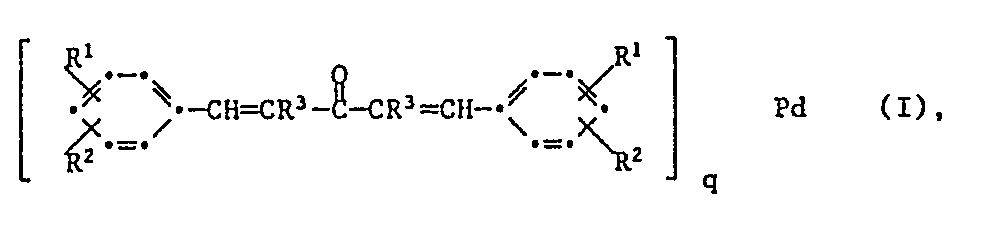
- the invention relates to polymer compositions in which a dibenzalacetone-palladium complex is dissolved, a process for electroless metal deposition on substrate surfaces and the use of said polymer compositions in the production of metallized surfaces or of conductive patterns on substrate surfaces.
- EP-A 125 617 describes mixtures of polymers and organometallic complexes. Pd-II complexes but no Pd ° complexes, for example dibenzalacetone-palladium complexes, are mentioned. Pd metal can be deposited from such Pd-II complexes either reductively or by heating to relatively high temperatures. The thermally activated polymer surfaces are suitable according to EP-A 125 617
- R 1 , R 2 , R 4 and R 5 as alkyl and alkoxy groups can be straight-chain or branched. Examples include: methyl, ethyl, n-propyl, isopropyl, n-butyl, sec-butyl, tert.
- R 1 , R 2 , R 4 and R 5 carry non-polar substituents, for example C 1 -C 4 alkyl or alkoxy radicals, as substituted phenyl. Examples include methyl, ethyl or methoxy.
- Examples of preferred substituted phenyl radicals R 1 , R 2 , R 4 and R 5 are o-, m- or p-tolyl, o-, m- or p-methoxyphenyl or 2,3-, 2,4-, 2,5 -, 2,6- or 3,5-dimethylphenyl.
- m is preferably a number from 2-4 and n is preferably a number from 0-10, particularly preferably 0-6.
- group C m H 2m means ethylene, 1,2- or 1,3-propylene or 1,4-butylene.
- the halogen atom R 2 can be fluorine, chlorine, bromine or iodine. Chlorine and bromine, in particular chlorine, are preferred.
- R 2 is a glycidyl ether radical, it is preferably a group of the formula II wherein R 6 and R 8 each represent a hydrogen atom, where R 7 is then a hydrogen atom or a methyl group, or wherein R 6 and R 8 together represent -CH 2 CH 2 -, where R 7 is then a hydrogen atom.
- R 2 as glycidyl ether radical is preferably a group of the formula III
- R 3 as C 1 -C 4 -alkyl is preferably straight-chain. Examples of such radicals are methyl, ethyl, propyl or butyl, but particularly preferably methyl.
- R 3 is preferably hydrogen.
- R 3 groups together form a C 2 -C 4 polymethylene chain, these are, for example, ethylene, trimethylene and tetramethylene.
- R 4 and R 5 are preferably hydrogen.
- the compounds of the formula can also be in the form of mixtures with different meanings of q.
- q is preferably 2 to 3.5.
- compositions containing compounds of the formula 1 in which R 1 is hydrogen, R 2 is C 1 -C 12 alkyl, C 1 -C 4 alkoxy, halogen or a glycidyl ether radical are preferred, R 3 is hydrogen and q is a number from 2 to 3, 5 is.
- compositions containing compounds of the formula I in which R 1 is hydrogen, R 2 is C 1 -C 5 alkyl, in particular isopropyl, R 3 is hydrogen and q is a number from 2 to 3.5 are particularly preferred.
- the groups R 2 are preferably each in the p-position.
- the palladium complexes of the formula dissolve in high concentrations in many commercially available polymers.
- the polymers can be soluble or insoluble in organic solvents; i.e. linear or cross-linked polymers.
- the cross-linked polymer precursors must be soluble in organic solvents.
- the solvents used are those which do not decompose the palladium complex I, preferably apolar organic solvents.
- solvents examples include aliphatic or aromatic hydrocarbons, such as n-hexane, n-heptane, cyclohexane, benzene, toluene or xylene, ethers, such as di-n-butyl ether, diethyl ether, diphenyl ether, 1,4-dioxane, anisole tetrahydrofuran , diethylene glycol diethyl ether, Ethylenglykoldimethyl ether or triethylene glycol dimethyl ether, halogenated hydrocarbons such as carbon tetrachloride, chlorobenzene, bromobenzene, chloroform, dichloromethane or 1,2-dichloroethane, ketones such as cyclohexanone, methyl ethyl ketone, acetophenone or acetone, and esters such as ethyl acetate.
- the respective polymers are considered soluble if they dissolve in the solvent in question at room temperature to at least 1 mg / l, preferably at least 10 mg / l.
- the polymers preferably have a glass transition temperature of more than 90 ° C.
- the polymer component in the mixtures according to the invention must be free from olefinic double bonds or conjugated, non-aromatic double bond systems.
- the palladium complex is selected such that it is not polymerized into the polymer matrix in the subsequent crosslinking step.
- compositions containing as component a) a polymer (mixture) which is soluble in organic solvents are preferred.
- compositions in which the polymer is selected from the group consisting of polystyrene, polyvinyl chloride, polycarbonate, polyarylate and polyimide soluble in organic solvents are particularly preferred.
- compositions according to the invention may equally well contain, as component a), a crosslinked or crosslinkable polymer, for example an epoxy resin.
- a crosslinked or crosslinkable polymer for example an epoxy resin.
- the palladium complex should be chosen so that it is not polymerized into the polymer structure, but only remains dissolved in it.
- the invention therefore preferably relates to compositions as defined above, containing as component a) an epoxy resin.
- epoxy resins which are suitable for the construction of crosslinked substrates and of hardeners for these resins can be found in Ullmann's Encyclopedia of Industrial Chemistry, Volume 10, 2. 563-580 (4th edition, Verlag Chemie, Weinheim / Bergstr .; 1975).
- the proportion of dibenzalacetone-palladium complex of the formula 1 in the compositions according to the invention is generally 0.1-25% by weight, preferably 0.5-10% by weight, based on the total mixture.
- the mixtures according to the invention can also contain other known customary additives.
- additives are pigments, dyes, reinforcing materials such as glass fibers, flame retardants, antistatic agents, flow control agents, release agents, adhesion promoters, antioxidants and light stabilizers.
- the mixtures according to the invention can also contain electrically conductive fillers c), expediently in amounts of 1-90% by weight, particularly 40-80% by weight, based on the total weight of the mixture, components a) to c) add up to 100% by weight.
- electrically conductive fillers are those of an organic or inorganic type, e.g. Carbon black and graphite or metals of groups Vb, Vlb, VIII and Ib of the periodic table, alloys and salts thereof, such as halides, oxides and sulfides.
- suitable metals and metal compounds are: vanadium, niobium, tantalum, molybdenum, tungsten, copper, noble metals, such as Pt, Pd, Ag and Au, AgPd alloys, silver oxide, silver iodide, copper (il) sulfide, copper (1) iodide, Copper (II) oxide, gold (III) bromide, iodide and oxide, molybdenum (IV) sulfide, niobium (V) chloride and oxide, palladium iodide, palladium oxide, platinum (VI) bromide and chloride, vanadium (III) chloride, vanadium (IV) oxide, tungsten (VI) chloride and oxide.
- Silver, copper, silver / palladium alloys, palladium, platinum, gold, tungsten and molybdenum are preferred.
- Au, Pt AgPd and especially Ag and Cu powder are particularly preferred.
- compositions according to the invention can be prepared in a simple manner by dissolving the polymer or its crosslinkable precursor combined with a suitable crosslinking agent and the complex together and then pouring this solution into films in a manner known per se or applying it to a suitable substrate and optionally then hardens.
- Suitable substrates are common materials, which are preferably electrically non-conductive. Examples include paper, wood, glass, ceramics, semiconductors such as silicon, germanium or gallium arsenide, and in particular plastics, preferably hardened epoxy resins.
- metallic substrates such as aluminum or copper, can also be coated with the mixtures.
- the substrate is coated using customary methods, for example by immersion, brushing and spraying processes, spin coating, cascade casting or curtain casting coating.
- the polymer or its crosslinkable precursor and complex I can be dissolved together in a solvent. However, it is also possible to use mixtures of different solvents or to combine separate solutions of polymer or crosslinkable precursor and complex in different solvents.
- an adhesion promoter can be added to the solution.
- an adhesion promoter you can e.g. use a linear, soluble epoxy polymer.
- the compounds of formula 1 can be prepared by processes known per se (cf., for example, J. Chem.Soc. D, 1970, 1065 and US Pat. No. 4,347,323) by q mol of a compound of formula IV in the presence of a base and optionally an H donor with a soluble palladium salt.
- R 1 , R 2 , R 3 and q have the meaning given under formula I.
- Alkali metal salts of aliphatic monocarboxylic acids can be used as bases.
- Suitable palladium salts are, for example, PdBr 2 , PdCl 2 and Na 2 PdCl 4 .
- Na 2 PdC 1 4 and especially PdCl 2 are particularly preferably used.
- the reaction is expediently carried out in an organic solvent which also acts as an H donor. Suitable for this purpose are, for example, alkanols with up to 6 carbon atoms, especially ethanol and particularly preferably methanol.
- the compounds of the formula IV can be prepared in a manner known per se, for example analogously to the process described in US Pat. No. 3,295,974.
- composition according to the invention can be used for the electroless metallization of plastics or for the production of structured metal surfaces on plastics.
- the activation for the electroless metal deposition is carried out by heating to temperatures above 100 ° C., preferably to 100-250 ° C., particularly preferably to 150-200 ° C.
- the heating can be carried out, for example, by annealing the sample or by irradiation with IR radiation.
- Sources such as IR lasers, or the IR component of actinic radiation sources (for example xenon lamps, argon lamps, tungsten lamps, carbon arcs, metal halide and metal arc lamps, such as mercury lamps) take place.
- the temperature treatment releases finely dispersed, catalytically active palladium.
- Irradiation with IR sources can also take place in an image, e.g. by a laser beam that is guided over the surface.
- the annealing process can take between 1 and 60 minutes depending on the temperature; the tempering times are surprisingly very short.
- the Pd ° clusters formed are catalytically active and catalyze the electroless metallization (eg nickel plating, copper plating) of the polymer surface, for example according to the following scheme:
- Electroless metal deposition can be carried out using metallization baths known per se and by customary methods.
- suitable metals are copper, nickel, cobalt, silver, gold and tin or cobalt-phosphorus and cobalt-nickel alloys.
- composition according to the invention in a structured manner to a substrate, for example by means of a screen printing or a selectively controlled spray mist recording method. Suitable recording methods are described for example in DE-OS 3,326,508.
- the structuring can also be carried out using a photoresist.
- a substrate is coated with a photoresist in a manner known per se.
- the palladium complex 1 can either be dissolved in the photoresist or in an underlying polymer substrate, preferably a polymer layer.
- the sample is annealed and immersed in a metallizing bath.
- the metal deposition now takes place either on the structured photoresist or on the polymer substrate structured by the photoresist.
- stage (iii) and (iv) you can switch on a tempering step between stage (iii) and (iv) to pre-harden the exposed photoresist.
- the materials customary in technology can be used as photoresists.
- photoresist also includes olefinically unsaturated compounds. P.S. gives an overview of imaging processes with such varnishes and selected compound classes. Pappas in “UV Curing: Science and Technology", Chapter 9, pp. 230-253 (1973).
- the photoresist must of course be chosen so that a structure created by the irradiation and development step survives the annealing step without major distortions.
- Such systems are known to the person skilled in the art or can be selected using routine methods.
- a radiation-sensitive polymer system is chosen as the photoresist, the polymer having no olefinic double bonds.
- good results can already be achieved with relatively small amounts of the Pd compound.
- less than 10% by weight of the complex of the formula I, based on the polymer solution is sufficient in order to obtain a catalytically active surface after the exposure and tempering step.
- preference is given to using 1-5% by weight of the complex of the formula 1, based on the polymer solution.
- Examples of radiation-sensitive polymer systems with polymers without olefinic double bonds are combination ions of epoxy resins with photoinitiators of cationic polymerization.
- exposure to a predetermined pattern of actinic radiation means both exposure through a photomask that contains a predetermined pattern, such as a slide, and exposure through a laser beam that is moved, for example, computer-controlled, over the surface, and thus Image created.
- actinic radiation When generating images using a photoresist, actinic radiation of 200 to 600 nm is preferably used. Suitable sources of actinic radiation include carbon arcs, mercury vapor lamps, fluorescent lamps with ultraviolet light-emitting phosphors, argon and xenon incandescent lamps, tungsten lamps and photographic floodlight lamps. However, X-rays or electron beams as well as high-energy radiation can also be used.
- developers can take place, for example, with water, aqueous or aqueous-organic solutions of a base or acid, organic solvents or solvent mixtures.
- Another object of the invention is the use of the mixtures according to the invention for electroless metal deposition, in particular for producing electrically conductive patterns on plastic surfaces.
- patterns according to the invention patterns with high resolution can be achieved.
- Such products can be used, for example, as printed circuits.
- Example 1 Tris (dibenzalacetone-p, p'-diglycidyl ether) palladium.
- a precipitate is formed which is filtered off under argon and washed once with 100 ml of methanol, three times with 100 ml of water and twice with 100 ml of methanol. The product is then dried at 50 ° C in a vacuum. To completely remove residual dibenzalacetone-bis-p, p'-diglycidyl ether, the crystals are suspended again in 700 ml of methanol and filtered off under argon. It is then dried in vacuo. 100.7 g of violet crystals (97% of theory) are obtained. Decomposition range: 120-160 ° C. The analysis gives a value of 3.2 for q.
- Example 2 Tris (p, p'-diisopropyldibenzalacetone) palladium.
- Example 3 Bis (dibenzalacetone) palladium.
- Examples BE One works as described in example A.
- the working conditions of the experiments AE are described in the following table.
- Well-adhering nickel or copper coatings are obtained in each case.
- Example F An epoxy resin plate (60x40x2mm) is coated with a 50 ⁇ m thick polymer film of the composition according to Example C. After the solvent has evaporated, the plate 6 min. heated to 170 ° C and then immersed in one of the nickel plating baths described in Example A. The surface is covered with a well-adhering nickel film.
- Example G Execution as described in Example F. A glass plate is used as the substrate.
- Example H Execution as described in Example F. An aluminum plate is used as the substrate.
- Example 1 0.25 g of the complex according to Example 1 is dissolved in 20 g of 1,2-dichloroethane in a solution of 5 g of a linear polyepoxide * ). With this solution a 50 ⁇ m thick polymer film is produced on an epoxy resin plate (60x40x2mm). After the solvent has evaporated, the coated epoxy resin plate is 6 min. heated to 170 ° C and then immersed in one of the nickel deposition baths described in Example A. A well adhering nickel film is formed on the coated resin surface.
- the epoxy polymer is a linear addition copolymer consisting of a diglycidyl ether based on bisphenol A (epoxy value: 5.3 Val / kg) and benzylamine in a molar ratio of 1: 1.
- the production follows the in J. Polym. Sci. Polym. Chem. Ed., 22 249 (1984).
- Example J 0.5 g of the complex according to Example 1, 0.5 g of the linear polyepoxide according to Example 1 and 10.0 g Makrolon® (cf. Example C) are dissolved in 70 g 1,2 dichloroethane. An epoxy resin plate is treated with the solution obtained as described in Example I. A well adhering nickel film is obtained on the coated resin surface.
- Example K 11.2 g (56.0% by weight) of a diglycidyl ether based on bisphenol A (epoxy value: 5.25-5.4 Vat / kg), 7.8 g (39.0% by weight) of hexahydropthalic anhydride and 1.0 g (5.0% by weight) of the complex according to Example 2 are mixed at 90 ° C. for 15 minutes. Then 0.06 g of benzyldimethylamine is added as an accelerator. After a further 5 minutes at 90 ° C., the mixture is poured into a mold preheated to 100 ° C. and cured for 4 hours at 100 ° C. and for a further 4 hours at 120 ° C.
- the molded body is tempered for a further 2 hours at 240 ° C. and then coated with nickel in a commercial nickel plating bath (Shipley Niposit® 468 or Niposit® PM 980). A well adhering nickel coating is obtained.
- the nickel plating can also be carried out using the nickel plating bath according to example A. Comparable results are achieved.
- Example L 22.4 g (50.8 wt.%) Of a diglycidyl ether based on bisphenol A (epoxy value: 5.25-5.4 val / kg), 15.4 g (34.9 wt.%) Hexahydrophthalic anhydride and 6. 3 g (14.3% by weight) of the complex according to Example 3 are mixed at 90 ° C. for 15 minutes. Then 0.1 g of benzyldimethylamine is added as an accelerator. After a further 5 minutes at 90 ° C., the mixture is poured into a mold preheated to 100 ° C. and cured for 4 hours at 100 ° C. and for a further 4 hours at 120 ° C.
- the molded body is annealed at 240 ° C. for 1 hour and then coated with nickel in a commercial nickel plating bath (Shipley Nisposit® 468 or Nisposit® PM 980). A well adhering nickel coating is obtained.
- the nickel plating can also be carried out with comparably good results using the nickel plating bath described in Example A.
- Example M 0.25 g tris (p, p'-diisopropyldibenzalacetone) palladium and 0.2 g polystyrene are dissolved in 20 ml toluene. This solution is used as a writing ink in a Hewlett-Packard "Thinkjet" printer with a modified writing head * ). With the printer, a text is written on a transparency for normal copiers (Folex® X-100). The film is then 15 min. annealed at 170 ° C. The film is then immersed in one of the nickel deposition baths written in Example A (duration 15 minutes). A nickel coating adheres well to the film at the printed areas.
- the ink reservoir is made of aluminum to increase resistance to organic solvents. In addition, all bonds are made with the solvent-resistant Araldit® adhesive.
- Example N 20 g of a photoresist from 120 parts by weight of a technical epoxy cresol novolak (epoxy content 4.5 equivalents / kg), 50 parts by weight a technical bisphenol A epoxy resin (epoxy content 0.5 eq./kg), 20 parts by weight Talc, 1 part by weight Irgatith green, 2 parts by weight ( ⁇ 6 -stylbene) ( ⁇ 5 -cyclopentadienyl) iron (II) hexafluorophosphate and 200 parts by weight Cyclohexanone is mixed with a solution of 0.5 g of the complex according to Example 2 in 15 ml of dichloroethane and mixed well.
- a technical epoxy cresol novolak epoxy content 4.5 equivalents / kg
- a technical bisphenol A epoxy resin epoxy content 0.5 eq./kg
- Talc 1 part by weight Irgatith green
- ⁇ 6 -stylbene ⁇ 5 -cyclopentadie
- This mixture is applied to a glass plate (200x100x4 mm) using a 70 ⁇ squeegee.
- the applied lacquer is dried for one hour at 80 ° C.
- the paint is exposed through a mask (5000 W Hg high-pressure lamp Berner M 061), 20 min. hardened at 135 ° C, and then developed by immersion in cyclohexanone for 1 1/2 min.
- annealing is carried out at 230 ° C in a forced air oven for one hour.
- the plate is then nickel-plated in a metallizing bath described in Example A. A well adhering nickel coating is created on the structured surface of the photoresist.
- Example 0 The procedure is as in Example N. Instead of a glass plate, an epoxy carbon fiber laminate is used as the substrate. After the irradiation, 10 min. hardened at 135 ° C. After development and metallization, a well-adhering nickel coating is created on the structured surface of the photoresist.
Landscapes
- Chemical & Material Sciences (AREA)
- Metallurgy (AREA)
- Engineering & Computer Science (AREA)
- Materials Engineering (AREA)
- Mechanical Engineering (AREA)
- General Chemical & Material Sciences (AREA)
- Organic Chemistry (AREA)
- Chemical Kinetics & Catalysis (AREA)
- Compositions Of Macromolecular Compounds (AREA)
- Addition Polymer Or Copolymer, Post-Treatments, Or Chemical Modifications (AREA)
- Manufacturing Of Printed Wiring (AREA)
- Paints Or Removers (AREA)
- Chemically Coating (AREA)
- Conductive Materials (AREA)
- Manufacturing Of Electric Cables (AREA)
Abstract
- a) mindestens ein organisches Polymeres und
- b) in diesem Polymeren einheitlich gelöst aber nicht damit copolymerisierbar einen Komplex der Formel 1
Description
- Die Erfindung betrifft Polymerzusammensetzungen, in denen ein Dibenzalaceton-Palladiumkomplex gelöst ist, ein Verfahren zur stromlosen Metallabscheidung auf Substratoberflächen sowie die Verwendung besagter Polymerzusammensetzungen bei der Herstellung von metallisiserten Oberflächen oder von leitfähigen Mustern auf Substratoberflächen.
- Aus der US-PS 3,993,807 ist es bekannt, dass Lösungen von Komplexen aus Palladium, Triphenylphosphit und einer olefinisch oder acetylenisch ungesättigten organischen Verbindung mit 3-16 C-Atomen oder von Dibenzalaceton-Palladium-Komplexen für die stromlose Metallabscheidung auf Substraten, wie Metallen, oxidierten Metallen und Kunststoffen, eingesetzt werden können. Dabei werden die zu beschichtenden Substrate ein oder mehrere Male in eine Lösung der Palladium-Komplexe getaucht, bevorzugt in Benzol oder Toluol-Lösungen, und auf 100-300° C erhitzt, wobei Palladium auf der Substrat-Oberfläche abgeschieden wird. Die so beschichteten Substrate eignen sich zur stromlosen Metallabscheidung. Eine Vorbehandlung des zu metallisierenden Substrates mit einem Aktivierbad kann allerdings zu Problemen führen (ungenügende Benetzung, Quellung der Oberfläche).
- In der EP-A 125 617 sind Mischungen aus Polymeren und Organometallkomplexen beschrieben. Es werden Pd-II-Komplexe aber keine Pd°-Komplexe, beispielsweise Dibenzalaceton-Palladiumkomplexe, erwähnt. Aus solchen Pd-II-Komplexen lässt sich Pd-Metall entweder reduktiv oder durch Erhitzen auf relativ hohe Temperaturen abscheiden. Die thermisch aktivierten Polymeroberflächen eignen sich nach der EP-A 125 617
- zur stromlosen Metallabscheidung.
- Die vorliegende Erfindung betrifft Zusammensetzungen enthaltend
- a) mindestens ein organisches Polymeres und
- b) in diesem Polymeren einheitlich gelöst aber nicht damit copolymerisierbar einen Dibenzalaceton-Palladiumkomplex der Formel 1

R3 Wasserstoff oder C1-C4Alkyl ist oder die beiden Gruppen R3 zusammen eine Polymethylenkette von 2-4 Kohlenstoffatomen bilden, R4 und R5 eine der Bedeutungen von R1 besitzen und
q eine Zahl von 1 bis 3,5 ist, m für eine Zahl von 2 bis 6 und n für eine Zahl von 0 bis 20 steht, mit der Massgabe, dass die Zusammensetzung kein Polymeres mit einer olefinischen Doppelbindung enthält. - R1, R2, R4 und R5 als Alkyl- und Alkoxygruppen können geradkettig oder verzweigt sein. Als Beispiele seien genannt: Methyl, Ethyl, n-Propyl, Isopropyl, n- Butyl, sek.Butyl, tert. Butyl, n-Pentyl, n-Hexyl, n-Heptyl, n-Octyl, 2-Ethylhexyl, n-Decyl, n-Dodecyl, n-Tetradecyl, n-Hexadecyl oder n-Octadecyl, sowie Methoxy, Ethoxy, n-Propoxy, Isopropoxy, n-Butoxy, sek. Butoxy, tert.Butoxy, Pentoxy oder Hexoxy.
- Als substituiertes Phenyl tragen Rl, R2, R4 bzw. R5 nichtpolare Substituenten, beispielsweise C1-C4-Alkyl-oder -Alkoxyreste. Beispiele dafür sind insbesondere Methyl, Ethyl oder Methoxy.
- Beispiele für bevorzugte substitutierte Phenylreste R1, R2, R4 und R5 sind o-, m- oder p-Tolyl, o-, m- oder p-Methoxyphenyl oder 2,3-, 2,4-, 2,5-, 2,6- oder 3,5-Dimethylphenyl.
- In der Gruppe -(O-CmH2m-)n-OR4 ist m bevorzugt eine Zahl von 2-4 und n bevorzugt eine Zahl von 0-10, besonders bevorzugt 0-6. Insbesondere bedeutet die Gruppe CmH2m Ethylen, 1,2- oder 1,3-Propylen oder 1,4-Butylen.
- Als Halogenatom kann R2 Fluor, Chlor, Brom oder lod bedeuten. Bevorzugt werden Chlor und Brom, insbesondere Chlor.
- Ist R2 ein Glycidyletherrest, so handelt es sich dabei vorzugsweise um eine Gruppe der Formel II

- Vorzugsweise ist R2 als Glycidyletherrest eine Gruppe der Formel III

R3 ist vorzugsweise Wasserstoff. - Bilden beide Reste R3 zusammen eine C2-C4Polymethylenkette, so handelt es sich dabei beispielsweise um Ethylen, Trimethylen und Tetramethylen. R4 und R5 sind vorzugsweise Wasserstoff.
- Die Verbindungen der Formel können auch in Form von Gemischen mit unterschiedlicher Bedeutung von q vorliegen. q ist vorzugsweise 2 bis 3,5.
- Bevorzugt werden Zusammensetzungen enthaltend Verbindungen der Formel 1, worin R1 Wasserstoff ist, R2 C1-C12Alkyl, C1-C4Alkoxy, Halogen oder ein Glycidyletherrest ist, R3 Wasserstoff bedeutet und q eine Zahl von 2 bis 3,5 ist.
- Besonders bevorzugt werden Zusammensetzungen enthaltend Verbindungen der Formel I, worin R1 Wasserstoff ist, R2 C1-C5Alkyl, insbesondere Isopropyl, ist, R3 Wasserstoff bedeutet und q eine Zahl von 2 bis 3, 5 ist.
- Vorzugsweise befinden sich die Gruppen R2 jeweils in p-Position.
- Ueberraschenderweise lösen sich die Palladiumkomplexe der Formel in hohen Konzentrationen in vielen handelsüblichen Polymeren. Die Polymeren können löslich oder unlöslich in organischen Lösungsmitteln sein; d.h., es handelt sich um lineare oder um vernetzte Polymere. Jedoch müssen die Vorstufen der vernetzten Polymeren in organischen Lösungsmitteln löslich sein.
- Bei den verwendeten Lösungsmitteln handelt es sich um solche, die den Palladiumkomplex I nicht zersetzen, bevorzugt um apolare organische Lösungsmittel.
- Beispiele für solche Lösungsmittel sind aliphatische oder aromatische Kohlenwasserstoffe, wie beispielsweise n-Hexan, n-Heptan, Cyclohexan, Benzol, Toluol oder Xylol, Ether, wie beispielsweise Di-n-butylether, Diethylether, Diphenylether, 1,4-Dioxan, Anisol Tetrahydrofuran, Diethylenglykoldiethylether, Ethylenglykoldimethyl ether oder Triethylenglykoldimethylether, halogenierte Kohlenwasserstoffe, wie beispielsweise Tetrachlorkohlenstoff, Chlorbenzol, Brombenzol, Chloroform, Dichlormethan oder 1,2-Dichlorethan, Ketone, wie beispielsweise Cyclohexanon, Methylethylketon, Acetophenon oder Aceton, sowie Ester, wie beispielsweise Essigsäureethylester. Bevorzugt werden Zusammensetzungen enthaltend als Komponente a) ein in organischen Lösungsmitteln lösliches Polymer(gemisch).
- Als löslich werden die jeweiligen Polymeren dann angesehen, wenn sie sich in dem betreffenden Lösungsmittel bei Raumtemperatur zu wenigstens 1 mg/I, vorzugsweise mindestens 10 mg/I, lösen.
- Als Polymersubstrate können die unterschiedlichsten Verbindungsklassen bzw. Gemische davon eingesetzt werden, sofern sie unter die oben angegebene Definition fallen.
- Vorzugsweise haben die Polymeren eine Glasübergangstemperatur von mehr als 90°C.
- Die Polymerkomponente in den erfindungsgemässen Mischungen muss frei von olefinischen Doppelbindungen oder konjugierten, nichtaromatischen Doppelbindungssystemen sein.
- Enthält die Polymerkomponente vernetzbare Gruppen für eine nach der Herstellung der Palladiumkomplex- /Präpolymerenmischung durchzuführende Vernetzungsreaktion, so wird der Palladiumkomplex so gewählt, dass er im anschliessenden Vernetzungsschritt nicht in die Polymermatrix einpolymerisiert wird.
- Beispiele für brauchbare Polymerklassen sind:
- 1. Polymere von Mono- und Diolefinen, beispielsweise Polyethylen (das gegebenenfalls vernetzt sein kann), Polypropylen, Polyisobutylen, Polybuten-1 oder Polymethylpenten-1, sowie Polymerisate von Cycloolefinen wie z.B. von Cyclopenten oder Norbornen.
- 2. Mischungen der unter 1) genannten Polymeren, z.B. Mischungen von Polypropylen mit Polyisobutylen.
- 3. Copolymere von Mono- und Diolefinen untereinander oder mit anderen Vinylmonomeren, wie z.B. Ethylen-Propylen-Copolymere, Propylen-Buten-1-Copolymere, Propylen-Isobutylen-Copolymere, Ethylen-Buten-1-Copolymere, Ethylen-Alkyacrylat-Copolymere oder Ethylen-Alkylmethacrylat-Copolymere oder Ethylen-Vinylacetat-Copolymere.
- 4. Polystyrol, Poly-(p-methylstyrol).
- 5. Copolymere von Styrol oder a-Methylstyrol mit Acrylderivaten, wie z.B. Styrol-Acrylnitril, Styrol-Alkylmethacrylat, Styrol-Maleinanhydrid, Styrol-Acrylnitril-Methylacrylat; Mischungen von hoher Schlagzähigkeit aus Styrol-Copolymeren und einem anderen Polymer wie z.B. einem Polyacrylat; sowie Block-Copolymere des Styrols, wie z.B. Styrol-Ethylen/Butylen-Styrol oder Styrol-Ethylen/Propylen-Styrol.
- 6. Pfropfcopolymere von Styrol, wie z.B. Styrol und Acrylnitril auf Polyalkylacrylaten oder Polyalkylmethacrylaten.
- 7. Halogenhaltige Polymere, wie z.B. Polychloropren, chloriertes oder chlorsulfoniertes Polyethylen, Epichlorhydrinhomo- und copolymere, insbesondere Polymere aus halogenhaltigen Vinylverbindungen, wie z.B. Polyvinylchlorid, Polyvinylidenchlorid, Polyvinylfluorid, Polyvinylidenfluorid; sowie deren Copolymere wie Vinylchlorid-Vinylchlorid-Vinylidenchlorid, Vinylchlorid-Vinylacetat oder Vinylidenchlorid-Vinylacetat; sowie chlorierter Kautschuk.
- 8. Polymere, die sich von Derviaten (Estern) a,ß-ungesättigter Säuren ableiten, wie Polyacrylate, Polymethacrylate und Polyacrylnitrile.
- 9. Copolymere der unter 8) genannten Monomeren untereinander oder mit anderen ungesättigten Monomeren, wie z.B. Acrylnitril-Alkylacrylat- Copolymere, Acrylnitril-Alkoxyalkylacrylat-Copolymere oder Acylnitril-Vinylhalogenid-Copolymere.
- 10. Homo- und Copolymere von cyclischen Ethern, wie Polyalklenglykole, Polyethylenoxyd, Polypropylenoxyd oder deren Copolymere mit Bisglycidylethern.
- 11. Polyphenyloxide und -sulfide und deren Mischungen mit Styrolpolymeren.
- 12. Polyimide, Polyetherimide, Polyesterimide und Polybenzimidazole.
- 13. Polyester, die sich von Dicarbonsäuren und Dialkoholen und/oder von Hydroxycarbonsäuren oder den entsprechenden Lactonen ableiten, wie Polyethylenterephthalat, Polybutylenterephthalat, Poly-1,4-dimethylotcyclohexanterephthalat, Polyhydroxybenzoate, sowie Block-Polyether-ester, die sich von Polyethern mit Hydroxylendgruppen ableiten.
- 14. Polycarabonate.
- 15. Polysulfone, Polyethersulfone und Polyetherketone.
- 16. Vernetzte oder vernetzbare Polymere, die sich von Aldehyden einerseits und Phenolen andererseits ableiten, wie Phenol-Formaldehydharze.
- 17. Nicht-trocknende Alkydharze.
- 18. Vernetzbare Acrylharze, die sich von substituierten Acrylsäureestern ableiten wie z.B. Epoxygruppen enthaltende Polyacrylate.
- 19. Alkydharze, Polyesterharze und Acrylatharze, die mit Epoxidharzen vernetzt sind.
- 20. Vernetzte oder vernetzbare Epoxidharze, die sich von Polyepoxiden ableiten, z.B. von Bis-glycidylethern oder von cycloaliphatischen Diepoxiden, sowie lineare Epoxidharze, beispielsweise solche auf Bisphenol A Basis.
- 21. Polymerhomolog chemisch agbewandelte Derivate von natürlichen Polymeren, wie Celluloseacetate, -propionate und -butyrate, bzw. die Celluloseether, wie Methylcellulose.
- 22. Mischungen (Polyblends) der vorgenannten Polymeren wie z.B. PVC/EVA.
- Bevorzugt werden Zusammensetzungen enthaltend als Komponente a) ein in organische Lösungsmitteln lösliches Polymer(gemisch).
- Besonders bevorzugt werden Zusammensetzungen, worin das Polymere ausgewählt wird aus der Gruppe bestehend aus Polystyrol, Polyvinylchlorid, Polycarbonat, Polyarylat und in organischen Lösungsmitteln löslichem Polyimid.
- Die erfindungsgemässen Zusammensetzungen können aber ebensogut als Komponente a) ein vernetztes oder vernetzbares Polymeres enthalten, beispielsweise ein Epoxidharz. In einem solchen Fall sollte der Palladiumkomplex so gewählt werden, dass er nicht in das Polymergerüst einpolymerisiert wird, sondern lediglich darin gelöst bleibt.
- Die Erfindung betrifft daher bevorzugt Zusammensetzungen, wie oben definiert, enthaltend als Komponente a) ein Epoxidharz.
- Beispiele für Epoxidharze, die sich zum Aufbau von vernetzten Substraten eignen, sowie von Härtern für diese Harze, findet man in Ullmanns Enzyklopädie der technischen Chemie, Band 10, 2. 563-580 (4. Auflage, Verlag Chemie, Weinheim/Bergstr.; 1975).
- Der Anteil an Dibenzalaceton-Palladiumkomplex der Formel 1 in den erfindungsgemässen Zusammensetzungen beträgt in der Regel 0,1-25 Gew.%, vorzugsweise 0,5-10 Gew.%, bezogen auf die Gesamtmischung.
- Die erfindungsgemässen Gemische können auch weitere bekannte übliche Zusatzstoffe enthalten. Beispiele für solche Zusatzstoffe sind Pigmente, Farbstoffe, Verstärkungsmaterialien, wie Glasfasern, Flammhemmer, Antistatika, Verlaufmittel, Trennmittel, Haftvermittler, Antioxidantien und Lichtschutzmittel.
- Die erfindungsgemässen Gemische können - neben weiteren üblichen Zusätzen - auch elektrisch leitende Füllstoffe c) enthalten, zweckmässig in Mengen von 1-90 Gew.%, besonders 40-80 Gew.%, bezogen auf das Gesamtgewicht des Gemisches, wobei sich die Komponenten a) bis c) auf 100 Gew.% ergänzen. Als elektrisch leitende Füllstoffe eignen sich solche organischer oder anorganischer Art, wie z.B. Russ und Graphit oder Metalle der Gruppen Vb, Vlb, VIII und Ib des periodischen Systems, Legierungen und Salze davon, wie Halogenide, Oxide und Sulfide.
- Beispiele geeigneter Metalle und Metallverbindungen sind: Vanadium, Niob, Tantal, Molybdän, Wolfram, Kupfer, Edelmetalle, wie Pt, Pd, Ag und Au, AgPd-Legierungen, Silberoxid, Silberjodid, Kupfer(il)sulfid, Kupfer(1)jodid, Kupfer(II)oxid, Gold(III)bromid, -jodid und-oxid, Molybdän(lV)sulfid, Niob(V)chlorid und -oxid, Palladiumjodid, Palladiumoxid, Platin (Vl)bromid und -chlorid, Vanadium(III)chlorid, Vanadium(lV)oxid, Wolfram(Vl)chlorid und-oxid. Bevorzugt sind Silber, Kupfer, Silber/Palladiumlegierungen, Palladium, Platin, Gold, Wolfram und Molybdän. Besonders bevorzugt sind Au, Pt AgPd und vor allem Ag und Cu-Pulver.
- Die erfindungsgemässen Zusammensetzungen lassen sich in einfacher Weise dadurch herstellen, indem man das Polymere oder dessen vernetzbare Vorstufe kombiniert mit einem geeigneten Vernetzungs mittel und den Komplex gemeinsam löst und diese Lösung anschliessend in an sich bekannter Weise zu Filmen vergiesst oder auf ein geeignetes Substrat aufträgt und gegebenenfalls anschliessend härtet.
- Geeignete Substrate sind übliche Werkstoffe, die vorzugsweise elektrisch nicht leitend sind. Beispiele dafür sind Papier, Holz, Glas, Keramik, Halbleiter, wie Silizium, Germanium oder Galliumarsenid, und insbesondere Kunststoffe, bevorzugt gehärtete Epoxidharze.
- Selbstverständlich können auch metallische Substrate, wie beispielsweise Aluminium oder Kupfer, mit den Mischungen beschichtet werden.
- Die Beschichtung des Substrates erfolgt mit üblichen Methoden, beispielsweise durch Tauch-, Streich- und Sprühverfahren, Schleuder-, Kaskadenguss- oder Vorhanggussbeschichtung.
- Man kann allerdings auch eine Folie aus der erfindungsgemässen Mischung giessen und diese dann anschliessend auf ein geeignetes Substrat aufkleben.
- Das Polymere bzw. dessen vernetzbare Vorstufe und der Komplex I können gemeinsam in einem Lösungsmittel gelöst werden. Man kann aber auch Mischungen unterschiedlicher Lösungsmittel einsetzen oder getrennte Lösungen von Polymer bzw. vernetzbarer Vorstufe und Komplex in unterschiedlichen Lösungsmitteln zusammengeben.
- Die Wahl des jeweiligen Lösungsmittelgemisches richtet sich nach den jeweils verwendeten Polymeren und Komplexen und kann vom Fachmann anhand von Routineversuchen bestimmt werden.
- Zur Haftverbesserung von Beschichtungen kann der Lösung ein Haftvermittler zugesetzt sein. Als Haftvermittler kann man z.B. ein lineares, lösliches Epoxidpolymeres einsetzen.
- Die Wahl der jeweiligen Polymer(mischungen) und der Palladiumkomplexe 1 richtet sich nach der Löslichkeit der Komponenten ineinander und kann vom Fachmann ebenfalls anhand von Routineversuchen ermittelt werden.
- Die Verbindungen der Formel 1 können nach an sich bekannten Verfahren hergestellt werden (vgl. z.B. J.Chem.Soc. D, 1970, 1065 und US-PS 4,347,323), indem man q Mol einer Verbindung der Formel IV

- Als Basen können z.B. Alkalimetallsalze aliphatischer Monocarbonsäuren, besonders Kalium- und Natriumacetat, verwendet werden. Geeignete Palladiumsalze sind beispielsweise PdBr2, PdCl2 und Na2PdCl4. Besonders bevorzugt verwendet man Na2PdC14 und vor allem PdCl2. Die Umsetzung wird zweckmässig in einem organischen Lösungsmittel durchgeführt, das gleichzeitig auch als H-Donor fungiert. Dazu eignen sich z.B. Alkanole mit bis zu 6 C-Atomen, vor allem Ethanol und besonders bevorzugt Methanol.
- Die Verbindungen der Formel IV können auf an sich bekannte Weise hergestellt werden, beispielsweise analog dem in der US-PS 3,295,974 beschriebenen Verfahren.
- Die erfindungsgemässe Zusammensetzung kann zur stromlosen Metallisierung von Kunststoffen oder zur Herstellung von strukurierten Metalloberflächen auf Kunststoffen eingesetzt werden.
- Als besonders vorteilhaft ist anzusehen, dass keine Vorbehandlung der zu metallisierenden Oberfläche (Aktivierbad, Reduktionsbad) notwendig ist, dass die Metallabscheidung auf beschichteten Substra ten durchgeführt werden kann, dass der Komplex 1 keine aggressiven Bestandteile enthält, die ihrerseits das Polymere angreifen können und dass bereits relativ geringe Mengen an Komplex 1 für die stromlose Metallisierung der Kunststoffoberfläche ausreichen.
- Die Aktivierung der Zusammensetzung für die stromlose Metallabscheidung erfolgt durch Erwärmen auf Temperaturen oberhalb von 100°C, vorzugsweise auf 100-250° C, besonders bevorzugt auf 150-200° C, die Erwärmung kann beispielsweise durch Tempern der Probe oder durch Bestrahlung mit IR-Quellen, wie beispielsweise IR-Lasern, oder dem IR-Anteil von aktinischen Strahlungsquellen (beispielsweise Xenonlampen, Argonlampen, Wolframlampen, Kohlelichtbogen, Metallhalogenid- und Metallichtbogenlampen, wie Quecksilberlampen) erfolgen.
- Durch die Temperaturbehandlung wird eine Freisetzung von fein dispergiertem, katalytisch aktivem Palladium bewirkt.
- Die Bestrahlung mit IR-Quellen kann auch bildmässig erfolgen, z.B. durch einen Laserstrahl der über die Oberfläche geführt wird.
- Der Temperprozess kann je nach Temperatur zwischen 1 und 60 Minuten dauern; die Temperzeiten sind also überraschenderweise sehr kurz. Bei dem Temperprozess zersetzt sich der Palladiumkomplex 1 nach folqendem Schema (DBA=Dibenzalacetonderivat):

- Gegenstand der Erfindung ist daher auch ein Verfahren zur Aktivierung von Polymeroberflächen zum Zwecke der stromlosen Metallisierung wobei
- i) eine Lösung des Komplexes der Formel 1 in einem Polymeren, wie oben definiert, auf ein Substrat aufgebracht wird oder als freitragender Film hergestellt wird und
- ii) die Anordnung auf Temperaturen über 100°C erhitzt wird, wobei der Komplex 1 sich zersetzt und fein verteiltes, katalytisch aktives Pd° entsteht.
- Die gebildeten Pd°-Kluster sind katalytisch aktiv und katalysieren die stromlose Metallisierung (z.B. Vernickelung, Verkupferung) der Polymeroberfläche, beispielsweise nach folgendem Schema:


- Die Haftung des Metallfilms ist ausgezeichnet. Die stromlose Metallabscheidung kann mit an sich bekannten Metallisierungsbädern und nach üblichen Methoden erfolgen. Als Metalle eignen sich beispielsweise Kupfer, Nickel, Kobalt, Silber, Gold und Zinn oder Kobalt-Phosphor- und Kobalt-Nickel-Legierungen.
- Die Erfindung betrifft daher auch ein Verfahren zur stromlosen Metallabscheidung auf Polymeroberflächen umfassend eine Aktiverung der Polymeroberfläche, wie oben definiert (Schritte i und ii), und daran anschliessend
- iii) die stromlose Metallisierung der aktivierten Polymeroberfläche in an sich bekannter Weise.
- Soll ein Metallmuster auf einer Substratoberfläche hergestellt werden, so bietet es sich an, die erfindungsgemässe Zusammensetzung struckturiert auf ein Substrat aufzubringen, beispielsweise mittels eines Siebdruck- oder eines selektiv gesteuerten Sprühnebel-Aufzeichnungsverfahren. Geeignete Aufzeichnungsverfahren sind beispielsweise in der DE-OS 3,326,508 beschrieben.
- Die Erfindung betrifft daher auch ein Verfahren zur Erzeugung von metallischen Mustern auf Substratoberflächen umfassend
- i) strukturiertes Aufbringen einer Lösung eines Komplexes in einem Polymeren, wie oben definiert, auf ein Substrat,
- ii) Erhitzen der Anordnung auf Temperaturen von über 100° C, wobei der Komplex I sich zersetzt und fein verteiltes, katalytisch aktives Pd° entsteht und
- iii) stromlose Metallisierung der aktivierten Polymeroberfläche in an sich bekannter Weise.
- Die Strukturierung kann auch mittels eines Photolackes erfolgen. Zu diesem Zweck wird ein Substrat in an sich bekannter Weise mit einem Photolack beschichtet. Der Palladiumkomplex 1 kann entweder in dem Photolack oder in einem darunterliegenden Polymersubstrat, vorzugsweise einer Polymerschicht, gelöst sein. Nach dem Bestrahlen der Anordnung mit aktinischem Licht und der anschliessenden Entwicklung des Photolackes (positiv oder negativ arbeitend) wird die Probe getempert und in ein Metallisierbad getaucht. Die Metallabscheidung erfolgt nun entweder auf dem strukturierten Photolack oder auf dem durch den Photolack strukturierten Polymersubstrat.
- Die Erfindung betrifft daher ferner ein Verfahren zur Erzeugung von metallischen Mustern auf Polymeroberflächen umfassend
- i) das Aufbringen einer Lösung des Komplexes 1 in einem Polymeren, wie oben definiert, auf ein Substrat oder Herstellung eines freitragenden Films auf besagter Lösung,
- ii) Beschichten der Polymeroberfläche mit einem positiv oder negativ arbeitendem Photolack,
- iii) Belichten der Anordnung mit einem vorbestimmten Muster aktinischer Strahlung,
- iv) Entwickeln des Photolackes in an sich bekannter Weise,
- v) Erhitzen der Anordnung auf Temperaturen von mehr als 100°C, wobei der Komplex 1 sich zersetzt und fein verteiltes, katalytisch aktives Pd° entsteht, und
- vi) stromloses Metallisieren des aktivierten vom Photolack nicht mehr bedeckten Teils der Polymeroberfläche in an sich bekannter Weise.
- Selbstverständlich kann man zwischen Stufe (iii) und (iv) noch einen Temperschritt einschalten, um den belichteten Photolack vorzuhärten. Als Photolacke lassen sich die in der Technik üblichen Materialien einsetzen. Der Begriff "Photolack" umfasst auch olefinisch ungesättigte Verbindungen. Eine Uebersicht über Abbildungsverfahren mit solchen Lacken und über ausgewählte Verbindungsklassen gibt P.S. Pappas in "UV Curing: Science and Technology", Kapitel 9, S. 230-253 (1973).
- Der Photolack muss natürlich so gewählt werden, dass eine durch den Bestrahlungs- und Entwicklungsschritt erzeugte Strucktur den Temperschritt ohne grössere Verzerrungen übersteht. Solche Systeme sind dem Fachmann bekannt oder können mittels Routineverfahren ausgewählt werden.
- Verfährt man nach der Variante, bei der ein in einem Photolack gelöster Komplex der Formel I vorliegt, so wählt man als Photolack ein strahlungsempfindliches Polymersystem, wobei das Polymere keine olefinischen Doppelbindungen besitzt. In diesem Verfahren lassen sich bereits mit relativ geringen Mengen der Pd-Verbindung gute Ergebnisse erzielen. Hier genügen in der Regel weniger als 10 Gew.% des Komplexes der Formel I, bezogen auf die Polymerlösung, um nach erfolgter Belichtung und Temperstufe eine katalytisch aktive Oberfläche zu erhalten. Bevorzugt verwendet man bei dieser Variante 1 - 5 Gew.% des Komplexes der Formel 1 bezogen auf die Polymerlösung.
- Beispiele für strahlungsempfindliche Polymersysteme mit Polymeren ohne olefinische Doppelbindungen sind Kombinationion von Epoxidharzen mit Photoinitiatoren der kationischen Polymerisation.
-
- - Bevorzugte Kombinationen dieses Typs sind in der EP-A 153,904 bechrieben; diese Kombinationen sind ebenfalls Gegenstand der vorliegenden Beschreibung. Ganz besonders bevorzugt setzt man Kombinationen von Epoxidharzen auf Bisphenol-A Basis oder auf Basis von Phenol- oder Kresol-Novolacken mit Eisen-Aren Photoinitiatoren ein. Solche Gemische sind ebenfalls in der EP-A 153,904 beschrieben.
- Gegenstand der Erfindung ist also ferner ein Verfahren zur Erzeugung von metallischen Mustern auf Polymeroberflächen umfassend
- i) das Aufbringen einer Zusammensetzung enthaltend
- a) einen positiv oder negativ arbeitenden Photolack und
- b) in diesem Photolack einheitlich gelöst aber nicht damit copolymerisierbar einen Dibenzalacetonkomplex der Formel I, wie oben definiert,
auf eine Substratoberfläche, mit der Massgabe, dass der Photolack kein Polymeres mit einer olefinischen Doppelbindung enthält, - ii) Belichten der Anordnung mit einem vorbestimmten Muster aktinischer Strahlung,
- iii) Entwickeln des Photolackes in an sich bekannter Weise, iv) Erhitzen der Anordnung auf Temperaturen von mehr als 100°C, wobei der Komplex 1 sich zersetzt und fein verteiltes, katalytisch aktives Pd° entsteht und v) stromloses Metallisieren der vom Photolack bedeckten Teile der Anordnung in an sich bekannter Weise. Auch bei dieser Ausführungsform wird zwischen Schritt ii) und iii) vorzugsweise ein Temperschritt geschaltet, um den belichteten Photolack vorzuhärten.
- Der Ausdruck "Belichtung mit einem vorbestimmten Muster aktinischer Strahlung" bedeutet sowohl eine Belichtung durch eine Photomaske, die ein vorbestimmtes Muster enthält, beispielsweise ein Diapositiv, sowie die Belichtung durch einen Laserstrahl, der beispielsweise computergesteuert über die Oberfläche bewegt wird, und auf diese Weise ein Bild erzeugt.
- Bei der Bilderzeugung mittels eines Photolackes wird vorzugsweise aktinische Strahlung von 200 bis 600 nm verwendet. Geeignete Quellen aktinischer Strahlung umfassen Kohlebögen, Quecksilberdampflampen, fluoreszierende Lampen mit ultraviolettes Licht emittierenden Phosphoren, Argon- und Xenonglühlampen, Wolframlampen und photographische Flutlichtlampen. Es lassen sich aber auch Röntgen- oder Elektronenstrahlen sowie hochenergetische Strahlung verwenden.
- Als Entwickler kommen je nach Art des gewählten Photolackes unterschiedlichste Materialien in Frage. Die Entwicklung kann beispielsweise mit Wasser, wässrigen oder wässrig-organischen Lösungen einer Base oder Säure, organischen Lösungsmitteln oder Lösungsmittelgemischen erfolgen.
- Ein weiterer Gegenstand der Erfindung ist die Verwendung der erfindungsgemässen Mischungen zur stromlosen Metallabscheidung, insbesondere zur Erzeugung von elektrisch leitfähigen Mustern auf Kunststoffoberflächen. Mit dem erfindungsgemässen Verfahren können Muster mit hoher Auflösung erzielt werden. Solche Produkte können beispielsweise als gedruckte Schaltungen verwendet werden.
- Die nachfolgenden Beispiele erläutern die Erfindung näher.
- 15 g PdC12 werden in einer Lösung aus 10,7 g NaC1 in 65 ml Wasser unter kräftigem Rührem zum Sieden erhitzt, bis das Palladiumchlorid vollständig gelöst ist. Dann wird das Wasser abdestilliert. Der Rückstand wird in 200 ml Methanol aufgenommen und auf 60° C erwärmt. 105,9 g Dibenzalaceton-bis-p,p'-diglycidylether und 42,8 g Natriumacetat·3H20 werden zugesetzt und es werden nochmals 175 ml Methanol zugegeben. Nach weiteren 15 Minuten bei 60°C wird die Mischung abgekühlt. Es entsteht ein Niederschlag, der unter Argon abfiltriert und einmal mit 100 ml Methanol, dreimal mit je 100 ml Wasser und noch zweimal mit 100 ml Methanol gewaschen wird. Anschliessend wird das Produkt bei 50° C im Vakuum getrocknet. Zur völligen Entfernung von restlichem Dibenzalaceton-bis-p,p'-diglycidylether werden die Kristalle nochmals in 700 ml Methanol suspendiert und unter Argon abfiltriert. Anschliessend wird im Vakuum getrocknet. Man erhält 100,7 g violetter Kristalle (97 % der Theorie). Zersetzungsbereich: 120-160°C. Die Analyse ergibt für q einen Wert von 3,2.
- Die Herstellung dieser Verbindung erfolgt gemäss US-PS 4,347,232.
- Die Herstellung erfolgt gemäss J.Chem. Soc. D 1970, 1065.
- Beispiel A: 20 g PVC werden in 80 g Tetrahydrofuran gelöst und mit einer Lösung von 0,6 g des Komplexes aus Beispiel 2 in 30 g Tetrahydrofuran versetzt. Die Lösung wird zu einem Film von 200 µm Dicke vergossen. Nach dem Abdunsten des Lösungsmittels wird der Film 15 min. bei 170°C getempert und anschliessend in einem kommerziellen Vernickelungsbad (SHIPLEY Nisposit® 468 bzw. PM 980) mit Nickel beschichtet. Es wird ein gut haftender Nickelüberzug erhalten. Ein weiterer Film wird in ein kommerzielles Verkupferungsbad gehalten (SHIPLEY Cuposit® CP 78 bzw. 328). Es wird ein gut haftender Kupferüberzug erhalten. Vergleichbare Ergebnisse werden mit den folgenden Metallisierungsbädern erhalten.
- a) Verkupferungsbad. Badzusammensetzung entsprechend "Printed Circuits Handbook", 2. Auflage, C.F. Coombs, jr. et al., McGraw Hill Book Co., New York, 1979, S. 7-5:
25 g/I CuSO4·5 H20
60 g/I Natriumgluconat
20 g/I NaOH
25 g/l 37%ige wässrige Formaldehydlösung, unter Sauerstoff-Strom.
Arbeitstemperatur: 20° C. - b) Vernickelungsbad. Badzusammensetzung entsprechend J. Appl., Electrochem., 1 (1971) 167:
30 g/I NiCl2·6 H20
10 g/I NaH2PO2·H2O - Beispiele B-E: Man arbeitet wie in Beispiel A beschrieben. Die Arbeitsbedingungen der Experimente A-E sind in der folgenden Tabelle beschrieben. Man erhält jeweils gut haftende Nickel- bzw. Kupferüberzüge.

- Beispiel F: Eine Epoxidharzplatte (60x40x2mm) wird mit einem 50 µm dicken Polymerfilm der Zusammensetzung nach Beispiel C beschichtet. Nach dem Abdunsten des Lösungsmittels wird die Platte 6 min. auf 170°C erwärmt und anschliessend in eines der in Beispiel A beschriebenen Vernickelungsbäder getaucht. Die Oberfläche überzieht sich mit einem gut haftenden Nickelfilm.
- Beispiel G: Durchführung wie in Beispiel F beschrieben. Als Substrat wird eine Glasplatte verwendet.
- Beispiel H: Durchführung wie in Beispiel F beschrieben. Als Substrat wird eine Aluminiumplatte verwendet.
- Beispiel 1: 0,25 g des Komplexes gemäss Beispiel 1 werden in einer Lösung von 5 g eines linearen Polyepoxids*) in 20 g 1,2-Dichlorethan gelöst. Mit dieser Lösung wird auf einer Epoxidharzplatte (60x40x2mm) ein 50 µm dicker Polymerfilm erzeugt. Nach dem Abdunsten des Lösungsmittels wird die beschichtete Epoxidharzplatte 6 min. auf 170°C erwärmt und anschliessend in eines der in Beispiel A beschriebenen Nickelabscheidungsbäder getaucht. Es entsteht ein gut haftender Nickelfilm auf der beschichteten Harzoberfläche.
- *) Das Epoxidpolymere ist ein lineares Additionscopolymeres bestehend aus einem Diglycidylether auf Bisphenol A Basis (Epoxidwert:5,3 Val/kg) und Benzylamin im Molverhältnis 1:1. Die Herstellung erfolgt nach der in J. Polym. Sci. Polym. Chem. Ed., 22 249 (1984) beschriebenen Methode.
- Beispiel J: 0,5 g des Komplexes gemäss Beispiel 1, 0,5 g des linearen Polyepoxids gemäss Beispiel 1 und 10,0 g Makrolon® (vgl. Beispiel C) werden in 70 g 1,2 Dichlorethan gelöst. Mit der erhaltenen Lösung wird eine Epoxidharzplatte wie in Beispiel I beschrieben behandelt. Es wird ein gut haftender Nickelfilm auf beschichteten Harzoberfläche erhalten.
- Beispiel K: 11,2 g (56,0 Gew.%) eines Diglycidylethers auf Bisphenol A Basis (Epoxidwert: 5,25-5,4 Vat/kg), 7,8 g (39,0 Gew.%) Hexahydropthafsäureanhydrid und 1,0 g (5,0 Gew.%) des Komplexes gemäss Beispiel 2 werden bei 90° C während 15 Minuten vermischt. Dann gibt man 0,06 g Benzyldimethylamin als Beschleuniger zu. Nach weiteren 5 Minuten bei 90°C wird die Mischung in eine auf 100°C vorgeheizte Form gegossen und 4 Stunden bei 100°C sowie weitere 4 Stunden bei 120°C gehärtet. Nach dem Entfernen der Form wird der Formkörper weitere 2 Stunden bei 240°C getempert und anschliessend in einem kommerziellen Vernickelungsbad (Shipley Niposit® 468 bzw. Niposit® PM 980) mit Nickel beschichtet. Es wird ein gut haftender Nickelüberzug erhalten.
- Die Vernickelung lässt sich auch mit dem Vernickelungsbad gemäss Beispiel A durchführen. Es werden vergleichbare Ergebnisse erzielt.
- Beispiel L: 22,4 g (50,8 Gew.%) eines Diglycidylethers auf Bisphenol A Basis (Epoxidwert:5,25-5,4 Val/kg), 15.4 g (34,9 Gew.%) Hexahydrophthalsäureanhydrid und 6,3 g (14,3 Gew.%) des Komplexes gemäss Beispiel 3 werden bei 90°C während 15 Minuten vermischt. Dann gibt man 0,1 g Benzyldimethylamin als Beschleuniger zu. Nach weiteren 5 Minuten bei 90°C wird die Mischung in eine auf 100°C vorgeheizte Form gegossen und 4 Stunden bei 100°C sowie weitere 4 Stunden bei 120°C gehärtet. Nach dem Entfernen der Form wird der Formkörper 1 Stunde bei 240° C getempert und anschliessend in einem kommerziellen Vernickelungsbad (Shipley Nisposit® 468 bzw. Nisposit® PM 980) mit Nickel beschichtet. Es wird ein gut haftender Nickelüberzug erhalten.
- Die Vernickelung lässt sich mit vergleichbar guten Ergebnissen auch mit dem in Beispiel A beschriebenen Vernickelungsbad durchführen.
- Beispiel M: 0,25 g Tris(p,p'-diisopropyldibenzalaceton)-Palladium und 0.2 g Polystyrol werden in 20 ml Toluol gelöst. Diese Lösung wird als Schreibtinte in einem Hewlett-Packard "Thinkjet"-Printer mit modifiziertem Schreibkopf*) verwendet. Mit dem Printer wird auf eine Transparentfolie für Normalkopierer (Folex® X-100) ein Text geschrieben. Anschliessend wird die Folie 15 min. bei 170°C getempert. Danach wird die Folie in eines der in Beispiel A geschriebenen Nickelabscheidungsbäder getaucht (Dauer 15 min.). An den bedruckten Stellen entsteht ein gut auf der Folie haftender Nickelüberzug.
- *) Das Tintenvorratsgefäss ist aus Aluminium gefertigt, um die Resistenz gegen organische Lösungsmittel zu erhöhen. Ferner sind alle Verklebungen mit dem ebenfalls lösungsmittelresistenten Araldit®-Kleber ausgeführt.
- Beispiel N: 20 g eines Photolacks aus 120 Gew.T. eines technischen Epoxidkresol-Novolaks (Epoxidgehalt 4,5 Aequ./kg), 50 Gew.T. eines technischen Bisphenol A Epoxidharzes (Epoxidgehalt 0,5 Aequ./kg), 20 Gew.T. Talkum, 1 Gew.T. Irgatithgrün, 2 Gew.T. (η6-Stilben)(η5-cyclopentadienyl)eisen(II)-hexafluorophosphat und 200 Gew.T. Cyclohexanon werden mit einer Lösung von 0,5 g des Komplexes gemäss Beispiel 2 in 15 ml Dichlorethan versetzt und gut durchmischt. Diese Mischung wird mit einer 70µ-Rakel auf eine Glasplatte (200x100x4 mm) aufgetragen. Der aufgetragene Lack wird eine Stunde bei 80°C getrocknet. Zur Strukturierung wird der Lack durch eine Maske belichtet (5000 W Hg-Hochdrucklampe Berner M 061), 20 min. bei 135°C gehärtet, und anschliessend durch 1 1/2 min Eintauchen in Cyclohexanon entwickelt. Zur Pd°-Abscheidung wird eine Stunde bei 230° C in einem Umluftofen getempert. Danach wird die Platte in einem unter Beispiel A beschriebenen Metallisierbad vernickelt. Auf der strukturierten Oberflächen des Photolacks entsteht ein gut haftender Nickelüberzug.
- Beispiel 0: Es wird wie in Beispiel N verfahren. Anstelle einer Glasplatte wird ein Epoxy-Kohlefasser-Laminat als Substrat verwendet. Nach der Bestrahlung wird 10 min. bei 135°C gehärtet. Nach Entwicklung und Metallisierung entsteht auf der strukturierten Oberfläche des Photolacks ein gut haftender Nickelüberzug.
Claims (14)

R2 eine der Bedeutungen von R1 annimmt oder zusätzlich eine Amino-, Nitro- oder Cyangruppe darstellt, ein Rest -(-O-CmH2m-)nOR4 oder -O-CH2-CH·OR4-CH2·OR5 oder ein Halogenatom oder ein Glycidyletherrest ist,
R3 Wasserstoff oder C1-C4Alkyl ist oder die beiden Gruppen R3 zusammen eine Polymethylenkette von 2-4 Kohlenstoffatomen bilden,
R4 und R5 eine der Bedeutung von R besitzen und
q eine Zahl von 1 bis 3,5 ist,
m für eine Zahl von 2 bis 6 und n für eine Zahl von 0 bis 20 steht,
mit der Massgabe, dass die Zusammensetzung kein Polymeres mit einer olefinischen Doppelbindung enthält.
Applications Claiming Priority (2)
| Application Number | Priority Date | Filing Date | Title |
|---|---|---|---|
| CH348/86 | 1986-01-30 | ||
| CH34886 | 1986-01-30 |
Publications (2)
| Publication Number | Publication Date |
|---|---|
| EP0233145A1 true EP0233145A1 (de) | 1987-08-19 |
| EP0233145B1 EP0233145B1 (de) | 1989-10-18 |
Family
ID=4184967
Family Applications (1)
| Application Number | Title | Priority Date | Filing Date |
|---|---|---|---|
| EP87810046A Expired EP0233145B1 (de) | 1986-01-30 | 1987-01-26 | Polymerzusammensetzungen enthaltend einen gelösten Dibenzalaceton-Palladiumkomplex |
Country Status (5)
| Country | Link |
|---|---|
| US (1) | US5045436A (de) |
| EP (1) | EP0233145B1 (de) |
| JP (1) | JPS62192584A (de) |
| DE (1) | DE3760813D1 (de) |
| PH (1) | PH23902A (de) |
Cited By (6)
| Publication number | Priority date | Publication date | Assignee | Title |
|---|---|---|---|---|
| US5030742A (en) * | 1988-12-16 | 1991-07-09 | Ciba-Geigy Corporation | Ultrathin layers of palladium(O) complexes |
| WO1991009986A1 (en) * | 1989-12-21 | 1991-07-11 | Monsanto Company | Catalytic, water-soluble polymeric films for metal coatings |
| US5082734A (en) * | 1989-12-21 | 1992-01-21 | Monsanto Company | Catalytic, water-soluble polymeric films for metal coatings |
| WO2002059209A1 (en) * | 2001-01-24 | 2002-08-01 | Toray Engineering Company,Limited | Polyimide resin precursor solution, laminates for electronic components made by using the solution and process for production of the laminates |
| DE102005015454A1 (de) * | 2005-04-04 | 2006-10-05 | Infineon Technologies Ag | Halbleitersensorbauteil mit Hohlraumgehäuse und Sensorchip sowie Verfahren zur Herstellung desselben |
| DE102005037321A1 (de) * | 2005-08-04 | 2007-02-15 | Infineon Technologies Ag | Halbleiterbauteil mit Leiterbahnen zwischen Halbleiterchip und Schaltungsträger und Verfahren zur Herstellung desselben |
Families Citing this family (11)
| Publication number | Priority date | Publication date | Assignee | Title |
|---|---|---|---|---|
| US5389496A (en) * | 1987-03-06 | 1995-02-14 | Rohm And Haas Company | Processes and compositions for electroless metallization |
| US5506091A (en) * | 1990-04-20 | 1996-04-09 | Nisshinbo Industries, Inc. | Photosensitive resin composition and method of forming conductive pattern |
| US5310580A (en) * | 1992-04-27 | 1994-05-10 | International Business Machines Corporation | Electroless metal adhesion to organic dielectric material with phase separated morphology |
| US5419954A (en) * | 1993-02-04 | 1995-05-30 | The Alpha Corporation | Composition including a catalytic metal-polymer complex and a method of manufacturing a laminate preform or a laminate which is catalytically effective for subsequent electroless metallization thereof |
| US6141870A (en) | 1997-08-04 | 2000-11-07 | Peter K. Trzyna | Method for making electrical device |
| ATE435070T1 (de) * | 2002-09-13 | 2009-07-15 | Wako Pure Chemical Industies L | Palladiumkatalysatorzusammensetzung |
| US8435603B2 (en) * | 2003-12-05 | 2013-05-07 | Conductive Inkjet Technology Limited | Formation of solid layers on substrates |
| EP1689909B1 (de) * | 2003-12-05 | 2017-10-11 | CIT Technology Limited | Ausbildung von festen schichten auf trägern |
| DE102005015455B4 (de) | 2005-04-04 | 2021-03-18 | Infineon Technologies Ag | Kunststoffgehäuse und Halbleiterbauteil mit derartigem Kunststoffgehäuse sowie ein Verfahren zur Herstellung eines Kunststoffgehäuses |
| US8436197B2 (en) * | 2007-10-25 | 2013-05-07 | West Chester University Of Pennsylvania Of The State System Of Higher Education | Palladium complexes and polymerization and coupling processes thereof |
| SG11202104359PA (en) * | 2018-12-14 | 2021-05-28 | Univ Nanyang Tech | Metallization of three-dimensional printed structures |
Citations (2)
| Publication number | Priority date | Publication date | Assignee | Title |
|---|---|---|---|---|
| FR2289629A1 (fr) * | 1974-10-29 | 1976-05-28 | Basf Ag | Activation de substrats pour la metallisation sans courant electrique |
| EP0125617A2 (de) * | 1983-05-11 | 1984-11-21 | Nissan Chemical Industries Ltd. | Verfahren zur Herstellung eines metallisierten Polymers aus der Polymerzusammensetzung |
Family Cites Families (10)
| Publication number | Priority date | Publication date | Assignee | Title |
|---|---|---|---|---|
| US3900320A (en) * | 1971-09-30 | 1975-08-19 | Bell & Howell Co | Activation method for electroless plating |
| US3950570A (en) * | 1974-05-02 | 1976-04-13 | Western Electric Company, Inc. | Method of depositing a metal on a surface |
| DE2451276C2 (de) * | 1974-10-29 | 1982-12-30 | Basf Ag, 6700 Ludwigshafen | Verfahren zur Herstellung starrer magnetischer Aufzeichnungsträger |
| GB2085874B (en) * | 1980-09-04 | 1984-08-08 | Johnson Matthey Plc | Hydroformylation of olefins |
| DD157989A3 (de) * | 1980-10-10 | 1982-12-22 | Lothar Gierth | Verfahren zur strukturierten chemisch-reduktiven metallabscheidung |
| US4347232A (en) * | 1981-06-17 | 1982-08-31 | Fmc Corporation | Preparation of hydrogen peroxide from its elements |
| DE3148280A1 (de) * | 1981-12-05 | 1983-06-09 | Bayer Ag, 5090 Leverkusen | Verfahren zur aktivierung von substratoberflaechen fuer die stromlose metallisierung |
| DE3326508A1 (de) * | 1983-07-22 | 1985-02-07 | Bayer Ag, 5090 Leverkusen | Verfahren zum aktivieren von substratoberflaechen fuer die direkte partielle metallisierung von traegermaterialien |
| US4469714A (en) * | 1983-09-02 | 1984-09-04 | Okuno Chemical Industry Co., Ltd. | Composition for bonding electroconductive metal coating to electrically nonconductive material |
| US4574095A (en) * | 1984-11-19 | 1986-03-04 | International Business Machines Corporation | Selective deposition of copper |
-
1987
- 1987-01-26 DE DE8787810046T patent/DE3760813D1/de not_active Expired
- 1987-01-26 EP EP87810046A patent/EP0233145B1/de not_active Expired
- 1987-01-29 PH PH34785A patent/PH23902A/en unknown
- 1987-01-30 JP JP62020351A patent/JPS62192584A/ja active Pending
-
1989
- 1989-03-03 US US07/319,884 patent/US5045436A/en not_active Expired - Fee Related
Patent Citations (2)
| Publication number | Priority date | Publication date | Assignee | Title |
|---|---|---|---|---|
| FR2289629A1 (fr) * | 1974-10-29 | 1976-05-28 | Basf Ag | Activation de substrats pour la metallisation sans courant electrique |
| EP0125617A2 (de) * | 1983-05-11 | 1984-11-21 | Nissan Chemical Industries Ltd. | Verfahren zur Herstellung eines metallisierten Polymers aus der Polymerzusammensetzung |
Cited By (8)
| Publication number | Priority date | Publication date | Assignee | Title |
|---|---|---|---|---|
| US5030742A (en) * | 1988-12-16 | 1991-07-09 | Ciba-Geigy Corporation | Ultrathin layers of palladium(O) complexes |
| WO1991009986A1 (en) * | 1989-12-21 | 1991-07-11 | Monsanto Company | Catalytic, water-soluble polymeric films for metal coatings |
| US5082734A (en) * | 1989-12-21 | 1992-01-21 | Monsanto Company | Catalytic, water-soluble polymeric films for metal coatings |
| WO2002059209A1 (en) * | 2001-01-24 | 2002-08-01 | Toray Engineering Company,Limited | Polyimide resin precursor solution, laminates for electronic components made by using the solution and process for production of the laminates |
| DE102005015454A1 (de) * | 2005-04-04 | 2006-10-05 | Infineon Technologies Ag | Halbleitersensorbauteil mit Hohlraumgehäuse und Sensorchip sowie Verfahren zur Herstellung desselben |
| DE102005015454B4 (de) * | 2005-04-04 | 2010-02-18 | Infineon Technologies Ag | Halbleitersensorbauteil mit Hohlraumgehäuse und Sensorchip sowie Verfahren zur Herstellung desselben |
| DE102005037321A1 (de) * | 2005-08-04 | 2007-02-15 | Infineon Technologies Ag | Halbleiterbauteil mit Leiterbahnen zwischen Halbleiterchip und Schaltungsträger und Verfahren zur Herstellung desselben |
| DE102005037321B4 (de) * | 2005-08-04 | 2013-08-01 | Infineon Technologies Ag | Verfahren zur Herstellung von Halbleiterbauteilen mit Leiterbahnen zwischen Halbleiterchips und einem Schaltungsträger |
Also Published As
| Publication number | Publication date |
|---|---|
| PH23902A (en) | 1989-12-18 |
| DE3760813D1 (en) | 1989-11-23 |
| US5045436A (en) | 1991-09-03 |
| EP0233145B1 (de) | 1989-10-18 |
| JPS62192584A (ja) | 1987-08-24 |
Similar Documents
| Publication | Publication Date | Title |
|---|---|---|
| EP0233145B1 (de) | Polymerzusammensetzungen enthaltend einen gelösten Dibenzalaceton-Palladiumkomplex | |
| EP0233567B1 (de) | Härtbare Mischungen, enthaltend N-Sulfonylaminosulfoniumsalze als kationisch wirksame Katalysatoren | |
| EP0006561B1 (de) | Lichtempfindliches Gemisch | |
| EP0153904B1 (de) | Verfahren zur Herstellung einer Schutzschicht oder einer Reliefabbildung | |
| EP0072780B1 (de) | Imidylverbindungen, Polymere daraus und Verwendung der Polymeren | |
| EP0689098B1 (de) | Positiv-Photoresist | |
| DE3715412C2 (de) | ||
| EP0302019B1 (de) | Negativ-Photoresist auf Basis von Polyphenolen und ausgewählten Epoxid-oder Vinyletherverbindungen | |
| DE3717199A1 (de) | Photohaertbare resist-harzmasse zum stromlosen plattieren und ihre verwendung zur herstellung von gedruckten schaltungen | |
| EP0119959B1 (de) | Verfahren zur Bilderzeugung | |
| DE2451217C2 (de) | Aktivierung von Substraten für die stromlose Metallisierung | |
| EP0182744B1 (de) | Photohärtbare gefüllte Expoxidharz-Zusammensetzungen und deren Verwendung | |
| DE2834791A1 (de) | Durch hochenergetische strahlung haertbares resistmaterial und herstellungsverfahren | |
| EP0683435B1 (de) | Positiv arbeitendes strahlungsempfindliches Gemisch | |
| DE69422319T2 (de) | Positiv arbeitende Resistmaterialien mit besonderen Oniumsalzen | |
| EP0562393A1 (de) | Verfahren zur Verbesserung der Haftfestigkeit von stromlos abgeschiedenen Metallschichten | |
| EP0295211B1 (de) | Photoresistzusammensetzungen | |
| EP0214097B1 (de) | Mischung aus Olefin und Dibenzalaceton-Palladiumkomplex und deren Verwendung | |
| CH625796A5 (de) | ||
| EP0717317B1 (de) | Strahlungsempfindliches Gemisch | |
| EP0126029B1 (de) | Verfahren zur Bilderzeugung | |
| DE3886616T2 (de) | Positive photoempfindliche harzzubereitung und verfahren zur herstellung. | |
| DE3510133A1 (de) | Strahlungsempfindliche, metallkomplex bildende polymere, verfahren zur polymerisation von acetylen und beschichtetes material | |
| EP0521826A1 (de) | Verfahren zur Herstellung von elektrisch leitenden Schichten | |
| DE19546140A1 (de) | Photoempfindliche Zusammensetzung |
Legal Events
| Date | Code | Title | Description |
|---|---|---|---|
| PUAI | Public reference made under article 153(3) epc to a published international application that has entered the european phase |
Free format text: ORIGINAL CODE: 0009012 |
|
| 17P | Request for examination filed |
Effective date: 19870128 |
|
| AK | Designated contracting states |
Kind code of ref document: A1 Designated state(s): CH DE FR GB IT LI NL SE |
|
| 17Q | First examination report despatched |
Effective date: 19890314 |
|
| GRAA | (expected) grant |
Free format text: ORIGINAL CODE: 0009210 |
|
| AK | Designated contracting states |
Kind code of ref document: B1 Designated state(s): CH DE FR GB IT LI NL SE |
|
| REF | Corresponds to: |
Ref document number: 3760813 Country of ref document: DE Date of ref document: 19891123 |
|
| ITF | It: translation for a ep patent filed | ||
| ET | Fr: translation filed | ||
| GBT | Gb: translation of ep patent filed (gb section 77(6)(a)/1977) | ||
| PLBE | No opposition filed within time limit |
Free format text: ORIGINAL CODE: 0009261 |
|
| STAA | Information on the status of an ep patent application or granted ep patent |
Free format text: STATUS: NO OPPOSITION FILED WITHIN TIME LIMIT |
|
| 26N | No opposition filed | ||
| ITTA | It: last paid annual fee | ||
| PGFP | Annual fee paid to national office [announced via postgrant information from national office to epo] |
Ref country code: FR Payment date: 19921119 Year of fee payment: 7 |
|
| PGFP | Annual fee paid to national office [announced via postgrant information from national office to epo] |
Ref country code: DE Payment date: 19921203 Year of fee payment: 7 |
|
| PGFP | Annual fee paid to national office [announced via postgrant information from national office to epo] |
Ref country code: GB Payment date: 19921207 Year of fee payment: 7 |
|
| PGFP | Annual fee paid to national office [announced via postgrant information from national office to epo] |
Ref country code: SE Payment date: 19930129 Year of fee payment: 7 |
|
| PGFP | Annual fee paid to national office [announced via postgrant information from national office to epo] |
Ref country code: NL Payment date: 19930131 Year of fee payment: 7 |
|
| PGFP | Annual fee paid to national office [announced via postgrant information from national office to epo] |
Ref country code: CH Payment date: 19930311 Year of fee payment: 7 |
|
| PG25 | Lapsed in a contracting state [announced via postgrant information from national office to epo] |
Ref country code: GB Effective date: 19940126 |
|
| PG25 | Lapsed in a contracting state [announced via postgrant information from national office to epo] |
Ref country code: SE Effective date: 19940127 |
|
| PG25 | Lapsed in a contracting state [announced via postgrant information from national office to epo] |
Ref country code: LI Effective date: 19940131 Ref country code: CH Effective date: 19940131 |
|
| PG25 | Lapsed in a contracting state [announced via postgrant information from national office to epo] |
Ref country code: NL Effective date: 19940801 |
|
| NLV4 | Nl: lapsed or anulled due to non-payment of the annual fee | ||
| GBPC | Gb: european patent ceased through non-payment of renewal fee |
Effective date: 19940126 |
|
| PG25 | Lapsed in a contracting state [announced via postgrant information from national office to epo] |
Ref country code: FR Effective date: 19940930 |
|
| REG | Reference to a national code |
Ref country code: CH Ref legal event code: PL |
|
| PG25 | Lapsed in a contracting state [announced via postgrant information from national office to epo] |
Ref country code: DE Effective date: 19941001 |
|
| REG | Reference to a national code |
Ref country code: FR Ref legal event code: ST |
|
| EUG | Se: european patent has lapsed |
Ref document number: 87810046.0 Effective date: 19940810 |
|
| PG25 | Lapsed in a contracting state [announced via postgrant information from national office to epo] |
Ref country code: IT Free format text: LAPSE BECAUSE OF NON-PAYMENT OF DUE FEES;WARNING: LAPSES OF ITALIAN PATENTS WITH EFFECTIVE DATE BEFORE 2007 MAY HAVE OCCURRED AT ANY TIME BEFORE 2007. THE CORRECT EFFECTIVE DATE MAY BE DIFFERENT FROM THE ONE RECORDED. Effective date: 20050126 |