EP0235013A1 - Radome pliant - Google Patents
Radome pliant Download PDFInfo
- Publication number
- EP0235013A1 EP0235013A1 EP87400246A EP87400246A EP0235013A1 EP 0235013 A1 EP0235013 A1 EP 0235013A1 EP 87400246 A EP87400246 A EP 87400246A EP 87400246 A EP87400246 A EP 87400246A EP 0235013 A1 EP0235013 A1 EP 0235013A1
- Authority
- EP
- European Patent Office
- Prior art keywords
- radome
- arches
- pivoting
- main
- auxiliary
- Prior art date
- Legal status (The legal status is an assumption and is not a legal conclusion. Google has not performed a legal analysis and makes no representation as to the accuracy of the status listed.)
- Granted
Links
- 230000015572 biosynthetic process Effects 0.000 claims abstract description 5
- 239000000463 material Substances 0.000 claims description 8
- 230000001360 synchronised effect Effects 0.000 claims description 3
- 230000008878 coupling Effects 0.000 claims description 2
- 238000010168 coupling process Methods 0.000 claims description 2
- 238000005859 coupling reaction Methods 0.000 claims description 2
- 241000238876 Acari Species 0.000 claims 1
- 230000000284 resting effect Effects 0.000 claims 1
- 230000003014 reinforcing effect Effects 0.000 abstract description 2
- 239000002184 metal Substances 0.000 description 9
- 238000009434 installation Methods 0.000 description 7
- 239000007787 solid Substances 0.000 description 3
- 238000004804 winding Methods 0.000 description 3
- 230000007797 corrosion Effects 0.000 description 2
- 238000005260 corrosion Methods 0.000 description 2
- 230000000694 effects Effects 0.000 description 2
- 239000012530 fluid Substances 0.000 description 2
- 229910001092 metal group alloy Inorganic materials 0.000 description 2
- 230000005540 biological transmission Effects 0.000 description 1
- 230000015556 catabolic process Effects 0.000 description 1
- 239000011248 coating agent Substances 0.000 description 1
- 238000000576 coating method Methods 0.000 description 1
- 239000002131 composite material Substances 0.000 description 1
- 238000010276 construction Methods 0.000 description 1
- 239000004744 fabric Substances 0.000 description 1
- 229920000728 polyester Polymers 0.000 description 1
- 229920000915 polyvinyl chloride Polymers 0.000 description 1
- 239000004800 polyvinyl chloride Substances 0.000 description 1
- 238000009877 rendering Methods 0.000 description 1
- 230000000630 rising effect Effects 0.000 description 1
- 230000008961 swelling Effects 0.000 description 1
- 229920002994 synthetic fiber Polymers 0.000 description 1
Images

Classifications
-
- E—FIXED CONSTRUCTIONS
- E04—BUILDING
- E04H—BUILDINGS OR LIKE STRUCTURES FOR PARTICULAR PURPOSES; SWIMMING OR SPLASH BATHS OR POOLS; MASTS; FENCING; TENTS OR CANOPIES, IN GENERAL
- E04H15/00—Tents or canopies, in general
- E04H15/20—Tents or canopies, in general inflatable, e.g. shaped, strengthened or supported by fluid pressure
-
- E—FIXED CONSTRUCTIONS
- E04—BUILDING
- E04H—BUILDINGS OR LIKE STRUCTURES FOR PARTICULAR PURPOSES; SWIMMING OR SPLASH BATHS OR POOLS; MASTS; FENCING; TENTS OR CANOPIES, IN GENERAL
- E04H15/00—Tents or canopies, in general
- E04H15/32—Parts, components, construction details, accessories, interior equipment, specially adapted for tents, e.g. guy-line equipment, skirts, thresholds
- E04H15/34—Supporting means, e.g. frames
- E04H15/36—Supporting means, e.g. frames arch-shaped type
- E04H15/38—Supporting means, e.g. frames arch-shaped type expansible, e.g. extensible in a fan type manner
-
- E—FIXED CONSTRUCTIONS
- E04—BUILDING
- E04H—BUILDINGS OR LIKE STRUCTURES FOR PARTICULAR PURPOSES; SWIMMING OR SPLASH BATHS OR POOLS; MASTS; FENCING; TENTS OR CANOPIES, IN GENERAL
- E04H15/00—Tents or canopies, in general
- E04H15/20—Tents or canopies, in general inflatable, e.g. shaped, strengthened or supported by fluid pressure
- E04H2015/202—Tents or canopies, in general inflatable, e.g. shaped, strengthened or supported by fluid pressure with inflatable panels, without inflatable tubular framework
- E04H2015/203—Tents or canopies, in general inflatable, e.g. shaped, strengthened or supported by fluid pressure with inflatable panels, without inflatable tubular framework supported by a non-inflatable structure or framework
-
- E—FIXED CONSTRUCTIONS
- E04—BUILDING
- E04H—BUILDINGS OR LIKE STRUCTURES FOR PARTICULAR PURPOSES; SWIMMING OR SPLASH BATHS OR POOLS; MASTS; FENCING; TENTS OR CANOPIES, IN GENERAL
- E04H15/00—Tents or canopies, in general
- E04H15/20—Tents or canopies, in general inflatable, e.g. shaped, strengthened or supported by fluid pressure
- E04H2015/202—Tents or canopies, in general inflatable, e.g. shaped, strengthened or supported by fluid pressure with inflatable panels, without inflatable tubular framework
- E04H2015/204—Tents or canopies, in general inflatable, e.g. shaped, strengthened or supported by fluid pressure with inflatable panels, without inflatable tubular framework made from contiguous inflatable tubes
Definitions
- the present invention relates to a folding radome intended for the protection of materials of relatively large dimensions such as telescopes, radars, telecommunications antennas ... and possibly military, industrial or sports installations against bad weather.
- the window or opening which allows free communication with the external atmosphere usually comprises a fixed position or orientation, most often difficult to modify or even practically non-modifiable without rendering, in an expensive manner , mobile their installation itself.
- radomes are often either radomes with a fixed metal frame or inflatable radomes without a metal frame. Radomes with a fixed metal frame are radomes provided with a solid fixed metal frame mounted on a rigid base and covered with a flexible waterproof envelope. These known radomes are resistant to bad weather and strong wind thanks to their solid metal frame.
- the aim of the present invention is to avoid these drawbacks, which makes it possible to produce an economical folding radome having a relatively simple, light structure, resistant to bad weather and strong winds, easy to be transported and installed, partially or totally retractable as desired. use of the equipment it provides protection.
- a weather protection radome having a rigid folding frame and a flexible cover formed of one or more parts, is characterized in that, to prevent any pocket formation, this cover is made of double wall, and compartmentalized in lenticular spindles, independent of each other, and inflatable.
- a radome, object of the invention is applicable to any scientific, military, industrial or sports installation.
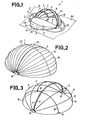
- a folding radome 1 according to an illustrated exemplary embodiment of the invention comprises a rigid folding frame 2 and a flexible cover or envelope 3 defining a part of a volume of revolution such as a portion of a sphere or an ellipsoid .
- the folding radome 1 has a substantially hemispherical shape.
- the component parts of a folding hemi radome 1 are applicable to the folding radomes of the invention having a shape of part of another volume of revolution.
- the rigid folding frame 2 comprises (FIGS. 1, 2, 3) on the one hand two main arches 4, 5, and preferably one or more secondary arches 6, 7, 8, 9 pivoting at their ends around the horizontal axes respectively vertically and laterally offset in two diametrically opposite pivot supports 10, 11 (FIG. 5) and on the other hand in a direction orthogonal to these main and secondary arches one or preferably two auxiliary arches 12, 13 pivoting each at their ends around the horizontal axes which are located in two opposite articulation supports 14, 15 and 16, 17 at a height greater than those of the pivot axes of the main arches 4 and 5.
- the main arches 4 , 5 secondary 6, 7, 8, 9 and auxiliary 12, 13 respectively take positions represented in FIG. 3 or partially represented in broken lines in FIG. 5.
- the main, secondary and auxiliary arches are superimposed and respectively take positions partially shown in solid lines in FIG. 5.
- the auxiliary arches 12 and 13 are thus respectively above the others main and secondary hoops.
- the floor 19 of this radome 1 and the platform 20 surrounding the latter (FIG. 1) are constructed so as to have a level identical to and equal to or greater than that of these auxiliary arches 12 and 13 in their retracting positions partially shown in FIG. 5.
- the pivoting supports 10 and 11 are then fixed in a trench or slot circular 21 hollowed out or formed in the platform 20.
- the main hoops 4, 5 and secondary 6, 7, 8, 9 are stored in this trench 21 when the radome 1 is fully opened while the two auxiliary hoops 12 and 13 are respectively sheltered in the trenches or slots 22, 23 formed in this platform 20.
- the two auxiliary poles 12 and 13 which guide the movement of the main and secondary poles are reduced to a single auxiliary pole.
- the flexible cover or envelope 3 of the folding radome 1 consists of two parts 24 and 25 (FIG. 2) each covering an area substantially equal to that of half of a hemisphere.
- Each of the parts 24 and 25 is fixed by a first of its edges in the trench 21 against the floor 19 and by its second edge to one of the two main poles 4, 5 while its central zone is fixed to the secondary poles 6 , 7 or 8, 9.
- Each of the parts 24, 25 of the flexible cover or envelope 3 forms (FIG. 4) a double wall assembly, compartmentalized in inflatable spindles 26, independent, that is to say not communicable with one another by their side walls, and having a lenticular cross-section, in other words substantially elliptical.
- These spindles with lenticular section 26 inflatable under a predetermined pressure play the role of inflatable multi-beams and allow the flexible cover 3 to remain alone in hemispherical shape and to offer good wind resistance, even without the rigid folding frame 2.
- Certain known radomes include a cover or a flexible wall in which cylindrical tubes are formed and inflated to stiffen or serve as beams for holding this wall or cover in position.
- the surface tension of the cover or wall of the radome is broken along the place occupied by this tube inflated and a pocket can form, because the surface of the material forming the cylindrical envelope of the deflated tube is always greater than that occupying its diameter and this difference in dimensions is not absorbed or compensated by any available traction exerting on this cover or wall, the other cylindrical tubes being already inflated to its predetermined maximum degree.
- the neighboring lenticular spindles 26 more or less round off and instantaneously create a traction on the cover 3 at the location of the deflated spindle so as to maintain constantly cover 3 in tension and avoid any disadvantageous formation of pocket or flaccid part in it, creating areas of weakness in wind resistance.
- the lenticular shape thus gives the swollen spindles 26 a constantly available power of traction on the covering zones 3 which surround them and allows these spindles 26 to maintain uniformity of tension over the entire surface of this covering 3.
- a combination of a rigid folding frame 2, a flexible cover 3 with inflatable lenticular spindles 26 and an internal pressure created substantially equal to the dynamic pressure of a wind with predetermined characteristics makes it possible to give this folding radome 1 even better mechanical resistance to this wind, with respect to a combination of a frame 2 and a cover 3 with inflatable lenticular spindles 26 described in a previous paragraph, and excellent safety Operating.
- the lenticular spindles 26 always keep the cover 3 in tension and thereby reduce or eliminate the vulnerability of the installation.
- the internal wall is pressed against the external wall under the effect of the internal pressure and / or the traction exerted by neighboring spindles which more or less round off and thus plug or seal this tear, which makes it possible to avoid any aggravation of this incident.
- the systems for inflating the lenticular spindles 26 and for creating internal pressure in the radome 1 are systems of known types which are not described in detail below.
- the folding frame 2 is preferably made of a known material such as a metal, a metal alloy or a composite synthetic material, mechanically resistant, light and little or not vulnerable to corrosion.
- the flexible cover 3 is preferably made of a mechanically resistant, waterproof fabric such as that provided with a support in polyester covered with a coating based on polyvinyl chloride.
- the folding radome 1 can have a diameter of fifty meters or more and a height of thirty meters or more.
- the main hoops 4, 5 and secondary 6, 7, 8, 9 are made of a material chosen from profiles, angles and tubes shaped and provided with holes for their fixing by screws or bolts to the cover 3.
- the cover 3 can be reinforced at their points of attachment to the arches of the frame 2, by known reinforcing elements such as plates, washers, etc.
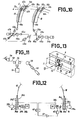
- the auxiliary poles 12, 13 are, in the example illustrated (FIGS. 6, 7, 8, 9) constituted by sections of metal or of a resistant metal alloy, little or not vulnerable to corrosion, having a cross section at E ( Figure 9) each defining two parallel sliding paths 30 a , 30 b or 31 a , 31 b respectively for two of the four identical carriages 32 a , 32 b or 33 a , 33 b of a closing operation system and d opening of the flexible cover 3 of the radome 1.
- Each of the sliding tracks 30 or 31 preferably has a cross section in the shape of a C.
- the ends of the arches 12 and 13 rotate around the horizontal axes such as 34 in the figure 6, respectively in articulation supports 14, 15, 16, 17, and each carry a pivoting system comprising a toothed sector 35 and a drive pinion 36 driven, through a coupling 37 by a geared motor 38.
- a synchronization of the drive movement of the ux control gears 36 a , 36 b is carried out (FIG.
- a system comprising two dynamotachymetric motors 39 a , 39 b mounted respectively on the shafts of the gearmotors 38 a , 38 b of which one 38 b is controlled or piloted, a comparator 40 of the data emitted by these dynamotachymetrics 39 a , 39 b , an amplifier 41 of the output signal of this comparator 40 and a variable speed drive 42 receiving the signal command from this amplifier 41 to correct the speed of the gearmotor 38 and has the constant to equal the speed of the geared motor 38 b which is controlled or driven.
- the pinions 36 a , 36 b drive the toothed sectors 35 a and 35 b at the same speed to pivot the auxiliary arch 34 a , 34 b either in its low retraction position partially illustrated in FIG. 5 either in its high position, illustrated in FIG. 1.
- the auxiliary roll bar 13 comprises the same structure as that of the roll bar 12 and pivoting systems 35, 36 37, 38 and synchronization systems 39, 40, 41, 42 identical to those of this auxiliary roll bar 12 described above.
- Each 32 a , 32 b , 33 a , 33 b of the carriages of a pair of carriages 32, 33 which slide respectively in the tracks 30 and 31 of an auxiliary hoop 12 or 13, comprises ( Figures 8,9) 44 provided with rollers 45 and guide rollers 46 bearing on the bottom and side walls of these tracks, and surmounted by an attachment support 47 on which is fixed a corresponding main hoop 4 or 5.
- Each of the carriages 32 a , 32 b is respectively pulled on the one hand in one direction by one or more traction cables 48 a , 48 b from a drive system comprising (FIGS.
- the carriages 33 a and 33 b of the auxiliary hoop 13 are respectively pulled on the one hand in one direction, by one or more traction cables 58 a , 58 b d a drive system comprising ( Figure 10) a drum 59 a, 59 b traction cable arrangement 58a, 58b, the pulleys reference 60 a , 60 b , a geared motor 61 a , 61 b , and on the other hand in an opposite direction, by one or more return cables 62 a , 62 b of a winding system identical to that intended for the cables return 52 a , 52 b of the carriages 32 a , 32 b of the auxiliary arch 12, in other words a storage drum for these return cables, idler pulleys, a geared motor for driving this storage drum and a counterweight device ensuring good tension of these return cables 62 a , 62 b of traction
- the main arches 4 and 5 are also and respectively fixed on the attachment supports of the carriages 33 a and 33 b of the auxiliary arch 13 (FIG. 10). Synchronization in a pivoting of each of the main arches 4 and 5 by geared motors 51 a and 61 a or 51 b and 61 b is carried out by a system comprising dynamo-speedometers 65 a or 65 b and 66 a or 66 b mounted on the shaft of the corresponding geared motors 51 a or 51 b and 61 a or 61 b of which one 51 a or 51 b is controlled or piloted, a comparator 67 a or 67 b of the data emitted by these dynamotachymetrics 65 a or 65 b and 66 a or 66 b , an amplifier 68 a or 68 b of the output signal of this comparator and a variable speed drive 69 a or 69 b which receives a control signal emitted by this amplifier
- a synchronization of winding of the return cables 52 a and 62 a or 52 b and 62 b of the carriages 32 a and 33 a or 32 b and 33 b by the corresponding geared motors 55 is carried out by a system similar to that which ensures the regulation geared motors 51 a and 61 a ( Figure 10).
- the main arches 4 and 5 preferably include one or more locking devices 70 which allow them to be connected and block the closing of the folding radome 1.
- This locking device 70 comprises for example on the one hand a substantially rectangular cleat 71, integral with the first of the two main arches shown in broken lines and pivoting about an axis perpendicular to the plane of its body under the control of a motor 72, and on the other share a rectangular opening 73 formed in the second 4 of these main arches for the passage of this cleat 71, and provided in its longitudinal edges with rising risers 74, 75, shown in broken lines.
- radome 1 When radome 1 is folded or retracted, the material protected by this radome is completely free to be in communication with the outside atmosphere.
- the retracted radome 1 does not interfere with the equipment from the point of view of vision, transmission or reception and does not create electrical, magnetic or light disturbances, provides effective protection against bad weather and withstands strong winds with great operational safety, that radomes of known types do not have all these characteristics.
- the folding radome 1 comprises a light structure facilitating its installation, and a simple operation which facilitates its use.
Landscapes
- Engineering & Computer Science (AREA)
- Architecture (AREA)
- Civil Engineering (AREA)
- Structural Engineering (AREA)
- Fluid Mechanics (AREA)
- Physics & Mathematics (AREA)
- Details Of Aerials (AREA)
- Aerials With Secondary Devices (AREA)
- Vehicle Body Suspensions (AREA)
- Inorganic Insulating Materials (AREA)
- Preparing Plates And Mask In Photomechanical Process (AREA)
- Seal Device For Vehicle (AREA)
- Outer Garments And Coats (AREA)
- Superstructure Of Vehicle (AREA)
- Tents Or Canopies (AREA)
Abstract
Description
- La présente invention concerne un radome pliant destiné à la protection de matériels de dimensions relativement grandes tels que télescopes, radars, antennes de télécommunications ... et éventuellement des installations militaires, industrielles ou sportives contre les intempéries.
- Jusqu'à présent la protection de ces matériels contre les intempéries est assurée soit par des dômes rigides à fenêtre soit par des radomes gonflables à ouverture à rideau. Dans ces dômes rigides ou radomes gonflables, la fenêtre ou l'ouverture qui permet une libre communication avec l'atmosphère extérieure comprend habituellement une position ou une orientation fixe, le plus souvent difficilement modifiable voire pratiquement non modifiable sans rendre, d'une façon onéreuse, mobile leur installation même.
- Une limitation de la libre communication avec l'atmosphère extérieure par une orientation fixe de cette fenêtre ou ouverture devient parfois un inconvénient majeur dans l'exploitation de certaines installations telles que celle qui assure la protection d'un matériel d'observation astronomique, un télescope par exemple. Par ailleurs, les radomes connus sont souvent soit des radomes à armature métallique fixe soit des radomes gonflables sans armature métallique. Les radomes à armature métallique fixe sont des radomes munis d'une solide charpente métallique fixe montée sur un soubassement rigide et recouverte d'une enveloppe souple imperméable. Ces radomes connus résistent bien aux intempéries et au vent fort grâce à leur solide charpente métallique. Cependant, lors d'une installation dans un endroit peu accessible aux véhicules de transport par exemple celui situé dans une région montagneuse entourée de forêts denses sans accès praticables, l'acheminement des matériaux pour une construction de cette solide charpente du radome pose des problèmes difficiles à résoudre économiquement. Les radomes connus gonflables sans armature métallique sont souvent des radomes à enveloppe souple maintenue en position par des poutres sous forme de tubes souples cylindriques gonflés sous une pression prédéterminée qui les rend plus ou moins rigides. Ces radomes connus sont légers mais plus ou moins vulnérables aux vents forts et ne résistent pas à ceux-ci quand une ou plusieurs de ces poutres sont dégonflées consécutivement à une fuite accidentelle ou une crevaison.
- La présente invention ayant pour but d'éviter ces inconvénients, permet de réaliser un radome pliant économique ayant une structure relativement simple, légère, résistante aux intempéries et aux vents forts, facile à être transportée et installée, escamotable partiellement ou totalement au choix, lors d'une utilisation du matériel qu'il assure la protection.
- Selon l'invention, un radome de protection contre les intempéries ayant une armature rigide pliante et une couverture souple formée de une ou plusieurs parties, est caractérisé en ce que, pour empêcher toute formation de poche, cette couverture est réalisée en double paroi, et compartimentée en fuseaux lenticulaires, indépendants les uns des autres, et gonflables.
- Pour mieux faire comprendre l'invention, on en décrit ci-après un exemple de réalisation illustré par des dessins ci-annexés dont:
- - La figure 1 représente une vue schématique en perspective d'un radome pliant réalisé selon l'invention, le montrant dans sa position partiellement escamotée,
- - la figure 2 représente à une autre échelle, une vue en perspective du radome de la figure 1, dans sa position fermée,
- - la figure 3 représente une vue partielle schématique en perspective du radome de la figure 2 dont l'enveloppe ou couverture est enlevée,
- - la figure 4 représente à une autre échelle, une vue partielle schématique en coupe suivant un plan vertical IV-IV du radome de la figure 2, montrant la couverture de ce dernier,
- - la figure 5 représente à une autre échelle, une vue schématique partielle d'un support de pivotement des extrémités des arceaux principaux et secondaires de l'armature pliante du radome de la figure 3,
- - la figure 6 représente à une autre échelle, une vue partielle et schématique d'un système de pivotement des extrémités des arceaux auxiliaires de l'armature du radome de la figure 3,
- - la figure 7 représente à une autre échelle une vue partielle et schématique d'un arceau auxiliaire de l'armature du radome de la figure 3 montrant des chariots d'entrainement des arceaux principaux et secondaires,
- - la figure 8 représente à une autre échelle une vue schématique d'un tronçon de l'arceau auxiliaire de la figure 7,
- - la figure 9 représente à une autre échelle, une vue schématique, partielle, en coupe suivant un plan IX-IX de l'arceau auxiliaire de la figure 8 montrant un chariot d'entrainement d'arceaux principaux et secondaires,
- - la figure 10 représente à une autre échelle, une vue partielle et schématique d'un système d'entrainement des arceaux principaux et secondaires de l'armature du radome de la figure 3,
- - la figure 11 représente une vue partielle et schématique d'un dispositif de tension de cables du système d'entrainement des arceaux principaux et secondaires de la figure 10,
- - la figure 12 représente à une autre échelle une vue partielle et schématique d'un système de pivotement des arceaux auxiliaires, de la figure 6 et
- - la figure 13 représente à une autre échelle une vue partielle et schématique d'un tronçon des arceaux principaux de l'armature du radome de la figure 3, montrant un des dispositifs de verrouillage rendant solidaires ces arceaux principaux.
- Un radome, objet de l'invention est applicable à toute installation scientifique, militaire, industrielle ou sportive.
- Un radome pliant 1 selon un exemple illustré de réalisation de l'invention comprend une armature rigide pliante 2 et une couverture ou enveloppe souple 3 définissant une partie d'un volume de révolution telle qu'une portion d'une sphère ou d'un ellipsoïde. Dans l'exemple illustré le radome pliant 1 a une forme sensiblement hémisphérique. Les éléments composants d'un radome pliant hémis phériques 1 sont applicables aux radomes pliants de l'invention présentant une forme d'une partie d'un autre volume de révolution.
- L'armature rigide pliante 2 comprend (figures 1 , 2 , 3) d'une part deux arceaux principaux 4 ,5, et de préférence un ou plusieurs arceaux secondaires 6 , 7 , 8 , 9 pivotants à leurs extrémités autour des axes horizontaux respectivement décalés verticalement et latéralement dans deux supports de pivotement diamétralement opposés 10, 11 (figure 5) et d'autre part dans une direction orthogonale à ces arceaux principaux et secondaires un ou de préférence deux arceaux auxiliaires 12 , 13 pivotants chacun à leurs extrémités autour des axes horizontaux qui se trouvent dans deux supports d'articulation opposés 14 , 15 et 16 , 17 à une hauteur supérieure à celles des axes de pivotement des arceaux principaux 4 et 5. Dans une fermeture ou élévation du radome pliant 1, les arceaux principaux 4 , 5 secondaires 6 , 7 , 8 , 9 et auxiliaires 12 , 13 prennent respectivement des positions représentées dans la figure 3 ou partiellement représentées en traits discontinus dans la figure 5.
- Dans une ouverture complète ou escamotage du radome pliant 1, les arceaux principaux, secondaires et auxiliaires sont superposés et prennent respectivement des positions partiellement représentées en traits pleins dans la figure 5. Les arceaux auxiliaires 12 et 13 se trouvent ainsi respectivement au-dessus des autres arceaux principaux et secondaires. Pour obtenir une facilité d'entrée dans le radome ouvert 1 et de sortie de celui-ci d'un matériel de transport notamment celui à roues, le plancher 19 de ce radome 1 et la plate-forme 20 entourant ce dernier (figure 1) sont construits de manière à avoir un niveau identique et égal ou supérieur à celui de ces arceaux auxiliaires 12 et 13 dans leurs positions d'escamotage partiellement représentées dans la figure 5. Les supports de pivotement 10 et 11 sont alors fixés dans une tranchée ou fente circulaire 21 creusée ou formée dans la plate-forme 20. Les arceaux principaux 4 , 5 et secondaires 6 , 7 , 8 , 9 sont rangés dans cette tranchée 21 lors d'une ouverture complète du radome 1 tandis que les deux arceaux auxiliaires 12 et 13 sont respectivement abrités dans les tranchées ou fentes 22 , 23 formées dans cette plate-forme 20.
- Dans une variante de réalisation non représentée où la dimension du radome 1 est relativement faible, les deux arceaux auxiliaires 12 et 13 qui guident le mouvement des arceaux principaux et secondaires sont réduits à un seul arceau auxiliaire.
- La couverture ou enveloppe souple 3 du radome pliant 1 est constituée de deux parties 24 et 25 (figure 2) recouvrant chacune une surface sensiblement égale à celle d'une moitié d'un hémisphère. Chacune des parties 24 et 25 est fixée par un premier de ses bords dans la tranchée 21 contre le plancher 19 et par son deuxième bord à un des deux arceaux principaux 4 , 5 tandis que sa zone centrale est fixée sur le ou les arceaux secondaires 6 , 7 ou 8 , 9.
- Chacune des parties 24 , 25 de la couverture ou enveloppe souple 3 forme (figure 4) un ensemble à double paroi, compartimenté en fuseaux gonflables 26, indépendants c'est-à-dire non communicables entre eux par leurs parois latérales, et ayant une section transversale lenticulaire autrement dit sensiblement elliptique. Ces fuseaux à section lenticulaire 26 gonflables sous une pression prédéterminée jouent le rôle de multipoutres gonflables et permettent à la couverture souple 3 de se maintenir seule en forme hémisphérique et d'opposer une bonne résistance au vent, même sans l'armature rigide pliante 2. Dans une combinaison où une armature rigide pliante 2 est solidement fixée par ses arceaux principaux 4 , 5 et secondaires 6 , 7 , 8 , 9 à la couverture souple 3 sur le long des bords correspondants des fuseaux 26, ces fuseaux lenticulaires gonflables 26 permettent de surmultiplier la résistance mécanique du radome 1 aux intempéries notamment aux vents forts atteignant ou dépassant 250 kilomètres/heure. En comparaison avec un radome connu à charpente métallique fixe et à couverture souple gonflée de l'intérieur de ce radome, et pour une résistance mécanique prédéterminée du radome aux vents d'une vitesse maximale donnée, le radome pliant 1 grâce à une couverture 3 à fuseaux à section lenticulaire 26 a l'avantage d'avoir une armature pliante 2 plus légère que la charpente fixe du radome connu. Cet avantage contribue à faciliter l'installation du radome pliant 1 dans des endroits difficilement accessibles par des moyens de transport terrestre à roues ou à chaines.
- Certains radomes connus comprennent une couverture ou une paroi souple dans laquelle des boudins cylindriques sont formés et gonflés pour rigidifier ou servir de poutres de maintien en position de cette paroi ou couverture. Cependant lors d'un dégonflage suite à une fuite accidentelle du fluide gonflant ou d'une crevaison d'un de ces boudins, la tension de surface de la couverture ou paroi du radome est rompue sur le long de l'endroit occupé par ce boudin gonflé et une poche peut se former, car la surface de matière formant l'enveloppe cylindrique du boudin dégonflé est toujours supérieure à celle occupant son diamètre et cette différence de dimensions n'est pas absorbée ou compensée par aucune traction disponible exerçant sur cette couverture ou paroi, les autres boudins cylindriques étant déjà gonflés à son degré maximal prédéterminé. Dans le cas d'un radome connu comportant un gonflage intérieur, ce gonflage s'avère souvent insuffisant ou inefficace dans un rétablissement de la tension de la couverture de ce radome lors d'un dégonflage accidentel d'une de ces poutres sous forme de boudins cylindriques gonflables. Un manque de tension de la couverture d'un radome à l'endroit d'un boudin cylindrique dégonflé, provoque habituellement un flottement et un claquage qui déchire la couverture du radome en cet endroit sous l'effet d'un vent fort. Une formation d'une poche dans la couverture à l'endroit d'un boudin cylindrique dégonflé rend encore plus vulnérable la résistance de cette couverture aux vents forts.
- Dans le radome pliant 1, quand un fuseau lenticulaire 26 de la couverture 3 est dégonflé accidentellement, les fuseaux lenticulaires 26 voisins s'arrondissent plus ou moins et créent instantanément une traction sur la couverture 3 à l'endroit du fuseau dégonflé de manière à maintenir constamment cette couverture 3 en tension et éviter toute formation désavantageuse de poche ou de partie flasque dans celle-ci, y créant des zones de faiblesse dans la résistance aux vents. La forme lenticulaire donne ainsi aux fuseaux gonflés 26 un pouvoir constamment disponible de traction sur les zones de couverture 3 qui les entourent et permet à ces fuseaux 26 de maintenir une uniformité de tension sur toute la surface de cette couverture 3.
- Dans le radome pliant 1, une combinaison d'une armature rigide pliante 2, d'une couverture souple 3 à fuseaux lenticulaires gonflables 26 et d'une pression interne créée sensiblement égale à la pression dynamique d'un vent à caractéristiques prédéterminées, permet de donner à ce radome pliant 1 une résistance mécanique encore meilleure à ce vent, vis-à-vis d'une combinaison d'une armature 2 et d'une couverture 3 à fuseaux lenticulaires gonflables 26 décrite dans un paragraphe précédent, et une excellente sécurité de fonctionnement.
- En effet, même une absence accidentelle de la pression interne créée dans ce radome pliant 1, les fuseaux lenticulaires 26 maintiennent toujours la couverture 3 en tension et diminuent ou éliminent de ce fait la vulnérabilité de l'installation. En cas d'une déchirure accidentelle de la paroi externe de la couverture 3 à l'endroit d'un fuseau, la paroi interne vient se plaquer sur la paroi externe sous l'effet de la pression interne et/ou de la traction exercée par les fuseaux voisins qui s'arrondissent plus ou moins et ainsi colmater ou obturer cette déchirure, ce qui permet d'éviter toute aggravation de cet incident.
- Les systèmes de gonflage des fuseaux lenticulaires 26 et de création de pression interne dans le radome 1 sont des systèmes de types connus qui ne sont pas décrits en détail dans la suite.
- L'armature pliante 2 est de préférence réalisée en un matériau connu tel qu'un métal, un alliage métallique ou une matière synthétique composite, mécaniquement résistant, léger et peu ou non vulnérable à la corrosion.
- La couverture souple 3 est réalisée de préférence en un tissu mécaniquement résistant, imperméable tel que celui pourvu d'un support en un polyester recouvert d'une enduction à base de polychlorure de vinyl.
- Le radome pliant 1 peut avoir un diamètre égal ou supérieur à cinquante mètres et une hauteur égale ou supérieure à trente mètres.
- Dans l'armature pliante 2, les arceaux principaux 4 , 5 et secondaires 6 , 7 , 8 , 9 sont constitués en un matériau choisi parmi les profilés, cornières et tubes mis en forme et munis de trous destinés à leur fixation par vis ou boulons à la couverture 3. La couverture 3 peut être renforcée à leurs points de fixation aux arceaux de l'armature 2, par des éléments de renforcement connus tels que plaquettes, rondelles...
- Les arceaux auxiliaires 12 , 13 sont, dans l'exemple illustré (figures 6 , 7 , 8 , 9) constitués par des profilés en métal ou en un alliage métallique résistant, peu ou non vulnérable à la corrosion, ayant une section transversale en E (figure 9) définissant chacun deux voies parallèles de coulissement 30a, 30b ou 31a, 31b respectivement pour deux des quatre chariots identiques 32a, 32b ou 33a, 33b d'un système de manoeuvre de fermeture et d'ouverture de la couverture souple 3 du radome 1. Chacune des voies de coulissement 30 ou 31 a de préférence une section transversale en forme d'un C. Les extrémités des arceaux 12 et 13 tournent autour des axes horizontaux tels que 34 dans la figure 6, respectivement dans des supports d'articulation 14 , 15 , 16 , 17, et portent chacune un système de pivotement comportant un secteur denté 35 et un pignon de commande 36 entrainé, à travers un accouplement 37 par un moto-réducteur 38. Une synchronisation du mouvement d'entrainement des deux pignons de commande 36a, 36b est effectuée (figure 12) par un système comprenant deux dynamotachymétriques 39a, 39b montés respectivement sur les arbres des motoréducteurs 38a, 38b dont l'un 38b est commandé ou piloté, un comparateur 40 des données émises par ces dynamotachymétriques 39a, 39b, un amplificateur 41 du signal de sortie de ce comparateur 40 et un variateur de vitesse 42 recevant le signal de commande issu de cet amplificateur 41 pour rectifier la vitesse du motoréducteur 38a et la rendre constamment égale à la vitesse du motoréducteur 38b qui est commandé ou piloté. Grâce à cette synchronisation, les pignons 36a, 36b entrainent à la même vitesse les secteurs dentés 35a et 35b pour pivoter l'arceau auxiliaire 34a, 34b soit dans sa position basse d'escamotage partiellement illustrée dans la figure 5 soit dans sa position haute, illustrée dans la figure 1.
- L'arceau auxiliaire 13 comprend une même structure que celle de l'arceau 12 et des systèmes de pivotement 35 , 36 37 , 38 et de synchronisation 39 , 40 , 41 , 42 identiques à ceux de cet arceau auxiliaire 12 décrit ci-dessus.
- Chacun 32a, 32b, 33a, 33b des chariots d'une paire de chariots 32, 33 qui coulissent respectivement dans les voies 30 et 31 d'un arceau auxiliaire 12 ou 13, comprend (figures 8,9) un corps 44 muni de galets de roulement 45 et de galets de guidage 46 s'appuyant sur des parois de fond et de côté de ces voies, et surmonté d'un support d'attache 47 sur lequel est fixé un arceau principal 4 ou 5 correspondant. Chacun des chariots 32a, 32b est respectivement tiré d'une part dans une direction par un ou des câbles de traction 48a, 48b d'un système d'entraînement comprenant (figures 8, 10), un tambour 49a, 49b de rangement de câble de traction 48a, 48b, des poulies de renvoi 50a, 50b, un motoréducteur 51a, 51b, et d'autre part dans une direction opposée, par un ou des câbles de rappel 52a, 52b d'un système d'enroulement comprenant (figures 8, 10, 11) un tambour 53a, 53b des poulies de renvoi 54a, 54b, un motoréducteur 55a, 55b d'entraînement de ce tambour 53a, 53b, et un dispositif à contrepoids 56a, 56b assurant une bonne tension des câbles de rappel 52a, 52b et de traction 48a, 48b.
- D'une manière analogue aux chariots 32a et 32b, les chariots 33a et 33b de l'arceau auxiliaire 13 sont respectivement tirés d'une part dans une direction, par un ou des câbles de traction 58a, 58b d'un système d'entraînement comprenant (figure 10) un tambour 59a, 59b de rangement de câbles de traction 58a, 58b, des poulies de renvoi 60a, 60b, un motoréducteur 61a, 61b, et d'autre part dans une direction opposée, par un ou des câbles de rappel 62a, 62b d'un système d'enroulement identique à celui destiné aux câbles de rappel 52a, 52b des chariots 32a, 32b de l'arceau auxiliaire 12, autrement dit un tambour de rangement de ces câbles de rappel, des poulies de renvoi, un motoréducteur d'entraînement de ce tambour de rangement et un dispositif à contrepoids assurant une bonne tension de ces câbles de rappel 62a, 62b de traction 58a, 58b.
- Les arceaux principaux 4 et 5 sont également et respectivement fixés sur les supports d'attache des chariots 33a et 33b de l'arcau auxiliaire 13 (figure 10). Une synchronisation dans un pivotement de chacun des arceaux principaux 4 et 5 par des motoréducteurs 51a et 61a ou 51b et 61b est effectué par un système comportant des dynamotachymétriques 65a ou 65b et 66a ou 66b montés sur l'arbre des motoréducteurs correspondants 51a ou 51b et 61a ou 61b dont l'un 51a ou 51b est commandé ou piloté, un comparateur 67a ou 67b des données émises par ces dynamotachymétriques 65a ou 65b et 66a ou 66b, un amplificateur 68a ou 68b du signal de sortie de ce comparateur et un variateur de vitesse 69a ou 69b qui reçoit un signal de commande émis par cet amplificateur 68a ou 68b, et rectifie la vitesse du motoréducteur 61a ou 61b en vue de la rendre égale à celle du motoréducteur 51a ou 51b. Il en résulte que lors d'un fonctionnement synchronisé des motoréducteurs 51a et 61a ou 51b et 61b les câbles de traction 48a et 58a ou 48b et 58b sont simultanément tirés afin de ramener les chariots correspondants 32a et 33a ou 32b et 33b, par conséquent l'arceau principal 12 ou l'arceau principal 13, vers le plancher 19 autrement dit de replier ou escamoter le radome pliant 1.
- Une synchronisation d'enroulement des câbles de rappel 52a et 62a ou 52b et 62b des chariots 32a et 33a ou 32b et 33b par les motoréducteurs 55 correspondants est réalisée par un système analogue à celui qui assure la régulation des motoréducteurs 51a et 61a(figure 10).
- Quand les câbles de rappel 52a et 62a ou 52b et 62b sont tirés, les chariots correspondants 32a et 33a ou 32b et 33b, par conséquent l'arceau principal 12 ou l'arceau principal 13, sont ramenés vers le haut, ce qui permet de déployer le radome pliant 1 autrement dit de fermer ce dernier.
- Les arceaux principaux 4 et 5 comprennent de préférence un ou plusieurs dispositifs de verrouillage 70 qui permettent de les relier et de bloquer la fermeture du radome pliant 1. Un de ces dispositifs de verrouillage est schématiquement illustré dans la figure 13. Ce dispositif de verrouillage 70 comprend par exemple d'une part un taquet sensiblement rectangulaire 71, solidaire du premier des deux arceaux principaux représenté en traits discontinus et pivotant autour d'un axe perpendiculaire au plan de son corps sous la commande d'un moteur 72, et d'autre part une ouverture rectangulaire 73 formée dans le deuxième 4 de ces arceaux principaux pour le passage de ce taquet 71, et pourvue dans ses bords longitudinaux de rampes opposées montantes 74, 75, représentées en traits discontinus. Quand le taquet 71 passe à travers l'ouverture 73 dans l'arceau principal 4, pivote et remonte les pentes de ces rampes opposées 74,75, l'arceau principal 4 est serré contre l'arceau principal 5 et bloque la fermeture du radome pliant 1. Des joints souples 76, 77 gonflés ou non sont montés sur les surfaces en contact des arceaux principaux 4 et 5 pour renforcer l'étanchéïté de la fermeture du radome 1 et éviter le cas échéant des fuites de fluide sous pression créant une pression interne dans ce radome pliant 1. Les dispositifs 70 peuvent étre remplacés par tous autres dispositifs de fermeture connus.
- Quand le radome 1 est replié ou escamoté, le matériel protégé par ce radome est totalement libre d'être en communication avec l'atmosphère extérieure. Le radome 1 escamoté ne gêne pas le matériel au point de vue vision, transmission ou réception et ne crée pas de perturbations électriques, magnétiques ou lumineuses, assure une protection efficace contre les intempéries et résiste excellement aux vents forts avec une grande sécurité de fonctionnement, ce que les radomes de types connus ne possèdent pas toutes ces caractéristiques. En outre, le radome pliant 1 comprend une structure légère facilitant son installation, et un fonctionnement simple qui facilite son utilisation.
Claims (11)
Priority Applications (1)
| Application Number | Priority Date | Filing Date | Title |
|---|---|---|---|
| AT87400246T ATE51669T1 (de) | 1986-02-07 | 1987-02-03 | Zusammenfaltbare radarkuppel. |
Applications Claiming Priority (2)
| Application Number | Priority Date | Filing Date | Title |
|---|---|---|---|
| FR8601723 | 1986-02-07 | ||
| FR8601723A FR2594157B1 (fr) | 1986-02-07 | 1986-02-07 | Radome pliant. |
Publications (2)
| Publication Number | Publication Date |
|---|---|
| EP0235013A1 true EP0235013A1 (fr) | 1987-09-02 |
| EP0235013B1 EP0235013B1 (fr) | 1990-04-04 |
Family
ID=9331931
Family Applications (1)
| Application Number | Title | Priority Date | Filing Date |
|---|---|---|---|
| EP87400246A Expired - Lifetime EP0235013B1 (fr) | 1986-02-07 | 1987-02-03 | Radome pliant |
Country Status (7)
| Country | Link |
|---|---|
| US (1) | US4833837A (fr) |
| EP (1) | EP0235013B1 (fr) |
| AT (1) | ATE51669T1 (fr) |
| DE (1) | DE3762139D1 (fr) |
| DK (1) | DK57787A (fr) |
| ES (1) | ES2015303B3 (fr) |
| FR (1) | FR2594157B1 (fr) |
Cited By (3)
| Publication number | Priority date | Publication date | Assignee | Title |
|---|---|---|---|---|
| FR2709876A1 (fr) * | 1993-09-07 | 1995-03-17 | Deutsche Aerospace | Radôme pour des installations radars. |
| WO1998044222A1 (fr) * | 1997-04-02 | 1998-10-08 | Spironef Technologies | Voute gonflable, deployable et escamotable |
| FR3106440A1 (fr) * | 2020-01-21 | 2021-07-23 | E-Business Venture | Structure de protection d'une antenne de communication vis a vis de son environnement |
Families Citing this family (46)
| Publication number | Priority date | Publication date | Assignee | Title |
|---|---|---|---|---|
| US5070659A (en) * | 1990-02-02 | 1991-12-10 | Stadium Consultants International, Inc. | Retractable roof for stadium structure |
| US4995203A (en) * | 1990-02-02 | 1991-02-26 | Stadium Consultants International Inc. | Retractable roof for stadium structure |
| US5115998A (en) * | 1990-06-29 | 1992-05-26 | The United States Of America As Represented By The Secretary Of The Air Force | Annular balloon |
| US5328132A (en) * | 1993-04-28 | 1994-07-12 | General Dynamics Corporation, Space Systems Division | Engine protection system for recoverable rocket booster |
| DE4413722A1 (de) * | 1994-04-20 | 1995-10-26 | Braun Aristides | Überdachung durch Leichtbaukonstruktion |
| US5625982A (en) * | 1994-07-15 | 1997-05-06 | Foote; Byron N. | Articulated dome |
| US6065252A (en) * | 1995-10-20 | 2000-05-23 | Norsen; Robert A. | Pneumatically convertible roof |
| US5743786A (en) * | 1996-05-30 | 1998-04-28 | Lindsey; Alan | Balloon face polyhedra |
| US5778603A (en) * | 1996-10-29 | 1998-07-14 | Reppas; George S. | Retractable dome |
| US6082054A (en) | 1998-08-27 | 2000-07-04 | Silberman; Cyril J. | Retractable stadium roofs and transport mechanism therefor |
| AU752486C (en) * | 1999-03-17 | 2006-03-16 | Hugh William Bramwells | Shielding assembly |
| AUPP928099A0 (en) * | 1999-03-17 | 1999-04-15 | Bramwells, Hugh William | Shielding assembly |
| US6415556B1 (en) | 2000-07-03 | 2002-07-09 | Uni-Systems, Inc. | Transport mechanism for large structures such as retractable stadium rooves |
| US6718696B2 (en) | 2001-01-23 | 2004-04-13 | Uni-Systems, Llc | Movable wall for stadium |
| US6789360B2 (en) | 2001-01-23 | 2004-09-14 | Uni-Systems, Llc | Retractable roof system for stadium |
| US6698141B2 (en) | 2001-01-23 | 2004-03-02 | Uni-Systems, Llc | Convertible stadium and method of operating |
| US6795753B2 (en) * | 2002-09-10 | 2004-09-21 | Andrew Corporation | Compressor control module |
| US7520091B2 (en) * | 2004-07-09 | 2009-04-21 | Friedman Daniel B | Adaptable roof system |
| US7464900B2 (en) * | 2004-10-20 | 2008-12-16 | The Boeing Company | Folding retractable protective dome for space vehicle equipment |
| US20060081343A1 (en) * | 2004-10-20 | 2006-04-20 | Clark Paul R | Retractable protective dome for space vehicle equipment |
| US8186107B2 (en) * | 2005-03-09 | 2012-05-29 | Uni-Systems, Llc | Cable drive and control system for movable stadium roof panels |
| US7594360B2 (en) * | 2005-03-09 | 2009-09-29 | Uni-Systems, Llc | Lateral release mechanism for movable roof panels |
| DE102005015927B4 (de) * | 2005-04-06 | 2008-01-10 | Jochen Stein | Transportable Raumzelle |
| US8056858B2 (en) * | 2007-02-27 | 2011-11-15 | Raytheon Company | Device and method for providing radiation occlusion and aero-thermal protection |
| US20090121207A1 (en) * | 2007-11-14 | 2009-05-14 | James Patrick Bowerman | Configurable enclosure |
| US8013802B2 (en) * | 2008-12-01 | 2011-09-06 | Lockheed Martin Corporation | Portable radar fairing |
| US9744741B2 (en) | 2010-12-14 | 2017-08-29 | Dsm Ip Assets B.V. | Material for radomes and process for making the same |
| US8950308B2 (en) * | 2011-03-23 | 2015-02-10 | Advanced Materials And Devices, Inc. | Forward closure system |
| US20140327595A1 (en) | 2011-09-12 | 2014-11-06 | Dsm Ip Assets B.V.. | Composite radome wall |
| RU150799U1 (ru) * | 2013-01-10 | 2015-02-27 | Тини Лав Лтд. | Детский игровой центр |
| US9011196B2 (en) | 2013-03-15 | 2015-04-21 | Global Marketing Enterprise (Gme) Ltd. | Developmental activity gym for babies |
| EP2883276B1 (fr) * | 2013-06-27 | 2019-05-22 | CommScope Technologies LLC | Radôme pliable |
| USD739555S1 (en) * | 2014-03-20 | 2015-09-22 | Rob McAlister Limited | Folding structure for storage, shelter, and plant growing |
| US9493939B2 (en) * | 2014-07-25 | 2016-11-15 | South Industries, Inc. | Airform for facilitating construction of a structure |
| USD774208S1 (en) * | 2014-11-13 | 2016-12-13 | Kt-Shelter Oy | Shelter |
| US10307686B2 (en) * | 2016-11-17 | 2019-06-04 | Skip Hop, Inc. | Activity gym |
| US20190106902A1 (en) * | 2017-10-06 | 2019-04-11 | Francisco Irizarry | Automatically Retractable Vehicle Cover |
| WO2019121663A1 (fr) | 2017-12-22 | 2019-06-27 | Dsm Ip Assets B.V. | Tissu composite de fibres de polyéthylène à efficacité élevée |
| WO2019121675A1 (fr) | 2017-12-22 | 2019-06-27 | Dsm Ip Assets B.V. | Procédé de production d'un tissu composite de fibres de polyéthylène haute performance |
| WO2021229411A1 (fr) * | 2020-05-12 | 2021-11-18 | Philip Morris Products S.A. | Abri de filtration d'air |
| CN112031166B (zh) * | 2020-09-04 | 2022-06-21 | 中国科学院国家天文台 | 一种能完全铺平的开放式天文圆顶 |
| ES2936384B2 (es) * | 2021-09-16 | 2024-03-07 | Gaptec 2011 S L | Sistema de plegado y desplegado de hangares |
| USD1021141S1 (en) * | 2021-09-29 | 2024-04-02 | Christopher Fisher Goldblatt | Domed structure |
| USD1087393S1 (en) * | 2022-08-01 | 2025-08-05 | Hyundai Motor Company | Structure for mobility station |
| USD1087394S1 (en) * | 2022-08-01 | 2025-08-05 | Hyundai Motor Company | Structure for mobility station |
| CN117913523B (zh) * | 2023-12-30 | 2024-09-17 | 扬州斯帕克实业有限公司 | 一种便携的透波雷达罩 |
Citations (6)
| Publication number | Priority date | Publication date | Assignee | Title |
|---|---|---|---|---|
| US3332176A (en) * | 1962-03-05 | 1967-07-25 | Robert E Breidenthal | Inflatable structure |
| FR2066636A5 (fr) * | 1970-10-28 | 1971-08-06 | Flechair Sa | |
| FR2067435A5 (fr) * | 1969-11-03 | 1971-08-20 | Laporte Robert | |
| FR2130416A1 (fr) * | 1971-03-19 | 1972-11-03 | Kranz Vladimir | |
| FR2296072A1 (fr) * | 1974-12-23 | 1976-07-23 | Seep | Facade mobile a effacement lateral, notamment pour piscine a toiture et longs pans se degageant completement |
| FR2370137A1 (fr) * | 1976-11-05 | 1978-06-02 | Selam Gabriel | Dispositif de rotation pour arceaux mobiles |
Family Cites Families (11)
| Publication number | Priority date | Publication date | Assignee | Title |
|---|---|---|---|---|
| US2830606A (en) * | 1953-08-24 | 1958-04-15 | Louis E Daugherty | Inflated tent |
| US2900994A (en) * | 1955-10-07 | 1959-08-25 | John R Igoe | Collapsible inflatable tent |
| NL7203364A (fr) * | 1971-03-16 | 1972-09-19 | ||
| GB1539731A (en) * | 1975-04-09 | 1979-01-31 | British Petroleum Co | Growth of plants |
| CA1027727A (fr) * | 1976-06-17 | 1978-03-14 | Abitibi Paper Company Ltd. | Garage transportable |
| CA1049370A (fr) * | 1976-10-05 | 1979-02-27 | Gerhardt A. Warner | Enceinte portable |
| CH630685A5 (en) * | 1977-11-21 | 1982-06-30 | Sarna Kunststoff Ag | Lightweight-construction hall and method of assembling the same |
| FR2444763A1 (fr) * | 1978-12-19 | 1980-07-18 | Milinic Vojin | Couverture variable pour batiments et terrains |
| US4387533A (en) * | 1980-08-01 | 1983-06-14 | Green George H | Method and apparatus for retaining heat in greenhouse and similar structures |
| SU964081A1 (ru) * | 1981-06-18 | 1982-10-07 | Предприятие П/Я А-1836 | Раскладное тентовое укрытие |
| US4583331A (en) * | 1983-12-27 | 1986-04-22 | Clamshell Partners Ltd. | Frame supported structure with tensioned fabric panels |
-
1986
- 1986-02-07 FR FR8601723A patent/FR2594157B1/fr not_active Expired - Fee Related
-
1987
- 1987-02-03 DE DE8787400246T patent/DE3762139D1/de not_active Expired - Fee Related
- 1987-02-03 ES ES87400246T patent/ES2015303B3/es not_active Expired - Lifetime
- 1987-02-03 EP EP87400246A patent/EP0235013B1/fr not_active Expired - Lifetime
- 1987-02-03 AT AT87400246T patent/ATE51669T1/de not_active IP Right Cessation
- 1987-02-04 DK DK057787A patent/DK57787A/da unknown
- 1987-02-05 US US07/011,239 patent/US4833837A/en not_active Expired - Fee Related
Patent Citations (6)
| Publication number | Priority date | Publication date | Assignee | Title |
|---|---|---|---|---|
| US3332176A (en) * | 1962-03-05 | 1967-07-25 | Robert E Breidenthal | Inflatable structure |
| FR2067435A5 (fr) * | 1969-11-03 | 1971-08-20 | Laporte Robert | |
| FR2066636A5 (fr) * | 1970-10-28 | 1971-08-06 | Flechair Sa | |
| FR2130416A1 (fr) * | 1971-03-19 | 1972-11-03 | Kranz Vladimir | |
| FR2296072A1 (fr) * | 1974-12-23 | 1976-07-23 | Seep | Facade mobile a effacement lateral, notamment pour piscine a toiture et longs pans se degageant completement |
| FR2370137A1 (fr) * | 1976-11-05 | 1978-06-02 | Selam Gabriel | Dispositif de rotation pour arceaux mobiles |
Cited By (5)
| Publication number | Priority date | Publication date | Assignee | Title |
|---|---|---|---|---|
| FR2709876A1 (fr) * | 1993-09-07 | 1995-03-17 | Deutsche Aerospace | Radôme pour des installations radars. |
| WO1998044222A1 (fr) * | 1997-04-02 | 1998-10-08 | Spironef Technologies | Voute gonflable, deployable et escamotable |
| FR2761707A1 (fr) * | 1997-04-02 | 1998-10-09 | Scebep Spironef | Voute gonflable, deployable et escamotable |
| US6332290B1 (en) | 1997-04-02 | 2001-12-25 | S.A. Spironef Technologies | Inflatable, deployable, and collapsible arch |
| FR3106440A1 (fr) * | 2020-01-21 | 2021-07-23 | E-Business Venture | Structure de protection d'une antenne de communication vis a vis de son environnement |
Also Published As
| Publication number | Publication date |
|---|---|
| DK57787A (da) | 1987-08-08 |
| ATE51669T1 (de) | 1990-04-15 |
| FR2594157A1 (fr) | 1987-08-14 |
| FR2594157B1 (fr) | 1991-03-15 |
| DK57787D0 (da) | 1987-02-04 |
| ES2015303B3 (es) | 1990-08-16 |
| US4833837A (en) | 1989-05-30 |
| DE3762139D1 (de) | 1990-05-10 |
| EP0235013B1 (fr) | 1990-04-04 |
Similar Documents
| Publication | Publication Date | Title |
|---|---|---|
| EP0235013B1 (fr) | Radome pliant | |
| BE1001411A3 (fr) | Element de construction transportable en forme de conteneur. | |
| EP0312429A1 (fr) | Voûte gonflable à double paroi polylobée | |
| EP3469162B1 (fr) | Structure repliable et dépliable pour l'érection rapide d'abris | |
| FR2932709A1 (fr) | Structure articulee deployable | |
| WO2019150055A1 (fr) | Procédé et kit de construction de structure de protection | |
| WO1990008861A1 (fr) | Construction rigide extensible | |
| EP2341199A1 (fr) | Abri mobile pour piscine | |
| EP1723692B1 (fr) | Dispositif a mat telescopique elevateur pour tete senseur | |
| EP0517559B1 (fr) | Voûte gonflable,déployable et escamotable | |
| FR2508413A1 (fr) | Ensembles de feuilles deployables pour engin spatial | |
| WO2014072638A1 (fr) | Installation télescospique de rangement a l'intérieur d'une fosse d'un élément de couverture | |
| FR2621638A1 (fr) | Superstructure rigidifiable par gonflage, notamment pour la couverture de terrains de sports | |
| FR2892377A1 (fr) | Protection escamotable d'un pont exterieur de navire | |
| EP4436871B1 (fr) | Systeme de traction a aile captive muni d´un socle a espace interne de stockage | |
| WO1986003722A1 (fr) | Structure de bateau de type plaisance | |
| FR2749605A1 (fr) | Dispositif d'abri modulaire et transportable | |
| EP1260135A1 (fr) | Dispositif de couverture réversible de toiture de bâtiments de type serre par une bâche | |
| FR2607173A1 (fr) | Dispositif de couverture temporaire d'une surface notamment horizontale ou inclinee telle que la surface d'un liquide ou une toiture | |
| EP3394367B1 (fr) | Installation télescospique de rangement a l'intérieur d'une chambre de stockage d'un élément de couverture | |
| FR2589924A1 (fr) | Ensemble d'abri perfectionne | |
| FR3161409A1 (fr) | Dispositif de rangement d’une aile de navire | |
| FR2486313A1 (fr) | Structure gonflable avec ouverture | |
| FR3067051B1 (fr) | Dispositif de couverture deployable pour espace de stockage exterieur | |
| WO2025040398A1 (fr) | Structure gonflable pliable |
Legal Events
| Date | Code | Title | Description |
|---|---|---|---|
| PUAI | Public reference made under article 153(3) epc to a published international application that has entered the european phase |
Free format text: ORIGINAL CODE: 0009012 |
|
| AK | Designated contracting states |
Kind code of ref document: A1 Designated state(s): AT BE CH DE ES FR GB IT LI NL SE |
|
| 17P | Request for examination filed |
Effective date: 19880115 |
|
| 17Q | First examination report despatched |
Effective date: 19881209 |
|
| GRAA | (expected) grant |
Free format text: ORIGINAL CODE: 0009210 |
|
| AK | Designated contracting states |
Kind code of ref document: B1 Designated state(s): AT BE CH DE ES FR GB IT LI NL SE |
|
| REF | Corresponds to: |
Ref document number: 51669 Country of ref document: AT Date of ref document: 19900415 Kind code of ref document: T |
|
| ITF | It: translation for a ep patent filed | ||
| REF | Corresponds to: |
Ref document number: 3762139 Country of ref document: DE Date of ref document: 19900510 |
|
| GBT | Gb: translation of ep patent filed (gb section 77(6)(a)/1977) | ||
| RAP4 | Party data changed (patent owner data changed or rights of a patent transferred) |
Owner name: SOCIETE D'ETUDES TECHNIQUES ET D'ENTREPRISES GENER |
|
| PLBE | No opposition filed within time limit |
Free format text: ORIGINAL CODE: 0009261 |
|
| STAA | Information on the status of an ep patent application or granted ep patent |
Free format text: STATUS: NO OPPOSITION FILED WITHIN TIME LIMIT |
|
| 26N | No opposition filed | ||
| ITTA | It: last paid annual fee | ||
| PGFP | Annual fee paid to national office [announced via postgrant information from national office to epo] |
Ref country code: CH Payment date: 19940117 Year of fee payment: 8 |
|
| PGFP | Annual fee paid to national office [announced via postgrant information from national office to epo] |
Ref country code: DE Payment date: 19940121 Year of fee payment: 8 |
|
| PGFP | Annual fee paid to national office [announced via postgrant information from national office to epo] |
Ref country code: SE Payment date: 19940124 Year of fee payment: 8 Ref country code: GB Payment date: 19940124 Year of fee payment: 8 |
|
| PGFP | Annual fee paid to national office [announced via postgrant information from national office to epo] |
Ref country code: BE Payment date: 19940131 Year of fee payment: 8 |
|
| PGFP | Annual fee paid to national office [announced via postgrant information from national office to epo] |
Ref country code: ES Payment date: 19940215 Year of fee payment: 8 |
|
| PGFP | Annual fee paid to national office [announced via postgrant information from national office to epo] |
Ref country code: FR Payment date: 19940222 Year of fee payment: 8 |
|
| PGFP | Annual fee paid to national office [announced via postgrant information from national office to epo] |
Ref country code: AT Payment date: 19940225 Year of fee payment: 8 |
|
| PGFP | Annual fee paid to national office [announced via postgrant information from national office to epo] |
Ref country code: NL Payment date: 19940228 Year of fee payment: 8 |
|
| EAL | Se: european patent in force in sweden |
Ref document number: 87400246.2 |
|
| PG25 | Lapsed in a contracting state [announced via postgrant information from national office to epo] |
Ref country code: GB Effective date: 19950203 Ref country code: AT Effective date: 19950203 |
|
| PG25 | Lapsed in a contracting state [announced via postgrant information from national office to epo] |
Ref country code: SE Effective date: 19950204 Ref country code: ES Free format text: LAPSE BECAUSE OF NON-PAYMENT OF DUE FEES Effective date: 19950204 |
|
| PG25 | Lapsed in a contracting state [announced via postgrant information from national office to epo] |
Ref country code: LI Effective date: 19950228 Ref country code: CH Effective date: 19950228 Ref country code: BE Effective date: 19950228 |
|
| BERE | Be: lapsed |
Owner name: SOC. D'ETUDES TECHNIQUES ET D'ENTREPRISES GENERALE Effective date: 19950228 |
|
| PG25 | Lapsed in a contracting state [announced via postgrant information from national office to epo] |
Ref country code: NL Effective date: 19950901 |
|
| GBPC | Gb: european patent ceased through non-payment of renewal fee |
Effective date: 19950203 |
|
| PG25 | Lapsed in a contracting state [announced via postgrant information from national office to epo] |
Ref country code: FR Effective date: 19951031 |
|
| NLV4 | Nl: lapsed or anulled due to non-payment of the annual fee |
Effective date: 19950901 |
|
| PG25 | Lapsed in a contracting state [announced via postgrant information from national office to epo] |
Ref country code: DE Effective date: 19951101 |
|
| EUG | Se: european patent has lapsed |
Ref document number: 87400246.2 |
|
| REG | Reference to a national code |
Ref country code: FR Ref legal event code: ST |
|
| REG | Reference to a national code |
Ref country code: ES Ref legal event code: FD2A Effective date: 19990405 |
|
| PG25 | Lapsed in a contracting state [announced via postgrant information from national office to epo] |
Ref country code: IT Free format text: LAPSE BECAUSE OF NON-PAYMENT OF DUE FEES;WARNING: LAPSES OF ITALIAN PATENTS WITH EFFECTIVE DATE BEFORE 2007 MAY HAVE OCCURRED AT ANY TIME BEFORE 2007. THE CORRECT EFFECTIVE DATE MAY BE DIFFERENT FROM THE ONE RECORDED. Effective date: 20050203 |