EP0236268A1 - Halogenacylierte Amine zum Schützen von Kulturpflanzen vor der phytotoxischen Wirkung von stark wirksamen Halogenacyl-Herbiziden - Google Patents
Halogenacylierte Amine zum Schützen von Kulturpflanzen vor der phytotoxischen Wirkung von stark wirksamen Halogenacyl-Herbiziden Download PDFInfo
- Publication number
- EP0236268A1 EP0236268A1 EP87810097A EP87810097A EP0236268A1 EP 0236268 A1 EP0236268 A1 EP 0236268A1 EP 87810097 A EP87810097 A EP 87810097A EP 87810097 A EP87810097 A EP 87810097A EP 0236268 A1 EP0236268 A1 EP 0236268A1
- Authority
- EP
- European Patent Office
- Prior art keywords
- chloroacetyl
- methylaniline
- ethyl
- formula
- dimethylaniline
- Prior art date
- Legal status (The legal status is an assumption and is not a legal conclusion. Google has not performed a legal analysis and makes no representation as to the accuracy of the status listed.)
- Withdrawn
Links
- 230000002363 herbicidal effect Effects 0.000 title claims abstract description 40
- 229910052736 halogen Inorganic materials 0.000 title claims abstract description 22
- -1 halogen acetanilides Chemical class 0.000 title claims description 79
- 150000002537 isoquinolines Chemical class 0.000 title description 2
- 239000004009 herbicide Substances 0.000 claims abstract description 43
- 239000000729 antidote Substances 0.000 claims abstract description 39
- 229910052739 hydrogen Inorganic materials 0.000 claims abstract description 35
- 239000001257 hydrogen Substances 0.000 claims abstract description 35
- 241000196324 Embryophyta Species 0.000 claims abstract description 29
- 244000038559 crop plants Species 0.000 claims abstract description 23
- UWYZHKAOTLEWKK-UHFFFAOYSA-N 1,2,3,4-tetrahydroisoquinoline Chemical class C1=CC=C2CNCCC2=C1 UWYZHKAOTLEWKK-UHFFFAOYSA-N 0.000 claims abstract description 21
- UFHFLCQGNIYNRP-UHFFFAOYSA-N Hydrogen Chemical compound [H][H] UFHFLCQGNIYNRP-UHFFFAOYSA-N 0.000 claims abstract description 21
- 150000002431 hydrogen Chemical class 0.000 claims abstract description 21
- 150000002367 halogens Chemical class 0.000 claims abstract description 20
- 125000004438 haloalkoxy group Chemical group 0.000 claims abstract description 12
- 125000003302 alkenyloxy group Chemical group 0.000 claims abstract description 10
- 125000000449 nitro group Chemical group [O-][N+](*)=O 0.000 claims abstract description 10
- 230000000885 phytotoxic effect Effects 0.000 claims abstract description 10
- 240000008042 Zea mays Species 0.000 claims abstract description 6
- 235000002017 Zea mays subsp mays Nutrition 0.000 claims abstract description 5
- 239000000203 mixture Substances 0.000 claims description 36
- 239000004480 active ingredient Substances 0.000 claims description 27
- 239000003795 chemical substances by application Substances 0.000 claims description 21
- 150000001875 compounds Chemical class 0.000 claims description 18
- 125000001188 haloalkyl group Chemical group 0.000 claims description 18
- 238000000034 method Methods 0.000 claims description 18
- 125000000217 alkyl group Chemical group 0.000 claims description 12
- 239000002253 acid Substances 0.000 claims description 10
- 239000000460 chlorine Substances 0.000 claims description 9
- 229910052801 chlorine Inorganic materials 0.000 claims description 8
- 238000002360 preparation method Methods 0.000 claims description 8
- 125000003545 alkoxy group Chemical group 0.000 claims description 7
- 239000011230 binding agent Substances 0.000 claims description 7
- 230000000254 damaging effect Effects 0.000 claims description 7
- 125000001424 substituent group Chemical group 0.000 claims description 7
- 125000005133 alkynyloxy group Chemical group 0.000 claims description 6
- WKBOTKDWSSQWDR-UHFFFAOYSA-N Bromine atom Chemical group [Br] WKBOTKDWSSQWDR-UHFFFAOYSA-N 0.000 claims description 5
- GDTBXPJZTBHREO-UHFFFAOYSA-N bromine Chemical group BrBr GDTBXPJZTBHREO-UHFFFAOYSA-N 0.000 claims description 5
- 229910052794 bromium Chemical group 0.000 claims description 5
- HFFLGKNGCAIQMO-UHFFFAOYSA-N trichloroacetaldehyde Chemical class ClC(Cl)(Cl)C=O HFFLGKNGCAIQMO-UHFFFAOYSA-N 0.000 claims description 5
- 125000006643 (C2-C6) haloalkenyl group Chemical group 0.000 claims description 4
- OODPLEHMGIQLTQ-UHFFFAOYSA-N 2,2-dichloro-1-(1,3-dimethyl-3,4-dihydro-1h-isoquinolin-2-yl)ethanone Chemical compound C1=CC=C2C(C)N(C(=O)C(Cl)Cl)C(C)CC2=C1 OODPLEHMGIQLTQ-UHFFFAOYSA-N 0.000 claims description 4
- CRQNNZXVECQOOO-UHFFFAOYSA-N 2,2-dichloro-1-(1-propan-2-yl-3,4-dihydro-1h-isoquinolin-2-yl)ethanone Chemical compound C1=CC=C2C(C(C)C)N(C(=O)C(Cl)Cl)CCC2=C1 CRQNNZXVECQOOO-UHFFFAOYSA-N 0.000 claims description 4
- UGUAQTWXVMMYQL-UHFFFAOYSA-N 2,2-dichloro-1-(3,4-dihydro-1h-isoquinolin-2-yl)ethanone Chemical compound C1=CC=C2CN(C(=O)C(Cl)Cl)CCC2=C1 UGUAQTWXVMMYQL-UHFFFAOYSA-N 0.000 claims description 4
- COAXUSLZOPHAJX-UHFFFAOYSA-N 2,2-dichloro-1-(6,7-dimethoxy-3,4-dihydro-1h-isoquinolin-2-yl)ethanone Chemical compound C1CN(C(=O)C(Cl)Cl)CC2=C1C=C(OC)C(OC)=C2 COAXUSLZOPHAJX-UHFFFAOYSA-N 0.000 claims description 4
- HKPHPIREJKHECO-UHFFFAOYSA-N Amichlor Natural products CCCCOCN(C(=O)CCl)C1=C(CC)C=CC=C1CC HKPHPIREJKHECO-UHFFFAOYSA-N 0.000 claims description 4
- 125000004183 alkoxy alkyl group Chemical group 0.000 claims description 4
- 125000006350 alkyl thio alkyl group Chemical group 0.000 claims description 4
- 125000004414 alkyl thio group Chemical group 0.000 claims description 4
- 239000012876 carrier material Substances 0.000 claims description 4
- 125000001309 chloro group Chemical group Cl* 0.000 claims description 4
- 229910052757 nitrogen Inorganic materials 0.000 claims description 4
- 150000003254 radicals Chemical class 0.000 claims description 4
- VUMUKEBWCBNLSA-UHFFFAOYSA-N 2,2-dichloro-1-(1-ethyl-3,4-dihydro-1h-isoquinolin-2-yl)ethanone Chemical compound C1=CC=C2C(CC)N(C(=O)C(Cl)Cl)CCC2=C1 VUMUKEBWCBNLSA-UHFFFAOYSA-N 0.000 claims description 3
- ZLZVQIPICBUUEI-UHFFFAOYSA-N 2,2-dichloro-1-(1-methyl-3,4-dihydro-1h-isoquinolin-2-yl)ethanone Chemical compound C1=CC=C2C(C)N(C(=O)C(Cl)Cl)CCC2=C1 ZLZVQIPICBUUEI-UHFFFAOYSA-N 0.000 claims description 3
- WVQBLGZPHOPPFO-UHFFFAOYSA-N 2-chloro-N-(2-ethyl-6-methylphenyl)-N-(1-methoxypropan-2-yl)acetamide Chemical compound CCC1=CC=CC(C)=C1N(C(C)COC)C(=O)CCl WVQBLGZPHOPPFO-UHFFFAOYSA-N 0.000 claims description 3
- UDRNNGBAXFCBLJ-UHFFFAOYSA-N 2-chloro-n-(2,3-dimethylphenyl)-n-propan-2-ylacetamide Chemical compound ClCC(=O)N(C(C)C)C1=CC=CC(C)=C1C UDRNNGBAXFCBLJ-UHFFFAOYSA-N 0.000 claims description 3
- KDMLKNHNRDKNTE-UHFFFAOYSA-N 2-chloro-n-(2,6-dimethylphenyl)-n-(1,2,4-triazol-1-ylmethyl)acetamide Chemical compound CC1=CC=CC(C)=C1N(C(=O)CCl)CN1N=CN=C1 KDMLKNHNRDKNTE-UHFFFAOYSA-N 0.000 claims description 3
- JPIAPIRTQWNVCT-UHFFFAOYSA-N 2-chloro-n-(2,6-dimethylphenyl)-n-(1,3-dioxolan-2-ylmethyl)acetamide Chemical compound CC1=CC=CC(C)=C1N(C(=O)CCl)CC1OCCO1 JPIAPIRTQWNVCT-UHFFFAOYSA-N 0.000 claims description 3
- CDACHQNZPZBVKH-UHFFFAOYSA-N 2-chloro-n-(2,6-dimethylphenyl)-n-(furan-2-ylmethyl)acetamide Chemical compound CC1=CC=CC(C)=C1N(C(=O)CCl)CC1=CC=CO1 CDACHQNZPZBVKH-UHFFFAOYSA-N 0.000 claims description 3
- QOOIYASRVAOGIL-UHFFFAOYSA-N 2-chloro-n-(2,6-dimethylphenyl)-n-phenacylacetamide Chemical compound CC1=CC=CC(C)=C1N(C(=O)CCl)CC(=O)C1=CC=CC=C1 QOOIYASRVAOGIL-UHFFFAOYSA-N 0.000 claims description 3
- DQLWPEVFXSRNIQ-UHFFFAOYSA-N 2-chloro-n-(2-chlorophenyl)-n-propan-2-ylacetamide Chemical compound ClCC(=O)N(C(C)C)C1=CC=CC=C1Cl DQLWPEVFXSRNIQ-UHFFFAOYSA-N 0.000 claims description 3
- VIKQQGJMQDNWCH-UHFFFAOYSA-N 2-chloro-n-(cyanomethyl)-n-(2,6-dimethylphenyl)acetamide Chemical compound CC1=CC=CC(C)=C1N(CC#N)C(=O)CCl VIKQQGJMQDNWCH-UHFFFAOYSA-N 0.000 claims description 3
- IBBLCWBPXDXJQF-UHFFFAOYSA-N 2-chloro-n-[2-(4-chlorophenyl)-2-oxoethyl]-n-(2,6-dimethylphenyl)acetamide Chemical compound CC1=CC=CC(C)=C1N(C(=O)CCl)CC(=O)C1=CC=C(Cl)C=C1 IBBLCWBPXDXJQF-UHFFFAOYSA-N 0.000 claims description 3
- VONWPEXRCLHKRJ-UHFFFAOYSA-N 2-chloro-n-phenylacetamide Chemical class ClCC(=O)NC1=CC=CC=C1 VONWPEXRCLHKRJ-UHFFFAOYSA-N 0.000 claims description 3
- XFXPMWWXUTWYJX-UHFFFAOYSA-N Cyanide Chemical compound N#[C-] XFXPMWWXUTWYJX-UHFFFAOYSA-N 0.000 claims description 3
- 230000003042 antagnostic effect Effects 0.000 claims description 3
- 239000012736 aqueous medium Substances 0.000 claims description 3
- 230000003197 catalytic effect Effects 0.000 claims description 3
- 238000005520 cutting process Methods 0.000 claims description 3
- STEPQTYSZVCJPV-UHFFFAOYSA-N metazachlor Chemical compound CC1=CC=CC(C)=C1N(C(=O)CCl)CN1N=CC=C1 STEPQTYSZVCJPV-UHFFFAOYSA-N 0.000 claims description 3
- 125000004043 oxo group Chemical group O=* 0.000 claims description 3
- 239000003495 polar organic solvent Substances 0.000 claims description 3
- 125000004509 1,3,4-oxadiazol-2-yl group Chemical group O1C(=NN=C1)* 0.000 claims description 2
- 125000004521 1,3,4-thiadiazol-2-yl group Chemical group S1C(=NN=C1)* 0.000 claims description 2
- BQSCJUWZCLCXJK-UHFFFAOYSA-N 2-chloro-n-(1,3-dioxan-2-ylmethyl)-n-(2-ethyl-6-methylphenyl)acetamide Chemical compound CCC1=CC=CC(C)=C1N(C(=O)CCl)CC1OCCCO1 BQSCJUWZCLCXJK-UHFFFAOYSA-N 0.000 claims description 2
- ZKBAZVCGCOBULN-UHFFFAOYSA-N 2-chloro-n-(1,3-dioxolan-2-ylmethyl)-n-(2-ethyl-6-methylphenyl)acetamide Chemical compound CCC1=CC=CC(C)=C1N(C(=O)CCl)CC1OCCO1 ZKBAZVCGCOBULN-UHFFFAOYSA-N 0.000 claims description 2
- IWBVPTHEQYNDFB-UHFFFAOYSA-N 2-chloro-n-(1-methoxypropan-2-yl)-n-(2-methylphenyl)acetamide Chemical compound COCC(C)N(C(=O)CCl)C1=CC=CC=C1C IWBVPTHEQYNDFB-UHFFFAOYSA-N 0.000 claims description 2
- KBINTUMFQYSSSR-UHFFFAOYSA-N 2-chloro-n-(2,3-dimethylphenyl)-n-(1-methoxypropan-2-yl)acetamide Chemical compound COCC(C)N(C(=O)CCl)C1=CC=CC(C)=C1C KBINTUMFQYSSSR-UHFFFAOYSA-N 0.000 claims description 2
- NXFSZAARYUBOBT-UHFFFAOYSA-N 2-chloro-n-(2,6-diethylphenyl)-n-(1-methoxypropan-2-yl)acetamide Chemical compound CCC1=CC=CC(CC)=C1N(C(C)COC)C(=O)CCl NXFSZAARYUBOBT-UHFFFAOYSA-N 0.000 claims description 2
- WNFVVJKAQZVPBK-UHFFFAOYSA-N 2-chloro-n-(2,6-diethylphenyl)-n-(2-ethoxyethyl)acetamide Chemical compound CCOCCN(C(=O)CCl)C1=C(CC)C=CC=C1CC WNFVVJKAQZVPBK-UHFFFAOYSA-N 0.000 claims description 2
- STLBIPCVNZLGSV-UHFFFAOYSA-N 2-chloro-n-(2,6-diethylphenyl)-n-(2-methoxyethyl)acetamide Chemical compound CCC1=CC=CC(CC)=C1N(CCOC)C(=O)CCl STLBIPCVNZLGSV-UHFFFAOYSA-N 0.000 claims description 2
- ZPKDHDWWLJMPBD-UHFFFAOYSA-N 2-chloro-n-(2,6-diethylphenyl)-n-(5-methyl-1,3,4-oxadiazol-2-yl)acetamide Chemical compound CCC1=CC=CC(CC)=C1N(C(=O)CCl)C1=NN=C(C)O1 ZPKDHDWWLJMPBD-UHFFFAOYSA-N 0.000 claims description 2
- BCVZQNMDHYRBOG-UHFFFAOYSA-N 2-chloro-n-(2,6-diethylphenyl)-n-[(4-methyl-5-methylsulfanyl-1,2,4-triazol-3-yl)methyl]acetamide Chemical compound CCC1=CC=CC(CC)=C1N(C(=O)CCl)CC1=NN=C(SC)N1C BCVZQNMDHYRBOG-UHFFFAOYSA-N 0.000 claims description 2
- QRMXVCIROCSOPW-UHFFFAOYSA-N 2-chloro-n-(2,6-dimethylphenyl)-n-(1-methoxybutan-2-yl)acetamide Chemical compound COCC(CC)N(C(=O)CCl)C1=C(C)C=CC=C1C QRMXVCIROCSOPW-UHFFFAOYSA-N 0.000 claims description 2
- KJYQOYQOCGXPLR-UHFFFAOYSA-N 2-chloro-n-(2,6-dimethylphenyl)-n-(1-methoxypropan-2-yl)acetamide Chemical compound COCC(C)N(C(=O)CCl)C1=C(C)C=CC=C1C KJYQOYQOCGXPLR-UHFFFAOYSA-N 0.000 claims description 2
- ODHYTKMLSKYOOS-UHFFFAOYSA-N 2-chloro-n-(2,6-dimethylphenyl)-n-(2-propan-2-yloxyethyl)acetamide Chemical compound CC(C)OCCN(C(=O)CCl)C1=C(C)C=CC=C1C ODHYTKMLSKYOOS-UHFFFAOYSA-N 0.000 claims description 2
- NIZACMDZBQKMTD-UHFFFAOYSA-N 2-chloro-n-(2,6-dimethylphenyl)-n-(2-propoxyethyl)acetamide Chemical compound CCCOCCN(C(=O)CCl)C1=C(C)C=CC=C1C NIZACMDZBQKMTD-UHFFFAOYSA-N 0.000 claims description 2
- QDOJXLUCPMRXBN-UHFFFAOYSA-N 2-chloro-n-(2-chloro-6-methylphenyl)-n-(2-ethoxyethyl)acetamide Chemical compound CCOCCN(C(=O)CCl)C1=C(C)C=CC=C1Cl QDOJXLUCPMRXBN-UHFFFAOYSA-N 0.000 claims description 2
- HJMQOYUROLIRKV-UHFFFAOYSA-N 2-chloro-n-(2-chloro-6-methylphenyl)-n-(2-methoxyethyl)acetamide Chemical compound COCCN(C(=O)CCl)C1=C(C)C=CC=C1Cl HJMQOYUROLIRKV-UHFFFAOYSA-N 0.000 claims description 2
- ZNEWTULDPKTNQN-UHFFFAOYSA-N 2-chloro-n-(2-ethoxyethyl)-n-(2,3,6-trimethylphenyl)acetamide Chemical compound CCOCCN(C(=O)CCl)C1=C(C)C=CC(C)=C1C ZNEWTULDPKTNQN-UHFFFAOYSA-N 0.000 claims description 2
- XZSLOQBJJCONRW-UHFFFAOYSA-N 2-chloro-n-(2-ethoxyethyl)-n-(2-ethyl-6-methylphenyl)acetamide Chemical compound CCOCCN(C(=O)CCl)C1=C(C)C=CC=C1CC XZSLOQBJJCONRW-UHFFFAOYSA-N 0.000 claims description 2
- WTDMSARUTWSAFQ-UHFFFAOYSA-N 2-chloro-n-(2-ethoxyethyl)-n-(2-methylphenyl)acetamide Chemical compound CCOCCN(C(=O)CCl)C1=CC=CC=C1C WTDMSARUTWSAFQ-UHFFFAOYSA-N 0.000 claims description 2
- JITPBKOUWKYXOT-UHFFFAOYSA-N 2-chloro-n-(2-ethoxypropyl)-n-(2-ethyl-6-methylphenyl)acetamide Chemical compound CCOC(C)CN(C(=O)CCl)C1=C(C)C=CC=C1CC JITPBKOUWKYXOT-UHFFFAOYSA-N 0.000 claims description 2
- CSDFLGOLPKXOBC-UHFFFAOYSA-N 2-chloro-n-(2-ethyl-6-methylphenyl)-n-(2-propan-2-yloxyethyl)acetamide Chemical compound CCC1=CC=CC(C)=C1N(CCOC(C)C)C(=O)CCl CSDFLGOLPKXOBC-UHFFFAOYSA-N 0.000 claims description 2
- GMDBXHNSCSJZLE-UHFFFAOYSA-N 2-chloro-n-(2-ethyl-6-methylphenyl)-n-(2-propoxyethyl)acetamide Chemical compound CCCOCCN(C(=O)CCl)C1=C(C)C=CC=C1CC GMDBXHNSCSJZLE-UHFFFAOYSA-N 0.000 claims description 2
- QIAIWDZNXXJLSS-UHFFFAOYSA-N 2-chloro-n-(2-ethyl-6-methylphenyl)-n-(5-methyl-1,3,4-oxadiazol-2-yl)acetamide Chemical compound CCC1=CC=CC(C)=C1N(C(=O)CCl)C1=NN=C(C)O1 QIAIWDZNXXJLSS-UHFFFAOYSA-N 0.000 claims description 2
- BSNWBWQIIDAFLZ-UHFFFAOYSA-N 2-chloro-n-(2-ethyl-6-methylphenyl)-n-(furan-2-ylmethyl)acetamide Chemical compound CCC1=CC=CC(C)=C1N(C(=O)CCl)CC1=CC=CO1 BSNWBWQIIDAFLZ-UHFFFAOYSA-N 0.000 claims description 2
- LEWXCISRENMMMO-UHFFFAOYSA-N 2-chloro-n-(2-ethyl-6-methylphenyl)-n-(pyrazol-1-ylmethyl)acetamide Chemical compound CCC1=CC=CC(C)=C1N(C(=O)CCl)CN1N=CC=C1 LEWXCISRENMMMO-UHFFFAOYSA-N 0.000 claims description 2
- PPPBSNAKNNDTLQ-UHFFFAOYSA-N 2-chloro-n-(2-ethyl-6-methylphenyl)-n-phenacylacetamide Chemical compound CCC1=CC=CC(C)=C1N(C(=O)CCl)CC(=O)C1=CC=CC=C1 PPPBSNAKNNDTLQ-UHFFFAOYSA-N 0.000 claims description 2
- GSIADRRHQMXJNC-UHFFFAOYSA-N 2-chloro-n-(2-ethyl-6-methylphenyl)-n-prop-2-ynylacetamide Chemical compound CCC1=CC=CC(C)=C1N(CC#C)C(=O)CCl GSIADRRHQMXJNC-UHFFFAOYSA-N 0.000 claims description 2
- NNVRQGZJHLEKBG-UHFFFAOYSA-N 2-chloro-n-(2-methoxyethyl)-n-(2-methoxy-6-methylphenyl)acetamide Chemical compound COCCN(C(=O)CCl)C1=C(C)C=CC=C1OC NNVRQGZJHLEKBG-UHFFFAOYSA-N 0.000 claims description 2
- SXAAVRUIADQETA-UHFFFAOYSA-N 2-chloro-n-(2-methoxyethyl)-n-(2-methylphenyl)acetamide Chemical compound COCCN(C(=O)CCl)C1=CC=CC=C1C SXAAVRUIADQETA-UHFFFAOYSA-N 0.000 claims description 2
- 125000004200 2-methoxyethyl group Chemical group [H]C([H])([H])OC([H])([H])C([H])([H])* 0.000 claims description 2
- 125000006224 2-tetrahydrofuranylmethyl group Chemical group [H]C([H])(*)C1([H])OC([H])([H])C([H])([H])C1([H])[H] 0.000 claims description 2
- VTNQPKFIQCLBDU-UHFFFAOYSA-N Acetochlor Chemical compound CCOCN(C(=O)CCl)C1=C(C)C=CC=C1CC VTNQPKFIQCLBDU-UHFFFAOYSA-N 0.000 claims description 2
- WFKSADNZWSKCRZ-UHFFFAOYSA-N Diethatyl-ethyl Chemical compound CCOC(=O)CN(C(=O)CCl)C1=C(CC)C=CC=C1CC WFKSADNZWSKCRZ-UHFFFAOYSA-N 0.000 claims description 2
- 125000005118 N-alkylcarbamoyl group Chemical group 0.000 claims description 2
- 235000005824 Zea mays ssp. parviglumis Nutrition 0.000 claims description 2
- XCSGPAVHZFQHGE-UHFFFAOYSA-N alachlor Chemical compound CCC1=CC=CC(CC)=C1N(COC)C(=O)CCl XCSGPAVHZFQHGE-UHFFFAOYSA-N 0.000 claims description 2
- 125000004453 alkoxycarbonyl group Chemical group 0.000 claims description 2
- 125000003236 benzoyl group Chemical group [H]C1=C([H])C([H])=C(C([H])=C1[H])C(*)=O 0.000 claims description 2
- 125000003917 carbamoyl group Chemical group [H]N([H])C(*)=O 0.000 claims description 2
- 125000001589 carboacyl group Chemical class 0.000 claims description 2
- 235000005822 corn Nutrition 0.000 claims description 2
- 125000004093 cyano group Chemical group *C#N 0.000 claims description 2
- SCCDDNKJYDZXMM-UHFFFAOYSA-N dimethachlor Chemical compound COCCN(C(=O)CCl)C1=C(C)C=CC=C1C SCCDDNKJYDZXMM-UHFFFAOYSA-N 0.000 claims description 2
- KXAVQXSMZBKSOS-UHFFFAOYSA-N ethyl 2-(n-(2-chloroacetyl)-2,6-dimethylanilino)acetate Chemical compound CCOC(=O)CN(C(=O)CCl)C1=C(C)C=CC=C1C KXAVQXSMZBKSOS-UHFFFAOYSA-N 0.000 claims description 2
- ORTFAQDWJHRMNX-UHFFFAOYSA-N hydroxidooxidocarbon(.) Chemical group O[C]=O ORTFAQDWJHRMNX-UHFFFAOYSA-N 0.000 claims description 2
- WMRNUXKJMBLTLO-UHFFFAOYSA-N n-(2-butoxyethyl)-2-chloro-n-(2,6-diethylphenyl)acetamide Chemical compound CCCCOCCN(C(=O)CCl)C1=C(CC)C=CC=C1CC WMRNUXKJMBLTLO-UHFFFAOYSA-N 0.000 claims description 2
- WHUMMUWAYKMPKW-UHFFFAOYSA-N n-(2-tert-butylphenyl)-2-chloro-n-(5-methyl-1,3,4-oxadiazol-2-yl)acetamide Chemical compound O1C(C)=NN=C1N(C(=O)CCl)C1=CC=CC=C1C(C)(C)C WHUMMUWAYKMPKW-UHFFFAOYSA-N 0.000 claims description 2
- 125000004433 nitrogen atom Chemical group N* 0.000 claims description 2
- 239000003960 organic solvent Substances 0.000 claims description 2
- 125000002023 trifluoromethyl group Chemical group FC(F)(F)* 0.000 claims description 2
- IBNZKKRYQQJMMH-UHFFFAOYSA-N 2-(2,2-dichloroethyl)-1-methyl-3,4-dihydro-1H-isoquinoline Chemical compound CC1C2=CC=CC=C2CCN1CC(Cl)Cl IBNZKKRYQQJMMH-UHFFFAOYSA-N 0.000 claims 1
- FGYMFIKOEQQHKC-UHFFFAOYSA-N 2-chloro-n-(2,2-diethoxyethyl)-n-(2,6-dimethylphenyl)acetamide Chemical compound CCOC(OCC)CN(C(=O)CCl)C1=C(C)C=CC=C1C FGYMFIKOEQQHKC-UHFFFAOYSA-N 0.000 claims 1
- GNINOWAQBGRGIM-UHFFFAOYSA-N 2-chloro-n-(2,6-dimethylphenyl)-n-(3-methoxybutan-2-yl)acetamide Chemical compound COC(C)C(C)N(C(=O)CCl)C1=C(C)C=CC=C1C GNINOWAQBGRGIM-UHFFFAOYSA-N 0.000 claims 1
- NZKNDSNFQUHUDF-UHFFFAOYSA-N 2-chloro-n-(2,6-dimethylphenyl)-n-(4-ethoxy-2-methylbutan-2-yl)acetamide Chemical compound CCOCCC(C)(C)N(C(=O)CCl)C1=C(C)C=CC=C1C NZKNDSNFQUHUDF-UHFFFAOYSA-N 0.000 claims 1
- ULHCXOHYGYFFPU-UHFFFAOYSA-N 2-chloro-n-(2-methoxyethyl)-n-(2,3,6-trimethylphenyl)acetamide Chemical compound COCCN(C(=O)CCl)C1=C(C)C=CC(C)=C1C ULHCXOHYGYFFPU-UHFFFAOYSA-N 0.000 claims 1
- 125000002252 acyl group Chemical group 0.000 claims 1
- 150000008064 anhydrides Chemical class 0.000 claims 1
- RZYBVQRHUAFBQE-UHFFFAOYSA-N methyl 2-(n-(2-chloroacetyl)-2,6-dimethylanilino)acetate Chemical compound COC(=O)CN(C(=O)CCl)C1=C(C)C=CC=C1C RZYBVQRHUAFBQE-UHFFFAOYSA-N 0.000 claims 1
- MFZYNEGZCZXCSZ-UHFFFAOYSA-N n-but-3-ynyl-2-chloro-n-phenylacetamide Chemical compound C#CCCN(C(=O)CCl)C1=CC=CC=C1 MFZYNEGZCZXCSZ-UHFFFAOYSA-N 0.000 claims 1
- 229940075522 antidotes Drugs 0.000 abstract description 12
- 125000004169 (C1-C6) alkyl group Chemical group 0.000 abstract description 4
- 244000062793 Sorghum vulgare Species 0.000 abstract description 4
- 235000019713 millet Nutrition 0.000 abstract description 4
- 125000004178 (C1-C4) alkyl group Chemical group 0.000 abstract description 3
- 235000016383 Zea mays subsp huehuetenangensis Nutrition 0.000 abstract description 3
- 235000013339 cereals Nutrition 0.000 abstract description 3
- 235000009973 maize Nutrition 0.000 abstract description 3
- 240000007594 Oryza sativa Species 0.000 abstract description 2
- 235000007164 Oryza sativa Nutrition 0.000 abstract description 2
- 235000009566 rice Nutrition 0.000 abstract description 2
- 125000000229 (C1-C4)alkoxy group Chemical group 0.000 abstract 1
- YXFVVABEGXRONW-UHFFFAOYSA-N Toluene Chemical compound CC1=CC=CC=C1 YXFVVABEGXRONW-UHFFFAOYSA-N 0.000 description 21
- 239000000126 substance Substances 0.000 description 15
- 238000011282 treatment Methods 0.000 description 15
- XLYOFNOQVPJJNP-UHFFFAOYSA-N water Substances O XLYOFNOQVPJJNP-UHFFFAOYSA-N 0.000 description 12
- HEMHJVSKTPXQMS-UHFFFAOYSA-M sodium hydroxide Inorganic materials [OH-].[Na+] HEMHJVSKTPXQMS-UHFFFAOYSA-M 0.000 description 11
- 239000004094 surface-active agent Substances 0.000 description 11
- RTZKZFJDLAIYFH-UHFFFAOYSA-N Diethyl ether Chemical compound CCOCC RTZKZFJDLAIYFH-UHFFFAOYSA-N 0.000 description 9
- 230000001681 protective effect Effects 0.000 description 9
- 0 C[C@@](CCC1)*2[C@]1CCCCC2 Chemical compound C[C@@](CCC1)*2[C@]1CCCCC2 0.000 description 8
- LYCAIKOWRPUZTN-UHFFFAOYSA-N Ethylene glycol Chemical compound OCCO LYCAIKOWRPUZTN-UHFFFAOYSA-N 0.000 description 8
- VEXZGXHMUGYJMC-UHFFFAOYSA-N Hydrochloric acid Chemical compound Cl VEXZGXHMUGYJMC-UHFFFAOYSA-N 0.000 description 8
- 239000008187 granular material Substances 0.000 description 8
- 230000000694 effects Effects 0.000 description 7
- 239000002689 soil Substances 0.000 description 7
- 239000007787 solid Substances 0.000 description 7
- 239000000243 solution Substances 0.000 description 7
- WSFSSNUMVMOOMR-UHFFFAOYSA-N Formaldehyde Chemical compound O=C WSFSSNUMVMOOMR-UHFFFAOYSA-N 0.000 description 6
- 239000000654 additive Substances 0.000 description 6
- 239000003905 agrochemical Substances 0.000 description 6
- 125000004432 carbon atom Chemical group C* 0.000 description 6
- 239000000839 emulsion Substances 0.000 description 6
- AWJUIBRHMBBTKR-UHFFFAOYSA-N isoquinoline Chemical compound C1=NC=CC2=CC=CC=C21 AWJUIBRHMBBTKR-UHFFFAOYSA-N 0.000 description 6
- VLKZOEOYAKHREP-UHFFFAOYSA-N n-Hexane Chemical compound CCCCCC VLKZOEOYAKHREP-UHFFFAOYSA-N 0.000 description 6
- 150000003839 salts Chemical class 0.000 description 6
- RYHBNJHYFVUHQT-UHFFFAOYSA-N 1,4-Dioxane Chemical compound C1COCCO1 RYHBNJHYFVUHQT-UHFFFAOYSA-N 0.000 description 5
- LFQSCWFLJHTTHZ-UHFFFAOYSA-N Ethanol Chemical compound CCO LFQSCWFLJHTTHZ-UHFFFAOYSA-N 0.000 description 5
- 235000014113 dietary fatty acids Nutrition 0.000 description 5
- 235000019441 ethanol Nutrition 0.000 description 5
- 239000000194 fatty acid Substances 0.000 description 5
- 229930195729 fatty acid Natural products 0.000 description 5
- 238000009472 formulation Methods 0.000 description 5
- 239000000047 product Substances 0.000 description 5
- IGFHQQFPSIBGKE-UHFFFAOYSA-N 4-nonylphenol Chemical compound CCCCCCCCCC1=CC=C(O)C=C1 IGFHQQFPSIBGKE-UHFFFAOYSA-N 0.000 description 4
- ZAMOUSCENKQFHK-UHFFFAOYSA-N Chlorine atom Chemical compound [Cl] ZAMOUSCENKQFHK-UHFFFAOYSA-N 0.000 description 4
- IAZDPXIOMUYVGZ-UHFFFAOYSA-N Dimethylsulphoxide Chemical compound CS(C)=O IAZDPXIOMUYVGZ-UHFFFAOYSA-N 0.000 description 4
- DGAQECJNVWCQMB-PUAWFVPOSA-M Ilexoside XXIX Chemical compound C[C@@H]1CC[C@@]2(CC[C@@]3(C(=CC[C@H]4[C@]3(CC[C@@H]5[C@@]4(CC[C@@H](C5(C)C)OS(=O)(=O)[O-])C)C)[C@@H]2[C@]1(C)O)C)C(=O)O[C@H]6[C@@H]([C@H]([C@@H]([C@H](O6)CO)O)O)O.[Na+] DGAQECJNVWCQMB-PUAWFVPOSA-M 0.000 description 4
- UIIMBOGNXHQVGW-UHFFFAOYSA-M Sodium bicarbonate Chemical compound [Na+].OC([O-])=O UIIMBOGNXHQVGW-UHFFFAOYSA-M 0.000 description 4
- 239000000969 carrier Substances 0.000 description 4
- 238000006243 chemical reaction Methods 0.000 description 4
- 239000012141 concentrate Substances 0.000 description 4
- 235000008504 concentrate Nutrition 0.000 description 4
- FBCCMZVIWNDFMO-UHFFFAOYSA-N dichloroacetyl chloride Chemical compound ClC(Cl)C(Cl)=O FBCCMZVIWNDFMO-UHFFFAOYSA-N 0.000 description 4
- 150000004665 fatty acids Chemical class 0.000 description 4
- 239000007788 liquid Substances 0.000 description 4
- 239000002736 nonionic surfactant Substances 0.000 description 4
- 239000003921 oil Substances 0.000 description 4
- 235000019198 oils Nutrition 0.000 description 4
- 239000000843 powder Substances 0.000 description 4
- 239000011734 sodium Substances 0.000 description 4
- 229910052708 sodium Inorganic materials 0.000 description 4
- 235000015424 sodium Nutrition 0.000 description 4
- 239000002904 solvent Substances 0.000 description 4
- 238000009331 sowing Methods 0.000 description 4
- 239000004563 wettable powder Substances 0.000 description 4
- ZWEHNKRNPOVVGH-UHFFFAOYSA-N 2-Butanone Chemical compound CCC(C)=O ZWEHNKRNPOVVGH-UHFFFAOYSA-N 0.000 description 3
- CSCPPACGZOOCGX-UHFFFAOYSA-N Acetone Chemical compound CC(C)=O CSCPPACGZOOCGX-UHFFFAOYSA-N 0.000 description 3
- UHOVQNZJYSORNB-UHFFFAOYSA-N Benzene Chemical compound C1=CC=CC=C1 UHOVQNZJYSORNB-UHFFFAOYSA-N 0.000 description 3
- XDTMQSROBMDMFD-UHFFFAOYSA-N Cyclohexane Chemical compound C1CCCCC1 XDTMQSROBMDMFD-UHFFFAOYSA-N 0.000 description 3
- YMWUJEATGCHHMB-UHFFFAOYSA-N Dichloromethane Chemical compound ClCCl YMWUJEATGCHHMB-UHFFFAOYSA-N 0.000 description 3
- XEKOWRVHYACXOJ-UHFFFAOYSA-N Ethyl acetate Chemical compound CCOC(C)=O XEKOWRVHYACXOJ-UHFFFAOYSA-N 0.000 description 3
- ZMXDDKWLCZADIW-UHFFFAOYSA-N N,N-Dimethylformamide Chemical compound CN(C)C=O ZMXDDKWLCZADIW-UHFFFAOYSA-N 0.000 description 3
- KWYUFKZDYYNOTN-UHFFFAOYSA-M Potassium hydroxide Chemical compound [OH-].[K+] KWYUFKZDYYNOTN-UHFFFAOYSA-M 0.000 description 3
- VYPSYNLAJGMNEJ-UHFFFAOYSA-N Silicium dioxide Chemical compound O=[Si]=O VYPSYNLAJGMNEJ-UHFFFAOYSA-N 0.000 description 3
- QAOWNCQODCNURD-UHFFFAOYSA-N Sulfuric acid Chemical compound OS(O)(=O)=O QAOWNCQODCNURD-UHFFFAOYSA-N 0.000 description 3
- ZMANZCXQSJIPKH-UHFFFAOYSA-N Triethylamine Chemical compound CCN(CC)CC ZMANZCXQSJIPKH-UHFFFAOYSA-N 0.000 description 3
- 239000013543 active substance Substances 0.000 description 3
- 239000003513 alkali Substances 0.000 description 3
- HUMNYLRZRPPJDN-UHFFFAOYSA-N benzaldehyde Chemical compound O=CC1=CC=CC=C1 HUMNYLRZRPPJDN-UHFFFAOYSA-N 0.000 description 3
- 239000011248 coating agent Substances 0.000 description 3
- 238000000576 coating method Methods 0.000 description 3
- 238000009833 condensation Methods 0.000 description 3
- 230000005494 condensation Effects 0.000 description 3
- 238000001816 cooling Methods 0.000 description 3
- 150000002170 ethers Chemical class 0.000 description 3
- 238000002844 melting Methods 0.000 description 3
- 230000008018 melting Effects 0.000 description 3
- 239000007921 spray Substances 0.000 description 3
- 125000001478 1-chloroethyl group Chemical group [H]C([H])([H])C([H])(Cl)* 0.000 description 2
- QPILYVQSKNWRDD-UHFFFAOYSA-N 1-methyl-1,2,3,4-tetrahydroisoquinoline Chemical compound C1=CC=C2C(C)NCCC2=C1 QPILYVQSKNWRDD-UHFFFAOYSA-N 0.000 description 2
- PBYMYAJONQZORL-UHFFFAOYSA-N 1-methylisoquinoline Chemical compound C1=CC=C2C(C)=NC=CC2=C1 PBYMYAJONQZORL-UHFFFAOYSA-N 0.000 description 2
- 239000005995 Aluminium silicate Substances 0.000 description 2
- 229910021532 Calcite Inorganic materials 0.000 description 2
- VTYYLEPIZMXCLO-UHFFFAOYSA-L Calcium carbonate Chemical compound [Ca+2].[O-]C([O-])=O VTYYLEPIZMXCLO-UHFFFAOYSA-L 0.000 description 2
- VGCXGMAHQTYDJK-UHFFFAOYSA-N Chloroacetyl chloride Chemical compound ClCC(Cl)=O VGCXGMAHQTYDJK-UHFFFAOYSA-N 0.000 description 2
- HEDRZPFGACZZDS-UHFFFAOYSA-N Chloroform Chemical compound ClC(Cl)Cl HEDRZPFGACZZDS-UHFFFAOYSA-N 0.000 description 2
- 239000005977 Ethylene Substances 0.000 description 2
- IAYPIBMASNFSPL-UHFFFAOYSA-N Ethylene oxide Chemical class C1CO1 IAYPIBMASNFSPL-UHFFFAOYSA-N 0.000 description 2
- PXGOKWXKJXAPGV-UHFFFAOYSA-N Fluorine Chemical compound FF PXGOKWXKJXAPGV-UHFFFAOYSA-N 0.000 description 2
- 244000182067 Fraxinus ornus Species 0.000 description 2
- BAVYZALUXZFZLV-UHFFFAOYSA-N Methylamine Chemical compound NC BAVYZALUXZFZLV-UHFFFAOYSA-N 0.000 description 2
- SECXISVLQFMRJM-UHFFFAOYSA-N N-Methylpyrrolidone Chemical compound CN1CCCC1=O SECXISVLQFMRJM-UHFFFAOYSA-N 0.000 description 2
- OFBQJSOFQDEBGM-UHFFFAOYSA-N Pentane Chemical compound CCCCC OFBQJSOFQDEBGM-UHFFFAOYSA-N 0.000 description 2
- 229920003171 Poly (ethylene oxide) Polymers 0.000 description 2
- 239000002202 Polyethylene glycol Substances 0.000 description 2
- 229920001214 Polysorbate 60 Polymers 0.000 description 2
- XSQUKJJJFZCRTK-UHFFFAOYSA-N Urea Chemical compound NC(N)=O XSQUKJJJFZCRTK-UHFFFAOYSA-N 0.000 description 2
- 230000000996 additive effect Effects 0.000 description 2
- 150000001298 alcohols Chemical class 0.000 description 2
- 150000001338 aliphatic hydrocarbons Chemical class 0.000 description 2
- 150000008055 alkyl aryl sulfonates Chemical class 0.000 description 2
- 235000012211 aluminium silicate Nutrition 0.000 description 2
- 150000003863 ammonium salts Chemical class 0.000 description 2
- 238000004458 analytical method Methods 0.000 description 2
- 239000003945 anionic surfactant Substances 0.000 description 2
- RDOXTESZEPMUJZ-UHFFFAOYSA-N anisole Chemical compound COC1=CC=CC=C1 RDOXTESZEPMUJZ-UHFFFAOYSA-N 0.000 description 2
- 239000005557 antagonist Substances 0.000 description 2
- 150000004945 aromatic hydrocarbons Chemical class 0.000 description 2
- 239000002585 base Substances 0.000 description 2
- 125000003785 benzimidazolyl group Chemical class N1=C(NC2=C1C=CC=C2)* 0.000 description 2
- 239000011575 calcium Substances 0.000 description 2
- 229910052791 calcium Inorganic materials 0.000 description 2
- 239000003093 cationic surfactant Substances 0.000 description 2
- MVPPADPHJFYWMZ-UHFFFAOYSA-N chlorobenzene Chemical compound ClC1=CC=CC=C1 MVPPADPHJFYWMZ-UHFFFAOYSA-N 0.000 description 2
- 125000004218 chloromethyl group Chemical group [H]C([H])(Cl)* 0.000 description 2
- 239000003240 coconut oil Substances 0.000 description 2
- 239000007859 condensation product Substances 0.000 description 2
- JHIVVAPYMSGYDF-UHFFFAOYSA-N cyclohexanone Chemical compound O=C1CCCCC1 JHIVVAPYMSGYDF-UHFFFAOYSA-N 0.000 description 2
- 239000003599 detergent Substances 0.000 description 2
- 125000004772 dichloromethyl group Chemical group [H]C(Cl)(Cl)* 0.000 description 2
- 238000010790 dilution Methods 0.000 description 2
- 239000012895 dilution Substances 0.000 description 2
- 239000003995 emulsifying agent Substances 0.000 description 2
- 238000005516 engineering process Methods 0.000 description 2
- 150000002148 esters Chemical class 0.000 description 2
- 125000001495 ethyl group Chemical group [H]C([H])([H])C([H])([H])* 0.000 description 2
- 238000002474 experimental method Methods 0.000 description 2
- 239000011737 fluorine Substances 0.000 description 2
- 229910052731 fluorine Inorganic materials 0.000 description 2
- 239000011521 glass Substances 0.000 description 2
- 238000000227 grinding Methods 0.000 description 2
- 230000009931 harmful effect Effects 0.000 description 2
- 238000005984 hydrogenation reaction Methods 0.000 description 2
- 125000001449 isopropyl group Chemical group [H]C([H])([H])C([H])(*)C([H])([H])[H] 0.000 description 2
- NLYAJNPCOHFWQQ-UHFFFAOYSA-N kaolin Chemical compound O.O.O=[Al]O[Si](=O)O[Si](=O)O[Al]=O NLYAJNPCOHFWQQ-UHFFFAOYSA-N 0.000 description 2
- 150000002576 ketones Chemical class 0.000 description 2
- 238000004519 manufacturing process Methods 0.000 description 2
- 239000000463 material Substances 0.000 description 2
- BDAGIHXWWSANSR-UHFFFAOYSA-N methanoic acid Natural products OC=O BDAGIHXWWSANSR-UHFFFAOYSA-N 0.000 description 2
- 125000002496 methyl group Chemical group [H]C([H])([H])* 0.000 description 2
- 238000002156 mixing Methods 0.000 description 2
- AICOOMRHRUFYCM-ZRRPKQBOSA-N oxazine, 1 Chemical compound C([C@@H]1[C@H](C(C[C@]2(C)[C@@H]([C@H](C)N(C)C)[C@H](O)C[C@]21C)=O)CC1=CC2)C[C@H]1[C@@]1(C)[C@H]2N=C(C(C)C)OC1 AICOOMRHRUFYCM-ZRRPKQBOSA-N 0.000 description 2
- QNGNSVIICDLXHT-UHFFFAOYSA-N para-ethylbenzaldehyde Natural products CCC1=CC=C(C=O)C=C1 QNGNSVIICDLXHT-UHFFFAOYSA-N 0.000 description 2
- 231100000208 phytotoxic Toxicity 0.000 description 2
- 239000004033 plastic Substances 0.000 description 2
- 229920003023 plastic Polymers 0.000 description 2
- 229920001223 polyethylene glycol Polymers 0.000 description 2
- 229920000151 polyglycol Polymers 0.000 description 2
- 239000010695 polyglycol Substances 0.000 description 2
- 229920001451 polypropylene glycol Polymers 0.000 description 2
- 235000015497 potassium bicarbonate Nutrition 0.000 description 2
- BWHMMNNQKKPAPP-UHFFFAOYSA-L potassium carbonate Chemical compound [K+].[K+].[O-]C([O-])=O BWHMMNNQKKPAPP-UHFFFAOYSA-L 0.000 description 2
- 239000011814 protection agent Substances 0.000 description 2
- 239000011541 reaction mixture Substances 0.000 description 2
- 239000000344 soap Substances 0.000 description 2
- 229910000030 sodium bicarbonate Inorganic materials 0.000 description 2
- 235000017557 sodium bicarbonate Nutrition 0.000 description 2
- 239000007858 starting material Substances 0.000 description 2
- 125000001273 sulfonato group Chemical class [O-]S(*)(=O)=O 0.000 description 2
- 150000003467 sulfuric acid derivatives Chemical class 0.000 description 2
- 239000000725 suspension Substances 0.000 description 2
- 239000004546 suspension concentrate Substances 0.000 description 2
- 238000012360 testing method Methods 0.000 description 2
- 150000003526 tetrahydroisoquinolines Chemical class 0.000 description 2
- 125000000147 tetrahydroquinolinyl group Chemical class N1(CCCC2=CC=CC=C12)* 0.000 description 2
- 150000003558 thiocarbamic acid derivatives Chemical class 0.000 description 2
- 125000003866 trichloromethyl group Chemical group ClC(Cl)(Cl)* 0.000 description 2
- GETQZCLCWQTVFV-UHFFFAOYSA-N trimethylamine Chemical compound CN(C)C GETQZCLCWQTVFV-UHFFFAOYSA-N 0.000 description 2
- 239000008096 xylene Substances 0.000 description 2
- WRIDQFICGBMAFQ-UHFFFAOYSA-N (E)-8-Octadecenoic acid Natural products CCCCCCCCCC=CCCCCCCC(O)=O WRIDQFICGBMAFQ-UHFFFAOYSA-N 0.000 description 1
- IAMALOVTVCLUKP-IHWYPQMZSA-N (z)-2-chlorobut-2-enoyl chloride Chemical compound C\C=C(/Cl)C(Cl)=O IAMALOVTVCLUKP-IHWYPQMZSA-N 0.000 description 1
- POTIYWUALSJREP-UHFFFAOYSA-N 1,2,3,4,4a,5,6,7,8,8a-decahydroquinoline Chemical class N1CCCC2CCCCC21 POTIYWUALSJREP-UHFFFAOYSA-N 0.000 description 1
- HYNDYAQJODYUGF-UHFFFAOYSA-N 1,2,3,4,5,7,8,9-octahydropyrido[1,2-a][1,4]diazepine Chemical compound C1NCCCN2CCCC=C21 HYNDYAQJODYUGF-UHFFFAOYSA-N 0.000 description 1
- FTTATHOUSOIFOQ-UHFFFAOYSA-N 1,2,3,4,6,7,8,8a-octahydropyrrolo[1,2-a]pyrazine Chemical compound C1NCCN2CCCC21 FTTATHOUSOIFOQ-UHFFFAOYSA-N 0.000 description 1
- WSLDOOZREJYCGB-UHFFFAOYSA-N 1,2-Dichloroethane Chemical compound ClCCCl WSLDOOZREJYCGB-UHFFFAOYSA-N 0.000 description 1
- SGUVLZREKBPKCE-UHFFFAOYSA-N 1,5-diazabicyclo[4.3.0]-non-5-ene Chemical compound C1CCN=C2CCCN21 SGUVLZREKBPKCE-UHFFFAOYSA-N 0.000 description 1
- 125000000453 2,2,2-trichloroethyl group Chemical group [H]C([H])(*)C(Cl)(Cl)Cl 0.000 description 1
- SWIVREDKCOLNFC-UHFFFAOYSA-N 2,2-dibromopropanoyl chloride Chemical compound CC(Br)(Br)C(Cl)=O SWIVREDKCOLNFC-UHFFFAOYSA-N 0.000 description 1
- UPPPFKUAZFRRHT-UHFFFAOYSA-N 2,2-dichloro-1-(1-methyl-3,4,4a,5-tetrahydro-1H-isoquinolin-2-yl)ethanone Chemical compound ClC(C(=O)N1C(C2=CC=CCC2CC1)C)Cl UPPPFKUAZFRRHT-UHFFFAOYSA-N 0.000 description 1
- IPKCHUGFUGHNRZ-UHFFFAOYSA-N 2,2-dichloropropanoyl chloride Chemical compound CC(Cl)(Cl)C(Cl)=O IPKCHUGFUGHNRZ-UHFFFAOYSA-N 0.000 description 1
- QKWWDTYDYOFRJL-UHFFFAOYSA-N 2,2-dimethoxyethanamine Chemical compound COC(CN)OC QKWWDTYDYOFRJL-UHFFFAOYSA-N 0.000 description 1
- XNWFRZJHXBZDAG-UHFFFAOYSA-N 2-METHOXYETHANOL Chemical group COCCO XNWFRZJHXBZDAG-UHFFFAOYSA-N 0.000 description 1
- JDSQBDGCMUXRBM-UHFFFAOYSA-N 2-[2-(2-butoxypropoxy)propoxy]propan-1-ol Chemical group CCCCOC(C)COC(C)COC(C)CO JDSQBDGCMUXRBM-UHFFFAOYSA-N 0.000 description 1
- OZGMODDEIHYPRY-UHFFFAOYSA-N 2-bromopropanoyl chloride Chemical compound CC(Br)C(Cl)=O OZGMODDEIHYPRY-UHFFFAOYSA-N 0.000 description 1
- ROIXRIKQIKVFKZ-UHFFFAOYSA-N 2-chloro-n-(2,6-diethylphenyl)-n-(1,2,4-triazol-1-ylmethyl)acetamide Chemical compound CCC1=CC=CC(CC)=C1N(C(=O)CCl)CN1N=CN=C1 ROIXRIKQIKVFKZ-UHFFFAOYSA-N 0.000 description 1
- 125000001340 2-chloroethyl group Chemical group [H]C([H])(Cl)C([H])([H])* 0.000 description 1
- LVAUGYUQQHBOCO-UHFFFAOYSA-N 2-chloroprop-2-enoic acid hydrochloride Chemical compound Cl.OC(=O)C(Cl)=C LVAUGYUQQHBOCO-UHFFFAOYSA-N 0.000 description 1
- XOTUAMWIFRDGMZ-UHFFFAOYSA-N 2-chloroprop-2-enoyl chloride Chemical compound ClC(=C)C(Cl)=O XOTUAMWIFRDGMZ-UHFFFAOYSA-N 0.000 description 1
- KKZUMAMOMRDVKA-UHFFFAOYSA-N 2-chloropropane Chemical group [CH2]C(C)Cl KKZUMAMOMRDVKA-UHFFFAOYSA-N 0.000 description 1
- RREIAXSROCKWED-UHFFFAOYSA-N 2-chloropropanoic acid;hydrochloride Chemical compound Cl.CC(Cl)C(O)=O RREIAXSROCKWED-UHFFFAOYSA-N 0.000 description 1
- JEQDSBVHLKBEIZ-UHFFFAOYSA-N 2-chloropropanoyl chloride Chemical compound CC(Cl)C(Cl)=O JEQDSBVHLKBEIZ-UHFFFAOYSA-N 0.000 description 1
- WBIQQQGBSDOWNP-UHFFFAOYSA-N 2-dodecylbenzenesulfonic acid Chemical class CCCCCCCCCCCCC1=CC=CC=C1S(O)(=O)=O WBIQQQGBSDOWNP-UHFFFAOYSA-N 0.000 description 1
- 125000003903 2-propenyl group Chemical group [H]C([*])([H])C([H])=C([H])[H] 0.000 description 1
- 125000001494 2-propynyl group Chemical group [H]C#CC([H])([H])* 0.000 description 1
- LQJBNNIYVWPHFW-UHFFFAOYSA-N 20:1omega9c fatty acid Natural products CCCCCCCCCCC=CCCCCCCCC(O)=O LQJBNNIYVWPHFW-UHFFFAOYSA-N 0.000 description 1
- ANOUKFYBOAKOIR-UHFFFAOYSA-N 3,4-dimethoxyphenylethylamine Chemical compound COC1=CC=C(CCN)C=C1OC ANOUKFYBOAKOIR-UHFFFAOYSA-N 0.000 description 1
- OSWFIVFLDKOXQC-UHFFFAOYSA-N 4-(3-methoxyphenyl)aniline Chemical compound COC1=CC=CC(C=2C=CC(N)=CC=2)=C1 OSWFIVFLDKOXQC-UHFFFAOYSA-N 0.000 description 1
- CSDQQAQKBAQLLE-UHFFFAOYSA-N 4-(4-chlorophenyl)-4,5,6,7-tetrahydrothieno[3,2-c]pyridine Chemical compound C1=CC(Cl)=CC=C1C1C(C=CS2)=C2CCN1 CSDQQAQKBAQLLE-UHFFFAOYSA-N 0.000 description 1
- QSBYPNXLFMSGKH-UHFFFAOYSA-N 9-Heptadecensaeure Natural products CCCCCCCC=CCCCCCCCC(O)=O QSBYPNXLFMSGKH-UHFFFAOYSA-N 0.000 description 1
- 235000007319 Avena orientalis Nutrition 0.000 description 1
- 244000075850 Avena orientalis Species 0.000 description 1
- 241000219310 Beta vulgaris subsp. vulgaris Species 0.000 description 1
- LSNNMFCWUKXFEE-UHFFFAOYSA-M Bisulfite Chemical compound OS([O-])=O LSNNMFCWUKXFEE-UHFFFAOYSA-M 0.000 description 1
- DKPFZGUDAPQIHT-UHFFFAOYSA-N Butyl acetate Natural products CCCCOC(C)=O DKPFZGUDAPQIHT-UHFFFAOYSA-N 0.000 description 1
- OYPRJOBELJOOCE-UHFFFAOYSA-N Calcium Chemical compound [Ca] OYPRJOBELJOOCE-UHFFFAOYSA-N 0.000 description 1
- 239000004215 Carbon black (E152) Substances 0.000 description 1
- 244000060011 Cocos nucifera Species 0.000 description 1
- 235000013162 Cocos nucifera Nutrition 0.000 description 1
- 229920000742 Cotton Polymers 0.000 description 1
- MQIUGAXCHLFZKX-UHFFFAOYSA-N Di-n-octyl phthalate Natural products CCCCCCCCOC(=O)C1=CC=CC=C1C(=O)OCCCCCCCC MQIUGAXCHLFZKX-UHFFFAOYSA-N 0.000 description 1
- ZAFNJMIOTHYJRJ-UHFFFAOYSA-N Diisopropyl ether Chemical compound CC(C)OC(C)C ZAFNJMIOTHYJRJ-UHFFFAOYSA-N 0.000 description 1
- XTHFKEDIFFGKHM-UHFFFAOYSA-N Dimethoxyethane Chemical compound COCCOC XTHFKEDIFFGKHM-UHFFFAOYSA-N 0.000 description 1
- VGGSQFUCUMXWEO-UHFFFAOYSA-N Ethene Chemical compound C=C VGGSQFUCUMXWEO-UHFFFAOYSA-N 0.000 description 1
- 239000004606 Fillers/Extenders Substances 0.000 description 1
- 244000068988 Glycine max Species 0.000 description 1
- 235000010469 Glycine max Nutrition 0.000 description 1
- 244000299507 Gossypium hirsutum Species 0.000 description 1
- 240000005979 Hordeum vulgare Species 0.000 description 1
- 235000007340 Hordeum vulgare Nutrition 0.000 description 1
- 241000209510 Liliopsida Species 0.000 description 1
- BZLVMXJERCGZMT-UHFFFAOYSA-N Methyl tert-butyl ether Chemical compound COC(C)(C)C BZLVMXJERCGZMT-UHFFFAOYSA-N 0.000 description 1
- CTQNGGLPUBDAKN-UHFFFAOYSA-N O-Xylene Chemical compound CC1=CC=CC=C1C CTQNGGLPUBDAKN-UHFFFAOYSA-N 0.000 description 1
- 239000005642 Oleic acid Substances 0.000 description 1
- ZQPPMHVWECSIRJ-UHFFFAOYSA-N Oleic acid Natural products CCCCCCCCC=CCCCCCCCC(O)=O ZQPPMHVWECSIRJ-UHFFFAOYSA-N 0.000 description 1
- 229910019142 PO4 Inorganic materials 0.000 description 1
- 244000046052 Phaseolus vulgaris Species 0.000 description 1
- 235000010627 Phaseolus vulgaris Nutrition 0.000 description 1
- 240000004713 Pisum sativum Species 0.000 description 1
- 235000010582 Pisum sativum Nutrition 0.000 description 1
- ZLMJMSJWJFRBEC-UHFFFAOYSA-N Potassium Chemical compound [K] ZLMJMSJWJFRBEC-UHFFFAOYSA-N 0.000 description 1
- DNIAPMSPPWPWGF-UHFFFAOYSA-N Propylene glycol Chemical group CC(O)CO DNIAPMSPPWPWGF-UHFFFAOYSA-N 0.000 description 1
- 240000000111 Saccharum officinarum Species 0.000 description 1
- 235000007201 Saccharum officinarum Nutrition 0.000 description 1
- 239000002262 Schiff base Substances 0.000 description 1
- 150000004753 Schiff bases Chemical class 0.000 description 1
- 235000007238 Secale cereale Nutrition 0.000 description 1
- 244000082988 Secale cereale Species 0.000 description 1
- 239000004113 Sepiolite Substances 0.000 description 1
- KEAYESYHFKHZAL-UHFFFAOYSA-N Sodium Chemical compound [Na] KEAYESYHFKHZAL-UHFFFAOYSA-N 0.000 description 1
- PRXRUNOAOLTIEF-ADSICKODSA-N Sorbitan trioleate Chemical compound CCCCCCCC\C=C/CCCCCCCC(=O)OC[C@@H](OC(=O)CCCCCCC\C=C/CCCCCCCC)[C@H]1OC[C@H](O)[C@H]1OC(=O)CCCCCCC\C=C/CCCCCCCC PRXRUNOAOLTIEF-ADSICKODSA-N 0.000 description 1
- 239000004147 Sorbitan trioleate Substances 0.000 description 1
- 229920002472 Starch Polymers 0.000 description 1
- 235000021355 Stearic acid Nutrition 0.000 description 1
- VBIIFPGSPJYLRR-UHFFFAOYSA-M Stearyltrimethylammonium chloride Chemical compound [Cl-].CCCCCCCCCCCCCCCCCC[N+](C)(C)C VBIIFPGSPJYLRR-UHFFFAOYSA-M 0.000 description 1
- 235000021536 Sugar beet Nutrition 0.000 description 1
- GSEJCLTVZPLZKY-UHFFFAOYSA-N Triethanolamine Chemical class OCCN(CCO)CCO GSEJCLTVZPLZKY-UHFFFAOYSA-N 0.000 description 1
- 235000021307 Triticum Nutrition 0.000 description 1
- 244000098338 Triticum aestivum Species 0.000 description 1
- 241000607479 Yersinia pestis Species 0.000 description 1
- 230000002745 absorbent Effects 0.000 description 1
- 239000002250 absorbent Substances 0.000 description 1
- 150000008061 acetanilides Chemical class 0.000 description 1
- 150000007513 acids Chemical class 0.000 description 1
- 150000001266 acyl halides Chemical class 0.000 description 1
- 239000000853 adhesive Substances 0.000 description 1
- 230000001070 adhesive effect Effects 0.000 description 1
- 230000000274 adsorptive effect Effects 0.000 description 1
- 150000001299 aldehydes Chemical class 0.000 description 1
- 125000001931 aliphatic group Chemical group 0.000 description 1
- 229910052783 alkali metal Inorganic materials 0.000 description 1
- 125000002947 alkylene group Chemical group 0.000 description 1
- 125000005336 allyloxy group Chemical group 0.000 description 1
- 229940027991 antiseptic and disinfectant quinoline derivative Drugs 0.000 description 1
- 238000013459 approach Methods 0.000 description 1
- 229960000892 attapulgite Drugs 0.000 description 1
- 239000000440 bentonite Substances 0.000 description 1
- 229910000278 bentonite Inorganic materials 0.000 description 1
- SVPXDRXYRYOSEX-UHFFFAOYSA-N bentoquatam Chemical compound O.O=[Si]=O.O=[Al]O[Al]=O SVPXDRXYRYOSEX-UHFFFAOYSA-N 0.000 description 1
- 150000003935 benzaldehydes Chemical class 0.000 description 1
- 125000001797 benzyl group Chemical group [H]C1=C([H])C([H])=C(C([H])=C1[H])C([H])([H])* 0.000 description 1
- BCOZLGOHQFNXBI-UHFFFAOYSA-M benzyl-bis(2-chloroethyl)-ethylazanium;bromide Chemical compound [Br-].ClCC[N+](CC)(CCCl)CC1=CC=CC=C1 BCOZLGOHQFNXBI-UHFFFAOYSA-M 0.000 description 1
- BJQHLKABXJIVAM-UHFFFAOYSA-N bis(2-ethylhexyl) phthalate Chemical compound CCCCC(CC)COC(=O)C1=CC=CC=C1C(=O)OCC(CC)CCCC BJQHLKABXJIVAM-UHFFFAOYSA-N 0.000 description 1
- 239000011449 brick Substances 0.000 description 1
- 125000004369 butenyl group Chemical group C(=CCC)* 0.000 description 1
- 125000006226 butoxyethyl group Chemical group 0.000 description 1
- 125000000484 butyl group Chemical group [H]C([*])([H])C([H])([H])C([H])([H])C([H])([H])[H] 0.000 description 1
- 125000000480 butynyl group Chemical group [*]C#CC([H])([H])C([H])([H])[H] 0.000 description 1
- 229910000019 calcium carbonate Inorganic materials 0.000 description 1
- 150000004657 carbamic acid derivatives Chemical class 0.000 description 1
- 239000004202 carbamide Substances 0.000 description 1
- BVKZGUZCCUSVTD-UHFFFAOYSA-N carbonic acid Chemical class OC(O)=O BVKZGUZCCUSVTD-UHFFFAOYSA-N 0.000 description 1
- 150000004649 carbonic acid derivatives Chemical class 0.000 description 1
- 239000004359 castor oil Substances 0.000 description 1
- 235000019438 castor oil Nutrition 0.000 description 1
- 125000002091 cationic group Chemical group 0.000 description 1
- RNFNDJAIBTYOQL-UHFFFAOYSA-N chloral hydrate Chemical compound OC(O)C(Cl)(Cl)Cl RNFNDJAIBTYOQL-UHFFFAOYSA-N 0.000 description 1
- 229960002327 chloral hydrate Drugs 0.000 description 1
- 239000004927 clay Substances 0.000 description 1
- 235000019864 coconut oil Nutrition 0.000 description 1
- 239000000599 controlled substance Substances 0.000 description 1
- 239000012050 conventional carrier Substances 0.000 description 1
- 239000012043 crude product Substances 0.000 description 1
- GUJOJGAPFQRJSV-UHFFFAOYSA-N dialuminum;dioxosilane;oxygen(2-);hydrate Chemical compound O.[O-2].[O-2].[O-2].[Al+3].[Al+3].O=[Si]=O.O=[Si]=O.O=[Si]=O.O=[Si]=O GUJOJGAPFQRJSV-UHFFFAOYSA-N 0.000 description 1
- DOIRQSBPFJWKBE-UHFFFAOYSA-N dibutyl phthalate Chemical group CCCCOC(=O)C1=CC=CC=C1C(=O)OCCCC DOIRQSBPFJWKBE-UHFFFAOYSA-N 0.000 description 1
- 125000003963 dichloro group Chemical group Cl* 0.000 description 1
- WCGGWVOVFQNRRS-UHFFFAOYSA-N dichloroacetamide Chemical class NC(=O)C(Cl)Cl WCGGWVOVFQNRRS-UHFFFAOYSA-N 0.000 description 1
- MTHSVFCYNBDYFN-UHFFFAOYSA-N diethylene glycol Chemical group OCCOCCO MTHSVFCYNBDYFN-UHFFFAOYSA-N 0.000 description 1
- 125000001028 difluoromethyl group Chemical group [H]C(F)(F)* 0.000 description 1
- 125000001891 dimethoxy group Chemical group [H]C([H])([H])O* 0.000 description 1
- 229940060296 dodecylbenzenesulfonic acid Drugs 0.000 description 1
- 239000010459 dolomite Substances 0.000 description 1
- 229910000514 dolomite Inorganic materials 0.000 description 1
- 229940079593 drug Drugs 0.000 description 1
- 239000003814 drug Substances 0.000 description 1
- 238000012377 drug delivery Methods 0.000 description 1
- 238000001035 drying Methods 0.000 description 1
- 239000000428 dust Substances 0.000 description 1
- 238000010410 dusting Methods 0.000 description 1
- 239000004495 emulsifiable concentrate Substances 0.000 description 1
- 230000001804 emulsifying effect Effects 0.000 description 1
- 238000005538 encapsulation Methods 0.000 description 1
- 125000005448 ethoxyethyl group Chemical group [H]C([H])([H])C([H])([H])OC([H])([H])C([H])([H])* 0.000 description 1
- 125000005745 ethoxymethyl group Chemical group [H]C([H])([H])C([H])([H])OC([H])([H])* 0.000 description 1
- 150000005452 ethyl sulfates Chemical class 0.000 description 1
- 241001233957 eudicotyledons Species 0.000 description 1
- 150000002191 fatty alcohols Chemical class 0.000 description 1
- 239000003337 fertilizer Substances 0.000 description 1
- 125000004216 fluoromethyl group Chemical group [H]C([H])(F)* 0.000 description 1
- NVVZQXQBYZPMLJ-UHFFFAOYSA-N formaldehyde;naphthalene-1-sulfonic acid Chemical compound O=C.C1=CC=C2C(S(=O)(=O)O)=CC=CC2=C1 NVVZQXQBYZPMLJ-UHFFFAOYSA-N 0.000 description 1
- 235000019253 formic acid Nutrition 0.000 description 1
- 230000035784 germination Effects 0.000 description 1
- ZEMPKEQAKRGZGQ-XOQCFJPHSA-N glycerol triricinoleate Natural products CCCCCC[C@@H](O)CC=CCCCCCCCC(=O)OC[C@@H](COC(=O)CCCCCCCC=CC[C@@H](O)CCCCCC)OC(=O)CCCCCCCC=CC[C@H](O)CCCCCC ZEMPKEQAKRGZGQ-XOQCFJPHSA-N 0.000 description 1
- 150000002334 glycols Chemical class 0.000 description 1
- 208000037824 growth disorder Diseases 0.000 description 1
- 150000004820 halides Chemical class 0.000 description 1
- 125000005252 haloacyl group Chemical group 0.000 description 1
- 125000000262 haloalkenyl group Chemical group 0.000 description 1
- 125000004995 haloalkylthio group Chemical group 0.000 description 1
- 150000008282 halocarbons Chemical class 0.000 description 1
- 231100001261 hazardous Toxicity 0.000 description 1
- FUZZWVXGSFPDMH-UHFFFAOYSA-M hexanoate Chemical compound CCCCCC([O-])=O FUZZWVXGSFPDMH-UHFFFAOYSA-M 0.000 description 1
- 125000004051 hexyl group Chemical group [H]C([H])([H])C([H])([H])C([H])([H])C([H])([H])C([H])([H])C([H])([H])* 0.000 description 1
- 238000003898 horticulture Methods 0.000 description 1
- 150000004678 hydrides Chemical class 0.000 description 1
- 229930195733 hydrocarbon Natural products 0.000 description 1
- 125000004435 hydrogen atom Chemical group [H]* 0.000 description 1
- 150000004679 hydroxides Chemical class 0.000 description 1
- WGCNASOHLSPBMP-UHFFFAOYSA-N hydroxyacetaldehyde Natural products OCC=O WGCNASOHLSPBMP-UHFFFAOYSA-N 0.000 description 1
- 238000007654 immersion Methods 0.000 description 1
- 238000010348 incorporation Methods 0.000 description 1
- 239000012442 inert solvent Substances 0.000 description 1
- 239000004615 ingredient Substances 0.000 description 1
- 150000007529 inorganic bases Chemical class 0.000 description 1
- 229910052500 inorganic mineral Inorganic materials 0.000 description 1
- PNDPGZBMCMUPRI-UHFFFAOYSA-N iodine Chemical compound II PNDPGZBMCMUPRI-UHFFFAOYSA-N 0.000 description 1
- 229910052740 iodine Inorganic materials 0.000 description 1
- QXJSBBXBKPUZAA-UHFFFAOYSA-N isooleic acid Natural products CCCCCCCC=CCCCCCCCCC(O)=O QXJSBBXBKPUZAA-UHFFFAOYSA-N 0.000 description 1
- 125000006229 isopropoxyethyl group Chemical group [H]C([H])([H])C([H])(OC([H])([H])C([H])([H])*)C([H])([H])[H] 0.000 description 1
- 239000010410 layer Substances 0.000 description 1
- 229920005610 lignin Polymers 0.000 description 1
- 230000036244 malformation Effects 0.000 description 1
- 239000002609 medium Substances 0.000 description 1
- 125000005394 methallyl group Chemical group 0.000 description 1
- 125000000956 methoxy group Chemical group [H]C([H])([H])O* 0.000 description 1
- UZKWTJUDCOPSNM-UHFFFAOYSA-N methoxybenzene Substances CCCCOC=C UZKWTJUDCOPSNM-UHFFFAOYSA-N 0.000 description 1
- 125000004184 methoxymethyl group Chemical group [H]C([H])([H])OC([H])([H])* 0.000 description 1
- 150000005451 methyl sulfates Chemical class 0.000 description 1
- 125000000325 methylidene group Chemical group [H]C([H])=* 0.000 description 1
- 239000011785 micronutrient Substances 0.000 description 1
- 235000013369 micronutrients Nutrition 0.000 description 1
- 239000011707 mineral Substances 0.000 description 1
- 235000010755 mineral Nutrition 0.000 description 1
- 229910052901 montmorillonite Inorganic materials 0.000 description 1
- 125000004123 n-propyl group Chemical group [H]C([H])([H])C([H])([H])C([H])([H])* 0.000 description 1
- 150000002790 naphthalenes Chemical class 0.000 description 1
- 150000002825 nitriles Chemical class 0.000 description 1
- RNVCVTLRINQCPJ-UHFFFAOYSA-N o-toluidine Chemical compound CC1=CC=CC=C1N RNVCVTLRINQCPJ-UHFFFAOYSA-N 0.000 description 1
- QIQXTHQIDYTFRH-UHFFFAOYSA-N octadecanoic acid Chemical class CCCCCCCCCCCCCCCCCC(O)=O QIQXTHQIDYTFRH-UHFFFAOYSA-N 0.000 description 1
- OQCDKBAXFALNLD-UHFFFAOYSA-N octadecanoic acid Chemical class CCCCCCCC(C)CCCCCCCCC(O)=O OQCDKBAXFALNLD-UHFFFAOYSA-N 0.000 description 1
- 150000002888 oleic acid derivatives Chemical class 0.000 description 1
- 239000012044 organic layer Substances 0.000 description 1
- 229910052625 palygorskite Inorganic materials 0.000 description 1
- 125000006340 pentafluoro ethyl group Chemical group FC(F)(F)C(F)(F)* 0.000 description 1
- 125000001147 pentyl group Chemical group C(CCCC)* 0.000 description 1
- 239000003208 petroleum Substances 0.000 description 1
- 150000007925 phenylethylamine derivatives Chemical class 0.000 description 1
- 235000021317 phosphate Nutrition 0.000 description 1
- 150000003013 phosphoric acid derivatives Chemical class 0.000 description 1
- 150000003014 phosphoric acid esters Chemical class 0.000 description 1
- 150000003021 phthalic acid derivatives Chemical class 0.000 description 1
- 230000000704 physical effect Effects 0.000 description 1
- 239000002798 polar solvent Substances 0.000 description 1
- 229920000642 polymer Polymers 0.000 description 1
- 229910052700 potassium Inorganic materials 0.000 description 1
- 229910000028 potassium bicarbonate Inorganic materials 0.000 description 1
- 239000011736 potassium bicarbonate Substances 0.000 description 1
- 229910000027 potassium carbonate Inorganic materials 0.000 description 1
- 235000011181 potassium carbonates Nutrition 0.000 description 1
- 230000001376 precipitating effect Effects 0.000 description 1
- 238000012545 processing Methods 0.000 description 1
- 125000006225 propoxyethyl group Chemical group [H]C([H])([H])C([H])([H])C([H])([H])OC([H])([H])C([H])([H])* 0.000 description 1
- 239000003223 protective agent Substances 0.000 description 1
- 235000018102 proteins Nutrition 0.000 description 1
- 102000004169 proteins and genes Human genes 0.000 description 1
- 108090000623 proteins and genes Proteins 0.000 description 1
- 239000008262 pumice Substances 0.000 description 1
- 150000003242 quaternary ammonium salts Chemical class 0.000 description 1
- 125000002943 quinolinyl group Chemical class N1=C(C=CC2=CC=CC=C12)* 0.000 description 1
- SBYHFKPVCBCYGV-UHFFFAOYSA-N quinuclidine Chemical compound C1CC2CCN1CC2 SBYHFKPVCBCYGV-UHFFFAOYSA-N 0.000 description 1
- 239000002994 raw material Substances 0.000 description 1
- 238000006798 ring closing metathesis reaction Methods 0.000 description 1
- 239000004576 sand Substances 0.000 description 1
- 229920006395 saturated elastomer Polymers 0.000 description 1
- 150000004671 saturated fatty acids Chemical class 0.000 description 1
- 235000003441 saturated fatty acids Nutrition 0.000 description 1
- 229910052624 sepiolite Inorganic materials 0.000 description 1
- 235000019355 sepiolite Nutrition 0.000 description 1
- 239000000377 silicon dioxide Substances 0.000 description 1
- CDBYLPFSWZWCQE-UHFFFAOYSA-L sodium carbonate Substances [Na+].[Na+].[O-]C([O-])=O CDBYLPFSWZWCQE-UHFFFAOYSA-L 0.000 description 1
- 229910000029 sodium carbonate Inorganic materials 0.000 description 1
- 239000012312 sodium hydride Substances 0.000 description 1
- 229910000104 sodium hydride Inorganic materials 0.000 description 1
- 229960000391 sorbitan trioleate Drugs 0.000 description 1
- 235000019337 sorbitan trioleate Nutrition 0.000 description 1
- 235000012424 soybean oil Nutrition 0.000 description 1
- 239000003549 soybean oil Substances 0.000 description 1
- 241000894007 species Species 0.000 description 1
- 238000005507 spraying Methods 0.000 description 1
- 235000020354 squash Nutrition 0.000 description 1
- 239000003381 stabilizer Substances 0.000 description 1
- 235000019698 starch Nutrition 0.000 description 1
- 239000008107 starch Substances 0.000 description 1
- 239000008117 stearic acid Chemical class 0.000 description 1
- 239000004575 stone Substances 0.000 description 1
- 235000000346 sugar Nutrition 0.000 description 1
- 125000000542 sulfonic acid group Chemical group 0.000 description 1
- 150000003460 sulfonic acids Chemical class 0.000 description 1
- 230000008961 swelling Effects 0.000 description 1
- 230000002889 sympathetic effect Effects 0.000 description 1
- 239000000454 talc Substances 0.000 description 1
- 229910052623 talc Inorganic materials 0.000 description 1
- 239000003760 tallow Substances 0.000 description 1
- 150000003512 tertiary amines Chemical class 0.000 description 1
- 150000003918 triazines Chemical class 0.000 description 1
- PVFOMCVHYWHZJE-UHFFFAOYSA-N trichloroacetyl chloride Chemical compound ClC(=O)C(Cl)(Cl)Cl PVFOMCVHYWHZJE-UHFFFAOYSA-N 0.000 description 1
- 238000002604 ultrasonography Methods 0.000 description 1
- 238000009827 uniform distribution Methods 0.000 description 1
- 150000004670 unsaturated fatty acids Chemical class 0.000 description 1
- 235000021122 unsaturated fatty acids Nutrition 0.000 description 1
- 150000003672 ureas Chemical class 0.000 description 1
- 235000015112 vegetable and seed oil Nutrition 0.000 description 1
- 239000008158 vegetable oil Substances 0.000 description 1
- 238000009736 wetting Methods 0.000 description 1
- 150000003738 xylenes Chemical class 0.000 description 1
Classifications
-
- A—HUMAN NECESSITIES
- A01—AGRICULTURE; FORESTRY; ANIMAL HUSBANDRY; HUNTING; TRAPPING; FISHING
- A01N—PRESERVATION OF BODIES OF HUMANS OR ANIMALS OR PLANTS OR PARTS THEREOF; BIOCIDES, e.g. AS DISINFECTANTS, AS PESTICIDES OR AS HERBICIDES; PEST REPELLANTS OR ATTRACTANTS; PLANT GROWTH REGULATORS
- A01N25/00—Biocides, pest repellants or attractants, or plant growth regulators, characterised by their forms, or by their non-active ingredients or by their methods of application, e.g. seed treatment or sequential application; Substances for reducing the noxious effect of the active ingredients to organisms other than pests
- A01N25/32—Ingredients for reducing the noxious effect of the active substances to organisms other than pests, e.g. toxicity reducing compositions, self-destructing compositions
-
- A—HUMAN NECESSITIES
- A01—AGRICULTURE; FORESTRY; ANIMAL HUSBANDRY; HUNTING; TRAPPING; FISHING
- A01N—PRESERVATION OF BODIES OF HUMANS OR ANIMALS OR PLANTS OR PARTS THEREOF; BIOCIDES, e.g. AS DISINFECTANTS, AS PESTICIDES OR AS HERBICIDES; PEST REPELLANTS OR ATTRACTANTS; PLANT GROWTH REGULATORS
- A01N43/00—Biocides, pest repellants or attractants, or plant growth regulators containing heterocyclic compounds
- A01N43/34—Biocides, pest repellants or attractants, or plant growth regulators containing heterocyclic compounds having rings with one nitrogen atom as the only ring hetero atom
- A01N43/40—Biocides, pest repellants or attractants, or plant growth regulators containing heterocyclic compounds having rings with one nitrogen atom as the only ring hetero atom six-membered rings
- A01N43/42—Biocides, pest repellants or attractants, or plant growth regulators containing heterocyclic compounds having rings with one nitrogen atom as the only ring hetero atom six-membered rings condensed with carbocyclic rings
Definitions
- the present invention relates to an agent for protecting crop plants from the phytotoxic action of highly effective haloacyl herbicides, which contains a haloacylated tetrahydroisoquinoline as herbicide-antagonizing agent, furthermore agents which already contain the herbicide in addition to this antagonizing agent and a process for selective weed control by means of these herbicides and this antidote.
- the invention also encompasses new tetrahydroisoquinolines and other processes for their production.
- herbicides from a wide variety of substance classes such as triazines, urea derivatives, carbamates, thiolcarbamates, haloacetanilides, halophenoxyacetic acids, etc.
- triazines such as triazines, urea derivatives, carbamates, thiolcarbamates, haloacetanilides, halophenoxyacetic acids, etc.
- haloacetanilides halophenoxyacetic acids, etc.
- the quality of the seeds can also play a role in herbicide tolerance.
- the chemical treatment agent must be a substance that remains in close contact with the crop long enough to protect the emerging crop plants until the herbicide no longer has a phytotoxically hazardous concentration.
- Other compounds tend to have phytotoxic effects on the crops themselves. This can be done in three ways, namely by preventing the emergence of the useful plants so that poor germination takes place, by producing malformations in the growth of the emerging useful plants and by stunting or delaying the growth of the nut plants. In some cases these effects can be eliminated by simply reducing the concentration of the agents. In other cases, however, it does not seem to be possible to use the compounds in a sufficiently low concentration that the damage is reduced to an economically acceptable level.
- the chemical treatments protect crops against conventional amounts of herbicides; but if overdoses occur occasionally, e.g. when overlapping spray surfaces, the connections no longer offer protection. For the technical application it is therefore considering the possibility of such occasional and unintentional overdoses e.g. in overlapping treatment areas, it is desirable to protect the seed against approximately twice the intended application concentration for weed control.
- acylamide derivatives is outstandingly suitable for protecting crop plants against the damaging action of agricultural chemicals, such as, for example, crop protection agents, in particular herbicides.
- agricultural chemicals such as, for example, crop protection agents, in particular herbicides.
- acylamide derivatives are therefore also referred to below as “antidotes”, “antidotes” or “safeners”.
- Halogen itself in the definitions and halogen as part in haloalkoxy, haloalkyl or haloalkenyl are to be understood as fluorine, chlorine, bromine and iodine, but preferably fluorine, chlorine and bromine, but especially chlorine.
- alkyl is to be understood as straight-chain or branched alkyl; e.g .: methyl, ethyl, n-propyl, i-propyl or the isomeric butyl, pentyl or hexyl.
- Alkoxy is understood to mean: methoxy, ethoxy, n-propyloxy, i-propyloxy or the isomeric butyloxy, pentyloxy or hexyloxy radicals, but in particular methoxy, ethoxy or i-propyloxy.
- Examples of unsaturated substituents or parts of substituents are allyl, allyloxy, propargyl, propargyloxy, methallyl, methallyloxy, butenyl, butenyloxy, butynyl, butynyloxy, 3,3,3-trilfluoro-I-propenyl, 3,3,3-trichloro-1-propynyl or 2,3-dichloropropen-yl.
- Alkoxyalkyl radicals are represented by methoxymethyl, ethoxymethyl, methoxyethyl and ethoxyethyl, propoxyethyl, isopropoxyethyl, butoxyethyl, allyloxyethyl, but especially methoxyethyl.
- Haloalkyl as substituents such as haloalkoxy or haloalkylthio generally represents chloromethyl, fluoromethyl, difluoromethyl, trifluoromethyl, dichloromethyl, trichloromethyl, 2-chloroethyl, 2,2,2-trilfluoroethyl, 1,1,2,2-tetrafluoroethyl, pentafluoroethyl, 1, 1,2-trifluoro-2-chloroethyl, 2,2, -trifluoro-1,1-dichloroethyl, pentachloroethyl, 3,3,3-trifluoropropyl, 2,3-dichloropropyl, 2-chloro propyl, 1,1,2,3,3,3-hexafluoropropyl, 3,3,3-trichloropropyl, 2,2,2-trichloroethyl, 1-chloroethyl, but especially chloromethyl, dichloromethyl, trichloro
- acylamides of the formula I are prepared by using an acylhalide of the formula II wherein Q is chlorine or bromine or a radical O-COX and X has the meaning given under formula I, in an inert organic solvent, in the presence of the at least equimolar amount of an acid-binding agent, with a 1,2,3,4-tetrahydroisoquinoline Formula III implements wherein n, R, R 1 , R 2 and R 3 have the meaning given under formula I.
- Suitable solvents are, for example, aliphatic or aromatic hydrocarbons such as benzene, toluene, xylenes, cyclohexane, petroleum ether, halogenated hydrocarbons such as chlorobenzene, methylene chloride, ethylene chloride, chloroform, ether and ethereal compounds such as diethyl ether, diisopropyl ether, t-butyl methyl ether, dimethoxyethane, dioxane, dioxane, dioxane, dioxane, dioxane, dioxane, Anisole; Ketones such as acetone, methyl ethyl ketone; Esters such as ethyl acetate, butyl acetate and mixtures of such solvents with one another.
- aliphatic or aromatic hydrocarbons such as benzene, toluene, xylenes, cyclohexane, petroleum
- Acid-binding agents are, in particular, tertiary amines such as trimethylamine, triethylamine, quinuclidine, 1,4-diazabicyclo- (2,2,2) -cotane, 1,5-diazabicyclo (4,3,0) non-5-ene or 1, 5-diazabicyclo (5,4,0) -undec-7-ene.
- tertiary amines such as trimethylamine, triethylamine, quinuclidine, 1,4-diazabicyclo- (2,2,2) -cotane, 1,5-diazabicyclo (4,3,0) non-5-ene or 1, 5-diazabicyclo (5,4,0) -undec-7-ene.
- inorganic bases such as hydrides such as sodium or calcium hydride, hydroxides such as sodium and potassium hydroxide, carbonates such as sodium and potassium carbonate or hydrogen carbonates such as potassium and sodium hydrogen carbonate can also be used.
- the starting compounds of formula II are known; some of the starting compounds of the formula III are known or can be prepared by known methods. Some of them are substances from the range of sympathetic drugs.
- phenylalkylamines are condensed with aldehydes to form Schiff bases and these are ring-closed using hydrochloric acid.
- a specific embodiment is the condensation of 3,4-Dimethoxyphenyläthylamin (homoveratrylamine) and formaldehyde in the presence of formic acid, wherein after the Behandung of 3,4-dimethoxy-N-methylene-phenyl g methylamine and hydrochloric acid, the 6,7-di- forms methoxy-isoquinoline chlorohydrate. (Synth. Commun. 14 (1984) 1221-1228).
- Acylated phenylethylamines can also be condensed with polyphosphonic acid at temperatures between 130 ° and 200 ° C. to give dihydroisoquinolines and then hydrogenated. (Ber. 91 1551 (1958)).
- Another approach is based on benzaldehyde or a substituted benzaldehyde by condensation with aminoacetaldehyde dimethyl acetal followed by ring closure, for example using sulfuric acid and subsequent hydrogenation to tetrahydroisoquinoline in the presence of hydrochloric acid.
- the 1-methyl-isoquinoline can also be formed by condensation of isoquinoline with dimethyl sulfoxide in the presence of sodium hydride by treatment with ultrasound at 25 ° for two hours by means of a special reaction.
- the 1-methyl-tetrahydroisoquinoline is obtained by subsequent hydrogenation.
- haloacyl-tetra-hydroisoquinoline of the formula I is to use non-acylated compounds of the formula III with chloral or a chloral derivative formed by addition to its oxo group in an aqueous medium and / or a polar organic solvent, in the presence of acid-binding agents and the catalytic amount of an inorganic or organic cyanide.
- chloral hydrate can also be used, instead of NaOH also an excess of secondary base or an alkali or alkaline earth salt of a weak acid such as e.g. Sodium bicarbonate or calcium carbonate can be used. The reaction is accelerated by alkali metal cyanides.
- Halogen acylated hydrogenated isoquinolines or quinoline derivatives are known from the literature.
- the dichloroacylated perhydroquinoline has already been mentioned in DE-OS 2 218 097.
- the dichloroacylated tetrahydroquinoline (DE-OS 2 828 265) and the diehloracylated tetrahydroquinoline (DE-OS 2 828 293, DOS 2 828 265) and the 2-chloroprop Pionyltetrahydrochinaldin (EP-A 023 306, EP-A 023 307) are described as safeners (antidotes).
- the same also applies to the dichloroacylated tetrahydroisoquinine (DE-OS 2 245 471 and DE-OS 2 828 222).
- halogen-acylated 1,2,3,4-tetrahydro-isoquinoline derivatives of the formula I according to the invention show excellent safener action and are superior in their action to known compounds.
- an antidote or antidote of the formula I can be used for pretreating the seed of the crop (dressing the seed or the cuttings) or added to the soil before or after the seed.
- it can also be applied on its own or together with the herbicide before or after emergence of the plants.
- the treatment of the plant or the seed with the antidote can therefore in principle be carried out independently of the time of application of the phytotoxic chemical.
- the plant can also be treated by simultaneous application of phytotoxic chemicals and antidotes (tank mix).
- the application rates of the antidote in relation to the herbicide largely depend on the type of application.
- the ratio of the amounts of antidote to herbicide is in the range from 1: 100 to 5: 1.
- the full protective effect is achieved with a quantity ratio of antidote to herbicide of 1: 5 to 1:50.
- much smaller amounts of antidote are required compared to the amounts of herbicide later used per hectare of cultivated area.
- 0.1-10 g antidotes are required per kg of seed for seed dressing.
- the amount of antidote I required to achieve the desired safing effect can vary greatly depending on the type of application and the time and cannot be determined by simple experiments.
- the invention therefore relates to protective agents for crop plants which contain, as active ingredient, an antidote of the formula I together with conventional carriers. Such agents can optionally also contain those agricultural chemicals from whose influence the crop is to be protected.
- Crop plants in the context of the present invention are all plants which produce crops in some form, such as seeds, roots, stems, bulbs, leaves, flowers, and furthermore ingredients, such as oil, sugar, starch, protein, etc., and are grown for this purpose .
- These plants include, for example, all types of grain, such as wheat, rye, barley and oats, as well as rice, millet, maize, cotton, sugar beet, sugar cane, soybeans, beans and peas.
- the antidote can be used wherever a crop of the aforementioned type is to be protected against the harmful effects of an agricultural chemical.
- agricultural chemicals are primarily herbicides from a wide variety of substance classes, but especially halogenoacetanilides.
- Haloacetanilides the damaging effect on crop plants with the aid of the acylamide derivatives of the formula I can be abolished, have already become known in large numbers.
- Such haloacetanilides can be described by the following general formula IV:
- Hal is halogen, in particular chlorine or bromine
- R 2 and R 3 are each independently hydrogen, halogen, lower alkyl, alkoxy, alkylthio, haloalkyl, alkoxyalkyl or alkylthioalkyl
- Z is hydrogen, halogen, lower alkyl, alkoxy, alkylthio, haloalkyl , Alkoxyalkyl or alkylthioalkyl, where the abovementioned Z radicals are preferably in the 3-position with respect to the nitrogen atom
- n is 0 to 3
- Y is alkylene, in particular methylene, 1,1-1,2-ethylene, 1,2-ethylene being through 1-2 lower alkyl groups can be substituted
- R 4 lower alkoxy, hydroxycarbonyl, alkoxycarbonyl, carbamoyl, N-alkylcarbamoyl, N, N-dialkylcarbamoyl, cyano, an optionally substituted nitrogen-containing heterocyclic
- the invention also relates to a method for the selective control of weeds in crop plants, wherein the crop plants, parts of the crop plants or cropland for crop plants are treated with a herbicide and a compound of the formula I or an agent which contains this combination.
- the agents containing the herbicide / antidote combination also form part of the present invention.
- the weeds to be controlled can be both monocot and dicot weeds.
- the dressing of the seeds or the treatment of the germinated seedlings are naturally the preferred methods of application, because the treatment of the active ingredient is completely aimed at the target culture.
- 10 g to 500 g, preferably 50 to 250 g ai are used per 100 kg of seed, depending on the method, which also allows the addition of other active substances or micronutrients, to deviate upwards or downwards from the specified limit concentrations (repeat stain ).
- a liquid processing of a mixture of antidote and herbicide (mutual ratio between 10: 1 and 1:30) is used, the amount of herbicide applied being 0.1 to 10 kg per hectare.
- Such a tank mix is preferably applied before or immediately after sowing or is worked into the soil which has not yet been sown to a depth of 5 to 10 cm.
- the antidote is introduced as an emulsion concentrate, wettable powder or as granules into the open sown seed furrow and the herbicide is then applied in a normal manner after the seed furrow has been covered in a pre-emergence process.
- the active ingredient is applied in solution to mineral granulate carriers or polymerized granules (urea / formaldehyde) and allowed to dry. If necessary, a coating can be applied (coating granules), which allows the active ingredient to be dispensed in doses over a certain period of time.
- mineral granulate carriers or polymerized granules urea / formaldehyde
- a coating can be applied (coating granules), which allows the active ingredient to be dispensed in doses over a certain period of time.
- the compounds of the formula I are used in unchanged form or, preferably, as agents together with the auxiliaries customary in formulation technology and are therefore, for example, to emulsion concentrates, directly sprayable or dilutable solutions, diluted emulsions, wettable powders, soluble powders, dusts, granules, by encapsulation in e.g. polymeric materials processed in a known manner.
- the application methods such as spraying, atomizing, dusting, scattering or pouring, are selected in the same way as the type of agent, in accordance with the desired objectives and the given conditions.
- formulations ie the agents, preparations or compositions comprising the active ingredient of the formula I and the antidote and, if appropriate, a solid or liquid additive, are prepared in a known manner, for example by intimate mixing and / or grinding the active ingredients with extenders, such as with solvents, solid carriers and optionally surface-active compounds (surfactants).
- extenders such as with solvents, solid carriers and optionally surface-active compounds (surfactants).
- Possible solvents are: aromatic hydrocarbons, preferably the fractions C ⁇ to C 12 , such as xylene mixtures or substituted naphthalenes, phthalic acid esters such as dibutyl or dioctyl phthalate, aliphatic hydrocarbons such as cyclohexane or paraffins, alcohols and glycols, and their ethers and esters, such as ethanol , Ethylene glycol, ethylene glycol monomethyl or ethyl ether, ketones such as cyclohexanone, strongly polar solvents such as N-methyl-2-pyrrolidone, dimethyl sulfoxide or dimethylformamide, and optionally epoxidized vegetable oil such as epoxidized coconut oil or soybean oil; or water.
- aromatic hydrocarbons preferably the fractions C ⁇ to C 12
- phthalic acid esters such as dibutyl or dioctyl phthalate
- aliphatic hydrocarbons such as cyclohex
- solid carriers e.g. natural dust, such as calcite, talc, kaolin, montmorillonite or attapulgite
- solid carriers e.g. natural dust, such as calcite, talc, kaolin, montmorillonite or attapulgite
- highly disperse silica or highly disperse absorbent polymers can also be added.
- adsorptive granulate carriers come porous types such as Pumice stone, broken brick, sepiolite or bentonite, as non-sorptive carrier materials e.g. Calcite or sand in question.
- a large number of pregranulated materials of inorganic or organic nature such as, in particular, dolomite or comminuted plant residues can be used.
- suitable surface-active compounds are nonionic, cationic and / or anionic surfactants with good emulsifying, dispersing and wetting properties.
- surfactants are also to be understood as mixtures of surfactants.
- Suitable anionic surfactants can be both so-called water-soluble soaps and water-soluble synthetic surface-active compounds.
- the soaps are the alkali, alkaline earth or optionally substituted ammonium salts of higher fatty acids (C 10 -C 22 ), such as the Na or K salts of oleic or stearic acid, or of natural fatty acid mixtures, for example from coconut or tallow oil can be obtained.
- the fatty acid methyl taurine salts should also be mentioned.
- the fatty sulfonates or sulfates are usually present as alkali, alkaline earth or optionally substituted ammonium salts and have an alkyl radical with 8 to 22 carbon atoms, alkyl also including the alkyl part of acyl radicals, e.g. the Na or Ca salt of lignin sulfonic acid, dodecylsulfuric acid ester or a fatty alcohol sulfate mixture made from natural fatty acids.
- This subheading also includes the salts of sulfuric acid esters and sulfonic acids from fatty alcohol / ethylene oxide adducts.
- the sulfonated benzimidazole derivatives preferably contain 2 sulfonic acid groups and a fatty acid residue with 8-22 carbon atoms.
- Alkylarylsulfonates are e.g. the sodium, calcium or triethanolamine salts of dodecylbenzenesulfonic acid, dibutylnaphthalenesulfonic acid, or a naphthalenesulfonic acid-formaldehyde condensation product.
- Corresponding phosphates such as e.g. Salts of the phosphoric acid ester of a p-nonylphenol (4-14) ethylene oxide adduct in question.
- Suitable nonionic surfactants are primarily polyglycol ether derivatives of aliphatic or cycloaliphatic alcohols, saturated or unsaturated fatty acids and alkylphenols, which can contain 3 to 30 glycol ether groups and 8 to 20 carbon atoms in the (aliphatic) hydrocarbon radical and 6 to 18 carbon atoms in the alkyl radical of the alkylphenols .
- nonionic surfactants are the water-soluble polyethylene oxide adducts containing 20 to 250 ethylene glycol ether groups and 10 to 100 propylene glycol ether groups with polypropylene glycol, ethylene diaminopolypropylene glycol and alkyl polypropylene glycol with 1 to 10 carbon atoms in the alkyl chain.
- the compounds mentioned usually contain 1 to 5 ethylene glycol units per propylene glycol unit.
- nonionic surfactants include nonylphenol polyethoxyethanols, castor oil polyglycol ethers, polypropylene-polyethylene oxide adducts, tributylphenoxypolyäthoxyäthanol, polyethylene glycol and Oxtylphenoxypolyäthoxyäthanol.
- Fatty acid esters of polyoxyethylene sorbitan such as polyoxyethylene sorbitan trioleate, are also suitable.
- the cationic surfactants are primarily quaternary ammonium salts which contain at least one alkyl radical having 8 to 22 carbon atoms as N substituents and, as further substituents, have lower, optionally halogenated alkyl, benzyl or lower hydroxyalkyl radicals.
- the salts are preferably in the form of halides, methyl sulfates or ethyl sulfates, e.g. the stearyltrimethylammonium chloride or the benzyldi (2-chloroethyl) ethylammonium bromide.
- the active substance preparations generally contain 0.1 to 99%, in particular 0.1 to 80%, active substance of the formula I, 1 to 99% of a solid or liquid additive and 0 to 25%, in particular 0.1 to 25%, one Surfactants.
- Active ingredients of formulas I and II 1 to 50%, preferably 5 to 10% surfactant: 5 to 30%, preferably 10 to 20% liquid carrier: 50 to 94%, preferably 70 to 85%.
- Active ingredient 0.1 to 10%, preferably 0.1 to 1% solid carrier material: 99.9 to 90%, preferably 99.9 to 99%.
- Active ingredient mixture 5 to 75%, preferably 10 to 50% water: 94 to 25%, preferably 90 to 30% surfactant: 1 to 40%, preferably 2 to 30%.
- Active ingredient mixture 0.5 to 90%, preferably 1 to 80% surface-active agent: 0.5 to 20%, preferably 1 to 15% solid carrier material: 5 to 95%, preferably 15 to 90%.
- Active ingredient mixture 0.5 to 30%, preferably 3 to 15% solid carrier: 99.5 to 70%, preferably 97 to 85%.
- the use forms can be diluted down to 0.001% of active ingredient.
- the application rates are generally 0.01 to 10 kg / ha, preferably 0.025 to 5 kg / ha.
- the agents can also contain other additives such as stabilizers, defoamers, viscosity regulators, binders, adhesives and fertilizers or other active ingredients to achieve special effects.
- temperatures are in degrees Celsius, the pressures in millibars mb.
- Example 2 Preparation of N- (6,7-dimethoxy-tetrahydroisoquinoline) dichloroacetamide (compound 1.02) 23 g of 6,7-dimethoxy-tetrahydroisoquinoline chlorohydrate (mp. 261 °) are suspended in 70 ml of toluene. A solution of 8 g of NaOH in 40 ml of water is added, the reaction mixture being heated to 40 ° and the free isoquinoline base precipitating. It is cooled to -15 ° and a solution of 14.7 g of dichloroacetyl chloride in 15 ml of toluene is slowly added dropwise at this temperature.
- the precipitated product is filtered off, washed with water and In-HCl, then washed again with water and then with hexane and dried in vacuo at 40 °. This gives 15.5 g of crude product with a melting point of 122-125 °. This is dissolved hot in 75 ml of alcohol and 25 mml of pentane are added. The product crystallizes on cooling. This gives 13.9 g of the title product with a melting point of 122-123 °.
- N- (1-ethyl-tetrahydro-iso-quinoline) dichloroacatamide is produced as a thick, light oil in N- (1-isopropyl-tetrahydroisoquinoline) dichloroacetamide as a thick, light oil.
- the active ingredient is mixed well with the additives and ground well in a suitable mill.
- Spray powder is obtained which can be diluted with water to form suspensions of any desired concentration.
- Emulsions of any desired concentration can be prepared from this concentrate by dilution with water.
- Ready-to-use dusts are obtained by mixing the active ingredient with the carrier and grinding it in a suitable mill.
- the active ingredient is mixed with the additives, ground and moistened with water. This mixture is extruded and then dried in an air stream.
- the finely ground active ingredient is applied evenly in a mixer to the kaolin moistened with polyethylene glycol. In this way, dust-free coating granules are obtained.
- the finely ground active ingredient is intimately mixed with the additives. This gives a suspension concentrate from which suspensions of any desired concentration can be prepared by dilution with water.
- the damage to the plant is assessed in a linear nine-stage rating scheme, where 1 stands for 100% damage and 9 for no damage (plant grows like the untreated reference).
- the herbicide is applied at a rate in which the test plant is partially damaged (ie between 0 and 100%).
- rel. Safener effect determined. This is the difference between the ratings of the herbicide and herbicide + safener. The real safener effect is given in percent.
- Plastic pots (upper diameter 9 cm, content 315 ccm) are filled with sandy clay loam. Corn seeds of the 'LG-5' variety are sown and covered with soil and then watered on.
- the substance of formula I to be tested as a safener is dissolved in water at a rate of 1.5 kg AS / ha corresponding concentration and sprayed onto the soil surface together with the herbicide of formula II in 550 1 broth / ha.
- Metolachlor of the formula is used as a herbicide added to the spray mixture at a rate of 8 kg / ha.
- test plants are cultivated in a greenhouse with 13 hours of light (24-26-C) and 11 hours of dark (20-22'C) and a relative humidity of approx. 40-60%.
- the protective effect of the safener is rated in% two weeks after sowing and application. Plants that are only treated with the herbicide and completely untreated controls serve as a reference.
- Example 11 Trial with antidote and herbicide in millet in the pre-emergence process. Application of the antidotes by seed dressing.
- the tested compounds reduce the harmful effects of the herbicide.
Landscapes
- Life Sciences & Earth Sciences (AREA)
- Health & Medical Sciences (AREA)
- General Health & Medical Sciences (AREA)
- Dentistry (AREA)
- Plant Pathology (AREA)
- Engineering & Computer Science (AREA)
- Pest Control & Pesticides (AREA)
- Agronomy & Crop Science (AREA)
- Wood Science & Technology (AREA)
- Zoology (AREA)
- Environmental Sciences (AREA)
- Toxicology (AREA)
- Agricultural Chemicals And Associated Chemicals (AREA)
- Other In-Based Heterocyclic Compounds (AREA)
Abstract
Halogenacylierte 1,2,3,4-Tetrahydroisochinoline der untenstehenden Formel I sind geeignet als Gegenmittel ("Antidot" oder "Safener") Kulturpflanzen, insbesondere Getreide, Mais, Hirse, Reis vor der phytotoxischen Wirkung von Halogenacyl-Herbiziden zu schützen, ohne dass dadurch die gewünschte Herbizidwirkung auf Unkräuter ebenfalls reduziert würde.
Die 1,2,3,4-Tetrahydroisochinoline entsprechen
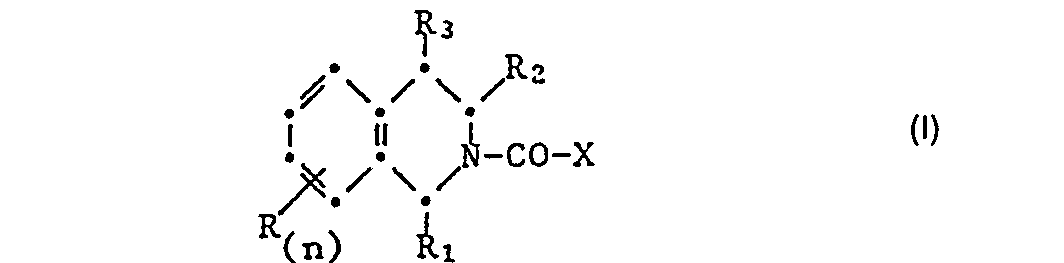
- R gleich oder verschieden Wasserstoff, Halogen, C1-C4-Alkyl, C1-C4-Alkoxy, C1-C4-Alkylthio, Halogenallyl, Halogenalkoxy, Alkenyloxy, Alkinyloxy, Dioxymethylen oder Nitro,
- n = eine Zahl 1, 2 oder 3,
- R1, R2 und R3 je Wasserstoff, C1-C6-Alkyl oder C3-C6-Alkenyl und X
- C1-C6-Halogenalkyl oder C2-C6-Halogenalkenyl bedeuten,
mit der Massgabe, dass wenn R Wasserstoff bedeutet R1, R2 und R3 nicht ebenfalls Wasserstoff sein dürfen.
Description
- Die vorliegende Erfindung betrifft ein Mittel zum Schutz von Kulturpflanzen vor der phytotoxischen Wirkung von stark wirksamen Halogenacyl-Herbiziden, welches als Herbizid-antagonisierenden Wirkstoff ein halogenacyliertes Tetrahydroisochinolin enthält, ferner Mittel welche neben diesem antagonisierenden Wirkstoff bereits das Herbizid enthalten und ein Verfahren zur selektiven Unkrautbekämpfung mittels dieser Herbizide und diesem Gegenmittel. Die Erfindung umfasst auch neue Tetrahydroisochinoline und weitere Verfahren zu deren Herstellung.
- Es ist bekannt, dass Herbizide aus den verschiedensten Stoffklassen, wie Triazine, Harnstoffderivate, Carbamate, Thiolcarbamate, Halogenacetanilide, Halogenphenoxyessigsäuren usw. bei der Anwendung in wirksamer Dosis gelegentlich neben den zu bekämpfenden Unkräutern auch die Kulturpflanzen in gewissem Masse schädigen. Es können klimatische Verhältnisse oder eine Bodenbeschaffenheit vorliegen, so dass die für normale Bedingungen empfohlene Herbizidmenge als Ueberdosis wirkt. Die Qualität des Saatgutes kann bei der Herbizidverträglichkeit auch eine Rolle spielen. Um diesem Problem zu begegnen, sind schon verschiedene Stoffe vorgeschlagen worden, welche befähigt sind, die schädigende Wirkung des Herbizides auf die Kulturpflanze spezifisch zu antagonisieren, d.h. die Kulturpflanze zu schützen, ohne dabei die Herbizidwirkung auf die zu bekämpfenden Unkräuter merklich zu beeinflussen. Dabei hat es sich gezeigt, dass die vorgeschlagenen Gegenmittel sowohl bezüglich der Kulturpflanzen als auch bezüglich des Herbizides und gegebenenfalls auch in Abhängigkeit von der Applikationsart oft sehr artspezifisch wirken, d.h. ein bestimmtes Gegenmittel eignet sich oft nur für eine bestimmte Kulturpflanze und einige wenige herbizide Stoffklassen.
- Vom wirtschaftlichen Gesichtspunkt müssen bei der Verwendung von chemischen Schutzmitteln (Safener) gegen Herbizide mehrere Faktoren in Betracht gezogen werden. Das chemische Behandlungsmittel muss ein Stoff sein, der lange genug in enger Berührung mit dem Nutzpflanzengut bleibt, um die auflaufenden Nutzpflanzen zu schützen, bis keine phytotoxisch gefährdende Konzentration an dem Herbizid mehr vorhanden ist. Andere Verbindungen neigen dazu, phytotoxische Wirkungen auf die Nutzpflanzen selbst auszuüben. Dies kann auf dreierlei Weise erfolgen, nämlich durch Verhinderung des Auflaufens der Nutzpflanzen, so dass eine schlechte Keimung stattfindet, durch Erzeugung von Missbildungen beim Wachstum der auflaufenden Nutzpflanzen und durch Verkümmerung oder Verzögerung des Wachstums der Nutpflanzen. In einigen Fällen lassen sich diese Wirkungen durch einfaches Herabsetzen der Anwendungskonzentration der Mittel beseitigen. In anderen Fällen scheint es aber nicht möglich zu sein, die Verbindungen in einer genügend niedrigen Konzentration anzuwenden, dass die Schädigung auf ein wirtschaftlich tragbares Ausmass herabgesetzt wird. In einigen Fällen schützen die chemischen Behandlungsmittel die Nutzpflanzen zwar gegen die herkömmlichen Mengen an Herbiziden; wenn aber gelgentlich Ueberdosierungen vorkommen, wie z.B. beim Ueberlappen von Spritzflächen, bieten die Verbindungen keinen Schutz mehr. Für die technische Anwendung ist es daher in Anbetracht der Möglichkeit solcher gelegentlicher und unbeabsichtiger Ueberdosierungen z.B. in sich überlappender Behandlungsflächen wünschenswert, das Saatgut gegen etwa das Doppelte der beabsichtigten Anwendungskonzentration der Unkrautbekämpfung zu schützen.
- Die direkte pre- oder postemergente Behandlung von Getreide und Mais mit Gegenmitteln als Antagonisten von Thiocarbamaten und anderen Herbizidklassen auf einer Anbaufläche ist in den Deutschen Offenlegungsschriften 2.141.586 und 2.218.097, sowie im US-Patent 3.867.444 beschrieben.
- Ferner können Maispflanzen gemäss der Deutschen Offenlegungsschrift 2.402.983 wirksam vor Schädigung durch Chloracetanilide geschützt werden, indem man dem Boden als Gegenmittel ein N-disubstituiertes Dichloracetamid zuführt. Derartige Verbindungen werden gemäss US-PS 4.137.070 auch als Antidotes bei herbiziden Thiocarbamaten verwendet oder gemäss DE-OS 2.828.265 und 2.828.293 als Antidot gegen herbizide Acetanilide.
- Es wurde nun gefunden, dass sich überraschenderweise eine Gruppe Acylamid-Derivaten hervorragend dazu eignet, Kulturpflanzen gegen schädigende Wirkung von Agrarchemikalien, wie beispielsweise Pflanzenschutzmitteln, insbesondere Herbiziden, zu schützen. Diese Acylamid-Derivate werden daher im folgenden auch als "Gegenmittel", "Antidot" oder "Safener" bezeichnet.
- Die halogenacylierten 1,2,3,4-Tetrahydro-isochinoline, die zum Schützen von Kulturpflanzen gegen die schädigende Wirkung von herbizid wirksamen Chloracetaniliden geeignet sind entsprechen der Formel I

- R gleich oder verschieden Wasserstoff, Halogen, Cl-C4-Alkyl, CI-C4-Alkoxy, C1-C4-Alkylthio, Halogenalkyl, Halogenalkoxy, Alkenyloxy, Alkinyloxy, Dioxymethylen oder Nitro,
- n = eine Zahl 1, 2 oder 3,
- RI, Rz und R3 je Wasserstoff, C1-C6-Alkyl oder C3-C6-Alkenyl und X C1-C6-Halogenalkyl oder C2-C6-Halogenalkenyl bedeuten, mit der Massgabe, dass wenn R Wasserstoff bedeutet R1, R2 und R3 nicht ebenfalls Wasserstoff sein dürfen.
- Soweit optisch isomere Verbindungen der Formel I existieren, sind im Rahmen der vorliegenden Erfindung sowohl die optisch reinen Isomere wie auch die Isomerengemische zu verstehen.
- Unter Halogen selbst in den Definitionen sowie Halogen als Teil in Halogenalkoxy, Halogenalkyl oder Halogenalkenyl sind Fluor, Chlor, Brom und Jod, vorzugsweise jedoch Fluor, Chlor und Brom, insbesondere aber Chlor zu verstehen.
- In den Definitionen ist unter Alkyl geradkettiges oder verzweigtes Alkyl zu verstehen; z.B.: Methyl, Aethyl, n-Propyl, i-Propyl oder die isomeren Butyl, Pentyl oder Hexyl.
- Unter Alkoxy ist zu verstehen: Methoxy, Aethoxy, n-Propyloxy, i-Propyloxy oder die isomeren Butyloxy-, Pentyloxy- oder Hexyloxyreste, insbesondere aber Methoxy, Aethoxy oder i-Propyloxy.
- Beispiele für ungesättigte Substituenten oder Substituententeile sind Allyl, Allyloxy, Propargyl, Propargyloxy, Methallyl, Methallyloxy, Butenyl, Butenyloxy, Butinyl, Butinyloxy, 3,3,3-Trilfluor-I-propenyl, 3,3,3-Trichlor-1-propinyl oder 2,3-Dichlorpropen-yl.
- Alkoxyalkylreste werden repräsentiert durch Methoxymethyl, Aethoxymethyl, Methoxyäthyl und Aethoxyäthyl, Propoxyäthyl, Isopropoxy- äthyl, Butoxyäthyl, Allyloxyäthyl, insbesondere aber Methoxyäthyl. Halogenalkyl als Substituenten wie Halogenalkoxy oder Halogenalkylthio steht in der Regel für Chlormethyl, Fluormethyl, Difluormethyl, Trifluormethyl, Dichlormethyl, Trichlormethyl, 2-Chloräthyl, 2,2,2-Trilfluoräthyl, 1,1,2,2-Tetrafluoräthyl, Pentafluoräthyl, 1,1,2-Trifluor-2-chloräthyl, 2,2,-Trifluor-1,1-dichloräthyl, Pentachloräthyl, 3,3,3-Trifluorpropyl, 2,3-Dichlorpropyl, 2-Chlorpropyl, 1,1,2,3,3,3-Hexafluorpropyl, 3,3,3-Trichlorpropyl, 2,2,2-Trichloräthyl, 1-Chloräthyl, insbesondere aber Chlormethyl, Dichlormethyl, Trichlormethyl und 1-Chloräthyl.
- Wegen ihrer Wirkung als Herbizidantagonisten sind diejenigen Acylamid-Derivate der Formel I hervorzuheben, in denen R Wasserstoff und R1 Methyl, Aethyl oder Isopropyl; R Methoxy, Dimethoxy oder Methylendioxy und R1, R2, R3 Wasserstoff sowie R Chlor und R1, R2, R3 Wasserstoff oder R Dichlor und R1, R2, R3 Wasserstoff bedeuten.
- Bevorzugte Verbindungen sind:
- N-Dichloracetyl-1-methyl-tetrahydroisochinolin
- N-Dichloracetyl-1-äthyl-tetrahydroisochinolin,
- N-Dichloracetyl-1-isopropyltetrahydroisochinolin,
- N-Dichloracetyl-7-methoxy-tetrahydroisochinolin,
- N-Dichloracetyl-6,7-dimethoxy-tetrahydroisochinolin,
- N-Dichloracetyl-6,7-methylendioxy-tetrahydroisochinolin,
- N-Dichloracetyl-7,8-dichlor-tetrahydroisochinolin
- N-Dichloracetyl-7-chlor-tetrahydroisochinolin,
- N-Dichloracaetyl-7-fluor-tetrahydroisochinolin
- N-2-Chlorpropionyl-6,7-dimethoxy-tetrahydroisochinolin.
- Des weiteren betrifft die Erfindung neue 1,2,3,4-Tetrahydroisochinoline der Formel I

- R gleich oder verschieden Wasserstoff, Halogen, C1-C4-Alkyl, Ci-C4-Alkoxy, CI-C4-Alkylthio, Halogenalkyl, Halogenalkoxy, Alkenyloxy, Alkinyloxy, Dioxymethylen oder Nitro,
- n = eine Zahl 1, 2 oder 3,
- R1, R2 und R3 je Wasserstoff, C1-C6-Alkyl oder C3-C6-Alkenyl und X C1-C6-Halogenalkyl oder C2-C6-Halogenalkenyl bedeuten,
- 2-Dichloracetyl-1,2,3,4-tetrahydroisochinolin,
- 2-Dichloracetyl-1-methyl-1,2,3,4-tetrahydroisochinolin,
- 2-Dichloracetyl-1-aethyl-1,2,3,4-tetrahydroisochinolin,
- 2-Dichloracetyl-1-isopropyl-1,2,3,4-tetrahydroisochinolin,
- 2-Dichloracetyl-1,3-dimethyl-1,2,3,4-tetrahydroisochinolin,
- 2-Dichloracetyl-6,7-dimethoxy-1,2,3,4-tetrahydroisochinolin,
- 2-Dichloracetyl-3-ethyl-1,2,3,4-tetrahydroisochinolin
- 2-Dichloracetyl-4-ethyl-1,2,3,4-tetrahydroisochinolin.
- Die Acylamide der Formel I werden hergestellt, indem man ein Acylhalid der Formel II


- Als Acylierungsmittel seien genannt:
- das Chloracetylchlorid
- das Dichloracetylchlorid
- das 2-Chlorpropionsäurechlorid
- das 2,2-Dichlorpropionsäurechlorid
- das 2-Chlor-acrylsäurechlorid
- das Trichloracetylchlorid
- das Dibrompropionsäurechlorid
- das Brompropionsäurechlorid
- das Chlor-crotonsäurechlorid
- Die Reaktion wird zweckmässigerweise in einem reaktionsinerten Lösungsmittel bei Normaldruck durchgeführt. Als Lösungsmittel eignen sich beispielsweise aliphatische oder aromatische Kohlenwasserstoffe wie Benzol, Toluol, Xylole, Cyclohexan, Petroläther, halogenierte Kohlenwasserstoffe wie Chlorbenzol, Methylenchlorid, Aethylenchlorid, Chloroform, Aether und ätherartige Verbindungen wie Diäthyläther, Diisopropyläther, t-Butylmethyläther, Dimethoxyäthan, Dioxan, Tetrahydrofuran, Anisol; Ketone wie Aceton, Methyläthylketon; Ester wie Aethylacetat, Butylacetat und Gemische solcher Lösungsmittel untereinander.
- Als säurebindende Mittel sind insbesondere tertiäre Amine wie Trimethylamin, Triäthylamin, Chinuclidin, 1,4-Diazabicyclo-(2,2,2)-cotan, 1,5-Diazabicyclo(4,3,0)non-5-en oder 1,5-Diazabicyclo(5,4,0)-undec-7-en geeignet. Es können aber auch anorganische Basen wie Hydridewie Natrium- oder Calciumhydrid, Hydroxide wie Natrium- und Kaliumhydroxid, Carbonate wie Natrium-und Kaliumcarbonat oder Hydrogencarbonate wie Kalium- und Natriumhydrogencarbonat verwendet werden. Es kann auch die doppelmolare Menge des 1,2,3,4-Tetrahydroisochinolins verwendet werden.
- Die Ausgangsverbindungen der Formel II sind bekannt; die Ausgangsverbindungen der Formel III sind teilweise bekannt bzw. können nach bekannten Methoden hergestellt werden. Teilweise sind es Stoffe aus der Reihe der sympathicolytisch wirkenden Pharmaka.
- Nach Decker und Becker (Ann 395 342 (1913) werden Phenylalkylamine mit Aldehyden zu Schiff'schen Basen kondensiert und diese mittels Salzsäure ringgeschlossen.

- Eine spezielle Ausführungsform ist die Kondensation von 3,4-Dimethoxyphenyläthylamin (Homoveratrylamin) und Formaldehyd in Gegenwart von Ameisensäure, wobei sich nach der Behandung des 3,4-Dimethoxy-N-methylen-phenylgthylamin und Salzsäure das 6,7-Di- methoxy-isochinolinchlorhydrat bildet. (Synth. Commun. 14 (1984) 1221-1228).

- Man kann auch acylierte Phenyläthylamine mit Polylphosphonsäure bei Temperaturen zwischen 130° und 200°C zu Dihydroisochinolinen kondensieren und anschliessend hydrieren. (Ber. 91 1551 (1958)).

- Ein anderer Weg geht von Benzaldehyd bzw. einem substituierten Benzaldehyd aus durch Kondensation mit Aminoacetaldehyddimethylacetal mit anschliessendem Ringschluss z.B. mittels Schwefelsäure und nachfolgender Hydrierung zum Tetrahydroisochinolin in Gegenwart von Salzsäure.


- Durch eine spezielle Reaktion kann das 1-Methyl-Isochinolin auch durch Kondensation von Isochinolin mit Dimethylsulfoxyd in Gegenwart von Natriumhydrid durch zweistündige Behandlung mit Ultraschall bei 25° gebildet werden.

- Durch nachträglicher Hydrierung wird das 1-Methyl-Tetrahydroisochinolin gewonnen.
- Ein weiteres Verfahren zur Herstellung von Halogenacyl-tetra-hydroisochinolin der Formel I besteht darin, nicht acylierte Verbindungen der Formel III mit Chloral oder einem durch Addition an dessen Oxogruppe gebildeten Chloralderivat in wässrigem Medium und/oder einem polaren organischen Lösungsmittel, in Gegenwart säurebindender Mittel und der katalytischen Menge eines anorganischen oder organischen Cyanides umsetzt. (DE-OS 2 807 340)

- Anstelle von Chloral kann auch Chloralhydrat, anstelle von NaOH auch ein Ueberschuss an sekundärer Base bzw. einem Alkali- oder Erdalkalisalz einer schwachen Säure wie z.B. Natriumbicarbonat oder Calciumcarbonat verwendet werden. Die Umsetzung wird durch Alkalicyanide beschleunigt.
- Die Erfindung betrifft auch ein Verfahren zur Herstellung von 1,2,3,4-Tetrahydroisochinolinen der Formel I
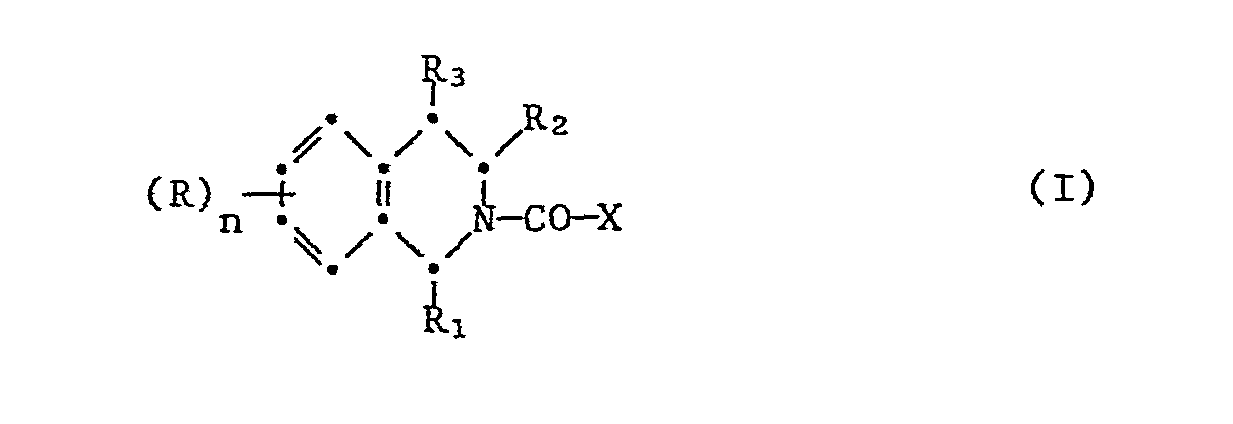
- X CHC12
- R gleich oder verschieden Wasserstoff, Halogen, C1-C4-Alkyl, CI-C4-Alkoxy, CI-C4-Alkylthio, Halogenalkyl, Halogenalkoxy, Alkenyloxy, Alkinyloxy, Dioxymethylen oder Nitro,
- n = eine Zahl 1, 2 oder 3 und
- RI, Rz und R3 je Wasserstoff, C1-C6-Alkyl oder C3-C6-Alkenyl bedeuten, dadurch gekennzeichnet, dass man ein 1,2,3,4-Tetrahydroisochinolin der Formel III
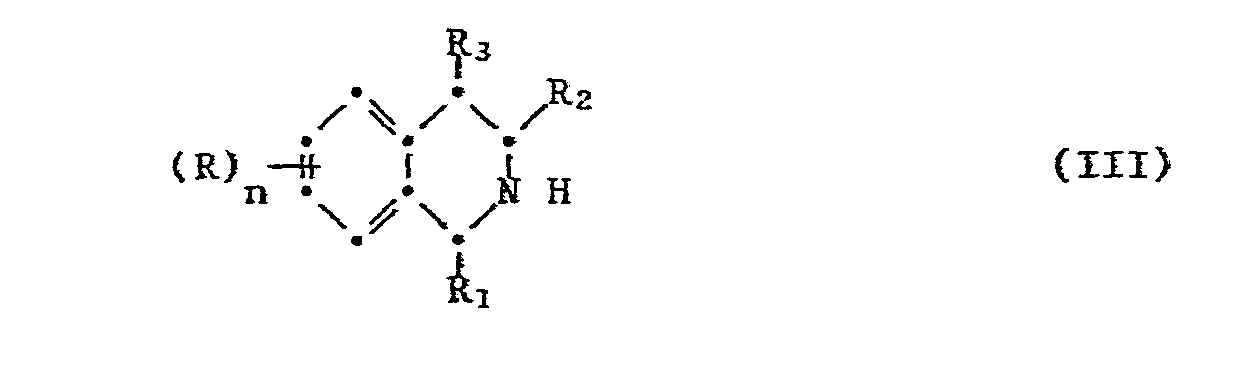
- Halogenacylierte hydrierte Isochinoline bzw. Chinolinderivate sind aus der Literatur bekannt.
- So wurde das dichloracylierte Perhydrochinolin bereits in der DE-OS 2 218 097 erwähnt. Auch das dichloracylierte Tetrahydrochinolin (DE-OS 2 828 265) bzw. das diehloracylierte Tetrahydrochinaldin (DE-OS 2 828 293, DOS 2 828 265) sowie das 2-Chlorpropionyltetrahydrochinaldin (EP-A 023 306, EP-A 023 307) sind als Safener (Antidote) beschrieben. Dasselbe gilt auch für das dichloracylierte Tetrahydroisochinaldin (DE-OS 2 245 471 und DE-OS 2 828 222).
- Die erfindungsgemässen halogenacylierten 1,2,3,4-Tetrahydro-isochinolinderivate der Formel I zeigen ausgezeichnete Safenerwirkung und sind in ihrer Wirkung bekannten Verbindungen überlegen.
- Ein Gegenmittel oder Antidot der Formel I kann je nach Anwendungszweck zur Vorbehandlung des Saatgutes der Kulturpflanze (Beizung des Samens oder der Stecklinge) eingesetzt oder vor oder nach der Saat in den Boden gegeben werden. Es kann aber auch für sich allein oder zusammen mit dem Herbizid vor oder nach dem Auflaufen der Pflanzen appliziert werden. Die Behandlung der Pflanze oder des Saatgutes mit dem Antidot kann daher grundsätzlich unabhängig vom Zeitpunkt der Applikation der phytotoxischen Chemikalie erfolgen. Die Behandlung der Pflanze kann jedoch auch durch gleichzeitige Applikation von phytotoxischer Chemikalie und Gegenmittel (Tankmischung) erfolgen. Die preemergente Behandlung schliesst sowohl die Behandlung der Anbaufläche vor der Aussaat (ppi = pre plant incorporation) als auch die Behanldung der angesäten, aber noch nicht bewachsenen Anbauflächen ein.
- Die Aufwandmengen des Gegenmittels im Verhältnis zum Herbizid richten sich weitgehend nach der Anwendungsart. Bei einer Feldbehandlung, bei der Herbizid und Gegenmittel entweder gleichzeitig (Tankmischung) oder separat appliziert werden, liegt das Verhältnis der Mengen von Gegenmittel zu Herbizid im Bereich von 1:100 bis 5:1. In der Regel wird bei einem Mengenverhältnis von Gegenmittel zu Herbzid von 1:5 bis 1:50 die volle Schutzwirkung erreicht. Bei der Samenbeizung und ähnlichen gezielten Schutzmassnahmen werden jedoch weit geringere Mengen Gegenmittel im Vergleich mit den später pro Hektar Anbaufläche verwendeten Mengen an Herbizid benötigt. Im allgemeinen werden bei der Samenbeizung pro kg Samen 0,1-10 g Gegenmittel benötigt. In der Regel wird mit 0,1-5 g Gegenmittel pro kg Samen bereits die volle Schutzwirkung erreicht. Falls das Gegenmittel kurz vor der Aussaat durch Samenquellung appliziert werden soll, so werden zweckmässig Lösungen des Gegenmittels verwendet, welche den Wirkstoff in einer Konzentration von 1-10'000 ppm enthalten. In der Regel wird mit Konzentrationen des Gegenmittels von 100-1'000 ppm die volle Schutzwirkung erreicht.
- Die zur Erzielung der gewünschten Safening Effekts notwendige Menge des Antidots I kann je nach Anwendungsart und Zeitpunkt sehr unterschiedlich sein und ist durch einfache Versuche nicht zu ermitteln.
- In der Regel liegt zwischen protektiven Massnahmen, wie Samenbeizung und Behandlung von Stecklingen mit einem Gegenmittel der Formel I und der möglichen späteren Feldbehandlung mit Agrarchemikalien ein längerer Zeitraum. Vorbehandeltes Saat- und Pflanzengut kann später in der Landwirtschaft, im Gartenbau und in der Forstwirtschaft mit unterschiedlichen Chemikalien in Berührung kommen. Die Erfindung bezieht sich daher auf protektive Mittel für Kulturpflanzen, die als Wirkstoff ein Gegenmittel der Formel I zusammen mit üblichen Trägerstoffen enthalten. Solche Mittel können gegebenenfalls zusätzlich jene Agrarchemikalien enthalten, vor deren Einfluss die Kulturpflanze geschützt werden soll.
- Als Kulturpflanzen gelten im Rahmen vorliegender Erfindung alle Plfanzen, die in irgendeiner Form Ertragsstoffe, wie Samen, Wurzeln, Stengel, Knollen, Blätter, Blüten, ferner Inhaltsstoffe, wie Oele, Zucker, Stärke, Eiweiss usw., produzieren und zu diesem Zweck angebaut werden. Zu diesen Pflanzen gehören beispielsweise sämtliche Getreidearten, wie Weizen, Roggen, Gerste und Hafer, daneben vor allem Reis, Kulturhirse, Mais, Baumwolle, Zuckerrüben, Zuckerrohr, Soja, Bohnen und Erbsen.
- Das Gegenmittel kann überall dort eingesetzt werden, wo eine Kulturpflanze der vorgenannten Art vor der schädlichen Wirkung einer Agrarchemikalie geschützt werden soll. Dabei kommen als Agrarchemikalien in erster Linie Herbizide der verschiedensten Stoffklassen, insbesondere jedoch Halogenacetanilide, in Betracht.
- Halogenacetanilide, deren schädigende Wirkung gegenüber Kulturpflanzen mit Hilfe der Acylamid-Derivate der Formel I aufgehoben werden kann, sind bereits in grosser Zahl bekannt geworden. Solche Halogenacetaniliden können durch die folgende allgemeine Formel IV beschrieben werden:

- In dieser Formel bedeuten Hal Halogen, insbesondere Chlor oder Brom, R2 und R3 unabhängig voneinander je Wasserstoff, Halogen, niederes Alkyl, Alkoxy, Alkylthio, Halogenalkyl, Alkoxyalkyl oder Alkylthioalkyl, Z Wasserstoff, Halogen, niederes Alkyl, Alkoxy, Alkylthio, Halogenalkyl, Alkoxyalkyl oder Alkylthioalkyl, wobei die vorgenannten Reste Z vorzugsweise in 3-Stellung in Bezug auf das Stickstoffatom stehen, n 0 bis 3, Y Alkylen, insbesondere Methylen, 1,1-1,2-Aethylen, wobei 1,2-Aethylen durch 1-2 niedere Alkylgruppen substituiert sein kann, und R4 niederes Alkoxy, Hydroxycarbonyl, Alkoxycarbonyl, Carbamoyl, N-Alkylcarbamoyl, N,N-Dialkylcarbamoyl, Cyano, ein gegebenenfalls substituierter stickstoffhaltiger heterocyclischer Rest, Alkanoyl, gegebenenfalls substituiertes Benzoyl, gegebenenfalls substituiertes 1,3,4-Oxadiazol-2-yl, 1,3,4-Thiadiazol-2-yl, 1,3,4-Triazol-3-yl oder 1,3,4-Triazol-1-yl bedeutet.
- Als einzelne Vertreter solcher Halogenacetanilide seien beispielsweise die folgenden genannt:
- N-Aethoxymethyl-N-chloracetyl-2-äthyl-6-methylanilin,
- N-Chloracetyl-N-methoxymethyl-2,6-diäthylanilin,
- N-Chloracetyl-N-(2-methoxyäthyl)-2,6-dimethylanilin, N-(2-Allyloxyäthyl)-N-chloracetyl-2,6-dimethylanilin, N-Chloracetyl-N-(2-n-propoxyäthyl)-2,6-dimethylanilin, N-Chloracetyl-N-(2-isopropoxyäthyl)-2,6-dimethylanilin, N-Chloracetyl-N-(2-methoxyäthyl)-2-äthyl-6-dimethylanilin, N-Chloracetyl-N-(methoxyäthyl)-2,6-diäthylanilin, N-(2-Aethoxyäthyl)-N-chloracetyl-2-äthyl-6-methylanilin, N-Chloracetyl-N-(2-methoxy-l-methyläthyl)-2-methylanilin, N-Chloracetyl-N-(2-methoxy-1-methyläthyl)-2,6-methylanilin, N-Chloracetyl-N-(2-methoxy-1-methyläthyl)-2,6-diäthylanilin, N-Chloracetyl-N-(2-methoxy-1-methyläthyl)-2-äthyl-6-methylanilin, N-(2-Aethoxyäthyl)-N-chloracetyl-2,6-diäthylanilin, N-Chloracetyl-N-(2-propoxyäthyl)-2-äthyl-6-methylanilin, N-Chloracetyl-N-(2-propoxyäthyl)-2-diäthylanilin, N-Chloracetyl-N-(2-isopropoxyäthyl)-2-äthyl-6-methylanilin, N-Aethyloxycarbonylmethyl-N-chloracetyl-2,6-dimethylanilin, N-Aethoxycarbonylmethyl-N-chloracetyl-2,6-diäthylanilin, N-Chloracetyl-N-methoxycarhonylmethyl-2,6-dimethylanilin, N-Chloracetyl-N-(2,2-diäthoxyäthyl)-2,6-dimethylanilin, N-Chloracetyl-N-(2-methoxy-1-methyläthyl)-2,3-dimethylanilin, N-(2-Aethoxyäthyl)-N-chloracetyl-2-methylanilin, N-Chloracetyl-N-(2-methoxyäthyl)-2-methylanilin, N-Chloracetyl-N-(2-methoxy-l-methyläthyl)-2,6-dimethylanilin, N-(2-Aethoxy-2-methyläthyl)-N-chloracetyl-2-äthyl-6-methylanilin, N-Chloracetyl-N-(1-äthyl-2-methoxyäthyl)-2,6-dimethylanilin, N-Chloracetyl-N-(2-methoxyäthyl)-2-methoxy-6-methylanilin, N-n-Butoxymethyl-N-chloracetyl-2-tert.-butylanilin, N-(2-Aethoxyathyl-methyläthyl)-2,6-dimethylanilin, N-Chloracetyl-N-(2-methoxyäthyl)-2-chlor-6-methylanilin, N-(2-Aethoxyäthyl)-N-chloracetyl-2-chlor-6-methylanilin, N-(2-Aethoxyhthyl)-N-chloracetyl-2,3,6-trimethylanilin, N-Chloracetyl-N-(2-methoxyäthyl)-2,3,6-trimethylanilin, N-Chloracetyl-N-cyanomethyl-2,6-dimethylanilin, N-But-3-in-1-yl-N-chloracetylanilin, N-Chloracetyl-N-propargyl-2-äthyl-6-methylanilin, N-Chloracetyl-N-(1,3-dioxolan-2-ylmethyl)-2,6-dimethylanilin, N-Chloracetyl-N-(1,3-dioxolan-2-ylmethyl)-2-äthyl-6-methylanilin,
- N-Chloracetyl-N-(1,3-dioxan-2-ylmethyl)-2-äthyl-6-methylanilin,
- N-Chloracetyl-N-(2-furanylmethyl)-2,6-dimethylanilin,
- N-Chloracetyl-N-(2-furanylmethyl)-2-äthyl-6-methylanilin,
- N-Chloracetyl-N-(2-tetrahydrofuranylmethyl)-2,6-methylanilin,
- N-Chloracetyl-N-(N-propargylcarbamoylmethyl)-2,6-methylanilin,
- N-Chloracetyl-N-(N,N-dimethylcarbamoylmethyl)-2,6-methylanilin,
- N-(n-Butoxymethyl)-N-chloracetyl-2,6-diäthylanilin,
- N-(2-n-Butoxyäthyl)-N-chloracetyl-2,6-diäthylanilin,
- N-Chloracetyl-N-(2-methoxy-l,2-dimethyläthyl)-2,6-dimethylanilin,
- N-Chloracetyl-N-isopropyl-2,3-dimethylanilin,
- N-Chloracetyl-N-isopropyl-2-chloranilin,
- N-chloracetyl-N-(lH-pyrazol-1-ylmethyl)-2,6-dimethylanilin,
- N-Chloracetyl-N-(lH-pyrazol-l-ylmethyl)-2-äthyl-6-methylanilin,
- N-Chloracetyl-N-(1H-1,2,4-triazol-1-ylmethyl)-2,6-dimethylanilin,
- N-Chloracetyl-N-(1H-1,2,4-triazol-1-ylmethyl)-2,6-diäthylanilin,
- N-Benzoylmethyl-N-chloracetyl-2,6-dimethylanilin,
- N-Benzoylmethyl-N-chloracetyl-2-äthyl-6-methylanilin,
- N-Chloracetyl-N-(5-methyl-1,3,4-oxadiazol-2-yl)-2,6-diäthylanilin,
- N-chloracetyl-N-(5-methyl-1,3,4-oxadiazol-2-yl)-2-äthyl-6-methylanilin,
- N-Chloracetyl-N-(5-methyl-1,3,4-oxadiazol-2-yl)-2-tert.butylanilin,
- N-Chloracetyl-N-(4-chlorbenzoylmethyl)-2,6-dimethylanilin und
- N-Chloracetyl-N-(1-methyl-5-methylthio-1,3,4-triazol-2-ylmethyl)-2,6-diäthylanilin
- Weitere Halogenacetanilide, deren schädigende Wirkung auf Kulturpflanzen durch die neuen Acylamid-Derivate der Formel I aufgehoben werden kann, sind in R. Wegler, Chemie der Pflanzenschutz- und Schädlingsbekämpfungsmittel, Bd. 8, Seiten 90-93 und Seiten 322-327 aufgeführt.
- Die Erfindung betrifft auch ein Verfahren zur selektiven Bekämpfung von Unkräutern in Kulturpflanzenbeständen, wobei die Kulturpflanzenbestände, teile der Kulturpflanzen oder Anbauflächen für Kulturpflanzen mit einem Herbizid und einer Verbindung der Formel I oder einem Mittel, welches diese Kombination enthält, behandelt werden. Die die Herbizid/Antidot-Kombination enthaltenden Mittel bilden ebenfalls einen Bestandteil der vorliegenden Erfindung.
- Bei den zu bekämpfenden Unkräutern kann es sich sowohl um monokotyle wie auch um dikotyle Unrkräuter handeln.
- Für die Verwendung von Verbindungen der Formel I oder sie enthaltender Mittel zum Schützen von Kulturpflanzen gegen schädigende Wirkungen von Agrarchemikalien kommen verschiedene Methoden und Techniken in Betracht, wie beispielsweie die folgenden:
-
- a) Beizung der Samen mit einem als Spritzpulver formulierten Wirkstoff durch Schütteln in einem Gefäss bis zur gleichmässigen Verteilung auf der Samenoberfläche (Trockenbeizung). Man verwendet dabei etwa 10 bis 500 g Wirkstoff der Formel 1 (40 g bis 2 kg Spritzpulver) pro 100 kg Saatgut.
- b) Beizung der Samen mit einem Emulsionskonzentrat des Wirkstoffs der Formel I nach der Methode a) (Nassbeizung).
- c) Beizung durch Tauchen des Saatguts in eine Brühe mit 50-5000 ppm Wirkstoff der Formel I während 1 bis 72 Stunden und gegebenenfalls nachfolgendes Trocknen der Samen (Tauchbeizung).
- Die Beizung des Saatguts oder die Behandlung des angekeimten Sämlings sind naturgemäss die bevorzugten Methoden der Applikation, weil die Wirkstoffbehandlung vollständig auf die Zielkultur gerichtet ist. Man verwendet in der Regel 10 g bis 500 g, vorzugsweise 50 bis 250 g AS pro 100 kg Saatgut, wobei man je nach Methodik, die auch den Zusatz anderer Wirkstoffe oder Mikronährstoffe ermöglicht, von den angegebenen Grenzkonzentrationen nach oben oder unter abweichen kann (Wiederholungsbeize).
- Eine flüssige Aufarbeitung eines Gemisches von Gegenmittel und Herbizid (gegenseitiges Mengenverhältnis zwischen 10:1 und 1:30) wird verwendet, wobei die Aufwandmenge an Herbizid 0,1 bis 10 kg pro Hektar beträgt. Solche Tankmischung wird vorzugsweise vor oder unmittelbar nach der Aussaat appliziert oder 5 bis 10 cm tief in den noch nicht gesäten Boden eingearbeitet.
- Das Gegenmittel wird als Emulsionskonzentrat, Spritzpulver oder als Granulat in die offene besäte Saatfurche eingebracht und hierauf wird nach dem Decken der Saatfurche in normaler Weie das Herbizid im Vorauflaufverfahren appliziert.
- Der Wirkstoff wird in Lösung auf mineralische Granulaträger oder polymerisierte Granulate (Harnstoff/Formaldehyd) aufgezogen und trocknen gelassen. Gegebenenfalls kann ein Ueberzug aufgebracht wereden (Umhüllungsgranulate), der es erlaubt, den Wirkstoff über einen bestimmten Zeitraum dosiert abzugeben.
- Die Verbindungen der Formel I werden in unveränderter Form oder vorzugsweise als Mittel zusammen mit den in der Formulierungstechnik üblichen Hilfsmitteln eingesetzt und werden daher z.B. zu Emulsionskonzentraten, direkt verprühbaren oder verdünnbaren Lösungen, verdünnten Emulsionen, Spritzpulvern, löslichen Pulvern, Stäubemitteln, Granulaten, durch Verkapselungen in z.B. polymeren Stoffen in bekannter Weise verarbeitet. Die Anwendungsverfahren wie Versprühen, Vernebeln, Verstäuben, Verstreuen oder Giessen werden gleich wie die Art der Mittel den angestrebten Zielen und den gegebenen Verhältnissen entsprechend gewählt.
- Die Formulierungen, d.h. die den Wirkstoff der Formel I sowie das Gegenmittel und gegebenenfalls einen festen oder flüssigen Zusatzstoff enthaltenden Mittel, Zubereitungen oder Zusammensetzungen werden in bekannter Weise hergestellt, z.B. durch inniges Vermischen und/oder Vermahlen der Wirkstoffe mit Streckmitteln, wie z.B. mit Lösungsmitteln, festen Trägerstoffen und gegebenenfalls oberflächenaktiven Verbindungen (Tensiden).
- Als Lösungsmittel können in Frage kommen: Aromatische Kohlenwasserstoffe, bevorzugt die Fraktionen Cε bis C12, wie z.B. Xylolgemische oder substituierte Naphthaline, Phthalsäureester wie Dibutyl- oder Dioctylphthalat, aliphatische Kohlenwasserstoffe wie Cyclohexan oder Paraffine, Alkohole und Glykole sowie deren Aether und Ester, wie Aethanol, Aethylenglykol, Aethylenglykolmonomethyl- oder -äthyläther, Ketone wie Cyclohexanon, stark polare Lösungsmittel wie N-Methyl-2-pyrrolidon, Dimethylsulfoxid oder Dimethylformamid, sowie gegegebenenfalls epoxidiertes Pflanzenöl wie epoxydiertes Kokosnussöl oder Sojaöl; oder Wasser.
- Als feste Trägerstoffe, z.B. für Stäubemittel und dispergierbare Pulver, werden in der Regel natürliche Gesteinsmehle verwendet, wie Calcit, Talkum, Kaolin, Montmorillonit oder Attapulgit. Zur Verbesserung der physikalischen Eigenschaften können auch hochdisperse Kieselsäure oder hochdisperse saugfähige Polymerisate zugesetzt werden. Als gekörnte, adsorptive Granulatträger kommen poröse Typen wie z.B. Bimsstein, Ziegelbruch, Sepiolit oder Bentonit, als nicht sorptive Trägermaterialien z.B. Calcit oder Sand in Frage. Darüberhinaus kann eine Vielzahl von vorgranulierten Materialien anorganischer oder organischer Natur wie insbesondere Dolomit oder zerkleinerte Pflanzenrückstände verwendet werden.
- Als oberflächenaktive Verbindungen kommen je nach der Art des zu formulierenden Wirkstoffes der Formel I nichtionogene, kation-und/oder anionaktive Tenside mit guten Emulgier-, Dispergier- und Netzeigenschaften in Betracht. Unter Tensiden sind auch Tensidgemische zu verstehen.
- Geeignete anionische Tenside können sowohl sog. wasserlösliche Seifen als auch wasserlösliche synthetische oberflächenaktive Verbindungen sein.
- Als Seifen seien die Alkali-, Erdalkali- oder gegebenenfalls substituierte Ammoniumsalze von höheren Fettsäuren (C10-C22), wie z.B. die Na- oder K-Salze der Oel- oder Stearinsäure, oder von natürlichen Fettsäuregemischen die z.B. aus Kokosnuss- oder Talgöl gewonnen werden können, genannt. Ferner sind auch die Fettsäuremethyl-taurinsalze zu erwähnen.
- Häufiger werden jedoch sogenannte synthetische Tenside verwendet, insbesondere Fettsulfonate, Fettsulfate, sulfonierte Benzimidazolderivate oder Alkylarylsulfonate.
- Die Fettsulfonate oder -sulfate liegen in der Regel als Alkali-, Erdalkali- oder gegebenenfalls substituierte Ammoniumsalze vor und weisen einen Alkylrest mit 8 bis 22 C-Atomen auf, wobei Alkyl auch den Alkylteil von Acylresten einschliesst, z.B. das Na- oder Ca-Salz der Ligninsulfonsäure, des Dodecylschwefelsäureesters oder eines aus natürlichen Fettsäuren hergestellten Fettalkoholsulfatgemisches. Hierher gehören auch die Salze der Schwefelsäureester und Sulfonsäuren von Fettalkohol-Aethylenoxid-Addukten. Die sulfonierten Benzimidazolderivate enthalten vorzugsweise 2 Sulfonsäuregruppen und einen Fettsäurerest mit 8-22 C-Atomen. Alkylarylsulfonate sind z.B. die Na-, Ca- oder Triäthanolaminsalze der Dodecylbenzolsulfonsäure, der Dibutylnaphthalinsulfonsäure, oder eines Naphthalinsulfonsäure-Formaldehydkondensationsproduktes.
- Ferner kommen auch entsprechende Phosphate wie z.B. Salze des Phosphorsäureesters eines p-Nonylphenol-(4-14)-Aethylenoxid-Adduktes in Frage.
- Als nicht ionische Tenside kommen in erster Linie Polyglykolätherderivate von aliphatischen oder cycloaliphatischen Alkoholen, gesättigten oder ungesättigten Fettsäuren und Alkylphenolen in Frage, die 3 bis 30 Glykoläthergruppen und 8 bis 20 Kohlenstoffatome im (aliphatischen) Kohlenwasserstoffrest und 6 bis 18 Kohlenstoffatome im Alkylrest der Alkylphenole enthalten können.
- Weitere geeignete nichtionische Tenside sind die wasserlöslichen, 20 bis 250 Aethylenglykoläthergruppen und 10 bis 100 Propylenglykoläthergruppen enthaltenden Polyäthylenoxidaddukte an Polypropylenglykol, Aethylendiaminopolypropylenglykol und Alkylpolypropylenglykol mit 1 bis 10 Kohlenstoffatomen in der Alkylkette. Die genannten Verbindungen enthalten üblicherweise pro Propylenglykol-Einheit 1 bis 5 Aethylenglykoleinheiten.
- Als Beispiele nichtionischer Tenside seien Nonylphenolpolyäthoxy- äthanole, Ricinusölpolyglykoläther, Polypropylen-Polyäthylenoxidaddukte, Tributylphenoxypolyäthoxyäthanol, Polyäthylenglykol und Oxtylphenoxypolyäthoxyäthanol erwähnt.
- Ferner kommen auch Fettsäureester von Polyoxyäthylensorbitan wie das Polyoxyäthylensorbitan-trioleat in Betracht.
- Bei den kationischen Tensiden handelt es sich vor allem um quartäre Ammoniumsalze, welche als N-Substituenten mindestens einen Alkylrest mit 8 bis 22 C-Atomen enthalten und als weitere Substituenten niedrige, gegebenenfalls halogenierte Alkyl-, Benzyl- oder niedrige Hydroxyalkylreste aufweisen. Die Salze liegen vorzugsweise als Halogenide, Methylsulfate oder Aethylsulfate vor, z.B. das Stearyltrimethylammoniumchlorid oder das Benzyldi(2-chloräthyl)-äthylammoniumbromid.
- Die in der Formulierungstechnik gebräuchlichen Tenside sind u.a. in folgenden Publikationen beschrieben:
- "1985 International Mc Cutcheon's Emulsifier &
- Detergents"; Glenn Rock, NJ 07452 USA
- H. Stache "Tensid-Taschenbuch", 2. Aufl., C. Hanser Verlag, München, Wien 1981
- M. and J. Ash, "Encyclopedia of Surfactants" Vol. I-III, Chemical Publishing Co., New York, 1980-1981.
- Die Wirkstoffzubereitungen enthalten in der Regel 0,1 bis 99 %, insbesondere 0,1 bis 80 %, Wirkstoff der Formel I, 1 bis 99 % eines festen oder flüssigen Zusatzstoffes und 0 bis 25 %, insbesonders 0,1 bis 25 %, eines Tensides.
- Insbesondere setzen sich bevorzugte Formulierungen folgendermassen zusammen: (% = Gewichtsprozent)
- Wirkstoffe der Formeln I und II 1 bis 50 %, bevorzugt 5 bis 10 % oberflächenaktives Mittel: 5 bis 30 %, vorzugsweise 10 bis 20 % flüssiges Trägermittel: 50 bis 94 %, vorzugsweise 70 bis 85 %.
- Aktiver Wirkstoff: 0,1 bis 10 %, vorzugsweise 0,1 bis 1 % festes Trägermaterial: 99,9 bis 90 %, vorzugsweise 99,9 bis 99 %.
- Wirkstoffgemisch: 5 bis 75 %, vorzugsweise 10 bis 50 % Wasser: 94 bis 25 %, vorzugsweise 90 bis 30 % oberflächenaktives Mittel: 1 bis 40 %, vorzugsweise 2 bis 30 %.
- Wirkstoffgemisch : 0,5 bis 90 %, vorzugsweise 1 bis 80 % oberflächenaktives Mittel: 0,5 bis 20 %, vorzugsweise 1 bis 15 % festes Trägermaterial: 5 bis 95 %, vorzgusweise 15 bis 90 %.
- Wirkstoffgemisch: 0,5 bis 30 %, vorzugsweise 3 bis 15 % festes Trägermittel: 99,5 bis 70 %, vorzugsweise 97 bis 85 %.
- Während als Handelsware eher konzentrierte Mittel bevorzugt werden, verwendet der Endverbraucher in der Regel verdünnte Mittel. Die Anwendungsformen können bis hinab zu 0,001 % an Wirkstoff verdünnt werden. Die Aufwandmengen betragen in der Regel 0,01 bis 10 kg/ha, vorzugsweise 0,025 bis 5 kg/ha.
- Die Mittel können auch weitere Zusätze wie Stabilisatoren, Entschäumer, Viskositätsregulatoren, Bindemittel, Haftmittel sowie Dünger oder andere Wirkstoffe zur Erzielung spezieller Effekte enthalten.
- In den folgenden Beispielen sind die Temperaturen in Celsiusgraden °C, die Drücke in Millibar mb angegeben.
- Beispiel 1: Herstellung von N-(1-Methyl-tetrahydroisochinolin)-dichloracetamid (Verbindung 1.01)

- In einen 350 ml Vierhalskolben gibt man 14,7 g 1-Methyl-tetrahydroisochinolin und 60 ml Toluol und rührt bis sich das Isochinolin gelöst hat. Dazu gibt man 20 g 20 %ige Natronlauge und rührt unter Kühlung des Kolbens im COz/Alkohol-Bad bis die Temperatur der Reaktionslösung -15" erreicht hat. Dann tropft man langsam in die gerührte Aminlösung eine 14,8 g Dichloessigsäurechlorid welche in 10 ml Toluol gelöst sind. Nachdem alles zugetropft ist, was ca. 1/2 Stunde in Anspruch nimmt, wird das Kühlbad entfernt und das Reaktionsgemisch weitergerührt bis es Raumtemperatur erreicht hat. Dann wird es auf Eis/Wasser gegossen und die organische Schicht im Schedetrichter mit Toluol extrahiert. Die Toluoolphasen werden gesammelt, je zweimal mit ln-Salzsäure und Wasser gewaschen, getrocknetund im Vakuum eingedampft. Es hinterbleibt ein helles Oel, das sich über Nacht festigt. Ausbeute 23,8 g Smp. 74-77°. Dieses Rohmaterial wird in 25 g Toluol werm gelöst, dann eiskalt gestellt und langsam mit 60 ml Hexan versetzt, wobei das Kondensationsprodukt kristallin ausfällt. Man erhält so 19,6 g Titelprodukt mit Schmelzpunkt 79-80°.
- Analyse C12H13C12NO

- Beispiel 2: Herstellung von N-(6,7-Di-methoxy-tetrahydroisochinolin)-dichloracetamid (Verbindung 1.02)

- Analyse C13H15Cl2NO3 Mol.-Gew. 304,17

- In gleicher Weise werden N-(1-Aethyl-tetrahydro-iso-chinolin)di- chloracatamid als dickes helles Oel im N-(1-Isopropyl-tetrahydroisochinolin)dichloracetamid als dickes helles Oel hergestellt.
- Weitere auf diese Weise herzustellende Verbindungen sind in der folgenden Tabelle aufgeführt:


-

- Der Wirkstoff wird mit den Zusatzstoffen gut vermischt und in einer geeigneten Mühle gut vermahlen. Man erhält Spritzpulver, die sich mit Wasser zu Suspensionen jeder gewünschten Konzentration verdünnen lassen.

- Aus diesem Konzentrat können durch Verdünnen mit Wasser Emulsionen jeder gewünschten Konzentration hergestellt werden.

- Man erhält anwendungsfertige Stäubemittel, indem der Wirkstoff mit dem Träger vermischt und auf einer geeigneten Mühle vermahlen wird.

- Der Wirkstoff wird mit den Zusatzstoffen vermischt, vermahlen und mit Wasser angefeuchtet. Dieses Gemisch wird extrudiert und anschliessend im Luftstrom getrocknet.

- Der fein gemahlene Wirkstoff wird in einem Mischer auf das mit Polyäthylenglykol angefeuchtete Kaolin gleichmässig aufgetragen. Auf diese Weise erhält man staubfreie Umhüllungs-Granulate.

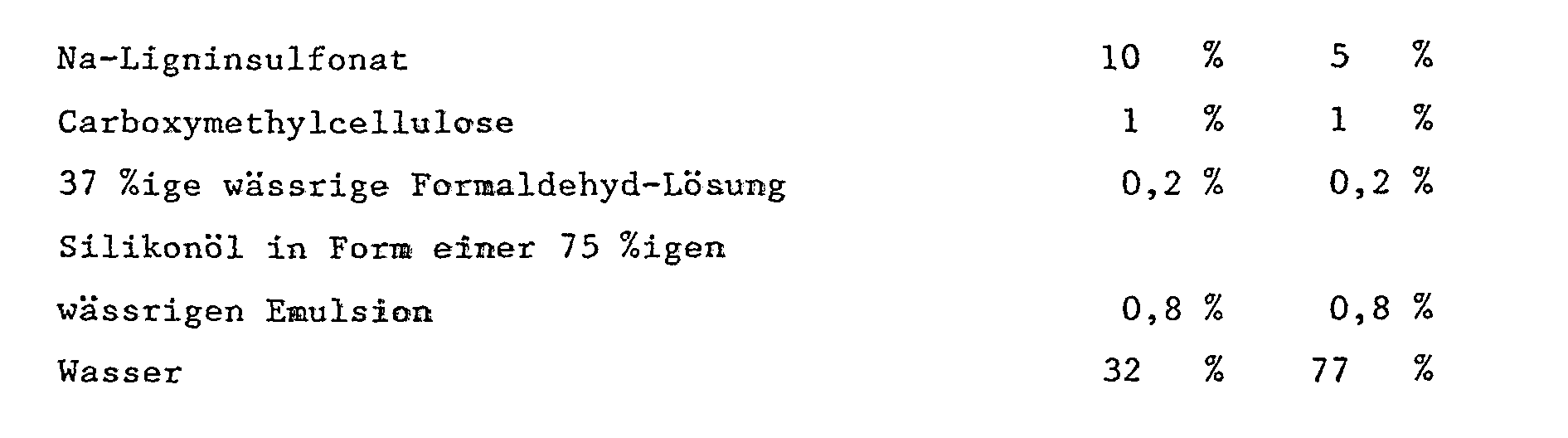
- Der fein gemahlene Wirkstoff wird mit den Zusatzstoffen innig vermischt. Man erhält so ein Suspensions-Konzentrat, aus welchem durch Verdünnen mit Wasser Suspensionen jeder gewünschten Konzentration hergestellt werden können.

- Die Fähigkeit der Verindungen der Formel I, Kulturpflanzen vor der phytotoxischen Wirkung starker Herbizide zu schützen, kann aus dem folgenden Beispiel ersehen werden. In der Versuchsbeschreibung werden die Verbindungen der Formel I als Safener oder Gegenmittel (Antidot) bezeichnet.
- Zur Bestimmung der Schutzwirkung des Safeners wird die Schädigung an der Pflanze in einem linearen neunstufigen Bonitierungsschema bewertet, wobei 1 für 100 % Schädigung und 9 für keine Schädigung (Pflanze wächst wie die unbehandelte Referenz) steht. Das Herbizid wird in einer Aufwandmenge appliziert, in welcher die Versuchspflanze teilweise geschädigt wird (d.i. zwischen 0 und 100 %). Zur Bewertung der Safenerwirkung wird die sogenannte rel. Safenerwirkung ermittelt. Dies ist die Differenz der bei dem Herbizid und Herbizid + Safener ermittelten Bonitiernoten. Die realtive Safenerwirkung wird in Prozent angegeben.
- Beispiel 10: Vorauflaufapplikation von Safener und Herbizid in Tankmischung
- Plastiktöpfe (oberer Durchmesser 9 cm, Inhalt 315 ccm) werden mit sandig toniger Lehmerde gefüllt. Maissamen der Sorte 'LG-5' werden eingesät und mit Erde bedeckt und anschliessend angegossen.
- Die als Safener zu prüfende Substanz der Formel I wird in einer Aufwandmenge von 1,5 kg AS/ha entsprechenden Konzentration in Wasser gelöst und zusammen mit dem Herbizid der Formel II in 550 1 Brühe/ha auf die Bodenoberfläche aufgesprüht.
- Als Herbizid wird Metolachlor der Formel

- Die Testpflanzen werden im Gewächshaus kultiviert bei 13 Std. Licht (24-26-C) und 11 Std. Dunkel (20-22'C) und einer relativen Luftfeuchtigkeit von ca. 40-60 %.
- Zwei Wochen nach Saat und Applikation wird die Schutzwirkung des Safeners in % bonitiert. Als Referenz dienen dabei Pflanzen, welche nur mit dem Herbizid behandelt sind, sowie vollständig unbehandelte Kontrollen.
- Die Ergebnisse sind in nachfolgender Tabelle zusammengefasst.

- Hirsesamen der Sorte Funk G 522 werden mit dem Antidot in einem Glaskolben zusammengegeben. Samen und Produkt werden durch Schütteln und Rotation des Glaskoblens gut durchgemischt. Anschliessend wird der so gebeizte Samen in einem mit sandiger Erde gefüllten Plasticcontainer (25 x 17 cm2 Bodenfläche, 12 cm hoch) eingesät. Der Samen wird mit einer dünnen Erdschicht bedeckt. Darauf wird nun eine wässrige Herbizidemulsion in der gewünschten Applikationsmenge gesprüht. Der Zustand der Pflanzen wird 21 Tage nach der Behandlung evakuiert und die Schutzwirkung des Gegenmittels in Prozent ausgewertet. Als Referenz dienten dabei die mit dem Herbizid allein behandelten Pflanzen (keine Schutzwirkung) sowie unbehandelte Kontrollpflanzen (nochmals Wachstum = 100%ige Schutzwirkung).
- Die geprüften Verbindungen verringern die Schadwirkung des Herbizides.
mit der Massgabe, dass folgende Verbindungen nicht mit umfasst sind:
Claims (21)
1. Ein Mittel zum Schützen von Kulturpflanzen von der phytotoxischen Wirkung von herbizid wirksamen Halogenacetaniliden, dadurch gekennzeichnet, dass es neben inerten Trägermaterial und gegebenenfalls dem Halogenacetanilid, als antagonisierendem Wirkstoff ein halogenacyliertes 1,2,3,4-Tetrahydroisochinolin der Formel I enthält,

worin
mit der Massgabe, dass wenn R Wasserstoff bedeutet Ri, R2 und R3 nicht ebenfalls Wasserstoff sein dürfen.
R gleich oder verschieden Wasserstoff, Halogen, C1-C4-Alkyl, CI-C4-Alkoxy, C1-C4-Alkylthio, Halogenalkyl, Halogenalkoxy, Alkenyloxy, Alkinyloxy, Dioxymethylen oder Nitro,
n = eine Zahl 1, 2 oder 3,
R1, R2 und R3 je Wasserstoff, C1-C6-Alkyl oder C3-C6-Alkenyl und
X C1-C6-Halogenalkyl oder C2-C6-Halogenalkenyl bedeuten,
mit der Massgabe, dass wenn R Wasserstoff bedeutet Ri, R2 und R3 nicht ebenfalls Wasserstoff sein dürfen.
2. Mittel gemäss Anspruch 1, dadurch gekennzeichnet, dass im Acylamidderivat der Formel I X für C1-C3-Halogenalkyl steht, während die übrigen Substituenten die im Anspruch 1 gegebene Bedeutung haben.
3. Mittel gemäss Anspruch 2, dadurch gekennzeichnet, dass im Acylamidderivat der Formel I für R1 C1-C4-Alkyl und für X CI-C3-Halogenakyl stehen, während die übrigen Substituenten die im Anspruch 1 gegebene Bedeutung haben.
4. Mittel gemäss Anspruch 3, dadurch gekennzeichnet, dass im Acylamidderivat der Formel I für R1 C1-C4-Alkyl und für R2, R3 und R Wasserstoff stehen, während X C1-C2-Halogenalkyl bedeuten.
5. Mittel gemäss Anspruch 2, dadurch gekennzeichnet, dass im Acylamidderivat der Formel I für R C1-C4-Alkoxy bzw. C2-C4-Alkenyl- oxyreste stehen, wähend R1, R2, R3 Wasserstoff und X CI-C2-Halogenalkylreste bedeuten.
6. Mittel gemäss Anspruch 5, dadurch gekennzeichnet, dass im Acylamidderivat der Formel I für R 6,7-Di-methoxy steht, während R1, Rz, R3 Wasserstoff und X C1-C2-Halogenalkyl bedeuten.
7. Mittel gemäss Anspruch 2, dadurch gekennzeichnet, dass im Acylamidderivat der Formel I für R Halogen steht, während R1, R2, R3 Wasserstoff und X C1-C2-Halogenalkyl bedeuten.
8. Mittel gemäss Anspruch 2, dadurch gekennzeichnet, dass im Acylamidderivat der Formel I für R Dioxymethylen (Methylendioxy) steht während R1, R2, R3 Wasserstoff und X C1-C2-Halogenalkyl bedeuten.
9. Mittel gemäss Anspruch 7, dadurch gekennzeichnet, dass R für Chlor und n für 2 steht, während R1, R2, R3 Wasserstoff und X C1-C2-Halogenalkyl bedeuten.
10. Mittel gemäss Anspruch 2, dadurch gekennzeichnet, dass im Acylamidderivat der Formel I für R Trifluormethyl steht, während R1, R2, R3 Wasserstoff und X Ci-Cz-Halogenalkyl bedeuten.
11. Mittel gemäss einem der Ansprüche 1 bis 10 enthaltend als Verbindung der Formel I
2-Dichloracetyl-1,2,3,4-tetrahydroisochinolin,
2-Dichloracetyl-1-methyl-1,2,3,4-tetrahydroisochinolin,
2-Dichloracetyl-1-aethyl-1,2,3,4-tetrahydroisochinolin,
2-Dichloracetyl-1-isopropyl-1,2,3,4-tetrahydroisochinolin,
2-Dichloracetyl-1,3-dimethyl-1,2,3,4-tetrahydroisochinolin,
2-Dichloracetyl-6,7-dimethoxy-1,2,3,4-tetrahydroisochinolin,
2-Dichloracetyl-3-ethyl-1,2,3,4-tetrahydroisochinolin oder
2-Dichloracetyl-4-ethyl-1,2,3,4-tetrahydroisochinolin.
12. Ein Mittel gemäss einem der Ansprüchen 1 bis 11 zum Schützen von Kulturpflanzen gegen die phytotoxische Wirkung herbizider Halogenacetanilide der Formel IV

worin
Hal Halogen,
RZ und R3 unabhängig voneinander Wasserstoff, Halogen, niederes Alkyl, Alkoxy, Alkylthio, Halogenalkyl, Alkoxyalkyl oder Alkylthioalkyl, Z Wasserstoff, Halogen, niederes Alkyl, Alkoxy, Alkylthio, Halogenalkyl, Alkoxyalkyl oder Alkylthioalkyl bedeutet, wobei die vorgenannten Reste Z vorzugsweise in 3-Stellung in Bezug auf das Stickstoffatom stehen und n 0 bis 3, Y gegebenenfalls bis zu zweifach durch Cl-C4-Alkyl substituiertes Cl-C4-Alkylen, und R4 niederes Alkoxy, Hydroxycarbonyl, Alkoxycarbonyl, Carbamoyl, N-Alkylcarbamoyl, N,N-Dialkylcarbamoyl, Cyano, ein gegebenenfalls substituierter stickstoffhaltiger heterocyclischer Rest, Alkanoyl, gegebenenfalls substituiertes Benzoyl, gegebenenfalls substituiertes 1,3,4-Oxadiazol-2-yl, 1,3,4-Thiadiazol-2-yl, 1,3,4-Triazol-3-yl oder 1,3,4-Triazol-1-yl bedeutet.
13. Ein Mittel gemäss Anspruch 12 zum Schützen von Kulturpflanzen gegen die phytotoxische Wirkung folgender herbizider Chloracetanilide:
N-Aethoxymethyl-N-chloracetyl-2-äthyl-6-methylanilin,
N-Chloracetyl-N-methoxymethyl-2,6-diäthylanilin,
N-Chloracetyl-N-(2-methoxyäthyl)-2,6-dimethylanilin,
N-(2-Allyloxyäthyl)-N-chloracetyl-2,6-dimethylanilin,
N-Chloracetyl-N-(2-n-propoxyäthyl)-2,6-dimethylanilin,
N-Chloracetyl-N-(2-isopropoxyäthyl)-2,6-dimethylanilin,
N-Chloracetyl-N-(2-methoxyäthyl)-2-äthyl-6-dimethylanilin,
N-Chloracetyl-N-(methoxyäthyl)-2,6-diäthylanilin,
N-(2-Aethoxyäthyl)-N-chloracetyl-2-äthyl-6-methylanilin,
N-Chloracetyl-N-(2-methoxy-l-methyläthyl)-2-methylanilin,
N-Chloracetyl-N-(2-methoxy-1-methyläthyl)-2,6-methylanilin,
N-Chloracetyl-N-(2-methoxy-l-methyläthyl)-2,6-diäthylanilin,
N-Chloracetyl-N-(2-methoxy-l-methyläthyl)-2-äthyl-6-methylanilin,
N-(2-Aethoxyäthyl)-N-chloracetyl-2,6-diäthylanilin,
N-Chloracetyl-N-(2-propoxyäthyl)-2-äthyl-6-methylanilin,
N-Chloracetyl-N-(2-propoxyäthyl)-2-diäthylanilin,
N-Chloracetyl-N-(2-isopropoxyäthyl)-2-äthyl-6-methylanilin,
N-Aethyloxycarbonylmethyl-N-chloracetyl-2,6-dimethylanilin,
N-Aethoxycarbonylmethyl-N-chloracetyl-2,6-diäthylanilin,
N-Chloracetyl-N-methoxycarbonylmethyl-2,6-dimethylanilin,
N-Chloracetyl-N-(2,2-diäthoxyäthyl)-2,6-dimethylanilin,
N-Chloracetyl-N-(2-methoxy-l-methyläthyl)-2,3-dimethylanilin,
N-(2-Aethoxyäthyl)-N-chloracetyl-2-methylanilin,
N-Chloracetyl-N-(2-methoxyäthyl)-2-methylanilin,
N-Chloracetyl-N-(2-methoxy-l-methyläthyl)-2,6-dimethylanilin,
N-(2-Aethoxy-2-methyläthyl)-N-chloracetyl-2-äthyl-6-methylanilin,
N-Chloracetyl-N-(1-äthyl-2-methoxyäthyl)-2,6-dimethylanilin,
N-Chloracetyl-N-(2-methoxyäthyl)-2-methoxy-6-methylanilin,
N-n-Butoxymethyl-N-chloracetyl-2-tert.-butylanilin,
N-(2-Aethoxyäthyl-methyläthyl)-2,6-dimethyl-N-chloracetylanilin,
N-Chloracetyl-N-(2-methoxyäthyl)-2-chlor-6-methylanilin,
N-(2-Aethoxyäthyl)-N-ehloracetyl-2-chlor-6-methylanilin,
N-(2-Aethoxyäthyl)-N-chloracetyl-2,3,6-trimethylanilin,
N-Chloracetyl-N-(2-methoxyäthyl)-2,3,6-trimethylanilin,
N-Chloracetyl-N-cyanomethyl-2,6-dimethylanilin,
N-But-3-in-i-yl-N-chloracetylanilin,
N-Chloracetyl-N-propargyl-2-äthyl-6-methylanilin,
N-Chloracetyl-N-(1,3-dioxolan-2-ylmethyl)-2,6-dimethylanilin,
N-Chloracetyl-N-(1,3-dioxolan-2-ylmethyl)-2-äthyl-6-methylanilin,
N-Chloracetyl-N-(1,3-dioxan-2-ylmethyl)-2-äthyl-6-methylanilin,
N-Chloracetyl-N-(2-furanylmethyl)-2,6-dimethylanilin,
N-Chloracetyl-N-(2-furanylmethyl)-2-äthyl-6-methylanilin,
N-Chloracetyl-N-(2-tetrahydrofuranylmethyl)-2,6-methylanilin,
N-Chloracetyl-N-(N-propargylcarbamoylmethyl)-2,6-methylanilin,
N-Chloracetyl-N-(N,N-dimethylcarbamoylmethyl)-2,6-methylanilin,
N-(n-Butoxymethyl)-N-chloracetyl-2,6-diäthylanilin,
N-(2-n-Butoxyäthyl)-N-chloracetyl-2,6-diäthylanilin,
N-Chloracetyl-N-(2-methoxy-1,2-dimethyläthyl)-2,6-dimethylanilin,
N-Chloracetyl-N-isopropyl-2,3-dimethylanilin,
N-Chloracetyl-N-isopropyl-2-chloranilin,
N-Chloracetyl-N-(1H-pyrazol-1-ylmethyl)-2,6-dimethylanilin,
N-Chloracetyl-N-(1H-pyrazol-1-ylmethyl)-2-äthyl-6-methylanilin,
N-Chloracetyl-N-(1H-1,2,4-triazol-1-ylmethyl)-2,6-dimethylanilin,
N-Chloracetyl-N-(1H-1,2,4-triazol-I-ylmethyl)-2,6-diäthylanilin,
N-Benzoylmethyl-N-chloracetyl-2,6-dimethylanilin,
N-Benzoylmethyl-N-chloracetyl-2-äthyl-6-methylanilin,
N-Chloracetyl-N-(5-methyl-1,3,4-oxadiazol-2-yl)-2,6-diäthylanilin,
N-Chloracetyl-N-(5-methyl-1,3,4-oxadiazol-2-yl)-2-äthyl-6-methylanilin,
N-Chloracetyl-N-(5-methyl-1,3,4-oxadiazol-2-yl)-2-tert.butylanilin,
N-Chloracetyl-N-(4-chlorbenzoylmethyl)-2,6-dimethylanilin oder
N-Chloracetyl-N-(1-methyl-5-methylthio-1,3,4-triazol-2-ylmethyl)-
2,6-diäthylanilin
14. Verfahren zur Herstellung von 1,2,3,4-Tetrahydroisochinolinen der Formel I
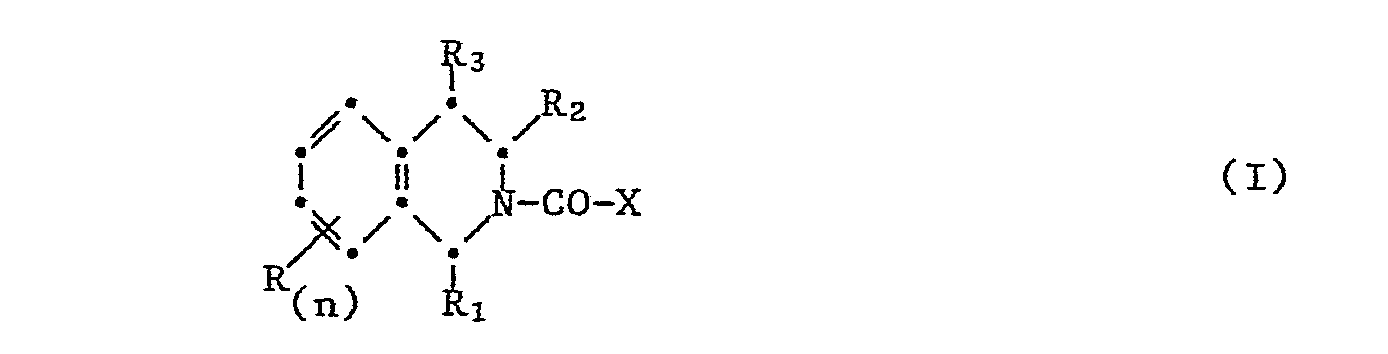
worin
R gleich oder verschieden Wasserstoff, Halogen, C1-C4-Alkyl, Cl-C4-Alkoxy, C1-C4-Alkylthio, Halogenalkyl, Halogenalkoxy, Alkenyloxy, Alkinyloxy, Dioxymethylen oder Nitro,
n = eine Zahl 1, 2 oder 3,
R1, R2 und R3 je Wasserstoff, C1-C6-Alkyl oder C3-C6-Alkenyl und X C1-C6-Halogenalkyl oder C2-C6-Halogenalkenyl bedeuten,
mit der Massgabe, dass folgende Verbindungen nicht mit umfasst sind:
2-Dichloracetyl-1,2,3,4-tetrahydroisochinolin,
2-Dichloraeetyl-1-methyl-1,2,3,4-tetrahydroisochinolin,
2-Dichloracetyl-1-aethyl-1,2,3,4-tetrahydroisochinolin,
2-Dichloracetyl-1-isopropyl-1,2,3,4-tetrahydroisochinolin,
2-Dichloracetyl-1,3-dimethyl-1,2,3,4-tetrahydroisochinolin,
2-Dichloracetyl-6,7-dimethoxy-1,2,3,4-tetrahydroisochinolin,
2-Dichloracetyl-3-ethyl-1,2,3,4-tetrahydroisochinolin
und
2-Dichloracetyl-4-ethyl-1,2,3,4-tetrahydroisochinolin, dadurch gekennzeichnet, dass man ein Acylderivat der Formel II

bzw. dessen Anhydrid, worin Q Chlor oder Brom oder den Rest -0-CO-X bedeutet und X die im Anspruch 1 gegebene Bedeutung haben, in einem inerten organischen Lösungsmittel, in Gegenwart der mindestens äquimolaren Menge eines säurebindenden Mittels, mit einem 1,2,3,4-Tetrahydroisochinolin der Formel III umsetzt

worin R(n), R1, R2, R3 wie zuvor definiert sind.
15. Verfahren zur Herstellung von 1,2,3,4-Tetrahydroisochinolinen der Formel I

worin
X CHC12 und
R gleich oder verschieden Wasserstoff, Halogen, C1-C4-Alkyl, C1-C4-Alkoxy, C1-C4-Alkylthio, Halogenalkyl, Halogenalkoxy, Alkenyloxy, Alkinyloxy, Dioxymethylen oder Nitro,
n = eine Zahl 1, 2 oder 3 und
R1, Rz und R3 je Wasserstoff, C1-C6-Alkyl oder C3-C6-Alkenyl bedeuten, dadurch gekennzeichnet, dass man ein 1,2,3,4-Tetrahydroisochinolin der Formel III

worin R(n), Rτ, R2 und R3 wie zuvor definiert sind, mit Choral oder einem durch Addition an dessen Oxogruppe gebildetem Chloralderivat in einem wässrigen Medium, und/oder einem polaren organischen Lösungsmittel, in Gegenwart säurebindender Mittel und der katalytisch wirkenden Menge eines anorganischen oder organischen Cyanides umsetzt.
16. Verwendung eines Mittels gemäss einem der Ansprüche 1 bis 13 zum Schützen von Kulturpflanzen gegen die phytotoxische Wirkung herbizider Halogenacetanilide.
17. Verfahren zur selektiven Bekämpfung von Unkräutern in Nutzpflanzenkulturen, dadurch gekennzeichnet, dass man die Kulturpflanzen oder deren Anbaufläche sowohl mit einem herbizid wirksamen Halogenacetanilid gemäss Anspruch 12 oder 13, als auch mit einer wirksamen Menge eines Acylamidderivates der Formel I gemäss einem der Ansprüche 1 bis 11 als Gegenmittel behandelt.
18. Verwendung der Acylamidderivate der Formel I gemäss Anspruch 16 zum Schützen von Mais gegen die schädigende Wirkung herbizid wirksamer Halogenacetanilide.
19. Verfahren zum Schützen von Kulturpflanzen von Schäden, die bei der Applikation von Halogenacetanilid Herbiziden gemäss Anspruch 12 oder 13 auftreten, dadurch gekennzeichnet, dass man entweder die Anbaufläche für die Pflanze vor oder während der Applikation des Herbizides oder den Samen oder die Stecklinge an Pflanzen, oder die Pflanze selbst mit einer wirksamen Menge eines Acylamidderivates der Formel I gemäss einem der Ansprüche 1 bis 11 bedeutet.
20. Saatgut von Nutzpflanzen, das mit einer antagonistisch wirksamen Menge eines Acylamidderivates der Formel 1 gemäss einem der Ansprüche 1 bis 11 behandelt worden ist.
Applications Claiming Priority (2)
| Application Number | Priority Date | Filing Date | Title |
|---|---|---|---|
| CH73686 | 1986-02-25 | ||
| CH736/86 | 1986-02-25 |
Publications (1)
| Publication Number | Publication Date |
|---|---|
| EP0236268A1 true EP0236268A1 (de) | 1987-09-09 |
Family
ID=4194003
Family Applications (1)
| Application Number | Title | Priority Date | Filing Date |
|---|---|---|---|
| EP87810097A Withdrawn EP0236268A1 (de) | 1986-02-25 | 1987-02-19 | Halogenacylierte Amine zum Schützen von Kulturpflanzen vor der phytotoxischen Wirkung von stark wirksamen Halogenacyl-Herbiziden |
Country Status (5)
| Country | Link |
|---|---|
| EP (1) | EP0236268A1 (de) |
| JP (1) | JPS62205061A (de) |
| BR (1) | BR8700875A (de) |
| IL (1) | IL81647A (de) |
| ZA (1) | ZA871318B (de) |
Cited By (1)
| Publication number | Priority date | Publication date | Assignee | Title |
|---|---|---|---|---|
| EP0407341A1 (de) * | 1989-07-05 | 1991-01-09 | Ciba-Geigy Ag | Selektiv-herbizides Mittel |
Citations (5)
| Publication number | Priority date | Publication date | Assignee | Title |
|---|---|---|---|---|
| FR2153002A1 (de) * | 1971-09-17 | 1973-04-27 | Gulf Research Development Co | |
| EP0006542A2 (de) * | 1978-06-28 | 1980-01-09 | Bayer Ag | Verwendung des N-Dichloracetyl-1,2,3,4-tetrahydroisochinolins als Gegenmittel zum Schutz von Kulturpflanzen vor Schädigungen durch herbizid-wirksame Acetanilide; die so erhaltenen Kombinationen und Verfahren zu deren Herstellung |
| EP0023307A1 (de) * | 1979-07-26 | 1981-02-04 | Bayer Ag | N-(Alpha-Chlorpropionyl)-1,2,3,4-tetrahydro-iso-chinolin, Verfahren zu dessen Herstellung und dessen Verwendung als Gegenmittel zum Schutz von Kulturpflanzen vor Schädigungen durch Herbizide |
| FR2564288A1 (fr) * | 1984-05-16 | 1985-11-22 | Bayer Ag | Utilisation d'amides pour ameliorer la tolerance par des plantes cultivees d'heteroaryloxyacetamides doues d'activite herbicide |
| EP0190105A2 (de) * | 1985-01-31 | 1986-08-06 | Ciba-Geigy Ag | Herbizides Mittel |
-
1987
- 1987-02-19 EP EP87810097A patent/EP0236268A1/de not_active Withdrawn
- 1987-02-23 IL IL81647A patent/IL81647A/xx unknown
- 1987-02-24 ZA ZA871318A patent/ZA871318B/xx unknown
- 1987-02-24 BR BR8700875A patent/BR8700875A/pt unknown
- 1987-02-25 JP JP62042449A patent/JPS62205061A/ja active Pending
Patent Citations (5)
| Publication number | Priority date | Publication date | Assignee | Title |
|---|---|---|---|---|
| FR2153002A1 (de) * | 1971-09-17 | 1973-04-27 | Gulf Research Development Co | |
| EP0006542A2 (de) * | 1978-06-28 | 1980-01-09 | Bayer Ag | Verwendung des N-Dichloracetyl-1,2,3,4-tetrahydroisochinolins als Gegenmittel zum Schutz von Kulturpflanzen vor Schädigungen durch herbizid-wirksame Acetanilide; die so erhaltenen Kombinationen und Verfahren zu deren Herstellung |
| EP0023307A1 (de) * | 1979-07-26 | 1981-02-04 | Bayer Ag | N-(Alpha-Chlorpropionyl)-1,2,3,4-tetrahydro-iso-chinolin, Verfahren zu dessen Herstellung und dessen Verwendung als Gegenmittel zum Schutz von Kulturpflanzen vor Schädigungen durch Herbizide |
| FR2564288A1 (fr) * | 1984-05-16 | 1985-11-22 | Bayer Ag | Utilisation d'amides pour ameliorer la tolerance par des plantes cultivees d'heteroaryloxyacetamides doues d'activite herbicide |
| EP0190105A2 (de) * | 1985-01-31 | 1986-08-06 | Ciba-Geigy Ag | Herbizides Mittel |
Non-Patent Citations (1)
| Title |
|---|
| CHEMICAL PATENTS INDEX, BASIC ABSTRACTS JOURNAL, Section C, AGDOC, week 8632, 1. Oktober 1986, Zusammenfassung Nr. 86-208 365, Derwent Publications, Ltd, London, GB * |
Cited By (1)
| Publication number | Priority date | Publication date | Assignee | Title |
|---|---|---|---|---|
| EP0407341A1 (de) * | 1989-07-05 | 1991-01-09 | Ciba-Geigy Ag | Selektiv-herbizides Mittel |
Also Published As
| Publication number | Publication date |
|---|---|
| IL81647A0 (en) | 1987-09-16 |
| ZA871318B (en) | 1987-10-28 |
| JPS62205061A (ja) | 1987-09-09 |
| IL81647A (en) | 1990-11-05 |
| BR8700875A (pt) | 1987-12-29 |
Similar Documents
| Publication | Publication Date | Title |
|---|---|---|
| EP0191736B1 (de) | Verwendung von Chinolinderivaten zum Schützen von Kulturpflanzen | |
| EP0094349B1 (de) | Verwendung von Chinolinderivaten zum Schützen von Kulturpflanzen | |
| EP0094348B1 (de) | Neue Oximäther, Verfahren zu ihrer Herstellungs, Mittel die die neuen Oximäther enthalten und ihre Verwendung | |
| DE3875556T2 (de) | 5-heterocyclisch substituierte oxazolidin-halogenacetamide. | |
| EP0055693A1 (de) | Verwendung von Phenylpyrimidinen als Gegenmittel zum Schützen von Kulturpflanzen vor durch Herbizide verursachte phytotoxische Schäden | |
| EP0086750A2 (de) | Verwendung von Chinolinderivaten zum Schützen von Kulturpflanzen | |
| EP0002180A1 (de) | Substituierte 3-Aminopyrazole, diese enthaltende Herbizide und Verfahren zur Bekämpfung unerwünschten Pflanzenwuchses | |
| EP0096657A2 (de) | 2-Phenyl-, 2-Naphthyl- und 2-Heterocyclylpyrimidine als Gegenmittel zum Schützen von Kulturpflanzen vor durch Herbizide verursachte phytotoxische Schäden | |
| EP0003805B1 (de) | Pyridazonverbindungen und diese enthaltende herbizide Zusammensetzungen | |
| EP0149974B1 (de) | Mittel zum Schützen von Kulturpflanzen vor der phytotoxischen Wirkung von Herbiziden | |
| EP0207894A1 (de) | Herbizid wirkende Derivate des N-Phenyl-3,4,5,6-tetrahydrophthalsäureimides | |
| EP0159287B1 (de) | Verwendung von Chinolinderivaten zum Schützen von Kulturpflanzen | |
| EP0138773B1 (de) | Verwendung von Chinolinderivaten zum Schützen von Kulturpflanzen | |
| EP0112280B1 (de) | 2-Aryl-4,6-dihalogenpyrimidine als Gegenmittel zum Schützen von Kulturpflanzen vor durch Herbizide verursachten phytotoxischen Schäden | |
| US5028256A (en) | Composition for protecting culture plants from the phytotoxic action of herbicidally active chloracetanilides | |
| EP0310555B1 (de) | 1,5-Diphenyl-1,2,4,-triazol-3-carbonsäurederivate zum Schutz von Kulturpflanzen vor der phytotoxischen Wirkung von Herbiziden | |
| EP0397602A1 (de) | Neue N-Phenylpyrrolidine | |
| EP0305332A2 (de) | Imidazol-Derivate | |
| EP0122231A2 (de) | Herbizides Mittel | |
| EP0163607B1 (de) | Mittel zum Schützen von Kulturpflanzen vor der phytotoxischen Wirkung von herbizid wirksamen Chloracetaniliden | |
| EP0094351B1 (de) | Cyclopropancarbonsäurederivate | |
| EP0098440B1 (de) | 3,7-Dichlor-chinolinderivate, Verfahren zu ihrer Herstellung und ihre Verwendung zur Bekämpfung unerwünschten Pflanzenwuchses | |
| EP0407341B1 (de) | Selektiv-herbizides Mittel | |
| EP0092517B1 (de) | Neue Oximäther, Verfahren zu ihrer Herstellung, Mittel die die neuen Oximäther enthalten und ihre Verwendung | |
| CH664565A5 (de) | Mittel zum schuetzen von kulturpflanzen vor der phytotoxischen wirkung von herbizid wirksamen chloracetaniliden. |
Legal Events
| Date | Code | Title | Description |
|---|---|---|---|
| PUAI | Public reference made under article 153(3) epc to a published international application that has entered the european phase |
Free format text: ORIGINAL CODE: 0009012 |
|
| 17P | Request for examination filed |
Effective date: 19870221 |
|
| AK | Designated contracting states |
Kind code of ref document: A1 Designated state(s): AT BE CH DE ES FR GB GR IT LI NL SE |
|
| 17Q | First examination report despatched |
Effective date: 19880818 |
|
| STAA | Information on the status of an ep patent application or granted ep patent |
Free format text: STATUS: THE APPLICATION IS DEEMED TO BE WITHDRAWN |
|
| 18D | Application deemed to be withdrawn |
Effective date: 19890301 |
|
| RIN1 | Information on inventor provided before grant (corrected) |
Inventor name: MARTIN, HENRY, DR. |