EP0237176A2 - Verbinder mit Leiterbahnen mit kleinem Abstand - Google Patents
Verbinder mit Leiterbahnen mit kleinem Abstand Download PDFInfo
- Publication number
- EP0237176A2 EP0237176A2 EP87301030A EP87301030A EP0237176A2 EP 0237176 A2 EP0237176 A2 EP 0237176A2 EP 87301030 A EP87301030 A EP 87301030A EP 87301030 A EP87301030 A EP 87301030A EP 0237176 A2 EP0237176 A2 EP 0237176A2
- Authority
- EP
- European Patent Office
- Prior art keywords
- conductive
- connector
- conductive passages
- adhesive
- passages
- Prior art date
- Legal status (The legal status is an assumption and is not a legal conclusion. Google has not performed a legal analysis and makes no representation as to the accuracy of the status listed.)
- Withdrawn
Links
Images


Classifications
-
- H—ELECTRICITY
- H05—ELECTRIC TECHNIQUES NOT OTHERWISE PROVIDED FOR
- H05K—PRINTED CIRCUITS; CASINGS OR CONSTRUCTIONAL DETAILS OF ELECTRIC APPARATUS; MANUFACTURE OF ASSEMBLAGES OF ELECTRICAL COMPONENTS
- H05K3/00—Apparatus or processes for manufacturing printed circuits
- H05K3/36—Assembling printed circuits with other printed circuits
- H05K3/361—Assembling flexible printed circuits with other printed circuits
-
- H—ELECTRICITY
- H01—ELECTRIC ELEMENTS
- H01R—ELECTRICALLY-CONDUCTIVE CONNECTIONS; STRUCTURAL ASSOCIATIONS OF A PLURALITY OF MUTUALLY-INSULATED ELECTRICAL CONNECTING ELEMENTS; COUPLING DEVICES; CURRENT COLLECTORS
- H01R43/00—Apparatus or processes specially adapted for manufacturing, assembling, maintaining, or repairing of line connectors or current collectors or for joining electric conductors
- H01R43/007—Apparatus or processes specially adapted for manufacturing, assembling, maintaining, or repairing of line connectors or current collectors or for joining electric conductors for elastomeric connecting elements
-
- H—ELECTRICITY
- H05—ELECTRIC TECHNIQUES NOT OTHERWISE PROVIDED FOR
- H05K—PRINTED CIRCUITS; CASINGS OR CONSTRUCTIONAL DETAILS OF ELECTRIC APPARATUS; MANUFACTURE OF ASSEMBLAGES OF ELECTRICAL COMPONENTS
- H05K2201/00—Indexing scheme relating to printed circuits covered by H05K1/00
- H05K2201/09—Shape and layout
- H05K2201/09209—Shape and layout details of conductors
- H05K2201/09654—Shape and layout details of conductors covering at least two types of conductors provided for in H05K2201/09218 - H05K2201/095
- H05K2201/097—Alternating conductors, e.g. alternating different shaped pads, twisted pairs; Alternating components
-
- H—ELECTRICITY
- H05—ELECTRIC TECHNIQUES NOT OTHERWISE PROVIDED FOR
- H05K—PRINTED CIRCUITS; CASINGS OR CONSTRUCTIONAL DETAILS OF ELECTRIC APPARATUS; MANUFACTURE OF ASSEMBLAGES OF ELECTRICAL COMPONENTS
- H05K2201/00—Indexing scheme relating to printed circuits covered by H05K1/00
- H05K2201/10—Details of components or other objects attached to or integrated in a printed circuit board
- H05K2201/10613—Details of electrical connections of non-printed components, e.g. special leads
- H05K2201/10954—Other details of electrical connections
- H05K2201/10977—Encapsulated connections
-
- H—ELECTRICITY
- H05—ELECTRIC TECHNIQUES NOT OTHERWISE PROVIDED FOR
- H05K—PRINTED CIRCUITS; CASINGS OR CONSTRUCTIONAL DETAILS OF ELECTRIC APPARATUS; MANUFACTURE OF ASSEMBLAGES OF ELECTRICAL COMPONENTS
- H05K2203/00—Indexing scheme relating to apparatus or processes for manufacturing printed circuits covered by H05K3/00
- H05K2203/11—Treatments characterised by their effect, e.g. heating, cooling, roughening
- H05K2203/1189—Pressing leads, bumps or a die through an insulating layer
-
- H—ELECTRICITY
- H05—ELECTRIC TECHNIQUES NOT OTHERWISE PROVIDED FOR
- H05K—PRINTED CIRCUITS; CASINGS OR CONSTRUCTIONAL DETAILS OF ELECTRIC APPARATUS; MANUFACTURE OF ASSEMBLAGES OF ELECTRICAL COMPONENTS
- H05K3/00—Apparatus or processes for manufacturing printed circuits
- H05K3/30—Assembling printed circuits with electric components, e.g. with resistors
- H05K3/303—Assembling printed circuits with electric components, e.g. with resistors with surface mounted components
- H05K3/305—Affixing by adhesive
Definitions
- This invention relates to connectors which provide electrical continuity between members facing each other such as connection between large scale integrated circuits (LSI) and printed circuit boards or between electrical circuits and lead wires. This invention also relates to a method of making electrical connection with electrical connectors of the invention.
- LSI large scale integrated circuits
- electrical connection between members facing each other is made by soldering or by using a conductive adhesive sheet (Refer to Japanese Patent Kokai Laid-Open Publn. 21192/'76) made by forming conductive layer of thickness equal to the diameter of conductive particles (4') dispersed in insulative resin (1') as illustrated in Fig. 5, or by using laminated connectors sliced into desired thickness as illustrated in Fig. 6, made by alternately laminating the layer of conductive material 4" having carbon particles dispersed in organic binder and the insulative layer 1" mainly composed of organic binder (Refer to Japanese Patent Kokai Laid-Open Publn. 141807/'82).
- a flexible connector comprising an adhesive resin containing conductive particles on the plurality of linear or belt type conductive passages formed on the substrate is disclosed by Japanese Patent Kokai (Laid-Open Publn) 154778/'83.
- electrical connection is made simply by applying heat and pressure on the connector placed on facing members.
- the conductive adhesive sheet made of forming a conductive layer of thickness roughly equal to the diameter of the conductive particles (4') shown in F ig. 5 distributed over the insulative resin (1') has the following drawbacks.
- the laminated connector illustrated in Fig. 6 is made by alternately laminating layers of conductive (4") having the carbon particles scattered over the organic binder and the insulative layer 1" and sliced to the desired thickness requires an added process of slicing after laminating the conductors and insulators, though this process produces conductive layer of uniform thickness. Moreover, a mechanical connecting tool, such as a clip, is needed to connect the facing members making it difficult to make the connector compact. The application may be limited to liquid crystal display and the like since electrical continuity is obtained through conductive particles, such as carbon particles, which increases resistance.
- the flexible connector described in Japanese patent Kokai Laid-Open Publn. 154778/'83 has limited width and pitches of the conductive passages due to manufacturing convenience and connectors with fine pitches can not be made. Since the conductive particles are not fixed on the conductive passages, the adhesive containing conductive particles is likely to shift positions during bonding operation with heat and pressure, causing short-circuit of adjacent terminals.
- the present invention solves the above problems of the prior art methods and provides a low-resistance connector with a high reliability for connecting members having fine pitched conductive passages.
- the present invention provides a connector comprising conductive passages which are at least partially of 0.5 mm or less in width, the fine pitched conductive passages formed on a base film and coated by a substantially insulative adhesive melting at lower temperatures than that of the base film.
- the conductive passages preferably contain fine convexes and concaves on their surfaces and preferably are made of a metallic material.
- the present invention also provides a method for making electrical connection by heating and pressing two pairs of diametically opposed connectors of the present invention by use of substantially insulative adhesive by providing the adhesive between diametrically opposed conductors.
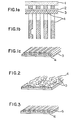
- the present invention is described by referring to Figures 1,(a), (b) and (c).
- the invention provides a connector having conductive passages (4) of at least partially 0.5 mm or less wide, made of fine pitched conductive passages formed on the base-film (3) through adhesive (2), and coated with substantially insulative adhesive (1) which is melted at temperatures lower than that required to melt the base-film (3).
- the conductive passages (4) of the invention must be at least partially 0.5 mm or less wide. Accordingly in bonding LSI to printed circuit boards, bonding pressure must be maintained at several hundred kg/cm 2 or less which requires the conductive passages to be at least partially of 0.5 mm wide or less.
- the width of the passage (4) may exceed 0.5 mm if auxiliary structures (5) of partially 0.5 mm wide portions are provided on both sides of the passage (4).
- the conductive passages (4) may have minute convexes and concaves (6) as shown in Fig. 3 or the conductive passages (4) as shown in Fig. 4 may preferably have a pointed end (7) to provide a stabilized connection at lower bonding pressure.
- the connector of the invention may be manufactured by laminating metal foil on polyester film used for flexible printed circuit board and by providing the conductive passages by etching and by covering them with insulative adhesive or laminating the adhesive over them.
- the conductive passages of this invention may be made of copper wires, stainless steel wires or nickel wires.
- Polyester may be preferred since it is inexpensive and flexible at bonding temperatures.
- the adhesive layer of this invention may be made of any adhesives capable of bonding the passages and members including insulative adhesives of pressure sensitive, heat sensitive, photo-hardening and electron beam hardening types. These include numerous resins of rubber, polyester, polyamide, poly (meta) acryl, ethylenevinyl acetate, polyamide-phenol, polyamide-epoxy, terpene and aliphatic groups. These resins may contain tackifier or non-conductive particles.
- the thickness of the insulative adhesive of this invention is not particularly limited but the preferred thickness may be: or less Where: H is the thickness of conductive passage,
- the connector of this invention is bonded to members by applying heat and pressure on the bonded side of the connector (A) and the terminal 8 of the members (B) to form the highly reliable conductive passages as illustrated in Fig. 7.
- One example of effective application of this invention is to flexible printing circuit board.
- Many kinds of parts of other circuit boards may be bonded with heat and pressure through adhesive films of the terminals of parts to be mounted on flexible printing or other circuit boards are designated at least partially 0.5 mm or less wide. Mounting of parts or bonding to other circuit boards may be made easier if adhesive films are formed in advance over the entire surface or terminals of flexible circuit board.
- connectors are bonded using Teflon adhesive tape (No. 61 Scotch Tape made by Sumitomo 3M) pasted on metallic head of 6 mm wide.
- the bonding temperatures are measured on the surface of the bonding head.
- the tape connector of the invention was made by laminating polyester adhesive film (K-1294, T oray) after applying ordinary etching using positive type photo resist to copper/polyester film laminate on the market (Cu/PET of 35/25 ⁇ in thickness, made by Nikkan Kogyo, 10 T -25C11).
- a tape connector of the invention was made in the same manner as in Example 1 and was bonded to conductive glass (indiumtin) to obtain the mean resistance, the number of open terminals and short-circuit between adjacent terminals which are shown in Table 2.
- One side of a copper foil having a thickness of 20 microns was coated with polyester adhesive (K-1294, Toray) and the other side coated with positive type photo resist (OFPR RF 3FH315, Tokyo Oka Kogyo Co.) having a thickness of 3 microns.
- the resist surface is exposed to high pressure mercury lamp (JP-200, Oku Seisakusho) through positive film (Startaint 150 lines/inch, 70%, Sakurai Co., Ltd.) for 30 seconds and developed for one minute with 1% aq-NaOH solution at 25°C.
- the resist surface was then etched with 42% ferrous chloride solution. After removing residual resist by 3% NaOH, polyester adhesive was laminated on the copper foil to obtain the anisotropic conductive adhesive.
- the diameter of the copper particles of anisotropic conductive adhesive obtained in this method is 60 micron.
- the connector of the invention has a firm electrical connection even after a lapse of time while the anisotropic conductive adhesive compared showed open terminals and short circuits in addition to a high initial resistance and numerous open terminals were created after a lapse of time.
- Example 1 electrical continuity is not formed if the conductor on the tape connector is too wide.
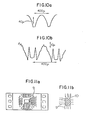
- This drawback is removed by the tape connector of the invention having minute auxiliary structures partially made on each conductor as illustrated in F ig. 8.
- (a) was 2.0 mm
- the tape connectors thus obtained are bonded to conductive glass and the results after a lapse of time under various conditions are shown in Table 3. No defective continuity (open terminals) was observed. In this case, the conductor on the tape connectors had been silver-plated in advance.
- the copper surface of copper/polyester laminate is sandblasted to surface coarseness of 3.45 ⁇ .
- Tape connector made of the copper/polyester laminate obtained was bonded to conductive glass. The resistances measured are shown in Table 4.
- a tape connector of the invention similar to that of Example 3 was made from a copper/polyester laminate of different thickness and bonded to conductive glass. The results are shown in Table 5. Resistance was somewhat higher but still well within the practical range obtained when the thickness of copper/PET is 35 to 50 p.
- Acrylic adhesive (W-248-E of Negami Kogyo Co., Ltd.) of 30 p and thickness had higher resistance than those of other thickness and open terminals were observed in case of 40 p thick adhesive.
- Polyester resin (K-1294, Toray Co., Ltd.) produced no open terminals but exhibited somewhat higher resistance in case of 40 p thickness than those of other thickness.
- Either resin of 20 p or less thickness has substantially low resistance.
- Tape connectors of the invention similar to that of Example 1 were made using polyester resin (K-1294, Toray Co., Ltd.), phenoxy resin (PKHH, Union Carbide) and Rubber resin (JA7413-R, Sumitomo 3M) as adhesives, and bonded to conductive glass at different temperatures. The results are shown in Table 7.
- the width of the conductive passage must be 0.5 mm or less, or preferably 0.4 mm or less to form stable continuity in case of a conductor with smooth surface.
Landscapes
- Engineering & Computer Science (AREA)
- Manufacturing & Machinery (AREA)
- Microelectronics & Electronic Packaging (AREA)
- Coupling Device And Connection With Printed Circuit (AREA)
- Adhesives Or Adhesive Processes (AREA)
Applications Claiming Priority (4)
| Application Number | Priority Date | Filing Date | Title |
|---|---|---|---|
| JP25347/86 | 1986-02-07 | ||
| JP2534786A JPS62184788A (ja) | 1986-02-07 | 1986-02-07 | 電気的導通の形成方法 |
| JP2534686A JPS62184785A (ja) | 1986-02-07 | 1986-02-07 | コネクタ |
| JP25346/86 | 1986-02-07 |
Publications (2)
| Publication Number | Publication Date |
|---|---|
| EP0237176A2 true EP0237176A2 (de) | 1987-09-16 |
| EP0237176A3 EP0237176A3 (de) | 1988-12-28 |
Family
ID=26362947
Family Applications (1)
| Application Number | Title | Priority Date | Filing Date |
|---|---|---|---|
| EP87301030A Withdrawn EP0237176A3 (de) | 1986-02-07 | 1987-02-05 | Verbinder mit Leiterbahnen mit kleinem Abstand |
Country Status (2)
| Country | Link |
|---|---|
| EP (1) | EP0237176A3 (de) |
| CA (1) | CA1271990A (de) |
Cited By (5)
| Publication number | Priority date | Publication date | Assignee | Title |
|---|---|---|---|---|
| GB2238432B (en) * | 1989-10-03 | 1994-07-13 | Nippon Graphite Ind Ltd | Method of producing electrically conductive anisotropic heat sealing connector members |
| WO2002020686A3 (en) * | 2000-09-08 | 2002-06-06 | 3M Innovative Properties Co | Thermocurable electroconductive adhesive sheet, connection structure and connection method using the same |
| US6908318B2 (en) | 2001-08-08 | 2005-06-21 | 3M Innovative Properties Company | Batch electrically connecting sheet |
| US20110005830A1 (en) * | 2008-03-19 | 2011-01-13 | Koninklijke Philips Electronics N.V. | Connector for establishing an electrical connection with conductive tape |
| EP2293460B1 (de) * | 2008-06-27 | 2019-06-12 | Teijin Limited | Blattstruktur für kommunikation |
Family Cites Families (5)
| Publication number | Priority date | Publication date | Assignee | Title |
|---|---|---|---|---|
| US4113981A (en) * | 1974-08-14 | 1978-09-12 | Kabushiki Kaisha Seikosha | Electrically conductive adhesive connecting arrays of conductors |
| CA1132213A (en) * | 1979-04-02 | 1982-09-21 | Matthew Pobog | Printed circuit board connector |
| JPS5670529A (en) * | 1979-11-14 | 1981-06-12 | Hitachi Ltd | Liquid crystal display unit |
| CA1217985A (en) * | 1981-12-28 | 1987-02-17 | Robert H. Stow | Hot-tackifying adhesive tape |
| DE3240407A1 (de) * | 1982-11-02 | 1984-05-03 | Vdo Adolf Schindling Ag, 6000 Frankfurt | Verbindungsanschluss |
-
1987
- 1987-02-05 EP EP87301030A patent/EP0237176A3/de not_active Withdrawn
- 1987-02-06 CA CA000529180A patent/CA1271990A/en not_active Expired
Cited By (6)
| Publication number | Priority date | Publication date | Assignee | Title |
|---|---|---|---|---|
| GB2238432B (en) * | 1989-10-03 | 1994-07-13 | Nippon Graphite Ind Ltd | Method of producing electrically conductive anisotropic heat sealing connector members |
| WO2002020686A3 (en) * | 2000-09-08 | 2002-06-06 | 3M Innovative Properties Co | Thermocurable electroconductive adhesive sheet, connection structure and connection method using the same |
| US6908318B2 (en) | 2001-08-08 | 2005-06-21 | 3M Innovative Properties Company | Batch electrically connecting sheet |
| US20110005830A1 (en) * | 2008-03-19 | 2011-01-13 | Koninklijke Philips Electronics N.V. | Connector for establishing an electrical connection with conductive tape |
| US8492653B2 (en) * | 2008-03-19 | 2013-07-23 | Koninklijke Philips Electronics N.V. | Connector for establishing an electrical connection with conductive tape |
| EP2293460B1 (de) * | 2008-06-27 | 2019-06-12 | Teijin Limited | Blattstruktur für kommunikation |
Also Published As
| Publication number | Publication date |
|---|---|
| CA1271990A (en) | 1990-07-24 |
| EP0237176A3 (de) | 1988-12-28 |
Similar Documents
| Publication | Publication Date | Title |
|---|---|---|
| US4814040A (en) | Method of connecting electronic element to base plate | |
| US4588456A (en) | Method of making adhesive electrical interconnecting means | |
| US4642421A (en) | Adhesive electrical interconnecting means | |
| EP0490530A2 (de) | Biegsame Leiterplatte | |
| JP2000195339A (ja) | 異方導電性接着フィルム | |
| WO1986002231A1 (en) | Electrical interconnection means | |
| WO1986006551A1 (en) | Flexible electrical jumper cable and assembly | |
| EP0232127A2 (de) | Anisotroper, elektrisch leitender Filmverbinder | |
| US8546696B2 (en) | Printed circuit board and method for manufacturing the same | |
| JPH07157720A (ja) | 異方導電フィルム | |
| CA1271990A (en) | Connector with fine-pitched conductive passages | |
| US20030199180A1 (en) | Connector integrated with a LED element, method for manufacturing the same, and a LED including the same connector | |
| KR830001556B1 (ko) | 접착테이프식 전기접속자 | |
| US20050233620A1 (en) | Anisotropic conductive sheet and its manufacturing method | |
| JP2001052780A (ja) | 電気コネクタおよびその製造方法 | |
| KR920005071B1 (ko) | 배선기판 | |
| JP5082296B2 (ja) | 配線付き接着剤及び回路接続構造 | |
| JPH0311061B2 (de) | ||
| JP3463539B2 (ja) | 異方導電性接着剤付き可撓性回路基板および製造方法 | |
| JP2003287766A (ja) | 液晶表示装置 | |
| JP3944794B2 (ja) | 回路の接続構造 | |
| JP2762813B2 (ja) | 半導体チップの接続方法 | |
| EP0303384A2 (de) | Biegsames Verbindungsband | |
| JPH0736348B2 (ja) | 低ピッチヒートシールコネクターとその製造方法 | |
| JPS62184785A (ja) | コネクタ |
Legal Events
| Date | Code | Title | Description |
|---|---|---|---|
| PUAI | Public reference made under article 153(3) epc to a published international application that has entered the european phase |
Free format text: ORIGINAL CODE: 0009012 |
|
| AK | Designated contracting states |
Kind code of ref document: A2 Designated state(s): DE ES FR GB IT NL SE |
|
| PUAL | Search report despatched |
Free format text: ORIGINAL CODE: 0009013 |
|
| AK | Designated contracting states |
Kind code of ref document: A3 Designated state(s): DE ES FR GB IT NL SE |
|
| 17P | Request for examination filed |
Effective date: 19890613 |
|
| 17Q | First examination report despatched |
Effective date: 19910515 |
|
| STAA | Information on the status of an ep patent application or granted ep patent |
Free format text: STATUS: THE APPLICATION IS DEEMED TO BE WITHDRAWN |
|
| 18D | Application deemed to be withdrawn |
Effective date: 19910926 |
|
| RIN1 | Information on inventor provided before grant (corrected) |
Inventor name: KIMURA, NAOYAC/O MINNESOTA MINING AND Inventor name: EMORI, KENJIC/O MINNESOTA MINING AND Inventor name: HAGIWARA, YOSHICHIC/O MINNESOTA MINING AND Inventor name: KAWAMOTO, YOSHITAKAC/O MINNESOTA MINING AND Inventor name: HIRASAWA, YUJIC/O MINNESOTA MINING AND |