EP0237261A2 - Gesinterte Siliciumnitridkörper - Google Patents
Gesinterte Siliciumnitridkörper Download PDFInfo
- Publication number
- EP0237261A2 EP0237261A2 EP87301879A EP87301879A EP0237261A2 EP 0237261 A2 EP0237261 A2 EP 0237261A2 EP 87301879 A EP87301879 A EP 87301879A EP 87301879 A EP87301879 A EP 87301879A EP 0237261 A2 EP0237261 A2 EP 0237261A2
- Authority
- EP
- European Patent Office
- Prior art keywords
- silicon nitride
- nitride sintered
- sintered bodies
- phase
- sintered body
- Prior art date
- Legal status (The legal status is an assumption and is not a legal conclusion. Google has not performed a legal analysis and makes no representation as to the accuracy of the status listed.)
- Granted
Links
- 229910052581 Si3N4 Inorganic materials 0.000 title claims abstract description 80
- HQVNEWCFYHHQES-UHFFFAOYSA-N silicon nitride Chemical compound N12[Si]34N5[Si]62N3[Si]51N64 HQVNEWCFYHHQES-UHFFFAOYSA-N 0.000 title claims abstract description 58
- 239000013078 crystal Substances 0.000 claims abstract description 44
- VSIIXMUUUJUKCM-UHFFFAOYSA-D pentacalcium;fluoride;triphosphate Chemical group [F-].[Ca+2].[Ca+2].[Ca+2].[Ca+2].[Ca+2].[O-]P([O-])([O-])=O.[O-]P([O-])([O-])=O.[O-]P([O-])([O-])=O VSIIXMUUUJUKCM-UHFFFAOYSA-D 0.000 claims abstract description 21
- NWXHSRDXUJENGJ-UHFFFAOYSA-N calcium;magnesium;dioxido(oxo)silane Chemical group [Mg+2].[Ca+2].[O-][Si]([O-])=O.[O-][Si]([O-])=O NWXHSRDXUJENGJ-UHFFFAOYSA-N 0.000 claims abstract description 19
- 239000002245 particle Substances 0.000 claims description 15
- 229910052749 magnesium Inorganic materials 0.000 claims description 11
- 229910052742 iron Inorganic materials 0.000 claims description 10
- 229910052782 aluminium Inorganic materials 0.000 claims description 8
- 229910052909 inorganic silicate Inorganic materials 0.000 claims description 8
- 229910052760 oxygen Inorganic materials 0.000 claims description 8
- 229910052710 silicon Inorganic materials 0.000 claims description 8
- 229910052727 yttrium Inorganic materials 0.000 claims description 7
- 229910052759 nickel Inorganic materials 0.000 claims description 6
- 229910052761 rare earth metal Inorganic materials 0.000 claims description 6
- QVGXLLKOCUKJST-UHFFFAOYSA-N atomic oxygen Chemical compound [O] QVGXLLKOCUKJST-UHFFFAOYSA-N 0.000 claims description 4
- 229910052751 metal Inorganic materials 0.000 claims description 4
- 239000001301 oxygen Substances 0.000 claims description 4
- 239000002184 metal Substances 0.000 claims description 3
- 150000002739 metals Chemical class 0.000 claims 1
- 230000003068 static effect Effects 0.000 abstract description 17
- 239000012071 phase Substances 0.000 description 61
- 239000011521 glass Substances 0.000 description 17
- 238000010304 firing Methods 0.000 description 13
- 239000000203 mixture Substances 0.000 description 12
- 238000000465 moulding Methods 0.000 description 11
- 239000000843 powder Substances 0.000 description 10
- 239000000654 additive Substances 0.000 description 8
- 238000000034 method Methods 0.000 description 8
- 238000002441 X-ray diffraction Methods 0.000 description 5
- 230000000996 additive effect Effects 0.000 description 5
- 238000001816 cooling Methods 0.000 description 5
- 238000013001 point bending Methods 0.000 description 5
- 239000002994 raw material Substances 0.000 description 5
- 238000003303 reheating Methods 0.000 description 5
- 239000012298 atmosphere Substances 0.000 description 4
- 230000000052 comparative effect Effects 0.000 description 4
- 239000000463 material Substances 0.000 description 4
- 230000008569 process Effects 0.000 description 4
- 238000003801 milling Methods 0.000 description 3
- 230000003647 oxidation Effects 0.000 description 3
- 238000007254 oxidation reaction Methods 0.000 description 3
- 239000000126 substance Substances 0.000 description 3
- 229910016523 CuKa Inorganic materials 0.000 description 2
- MCMNRKCIXSYSNV-UHFFFAOYSA-N Zirconium dioxide Chemical compound O=[Zr]=O MCMNRKCIXSYSNV-UHFFFAOYSA-N 0.000 description 2
- 238000005452 bending Methods 0.000 description 2
- 239000000919 ceramic Substances 0.000 description 2
- 229910052637 diopside Inorganic materials 0.000 description 2
- 230000002706 hydrostatic effect Effects 0.000 description 2
- 150000002500 ions Chemical class 0.000 description 2
- 238000005259 measurement Methods 0.000 description 2
- 238000002156 mixing Methods 0.000 description 2
- 230000001590 oxidative effect Effects 0.000 description 2
- 238000005245 sintering Methods 0.000 description 2
- 239000006104 solid solution Substances 0.000 description 2
- XLYOFNOQVPJJNP-UHFFFAOYSA-N water Substances O XLYOFNOQVPJJNP-UHFFFAOYSA-N 0.000 description 2
- 239000004677 Nylon Substances 0.000 description 1
- 238000004458 analytical method Methods 0.000 description 1
- 230000007797 corrosion Effects 0.000 description 1
- 238000005260 corrosion Methods 0.000 description 1
- 238000002425 crystallisation Methods 0.000 description 1
- 230000008025 crystallization Effects 0.000 description 1
- 230000007547 defect Effects 0.000 description 1
- 238000010586 diagram Methods 0.000 description 1
- 230000003467 diminishing effect Effects 0.000 description 1
- 230000008020 evaporation Effects 0.000 description 1
- 238000001704 evaporation Methods 0.000 description 1
- 239000007789 gas Substances 0.000 description 1
- 230000006872 improvement Effects 0.000 description 1
- 239000012535 impurity Substances 0.000 description 1
- 239000004615 ingredient Substances 0.000 description 1
- 238000001746 injection moulding Methods 0.000 description 1
- 229910052500 inorganic mineral Inorganic materials 0.000 description 1
- 230000003993 interaction Effects 0.000 description 1
- 239000007791 liquid phase Substances 0.000 description 1
- 238000004519 manufacturing process Methods 0.000 description 1
- 239000007769 metal material Substances 0.000 description 1
- 239000011707 mineral Substances 0.000 description 1
- 238000012986 modification Methods 0.000 description 1
- 230000004048 modification Effects 0.000 description 1
- 239000012299 nitrogen atmosphere Substances 0.000 description 1
- 229920001778 nylon Polymers 0.000 description 1
- 230000000704 physical effect Effects 0.000 description 1
- 229910001404 rare earth metal oxide Inorganic materials 0.000 description 1
- 239000011347 resin Substances 0.000 description 1
- 229920005989 resin Polymers 0.000 description 1
- 230000035939 shock Effects 0.000 description 1
- 239000007790 solid phase Substances 0.000 description 1
- 239000007858 starting material Substances 0.000 description 1
- 238000010998 test method Methods 0.000 description 1
- 238000011282 treatment Methods 0.000 description 1
Images
Classifications
-
- C—CHEMISTRY; METALLURGY
- C04—CEMENTS; CONCRETE; ARTIFICIAL STONE; CERAMICS; REFRACTORIES
- C04B—LIME, MAGNESIA; SLAG; CEMENTS; COMPOSITIONS THEREOF, e.g. MORTARS, CONCRETE OR LIKE BUILDING MATERIALS; ARTIFICIAL STONE; CERAMICS; REFRACTORIES; TREATMENT OF NATURAL STONE
- C04B35/00—Shaped ceramic products characterised by their composition; Ceramics compositions; Processing powders of inorganic compounds preparatory to the manufacturing of ceramic products
- C04B35/515—Shaped ceramic products characterised by their composition; Ceramics compositions; Processing powders of inorganic compounds preparatory to the manufacturing of ceramic products based on non-oxide ceramics
- C04B35/58—Shaped ceramic products characterised by their composition; Ceramics compositions; Processing powders of inorganic compounds preparatory to the manufacturing of ceramic products based on non-oxide ceramics based on borides, nitrides, i.e. nitrides, oxynitrides, carbonitrides or oxycarbonitrides or silicides
- C04B35/584—Shaped ceramic products characterised by their composition; Ceramics compositions; Processing powders of inorganic compounds preparatory to the manufacturing of ceramic products based on non-oxide ceramics based on borides, nitrides, i.e. nitrides, oxynitrides, carbonitrides or oxycarbonitrides or silicides based on silicon nitride
Definitions
- the present invention relates to high density silicon nitride sintered bodies having excellent mechanical strength and oxidation resistance.
- silicon nitride sintered bodies are more excellent in terms of mechanical strength at high temperatures, thermal resistance, thermal shock resistance and corrosion resistance than metallic materials, they have been examined for application as high temperature structural members for which the latter cannot be used, and uses of the former are actively being developed.
- Silicon nitride is a covalent substance, and therefore cannot be easily sintered through a solid phase. Thus, it is sintered through a liquid phase in which the silicon nitride is densified through production of a glass phase at a firing temperature under addition of Y 2 0 3 , A1 2 0 3 , MgO, Ce0 2 , Si0 2 , ZrO 2 , a rare earth oxide, AlN, or the like. For this reason, the silicon nitride sintered bodies thus obtained each contain a large amount of the glass phase produced in the grain boundaries during firing. Thus, when a use temperature is high, the intergranular glass phase is softened so that the mechanical strength and the oxidation resistance are lowered, while the characteristics of static fatigue due to creep deformation and creep rupture are deteriorated.
- Japanese patent application Laid-open No. 55-3,397 discloses silicon nitride sintered bodies which are fired with addition of Y 2 0 3 and Si0 2 and contain a crystalline phase consisting of Y 2 O 3 ⁇ 2SiO 2 and 10Y 2 O 3 ⁇ 9SiO 2 ⁇ Si 3 N 4 at grain boundaries.
- Japanese patent application Laid-open No. 56-59,674 discloses silicon nitride sintered bodies which are fired with addition of Y 2 0 3 and contain xY 2 0 3 -ySi 3 N 4 crystalline phase in grain boundaries.
- 59-8,670 discloses silicon nitride sintered bodies in which an intergranular phase is a mellilite mineral phase represented by (Si, Mg, Y) (O, N).
- Japanese patent publication No. 58-50,944 discloses a method of crystallizing Y 2 O 3 ⁇ Si 3 N 4 or Ce 2 0 3 -Si 3 N 4 in an intergranular phase by reheating a silicon nitride sintered body added with Y 2 0 3 or Ce0 2 .
- F.F. Lange “CERAMIC BULLETIN 62 (12) 1369-1374" shows that an intergranular phase is crystallized into Y 5 (Si0 4 ) 3 N crystals of an apatite structure.
- Each of the above silicon nitride sintered bodies having the intergranular crystalline phase has an improved high temperature strength.
- the grain boundaries are crystallized during a cooling step from a firing temperature or a reheating step in an inert atmosphere, the crystallized phase formed at the grain boundaries are not necessarily stable in an oxidative atmosphere as ordinary use conditions. Consequently, when they are used in the oxidative atmosphere, the crystalline phase varies and its volume locally changes, so that cracks are formed to greatly deteriorate mechanical strength and oxidation resistance.
- the silicon nitride sintered bodies in which a majority part of grain boundaries are made of a crystalline phase is free from creep deformation and creep rupture because softening of the intergranular glass phase under a static loading does not occur at high temperatures, they are statically fatigued, without being deformed, due to a subcritical crack growth in which initial stage defects granually progress. Then, they are fractured after a given time period even under a stress lower than that corresponding to an instant fracture strength such as a bending resistive strength, etc.
- This static fatigue characteristics can be evaluated based on a stress dependency of a time in which the silicon nitride is fractured.
- the subcritical crack growth causing the static fatigue is considered to be influenced by thermal and chemical stabilities and a mechanical strength of the intergranular phase, a stress developed in the microstructure during cooling from the firing temperature owing to a difference in thermal expansion between the intergranular phase and the Si 3 N 4 crystalline particles, adhesion between the intergranular phase and the Si 3 N 4 crystalline particles, a quality and an amount of the residual glass phase, etc.
- the silicon nitride sintered bodies having the crystallized intergranular phase has a shortcoming that its reliability as a material of parts to be used for a long time period under a stress is lowered due to a static fatigue fracture caused by this subcritical crack growth.
- the present invention seeks at least partly to solve the above-mentioned problems.
- the object of the present invention is to provide silicon nitride sintered bodies which will not fracture for a specific time period or forever at a temperature range of not more than 1,000°C under a static stress smaller than that corresponding to an instant fracture strength.
- the intergranular phase is substantially crystallized into diopside structure type crystals and apatite structure type crystals.
- the silicon nitride sintered bodies according to the present invention are characterized in that the intergranular phase is substantially crystallized into diopside structure type crystals and apatite structure type crystals.
- the diopside structure is a crystalline structure of a monoclinic system crystals represented by CaMgSi 2 O 6 .
- crystalographical positions of Ca are occupied by Ca, Y, a rare earth element, Mg, Fe, or Ni; crystallographical positions of Mg are occupied by Mg, Al, Fe, Ni, or Si; crystallographical positions of Si are occupied by Si, or Al; and crystallographical positions of 0 are occupied by O or N.
- the diopside structure type crystals may include Ca(Mg, Fe, Al) (Si, Al) 2 0 6 given in JCPDS card 25-1217 and crystals composed of the above various elements as well as solid solutions thereof.
- the apatite structure is a crystalline structure of hexagonal system crystals represented by Ca(Si0 4 ) 3 F.
- crystallographical positions of Ca are occupied by Ca, Y, a rare earth element, Mg, Fe, or Ni; the crystallographical positions of Si are occupied by Si, or Al; the crystallographical positions of 0 are occupied 0 or N; and the crystallographical portions of F are occupied by 0 or N.
- the apatite structure type crystals may include Ce 4.67 (SiO 4 ) 3 O shown in JCPDS card 30-336, Y 5 (Si0 4 ) 3 N shown in 30-1462, and (Y 4 Mg)(Si0 4 ) 3 0 shown in 20-1410 as well as crystals composed of the above various elements including their solid solutions.
- the silicon nitride sintered bodies according to the present invention have the intergranular phase which is crystallized into mixed crystals of the diopside structure type crystals and the apatite structure type crystals.
- the silicon nitride sintered bodies according to the present invention in which the intergranular phase is crystallized into mixed crystals of the diopside structure and the apatite structure have an improved static fatigue resistance and widen an acceptable composition range.
- the X-ray diffraction intensity ratio of the crystal of diopside structure to the crystal of apatite structure is more than 0.2, because of the improvement of static fatigue property.
- the silicon nitride sintered bodies according to the present invention are intended to be used for the high temperature structural members, they have such a high density and a high strength that preferably bulk density is not more than 3.1 g/cm3 and strength at both room temperature and at 1,200°C is not less than 600 MPa.
- the silicon nitride sintered bodies according to the present invention preferably contain not less than 70% by weight of Si 3 N 4 particles in which 70% by weight of the Si 3 N 4 particles are ⁇ -Si 3 N 4 needle-like particles.
- the intergranular phase of the Si 3 N 4 particles is crystallized into the diopside structure type crystals and the apatite structure type crystals.
- the intergranular phase of the silicon nitride sintered bodies is crystallized by firing and densifying a molding of a formulated Si 3 N 4 raw material powder added with a sintering aid and then crystallizing a glass phase present in the Si 3 N 4 particle intergranular phase during a cooling step in the firing or during a reheating step. Therefore, the phase crystallized in the intergranular phase of the silicon nitride sintered body varies depending upon the composition of the glass phase existing in the intergranular phase and the shape of the glass phase in the microstructure after the sintering, the interaction between the glass phase and the coexistent Si 3 N 4 particles, a crystallizing temperature, a temperature gradient, and a surrounding atmosphere.
- composition of the glass phase and the microstructure between the glass phase and the Si 3 N 4 particles vary depending upon Si 3 N 4 raw material, an additive composition, physical properties of additive ingredients, powder treatments such as mixing, milling, etc., a molding way, and a firing way.
- the crystalline phase crystallized in the intergranular phase of the silicon nitride sintered body conspicuously depends upon an amount of oxygen in the composition of the glass phase existing in the intergranular phase.
- the amount of oxygen contained in the silicon nitride sintered body is from 1.3 to 2.2 times in equivalent that of a metal element or elements other than Si contained in the sintered body.
- a composition including Ca, Y, a rare earth element, Mg, Fe, Ni and/or Al is formulated into an Si 3 N 4 raw material having an appropriate amount of 0, which is milled, mixed and/or heated to obtain a molding powder.
- an element having an ion radius being not less than 0.8 ⁇ , such as Ca, Y and a rare earth element is mixed into the Si 3 N 4 powder together with an element having an ion radius being 0.5 to 0.8 ⁇ , such as Mg, Fe, and Ni in combination.
- the thus formulated powder is next molded into a desired shape according to a dry type molding process, an injection molding process, a slip cast molding process, or the like, and fired in an N 2 atmosphere or the like under a normal pressure, an elevated pressure, a hot press, or a hot hydrostatic pressure to obtain a silicon nitride sintered body in which an intergranular phase is a glass phase.
- the firing conditions are selected so as to give the intended composition of the glass phase and the intended microstructure of the silicon nitride sintered body in which the silicon nitride is fully densified and the glass phase in the intergranular phase is to be crystallized into the diopside structure type crystals and the apatite structure type crystals.
- the glass phase in the intergranular phase is crystallized through temperature-maintaining during the cooling step in the firing or during reheating.
- the maintained temperature in the cooling step or the reheating temperature is preferably from 800 to 1,400°C.
- the silicon nitride sintered body is once kept at a nualeus- producing temperature which is relatively low and then maintained again at a crystal-growing temperature which is relatively high.
- the silicon nitride sintered bodies according to the present invention are silicon nitride sintered bodies in which the intergranular phase produced under controlled conditions is substantially. crystallized into the diopside structure type crystals and the apatite structure type crystals.
- a mixture of an Si 3 N 4 raw material powder containing 0.5 % by weight of metallic element impurities and 1.7% by weight of 0 and having the average particle size of 0.6 ⁇ m and a BET specific surface area of 22 m2/g and additives each having a purity of not less than 99%, the average particle size of 0.3 to 2 ⁇ m and a BET specific surface area of 6 to 32 m2/g in Table 1 were formulated in recipes of Table 1, and milled in a nylon resin vessel having an inner volume of 1.2 liters for 10 hours by using a vibration mill at a vibration frequency of 1,200/min. with addition of 500 ml of water and 1.2 kg of silicon nitride magnetic media per 200 g of the formulated mixture.
- Example 1-6 were obtained by using the same materials, formulating them with an additive or additives at a formulating recipe in Table 1, equally milling, granulating, and molding the resulting mixture, and firing and crystallizing the molding under the firing and crystallizing conditions shown in Table 1.
- Chemical analysis revealed that the metallic components of the sintered bodies (Examples 1-8 and Comparative Examples 1-6) were almost met with those of the formulated compositions, respectively.
- An amount of oxygen was also indicated in Table 1 as a number of times with respect to the other metallic components than Si in each of the sintered bodies.
- the bulk densities of the sintered bodies were measured according to Archimedean process.
- the four point bending strength was measured according to "fine ceramics bending strength test method" in JIS 1601.
- the static fatigue characteristics were measured based on whether a sample having the same dimension as in the four point bending strength measurement was fractured or not by employing the same method as in the four point bending strength measurement when a constant stress was given at 800°C for 500 hours.
- a deflected amount of the four point bending test sample was measured at that time to obtain a deformation amount at a tensile face thereof.
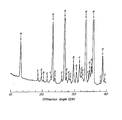
- the kind of the intergranular crystalline phase was determined based on results in an X-ray diffraction analysis using CuK a line.
- D, A, and M are the diopside structural type crystals, the apatite structure type crystals, and mellilite structure type crystals having the same crystalline structure as the triclinic system crystals of Y 2 O 3 ⁇ Si 3 n 4 shown in JCPDS card 28-1457, respectively, while K and X are-crystals having the same crystalline structure as that of the YSi0 2 N shown in JCPDS card 31-1462 and crystals having other crystalline structure than those of D, A, M and K, respectively.
- the silicon nitride sintered bodies according to the present invention in which the intergranular phase is crystallized into the diopside structure type crystals and the apatite structure type crystals have high strength at room temperature and at high temperatures being not less than 520 MPa and extremely more excellent static fatigue characteristics at 800°C as compared with the Comparative Examples, and are neither fractured or deformed under load of 450 MPa or a stress corresponding to not less than 60% of the strength at 800°C for 500 hours.
- the silicon nitride sintered bodies according to the present invention have excellent density and mechanical strength and extremely excellent static fatigue characteristics.
- the silicon nitride sintered bodies according to the present invention may be applied in a variety of uses, for instance, as mechanical structural materials for, such as, engine parts, gas turbine parts, etc.
- the silicon nitride sintered bodies according to the present invention have excellent static fatigue characteristics, reliability of the use life of the material can be largely improved so that the invention has the extremely great industrial values.
Landscapes
- Engineering & Computer Science (AREA)
- Chemical & Material Sciences (AREA)
- Ceramic Engineering (AREA)
- Manufacturing & Machinery (AREA)
- Materials Engineering (AREA)
- Structural Engineering (AREA)
- Organic Chemistry (AREA)
- Ceramic Products (AREA)
Applications Claiming Priority (2)
| Application Number | Priority Date | Filing Date | Title |
|---|---|---|---|
| JP47410/86 | 1986-03-06 | ||
| JP61047410A JPS62207765A (ja) | 1986-03-06 | 1986-03-06 | 窒化珪素焼結体 |
Publications (3)
| Publication Number | Publication Date |
|---|---|
| EP0237261A2 true EP0237261A2 (de) | 1987-09-16 |
| EP0237261A3 EP0237261A3 (en) | 1987-12-09 |
| EP0237261B1 EP0237261B1 (de) | 1990-06-06 |
Family
ID=12774355
Family Applications (1)
| Application Number | Title | Priority Date | Filing Date |
|---|---|---|---|
| EP87301879A Expired EP0237261B1 (de) | 1986-03-06 | 1987-03-04 | Gesinterte Siliciumnitridkörper |
Country Status (4)
| Country | Link |
|---|---|
| US (1) | US4830991A (de) |
| EP (1) | EP0237261B1 (de) |
| JP (1) | JPS62207765A (de) |
| DE (1) | DE3763067D1 (de) |
Cited By (3)
| Publication number | Priority date | Publication date | Assignee | Title |
|---|---|---|---|---|
| EP0361148A1 (de) * | 1988-09-10 | 1990-04-04 | Hoechst Aktiengesellschaft | Siliziumnitrid-Keramik und Verfahren zu ihrer Herstellung |
| EP0419757A1 (de) * | 1989-09-26 | 1991-04-03 | Rockwell International Corporation | Verfahren zum Spritzgiessen von keramischen Werkstoffen |
| US5188781A (en) * | 1988-09-10 | 1993-02-23 | Hoechst Aktiengesellschaft | Silicon nitride ceramic and a process for its preparation |
Families Citing this family (11)
| Publication number | Priority date | Publication date | Assignee | Title |
|---|---|---|---|---|
| JPH07115931B2 (ja) * | 1986-06-02 | 1995-12-13 | トヨタ自動車株式会社 | 窒化ケイ素焼結体の製造方法 |
| JP2512061B2 (ja) * | 1987-11-26 | 1996-07-03 | 日本碍子株式会社 | 均質窒化珪素焼結体およびその製造方法 |
| US5118645A (en) * | 1988-01-27 | 1992-06-02 | The Dow Chemical Company | Self-reinforced silicon nitride ceramic of high fracture toughness and a method of preparing the same |
| JP2524201B2 (ja) * | 1988-08-22 | 1996-08-14 | 日本特殊陶業株式会社 | 窒化珪素質焼結体及びその製造方法 |
| DE3840173A1 (de) * | 1988-11-29 | 1990-05-31 | Hoechst Ag | Siliciumnitridkeramik mit devitrifizierter integranularer glasphase und verfahren zu ihrer herstellung |
| US5316856A (en) * | 1988-12-03 | 1994-05-31 | Ngk Spark Plug Co., Ltd. | Silicon nitride base sintered body |
| DE3905271A1 (de) * | 1989-02-21 | 1990-08-23 | Hoechst Ag | Siliziumnitrid-keramik und verfahren zu ihrer herstellung |
| US5030599A (en) * | 1990-07-19 | 1991-07-09 | W. R. Grace & Co.-Conn. | Silicon nitride sintered materials |
| US5439853A (en) * | 1991-09-26 | 1995-08-08 | Omori; Mamoru | Mixed oxide composite ceramics and method of producing the same |
| JPH05148026A (ja) * | 1991-11-25 | 1993-06-15 | Sumitomo Electric Ind Ltd | 窒化ケイ素系焼結体 |
| JP2021147272A (ja) * | 2020-03-19 | 2021-09-27 | 株式会社東芝 | 構造体及び接合体 |
Family Cites Families (13)
| Publication number | Priority date | Publication date | Assignee | Title |
|---|---|---|---|---|
| US4046580A (en) * | 1974-06-28 | 1977-09-06 | Tokyo Shibaura Electric Co., Ltd. | Silicon nitride-based sintered material and method for manufacturing the same |
| US4102698A (en) * | 1976-11-23 | 1978-07-25 | Westinghouse Electric Corp. | Silicon nitride compositions in the Si3 N4 -Y2 O3 -SiO2 system |
| JPS53140310A (en) * | 1977-05-14 | 1978-12-07 | Toyoda Chuo Kenkyusho Kk | Manufacture of silicon nitride sintered articles |
| US4280850A (en) * | 1978-06-15 | 1981-07-28 | Gte Laboratories, Incorporated | S13N4 Having high temperature strength and method |
| CA1123862A (en) * | 1978-09-20 | 1982-05-18 | J. Thomas Smith | Oxidation resistant silicon nitride containing rare earth oxide |
| US4280973A (en) * | 1979-11-14 | 1981-07-28 | Ford Motor Company | Process for producing Si3 N4 base articles by the cold press sinter method |
| JPS5659674A (en) * | 1980-07-25 | 1981-05-23 | Tokyo Shibaura Electric Co | Silicon nitride refractory sintered body |
| JPS5850944A (ja) * | 1981-09-24 | 1983-03-25 | 株式会社島津製作所 | 超音波診断装置 |
| US4388414A (en) * | 1981-12-21 | 1983-06-14 | Ford Motor Company | Thermally stable silicon nitride material |
| JPS598670A (ja) * | 1982-07-02 | 1984-01-17 | 東芝タンガロイ株式会社 | 高靭性窒化硅素基焼結体 |
| EP0107919A1 (de) * | 1982-10-01 | 1984-05-09 | The British Ceramic Research Association Limited | Keramische Siliciumnitridkörper |
| JPS59146981A (ja) * | 1983-02-09 | 1984-08-23 | 日本碍子株式会社 | 窒化珪素焼結体およびその製造法 |
| ATE21096T1 (de) * | 1983-02-26 | 1986-08-15 | Lucas Cookson Syalon Limited | Keramisches siliciumaluminiumoxynitridprodukt und herstellungsverfahren. |
-
1986
- 1986-03-06 JP JP61047410A patent/JPS62207765A/ja active Granted
-
1987
- 1987-02-26 US US07/019,252 patent/US4830991A/en not_active Expired - Lifetime
- 1987-03-04 DE DE8787301879T patent/DE3763067D1/de not_active Expired - Fee Related
- 1987-03-04 EP EP87301879A patent/EP0237261B1/de not_active Expired
Non-Patent Citations (5)
| Title |
|---|
| AMERICAN CERAMIC SOCIETY BULLETIN, vol. 59, no. 2, February 1980, pages 239, 240, 249, Columbus, Ohio, US; F.F. LANGE "Si3N4-Ce203-Si02 materials: Phase relations and strength" * |
| AMERICAN CERAMIC SOCIETY BULLETIN, vol. 62, no. 12, December 1983, pages 1369-1374, Columbus, Ohio, US; F.F. LANGE "Fabrication and properties of dense polyphase silicon nitride" * |
| JOURNAL OF MATERIALS SCIENCE, vol. 20, no. 10, October 1985, pages 3545-3556, London, GB; L.K.L. FALK et al.: "Development of microstructure during the fabrication of Si3N4 by nitridation and pressureless sintering of Si:Si3N4 compacts" * |
| JOURNAL OF THE AMERICAN CERAMIC SOCIETY, vol. 63, no. 1-2, January-February 1980, pages 35-37, Columbus, Ohio, US; L.J. GAUCKLER et al.: "The System Si3N4-Si02-Y203" * |
| JOURNAL OF THE AMERICAN CERAMIC SOCIETY, vol. 68, no. 7, July 1985, pages 413-418, Columbus, Ohio, US; R.K. GOVILA et al.: "Fracture of Yttria-doped, sintered reaction-bonded silicon nitride" * |
Cited By (3)
| Publication number | Priority date | Publication date | Assignee | Title |
|---|---|---|---|---|
| EP0361148A1 (de) * | 1988-09-10 | 1990-04-04 | Hoechst Aktiengesellschaft | Siliziumnitrid-Keramik und Verfahren zu ihrer Herstellung |
| US5188781A (en) * | 1988-09-10 | 1993-02-23 | Hoechst Aktiengesellschaft | Silicon nitride ceramic and a process for its preparation |
| EP0419757A1 (de) * | 1989-09-26 | 1991-04-03 | Rockwell International Corporation | Verfahren zum Spritzgiessen von keramischen Werkstoffen |
Also Published As
| Publication number | Publication date |
|---|---|
| JPS62207765A (ja) | 1987-09-12 |
| US4830991A (en) | 1989-05-16 |
| DE3763067D1 (de) | 1990-07-12 |
| EP0237261A3 (en) | 1987-12-09 |
| EP0237261B1 (de) | 1990-06-06 |
| JPH0256311B2 (de) | 1990-11-29 |
Similar Documents
| Publication | Publication Date | Title |
|---|---|---|
| EP0174153B1 (de) | Siliziumnitridsinterkörper und Verfahren zu seiner Herstellung | |
| US5098449A (en) | Self-reinforced silicon nitride ceramic with crystalline grain boundary phase, and a method of preparing the same | |
| CA1131257A (en) | Si.sub.3n.sub.4 having high temperature strength and method | |
| US4506021A (en) | 0'-Phase sialon ceramic product and a method of forming dense ceramic product | |
| EP0237261B1 (de) | Gesinterte Siliciumnitridkörper | |
| US4511525A (en) | Process for producing sintered silicon nitride-base body | |
| EP0126820B1 (de) | Gesinterte Siliziumnitridformkörper und Verfahren zu ihrer Herstellung | |
| EP0202899B1 (de) | Siliziumnitridformkörper und Verfahren zu seiner Herstellung | |
| EP0589411A2 (de) | Siliciumnitrid-Sinterkörper und Verfahren zu seiner Herstellung | |
| EP0552381B1 (de) | Gesinterter siliciumnitridverbundkörper und seine herstellung | |
| US5846891A (en) | Thermal shock-resistant alumina-mullite composite material and preparation method thereof | |
| US5177038A (en) | Silicon nitride sintered bodies | |
| US5759933A (en) | Gas pressure sintered silicon nitride having high strength and stress rupture resistance | |
| US5494866A (en) | Stress-rupture resistant sintered silicon nitride | |
| US5118644A (en) | Thermal shock-resistant silicon nitride sintered material | |
| EP0572464B1 (de) | Selbstarmierte siliciumnitridkeramik mit kristalliner korngrenzenphase und verfahren zu ihrer herstellung | |
| US5238882A (en) | Method of manufacturing silicon nitride sintered bodies | |
| US5178809A (en) | Process for producing silicon nitride sintered material | |
| US5637540A (en) | Sintered silicon nitride of high toughness, strength and reliability | |
| EP0825162B1 (de) | Siliciumnitrid-Sinterwerkstoff und Verfahren zur Herstellung davon | |
| EP0636112B1 (de) | Gesintertes siliciumnitrid hoher zähigkeit, festigkeit und zuverlässigkeit | |
| KR100435292B1 (ko) | 고인성 산질화규소 요업체의 제조방법 | |
| KR19980072405A (ko) | 내열충격성 알루미나-물라이트 복합체 조성물 및 그 제조방법 | |
| WO1994025413A1 (en) | Silicon aluminium oxynitride materials |
Legal Events
| Date | Code | Title | Description |
|---|---|---|---|
| PUAI | Public reference made under article 153(3) epc to a published international application that has entered the european phase |
Free format text: ORIGINAL CODE: 0009012 |
|
| AK | Designated contracting states |
Kind code of ref document: A2 Designated state(s): DE GB SE |
|
| PUAL | Search report despatched |
Free format text: ORIGINAL CODE: 0009013 |
|
| AK | Designated contracting states |
Kind code of ref document: A3 Designated state(s): DE GB SE |
|
| 17P | Request for examination filed |
Effective date: 19880311 |
|
| 17Q | First examination report despatched |
Effective date: 19890505 |
|
| GRAA | (expected) grant |
Free format text: ORIGINAL CODE: 0009210 |
|
| AK | Designated contracting states |
Kind code of ref document: B1 Designated state(s): DE GB SE |
|
| REF | Corresponds to: |
Ref document number: 3763067 Country of ref document: DE Date of ref document: 19900712 |
|
| PLBE | No opposition filed within time limit |
Free format text: ORIGINAL CODE: 0009261 |
|
| STAA | Information on the status of an ep patent application or granted ep patent |
Free format text: STATUS: NO OPPOSITION FILED WITHIN TIME LIMIT |
|
| 26N | No opposition filed | ||
| EAL | Se: european patent in force in sweden |
Ref document number: 87301879.0 |
|
| REG | Reference to a national code |
Ref country code: GB Ref legal event code: IF02 |
|
| PGFP | Annual fee paid to national office [announced via postgrant information from national office to epo] |
Ref country code: GB Payment date: 20020222 Year of fee payment: 16 |
|
| PGFP | Annual fee paid to national office [announced via postgrant information from national office to epo] |
Ref country code: SE Payment date: 20020322 Year of fee payment: 16 |
|
| PGFP | Annual fee paid to national office [announced via postgrant information from national office to epo] |
Ref country code: DE Payment date: 20020527 Year of fee payment: 16 |
|
| PG25 | Lapsed in a contracting state [announced via postgrant information from national office to epo] |
Ref country code: GB Free format text: LAPSE BECAUSE OF NON-PAYMENT OF DUE FEES Effective date: 20030304 |
|
| PG25 | Lapsed in a contracting state [announced via postgrant information from national office to epo] |
Ref country code: SE Free format text: LAPSE BECAUSE OF NON-PAYMENT OF DUE FEES Effective date: 20030305 |
|
| PG25 | Lapsed in a contracting state [announced via postgrant information from national office to epo] |
Ref country code: DE Free format text: LAPSE BECAUSE OF NON-PAYMENT OF DUE FEES Effective date: 20031001 |
|
| GBPC | Gb: european patent ceased through non-payment of renewal fee | ||
| EUG | Se: european patent has lapsed |