EP0237263A2 - System zum Applizieren von Medikamenten durch die Haut - Google Patents
System zum Applizieren von Medikamenten durch die Haut Download PDFInfo
- Publication number
- EP0237263A2 EP0237263A2 EP87301887A EP87301887A EP0237263A2 EP 0237263 A2 EP0237263 A2 EP 0237263A2 EP 87301887 A EP87301887 A EP 87301887A EP 87301887 A EP87301887 A EP 87301887A EP 0237263 A2 EP0237263 A2 EP 0237263A2
- Authority
- EP
- European Patent Office
- Prior art keywords
- drug
- reservoir
- membrane
- delivery system
- layer
- Prior art date
- Legal status (The legal status is an assumption and is not a legal conclusion. Google has not performed a legal analysis and makes no representation as to the accuracy of the status listed.)
- Granted
Links
Images

Classifications
-
- A—HUMAN NECESSITIES
- A61—MEDICAL OR VETERINARY SCIENCE; HYGIENE
- A61K—PREPARATIONS FOR MEDICAL, DENTAL OR TOILETRY PURPOSES
- A61K9/00—Medicinal preparations characterised by special physical form
- A61K9/70—Web, sheet or filament bases ; Films; Fibres of the matrix type containing drug
- A61K9/7023—Transdermal patches and similar drug-containing composite devices, e.g. cataplasms
- A61K9/703—Transdermal patches and similar drug-containing composite devices, e.g. cataplasms characterised by shape or structure; Details concerning release liner or backing; Refillable patches; User-activated patches
- A61K9/7084—Transdermal patches having a drug layer or reservoir, and one or more separate drug-free skin-adhesive layers, e.g. between drug reservoir and skin, or surrounding the drug reservoir; Liquid-filled reservoir patches
Definitions
- the invention is concerned with a transdermal drug delivery system and most particularly with a system in which the drug in the drug reservoir is in a totally dissolved state.
- the structure of a transdermal bandage or device consists of (a) a transdermal delivery system comprising an impermeable backing, a drug-containing reservoir, a rate-controlling membrane on the side to be ultimately proximate to the skin of the patient and (b) a means of attaching the system to the dermal surface.
- the reservoir the source of supply for the drug, whether a single solid unit, a walled unit or a unit employing drug containing micro-capsules within the reservoir structure, contains the drug partly in particulate form and partly in solution i.e., contains drug in excess of its saturation solubility.
- the drug in solution migrates to the permeable membrane surface, passes through the membrane and onto the skin for absorption. As the dissolved drug passes through the membrane some of the undissolved drug dissolves and there is, until the supply of undissolved drug is exhausted, a mixture of both dissolved and undissolved drug in the reservoir.
- the presence of dissolved and undissolved drug is considered necessary to provide for the near zero order rate of delivery, zero order being the rate of delivery which is constant or independent of time. It has been found, however, that when certain drugs such as, for example, timolol, are employed in a unitary solid reservoir of dissolved and undissolved drug, the dissolved drug often slowly crystallizes subsequent to fabrication.
- the drug may be supplied in the reservoir in a completely dissolved form and still provide a bandage exhibiting substantially constant delivery rate during the time required to accomplish the desired therapy.
- a transdermal system suitable for use for all drugs but especially useful for those drugs whose properties render them unsuitable in the manufacture of bandages employing conventional delivery systems in which the drug is supplied as a mixture of undissolved and dissolved drug.
- the invention resides in the discovery that a substantially constant release of drug may be achieved from a reservoir in which the drug is completely in the dissolved form in a relatively simple transdermal delivery system of an impermeable backing layer, a drug reservoir layer, and a rate controlling membrane layer.
- a release profile indicating that a substantially constant release of drug for a period of time sufficient to be effectively utilized for therapeutic purposes was discovered and found to rest on certain relationships among diffusion coefficient of the drug in the reservoir, the reservoir thickness, the diffusion coefficient of the drug in the membrane, the membrane thickness, and the partition coefficient between the membrane and the reservoir.
- a transdermal system for administering drug for an extended period comprising (a) a backing layer substantially impermeable to the drug and forming the top or outer surface of a bandage employing the delivery system, (b) a reservoir layer comprising dissolved drug in a continuous matrix of carrier, and (c) a membrane layer comprising a structure exhibiting some rate controlling property, wherein the following relationships are satisfied simultaneously: and wherein h is membrane thickness K is partition coefficient of drug between membrane and reservoir D m is diffusion coefficient of drug in membrane x max is reservoir thickness D r is diffusion coefficient of drug in reservoir, T is the desired wear time of the bandage, ⁇ is a design parameter ranging from but not including 0 to but not including 1, and which represents the fractional drop in the theoretical flux from time zero to the end of the wear period T, ⁇ is a design parameter ranging from but not including 0 to and including 1, which allows adjustments to shape of release profile, initial concentration, C o , fraction of total drug depleted from the reservoir, h
- membrane layer comprising a structure exhibiting some rate controlling property is meant either a semipermeable membrane or a properly prepared microporous membrane through which rate control is obtained by the extent of diffusivity of the drug therein.
- ⁇ is a function of the therapeutic index of the drug.
- the preferred range for ⁇ is from 0.01 to 0.67, when substantially constant rate of release is desired.
- ⁇ is preferably lower than 0.3 with a preferred range from 0.3 down to 0.01.
- the value of design parameter, ⁇ is 1, while ⁇ ranges from 0.01 to 0.67, preferably from 0.01 to 0.3.
- the value of design parameter ⁇ is less than 1, while ⁇ remains in the range 0.01 to 0.67, preferably from 0.01 to 0.3.
- a suboptimal bandage design for a given delivery profile will result in a higher value for and a lower value for than a corresponding optimal patch design.
- Optimal conditions may not be the most desirable. For example, the efficiency may be so great that such a thin membrane is called for that from practical considerations such as handling during manufacture it would be less desirable.
- a suboptimal system uses a thinner reservoir than that called for by a corresponding optimal design and is desirable when a high fractional depletion of drug from the reservoir is sought.
- a suboptimal system is also desirable when the optimal system would call for a reservoir which would be so thick that it would be impractical for wearability.
- the present invention is not limited to any particular class of drugs.
- the drug to be employed should have a solubility of about 0.1 percent or greater in the reservoir material. It is especially useful for the more "potent" drugs, i.e., those to be administered at a daily dose of about 20 mg or less.
- classes of drugs for which the present invention is most useful include, tranquilizers, analgesics, antimigraine drugs, CNS active drugs, antihistamines, dopanergic drugs, anti-cholinergics, ⁇ -blockers, calcium entry blocker, anti-anginal drugs, and other cardiovascular drugs but are not limited thereto.
- FIG. 1 illustrates the basic and preferred structure of a transdermal bandage incorporating the transdermal delivery system, generally designated 10.
- the components are the backing layer 11, drug reservoir layer 12 consisting of drug 13 homogeneously distributed as a molecular solution in a continuous matrix 14, a membrane layer 15 coextensive with the drug reservoir layer and along the surface opposite that occupied by the backing layer and optionally, but preferably, an adhesive layer 16 along the opposite surface of the membrane layer as a means for affixing the bandage to the skin.
- the backing member is impermeable to the drug and prevents back diffusion of the drug into the environment.
- the backing member may be any of a number of impermeable materials taught in the transdermal bandage art. Suitable backing materials include polyethylene, polypropylene, polycarbonate, polyester, polyethylene terephthalate (PET), metal foils, and the like.
- the matrix may be solid, or if a wall structure is employed for the reservoir, it may be a gel. A solid reservoir is preferred.
- Materials for the continuous matrix of the reservoir layer, if solid, and for the membrane layer may be selected from a number of polymers.
- a particular polymer is not limited as being suitable only for the reservoir matrix or for membrane layer. The selection is dependent on the solubility and diffusivity of the particular drug in each polymer and the time during which an approximately constant release rate is sought.
- Suitable polymers for a solid matrix include silicones, acrylic adhesive resins, ethylene vinyl acetate copolymers, plasticized polyvinyl acetate/polyvinyl chloride resins, plasticized hydrolyzed polyvinyl alcohol, rubber-based adhesives such as polyisobutylenes extended with a solvent such as mineral oil, plasticized polyvinyl chloride, polyethylene glycols and polypropylene glycols of varying molecular weights, and cellulose esters. If the polymer selected is one which has adhesive properties it may serve the dual function of a rate controlling membrane of the transdermal system and an affixing adhesive when the transdermal system is part of a bandage.
- Hydrogel polymers which are useful as matrix polymers include poly(hydroxyalkyl methacrylate)s of which poly-(2-hydroxyethyl methacrylate), poly(glyceryl methacrylate) and poly(hydroxypropyl methacrylate) are well-known and identified in the literature as (P-HEMA), (P-GMA) and (P-(HPMA), respectively.
- Other hydrogel polymers include poly(acrylamide), poly(methacrylamide), poly(N-vinyl-2-pyrrolidine), and poly(vinyl alcohol), hydroxypropyl guar, high molecular weight polypropylene glycol or polyethylene glycol, and the like.
- Polymers which may be employed where the drug reservoir is in a walled structure include the foregoing hydrogel polymers extended with solvents such as propylene glycol, glycerine, low molecular weight polyethylene glycol and the like.
- the membrane which has rate-controlling properties may be a solid semi-permeable film of the materials above described but may also be a microporous membrane of material such as microporous polypropylene, polyethylene or polycarbonate. Other substantially impermeable materials such as those useful as backing materials may be made microporous by treatment known to those skilled in the art. If a microporous membrane is employed the pores must be at least ten times the molecular diameter of the drug and the pores must be filled with material which satisfies the requirements for K and D m . The drug should have essentially no solubility in or permeability through the material from which the microporous membrane is prepared.
- Equation 1 should be modified to be wherein ⁇ is the tortuosity of the diffusion path through the membrane E is the fractional porosity of the membrane K ⁇ is the drug partition coefficient between material in the micropores and the reservoir material D m ⁇ is drug diffusion coefficient in the material in the micropores of the membrane, and all other terms are as previously defined.
- ⁇ ranges from 0.01 to 0.67 preferably from 0.01 to 0.3. If an optimal system is sought, then ⁇ is 1.
- ⁇ is as defined and ⁇ is less than 1 and greater than zero. Equation 2 must be satisfied simultaneously with Equation 1A for both optimal and non-optimal bandages.
- the membrane may be of material which has adhesive properties thereby serving as a means for affixing the system to skin or other biological membrane.
- a layer of adhesive may be employed as an affixing means. If an adhesive is employed in addition to a semipermeable membrane, the nature of the adhesive must be such that there is substantially no solubility of the drug in the adhesive and further that the adhesive be of such permeability and porosity as to exhibit no deterrent to the movement of the drug from the membrane to the dermal or mucosal surface.
- Suitable adhesives include silicone rubber, pressure sensitive acrylate resins, polyisobutylenes, polyisobutylenes extended with suitable solvents such as mineral oil, as well as other medical adhesives such as, for example, those noted in the chapter by Gross et al on "Medical and Biological Adhesives” in Handbook of Adhesives edited by I. Skeist, Van Nostrand Reinhold, New York.
- the initial step is the determination of the diffusion coefficient of the drug in the reservoir, D r , the diffusion coefficient of the drug in the membrane, D m or D m ⁇ , and the partition coefficient, K or K ⁇ .
- the diffusion coefficient of the drug in the reservoir, D r is determined by first dissolving the drug to be used in a solution of matrix-forming polymer at a concentration below the saturation solubility of the drug in the polymer solution, and then coating the solution and allowing the coating to dry or curing the coating to form a drug bearing film.
- the coating may be made on a releasable surface so that a free film is employed in the diffusion coefficient determination or may be made on an impermeable backing material in which case the film with backing is employed in making the determination.
- the film is then mounted so that the surface of the film contacts a stirred receptor solution which serves as a sink for the drug and which does not swell or dissolve the film.
- the receptor solution which is maintained at a constant temperature, preferably 32°C, is sampled at appropriate intervals and quantitative determination of drug concentration made by HPLC (high pressure liquid chromatography) with UV detection or by other suitable means based on the physical-chemical characteristics of the drug.
- the value for D r is then determined by a nonlinear regression fit of observed data to either the earliest time or the late time approximation as is appropriate for drug release from a continuous matrix containing only dissolved drug as discussed in Baker et al, "Controlled Release: Mechanism and Rates" in Advances in Experimental Medicine and Biology , Vol 47. page 41, Eds. Tanquary et al, Plenum Press, N.Y., 1974.
- the diffusion coefficient of drug in the membrane D m or D m ⁇ is determined by mounting the membrane between two chambers of a side-by-side diffusion cell. A determined amount of drug in solution (donor phase) is placed in one chamber and a receptor solvent in the other, into which the drug diffuses and in which it will remain substantially below its saturation solubility (receptor phase). The cells are stirred while maintained in a constant temperature bath, preferably at 32°C. The receptor phase is sampled from time to time and assayed for drug, and steady state flux through the membrane calculated.
- K m the partition coefficient between the donor solution and membrane, is determined by equilibrating a known volume of donor solution at 32°C, then assaying the solution for change in drug concentration to determine partitioning between membrane and donor.
- the partition coefficient for the completed delivery system, K or K ⁇ may be determined by alternative methods.
- one component of the patch such as the materials in the micropores of a microporous membrane is a liquid and the other component is a solid
- the partition coefficient, K ⁇ may be determined employing a method analogous to a conventional liquid-liquid partitioning relationship as described on pages 138-139 of Chemical Equilibrium by A. J. Bard, Harper and Row, New York, N.Y., 1966.
- a known volume of liquid is equilibrated with a known volume or weight of solid which contains a known concentration of drug, and the liquid is assayed to determine drug concentration.
- the partition coefficient is the ratio between concentration in the liquid and final concentration in the solid.
- K can be indirectly estimated by preparing a prototype system using reservoir material with known D r and C o , and membrane material with known D m .
- the thickness, x max , selected for the reservoir material, and the thickness, h, selected for the membrane material are arbitrary, the selection being consistent with ease of handling.
- the entire drug release profile from the prototype system can be generated, and K determined by statistically fitting experimental observations to the differential equations which describe release rate from the entire system.
- the statistical fitting with this model requires selecting several initial estimates for K. These initial estimates, together with known parameters, C o , D r , D m , and the arbitrary values for x max and h, can be used to simulate release profiles by numerical solution of differential equations which describe this system.
- the sum of squared differences between each simulation and the experimental observations are calculated, and a suitable search technique (such as a Simplex search) is used to arrive at the value of K which provides the minimum differences between observed values and simulated values. (This is analogous to the use of nonlinear regression techniques to fit observed data to the integrated form of equations.)
- Equation 2 After determining the partition coefficient (K) and the diffusion coefficient for the particular drug in the materials selected for the system, desired values for the design parameters ⁇ and ⁇ are chosen within the ranges previously set forth. After ⁇ and ⁇ have been selected, reservoir thickness (x max ) is calculated from Equation 2. Then, membrane thickness (h) is calculated from either Equation 1 or 1A for semipermeable (solution) membrane or microporous membrane, respectively. The values for ⁇ , ⁇ , x max and h must be such that Equations 1 or 1A and Equation 2 are satisfied simultaneously.
- drug concentration in the reservoir C o is calculated employing Fick's law, using for semipermeable membrane and for microporous membrane to obtain the desired concentration of the drug in the reservoir needed for the desired magnitude of drug delivery.
- J o is initial flux from the system which is chosen so that J o and J t are consistent with the therapy for the drug of interest wherein J t is flux at the end of the wear period.
- the transdermal bandage or drug delivery system may then be prepared employing the materials and dimensions determined above.
- a solution of drug and reservoir matrix material is coated onto an impermeable backing.
- the coating must be of suitable "wet" film thickness to provide for the desired final reservoir thickness.
- the solvent is removed from the film by drying to obtain a drug reservoir matrix as a film on backing material.
- the reservoir matrix may be coated onto the backing material using other techniques such as hot melt deposition, extrusion and the like.
- a membrane of predetermined thickness is laminated onto the reservoir layer to obtain the desired transdermal delivery system.
- the membrane layer may be coated with an adhesive to obtain a bandage provided that the adhesive selected is one that provides a free flow of the drug. Alternatively other fastening means may be employed.
- the transdermal delivery system may be produced in a similar manner, or in a manner similar to a liquid in which case an appropriate solution is metered into an appropriate envelope or walled container as reservoir.
- the desired therapeutic dosage of drug may be delivered at a substantially constant delivery rate for a substantial portion of the time required for said delivery.
- the drug delivery system is prepared in a similar manner except that Equations 1A and 2 must be satisfied simultaneously.
- the microporous membrane first must be primed to provide some rate controlling properties, and the diffusivity determined on the primed microporous membrane.
- primed microporous membrane is meant that the pores have been prepared or treated for diffusion control.
- the microporous membrane which may be a commercially available microporous membrane or one prepared by known methods, may be primed by known methods.
- One method which may be employed to prepare a microporous membrane is to soak the membrane in a solvent which will be the medium for transport of the drug, which solvent then fills the pores of the membrane.
- a stepwise procedure may be required.
- it would be necessary to wet the pores by first soaking the membrane with isopropanol, then dipping the membrane in a 50:50 propylene glycol/isopropanol mixture, thereafter in a mixture having a higher concentration of propylene glycol, and repeating the procedure with increasing concentration of propylene glycol until the membrane is wetted with 100 percent propylene glycol.
- the bandages employing the system of the present invention have numerous advantages. They show stability in storage, i.e., there is substan tially no tendency for the drug to crystallize out during storage or manufacture, thereby eliminating an annealing period after the step of coating with the reservoir matrix, and since the drug is always in solution they may be prepared without carrier materials to retain the drug homogeneously dispersed.
- timolol a ⁇ -adrenoreceptor blocking agent for the treatment of hypertension
- timolol a ⁇ -adrenoreceptor blocking agent for the treatment of hypertension
- timolol was employed in the free base form, an acrylate was selected for the reservoir matrix, ethylene vinyl acetate for the membrane and polyethylene for the backing.
- D r was determined for timolol in a commercially available acrylate film-forming material, a 30 percent weight/weight (w/w) vinyl acetate-acrylate copolymer in 53:11:36 ethyl acetate :toluene:ethanol solvent (Gelva R RA-737 multipolymer solution obtained from Monsanto) in the manner previously described.
- D r was determined to be 1.58 x 10 -6 cm2/hour.
- D m was then determined using 7.5 percent ethylene vinyl acetate copolymer film (PE-75 from Pierson Industries) and found to be 2.85 x 10 -6 cm2/hour.
- K value was obtained by carrying out diffusion studies with the membrane material and the reservoir material, employing a membrane and reservoir film of arbitrarily selected thickness, and measuring flux, and determining K by statistically fitting differential equations describing the model to the observed drug release profile from the system. It was found to be approximately 0.064.
- ⁇ the desired drop in flux, ⁇ , was set at 0.5, and since it was desired to design an optimal system (i.e., minimum h and C o ), ⁇ was set equal to 1.0.
- the desired thickness of the reservoir layer was determined from Equation 2, the membrane thickness was determined from Equation 1, and the desired C o was approximated from the relationship From D r , D m and K obtained from preliminary experimental determinations, from h and x max and C o determined by calculation and the known desired time over which a determined amount of drug is to be administered, the drug delivery system then was prepared.
- the drug reservoir was prepared by dissolving 0.20 gram of anhydrous timolol base in 2.67 grams of the above-identified vinyl acetate-acrylate copolymer solution to obtain a final dry film concentration of 20 percent (w/w) timolol in acrylic resin solution. With a Gardner knife, the solution was cast to a wet film thickness of 0.072 centimeter onto a silicone coated paper release liner. The resulting coated film was allowed to dry at ambient temperature and pressure to obtain a solid reservoir. A polyethylene film of 0.005 centimeter thickness, said polyethylene film to be the backing, was laminated to the reservoir. The resulting reservoir contained 20 percent w/w anhydrous timolol base in an acrylic polymer film of 0.025 centimeter thickness.
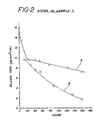
- the release rate of the drug from the delivery system was determined by mounting the system in a diffusion cell and measuring the rate of release into an isotonic phosphate buffer of pH 7.4. From the measured amount of release over time, the release rate was calculated. When the release rate was plotted against time, a profile identified as A in Figure 2 was obtained. The drop in flux, ⁇ , from time zero to 168 hours calculated from a curve fitted to the experimental values was approximately 0.54. This correlates with the desired figure of 0.5 for ⁇ .
- a drug delivery system was prepared employing the same materials, employing the same values for ⁇ and ⁇ , but varying the thickness of the reservoir.
- a system was made having a final reservoir thickness of 0.0056 centimeter so that Equation 1 was satisfied but Equation 2 was not.
- the above determined release profiles show that when the reservoir thickness is 0.025 centimeter, the release rate becomes substantially constant after about the first forty hours (i.e., there is an approximately 25 percent drop between 48 and 168 hours) whereas when the reservoir thickness is 0.0056 centimeter, there is an undesirably large drop in the drug release rate over 48 to 168 hours.
- a 1.2 percent solution of drug is first prepared by dissolving, 0.12 gram of noxazinol as a free base in 9.88 grams of propylene glycol gelled with 2 percent hydroxypropyl guar (HP-60 Jaguar from Celanese). This serves as the dissolved drug reservoir.
- a 0.657 cubic centimeter aliquot of drug reservoir material is metered thereinto, the fourth side sealed, and the material spread evenly to produce a reservoir of 0.073 centimeter thickness.
- the release rate of the drug from the reservoir thus prepared may be determined in the manner described in Example I.
- the release profile of the delivery system would be seen in Figure 3 which would indicate a substantially constant release rate during the entire period.
Landscapes
- Health & Medical Sciences (AREA)
- Engineering & Computer Science (AREA)
- Bioinformatics & Cheminformatics (AREA)
- Dermatology (AREA)
- Chemical & Material Sciences (AREA)
- Medicinal Chemistry (AREA)
- Pharmacology & Pharmacy (AREA)
- Epidemiology (AREA)
- Life Sciences & Earth Sciences (AREA)
- Animal Behavior & Ethology (AREA)
- General Health & Medical Sciences (AREA)
- Public Health (AREA)
- Veterinary Medicine (AREA)
- Medicinal Preparation (AREA)
Applications Claiming Priority (2)
| Application Number | Priority Date | Filing Date | Title |
|---|---|---|---|
| US06/838,852 US4797284A (en) | 1986-03-12 | 1986-03-12 | Transdermal drug delivery system |
| US838852 | 1986-03-12 |
Publications (3)
| Publication Number | Publication Date |
|---|---|
| EP0237263A2 true EP0237263A2 (de) | 1987-09-16 |
| EP0237263A3 EP0237263A3 (en) | 1988-01-13 |
| EP0237263B1 EP0237263B1 (de) | 1990-09-19 |
Family
ID=25278217
Family Applications (1)
| Application Number | Title | Priority Date | Filing Date |
|---|---|---|---|
| EP87301887A Expired - Lifetime EP0237263B1 (de) | 1986-03-12 | 1987-03-04 | System zum Applizieren von Medikamenten durch die Haut |
Country Status (5)
| Country | Link |
|---|---|
| US (1) | US4797284A (de) |
| EP (1) | EP0237263B1 (de) |
| JP (1) | JPS62221620A (de) |
| CA (1) | CA1271680A (de) |
| DE (1) | DE3764980D1 (de) |
Cited By (3)
| Publication number | Priority date | Publication date | Assignee | Title |
|---|---|---|---|---|
| DE4438989A1 (de) * | 1994-09-16 | 1996-03-21 | Lohmann Therapie Syst Lts | Scopolaminpflaster |
| US5762952A (en) * | 1993-04-27 | 1998-06-09 | Hercon Laboratories Corporation | Transdermal delivery of active drugs |
| US9078833B2 (en) | 2002-08-30 | 2015-07-14 | Alza Corporation | Multilaminate backing construction |
Families Citing this family (47)
| Publication number | Priority date | Publication date | Assignee | Title |
|---|---|---|---|---|
| ES2028074T3 (es) * | 1986-06-13 | 1992-07-01 | Alza Corporation | Activacion por humedad de un sistema de suministro transdermico de farmacos. |
| US5343653A (en) * | 1986-07-17 | 1994-09-06 | Celaflor Gmbii | Device for transcuticular application of active substance to plants |
| US5344656A (en) * | 1986-09-12 | 1994-09-06 | Alza Corporation | Subsaturated transdermal therapeutic system having improved release characteristics |
| US4908027A (en) * | 1986-09-12 | 1990-03-13 | Alza Corporation | Subsaturated transdermal therapeutic system having improved release characteristics |
| US5306502A (en) * | 1987-09-01 | 1994-04-26 | Lts Lohmann Therapie-Systeme Gmbh & Co. Kg | Apparatus for delivering nitroglycerin to the skin, processes for the production thereof and the use thereof |
| DE3743946A1 (de) * | 1987-09-01 | 1989-03-09 | Lohmann Gmbh & Co Kg | Vorrichtung zur abgabe von nitroglycerin an die haut, verfahren zu ihrer herstellung sowie ihre verwendung |
| US4781924A (en) | 1987-11-09 | 1988-11-01 | Alza Corporation | Transdermal drug delivery device |
| JPH02149514A (ja) * | 1988-04-06 | 1990-06-08 | Nitto Denko Corp | 医薬部材 |
| US4942037A (en) * | 1988-06-02 | 1990-07-17 | Merck & Co., Inc. | Transdermal delivery systems |
| US5269979A (en) * | 1988-06-08 | 1993-12-14 | Fountain Pharmaceuticals, Inc. | Method for making solvent dilution microcarriers |
| US5133965A (en) * | 1988-06-08 | 1992-07-28 | Fountain Pharmaceuticals, Inc. | Dressing material having adsorbed thereon a solvent dilution microcarrier precursor solution |
| US5004610A (en) * | 1988-06-14 | 1991-04-02 | Alza Corporation | Subsaturated nicotine transdermal therapeutic system |
| US5508038A (en) * | 1990-04-16 | 1996-04-16 | Alza Corporation | Polyisobutylene adhesives for transdermal devices |
| US5071704A (en) * | 1990-06-13 | 1991-12-10 | Fischel Ghodsian Fariba | Device for controlled release of vapors and scents |
| US5455043A (en) * | 1990-06-13 | 1995-10-03 | Fischel-Ghodsian; Fariba | Device for controlled release of vaporous medications through nasal route |
| AU6491494A (en) * | 1993-04-07 | 1994-10-24 | Rexham Industries Corp. | Method of coating microporous membranes and resulting products |
| CA2187023A1 (en) * | 1994-04-13 | 1995-10-26 | Steven Andrew Giannos | Temporally controlled drug delivery systems |
| US5730721A (en) * | 1996-01-25 | 1998-03-24 | Vesture Corporation | Medical applicator and method |
| US6337328B1 (en) | 1999-03-01 | 2002-01-08 | Sepracor, Inc. | Bupropion metabolites and methods of use |
| US6733785B1 (en) * | 1999-06-11 | 2004-05-11 | Lintec Corporation | Moisture-sensitive preparation of percutaneous absorption type |
| US20040220785A1 (en) * | 2003-01-21 | 2004-11-04 | Van Osdol William W. | Computational model for transdermal drug delivery |
| US20050118246A1 (en) * | 2003-10-31 | 2005-06-02 | Wong Patrick S. | Dosage forms and layered deposition processes for fabricating dosage forms |
| US8287923B2 (en) * | 2005-06-10 | 2012-10-16 | Medical College Of Georgia Research Institute, Inc. | Compositions and methods for treating immune disorders |
| US20070065494A1 (en) * | 2005-08-03 | 2007-03-22 | Watson Laboratories, Inc. | Formulations and Methods for Enhancing the Transdermal Penetration of a Drug |
| US9446017B2 (en) | 2005-08-11 | 2016-09-20 | Augusta University Research Institute, Inc. | Compositions and methods for treating herpes simplex virus |
| US9114133B2 (en) | 2006-08-25 | 2015-08-25 | U.S. Dept. Of Veterans Affairs | Method of improving diastolic dysfunction |
| US20080226698A1 (en) * | 2007-03-16 | 2008-09-18 | Mylan Technologies, Inc. | Amorphous drug transdermal systems, manufacturing methods, and stabilization |
| MX2010012989A (es) * | 2008-05-30 | 2011-04-27 | Mylan Inc | Sistema de suministro de farmaco transdermico estabilizado. |
| JP2012504609A (ja) * | 2008-10-06 | 2012-02-23 | マイラン・テクノロジーズ,インコーポレイテッド | アモルファスロチゴチン経皮システム |
| US20130017188A1 (en) | 2009-07-31 | 2013-01-17 | The Brigham And Women's Hospital, Inc. | Modulation of sgk1 expression in th17 cells to modulate th17-mediated immune responses |
| CA2794565C (en) | 2010-04-08 | 2018-08-21 | Emory University | Substituted androst-4-ene diones |
| KR101802553B1 (ko) * | 2010-09-23 | 2017-11-28 | 모노졸 알엑스, 엘엘씨 | 제약 생성물을 패키지 표면 상에 직접적으로 형성시키는 방법 및 시스템 |
| US9585930B2 (en) | 2011-03-20 | 2017-03-07 | Trustees Of Boston University | Therapeutic agent for emphysema and COPD |
| WO2012151474A2 (en) | 2011-05-04 | 2012-11-08 | Trustees Of Boston University | Proton-motive force stimulation to potentiate aminoglycoside antibiotics against persistent bacteria |
| WO2013003697A1 (en) | 2011-06-30 | 2013-01-03 | Trustees Of Boston University | Method for controlling tumor growth, angiogenesis and metastasis using immunoglobulin containing and proline rich receptor-1 (igpr-1) |
| EP2543370A1 (de) | 2011-07-06 | 2013-01-09 | Georgia Health Sciences University Research Institute, Inc. | Zusammensetzungen und Verfahren zur Behandlung des Herpes-simplex-Virus |
| US9243037B2 (en) | 2011-11-10 | 2016-01-26 | Trustees Of Boston College | Gramicidin a mutants that function as antibiotics with improved solubility and reduced toxicity |
| US20150366890A1 (en) | 2013-02-25 | 2015-12-24 | Trustees Of Boston University | Compositions and methods for treating fungal infections |
| EP3036226B1 (de) | 2013-08-22 | 2020-01-08 | The General Hospital Corporation | Hemmer der humanen 12/15-lipoxygenase |
| US11382883B2 (en) | 2013-08-29 | 2022-07-12 | Trustees Of Boston University | Intermediate metabolism products to potentiate aminoglycoside antibiotics in bacterial infections |
| ES2815553T3 (es) * | 2015-02-27 | 2021-03-30 | Ecolab Usa Inc | Sistema y método de tratamiento de artículos con insecticida |
| EP3303286B1 (de) | 2015-06-01 | 2023-10-04 | Cedars-Sinai Medical Center | An rela von nf-kb anbindende verbindungen zur verwendung bei der behandlung von krebs |
| KR102123365B1 (ko) | 2015-07-28 | 2020-06-16 | 바이옴 테라퓨틱스 리미티드 | 항박테리아 치료제 및 예방제 |
| SG11201805570WA (en) | 2015-12-30 | 2018-07-30 | Corium Int Inc | Systems and methods for long term transdermal administration |
| WO2018004797A1 (en) * | 2016-06-29 | 2018-01-04 | The University Of Akron | Apparatus and method for zero order drug delivery from multilayer amphiphilic co-networks |
| AU2017301928B2 (en) * | 2016-07-27 | 2023-04-06 | Corium, LLC. | Donepezil transdermal delivery system |
| WO2019167070A1 (en) | 2018-02-27 | 2019-09-06 | Akshay Sanghavi | Topical copper tripeptide composition and process of preparation. |
Family Cites Families (15)
| Publication number | Priority date | Publication date | Assignee | Title |
|---|---|---|---|---|
| US3598122A (en) * | 1969-04-01 | 1971-08-10 | Alza Corp | Bandage for administering drugs |
| US3854480A (en) * | 1969-04-01 | 1974-12-17 | Alza Corp | Drug-delivery system |
| US3716795A (en) * | 1971-03-18 | 1973-02-13 | Control Concepts Corp | Time comb generator |
| US3993072A (en) * | 1974-08-28 | 1976-11-23 | Alza Corporation | Microporous drug delivery device |
| US4144317A (en) * | 1975-05-30 | 1979-03-13 | Alza Corporation | Device consisting of copolymer having acetoxy groups for delivering drugs |
| US4060084A (en) * | 1976-09-07 | 1977-11-29 | Alza Corporation | Method and therapeutic system for providing chemotherapy transdermally |
| US4286592A (en) * | 1980-02-04 | 1981-09-01 | Alza Corporation | Therapeutic system for administering drugs to the skin |
| US4336243A (en) * | 1980-08-11 | 1982-06-22 | G. D. Searle & Co. | Transdermal nitroglycerin pad |
| US4460372A (en) * | 1981-02-17 | 1984-07-17 | Alza Corporation | Percutaneous absorption enhancer dispenser for use in coadministering drug and percutaneous absorption enhancer |
| US4486193A (en) * | 1981-07-22 | 1984-12-04 | Alza Corporation | Method for treating ischemic conditions by administering drug by two routes |
| US4605548A (en) * | 1983-05-31 | 1986-08-12 | Nitto Electric Industrial Co., Ltd. | Drug administration material |
| US4568343A (en) * | 1984-10-09 | 1986-02-04 | Alza Corporation | Skin permeation enhancer compositions |
| US4752478A (en) * | 1984-12-17 | 1988-06-21 | Merck & Co., Inc. | Transdermal system for timolol |
| US4756710A (en) * | 1985-04-05 | 1988-07-12 | Merck & Co., Inc. | pH-Mediated drug delivery system |
| US4753995A (en) * | 1986-08-29 | 1988-06-28 | Mobil Oil Corporation | Compositions of linear polyethylene and polyvinylidene fluoride for film extrusion, and films thereof |
-
1986
- 1986-03-12 US US06/838,852 patent/US4797284A/en not_active Expired - Fee Related
-
1987
- 1987-03-04 DE DE8787301887T patent/DE3764980D1/de not_active Expired - Lifetime
- 1987-03-04 EP EP87301887A patent/EP0237263B1/de not_active Expired - Lifetime
- 1987-03-11 CA CA000531770A patent/CA1271680A/en not_active Expired
- 1987-03-12 JP JP62055499A patent/JPS62221620A/ja active Pending
Cited By (6)
| Publication number | Priority date | Publication date | Assignee | Title |
|---|---|---|---|---|
| US5762952A (en) * | 1993-04-27 | 1998-06-09 | Hercon Laboratories Corporation | Transdermal delivery of active drugs |
| DE4438989A1 (de) * | 1994-09-16 | 1996-03-21 | Lohmann Therapie Syst Lts | Scopolaminpflaster |
| DE4438989C2 (de) * | 1994-09-16 | 1999-02-25 | Lohmann Therapie Syst Lts | Scopolaminpflaster |
| US9078833B2 (en) | 2002-08-30 | 2015-07-14 | Alza Corporation | Multilaminate backing construction |
| US9248105B2 (en) | 2002-08-30 | 2016-02-02 | Alza Corporation | Multilaminate backing construction |
| US9522122B2 (en) | 2002-08-30 | 2016-12-20 | Alza Corporation | Multilaminate backing construction |
Also Published As
| Publication number | Publication date |
|---|---|
| CA1271680A (en) | 1990-07-17 |
| DE3764980D1 (de) | 1990-10-25 |
| EP0237263B1 (de) | 1990-09-19 |
| EP0237263A3 (en) | 1988-01-13 |
| JPS62221620A (ja) | 1987-09-29 |
| US4797284A (en) | 1989-01-10 |
Similar Documents
| Publication | Publication Date | Title |
|---|---|---|
| EP0237263B1 (de) | System zum Applizieren von Medikamenten durch die Haut | |
| US4880633A (en) | Transdermal drug delivery system | |
| US5273756A (en) | Transdermal drug delivery device using a membrane-protected microporous membrane to achieve delayed onset | |
| US5273755A (en) | Transdermal drug delivery device using a polymer-filled microporous membrane to achieve delayed onset | |
| US5234690A (en) | Transdermal drug delivery device using an unfilled microporous membrane to achieve delayed onset | |
| CA1272954A (en) | Ph-mediated drug delivery system | |
| CA2161004C (en) | Active ingredient patch | |
| EP2158905B1 (de) | Zusammensetzung zur transdermalen Verabreichung von Fentanyl | |
| DK175328B1 (da) | Fremgangsmåde til fremstilling af et transdermalt nikotinplaster samt et transdermalt nikotinplaster | |
| AU2002215315A1 (en) | Composition for the transdermal delivery of fentanyl | |
| EP0608357A1 (de) | Vorrichtung zur transdermalen verabreichung von arzneimitteln mit einer kontrollierten, zeitlichen strömungsänderung | |
| EP0144486B1 (de) | Pharmazeutische Zusammensetzung mit verzögerter Abgabe und Verfahren zu deren Herstellung | |
| EP0344840A2 (de) | Transdermales Abgabesystem | |
| JPH0316571A (ja) | 段階的な薬物放出を呈する皮膚経由医療薬 | |
| US7763274B2 (en) | Administration form with active substance-containing particles, for application on the skin or mucosa | |
| WO1989012470A1 (en) | Subsaturated transdermal delivery device | |
| PL197721B1 (pl) | Transdermalny system terapeutyczny zawierający chlorowodorek efedryny, membranę, zbiornik i zewnętrzną warstwę zabezpieczającą oraz sposób jego otrzymywania | |
| PL197592B1 (pl) | Transdermalny system terapeutyczny zawierający substancję czynną, membranę, zbiornik i zewnętrzną warstwę zabezpieczającą oraz sposób jego otrzymywania | |
| AU2007205756A1 (en) | Composition for the transdermal delivery of fentanyl |
Legal Events
| Date | Code | Title | Description |
|---|---|---|---|
| PUAI | Public reference made under article 153(3) epc to a published international application that has entered the european phase |
Free format text: ORIGINAL CODE: 0009012 |
|
| AK | Designated contracting states |
Kind code of ref document: A2 Designated state(s): CH DE FR GB IT LI NL |
|
| ITCL | It: translation for ep claims filed |
Representative=s name: SOCIETA' ITALIANA BREVETTI S.P.A. |
|
| PUAL | Search report despatched |
Free format text: ORIGINAL CODE: 0009013 |
|
| AK | Designated contracting states |
Kind code of ref document: A3 Designated state(s): CH DE FR GB IT LI NL |
|
| 17P | Request for examination filed |
Effective date: 19880609 |
|
| 17Q | First examination report despatched |
Effective date: 19891208 |
|
| GRAA | (expected) grant |
Free format text: ORIGINAL CODE: 0009210 |
|
| AK | Designated contracting states |
Kind code of ref document: B1 Designated state(s): CH DE FR GB IT LI NL |
|
| REF | Corresponds to: |
Ref document number: 3764980 Country of ref document: DE Date of ref document: 19901025 |
|
| ET | Fr: translation filed | ||
| ITF | It: translation for a ep patent filed | ||
| PLBE | No opposition filed within time limit |
Free format text: ORIGINAL CODE: 0009261 |
|
| STAA | Information on the status of an ep patent application or granted ep patent |
Free format text: STATUS: NO OPPOSITION FILED WITHIN TIME LIMIT |
|
| 26N | No opposition filed | ||
| PGFP | Annual fee paid to national office [announced via postgrant information from national office to epo] |
Ref country code: GB Payment date: 19931204 Year of fee payment: 8 |
|
| PGFP | Annual fee paid to national office [announced via postgrant information from national office to epo] |
Ref country code: CH Payment date: 19931210 Year of fee payment: 8 |
|
| PGFP | Annual fee paid to national office [announced via postgrant information from national office to epo] |
Ref country code: FR Payment date: 19931228 Year of fee payment: 8 |
|
| PGFP | Annual fee paid to national office [announced via postgrant information from national office to epo] |
Ref country code: DE Payment date: 19940225 Year of fee payment: 8 |
|
| ITTA | It: last paid annual fee | ||
| PGFP | Annual fee paid to national office [announced via postgrant information from national office to epo] |
Ref country code: NL Payment date: 19940331 Year of fee payment: 8 |
|
| PG25 | Lapsed in a contracting state [announced via postgrant information from national office to epo] |
Ref country code: GB Effective date: 19950304 |
|
| PG25 | Lapsed in a contracting state [announced via postgrant information from national office to epo] |
Ref country code: LI Effective date: 19950331 Ref country code: CH Effective date: 19950331 |
|
| PG25 | Lapsed in a contracting state [announced via postgrant information from national office to epo] |
Ref country code: NL Effective date: 19951001 |
|
| GBPC | Gb: european patent ceased through non-payment of renewal fee |
Effective date: 19950304 |
|
| PG25 | Lapsed in a contracting state [announced via postgrant information from national office to epo] |
Ref country code: FR Free format text: LAPSE BECAUSE OF NON-PAYMENT OF DUE FEES Effective date: 19951130 |
|
| REG | Reference to a national code |
Ref country code: CH Ref legal event code: PL |
|
| NLV4 | Nl: lapsed or anulled due to non-payment of the annual fee |
Effective date: 19951001 |
|
| PG25 | Lapsed in a contracting state [announced via postgrant information from national office to epo] |
Ref country code: DE Effective date: 19951201 |
|
| REG | Reference to a national code |
Ref country code: FR Ref legal event code: ST |
|
| PG25 | Lapsed in a contracting state [announced via postgrant information from national office to epo] |
Ref country code: IT Free format text: LAPSE BECAUSE OF NON-PAYMENT OF DUE FEES;WARNING: LAPSES OF ITALIAN PATENTS WITH EFFECTIVE DATE BEFORE 2007 MAY HAVE OCCURRED AT ANY TIME BEFORE 2007. THE CORRECT EFFECTIVE DATE MAY BE DIFFERENT FROM THE ONE RECORDED. Effective date: 20050304 |