EP0238193B1 - Verfahren zur Herstellung von Polyarylenthioäthern mit hoher Stabilität - Google Patents
Verfahren zur Herstellung von Polyarylenthioäthern mit hoher Stabilität Download PDFInfo
- Publication number
- EP0238193B1 EP0238193B1 EP87301210A EP87301210A EP0238193B1 EP 0238193 B1 EP0238193 B1 EP 0238193B1 EP 87301210 A EP87301210 A EP 87301210A EP 87301210 A EP87301210 A EP 87301210A EP 0238193 B1 EP0238193 B1 EP 0238193B1
- Authority
- EP
- European Patent Office
- Prior art keywords
- reaction
- stirring
- polymerization
- compound
- alkali metal
- Prior art date
- Legal status (The legal status is an assumption and is not a legal conclusion. Google has not performed a legal analysis and makes no representation as to the accuracy of the status listed.)
- Expired - Lifetime
Links
- 150000003568 thioethers Chemical class 0.000 title claims description 50
- 229920000412 polyarylene Polymers 0.000 title claims description 45
- 238000004519 manufacturing process Methods 0.000 title description 4
- 238000003756 stirring Methods 0.000 claims description 72
- 238000006116 polymerization reaction Methods 0.000 claims description 49
- 238000006243 chemical reaction Methods 0.000 claims description 48
- 150000001875 compounds Chemical class 0.000 claims description 47
- 238000000034 method Methods 0.000 claims description 37
- 229910052977 alkali metal sulfide Inorganic materials 0.000 claims description 28
- 150000007944 thiolates Chemical group 0.000 claims description 27
- 125000003396 thiol group Chemical group [H]S* 0.000 claims description 26
- XLYOFNOQVPJJNP-UHFFFAOYSA-N water Substances O XLYOFNOQVPJJNP-UHFFFAOYSA-N 0.000 claims description 20
- 239000011541 reaction mixture Substances 0.000 claims description 10
- OCJBOOLMMGQPQU-UHFFFAOYSA-N 1,4-dichlorobenzene Chemical compound ClC1=CC=C(Cl)C=C1 OCJBOOLMMGQPQU-UHFFFAOYSA-N 0.000 claims description 7
- 229910052979 sodium sulfide Inorganic materials 0.000 claims description 7
- GRVFOGOEDUUMBP-UHFFFAOYSA-N sodium sulfide (anhydrous) Chemical group [Na+].[Na+].[S-2] GRVFOGOEDUUMBP-UHFFFAOYSA-N 0.000 claims description 7
- 239000000155 melt Substances 0.000 claims description 6
- 239000003495 polar organic solvent Substances 0.000 claims description 6
- ZPQOPVIELGIULI-UHFFFAOYSA-N 1,3-dichlorobenzene Chemical compound ClC1=CC=CC(Cl)=C1 ZPQOPVIELGIULI-UHFFFAOYSA-N 0.000 claims description 5
- SECXISVLQFMRJM-UHFFFAOYSA-N N-Methylpyrrolidone Chemical group CN1CCCC1=O SECXISVLQFMRJM-UHFFFAOYSA-N 0.000 claims description 5
- -1 polyparaphenylene Polymers 0.000 claims description 5
- 238000005695 dehalogenation reaction Methods 0.000 claims description 4
- 229920001400 block copolymer Polymers 0.000 claims description 3
- UCKMPCXJQFINFW-UHFFFAOYSA-N Sulphide Chemical compound [S-2] UCKMPCXJQFINFW-UHFFFAOYSA-N 0.000 claims 2
- 229920000265 Polyparaphenylene Polymers 0.000 claims 1
- 239000002798 polar solvent Substances 0.000 claims 1
- 229920000642 polymer Polymers 0.000 description 32
- CSCPPACGZOOCGX-UHFFFAOYSA-N Acetone Chemical compound CC(C)=O CSCPPACGZOOCGX-UHFFFAOYSA-N 0.000 description 10
- 239000000463 material Substances 0.000 description 10
- 238000010128 melt processing Methods 0.000 description 8
- 239000000843 powder Substances 0.000 description 6
- 238000001125 extrusion Methods 0.000 description 5
- 238000002156 mixing Methods 0.000 description 5
- 239000000203 mixture Substances 0.000 description 5
- 238000002360 preparation method Methods 0.000 description 5
- 150000003573 thiols Chemical group 0.000 description 5
- RFFLAFLAYFXFSW-UHFFFAOYSA-N 1,2-dichlorobenzene Chemical compound ClC1=CC=CC=C1Cl RFFLAFLAYFXFSW-UHFFFAOYSA-N 0.000 description 4
- CWYNVVGOOAEACU-UHFFFAOYSA-N Fe2+ Chemical compound [Fe+2] CWYNVVGOOAEACU-UHFFFAOYSA-N 0.000 description 4
- XEEYBQQBJWHFJM-UHFFFAOYSA-N Iron Chemical compound [Fe] XEEYBQQBJWHFJM-UHFFFAOYSA-N 0.000 description 4
- 150000001491 aromatic compounds Chemical class 0.000 description 4
- 230000000977 initiatory effect Effects 0.000 description 4
- 239000002002 slurry Substances 0.000 description 4
- ZMXDDKWLCZADIW-UHFFFAOYSA-N N,N-Dimethylformamide Chemical compound CN(C)C=O ZMXDDKWLCZADIW-UHFFFAOYSA-N 0.000 description 3
- 238000002835 absorbance Methods 0.000 description 3
- 229910052783 alkali metal Inorganic materials 0.000 description 3
- 230000000052 comparative effect Effects 0.000 description 3
- 229920001577 copolymer Polymers 0.000 description 3
- 239000000835 fiber Substances 0.000 description 3
- PGLTVOMIXTUURA-UHFFFAOYSA-N iodoacetamide Chemical compound NC(=O)CI PGLTVOMIXTUURA-UHFFFAOYSA-N 0.000 description 3
- 239000003960 organic solvent Substances 0.000 description 3
- 239000008188 pellet Substances 0.000 description 3
- 238000012545 processing Methods 0.000 description 3
- 239000002904 solvent Substances 0.000 description 3
- 239000000126 substance Substances 0.000 description 3
- VTYYLEPIZMXCLO-UHFFFAOYSA-L Calcium carbonate Chemical compound [Ca+2].[O-]C([O-])=O VTYYLEPIZMXCLO-UHFFFAOYSA-L 0.000 description 2
- VYPSYNLAJGMNEJ-UHFFFAOYSA-N Silicium dioxide Chemical compound O=[Si]=O VYPSYNLAJGMNEJ-UHFFFAOYSA-N 0.000 description 2
- 229910000831 Steel Inorganic materials 0.000 description 2
- 238000013019 agitation Methods 0.000 description 2
- 150000001340 alkali metals Chemical class 0.000 description 2
- QARVLSVVCXYDNA-UHFFFAOYSA-N bromobenzene Chemical compound BrC1=CC=CC=C1 QARVLSVVCXYDNA-UHFFFAOYSA-N 0.000 description 2
- 238000000748 compression moulding Methods 0.000 description 2
- 238000004132 cross linking Methods 0.000 description 2
- 230000003247 decreasing effect Effects 0.000 description 2
- 230000000694 effects Effects 0.000 description 2
- 230000008020 evaporation Effects 0.000 description 2
- 238000001704 evaporation Methods 0.000 description 2
- 238000001879 gelation Methods 0.000 description 2
- 230000005484 gravity Effects 0.000 description 2
- 238000010438 heat treatment Methods 0.000 description 2
- 229920006158 high molecular weight polymer Polymers 0.000 description 2
- 229920001519 homopolymer Polymers 0.000 description 2
- 239000012535 impurity Substances 0.000 description 2
- 238000011065 in-situ storage Methods 0.000 description 2
- 229910052742 iron Inorganic materials 0.000 description 2
- 238000005259 measurement Methods 0.000 description 2
- 238000002844 melting Methods 0.000 description 2
- 230000008018 melting Effects 0.000 description 2
- 238000005121 nitriding Methods 0.000 description 2
- 239000002994 raw material Substances 0.000 description 2
- 238000011160 research Methods 0.000 description 2
- 229920005989 resin Polymers 0.000 description 2
- 239000011347 resin Substances 0.000 description 2
- 239000000243 solution Substances 0.000 description 2
- 239000010959 steel Substances 0.000 description 2
- 230000009469 supplementation Effects 0.000 description 2
- 238000012360 testing method Methods 0.000 description 2
- 229920001169 thermoplastic Polymers 0.000 description 2
- 230000001131 transforming effect Effects 0.000 description 2
- AVQQQNCBBIEMEU-UHFFFAOYSA-N 1,1,3,3-tetramethylurea Chemical compound CN(C)C(=O)N(C)C AVQQQNCBBIEMEU-UHFFFAOYSA-N 0.000 description 1
- YJUUZFWMKJBVFJ-UHFFFAOYSA-N 1,3-dimethylimidazolidin-4-one Chemical compound CN1CN(C)C(=O)C1 YJUUZFWMKJBVFJ-UHFFFAOYSA-N 0.000 description 1
- SWJPEBQEEAHIGZ-UHFFFAOYSA-N 1,4-dibromobenzene Chemical compound BrC1=CC=C(Br)C=C1 SWJPEBQEEAHIGZ-UHFFFAOYSA-N 0.000 description 1
- KFAKZJUYBOYVKA-UHFFFAOYSA-N 1,4-dichloro-2-methylbenzene Chemical compound CC1=CC(Cl)=CC=C1Cl KFAKZJUYBOYVKA-UHFFFAOYSA-N 0.000 description 1
- JDPKCYMVSKDOGS-UHFFFAOYSA-N 1,4-dichloronaphthalene Chemical compound C1=CC=C2C(Cl)=CC=C(Cl)C2=C1 JDPKCYMVSKDOGS-UHFFFAOYSA-N 0.000 description 1
- ZFPGARUNNKGOBB-UHFFFAOYSA-N 1-Ethyl-2-pyrrolidinone Chemical compound CCN1CCCC1=O ZFPGARUNNKGOBB-UHFFFAOYSA-N 0.000 description 1
- YUKILTJWFRTXGB-UHFFFAOYSA-N 1-chloro-3-methoxybenzene Chemical compound COC1=CC=CC(Cl)=C1 YUKILTJWFRTXGB-UHFFFAOYSA-N 0.000 description 1
- OSOUNOBYRMOXQQ-UHFFFAOYSA-N 1-chloro-3-methylbenzene Chemical compound CC1=CC=CC(Cl)=C1 OSOUNOBYRMOXQQ-UHFFFAOYSA-N 0.000 description 1
- YRGAYAGBVIXNAQ-UHFFFAOYSA-N 1-chloro-4-methoxybenzene Chemical compound COC1=CC=C(Cl)C=C1 YRGAYAGBVIXNAQ-UHFFFAOYSA-N 0.000 description 1
- HIXDQWDOVZUNNA-UHFFFAOYSA-N 2-(3,4-dimethoxyphenyl)-5-hydroxy-7-methoxychromen-4-one Chemical compound C=1C(OC)=CC(O)=C(C(C=2)=O)C=1OC=2C1=CC=C(OC)C(OC)=C1 HIXDQWDOVZUNNA-UHFFFAOYSA-N 0.000 description 1
- GPAPPPVRLPGFEQ-UHFFFAOYSA-N 4,4'-dichlorodiphenyl sulfone Chemical compound C1=CC(Cl)=CC=C1S(=O)(=O)C1=CC=C(Cl)C=C1 GPAPPPVRLPGFEQ-UHFFFAOYSA-N 0.000 description 1
- 235000010893 Bischofia javanica Nutrition 0.000 description 1
- 240000005220 Bischofia javanica Species 0.000 description 1
- 229920000049 Carbon (fiber) Polymers 0.000 description 1
- VEXZGXHMUGYJMC-UHFFFAOYSA-N Hydrochloric acid Chemical compound Cl VEXZGXHMUGYJMC-UHFFFAOYSA-N 0.000 description 1
- FXHOOIRPVKKKFG-UHFFFAOYSA-N N,N-Dimethylacetamide Chemical compound CN(C)C(C)=O FXHOOIRPVKKKFG-UHFFFAOYSA-N 0.000 description 1
- ZWXPDGCFMMFNRW-UHFFFAOYSA-N N-methylcaprolactam Chemical compound CN1CCCCCC1=O ZWXPDGCFMMFNRW-UHFFFAOYSA-N 0.000 description 1
- 229930182556 Polyacetal Natural products 0.000 description 1
- 239000004952 Polyamide Substances 0.000 description 1
- 239000004642 Polyimide Substances 0.000 description 1
- 239000004721 Polyphenylene oxide Substances 0.000 description 1
- 239000004793 Polystyrene Substances 0.000 description 1
- GWEVSGVZZGPLCZ-UHFFFAOYSA-N Titan oxide Chemical compound O=[Ti]=O GWEVSGVZZGPLCZ-UHFFFAOYSA-N 0.000 description 1
- RTAQQCXQSZGOHL-UHFFFAOYSA-N Titanium Chemical compound [Ti] RTAQQCXQSZGOHL-UHFFFAOYSA-N 0.000 description 1
- 229920000122 acrylonitrile butadiene styrene Polymers 0.000 description 1
- 150000008044 alkali metal hydroxides Chemical class 0.000 description 1
- 150000008064 anhydrides Chemical class 0.000 description 1
- 125000000732 arylene group Chemical group 0.000 description 1
- 239000010425 asbestos Substances 0.000 description 1
- QVGXLLKOCUKJST-UHFFFAOYSA-N atomic oxygen Chemical compound [O] QVGXLLKOCUKJST-UHFFFAOYSA-N 0.000 description 1
- 230000015572 biosynthetic process Effects 0.000 description 1
- 229910000019 calcium carbonate Inorganic materials 0.000 description 1
- 238000011088 calibration curve Methods 0.000 description 1
- 239000006229 carbon black Substances 0.000 description 1
- 239000004917 carbon fiber Substances 0.000 description 1
- 150000007942 carboxylates Chemical class 0.000 description 1
- 239000003086 colorant Substances 0.000 description 1
- 238000007796 conventional method Methods 0.000 description 1
- 238000007334 copolymerization reaction Methods 0.000 description 1
- 239000013078 crystal Substances 0.000 description 1
- 238000000354 decomposition reaction Methods 0.000 description 1
- 230000018044 dehydration Effects 0.000 description 1
- 238000006297 dehydration reaction Methods 0.000 description 1
- 238000004925 denaturation Methods 0.000 description 1
- 230000036425 denaturation Effects 0.000 description 1
- 238000013461 design Methods 0.000 description 1
- 238000001514 detection method Methods 0.000 description 1
- QTNDMWXOEPGHBT-UHFFFAOYSA-N dicesium;sulfide Chemical compound [S-2].[Cs+].[Cs+] QTNDMWXOEPGHBT-UHFFFAOYSA-N 0.000 description 1
- 238000002845 discoloration Methods 0.000 description 1
- 239000000975 dye Substances 0.000 description 1
- RTZKZFJDLAIYFH-UHFFFAOYSA-N ether Substances CCOCC RTZKZFJDLAIYFH-UHFFFAOYSA-N 0.000 description 1
- 150000002170 ethers Chemical class 0.000 description 1
- 238000011156 evaluation Methods 0.000 description 1
- 239000012765 fibrous filler Substances 0.000 description 1
- 239000000945 filler Substances 0.000 description 1
- 239000003365 glass fiber Substances 0.000 description 1
- 229910052736 halogen Inorganic materials 0.000 description 1
- 125000005843 halogen group Chemical group 0.000 description 1
- 150000002367 halogens Chemical class 0.000 description 1
- 238000009998 heat setting Methods 0.000 description 1
- GNOIPBMMFNIUFM-UHFFFAOYSA-N hexamethylphosphoric triamide Chemical compound CN(C)P(=O)(N(C)C)N(C)C GNOIPBMMFNIUFM-UHFFFAOYSA-N 0.000 description 1
- 150000004677 hydrates Chemical class 0.000 description 1
- 230000001976 improved effect Effects 0.000 description 1
- 238000002347 injection Methods 0.000 description 1
- 239000007924 injection Substances 0.000 description 1
- 238000001746 injection moulding Methods 0.000 description 1
- 150000002576 ketones Chemical class 0.000 description 1
- 239000007791 liquid phase Substances 0.000 description 1
- XIXADJRWDQXREU-UHFFFAOYSA-M lithium acetate Chemical compound [Li+].CC([O-])=O XIXADJRWDQXREU-UHFFFAOYSA-M 0.000 description 1
- GLNWILHOFOBOFD-UHFFFAOYSA-N lithium sulfide Chemical compound [Li+].[Li+].[S-2] GLNWILHOFOBOFD-UHFFFAOYSA-N 0.000 description 1
- 238000002074 melt spinning Methods 0.000 description 1
- 229910052751 metal Inorganic materials 0.000 description 1
- 239000002184 metal Substances 0.000 description 1
- VNWKTOKETHGBQD-UHFFFAOYSA-N methane Chemical compound C VNWKTOKETHGBQD-UHFFFAOYSA-N 0.000 description 1
- 238000012986 modification Methods 0.000 description 1
- 230000004048 modification Effects 0.000 description 1
- VWBWQOUWDOULQN-UHFFFAOYSA-N nmp n-methylpyrrolidone Chemical compound CN1CCCC1=O.CN1CCCC1=O VWBWQOUWDOULQN-UHFFFAOYSA-N 0.000 description 1
- 229910052760 oxygen Inorganic materials 0.000 description 1
- 239000001301 oxygen Substances 0.000 description 1
- 230000020477 pH reduction Effects 0.000 description 1
- 150000004686 pentahydrates Chemical class 0.000 description 1
- 239000000049 pigment Substances 0.000 description 1
- 229920002492 poly(sulfone) Polymers 0.000 description 1
- 229920002647 polyamide Polymers 0.000 description 1
- 229920000515 polycarbonate Polymers 0.000 description 1
- 239000004417 polycarbonate Substances 0.000 description 1
- 229920000728 polyester Polymers 0.000 description 1
- 229920001721 polyimide Polymers 0.000 description 1
- 229920006324 polyoxymethylene Polymers 0.000 description 1
- 229920006380 polyphenylene oxide Polymers 0.000 description 1
- 229920002223 polystyrene Polymers 0.000 description 1
- 229920001021 polysulfide Polymers 0.000 description 1
- 239000005077 polysulfide Substances 0.000 description 1
- 150000008117 polysulfides Polymers 0.000 description 1
- DPLVEEXVKBWGHE-UHFFFAOYSA-N potassium sulfide Chemical compound [S-2].[K+].[K+] DPLVEEXVKBWGHE-UHFFFAOYSA-N 0.000 description 1
- 229920005604 random copolymer Polymers 0.000 description 1
- 229910052895 riebeckite Inorganic materials 0.000 description 1
- AHKSSQDILPRNLA-UHFFFAOYSA-N rubidium(1+);sulfide Chemical compound [S-2].[Rb+].[Rb+] AHKSSQDILPRNLA-UHFFFAOYSA-N 0.000 description 1
- 239000000377 silicon dioxide Substances 0.000 description 1
- 230000002269 spontaneous effect Effects 0.000 description 1
- 230000006641 stabilisation Effects 0.000 description 1
- 238000011105 stabilization Methods 0.000 description 1
- 229920003002 synthetic resin Polymers 0.000 description 1
- 239000000057 synthetic resin Substances 0.000 description 1
- 229920005992 thermoplastic resin Polymers 0.000 description 1
- 239000010936 titanium Substances 0.000 description 1
- 229910052719 titanium Inorganic materials 0.000 description 1
- OGIDPMRJRNCKJF-UHFFFAOYSA-N titanium oxide Inorganic materials [Ti]=O OGIDPMRJRNCKJF-UHFFFAOYSA-N 0.000 description 1
- 238000005406 washing Methods 0.000 description 1
Images
Classifications
-
- C—CHEMISTRY; METALLURGY
- C08—ORGANIC MACROMOLECULAR COMPOUNDS; THEIR PREPARATION OR CHEMICAL WORKING-UP; COMPOSITIONS BASED THEREON
- C08G—MACROMOLECULAR COMPOUNDS OBTAINED OTHERWISE THAN BY REACTIONS ONLY INVOLVING UNSATURATED CARBON-TO-CARBON BONDS
- C08G75/00—Macromolecular compounds obtained by reactions forming a linkage containing sulfur with or without nitrogen, oxygen, or carbon in the main chain of the macromolecule
- C08G75/02—Polythioethers
- C08G75/0204—Polyarylenethioethers
- C08G75/025—Preparatory processes
- C08G75/0254—Preparatory processes using metal sulfides
-
- C—CHEMISTRY; METALLURGY
- C08—ORGANIC MACROMOLECULAR COMPOUNDS; THEIR PREPARATION OR CHEMICAL WORKING-UP; COMPOSITIONS BASED THEREON
- C08G—MACROMOLECULAR COMPOUNDS OBTAINED OTHERWISE THAN BY REACTIONS ONLY INVOLVING UNSATURATED CARBON-TO-CARBON BONDS
- C08G75/00—Macromolecular compounds obtained by reactions forming a linkage containing sulfur with or without nitrogen, oxygen, or carbon in the main chain of the macromolecule
- C08G75/02—Polythioethers
- C08G75/0204—Polyarylenethioethers
- C08G75/0245—Block or graft polymers
Definitions
- This invention relates to a process for producing polyarylene thioethers having high stability. More particularly, this invention relates to a process for producing stable polyarylene thioethers by the reaction of an alkali metal sulfide and a dihaloaromatic compound in a polar organic solvent, characterized in that total charge of the haloaromatic compound (dihaloaromatic compound alone or mixture) is used in an appropriately excessive amount to the effective charge of the alkali metal sulfide and the reaction is continued until the concentration of a thiolate group or a thiol group at the resulting polyarylene thioether terminal reaches 10 ⁇ mole/g or less by intense stirring for substantial mixing at least on the latter step of the reaction.
- Polyarylene thioethers are thermoplastic resins having high crystallizability and can be processed into not only molded articles by injection molding or the like but also film, sheet, plate, fiber or other formed articles by extrusion molding, compression molding, inflation, melt spinning, stretching or the like. Therefore, it has been expected that formed articles by melt process having excellent properties might be obtained.
- melt viscosity materials i.e. materials of low molecular weight
- curing resins wherein relatively low melt viscosity materials (i.e. materials of low molecular weight) is "cured” or treated at an elevated temperature in the presence of oxygen or the like to cause crosslinking, branching or the like so that the apparent melt viscosity is increased.
- Such resins of which melt viscosity is increased by "curing” have many problems such as strong coloration (in this invention, "coloration” means spontaneous coloration or discoloration and does not mean intentional coloration by addition of colorants), an insufficient mechanical strength due to the structure of a lot of crosslinking and branching and particularly thermal instability which tends to cause stronger coloration and gelation thus increasing viscosity upon melt processing.
- the polyarylene thioethers obtained by these processes generally have sufficiently high melt viscosity and can be subjected to melt processings such as extrusion without curing, compression molding, stretching, heat setting and the like, so that it has been expected to obtain formed products which have excellent mechanical properties and low coloration.
- the former process has a problem that cost for production is high, and the latter process, which is excellent in economy, has also a problem that coloration tends to occur like in the case of the former process in the conventional melt processing wherein polymer powder is subjected to melting in a cylinder of an extruder, particularly a ferrous extruder.
- the present inventors have suspected that the main factor of coloration in polyarylene thioethers, even if they are not "cured", in melt processing by the use of a melt extruder which is constructed with ferrous materials is the reaction of the thiolate structure ( ⁇ SM) (M: alkali metal), the thiol structure ( ⁇ SH) or the other chemical structures derived from these structures (for example ( ⁇ S-S) ⁇ and the like) at the terminal of a polymer with the metal surface (particularly the iron surface) of the processing machine during melting.
- ⁇ SM thiolate structure
- ⁇ SH thiol structure
- ⁇ S-S the other chemical structures derived from these structures
- the present inventors have conducted researches in detail for the terminal structure of the polyarylene thioether after completion of polymerization.
- the conventional method that is, the polymerization method wherein an alkali metal sulfide and a dihaloaromatic compound are reacted in a polar organic solvent under the conventional reaction condition, for example when a para-isomer is used as the dihaloaromatic compound
- most of both terminals of the polymer chain are present in the form of thiolate or thiol structures in the polymerization system in the initial period of the polymerization, but most of the polymer chains are present in the polymerization system in the form wherein one of the terminal of the polymer chain has in average a thiolate or thiol structure and the other terminal has a structure ( ⁇ S-ArX) (Ar: arylene group, X: halogen) in final period of the polymerization.
- the present inventors have finally found that under the conventional polymerization condition a polymer having in average a thiolate or thiol structure in one terminal is obtained upon the completion of polymerization and the terminal structure or the chemical structures derived therefrom (-SS- or the like) will lower the stability of the polymer.
- the present inventors have conducted researches on whether a polymer having the least quantity of thiolate or thiol structure at the terminal of the polymer chain can be produced or not. As the result, they have finally obtained a polymer which has an extremely low content of the thiolate group or the thiol group by polymerization reaction wherein an appropriately excessive amount of the total charge of the dihaloaromatic compound to the effective charge of the alkali metal sulfide is used and stirring with intense mixing is used.
- the process for producing a polyarylene thioether having high stability is a process for producing a polyarylene thioether by dehalogenation/sulfidization reaction of an alkali metal sulfide with a dihaloaromatic compound in a polar organic solvent, characterized in that the reaction is continued until the concentration of a thiolate group or a thiol group at the resulting polyarylene thioether terminal reaches 10 ⁇ mole/g or less by adopting at least the conditions:
- the object of stabilization can be achieved by a simple method that the dihaloaromatic compound having been charged in an appropriate amount is reacted with the terminal group of a polyarylene thioether produced, and no complicated procedure such as the post-addition of the dihaloaromatic compound during polymerization is required.
- the polyarylene thioether obtained by the process according to this invention contains only very low amount of a thiolate group or a thiol group at the terminal group and has very high thermal and chemical stabilities, so that gelation or coloration will not occur during extrusion with an extruder constructed with a ferrous material. Therefore, it is possible to obtain substantially colorless and transparent melt processed articles such as film, sheet, or fiber. Additionally, when a pigmented or dyed product is desired, it is also possible to obtain a melt processed article having a high chroma
- the basic structure of the polyarylene thioether is formed based on the dehalogenation/sulfidization reaction of the alkali metal sulfide with the dihaloaromatic compound in a polar organic solvent.
- the primary materials used for the preparation of the polyarylene thioether of this invention are an alkali metal sulfide and a dihaloaromatic compound.
- Alkali metal sulfides used in this invention including sulfides formed in situ include lithium sulfide, sodium sulfide, potassium sulfide, rubidium sulfide, cesium sulfide and mixtures thereof. These alkali metal sulfides can be used as hydrates or aqueous mixtures or as the anhydrides, and those formed in situ can also be used.
- sodium sulfide is most inexpensive and therefore preferred.
- alkali metal polysulfides or alkali metal thiosulfates are contained in trace amounts in the alkali metal sulfides. It is thus permissible to use in combination with the sulfides a small amount of an alkali metal hydroxide for removing or transforming these impurities into the corresponding sulfides.
- the crystal of sodium sulfide ⁇ pentahydrate is most preferred among the commercially available alkali metal sulfides.
- haloaromatic compound in this invention means haloaromatic compound which has as its major component a dihaloaromatic compound which is essential for the formation of the polyarylene thioether structure.
- major component means that the dihaloaromatic compound is present at least in an equimolar amount to the effective charge of the alkali metal sulfide.
- dihaloaromatic compound used in this invention those disclosed in the specification of Japanese Patent Laid-Open Publication No. 22926/84 may be used.
- dihaloaryls such as p-dichlorobenzene, m-dichlorobenzene, o-dichlorobenzene, 2,5-dichlorotoluene, p-dibromobenzene, p,p ⁇ -dichlorodiphenyl, 1,4-dichloronaphthalene and the like; dihaloaryl ethers such as p,p ⁇ -dichlorodiphenyl ether and the like; dihaloaryl thioethers such as p,p ⁇ -dichlorodiphenyl thioether and the like; dihaloaryl ketones such as p,p ⁇ -dichlorodiphenyl ketone and the like; and dihaloarylsulfones such as p,p ⁇
- diahaloaromatic compounds preferably have the group as much as possible for the purpose of obtaining a polyarylene thioether having high heat resistance, and thus p-dichlorobenzene is preferably used.
- the copolymer of is preferred rather than the homopolymer thereof and the aforementioned dihalo compounds are used in combination with p-dichlorobenzene depending on uses.
- m-dichlorobenzene and/or o-dichlorobenzene are preferably used as the comonomer.
- the amount used is preferably 5 to 40 mole %, particularly 10 to 25 mole %, of the total mixture.
- the amount is 5 mole % or more, the improved effect of processability appears. When it is 40 mole % or less, heat resistance and mechanical properties are not excessively decreased. Furthermore, in the case of copolymerization, compounds having a strong polar group such as p,p'-dichlorodiphenylsulfone or the like give chemically inferior structures, and it is thus desirably present in a small amount.
- the dihaloaromatic compound is present in an amount at least equimolar to the effective charge of the alkali metal sulfide.
- the portion over the equimolar amount, that is the excessive portion can partly or totally be a monohaloaromatic compound.
- the monohaloaromatic compound includes monohaloaryls such as l-chloronaphthalene, m-chlorotoluene, bromobenzene and the like; monohaloaryl ether such as p-chloroanisole, m-chloroanisole and the like; and monohaloaryl thioethers such as p-chlorodiphenyl thioether.
- Polymerization solvents are not main materials, but important for obtaining a high molecular weight polyarylene thioether.
- NMP N-methylpyrrolidone
- N-ethylpyrrolidone N,N-dimethylformamide
- N,N-dimethylacetamide N-methylcaprolactam
- tetramethylurea hexamethylphosphoric triamide
- 1,3-dimethyl-2-imidazolinone mixture thereof, etc.
- N-methylpyrrolidone is particularly preferred.
- the organic solvent as a polymerization solvent is preferably an aprotic compound.
- the amount of the organic solvent is preferably used in a proportion of 0.2 to 5 kg per mole of the effective charge of the alkali metal sulfide used.
- the basic structure of the polyarylene thioether is formed based on the dehalogenation/sulfidization reaction of the dihaloaromatic compound with the alkali metal sulfide in a polar organic solvent. Particularly, when a substantially linear high molecular weight polyarylene thioether is required, the afore-mentioned method of "two-step polymerization with supplementation of water" is preferred. When the thioether is intended to use for sealed articles or the like, the conventional preparation method of polyarylene thioether can be resorted to.
- block copolymers are often more preferable than random copolymers, and for the preparation of the block copolymer comprising the block of there may be used, for example, a method disclosed in the specification of Japanese patent Laid-Open Publication No. 14228/86.
- a reaction apparatus of which the part contacting with the reaction solution is constructed with a titanium material rather than the conventional reactor made of a ferrous material.
- This invention is characterized in that such usual polymerization methods are conducted under vigorous stirring condition.
- the process of this invention is characterized by the fact that the polymerization is carried out with satisfying at least the following two conditions: (i) controlling the total charge of the haloaromatic compound to the effective charge of the alkali metal sulfide, which effective charge means such an effective residual amount that the loss by dehydration operation before initiation of polymerization has been subtracted from the initial charge, in an appropriately excessive level and (ii) conducting the reaction with intense stirring which is sufficiently effective for mixing at least at the latter stage of the polymerization reaction, so that the excessive amount of the haloaromatic compound is compulsively and effectively reacted with the thiolate or thiol groups at the polymer terminals until the concentration of the thiolate or thiol group reaches 10 ⁇ mole/g or less.
- the ratio thereof to the average charge (A) of the alkali metal sulfide, (B)/(A), is in the range of 1.002 - 1.25 (equivalent weight/equivalent weight), particularly 1.005 - 1.2 (equivalent weight/equivalent weight). If the ratio is less than 1.002, the excessive amount remains in low level and therefore tends to be insufficient for transforming the thiolate or thiol groups. On the other hand, if the ratio exceeds 1.25, a polymer having the desired molecular weight may hardly be produced.
- the haloaromatic compound At least the equimolar amount to the effective charge of the alkali metal sulfide is preferably charged as the dihaloaromatic compound for obtaining the high molecular weight polyarylene thioether.
- a part or all of the portion over the equimolar amount, that is the excessive portion, can be a monohalo-substituted aromatic compound.
- the timing of charging the haloaromatic compound it is most advantageous to charge the total amount at the initiation of polymerization.
- the excessive portion, particularly other than the dihaloaromatic compound can also be charged during polymerization.
- Stirring during the polymerization reaction according to this invention is carried out from the aspect of intense stirring for effective mixing and effective increase of probability of collision of the thiolate or thiol groups of at the terminal of the resulting polymer to the residual haloaromatic compound so that the once-formed terminal of the polymer chain is modified.
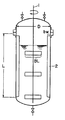
- the stirring condition is required to ensure that the reaction by the aforementioned collision will sufficiently be caused. Even if the stirring rate is high, it will be difficult to provide the reaction mixture with sufficient agitation if the reaction mixture undergoes a laminar flow, particularly when a reactor having a large volume of 1 m3 or more is used for the reaction.
- P stirring power
- N p stirring power number
- N p stirring power number
- p density of the reaction mixture (kg/m3)
- n stirring rate (rps, rotation per second)
- d length of stirring blade (M)
- Stirring power number N p is a constant of a reactor which varies depending on Reynolds number, but the term "stirring power number" in this invention indicates the stirring power number in the range of relatively constant value with Reynolds number of 5X10⁴ or more. According to the experiences of the present inventors, if the stirring power number is small, it is difficult from the standpoint of apparatus design to obtain a large stirring power of P>1.0 kw/m3 because the unacceptable increase of stirring rate or stirring blade length is required, and, furthermore, even if the stirring power of P>1.0 kw/m3 is obtained, it is not possible to cause the desired reaction.
- the reactor wherein the stirring power number is 1.2 or more with Reynolds number of 5x10⁴ or more, preferably used, for example, is an apparatus equipped with effective number of baffles.
- the period and time for stirring under the stirring condition of this invention can be any period and time during which the concentration of the terminal thiolate or thiol groups reaches 10 ⁇ mole/g or less.
- Stirring of this type can be carried out over all reaction period from the initiation of the reaction.
- stirring can also be carried out so that the stirring of this type is carried out only for the final stage of the reaction, the stirring for the initial stage being of a conventional type.
- stirring is carried out under this particular stirring condition of this invention, for the initial stage of the reaction, the molecular weight of the resulting polyarylene thioether tends to be lowered.
- final stage indicates the period near the completion time of reaction.
- stirring is conducted under this stirring condition only for the final stage of reaction, it is preferably conducted at least for 1 hour or more, particularly for 2 hours or more before completion of reaction. If stirring continues for less than 1 hour, the reaction of the terminal thiolate or thiol groups with the remaining halo-substituted aromatic compound tends to be insufficient.
- the aforementioned polymerization process of this invention can be applied to all of the polymerization processes for producing the homopolymer, copolymer, and block polymers of the polyarylene thioether.
- the aforementioned method of the two-step polymerization with addition of water is one of the methods whereto the polymerization process according to this invention is applied.
- both the raw materials are charged in the range of the ratio (B)/(A) of 1.0025 - 1.09 (mole/mole), at least the former stage of the polymerization, during which no water has not been supplemented, is conducted with the stirring which will satisfy either one of the stirring conditions (a) that a reactor having a stirring power number of less than 1.2 is used or (b) that the stirring power applied is less than 1.0 (kw/m3), and the latter stage of the polymerization, during which water has been supplemented, is conducted with stirring which will satisfy the stirring conditions that a reactor having stirring power number of 1.2 or more is used and intense stirring with a stirring power of 1.0 kw/m3 or more is conducted.
- the polyarylene thioether obtained according to this invention has an extremely decreased concentration of the terminal thiolate or thiol groups.
- the terminal thiolate or thiol groups can be quantitatively determined by the mercapto group determination method using iodo-acetamide.
- the terminal thiolate or thiol groups of the polyarylene thioether obtained in this invention have a concentration of 10 ⁇ mole/g or less.
- the polyarylene thioether of this invention has an extremely high stability compared with that of conventional polyarylene thioethers. Thus, even when it is melt extruded with a melt processing apparatus which is constructed with iron materials, decomposition reaction occurs only rarely. Thus, clear melt molded articles wherein coloration or denaturation occurs only rarely are obtained.
- the polyarylene thioether polymer of this invention belongs to the category of thermoplastic polymers, and thus it is possible to conduct a variety of processing or modification which is applicable to thermoplastic polymers.
- the polymer can also be used with being filled with powdery fillers such as carbon black, calcium carbonate powder, silica powder, titanium oxide powder or the like or fibrous fillers such as carbon fiber, glass fiber, asbestos, polyaramide fiber or the like.
- the polymer can also be used with being incorporated with one or more of synthetic resins such as polycarbonate, polyphenylene oxide, polysulfone, polyarylene, polyacetal, polyimide, polyamide, polyester, polystyrene, or ABS.
- reaction vessels In one of the reaction vessels a commercial hydrated sodium sulfide was charged together with N-methylpyrrolidone. Temperature was raised up to ca. 200°C before initiation of polymerization and an appropriate amount of water was removed by evaporation to control the water content in the reaction mixture. All of H2S removed by evaporation during the operation was collected and determined, so that the effective charge of Na2S was calculated and the corresponding amount of the haloaromatic compound was charged to react at a certain temperature for a certain period (polymerization in the former stage).
- reaction conditions such as the amount and ratio of respective raw materials, the types of reaction vessels, stirring power, power number, reaction temperature, time and the like are listed collectively in Table 1.
- part of the reaction mixture (slurry) was taken and immediately subjected to the quantitative determination of the terminal thiolate or thiol groups.
- the remaining slurry was filtered, purified by washing with acetone and water and dried to obtain a powdered polymer.
- the water content (mole/mole) in the reaction mixture represents the molar ratio of the water content and the effective charge of sodium sulfide.
- p-DCB represents paradichlorobenzene, m-DCB metadichlorobenzene, and NMP N-methylpyrrolidone.
- the amount of the sample is preferably selected to ensure that the concentration of the thiol group in the acetone slurry is in the range of 0.1 - 0.3 mmole). 3 runs of measurement were conducted for the same dried sample and the average concentration of the terminal thiol group was calculated. The results are collectively shown in Table 2.
- each of polymers was heated to 320°C to melt it and processed by extrusion into pellets.
- the degree of coloration by heating in the melt processing was used as a measure of stability. That is, the polymer powders P1 - P6, PP1 - PP4 illustrated in Table 1 were subjected to melt processing with the use of a uniaxial kneading-extruder (cylinder: nitriding steel, screw barrel: nitriding steel) to form pellets. The pellets were pressed under the condition of pre-heating for 320°C/2 min.
- the terminal thiolate or thiol group concentration was less than 10 ⁇ mole/g polymer and the HUNTER whiteness was 30% or more which showed low coloration.
- Comparative Examples PP-1, PP-3 and PP-4 wherein the vessel X having a small stirring power number was used on polymerization at the latter stage and in Comparative Example PP-2 wherein the vessel Y having a large stirring power number and a low stirring power was used at the latter stage, stirring effect was poor and the reaction was insufficient.
- the terminal thiolate or thiol group concentration was over 10 ⁇ mole/g polymer and HUNTER whiteness was small and thus coloration was intense.
Landscapes
- Chemical & Material Sciences (AREA)
- Health & Medical Sciences (AREA)
- Chemical Kinetics & Catalysis (AREA)
- Medicinal Chemistry (AREA)
- Polymers & Plastics (AREA)
- Organic Chemistry (AREA)
- Polymers With Sulfur, Phosphorus Or Metals In The Main Chain (AREA)
Claims (9)
- Ein Verfahren zur Herstellung eines Polyarylenthioäthers mittels einer Dehalogenisierungs-Sulfidierungsreaktion zwischen einem Alkalimetallsulfid und einer dihalogenaromatischen Verbindung in einem polaren organischen Lösungsmittel, dadurch gekennzeichnet, daß die Reaktion fortgesetzt wird, bis die Konzentration einer Thiolatgruppe oder einer Thiolgruppe in Endstellung an dem gebildeten Polyarylenthioäther einen Wert von 10 µMol/g oder weniger erreicht, indem man mindestens die folgenden Bedingungen anwendet:(a) die dihalogenaromatische Verbindung wird als Hauptkomponente einer halogenaromatischen Verbindung angewendet, wobei das Verhältnis eines Äquivalentgewichtes der Gesamtbeschickung an (B) der halogenaromatischen Verbindung zu einem Äquivalentgewicht der effektiven Beschickung (A) an Alkalimetallsulfid, d.h. (B)/(A), einen Wert im Bereich von 1.002 bis 1.25 hat, und die dihalogenaromatische Verbindung ist mindestens in einer Menge vorhanden, welche mit der effektiven Beschickung mit dem Alkalimetallsulfid äquimolekular ist, und(b) während eines späteren Zeitabschnittes von mindestens einer Stunde vor Beendigung der Reaktion wird diese Reaktion derart durchgeführt, daß eine Vorrichtung mit einer Rührleistungszahl (stirring power number) von 1.2 oder mehr bei eines Reynolds-Zahl von 5 x 10⁴ oder mehr verwendet wird, und die Reaktion wird unter solchen Rührbedingungen durchgeführt, daß die Rührenergie (stirring power) einen Wert von 1.0 kw/m³ oder mehr hat.
- Ein Verfahren zur Herstellung eines Polyarylenthioäthers gemäß Anspruch 1, in welchem in einer zeitlich früheren Stufe die Polymerisation unter mindestens einer der nachstehenden Rührbedingungen durchgeführt wird, daß nämlich eine Vorrichtung derart verwendet wird, daß die Rührleistungszahl einen Wert von weniger als 1.2 bei einer Reynolds-Zahl von 5 x 10⁴ oder mehr hat, oder daß die Rührenergie einen Wert von weniger als 1.0 kw/m³ hat, wobei bei einer Temperatur von 230°C oder niedriger mit einem Wassergehalt von 2.4 Mol oder weniger je Mol (A) in der Reaktionsmischung gearbeitet wird, wobei die Umwandlung der halogenaromatischen Verbindung 90 Mol% oder mehr beträgt und die Schmelzviskosität des gebildeten Polyarylenthioäthers, bestimmt bei 310°C mit einer Schergeschwindigkeit von 200 sec.⁻¹, 30 Pas (300 Poise) oder weniger beträgt, während in dem späteren Zeitabschnitt der Polymerisation von mindestens einer Stunde vor Beendigung der Reaktion diese mit einem Wassergehalt in der Reaktionsmischung von 2.5 bis 10 Mol je Mol (A) bei einer Temperatur von 240 bis 280°C derart durchgeführt wird, daß der gebildete Polyarylenthioäther eine Viskosität von 100 Pas (1000 Poise) oder mehr aufweist, und wobei die Reaktion mit einem Äquivalentgewichtsverhältnis von (B)/(A) im Bereich von 1.0025 bis 1.09 durchgeführt wird.
- Ein Verfahren zur Herstellung eines Polyarylenthioäthers gemäß Anspruch 1 oder 2, in welchem die halogenaromatische Verbindung im wesentlichen aus para-Dichlorbenzol besteht.
- Ein Verfahren gemäß Anspruch 1 oder 2, in welchem die halogenaromatische Verbindung para-Dichlorbenzol und meta-Dichlorbenzol ist und der daraus gebildete Polyarylenthioäther ein Blockcopolymer ist, welches im wesentlichen aus einem Poly-paraphenylensulfidblock und aus einem Poly-metaphenylensulfidblock besteht.
- Ein Verfahren nach irgendeinem der vorhergehenden Ansprüche, in welchem das Äquivalentgewichtsverhältnis (B)/(A) im Bereich von 1.005 bis 1.2 liegt.
- Ein Verfahren gemäß irgendeinem der vorhergehenden Ansprüche, in welchem die Rührleistungszahl in der zeitlich späteren Polymerisationsstufe einen Wert von 1.4 oder mehr hat.
- Ein Verfahren nach irgendeinem der vorhergehenden Ansprüche, in welchem die Rührenergie in dem zeitlich späteren Abschnitt einen Wert von 1.1 kw/m³ oder mehr hat.
- Verfahren nach einem der vorhergehenden Ansprüche, in welchem das Alkalimetallsulfid Natriumsulfid ist.
- Ein Verfahren nach einem der vorhergehenden Ansprüche, in welchem das organische polare Lösungsmittel N-Methylpyrrolidon ist.
Applications Claiming Priority (2)
| Application Number | Priority Date | Filing Date | Title |
|---|---|---|---|
| JP30457/86 | 1986-02-14 | ||
| JP61030457A JPH0643489B2 (ja) | 1986-02-14 | 1986-02-14 | 安定性の高いポリアリ−レンチオエ−テルの製造法 |
Publications (2)
| Publication Number | Publication Date |
|---|---|
| EP0238193A1 EP0238193A1 (de) | 1987-09-23 |
| EP0238193B1 true EP0238193B1 (de) | 1991-07-31 |
Family
ID=12304428
Family Applications (1)
| Application Number | Title | Priority Date | Filing Date |
|---|---|---|---|
| EP87301210A Expired - Lifetime EP0238193B1 (de) | 1986-02-14 | 1987-02-12 | Verfahren zur Herstellung von Polyarylenthioäthern mit hoher Stabilität |
Country Status (5)
| Country | Link |
|---|---|
| US (1) | US4761468A (de) |
| EP (1) | EP0238193B1 (de) |
| JP (1) | JPH0643489B2 (de) |
| CA (1) | CA1270593A (de) |
| DE (1) | DE3771751D1 (de) |
Families Citing this family (15)
| Publication number | Priority date | Publication date | Assignee | Title |
|---|---|---|---|---|
| US5268451A (en) * | 1988-05-26 | 1993-12-07 | Kureha Kagaku Kogyo Kabushiki Kaisha | Process for the preparation of cross-linked polyarylene sulfide |
| US4952671A (en) * | 1988-07-15 | 1990-08-28 | Eastman Kodak Company | Terminated copoly(arylene sulfide) |
| US5905137A (en) * | 1996-11-19 | 1999-05-18 | Hoechst Aktiengesellschaft | Process for preparing sulfur-containing polymers |
| JP4055491B2 (ja) * | 2001-07-19 | 2008-03-05 | 東ソー株式会社 | 粒状ポリアリーレンスルフィドの製造方法 |
| DE60323394D1 (de) * | 2002-12-27 | 2008-10-16 | Kureha Corp | Polyarylensulfid und dessen herstellungsverfahren |
| US8883960B2 (en) | 2007-01-04 | 2014-11-11 | Sk Chemicals Co., Ltd. | Polyarylene sulfide resin with excellent luminosity and preparation method thereof |
| JP6045836B2 (ja) * | 2011-07-28 | 2016-12-14 | 住友化学株式会社 | ポリエーテルスルホンの製造方法 |
| CN102329426B (zh) * | 2011-08-11 | 2013-07-24 | 深圳市宝力特科技有限公司 | 一种聚苯硫醚树脂的合成工艺 |
| WO2015047718A1 (en) | 2013-09-25 | 2015-04-02 | Ticona Llc | Multi-stage process for forming polyarylene sulfides |
| US9617387B2 (en) | 2013-09-25 | 2017-04-11 | Ticona Llc | Scrubbing process for polyarylene sulfide formation |
| US9604156B2 (en) | 2013-09-25 | 2017-03-28 | Ticona Llc | Method and system for separation of a polymer from multiple compounds |
| WO2015047720A1 (en) | 2013-09-25 | 2015-04-02 | Ticona Llc | Process for forming low halogen content polyarylene sulfides |
| US9388283B2 (en) | 2013-09-25 | 2016-07-12 | Ticona Llc | Method of polyarylene sulfide crystallization |
| JP6684206B2 (ja) | 2013-09-25 | 2020-04-22 | ティコナ・エルエルシー | ポリアリーレンスルフィドの形成中における塩副生成物の分離 |
| CN106633062B (zh) * | 2016-12-30 | 2018-12-28 | 浙江新和成特种材料有限公司 | 一种低氯含量的聚苯硫醚及其制备方法、树脂组合物和成形体 |
Family Cites Families (10)
| Publication number | Priority date | Publication date | Assignee | Title |
|---|---|---|---|---|
| US3408342A (en) * | 1965-08-31 | 1968-10-29 | Phillips Petroleum Co | Stabilized poly(arylene sulfides |
| US4238585A (en) * | 1979-08-10 | 1980-12-09 | Thiokol Corporation | Aryl amine terminated polysulfide polymers, related compounds and processes for their preparation |
| US4282347A (en) * | 1979-08-14 | 1981-08-04 | Phillips Petroleum Company | Preparation of branched polymers of arylene sulfide |
| US4324886A (en) * | 1980-05-06 | 1982-04-13 | Phillips Petroleum Company | Arylene sulfide polymer prepared from aminoalkanoate |
| DE3019732A1 (de) * | 1980-05-23 | 1981-12-03 | Bayer Ag, 5090 Leverkusen | Verfahren zur herstellung von polyarylensulfiden |
| JPS5790018A (en) * | 1980-11-27 | 1982-06-04 | Toray Ind Inc | Stabilized polyphenylene sulfide and its production |
| US4608433A (en) * | 1982-01-18 | 1986-08-26 | The Dow Chemical Company | Inert monovalent hydrocarbon terminated polysulfide polymers |
| DE3421608A1 (de) * | 1984-06-09 | 1985-12-12 | Bayer Ag, 5090 Leverkusen | Verfahren zur herstellung von polyarylensulfiden mit funktionellen endgruppen |
| CH665507A5 (de) * | 1984-06-12 | 1988-05-13 | Bbc Brown Boveri & Cie | Horizontalachsige elektrische maschine mit einer einrichtung zur statorblechpaketbefestigung. |
| US4645826A (en) * | 1984-06-20 | 1987-02-24 | Kureha Kagaku Kogyo Kabushiki Kaisha | Process for production of high to ultra-high molecular weight linear polyarylenesulfides |
-
1986
- 1986-02-14 JP JP61030457A patent/JPH0643489B2/ja not_active Expired - Lifetime
-
1987
- 1987-02-12 EP EP87301210A patent/EP0238193B1/de not_active Expired - Lifetime
- 1987-02-12 DE DE8787301210T patent/DE3771751D1/de not_active Expired - Fee Related
- 1987-02-13 CA CA000529685A patent/CA1270593A/en not_active Expired - Fee Related
- 1987-02-17 US US07/015,346 patent/US4761468A/en not_active Expired - Lifetime
Also Published As
| Publication number | Publication date |
|---|---|
| DE3771751D1 (de) | 1991-09-05 |
| US4761468A (en) | 1988-08-02 |
| JPH0643489B2 (ja) | 1994-06-08 |
| CA1270593A (en) | 1990-06-19 |
| JPS62187731A (ja) | 1987-08-17 |
| EP0238193A1 (de) | 1987-09-23 |
Similar Documents
| Publication | Publication Date | Title |
|---|---|---|
| US4761468A (en) | Process for preparing polyarylene thioether having thiol/thiolate end group concentration of 10 micro mole/g or less | |
| US8138302B2 (en) | Polyarylene sulfide and process for producing the same | |
| EP1577337B1 (de) | Herstellungsverfahren und reinigungsverfahren für polyarylensulfid sowie reinigungsverfahren für die dabei verwendete organische lösung | |
| US7834133B2 (en) | Production process of poly(arylene sulfide) | |
| EP0448194B1 (de) | Prozess zur Herstellung von Polyarylensulfiden | |
| EP1586601A1 (de) | Polyarylensulfid und herstellungsverfahren dafür | |
| WO2002081550A1 (fr) | Procede de production continue de sulfure de polyarylene | |
| EP0354133B1 (de) | Verfahren zur Herstellung von Copoly(arylensulfiden) mit endständigen Gruppen | |
| CA2001097C (en) | Poly(arylene thioether) block copolymer fibers and production process thereof | |
| JPH0770319A (ja) | ポリアリーレンスルフイド類 | |
| EP0368503A2 (de) | Fasern aus Polyarylenthioetherblockcopolymeren und Verfahren zu ihrer Herstellung | |
| TWI299337B (de) | ||
| US5369191A (en) | Aromatic thioether ketone/thioether sulfone copolymer and production process thereof | |
| CA2004259A1 (en) | Higher molecular weight arylene sulfide resin and process for its preparation | |
| EP0369620A2 (de) | Polyarylenthioetherblockcopolymer und Verfahren zu dessen Herstellung | |
| US5008370A (en) | Poly(arylene thioether-ketones) improved in melt stability and preparation process thereof | |
| EP0518702A1 (de) | Verfahren zur Darstellung von modifizierten Polyphenylensulfidharzen | |
| EP0320142A2 (de) | Verfahren zur Herstellung von Polyarylensulfiden | |
| US5312894A (en) | Granular high-melt-stable poly(arylene thioether-ketone) and production process thereof | |
| US5391645A (en) | Poly(arylene thioether-ketone) copolymer and production process thereof | |
| EP0369653B1 (de) | Polyarylenthioätherketone mit verbesserter Schmelzstabilität und Verfahren zu ihrer Herstellung | |
| US5250636A (en) | Poly(arylene thioether-ketone-ketone) copolymer and production process thereof | |
| US5153264A (en) | Poly(arylene thioether) block copolymer and production process thereof | |
| EP0512868B1 (de) | Hoch-hitzebeständige Harzmassen | |
| US5153278A (en) | Poly(arylene thioether) block copolymer and production process thereof |
Legal Events
| Date | Code | Title | Description |
|---|---|---|---|
| PUAI | Public reference made under article 153(3) epc to a published international application that has entered the european phase |
Free format text: ORIGINAL CODE: 0009012 |
|
| 17P | Request for examination filed |
Effective date: 19870226 |
|
| AK | Designated contracting states |
Kind code of ref document: A1 Designated state(s): DE FR GB |
|
| 17Q | First examination report despatched |
Effective date: 19891023 |
|
| GRAA | (expected) grant |
Free format text: ORIGINAL CODE: 0009210 |
|
| AK | Designated contracting states |
Kind code of ref document: B1 Designated state(s): DE FR GB |
|
| REF | Corresponds to: |
Ref document number: 3771751 Country of ref document: DE Date of ref document: 19910905 |
|
| ET | Fr: translation filed | ||
| PLBE | No opposition filed within time limit |
Free format text: ORIGINAL CODE: 0009261 |
|
| STAA | Information on the status of an ep patent application or granted ep patent |
Free format text: STATUS: NO OPPOSITION FILED WITHIN TIME LIMIT |
|
| 26N | No opposition filed | ||
| PGFP | Annual fee paid to national office [announced via postgrant information from national office to epo] |
Ref country code: DE Payment date: 20010205 Year of fee payment: 15 |
|
| PGFP | Annual fee paid to national office [announced via postgrant information from national office to epo] |
Ref country code: GB Payment date: 20010207 Year of fee payment: 15 |
|
| PGFP | Annual fee paid to national office [announced via postgrant information from national office to epo] |
Ref country code: FR Payment date: 20010213 Year of fee payment: 15 |
|
| REG | Reference to a national code |
Ref country code: GB Ref legal event code: IF02 |
|
| PG25 | Lapsed in a contracting state [announced via postgrant information from national office to epo] |
Ref country code: GB Free format text: LAPSE BECAUSE OF NON-PAYMENT OF DUE FEES Effective date: 20020212 |
|
| PG25 | Lapsed in a contracting state [announced via postgrant information from national office to epo] |
Ref country code: DE Free format text: LAPSE BECAUSE OF NON-PAYMENT OF DUE FEES Effective date: 20020903 |
|
| GBPC | Gb: european patent ceased through non-payment of renewal fee |
Effective date: 20020212 |
|
| PG25 | Lapsed in a contracting state [announced via postgrant information from national office to epo] |
Ref country code: FR Free format text: LAPSE BECAUSE OF NON-PAYMENT OF DUE FEES Effective date: 20021031 |
|
| REG | Reference to a national code |
Ref country code: FR Ref legal event code: ST |
|
| REG | Reference to a national code |
Ref country code: HK Ref legal event code: AM43 Ref document number: 1163536 Country of ref document: HK |