EP0238954A2 - Verfahren zur Herstellung von L-Phosphinothricin(derivaten) sowie ihrer Alkylester - Google Patents
Verfahren zur Herstellung von L-Phosphinothricin(derivaten) sowie ihrer Alkylester Download PDFInfo
- Publication number
- EP0238954A2 EP0238954A2 EP87103720A EP87103720A EP0238954A2 EP 0238954 A2 EP0238954 A2 EP 0238954A2 EP 87103720 A EP87103720 A EP 87103720A EP 87103720 A EP87103720 A EP 87103720A EP 0238954 A2 EP0238954 A2 EP 0238954A2
- Authority
- EP
- European Patent Office
- Prior art keywords
- formula
- methyl
- derivatives
- compounds
- homoalanin
- Prior art date
- Legal status (The legal status is an assumption and is not a legal conclusion. Google has not performed a legal analysis and makes no representation as to the accuracy of the status listed.)
- Granted
Links
- 238000004519 manufacturing process Methods 0.000 title description 5
- 125000005907 alkyl ester group Chemical group 0.000 title 1
- 238000000034 method Methods 0.000 claims abstract description 14
- IAJOBQBIJHVGMQ-BYPYZUCNSA-N glufosinate-P Chemical compound CP(O)(=O)CC[C@H](N)C(O)=O IAJOBQBIJHVGMQ-BYPYZUCNSA-N 0.000 claims abstract description 13
- 229910052703 rhodium Inorganic materials 0.000 claims abstract description 6
- 239000010948 rhodium Substances 0.000 claims abstract description 6
- 229910052707 ruthenium Inorganic materials 0.000 claims abstract description 6
- KJTLSVCANCCWHF-UHFFFAOYSA-N Ruthenium Chemical compound [Ru] KJTLSVCANCCWHF-UHFFFAOYSA-N 0.000 claims abstract description 5
- 229910052741 iridium Inorganic materials 0.000 claims abstract description 5
- 238000002360 preparation method Methods 0.000 claims abstract description 5
- MHOVAHRLVXNVSD-UHFFFAOYSA-N rhodium atom Chemical compound [Rh] MHOVAHRLVXNVSD-UHFFFAOYSA-N 0.000 claims abstract description 5
- GKOZUEZYRPOHIO-UHFFFAOYSA-N iridium atom Chemical compound [Ir] GKOZUEZYRPOHIO-UHFFFAOYSA-N 0.000 claims abstract description 4
- 238000009876 asymmetric hydrogenation reaction Methods 0.000 claims abstract description 3
- 150000001875 compounds Chemical class 0.000 claims description 16
- UFHFLCQGNIYNRP-UHFFFAOYSA-N Hydrogen Chemical compound [H][H] UFHFLCQGNIYNRP-UHFFFAOYSA-N 0.000 claims description 6
- 125000002252 acyl group Chemical group 0.000 claims description 6
- 125000001997 phenyl group Chemical group [H]C1=C([H])C([H])=C(*)C([H])=C1[H] 0.000 claims description 6
- 239000001257 hydrogen Substances 0.000 claims description 5
- 229910052739 hydrogen Inorganic materials 0.000 claims description 5
- 125000004191 (C1-C6) alkoxy group Chemical group 0.000 claims description 4
- 125000004169 (C1-C6) alkyl group Chemical group 0.000 claims description 4
- 150000001336 alkenes Chemical group 0.000 claims description 4
- 150000001450 anions Chemical class 0.000 claims description 4
- 125000004122 cyclic group Chemical group 0.000 claims description 4
- JRZJOMJEPLMPRA-UHFFFAOYSA-N olefin Natural products CCCCCCCC=C JRZJOMJEPLMPRA-UHFFFAOYSA-N 0.000 claims description 4
- 125000001424 substituent group Chemical group 0.000 claims description 4
- 125000003545 alkoxy group Chemical group 0.000 claims description 3
- 125000004437 phosphorous atom Chemical group 0.000 claims description 3
- 125000001589 carboacyl group Chemical group 0.000 claims description 2
- 125000002091 cationic group Chemical group 0.000 claims description 2
- 150000004696 coordination complex Chemical class 0.000 claims description 2
- 239000012188 paraffin wax Substances 0.000 claims description 2
- 125000003236 benzoyl group Chemical group [H]C1=C([H])C([H])=C(C([H])=C1[H])C(*)=O 0.000 claims 1
- 239000003054 catalyst Substances 0.000 abstract description 15
- OKKJLVBELUTLKV-UHFFFAOYSA-N Methanol Chemical compound OC OKKJLVBELUTLKV-UHFFFAOYSA-N 0.000 description 24
- -1 aryloxycarbonyl radical Chemical class 0.000 description 19
- VEXZGXHMUGYJMC-UHFFFAOYSA-N Hydrochloric acid Chemical compound Cl VEXZGXHMUGYJMC-UHFFFAOYSA-N 0.000 description 10
- 238000006243 chemical reaction Methods 0.000 description 10
- LFQSCWFLJHTTHZ-UHFFFAOYSA-N Ethanol Chemical compound CCO LFQSCWFLJHTTHZ-UHFFFAOYSA-N 0.000 description 9
- YXFVVABEGXRONW-UHFFFAOYSA-N Toluene Chemical compound CC1=CC=CC=C1 YXFVVABEGXRONW-UHFFFAOYSA-N 0.000 description 9
- GCZPTWOGXDBENT-WCCKRBBISA-N (2s)-2-amino-4-[hydroxy(methyl)phosphoryl]butanoic acid;hydrochloride Chemical compound Cl.CP(O)(=O)CC[C@H](N)C(O)=O GCZPTWOGXDBENT-WCCKRBBISA-N 0.000 description 8
- XKRFYHLGVUSROY-UHFFFAOYSA-N Argon Chemical compound [Ar] XKRFYHLGVUSROY-UHFFFAOYSA-N 0.000 description 8
- 230000003287 optical effect Effects 0.000 description 8
- 239000011541 reaction mixture Substances 0.000 description 8
- QTBSBXVTEAMEQO-UHFFFAOYSA-N Acetic acid Chemical compound CC(O)=O QTBSBXVTEAMEQO-UHFFFAOYSA-N 0.000 description 7
- XLYOFNOQVPJJNP-UHFFFAOYSA-N water Substances O XLYOFNOQVPJJNP-UHFFFAOYSA-N 0.000 description 6
- 150000002500 ions Chemical class 0.000 description 5
- 239000007787 solid Substances 0.000 description 5
- YIMSSVBUCNQOPM-UHFFFAOYSA-O (3-acetamido-3-carboxyprop-2-enyl)-(hydroxymethyl)-oxophosphanium Chemical compound CC(=O)NC(C(O)=O)=CC[P+](=O)CO YIMSSVBUCNQOPM-UHFFFAOYSA-O 0.000 description 4
- IJGRMHOSHXDMSA-UHFFFAOYSA-N Atomic nitrogen Chemical compound N#N IJGRMHOSHXDMSA-UHFFFAOYSA-N 0.000 description 4
- DEFJQIDDEAULHB-IMJSIDKUSA-N L-alanyl-L-alanine Chemical compound C[C@H](N)C(=O)N[C@@H](C)C(O)=O DEFJQIDDEAULHB-IMJSIDKUSA-N 0.000 description 4
- 229910052786 argon Inorganic materials 0.000 description 4
- 238000005984 hydrogenation reaction Methods 0.000 description 4
- 239000000203 mixture Substances 0.000 description 4
- 239000002904 solvent Substances 0.000 description 4
- AZUYLZMQTIKGSC-UHFFFAOYSA-N 1-[6-[4-(5-chloro-6-methyl-1H-indazol-4-yl)-5-methyl-3-(1-methylindazol-5-yl)pyrazol-1-yl]-2-azaspiro[3.3]heptan-2-yl]prop-2-en-1-one Chemical compound ClC=1C(=C2C=NNC2=CC=1C)C=1C(=NN(C=1C)C1CC2(CN(C2)C(C=C)=O)C1)C=1C=C2C=NN(C2=CC=1)C AZUYLZMQTIKGSC-UHFFFAOYSA-N 0.000 description 3
- UHOVQNZJYSORNB-UHFFFAOYSA-N Benzene Chemical compound C1=CC=CC=C1 UHOVQNZJYSORNB-UHFFFAOYSA-N 0.000 description 3
- RWRDLPDLKQPQOW-UHFFFAOYSA-N Pyrrolidine Chemical compound C1CCNC1 RWRDLPDLKQPQOW-UHFFFAOYSA-N 0.000 description 3
- 229960000583 acetic acid Drugs 0.000 description 3
- 230000002378 acidificating effect Effects 0.000 description 3
- 125000004432 carbon atom Chemical group C* 0.000 description 3
- 150000003254 radicals Chemical class 0.000 description 3
- 230000035484 reaction time Effects 0.000 description 3
- 238000010992 reflux Methods 0.000 description 3
- 150000003839 salts Chemical class 0.000 description 3
- 239000007858 starting material Substances 0.000 description 3
- 239000000758 substrate Substances 0.000 description 3
- YJTNHDYMQPHXFO-UHFFFAOYSA-N 4-(hydroxymethylphosphinyl)-2-oxobutyric acid Chemical compound CP(O)(=O)CCC(=O)C(O)=O YJTNHDYMQPHXFO-UHFFFAOYSA-N 0.000 description 2
- DLFVBJFMPXGRIB-UHFFFAOYSA-N Acetamide Chemical compound CC(N)=O DLFVBJFMPXGRIB-UHFFFAOYSA-N 0.000 description 2
- CSCPPACGZOOCGX-UHFFFAOYSA-N Acetone Chemical compound CC(C)=O CSCPPACGZOOCGX-UHFFFAOYSA-N 0.000 description 2
- RDIKFPRVLJLMER-BQBZGAKWSA-N Ala-Leu Chemical compound CC(C)C[C@@H](C(O)=O)NC(=O)[C@H](C)N RDIKFPRVLJLMER-BQBZGAKWSA-N 0.000 description 2
- 108700023418 Amidases Proteins 0.000 description 2
- KAKZBPTYRLMSJV-UHFFFAOYSA-N Butadiene Chemical compound C=CC=C KAKZBPTYRLMSJV-UHFFFAOYSA-N 0.000 description 2
- WYURNTSHIVDZCO-UHFFFAOYSA-N Tetrahydrofuran Chemical compound C1CCOC1 WYURNTSHIVDZCO-UHFFFAOYSA-N 0.000 description 2
- 108010056243 alanylalanine Proteins 0.000 description 2
- 102000005922 amidase Human genes 0.000 description 2
- 239000012300 argon atmosphere Substances 0.000 description 2
- 238000003776 cleavage reaction Methods 0.000 description 2
- 239000012230 colorless oil Substances 0.000 description 2
- 230000002255 enzymatic effect Effects 0.000 description 2
- 239000012362 glacial acetic acid Substances 0.000 description 2
- 230000002363 herbicidal effect Effects 0.000 description 2
- 125000004356 hydroxy functional group Chemical group O* 0.000 description 2
- 150000002466 imines Chemical class 0.000 description 2
- 239000011261 inert gas Substances 0.000 description 2
- 150000007522 mineralic acids Chemical class 0.000 description 2
- 229910052757 nitrogen Inorganic materials 0.000 description 2
- 150000007524 organic acids Chemical class 0.000 description 2
- WLJVXDMOQOGPHL-UHFFFAOYSA-N phenylacetic acid Chemical compound OC(=O)CC1=CC=CC=C1 WLJVXDMOQOGPHL-UHFFFAOYSA-N 0.000 description 2
- 238000001953 recrystallisation Methods 0.000 description 2
- 230000007017 scission Effects 0.000 description 2
- 238000003756 stirring Methods 0.000 description 2
- HDPNBNXLBDFELL-UHFFFAOYSA-N 1,1,1-trimethoxyethane Chemical compound COC(C)(OC)OC HDPNBNXLBDFELL-UHFFFAOYSA-N 0.000 description 1
- VYXHVRARDIDEHS-UHFFFAOYSA-N 1,5-cyclooctadiene Chemical compound C1CC=CCCC=C1 VYXHVRARDIDEHS-UHFFFAOYSA-N 0.000 description 1
- 239000004912 1,5-cyclooctadiene Substances 0.000 description 1
- LBLYYCQCTBFVLH-UHFFFAOYSA-N 2-Methylbenzenesulfonic acid Chemical compound CC1=CC=CC=C1S(O)(=O)=O LBLYYCQCTBFVLH-UHFFFAOYSA-N 0.000 description 1
- HBAQYPYDRFILMT-UHFFFAOYSA-N 8-[3-(1-cyclopropylpyrazol-4-yl)-1H-pyrazolo[4,3-d]pyrimidin-5-yl]-3-methyl-3,8-diazabicyclo[3.2.1]octan-2-one Chemical class C1(CC1)N1N=CC(=C1)C1=NNC2=C1N=C(N=C2)N1C2C(N(CC1CC2)C)=O HBAQYPYDRFILMT-UHFFFAOYSA-N 0.000 description 1
- CCNFQMNABFUFMN-UHFFFAOYSA-N Cl.CP(O)=O Chemical compound Cl.CP(O)=O CCNFQMNABFUFMN-UHFFFAOYSA-N 0.000 description 1
- 229910020366 ClO 4 Inorganic materials 0.000 description 1
- 241000196324 Embryophyta Species 0.000 description 1
- 108010073038 Penicillin Amidase Proteins 0.000 description 1
- GOOHAUXETOMSMM-UHFFFAOYSA-N Propylene oxide Chemical compound CC1CO1 GOOHAUXETOMSMM-UHFFFAOYSA-N 0.000 description 1
- FZNCGRZWXLXZSZ-CIQUZCHMSA-N Voglibose Chemical compound OCC(CO)N[C@H]1C[C@](O)(CO)[C@@H](O)[C@H](O)[C@H]1O FZNCGRZWXLXZSZ-CIQUZCHMSA-N 0.000 description 1
- WGOBPPNNYVSJTE-HSZRJFAPSA-N [(2r)-1-diphenylphosphanylpropan-2-yl]-diphenylphosphane Chemical compound C([C@@H](C)P(C=1C=CC=CC=1)C=1C=CC=CC=1)P(C=1C=CC=CC=1)C1=CC=CC=C1 WGOBPPNNYVSJTE-HSZRJFAPSA-N 0.000 description 1
- YUDRVAHLXDBKSR-UHFFFAOYSA-N [CH]1CCCCC1 Chemical compound [CH]1CCCCC1 YUDRVAHLXDBKSR-UHFFFAOYSA-N 0.000 description 1
- 125000002777 acetyl group Chemical group [H]C([H])([H])C(*)=O 0.000 description 1
- 238000005903 acid hydrolysis reaction Methods 0.000 description 1
- 230000010933 acylation Effects 0.000 description 1
- 238000005917 acylation reaction Methods 0.000 description 1
- 125000001931 aliphatic group Chemical group 0.000 description 1
- 125000004453 alkoxycarbonyl group Chemical group 0.000 description 1
- 125000000217 alkyl group Chemical group 0.000 description 1
- 230000029936 alkylation Effects 0.000 description 1
- 238000005804 alkylation reaction Methods 0.000 description 1
- 150000001412 amines Chemical class 0.000 description 1
- 150000001413 amino acids Chemical class 0.000 description 1
- 125000003710 aryl alkyl group Chemical group 0.000 description 1
- 125000003118 aryl group Chemical group 0.000 description 1
- 239000012298 atmosphere Substances 0.000 description 1
- 125000004429 atom Chemical group 0.000 description 1
- HCZNBZKRJTYNCE-UHFFFAOYSA-L bicyclo[2.2.1]hepta-2,5-diene;rhodium(2+);dichloride Chemical compound [Cl-].[Cl-].[Rh+2].C1=CC2C=CC1C2.C1=CC2C=CC1C2 HCZNBZKRJTYNCE-UHFFFAOYSA-L 0.000 description 1
- GINJFDRNADDBIN-FXQIFTODSA-N bilanafos Chemical compound OC(=O)[C@H](C)NC(=O)[C@H](C)NC(=O)[C@@H](N)CCP(C)(O)=O GINJFDRNADDBIN-FXQIFTODSA-N 0.000 description 1
- 229910052799 carbon Inorganic materials 0.000 description 1
- 150000001722 carbon compounds Chemical class 0.000 description 1
- 150000003857 carboxamides Chemical class 0.000 description 1
- 150000001768 cations Chemical class 0.000 description 1
- 239000012043 crude product Substances 0.000 description 1
- 239000013078 crystal Substances 0.000 description 1
- GPAYUJZHTULNBE-UHFFFAOYSA-N diphenylphosphine Chemical compound C=1C=CC=CC=1PC1=CC=CC=C1 GPAYUJZHTULNBE-UHFFFAOYSA-N 0.000 description 1
- 230000000694 effects Effects 0.000 description 1
- 150000002148 esters Chemical class 0.000 description 1
- 238000000855 fermentation Methods 0.000 description 1
- 230000004151 fermentation Effects 0.000 description 1
- 239000000706 filtrate Substances 0.000 description 1
- 125000000524 functional group Chemical group 0.000 description 1
- 229940093915 gynecological organic acid Drugs 0.000 description 1
- 239000004009 herbicide Substances 0.000 description 1
- 125000000623 heterocyclic group Chemical group 0.000 description 1
- 150000002431 hydrogen Chemical class 0.000 description 1
- 238000011065 in-situ storage Methods 0.000 description 1
- 230000006698 induction Effects 0.000 description 1
- 150000002503 iridium Chemical class 0.000 description 1
- 229910052751 metal Inorganic materials 0.000 description 1
- 239000002184 metal Substances 0.000 description 1
- 125000000956 methoxy group Chemical group [H]C([H])([H])O* 0.000 description 1
- 125000002496 methyl group Chemical group [H]C([H])([H])* 0.000 description 1
- 230000000813 microbial effect Effects 0.000 description 1
- 235000005985 organic acids Nutrition 0.000 description 1
- 229960003424 phenylacetic acid Drugs 0.000 description 1
- 239000003279 phenylacetic acid Substances 0.000 description 1
- LEVJVKGPFAQPOI-UHFFFAOYSA-N phenylmethanone Chemical compound O=[C]C1=CC=CC=C1 LEVJVKGPFAQPOI-UHFFFAOYSA-N 0.000 description 1
- FVZVCSNXTFCBQU-UHFFFAOYSA-N phosphanyl Chemical group [PH2] FVZVCSNXTFCBQU-UHFFFAOYSA-N 0.000 description 1
- 125000005328 phosphinyl group Chemical group [PH2](=O)* 0.000 description 1
- 229910052698 phosphorus Inorganic materials 0.000 description 1
- 239000002574 poison Substances 0.000 description 1
- 231100000614 poison Toxicity 0.000 description 1
- 150000003467 sulfuric acid derivatives Chemical class 0.000 description 1
- YLQBMQCUIZJEEH-UHFFFAOYSA-N tetrahydrofuran Natural products C=1C=COC=1 YLQBMQCUIZJEEH-UHFFFAOYSA-N 0.000 description 1
- 239000000052 vinegar Substances 0.000 description 1
- 235000021419 vinegar Nutrition 0.000 description 1
- 238000010626 work up procedure Methods 0.000 description 1
Classifications
-
- C—CHEMISTRY; METALLURGY
- C07—ORGANIC CHEMISTRY
- C07F—ACYCLIC, CARBOCYCLIC OR HETEROCYCLIC COMPOUNDS CONTAINING ELEMENTS OTHER THAN CARBON, HYDROGEN, HALOGEN, OXYGEN, NITROGEN, SULFUR, SELENIUM OR TELLURIUM
- C07F9/00—Compounds containing elements of Groups 5 or 15 of the Periodic Table
- C07F9/02—Phosphorus compounds
- C07F9/28—Phosphorus compounds with one or more P—C bonds
- C07F9/30—Phosphinic acids [R2P(=O)(OH)]; Thiophosphinic acids ; [R2P(=X1)(X2H) (X1, X2 are each independently O, S or Se)]
- C07F9/301—Acyclic saturated acids which can have further substituents on alkyl
-
- C—CHEMISTRY; METALLURGY
- C07—ORGANIC CHEMISTRY
- C07F—ACYCLIC, CARBOCYCLIC OR HETEROCYCLIC COMPOUNDS CONTAINING ELEMENTS OTHER THAN CARBON, HYDROGEN, HALOGEN, OXYGEN, NITROGEN, SULFUR, SELENIUM OR TELLURIUM
- C07F9/00—Compounds containing elements of Groups 5 or 15 of the Periodic Table
- C07F9/02—Phosphorus compounds
- C07F9/28—Phosphorus compounds with one or more P—C bonds
- C07F9/30—Phosphinic acids [R2P(=O)(OH)]; Thiophosphinic acids ; [R2P(=X1)(X2H) (X1, X2 are each independently O, S or Se)]
- C07F9/32—Esters thereof
- C07F9/3205—Esters thereof the acid moiety containing a substituent or a structure which is considered as characteristic
- C07F9/3211—Esters of acyclic saturated acids which can have further substituents on alkyl
Definitions
- L-phosphinothricin L-phosphinothricin
- L-Ptc L-phosphinothricin
- its esters and their salts with organic or inorganic acids or bases are, as described in DE-OS 28 56 260, the effective ones Enantiomers of the herbicidally active racemates described in DE-OS 27 17 440.
- the herbicidal activity of L-Ptc against numerous mono- and dicotyledonous, annual and perennial weeds is twice as great as that of racemate.
- pure L-Ptc instead of the racemate, the application rate of the herbicide can therefore be considerably reduced, which also reduces any undesirable side effects accordingly.
- N-acylated D, L-Ptc derivatives with the aid of acylases, be it a) by means of microbial acylases according to DE-OS 29 39 269, or b) by using penicillin-G-acylase according to DE -OS 30 48 612.
- Disadvantages of process a) are the low optical purity of the L-Ptc obtained, b) the complex work-up of the crude product via ion exchangers and the relatively high cost of the phenylacetic acid required for acylation.
- the starting materials II can be prepared in a simple manner from 4- (hydroxymethylphosphinyl) -2-oxobutyric acid and carboxamides analogously to EP-OS 30 424.
- R preferably represents OH and (C 1 -C 6 ) alkoxy and R, preferably H and (C 1 -C 6 ) alkyl.
- R represents any acyl, alkoxy or aryloxy radical.
- the lower alkanoyl (preferably acetyl) and the benzoyl compound (s) are most suitable, but the nature of the radical R 3 is not necessary for the reaction to succeed critical.
- the inventive method is carried out in such a way that the 2,3-dehydrophosphinothricin derivative of the general formula II in a suitable solvent such as water, methanol, ethanol, benzene, toluene or tetrahydrofuran, under an inert gas atmosphere, whereby inert gases are understood to be nitrogen or argon , dissolves and then adds a solution of the catalyst in the same or in a different solvent.
- a suitable solvent such as water, methanol, ethanol, benzene, toluene or tetrahydrofuran
- Suitable salts are the tribromides, trichlorides or sulfates of Ru, Rh or Ir.
- Suitable (di) -olefins are ethylene, propylene and butadiene and their homologues, but especially 1,5-cyclooctadiene and norbomadiene.
- radical Z is the dimethylene radical (CH 2 -CH 2 -), which can also carry further substituents on one or both CH 2 groups, for example one or two CH 3 groups or the cyclohexyl radical, so that the C -Atom becomes a chiral center.
- CH 2 groups for example one or two CH 3 groups or the cyclohexyl radical
- Typical representatives are:
- the dimethylene radical Z can also be part of an isocyclic ring system. Examples are given (Vf: J. Chem. Soc. Chem. Comm. 1983, 895; Vg: reports 114, 1137 (1981)) Finally, Z can also be a tetramethylene radical (-CH 2 -CH 2 -CH 2 -CH 2 -), which is substituted on one or more carbon atoms (preferably the two middle ones) by a methoxy group. Those compounds in which the two middle carbon atoms are linked via a O-alkylene-O bridge to form a 5- or 6-membered ring are particularly preferred. Compounds of this type are described in DE-AS 21 61 200.
- A CI-, Br-, ClO 4 -, BF 4 - or PF 6 - is preferred.
- the catalyst can either be isolated or used in situ for the hydrogenation of II.
- hydrogen is injected. It is hydrogenated at pressures of 0.5-200 bar, but preferably at 1-70 bar.
- the reaction temperature is -10 to 120 ° C, but preferably 5 to 80 ° C.
- the molar ratio of catalyst (111) and substrate (11) is in the range between 1:10 and 1: 100000, but preferably in the range between 1:50 and 1: 50,000.
- reaction vessel After the calculated amount of hydrogen has been taken up, the reaction vessel is let down and the catalyst is known, e.g. by stirring in a cation exchanger.
Landscapes
- Chemical & Material Sciences (AREA)
- Organic Chemistry (AREA)
- Health & Medical Sciences (AREA)
- Life Sciences & Earth Sciences (AREA)
- Biochemistry (AREA)
- General Health & Medical Sciences (AREA)
- Molecular Biology (AREA)
- Organic Low-Molecular-Weight Compounds And Preparation Thereof (AREA)
- Catalysts (AREA)
- Preparation Of Compounds By Using Micro-Organisms (AREA)
- Low-Molecular Organic Synthesis Reactions Using Catalysts (AREA)
Abstract
Description
- Die vorliegende Erfindung betrifft ein Verfahren zur Herstellung von L Homoalanin-4-yl(methyl)-phosphinsäure sowie ihrer Derivate der allgemeinen Formel I

- R Hydroxy, (C1-C6)Alkoxy, Ala-Ala(OH) oder Ala-Leu(OH),
- R' Wasserstoff oder (C1-C6)-Alkyl,
- R2 Wasserstoff, einen Acyl-, Alkoxycarbonyl-oder Aryloxycarbonylrest bedeuten, sowie deren Salze mit anorganischen oder organischen Säuren oder Basen.
- L-Homoalanin-4-yl(methyl)phosphinsäure, im folgenden L-Phosphinothricin oder kurz L-Ptc genannt, ihre Ester sowie ihre Salze mit organischen oder anorganischen Säuren oder Basen sind, wie in der DE-OS 28 56 260 beschrieben die wirksamen Enantiomeren der in der DE-OS 27 17 440 beschriebenen, herbizid wirksamen Racemate. Laut DE-OS 28 56 260 ist die herbizide Wirkung von L-Ptc gegen zahlreiche mono-und dikotyle, einjährige und mehrjährige Unkräuter doppelt so groß wie die des Racemats. Durch Verwendung von reinem L-Ptc anstelle des Racemats kann daher die Aufwandmenge des Herbizids erheblich reduziert werden, wodurch auch eventuelle unerwünschte Nebenwirkungen entsprechend verringert werden.
- Der breiten Anwendung von L-Ptc standen bisher jedoch die Schwierigkeiten bei seiner Herstellung entgegen.
- Zwar werden in der JA-OS 73-85538 und JA-OS 74-31890 die saure bzw. enzymatische Spaltung des L-Ptc enthaltenden Antiobiotikums SF-1293 beschrieben, jedoch ist die Herstellung des letzteren auf fermentativem Wege, wie sie z.B. in der DE-OS 22 36 599 beschrieben ist, sehr aufwendig.
- Bekannt ist femer die Spaltung von N-acylierten D,L-Ptc-Derivaten mit Hilfe von Acylasen, sei es a) mittels mikrobieller Acylasen gemäß DE-OS 29 39 269, sei es b) durch Einsatz von Penicillin-G-acylase gemäß DE-OS 30 48 612. Nachteilig sind bei dem Verfahren a) die geringe optische Reinheit des erhaltenen L-Ptc, bei b) die aufwendige Aufarbeitung der Rohprodukt über Ionenaustauscher sowie die relativ hohen Kosten der zur Acylierung benötigten Phenylessigsäure.
- Das einzige bisher bekannt gewordene nicht-enzymatische Verfahren zur Herstellung von L-Ptc, das in der EP-OS-127 429 beschrieben wird, benutzt ein chirales, nichtracemisches Imin als Ausgangsmaterial, um in einem Alkylierungsschritt nach dem Prinzip der asymmetrischen Induktion (zur Erläuterung des Begriffs siehe E.L. Eliel: Stereochemie der Kohlenstoffverbindungen S. 23-30, Verlag Chemie, Weinheim 1966) das chirale Kohlenstoffatom im L-Ptc aufzubauen.
- Nachteilig bei diesem Verfahren ist allerdings, daß der teure chirale Hilfsstoff, der zur Herstellung des chiralen Imins verwendet wird, in äquimolaren Mengen benötigt wird und nach der Reaktion nicht wieder zurückgewonnen werden kann.
- Es bestand daher die Aufgabe, ein einfaches Verfahren zu entwickeln, das die Herstellung von L-Phosphinothricin in größeren Mengen und mit hoher optischer Reinheit erlaubt
- Gegenstand der Erfindung ist somit ein Verfahren zur Herstellung von L-Homoalanin-4-yl(methyl)-phosphinsäure sowie ihrer Derivate der allgemeinen Formel I, das dadurch gekennzeichnet ist, daß man 2,3-Dehydro-phosphinothricinderivate der allgemeinen Formel II

- R und R, die gleiche Bedeutung wie in Formel I haben und
- R3 einen Acyl-, Alkoxy-oder Aryloxycarbonylrest bedeutet, in Gegenwart eines für die homogene asymmetrische Hydrierung geeigneten Komplexes der Formel III

- Z eine C2-C4-Paraffinkette, die einen oder mehrere Substituenten enthalten oder Teil eines Ringsystems sein kann;
- R4 und RS gleich oder verschieden sind und Phenyl oder substituiertes Phenyl,
- M Ruthenium, Rhodium oder Iridium und
- B ein mit M einen kationischen Koordinationsmetallkomplex bildendes Olefin oder Di-olefin bedeuten, mit der Maßgabe, daß mindestens eines der P-Atome und/oder der Rest Z chiral sein müssen, und
- A- ein Anion/äquivalent ist.
- Die Ausgangsstoffe II lassen sich analog EP-OS 30 424 auf einfache Weise aus 4-(Hydroxy-methyl- phosphinyl)-2-oxobuttersäure und Carbonsäureamiden herstellen.
- In Formel II stehen R bevorzugt für OH und (C1-C6)Alkoxy und R, bevorzugt für H und (C1-C6)-Alkyl. R, stellt einen beliebigen Acyl-, Alkoxy-oder Aryloxyrest dar. Aus praktischen Gründen sind die niederen Alkanoyl-(vorzugsweise Acetyl) und die Benzoylverbindung(en) am besten geeignet, doch ist die Natur des Restes R3 für das Gelingen der Reaktion nicht kritisch.
- Hydrierungen mit chiralen Katalysätoren sind zwar prinzipiell aus der Literatur bekannt, jedoch werden, wie z.B. in der DE-OS 24 56 937 beschrieben, immer nur dann hohe optische Ausbeuten erzielt, wenn der Substituent Q in den Ausgangsstoffen der allgemeinen Formel IV ein aromatischer, oder wie in J. Org. Chem. 46 , 5086 (1981) beschrieben, ein aliphatischer Rest ohne funktionelle Gruppen ist.

- Überraschend an dem erfindungsgemäß Verfahren ist jedoch, daß man als Substrate für die Hydrierung auch solche Verbindungen der allgemeinen Formel IV einsetzen kann, die in ihrer Seitenkette Q eine Phosphinylgruppe tragen, welche zur koordinativen Bindung am zentralen Metallatom des Katalysators befähigt ist und damit den Katalysator vergiften würde.
- Das erfindungsgemäße Verfahren wird in der Weise ausgeführt, daß man das 2,3-Dehydrophosphinothricinderivat der allgemeinen Formel II in einem geeigneten Lösungsmittel wie Wasser, Methanol, Ethanol, Benzol, Toluol oder Tetrahydrofuran, unter Inertgasatmosphäre, wobei unter inerten Gasen Stickstoff oder Argon verstanden werden, löst und anschließend eine Lösung des Katalysators im gleichen oder in einem anderen Lösungsmittel hinzufügt.
- Die Herstellung des Katalysators III erfolgt in an sich bekannter Weise, indem man einen durch Umsetzung eines geeigneten Ruthenium-, Rhodium-oder Iridium-salzes mit einem (Di-)olefin erhaltenen Komplex der allgemeinen Formel
- [(B)M+Aθ]2
- entweder direkt oder auf dem Umweg über das Fluoborat mit einer Verbindung der Formel

- Beispiele für geeignete Salze sind die Tribromide, Trichloride oder Sulfate von Ru, Rh oder lr. Als (Di)-olefine eignen sich Äthylen, Propylen und Butadien und deren Homologe, insbesondere aber 1,5-Cyclooctadien und Norbomadien.
- Ein Beispiel für den Rest Z ist der Dimethylenrest (CH2-CH2-), der an einer oder an beiden CH2-Gruppen auch weitere Substituenten, beispielsweise eine oder zwei CH3-Gruppen oder den Cyclohexylrest tragen kann, wodurch das betreffende C-Atom zum Chiralitätszentrum wird. Derartige Verbindungen sind z.B. in JACS 100, 5491 (1978), Berichte 113, 2323 (1980) und J. Org. Chem. 45, 5187 (1980) beschrieben. Typische Vertreter sind z.B.:

- Ist der Dimethylenrest unsubstituiert, so muß stattdessen mindestens eines der beiden P-Atome chiral sein, was dann der Fall ist, wenn die Reste R4 und Rs voneinander verschieden sind. Verbindungen dieser Art sind in der DE-AS 24 56 937 ausführlich beschrieben. Ein geeigneter Vertreter dieser Verbindungsklasse ist z.B.

- Verbindungen der Formel V, in denen der Dimethylenrest Z Teil eines heterocyclischen Systems ist, sind Gegenstand der EP-OS 151 282 und außerdem in Angew. Chem. 96, 425 (1984) beschrieben. Die darin genannten Verbindungen leiten sich vom Pyrrolidin ab und haben die allgemeine Formel

- Femer kann der Dimethylenrest Z auch Bestandteil eines isocyclischen Ringsystems sein. Als Beispiele seien genannt


- Das Anion A ergibt sich zwangsläufig aus dem weiter oben beschriebenen Herstellungsverfahren für den Komplex 111. Bevorzugt ist A= CI-, Br-, ClO4-, BF4- oder PF6-.
- Der Katalysator kann entweder isoliert oder in situ für die Hydrierung von II eingesetzt werden.
- Nach der Zugabe des Kataslysators zur Substratlösung wird Wasserstoff aufgedrückt. Man hydriert bei Drucken von 0,5 -200 bar, bevorzugt jedoch bei 1 - 70 bar. Die Reaktionstemperatur beträgt -10 bis 120°C, bevorzugt jedoch 5 bis 80°C.
- Das Molverhältnis von Katalysator (111) und Substrat (11) liegt im Bereich zwischen 1 : 10 und 1 :100000, bevorzugt jedoch im Bereich zwischen 1 : 50 und 1 : 50000.
- Nach Aufnahme der berechneten Wasserstoffmenge wird das Reaktionsgefäß entspannt und der Katalysator auf bekannte Weise, z.B. durch Einrühren eines Kationenaustauscher, entfernt.
- Die entstandenen N-Acyl-bzw. Alkoxy(Phenoxy)carbonylderivate können durch saure Hydrolyse in die Aminhydrochloride (Rz = H) und diese wiederum, wie z.B. in der DE-OS 30 48 612 beschrieben, in die freien Amine überführt werden. Im Falle von R = R, = H erhält man so das L-Ptc in mindestens 85 %iger optischer Ausbeute, d.h. mindestens 92 %.
- Die nachfolgenden Beispiele sollen das Verfahren näher erläutern, ohne daß damit eine Einschränkung beabsichtigt ist.
-
- a) 18,0 g (0,1 mol) 4-(Hydroxy-methylphosphinyl)-2-oxobuttersäure (hergestellt nach EP-OS 30 424) und 11,8 g (0,2 mol) Acetamid werden in 50 ml Eisessig suspendiert und 4 Stunden bei Raumtemperatur gerührt. Dann werden 100 ml Toluol und 1 Kristall Toluolsulfonsäure hinzugefügt und die Reaktionsmischung 5 Stunden am Wasserabscheider erhitzt. Das Lösungsmittel wird im Vakuum vollständig abdestilliert und der Rückstand durch Aufnehmen in Esessig/Toluol zur Kristallisation gebracht. Nach Umkristallisieren aus Eisessig/Aceton erhält man 13,1 g (59 % der Theorie) 2-Acetamido-4-(hydroxy-methylphosphinyl)-2-butensäure als weißen Feststoff vom Fp. 186 - 189°C (Zers.).
- b) 0.0087 g (0,019 mmol) Chlor-norbomadien-rhodium(I)-dimer und 0,022 g (0,053 mmol) der Verbindung Va werden unter Argonatmosphäre in 5 ml Methanol gelöst. Die erhaltene Katalysatorlösung wird unter Argon zu einer Lösung von 2,21 g (0,01 mol) 2-Acetamido-4-(hydroxy-methylphosphinyl)-2-butensäure in 45 ml Methanol gegeben. Das Reaktionsgefäß wird evakuiert, dann wird bei einem Druck von 3,0 bar hydriert. Nach 44 Stunden Reaktionszeit wird das Reaktionsgefäß entspannt, die Reaktionsmischung eingeengt, der Rückstand in Wasser aufgenommen und der ausgefallene Katalysator abgetrennt. Durch Zugabe einer äquivalenten Menge konz. Salzsäure zum Filtrat wird eine 6-N salzsaure Lösung hergestellt, die 12 Stunden am Rückfluß gekocht wird. Nach des Einengen dieser Lösung erhält man 2,0 g (91,9 % der Theorie) L-Homoalanin-4-yl(methyl)phophinsäurehydrochlorid als weißen Feststoff, der durch Umkristallisation aus einem Ethanol/Wasser-Gemisch gereinigt wird.
Fp. 194 -196°C (Zers.);
- c) 0,33 g (0,0015 mol) L-Homoalanin-4-yl(methyl)phosphinsäurehydrochlorid werden in 15 ml Ethanol/Wasser gelöst und mit 0,3 g (0,005 mol) Propenoxid versetzt. Nach eintägigem Stehen bei Raumtemperatur erhält man 0,22 g (80,1 % der Theorie) L-Homoalanin-4-yl(methyl)phosphinsäure als weißen Feststoff vom Fp. 212 - 214°C (Zers.);

- a) 2,21 g (0,01 mol) 2-Acetamido-4-(hydroxy-methy(phosphinyl)-2-butensäure (Beispiel 1a) werden in 60 ml Methanol gelöst. Zu dieser Lösung wird unter Argon eine Lösung von 0,025 g (0,036 mmoi) Norbornadien-[R-(+)-1,2-bis(diphenylphosphino)propan]rhodium-tetrafluo-borat (hergestellt nach JACS 100, 5491 (1978)) in 10 ml Methanol gegeben. Das Reaktionsgefäß wird auf 45°C erwärmt, dann wird evakuiert und anschließend bei einem Druck von 1 bar hydriert. Nach 22 Stunden Reaktionszeit wird das Reaktionsgefäß entspannt und die Reaktionsmischung zur Enftemung des Katalysators mit 2 g saurem Ionenaustauscher (H+-Form) versetzt. Nach 3 Stunden Rühren bei Raumtemperatur wird der lonenaustauscher abgetrennt, die Reaktionsmischung eingeengt, der Rückstand in 6 N Salzsäure aufgenommen und 12 Stunden am Rückfluß gekocht. Nach dem Einengen dieser Lösung erhält man 2,05 g (94,2 % der Theorie) L-Homolanin-4-yl(methyl)phosphinsäurehydrochlorid als weißen Feststoff. Fp. 188 - 190°C (Zers.)
- Eine unter Stickstoff hergestellte Lösung von 1,1 g (0,005 mol) 2-Acetamido-4-(hydroxy-methylphsophi- nyl}-2-butensäure (Beispiel 1a) und 10 mg (0,012 mmol) {(R,R)-P,P'-[N-Benzoylpyrrolidin-3,4-diyl]bis-(diphenylphosphan)}-1,5-cycloociadienrhodium-tetrafluo-borat (hergestellt gemäß EP-OS 151 282) in 60 ml Methanol wird in einem Autoklaven bei einem Druck von 15 bar und einer Temperatur von 30°C unter Rühren hydriert. Nach 24 Stunden Reaktionszeit ist die Hydrierung beendet. Die Aufarbeitung erfolgt analog Beispiel 2.
- Ausbeute an L-Homoalanin-4-yl(methyl)phosphinsäure-hydrochlorid:1,04 g (96 % der Theorie).

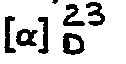
- Bei Verwendung von Wasser als Lösungsmittel und Anwendung eines H2-Drucks von 50 bar erhält man 1 g (92,3 % der Theorie) L-Homoalanin-4-yl(methyl)phosphinsäure-hydrochlorid mit einem Drehwinkel

-
- a) 4,9 g (0,022 mol) 2-Acetamido-4-(hydroxy-methyl-phosphinyl)-2-butensäure (Beispiel 1a) werden in einem Gemisch von 15 ml Essigsäure und 30 ml Orthoessigsäuretrimethylester suspendiert und 5 Minuten am Rückfluß erhitzt. Die Reaktionsmischung wird im Hochvakuum von allen flüchtigen Anteilen befreit, der Rückstand anschließen im Hochvakuum destilliert. Man erhält 4,8 g (88,4 % der Theorie) [(3-Acetamido-3-methoxycarbonyl)-2-propen-1-yl]-(methyl)-phosphinsäuremethylester als farbloses Öl vom Kp. 212-15/0,0013 mbar. 5 .
- b) 0,0100 g (0,021 mmol) Chlor-norbornadien-rhodium(I)-dimer und 0,0227 g (0,050 mmol) (2R, 3R)-(- )-2,3-Bis(dipheny)phosphino)-bicyclo[2,2,1]hept-5-en (Verbindung V g) werden unter Argonatmosphäre in 5 ml entgastem Methanol gelöst. Die erhaltene Katalysatorlösung wird 15 min bei Raumtemperatur gerührt und dann unter Argon zu einer Lösung von 3,9 g (0,016 mol) [(3-Acetamido-3-methoxycarbonyl)-2-propen-1-yl]-(methyl)-phosphinsäuremethylester in 50 ml Methanol gegeben. Das Reaktionsgefäß wird evakuiert, dann wird bei einem Druck von 2,5 bar hydriert. Nach 3 Stunden ist die Reaktion beendet. Nach Entspannen des Reaktionsgefäßes wird die Reaktionsmischung zur Entfernung des Katalysators mit 2 g saurem Ionenaustauscher (H+-Form) versetzt und 3 Stunden bei Raumtemperatur gerührt. Der lonenaustauscher wird abgetrennt und die Reaktionsmischung vollständig eingeengt.
- Es verbleiben 3,7 g (94:5 % der Theorie) [(3-Acetamido-3-methoxycarbonyl)-1-propyl]-(methyl)-phospinsäuremethylester als farbloses Öl.
- 'H-NMR (CDCl3): δ = 1,47 (d, = 14 Hz, 3H), 1,60-2,30 (m, 4H), 2,03 (s, 3H), 3,70 (d, = 10,7 Hz, 3H), 3,78 (s, 3H) 4,62 (m, 1 H), 7,14 (m, breit, 1 H)
- c) 2,7 g (0,0108 mol) [(3-Acetamido-3-methoxycarbonyl)-1-propyl]-(methyl)phosphinsäuremethylester werden in 80 ml 6N Salzsäure gelöst und 15 Stunden am Rückfluß gekocht. Die Reaktionsmischung wird vollständig eingeengt und der verbleibende Rückstand durch Aufnehmen in Ethanol zur Kristallisation gebracht.
- Man erhält 2,08 g (88,3 % der Theorie) L-Homoalanin-4-yl(methyl)phosphinsäure-hydrochlorid vom Fp. 194-96 °C (Zers.).
-

- d) 0,5 g (0,0023 mol) L-Homoalanin-4-yl(methyl)phosphinsäurehydrochlorid werden analog Beispiel 1c) in die freie Aminosäure überführt.
- Man erhält 0,4 g (96 % der Theorie) L-Homoalanin-4-yl(methyl)phosphinsäure als weißen Feststoff vom Fp. 210-212 °C (Zers.).
-

- Dies entspricht einer optischen Ausbeute von mindestens 88,2 % bezogen auf

Claims (4)


Priority Applications (1)
| Application Number | Priority Date | Filing Date | Title |
|---|---|---|---|
| AT87103720T ATE64737T1 (de) | 1986-03-22 | 1987-03-14 | Verfahren zur herstellung von lphosphinothricin(derivaten) sowie ihrer alkylester. |
Applications Claiming Priority (2)
| Application Number | Priority Date | Filing Date | Title |
|---|---|---|---|
| DE19863609818 DE3609818A1 (de) | 1986-03-22 | 1986-03-22 | Verfahren zur herstellung von l-phosphinothricin(derivaten) sowie ihrer alkylester |
| DE3609818 | 1986-03-22 |
Publications (3)
| Publication Number | Publication Date |
|---|---|
| EP0238954A2 true EP0238954A2 (de) | 1987-09-30 |
| EP0238954A3 EP0238954A3 (en) | 1988-09-14 |
| EP0238954B1 EP0238954B1 (de) | 1991-06-26 |
Family
ID=6297097
Family Applications (1)
| Application Number | Title | Priority Date | Filing Date |
|---|---|---|---|
| EP87103720A Expired - Lifetime EP0238954B1 (de) | 1986-03-22 | 1987-03-14 | Verfahren zur Herstellung von L-Phosphinothricin(derivaten) sowie ihrer Alkylester |
Country Status (10)
| Country | Link |
|---|---|
| US (1) | US4922006A (de) |
| EP (1) | EP0238954B1 (de) |
| JP (1) | JP2519238B2 (de) |
| AT (1) | ATE64737T1 (de) |
| CA (1) | CA1302649C (de) |
| DE (2) | DE3609818A1 (de) |
| DK (1) | DK144587A (de) |
| ES (1) | ES2024447B3 (de) |
| IL (1) | IL81952A (de) |
| ZA (1) | ZA872058B (de) |
Cited By (9)
| Publication number | Priority date | Publication date | Assignee | Title |
|---|---|---|---|---|
| EP0382113A1 (de) * | 1989-02-06 | 1990-08-16 | Hoechst Schering AgrEvo GmbH | Verfahren zur enzymatischen Trennung von 2-Amino-4-methylphosphinobuttersäurederivaten |
| EP0329043A3 (en) * | 1988-02-19 | 1990-11-22 | Hoechst Aktiengesellschaft | Optically active rhodium-complexes of 3,4-bis(diarylphosphino)-pyrrolidines, and their use in the preparation of phosphinothricine by asymmetric hydrogenation |
| US5374736A (en) * | 1988-05-27 | 1994-12-20 | Hoechst Aktiengesellschaft | L-4-(phosphinylethyl)-1,3-oxazolidin-5-one derivatives as intermediates for synthesis of phosphorus-containing L-amino acids |
| US5420329A (en) * | 1991-12-13 | 1995-05-30 | Hoechst Aktiengesellschaft | Process for the preparation of L-phosphinothricin and its derivatives |
| US5767309A (en) * | 1994-03-04 | 1998-06-16 | Hoechst Schering Agrevo Gmbh | Processes for preparing L!- or D!-homoalanin-4-yl-(methyl)phosphinic acid and salts thereof by racemate resolution |
| EP1864989A4 (de) * | 2005-03-29 | 2010-06-23 | Meiji Seika Kaisha | Verfahren zur herstellung von l-2-amino-4-(hydroxymethylphosphinyl)butansäure |
| WO2018108797A1 (de) | 2016-12-15 | 2018-06-21 | Bayer Cropscience Aktiengesellschaft | Verfahren zur herstellung von l-glufosinat oder dessen salzen unter verwendung von ephedrin |
| WO2018108794A1 (de) | 2016-12-15 | 2018-06-21 | Bayer Cropscience Aktiengesellschaft | Verfahren zur herstellung von d-glufosinat oder dessen salzen unter verwendung von ephedrin |
| WO2022207753A1 (en) | 2021-04-01 | 2022-10-06 | Basf Se | Methods for preparing l-glufosinate |
Families Citing this family (13)
| Publication number | Priority date | Publication date | Assignee | Title |
|---|---|---|---|---|
| US5175344A (en) * | 1986-02-13 | 1992-12-29 | Ciba-Geigy Corporation | Unsaturated amino acids |
| US5051413A (en) * | 1986-02-13 | 1991-09-24 | Ciba-Geigy Corporation | Unsaturated amino acids |
| ES2060122T3 (es) * | 1989-04-07 | 1994-11-16 | Ciba Geigy Ag | Derivados insaturados de acidos aminodicarboxilicos. |
| US5488140A (en) * | 1989-09-26 | 1996-01-30 | Ciba-Geigy Corporation | 4-substituted 2-aminoalk-3-enoic |
| US5294734A (en) * | 1989-09-26 | 1994-03-15 | Ciba-Geigy Corp. | 4-substituted 2-aminoalk-3-enoic acids |
| TW353663B (en) * | 1991-04-06 | 1999-03-01 | Hoechst Ag | Process for the preparation of phosphorus-containing L-amino acids, their derivatives and intermediates for this process |
| US5473092A (en) * | 1992-11-20 | 1995-12-05 | Monsanto Company | Synthesis of optically-active phosphono analogs of succinates |
| PL2060578T3 (pl) * | 2006-09-04 | 2014-08-29 | Meiji Seika Pharma Co Ltd | Sposób wytwarzania optycznie czynnego kwasu aminofosfinylobutanowego |
| EP2065391B1 (de) | 2006-09-20 | 2014-06-18 | Meiji Seika Pharma Co., Ltd. | Verfahren zur herstellung einer phosphorhaltigen a-aminosäure und zwischenprodukt für die herstellung davon |
| US8329935B2 (en) | 2007-03-19 | 2012-12-11 | Meji Seika Kaisha Ltd. | Process for producing phosphorus-containing dehydroamino acid |
| WO2008117733A1 (ja) | 2007-03-23 | 2008-10-02 | Meiji Seika Kaisha Ltd. | リン含有α-ケト酸の製造法 |
| US8481779B2 (en) | 2010-06-15 | 2013-07-09 | Meiji Seika Pharma Co., Ltd. | Method for producing N-substituted-2-amino-4-(hydroxymethylphosphinyl)-2-butenoic acid |
| CN107434812B (zh) * | 2017-09-08 | 2019-07-02 | 南京工业大学 | 一种合成2-酰胺基-4-(o-烷基甲膦酰基)-2-丁烯酸及其酯的方法 |
Family Cites Families (1)
| Publication number | Priority date | Publication date | Assignee | Title |
|---|---|---|---|---|
| JPS59219297A (ja) * | 1983-05-27 | 1984-12-10 | Meiji Seika Kaisha Ltd | 光学活性な〔(3−アミノ−3−カルボキシ)プロピル−1〕−ホスフイン酸誘導体の製造法 |
-
1986
- 1986-03-22 DE DE19863609818 patent/DE3609818A1/de not_active Withdrawn
-
1987
- 1987-03-14 AT AT87103720T patent/ATE64737T1/de not_active IP Right Cessation
- 1987-03-14 DE DE8787103720T patent/DE3770962D1/de not_active Expired - Lifetime
- 1987-03-14 EP EP87103720A patent/EP0238954B1/de not_active Expired - Lifetime
- 1987-03-14 ES ES87103720T patent/ES2024447B3/es not_active Expired - Lifetime
- 1987-03-19 JP JP62062771A patent/JP2519238B2/ja not_active Expired - Lifetime
- 1987-03-20 US US07/028,231 patent/US4922006A/en not_active Expired - Lifetime
- 1987-03-20 DK DK144587A patent/DK144587A/da not_active IP Right Cessation
- 1987-03-20 IL IL81952A patent/IL81952A/xx not_active IP Right Cessation
- 1987-03-20 ZA ZA872058A patent/ZA872058B/xx unknown
- 1987-03-20 CA CA000532574A patent/CA1302649C/en not_active Expired - Lifetime
Cited By (14)
| Publication number | Priority date | Publication date | Assignee | Title |
|---|---|---|---|---|
| EP0329043A3 (en) * | 1988-02-19 | 1990-11-22 | Hoechst Aktiengesellschaft | Optically active rhodium-complexes of 3,4-bis(diarylphosphino)-pyrrolidines, and their use in the preparation of phosphinothricine by asymmetric hydrogenation |
| US5530142A (en) * | 1988-05-27 | 1996-06-25 | Hoechst Aktiengesellschaft | Process for the preparation of phosphorus-containing L-amino acids and their esters and N-derivatives |
| US5374736A (en) * | 1988-05-27 | 1994-12-20 | Hoechst Aktiengesellschaft | L-4-(phosphinylethyl)-1,3-oxazolidin-5-one derivatives as intermediates for synthesis of phosphorus-containing L-amino acids |
| US5879930A (en) * | 1989-02-06 | 1999-03-09 | Hoechst Aktiengesellschaft | Process for the enzymatic resolution of 2-amino-4-methyl-phosphinobutyric acid derivatives |
| US5756346A (en) * | 1989-02-06 | 1998-05-26 | Hoechst Aktiengesellschaft | Process for the enzymatic resolution of 2-amino-4-methyl-phosphinobutyric acid derivatives |
| US5756800A (en) * | 1989-02-06 | 1998-05-26 | Hoechst Aktiengesellschaft | Process for the enzymatic resolution of 2-amino-4-methyl-phosphinobutyric acid derivatives |
| EP0382113A1 (de) * | 1989-02-06 | 1990-08-16 | Hoechst Schering AgrEvo GmbH | Verfahren zur enzymatischen Trennung von 2-Amino-4-methylphosphinobuttersäurederivaten |
| US5420329A (en) * | 1991-12-13 | 1995-05-30 | Hoechst Aktiengesellschaft | Process for the preparation of L-phosphinothricin and its derivatives |
| US5767309A (en) * | 1994-03-04 | 1998-06-16 | Hoechst Schering Agrevo Gmbh | Processes for preparing L!- or D!-homoalanin-4-yl-(methyl)phosphinic acid and salts thereof by racemate resolution |
| US5869668A (en) * | 1994-03-04 | 1999-02-09 | Hoechst Schering Agrevo Gmbh | Processes for preparing L!- or D!-homoalanin-4-yl-(methyl) phosphinic acid and salts thereof by racemate resolution |
| EP1864989A4 (de) * | 2005-03-29 | 2010-06-23 | Meiji Seika Kaisha | Verfahren zur herstellung von l-2-amino-4-(hydroxymethylphosphinyl)butansäure |
| WO2018108797A1 (de) | 2016-12-15 | 2018-06-21 | Bayer Cropscience Aktiengesellschaft | Verfahren zur herstellung von l-glufosinat oder dessen salzen unter verwendung von ephedrin |
| WO2018108794A1 (de) | 2016-12-15 | 2018-06-21 | Bayer Cropscience Aktiengesellschaft | Verfahren zur herstellung von d-glufosinat oder dessen salzen unter verwendung von ephedrin |
| WO2022207753A1 (en) | 2021-04-01 | 2022-10-06 | Basf Se | Methods for preparing l-glufosinate |
Also Published As
| Publication number | Publication date |
|---|---|
| US4922006A (en) | 1990-05-01 |
| IL81952A (en) | 1991-07-18 |
| DK144587D0 (da) | 1987-03-20 |
| JPS62226993A (ja) | 1987-10-05 |
| EP0238954B1 (de) | 1991-06-26 |
| EP0238954A3 (en) | 1988-09-14 |
| JP2519238B2 (ja) | 1996-07-31 |
| DE3609818A1 (de) | 1987-09-24 |
| DE3770962D1 (de) | 1991-08-01 |
| IL81952A0 (en) | 1987-10-20 |
| ATE64737T1 (de) | 1991-07-15 |
| ZA872058B (en) | 1987-09-14 |
| ES2024447B3 (es) | 1992-03-01 |
| DK144587A (da) | 1987-09-23 |
| CA1302649C (en) | 1992-06-02 |
Similar Documents
| Publication | Publication Date | Title |
|---|---|---|
| EP0238954B1 (de) | Verfahren zur Herstellung von L-Phosphinothricin(derivaten) sowie ihrer Alkylester | |
| EP0346658B1 (de) | Verfahren zur Herstellung phosphorhaltiger L-Aminosäuren sowie ihrer Ester und N-Derivate | |
| EP0104375B1 (de) | Neue, phosphorhaltige Biphenylderivate und deren Verwendung für asymmetrische Hydrierungen und enantioselektive Wasserstoffverschiebungen | |
| DE69114986T2 (de) | Eine Phosphino-Binapthyl-Verbindung und Übergangsmetall-Komplexe davon. | |
| EP0138141B1 (de) | Verfahren zur selektiven Hydrierung von C-C-Doppelbindungen in Gegenwart von reduzierbaren, stickstoffhaltigen Gruppen | |
| EP0583433B1 (de) | Diphosphinliganden | |
| DE69412309T2 (de) | Phosphinverbindung und diese als Ligand enthaltender Übergangsmetall-Phosphinkomplex | |
| DE2344332B2 (de) | Verfahren zur Herstellung von Vinylphosphinsa'uren | |
| EP2342211B1 (de) | Verfahren zur herstellung von 6-chlorodibenzo[d,f][1,3,2]-dioxaphosphepin | |
| DE69111358T2 (de) | Optisch aktiver Iridiumphosphinkomplex und dessen Verwendung zur katalytischen Herstellung von optisch aktiven Alkoholen. | |
| DD249027A5 (de) | Verfahren zur herstellung von neuen verbindungen | |
| EP0224880B1 (de) | Verfahren zur Herstellung von L-Homoalanin-4-yl(methyl)-phosphinsäure sowie ihrer Alkylester | |
| EP0546566A1 (de) | Verfahren zur Herstellung von L-Phosphinothricin und seinen Derivaten | |
| DE3153690C2 (de) | ||
| EP0031877A1 (de) | Optisch aktive 1,2-Bis(diphenylphosphino)-verbindungen, diese als chirale Liganden enthaltende Metallkomplexe und deren Verwendung | |
| EP0437690B1 (de) | Verfahren zur asymmetrischen Hydrierung von alpha-Ketocarbonyl-verbindungen zu optisch aktiven alpha-Hydroxycarbonylverbindungen | |
| EP0297369A2 (de) | Verfahren zur Herstellung von N-Phosphonomethylglycin | |
| EP0512415B1 (de) | Verfahren zur enantioselektiven Synthese von 2(R)-Benzylbernsteinsäuremonoamid-Derivaten | |
| DE69300826T2 (de) | Hydrierung. | |
| DE3928291A1 (de) | Phosphorigsaeure-arylester-amid-halogenide, phosphonigsaeurearylester-amide, verfahren zu ihrer herstellung und deren verwendung zur stabilisierung von kunststoffen | |
| DE4341605C2 (de) | Verfahren zur Herstellung homochiraler Aminoalkohole | |
| EP0772588B1 (de) | Herstellung von carbaminsäurevinylestern | |
| EP0512416B1 (de) | Neue homochirale Diphosphine | |
| DE2759683C3 (de) | Asymmetrische Aminophosphine, Verfahren zu deren Herstellung und deren Verwendung | |
| EP0184753A2 (de) | Verfahren zur Herstellung von alpha-Aminoalkylphosphon- und von alpha-Aminoalkylphosphinsäuren |
Legal Events
| Date | Code | Title | Description |
|---|---|---|---|
| PUAI | Public reference made under article 153(3) epc to a published international application that has entered the european phase |
Free format text: ORIGINAL CODE: 0009012 |
|
| AK | Designated contracting states |
Kind code of ref document: A2 Designated state(s): AT BE CH DE ES FR GB IT LI NL |
|
| PUAL | Search report despatched |
Free format text: ORIGINAL CODE: 0009013 |
|
| AK | Designated contracting states |
Kind code of ref document: A3 Designated state(s): AT BE CH DE ES FR GB IT LI NL |
|
| 17P | Request for examination filed |
Effective date: 19890210 |
|
| 17Q | First examination report despatched |
Effective date: 19901108 |
|
| GRAA | (expected) grant |
Free format text: ORIGINAL CODE: 0009210 |
|
| AK | Designated contracting states |
Kind code of ref document: B1 Designated state(s): AT BE CH DE ES FR GB IT LI NL |
|
| REF | Corresponds to: |
Ref document number: 64737 Country of ref document: AT Date of ref document: 19910715 Kind code of ref document: T |
|
| ITF | It: translation for a ep patent filed | ||
| REF | Corresponds to: |
Ref document number: 3770962 Country of ref document: DE Date of ref document: 19910801 |
|
| ET | Fr: translation filed | ||
| GBT | Gb: translation of ep patent filed (gb section 77(6)(a)/1977) | ||
| REG | Reference to a national code |
Ref country code: ES Ref legal event code: FG2A Ref document number: 2024447 Country of ref document: ES Kind code of ref document: B3 |
|
| PLBE | No opposition filed within time limit |
Free format text: ORIGINAL CODE: 0009261 |
|
| STAA | Information on the status of an ep patent application or granted ep patent |
Free format text: STATUS: NO OPPOSITION FILED WITHIN TIME LIMIT |
|
| 26N | No opposition filed | ||
| PGFP | Annual fee paid to national office [announced via postgrant information from national office to epo] |
Ref country code: ES Payment date: 19950314 Year of fee payment: 9 |
|
| PG25 | Lapsed in a contracting state [announced via postgrant information from national office to epo] |
Ref country code: ES Free format text: LAPSE BECAUSE OF NON-PAYMENT OF DUE FEES Effective date: 19960315 |
|
| REG | Reference to a national code |
Ref country code: ES Ref legal event code: FD2A Effective date: 19990301 |
|
| REG | Reference to a national code |
Ref country code: GB Ref legal event code: IF02 |
|
| PGFP | Annual fee paid to national office [announced via postgrant information from national office to epo] |
Ref country code: DE Payment date: 20051207 Year of fee payment: 20 |
|
| PGFP | Annual fee paid to national office [announced via postgrant information from national office to epo] |
Ref country code: NL Payment date: 20060305 Year of fee payment: 20 |
|
| PGFP | Annual fee paid to national office [announced via postgrant information from national office to epo] |
Ref country code: GB Payment date: 20060308 Year of fee payment: 20 Ref country code: FR Payment date: 20060308 Year of fee payment: 20 |
|
| PGFP | Annual fee paid to national office [announced via postgrant information from national office to epo] |
Ref country code: AT Payment date: 20060313 Year of fee payment: 20 |
|
| PGFP | Annual fee paid to national office [announced via postgrant information from national office to epo] |
Ref country code: CH Payment date: 20060315 Year of fee payment: 20 |
|
| PGFP | Annual fee paid to national office [announced via postgrant information from national office to epo] |
Ref country code: IT Payment date: 20060331 Year of fee payment: 20 |
|
| PGFP | Annual fee paid to national office [announced via postgrant information from national office to epo] |
Ref country code: BE Payment date: 20060509 Year of fee payment: 20 |
|
| PG25 | Lapsed in a contracting state [announced via postgrant information from national office to epo] |
Ref country code: GB Free format text: LAPSE BECAUSE OF EXPIRATION OF PROTECTION Effective date: 20070313 |
|
| PG25 | Lapsed in a contracting state [announced via postgrant information from national office to epo] |
Ref country code: NL Free format text: LAPSE BECAUSE OF EXPIRATION OF PROTECTION Effective date: 20070314 |
|
| REG | Reference to a national code |
Ref country code: GB Ref legal event code: PE20 |
|
| REG | Reference to a national code |
Ref country code: CH Ref legal event code: PL |
|
| NLV7 | Nl: ceased due to reaching the maximum lifetime of a patent |
Effective date: 20070314 |
|
| BE20 | Be: patent expired |
Owner name: *HOECHST A.G. Effective date: 20070314 |