EP0239074A2 - Production d'huile diesel - Google Patents
Production d'huile diesel Download PDFInfo
- Publication number
- EP0239074A2 EP0239074A2 EP87104317A EP87104317A EP0239074A2 EP 0239074 A2 EP0239074 A2 EP 0239074A2 EP 87104317 A EP87104317 A EP 87104317A EP 87104317 A EP87104317 A EP 87104317A EP 0239074 A2 EP0239074 A2 EP 0239074A2
- Authority
- EP
- European Patent Office
- Prior art keywords
- zone
- soaking zone
- diesel
- liquid
- soaking
- Prior art date
- Legal status (The legal status is an assumption and is not a legal conclusion. Google has not performed a legal analysis and makes no representation as to the accuracy of the status listed.)
- Withdrawn
Links
Images

Classifications
-
- C—CHEMISTRY; METALLURGY
- C10—PETROLEUM, GAS OR COKE INDUSTRIES; TECHNICAL GASES CONTAINING CARBON MONOXIDE; FUELS; LUBRICANTS; PEAT
- C10G—CRACKING HYDROCARBON OILS; PRODUCTION OF LIQUID HYDROCARBON MIXTURES, e.g. BY DESTRUCTIVE HYDROGENATION, OLIGOMERISATION, POLYMERISATION; RECOVERY OF HYDROCARBON OILS FROM OIL-SHALE, OIL-SAND, OR GASES; REFINING MIXTURES MAINLY CONSISTING OF HYDROCARBONS; REFORMING OF NAPHTHA; MINERAL WAXES
- C10G51/00—Treatment of hydrocarbon oils, in the absence of hydrogen, by two or more cracking processes only
- C10G51/02—Treatment of hydrocarbon oils, in the absence of hydrogen, by two or more cracking processes only plural serial stages only
-
- C—CHEMISTRY; METALLURGY
- C10—PETROLEUM, GAS OR COKE INDUSTRIES; TECHNICAL GASES CONTAINING CARBON MONOXIDE; FUELS; LUBRICANTS; PEAT
- C10G—CRACKING HYDROCARBON OILS; PRODUCTION OF LIQUID HYDROCARBON MIXTURES, e.g. BY DESTRUCTIVE HYDROGENATION, OLIGOMERISATION, POLYMERISATION; RECOVERY OF HYDROCARBON OILS FROM OIL-SHALE, OIL-SAND, OR GASES; REFINING MIXTURES MAINLY CONSISTING OF HYDROCARBONS; REFORMING OF NAPHTHA; MINERAL WAXES
- C10G9/00—Thermal non-catalytic cracking, in the absence of hydrogen, of hydrocarbon oils
-
- C—CHEMISTRY; METALLURGY
- C10—PETROLEUM, GAS OR COKE INDUSTRIES; TECHNICAL GASES CONTAINING CARBON MONOXIDE; FUELS; LUBRICANTS; PEAT
- C10G—CRACKING HYDROCARBON OILS; PRODUCTION OF LIQUID HYDROCARBON MIXTURES, e.g. BY DESTRUCTIVE HYDROGENATION, OLIGOMERISATION, POLYMERISATION; RECOVERY OF HYDROCARBON OILS FROM OIL-SHALE, OIL-SAND, OR GASES; REFINING MIXTURES MAINLY CONSISTING OF HYDROCARBONS; REFORMING OF NAPHTHA; MINERAL WAXES
- C10G51/00—Treatment of hydrocarbon oils, in the absence of hydrogen, by two or more cracking processes only
- C10G51/02—Treatment of hydrocarbon oils, in the absence of hydrogen, by two or more cracking processes only plural serial stages only
- C10G51/04—Treatment of hydrocarbon oils, in the absence of hydrogen, by two or more cracking processes only plural serial stages only including only thermal and catalytic cracking steps
Definitions
- This invention relates to the production of hydrocarbon middle distillates boiling in the diesel fuel range.
- an object of this invention to provide a continuous process for production of hydrocarbons boiling in the diesel fuel range without correspondingly larger increases in co-production of gasoline.
- virgin hydrocarbon oil that is oil not previously subjected to cracking
- virgin hydrocarbon oil is heat soaked in the liquid phase at a temperature between 385°C and 440°C and within the critical pressure range between 1.38 and 3.84 kg/cm2 abs.
- Heated oil is maintained in the soaking zone as a heavy oil liquid portion for an average residence time equivalent to from 1 to 4 hours on a fresh feed basis.
- the liquid phase undergoes mild thermal cracking to evolve a vapor phase rich in hydrocarbons boiling in the diesel fuel range.
- the vapor phase is withdrawn from the soaking zone substantially as it is formed from the liquid phase heavy oil and passed directly to a fractionation zone for recovery of a diesel range fuel product. No hydrogen is introduced to the soaking zone.
- the process of the invention and the feedstock are intimately related inasmuch as we have found that virgin oils having a Conradson carbon content below 2 weight percent and boiling predominantly above 345°C contain a good distribution of moderately heavy molecules which may be thermally cracked under mild conditions without forming excessive amounts of light ends and coke.
- the Conradson test for measurement of carbon residues in hydrocarbons is well known.
- the virgin oils may be taken directly from atmospheric or vacuum distillation towers as atmospheric residuum or vacuum gas oil.
- Preferred feedstocks are vacuum gas oils boil damaging between 345°C and 565°C.
- the oil feed is heated to incipient cracking temperature near or within the stated ranges in, typically, a conventional refinery furnace. Care should be taken that feed residence time in the furnace be minimized to ensure that significant coking does not occur on the hot tube walls.
- the furnace outlet temperature will be between 415°C and 510°C.
- the resulting heated oil is then transferred to a back-mixed soaking zone having a vapor zone in the upper portion thereof and a liquid zone in the lower portion.
- the soaking zone is operated within the ranges of temperature, residence time, and pressure stated above, however, the critical pressure range refers to vapor zone pressure.
- the soaking zone may be a vertical, cylindrical, low-pressure vessel preferably provided with means such as a pump-around to augment internal back-mixing which will naturally occur in this configuration. Alternatively, part of the heavy oil in the soaker may be recirculated through the furnace if necessary to maintain desired temperature in the soaking zone.
- the soaking zone is maintained at single equilibrium flash vaporization conditions in which the diesel component is removed from the soaking zone substantially as it is formed.
- the usual residence time and temperature parameters in thermal cracking operations will not, alone, bring about the desired increase in diesel/gasoline product ratio.
- conversion to diesel range product in excess of gasoline range product is favored by decreasing the ratio of residence time of the diesel range component in the soaking zone with respect to residence time of the heavy oil in the soaking zone.
- the diesel/heavy oil residence time ratio may be approximated from flash calculations.
- the diesel/heavy oil residence time ratio is a pressure dependent function as illustrated in Figure 1. At risk of oversimplification, the ultimate diesel/ gasoline product ratio, therefore, is also a pressure dependent function with higher diesel make favored by lower pressure.
- a North Slope vacuum gas oil having an initial boiling point of 332°C, an end point of 575°C, and a volume average boiling point of 446°C was employed as feedstock in the runs tabulated below.
- the feed had a sulfur content of 1.3 weight percent, however, the Conradson carbon content was too low to measure. No catalyst was employed.
- a 300 cc stirred reactor fitted with dip tube for withdrawal of liquid and gaseous products was used in the experiments.
- the reactor vapor space was purged with nitrogen. Hydrocarbons removed from the reactor were quenched to ambient conditions and passed to a gas/liquid separator. After reactor heat-up, runs were conducted for 6-7 hours with total gas make and analysis continuously determined while liquid products were weighed each hour. Liquid samples were analyzed at two-hour intervals. The products' vapor-liquid equilibrium at run conditions was calculated by thermodynamic equilibrium flash calculation. Results of the runs and calculations are tabulated below.
- the overhead vapor from the soaking zone contains the bulk of the diesel fraction made in the process.
- residence time of the overhead vapor portion in the soaking zone should be less than 1 minute and will typically be between 0.2 and 0.8 minutes. Short residence time may be attained by appropriate vapor space design and, preferably, with use of stripping steam to the soaker.
- the overhead vapor portion in its entirety is introduced directly to an intermediate point of a fractionation zone for recovery of a diesel range fuel product.
- the fractionation zone may be a distillation tower of conventional design. Mechanical design of the system should be characterized by low residence time between the soaking zone and the fractionation zone.
- the heavy oil liquid portion is recovered from the soaking zone.
- This portion is a suitable feedstock to downstream cracking operations such hydrocracking or fluid catalytic cracking for production of high octane gasoline.
- the liquid portion recoverd therefrom may still contain enough diesel fraction to warrant recovery in the fractionation zone.
- the liquid portion from the soaking zone is introduced to a catalytic cracking unit for the production of gasoline.
- the liquid portion from the soaking zone is introduced directly to the fractionation zone at a point below the intermediate point thereof at which the overhead vapor portion is introduced. The bulk of the liquid portion processed in this manner passes through the bottom of the fractionator so that a major portion of the heavy oil recovered from the soaking zone is introduced to the downstream catalytic cracking unit.
- a recycle stream boiling above 345°C, preferably between 400°C and 510°C may be recovered from the fractionation zone and introduced to the soaking zone. Typically, this recycle stream will be from 20 to 50 weight percent of the fresh feed to the soaking zone.
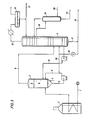
- 113,400 kg/hr. of vacuum gas oil having an initial boiling point of 345°C and an end point of 565°C is introduced through line 1 to coil furnace 2, heated to 495°C, and discharged to soaker 3 which contains liquid phase 4 and vapor phase 5.
- the soaker is recirculated by pump-around 6, operates at 413°C, and has a vapor zone pressure of 2.09 kg/cm2 abs.
- Heavy oil is maintained in the soaker for a residence time equivalent to 2 hours on a fresh feed basis and is thermally cracked to a vapor portion comprised principally of hydrocarbons boiling in the diesel fuel range with a lesser amount of light ends and gases.
- Vapor evolution is aided by stripping steam introduced to the soaker at 7 in order to quickly remove the vaporized diesel fraction from the soaker as well as to reduce the hydrocarbon partial pressure therein.
- the vapor portion from the soaker containing most of the desired diesel fraction is introduced via line 8 directly to an intermediate point of fractionator 9.
- a forward flow of 68,000 kg/hr. of heavy oil is removed from pump-around 6 and introduced via line 10 to the fractionator to extract a small amount of diesel range material remaining in the liquid portion removed from the soaker. Most of this stream will pass through the lower part of the fractionator and be removed as bottoms stream 11. With some feedstocks, the amount of diesel found in the liquid portion will be negligible and the liquid portion may by-pass the fractionator via line 12 to line 13.
- the hydrocarbon liquid in line 13 is subsequently employed as feedstock to a fluid catalytic cracking unit (not shown) for the production of gasoline.
- a slip-stream boiling between 400°C and 510°C in the amount of 40 weight percent of the fresh feed in line 1 is removed from fractionator 9 and recycled through line 14 to soaker 3 in order to reduce coke formation in the system.
- Hydrocarbons within and above the naphtha range are removed as fractionator overhead through line 15, cooled, and separated in 16. Gases are removed from the separator while 10,500 kg/hr. of hydrocarbons boiling in the gasoline range are removed via line 17.
- Hydrocarbons within the diesel fuel range are removed from the fractionator via line 18 to stripper 19 where steam introduced at 20 strips off excessively light material.
- 29,000 kg/hr. of diesel fuel having an API number of 35.2° is removed via line 21 for blending or subsequent desulfurization.
- the ratio of diesel to gasoline range product is 2.8 based on a diesel/gasoline cut-point of 193°C.
Landscapes
- Chemical & Material Sciences (AREA)
- Oil, Petroleum & Natural Gas (AREA)
- Engineering & Computer Science (AREA)
- Chemical Kinetics & Catalysis (AREA)
- General Chemical & Material Sciences (AREA)
- Organic Chemistry (AREA)
- Physics & Mathematics (AREA)
- Thermal Sciences (AREA)
- Production Of Liquid Hydrocarbon Mixture For Refining Petroleum (AREA)
- Liquid Carbonaceous Fuels (AREA)
Applications Claiming Priority (2)
| Application Number | Priority Date | Filing Date | Title |
|---|---|---|---|
| US06/843,442 US4695367A (en) | 1986-03-24 | 1986-03-24 | Diesel fuel production |
| US843442 | 1986-03-24 |
Publications (2)
| Publication Number | Publication Date |
|---|---|
| EP0239074A2 true EP0239074A2 (fr) | 1987-09-30 |
| EP0239074A3 EP0239074A3 (fr) | 1989-06-07 |
Family
ID=25289988
Family Applications (1)
| Application Number | Title | Priority Date | Filing Date |
|---|---|---|---|
| EP87104317A Withdrawn EP0239074A3 (fr) | 1986-03-24 | 1987-03-24 | Production d'huile diesel |
Country Status (7)
| Country | Link |
|---|---|
| US (1) | US4695367A (fr) |
| EP (1) | EP0239074A3 (fr) |
| JP (1) | JPS62232490A (fr) |
| KR (1) | KR870008995A (fr) |
| CN (1) | CN87102345A (fr) |
| BR (1) | BR8701299A (fr) |
| IN (1) | IN167978B (fr) |
Cited By (2)
| Publication number | Priority date | Publication date | Assignee | Title |
|---|---|---|---|---|
| WO2010011339A2 (fr) | 2008-07-25 | 2010-01-28 | Exxonmobil Research And Engineering Company | Procédé pour la conversion flexible de gasoil sous vide |
| US8168061B2 (en) | 2008-07-25 | 2012-05-01 | Exxonmobil Research And Engineering Company | Process for flexible vacuum gas oil conversion using divided wall fractionation |
Families Citing this family (4)
| Publication number | Priority date | Publication date | Assignee | Title |
|---|---|---|---|---|
| FR2741889B1 (fr) * | 1995-12-04 | 1999-01-29 | Total Raffinage Distribution | Perfectionnements apportes aux procedes et aux dispositifs de viscoreduction de charges lourdes d'hydrocarbures |
| RU2213125C1 (ru) * | 2002-08-28 | 2003-09-27 | Общество ограниченной ответственности Фирма "Ливия" | Способ получения экологически чистого судового маловязкого топлива |
| RU2232793C1 (ru) * | 2003-07-15 | 2004-07-20 | Закрытое акционерное общество "Пионер-Петролеум" | Способ получения маловязкого судового топлива |
| RU2312129C1 (ru) * | 2006-03-30 | 2007-12-10 | Государственное образовательное учреждение высшего профессионального образования "Уфимский государственный нефтяной технический университет" | Комбинированный способ получения судовых топлив и дорожных битумов (варианты) |
Family Cites Families (28)
| Publication number | Priority date | Publication date | Assignee | Title |
|---|---|---|---|---|
| US1900170A (en) * | 1921-10-31 | 1933-03-07 | Universal Oil Prod Co | Process and apparatus for converting oils |
| US1688860A (en) * | 1921-10-31 | 1928-10-23 | Universal Oil Prod Co | Process for cracking oil |
| US2105526A (en) * | 1925-03-23 | 1938-01-18 | Universal Oil Prod Co | Process of hydrocarbon oil conversion |
| US1712187A (en) * | 1925-06-29 | 1929-05-07 | Standard Oil Co | Pressure distillation of heavy hydrocarbon oils |
| US1920331A (en) * | 1925-11-09 | 1933-08-01 | Standard Oil Co | Conversion of high-boiling hydrocarbon oils into lower boiling hydrocarbon oils |
| US1748065A (en) * | 1926-06-28 | 1930-02-25 | Universal Oil Prod Co | Process of cracking hydrocarbons |
| US1933507A (en) * | 1929-08-21 | 1933-10-31 | Standard Oil Dev Co | Cracking in homogeneous state |
| US2039763A (en) * | 1932-07-05 | 1936-05-05 | Brassert Tidewater Dev Corp | Method of coking liquid hydrocarbons |
| US2103561A (en) * | 1932-08-23 | 1937-12-28 | Texas Co | Method of converting hydrocarbon oil |
| US2050427A (en) * | 1933-09-01 | 1936-08-11 | Universal Oil Prod Co | Conversion and coking of hydrocarbon oils |
| US2170333A (en) * | 1937-06-30 | 1939-08-22 | Universal Oil Prod Co | Conversion of hydrocarbon oils |
| US2626892A (en) * | 1950-12-09 | 1953-01-27 | Standard Oil Dev Co | Cracking residual fractions containing salts |
| US2687986A (en) * | 1951-05-01 | 1954-08-31 | Standard Oil Dev Co | Hydrocarbon conversion |
| US2717865A (en) * | 1951-05-17 | 1955-09-13 | Exxon Research Engineering Co | Coking of heavy hydrocarbonaceous residues |
| US2748061A (en) * | 1951-08-18 | 1956-05-29 | Shell Dev | Thermal treatment and separation process |
| US2752290A (en) * | 1953-11-27 | 1956-06-26 | Cabot Godfrey L Inc | Production of pitch from petroleum residues |
| US3707459A (en) * | 1970-04-17 | 1972-12-26 | Exxon Research Engineering Co | Cracking hydrocarbon residua |
| US3687840A (en) * | 1970-04-28 | 1972-08-29 | Lummus Co | Delayed coking of pyrolysis fuel oils |
| JPS5144103A (en) * | 1974-09-25 | 1976-04-15 | Maruzen Oil Co Ltd | Sekyukookusuno seizoho |
| US4177133A (en) * | 1974-09-25 | 1979-12-04 | Maruzen Petrochem Co Ltd | Process for producing high-crystalline petroleum coke |
| US4199434A (en) * | 1974-10-15 | 1980-04-22 | The Lummus Company | Feedstock treatment |
| CA1137434A (fr) * | 1978-07-11 | 1982-12-14 | Mohammed Akbar | Methode fractionnement en continu des petroles |
| US4522703A (en) * | 1981-07-08 | 1985-06-11 | Mobil Oil Corporation | Thermal treatment of heavy hydrocarbon oil |
| NL8201119A (nl) * | 1982-03-18 | 1983-10-17 | Shell Int Research | Werkwijze voor de bereiding van koolwaterstofoliedestillaten. |
| US4443325A (en) * | 1982-12-23 | 1984-04-17 | Mobil Oil Corporation | Conversion of residua to premium products via thermal treatment and coking |
| US4428823A (en) * | 1983-01-03 | 1984-01-31 | Uop Inc. | Integrated thermal cracking and visbreaking process |
| JPS59157180A (ja) * | 1983-02-28 | 1984-09-06 | Fuji Sekiyu Kk | 石油系重質油から分解軽質油と燃料として好適なピツチを製造する方法 |
| US4519898A (en) * | 1983-05-20 | 1985-05-28 | Exxon Research & Engineering Co. | Low severity delayed coking |
-
1986
- 1986-03-24 US US06/843,442 patent/US4695367A/en not_active Expired - Fee Related
-
1987
- 1987-02-19 IN IN149/DEL/87A patent/IN167978B/en unknown
- 1987-03-23 JP JP62065929A patent/JPS62232490A/ja active Pending
- 1987-03-23 BR BR8701299A patent/BR8701299A/pt unknown
- 1987-03-24 EP EP87104317A patent/EP0239074A3/fr not_active Withdrawn
- 1987-03-24 CN CN198787102345A patent/CN87102345A/zh active Pending
- 1987-03-24 KR KR870002708A patent/KR870008995A/ko not_active Withdrawn
Cited By (4)
| Publication number | Priority date | Publication date | Assignee | Title |
|---|---|---|---|---|
| WO2010011339A2 (fr) | 2008-07-25 | 2010-01-28 | Exxonmobil Research And Engineering Company | Procédé pour la conversion flexible de gasoil sous vide |
| WO2010011339A3 (fr) * | 2008-07-25 | 2010-10-21 | Exxonmobil Research And Engineering Company | Procédé pour la conversion flexible de gasoil sous vide |
| US8163168B2 (en) | 2008-07-25 | 2012-04-24 | Exxonmobil Research And Engineering Company | Process for flexible vacuum gas oil conversion |
| US8168061B2 (en) | 2008-07-25 | 2012-05-01 | Exxonmobil Research And Engineering Company | Process for flexible vacuum gas oil conversion using divided wall fractionation |
Also Published As
| Publication number | Publication date |
|---|---|
| IN167978B (fr) | 1991-01-19 |
| US4695367A (en) | 1987-09-22 |
| KR870008995A (ko) | 1987-10-22 |
| JPS62232490A (ja) | 1987-10-12 |
| BR8701299A (pt) | 1987-12-29 |
| EP0239074A3 (fr) | 1989-06-07 |
| CN87102345A (zh) | 1987-09-30 |
Similar Documents
| Publication | Publication Date | Title |
|---|---|---|
| US6048448A (en) | Delayed coking process and method of formulating delayed coking feed charge | |
| US4443325A (en) | Conversion of residua to premium products via thermal treatment and coking | |
| EP2851409A1 (fr) | Procédé efficace pour obtenir une qualité améliorée de gas-oil de cokéfaction | |
| US10760013B2 (en) | Process and apparatus for recycling slurry hydrocracked product | |
| US4519898A (en) | Low severity delayed coking | |
| EP1050572A2 (fr) | Procédé de craquage catalytique fluidisé d'huile résiduelle | |
| EP0435242A1 (fr) | Procédé pour convertir une huile hydrocarbonée lourde | |
| US4832823A (en) | Coking process with decant oil addition to reduce coke yield | |
| EP0150239A1 (fr) | Procédé et appareil pour l'amélioration du pétrole brut et de ses fractions résiduelles | |
| US5350503A (en) | Method of producing consistent high quality coke | |
| EP0956324A1 (fr) | Procede destine a accroitre le rendement en produits liquides dans un processus de cokefaction differee | |
| EP3710564A1 (fr) | Procédé et appareil d'extraction d'un produit hydrocraqué en suspension épaisse | |
| EP0160410B1 (fr) | Procédé pour augmenter le production d'huile désasphaltée à partir de résidus d'huile | |
| US3972807A (en) | Hydrocarbon deasphalting via solvent extraction | |
| US4441989A (en) | Process and apparatus for thermal cracking and fractionation of hydrocarbons | |
| EP0067020B1 (fr) | Procédé d'hydrostrippage d'huile brute | |
| EP0239074A2 (fr) | Production d'huile diesel | |
| US4051016A (en) | Fluid coking with H2 S addition | |
| GB2135333A (en) | Making coke for metallurgical purposes | |
| US5316655A (en) | Process for making light hydrocarbonaceous liquids in a delayed coker | |
| US4675097A (en) | Process for production of hydrogenated light hydrocarbons by treatment of heavy hydrocarbons with water and carbon monoxide | |
| US4428823A (en) | Integrated thermal cracking and visbreaking process | |
| US3472760A (en) | Process for converting asphaltenic oils and olefinic gasolines to high-value petroleum products | |
| US5024752A (en) | Upgrading of resids by liquid phase mild coking | |
| US2844518A (en) | Conversion of hydrocarbons |
Legal Events
| Date | Code | Title | Description |
|---|---|---|---|
| PUAI | Public reference made under article 153(3) epc to a published international application that has entered the european phase |
Free format text: ORIGINAL CODE: 0009012 |
|
| 17P | Request for examination filed |
Effective date: 19870324 |
|
| AK | Designated contracting states |
Kind code of ref document: A2 Designated state(s): DE ES FR GB IT |
|
| PUAL | Search report despatched |
Free format text: ORIGINAL CODE: 0009013 |
|
| AK | Designated contracting states |
Kind code of ref document: A3 Designated state(s): DE ES FR GB IT |
|
| STAA | Information on the status of an ep patent application or granted ep patent |
Free format text: STATUS: THE APPLICATION IS DEEMED TO BE WITHDRAWN |
|
| 18D | Application deemed to be withdrawn |
Effective date: 19901003 |
|
| RIN1 | Information on inventor provided before grant (corrected) |
Inventor name: ARMSTRONG, ROBERT B. Inventor name: EZERNACK, DANIEL D. |