EP0239461A1 - Dérivés de N-¬¬(hydroxy-2 phényl) (phényl) méthylène amino-2 éthyl acétamide, leur préparation et leur application en thérapeutique - Google Patents
Dérivés de N-¬¬(hydroxy-2 phényl) (phényl) méthylène amino-2 éthyl acétamide, leur préparation et leur application en thérapeutique Download PDFInfo
- Publication number
- EP0239461A1 EP0239461A1 EP87400531A EP87400531A EP0239461A1 EP 0239461 A1 EP0239461 A1 EP 0239461A1 EP 87400531 A EP87400531 A EP 87400531A EP 87400531 A EP87400531 A EP 87400531A EP 0239461 A1 EP0239461 A1 EP 0239461A1
- Authority
- EP
- European Patent Office
- Prior art keywords
- piperazinyl
- phenyl
- hydrogen
- piperidinyl
- chloro
- Prior art date
- Legal status (The legal status is an assumption and is not a legal conclusion. Google has not performed a legal analysis and makes no representation as to the accuracy of the status listed.)
- Withdrawn
Links
- -1 methylene amino-2 ethyl acetamide derivatives Chemical class 0.000 title claims description 25
- 238000002360 preparation method Methods 0.000 title claims description 3
- 238000000034 method Methods 0.000 title claims 3
- 125000001997 phenyl group Chemical group [H]C1=C([H])C([H])=C(*)C([H])=C1[H] 0.000 title description 2
- 230000001225 therapeutic effect Effects 0.000 title 1
- 150000001875 compounds Chemical class 0.000 claims abstract description 28
- UFHFLCQGNIYNRP-UHFFFAOYSA-N Hydrogen Chemical compound [H][H] UFHFLCQGNIYNRP-UHFFFAOYSA-N 0.000 claims abstract description 15
- 239000001257 hydrogen Substances 0.000 claims abstract description 15
- 229910052739 hydrogen Inorganic materials 0.000 claims abstract description 15
- 125000002496 methyl group Chemical group [H]C([H])([H])* 0.000 claims abstract description 7
- 125000002887 hydroxy group Chemical group [H]O* 0.000 claims abstract description 3
- LFQSCWFLJHTTHZ-UHFFFAOYSA-N Ethanol Chemical compound CCO LFQSCWFLJHTTHZ-UHFFFAOYSA-N 0.000 claims description 19
- 125000005843 halogen group Chemical group 0.000 claims description 12
- HEDRZPFGACZZDS-UHFFFAOYSA-N Chloroform Chemical compound ClC(Cl)Cl HEDRZPFGACZZDS-UHFFFAOYSA-N 0.000 claims description 10
- 239000002904 solvent Substances 0.000 claims description 10
- 125000004435 hydrogen atom Chemical group [H]* 0.000 claims description 5
- VGCXGMAHQTYDJK-UHFFFAOYSA-N Chloroacetyl chloride Chemical compound ClCC(Cl)=O VGCXGMAHQTYDJK-UHFFFAOYSA-N 0.000 claims description 4
- 239000002585 base Substances 0.000 claims description 4
- 238000010992 reflux Methods 0.000 claims description 4
- 239000012965 benzophenone Substances 0.000 claims description 3
- 230000009467 reduction Effects 0.000 claims description 3
- 125000004178 (C1-C4) alkyl group Chemical group 0.000 claims description 2
- 125000004769 (C1-C4) alkylsulfonyl group Chemical group 0.000 claims description 2
- PIICEJLVQHRZGT-UHFFFAOYSA-N Ethylenediamine Chemical compound NCCN PIICEJLVQHRZGT-UHFFFAOYSA-N 0.000 claims description 2
- 229910052783 alkali metal Inorganic materials 0.000 claims description 2
- 150000001340 alkali metals Chemical class 0.000 claims description 2
- RWCCWEUUXYIKHB-UHFFFAOYSA-N benzophenone Chemical compound C=1C=CC=CC=1C(=O)C1=CC=CC=C1 RWCCWEUUXYIKHB-UHFFFAOYSA-N 0.000 claims description 2
- 238000010438 heat treatment Methods 0.000 claims description 2
- 125000000956 methoxy group Chemical group [H]C([H])([H])O* 0.000 claims description 2
- 150000001412 amines Chemical class 0.000 claims 1
- 229910052736 halogen Inorganic materials 0.000 abstract 4
- 150000002367 halogens Chemical class 0.000 abstract 4
- 125000000217 alkyl group Chemical group 0.000 abstract 1
- 238000002560 therapeutic procedure Methods 0.000 abstract 1
- DLFVBJFMPXGRIB-UHFFFAOYSA-N Acetamide Chemical compound CC(N)=O DLFVBJFMPXGRIB-UHFFFAOYSA-N 0.000 description 18
- 239000000203 mixture Substances 0.000 description 18
- YMWUJEATGCHHMB-UHFFFAOYSA-N Dichloromethane Chemical compound ClCCl YMWUJEATGCHHMB-UHFFFAOYSA-N 0.000 description 16
- OKKJLVBELUTLKV-UHFFFAOYSA-N Methanol Chemical compound OC OKKJLVBELUTLKV-UHFFFAOYSA-N 0.000 description 15
- 125000002924 primary amino group Chemical group [H]N([H])* 0.000 description 12
- 125000004182 2-chlorophenyl group Chemical group [H]C1=C([H])C(Cl)=C(*)C([H])=C1[H] 0.000 description 9
- VYPSYNLAJGMNEJ-UHFFFAOYSA-N Silicium dioxide Chemical compound O=[Si]=O VYPSYNLAJGMNEJ-UHFFFAOYSA-N 0.000 description 8
- 125000001495 ethyl group Chemical group [H]C([H])([H])C([H])([H])* 0.000 description 8
- XLYOFNOQVPJJNP-UHFFFAOYSA-N water Substances O XLYOFNOQVPJJNP-UHFFFAOYSA-N 0.000 description 8
- 230000008018 melting Effects 0.000 description 7
- 238000002844 melting Methods 0.000 description 7
- 125000000325 methylidene group Chemical group [H]C([H])=* 0.000 description 7
- 239000012074 organic phase Substances 0.000 description 7
- XEKOWRVHYACXOJ-UHFFFAOYSA-N Ethyl acetate Chemical compound CCOC(C)=O XEKOWRVHYACXOJ-UHFFFAOYSA-N 0.000 description 6
- CSNNHWWHGAXBCP-UHFFFAOYSA-L Magnesium sulfate Chemical compound [Mg+2].[O-][S+2]([O-])([O-])[O-] CSNNHWWHGAXBCP-UHFFFAOYSA-L 0.000 description 6
- 239000000243 solution Substances 0.000 description 5
- KFZMGEQAYNKOFK-UHFFFAOYSA-N Isopropanol Chemical compound CC(C)O KFZMGEQAYNKOFK-UHFFFAOYSA-N 0.000 description 4
- 238000004587 chromatography analysis Methods 0.000 description 4
- 239000000377 silicon dioxide Substances 0.000 description 4
- 241001465754 Metazoa Species 0.000 description 3
- CDBYLPFSWZWCQE-UHFFFAOYSA-L Sodium Carbonate Chemical compound [Na+].[Na+].[O-]C([O-])=O CDBYLPFSWZWCQE-UHFFFAOYSA-L 0.000 description 3
- 208000025865 Ulcer Diseases 0.000 description 3
- 150000008366 benzophenones Chemical class 0.000 description 3
- 239000006260 foam Substances 0.000 description 3
- 125000001841 imino group Chemical group [H]N=* 0.000 description 3
- 229910052943 magnesium sulfate Inorganic materials 0.000 description 3
- 235000019341 magnesium sulphate Nutrition 0.000 description 3
- 125000003854 p-chlorophenyl group Chemical group [H]C1=C([H])C(*)=C([H])C([H])=C1Cl 0.000 description 3
- 229960002895 phenylbutazone Drugs 0.000 description 3
- VYMDGNCVAMGZFE-UHFFFAOYSA-N phenylbutazonum Chemical compound O=C1C(CCCC)C(=O)N(C=2C=CC=CC=2)N1C1=CC=CC=C1 VYMDGNCVAMGZFE-UHFFFAOYSA-N 0.000 description 3
- RTZKZFJDLAIYFH-UHFFFAOYSA-N Diethyl ether Chemical compound CCOCC RTZKZFJDLAIYFH-UHFFFAOYSA-N 0.000 description 2
- OTMSDBZUPAUEDD-UHFFFAOYSA-N Ethane Chemical compound CC OTMSDBZUPAUEDD-UHFFFAOYSA-N 0.000 description 2
- VEXZGXHMUGYJMC-UHFFFAOYSA-N Hydrochloric acid Chemical compound Cl VEXZGXHMUGYJMC-UHFFFAOYSA-N 0.000 description 2
- GLUUGHFHXGJENI-UHFFFAOYSA-N Piperazine Chemical compound C1CNCCN1 GLUUGHFHXGJENI-UHFFFAOYSA-N 0.000 description 2
- NQRYJNQNLNOLGT-UHFFFAOYSA-N Piperidine Chemical compound C1CCNCC1 NQRYJNQNLNOLGT-UHFFFAOYSA-N 0.000 description 2
- UIIMBOGNXHQVGW-DEQYMQKBSA-M Sodium bicarbonate-14C Chemical compound [Na+].O[14C]([O-])=O UIIMBOGNXHQVGW-DEQYMQKBSA-M 0.000 description 2
- 208000007107 Stomach Ulcer Diseases 0.000 description 2
- 239000013543 active substance Substances 0.000 description 2
- 239000002775 capsule Substances 0.000 description 2
- 229910052801 chlorine Inorganic materials 0.000 description 2
- 230000000694 effects Effects 0.000 description 2
- 230000004927 fusion Effects 0.000 description 2
- HDOWRFHMPULYOA-UHFFFAOYSA-N piperidin-4-ol Chemical compound OC1CCNCC1 HDOWRFHMPULYOA-UHFFFAOYSA-N 0.000 description 2
- 238000003756 stirring Methods 0.000 description 2
- 210000002784 stomach Anatomy 0.000 description 2
- 231100000397 ulcer Toxicity 0.000 description 2
- OSXVZDOVYCTYCW-UHFFFAOYSA-N (5-chloro-2-hydroxyphenyl)-(2-chlorophenyl)methanone Chemical compound OC1=CC=C(Cl)C=C1C(=O)C1=CC=CC=C1Cl OSXVZDOVYCTYCW-UHFFFAOYSA-N 0.000 description 1
- 125000000022 2-aminoethyl group Chemical group [H]C([*])([H])C([H])([H])N([H])[H] 0.000 description 1
- NHQDETIJWKXCTC-UHFFFAOYSA-N 3-chloroperbenzoic acid Chemical compound OOC(=O)C1=CC=CC(Cl)=C1 NHQDETIJWKXCTC-UHFFFAOYSA-N 0.000 description 1
- 125000000590 4-methylphenyl group Chemical group [H]C1=C([H])C(=C([H])C([H])=C1*)C([H])([H])[H] 0.000 description 1
- LLKFNPUXQZHIAE-UHFFFAOYSA-N 5-(3-aminopropyl)-8-bromo-3-methyl-2h-pyrazolo[4,3-c]quinolin-4-one Chemical compound O=C1N(CCCN)C2=CC=C(Br)C=C2C2=C1C(C)=NN2 LLKFNPUXQZHIAE-UHFFFAOYSA-N 0.000 description 1
- QTBSBXVTEAMEQO-UHFFFAOYSA-M Acetate Chemical compound CC([O-])=O QTBSBXVTEAMEQO-UHFFFAOYSA-M 0.000 description 1
- 0 B[C@@](**)NC(*)(c1ccc(*)c(*)c1*)c1cc(*)cc(*)c1O Chemical compound B[C@@](**)NC(*)(c1ccc(*)c(*)c1*)c1cc(*)cc(*)c1O 0.000 description 1
- ZAMOUSCENKQFHK-UHFFFAOYSA-N Chlorine atom Chemical compound [Cl] ZAMOUSCENKQFHK-UHFFFAOYSA-N 0.000 description 1
- 208000020401 Depressive disease Diseases 0.000 description 1
- ZAFNJMIOTHYJRJ-UHFFFAOYSA-N Diisopropyl ether Chemical compound CC(C)OC(C)C ZAFNJMIOTHYJRJ-UHFFFAOYSA-N 0.000 description 1
- FYYHWMGAXLPEAU-UHFFFAOYSA-N Magnesium Chemical compound [Mg] FYYHWMGAXLPEAU-UHFFFAOYSA-N 0.000 description 1
- 208000019695 Migraine disease Diseases 0.000 description 1
- 241000699670 Mus sp. Species 0.000 description 1
- 208000008469 Peptic Ulcer Diseases 0.000 description 1
- 241000700159 Rattus Species 0.000 description 1
- 241000700157 Rattus norvegicus Species 0.000 description 1
- QAOWNCQODCNURD-UHFFFAOYSA-L Sulfate Chemical compound [O-]S([O-])(=O)=O QAOWNCQODCNURD-UHFFFAOYSA-L 0.000 description 1
- 239000002253 acid Substances 0.000 description 1
- 150000007513 acids Chemical class 0.000 description 1
- 230000007059 acute toxicity Effects 0.000 description 1
- 231100000403 acute toxicity Toxicity 0.000 description 1
- 125000004390 alkyl sulfonyl group Chemical group 0.000 description 1
- 230000000202 analgesic effect Effects 0.000 description 1
- 230000001430 anti-depressive effect Effects 0.000 description 1
- 230000000767 anti-ulcer Effects 0.000 description 1
- 239000000935 antidepressant agent Substances 0.000 description 1
- 229940005513 antidepressants Drugs 0.000 description 1
- 125000004429 atom Chemical group 0.000 description 1
- UENWRTRMUIOCKN-UHFFFAOYSA-N benzyl thiol Chemical compound SCC1=CC=CC=C1 UENWRTRMUIOCKN-UHFFFAOYSA-N 0.000 description 1
- 239000003795 chemical substances by application Substances 0.000 description 1
- 239000000460 chlorine Substances 0.000 description 1
- 125000001309 chloro group Chemical group Cl* 0.000 description 1
- 239000013078 crystal Substances 0.000 description 1
- 150000004985 diamines Chemical class 0.000 description 1
- 239000008298 dragée Substances 0.000 description 1
- 239000003814 drug Substances 0.000 description 1
- 230000002183 duodenal effect Effects 0.000 description 1
- 208000000718 duodenal ulcer Diseases 0.000 description 1
- 230000037406 food intake Effects 0.000 description 1
- 230000002496 gastric effect Effects 0.000 description 1
- 201000005917 gastric ulcer Diseases 0.000 description 1
- 231100000029 gastro-duodenal ulcer Toxicity 0.000 description 1
- MSQACBWWAIBWIC-UHFFFAOYSA-N hydron;piperazine;chloride Chemical compound Cl.C1CNCCN1 MSQACBWWAIBWIC-UHFFFAOYSA-N 0.000 description 1
- 238000002329 infrared spectrum Methods 0.000 description 1
- 231100000636 lethal dose Toxicity 0.000 description 1
- 238000000655 nuclear magnetic resonance spectrum Methods 0.000 description 1
- 230000003287 optical effect Effects 0.000 description 1
- 239000008194 pharmaceutical composition Substances 0.000 description 1
- 239000000546 pharmaceutical excipient Substances 0.000 description 1
- 230000000144 pharmacologic effect Effects 0.000 description 1
- 239000012071 phase Substances 0.000 description 1
- 230000000704 physical effect Effects 0.000 description 1
- 239000000902 placebo Substances 0.000 description 1
- 229940068196 placebo Drugs 0.000 description 1
- 150000003839 salts Chemical class 0.000 description 1
- 229910000033 sodium borohydride Inorganic materials 0.000 description 1
- 239000012279 sodium borohydride Substances 0.000 description 1
- 229910000029 sodium carbonate Inorganic materials 0.000 description 1
- 239000000725 suspension Substances 0.000 description 1
- 239000003826 tablet Substances 0.000 description 1
- 231100000419 toxicity Toxicity 0.000 description 1
- 230000001988 toxicity Effects 0.000 description 1
- 230000002110 toxicologic effect Effects 0.000 description 1
- 231100000027 toxicology Toxicity 0.000 description 1
- 230000036269 ulceration Effects 0.000 description 1
- 230000001562 ulcerogenic effect Effects 0.000 description 1
- 238000005303 weighing Methods 0.000 description 1
Classifications
-
- C—CHEMISTRY; METALLURGY
- C07—ORGANIC CHEMISTRY
- C07D—HETEROCYCLIC COMPOUNDS
- C07D213/00—Heterocyclic compounds containing six-membered rings, not condensed with other rings, with one nitrogen atom as the only ring hetero atom and three or more double bonds between ring members or between ring members and non-ring members
- C07D213/02—Heterocyclic compounds containing six-membered rings, not condensed with other rings, with one nitrogen atom as the only ring hetero atom and three or more double bonds between ring members or between ring members and non-ring members having three double bonds between ring members or between ring members and non-ring members
- C07D213/04—Heterocyclic compounds containing six-membered rings, not condensed with other rings, with one nitrogen atom as the only ring hetero atom and three or more double bonds between ring members or between ring members and non-ring members having three double bonds between ring members or between ring members and non-ring members having no bond between the ring nitrogen atom and a non-ring member or having only hydrogen or carbon atoms directly attached to the ring nitrogen atom
- C07D213/60—Heterocyclic compounds containing six-membered rings, not condensed with other rings, with one nitrogen atom as the only ring hetero atom and three or more double bonds between ring members or between ring members and non-ring members having three double bonds between ring members or between ring members and non-ring members having no bond between the ring nitrogen atom and a non-ring member or having only hydrogen or carbon atoms directly attached to the ring nitrogen atom with hetero atoms or with carbon atoms having three bonds to hetero atoms with at the most one bond to halogen, e.g. ester or nitrile radicals, directly attached to ring carbon atoms
- C07D213/72—Nitrogen atoms
- C07D213/74—Amino or imino radicals substituted by hydrocarbon or substituted hydrocarbon radicals
-
- A—HUMAN NECESSITIES
- A61—MEDICAL OR VETERINARY SCIENCE; HYGIENE
- A61P—SPECIFIC THERAPEUTIC ACTIVITY OF CHEMICAL COMPOUNDS OR MEDICINAL PREPARATIONS
- A61P1/00—Drugs for disorders of the alimentary tract or the digestive system
- A61P1/04—Drugs for disorders of the alimentary tract or the digestive system for ulcers, gastritis or reflux esophagitis, e.g. antacids, inhibitors of acid secretion, mucosal protectants
-
- C—CHEMISTRY; METALLURGY
- C07—ORGANIC CHEMISTRY
- C07D—HETEROCYCLIC COMPOUNDS
- C07D211/00—Heterocyclic compounds containing hydrogenated pyridine rings, not condensed with other rings
- C07D211/04—Heterocyclic compounds containing hydrogenated pyridine rings, not condensed with other rings with only hydrogen or carbon atoms directly attached to the ring nitrogen atom
- C07D211/06—Heterocyclic compounds containing hydrogenated pyridine rings, not condensed with other rings with only hydrogen or carbon atoms directly attached to the ring nitrogen atom having no double bonds between ring members or between ring members and non-ring members
- C07D211/36—Heterocyclic compounds containing hydrogenated pyridine rings, not condensed with other rings with only hydrogen or carbon atoms directly attached to the ring nitrogen atom having no double bonds between ring members or between ring members and non-ring members with hetero atoms or with carbon atoms having three bonds to hetero atoms with at the most one bond to halogen, e.g. ester or nitrile radicals, directly attached to ring carbon atoms
- C07D211/40—Oxygen atoms
- C07D211/44—Oxygen atoms attached in position 4
- C07D211/46—Oxygen atoms attached in position 4 having a hydrogen atom as the second substituent in position 4
-
- C—CHEMISTRY; METALLURGY
- C07—ORGANIC CHEMISTRY
- C07D—HETEROCYCLIC COMPOUNDS
- C07D211/00—Heterocyclic compounds containing hydrogenated pyridine rings, not condensed with other rings
- C07D211/04—Heterocyclic compounds containing hydrogenated pyridine rings, not condensed with other rings with only hydrogen or carbon atoms directly attached to the ring nitrogen atom
- C07D211/06—Heterocyclic compounds containing hydrogenated pyridine rings, not condensed with other rings with only hydrogen or carbon atoms directly attached to the ring nitrogen atom having no double bonds between ring members or between ring members and non-ring members
- C07D211/36—Heterocyclic compounds containing hydrogenated pyridine rings, not condensed with other rings with only hydrogen or carbon atoms directly attached to the ring nitrogen atom having no double bonds between ring members or between ring members and non-ring members with hetero atoms or with carbon atoms having three bonds to hetero atoms with at the most one bond to halogen, e.g. ester or nitrile radicals, directly attached to ring carbon atoms
- C07D211/40—Oxygen atoms
- C07D211/44—Oxygen atoms attached in position 4
- C07D211/52—Oxygen atoms attached in position 4 having an aryl radical as the second substituent in position 4
-
- C—CHEMISTRY; METALLURGY
- C07—ORGANIC CHEMISTRY
- C07D—HETEROCYCLIC COMPOUNDS
- C07D211/00—Heterocyclic compounds containing hydrogenated pyridine rings, not condensed with other rings
- C07D211/04—Heterocyclic compounds containing hydrogenated pyridine rings, not condensed with other rings with only hydrogen or carbon atoms directly attached to the ring nitrogen atom
- C07D211/06—Heterocyclic compounds containing hydrogenated pyridine rings, not condensed with other rings with only hydrogen or carbon atoms directly attached to the ring nitrogen atom having no double bonds between ring members or between ring members and non-ring members
- C07D211/36—Heterocyclic compounds containing hydrogenated pyridine rings, not condensed with other rings with only hydrogen or carbon atoms directly attached to the ring nitrogen atom having no double bonds between ring members or between ring members and non-ring members with hetero atoms or with carbon atoms having three bonds to hetero atoms with at the most one bond to halogen, e.g. ester or nitrile radicals, directly attached to ring carbon atoms
- C07D211/56—Nitrogen atoms
- C07D211/58—Nitrogen atoms attached in position 4
-
- C—CHEMISTRY; METALLURGY
- C07—ORGANIC CHEMISTRY
- C07D—HETEROCYCLIC COMPOUNDS
- C07D211/00—Heterocyclic compounds containing hydrogenated pyridine rings, not condensed with other rings
- C07D211/04—Heterocyclic compounds containing hydrogenated pyridine rings, not condensed with other rings with only hydrogen or carbon atoms directly attached to the ring nitrogen atom
- C07D211/06—Heterocyclic compounds containing hydrogenated pyridine rings, not condensed with other rings with only hydrogen or carbon atoms directly attached to the ring nitrogen atom having no double bonds between ring members or between ring members and non-ring members
- C07D211/36—Heterocyclic compounds containing hydrogenated pyridine rings, not condensed with other rings with only hydrogen or carbon atoms directly attached to the ring nitrogen atom having no double bonds between ring members or between ring members and non-ring members with hetero atoms or with carbon atoms having three bonds to hetero atoms with at the most one bond to halogen, e.g. ester or nitrile radicals, directly attached to ring carbon atoms
- C07D211/60—Carbon atoms having three bonds to hetero atoms with at the most one bond to halogen, e.g. ester or nitrile radicals
- C07D211/62—Carbon atoms having three bonds to hetero atoms with at the most one bond to halogen, e.g. ester or nitrile radicals attached in position 4
-
- C—CHEMISTRY; METALLURGY
- C07—ORGANIC CHEMISTRY
- C07D—HETEROCYCLIC COMPOUNDS
- C07D235/00—Heterocyclic compounds containing 1,3-diazole or hydrogenated 1,3-diazole rings, condensed with other rings
- C07D235/02—Heterocyclic compounds containing 1,3-diazole or hydrogenated 1,3-diazole rings, condensed with other rings condensed with carbocyclic rings or ring systems
- C07D235/04—Benzimidazoles; Hydrogenated benzimidazoles
- C07D235/24—Benzimidazoles; Hydrogenated benzimidazoles with hetero atoms or with carbon atoms having three bonds to hetero atoms with at the most one bond to halogen, e.g. ester or nitrile radicals, directly attached in position 2
- C07D235/26—Oxygen atoms
-
- C—CHEMISTRY; METALLURGY
- C07—ORGANIC CHEMISTRY
- C07D—HETEROCYCLIC COMPOUNDS
- C07D295/00—Heterocyclic compounds containing polymethylene-imine rings with at least five ring members, 3-azabicyclo [3.2.2] nonane, piperazine, morpholine or thiomorpholine rings, having only hydrogen atoms directly attached to the ring carbon atoms
- C07D295/04—Heterocyclic compounds containing polymethylene-imine rings with at least five ring members, 3-azabicyclo [3.2.2] nonane, piperazine, morpholine or thiomorpholine rings, having only hydrogen atoms directly attached to the ring carbon atoms with substituted hydrocarbon radicals attached to ring nitrogen atoms
- C07D295/14—Heterocyclic compounds containing polymethylene-imine rings with at least five ring members, 3-azabicyclo [3.2.2] nonane, piperazine, morpholine or thiomorpholine rings, having only hydrogen atoms directly attached to the ring carbon atoms with substituted hydrocarbon radicals attached to ring nitrogen atoms substituted by carbon atoms having three bonds to hetero atoms with at the most one bond to halogen, e.g. ester or nitrile radicals
- C07D295/145—Heterocyclic compounds containing polymethylene-imine rings with at least five ring members, 3-azabicyclo [3.2.2] nonane, piperazine, morpholine or thiomorpholine rings, having only hydrogen atoms directly attached to the ring carbon atoms with substituted hydrocarbon radicals attached to ring nitrogen atoms substituted by carbon atoms having three bonds to hetero atoms with at the most one bond to halogen, e.g. ester or nitrile radicals with the ring nitrogen atoms and the carbon atoms with three bonds to hetero atoms attached to the same carbon chain, which is not interrupted by carbocyclic rings
- C07D295/15—Heterocyclic compounds containing polymethylene-imine rings with at least five ring members, 3-azabicyclo [3.2.2] nonane, piperazine, morpholine or thiomorpholine rings, having only hydrogen atoms directly attached to the ring carbon atoms with substituted hydrocarbon radicals attached to ring nitrogen atoms substituted by carbon atoms having three bonds to hetero atoms with at the most one bond to halogen, e.g. ester or nitrile radicals with the ring nitrogen atoms and the carbon atoms with three bonds to hetero atoms attached to the same carbon chain, which is not interrupted by carbocyclic rings to an acyclic saturated chain
Definitions
- the addition salts which the compounds of the invention can form with acids acceptable in pharmacology, and the various optical isomers are part of the invention.
- the preferred compounds of the invention are those of formula (I) in which R represents a 4-hydroxy-piperidinyl-1 group, and A and B together represent a carbon-nitrogen bond.
- Another category of preferred compounds is that of the compounds of formula (I) in which X 1 , X 4 and X 5 each represent a hydrogen atom, X 2 represents a chlorine atom or a methyl group and X 3 represents an atom chlorine.
- the compounds of the invention can be prepared according to the scheme below.
- a benzophenone of formula (II) is reacted first, in which X 1 , X 2 , X 3 , X 4 and X 5 are as defined above, with ethylenediamine in a first step, then with the 2-chloro acetic acid chloride in a second step.
- the starting benzophenones (II) are known; they are described for example in United States patent No. 4,094,992 and in British patent No. 2,111,051.
- X 5 is an alkylsulfonyl or benzylsulfonyl group
- X 5 F
- the first step of the above scheme preferably takes place with an excess of diamine, in a solvent such as chloroform and at reflux temperature.
- the second step takes place in the same container, at room temperature, in the presence of a base intended to fix the hydrochloric acid released.
- the compound of formula (III) thus obtained is reacted with a cyclic amine of formula RH, R being as defined above, at room temperature or with slight heating, in a solvent such as lower alcohol, and possibly in the presence of a base.
- a compound of formula (I) is thus obtained in which A and B together represent a carbon-nitrogen bond.
- the compound obtained is subjected to a reduction, for example by means of an alkali metal borohydride, at room temperature and in a solvent such as lower alcohol.
- the following table illustrates the structures and physical properties of some compounds according to the invention.
- the compounds of the invention have been the subject of toxicological and pharmacological tests which have demonstrated their interest as active substances of medicaments.
- mice Their acute toxicity is low: the lethal dose at 50% (LD 50 ) determined in mice is greater than 1000 mg / kg by the oral route for most of them.
- the compounds of the invention were tested as to their effect on phenylbutazone-induced stomach ulcer in rats.
- the test is carried out on female Wistar rats weighing 180-210 g on an empty stomach for 20 hours, divided into randomized blocks.
- Ulcers are caused by the oral administration of phenylbutazone in mole-to-mole solution with soda, at a dose of 200 mg / kg.
- the compounds to be studied are administered orally at a rate of 10, 30 or 100 mg / kg, 30 minutes before the ingestion of phenylbutazone, the control animals receiving only placebo.
- the compounds of the invention can be administered orally or parenterally, in the form of pharmaceutical compositions containing the active substance in combination with any suitable excipient, for example in the form of tablets, dragees, capsules, capsules or solutions or oral or injectable suspensions.
- the daily dosage can range from 10 to 2000 mg.
Landscapes
- Chemical & Material Sciences (AREA)
- Organic Chemistry (AREA)
- Health & Medical Sciences (AREA)
- Chemical Kinetics & Catalysis (AREA)
- Life Sciences & Earth Sciences (AREA)
- General Chemical & Material Sciences (AREA)
- Medicinal Chemistry (AREA)
- Nuclear Medicine, Radiotherapy & Molecular Imaging (AREA)
- Bioinformatics & Cheminformatics (AREA)
- Pharmacology & Pharmacy (AREA)
- Engineering & Computer Science (AREA)
- Animal Behavior & Ethology (AREA)
- General Health & Medical Sciences (AREA)
- Public Health (AREA)
- Veterinary Medicine (AREA)
- Pharmaceuticals Containing Other Organic And Inorganic Compounds (AREA)
- Hydrogenated Pyridines (AREA)
- Pyridine Compounds (AREA)
Abstract
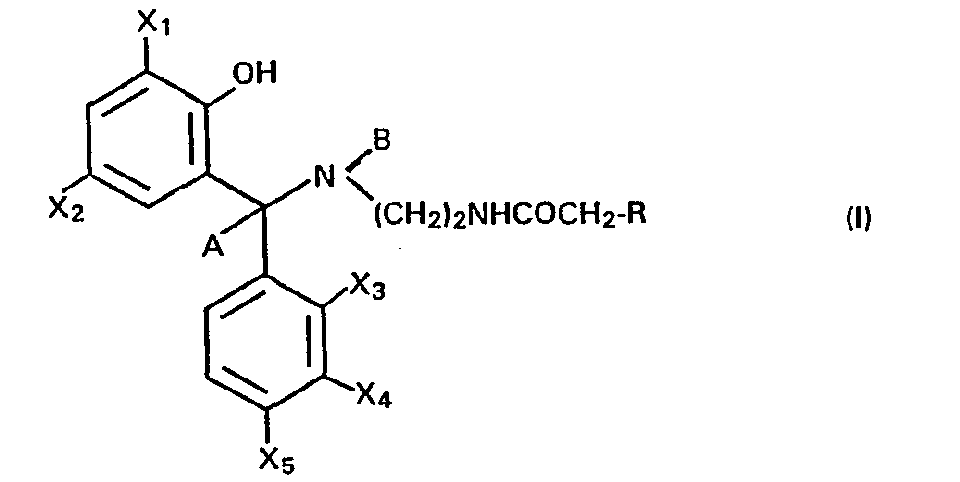
- A et B représentent chacun l'hydrogène ou forment ensemble une liaison, X1 représente l'hydrogène ou un halogène ou un alkyle, X2 et X5 représentent chacun l'hydrogène ou un halogène ou un méthyle, X3 représente l'hydrogène ou un halogène ou un hydroxyle, X4 représente l'hydrogène ou un halogène, et R représente un morpholinyle-4, un pipéridinyle-1 ou un pipérazinyle-1 éventuellement substitués.
Description
- Les composés de l'invention répondent à la formule générale (I)

- A et B représentent chacun un atome d'hydrogène ou bien représentent ensemble une liaison carbone-azote,
- X1 représente un atome d'hydrogène ou d'halogène ou un groupe (C1-C4)alkyle,
- X2 représente un atome d'hydrogène ou d'halogène ou un groupe méthyle, ,
- X3 représente un atome d'hydrogène ou d'halogène ou un groupe hydroxyle,
- X4 représente un atome d'hydrogène ou d'halogène,
- X5 représente un atome d'hydrogène ou d'halogène ou un groupe méthyle, (C1-C4)alkylsulfonyle ou benzylsulfonyle éventuellement substitué en para par un atome d'halogène ou un groupe méthoxy, et
- R représente un groupe morpholinyle-1, hydroxy-4 pipéridinyle-1, aminocarbonyl-4 pipéridinyle-1, hydroxy-4 phényl-4 pipéridinyle-1, (pipéridinyl-1)-4 pipéridinyle-1, (oxo-2 benzimidazolinyl-1)-4 pipéridinyle-1, pipérazinyle-1,
- méthyl-4 pipérazinyle-1, éthoxycarbonyl-4 pipérazinyle-1, phényl-4 pipérazinyle-1, chlorophényl-4 pipérazinyle-1, méthylphényl-4 pipérazinyle-1, ou (pyridinyl-2)-4 pipérazinyle-1.
- Les sels d'addition que peuvent former les composés de l'invention avec des acides acceptables en pharmacologie, et les divers isomères optiques, font partie de l'invention. Les composés préférés de l'invention sont ceux de formule (I) dans laquelle R représente un groupe hydroxy-4 pipéridinyle-1, et A et B représentent ensemble une liaison carbone-azote.
- Une autre catégorie de composés préférés est celle des composés de formule (I) dans laquelle X1, X4 et X5 représentent chacun un atome d'hydrogène, X2 représente un atome de chlore ou un groupe méthyle et X3 représente un atome de chlore.
- Les composés de l'invention peuvent être préparés selon le schéma ci-après.

- On fait réagir d'abord une benzophénone de formule (II), dans laquelle X1, X2, X3, X4 et X5 sont tels que définis ci-dessus, avec l'éthylènediamine dans une première étape, puis avec le chlorure de l'acide chloro-2 acétique dans une deuxième étape.
- Les benzophénones (II) de départ sont connues ; elles sont décrites par exemple dans le brevet des Etats Unis d'Amérique n° 4 094 992 et dans le brevet britannique n° 2 111 051. Dans le cas où X5 est un groupe alkylsulfonyle ou benzylsulfonyle on peut, de manière connue, faire réagir le composé fluoré correspondant (X5=F) avec un alkylmercaptan ou un benzylmer- captan, puis oxyder le produit obtenu, par exemple au moyen d'acide chloro-3 perbenzoïque.
- La première étape du schéma ci-dessus a lieu de préférence avec un excès de diamine, dans un solvant tel que le chloroforme et à la température de reflux.
- La deuxième étape a lieu dans le même récipient, à température ambiante, en présence d'une base destinée à fixer l'acide chlorhydrique libéré.
- Dans une troisième étape on fait réagir le composé de formule (III) ainsi obtenu, avec une amine cyclique de formule RH, R étant tel que défini ci-dessus, à température ambiante ou avec un léger chauffage, dans un solvant tel qu'un alcool inférieur, et éventuellement en présence d'une base.
- On obtient ainsi un composé de formule (I) dans laquelle A et B représentent ensemble une liaison carbone-azote.
- Si l'on désire préparer un composé de formule (I) dans laquelle A et B représentent chacun un atome d'hydrogène, on fait subir au composé obtenu une réduction, par exemple au moyen d'un borohydrure de métal alcalin, à température ambiante et dans un solvant tel qu'un alcool inférieur.
- Les exemples suivants illustrent en détail la préparation de quelques composés selon l'invention.
- Les micro-analyses et les spectres IR et RMN ont confirmé la structure des produits obtenus.
- N-[[[(chloro-5 hydroxy-2 phényl)(chloro-2 phényl)méthylène] amino]-2 éthyl] (hydroxy-4 pipéridinyl-1)-2 acétamide.
- a) Chloro-4 [(chloro-2 phényl)[(amino-2 éthyl)imino]]méthyl-2 phénol.
- On introduit 53,4 g (0,2 mole) de (chloro-5 hydroxy-2 phényl) (chloro-2 phényl)méthanone dans 500 ml de chloroforme, on ajoute 140 ml (2,1 mole) de diamino-1,2 éthane et on chauffe au reflux pendant 2 h. On lave ensuite la phase organique à l'eau jusqu'à obtenir un pH de 7 à 8.
- b) Chloro-2 N-[[[(chloro-5 hydroxy-2 phényl)(chloro-2 phényl) méthylène]amino]-2 éthyl]-acétamide.
- A la solution précédemment obtenue on ajoute 18 g (0,2 mole) de bicarbonate de sodium, 100 ml d'eau et 16 ml (0,2 mole) de chlorure de chloroacétyle. On agite le mélange pendant 30 mn à température ambiante, on sépare et sèche la phase organique, et on évapore le solvant.
- On reprend le résidu à chaud avec du méthanol, on décolore la solution avec du noir animal. On la laisse refroidir, et on filtre les cristaux formés. On obtient 43 g d'un produit jaune. Point de fusion : 122-124°C.
- c) N-[[[(chloro-5 hydroxy-2 phényl)(chloro-2 phényl) méthylène]amino]-2 éthyl] (hydroxy-4 pipéridinyl-1)-2 acétamide. On introduit 9 g (0,023 mole) du dérivé précédemment obtenu dans 100 ml d'éthanol contenant 5 g (0,05 mole) de hydroxy-4 pipéridine. On agite 1 h à,température ambiante, on évapore l'alcool et on reprend le résidu avec un mélange eau/acétate d'éthyle. On sépare la phase organique, on la sèche sur sulfate de magnésium, on chasse le solvant et on recristallise le résidu dans l'alcool isopropylique. On obtient 10,8 g de produit. Point de fusion : 154-155°C.
- N-[[[(méthyl-5 hydroxy-2 phényl)(chloro-2 phényl)méthylène] amino]-2 éthyl] (hydroxy-4 pipéridinyl-1)-2 acétamide.
- a) Méthyl-4 [(chloro-2 phényl)[amino-2 éthyl)imino]]méthyl-2 phénol.
- On introduit 12,3 g (0,05 mole) de (méthyl-5 hydroxy-2 phényl)(chloro-2 phényl)méthanone dans 150 ml de chloroforme, on ajoute 35 ml (0,5 mole) de diamino-1,2 éthane, et on chauffe au reflux pendant 3 h. Puis on lave la phase organique trois fois à l'eau.
- b) Chloro-2 N-[[[(méthyl-5 hydroxy-2 phényl)(chloro-2 phényl) méthylène]amino]-2 éthyl]-acétamide.
- A la solution précédemment obtenue on ajoute 30 ml d'eau contenant 4,65 g (0,055 mole) de bicarbonate de sodium, puis 4,11 ml (0,051 mole) de chlorure de chloroacétyle. On agite le mélange à température ambiante, on sépare la phase organique, on la sèche sur sulfate de magnésium et on évapore le solvant. On fait cristalliser le résidu dans un mélange d'acétate d'éthyle et d'éther isopropylique. On recueille 13 g de produit. Point de fusion : 94-95°C.
- c) N-[[[(méthyl-5 hydroxy-2 phényl)(chloro-2 phényl) méthylène] amino]-2 éthyl] (hydroxy-4 pipéridinyl-l)-2 acétamide. On introduit 7,25 g (0,02 mole) du dérivé précédemment obtenu dans 150 ml d'éthanol contenant 4 g (0,04 mole) de hydroxy-4 pipéridine. On agite le mélange pendant une journée à température ambiante, on évapore l'alcool et on purifie le résidu par chromatographie sur silice en éluant avec un mélange 90/10 de dichlorométhane/méthanol ; on fait recristalliser le produit obtenu dans l'éther éthylique. On en recueille 6 g. Point de fusion : 139-140°C.
- N-[[[(chloro-5 hydroxy-2 phényl)(chloro-2 phényl)méthylène] amino]-2 éthyl] [(chloro-4 phényl)-4 pipérazinyl-1]-2 acétamide.
- On dissout 10 g (0,026 mole) de chloro-2 N-[[[(chloro-5 hydroxy-2 phényl)(chloro-2 phényl) méthylène]amino]-2 éthyl]-acétamide obtenu selon l'exemple 1, a) et b), dans 200 ml d'éthanol et on ajoute 15,5 g (0,057 mole) de dichlorhydrate de (chloro-4 phényl)-1 pipérazine, tout en agitant le mélange à température ambiante. Ensuite on ajoute 9 g de carbonate de sodium et on chauffe le mélange au bain-marie à 50°C pendant 3 h. On isole la phase organique, on évapore l'alcool et on purifie le résidu par chromatographie sur silice en éluant avec un mélange 97,5/2,5 de dichlorométhane/méthanol.
- On recueille finalement 11,4 g de produit pur, sous forme de mousse. Point de fusion : 78-80°C.
- N-[[[(chloro-5 hydroxy-2 phényl)(chloro-2 phényl)méthylène] amino]-2 éthyl][(pyridinyl-2)-4 pipérazinyl-l]-2 acétamide.
- On dissout 10 g (0,026 mole) de chloro-2 N-[[[(chloro-5 hydroxy-2 phényl)(chloro-2 phényl) méthylène]amino]-2 éthyl]-acétamide obtenu selon l'exemple 1, a) et b), dans 200 ml d'éthanol et, sous agitation à température ambiante, on ajoute 9,4 g (0,057 mole) de (pyridinyl-2)-1 pipérazine. On chauffe le mélange en bain-marie à 50°C pendant 3 h. On isole la phase organique, on évapore l'alcool et on purifie le résidu par chromatographie sur silice en éluant avec un mélange 97,5/2,5 de dichlorométhane/méthanol.
- On recueille finalement 13 g de produit pur, sous forme de mousse. Point de fusion : 68-71°C.
- N-[[[(chloro-5 hydroxy-2 phényl)(chloro-2 phényl)méthyl] amino]-2 éthyl][(pyridinyl-2)-4 pipérazinyl-1]-2 acétamide.
- On dissout 4,6 g (0,0089 mole) de N-[[[(chloro-5 hydroxy-2 phényl)(chloro-2 phényl)méthylène]amino]-2 éthyl][(pyridi- nyl-2)-4 pipérazinyl-1]-2 acétamide, obtenu selon l'exemple 4, dans 100 ml d'éthanol, on ajoute 1 g (3 équivalents) de borohydrure de sodium, on agite le mélange pendant 1 h à température ambiante, et on le laisse reposer une nuit. On évapore l'alcool sous vide, on reprend le résidu avec du dichlorométhane, on lave le mélange deux fois à l'eau, on le filtre, on le sèche sur sulfate de magnésium et on évapore le solvant. Il reste une huile qu'on purifie par chromatographie sur silice en éluant avec un mélange 95/5 de dichlorométhane/ méthanol. On recueille finalement 4 g de produit pur sous forme de mousse. Point de fusion : 72-75°C.
- Le tableau suivant illustre les stuctures et propriétés physiques de quelques composés selon l'invention.


- Leur toxicité aigüe est faible : la dose léthale à 50 % (LD50) déterminée chez la souris est supérieure à 1000 mg/kg par la voie orale pour la plupart d'entre eux.
- Les composés de l'invention ont été testés quant à leur effet sur l'ulcère d'estomac induit par la phénylbutazone chez le rat.
- Le test est effectué sur des rats Wistar femelles pesant 180-210 g à jeun depuis 20 heures, répartis en blocs randomisés.
- Les ulcères sont provoqués par l'administration orale de phénylbutazone en solution mole à mole avec de la soude, à la dose de 200 mg/kg.
- Les composés à étudier sont administrés par voie orale à raison de 10, 30 ou 100 mg/kg, 30 minutes avant l'ingestion de phénylbutazone, les animaux témoins ne recevant que le placébo.
- Deux heures après l'administration de l'agent ulcérigène, les animaux sont sacrifiés par inhalation de chloroforme. Les estomacs sont prélevés et le degré d'ulcération est noté en aveugle de 0 à 3.
- Le tableau suivant donne les toxicités et les diminutions maximales d'ulcères obtenues aux doses indiquées, pour quelques composés de l'invention.
- Il montre que ces derniers ont une activité antiulcéreuse significative.
-

- Les composés de l'invention peuvent être administrés par voie orale ou parentérale, sous la forme de compositions pharmaceutiques contenant la substance active en association avec tout excipient approprié, par exemple sous la forme de comprimés, dragées, gélules, capsules ou de solutions ou de suspensions buvables ou injectables.
- La posologie quotidienne peut aller de 10 à 2000 mg.
Claims (6)
- Procédé de préparation d'un composé répondant à la formule générale (I)
 A et B représentent chacun un atome d'hydrogène ou bien représentent ensemble une liaison carbone-azote,X1 représente un atome d'hydrogène ou d'halogène ou un groupe (C1-C4)alkyleX2 représente un atome d'hydrogène ou d'halogène ou un groupe méthyle,X3 représente un atome d'hydrogène ou d'halogène ou un groupe hydroxyle,X4 représente un atome d'hydrogène ou d'halogène,X5 représente un atome d'hydrogène ou d'halogène ou un groupe méthyle, (Cl-C4)alkylsulfonyle ou benzylsulfonyle éventuellement substitué en para par un atome d'halogène ou un groupe méthoxy, etR représente un groupe morpholinyle-1, hydroxy-4 pipéridinyle-1, aminocarbonyl-4 pipéridinyle-1, hydroxy-4 phényl-4 pipéridinyle-1, (pipéridinyl-1)-4 pipéridinyle-1, (oxo-2 benzimidazolinyl-l)-4 pipéridinyle-1, pipérazinyle-1,méthyl-4 pipérazinyle-1, éthoxycarbonyl-4 pipérazinyle-1, phényl-4 pipérazinyle-1, chlorophényl-4 pipérazinyle-1,méthylphényl-4 pipérazinyle-1, ou (pyridinyl-2)-4 pipérazinyle-1,
 - procédé caractérisé en ce qu'on fait réagir une benzophénone de formule (II)
 dans laquelle X1, X2, X3, X4 et X5 sont tels que définis ci-dessus, avec un excès d'éthylènediamine, dans un solvant tel que le chloroforme et à température de reflux, puis on fait réagir le composé obtenu avec le chlorure d'acide chloro-2 acétique à température ambiante et en présence d'une base, puis on fait réagir le composé obtenu, de formule (III)
 avec une amine de formule RH, dans laquelle R est tel que défini ci-dessus, à température ambiante ou avec un léger chauffage, dans un solvant tel qu'un alcool inférieur et éventuellement en présence d'une base, et, si dans la formule (I) A et B représentent chacun un atome d'hydrogène, on soumet le composé obtenu à une réduction au moyen d'un borohydrure de métal alcalin, à température ambiante et dans un solvant tel qu'un alcool inférieur.
Applications Claiming Priority (2)
| Application Number | Priority Date | Filing Date | Title |
|---|---|---|---|
| FR8603489 | 1986-03-12 | ||
| FR8603489A FR2595695B1 (fr) | 1986-03-12 | 1986-03-12 | Derives de n-(((hydroxy-2 phenyl) (phenyl) methylene) amino-2) ethyl) acetamide, leur preparation et leur application en therapeutique |
Publications (1)
| Publication Number | Publication Date |
|---|---|
| EP0239461A1 true EP0239461A1 (fr) | 1987-09-30 |
Family
ID=9333030
Family Applications (1)
| Application Number | Title | Priority Date | Filing Date |
|---|---|---|---|
| EP87400531A Withdrawn EP0239461A1 (fr) | 1986-03-12 | 1987-03-11 | Dérivés de N-¬¬(hydroxy-2 phényl) (phényl) méthylène amino-2 éthyl acétamide, leur préparation et leur application en thérapeutique |
Country Status (12)
| Country | Link |
|---|---|
| EP (1) | EP0239461A1 (fr) |
| JP (1) | JPS62230767A (fr) |
| KR (1) | KR870008842A (fr) |
| AU (1) | AU6991087A (fr) |
| DK (1) | DK123987A (fr) |
| FI (1) | FI871067A7 (fr) |
| FR (1) | FR2595695B1 (fr) |
| HU (1) | HUT43820A (fr) |
| IL (1) | IL81858A0 (fr) |
| NO (1) | NO870998L (fr) |
| PT (1) | PT84452B (fr) |
| ZA (1) | ZA871766B (fr) |
Cited By (13)
| Publication number | Priority date | Publication date | Assignee | Title |
|---|---|---|---|---|
| US5635598A (en) * | 1993-06-21 | 1997-06-03 | Selectide Corporation | Selectively cleavabe linners based on iminodiacetic acid esters for solid phase peptide synthesis |
| US5684131A (en) * | 1991-04-12 | 1997-11-04 | Lebl; Michal | Substituted benzhydrylamines as handles for solid phase peptide synthesis |
| US6063794A (en) * | 1996-10-11 | 2000-05-16 | Cor Therapeutics Inc. | Selective factor Xa inhibitors |
| US6133256A (en) * | 1997-04-14 | 2000-10-17 | Cor Therapeutics Inc | Selective factor Xa inhibitors |
| US6194435B1 (en) | 1996-10-11 | 2001-02-27 | Cor Therapeutics, Inc. | Lactams as selective factor Xa inhibitors |
| US6204268B1 (en) | 1997-04-14 | 2001-03-20 | Cor Therapeutics, Inc | Selective factor Xa inhibitors |
| US6211183B1 (en) * | 1997-04-14 | 2001-04-03 | Cor Therapeutics, Inc. | Selective factor Xa inhibitors |
| US6218382B1 (en) | 1997-08-11 | 2001-04-17 | Cor Therapeutics, Inc | Selective factor Xa inhibitors |
| US6228854B1 (en) | 1997-08-11 | 2001-05-08 | Cor Therapeutics, Inc. | Selective factor Xa inhibitors |
| US6262047B1 (en) | 1996-10-11 | 2001-07-17 | Cor Therapeutics, Inc. | Selective factor Xa inhibitors |
| US6333321B1 (en) | 1997-08-11 | 2001-12-25 | Cor Therapeutics, Inc. | Selective factor Xa inhibitors |
| US6369063B1 (en) | 1997-04-14 | 2002-04-09 | Cor Therapeutics, Inc. | Selective factor Xa inhibitors |
| US6369080B2 (en) | 1996-10-11 | 2002-04-09 | Cor Therapeutics, Inc. | Selective factor Xa inhibitors |
Families Citing this family (1)
| Publication number | Priority date | Publication date | Assignee | Title |
|---|---|---|---|---|
| EP1611116A2 (fr) * | 2003-04-08 | 2006-01-04 | Neuromed Technologies, Inc. | Inhibiteurs des canaux calciques comprenant du benzhydryle espace de la piperazine |
Citations (2)
| Publication number | Priority date | Publication date | Assignee | Title |
|---|---|---|---|---|
| US4094992A (en) * | 1975-08-01 | 1978-06-13 | Synthelabo | Benzylidene derivatives |
| GB2111051A (en) * | 1981-11-18 | 1983-06-29 | Synthelabo | Therapeutically useful benzylidene derivatives |
-
1986
- 1986-03-12 FR FR8603489A patent/FR2595695B1/fr not_active Expired
-
1987
- 1987-03-10 IL IL81858A patent/IL81858A0/xx unknown
- 1987-03-11 KR KR870002176A patent/KR870008842A/ko not_active Withdrawn
- 1987-03-11 HU HU871055A patent/HUT43820A/hu unknown
- 1987-03-11 PT PT84452A patent/PT84452B/fr unknown
- 1987-03-11 EP EP87400531A patent/EP0239461A1/fr not_active Withdrawn
- 1987-03-11 ZA ZA871766A patent/ZA871766B/xx unknown
- 1987-03-11 DK DK123987A patent/DK123987A/da not_active Application Discontinuation
- 1987-03-11 AU AU69910/87A patent/AU6991087A/en not_active Abandoned
- 1987-03-11 JP JP62057891A patent/JPS62230767A/ja active Pending
- 1987-03-11 NO NO870998A patent/NO870998L/no unknown
- 1987-03-11 FI FI871067A patent/FI871067A7/fi not_active Application Discontinuation
Patent Citations (2)
| Publication number | Priority date | Publication date | Assignee | Title |
|---|---|---|---|---|
| US4094992A (en) * | 1975-08-01 | 1978-06-13 | Synthelabo | Benzylidene derivatives |
| GB2111051A (en) * | 1981-11-18 | 1983-06-29 | Synthelabo | Therapeutically useful benzylidene derivatives |
Non-Patent Citations (1)
| Title |
|---|
| DIE PHARMAZIE, vol. 35, no. 4, avril 1980, pages 256-263; F. BAHR et al.: "Zur Herstellung und Umwandlung von 3,4-Dihydrochinazolin-4-olen 1,2" * |
Cited By (15)
| Publication number | Priority date | Publication date | Assignee | Title |
|---|---|---|---|---|
| US5684131A (en) * | 1991-04-12 | 1997-11-04 | Lebl; Michal | Substituted benzhydrylamines as handles for solid phase peptide synthesis |
| US5891995A (en) * | 1991-04-12 | 1999-04-06 | Lebl; Michal | Substituted benzhydrylamines as handles for solid phase peptide synthesis |
| US5635598A (en) * | 1993-06-21 | 1997-06-03 | Selectide Corporation | Selectively cleavabe linners based on iminodiacetic acid esters for solid phase peptide synthesis |
| US6262047B1 (en) | 1996-10-11 | 2001-07-17 | Cor Therapeutics, Inc. | Selective factor Xa inhibitors |
| US6063794A (en) * | 1996-10-11 | 2000-05-16 | Cor Therapeutics Inc. | Selective factor Xa inhibitors |
| US6525076B1 (en) | 1996-10-11 | 2003-02-25 | Millennium Pharmaceuticals, Inc. | Selective factor Xa inhibitors |
| US6194435B1 (en) | 1996-10-11 | 2001-02-27 | Cor Therapeutics, Inc. | Lactams as selective factor Xa inhibitors |
| US6369080B2 (en) | 1996-10-11 | 2002-04-09 | Cor Therapeutics, Inc. | Selective factor Xa inhibitors |
| US6204268B1 (en) | 1997-04-14 | 2001-03-20 | Cor Therapeutics, Inc | Selective factor Xa inhibitors |
| US6369063B1 (en) | 1997-04-14 | 2002-04-09 | Cor Therapeutics, Inc. | Selective factor Xa inhibitors |
| US6211183B1 (en) * | 1997-04-14 | 2001-04-03 | Cor Therapeutics, Inc. | Selective factor Xa inhibitors |
| US6133256A (en) * | 1997-04-14 | 2000-10-17 | Cor Therapeutics Inc | Selective factor Xa inhibitors |
| US6228854B1 (en) | 1997-08-11 | 2001-05-08 | Cor Therapeutics, Inc. | Selective factor Xa inhibitors |
| US6218382B1 (en) | 1997-08-11 | 2001-04-17 | Cor Therapeutics, Inc | Selective factor Xa inhibitors |
| US6333321B1 (en) | 1997-08-11 | 2001-12-25 | Cor Therapeutics, Inc. | Selective factor Xa inhibitors |
Also Published As
| Publication number | Publication date |
|---|---|
| FI871067A7 (fi) | 1987-09-13 |
| JPS62230767A (ja) | 1987-10-09 |
| AU6991087A (en) | 1987-09-17 |
| FR2595695B1 (fr) | 1988-12-02 |
| DK123987D0 (da) | 1987-03-11 |
| KR870008842A (ko) | 1987-10-21 |
| ZA871766B (en) | 1987-09-01 |
| FR2595695A1 (fr) | 1987-09-18 |
| IL81858A0 (en) | 1987-10-20 |
| HUT43820A (en) | 1987-12-28 |
| DK123987A (da) | 1987-09-13 |
| PT84452B (fr) | 1989-03-17 |
| NO870998D0 (no) | 1987-03-11 |
| FI871067A0 (fi) | 1987-03-11 |
| PT84452A (fr) | 1987-04-01 |
| NO870998L (no) | 1987-09-14 |
Similar Documents
| Publication | Publication Date | Title |
|---|---|---|
| EP0217700B1 (fr) | Derives de benzimidazole, leur preparation et leur application en therapeutique | |
| EP0172096A1 (fr) | Dérivés d'acylaminométhyl-3 imidazo[1,2-a]pyridines, leur préparation et leur application en thérapeutique | |
| EP0202164A1 (fr) | Dérivés de (benzoyl-4 pipéridino)-2 phenyl-1 alcanols, leur préparation et leur application en thérapeutique | |
| FR2548666A1 (fr) | Nouveaux derives du nor-tropane et du granatane, leur procede de preparation et leur application en therapeutique | |
| FR2595695A1 (fr) | Derives de n-(((hydroxy-2 phenyl) (phenyl) methylene) amino-2) ethyl) acetamide, leur preparation et leur application en therapeutique | |
| FR2733750A1 (fr) | Derives de l'acide gamma-oxo-alpha-(phenylmethyl)-5,6- dihydro-4h-thieno(3,4-c)pyrrole-5-butanoique, leur preparation et leur application en therapeutique | |
| FR2679555A1 (fr) | Nouveaux derives de l'uree, leur preparation et leur application en therapeutique. | |
| EP0351255A2 (fr) | Dérivés de [(pipéridinyl-4)méthyl]-2 tétrahydro-1,2,3,4 isoquinoléine, leur préparation et leur application en thérapeutique | |
| FR2662442A1 (fr) | Trifluoromethylphenyltetrahydropyridines n-substituees procede pour leur preparation, intermediaires du procede et compositions pharmaceutiques les contenant. | |
| MC1357A1 (fr) | Derives de 2,3-indoledione | |
| EP0301936A1 (fr) | Dérivés de pipéridine, leur préparation et leur application en thérapeutique | |
| FR2600647A1 (fr) | Derives de la glycine | |
| FR2547822A1 (fr) | Acylpiperazinoquinazolines substituees utiles comme medicaments et procede pour leur preparation | |
| CA2045849A1 (fr) | Derives d'oxazolo pyridines, leur procede de preparation et les compositions pharmaceutiques qui les contiennent | |
| EP0005091B1 (fr) | Nouvelles pipérazines monosubstituées, leurs procédés de préparation et les compositions pharmaceutiques les renfermant | |
| FR2552083A1 (fr) | Derives de (alkynyloxy-3 hydroxy-2-propyl)-4 piperazinyl-1 n-phenyl acetamide, leur preparation et leur application en therapeutique | |
| BE1004489A3 (fr) | Derives de dihydropyrimidothiazine, leur procede de preparation et compositions pharmaceutiques les contenant. | |
| FR2615188A1 (fr) | Derives d'hydrazine, procede d'obtention et compositions pharmaceutiques les contenant | |
| EP0176444B1 (fr) | Nouveau procédé de préparation de dérivés du 4 H-1,2-4-triazole, nouveaux triazoles ainsi obtenus, leur applicication comme médicaments et les compositions pharmaceutiques les renfermant | |
| EP0266246A1 (fr) | Dérivés d'imidazo[4,5-b]pyridinone-2, leur préparation et leur application en thérapeutique | |
| EP0002401B1 (fr) | Dérivés de naphtalène, leur préparation et leur application en thérapeutique | |
| EP0067094A1 (fr) | Dérivés hétérocycliques d'amidoximes, leur préparation et leur application en thérapeutique | |
| FR2672888A1 (fr) | Nouvelles urees et thiourees, leur preparation et leur application en therapeutique. | |
| FR2607506A1 (fr) | Nouveaux derives de l'isoindolinone, leur preparation et les compositions pharmaceutiques qui les contiennent | |
| FR2551753A2 (fr) | Benzotriazine-1,2,3-ones-4, procede de preparation et medicaments les contenant |
Legal Events
| Date | Code | Title | Description |
|---|---|---|---|
| PUAI | Public reference made under article 153(3) epc to a published international application that has entered the european phase |
Free format text: ORIGINAL CODE: 0009012 |
|
| AK | Designated contracting states |
Kind code of ref document: A1 Designated state(s): AT BE CH DE ES FR GB GR IT LI LU NL SE |
|
| STAA | Information on the status of an ep patent application or granted ep patent |
Free format text: STATUS: THE APPLICATION HAS BEEN WITHDRAWN |
|
| 18W | Application withdrawn |
Withdrawal date: 19880225 |
|
| RIN1 | Information on inventor provided before grant (corrected) |
Inventor name: PURCELL, THOMAS Inventor name: COMARMOND, JACQUES Inventor name: ZARD, LYDIA |
|
| RTI1 | Title (correction) |
Free format text: N-????(HYDROXY-2-PHENYL)(PHENYL)METHYLENE AMINO-2 ETHYL ACETAMIDE DERIVATIVES, PROCESS FOR THEIR PREPARATION AND THEIR THERAPEUTICAL USE |