EP0240735A2 - Dispositif destiné à la mesure non envahissante de la pression sanguine et du pouls, en particulier chez un sujet humain - Google Patents
Dispositif destiné à la mesure non envahissante de la pression sanguine et du pouls, en particulier chez un sujet humain Download PDFInfo
- Publication number
- EP0240735A2 EP0240735A2 EP87103210A EP87103210A EP0240735A2 EP 0240735 A2 EP0240735 A2 EP 0240735A2 EP 87103210 A EP87103210 A EP 87103210A EP 87103210 A EP87103210 A EP 87103210A EP 0240735 A2 EP0240735 A2 EP 0240735A2
- Authority
- EP
- European Patent Office
- Prior art keywords
- pressure
- sensor
- artery
- pulse
- measurement
- Prior art date
- Legal status (The legal status is an assumption and is not a legal conclusion. Google has not performed a legal analysis and makes no representation as to the accuracy of the status listed.)
- Withdrawn
Links
Images
Classifications
-
- A—HUMAN NECESSITIES
- A61—MEDICAL OR VETERINARY SCIENCE; HYGIENE
- A61B—DIAGNOSIS; SURGERY; IDENTIFICATION
- A61B5/00—Measuring for diagnostic purposes; Identification of persons
- A61B5/02—Detecting, measuring or recording for evaluating the cardiovascular system, e.g. pulse, heart rate, blood pressure or blood flow
-
- A—HUMAN NECESSITIES
- A61—MEDICAL OR VETERINARY SCIENCE; HYGIENE
- A61M—DEVICES FOR INTRODUCING MEDIA INTO, OR ONTO, THE BODY; DEVICES FOR TRANSDUCING BODY MEDIA OR FOR TAKING MEDIA FROM THE BODY; DEVICES FOR PRODUCING OR ENDING SLEEP OR STUPOR
- A61M5/00—Devices for bringing media into the body in a subcutaneous, intra-vascular or intramuscular way; Accessories therefor, e.g. filling or cleaning devices, arm-rests
- A61M5/14—Infusion devices, e.g. infusing by gravity; Blood infusion; Accessories therefor
- A61M5/168—Means for controlling media flow to the body or for metering media to the body, e.g. drip meters, counters ; Monitoring media flow to the body
- A61M5/172—Means for controlling media flow to the body or for metering media to the body, e.g. drip meters, counters ; Monitoring media flow to the body electrical or electronic
- A61M5/1723—Means for controlling media flow to the body or for metering media to the body, e.g. drip meters, counters ; Monitoring media flow to the body electrical or electronic using feedback of body parameters, e.g. blood-sugar, pressure
-
- A—HUMAN NECESSITIES
- A61—MEDICAL OR VETERINARY SCIENCE; HYGIENE
- A61B—DIAGNOSIS; SURGERY; IDENTIFICATION
- A61B5/00—Measuring for diagnostic purposes; Identification of persons
- A61B5/02—Detecting, measuring or recording for evaluating the cardiovascular system, e.g. pulse, heart rate, blood pressure or blood flow
- A61B5/021—Measuring pressure in heart or blood vessels
-
- A—HUMAN NECESSITIES
- A61—MEDICAL OR VETERINARY SCIENCE; HYGIENE
- A61B—DIAGNOSIS; SURGERY; IDENTIFICATION
- A61B5/00—Measuring for diagnostic purposes; Identification of persons
- A61B5/02—Detecting, measuring or recording for evaluating the cardiovascular system, e.g. pulse, heart rate, blood pressure or blood flow
- A61B5/021—Measuring pressure in heart or blood vessels
- A61B5/022—Measuring pressure in heart or blood vessels by applying pressure to close blood vessels, e.g. against the skin; Ophthalmodynamometers
-
- A—HUMAN NECESSITIES
- A61—MEDICAL OR VETERINARY SCIENCE; HYGIENE
- A61B—DIAGNOSIS; SURGERY; IDENTIFICATION
- A61B5/00—Measuring for diagnostic purposes; Identification of persons
- A61B5/68—Arrangements of detecting, measuring or recording means, e.g. sensors, in relation to patient
- A61B5/6801—Arrangements of detecting, measuring or recording means, e.g. sensors, in relation to patient specially adapted to be attached to or worn on the body surface
- A61B5/6843—Monitoring or controlling sensor contact pressure
-
- A—HUMAN NECESSITIES
- A61—MEDICAL OR VETERINARY SCIENCE; HYGIENE
- A61B—DIAGNOSIS; SURGERY; IDENTIFICATION
- A61B2562/00—Details of sensors; Constructional details of sensor housings or probes; Accessories for sensors
- A61B2562/02—Details of sensors specially adapted for in-vivo measurements
-
- A—HUMAN NECESSITIES
- A61—MEDICAL OR VETERINARY SCIENCE; HYGIENE
- A61B—DIAGNOSIS; SURGERY; IDENTIFICATION
- A61B2562/00—Details of sensors; Constructional details of sensor housings or probes; Accessories for sensors
- A61B2562/02—Details of sensors specially adapted for in-vivo measurements
- A61B2562/0247—Pressure sensors
Definitions
- the invention is directed to a method for the bloodless measurement of blood pressure and pulse, particularly in humans.
- blood pressure is usually measured by means of a cuff which is placed around the arm in the bend of a patient's arm and then inflated until the flow of blood through the arteries is interrupted. The pressure required for this is determined using a manometer. The pressure is then slowly reduced until the blood can flow again without restriction. This pressure is also measured using the manometer. Based on the flow of blood through the artery, the doctor uses a stethoscope to determine the conditions of the artery on which the pressure measurement is based.
- the pulse frequency is determined by simply counting the individual pulse beats during a previous time interval.
- the measurements according to the known method can only be carried out by trained personnel and take up a not inconsiderable part of the time planned by the doctor for the care of a patient.
- the necessary equipment as well as the procedure itself cause suspicion, especially in children additional time must first be dispersed by the doctor.
- the object of the invention is to provide a solution while avoiding the disadvantages described, to create a method and a device with which both the blood pressure and the pulse can be carried out in a very short time by untrained personnel, in particular also by the patient himself. Applying pressure via the cuff, which is perceived by many patients as particularly unpleasant, is to be avoided as far as possible and the method should therefore also be particularly suitable for children, among other things, the blood pressure measuring device also making the use of peripheral devices possible.
- This object is achieved according to the invention in a method of the type described in the introduction in that the measurement is carried out by detecting the movement of the arteries from outside the body.
- the advantage of the invention is that the quantities to be recorded are essentially reduced to the arterial movement, so that a corresponding measurement can be carried out in a significantly shorter time and in a significantly simplified manner. Arterial movement can also be recorded by inexperienced personnel. Another key advantage is that they last longer Times can be carried out without interference and that the stresses that can be detected by long-term measurements for the patient can be remedied by external intervention measures.
- the invention provides that after detection of the artery movement, the signal thus obtained is converted into a pressure and / or path and / or pulse frequency signal.
- Pressure and / or path signals can be represented in simple electrical quantities using known technology. These sizes can then be processed further using conventional technology, in particular with small computers, which are generally available today in every doctor's office or are already available even with a large number of potential patients.
- the invention also provides that a sensor is acted upon directly by the arterial movement via a mechanical or fluidic coupling. Couplings of this type ensure that possible sources of error, for example due to the arm movement of the respective person, are reduced or eliminated, so that only the actual artery movement can be used as the underlying measurement variable, depending on the computing model, additional information can also be used for the further processing of the signal .
- Such quantities can be, for example, the real ambient pressure at the measuring point, the body temperature of the patient, possibly the eye pressure u. Like. more.
- the invention provides that the sensor acts on the artery via a predeterminable offset pressure, and the measurement of the offset pressure and the impulses that are made in the sensor are used to calculate the blood pressure.
- Another type of compensation is that at least two sensors are provided in a measuring circuit, one sensor acting on the artery to be measured and at least one of the other sensors on a pulse-neutral region of the body surface, the sensors also in this case with predetermined contact pressures against the Body surface of the person to be measured can be pressed.
- the invention also provides for an extreme value formation and / or a Fourie analysis of the course via a computer the artery movement with possibly averaging, a simultaneous determination of the pulse frequency, a correction value formation, a determination of an average correction value, with a storage of the determined values and / or with a printout of the determined values in digital or analog representation via a printer.
- the patient's blood pressure values can be determined from the extreme values without the need to record the flow noises.
- the influence of different sources of error can also be excluded by averaging.
- the synchronous detection of the pulse frequency also not only allows averaging, but also enables the compensation of measurement errors over a certain period of time, which depends on the pulse frequency, with the storage and the possible optical reproduction by printing out the measurement values for the diagnostician Provides information material.
- a blood pressure / pulse measurement is carried out continuously and / or that the measured values determined are used to control and / or regulate a medication pump.
- a particular advantage of the invention is that blood pressure and pulse frequency and also the type of pressure or pulse can be measured continuously over longer periods of time. This makes it possible to directly assign a medication pump to the patient, which supplies the patient with the necessary medication in the event of malfunctions. This makes it possible, for example, to wear a corresponding device, for example in the form of a wristwatch, on the wrist, the blood pressure and pulse detection device being assigned to the corresponding artery and a small pump for injecting medication being installed in the same device.
- the invention therefore also provides a device for carrying out the method, which is characterized in that the pressure sensor is designed as an electronic component and has an elastic mounting in a housing.
- Electronic pressure transducers are already available in different designs.
- the special storage of these components is essential for the present purpose.
- the elastic storage in a housing it can, for example, be a silicone mass or a similar material, makes it possible to make the measurement largely independent of external influences.
- the invention therefore also provides that the pressure sensor is connected to an amplifier, an A / D converter and a computing system, the latter possibly having a display device and / or a printer.
- a computing system possibly having a display device and / or a printer.
- conventional components are used, such as an amplifier and an analog / digital converter u. Like., But it has been shown in tests that these control structures are particularly useful.
- the invention also provides that the pressure sensor can be pressed against the body via a cuff or the like with predetermined or predeterminable offset pressure in the region of an artery.
- the predeterminable offset pressure is used by the computer to compensate for sources of error, so that it is ensured that the pulse transmitted to the pressure transducer by the arterial movement can be directly converted to the blood pressure.
- the pressure transducer can be pressed onto the skin surface in a housing under predeterminable spring force, in a further embodiment it can be provided that the springs act on one side of the elastic bearing means of the sensor with a silicone body, for example, and on the other side it is fixed or in turn arranged elastically on the housing of the pressure sensor.
- the springs act on one side of the elastic bearing means of the sensor with a silicone body, for example, and on the other side it is fixed or in turn arranged elastically on the housing of the pressure sensor.
- such a device is particularly suitable for controlling a medication pump, so that the invention also provides that the computing unit has a device for controlling and / or regulating such a medication pump.
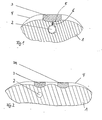
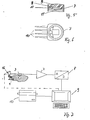
- a pressure transducer 3 is placed on a human arm 1 with an artery 2, which is only hinted at in FIGS. 1 and 2 and fixed there with a hinted cuff 4 with application of a pre (offset) pressure.
- an alternating impulse is exerted on the underside 5 of the pressure sensor 3 by a change in the shape of the artery 2 (shown in dashed lines in FIG. 1), which is indicated by the double arrow.
- These changing conditions are registered by the pressure sensor 3, converted into electrical signals, converted to an A / D (analog / digital) converter via an amplifier 7 and fed to a computer 9, the results of which can be printed out, if necessary, via a printer 10 connected there .
- pressure transducers 3 The more detailed structure of pressure transducers 3 is described in more detail below in connection with FIGS. 3-6.
- FIG. 2 A modified type is shown in FIG. 2: Here two pressure sensors 3 and 3a are provided, one of the pressure sensors 3 being arranged near the artery 2, while the pressure sensor 3a is arranged in an adjacent area largely undisturbed by its pulsation. Both pressure sensors are again placed around the forearm of a person by means of a cuff 4, which is also denoted by 1 here. With a corresponding circuit, the differing signals from the pressure sensor 3 and the pressure sensor 3a can be used to compensate for the respective measured values in order to achieve the highest possible measurement accuracy.
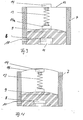
- FIGS. 3 and 4 The type of installation of such a sensor 8 is shown in FIGS. 3 and 4 in different versions.
- the sensor 8 is cast into the silicone bed 9 within a housing 7 which is closed off by a fixed cover 12.
- the special feature here is a spring bearing via a spring 13 which is clamped between two spring pistons 14 and 14a. This can be used, for example, to simulate a predeterminable offset pressure in the housing 7 in order to be able to compensate for measurement errors.
- FIG. 4 A modified exemplary embodiment is shown in FIG. 4, wherein all the same components have the same reference numerals.
- the main difference here is the design of the cover of the housing 7.
- This cover consists of an elastic membrane 15, which in turn serves for further incorrect compensation.
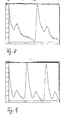
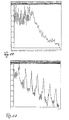
- FIG. 8 shows the pressure profile of a patient in the rest position, the pulse profile of the same patient after short exposure being shown in FIG. 9.
- the amplitude scale was made roughly the same in mathematical terms, while in reality it differs significantly.
- the curves not only show the typical pressure curve, but also reveal further details to the diagnostician through the special curve design.
- FIGS. 10 and 11 This applies e.g. also for the two FIGS. 10 and 11, in which the pressing of the artery on the upper arm is shown, measured by a pressure sensor on the radial artery. Not only the significant pressure drop can be seen here, but also details of the pulse behavior when the falling curve is enlarged according to FIG. 10 in FIG. 11.
- Essential for the invention is that with the pressure sensor and the electronic monitoring of the values of a M edikêtêtnpumpe is made possible 16 ( Figure 7.). This makes it possible for a sick patient to be given a dampening or stimulating medication directly from the outside, for example when stored setpoints are exceeded.
Landscapes
- Health & Medical Sciences (AREA)
- Life Sciences & Earth Sciences (AREA)
- Heart & Thoracic Surgery (AREA)
- Cardiology (AREA)
- Veterinary Medicine (AREA)
- Public Health (AREA)
- General Health & Medical Sciences (AREA)
- Animal Behavior & Ethology (AREA)
- Engineering & Computer Science (AREA)
- Biomedical Technology (AREA)
- Surgery (AREA)
- Medical Informatics (AREA)
- Molecular Biology (AREA)
- Pathology (AREA)
- Biophysics (AREA)
- Vascular Medicine (AREA)
- Physics & Mathematics (AREA)
- Physiology (AREA)
- Diabetes (AREA)
- Anesthesiology (AREA)
- Hematology (AREA)
- Ophthalmology & Optometry (AREA)
- Measuring Pulse, Heart Rate, Blood Pressure Or Blood Flow (AREA)
Applications Claiming Priority (2)
| Application Number | Priority Date | Filing Date | Title |
|---|---|---|---|
| DE19863609912 DE3609912A1 (de) | 1986-03-24 | 1986-03-24 | Messverfahren und geraet zur vereinfachten messung des blutdrucks und des pulses |
| DE3609912 | 1986-03-24 |
Publications (2)
| Publication Number | Publication Date |
|---|---|
| EP0240735A2 true EP0240735A2 (fr) | 1987-10-14 |
| EP0240735A3 EP0240735A3 (fr) | 1988-09-14 |
Family
ID=6297156
Family Applications (1)
| Application Number | Title | Priority Date | Filing Date |
|---|---|---|---|
| EP87103210A Withdrawn EP0240735A3 (fr) | 1986-03-24 | 1987-03-06 | Dispositif destiné à la mesure non envahissante de la pression sanguine et du pouls, en particulier chez un sujet humain |
Country Status (4)
| Country | Link |
|---|---|
| EP (1) | EP0240735A3 (fr) |
| KR (1) | KR890701055A (fr) |
| DE (1) | DE3609912A1 (fr) |
| WO (1) | WO1989003194A1 (fr) |
Cited By (5)
| Publication number | Priority date | Publication date | Assignee | Title |
|---|---|---|---|---|
| DE4012856A1 (de) * | 1990-04-18 | 1991-10-24 | Lebrecht Von Dr Klitzing | Medizinisches diagnosegeraet zur messung des blutpulses als auch des zeitlichen verlaufs jeder mit dem blutvolumen einhergehenden gefaessvolumenveraenderung |
| DE4105457A1 (de) * | 1991-02-21 | 1992-09-03 | Seca Gmbh | Verfahren und vorrichtung zur nichtinvasiven kontinuierlichen blutdruckmessung bei menschen |
| DE4410297A1 (de) * | 1994-03-25 | 1995-10-05 | Friedrich E Simon | Verfahren und Anordnung zur nichtinvasiven Messung des arteriellen Blutdruckes |
| EP0664102A3 (fr) * | 1993-11-30 | 1995-11-08 | Seiko Epson Corp | Appareil destiné à la commande du débit de médicaments et à la détection de signaux du pouls. |
| AT407949B (de) * | 1998-06-09 | 2001-07-25 | Cnsystems Medizintechnik Gmbh | Haemodynamischer patientenmonitor |
Families Citing this family (3)
| Publication number | Priority date | Publication date | Assignee | Title |
|---|---|---|---|---|
| DE3609912A1 (de) * | 1986-03-24 | 1987-10-08 | Franz Theo Dr Med Ernst | Messverfahren und geraet zur vereinfachten messung des blutdrucks und des pulses |
| US5158091A (en) * | 1990-11-30 | 1992-10-27 | Ivac Corporation | Tonometry system for determining blood pressure |
| US6002952A (en) | 1997-04-14 | 1999-12-14 | Masimo Corporation | Signal processing apparatus and method |
Family Cites Families (8)
| Publication number | Priority date | Publication date | Assignee | Title |
|---|---|---|---|---|
| US3535067A (en) * | 1967-03-07 | 1970-10-20 | Electro O Mech Inc | Blood pressure and pulse indicator |
| US3880145A (en) * | 1972-10-02 | 1975-04-29 | Stein Paul D | Method and apparatus for continuously monitoring blood pressure |
| FR2296396A1 (fr) * | 1974-12-31 | 1976-07-30 | Boulaine Andre | Dispositif de mesure du rythme cardiaque |
| DE2627531A1 (de) * | 1976-03-16 | 1977-09-22 | Duerr | Pulsabnehmer und sichtanzeige fuer ohren-herzreflex |
| US4269193A (en) * | 1977-11-04 | 1981-05-26 | Sri International | Noninvasive blood pressure monitoring transducer |
| US4425920A (en) * | 1980-10-24 | 1984-01-17 | Purdue Research Foundation | Apparatus and method for measurement and control of blood pressure |
| US4561447A (en) * | 1983-01-14 | 1985-12-31 | Nippon, Colin Co., Ltd. | Apparatus and method of detecting arterial pulse wave |
| DE3609912A1 (de) * | 1986-03-24 | 1987-10-08 | Franz Theo Dr Med Ernst | Messverfahren und geraet zur vereinfachten messung des blutdrucks und des pulses |
-
1986
- 1986-03-24 DE DE19863609912 patent/DE3609912A1/de not_active Withdrawn
-
1987
- 1987-03-06 EP EP87103210A patent/EP0240735A3/fr not_active Withdrawn
- 1987-10-09 WO PCT/DE1987/000458 patent/WO1989003194A1/fr not_active Ceased
- 1987-10-09 KR KR1019890700642A patent/KR890701055A/ko not_active Withdrawn
Cited By (6)
| Publication number | Priority date | Publication date | Assignee | Title |
|---|---|---|---|---|
| DE4012856A1 (de) * | 1990-04-18 | 1991-10-24 | Lebrecht Von Dr Klitzing | Medizinisches diagnosegeraet zur messung des blutpulses als auch des zeitlichen verlaufs jeder mit dem blutvolumen einhergehenden gefaessvolumenveraenderung |
| DE4105457A1 (de) * | 1991-02-21 | 1992-09-03 | Seca Gmbh | Verfahren und vorrichtung zur nichtinvasiven kontinuierlichen blutdruckmessung bei menschen |
| EP0664102A3 (fr) * | 1993-11-30 | 1995-11-08 | Seiko Epson Corp | Appareil destiné à la commande du débit de médicaments et à la détection de signaux du pouls. |
| US5730137A (en) * | 1993-11-30 | 1998-03-24 | Seiko Epson Corporation | Medication delivery control and pulse wave detection apparatus |
| DE4410297A1 (de) * | 1994-03-25 | 1995-10-05 | Friedrich E Simon | Verfahren und Anordnung zur nichtinvasiven Messung des arteriellen Blutdruckes |
| AT407949B (de) * | 1998-06-09 | 2001-07-25 | Cnsystems Medizintechnik Gmbh | Haemodynamischer patientenmonitor |
Also Published As
| Publication number | Publication date |
|---|---|
| DE3609912A1 (de) | 1987-10-08 |
| EP0240735A3 (fr) | 1988-09-14 |
| WO1989003194A1 (fr) | 1989-04-20 |
| KR890701055A (ko) | 1989-12-19 |
Similar Documents
| Publication | Publication Date | Title |
|---|---|---|
| DE69615007T2 (de) | Externer referenz-messfühler für einen patienten | |
| EP0625025B1 (fr) | Detecteur et dispositif permettant de mesurer la tension arterielle | |
| DE69821121T2 (de) | Verfahren und anordnung zur blutdruckmessung | |
| DE69434177T2 (de) | Membran-tonometer und anwendungsverfahren | |
| DE60119402T2 (de) | Anordnung zum Messen von Biosignalen | |
| DE2050939A1 (de) | Vorrichtung zur Rheoplethysmographie | |
| DE102005059435A1 (de) | Vorrichtung zur nichtinvasiven Blutdruckmessung | |
| DE4001179A1 (de) | Verfahren und vorrichtung zur nichteindringenden druckmessung | |
| DE112010003582T5 (de) | Vorrichtung zum Messen von biometrischen Informationen mit einer Handablage | |
| DE112010003588B4 (de) | Vorrichtung zum Messen von biometrischen Informationen | |
| WO1989003194A1 (fr) | Procede et equipement pour mesurer indirectement la pression sanguine et le pouls, en particulier chez l'homme | |
| DE10119527A1 (de) | Verfahren zur mobilen oder stationären Erfassung von Körperfunktions- und Stoffwechseldaten eines lebenden Körpers und Einrichtung zur Durchführung des Verfahrens | |
| DE19609698A1 (de) | Blutdruckmeßgerät | |
| DE69122929T2 (de) | Pulsmessgerät | |
| DE4139709C2 (de) | Pulswellenfühler | |
| EP3888549A1 (fr) | Détermination de la respiration à l'aide d'un capteur d'accélération | |
| EP1417926A1 (fr) | Méthode et appareil pour l'enrégistrement non-invasif du debit sanguin et pour l'enrégistrement et le traitement des signaux ECG et usage d'un appareil ECG | |
| EP0445809A2 (fr) | Dispositif de mesure de la pression sanguine | |
| DE2944600A1 (de) | Verfahren und geraet zum nachweis der bewegung von koerpergewebe | |
| DE102022120596B3 (de) | Verfahren und Vorrichtung zur nicht-invasiven Blutdruckmessung | |
| DE4012874C2 (de) | Blutdruckmeßvorrichtung mit einer Langzeit-EKG-Meßeinrichtung | |
| DE102004020515A1 (de) | Verfahren und Vorrichtung zur drahtlosen Aufzeichnung und Fernüberwachung von Muskelaktivitäten bei Tieren | |
| DE1961594A1 (de) | Medizinisches Instrument zum Feststellen von Leben oder Tod | |
| DE1918076A1 (de) | Verfahren und Messgeraet zur Beurteilung der Herzfunktion | |
| DE2360660B2 (de) | Verfahren und Vorrichtung zum Messen der foetalen Herzfrequenz |
Legal Events
| Date | Code | Title | Description |
|---|---|---|---|
| PUAI | Public reference made under article 153(3) epc to a published international application that has entered the european phase |
Free format text: ORIGINAL CODE: 0009012 |
|
| AK | Designated contracting states |
Kind code of ref document: A2 Designated state(s): AT BE CH DE ES FR GB GR IT LI LU NL SE |
|
| PUAL | Search report despatched |
Free format text: ORIGINAL CODE: 0009013 |
|
| AK | Designated contracting states |
Kind code of ref document: A3 Designated state(s): AT BE CH DE ES FR GB GR IT LI LU NL SE |
|
| 17P | Request for examination filed |
Effective date: 19890221 |
|
| RAP1 | Party data changed (applicant data changed or rights of an application transferred) |
Owner name: SECA GMBH |
|
| 17Q | First examination report despatched |
Effective date: 19911031 |
|
| STAA | Information on the status of an ep patent application or granted ep patent |
Free format text: STATUS: THE APPLICATION IS DEEMED TO BE WITHDRAWN |
|
| 18D | Application deemed to be withdrawn |
Effective date: 19920918 |
|
| RIN1 | Information on inventor provided before grant (corrected) |
Inventor name: ERNST, FRANZ. T., DR, MED. Inventor name: TEN HOMPEL, MICHAEL, DIPL.-ING. |