EP0241149A2 - Rückgewinnung von Wertstoffen aus gebrauchten, Tonerde enthaltenden Katalysatoren - Google Patents
Rückgewinnung von Wertstoffen aus gebrauchten, Tonerde enthaltenden Katalysatoren Download PDFInfo
- Publication number
- EP0241149A2 EP0241149A2 EP87302119A EP87302119A EP0241149A2 EP 0241149 A2 EP0241149 A2 EP 0241149A2 EP 87302119 A EP87302119 A EP 87302119A EP 87302119 A EP87302119 A EP 87302119A EP 0241149 A2 EP0241149 A2 EP 0241149A2
- Authority
- EP
- European Patent Office
- Prior art keywords
- catalyst
- spent
- atmospheres
- metal
- cobalt
- Prior art date
- Legal status (The legal status is an assumption and is not a legal conclusion. Google has not performed a legal analysis and makes no representation as to the accuracy of the status listed.)
- Granted
Links
Images

Classifications
-
- C—CHEMISTRY; METALLURGY
- C01—INORGANIC CHEMISTRY
- C01F—COMPOUNDS OF THE METALS BERYLLIUM, MAGNESIUM, ALUMINIUM, CALCIUM, STRONTIUM, BARIUM, RADIUM, THORIUM, OR OF THE RARE-EARTH METALS
- C01F7/00—Compounds of aluminium
- C01F7/68—Aluminium compounds containing sulfur
- C01F7/74—Sulfates
-
- C—CHEMISTRY; METALLURGY
- C01—INORGANIC CHEMISTRY
- C01G—COMPOUNDS CONTAINING METALS NOT COVERED BY SUBCLASSES C01D OR C01F
- C01G39/00—Compounds of molybdenum
- C01G39/02—Oxides; Hydroxides
-
- C—CHEMISTRY; METALLURGY
- C22—METALLURGY; FERROUS OR NON-FERROUS ALLOYS; TREATMENT OF ALLOYS OR NON-FERROUS METALS
- C22B—PRODUCTION AND REFINING OF METALS; PRETREATMENT OF RAW MATERIALS
- C22B21/00—Obtaining aluminium
- C22B21/0015—Obtaining aluminium by wet processes
- C22B21/0023—Obtaining aluminium by wet processes from waste materials
- C22B21/003—Obtaining aluminium by wet processes from waste materials from spent catalysts
-
- C—CHEMISTRY; METALLURGY
- C22—METALLURGY; FERROUS OR NON-FERROUS ALLOYS; TREATMENT OF ALLOYS OR NON-FERROUS METALS
- C22B—PRODUCTION AND REFINING OF METALS; PRETREATMENT OF RAW MATERIALS
- C22B23/00—Obtaining nickel or cobalt
- C22B23/04—Obtaining nickel or cobalt by wet processes
- C22B23/0407—Leaching processes
- C22B23/0415—Leaching processes with acids or salt solutions except ammonium salts solutions
- C22B23/043—Sulfurated acids or salts thereof
-
- C—CHEMISTRY; METALLURGY
- C22—METALLURGY; FERROUS OR NON-FERROUS ALLOYS; TREATMENT OF ALLOYS OR NON-FERROUS METALS
- C22B—PRODUCTION AND REFINING OF METALS; PRETREATMENT OF RAW MATERIALS
- C22B34/00—Obtaining refractory metals
- C22B34/30—Obtaining chromium, molybdenum or tungsten
- C22B34/34—Obtaining molybdenum
- C22B34/345—Obtaining molybdenum from spent catalysts
-
- C—CHEMISTRY; METALLURGY
- C22—METALLURGY; FERROUS OR NON-FERROUS ALLOYS; TREATMENT OF ALLOYS OR NON-FERROUS METALS
- C22B—PRODUCTION AND REFINING OF METALS; PRETREATMENT OF RAW MATERIALS
- C22B7/00—Working up raw materials other than ores, e.g. scrap, to produce non-ferrous metals and compounds thereof; Methods of a general interest or applied to the winning of more than two metals
- C22B7/009—General processes for recovering metals or metallic compounds from spent catalysts
-
- Y—GENERAL TAGGING OF NEW TECHNOLOGICAL DEVELOPMENTS; GENERAL TAGGING OF CROSS-SECTIONAL TECHNOLOGIES SPANNING OVER SEVERAL SECTIONS OF THE IPC; TECHNICAL SUBJECTS COVERED BY FORMER USPC CROSS-REFERENCE ART COLLECTIONS [XRACs] AND DIGESTS
- Y02—TECHNOLOGIES OR APPLICATIONS FOR MITIGATION OR ADAPTATION AGAINST CLIMATE CHANGE
- Y02P—CLIMATE CHANGE MITIGATION TECHNOLOGIES IN THE PRODUCTION OR PROCESSING OF GOODS
- Y02P10/00—Technologies related to metal processing
- Y02P10/20—Recycling
-
- Y—GENERAL TAGGING OF NEW TECHNOLOGICAL DEVELOPMENTS; GENERAL TAGGING OF CROSS-SECTIONAL TECHNOLOGIES SPANNING OVER SEVERAL SECTIONS OF THE IPC; TECHNICAL SUBJECTS COVERED BY FORMER USPC CROSS-REFERENCE ART COLLECTIONS [XRACs] AND DIGESTS
- Y10—TECHNICAL SUBJECTS COVERED BY FORMER USPC
- Y10S—TECHNICAL SUBJECTS COVERED BY FORMER USPC CROSS-REFERENCE ART COLLECTIONS [XRACs] AND DIGESTS
- Y10S502/00—Catalyst, solid sorbent, or support therefor: product or process of making
- Y10S502/515—Specific contaminant removal
- Y10S502/516—Metal contaminant removal
-
- Y—GENERAL TAGGING OF NEW TECHNOLOGICAL DEVELOPMENTS; GENERAL TAGGING OF CROSS-SECTIONAL TECHNOLOGIES SPANNING OVER SEVERAL SECTIONS OF THE IPC; TECHNICAL SUBJECTS COVERED BY FORMER USPC CROSS-REFERENCE ART COLLECTIONS [XRACs] AND DIGESTS
- Y10—TECHNICAL SUBJECTS COVERED BY FORMER USPC
- Y10S—TECHNICAL SUBJECTS COVERED BY FORMER USPC CROSS-REFERENCE ART COLLECTIONS [XRACs] AND DIGESTS
- Y10S502/00—Catalyst, solid sorbent, or support therefor: product or process of making
- Y10S502/515—Specific contaminant removal
- Y10S502/517—Sulfur or sulfur compound removal
Definitions
- This subject invention relates to the recovery of various chemicals and metals from spent alumina-base catalysts. More particularly, the invention relates to acid leaching spent hydrotreating catalysts to recover chemical and metal values.
- the alumina support is recovered in addition to the catalyst metals themselves.
- the hydrotreating of petroleum feedstock serves to upgrade the hydrocarbon fraction in the eventual distillate.
- the purpose of this is to remove impurities such as sulfur, nitrogen, oxygen and organo-metallic compounds which may be present.
- the quality of the feedstock is improved and downstream cracking or reforming catalysts are protected. That is, the downstream cracking or reforming catalysts are not altered or poisoned, and thus, they may be easily recycled.
- the most common material which poisons petroleum conversion catalysts is sulfur. Hydrodesulfurization is also beneficial for subsequent combustion of the treated hydrocarbon fraction as fuel in domestic heaters, industrial furnaces, etc., in reducing the discharge of sulfurous combustion products into the atmosphere.
- Petroleum refining is one of the largest manufacturing industries in the United States, with petroleum products accounting for at least 10% of the Gross National Product.
- Six basic catalyst-consuming processes are employed in the conversion of petroleum. The four most important are cracking, hydroprocessing/hydrodesulfurization, catalytic reforming and alkylation. Of lesser importance are hydrocarbon polymerization and isomerization, petrochemical processes such as the manufacture of aldehydes by reaction of carbon monoxide with hydrogen, the manufacture of alcohols by reacting aldehydes with hydrogen, as well as other vapor-phase catalytic processes.
- Hydrodesulfurization (HDS) is a term that is applied to the hydroprocessing of any petroleum feedstock since desulfurization via catalytic hydrogenation or hydrotreating is involved. However, the term is most appropriate for the treatment of the heavy, semi-solid residue or bottom stream from crude oil distillation towers.
- catalysts employed in hydrotreating and hydrodesulfurization are cobalt-molybdenum, nickel-molybdenum and nickel-tungsten combinations on an alumina support.
- the most common catalyst is a cobalt-molybdenum trioxide.
- spent catalysts are also of environmental concern. Not only doe the spent materials tend to be pyrophoric but they also contain leachable toxic heavy metals such as arsenic in addition to the nickel, cobalt or molybdenum. Moreover, present commercial processes tend to recover only molybdenum or cobalt and leave the inert alumina matrix and unrecovered metals for land disposal. The prior art is lacking in an economical method to recover and reuse all significant chemical and metal values including the alumina matrix.
- the present invention aims to overcome the problems and disadvantages present in the prior art by providing a simple, efficient and economical method for effecting a substantially complete extraction and recovery of valuable metal values from spent hydrodesulfurization or hydrogenation catalysts.
- the present invention provides a process for the recovery of aluminum and at least one other metal selected from molybdenum, nickel and cobalt from a spent catalyst comprising said at least one metal and carbonaceous matter deposited on a refractory alumina-containing inorganic oxide support, said process comprising:
- the present invention further provides a process for the recovery of aluminum from a spent hydrodesulfurization catalyst comprising at least one catalytically active metal and carbonaceous matter deposited on a refractory alumina-containing inorganic oxide support, said process comprising adding from 1 to 3 parts concentrated H2SO4 per part of hydrodesulfurization catalyst in a reaction zone at from 20° to 200°C and in the presence of hydrogen sulfide gas at a pressure of from 2 to 35 atmospheres, maintaining the resultant mixture in the reaction zone until the alumina in the catalyst is substantially completely dissolved, and mechanically separating the resultant Al2(SO4)3 solution from the resultant metal oxide-containing solid residue.
- the present invention still further provides a process for the recovery of solid molybdic acid from an aqueous slurry comprising cobalt and nickel sulfides, the process comprising oxidizing said sulfides at a temperature of from 20° to 200°C and in an oxygen atmosphere at a pressure of from 1 to 35 atmospheres, and mechanically separating the slurry to obtain solid molybdic acid and an aqueous metal sulfate solution.
- a process has been developed which can convert spent petroleum conversion or hydrogenation catalysts into marketable forms of aluminum, molydbenum, and other strategic metals in an energy-conserving manner, while solving the hazardous waste disposal problems associated with spent solid catalysts. All significant chemical and metal values may be recovered and reused from spent catalysts including the alumina catalyst matrix. Unrecovered trace metals such as arsenic may be fixed so that they will not leach into the groundwater if landfilled.
- the hydrodesulfurization catalysts are originally in the form of small rods or pellets; the largest dimensions are generally less than one centimeter. They are comprised generally of an activated inorganic oxide support which is porous.
- the inorganic oxide support commonly comprises activated alumina, or alumina composited with one or more inorganic oxides such as silica, zirconia, thoria, magnesia, titania, zinc oxide and the like.
- the inorganic oxide support is impregnated with compounds containing certain catalytically active metals such as cobalt, molybdenum and nickel.
- the spent petroleum conversion catalysts are generally discharged directly from the refinery operation as a solid, often in the form of an extrudate about 0.16 cm by 0.65 cm.
- This extrudate contains spent hydrodesulfurization (HDS) catalyst as well as a variety of other impurities from the refinery process.
- the waste catalysts may be directly removed from the refinery units without subjecting them to any treatment prior to subjecting them to the process of the present invention.
- a deoiling step is necessary prior to treatment. This can be achieved for example by washing with a low-boiling solvent, for instance an organic solvent such as petroleum naphtha, as is conventional in the art, for elimination of the major part of the hydrocarbons contained in the pores of the catalyst. Residual solvent is then eliminated by distillation at a suitable temperature.
- the hydrocarbons can also be burned, in a strictly limited quantity of air so as to stop the combustion before the noncombined carbon is also oxidized.
- a bed of spent hydrocarbon containing catalyst can be heated from the outside while contained in a closed treatment vessel at a temperature on the order of 400°C, having nitrogen flowing through it.
- the nitrogen effluent becomes charged with volatile liquid materials which distill slowly, a little at a time, and it is thus possible to recover them by condensation.
- the catalyst particles are now ready for treatment by the process of the present invention.
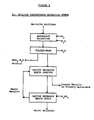
- FIG. 1 presents a processing flowsheet for the primary separation of a spent hydrodesulfurization catalyst.
- FIG. 2 depicts the sulfide concentrate oxidation steps.
- the catalyst is reacted with aqueous concentrated sulfuric acid in a low-pressure autoclave in the presence of added hydrogen sulfide gas.
- the reaction produces a metal sulfide precipitate and an aluminum sulfate solution. Separation of these two phases may be accomplished by any method known in the art, including decanting, centrifuging, and filtration. Filtration is preferred over the other methods of separation for reasons of cost and efficiency.
- the separation yields aluminum sulfate (alum) solution and a metal concentrate from which molybdenum, cobalt, and nickel are separated and recovered by oxidative leaching and ion exchange.
- the resulting chemical heat of reaction can supply a major portion of the required process energy.
- the initial step of the process is the complete disintegration of the catalyst's alumina matrix via the strongly exothermic and, hence, energy efficient reaction: Al2O3 + 3H2SO4 ⁇ Al2(SO4)3 + 3H2O + heat
- this reaction converts all the alumina to a commercially useful form, aluminum sulfate or alum, while making the other components, molybdenum, cobalt, and nickel, accessible to recovery.
- the hazardous waste disposal problem has been solved since the hazardous ingredients of the original catalyst are either destroyed or recycled.
- the only solid waste is generally an innocuous silicious material amounting to approximately ten weight percent of the original spent catalyst.
- FIG. 1 depicts the primary separation of spent hydrodesulfurization (HDS) catalyst using pressure hydrometallurgy.
- Pressure hydrometallurgy offers numerous advantages in processing varied mineral resources for value recovery. Elevated temperature and pressure conditions allow more rapid reaction than at atmospheric pressure and in some cases better handling of reaction by-products. Thus, leaching and precipitation and the like will occur at a more rapid rate.
- the spent hydrodesulfurization catalyst typically containing high levels of cobalt, nickel, molybdenum and aluminum, is a particularly suitable feed for a pressure hydrometallurgical process.
- a typical composition may include about 20 to 38% aluminum, about 5 to 15% molybdenum, about 1 to 5% nickel and about 1 to 5% cobalt.
- elevated temperatures favor dehydration of silica gels if any are present, thus improving filtration rates. It is also likely that more rapid reaction kinetics at elevated temperature allows nearly stoichiometric acid consumption during Al2O3 dissolution (about 2,000 kg 98% H2SO4 per metric ton of spent catalyst containing about 67% Al2O3). The speed of the reaction involving gaseous reactants are also increased by elevated pressure.
- H2S or elemental sulfur may be used as the sulfide source.
- H2S gas is preferred over sulfur because of its ease of handling and because lower temperatures can be used.
- Step (1) is capable of quantitatively converting the Al2O3 matrix of the catalyst to a solution of Al2(SO4)3 which is saleable as such while precipitating the cobalt, nickel and/or molybdenum into a solid sulfide mass.
- the amount of H2SO4 useful in the practice of the present invention is dependent on the composition of catalyst extrudate being treated, as this determines the acid consumption character of the extrudate.
- the amount of H2SO4 used is generally within the range of about 1 to 3 kg of H2SO4 per kg of catalyst. That is, about 1000 to 3000 kg of H2SO4 per metric ton of catalyst. Preferably, about 1500 to 2500 kg of H2SO4 per ton are used. More preferably, about 2000 kg of H2SO4 are used per ton of typical spent hydrodesulfurization catalyst.
- a suitable amount of water is also added at this stage to aid in dissolving Al2O3 and to assist in later separation steps.
- the water to catalyst ratio is determined so that the final Al2(SO4)3 solution is near commercial strength (about 4 to 5% aluminum).
- the amount of water is usually in the range of about 1 to 20 milliliters per gram of spent hydrodesulfurization catalyst. Preferably, about 5 to 9.5 milliliters per gram of catalyst.
- the spent metal-laden catalyst is treated in contact with the sulfuric acid and sulfiding agent in aqueous solution at conditions to effect maximum contact with the extracting solution.
- One preferred method is a continuous type of operation whereby the spent catalyst is continuously charged to a recovery vessel and processed downwardly therethrough in contact with the treating solution percolated upwardly through the spent catalyst mass and subsequently withdrawn overhead.
- the spent catalyst can be immersed in the treating solution for a predetermined time, preferably with agitation, i.e. under conditions in which the treating solution is circulated through or over the spent catalyst.
- the temperature is in the range of about 20° to 200°C, preferably, about 100° to 200°C.
- the absolute pressure is in the range of about 1 to about 35 atmospheres, preferably in the range of about 7.5 to 15.0 atmospheres.
- a hydrogen sulfide atmosphere is used since it assists in the precipitation of the cobalt, molybdenum and nickel and thereby improves the efficiency of the process.
- step (2) the mixture is separated and the solid is removed. Any method of mechanical separation known in the art is suitable, but filtration is usually preferred.
- the filtrate is an Al2(SO4)3 solution which is in ready-to-sell form. No further treatment is necessary.
- the filtered solid material is a sulfide concentrate and is essentially a wet fine powder filter cake of cobalt, nickel and/or molybdenum sulfide. Occasionally, silicon dioxide (SiO2) is present in the filter cake since some catalysts use silica as a binder or as a component of the catalyst support. A small amount of carbon or coke, which may have been present on the catalyst and was insoluble in sulfuric acid or the aluminum sulfate solution formed, may also be present.
- the mixed metal sulfides from the primary separation of spent hydrodesulfurization catalyst described above may remain as a concentrate and be sold in that form.
- the mixed metal sulfide concentrate is preferably separated into a molybdenum concentrate and a concentrate containing nickel/cobalt and other metals present. This may be accomplished with the use of ion exchange resins.
- Useful ion exchange resins include: Amberlite 120, Amberlite 200, Amberlite IR-118(H), [solid, strong acid resins]; Amberlite IRC-178, Chelex 100 [solid, chelating resins]. Liquid ion exchange/solvent extraction reagents generally known in the art are also useful.
- any acid may be used to strip the cobalt and/or nickel from the ion exchange resin.
- Suitable acids include HCl, HNO3, and H2SO4.
- the preferred acid is H2SO4.
- the acid used is preferably in the range of about 5% to 40%, particularly preferred is about 10% to 30%.
- the second major phase of the present process involves a pressurized oxidation of the mixed sulfide concentrate followed by filtration (isolating solid molybdic acid), isolation of cobalt and nickel for subsequent recovery (for example by ion exchange) and recycle of the acidic (H2SO4) molybdenum-containing liquor to the leach-precipitation autoclave.
- Impurities such as arsenic can build up in the recycle, however, by controlling acidity in the oxidation liquor or by a controlled addition of H2S to the recycle H2O4 stream, arsenic can be precipitated in the form of As2S3 and recovered for use or disposal.
- step (3) the sulfide precipitate is oxidized.
- the cobalt and nickel sulfides are converted to sulfates.
- the molybdenum sulfide is converted to MoO3 ⁇ H2O.
- the temperature is generally in the range of about 20° to 200°C, preferably about 100° to 200°C.
- the pressure is typically in the range of from about 1 atmosphere to 35 atmospheres of oxygen, preferably, about 7 to 20 atmospheres.
- Oxygen gas (O2) pressure is preferably used since it is more efficient than air in this reaction. When air is used it should be used at a pressure about five times greater than the pressure just indicated, i.e., it should be used at a pressure providing an oxygen partial pressure of between about 0 and 35 atmospheres..
- step (4) the slurry from step (3) is separated to yield molybdic acid (MoO3 ⁇ H2O) as a wet filter cake and a cobalt-nickel sulfate solution.
- molybdic acid MoO3 ⁇ H2O
- any method of mechanical separation is useful but filtration is preferred. Not all of the molybdic acid is filtered off in step (4), a small amount remains soluble in the filtrate.
- step (5) the cobalt and nickel are recovered from the sulfate solution in marketable form.
- This may be accomplished by any method wellknown in the art. Two possible methods are electrowinning and solvent extraction where the cobalt and nickel are taken out of the solution and the remaining molybdenum and H2SO4 remain in solution.
- Another common method for separating dissolved metals such as cobalt and nickel from each other is ion exchange. In ion exchange, the cobalt and nickel are taken out of solution and loaded onto an ion exchange resin. An acid is usually put back into the solution.
- step (6) the H2SO4-molybdenum liquors from step (5) are recycled to step (1).
- the above-described process operates with very little generation of solid waste or effluent discharge and gives high recovery values.
- the pressure oxidation of the mixed cobalt-molybdenum-nickel sulfide concentrate results in selective dissolution of cobalt and nickel content while soluble molybdenum levels are limited by molybdic acid solubility. It has been suggested that molybdic acid solubility in H2SO4 is pH dependent and falls within the range of about 3 to 20 grams molybdenum per liter of H2SO4 at pH 1-2. Filtration of the oxidation liquor proceeds rapidly (approximate rate > 5.3 1/hr/m2) producing a cobalt (and/or nickel)-rich liquor and a molybdenum-rich residue.
- An approximate leach time for full oxidation is about two to ten hours at 200°C and 15 atmospheres O2.
- the leach time is approximately four hours at 200°C and 15 atmospheres O2 for full oxidation.
- the spent hydrodesulfurization catalyst used in each of the tests was obtained from a commercial refinery.
- the spent catalysts were obtained in the form of extrudates, about 3 mm in diameter by about 6.5 mm in length, and had the following typical composition given in weight percent: Al 33.6 wt.% Mo 9.42 Co 3.23 Ni 0.1
- the balance of the composition is oxygen, as well as, SiO2, carbon, water and sulfur.
- Tables 1, 2 and 3 demonstrate that the reaction of spent hydrodesulfurization catalyst with H2SO4 proceeded rapidly in the autoclave under autogenous pressure at 100-200°C.
- the consumption of H2SO4 was essentially stoichiometric for the calculated oxide content in the spent catalyst (about 2,000 kg 98% H2SO4 per metric ton of spent catalyst).
- the filtration characteristics of the reaction slurry were improved over those of reaction slurries produced at atmospheric pressure. The improvement probably arose from the dehydration of silica gels to amorphous and/or crystalline SiO2 at the higher temperatures in the autoclave (150-200°C).
- filt. rate represents the filtration rate in liter/hour/square meter (1/hr/m2).
- HDS mesh indicates the screen size of the hydrodesulfurization catalyst mesh, for example, 35xO means using a 35 mesh screen with all of the material passing through.
- a Tyler screen was used in the examples of the present invention.
- H2S e.g., cobalt, nickel and molybdenum
- Elemental sulfur can be used in place of H2S but it is less effective.
- aluminum is dissolved and easily separated from the other metals since the other metals are precipitated.
- a cation exchange resin (Amberlite IR 120; acid form; strong acid exchanger) was used to separate soluble cobalt and nickel from molybdenum in the leach liquor. The Co/Ni was then isolated for subsequent recovery while the effluent from the cation exchanger column was recycled to the primary leach precipitation autoclave for recycle of molybdenum and H2SO4 content.
- the loaded ion exchange column was then stripped with 33% H2SO4 to elute cobalt (and/or nickel) and regenerate the resin. Aliquots of the strip liquor were collected and analyzed for cobalt, molybdenum and aluminum.
- Cobalt loading on the resin from the test liquor is about 0.8 milliequivalent cobalt per milliliter of wet resin.
- the preferred embodiments of the present invention can provide a process to recover cobalt, nickel, molybdenum and other strategic metals from spent hydrogenation catalysts, and a process for recovering alumina from spent hydrogenation catalysts.
- the preferred embodiments of the present invention can also provide a process to recover the catalytic metals from spent hydrodesulfurization catalysts in marketable form.
- the preferred embodiments of the present invention can further provide a process for recovering the metal values from spent catalysts in an energy efficient manner.
- the preferred embodiments of the present invention can still further provide a process for solving the hazardous waste disposal problem associated with spent metal-containing catalysts.
Landscapes
- Chemical & Material Sciences (AREA)
- Organic Chemistry (AREA)
- Engineering & Computer Science (AREA)
- Materials Engineering (AREA)
- Metallurgy (AREA)
- Mechanical Engineering (AREA)
- Manufacturing & Machinery (AREA)
- Chemical Kinetics & Catalysis (AREA)
- Inorganic Chemistry (AREA)
- Geology (AREA)
- Life Sciences & Earth Sciences (AREA)
- General Life Sciences & Earth Sciences (AREA)
- Environmental & Geological Engineering (AREA)
- Catalysts (AREA)
- Extraction Or Liquid Replacement (AREA)
- Inorganic Compounds Of Heavy Metals (AREA)
- Compounds Of Alkaline-Earth Elements, Aluminum Or Rare-Earth Metals (AREA)
- Manufacture And Refinement Of Metals (AREA)
Applications Claiming Priority (2)
| Application Number | Priority Date | Filing Date | Title |
|---|---|---|---|
| US846125 | 1986-03-31 | ||
| US06/846,125 US4657745A (en) | 1986-03-31 | 1986-03-31 | Value recovery from spent alumina-base catalyst |
Publications (3)
| Publication Number | Publication Date |
|---|---|
| EP0241149A2 true EP0241149A2 (de) | 1987-10-14 |
| EP0241149A3 EP0241149A3 (en) | 1989-07-12 |
| EP0241149B1 EP0241149B1 (de) | 1992-08-19 |
Family
ID=25297017
Family Applications (1)
| Application Number | Title | Priority Date | Filing Date |
|---|---|---|---|
| EP19870302119 Expired - Lifetime EP0241149B1 (de) | 1986-03-31 | 1987-03-12 | Rückgewinnung von Wertstoffen aus gebrauchten, Tonerde enthaltenden Katalysatoren |
Country Status (4)
| Country | Link |
|---|---|
| US (1) | US4657745A (de) |
| EP (1) | EP0241149B1 (de) |
| JP (1) | JPH0818826B2 (de) |
| DE (1) | DE3781187T2 (de) |
Cited By (2)
| Publication number | Priority date | Publication date | Assignee | Title |
|---|---|---|---|---|
| FR2687170A1 (fr) * | 1992-02-07 | 1993-08-13 | Eurecat Europ Retrait Catalys | Recuperation de molybdene et de vanadium a partir de catalyseurs uses. |
| WO1995001461A1 (en) * | 1993-06-29 | 1995-01-12 | Nederlandse Organisatie Voor Toegepast- Natuurwetenschappelijk Onderzoek Tno | Method for extracting metals from catalysts on the basis of al2o¿3? |
Families Citing this family (24)
| Publication number | Priority date | Publication date | Assignee | Title |
|---|---|---|---|---|
| US4818373A (en) * | 1984-10-19 | 1989-04-04 | Engelhard Corporation | Process for upgrading tar and bitumen |
| US4861565A (en) * | 1987-01-27 | 1989-08-29 | The Hall Chemical Company | Method of separately recovering metal values of petroleum refining catalyst |
| JP2580290B2 (ja) * | 1988-11-18 | 1997-02-12 | ダイセル化学工業株式会社 | 遷移金属触媒の分離回収方法 |
| JP2985647B2 (ja) * | 1993-02-26 | 1999-12-06 | 住友金属鉱山株式会社 | 使用済み触媒の溶解方法 |
| JP2751093B2 (ja) * | 1994-03-11 | 1998-05-18 | 住友金属鉱山株式会社 | 廃触媒からの有価金属の回収方法 |
| RU2190673C1 (ru) * | 2001-05-04 | 2002-10-10 | Волгоградский государственный технический университет | Способ извлечения никеля из отработанного никельсодержащего катализатора |
| DE10221326C1 (de) * | 2002-05-08 | 2003-12-18 | S E A D Stromerzeugung Gmbh & | Verfahren und Vorrichtung zur Abscheidung von Eisen-/Nickel-Metallen aus Fluiden |
| CN100371479C (zh) * | 2005-06-13 | 2008-02-27 | 山东铝业公司 | 从氧化铝基含镍催化剂废渣中回收钒的方法 |
| US7824633B2 (en) * | 2006-11-21 | 2010-11-02 | Freeport-Mcmoran Corporation | System and method for conversion of molybdenite to one or more molybdenum oxides |
| CN100540474C (zh) * | 2007-05-15 | 2009-09-16 | 中国铝业股份有限公司 | 从铝酸钠溶液中提取钼的方法 |
| WO2008153887A1 (en) * | 2007-06-05 | 2008-12-18 | Recycling Coordinators, Inc. | Catalyst slurry recycle |
| US7737068B2 (en) * | 2007-12-20 | 2010-06-15 | Chevron U.S.A. Inc. | Conversion of fine catalyst into coke-like material |
| US7790646B2 (en) * | 2007-12-20 | 2010-09-07 | Chevron U.S.A. Inc. | Conversion of fine catalyst into coke-like material |
| US8765622B2 (en) * | 2007-12-20 | 2014-07-01 | Chevron U.S.A. Inc. | Recovery of slurry unsupported catalyst |
| US20090159495A1 (en) * | 2007-12-20 | 2009-06-25 | Chevron U.S.A. Inc. | Heavy oil conversion |
| US8722556B2 (en) * | 2007-12-20 | 2014-05-13 | Chevron U.S.A. Inc. | Recovery of slurry unsupported catalyst |
| US20120148461A1 (en) * | 2009-08-24 | 2012-06-14 | Metal Tech Ltd. | Process for multi metal separation from raw materials and system for use |
| TWI401213B (zh) * | 2010-02-02 | 2013-07-11 | 廢加氫脫硫觸媒中鎳鈷精礦資源化回收方法 | |
| TWI427155B (zh) * | 2011-05-06 | 2014-02-21 | Hong Jing Metal Corp | 自含鉬廢觸媒中回收金屬之方法 |
| TWI427154B (zh) * | 2011-05-06 | 2014-02-21 | Hong Jing Metal Corp | 含鎢廢觸媒中的金屬回收方法 |
| JP5757425B2 (ja) * | 2011-11-25 | 2015-07-29 | 住友金属鉱山株式会社 | 高純度硫酸ニッケルの製造方法、及びニッケルを含む溶液からの不純物元素除去方法 |
| CN108067272B (zh) * | 2016-11-17 | 2020-08-11 | 中国石油化工股份有限公司 | 一种加氢催化剂制备方法 |
| CN108067273B (zh) * | 2016-11-17 | 2020-08-11 | 中国石油化工股份有限公司 | 一种加氢处理催化剂的制备方法 |
| CN116060140B (zh) * | 2021-10-29 | 2024-10-01 | 中国石油化工股份有限公司 | 一种废旧加氢催化剂回收再利用的方法 |
Family Cites Families (13)
| Publication number | Priority date | Publication date | Assignee | Title |
|---|---|---|---|---|
| US2112292A (en) * | 1935-12-13 | 1938-03-29 | Standard Ig Co | Process for recovery of catalytically active molybdenum sulphide |
| US3222933A (en) * | 1964-06-04 | 1965-12-14 | John W Howard | Pressure gauge for a pressurized vessel |
| BE756944A (fr) * | 1969-10-02 | 1971-03-16 | American Metal Climax Inc | Procede d'oxydation en phase liquide |
| NL7416555A (nl) * | 1974-12-19 | 1976-06-22 | Akzo Nv | Werkwijze voor het winnen van metalen uit ver- bruikte ontzwavelingskatalysatoren. |
| JPS5438218A (en) * | 1977-08-31 | 1979-03-22 | Sumitomo Metal Mining Co | Extracting of valuable metal from desulfurizing waste catalyst |
| US4343774A (en) * | 1979-08-20 | 1982-08-10 | Union Oil Company Of California | Method for recovering valuable metals from deactivated catalysts |
| US4317801A (en) * | 1981-01-21 | 1982-03-02 | Atlantic Richfield Company | Recovery of molybdenum from spent catalyst solutions from hydroperoxide epoxidations |
| FI63599C (fi) * | 1981-10-13 | 1983-07-11 | Outokumpu Oy | Saett att aotervinna vaerdemetaller fraon katalysatorer anvaenda foer avsvavling av raoolja |
| GB2115797A (en) * | 1982-02-24 | 1983-09-14 | Inco Ltd | The hydrogenation of carbonaceous material |
| US4721606A (en) * | 1982-08-20 | 1988-01-26 | Union Oil Company Of California | Recovery of metal values from spent catalysts |
| FR2535980B1 (fr) * | 1982-09-24 | 1988-06-17 | Chevron Res | Procede de separation des metaux du groupe viii et des groupes v ou vi du tableau periodique par transfert dans des solutions organiques |
| US4432953A (en) * | 1982-09-24 | 1984-02-21 | Chevron Research Company | Leaching cobalt from spent hydroprocessing catalysts with sulfur dioxide |
| US4537751A (en) * | 1984-03-28 | 1985-08-27 | Chevron Research Company | Treatment of alumina-base catalysts |
-
1986
- 1986-03-31 US US06/846,125 patent/US4657745A/en not_active Expired - Lifetime
-
1987
- 1987-03-12 EP EP19870302119 patent/EP0241149B1/de not_active Expired - Lifetime
- 1987-03-12 DE DE8787302119T patent/DE3781187T2/de not_active Expired - Lifetime
- 1987-03-30 JP JP7456887A patent/JPH0818826B2/ja not_active Expired - Lifetime
Cited By (3)
| Publication number | Priority date | Publication date | Assignee | Title |
|---|---|---|---|---|
| FR2687170A1 (fr) * | 1992-02-07 | 1993-08-13 | Eurecat Europ Retrait Catalys | Recuperation de molybdene et de vanadium a partir de catalyseurs uses. |
| WO1995001461A1 (en) * | 1993-06-29 | 1995-01-12 | Nederlandse Organisatie Voor Toegepast- Natuurwetenschappelijk Onderzoek Tno | Method for extracting metals from catalysts on the basis of al2o¿3? |
| NL9301133A (nl) * | 1993-06-29 | 1995-01-16 | Tno | Werkwijze voor het winnen van metalen uit katalysatoren op basis van A1êOë. |
Also Published As
| Publication number | Publication date |
|---|---|
| US4657745A (en) | 1987-04-14 |
| DE3781187D1 (de) | 1992-09-24 |
| JPH0818826B2 (ja) | 1996-02-28 |
| DE3781187T2 (de) | 1992-12-17 |
| EP0241149A3 (en) | 1989-07-12 |
| EP0241149B1 (de) | 1992-08-19 |
| JPS6311517A (ja) | 1988-01-19 |
Similar Documents
| Publication | Publication Date | Title |
|---|---|---|
| EP0241149B1 (de) | Rückgewinnung von Wertstoffen aus gebrauchten, Tonerde enthaltenden Katalysatoren | |
| US4721606A (en) | Recovery of metal values from spent catalysts | |
| US4432953A (en) | Leaching cobalt from spent hydroprocessing catalysts with sulfur dioxide | |
| US4554138A (en) | Leaching metals from spent hydroprocessing catalysts with ammonium sulfate | |
| CA2616375C (en) | Process for metals recovery from spent catalyst | |
| CA2331322C (en) | Process to recover molybdenum and vanadium metals from spent catalyst by alkaline leaching | |
| US4927794A (en) | Leaching cobalt, molybdenum, nickel, and vanadium from spent hydroprocessing catalysts | |
| US5298152A (en) | Process to prevent catalyst deactivation in activated slurry hydroprocessing | |
| CA1098714A (en) | Process for recovering vanadium accumulated on spent catalyst | |
| EP2606157B1 (de) | Verfahren zur abtrennung und rückgewinnung von metallen | |
| US4514368A (en) | Leaching nickel, cobalt, molybdenum, tungsten, and vanadium from spent hydroprocessing catalysts | |
| US4150976A (en) | Method for the recovery of metallic copper | |
| US4409190A (en) | Extracting cobalt from spent hydroprocessing catalysts with cyanide | |
| US4343774A (en) | Method for recovering valuable metals from deactivated catalysts | |
| US4374100A (en) | Recovery and recycle of molybdenum values from coal liquefaction residue | |
| EP0074675B1 (de) | Verfahren zur Gewinnung von fünfwertigen Vanadiumverbindungen aus sauren Katalisatorextrakten | |
| WO1986003188A1 (en) | Recovering vanadium values from ammonium bicarbonate solution using heat, sulfuric acid, and ammonium sulfate | |
| US5420088A (en) | Electrochemical catalyst recovery method | |
| JP3366997B2 (ja) | 使用済状態の精製用触媒の公害防止処理、および前記触媒の種々の金属成分の完全回収の新規方法 | |
| EP0060376B1 (de) | Verfahren zur Rückgewinnung und Wiederverwendung von Molybdän aus Rückständen der Kohleverflüssigung | |
| MXPA00010862A (en) | Process to recover molybdenum and vanadium metals from spent catalyst by alkaline leaching |
Legal Events
| Date | Code | Title | Description |
|---|---|---|---|
| PUAI | Public reference made under article 153(3) epc to a published international application that has entered the european phase |
Free format text: ORIGINAL CODE: 0009012 |
|
| AK | Designated contracting states |
Kind code of ref document: A2 Designated state(s): DE GB |
|
| PUAL | Search report despatched |
Free format text: ORIGINAL CODE: 0009013 |
|
| AK | Designated contracting states |
Kind code of ref document: A3 Designated state(s): DE GB |
|
| 17P | Request for examination filed |
Effective date: 19900102 |
|
| 17Q | First examination report despatched |
Effective date: 19910311 |
|
| GRAA | (expected) grant |
Free format text: ORIGINAL CODE: 0009210 |
|
| AK | Designated contracting states |
Kind code of ref document: B1 Designated state(s): DE GB |
|
| REF | Corresponds to: |
Ref document number: 3781187 Country of ref document: DE Date of ref document: 19920924 |
|
| PLBE | No opposition filed within time limit |
Free format text: ORIGINAL CODE: 0009261 |
|
| STAA | Information on the status of an ep patent application or granted ep patent |
Free format text: STATUS: NO OPPOSITION FILED WITHIN TIME LIMIT |
|
| 26N | No opposition filed | ||
| REG | Reference to a national code |
Ref country code: GB Ref legal event code: IF02 |
|
| PGFP | Annual fee paid to national office [announced via postgrant information from national office to epo] |
Ref country code: GB Payment date: 20020313 Year of fee payment: 16 |
|
| PGFP | Annual fee paid to national office [announced via postgrant information from national office to epo] |
Ref country code: DE Payment date: 20020327 Year of fee payment: 16 |
|
| PG25 | Lapsed in a contracting state [announced via postgrant information from national office to epo] |
Ref country code: GB Free format text: LAPSE BECAUSE OF NON-PAYMENT OF DUE FEES Effective date: 20030312 |
|
| PG25 | Lapsed in a contracting state [announced via postgrant information from national office to epo] |
Ref country code: DE Free format text: LAPSE BECAUSE OF NON-PAYMENT OF DUE FEES Effective date: 20031001 |
|
| GBPC | Gb: european patent ceased through non-payment of renewal fee |
Effective date: 20030312 |