EP0241212A2 - Übertragungsmaterial von Musterungen - Google Patents
Übertragungsmaterial von Musterungen Download PDFInfo
- Publication number
- EP0241212A2 EP0241212A2 EP87302853A EP87302853A EP0241212A2 EP 0241212 A2 EP0241212 A2 EP 0241212A2 EP 87302853 A EP87302853 A EP 87302853A EP 87302853 A EP87302853 A EP 87302853A EP 0241212 A2 EP0241212 A2 EP 0241212A2
- Authority
- EP
- European Patent Office
- Prior art keywords
- adhesive
- article
- further characterized
- carrier
- substrate
- Prior art date
- Legal status (The legal status is an assumption and is not a legal conclusion. Google has not performed a legal analysis and makes no representation as to the accuracy of the status listed.)
- Granted
Links
- 238000012546 transfer Methods 0.000 title claims description 21
- 238000013461 design Methods 0.000 claims abstract description 106
- 239000012790 adhesive layer Substances 0.000 claims abstract description 93
- 239000000853 adhesive Substances 0.000 claims description 167
- 230000001070 adhesive effect Effects 0.000 claims description 167
- 239000000758 substrate Substances 0.000 claims description 70
- 239000000203 mixture Substances 0.000 claims description 62
- 239000010410 layer Substances 0.000 claims description 37
- -1 polyethylene Polymers 0.000 claims description 33
- 239000000976 ink Substances 0.000 claims description 30
- 230000005855 radiation Effects 0.000 claims description 17
- 239000004743 Polypropylene Substances 0.000 claims description 12
- 239000000463 material Substances 0.000 claims description 12
- 229920001155 polypropylene Polymers 0.000 claims description 12
- 229920001971 elastomer Polymers 0.000 claims description 10
- 239000004800 polyvinyl chloride Substances 0.000 claims description 10
- 239000005060 rubber Substances 0.000 claims description 10
- XEKOWRVHYACXOJ-UHFFFAOYSA-N Ethyl acetate Chemical compound CCOC(C)=O XEKOWRVHYACXOJ-UHFFFAOYSA-N 0.000 claims description 9
- 229920000915 polyvinyl chloride Polymers 0.000 claims description 9
- 239000004698 Polyethylene Substances 0.000 claims description 8
- 229920000573 polyethylene Polymers 0.000 claims description 8
- 238000000926 separation method Methods 0.000 claims description 8
- 229920001577 copolymer Polymers 0.000 claims description 7
- 125000000391 vinyl group Chemical group [H]C([*])=C([H])[H] 0.000 claims description 7
- 229920002554 vinyl polymer Polymers 0.000 claims description 7
- NIXOWILDQLNWCW-UHFFFAOYSA-N 2-Propenoic acid Natural products OC(=O)C=C NIXOWILDQLNWCW-UHFFFAOYSA-N 0.000 claims description 6
- 230000001681 protective effect Effects 0.000 claims description 6
- SMZOUWXMTYCWNB-UHFFFAOYSA-N 2-(2-methoxy-5-methylphenyl)ethanamine Chemical compound COC1=CC=C(C)C=C1CCN SMZOUWXMTYCWNB-UHFFFAOYSA-N 0.000 claims description 4
- XTXRWKRVRITETP-UHFFFAOYSA-N Vinyl acetate Chemical compound CC(=O)OC=C XTXRWKRVRITETP-UHFFFAOYSA-N 0.000 claims description 3
- 150000001875 compounds Chemical class 0.000 claims description 3
- 238000003384 imaging method Methods 0.000 claims description 3
- 229920002635 polyurethane Polymers 0.000 claims description 3
- 239000004814 polyurethane Substances 0.000 claims description 3
- DXPPIEDUBFUSEZ-UHFFFAOYSA-N 6-methylheptyl prop-2-enoate Chemical compound CC(C)CCCCCOC(=O)C=C DXPPIEDUBFUSEZ-UHFFFAOYSA-N 0.000 claims description 2
- NIXOWILDQLNWCW-UHFFFAOYSA-M Acrylate Chemical compound [O-]C(=O)C=C NIXOWILDQLNWCW-UHFFFAOYSA-M 0.000 claims description 2
- BZHJMEDXRYGGRV-UHFFFAOYSA-N Vinyl chloride Chemical compound ClC=C BZHJMEDXRYGGRV-UHFFFAOYSA-N 0.000 claims description 2
- 229920001897 terpolymer Polymers 0.000 claims 3
- 239000011241 protective layer Substances 0.000 claims 2
- 239000010408 film Substances 0.000 description 50
- 238000000034 method Methods 0.000 description 25
- 239000011248 coating agent Substances 0.000 description 20
- 238000000576 coating method Methods 0.000 description 20
- 238000009472 formulation Methods 0.000 description 15
- 229920005989 resin Polymers 0.000 description 14
- 239000011347 resin Substances 0.000 description 14
- 239000002904 solvent Substances 0.000 description 13
- 238000011161 development Methods 0.000 description 11
- 238000010276 construction Methods 0.000 description 9
- 229920001296 polysiloxane Polymers 0.000 description 9
- YXFVVABEGXRONW-UHFFFAOYSA-N Toluene Chemical compound CC1=CC=CC=C1 YXFVVABEGXRONW-UHFFFAOYSA-N 0.000 description 8
- 238000003475 lamination Methods 0.000 description 7
- 229920000642 polymer Polymers 0.000 description 7
- 229910000831 Steel Inorganic materials 0.000 description 6
- 229920001903 high density polyethylene Polymers 0.000 description 6
- 239000004700 high-density polyethylene Substances 0.000 description 6
- 239000004615 ingredient Substances 0.000 description 6
- 230000037452 priming Effects 0.000 description 6
- 239000010959 steel Substances 0.000 description 6
- 239000004793 Polystyrene Substances 0.000 description 5
- 239000003795 chemical substances by application Substances 0.000 description 5
- 238000005520 cutting process Methods 0.000 description 5
- 229920000178 Acrylic resin Polymers 0.000 description 4
- 239000004925 Acrylic resin Substances 0.000 description 4
- IJGRMHOSHXDMSA-UHFFFAOYSA-N Atomic nitrogen Chemical compound N#N IJGRMHOSHXDMSA-UHFFFAOYSA-N 0.000 description 4
- VYPSYNLAJGMNEJ-UHFFFAOYSA-N Silicium dioxide Chemical compound O=[Si]=O VYPSYNLAJGMNEJ-UHFFFAOYSA-N 0.000 description 4
- PPBRXRYQALVLMV-UHFFFAOYSA-N Styrene Chemical compound C=CC1=CC=CC=C1 PPBRXRYQALVLMV-UHFFFAOYSA-N 0.000 description 4
- 238000013459 approach Methods 0.000 description 4
- 238000001035 drying Methods 0.000 description 4
- HJOVHMDZYOCNQW-UHFFFAOYSA-N isophorone Chemical compound CC1=CC(=O)CC(C)(C)C1 HJOVHMDZYOCNQW-UHFFFAOYSA-N 0.000 description 4
- 238000004519 manufacturing process Methods 0.000 description 4
- 238000002156 mixing Methods 0.000 description 4
- 239000003973 paint Substances 0.000 description 4
- 229920003051 synthetic elastomer Polymers 0.000 description 4
- 239000003963 antioxidant agent Substances 0.000 description 3
- 238000003776 cleavage reaction Methods 0.000 description 3
- KPUWHANPEXNPJT-UHFFFAOYSA-N disiloxane Chemical class [SiH3]O[SiH3] KPUWHANPEXNPJT-UHFFFAOYSA-N 0.000 description 3
- 238000010438 heat treatment Methods 0.000 description 3
- 230000007246 mechanism Effects 0.000 description 3
- 229920003052 natural elastomer Polymers 0.000 description 3
- 229920001194 natural rubber Polymers 0.000 description 3
- 239000000049 pigment Substances 0.000 description 3
- 239000004014 plasticizer Substances 0.000 description 3
- 229920005862 polyol Polymers 0.000 description 3
- 150000003077 polyols Chemical class 0.000 description 3
- 238000007639 printing Methods 0.000 description 3
- 230000008569 process Effects 0.000 description 3
- 230000007017 scission Effects 0.000 description 3
- 238000007650 screen-printing Methods 0.000 description 3
- 239000007787 solid Substances 0.000 description 3
- 239000005061 synthetic rubber Substances 0.000 description 3
- 238000012360 testing method Methods 0.000 description 3
- VVBLNCFGVYUYGU-UHFFFAOYSA-N 4,4'-Bis(dimethylamino)benzophenone Chemical compound C1=CC(N(C)C)=CC=C1C(=O)C1=CC=C(N(C)C)C=C1 VVBLNCFGVYUYGU-UHFFFAOYSA-N 0.000 description 2
- RSWGJHLUYNHPMX-UHFFFAOYSA-N Abietic-Saeure Natural products C12CCC(C(C)C)=CC2=CCC2C1(C)CCCC2(C)C(O)=O RSWGJHLUYNHPMX-UHFFFAOYSA-N 0.000 description 2
- CSCPPACGZOOCGX-UHFFFAOYSA-N Acetone Chemical compound CC(C)=O CSCPPACGZOOCGX-UHFFFAOYSA-N 0.000 description 2
- JOYRKODLDBILNP-UHFFFAOYSA-N Ethyl urethane Chemical compound CCOC(N)=O JOYRKODLDBILNP-UHFFFAOYSA-N 0.000 description 2
- 244000043261 Hevea brasiliensis Species 0.000 description 2
- RRHGJUQNOFWUDK-UHFFFAOYSA-N Isoprene Chemical compound CC(=C)C=C RRHGJUQNOFWUDK-UHFFFAOYSA-N 0.000 description 2
- 241000586605 Parlatoria proteus Species 0.000 description 2
- KHPCPRHQVVSZAH-HUOMCSJISA-N Rosin Natural products O(C/C=C/c1ccccc1)[C@H]1[C@H](O)[C@@H](O)[C@@H](O)[C@@H](CO)O1 KHPCPRHQVVSZAH-HUOMCSJISA-N 0.000 description 2
- 150000001252 acrylic acid derivatives Chemical class 0.000 description 2
- 239000000654 additive Substances 0.000 description 2
- 229920000180 alkyd Polymers 0.000 description 2
- 238000003490 calendering Methods 0.000 description 2
- 239000006229 carbon black Substances 0.000 description 2
- 239000000969 carrier Substances 0.000 description 2
- 230000015556 catabolic process Effects 0.000 description 2
- 238000011109 contamination Methods 0.000 description 2
- 238000003851 corona treatment Methods 0.000 description 2
- 238000004132 cross linking Methods 0.000 description 2
- JHIVVAPYMSGYDF-UHFFFAOYSA-N cyclohexanone Chemical compound O=C1CCCCC1 JHIVVAPYMSGYDF-UHFFFAOYSA-N 0.000 description 2
- 238000006731 degradation reaction Methods 0.000 description 2
- 230000009477 glass transition Effects 0.000 description 2
- 239000012948 isocyanate Substances 0.000 description 2
- 150000002513 isocyanates Chemical class 0.000 description 2
- QSHDDOUJBYECFT-UHFFFAOYSA-N mercury Chemical compound [Hg] QSHDDOUJBYECFT-UHFFFAOYSA-N 0.000 description 2
- 229910052757 nitrogen Inorganic materials 0.000 description 2
- 239000003921 oil Substances 0.000 description 2
- 239000002245 particle Substances 0.000 description 2
- 229920003023 plastic Polymers 0.000 description 2
- 239000004033 plastic Substances 0.000 description 2
- 238000012545 processing Methods 0.000 description 2
- 230000002441 reversible effect Effects 0.000 description 2
- 229920006395 saturated elastomer Polymers 0.000 description 2
- 239000000377 silicon dioxide Substances 0.000 description 2
- 239000002356 single layer Substances 0.000 description 2
- 239000000126 substance Substances 0.000 description 2
- 239000010409 thin film Substances 0.000 description 2
- KHPCPRHQVVSZAH-UHFFFAOYSA-N trans-cinnamyl beta-D-glucopyranoside Natural products OC1C(O)C(O)C(CO)OC1OCC=CC1=CC=CC=C1 KHPCPRHQVVSZAH-UHFFFAOYSA-N 0.000 description 2
- XLYOFNOQVPJJNP-UHFFFAOYSA-N water Substances O XLYOFNOQVPJJNP-UHFFFAOYSA-N 0.000 description 2
- BPXVHIRIPLPOPT-UHFFFAOYSA-N 1,3,5-tris(2-hydroxyethyl)-1,3,5-triazinane-2,4,6-trione Chemical compound OCCN1C(=O)N(CCO)C(=O)N(CCO)C1=O BPXVHIRIPLPOPT-UHFFFAOYSA-N 0.000 description 1
- ILBBNQMSDGAAPF-UHFFFAOYSA-N 1-(6-hydroxy-6-methylcyclohexa-2,4-dien-1-yl)propan-1-one Chemical compound CCC(=O)C1C=CC=CC1(C)O ILBBNQMSDGAAPF-UHFFFAOYSA-N 0.000 description 1
- KPAPHODVWOVUJL-UHFFFAOYSA-N 1-benzofuran;1h-indene Chemical compound C1=CC=C2CC=CC2=C1.C1=CC=C2OC=CC2=C1 KPAPHODVWOVUJL-UHFFFAOYSA-N 0.000 description 1
- QTBSBXVTEAMEQO-UHFFFAOYSA-M Acetate Chemical compound CC([O-])=O QTBSBXVTEAMEQO-UHFFFAOYSA-M 0.000 description 1
- MQIUGAXCHLFZKX-UHFFFAOYSA-N Di-n-octyl phthalate Natural products CCCCCCCCOC(=O)C1=CC=CC=C1C(=O)OCCCCCCCC MQIUGAXCHLFZKX-UHFFFAOYSA-N 0.000 description 1
- 239000004593 Epoxy Substances 0.000 description 1
- VGGSQFUCUMXWEO-UHFFFAOYSA-N Ethene Chemical compound C=C VGGSQFUCUMXWEO-UHFFFAOYSA-N 0.000 description 1
- 239000005977 Ethylene Substances 0.000 description 1
- 229920002633 Kraton (polymer) Polymers 0.000 description 1
- 239000000020 Nitrocellulose Substances 0.000 description 1
- ISWSIDIOOBJBQZ-UHFFFAOYSA-N Phenol Chemical compound OC1=CC=CC=C1 ISWSIDIOOBJBQZ-UHFFFAOYSA-N 0.000 description 1
- 239000004952 Polyamide Substances 0.000 description 1
- 229920001756 Polyvinyl chloride acetate Polymers 0.000 description 1
- 244000028419 Styrax benzoin Species 0.000 description 1
- 235000000126 Styrax benzoin Nutrition 0.000 description 1
- 235000008411 Sumatra benzointree Nutrition 0.000 description 1
- DAKWPKUUDNSNPN-UHFFFAOYSA-N Trimethylolpropane triacrylate Chemical compound C=CC(=O)OCC(CC)(COC(=O)C=C)COC(=O)C=C DAKWPKUUDNSNPN-UHFFFAOYSA-N 0.000 description 1
- 229920006266 Vinyl film Polymers 0.000 description 1
- FJWGYAHXMCUOOM-QHOUIDNNSA-N [(2s,3r,4s,5r,6r)-2-[(2r,3r,4s,5r,6s)-4,5-dinitrooxy-2-(nitrooxymethyl)-6-[(2r,3r,4s,5r,6s)-4,5,6-trinitrooxy-2-(nitrooxymethyl)oxan-3-yl]oxyoxan-3-yl]oxy-3,5-dinitrooxy-6-(nitrooxymethyl)oxan-4-yl] nitrate Chemical compound O([C@@H]1O[C@@H]([C@H]([C@H](O[N+]([O-])=O)[C@H]1O[N+]([O-])=O)O[C@H]1[C@@H]([C@@H](O[N+]([O-])=O)[C@H](O[N+]([O-])=O)[C@@H](CO[N+]([O-])=O)O1)O[N+]([O-])=O)CO[N+](=O)[O-])[C@@H]1[C@@H](CO[N+]([O-])=O)O[C@@H](O[N+]([O-])=O)[C@H](O[N+]([O-])=O)[C@H]1O[N+]([O-])=O FJWGYAHXMCUOOM-QHOUIDNNSA-N 0.000 description 1
- HVVWZTWDBSEWIH-UHFFFAOYSA-N [2-(hydroxymethyl)-3-prop-2-enoyloxy-2-(prop-2-enoyloxymethyl)propyl] prop-2-enoate Chemical compound C=CC(=O)OCC(CO)(COC(=O)C=C)COC(=O)C=C HVVWZTWDBSEWIH-UHFFFAOYSA-N 0.000 description 1
- 238000005299 abrasion Methods 0.000 description 1
- 150000008062 acetophenones Chemical class 0.000 description 1
- 125000005396 acrylic acid ester group Chemical group 0.000 description 1
- 239000002318 adhesion promoter Substances 0.000 description 1
- 230000002411 adverse Effects 0.000 description 1
- 125000005250 alkyl acrylate group Chemical group 0.000 description 1
- 125000005233 alkylalcohol group Chemical group 0.000 description 1
- 150000001412 amines Chemical class 0.000 description 1
- 229960002130 benzoin Drugs 0.000 description 1
- RWCCWEUUXYIKHB-UHFFFAOYSA-N benzophenone Chemical compound C=1C=CC=CC=1C(=O)C1=CC=CC=C1 RWCCWEUUXYIKHB-UHFFFAOYSA-N 0.000 description 1
- 239000012965 benzophenone Substances 0.000 description 1
- BJQHLKABXJIVAM-UHFFFAOYSA-N bis(2-ethylhexyl) phthalate Chemical compound CCCCC(CC)COC(=O)C1=CC=CC=C1C(=O)OCC(CC)CCCC BJQHLKABXJIVAM-UHFFFAOYSA-N 0.000 description 1
- 229920001400 block copolymer Polymers 0.000 description 1
- 229920002301 cellulose acetate Polymers 0.000 description 1
- 238000006243 chemical reaction Methods 0.000 description 1
- 239000003086 colorant Substances 0.000 description 1
- 238000007796 conventional method Methods 0.000 description 1
- 238000001816 cooling Methods 0.000 description 1
- 210000003298 dental enamel Anatomy 0.000 description 1
- 230000001419 dependent effect Effects 0.000 description 1
- ISAOCJYIOMOJEB-UHFFFAOYSA-N desyl alcohol Natural products C=1C=CC=CC=1C(O)C(=O)C1=CC=CC=C1 ISAOCJYIOMOJEB-UHFFFAOYSA-N 0.000 description 1
- 150000001993 dienes Chemical class 0.000 description 1
- 239000004205 dimethyl polysiloxane Substances 0.000 description 1
- 235000013870 dimethyl polysiloxane Nutrition 0.000 description 1
- 239000006185 dispersion Substances 0.000 description 1
- 239000002355 dual-layer Substances 0.000 description 1
- 239000000839 emulsion Substances 0.000 description 1
- 230000007613 environmental effect Effects 0.000 description 1
- 239000003822 epoxy resin Substances 0.000 description 1
- UHESRSKEBRADOO-UHFFFAOYSA-N ethyl carbamate;prop-2-enoic acid Chemical class OC(=O)C=C.CCOC(N)=O UHESRSKEBRADOO-UHFFFAOYSA-N 0.000 description 1
- 238000011156 evaluation Methods 0.000 description 1
- 238000001704 evaporation Methods 0.000 description 1
- 230000005484 gravity Effects 0.000 description 1
- 235000019382 gum benzoic Nutrition 0.000 description 1
- LNEPOXFFQSENCJ-UHFFFAOYSA-N haloperidol Chemical compound C1CC(O)(C=2C=CC(Cl)=CC=2)CCN1CCCC(=O)C1=CC=C(F)C=C1 LNEPOXFFQSENCJ-UHFFFAOYSA-N 0.000 description 1
- 231100000206 health hazard Toxicity 0.000 description 1
- 229920006262 high density polyethylene film Polymers 0.000 description 1
- 239000008240 homogeneous mixture Substances 0.000 description 1
- RCGIUOVPEJGLGD-UHFFFAOYSA-N imidazolidine-2,4-dione;prop-2-enoic acid Chemical compound OC(=O)C=C.OC(=O)C=C.OC(=O)C=C.OC(=O)C=C.OC(=O)C=C.OC(=O)C=C.O=C1CNC(=O)N1 RCGIUOVPEJGLGD-UHFFFAOYSA-N 0.000 description 1
- 239000003999 initiator Substances 0.000 description 1
- 238000010030 laminating Methods 0.000 description 1
- 229920000126 latex Polymers 0.000 description 1
- 230000000670 limiting effect Effects 0.000 description 1
- 229910052753 mercury Inorganic materials 0.000 description 1
- 229920001220 nitrocellulos Polymers 0.000 description 1
- 239000003960 organic solvent Substances 0.000 description 1
- 230000003647 oxidation Effects 0.000 description 1
- 238000007254 oxidation reaction Methods 0.000 description 1
- 229920001568 phenolic resin Polymers 0.000 description 1
- 239000005011 phenolic resin Substances 0.000 description 1
- 229920000435 poly(dimethylsiloxane) Polymers 0.000 description 1
- 229920002037 poly(vinyl butyral) polymer Polymers 0.000 description 1
- 229920000058 polyacrylate Polymers 0.000 description 1
- 229920002647 polyamide Polymers 0.000 description 1
- 229920000647 polyepoxide Polymers 0.000 description 1
- 229920001195 polyisoprene Polymers 0.000 description 1
- 238000006116 polymerization reaction Methods 0.000 description 1
- 229920000193 polymethacrylate Polymers 0.000 description 1
- 229920000098 polyolefin Polymers 0.000 description 1
- 229920002223 polystyrene Polymers 0.000 description 1
- 150000003097 polyterpenes Chemical class 0.000 description 1
- 229920002689 polyvinyl acetate Polymers 0.000 description 1
- 239000011118 polyvinyl acetate Substances 0.000 description 1
- 229920001291 polyvinyl halide Polymers 0.000 description 1
- 229920002102 polyvinyl toluene Polymers 0.000 description 1
- 239000000843 powder Substances 0.000 description 1
- 230000002028 premature Effects 0.000 description 1
- 238000002360 preparation method Methods 0.000 description 1
- 238000003825 pressing Methods 0.000 description 1
- 150000004053 quinones Chemical class 0.000 description 1
- 150000003254 radicals Chemical class 0.000 description 1
- 230000002829 reductive effect Effects 0.000 description 1
- 230000000717 retained effect Effects 0.000 description 1
- 238000000518 rheometry Methods 0.000 description 1
- 239000000243 solution Substances 0.000 description 1
- 239000003381 stabilizer Substances 0.000 description 1
- 238000003860 storage Methods 0.000 description 1
- 150000003440 styrenes Chemical class 0.000 description 1
- 238000004381 surface treatment Methods 0.000 description 1
- 239000004094 surface-active agent Substances 0.000 description 1
- 238000010998 test method Methods 0.000 description 1
- 125000000383 tetramethylene group Chemical group [H]C([H])([*:1])C([H])([H])C([H])([H])C([H])([H])[*:2] 0.000 description 1
- 229920001169 thermoplastic Polymers 0.000 description 1
- 229920001187 thermosetting polymer Polymers 0.000 description 1
- 239000004416 thermosoftening plastic Substances 0.000 description 1
- 229940096522 trimethylolpropane triacrylate Drugs 0.000 description 1
- 239000002699 waste material Substances 0.000 description 1
- 238000005303 weighing Methods 0.000 description 1
- 230000037303 wrinkles Effects 0.000 description 1
Images

Classifications
-
- B—PERFORMING OPERATIONS; TRANSPORTING
- B41—PRINTING; LINING MACHINES; TYPEWRITERS; STAMPS
- B41M—PRINTING, DUPLICATING, MARKING, OR COPYING PROCESSES; COLOUR PRINTING
- B41M5/00—Duplicating or marking methods; Sheet materials for use therein
-
- B—PERFORMING OPERATIONS; TRANSPORTING
- B44—DECORATIVE ARTS
- B44C—PRODUCING DECORATIVE EFFECTS; MOSAICS; TARSIA WORK; PAPERHANGING
- B44C1/00—Processes, not specifically provided for elsewhere, for producing decorative surface effects
- B44C1/16—Processes, not specifically provided for elsewhere, for producing decorative surface effects for applying transfer pictures or the like
- B44C1/165—Processes, not specifically provided for elsewhere, for producing decorative surface effects for applying transfer pictures or the like for decalcomanias; sheet material therefor
- B44C1/17—Dry transfer
- B44C1/1733—Decalcomanias applied under pressure only, e.g. provided with a pressure sensitive adhesive
-
- Y—GENERAL TAGGING OF NEW TECHNOLOGICAL DEVELOPMENTS; GENERAL TAGGING OF CROSS-SECTIONAL TECHNOLOGIES SPANNING OVER SEVERAL SECTIONS OF THE IPC; TECHNICAL SUBJECTS COVERED BY FORMER USPC CROSS-REFERENCE ART COLLECTIONS [XRACs] AND DIGESTS
- Y10—TECHNICAL SUBJECTS COVERED BY FORMER USPC
- Y10S—TECHNICAL SUBJECTS COVERED BY FORMER USPC CROSS-REFERENCE ART COLLECTIONS [XRACs] AND DIGESTS
- Y10S428/00—Stock material or miscellaneous articles
- Y10S428/914—Transfer or decalcomania
-
- Y—GENERAL TAGGING OF NEW TECHNOLOGICAL DEVELOPMENTS; GENERAL TAGGING OF CROSS-SECTIONAL TECHNOLOGIES SPANNING OVER SEVERAL SECTIONS OF THE IPC; TECHNICAL SUBJECTS COVERED BY FORMER USPC CROSS-REFERENCE ART COLLECTIONS [XRACs] AND DIGESTS
- Y10—TECHNICAL SUBJECTS COVERED BY FORMER USPC
- Y10T—TECHNICAL SUBJECTS COVERED BY FORMER US CLASSIFICATION
- Y10T428/00—Stock material or miscellaneous articles
- Y10T428/24—Structurally defined web or sheet [e.g., overall dimension, etc.]
- Y10T428/24802—Discontinuous or differential coating, impregnation or bond [e.g., artwork, printing, retouched photograph, etc.]
- Y10T428/24851—Intermediate layer is discontinuous or differential
- Y10T428/2486—Intermediate layer is discontinuous or differential with outer strippable or release layer
-
- Y—GENERAL TAGGING OF NEW TECHNOLOGICAL DEVELOPMENTS; GENERAL TAGGING OF CROSS-SECTIONAL TECHNOLOGIES SPANNING OVER SEVERAL SECTIONS OF THE IPC; TECHNICAL SUBJECTS COVERED BY FORMER USPC CROSS-REFERENCE ART COLLECTIONS [XRACs] AND DIGESTS
- Y10—TECHNICAL SUBJECTS COVERED BY FORMER USPC
- Y10T—TECHNICAL SUBJECTS COVERED BY FORMER US CLASSIFICATION
- Y10T428/00—Stock material or miscellaneous articles
- Y10T428/24—Structurally defined web or sheet [e.g., overall dimension, etc.]
- Y10T428/24802—Discontinuous or differential coating, impregnation or bond [e.g., artwork, printing, retouched photograph, etc.]
- Y10T428/24851—Intermediate layer is discontinuous or differential
- Y10T428/24868—Translucent outer layer
-
- Y—GENERAL TAGGING OF NEW TECHNOLOGICAL DEVELOPMENTS; GENERAL TAGGING OF CROSS-SECTIONAL TECHNOLOGIES SPANNING OVER SEVERAL SECTIONS OF THE IPC; TECHNICAL SUBJECTS COVERED BY FORMER USPC CROSS-REFERENCE ART COLLECTIONS [XRACs] AND DIGESTS
- Y10—TECHNICAL SUBJECTS COVERED BY FORMER USPC
- Y10T—TECHNICAL SUBJECTS COVERED BY FORMER US CLASSIFICATION
- Y10T428/00—Stock material or miscellaneous articles
- Y10T428/24—Structurally defined web or sheet [e.g., overall dimension, etc.]
- Y10T428/24802—Discontinuous or differential coating, impregnation or bond [e.g., artwork, printing, retouched photograph, etc.]
- Y10T428/24851—Intermediate layer is discontinuous or differential
- Y10T428/24868—Translucent outer layer
- Y10T428/24876—Intermediate layer contains particulate material [e.g., pigment, etc.]
-
- Y—GENERAL TAGGING OF NEW TECHNOLOGICAL DEVELOPMENTS; GENERAL TAGGING OF CROSS-SECTIONAL TECHNOLOGIES SPANNING OVER SEVERAL SECTIONS OF THE IPC; TECHNICAL SUBJECTS COVERED BY FORMER USPC CROSS-REFERENCE ART COLLECTIONS [XRACs] AND DIGESTS
- Y10—TECHNICAL SUBJECTS COVERED BY FORMER USPC
- Y10T—TECHNICAL SUBJECTS COVERED BY FORMER US CLASSIFICATION
- Y10T428/00—Stock material or miscellaneous articles
- Y10T428/24—Structurally defined web or sheet [e.g., overall dimension, etc.]
- Y10T428/24802—Discontinuous or differential coating, impregnation or bond [e.g., artwork, printing, retouched photograph, etc.]
- Y10T428/24934—Discontinuous or differential coating, impregnation or bond [e.g., artwork, printing, retouched photograph, etc.] including paper layer
-
- Y—GENERAL TAGGING OF NEW TECHNOLOGICAL DEVELOPMENTS; GENERAL TAGGING OF CROSS-SECTIONAL TECHNOLOGIES SPANNING OVER SEVERAL SECTIONS OF THE IPC; TECHNICAL SUBJECTS COVERED BY FORMER USPC CROSS-REFERENCE ART COLLECTIONS [XRACs] AND DIGESTS
- Y10—TECHNICAL SUBJECTS COVERED BY FORMER USPC
- Y10T—TECHNICAL SUBJECTS COVERED BY FORMER US CLASSIFICATION
- Y10T428/00—Stock material or miscellaneous articles
- Y10T428/24—Structurally defined web or sheet [e.g., overall dimension, etc.]
- Y10T428/24942—Structurally defined web or sheet [e.g., overall dimension, etc.] including components having same physical characteristic in differing degree
-
- Y—GENERAL TAGGING OF NEW TECHNOLOGICAL DEVELOPMENTS; GENERAL TAGGING OF CROSS-SECTIONAL TECHNOLOGIES SPANNING OVER SEVERAL SECTIONS OF THE IPC; TECHNICAL SUBJECTS COVERED BY FORMER USPC CROSS-REFERENCE ART COLLECTIONS [XRACs] AND DIGESTS
- Y10—TECHNICAL SUBJECTS COVERED BY FORMER USPC
- Y10T—TECHNICAL SUBJECTS COVERED BY FORMER US CLASSIFICATION
- Y10T428/00—Stock material or miscellaneous articles
- Y10T428/28—Web or sheet containing structurally defined element or component and having an adhesive outermost layer
- Y10T428/2843—Web or sheet containing structurally defined element or component and having an adhesive outermost layer including a primer layer
-
- Y—GENERAL TAGGING OF NEW TECHNOLOGICAL DEVELOPMENTS; GENERAL TAGGING OF CROSS-SECTIONAL TECHNOLOGIES SPANNING OVER SEVERAL SECTIONS OF THE IPC; TECHNICAL SUBJECTS COVERED BY FORMER USPC CROSS-REFERENCE ART COLLECTIONS [XRACs] AND DIGESTS
- Y10—TECHNICAL SUBJECTS COVERED BY FORMER USPC
- Y10T—TECHNICAL SUBJECTS COVERED BY FORMER US CLASSIFICATION
- Y10T428/00—Stock material or miscellaneous articles
- Y10T428/28—Web or sheet containing structurally defined element or component and having an adhesive outermost layer
- Y10T428/2848—Three or more layers
-
- Y—GENERAL TAGGING OF NEW TECHNOLOGICAL DEVELOPMENTS; GENERAL TAGGING OF CROSS-SECTIONAL TECHNOLOGIES SPANNING OVER SEVERAL SECTIONS OF THE IPC; TECHNICAL SUBJECTS COVERED BY FORMER USPC CROSS-REFERENCE ART COLLECTIONS [XRACs] AND DIGESTS
- Y10—TECHNICAL SUBJECTS COVERED BY FORMER USPC
- Y10T—TECHNICAL SUBJECTS COVERED BY FORMER US CLASSIFICATION
- Y10T428/00—Stock material or miscellaneous articles
- Y10T428/31504—Composite [nonstructural laminate]
- Y10T428/31551—Of polyamidoester [polyurethane, polyisocyanate, polycarbamate, etc.]
- Y10T428/31554—Next to second layer of polyamidoester
-
- Y—GENERAL TAGGING OF NEW TECHNOLOGICAL DEVELOPMENTS; GENERAL TAGGING OF CROSS-SECTIONAL TECHNOLOGIES SPANNING OVER SEVERAL SECTIONS OF THE IPC; TECHNICAL SUBJECTS COVERED BY FORMER USPC CROSS-REFERENCE ART COLLECTIONS [XRACs] AND DIGESTS
- Y10—TECHNICAL SUBJECTS COVERED BY FORMER USPC
- Y10T—TECHNICAL SUBJECTS COVERED BY FORMER US CLASSIFICATION
- Y10T428/00—Stock material or miscellaneous articles
- Y10T428/31504—Composite [nonstructural laminate]
- Y10T428/31551—Of polyamidoester [polyurethane, polyisocyanate, polycarbamate, etc.]
- Y10T428/31573—Next to addition polymer of ethylenically unsaturated monomer
-
- Y—GENERAL TAGGING OF NEW TECHNOLOGICAL DEVELOPMENTS; GENERAL TAGGING OF CROSS-SECTIONAL TECHNOLOGIES SPANNING OVER SEVERAL SECTIONS OF THE IPC; TECHNICAL SUBJECTS COVERED BY FORMER USPC CROSS-REFERENCE ART COLLECTIONS [XRACs] AND DIGESTS
- Y10—TECHNICAL SUBJECTS COVERED BY FORMER USPC
- Y10T—TECHNICAL SUBJECTS COVERED BY FORMER US CLASSIFICATION
- Y10T428/00—Stock material or miscellaneous articles
- Y10T428/31504—Composite [nonstructural laminate]
- Y10T428/31551—Of polyamidoester [polyurethane, polyisocyanate, polycarbamate, etc.]
- Y10T428/31573—Next to addition polymer of ethylenically unsaturated monomer
- Y10T428/31576—Ester monomer type [polyvinylacetate, etc.]
-
- Y—GENERAL TAGGING OF NEW TECHNOLOGICAL DEVELOPMENTS; GENERAL TAGGING OF CROSS-SECTIONAL TECHNOLOGIES SPANNING OVER SEVERAL SECTIONS OF THE IPC; TECHNICAL SUBJECTS COVERED BY FORMER USPC CROSS-REFERENCE ART COLLECTIONS [XRACs] AND DIGESTS
- Y10—TECHNICAL SUBJECTS COVERED BY FORMER USPC
- Y10T—TECHNICAL SUBJECTS COVERED BY FORMER US CLASSIFICATION
- Y10T428/00—Stock material or miscellaneous articles
- Y10T428/31504—Composite [nonstructural laminate]
- Y10T428/31855—Of addition polymer from unsaturated monomers
- Y10T428/3188—Next to cellulosic
- Y10T428/31895—Paper or wood
-
- Y—GENERAL TAGGING OF NEW TECHNOLOGICAL DEVELOPMENTS; GENERAL TAGGING OF CROSS-SECTIONAL TECHNOLOGIES SPANNING OVER SEVERAL SECTIONS OF THE IPC; TECHNICAL SUBJECTS COVERED BY FORMER USPC CROSS-REFERENCE ART COLLECTIONS [XRACs] AND DIGESTS
- Y10—TECHNICAL SUBJECTS COVERED BY FORMER USPC
- Y10T—TECHNICAL SUBJECTS COVERED BY FORMER US CLASSIFICATION
- Y10T428/00—Stock material or miscellaneous articles
- Y10T428/31504—Composite [nonstructural laminate]
- Y10T428/31855—Of addition polymer from unsaturated monomers
- Y10T428/31909—Next to second addition polymer from unsaturated monomers
-
- Y—GENERAL TAGGING OF NEW TECHNOLOGICAL DEVELOPMENTS; GENERAL TAGGING OF CROSS-SECTIONAL TECHNOLOGIES SPANNING OVER SEVERAL SECTIONS OF THE IPC; TECHNICAL SUBJECTS COVERED BY FORMER USPC CROSS-REFERENCE ART COLLECTIONS [XRACs] AND DIGESTS
- Y10—TECHNICAL SUBJECTS COVERED BY FORMER USPC
- Y10T—TECHNICAL SUBJECTS COVERED BY FORMER US CLASSIFICATION
- Y10T428/00—Stock material or miscellaneous articles
- Y10T428/31504—Composite [nonstructural laminate]
- Y10T428/31855—Of addition polymer from unsaturated monomers
- Y10T428/31909—Next to second addition polymer from unsaturated monomers
- Y10T428/31913—Monoolefin polymer
Definitions
- This invention relates to a thin film transfer graphic article and to methods for making and using same. More particularly it relates to an article and method for applying a thin film graphic design to substrates to provide a design thereon.
- One type of prefabricated graphic comprises sheets of polymeric film bearing a graphic design and a non-registered layer of adhesive under the graphic design which is protected by a liner.
- the sheets are die and/or "kiss cut" to provide the desired design.
- the design is bonded to the desired substrate by means of the adhesive layer after removal of the liner.
- Such graphics are generally limited to relatively simple configurations. Furthermore, accurate die and/or kiss cutting is difficult to achieve. Moreover, there is a substantial amount of material waste inherent with this method.
- U.S. Patent 4,286,008 discloses an article in which a photopolymerizable ink is screen printed onto a carrier film.
- an article is provided with an adhesive layer overlapping the ink layer. Cleavage of the adhesive layer along the edge of the ink is taught to occur.
- U.S. Patent 3,987,225 discloses an article of the type having a continuous adhesive layer.
- the adhesive is edge stressed by incorporating a solvent or dispersing powder in the adhesive. This is asserted to permit the adhesive to shear cleanly along the edge of the design, eliminating residual particles, or strings of adhesive.
- U.S. Patent 4,288,525 discloses a peel-apart dry transfer material in the form of opposing support layers.
- a continuous photosensitive layer and a continuous image-forming layer is sandwiched between the opposing support layers.
- the image-forming layer may contain an adhesive component, or a separate adhesive layer may be provided between the image-forming layer and an adjacent carrier film, or the adhesive may be applied after the exposure and peel-apart development.
- One use of the dry transfer material is to place the developed structure on a rigid, transparent support, adhesive-side down, and irradiate through the support to provide a strong bond such that the carrier film can then be stripped away leaving the photosensitive layer, the image layer, and the adhesive bonded to the substrate.
- United Kingdom Patent 2,053,497 discloses a peel-apart laminate composed of opposing carrier sheets which are transparent or translucent, between which are sandwiched a continuous image-forming layer or at least one further layer which is photosensitive, and an adhesive layer. After imagewise exposure to actinic radiation through a transparency, the laminate is peeled apart providing two decals or signs, one a positive and the other a negative of the original. Either is applied adhesive-side down to a substrate with the carrier sheet providing a protective covering for the underlying image layer.
- U.S. Patent 4,454,179 discloses an article having a continuous, actinic radation-transparent support, a continuous layer of an actinic radiation responsive adhesive and a graphic design interposed between the adhesive and the support.
- the graphic design is applied in a predetermined manner and is opaque to actinic radiation so that after the article has been exposed to such radiation through the support and applied to a substrate, removal of the support allows selective separation of the support and the radiation exposed portions of the adhesive from the substrate along the edges of the graphic design.
- the design and the underlying unexposed portions of the adhesive remain on the substrate.
- This patent describes only articles made in reverse order, that is the final color is the first applied to the support, after which the adhesive layer is applied.
- inks which are conventionally used as imaging materials to prepare the graphic design, which are translucent or transparent to actinic radiation cannot be utilized therewith.
- the adhesive characteristics beneath the graphic design are obviously very dependent on the effectiveness of the graphic to mask the actinic radiation.
- many colors, such as tints, translucent metallics and pearl- escents are transmissive to actinic radiation, thus resulting in high adhesion loss of the graphic to the adhesive. Such a result hampers the application of the graphic because the adhesion of the second adhesive layer to the substrate is greatly reduced.
- actinic radiation-responsive adhesives are not stable to storage at elevated temperatures, i.e., 50°C (125°F), for periods greater than about two weeks. If this occurs, loss of adhesion of the adhesive to the substrate occurs, resulting in poor application characteristics.
- the present invention provides a dry transfer article for application to a substrate to provide a design thereon, comprising a continuous support film or carrier; a continuous first adhesive coating or layer on the carrier, the first adhesive having a major surface comprising first and second surface portions; a graphic pattern or design on first surface portions of the first adhesive layer; and a continuous non-actinic radiation responsive second adhesive coating or layer having first and second segments, the first segments covering the graphic pattern over the first surface portions of the first adhesive, and second segments directly bonded to the second surface portions of the first adhesive, i.e., the exposed or uncovered areas of the first adhesive layer.
- the second adhesive has a fracture force less than the adhesive bond of the second adhesive segments to the second surface portions of the first adhesive, less than the adhesive bond of the second adhesive to the substrate, and less than the adhesive bond of the first adhesive segments to the graphic pattern. Furthermore, the second segments of the second adhesive have a bond force to the second surface portions of the first adhesives greater than the adhesive force of the second adhesive to the substrate.
- the article can be positioned or located on the substrate such that the second adhesive layer contacts same, and after such contact, the carrier, the entire first adhesive layer, and the second adhesive segments of the second adhesive layer, i.e., those contacting the exposed portions of the first adhesive layer, are selectively removed, leaving only the graphic design and the underlying second adhesive layer on the substrate.
- This selective removal occurs by cleavage or separation of the graphic design from the first adhesive layer and fracture of the second adhesive layer at the edges of the graphic pattern.
- the second adhesive is in complete registration with the graphic pattern.
- the cleavage and separation step also referred to as development herein, results in only the graphic design and the underlying second adhesive layer, in registration, being retained on the substrate. Development does not rely upon release of agents to disrupt bonds, selective application of pressure by burnishing, nor exposure to actinic radiation. Moreover, graphic designs and adhesives employed are capable of withstanding chemically and physically disruptive forces that have served to limit use of the transfer articles as direct paint substitutes for many purposes, especially exterior usage where abrasive or environmental conditions are severe.
- the first adhesive layer and second adhesive layer contacting the exposed portions of the first adhesive layer selectively separate from the graphic design and leave only the graphic design and the second adhesive layer in registry therewith on the substrate.
- Also provided is a process of making a dry transfer graphic design article comprising the steps of (a) providing a continuous carrier which preferably is capable of intimately conforming to compound surfaces, (b) applying a layer of first adhesive composition to said carrier; (c) applying a graphic design to portions of the first adhesive layer, and (d) applying a continuous layer of a second adhesive composition over the graphic design and the exposed portions of the first adhesive layer.
- a method for the on-site application of a graphic design article to a substrate comprising providing the graphic design article, applying the article to a substrate so that the second adhesive layer intimately contacts the substrate, and removing the carrier from the article, thereby selectively separating the carrier, the first adhesive layer and the second adhesive layer overlying the exposed portions of the first adhesive layer from the article along the surface and edges of the graphic design, leaving the graphic design and the second layer of adhesive in registry therewith bonded to the substrate.
- the ability to develop the transfer graphic article depends upon the proper balance of the adhesive and cohesive forces between the various layers during development. While there are many force relationships involved, the principal ones to consider are the forces of adhesion between the carrier film and the first adhesive layer; between the first adhesive layer and the second adhesive layer; between the first adhesive layer and the graphic design; between the second adhesive layer and the substrate; between the graphic design and the second adhesive layer; and between the second adhesive layer in registry with the graphic design and the substrate. Each of these forces must be within proper numerical balance for the desired transfer to occur.
- the article of this invention achieves the proper balance among the various relevant forces by the appropriate selection of materials useful therein.
- article 100 comprises a continuous carrier film 2, such as paper with first adhesive layer 3 adhered to carrier surface 12.
- Graphic design 4 is adhered to first adhesive layer 3 at first surface portions 20.
- a continuous second adhesive layer 5 is adhered to graphic design 4 and exposed surface portions 15 of first adhesive layer 3, i.e., those portions not covered by graphic design 4.
- article 100 has been applied to the surface of a substrate 8 with pressure such as may be exerted by a hand drawn squeegee or roller. Development is accomplished by, for example, applying a peeling force, here shown as being from right to left, to carrier film 2.
- the adhesion between surface 12 of carrier film 2 and first adhesive layer 3 exceeds the adhesion between the graphic design 4 and first surface portions of first adhesive layer 3 as at 20.
- the adhesion between exposed sections of first adhesive layer 3 and second segments 7 of the second adhesive layer exceeds the adhesion between segments 7 and substrate 8.
- first adhesive layer 3 and graphic design 4 is less than the adhesion between graphic design 4 and underlying adhesive sections 5a of the second adhesive layer, and also is less than the adhesion between those same adhesive sections 5a and substrate 8.
- article 100 splits as shown in Figure 2 leaving only graphic design 4 and adhesive sections 5a of the second adhesive layer on the surface of substrate 8. That portion of article 100 remaining after such separation may then be discarded.
- the carrier may be transparent to visible light to aid in accurately positioning the article of the invention on a substrate, and should be mutually compatible with first adhesive layer 3 so that there is no degradation of the bond between the two.
- the carrier is also preferably conformable to compound surfaces so that it intimately follows the contour of such surfaces without forming air bubbles or wrinkles which would either detract from the aesthetic appearance of the graphic design or adversely affect the adhesion of the graphic design to the substrate after development.
- the carrier may be selected from a variety of materials.
- polymeric materials such as polyethylene, polypropylene, and flexible poly(vinyl chloride) films and copolymers of ethylene, propylene and vinyl chloride may be used.
- Paper may also be used, a representative example being Type S-3178, a super- calendered flat stock saturated with latex rubber, available from the Kimberly Clark Corp.
- the carrier if polymeric, is from 0.05 to 0.2 mm thick. Paper thickness is preferably 0.1 mm.
- Polymeric carriers should also be free, or contain no more than limited quantities of additives which might bloom or migrate to the interface between the carrier surface and the first adhesive layer and thereby interfere with the development of the appropriate bond between the two.
- Representative examples of commercially available polymeric films useful as the carrier include Crown 136 (an unoriented polypropylene film manufactured by the Crown Zellerbach Corporation), Crown 190 (an unoriented high density polyethylene film manufactured by Crown Zellerbach Corporation), and flexible poly(vinyl chloride) films.
- first adhesive layer 3 demonstrates a 180° peel strength to carrier 2 of at least about 360 grams per cm width, and to the graphic design on first surface portions 20 of about 10 to 60 grams per cm width.
- the peel strength may be measured by priming a 2.54 cm wide sample of unoriented polypropylene film as described in Example 1 and coating the primed surface to a wet thickness of 0.1 mm with the first adhesive composition. After drying, the construction is laminated to a film which has the same composition as the ink of Example 1. A 2.2 kg roller is passed once over the construction to laminate the film to the adhesive. The film is separated from the adhesive using a Keil Tester, manufactured by Dow Corning Corporation, and the force necessary to bring about separation is reported as the 180 o peel strength. Additionally, the first adhesive layer preferably demonstrates no adhesion build-up to the graphic design after exposure to 25°C for seven days or upon exposure to ultraviolet light.
- First adhesive layer 3 can serve two functions. First, it may be used during the manufacture of the transfer graphic article. In this function it must have sufficient adhesive strength to lift the graphic design off an intermediate substrate. Second, it is used during application of the graphic design to the final substrate.
- the first adhesive layer also bonds to the second adhesive layer in such a way that after removal of the carrier, those portions of the two adhesive layers in contact with each other are removed by the carrier. It is this mechanism which renders the article of the present invention self-splitting thereby making it unnecessary to employ kiss-cutting techniques to provide separation of the graphic design from the carrier.
- first adhesive compositions may be used as the first adhesive layer.
- examples of such compositions include rubber-based and vinyl-based compositions.
- Rubber-based first adhesive compositions generally comprise either synthetic or natural rubber resins.
- Synthetic rubber resins such as block copolymers composed of terminal glassy resinous polymer blocks and central elastomeric blocks, are preferred.
- terminal blocks of these copolymers typically have a glass transition temperature above room temperature (i.e., above 20°C).
- the terminal blocks usually comprise up to 15 weight percent of the copolymer and have a weight average molecular weight of between 2,000 and 100,000.
- Styrene is one example of a group useful as the terminal block.
- the elastomeric blocks of these copolymers typically have a glass transition temperature below that of the terminal blocks and comprise recurring units of a conjugated diene such as isoprene or butylene, although polyolefin units, such as ethylene, may be included in the elastomeric blocks.
- a conjugated diene such as isoprene or butylene
- polyolefin units such as ethylene
- Examples of commercially available synthetic rubber resins of this type are the "Kraton” series of polymers available from the Shell Chemical Company.
- Natural rubber resins i.e., cis-1-4-polyisoprene
- Natural rubber resins i.e., cis-1-4-polyisoprene
- the natural or synthetic rubber portion of the first adhesive composition preferably comprises from 10 to 30 weight percent of the composition and more preferably from 15 to 20 weight percent of the composition.
- Vinyl-based adhesives typically comprise a blend of one or more acrylic resins together with one or more other reactive ingredients.
- other vinyl-type resins may be employed in addition to, or in place of, the acrylic resins.
- These other vinyl-type resins include, for example, polyvinyl-n-butyl acrylate, polyvinyl-n-butyl ether and polymers of acrylic acid esters and alkyl alcohols.
- Yet other types of useful vinyl-based adhesives are disclosed in U.S. Patent No. RE 24,906. Preferably these are crosslinked by the use of a multifunctional acrylate and appropriate processing during preparation of the article of the invention.
- vinyl-based adhesives comprise copolymers of alkyl acrylates, vinyl acetate and acrylic acid.
- a composition comprising 74 parts by weight isooctylacrylate, 22 parts by weight vinyl acetate and 4 parts by weight of acrylic acid may be polymerized by conventional techniques to provide a polymer having an inherent viscosity of from 1.3 to 1.6 at 30°C when measured at 20 percent by weight solids in ethyl acetate.
- Multifunctional acrylates such as trimethylol propane triacrylate, pentaerythritol triacrylate, hydantoin hexaacrylate, and triacrylate of tris-(2-hydroxyethyl)isocyanurate (available as "Sartomer” S R -368 from Sartomer Resins, Inc.) may be added if desired.
- Such multifunctional acrylates are typically employed at levels of from 3 to 15 percent by weight of the adhesive composition.
- free radical initiators such as benzophenone, Michler's ketone, benzoin alkyl ethers, acetophenones may then be added at concentrations of from 0.5 to 5 percent by weight.
- a test has been developed to assist in identifying suitable first adhesive compositions.
- the adhesive is coated onto a sheet of 0.1 mm thick poly(vinyl chloride) film at a thickness of from 0.10 to 0.50 mm.
- the adhesive is dried at a temperature of from 30 to 55 0 C until all the solvent has been removed.
- a second adhesive comprising by weight is prepared by mixing the ingredients together to provide a mixture having' an inherent viscosity of from 1.3 to 1.6 at 30°C and 20% solids by weight in ethyl acetate.
- This adhesive composition is coated onto a silicone coated release liner (e.g., 75-W-89-SPT6A/PS from Schoeller Release Products, Inc.) at a coating weight of 12.9 g/m 2 to 21.5 g/m 2 and dried.
- the carrier and first adhesive and the silicone and second adhesive are laminated together such that the two adhesives contact each other.
- the silicone release liner is then removed and the second adhesive is applied to a painted steel panel and heated for one hour at 150 C. After cooling to room temperature (i.e., 18°C) the carrier is removed. If the first adhesive being tested is suitable for use, both it and the second adhesive separate from the substrate with no ply failure (i.e., the first adhesive does not separate from the second adhesive) when the carrier is removed.
- ingredients may be added to the first adhesive layer. They include, for example, tackifiers, plasticizers, antioxidants and the like.
- Tackifiers useful in the first adhesive composition include, for example, rosin and rosin derivatives, polyterpene resins, coumarone-indene resins, and thermoplastic phenolic resins.
- Hydrogenated styrene-based resins e.g., "Regalrez” 1194 from Hercules, Inc.
- siloxane gums are also useful in tackifying the adhesive composition.
- An example of a useful commercially available siloxane qum is "PS A " 590 from the General Electric Company. This siloxane gum comprises 60 percent by weight polydimethyl siloxane gum and polysiloxane resin in toluene.
- Tackifiers useful in the first adhesive composition may comprise up to 20 weight percent thereof, and preferably they comprise from 3 to 15 weight percent.
- Plasticizers useful in the first adhesive composition improve the processability and flexibility of the adhesive composition. They may comprise up to 20 weight percent and preferably from 5 to 10 weight percent of the composition. Suitable plasticizers are known to those in the art and include parafinic naphthenic oils (e.g., "Tufflo", specific gravity at 25°C of 0.86, from Atlantic Richfield Corp.), dioctylphthalate, and the like.
- parafinic naphthenic oils e.g., "Tufflo", specific gravity at 25°C of 0.86, from Atlantic Richfield Corp.
- dioctylphthalate dioctylphthalate, and the like.
- Antioxidants useful in the first adhesive composition prevent degradation due to oxidation and typically comprise up to 2 weight percent of the first adhesive.
- useful antioxidants include " I rganox” 1010 (a hindered phenol available from Ciba-Geigy Corp.), “Tinuvin” 770 (a hindered amine available from Ciba-Geigy Corp.), and quinones.
- ingredients useful in the first adhesive composition include adhesion promoters, flow aids, and the like. Such other ingredients may each comprise up to 15 weight percent of the first adhesive composition.
- Priming agents and techniques may be employed to improve the adhesion of the first adhesive layer to the carrier. Priming agents and techniques are particularly useful when the carrier comprises polyethylene or polypropylene. Priming agents typically comprise a layer of a priming composition, while priming techniques typically comprise a surface treatment such as corona treatment.
- the first adhesive layer may be coated onto the carrier from a solution and the solvent then removed, preferably by heating at a temperature lower than a softening point of the carrier. Further processing of the adhesive layer is not necessary if a rubber-based adhesive has been used. If an acrylic-based adhesive has been used, crosslinking with either heat or ultraviolet light can be used to generate appropriate adhesion characteristics. In either event, it is preferred that the first adhesive layer have a thickness in the range of from 0.02 to 0.3 mm and preferably a thickness in the range of from 0.03 to 0.15 mm.
- the material which comprises the graphic design in the invention may be comprised of colored or non-colored (i.e., visibly transparent) ink compositions.
- Non-colored (i.e., clear) inks will typically be used as protective top coats or layers over the colored inks.
- Ink formulations useful herein preferably contain a polymeric component, preferably a high tensile strength polymer or resin such as polyvinyl butyral, cellulose nitrate, cellulose acetate, alkyds and alkyds modified or copolymerized with drying oil, styrene, urethane, vinyl, acrylic resin, polyvinylhalides, polyurethanes, urethane-acrylates, epoxy polymers, epoxy-phenolic, epoxy-polyamide and catalyzed epoxy resins and copolymers, chlorinated and isomerized rubber, polystyrene and polyvinyl toluene, polyacrylates, polymethacrylates, and thermosetting acrylic resins.
- a polymeric component preferably a high tensile strength polymer or resin such as polyvinyl butyral, cellulose nitrate, cellulose acetate, alkyds and alkyds modified or copolymerized with drying oil, styrene
- the ink may be applied as a solution, dispersion or emulsion in organic solvent medium or water, the solvent or water being removed after application.
- Any convenient pigment well known for use in printing inks may be used in the ink formulations including pigments modified by coating the pigment particles with surface active agents to improve dispersibility and increase covering power.
- the ink may be applied by a variety of conventional coating or printing techniques. Screen printing is a preferred technique.
- the resultant graphic can be a mono-layer or multi-layers, and can be a mono-color or multi-color image. It typically ranges in overall thickness from 0.0075 mm to 0.025 mm.
- the second adhesive layer employed in the invention must be capable of bonding to the graphic design with a force sufficient to retain the design thereon during development, and depends somewhat on the substrate and environment the graphic design is to be used in. For example, for transfer to automotive -xterior panels, it is preferred that this force be at least about 650 grams/cm width. In other words, this bonding force is not critical to the application and transfer of the graphic design, but is extremely crucial to the end performance of the graphic system once applied to a substrate. In addition, the bond to the substrate that the graphic is to be applied to must be sufficient to allow transfer and subsequent adhesion, preferably at least about 180 grams per cm width. Also in this regard, the fracture force of the adhesive must be low enough to allow selective fracture at areas in association with the graphic design, and preferably less than about 35 grams.
- this test measures the force necessary for the adhesive to fracture at the edge of the graphic design, thus providing a clean break between graphic and non-graphic areas, such that the second adhesive adhered to the substrate is in complete registration with the graphic design.
- the adhesive to be tested must be coated on a silicone release liner (75 W-81-SPT3A/PS, commercially available from Schoeller Release Products Inc.). Solvents are evaporated by baking the adhesive for 10 minutes at 95°C (200°F). The coating weight of the adhesive is measured by cutting a 155 cm section of adhesive coated release liner, removing the adhesive, and weighing the adhosive. Typical coating weights for this construction are 1.0-5.0 grains per 155 cm 2 .
- a 2.5 cm by 30.0 cm (1-inch by 12-inch) piece of polyvinyl chloride film (A 0.07 mm "Scotchcal” Brand Film from 3M Company, without adhesive) is laid flat on a 30.0 cm by 30.0 cm (12-inch by 12-inch) piece of the same polyvinyl chloride film.
- the adhesive is then laminated over the entire surface of both vinyl films, i.e., it is a continuous layer which covers both polymeric films.
- the lamination operation is done at room temperature between rubber rolls (70 durometer hardness) at a pressure of 67.7 newtons/cm 2 .
- the 1-inch polyvinyl chloride film is then removed at a 180 angle from the second film using a conventional Keil tester from Dow Corning Corporation. The force measured is the force needed to fracture at the edge of the 2.5 cm (1-inch) strip of polyvinyl chloride film.
- Adhesion of the second adhesive to the substrate is measured by coating the adhesive with a notch bar coater on a release liner (75 W-89-SPT3A/PS from Schoeller Release Products Inc.). Solvents are evaporated by baking the adhesive 10 minutes at 95°C (200 °F). The coating weight is measured as described in the previous paragraph. The adhesive is then laminated to polyvinyl chloride film (non-adhesive coated "Scotchcal” Brand Film from 3M Company) at room temperature with a force of 67.7 newtons/cm 2 between two 70 durometer hardness rubber rolls.
- the adhesive is tested by cutting a 2.54 cm wide strip of adhesive coated film, removing the release liner and laminating the film to a substrate with the aid of a squeegee (3M Brand PA-1 plastic squeegee). Immediate adhesion is measured by peeling the adhesive-coated film at 180° from the substrate using a conventional Instron device within one minute of the application to the substrate.
- a squeegee 3M Brand PA-1 plastic squeegee
- Table I describes the fracture force and the immediate adhesion of several adhesives.
- the adhesives were tested using the technique described in the previous paragraphs.
- the substrate used for the evaluation was a steel panel coated with Ford Motor Company enamel No. ESB-M50J.
- a qualitative judgment on the application properties of the adhesives in the graphic design article is also listed in Table I when the graphic design article is assembled using the process outlined in Example I.
- the adhesives described in Table I were polymerized using common polymerization techniques in acetone. The polymers were diluted to 15 percent solids with toluene prior to coating.
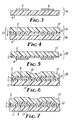
- Figures 3-7 demonstrate one technique for manufacturing the article of the invention.
- a layer of ink composition is selectively applied to a release liner 9 to provide a structure 16 bearing graphic design 4.
- One or more layers of ink may be applied if desired to provide a multi-color graphic, or, as previously noted, to provide a clear coating over the final graphic design.
- the ink is allowed to dry or cure depending on the type of ink employed. Screen printing is the preferred ink application method although many conventional coating and printing techniques may be employed.
- a variety of techniques may be utilized to apply a non-colored or clear layer over the graphic 4.
- the clear coating may be applied in exact registry over the graphic.
- this application technique is utilized, the final article retains the ability to be self-splitting.
- Premask tape 10 comprises carrier 2 and first adhesive layer 3 and is prepared as described above.
- Premask tape 10 and structure 16 are placed in face-to-face contact with graphic design 4 contacting first surface portions of first adhesive layer 3.
- the resulting construction 17 may then be passed through rubber rolls which apply sufficient pressure to cause graphic design 4 to adhere to first adhesive layer 3 with greater force than it adheres to release liner 9. Typical forces of 10 g/cm to 60 g/cm are sufficient to accomplish this.
- Release liner 9 is then removed from construction 17 to provide the multilayer film 18 shown in Figure 4.
- Film 18 can preferably then be corona treated (not shown) to insure that the surface made up of the graphic design 4 and the first adhesive layer 3 will have the proper adhesion to the second adhesive layer.
- Such treatment is particularly preferred when urethane-based ink systems are used as the graphic design. Treatment may be accomplished by exposure to a corona discharge (in an ENI Power Systems Model RS-8 Corona Surface Treater, for example) to provide increased surface free energy.
- second adhesive layer 5 may be applied either by coating and drying a layer of the second adhesive directly onto the graphic and first ahdesive layer surface or by using a transfer technique.
- second adhesive composition 5 is coated onto a release liner such as silicone-coated paper 11 (see Figure 6) using conventional coating and drying techniques.
- the resulting construction may then be laminated to film 18 to provide the article shown in Figure 6.
- the lamination causes carrier 2 and first adhesive layer 3 to generally conform to and surround the graphic design 4, it typically does not eliminate all spaces 19 between first adhesive layer 3 and graphic design 4. Spaces 19 may be removed by applying a rotating brush to surface 13 of carrier 2 to force carrier 2 and first adhesive layer 3 around graphic design 4 and against second adhesive layer 5 as shown in Figure 7.
- carrier 2 be a material which is slightly softenable when heated. This step insures that the article of the invention will split cleanly along the edges of the graphic design removal of the carrier.
- the release liner Upon use, the release liner is removed and the article positioned on the desired substrate. Moderate pressure is applied by stroking a squeegee across the face of the carrier film. The carrier film is then grasped manually and peeled away, taking with it the appropriate first and second adhesive layers and leaving the graphic design bonded to the substrate by means of the underlying second adhesive. If necessary, further pressure can be applied to the graphic surface to assure a stronger bond to the substrate.
- a self-splitting graphic design article according to the invention was prepared.
- Polypropylene resin polypropylene 3300, an extrudable polypropylene sold by Norchem Corporation having a number average molecular weight of 320,000
- One surface of the film was corona treated at 500 watts for a 0.75 meter width at a speed of 20 m/min.
- the corona-treated film was then primed with a layer of a composition containing:
- the primer was applied with a 150 knurled cylinder. After coating, the toluol was removed by air convection in an oven at 40 0 C.
- a first adhesive layer was applied to the primed surface of the polypropylene film from the following composition.
- composition was knife coated to a wet thickness of 0.13 mm.
- solvents were then evaporated from the composition by a convection oven at 40°C.
- the resulting adhesive-coated polypropylene was then rolled up on itself and stored for subsequent use.
- a graphic design was screen printed on a 118 g/m 2 leached low moisture base paper coated with 37.5 m (36 g/m 2 ) of high density polyethylene (HDPE).
- HDPE high density polyethylene
- the ink formulation was prepared by dissolving the polyvinyl chloride/polyvinyl acetate copolymer in the cyclohexanone, isophorone and diooctylphthalate.
- the carbon black was ground into this solution using a three roll paint mill to a fineness of grind of at least 8 on the P.C. scale.
- the resulting mixture was diluted with isophorone as needed to provide a viscosity of 1300 cps using a Brookfield viscometer No. 3 spindle.
- the solvents were evaporated in an air convection oven at 50 0 C.
- a non-pigmented, non-adhesive composition was screen printed using a 110 mesh screen in registration with the graphic design.
- This protective clear coat had the following formulation:
- the non-pigmented formulation was prepared by mixing the components together in a Cowles mixer.
- the formulation was diluted with "Carbitol" acetate to a viscosity of 500 cps (Brookfield viscometer No. 3 spindle). After the non-pigmented layer was printed, the construction was baked for two hours at 55 C.
- the HDPE coated paper bearing the graphic design was laminated to the previously described adhesive coated polypropylene carrier so that the first adhesive layer and the graphic were in contact by passing the construction between soft rubber rolls each having a 70 Durometer hardness such that a pressure of 67.7 newtons/cm 2 was applied.
- the HDPE coated paper was then removed and discarded.
- the resultant structure was corona treated on the surface bearing the first adhesive and graphic by exposing the structure to a 500 watt corona discharge at a speed of 20 m/min.
- a continuous second adhesive layer was then applied over the graphic and the first adhesive layer from the following composition
- This adhesive formulation was prepared by mixing the ingredients together at room temperature, coating the solution onto a silicone coated, white polyethylene sheet (05-4-HiD-ST6A/ST3A-White from Schoeller Release Products, Inc.) to a wet thickness of 0.075 mm, and evaporating the solvent by heating the film for 3 minutes at 58 C.
- the corona treated, graphic design bearing, adhesive coated polyethylene carrier was laminated to the second adhesive layer such that the second layer of adhesive contacted the corona treated surface of the first adhesive layer and the graphic design.
- the lamination was passed between rubber rolls (70 Durometer hardness) at a pressure of 67.7 newtons/cm 2 . This lamination was then passed over an oil-heated can at a temperature of 82°C. As the lamination passed over the hot can the unoriented polypropylene carrier side of the lamination was vigorously brushed with a coarse rotating brush to insure good lamination of the two adhesive layers and eliminate any air spaces between the first layer of adhesive at the edges of the graphic design.
- the silicone coated polyethylene film was removed and the article placed on a steel substrate such that the second layer of adhesive was against the surface of the steel substrate.
- Moderate pressure was applied to the free surface of the carrier film by stroking that surface with the edge of a polyethylene squeegee (3M Company PA-1 plastic applicator tool) over the film structure.
- the carrier film was then peeled off the substrate surface leaving the graphic design on the substrate. No adhesive remained on the top or the edges of the graphic or on the surfaces of the substrate where there was no graphic design.
- Example 1 was repeated with the following changes.
- the formulation was prepared by mixing the components at room temperature until a homogeneous mixture is achieved.
- the formulation was printed in registration with the ink layer using approximately l10 mesh screen.
- the protective clearcoat was cured by actinic radiation in a Linde Photocure System with four defocussed medium pressure mercury vapor lamps. The lamps were 0.75 meters above the coating. The bulbs had an intensity of 31 watts/cm 2 .
- the belt speed of the curing unit was 10 meter/minute. Nitrogen was passed through the curing chamber at a rate of 0.26 liter of N 2/ cm width (225 cubic feet of N 2 /ft. width) of curing chamber to provide a nitrogen environment therein.
- a second adhesive layer was applied using the formulation and procedures described in Example 1.
- the self-splitting graphic design article was then processed and applied to a steel substrate described in Example 1. After the carrier film was peeled off the substrate surface, the graphic design was left on the substrate. No adhesive remained on the top or the edges of the graphic or on the surfaces of the substrate where there was no graphic design.
- Example 1 was repeated except that the following single layer graphic design formulation was substituted for the dual layer graphic design used.
- the polyol resins, the stabilizers, the flow additives, and solvent were all mixed together.
- the carbon black was ground into the polyol solution using a three roll paint mill to a fineness of grind of at least 8 on the P.C. scale.
- the isocyanate was added to the solution. This composition was then diluted to 800 cps using a Brookfield viscometer, No. 3 spindle.
- the graphic design composition was screen printed on the HDPE coated paper from Schoeller Technical Papers, Inc. described in Example 1 with a 110 mesh screen.
- the carrier bearing the graphic design formulation was baked for 2 hours at 68 C to remove solvents and speed up the reaction between the isocyanate and the polyols.
- Example 1 is repeated except that the following second adhesive composition was used.
- the adhesive was notch bar coated onto a silicone-coated white polyethylene sheet (No. 05-4-HID-ST6A/ST3A-White, commercially available from Schoeller Release Products, Inc.) to a wet thickness of 0.075 mm, and the solvent was evaporated by heating the film for 3 minutes at 58 C.
- the adhesive was then laminated to the graphic design on the carrier and first adhesive of Example 1. When transfer was undertaken as per Example 1, similar results were obtained.
- Example 1 was repeated with the exception that the following carrier and first adhesive system was used.
- the carrier was an 0.1 mm super calendered saturated flat stock paper, Type S-3178, commercially availble from Kimberly-Clark Corp. This web was notch bar coated with the following adhesive composition to a wet thickness of 0.1 mm.
- Example 1 The solvent was evaporated by exposure to 100°C for 30 seconds.
- the adhesive was then crosslinked with actinic radiation by exposure to 0.663 Joules/cm 2 from two focused medium pressure mercury lamps at a web speed of 30.5 m/min (100 ft/min). When the balance of Example 1 was repeated, results similar thereto were obtained.
Landscapes
- Decoration By Transfer Pictures (AREA)
- Adhesive Tapes (AREA)
- Adhesives Or Adhesive Processes (AREA)
- Laminated Bodies (AREA)
Applications Claiming Priority (2)
| Application Number | Priority Date | Filing Date | Title |
|---|---|---|---|
| US846752 | 1986-04-01 | ||
| US06/846,752 US4759968A (en) | 1986-04-01 | 1986-04-01 | Transfer graphic article |
Publications (3)
| Publication Number | Publication Date |
|---|---|
| EP0241212A2 true EP0241212A2 (de) | 1987-10-14 |
| EP0241212A3 EP0241212A3 (en) | 1988-02-24 |
| EP0241212B1 EP0241212B1 (de) | 1990-10-10 |
Family
ID=25298847
Family Applications (1)
| Application Number | Title | Priority Date | Filing Date |
|---|---|---|---|
| EP19870302853 Expired - Lifetime EP0241212B1 (de) | 1986-04-01 | 1987-04-01 | Übertragungsmaterial von Musterungen |
Country Status (13)
| Country | Link |
|---|---|
| US (1) | US4759968A (de) |
| EP (1) | EP0241212B1 (de) |
| JP (1) | JPS62255199A (de) |
| KR (1) | KR940011818B1 (de) |
| AR (1) | AR246212A1 (de) |
| AU (1) | AU582681B2 (de) |
| BR (1) | BR8701468A (de) |
| CA (1) | CA1275872C (de) |
| DE (1) | DE3765446D1 (de) |
| ES (1) | ES2018681B3 (de) |
| MX (1) | MX165721B (de) |
| MY (1) | MY102343A (de) |
| ZA (1) | ZA871943B (de) |
Cited By (7)
| Publication number | Priority date | Publication date | Assignee | Title |
|---|---|---|---|---|
| WO2006019421A3 (en) * | 2004-07-20 | 2006-06-08 | Neenah Paper Inc | Image transfer to a substrate by using heat |
| WO2007115008A3 (en) * | 2006-03-31 | 2007-12-06 | Avery Dennison Corp | Process for manufacture of polymer film graphics |
| US7361247B2 (en) | 2003-12-31 | 2008-04-22 | Neenah Paper Inc. | Matched heat transfer materials and method of use thereof |
| US7470343B2 (en) | 2004-12-30 | 2008-12-30 | Neenah Paper, Inc. | Heat transfer masking sheet materials and methods of use thereof |
| US7604856B2 (en) | 2000-10-31 | 2009-10-20 | Neenah Paper, Inc. | Heat transfer paper with peelable film and discontinuous coatings |
| EP2172347A3 (de) * | 2008-09-12 | 2012-07-11 | Leonhard Kurz Stiftung & Co. KG | Transferfolie zur Verwendung in einem Kaltfolientransferverfahren |
| ITUB20154676A1 (it) * | 2015-10-14 | 2017-04-14 | Graphic Report S N C Di Brigato Antonio & C | Procedimento per realizzare decorazioni trasferibili e decorazione trasferibile |
Families Citing this family (24)
| Publication number | Priority date | Publication date | Assignee | Title |
|---|---|---|---|---|
| US4838708A (en) * | 1988-03-07 | 1989-06-13 | Minnesota Mining And Manufacturing Company | Security deposit bag |
| US4937040A (en) * | 1988-03-07 | 1990-06-26 | Minnesota Mining And Manufacturing Company | Security deposit bag |
| US5294470A (en) * | 1988-05-13 | 1994-03-15 | Ewan Frederick R | Tamper indicating containers and seals |
| GB8817239D0 (en) * | 1988-07-20 | 1988-08-24 | Adhesive Materials Ltd | Adhesive labels & methods for their manufacture |
| LU87402A1 (fr) * | 1988-12-06 | 1990-07-10 | Eurofloor Sa | Procede de production de revetements de sols ou de murs et produits obtenus |
| US5169681A (en) * | 1989-04-06 | 1992-12-08 | Kim Jae Duck | Method of producing an ornamental sticker without a separate cutting step |
| US5021275A (en) * | 1989-04-06 | 1991-06-04 | Kim Jae Duck | Ornamental stickers necessitating no separate cutting process and the manufacturing method thereof |
| US5028076A (en) * | 1989-06-14 | 1991-07-02 | Ivy Hill Corporation | Product having concealed message |
| US5480701A (en) * | 1990-10-04 | 1996-01-02 | Dai Nippon Printing Co., Ltd. | Lamiminate sheet and card |
| DE9110511U1 (de) * | 1991-08-24 | 1991-10-24 | Leonhard Kurz GmbH & Co, 90763 Fürth | Prägefolie, insbesondere Heißprägefolie |
| US5814402A (en) * | 1993-04-20 | 1998-09-29 | Decora Incorporated | Pressure sensitive dry transfer graphics article and method of manufacture |
| US5594044A (en) * | 1995-03-03 | 1997-01-14 | Videojet Systems International, Inc. | Ink jet ink which is rub resistant to alcohol |
| JP4773026B2 (ja) * | 2000-03-10 | 2011-09-14 | スリーエム イノベイティブ プロパティズ カンパニー | 複数の接着剤を有する医療用ドレッシングおよび製造方法 |
| US6703089B2 (en) | 2000-10-06 | 2004-03-09 | Imperial Home Decor Group Management, Inc. | Bleed-resistant dry-transfer wallcoverings |
| US6663143B2 (en) | 2000-12-04 | 2003-12-16 | Irving Joseph Zirker | Acrylic paint monotype artwork |
| JP4142871B2 (ja) * | 2001-12-27 | 2008-09-03 | 株式会社シード | マーク転写具、マーク転写テープおよびマーク転写テープの製造方法 |
| US7325916B2 (en) * | 2002-02-08 | 2008-02-05 | Gerber Scientific International, Inc. | Method and apparatus for making signs |
| KR200280679Y1 (ko) * | 2002-02-16 | 2002-07-13 | 주식회사 다이아덤코리아 | 장식용 스티커 시트 |
| US7645355B2 (en) * | 2006-11-17 | 2010-01-12 | 3M Innovative Properties Company | Method of making a microsphere transfer adhesive |
| US20100096062A1 (en) * | 2008-09-16 | 2010-04-22 | Serigraph, Inc. | Supported Article for Use in Decorating a Substrate |
| WO2010057518A1 (de) * | 2008-11-18 | 2010-05-27 | Atc All Thin Convert Ag | Verfahren und anlage zum erzeugen von laminaten und laminierzwischenprodukt |
| JP5406646B2 (ja) * | 2009-09-16 | 2014-02-05 | シスメックス株式会社 | 組織液収集方法に用いる組織液収集キット及び組織液収集シート |
| CN113201247A (zh) * | 2021-04-13 | 2021-08-03 | 杭州星发彩印有限公司 | 具有珠光效果的橡胶雨鞋 |
| CN118144459B (zh) * | 2024-04-25 | 2025-05-13 | 绍兴毅龙镭射科技有限公司 | 一种铂金浮雕镭射纸的生产工艺及镭射纸 |
Family Cites Families (13)
| Publication number | Priority date | Publication date | Assignee | Title |
|---|---|---|---|---|
| US3013917A (en) * | 1960-06-09 | 1961-12-19 | Karlan Mac | Dry transfer sheet and method |
| US3065120A (en) * | 1960-08-29 | 1962-11-20 | Mask Off Company Inc | Dry transfer decals |
| BE629735A (de) * | 1962-03-21 | |||
| GB1388030A (en) * | 1971-04-30 | 1975-03-19 | Pictorial Prod Inc | Decalcomanias |
| DE2203319A1 (de) * | 1972-01-25 | 1973-08-02 | Daimler Benz Ag | Dauerbremse fuer fahrzeuge, insbesondere fuer kraftfahrzeuge, vornehmlich schwere nutzfahrzeuge |
| GB1491678A (en) * | 1974-01-16 | 1977-11-09 | Marler Ltd E | Dry transfer materials |
| GB1493103A (en) * | 1975-01-24 | 1977-11-23 | Morol Ltd | Adhesive characters |
| GB1580076A (en) * | 1977-07-20 | 1980-11-26 | Marler E T Ltd | Pressure sensitive adhesive transfer |
| US4228211A (en) * | 1978-09-22 | 1980-10-14 | Grafische Onderneming Mago B.V. | Dry transfer material |
| US4374691A (en) * | 1980-05-09 | 1983-02-22 | Minnesota Mining And Manufacturing Company | Material and method for forming pressure transferable graphics |
| US4454179A (en) * | 1982-05-10 | 1984-06-12 | Minnesota Mining And Manufacturing Company | Dry transfer article |
| AU581948B2 (en) * | 1984-11-05 | 1989-03-09 | Jakob Schlaeper & Co. A.G. | Improvements in and relating to the production of transfers |
| US4640727A (en) * | 1985-01-28 | 1987-02-03 | Minnesota Mining And Manufacturing Company | Graphic design article |
-
1986
- 1986-04-01 US US06/846,752 patent/US4759968A/en not_active Expired - Fee Related
-
1987
- 1987-03-17 ZA ZA871943A patent/ZA871943B/xx unknown
- 1987-03-18 CA CA 532303 patent/CA1275872C/en not_active Expired - Lifetime
- 1987-03-19 AU AU70402/87A patent/AU582681B2/en not_active Ceased
- 1987-03-23 MX MX005664A patent/MX165721B/es unknown
- 1987-03-26 MY MYPI87000384A patent/MY102343A/en unknown
- 1987-03-31 KR KR1019870002990A patent/KR940011818B1/ko not_active Expired - Fee Related
- 1987-03-31 BR BR8701468A patent/BR8701468A/pt not_active IP Right Cessation
- 1987-03-31 JP JP62079535A patent/JPS62255199A/ja active Pending
- 1987-04-01 ES ES87302853T patent/ES2018681B3/es not_active Expired - Lifetime
- 1987-04-01 EP EP19870302853 patent/EP0241212B1/de not_active Expired - Lifetime
- 1987-04-01 DE DE8787302853T patent/DE3765446D1/de not_active Expired - Lifetime
- 1987-04-01 AR AR30718987A patent/AR246212A1/es active
Cited By (12)
| Publication number | Priority date | Publication date | Assignee | Title |
|---|---|---|---|---|
| US7604856B2 (en) | 2000-10-31 | 2009-10-20 | Neenah Paper, Inc. | Heat transfer paper with peelable film and discontinuous coatings |
| US7361247B2 (en) | 2003-12-31 | 2008-04-22 | Neenah Paper Inc. | Matched heat transfer materials and method of use thereof |
| WO2006019421A3 (en) * | 2004-07-20 | 2006-06-08 | Neenah Paper Inc | Image transfer to a substrate by using heat |
| US8372232B2 (en) | 2004-07-20 | 2013-02-12 | Neenah Paper, Inc. | Heat transfer materials and method of use thereof |
| US7470343B2 (en) | 2004-12-30 | 2008-12-30 | Neenah Paper, Inc. | Heat transfer masking sheet materials and methods of use thereof |
| WO2007115008A3 (en) * | 2006-03-31 | 2007-12-06 | Avery Dennison Corp | Process for manufacture of polymer film graphics |
| CN101415562B (zh) * | 2006-03-31 | 2011-04-20 | 艾利丹尼森公司 | 聚合物膜图形的制造方法 |
| AU2007233292B2 (en) * | 2006-03-31 | 2011-05-26 | Avery Dennison Corporation | Process for manufacture of polymer film graphics |
| US9725624B2 (en) | 2006-03-31 | 2017-08-08 | Avery Dennison Corporation | Process for manufacture of polymer film graphics |
| EP2172347A3 (de) * | 2008-09-12 | 2012-07-11 | Leonhard Kurz Stiftung & Co. KG | Transferfolie zur Verwendung in einem Kaltfolientransferverfahren |
| ITUB20154676A1 (it) * | 2015-10-14 | 2017-04-14 | Graphic Report S N C Di Brigato Antonio & C | Procedimento per realizzare decorazioni trasferibili e decorazione trasferibile |
| EP3156248A1 (de) * | 2015-10-14 | 2017-04-19 | Graphic Report S.N.C. Di Brigato Antonio & C. | Verfahren zur herstellung übertragbarer dekorationen und übertragbare dekoration |
Also Published As
| Publication number | Publication date |
|---|---|
| BR8701468A (pt) | 1988-01-19 |
| EP0241212B1 (de) | 1990-10-10 |
| KR940011818B1 (ko) | 1994-12-26 |
| EP0241212A3 (en) | 1988-02-24 |
| DE3765446D1 (de) | 1990-11-15 |
| ES2018681B3 (es) | 1991-05-01 |
| KR870009852A (ko) | 1987-11-30 |
| AR246212A1 (es) | 1994-07-29 |
| JPS62255199A (ja) | 1987-11-06 |
| MY102343A (en) | 1992-06-17 |
| AU7040287A (en) | 1987-10-08 |
| MX165721B (es) | 1992-12-02 |
| CA1275872C (en) | 1990-11-06 |
| AU582681B2 (en) | 1989-04-06 |
| US4759968A (en) | 1988-07-26 |
| ZA871943B (en) | 1988-10-26 |
Similar Documents
| Publication | Publication Date | Title |
|---|---|---|
| EP0241212B1 (de) | Übertragungsmaterial von Musterungen | |
| EP0209544B1 (de) | Grafisches design-material | |
| KR920000202B1 (ko) | 건조 전사체 | |
| US3892900A (en) | Masking films | |
| KR940011816B1 (ko) | 건식전사그래픽제품및그제조방법 | |
| EP0928475B1 (de) | Haftetikett | |
| AU592894B2 (en) | Self-weeding dry transfer article | |
| CA1098483A (en) | Dry-release transfers | |
| EP0243198B1 (de) | Materialien zur Herstellung von Symbolen | |
| EP0901910B1 (de) | Starke flexible Trockenübertragungsmaterialien | |
| KR100305103B1 (ko) | 자외선 경화형 점착성 전사잉크 | |
| EP0909662A2 (de) | Drucken eines Klebstoffmusters | |
| WO2003095236A2 (en) | Multilayer composite for the dry transfer of graphics to receptive substrates | |
| CA1057591A (en) | Dry transfers | |
| AU593625B2 (en) | Clear coat definition control | |
| JP3642371B2 (ja) | リサイクル用粘着ラベル | |
| CN1277693C (zh) | 在软性材料上粘贴图文的方法 | |
| US7282256B2 (en) | Photosensitive resin laminate for sign boards | |
| WO1995013926A1 (en) | Heat-transferable ink laminate and method of manufacture thereof | |
| CN211497475U (zh) | 一种温控性粘离膜 | |
| KR100446561B1 (ko) | 경면유광 효과 또는 경면유광과 경면무광이 공존하는 효과를 갖는 pvc바닥재의 표면처리방법 | |
| WO1991012145A1 (en) | Manufacture of signs | |
| JP2000328018A (ja) | 粘着ラベル | |
| WO2026080601A1 (en) | Tapes and articles including an edge coating, and methods of making articles |
Legal Events
| Date | Code | Title | Description |
|---|---|---|---|
| PUAI | Public reference made under article 153(3) epc to a published international application that has entered the european phase |
Free format text: ORIGINAL CODE: 0009012 |
|
| AK | Designated contracting states |
Kind code of ref document: A2 Designated state(s): BE DE ES FR GB IT NL SE |
|
| PUAL | Search report despatched |
Free format text: ORIGINAL CODE: 0009013 |
|
| AK | Designated contracting states |
Kind code of ref document: A3 Designated state(s): BE DE ES FR GB IT NL SE |
|
| 17P | Request for examination filed |
Effective date: 19880726 |
|
| 17Q | First examination report despatched |
Effective date: 19900119 |
|
| GRAA | (expected) grant |
Free format text: ORIGINAL CODE: 0009210 |
|
| ITF | It: translation for a ep patent filed | ||
| AK | Designated contracting states |
Kind code of ref document: B1 Designated state(s): BE DE ES FR GB IT NL SE |
|
| REF | Corresponds to: |
Ref document number: 3765446 Country of ref document: DE Date of ref document: 19901115 |
|
| ET | Fr: translation filed | ||
| PLBE | No opposition filed within time limit |
Free format text: ORIGINAL CODE: 0009261 |
|
| STAA | Information on the status of an ep patent application or granted ep patent |
Free format text: STATUS: NO OPPOSITION FILED WITHIN TIME LIMIT |
|
| 26N | No opposition filed | ||
| ITTA | It: last paid annual fee | ||
| EAL | Se: european patent in force in sweden |
Ref document number: 87302853.4 |
|
| PGFP | Annual fee paid to national office [announced via postgrant information from national office to epo] |
Ref country code: FR Payment date: 19950313 Year of fee payment: 9 |
|
| PGFP | Annual fee paid to national office [announced via postgrant information from national office to epo] |
Ref country code: SE Payment date: 19950316 Year of fee payment: 9 Ref country code: BE Payment date: 19950316 Year of fee payment: 9 |
|
| PGFP | Annual fee paid to national office [announced via postgrant information from national office to epo] |
Ref country code: DE Payment date: 19950324 Year of fee payment: 9 |
|
| PGFP | Annual fee paid to national office [announced via postgrant information from national office to epo] |
Ref country code: GB Payment date: 19950327 Year of fee payment: 9 |
|
| PGFP | Annual fee paid to national office [announced via postgrant information from national office to epo] |
Ref country code: ES Payment date: 19950407 Year of fee payment: 9 |
|
| PGFP | Annual fee paid to national office [announced via postgrant information from national office to epo] |
Ref country code: NL Payment date: 19950430 Year of fee payment: 9 |
|
| PG25 | Lapsed in a contracting state [announced via postgrant information from national office to epo] |
Ref country code: GB Effective date: 19960401 |
|
| PG25 | Lapsed in a contracting state [announced via postgrant information from national office to epo] |
Ref country code: SE Effective date: 19960402 Ref country code: ES Free format text: LAPSE BECAUSE OF NON-PAYMENT OF DUE FEES Effective date: 19960402 |
|
| PG25 | Lapsed in a contracting state [announced via postgrant information from national office to epo] |
Ref country code: BE Effective date: 19960430 |
|
| BERE | Be: lapsed |
Owner name: MINNESOTA MINING AND MFG CY Effective date: 19960430 |
|
| PG25 | Lapsed in a contracting state [announced via postgrant information from national office to epo] |
Ref country code: NL Effective date: 19961101 |
|
| GBPC | Gb: european patent ceased through non-payment of renewal fee |
Effective date: 19960401 |
|
| PG25 | Lapsed in a contracting state [announced via postgrant information from national office to epo] |
Ref country code: FR Effective date: 19961227 |
|
| PG25 | Lapsed in a contracting state [announced via postgrant information from national office to epo] |
Ref country code: DE Effective date: 19970101 |
|
| NLV4 | Nl: lapsed or anulled due to non-payment of the annual fee |
Effective date: 19961101 |
|
| EUG | Se: european patent has lapsed |
Ref document number: 87302853.4 |
|
| REG | Reference to a national code |
Ref country code: FR Ref legal event code: ST |
|
| REG | Reference to a national code |
Ref country code: ES Ref legal event code: FD2A Effective date: 19990301 |
|
| PG25 | Lapsed in a contracting state [announced via postgrant information from national office to epo] |
Ref country code: IT Free format text: LAPSE BECAUSE OF NON-PAYMENT OF DUE FEES;WARNING: LAPSES OF ITALIAN PATENTS WITH EFFECTIVE DATE BEFORE 2007 MAY HAVE OCCURRED AT ANY TIME BEFORE 2007. THE CORRECT EFFECTIVE DATE MAY BE DIFFERENT FROM THE ONE RECORDED. Effective date: 20050401 |