EP0241239B1 - Zellinie, die virale Aids-Antigene produziert, ohne infektiöse Viruspartikel zu produzieren - Google Patents
Zellinie, die virale Aids-Antigene produziert, ohne infektiöse Viruspartikel zu produzieren Download PDFInfo
- Publication number
- EP0241239B1 EP0241239B1 EP87302934A EP87302934A EP0241239B1 EP 0241239 B1 EP0241239 B1 EP 0241239B1 EP 87302934 A EP87302934 A EP 87302934A EP 87302934 A EP87302934 A EP 87302934A EP 0241239 B1 EP0241239 B1 EP 0241239B1
- Authority
- EP
- European Patent Office
- Prior art keywords
- aids
- cells
- cell line
- virus
- infectious
- Prior art date
- Legal status (The legal status is an assumption and is not a legal conclusion. Google has not performed a legal analysis and makes no representation as to the accuracy of the status listed.)
- Expired - Lifetime
Links
Images


Classifications
-
- C—CHEMISTRY; METALLURGY
- C07—ORGANIC CHEMISTRY
- C07K—PEPTIDES
- C07K14/00—Peptides having more than 20 amino acids; Gastrins; Somatostatins; Melanotropins; Derivatives thereof
- C07K14/005—Peptides having more than 20 amino acids; Gastrins; Somatostatins; Melanotropins; Derivatives thereof from viruses
-
- C—CHEMISTRY; METALLURGY
- C12—BIOCHEMISTRY; BEER; SPIRITS; WINE; VINEGAR; MICROBIOLOGY; ENZYMOLOGY; MUTATION OR GENETIC ENGINEERING
- C12N—MICROORGANISMS OR ENZYMES; COMPOSITIONS THEREOF; PROPAGATING, PRESERVING, OR MAINTAINING MICROORGANISMS; MUTATION OR GENETIC ENGINEERING; CULTURE MEDIA
- C12N7/00—Viruses; Bacteriophages; Compositions thereof; Preparation or purification thereof
-
- C—CHEMISTRY; METALLURGY
- C12—BIOCHEMISTRY; BEER; SPIRITS; WINE; VINEGAR; MICROBIOLOGY; ENZYMOLOGY; MUTATION OR GENETIC ENGINEERING
- C12Q—MEASURING OR TESTING PROCESSES INVOLVING ENZYMES, NUCLEIC ACIDS OR MICROORGANISMS; COMPOSITIONS OR TEST PAPERS THEREFOR; PROCESSES OF PREPARING SUCH COMPOSITIONS; CONDITION-RESPONSIVE CONTROL IN MICROBIOLOGICAL OR ENZYMOLOGICAL PROCESSES
- C12Q1/00—Measuring or testing processes involving enzymes, nucleic acids or microorganisms; Compositions therefor; Processes of preparing such compositions
- C12Q1/70—Measuring or testing processes involving enzymes, nucleic acids or microorganisms; Compositions therefor; Processes of preparing such compositions involving virus or bacteriophage
- C12Q1/701—Specific hybridization probes
- C12Q1/702—Specific hybridization probes for retroviruses
- C12Q1/703—Viruses associated with AIDS
-
- A—HUMAN NECESSITIES
- A61—MEDICAL OR VETERINARY SCIENCE; HYGIENE
- A61K—PREPARATIONS FOR MEDICAL, DENTAL OR TOILETRY PURPOSES
- A61K38/00—Medicinal preparations containing peptides
-
- C—CHEMISTRY; METALLURGY
- C12—BIOCHEMISTRY; BEER; SPIRITS; WINE; VINEGAR; MICROBIOLOGY; ENZYMOLOGY; MUTATION OR GENETIC ENGINEERING
- C12N—MICROORGANISMS OR ENZYMES; COMPOSITIONS THEREOF; PROPAGATING, PRESERVING, OR MAINTAINING MICROORGANISMS; MUTATION OR GENETIC ENGINEERING; CULTURE MEDIA
- C12N2740/00—Reverse transcribing RNA viruses
- C12N2740/00011—Details
- C12N2740/10011—Retroviridae
- C12N2740/16011—Human Immunodeficiency Virus, HIV
- C12N2740/16061—Methods of inactivation or attenuation
- C12N2740/16062—Methods of inactivation or attenuation by genetic engineering
-
- C—CHEMISTRY; METALLURGY
- C12—BIOCHEMISTRY; BEER; SPIRITS; WINE; VINEGAR; MICROBIOLOGY; ENZYMOLOGY; MUTATION OR GENETIC ENGINEERING
- C12N—MICROORGANISMS OR ENZYMES; COMPOSITIONS THEREOF; PROPAGATING, PRESERVING, OR MAINTAINING MICROORGANISMS; MUTATION OR GENETIC ENGINEERING; CULTURE MEDIA
- C12N2740/00—Reverse transcribing RNA viruses
- C12N2740/00011—Details
- C12N2740/10011—Retroviridae
- C12N2740/16011—Human Immunodeficiency Virus, HIV
- C12N2740/16111—Human Immunodeficiency Virus, HIV concerning HIV env
- C12N2740/16122—New viral proteins or individual genes, new structural or functional aspects of known viral proteins or genes
-
- Y—GENERAL TAGGING OF NEW TECHNOLOGICAL DEVELOPMENTS; GENERAL TAGGING OF CROSS-SECTIONAL TECHNOLOGIES SPANNING OVER SEVERAL SECTIONS OF THE IPC; TECHNICAL SUBJECTS COVERED BY FORMER USPC CROSS-REFERENCE ART COLLECTIONS [XRACs] AND DIGESTS
- Y10—TECHNICAL SUBJECTS COVERED BY FORMER USPC
- Y10S—TECHNICAL SUBJECTS COVERED BY FORMER USPC CROSS-REFERENCE ART COLLECTIONS [XRACs] AND DIGESTS
- Y10S435/00—Chemistry: molecular biology and microbiology
- Y10S435/81—Packaged device or kit
-
- Y—GENERAL TAGGING OF NEW TECHNOLOGICAL DEVELOPMENTS; GENERAL TAGGING OF CROSS-SECTIONAL TECHNOLOGIES SPANNING OVER SEVERAL SECTIONS OF THE IPC; TECHNICAL SUBJECTS COVERED BY FORMER USPC CROSS-REFERENCE ART COLLECTIONS [XRACs] AND DIGESTS
- Y10—TECHNICAL SUBJECTS COVERED BY FORMER USPC
- Y10S—TECHNICAL SUBJECTS COVERED BY FORMER USPC CROSS-REFERENCE ART COLLECTIONS [XRACs] AND DIGESTS
- Y10S436/00—Chemistry: analytical and immunological testing
- Y10S436/807—Apparatus included in process claim, e.g. physical support structures
- Y10S436/808—Automated or kit
-
- Y—GENERAL TAGGING OF NEW TECHNOLOGICAL DEVELOPMENTS; GENERAL TAGGING OF CROSS-SECTIONAL TECHNOLOGIES SPANNING OVER SEVERAL SECTIONS OF THE IPC; TECHNICAL SUBJECTS COVERED BY FORMER USPC CROSS-REFERENCE ART COLLECTIONS [XRACs] AND DIGESTS
- Y10—TECHNICAL SUBJECTS COVERED BY FORMER USPC
- Y10S—TECHNICAL SUBJECTS COVERED BY FORMER USPC CROSS-REFERENCE ART COLLECTIONS [XRACs] AND DIGESTS
- Y10S436/00—Chemistry: analytical and immunological testing
- Y10S436/811—Test for named disease, body condition or organ function
-
- Y—GENERAL TAGGING OF NEW TECHNOLOGICAL DEVELOPMENTS; GENERAL TAGGING OF CROSS-SECTIONAL TECHNOLOGIES SPANNING OVER SEVERAL SECTIONS OF THE IPC; TECHNICAL SUBJECTS COVERED BY FORMER USPC CROSS-REFERENCE ART COLLECTIONS [XRACs] AND DIGESTS
- Y10—TECHNICAL SUBJECTS COVERED BY FORMER USPC
- Y10S—TECHNICAL SUBJECTS COVERED BY FORMER USPC CROSS-REFERENCE ART COLLECTIONS [XRACs] AND DIGESTS
- Y10S436/00—Chemistry: analytical and immunological testing
- Y10S436/811—Test for named disease, body condition or organ function
- Y10S436/813—Cancer
-
- Y—GENERAL TAGGING OF NEW TECHNOLOGICAL DEVELOPMENTS; GENERAL TAGGING OF CROSS-SECTIONAL TECHNOLOGIES SPANNING OVER SEVERAL SECTIONS OF THE IPC; TECHNICAL SUBJECTS COVERED BY FORMER USPC CROSS-REFERENCE ART COLLECTIONS [XRACs] AND DIGESTS
- Y10—TECHNICAL SUBJECTS COVERED BY FORMER USPC
- Y10S—TECHNICAL SUBJECTS COVERED BY FORMER USPC CROSS-REFERENCE ART COLLECTIONS [XRACs] AND DIGESTS
- Y10S530/00—Chemistry: natural resins or derivatives; peptides or proteins; lignins or reaction products thereof
- Y10S530/808—Materials and products related to genetic engineering or hybrid or fused cell technology, e.g. hybridoma, monoclonal products
Definitions
- the present invention is related to a virus which causes acquired immunodeficiency syndrome (AIDS). More particularly, the present invention is related to a cell line capable of safely generating large quantities of the AIDS viral proteins without concomitant production of AIDS infectious viral particles.
- AIDS acquired immunodeficiency syndrome
- AIDS is a fatal human disease that is most likely caused by a T lymphotropic human retrovirus (Barre-Sinoussi, et al., Science 220:868, 1983; Popovic et al., Science 224: 497, 1984; Levy, et al. Science 225: 840, 1984). It is believed that the virus is spread when body fluids such as semen or blood from an infected individual, are passed to an uninfected person. Because a number of AIDS cases have been reported to result from the transfusion of contaminated blood, immunochemical testing of donor sera is being conducted to detect potential carriers. At present two types of screening tests are employed: enzyme-linked-immunoadsorbent (ELISA) assays and immunoblotting procedures.
- ELISA enzyme-linked-immunoadsorbent
- proteins isolated from purified virus particles or infected cell lysates are used as antigen to detect serum antibodies directed against the AIDS virus.
- the preparation of these viral antigens involves the handling of large volumes (about 50 liters/week) of infectious virus and tissue cultures. Presently, workers preparing these reagents cannot avoid continually being exposed to the infected materials and run the potential risk of contracting AIDS.
- an object of the present invention to provide a cell line capable of efficient production of AIDS viral antigens without concomitant production of infectious AIDS viral particles.
- the invention is thus directed to a cell line characterized by its capability of producing AIDS viral antigens without producing infectious viral particles, said cell line having the characteristics of ATCC-CRL 8993, and to a noninfectious AIDS virus assembled from antigenic viral proteins having molecular weight in kilodaltons of 160, 120, 90, 55, 46, 43, 41, 24 and 17 but not of 64 and 34, as determined by immuno-blot analysis in 3% - 27% polyacrylamide gel electrophoresis in the presence of mercaptoethanol, particularly wherein at least one of said antigenic viral proteins is capable of specifically binding with AIDS virus antibodies.
- the invention is further directed to a method of detecting AIDS virus antibodies in a sample characterized by reacting the sample with the aforesaid antigenic viral protein and immunologically determining the occurrence of antigen-antibody reaction, and to a kit for carrying out such a method comprising containers containing the aforesaid antigenic viral protein and reagents or means for immunological determination of the occurrence of antigen-antibody reaction.
- a unique human retrovirus has been consistently isolated from patients with the acquired immunodeficiency syndrome (AIDS) and is believed to be the cause of AIDS.
- Infection of human T-lymphocytes or T-lymphocyte lines with the AIDS RV can result in a variety of outcomes ranging from rapid cell death to the integration of functionally inert proviral DNAs.
- a typical AIDS RV infection is characterized by the appearance of multinucleated cells, a burst of reverse transcriptase (RT) activity, and profound cellular degeneration that extends over a 5 to 20 day period.
- RT reverse transcriptase
- a recent report describes non-cytotoxic effects of the AIDS RV on human lymphocytes.
- Leu-3 ⁇ non-virus producing cell derived from a Leu-3+ T cell line, that survived infection with the AIDS RV which constitutively produces all of the major viral proteins except p64 and p34 but not infectious virus. This discovery is now presented in detail.
- a cellular clone was isolated from a mass culture of survivor cells that contained a single copy of the AIDS RV provirus.
- the integrated proviral DNA was constitutively expressed but generated defective virus particles that failed to synthesize detectable reverse transcriptase. The methods and materials used in producing the cellular clone and in performing several tests and the like are described hereunder.
- One hundred eleven single cell clones were obtained, pooled into groups of 10, expanded to a total of 1 X 10⁶ cells, exposed to IUdR for 24 hours, cocultivated with Leu-3+ A3.01 cells, and examined daily for expression of AIDS RV by monitoring syncytia formation. A single clone (8E5) was thus obtained.
- DNA and RNA were prepared from AIDS RV infected cells or 8E5 cells and analyzed for the presence of virus-related sequences by Southern or Northern blot hybridization utilizing cloned LTR (long terminal repeat) or representative gag - pol - env probes as described by Folks et al., Proc. Natl. Acad. Sci. USA , 82:4539 (1985); Rabson et al., Science , 229:1388 (1985); Benn et al., Science , 230:949 (1985).
- cultured cells were sedimented onto polylysine coated glass slides, fixed in periodatelysine-paraformaldehyde-glutaraldehyde (PLPG), and pretreated with HCl and proteinase K to allow the labeled probe to enter the cells as described by Gendelman et al., J. Immun. Meth. , 65:137 (1983); Gendelman et al., Proc. Natl. Acad. Sci. USA , 82:7086.
- PLPG periodatelysine-paraformaldehyde-glutaraldehyde
- Subgenomic viral DNA fragments present in pB1 (Benn et al, supra ), pBenn6 (Folks et al., supra ), pB11 (Benn et al, supra ), and a recombinant plasmid (pRG-B), which contains a 1.35 kb Hind III fragment mapping between 8.25 and 9.6 kb on the proviral DNA, were subcloned into SP6/T7 vectors (Promega Biotec, Madison, WI) and the pooled DNAs transcribed using 35S-UTP (Amersham Corp., Arlington Hgts., IL). The labeled RNAs were incubated with 40 ⁇ M NaHCO3, 60 M Na2CO3, pH 10.2 prior to hybridization to facilitate their entry into cells.
- In situ hybridization was performed at 45°C for 8 hours. The samples where then washed in: 2X SSC at 22°C for 10 min X 2 changes; 2X SSC, 0.1% Triton X-100 at 60°C for 30 min; 2X SSC with RNase A (40 ⁇ g/ml) and RNase T1 (10 U/ml) at 37°C for 30 min; and 2X SSC at 60°C for 10 min. All solutions excluding those with RNase contained 5 ⁇ M DTT and 1 ⁇ M EDTA. Autoradiography was performed for 1-2 days following standard procedures well known in the art.
- probes synthesized in the sense orientation were incubated with duplicate cell preparations; in addition, uninfected cells were hybridized with antisense probes (such as complementary to viral mRNA). Infected cell preparations were also treated with RNase prior to addition of the probe.
- Immunoblotting Total cell lysates prepared from AIDS RV infected A3.01 or 8E5 (1 x 10⁸) cells were boiled in 2% SDS and 2-mercaptoethanol and electrophoresced through 3-27% gradient polyacrylamide gels at about 100 volts for about 18 hours. (Integration Separation Sciences) by the method of Laemmli, Nature 227:680 (1970), and transferred to nitrocellulose membranes (Towbin et al., Proc. Natl. Acad. Sci. USA , 76:4350 (1979)).
- the filters were then treated with 5% nonfat dry milk in 10 ⁇ M NaCl (TN) for 30 min and further rinsed in TN buffer containing 0.3% Tween-20, 0.5% NP40 (TN-TN) and 1% BSA. Pooled AIDS patient sera (1:1000), diluted in TN-TN containing 3% BSA, were incubated with the nitro-cellulose filters overnight at room temperature. The membranes were then washed 3X in TN-TN buffer, incubated for 2 hours with 125I-protein A (200,000 dpm/ml), washed, air dried, and exposed to x-ray film in accordance with techniques well known in the art.
- Electronmicroscopy A3.01 cells infected with the AIDS retrovirus, or 8E5 cells, were centrifuged at 650 X g in standard Beem capsules. The pellets were then gently washed in serum-free RPMI 1640 medium and fixed in situ for 1-2 hours in 2.5% gluteraldehyde in the presence of 0.1M sodium cacodylate buffer, pH 7.2. Following three 5 min washes in 0.1 M sodium cacodylate buffer containing 4% sucrose, the pellets were treated with 1% osmium tetroxide for 1-2 hours. They were then washed three times in 0.1 M sodium cacodylate buffer and dehydrated in 30 to 100% ethanol, followed by a final dehydration using propylene oxide.
- RNA, DNA, and protein in 8E5 cells Detection of viral RNA, DNA, and protein in 8E5 cells . Since it was unclear which, if any, AIDS RV gene products were being expressed in induced 8E5 cells, in situ hybridization was employed to monitor the IUdR effect. As shown in Fig. 1A, virtually all of the IUdR treated 8E5 cells synthesized viral RNA. Of interest was the fact that 8E5 cells, growing in the absence of IUdR, also expressed high levels of AIDS RV RNA (Fig. 1B). The in situ hybridization results shown in Fig. 1 also indicated that cloned 8E5 cells contained comparable amounts of viral mRNA relative to those present in a cell infected with virus (Fig. 1C).
- RNA present in the 8E5 clone polyadenylated RNA was isolated and examined by Northern blot hybridization using an LTR probe as mentioned above.
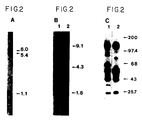
- Fig. 2B shows that, similar to A3.01 cells which actively produce virus, uninduced 8E5 cells also contain substantial amounts of 9.1 (genomic/ gag - pol ), 5.0, 4.3 ( env ), and 1.8-2.0 kb viral RNAs.
- this Northern analysis suggested that the expression of the 5.5 kb species of viral RNA might be reduced in 8E5 cells, S1 nuclease protection experiments (data not shown) indicated that RNAs processed at the putative splice acceptor for 5.5 kb viral RNA were readily identified.
- the number and state of proviral DNA copies in 8E5 cells were analyzed by Southern blot hybridization of Eco R I digested cellular DNA. Since the parental LAV provirus contains two internal Eco R I restriction sites defining a 1.1 kb viral DNA segment, the presence of only three reactive cleavage products (Fig. 2A) is consistent with the clonality of the 8E5 line and the existence of a single integrated copy of viral DNA.
- the one copy of the LAV provirus in 8E5 cells is constitutively expressed as viral RNA but provides no explanation for the absence of RT activity subsequent to IUdR treatment.
- the viral proteins present in 8E5 cells were analyzed by immunoblotting using pooled AIDS sera.
- a side-by-side comparison with the immunoreactive polypeptides present in virus-producing A3.01 cells evidences the presence of major viral encoded glycoprotein gp120, and polypeptides p55, p41, and p25 (as well as others not shown) and the absence of the prominent 64 kd and fainter 34 kd (kilodalton) viral polypeptides in 8E5 cells.
- a similar immunoblot was obtained when a lysate, prepared from 8E5 cells treated with IUdR, was examined (data not shown).
- tissue culture medium from untreated or IUdR treated 8E5 cells was also examined for the presence of infectious virus particles.
- Supernatants concentrated from 1 X 10⁸ 8E5 cells, were incubated with 2 X 10⁶ Leu-3+ A3.01 cells as described by Folks et al, supra , in an attempt to amplify any released viral particles.
- the synthesis of infectious progeny virions was invariably negative. Nonetheless, A3.01 cells, exposed to concentrated 8E5 tissue culture supernatants, did exhibit minimal syncytia formation. However, the development of syncytia could not be demonstrated following the serial (and blind) passage of the 8E5 supernatant through A3.01 cells.
Landscapes
- Chemical & Material Sciences (AREA)
- Health & Medical Sciences (AREA)
- Life Sciences & Earth Sciences (AREA)
- Organic Chemistry (AREA)
- Virology (AREA)
- Genetics & Genomics (AREA)
- Engineering & Computer Science (AREA)
- Zoology (AREA)
- Wood Science & Technology (AREA)
- Immunology (AREA)
- General Health & Medical Sciences (AREA)
- Bioinformatics & Cheminformatics (AREA)
- Proteomics, Peptides & Aminoacids (AREA)
- Biochemistry (AREA)
- Microbiology (AREA)
- Molecular Biology (AREA)
- Medicinal Chemistry (AREA)
- Biotechnology (AREA)
- Biophysics (AREA)
- General Engineering & Computer Science (AREA)
- AIDS & HIV (AREA)
- Analytical Chemistry (AREA)
- Physics & Mathematics (AREA)
- Biomedical Technology (AREA)
- Gastroenterology & Hepatology (AREA)
- Micro-Organisms Or Cultivation Processes Thereof (AREA)
- Medicines Containing Antibodies Or Antigens For Use As Internal Diagnostic Agents (AREA)
- Preparation Of Compounds By Using Micro-Organisms (AREA)
- Peptides Or Proteins (AREA)
- Measuring Or Testing Involving Enzymes Or Micro-Organisms (AREA)
Claims (11)
- Zellinie, dadurch gekennzeichnet, daß sie zur Erzeugung von AIDS-Virus-Antigenen ohne Erzeugung infektiöser Virus-partikel in der Lage ist, und daß sie durch die niedergelegte Zellinie ATCC CRL 8993 repräsentiert ist.
- Nichtinfektiöses AIDS-Virus, dadurch gekennzeichnet, daß es aus Antigenen Virusproteinen zusammengesetzt ist, die Molekulargewichte in Kilodalton von 160, 120, 90, 55, 46, 43, 41, 24 und 17, jedoch nicht von 64 und 34 haben, bestimmt durch Immuno-Blotting-Analyse durch Gelelektrophorese in 3-bis 27-prozentigem Polyacrylamidgel in Anwesenheit von Mercaptoethanol, wodurch es Zellen nicht infizieren kann.
- Virus nach Anspruch 2, weiter dadurch gekennzeichnet, daß mindestens eines der antigenen Virusproteine zu einer spezifischen Bindung mit AIDS-Virus-Antikörpern in der Lage ist.
- Virus nach Anspruch 2 oder 3, wobei das nichtinfektiöse AIDS-Virus durch eine Zellinie hergestellt ist, die durch die niedergelegte Zellinie ATCC CRL 8993 repräsentiert ist.
- Virus nach Anspruch 2 oder 3, wobei das nichtinfektiöse AIDS-Virus in einer Leu-3⁻-Zellinie produziert ist.
- Zellinie, die für die Produktion eines nichtinfektiösen AIDS-Virus nach einem der Ansprüche 2 bis 5 ausgelegt ist.
- Verfahren zum Nachweis von AIDS-Virus-Antikörpern in einer Probe, gekennzeichnet durch Reagieren der Probe mit einem nichtinfektiösen AIDS-Virus, das durch eine Zellinie nach Anspruch 1 oder Anspruch 6 produziert ist, und immunologisches Bestimmen des Auftretens einer Antigen-Antikörper-Reaktion.
- Ausrüstung zum Nachweis des Vorhandenseins von AIDS-Antikörpern in einer Probe, dadurch gekennzeichnet, daß sie ein nichtinfektiöses AIDS-Virus enthält, das durch eine Zellinie nach Anspruch 1 oder Anspruch 6 produziert ist, und Reagenzien bzw. Mittel zur immunologischen Bestimmung des Auftretens einer Antigen-Antikörper-Reaktion enthält.
- Ausrüstung nach Anspruch 8, dadurch gekennzeichnet, daß das AIDS-Virus in einem Behälter untergebracht ist.
- Verwendung eines nichtinfektiösen AIDS-Virus, das durch eine Zellinie nach Anspruch 1 oder Anspruch 6 produziert ist, bei der Herstellung eines Medikaments zur Behandlung oder Verhinderung des erworbenen Immundefektsyndroms (AIDS).
- Verwendung eines AIDS-Virus nach Anspruch 2 oder 3 bei der Herstellung eines Medikaments zur Behandlung oder Verhinderung des erworbenen Immundefektsyndroms (AIDS).
Applications Claiming Priority (2)
| Application Number | Priority Date | Filing Date | Title |
|---|---|---|---|
| US06/849,059 US4752565A (en) | 1986-04-07 | 1986-04-07 | Cell line producing AIDS viral antigens without producing infectious virus particles |
| US849059 | 1986-04-07 |
Publications (3)
| Publication Number | Publication Date |
|---|---|
| EP0241239A2 EP0241239A2 (de) | 1987-10-14 |
| EP0241239A3 EP0241239A3 (en) | 1989-08-16 |
| EP0241239B1 true EP0241239B1 (de) | 1994-11-30 |
Family
ID=25304965
Family Applications (1)
| Application Number | Title | Priority Date | Filing Date |
|---|---|---|---|
| EP87302934A Expired - Lifetime EP0241239B1 (de) | 1986-04-07 | 1987-04-03 | Zellinie, die virale Aids-Antigene produziert, ohne infektiöse Viruspartikel zu produzieren |
Country Status (11)
| Country | Link |
|---|---|
| US (1) | US4752565A (de) |
| EP (1) | EP0241239B1 (de) |
| JP (1) | JP2691184B2 (de) |
| AT (1) | ATE114711T1 (de) |
| AU (1) | AU597654B2 (de) |
| CA (1) | CA1286619C (de) |
| DE (1) | DE3750782T2 (de) |
| IE (1) | IE67276B1 (de) |
| IL (1) | IL82103A (de) |
| NZ (1) | NZ219897A (de) |
| WO (1) | WO1987006258A1 (de) |
Families Citing this family (37)
| Publication number | Priority date | Publication date | Assignee | Title |
|---|---|---|---|---|
| US4843011A (en) * | 1985-08-01 | 1989-06-27 | Akzo N.V. | Monoclonal antibodies for binding HTLV-III proteins, and cell lines for their production |
| FR2625100A2 (fr) * | 1986-03-13 | 1989-06-30 | Lurhuma Zirimwabagabo | Utilisation d'antigenes pour la preparation de vaccins, proteine rendue immunogene et composition pharmaceutique la comportant |
| US4935372A (en) * | 1986-05-20 | 1990-06-19 | Dana Farber Cancer Institute | Art nucleotide segments, vectors, cell lines methods of preparation and use |
| SE8605535L (sv) * | 1986-12-22 | 1988-06-23 | Birgitta Asjo | Cellsystem, dess framstellning och anvendning |
| SE8701765L (sv) * | 1987-04-28 | 1988-10-29 | Statens Bakteriologiska Lab | Analysmetod och medel foer denna |
| US4931393A (en) * | 1987-09-14 | 1990-06-05 | The United States Of America As Represented By The Department Of Health And Human Services | Non-infectious mutant clone of HIV |
| US5019510A (en) * | 1987-10-28 | 1991-05-28 | Institut Pasteur | Isolation, molecular cloning and sequencing of an HIV-1 isolate from a Gabonese donor |
| JPH01120284A (ja) * | 1987-11-05 | 1989-05-12 | Shiro Kato | Hiv不完全粒子および該製造方法 |
| US5997859A (en) * | 1988-03-21 | 1999-12-07 | Chiron Corporation | Method for treating a metastatic carcinoma using a conditionally lethal gene |
| US5716826A (en) | 1988-03-21 | 1998-02-10 | Chiron Viagene, Inc. | Recombinant retroviruses |
| US6569679B1 (en) | 1988-03-21 | 2003-05-27 | Chiron Corporation | Producer cell that generates adenoviral vectors encoding a cytokine and a conditionally lethal gene |
| US6133029A (en) | 1988-03-21 | 2000-10-17 | Chiron Corporation | Replication defective viral vectors for infecting human cells |
| US5631154A (en) * | 1988-06-10 | 1997-05-20 | Therion Biologics, Incorporated | Self assembled, defective, non-self-propagating lentivirus particles |
| US5747324A (en) * | 1988-06-10 | 1998-05-05 | Therion Biologics Corporation | Self-assembled, defective, non-self-propagating lentivirus particles |
| US5614404A (en) * | 1988-06-10 | 1997-03-25 | Theriod Biologics, Incorporated | Self-assembled, defective, non-self-propagating lentivirus particles |
| US5089479A (en) * | 1988-11-28 | 1992-02-18 | Krivan Howard C | Adhesion of mycoplasma pneumoniae and mycoplasma hominus to sulfatide |
| JP2852431B2 (ja) * | 1988-12-07 | 1999-02-03 | 財団法人阪大微生物病研究会 | レトロウイルスのプロテアーゼ、逆転写酵素及びエンドヌクレアーゼ、並びにこれ等の酵素の製法 |
| JP3140757B2 (ja) * | 1989-02-06 | 2001-03-05 | デイナ・フアーバー・キヤンサー・インステイテユート | パッケージング欠陥hivプロウイルス、細胞系及びその使用 |
| EP0431128B1 (de) * | 1989-06-01 | 2003-03-26 | Applied Biotechnology, Inc. | Rekombinante vectoren , die für selbstzusammengesetzte, defekte, sich nichtselbstvermehrende viruspartikel kodieren |
| GB8923123D0 (en) | 1989-10-13 | 1989-11-29 | Connaught Lab | A vaccine for human immunodeficiency virus |
| CA2067778A1 (en) * | 1989-10-16 | 1991-04-17 | The Whitehead Institute For Biomedical Research | Non-infectious hiv-1 particles and uses therefor |
| US5861282A (en) * | 1989-10-16 | 1999-01-19 | Whitehead Institute For Biomedical Research | Non-infectious HIV particles and uses therefor |
| DE69033710T2 (de) * | 1989-10-24 | 2001-06-13 | Chiron Corp. (N.D.Ges.D. Staates Delaware), Emeryville | Sekretion vom mit Gamma-Interferon Signalpeptid gebundenen humänen Protein |
| HUT60506A (en) * | 1989-11-20 | 1992-09-28 | Oncogen | Process for producing non-replicable, recombinant retrovirus particles and antiviral and immunogenic preparations |
| CA2059317A1 (en) * | 1991-01-15 | 1992-07-16 | Yi Zeng | Immuno-enzymatic test for detection of hiv-1 antibody |
| EP0588816A1 (de) * | 1991-05-15 | 1994-03-30 | Institut De Recherches Cliniques De Montreal | Nicht-ansteckendes hiv-genom enthaltendes nicht-menschliches transgenes tier |
| US6268211B1 (en) * | 1991-08-20 | 2001-07-31 | L'institut De Recherches Cliniques De Montreal | Non-infectious HIV transgene |
| US5470572A (en) * | 1993-07-16 | 1995-11-28 | University Of Puerto Rico | Non-infectious simian immunodeficiency virus particles produced by cell line CRL 11393 |
| KR960703172A (ko) | 1993-11-18 | 1996-06-19 | 스티븐 제이. 멘토 | 조건적으로 치사적인 유전자를 활용하기 위한 조성물 및 방법(Compositions and methods for utilizing conditionally lethal genes) |
| WO1995016040A2 (en) * | 1993-12-10 | 1995-06-15 | The Canadian Red Cross Society | Immunofluorescence assay for the detection of antibodies using recombinant antigens in insoluble form |
| US5888814A (en) * | 1994-06-06 | 1999-03-30 | Chiron Corporation | Recombinant host cells encoding TNF proteins |
| US5733781A (en) | 1994-07-19 | 1998-03-31 | Gen-Probe Incorporated | Oligonucleotides and methods for inhibiting propagation of human immunodeficiency virus |
| US6410725B1 (en) * | 1999-02-26 | 2002-06-25 | Myriad Genetics Inc. | Method for extracting DNA from dried specimens |
| WO2003018841A1 (en) * | 2001-08-24 | 2003-03-06 | The Circle For The Promotion Of Science And Engineering | Method of judging mismatch between single-stranded nucleic acid molecules |
| EP3060920B1 (de) | 2013-10-22 | 2018-11-14 | Roche Diagnostics GmbH | Verfahren zur messung zellfreier viruspartikel aus getrockneten blutflecken |
| CN116676367A (zh) * | 2023-05-31 | 2023-09-01 | 中国疾病预防控制中心性病艾滋病预防控制中心 | 一种基于8e5细胞的hiv-1病毒载量检测能力验证质控品的制备方法及应用 |
| CN118792258A (zh) * | 2024-06-29 | 2024-10-18 | 中国疾病预防控制中心性病艾滋病预防控制中心 | 一种含有逆转录酶抑制剂耐药位点q151m的细胞株、构建方法与应用 |
Family Cites Families (4)
| Publication number | Priority date | Publication date | Assignee | Title |
|---|---|---|---|---|
| FR2480780B1 (fr) * | 1980-04-22 | 1985-12-06 | Pasteur Institut | Procede de transformation de cellules, notamment eucaryotes, par un adn circulaire tel que celui du virus de l'hepatite b et preparations contenant les produits d'expression desdits adn |
| US4520113A (en) * | 1984-04-23 | 1985-05-28 | The United States Of America As Represented By The Secretary Of The Department Of Health And Human Services | Serological detection of antibodies to HTLV-III in sera of patients with AIDS and pre-AIDS conditions |
| US4652599A (en) * | 1984-04-23 | 1987-03-24 | The United States Of America As Represented By The Department Of Health And Human Services | Method of continuous production of retroviruses (HTLV-III) from patients with AIDS and pre-AIDS using permissive cells |
| DE3436682A1 (de) * | 1984-10-05 | 1986-04-10 | Hoechst Ag, 6230 Frankfurt | Schlauchfoermige verpackungshuelle, insbesondere wursthuelle, auf polyamidbasis |
-
1986
- 1986-04-07 US US06/849,059 patent/US4752565A/en not_active Expired - Lifetime
-
1987
- 1987-04-03 EP EP87302934A patent/EP0241239B1/de not_active Expired - Lifetime
- 1987-04-03 IL IL82103A patent/IL82103A/xx not_active IP Right Cessation
- 1987-04-03 AT AT87302934T patent/ATE114711T1/de not_active IP Right Cessation
- 1987-04-03 DE DE3750782T patent/DE3750782T2/de not_active Expired - Lifetime
- 1987-04-06 WO PCT/US1987/000742 patent/WO1987006258A1/en not_active Ceased
- 1987-04-06 AU AU72827/87A patent/AU597654B2/en not_active Expired
- 1987-04-06 CA CA000533899A patent/CA1286619C/en not_active Expired - Lifetime
- 1987-04-06 IE IE88387A patent/IE67276B1/en not_active IP Right Cessation
- 1987-04-06 JP JP62502365A patent/JP2691184B2/ja not_active Expired - Lifetime
- 1987-04-07 NZ NZ219897A patent/NZ219897A/en unknown
Non-Patent Citations (2)
| Title |
|---|
| Science, vol.228, 31th May 1985, pp.1091-1094 * |
| Science, vol.230, 15th Nov. 1985, pp. 810-813 * |
Also Published As
| Publication number | Publication date |
|---|---|
| IE870883L (en) | 1987-10-07 |
| WO1987006258A1 (en) | 1987-10-22 |
| CA1286619C (en) | 1991-07-23 |
| AU597654B2 (en) | 1990-06-07 |
| JP2691184B2 (ja) | 1997-12-17 |
| IE67276B1 (en) | 1996-03-20 |
| EP0241239A2 (de) | 1987-10-14 |
| AU7282787A (en) | 1987-11-09 |
| DE3750782D1 (de) | 1995-01-12 |
| ATE114711T1 (de) | 1994-12-15 |
| EP0241239A3 (en) | 1989-08-16 |
| NZ219897A (en) | 1990-04-26 |
| JPS63500985A (ja) | 1988-04-14 |
| US4752565A (en) | 1988-06-21 |
| IL82103A0 (en) | 1987-10-30 |
| DE3750782T2 (de) | 1995-04-13 |
| IL82103A (en) | 1991-01-31 |
Similar Documents
| Publication | Publication Date | Title |
|---|---|---|
| US4752565A (en) | Cell line producing AIDS viral antigens without producing infectious virus particles | |
| Lifson et al. | Induction of CD4-dependent cell fusion by the HTLV-III/LAV envelope glycoprotein | |
| US5030718A (en) | Retrovirus capable of causing AIDS, antigens obtained from this retrovirus and corresponding antibodies and their application for diagnostic purposes | |
| Robey et al. | Prospect for prevention of human immunodeficiency virus infection: purified 120-kDa envelope glycoprotein induces neutralizing antibody. | |
| Luciw et al. | Molecular cloning of AIDS-associated retrovirus | |
| JP2611106B2 (ja) | エイズの原因となる新規なレトロウイルス | |
| JP3058685B2 (ja) | ネコt細胞リンパトロピック レンチウィルスのポリペプチド | |
| US5736328A (en) | Hybridization assays for detecting the presence of an AIDS-associated virus | |
| US5066782A (en) | Retrovirus capable of causing AIDS, means and method for detecting it in vitro | |
| US5550052A (en) | Hybrid cell line formed between T4 lymphocytes and tumoral lymphoid type cells | |
| US5597896A (en) | Retrovirus human immunodeficiency virus type 2(HIV2), capable of causing AIDS, antigens obtained from this retrovirus and corresponding antibodies and their application for diagnostic purposes | |
| US7341731B2 (en) | HIV-2 antigen compositions | |
| US5830641A (en) | In vitro diagnostic assays for the detection of HIV-1 or HIV-2 employing viral-specific antigens and antibodies | |
| Kajikawa et al. | Analysis of antibody responses to phenotypically distinct lentiviruses | |
| Mussgay et al. | Progress in studies on the etiology and serologic diagnosis of enzootic bovine leukosis | |
| US5268265A (en) | Immunological complex comprising an antigen of Simian Immunodeficiency Virus (SIV) and an antibody against human immunodeficiency virus type 2 (HIV 2), and method and kit for detecting antibodies to HIV-2 reactive with antigens of SIV | |
| Chattopadhyay et al. | Biochemical characterization of the amphotropic group of murine leukemia viruses | |
| US5139947A (en) | Antigenic noninfectious hiv-producing cloned t cell | |
| Nehete et al. | A synthetic peptide from the first conserved region in the envelope protein gp160 is a strong T-cell epitope in HIV-infected chimpanzees and humans | |
| Tochikura et al. | Fusion activity dissociated from replication ability in feline immunodeficiency virus (FIV) in human cells | |
| WO1988008449A1 (en) | Hiv related human retrovirus strain with cloned nucleotide sequence and applications thereof | |
| Tanaka et al. | Prophylaxis against a Melanesian variant of human T-lymphotropic virus type I (HTLV-I) in rabbits using HTLV-I immune globulin from asymptomatically infected Japanese carriers | |
| CA1338323C (en) | Retrovirus capable of causing aids, means and methods for detecting it in vitro | |
| WO1989009815A1 (en) | Novel virus of the hiv-2 family and methods of detection therefor | |
| Goto et al. | Entry of adult T-cell leukemia-associated virus into human peripheral blood leukocytes |
Legal Events
| Date | Code | Title | Description |
|---|---|---|---|
| PUAI | Public reference made under article 153(3) epc to a published international application that has entered the european phase |
Free format text: ORIGINAL CODE: 0009012 |
|
| 17P | Request for examination filed |
Effective date: 19870410 |
|
| AK | Designated contracting states |
Kind code of ref document: A2 Designated state(s): AT BE CH DE FR GB IT LI LU NL SE |
|
| PUAL | Search report despatched |
Free format text: ORIGINAL CODE: 0009013 |
|
| AK | Designated contracting states |
Kind code of ref document: A3 Designated state(s): AT BE CH DE FR GB IT LI LU NL SE |
|
| 17Q | First examination report despatched |
Effective date: 19910702 |
|
| GRAA | (expected) grant |
Free format text: ORIGINAL CODE: 0009210 |
|
| AK | Designated contracting states |
Kind code of ref document: B1 Designated state(s): AT BE CH DE FR GB IT LI LU NL SE |
|
| REF | Corresponds to: |
Ref document number: 114711 Country of ref document: AT Date of ref document: 19941215 Kind code of ref document: T |
|
| ITF | It: translation for a ep patent filed | ||
| REF | Corresponds to: |
Ref document number: 3750782 Country of ref document: DE Date of ref document: 19950112 |
|
| ET | Fr: translation filed | ||
| EAL | Se: european patent in force in sweden |
Ref document number: 87302934.2 |
|
| PLBE | No opposition filed within time limit |
Free format text: ORIGINAL CODE: 0009261 |
|
| STAA | Information on the status of an ep patent application or granted ep patent |
Free format text: STATUS: NO OPPOSITION FILED WITHIN TIME LIMIT |
|
| 26N | No opposition filed | ||
| REG | Reference to a national code |
Ref country code: GB Ref legal event code: IF02 |
|
| PGFP | Annual fee paid to national office [announced via postgrant information from national office to epo] |
Ref country code: AT Payment date: 20060321 Year of fee payment: 20 |
|
| PGFP | Annual fee paid to national office [announced via postgrant information from national office to epo] |
Ref country code: FR Payment date: 20060417 Year of fee payment: 20 |
|
| PGFP | Annual fee paid to national office [announced via postgrant information from national office to epo] |
Ref country code: GB Payment date: 20060424 Year of fee payment: 20 |
|
| PGFP | Annual fee paid to national office [announced via postgrant information from national office to epo] |
Ref country code: SE Payment date: 20060426 Year of fee payment: 20 Ref country code: CH Payment date: 20060426 Year of fee payment: 20 |
|
| PGFP | Annual fee paid to national office [announced via postgrant information from national office to epo] |
Ref country code: IT Payment date: 20060430 Year of fee payment: 20 |
|
| PGFP | Annual fee paid to national office [announced via postgrant information from national office to epo] |
Ref country code: LU Payment date: 20060503 Year of fee payment: 20 |
|
| PGFP | Annual fee paid to national office [announced via postgrant information from national office to epo] |
Ref country code: BE Payment date: 20060516 Year of fee payment: 20 |
|
| PGFP | Annual fee paid to national office [announced via postgrant information from national office to epo] |
Ref country code: NL Payment date: 20060517 Year of fee payment: 20 |
|
| PGFP | Annual fee paid to national office [announced via postgrant information from national office to epo] |
Ref country code: DE Payment date: 20060531 Year of fee payment: 20 |
|
| PG25 | Lapsed in a contracting state [announced via postgrant information from national office to epo] |
Ref country code: GB Free format text: LAPSE BECAUSE OF EXPIRATION OF PROTECTION Effective date: 20070402 |
|
| PG25 | Lapsed in a contracting state [announced via postgrant information from national office to epo] |
Ref country code: NL Free format text: LAPSE BECAUSE OF EXPIRATION OF PROTECTION Effective date: 20070403 |
|
| REG | Reference to a national code |
Ref country code: GB Ref legal event code: PE20 |
|
| REG | Reference to a national code |
Ref country code: CH Ref legal event code: PL |
|
| NLV7 | Nl: ceased due to reaching the maximum lifetime of a patent |
Effective date: 20070403 |
|
| EUG | Se: european patent has lapsed | ||
| BE20 | Be: patent expired |
Owner name: THE *UNITED STATES OF AMERICA AS REPRESENTED BY TH Effective date: 20070403 |