EP0242221A2 - Dispositif pour améliorer le son - Google Patents
Dispositif pour améliorer le son Download PDFInfo
- Publication number
- EP0242221A2 EP0242221A2 EP87303400A EP87303400A EP0242221A2 EP 0242221 A2 EP0242221 A2 EP 0242221A2 EP 87303400 A EP87303400 A EP 87303400A EP 87303400 A EP87303400 A EP 87303400A EP 0242221 A2 EP0242221 A2 EP 0242221A2
- Authority
- EP
- European Patent Office
- Prior art keywords
- bridge
- body portion
- musical instrument
- stringed musical
- instrument
- Prior art date
- Legal status (The legal status is an assumption and is not a legal conclusion. Google has not performed a legal analysis and makes no representation as to the accuracy of the status listed.)
- Granted
Links
- 230000002708 enhancing effect Effects 0.000 title claims abstract description 27
- 239000000463 material Substances 0.000 claims abstract description 27
- 230000009969 flowable effect Effects 0.000 claims abstract description 19
- 230000013011 mating Effects 0.000 claims description 12
- 238000000034 method Methods 0.000 claims description 9
- 229920006362 Teflon® Polymers 0.000 claims description 4
- 239000004809 Teflon Substances 0.000 claims description 3
- 208000023514 Barrett esophagus Diseases 0.000 description 3
- 241000405217 Viola <butterfly> Species 0.000 description 3
- 230000001788 irregular Effects 0.000 description 3
- 238000009434 installation Methods 0.000 description 2
- 230000004075 alteration Effects 0.000 description 1
- 230000005540 biological transmission Effects 0.000 description 1
- 150000001875 compounds Chemical class 0.000 description 1
- 238000007796 conventional method Methods 0.000 description 1
- 238000003754 machining Methods 0.000 description 1
- 238000012986 modification Methods 0.000 description 1
- 230000004048 modification Effects 0.000 description 1
- 239000004033 plastic Substances 0.000 description 1
- -1 polyfluoroethylene Polymers 0.000 description 1
- 229920000642 polymer Polymers 0.000 description 1
- 230000001737 promoting effect Effects 0.000 description 1
- 229920003002 synthetic resin Polymers 0.000 description 1
- 239000000057 synthetic resin Substances 0.000 description 1
- BFKJFAAPBSQJPD-UHFFFAOYSA-N tetrafluoroethene Chemical compound FC(F)=C(F)F BFKJFAAPBSQJPD-UHFFFAOYSA-N 0.000 description 1
- 239000002023 wood Substances 0.000 description 1
Images
Classifications
-
- G—PHYSICS
- G10—MUSICAL INSTRUMENTS; ACOUSTICS
- G10D—STRINGED MUSICAL INSTRUMENTS; WIND MUSICAL INSTRUMENTS; ACCORDIONS OR CONCERTINAS; PERCUSSION MUSICAL INSTRUMENTS; AEOLIAN HARPS; SINGING-FLAME MUSICAL INSTRUMENTS; MUSICAL INSTRUMENTS NOT OTHERWISE PROVIDED FOR
- G10D3/00—Details of, or accessories for, stringed musical instruments, e.g. slide-bars
- G10D3/04—Bridges
Definitions
- the present invention relates generally to stringed musical instruments and particularly to a sound enhancing device for such instruments, one aspect of which is that it improves the mating relationship of the bridge to the body portion of the stringed musical instrument to improve the tone, clarity and richness of the sound.
- Stringed musical instruments such as a violin, viola, cello, guitar, and bass, currently utilize strings located in parallel succession extending from the scroll of the instrument, which is located at the end of the neck and attaching across the top of the instrument, to the tail piece located at the bottom of the instrument.
- the bridge consists of a wood device machined or fitted to predetermined dimensions. The bridge is located to fit on the top of the body portion of the instrument between the neck and the tail piece, its purpose being to lift the strings up off of the top of the body portion of the instrument, allowing their tension to be adjusted and transmitting the musical vibrations of the strings to the body of the instrument through the feet of the bridge.
- the bridge is attached or fitted to the instrument where the feet of the bridge contact the top of the body portion of the instrument.
- the bridge is held firmly in place through the tension of the strings exerting downward pressure on the bridge. Because the top of the body portion of the instrument is a compound curved surface, the bridge feet must be fitted accurately to the top in order to efficiently transmit the string vibrations to the body portion of the instrument and thereby produce musical tones.
- the conventional method for machining the bridge feet in order to mate them with the top of the instrument is a process of hand sanding the bridge feet. This is accomplished by attaching a small pad of sandpaper to the top of the body portion of the instrument where the bridge is to be located and moving the bridge feet over the sandpaper until the bridge feet are sanded into the same shape as the body.
- the drawback of this method is that hand sanding makes for an irregular and non-uniform fit due to the human's inability to maintain a constant and even pressure while sanding. This problem is exaggerated by the inability to precisely measure and eliminate microscopic gaps between the bridge feet and the top of the instrument.
- stringed instruments in use today do not provide a method of adjusting the location of the bridge feet laterally and longitudinally on the body of the instrument.
- current state of the art instruments after replacement or adjustment of the bridge, experience days to weeks of "play in" time during which the newly adjusted or fitted bridge naturally, as a result of the tension of the strings, develops a more conductive fit with the body of the instrument.
- changes in weather or temperature cause microscopic changes in the shape and contour of a stringed instrument, and the microscopic changes affect the mating relationship between the bridge feet and the body of the instrument.
- the present invention aims to provide an improved stringed instrument which is more appealing to the trained ear.
- the present invention also aims to provide other functional purposes, for example, a method of adjusting the location of the bridge laterally and longitudinally on the body of the instrument by which the play in time may be reduced significantly, possibly as much as 95%.
- use of the present invention aims to cause stringed instruments to adjust more quickly. to climatic changes and changes in temperature.
- these climatic and temperature changes do not affect the mating relationship between the bridge feet and the body of the instrument.
- the present invention aim.s to provide automatic adjustment to the microscopic changes in the shape and contour of the stringed instrument caused by the changes in temperature and weather.
- a bridge on a stringed instrument including a violin, viola, cello, guitar, and bass
- the sound enhancing device of the present invention accomplishes a perfect seat of the bridge to the top of the instrument by placement of a bridge pad of a cold flowable material between the feet of the bridge and the top of the stringed instrument.
- a perfect seat is achieved through the elastic "Cold Flow" properties of the bridge pad which allow it to conform and distort precisely to the irregular surfaces of the top of the stringed instrument and the bottom of the bridge feet.
- a sound enhancing device for a stringed musical instrument having a body portion and a plurality of strings running generally parallel to, and spaced apart transversely to, the axis of the stringed musical instrument along its top under tension includes a bridge located between the strings and the body portion of the stringed musical instrument, and is characterized by a bridge pad of a cold flowable material situated between the bridge and the body portion of the stringed musical instrument for enhancing the mating relationship of the bridge to the body portion of the stringed musical instrument, whereby, when the strings are under tension, the bridge pad, as a result of the tension, cold flows to conform and distort to the contacting surfaces of the body portion of the stringed musical instrument and the bridge so that.the string vibrations will be transmitted through the bridge to .the body portion of the stringed musical instrument with clarity, tone and richness of the sound of the stringed musical instrument.
- a bridge pad for a stringed musical instrument having a body portion and a plurality of strings under tension, for enhancing the mating relationship of a bridge situated between the strings and the body portion of the stringed musical instrument is characterised in that it comprises a cold flowable material cut and dimensioned such as to fit between the bridge and the body portion of the stringed musical instrument, whereby when the strings are under tension, the material will cold flow to conform to the contours of the body portion to enhance the mating relationship between the bridge and the body portion of the stringed musical instrument so that the string vibrations will be transmitted through the bridge to the body portion of the stringed musical instrument.
- a method for enhancing the mating relationship of a bridge to a body portion of a stringed musical instrument is characterised by the steps of loosening the strings to reduce the tension on the bridge situated between the strings and the body portion of the stringed musical instrument, inserting at least one pad of a cold flowable material between the bridge and the body portion of the stringed musical instrument, and tightening the strings, as a result of which, the material of the pad cold flows to conform to an outer surface of the body portion so that the string vibrations will be transmitted through to the body portion of the stringed musical instrument.
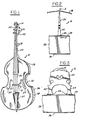
- FIG. 1 there is illustrated a stringed musical instrument 10, utilizing the sound enhancing device 12 of the present invention.
- the instrument 10 includes a scroll 14, pegs 16 to which the strings 18 are attached, and a peg machine 20 which operates to hold the pegs 16 in place.
- a saddle 22 serves to connect the peg machine 20 to a neck 24.
- a fingerboard 26 extends up from the top 28 of the instrument 10 to the neck 24, ultimately connecting with the saddle 22.
- a bridge 30 is located on the top 28 of a body portion 32 of the instrument 10 perpendicular to the longitudinal axis of the instrument and a pair of F holes 34 is also provided on the top 28 of the body portion 32.
- the top 28 is connected to the bottom 36 of the instrument by the side 38.
- a tail piece 40 is connected to the top 28 of the instrument and serves to connect the strings 18 of the instrument at its bottom.
- the sound enhancing device 12 includes the bridge 30 with the currently standard number of bridge feet 42 and 44.
- a bridge pad 46 is located between each of the bridge feet 42 and 44 and the top 28 of the instrument 10.
- the bridge 30, bridge feet 42, 44, bridge pad 46 and top 28 of the instrument 10 are depicted upon installation of the sound enhancing device 12.
- the bridge feet 42 and 44 mate with the bridge pad 46, with the bridge pad located between the bridge feet and the top 28 of the instrument.
- the strings 18 apply pressure to the bridge 30, bridge feet 42, 44, bridge pad 46, and the top 28 of the instrument.
- the bridge pad 46 is preferably a cold flowable material such as a plastic or polymeric material.
- Suitable commercially available cold flowable materials include synthetic resin polymers and products, for example a polyfluoroethylene such as Teflon ("TEFLON" is a trademark of E.I. DuPont deNemours & Company of Wilmington, Delaware) which is cold flowable and has a low coefficient of friction.
- Teflon a polyfluoroethylene
- Teflon is a trademark of E.I. DuPont deNemours & Company of Wilmington, Delaware
- Such a material may be compressed and cold flow upon tightening of the strings 18 of the instrument 10, which allows it to conform and distort precisely to the irregular surface of the top 28 of the stringed musical instrument 10 and the bottom of the bridge feet 42 and 44.
- the pads 46 develop a more conductive fit to enhance the mating relationship with the body portion 32 of the instrument 10 and feet 42 and 44 of the bridge 30.
- such a material has a low coefficient of friction, it provides for ease of adjusting the location of the sound enhancing device 12 laterally and longitudinally on the body portion 32 of the instrument 10 without requiring the loosening of the strings 18.
Landscapes
- Physics & Mathematics (AREA)
- Engineering & Computer Science (AREA)
- Acoustics & Sound (AREA)
- Multimedia (AREA)
- Stringed Musical Instruments (AREA)
- Input Circuits Of Receivers And Coupling Of Receivers And Audio Equipment (AREA)
- Noise Elimination (AREA)
- Massaging Devices (AREA)
- Percussion Or Vibration Massage (AREA)
- Control Of Motors That Do Not Use Commutators (AREA)
- Surgical Instruments (AREA)
Priority Applications (1)
| Application Number | Priority Date | Filing Date | Title |
|---|---|---|---|
| AT87303400T ATE87761T1 (de) | 1986-04-18 | 1987-04-16 | Tonverbesserungsgeraet. |
Applications Claiming Priority (2)
| Application Number | Priority Date | Filing Date | Title |
|---|---|---|---|
| US853664 | 1986-04-18 | ||
| US06/853,664 US4679481A (en) | 1986-04-18 | 1986-04-18 | Sound enhancing device |
Publications (3)
| Publication Number | Publication Date |
|---|---|
| EP0242221A2 true EP0242221A2 (fr) | 1987-10-21 |
| EP0242221A3 EP0242221A3 (en) | 1988-08-24 |
| EP0242221B1 EP0242221B1 (fr) | 1993-03-31 |
Family
ID=25316606
Family Applications (1)
| Application Number | Title | Priority Date | Filing Date |
|---|---|---|---|
| EP87303400A Expired - Lifetime EP0242221B1 (fr) | 1986-04-18 | 1987-04-16 | Dispositif pour améliorer le son |
Country Status (4)
| Country | Link |
|---|---|
| US (1) | US4679481A (fr) |
| EP (1) | EP0242221B1 (fr) |
| AT (1) | ATE87761T1 (fr) |
| DE (1) | DE3785072T2 (fr) |
Cited By (2)
| Publication number | Priority date | Publication date | Assignee | Title |
|---|---|---|---|---|
| US6635812B2 (en) | 2001-05-25 | 2003-10-21 | Rudolf Wittner Gmbh U. Co. | String holder for a musical instrument |
| WO2020194002A1 (fr) | 2019-03-27 | 2020-10-01 | Toth Karoly | Instrument à cordes |
Families Citing this family (5)
| Publication number | Priority date | Publication date | Assignee | Title |
|---|---|---|---|---|
| US7462767B1 (en) | 2005-06-10 | 2008-12-09 | Swift Dana B | Stringed musical instrument tension balancer |
| USD576664S1 (en) * | 2008-01-08 | 2008-09-09 | Akt International Co., Ltd. | Musical instrument |
| USD607486S1 (en) * | 2009-05-12 | 2010-01-05 | Bong Yeol Kwak | MP3 violin |
| USD628618S1 (en) * | 2010-04-20 | 2010-12-07 | Akt International Co., Limited | Ukulele |
| GB2532011A (en) * | 2014-11-04 | 2016-05-11 | C7Th Ltd | A capo for a stringed instrument |
Family Cites Families (7)
| Publication number | Priority date | Publication date | Assignee | Title |
|---|---|---|---|---|
| US388883A (en) * | 1888-09-04 | Bridge for violins | ||
| DE377709C (de) * | 1923-06-25 | Karl Herrmann | Steg fuer Streichinstrumente | |
| FR552437A (fr) * | 1922-06-01 | 1923-05-01 | Thibouville Lamy & Cie | Système d'appuis élastiques pour chevalets |
| US2103675A (en) * | 1934-03-06 | 1937-12-28 | Gylden Tone As Bergen | Bridge foot piece for stringed musical instruments |
| GB431998A (en) * | 1934-12-14 | 1935-07-18 | Jim Johannessen | Improvements in and relating to the bridges of bowed stringed musical instruments |
| US2199612A (en) * | 1939-01-09 | 1940-05-07 | Ernest R Born | Bridge for stringed instruments |
| US2786382A (en) * | 1954-07-28 | 1957-03-26 | Melita Sebastiano | Adjustable base for stringed instrument bridge |
-
1986
- 1986-04-18 US US06/853,664 patent/US4679481A/en not_active Expired - Fee Related
-
1987
- 1987-04-16 AT AT87303400T patent/ATE87761T1/de not_active IP Right Cessation
- 1987-04-16 EP EP87303400A patent/EP0242221B1/fr not_active Expired - Lifetime
- 1987-04-16 DE DE8787303400T patent/DE3785072T2/de not_active Expired - Fee Related
Cited By (3)
| Publication number | Priority date | Publication date | Assignee | Title |
|---|---|---|---|---|
| US6635812B2 (en) | 2001-05-25 | 2003-10-21 | Rudolf Wittner Gmbh U. Co. | String holder for a musical instrument |
| CZ298275B6 (cs) * | 2001-05-25 | 2007-08-15 | Rudolf Wittner Gmbh U. Co. | Struník pro hudební nástroj |
| WO2020194002A1 (fr) | 2019-03-27 | 2020-10-01 | Toth Karoly | Instrument à cordes |
Also Published As
| Publication number | Publication date |
|---|---|
| DE3785072D1 (de) | 1993-05-06 |
| US4679481A (en) | 1987-07-14 |
| ATE87761T1 (de) | 1993-04-15 |
| EP0242221A3 (en) | 1988-08-24 |
| EP0242221B1 (fr) | 1993-03-31 |
| DE3785072T2 (de) | 1993-09-02 |
Similar Documents
| Publication | Publication Date | Title |
|---|---|---|
| US4304163A (en) | Adjustable nut for stringed musical instrument | |
| US4104947A (en) | Capo | |
| US6124536A (en) | Bridge mechanism for the acoustic guitar | |
| US5600079A (en) | Method and apparatus for fully adjusting and intonating an acoustic guitar | |
| US6875910B2 (en) | Guitar bridge for improved sound transfer | |
| EP0803115A1 (fr) | Instrument a vent et element de fermeture pour instrument a vent | |
| EP0109419A1 (fr) | Systeme de suspension des cordes a hauteur de son stabilisee pour des instruments de musique | |
| EP0242221B1 (fr) | Dispositif pour améliorer le son | |
| ATE55025T1 (de) | Einstellbare bruecke und abstimmungseinheit fuer ein saitenmusikinstrument. | |
| US4541320A (en) | Stringed instrument saddle lock | |
| US6501010B2 (en) | Reed and mouthpiece assembly | |
| US6433264B1 (en) | Compensated nut for a stringed instrument | |
| US5644094A (en) | Bridge for stringed musical instruments | |
| AU662306B2 (en) | Stringed musical instrument | |
| US5814745A (en) | Method and apparatus for fully adjusting and intonating stringed, fretted musical instruments, and making adjustments to the rule of 18 | |
| US6156962A (en) | Stringed instrument with an oblique nut | |
| US4464970A (en) | Guitar bridge system | |
| US3440921A (en) | Bridge for stringed musical instruments | |
| US10607580B2 (en) | Intonation system for stringed instruments | |
| US6747198B1 (en) | Reed and mouthpiece assembly | |
| US3014394A (en) | Bass bar for stringed musical instrument | |
| US6750385B1 (en) | Stringed musical instrument | |
| US5381716A (en) | Tremolo system for stringed instruments | |
| US11276379B2 (en) | Retaining device for a chin rest for a stringed instrument | |
| US5492044A (en) | String support having a base with string support members and method |
Legal Events
| Date | Code | Title | Description |
|---|---|---|---|
| PUAI | Public reference made under article 153(3) epc to a published international application that has entered the european phase |
Free format text: ORIGINAL CODE: 0009012 |
|
| AK | Designated contracting states |
Kind code of ref document: A2 Designated state(s): AT DE FR GB |
|
| PUAL | Search report despatched |
Free format text: ORIGINAL CODE: 0009013 |
|
| AK | Designated contracting states |
Kind code of ref document: A3 Designated state(s): AT DE FR GB |
|
| 17P | Request for examination filed |
Effective date: 19890223 |
|
| 17Q | First examination report despatched |
Effective date: 19910215 |
|
| GRAA | (expected) grant |
Free format text: ORIGINAL CODE: 0009210 |
|
| AK | Designated contracting states |
Kind code of ref document: B1 Designated state(s): AT DE FR GB |
|
| REF | Corresponds to: |
Ref document number: 87761 Country of ref document: AT Date of ref document: 19930415 Kind code of ref document: T |
|
| PGFP | Annual fee paid to national office [announced via postgrant information from national office to epo] |
Ref country code: GB Payment date: 19930405 Year of fee payment: 7 |
|
| PGFP | Annual fee paid to national office [announced via postgrant information from national office to epo] |
Ref country code: FR Payment date: 19930408 Year of fee payment: 7 |
|
| ET | Fr: translation filed | ||
| REF | Corresponds to: |
Ref document number: 3785072 Country of ref document: DE Date of ref document: 19930506 |
|
| PLBE | No opposition filed within time limit |
Free format text: ORIGINAL CODE: 0009261 |
|
| STAA | Information on the status of an ep patent application or granted ep patent |
Free format text: STATUS: NO OPPOSITION FILED WITHIN TIME LIMIT |
|
| 26N | No opposition filed | ||
| PG25 | Lapsed in a contracting state [announced via postgrant information from national office to epo] |
Ref country code: GB Effective date: 19940416 |
|
| PGFP | Annual fee paid to national office [announced via postgrant information from national office to epo] |
Ref country code: DE Payment date: 19941010 Year of fee payment: 8 |
|
| PGFP | Annual fee paid to national office [announced via postgrant information from national office to epo] |
Ref country code: AT Payment date: 19941012 Year of fee payment: 8 |
|
| GBPC | Gb: european patent ceased through non-payment of renewal fee |
Effective date: 19940416 |
|
| PG25 | Lapsed in a contracting state [announced via postgrant information from national office to epo] |
Ref country code: FR Effective date: 19941229 |
|
| REG | Reference to a national code |
Ref country code: FR Ref legal event code: ST |
|
| PG25 | Lapsed in a contracting state [announced via postgrant information from national office to epo] |
Ref country code: AT Effective date: 19950416 |
|
| PG25 | Lapsed in a contracting state [announced via postgrant information from national office to epo] |
Ref country code: DE Effective date: 19960103 |