EP0242432A1 - Composition à base de caoutchouc pour bande de roulement - Google Patents
Composition à base de caoutchouc pour bande de roulement Download PDFInfo
- Publication number
- EP0242432A1 EP0242432A1 EP86113732A EP86113732A EP0242432A1 EP 0242432 A1 EP0242432 A1 EP 0242432A1 EP 86113732 A EP86113732 A EP 86113732A EP 86113732 A EP86113732 A EP 86113732A EP 0242432 A1 EP0242432 A1 EP 0242432A1
- Authority
- EP
- European Patent Office
- Prior art keywords
- phr
- sulfur
- rubber
- bts
- tread
- Prior art date
- Legal status (The legal status is an assumption and is not a legal conclusion. Google has not performed a legal analysis and makes no representation as to the accuracy of the status listed.)
- Withdrawn
Links
- 229920001971 elastomer Polymers 0.000 title claims abstract description 24
- 239000005060 rubber Substances 0.000 title claims abstract description 24
- 239000000203 mixture Substances 0.000 title claims description 21
- NINIDFKCEFEMDL-UHFFFAOYSA-N Sulfur Chemical compound [S] NINIDFKCEFEMDL-UHFFFAOYSA-N 0.000 claims abstract description 70
- 229910052717 sulfur Inorganic materials 0.000 claims abstract description 70
- 239000011593 sulfur Substances 0.000 claims abstract description 70
- 229920003051 synthetic elastomer Polymers 0.000 claims abstract description 32
- 239000005061 synthetic rubber Substances 0.000 claims abstract description 32
- 244000043261 Hevea brasiliensis Species 0.000 claims abstract description 24
- 229920003052 natural elastomer Polymers 0.000 claims abstract description 24
- 229920001194 natural rubber Polymers 0.000 claims abstract description 24
- 229920003048 styrene butadiene rubber Polymers 0.000 claims abstract description 21
- QAZLUNIWYYOJPC-UHFFFAOYSA-M sulfenamide Chemical compound [Cl-].COC1=C(C)C=[N+]2C3=NC4=CC=C(OC)C=C4N3SCC2=C1C QAZLUNIWYYOJPC-UHFFFAOYSA-M 0.000 claims abstract description 20
- 230000003647 oxidation Effects 0.000 claims abstract description 16
- 238000007254 oxidation reaction Methods 0.000 claims abstract description 16
- 150000001875 compounds Chemical class 0.000 claims description 38
- MHKLKWCYGIBEQF-UHFFFAOYSA-N 4-(1,3-benzothiazol-2-ylsulfanyl)morpholine Chemical compound C1COCCN1SC1=NC2=CC=CC=C2S1 MHKLKWCYGIBEQF-UHFFFAOYSA-N 0.000 claims description 27
- 239000005062 Polybutadiene Substances 0.000 claims description 10
- IOJUPLGTWVMSFF-UHFFFAOYSA-N benzothiazole Chemical compound C1=CC=C2SC=NC2=C1 IOJUPLGTWVMSFF-UHFFFAOYSA-N 0.000 claims description 8
- 229910052739 hydrogen Inorganic materials 0.000 claims description 8
- 239000001257 hydrogen Substances 0.000 claims description 8
- 229920002857 polybutadiene Polymers 0.000 claims description 7
- 125000004432 carbon atom Chemical group C* 0.000 claims description 6
- 125000002877 alkyl aryl group Chemical group 0.000 claims description 5
- 125000003710 aryl alkyl group Chemical group 0.000 claims description 5
- 125000000753 cycloalkyl group Chemical group 0.000 claims description 5
- 125000006686 (C1-C24) alkyl group Chemical group 0.000 claims description 4
- 125000004178 (C1-C4) alkyl group Chemical group 0.000 claims description 4
- 125000004435 hydrogen atom Chemical group [H]* 0.000 claims description 4
- GPNLWUFFWOYKLP-UHFFFAOYSA-N s-(1,3-benzothiazol-2-yl)thiohydroxylamine Chemical compound C1=CC=C2SC(SN)=NC2=C1 GPNLWUFFWOYKLP-UHFFFAOYSA-N 0.000 claims description 4
- ROGIWVXWXZRRMZ-UHFFFAOYSA-N 2-methylbuta-1,3-diene;styrene Chemical compound CC(=C)C=C.C=CC1=CC=CC=C1 ROGIWVXWXZRRMZ-UHFFFAOYSA-N 0.000 claims description 3
- FZWLAAWBMGSTSO-UHFFFAOYSA-N Thiazole Chemical group C1=CSC=N1 FZWLAAWBMGSTSO-UHFFFAOYSA-N 0.000 claims description 3
- 125000003118 aryl group Chemical group 0.000 claims description 3
- 239000000839 emulsion Substances 0.000 claims description 3
- 229920000642 polymer Polymers 0.000 claims description 3
- UFHFLCQGNIYNRP-UHFFFAOYSA-N Hydrogen Chemical compound [H][H] UFHFLCQGNIYNRP-UHFFFAOYSA-N 0.000 claims description 2
- 125000001997 phenyl group Chemical group [H]C1=C([H])C([H])=C(*)C([H])=C1[H] 0.000 claims description 2
- 150000002431 hydrogen Chemical class 0.000 claims 2
- IUJLOAKJZQBENM-UHFFFAOYSA-N n-(1,3-benzothiazol-2-ylsulfanyl)-2-methylpropan-2-amine Chemical compound C1=CC=C2SC(SNC(C)(C)C)=NC2=C1 IUJLOAKJZQBENM-UHFFFAOYSA-N 0.000 claims 1
- 230000001590 oxidative effect Effects 0.000 abstract description 11
- 238000004073 vulcanization Methods 0.000 abstract description 6
- 235000001508 sulfur Nutrition 0.000 description 67
- 239000002174 Styrene-butadiene Substances 0.000 description 17
- 150000008117 polysulfides Polymers 0.000 description 17
- 239000005077 polysulfide Substances 0.000 description 15
- HOEFWOBLOGZQIQ-UHFFFAOYSA-N morpholin-4-yl morpholine-4-carbodithioate Chemical compound C1COCCN1C(=S)SN1CCOCC1 HOEFWOBLOGZQIQ-UHFFFAOYSA-N 0.000 description 14
- 229920001021 polysulfide Polymers 0.000 description 14
- 125000004434 sulfur atom Chemical group 0.000 description 11
- 239000004594 Masterbatch (MB) Substances 0.000 description 6
- 239000004615 ingredient Substances 0.000 description 5
- 238000000034 method Methods 0.000 description 5
- 230000000704 physical effect Effects 0.000 description 5
- 238000005336 cracking Methods 0.000 description 4
- 230000007423 decrease Effects 0.000 description 4
- 238000005259 measurement Methods 0.000 description 4
- BWGNESOTFCXPMA-UHFFFAOYSA-N Dihydrogen disulfide Chemical compound SS BWGNESOTFCXPMA-UHFFFAOYSA-N 0.000 description 3
- 239000000654 additive Substances 0.000 description 3
- 230000032683 aging Effects 0.000 description 3
- 239000006229 carbon black Substances 0.000 description 3
- -1 cyclic sulfides Chemical class 0.000 description 3
- 230000000694 effects Effects 0.000 description 3
- 230000000717 retained effect Effects 0.000 description 3
- 238000012360 testing method Methods 0.000 description 3
- RMVRSNDYEFQCLF-UHFFFAOYSA-N thiophenol Chemical compound SC1=CC=CC=C1 RMVRSNDYEFQCLF-UHFFFAOYSA-N 0.000 description 3
- 229920008128 Ameripol Polymers 0.000 description 2
- OYPRJOBELJOOCE-UHFFFAOYSA-N Calcium Chemical compound [Ca] OYPRJOBELJOOCE-UHFFFAOYSA-N 0.000 description 2
- VTYYLEPIZMXCLO-UHFFFAOYSA-L Calcium carbonate Chemical compound [Ca+2].[O-]C([O-])=O VTYYLEPIZMXCLO-UHFFFAOYSA-L 0.000 description 2
- VYPSYNLAJGMNEJ-UHFFFAOYSA-N Silicium dioxide Chemical compound O=[Si]=O VYPSYNLAJGMNEJ-UHFFFAOYSA-N 0.000 description 2
- HCHKCACWOHOZIP-UHFFFAOYSA-N Zinc Chemical compound [Zn] HCHKCACWOHOZIP-UHFFFAOYSA-N 0.000 description 2
- XLOMVQKBTHCTTD-UHFFFAOYSA-N Zinc monoxide Chemical compound [Zn]=O XLOMVQKBTHCTTD-UHFFFAOYSA-N 0.000 description 2
- 239000012190 activator Substances 0.000 description 2
- 230000000996 additive effect Effects 0.000 description 2
- 239000003963 antioxidant agent Substances 0.000 description 2
- 229910052791 calcium Inorganic materials 0.000 description 2
- 239000011575 calcium Substances 0.000 description 2
- 229940000425 combination drug Drugs 0.000 description 2
- 230000006835 compression Effects 0.000 description 2
- 238000007906 compression Methods 0.000 description 2
- 230000003247 decreasing effect Effects 0.000 description 2
- 239000000945 filler Substances 0.000 description 2
- 230000000977 initiatory effect Effects 0.000 description 2
- 239000011133 lead Substances 0.000 description 2
- NHKJPPKXDNZFBJ-UHFFFAOYSA-N phenyllithium Chemical compound [Li]C1=CC=CC=C1 NHKJPPKXDNZFBJ-UHFFFAOYSA-N 0.000 description 2
- 239000000049 pigment Substances 0.000 description 2
- 230000002028 premature Effects 0.000 description 2
- 238000005096 rolling process Methods 0.000 description 2
- 239000011701 zinc Substances 0.000 description 2
- 229910052725 zinc Inorganic materials 0.000 description 2
- CFEMBVVZPUEPPP-UHFFFAOYSA-N 2-methylbuta-1,3-diene;prop-2-enenitrile Chemical compound C=CC#N.CC(=C)C=C CFEMBVVZPUEPPP-UHFFFAOYSA-N 0.000 description 1
- HLBZWYXLQJQBKU-UHFFFAOYSA-N 4-(morpholin-4-yldisulfanyl)morpholine Chemical compound C1COCCN1SSN1CCOCC1 HLBZWYXLQJQBKU-UHFFFAOYSA-N 0.000 description 1
- RYGMFSIKBFXOCR-UHFFFAOYSA-N Copper Chemical compound [Cu] RYGMFSIKBFXOCR-UHFFFAOYSA-N 0.000 description 1
- FYYHWMGAXLPEAU-UHFFFAOYSA-N Magnesium Chemical compound [Mg] FYYHWMGAXLPEAU-UHFFFAOYSA-N 0.000 description 1
- 229920000459 Nitrile rubber Polymers 0.000 description 1
- 235000021355 Stearic acid Nutrition 0.000 description 1
- JAWMENYCRQKKJY-UHFFFAOYSA-N [3-(2,4,6,7-tetrahydrotriazolo[4,5-c]pyridin-5-ylmethyl)-1-oxa-2,8-diazaspiro[4.5]dec-2-en-8-yl]-[2-[[3-(trifluoromethoxy)phenyl]methylamino]pyrimidin-5-yl]methanone Chemical compound N1N=NC=2CN(CCC=21)CC1=NOC2(C1)CCN(CC2)C(=O)C=1C=NC(=NC=1)NCC1=CC(=CC=C1)OC(F)(F)F JAWMENYCRQKKJY-UHFFFAOYSA-N 0.000 description 1
- 230000002411 adverse Effects 0.000 description 1
- 125000000217 alkyl group Chemical group 0.000 description 1
- 229910052782 aluminium Inorganic materials 0.000 description 1
- 238000004458 analytical method Methods 0.000 description 1
- 229910052788 barium Inorganic materials 0.000 description 1
- DSAJWYNOEDNPEQ-UHFFFAOYSA-N barium atom Chemical compound [Ba] DSAJWYNOEDNPEQ-UHFFFAOYSA-N 0.000 description 1
- 230000015572 biosynthetic process Effects 0.000 description 1
- NTXGQCSETZTARF-UHFFFAOYSA-N buta-1,3-diene;prop-2-enenitrile Chemical compound C=CC=C.C=CC#N NTXGQCSETZTARF-UHFFFAOYSA-N 0.000 description 1
- 229920005549 butyl rubber Polymers 0.000 description 1
- 229910052793 cadmium Inorganic materials 0.000 description 1
- BDOSMKKIYDKNTQ-UHFFFAOYSA-N cadmium atom Chemical compound [Cd] BDOSMKKIYDKNTQ-UHFFFAOYSA-N 0.000 description 1
- 229910000019 calcium carbonate Inorganic materials 0.000 description 1
- 230000015556 catabolic process Effects 0.000 description 1
- 238000006243 chemical reaction Methods 0.000 description 1
- YACLQRRMGMJLJV-UHFFFAOYSA-N chloroprene Chemical compound ClC(=C)C=C YACLQRRMGMJLJV-UHFFFAOYSA-N 0.000 description 1
- 238000013329 compounding Methods 0.000 description 1
- 239000000470 constituent Substances 0.000 description 1
- 229910052802 copper Inorganic materials 0.000 description 1
- 239000010949 copper Substances 0.000 description 1
- 238000006731 degradation reaction Methods 0.000 description 1
- 238000013461 design Methods 0.000 description 1
- 150000001993 dienes Chemical class 0.000 description 1
- 235000014113 dietary fatty acids Nutrition 0.000 description 1
- 125000002228 disulfide group Chemical group 0.000 description 1
- 150000002019 disulfides Chemical class 0.000 description 1
- 239000000194 fatty acid Substances 0.000 description 1
- 229930195729 fatty acid Natural products 0.000 description 1
- 150000004665 fatty acids Chemical class 0.000 description 1
- SLGWESQGEUXWJQ-UHFFFAOYSA-N formaldehyde;phenol Chemical compound O=C.OC1=CC=CC=C1 SLGWESQGEUXWJQ-UHFFFAOYSA-N 0.000 description 1
- 229910052749 magnesium Inorganic materials 0.000 description 1
- 239000011777 magnesium Substances 0.000 description 1
- ZLNQQNXFFQJAID-UHFFFAOYSA-L magnesium carbonate Chemical compound [Mg+2].[O-]C([O-])=O ZLNQQNXFFQJAID-UHFFFAOYSA-L 0.000 description 1
- 239000001095 magnesium carbonate Substances 0.000 description 1
- 229910000021 magnesium carbonate Inorganic materials 0.000 description 1
- 238000004519 manufacturing process Methods 0.000 description 1
- VYQNWZOUAUKGHI-UHFFFAOYSA-N monobenzone Chemical compound C1=CC(O)=CC=C1OCC1=CC=CC=C1 VYQNWZOUAUKGHI-UHFFFAOYSA-N 0.000 description 1
- 229940032017 n-oxydiethylene-2-benzothiazole sulfenamide Drugs 0.000 description 1
- 238000003012 network analysis Methods 0.000 description 1
- QIQXTHQIDYTFRH-UHFFFAOYSA-N octadecanoic acid Chemical compound CCCCCCCCCCCCCCCCCC(O)=O QIQXTHQIDYTFRH-UHFFFAOYSA-N 0.000 description 1
- OQCDKBAXFALNLD-UHFFFAOYSA-N octadecanoic acid Natural products CCCCCCCC(C)CCCCCCCCC(O)=O OQCDKBAXFALNLD-UHFFFAOYSA-N 0.000 description 1
- 229940049964 oleate Drugs 0.000 description 1
- ZQPPMHVWECSIRJ-KTKRTIGZSA-N oleic acid Chemical compound CCCCCCCC\C=C/CCCCCCCC(O)=O ZQPPMHVWECSIRJ-KTKRTIGZSA-N 0.000 description 1
- 229920001568 phenolic resin Polymers 0.000 description 1
- 229920005990 polystyrene resin Polymers 0.000 description 1
- 238000012545 processing Methods 0.000 description 1
- 230000003014 reinforcing effect Effects 0.000 description 1
- 150000003839 salts Chemical class 0.000 description 1
- 239000000377 silicon dioxide Substances 0.000 description 1
- 239000003381 stabilizer Substances 0.000 description 1
- 239000008117 stearic acid Substances 0.000 description 1
- 125000001424 substituent group Chemical group 0.000 description 1
- 238000010059 sulfur vulcanization Methods 0.000 description 1
- 150000003467 sulfuric acid derivatives Chemical class 0.000 description 1
- 238000010998 test method Methods 0.000 description 1
- 150000005671 trienes Chemical class 0.000 description 1
- 239000004636 vulcanized rubber Substances 0.000 description 1
- 239000011787 zinc oxide Substances 0.000 description 1
- XOOUIPVCVHRTMJ-UHFFFAOYSA-L zinc stearate Chemical class [Zn+2].CCCCCCCCCCCCCCCCCC([O-])=O.CCCCCCCCCCCCCCCCCC([O-])=O XOOUIPVCVHRTMJ-UHFFFAOYSA-L 0.000 description 1
Images



Classifications
-
- C—CHEMISTRY; METALLURGY
- C08—ORGANIC MACROMOLECULAR COMPOUNDS; THEIR PREPARATION OR CHEMICAL WORKING-UP; COMPOSITIONS BASED THEREON
- C08L—COMPOSITIONS OF MACROMOLECULAR COMPOUNDS
- C08L25/00—Compositions of, homopolymers or copolymers of compounds having one or more unsaturated aliphatic radicals, each having only one carbon-to-carbon double bond, and at least one being terminated by an aromatic carbocyclic ring; Compositions of derivatives of such polymers
- C08L25/02—Homopolymers or copolymers of hydrocarbons
- C08L25/04—Homopolymers or copolymers of styrene
- C08L25/08—Copolymers of styrene
- C08L25/10—Copolymers of styrene with conjugated dienes
-
- C—CHEMISTRY; METALLURGY
- C08—ORGANIC MACROMOLECULAR COMPOUNDS; THEIR PREPARATION OR CHEMICAL WORKING-UP; COMPOSITIONS BASED THEREON
- C08K—Use of inorganic or non-macromolecular organic substances as compounding ingredients
- C08K5/00—Use of organic ingredients
- C08K5/36—Sulfur-, selenium-, or tellurium-containing compounds
- C08K5/43—Compounds containing sulfur bound to nitrogen
- C08K5/44—Sulfenamides
-
- B—PERFORMING OPERATIONS; TRANSPORTING
- B60—VEHICLES IN GENERAL
- B60C—VEHICLE TYRES; TYRE INFLATION; TYRE CHANGING; CONNECTING VALVES TO INFLATABLE ELASTIC BODIES IN GENERAL; DEVICES OR ARRANGEMENTS RELATED TO TYRES
- B60C1/00—Tyres characterised by the chemical composition or the physical arrangement or mixture of the composition
- B60C1/0016—Compositions of the tread
-
- C—CHEMISTRY; METALLURGY
- C08—ORGANIC MACROMOLECULAR COMPOUNDS; THEIR PREPARATION OR CHEMICAL WORKING-UP; COMPOSITIONS BASED THEREON
- C08K—Use of inorganic or non-macromolecular organic substances as compounding ingredients
- C08K5/00—Use of organic ingredients
- C08K5/36—Sulfur-, selenium-, or tellurium-containing compounds
- C08K5/45—Heterocyclic compounds having sulfur in the ring
- C08K5/46—Heterocyclic compounds having sulfur in the ring with oxygen or nitrogen in the ring
- C08K5/47—Thiazoles
Definitions
- This invention relates to vulcanized synthetic rubber compositions.
- the considerations relating to vulcanizing a predominantly natural rubber (NR) composition are differ strictlyent from those for vulcanizing synthetic rubber (SR).
- SR synthetic rubber
- Tire tread requires a vulcanizate which is oxidation stable, highly durable under driving conditions, along with good wet and dry traction, low rolling resistance, inter alia, yet with sufficient flexibility to withstand deformation during use.
- Increasing the amount of sulfur decreases stability to oxidation (also refered to as 'oxidation' or 'oxidative' stability) when used with known accelerators in conventional ratios. As a result, the tire manufacturing industry has progressively lowered sulfur levels and increased the amount of accelerator used.
- Vulcanization of rubber with sulfur is a complicated process which is not fully understood.
- a variety of chemical compounds ("products" to avoid confusion with tread compounds) are formed depending upon the type of rubber, the sulfur level, the accelerator and activator used, etc.
- unaccelerated sulfur vulcanization produces long polysulfide crosslinks approaching 50 S atoms per crosslink.
- Relatively low concentrations of sulfenamide accelerators produce "long" crosslinks containing from about 3 to about 10 sulfur atoms per chain which is referred to as a "polysulfide” chain or crosslink.
- Sulfur donor systems give even shorter crosslinks - about 3 S atoms per chain.
- the proportionate amount of each compound formed in the vulcanizate depends so heavily on the type of rubber used, the type of sulfur, the type and thermal history of the carbon black, in addition to so many other factors, for example the sulfur level, whether oil extended, the type of accelerators and sulfur donors used, the amount of pigments and fillers such as silica, if these are used, inter alia, it is well accepted that it is implausibe to make logical deductions with reasonable assurance from measurements of physical properties obtained with a particular cure system and rubber compound, from properties obtained with a similar cure system but a different type of rubber.
- this invention relates to the use of a combination of compounds from the classes of benzothiazole sulfenamide (BTS) and thiocarbamyl sulfenamide (TCS) accelerators each of which has good scorch safety, but the TCS is more efficient.
- BTS benzothiazole sulfenamide
- TCS thiocarbamyl sulfenamide
- the vulcanizate therefore has different properties. TCS improves thermal and oxidative stability of SBR vulcanizates and also gives lower permanent set and heat buildup. However TCS adversely affects tear strength and flex life.
- My goal was to take advantage of the efficiency of the TCS in combination with the BTS in such a way as to use a lower net amount of accelerators and to increased the amount of sulfur.
- short crosslinks provide improved oxidation stability but they decrease the oxidation stability of NR if TCS is used.
- the oxidation stability of NR vulcanized with BTS and TCS (which produces short crosslinks) is poorer than when the NR is vulcanized with BTS alone (which produces longer crosslinks).
- Polysulfide crosslinks imbue the vulcanizate with high tensile strength, improved flex resistance and tear strength, high heat buildup and compression set, and poor thermal and oxidative stability. Good oxidative and thermal stability, low tensile strength, heat buildup and compression set, poor flex resistance and tear strength are attributable to monosulfide and disulfide crosslinks. Thus, a tire tread composition is always a compromise. This invention provides an unexpectedly good one.
- SR synthetic rubber
- SBR styrene-butadiene rubber
- NR natural rubber
- the modulus for a typical tire tread is in the range from about 8 MPa (megapascals) to about 10 MPa.
- the tread rubber composition (“tread compound”) of this invention is synthetic rubber, consisting essentially of at least 60 phr SBR, and more preferably about 70 phr SBR, the remaining SR being selected from the group consisting of halogenated SBR, cis-polybutadiene, ethylene-propylenediene polymer (epdm), emulsion polybutadiene, butadiene-acrylonitrile, isoprene-acrylonitrile, polychloroprene, isoprene-styrene or other unsaturated rubbers.
- the amount of natural rubber present, if any, is so small as not to affect the properties of the SR appreciably.
- the tread compound is 100 phr SR containing about 70 phr SBR in a masterbatch to be cured with sulfur and a combination of TCS and BTS accelerators.
- the tread compound before aging must meet the criterion for 300% modulus which is a measure of crosslink density.
- modulus is a measure of crosslink density.
- the preferred range of modulus for a tread compound is from about 1200 psi (about 82 MPa or 82 kg/cm2) to about 1800 psi (12.4 MPa or 124 kg/cm2), the most preferred for a passenger car tread compound being about 1300-1500 psi. This value will be determined by the amount of carbon black and other additives, including pigments, antioxidants, antiozonants and the like used, and particularly the type of rubbers. The longer the average length of a crosslink, the more unstable is the compound. The use of BTS as the only accelerator results in relatively long crosslinks and poor oxidation stability.
- TCS is represented by the formula A ⁇ - S-A ⁇ wherein A ⁇ is selected from the group consisting of and mixtures thereof, R a and R b are selected from the group consisting of hydrogen, C1-C24 alkyl, C2-C12 cyanoalkyl, C2-C12 alkoxyalkyl, cycloalkyl containing 4 to 8 ring carbon atoms, phenyl, and C7-C18 alkaryl or aralkyl; R is hydrogen or C1-C4 alkyl; and, x is an integer in the range from 4 to 7.
- TCS N-oxydiethylenethiocarbamyl-N ⁇ -oxydiethylene sulfenamide
- TCS when used as the only accelerator, gives vulcanizates with improved thermal stability, improved oxidation stability, lower heat buildup and lower permanent set than those made with BTS as the only accelerator. TCS also gives poorer unaged tear strength and flex-life than BTS. Thus, the goal was to lengthen the crosslinks produced by TCS so as to match the 300% modulus of a SR vulcanizate produced with BTS alone.
- BTS is represented by the formula T-S-B wherein B is selected from the group consisting of wherein R c and R d are hydrogen, C1-C24 alkyl, C6-C18 aryl, C7-C18 alkaryl or aralkyl, cycloalkyl containing 3 to 8 ring carbon atoms, R ⁇ is hydrogen or C1-C4 alkyl; z is an integer in the range from 2 to 7; and, T represents a thiazole ring, especially a benzothiazole ring.
- Alkyl in the foregoing may be linear or branched, and may contain primary, secondary and/or tertiary carbon atoms.
- Aryl, alkaryl, aralkyl, cycloalkyl and thiazole may have C1-C8 substituents.
- OBTS N-oxydiethylene-2-benzothiazole sulfenamide
- the amount of BTS used is in the range from about 0.3 phr to about 1.5 phr.
- the total amount of TCS and BTS used is in the range from 1 phr to 2 phr. Larger amounts of sulfenamide accelerators require decreasing the amount of sulfur in the masterbatch if the 300% modulus is to remain the same; since it is sought to increase the amount of sulfur to be used, the amount of sulfenamides used is limited to 2 phr.
- Additional compounding ingredients may be used in the tread compound, which ingredients include activators such as the oxides of lead, zinc, calcium and magnesium, fatty acids such as stearic and lauric, and salts thereof such as stearates of cadmium, zinc and copper, and lead oleate; antioxidants and antiozonants and stabilizers for degradation due to heat; and sulfur donors such as dithiodimorpholine.
- Fillers may also be used such as channel blacks, reinforcing blacks, thermal blacks, calcium carbonate and magnesium carbonate, sulfates of barium and and calcium, aluminum silicates, phenol-formaldehyde and polystyrene resins, and the like.
- the ingredients are added to the rubber using internal mixers such as a Banbury, a two-roll mill, or the like.
- the sulfur and the accelerators are added to the rubber near the end of the mixing cycle to minimize premature vulcanization.
- tread compounds described herein were evaluated for physical properties indicative of oxidative stability, by DeMattia Flexlife and Ringflex test procedures.
- Crosslink network analysis is done conventionally using phenyl lithium to cleave disulfide and polysulfide chains, and provide a measure of labile sulfur (procedure of Gregg).
- the procedure involves the measurement of volume swell to give the total crosslink density (moles/gm x 10 ⁇ 5).
- the vulcanizate is then reacted with phenyl lithium, and measurement of volume swell and crosslink density after this reaction gives a measurement of the monosulfide crosslinks.
- the polysulfide crosslink density including that of disulfide crosslinks, is equal to the total crosslink density minus the monosulfide crosslink density.
- Labile sulfur is all sulfur not attached to a C atom, and is measured as thiophenol. Labile sulfur divided by polysulfide crosslink density gives the average number of S atoms per polysulfide crosslink.
- Table I sets forth data for various SBR tire tread compounds made from a SBR/cis-polybutadiene (BR) masterbatch using OBTS alone, and effective OBTS/OTOS mixtures, the former being conventional. 300% modulus is measured both before and after aging, the latter being done under accelerated conditions at 100°C. Actual aging is due to use of the tire in service.
- the compositions of this invention are predominantly used for passenger tires, tires for vans and small trucks, and for retreading the tires of large trucks.
- the TCS/BTS curing system is most advantageous in any SR rubber which, upon vulcanization, is to contain the crosslink network devevloped with the use of a relatively high amount of sulfur.
- the TCS/BTS vulcanizates Based on the results in the ⁇ 588 patent we would expect the TCS/BTS vulcanizates to have a higher monosulfide crosslink density than those of BTS. I was surprised to find the polysulfide crosslink density of all vulcanizates was only slightly different, one from the other. However, there is a significant difference in the number of S atoms per polysulfide crosslink. At a preselected sulfur level, the TCS/BTS vulcanizates contain fewer S atoms per chain than the vulcanizates from BTS. The number of S atoms per polysulfide crosslink also shows an increase with an increase in sulfur level. Since the percentage of poysulfide crosslinks is essentially the same for all vulcanizates, the differences in physical properties can only be attributed to differences in lengths of polysulfide crosslinks.
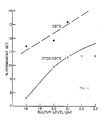
- Fig 1 there is shown a plot of %increase of 300% modulus against sulfur level (phr) using the same SBR/BR masterbatch with precisely similar amounts of each additive, but with OBTS in one case, and a combination of OTOS/OBTS in the other.
- phr sulfur level
- Fig 2 there is shown a plot of % permanent set against sulfur level (phr) using the same SBR compound with precisely similar amounts of each additive, but with OBTS in one case, and a combination of OTOS/OBTS in the other.
- phr sulfur level
- Fig 3 there is shown a plot of % retained tensile strength against sulfur level (phr) after 72 hr at 100°C, for a tread compound containing only natural rubber. It is evident that with BTS alone, the % retained tensile is much higher than with the combination of TCS/BTS used in the claimed invention. AT 2.0 phr sulfur, the NR vulcanizate has lost more than half its tensile, which is the reason for using very low amounts of sulfur in prior art compositions containing sulfenamides.
- Figure 4 is a plot of the number of sulfur atoms per polysulfide crosslink, multiplied by the percent polysulfide crosslinks, against sulfur (phr) level. It is seen that the value of 240 sulfurs at 1.8 phr sulfur in the vulcanizate containing only OBTS, is obtained at 2.2 phr sulfur when the OTOS/OBTS mixture is used.
- a synthetic rubber tread compound is prepared with the following ingredients to yield a masterbatch which is used for each example except for the sulfenamide accelerators which are varied as shown: 55 arts oil extended SBR commercially available as Ameripol® 1712 (40 parts SBR, 15 parts oil), 25 parts Ameripol® 1500 SBR, 35 parts Taktene® 1203 cis-polybutadiene, 3 phr zinc oxide, 2 phr stearic acid, 70 phr HAF carbon black, 20 phr Sundex processing oil, 2 phr Antozite® 67 and 2 phr Agerite® Resin D.
- the ingredients are mixed in a Banbury and portions are further mixed on a two-roll mill when the sulfur and accelerators are added.
- the stress-strain tests are conducted to determine modulus in accordance to standard ASTM procedures.
- Flex cracking can be a major cause of failure of vulcanized rubber articles subjected to flex.
- good flex resistance is essential to avoid failure due to groove-cracking. It is well known that groove-cracking involves two distinct steps: crack initiation, followed by crack growth. Vulcanizates of SBR normally resist crack initiation better than those of NR, but once a crack is initiated, in propagates faster in SBR. Crack growth tests are commonly used to evaluate the resistance to groove-cracking of tire treads. The DeMattia method is described in ASTM D813.
- Tear strength relates to the serviceability of the tread samples and is expressed as the pull in kiloNewtons per meter. Desired high tear strengths are obtained by increasing the sulfur levels regardless of which sulfenamide accelerators are used. Hence the goal of increasing the use of sulfur in the tread composition. Clearly the tear strengths of the samples 5-8 is at least as good as, or better than those of samples 1-3, and of sample 4 with only 1.8 phr sulfur.
- Tread design is an important factor in the good performance of tires with reference to traction, both wet and dry, braking, handling, cornering, and skid resistance, to maintain the good performance due to desirable such characteristics, it is vital to maintain the integrity of the tread.
- Under load a tire's tread is deformed, and not all the deformation is recovered after the load is removed, resulting in a permanent set caused by tread-smashing, and a loss of performance.
- the permanent set increases as the sulfur level increases as is seen in samples 1-3; while there is permanent set in samples 4-8, it is less than those of samples 1-3, and the values for samples 5-8 is unchanged despite the increase of sulfur.
Landscapes
- Chemical & Material Sciences (AREA)
- Health & Medical Sciences (AREA)
- Chemical Kinetics & Catalysis (AREA)
- Medicinal Chemistry (AREA)
- Polymers & Plastics (AREA)
- Organic Chemistry (AREA)
- Engineering & Computer Science (AREA)
- Mechanical Engineering (AREA)
- Compositions Of Macromolecular Compounds (AREA)
- Tires In General (AREA)
Applications Claiming Priority (2)
| Application Number | Priority Date | Filing Date | Title |
|---|---|---|---|
| US85485886A | 1986-04-22 | 1986-04-22 | |
| US854858 | 1986-04-22 |
Publications (1)
| Publication Number | Publication Date |
|---|---|
| EP0242432A1 true EP0242432A1 (fr) | 1987-10-28 |
Family
ID=25319708
Family Applications (1)
| Application Number | Title | Priority Date | Filing Date |
|---|---|---|---|
| EP86113732A Withdrawn EP0242432A1 (fr) | 1986-04-22 | 1986-10-03 | Composition à base de caoutchouc pour bande de roulement |
Country Status (2)
| Country | Link |
|---|---|
| EP (1) | EP0242432A1 (fr) |
| KR (1) | KR870010118A (fr) |
Cited By (4)
| Publication number | Priority date | Publication date | Assignee | Title |
|---|---|---|---|---|
| EP0591632A3 (en) * | 1992-10-08 | 1994-06-15 | Goodrich Co B F | Method of curing rubbers without forming nitrosamines |
| EP0662396A1 (fr) * | 1993-12-13 | 1995-07-12 | The Goodyear Tire & Rubber Company | Bandage pneumatique radial pour camions de taille moyenne ayant une bande de roulement composée d'au moins deux sortes de caoutchouc |
| AU756033B2 (en) * | 1998-12-16 | 2003-01-02 | Soler Y Palau, S.A. | Improvements to ultracompact air extractors for bathrooms |
| EP2233521A4 (fr) * | 2007-12-27 | 2012-01-25 | Bridgestone Corp | Composition de caoutchouc |
Citations (1)
| Publication number | Priority date | Publication date | Assignee | Title |
|---|---|---|---|---|
| US4119588A (en) * | 1976-09-14 | 1978-10-10 | The B. F. Goodrich Company | Reversion resistant rubber compositions with thio carbamyl sulfenamides |
-
1986
- 1986-10-03 EP EP86113732A patent/EP0242432A1/fr not_active Withdrawn
- 1986-10-10 KR KR1019860008492A patent/KR870010118A/ko not_active Ceased
Patent Citations (1)
| Publication number | Priority date | Publication date | Assignee | Title |
|---|---|---|---|---|
| US4119588A (en) * | 1976-09-14 | 1978-10-10 | The B. F. Goodrich Company | Reversion resistant rubber compositions with thio carbamyl sulfenamides |
Non-Patent Citations (2)
| Title |
|---|
| RUBBER CHEMISTRY AND TECHNOLOGY, vol. 50, no. 4, September/October 1977, pages 671-677, Rubber Division of the American Chemical Society, Inc.; J.F. Krymowski et al.: "Chemical reactions between thiocarbamylsulfenamides and benzothiazylsulfenamides leading to cure synergism" * |
| RUBBER CHEMISTRY AND TECHNOLOGY, vol. 59, no. 2, May/June 1986, pages 274-284, Rubber Division of the American Chemical Society, Inc.; R.W. LAYER: "Curing SBR with thiocarbamyl sulfenamide accelerators" * |
Cited By (6)
| Publication number | Priority date | Publication date | Assignee | Title |
|---|---|---|---|---|
| EP0591632A3 (en) * | 1992-10-08 | 1994-06-15 | Goodrich Co B F | Method of curing rubbers without forming nitrosamines |
| US5554699A (en) * | 1992-10-08 | 1996-09-10 | The B. F. Goodrich Company | Method of curing rubbers without forming nitrosamines |
| EP0662396A1 (fr) * | 1993-12-13 | 1995-07-12 | The Goodyear Tire & Rubber Company | Bandage pneumatique radial pour camions de taille moyenne ayant une bande de roulement composée d'au moins deux sortes de caoutchouc |
| AU756033B2 (en) * | 1998-12-16 | 2003-01-02 | Soler Y Palau, S.A. | Improvements to ultracompact air extractors for bathrooms |
| EP2233521A4 (fr) * | 2007-12-27 | 2012-01-25 | Bridgestone Corp | Composition de caoutchouc |
| US8609252B2 (en) | 2007-12-27 | 2013-12-17 | Bridgestone Corporation | Rubber composition |
Also Published As
| Publication number | Publication date |
|---|---|
| KR870010118A (ko) | 1987-11-30 |
Similar Documents
| Publication | Publication Date | Title |
|---|---|---|
| US8962746B2 (en) | Methods of making blocked-mercapto alkoxy-modified silsesquioxane compounds | |
| US4118367A (en) | Reinforced rubber | |
| JP2978249B2 (ja) | タイヤ・トレッド組成物 | |
| KR20050016204A (ko) | 카본 블랙 | |
| KR910006765B1 (ko) | 개량된 가공조제를 내포하고 있는 트레드 조성물을 갖는 타이어 | |
| US9074073B2 (en) | Rubber composition containing silica reinforcement and functionalized crosslinks and products with component thereof | |
| EP0723991A1 (fr) | Compositions de caoutchouc renforcé de silice et son utilisation dans des pneus | |
| US4119588A (en) | Reversion resistant rubber compositions with thio carbamyl sulfenamides | |
| US5023292A (en) | Tire compounds | |
| US4012332A (en) | Rubber vulcanization accelerator composition | |
| EP0242432A1 (fr) | Composition à base de caoutchouc pour bande de roulement | |
| JP2000154203A (ja) | ゴム組成物及びそれを用いた空気入りタイヤ | |
| US5328953A (en) | Rubber compositions with alkoxyalkanoic acid having improved processability vulcanisate properties | |
| US4791173A (en) | Tire tread rubber compositions | |
| US7205348B2 (en) | Rubber composition and method of making same | |
| BRPI1003622A2 (pt) | preparaÇço de composiÇço de borracha com alto teor de sÍlica, composiÇço de borracha resultante e pneu tendo o componente da mesma | |
| US7572850B2 (en) | Rubber composition and tire comprising same | |
| CA1265885A (fr) | Composition de caoutchouc pour semelles de pneus | |
| AU2004321922A1 (en) | Rubber composition and tire comprising same | |
| US20020040080A1 (en) | Pyrimidine derivatives as hardness stabilizers | |
| EP0320431A2 (fr) | Activateurs de vulcanisation pour caoutchoucs non halogénés | |
| US5777012A (en) | Polysulfides of n-methylpyrrolidinone | |
| EP0514876A1 (fr) | Composition de caoutchouc utilisable dans des pneus de voiture et sa préparation | |
| EP0643099B1 (fr) | Procédé de fabrication de compositions de caoutchouc vulcanisables | |
| Surya et al. | The effect of aptes-silane on tensile and ageing properties of the compound of natural rubber-silica |
Legal Events
| Date | Code | Title | Description |
|---|---|---|---|
| PUAI | Public reference made under article 153(3) epc to a published international application that has entered the european phase |
Free format text: ORIGINAL CODE: 0009012 |
|
| AK | Designated contracting states |
Kind code of ref document: A1 Designated state(s): AT BE CH DE ES FR GB GR IT LI LU NL SE |
|
| 17P | Request for examination filed |
Effective date: 19880406 |
|
| 17Q | First examination report despatched |
Effective date: 19881010 |
|
| 18W | Application withdrawn |
Withdrawal date: 19890602 |
|
| STAA | Information on the status of an ep patent application or granted ep patent |
Free format text: STATUS: THE APPLICATION HAS BEEN WITHDRAWN |
|
| R18W | Application withdrawn (corrected) |
Effective date: 19890602 |
|
| RIN1 | Information on inventor provided before grant (corrected) |
Inventor name: LAYER, ROBERT WESLEY |