EP0242743A1 - Spracherkennungssystem - Google Patents
Spracherkennungssystem Download PDFInfo
- Publication number
- EP0242743A1 EP0242743A1 EP87105363A EP87105363A EP0242743A1 EP 0242743 A1 EP0242743 A1 EP 0242743A1 EP 87105363 A EP87105363 A EP 87105363A EP 87105363 A EP87105363 A EP 87105363A EP 0242743 A1 EP0242743 A1 EP 0242743A1
- Authority
- EP
- European Patent Office
- Prior art keywords
- sentence
- word
- hypothesis
- partial
- error
- Prior art date
- Legal status (The legal status is an assumption and is not a legal conclusion. Google has not performed a legal analysis and makes no representation as to the accuracy of the status listed.)
- Granted
Links
- 238000000034 method Methods 0.000 claims abstract description 39
- 238000004364 calculation method Methods 0.000 claims abstract description 11
- 230000000717 retained effect Effects 0.000 claims description 2
- 239000002243 precursor Substances 0.000 description 14
- 230000007704 transition Effects 0.000 description 10
- 238000010586 diagram Methods 0.000 description 9
- 239000012634 fragment Substances 0.000 description 9
- 230000006870 function Effects 0.000 description 9
- 230000008859 change Effects 0.000 description 5
- 238000013459 approach Methods 0.000 description 3
- 238000012545 processing Methods 0.000 description 3
- 230000008878 coupling Effects 0.000 description 2
- 238000010168 coupling process Methods 0.000 description 2
- 238000005859 coupling reaction Methods 0.000 description 2
- 238000005516 engineering process Methods 0.000 description 2
- 238000003780 insertion Methods 0.000 description 2
- 230000037431 insertion Effects 0.000 description 2
- 230000004048 modification Effects 0.000 description 2
- 238000012986 modification Methods 0.000 description 2
- 230000004075 alteration Effects 0.000 description 1
- 230000001419 dependent effect Effects 0.000 description 1
- 238000002592 echocardiography Methods 0.000 description 1
- 230000000694 effects Effects 0.000 description 1
- 238000005259 measurement Methods 0.000 description 1
- 238000005457 optimization Methods 0.000 description 1
- 230000001151 other effect Effects 0.000 description 1
- 238000011084 recovery Methods 0.000 description 1
- 238000000926 separation method Methods 0.000 description 1
- 230000001131 transforming effect Effects 0.000 description 1
- 230000000007 visual effect Effects 0.000 description 1
Images


Classifications
-
- G—PHYSICS
- G10—MUSICAL INSTRUMENTS; ACOUSTICS
- G10L—SPEECH ANALYSIS TECHNIQUES OR SPEECH SYNTHESIS; SPEECH RECOGNITION; SPEECH OR VOICE PROCESSING TECHNIQUES; SPEECH OR AUDIO CODING OR DECODING
- G10L15/00—Speech recognition
- G10L15/08—Speech classification or search
- G10L15/18—Speech classification or search using natural language modelling
- G10L15/183—Speech classification or search using natural language modelling using context dependencies, e.g. language models
- G10L15/19—Grammatical context, e.g. disambiguation of the recognition hypotheses based on word sequence rules
- G10L15/193—Formal grammars, e.g. finite state automata, context free grammars or word networks
Definitions
- the present invention relates to machine recognition of speech.
- CWR Continuous Word Recognition
- a word hypothesizer and sentence recognizer are provided which are loosely coupled.
- the word hypothesizer constantly generates word hypotheses based on an incoming speech signal.
- the sentence recognizer assembles the hypotheses into allowable partial and complete sentences.
- the output of the word hypothesizer is not restricted by feedback from the sentence recognizer. Techniques including the measurement of the time gaps and time overlaps between words can result in the inclusion of additional selection criteria.
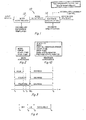
- FIG 1 shows a block diagram of a speech recognition system 10 according to the present invention.
- a word hypothesizer 12 accepts incoming speech signals, compares them to reference templates in its vocabulary, and generates word hypotheses.
- the input speech signals are preferably digitized signals, and the word hypothesizer 12 operates by dividing a sequence of speech samples into frames, extracting linear predictive coding (LPC) parameters, transforming the LPC parameters to a set of uncorrellated features, the Principal Feature Vector (PFV), and comparing them with the PFV parameters stored in vocabulary reference templates.
- LPC linear predictive coding
- PFV Principal Feature Vector
- Word hypothesizers generally are known in the art, and examples of hypothesizers which may be used with the present invention are described in a U.S. Patent Application Number 461,884.
- each word hypothesis is shown in Figure 2.
- This information consists of the hypothesized WORD, an ERROR value, and START and STOP TIMES for the word.
- the value ERROR indicates the confidence which the hypothesizer 12 places in its guess, and is determined by an appropriate metric indicating the "distance" between the template of the hypothesized word and the parameters of the actual word. A relatively large value for ERROR indicates a greater likelihood that the hypothesis is incorrect, while a relatively smaller value for ERROR indicates an increased likelihood that the word was correctly recognized.
- START-TIME and STOP-TIME are the actual start and stop times of the input speech vocalizations which generated the word hypothesis.
- the length of the actual utterance is given by (STOP-TIME) - (START-TIME).
- the word hypotheses are sent to the sentence recognizer 14, which attempts to construct sentences out of them.
- a grammar specification is used to assist the recognizer 14 in assembling the hypotheses into sentences.
- the grammar is preferably a finite-state grammar, and restricts those sentences which are recognized as valid by the system 10. Once the sentence recognizer 14 successfully recognizes a sentence, the recognized sentence is output from the speech recognition system 10.
- the word hypothesizer 12 and the sentence recognizer 14 are preferably not closely coupled. In other words, there is no direct feedback between the sentence recognizer 14 and the word hypothesizer 12.
- the word hypothesizer 12 constantly generates all hypotheses which match its reference templates. This is a departure from prior art systems that use a sentence recognizer which controls the word hypothesizer, constraining it to hypothesize only words which are considered to be valid next words by the recognizer.
- the present approach causes the hypothesizer 12 to generate a greater number of possible words, and increases the complexity of the sentence recognizer 14. In return, the system has a greater flexibility and the ability to "change its mind" about its current location in the grammar.
- word and “sentence” are not restricted to their common meanings.
- a word is some basic unit of speech utterance, and a sentence is some structure made up of such basic units.
- a "word” could be a phoneme, and a "sentence”, which is a structure made up of such phonemes, could correspond to English words.
- the basic unit of utterance could be a phrase, so that a "word” would actually consist of three or four English words, and a "sentence” would be a structure comprised of these phrases.
- words and “sentences” uses the terms "words” and “sentences” to mean English words and English sentences as constrained by a selected grammar, it will be understood that the present invention is not so limited.
- the recognition thresholds of word hypothesizer 12 are preferably set to a level where many hypotheses are generated. That is, the constraints for determining whether a valid hypothesis has been made are loosened, or broadened. This means that the hypothesizer 12 will often generate multiple hypotheses for a single utterance.
- FIG 3. This illustrates several hypotheses that may be generated by the utterance "FOURTEEN DEGREES”. Assuming the hypothesizer's vocabulary includes the words “FOUR”, “FORTY” and “FOURTEEN”, it is likely that the hypothesizer 12 will generate all three of these words as valid hypotheses during the utterance of the word "FOURTEEN”. If the speech system is being used to input information to a navigational system, for example, it is important that the sentence recognizer 14 be able to discriminate between the phrases "FOUR DEGREES”, FORTY DEGREES" and "FOURTEEN DEGREES”.
- the sentence recognizer 14 of the present invention makes this discrimination by introducing error terms for overlap of or gaps between words, in addition to those error terms which indicate confidence in recognition of the words themselves.
- the magnitude of the gap and overlap error terms increases with the degree of the misfit between consecutive word.
- the hypothesis "FOUR DEGREES” has a gap of duration t s -t 2 .
- "FORTY DEGREES” has a gap duration of t. -t 3 .
- the sentence recognizer 14 calculates these gap durations, and the corresponding gap errors, by making use of the start time and stop time information transmitted from the word hypothesizer 12 as part of the word hypothesis.
- Figure 4 illustrates the related problem of overlap. It is assumed that the word hypothesizer 12 recognizes the words “SEVEN”, “AVAILABLE” and UNAVAIL ABLE”. It also assumed that the grammar allows the sentence fragments "SEVEN AVAILABLE” and "SEVEN UNAVAILABLE”.
- the word hypothesizer 12 can be expected to generate the hypothesis “SEVEN” at time t 3 , and the hypotheses “AVAILABLE” and “UNAVAILABLE” at time t.. Both of these latter hypotheses may have approximately the same word error.
- the sentence recognizer 14 determines the correct utterance by detecting and preferring the lack of overlap between the word "SEVEN” and “AVAILABLE”, whereas the hypotheses "SEVEN UNAVAILABLE" give an overlap having duration t3 -t 2 -
- the error function for a sentence hypothesis, or a partial hypothesis up to a given point is:
- the functions EG and EO can be linear. That is, the gap and overlap errors increase linearly with increasing gap and overlap durations.
- Figure 5 shows a graph of preferred functions for overlap and gap error calculations. When the amount of overlap is zero, no additional error term is introduced. When the amount of overlap is positive, an overlap has occurred, and when the amount of overlap is negative a gap between word hypotheses has occurred.
- Curve 30 on the right side of Figure 5 shows the desired error function for overlap.
- the overlap error is small.
- the overlap error rises rapidly.
- This type of function takes into account co-articulation affects that often occur between words. That is, if approximately the same sound ends one word and begins a following word, that sound is usually uttered as only a single sound.
- the time t a will of course depend upon the particularities of an implementation, but is preferably on the order of one-half phoneme in length, being approximately 60 milliseconds.
- the overlap penalty should be fairly high. Of course, all of these numbers may be modified greatly depending upon circumstances such as talking speed of the speaker.
- Gap errors are preferably divided into two classes as shown on the left hand side of Figure 5.
- the sentence recognizer determines that nothing is being spoken and applies a low error value as shown by the lower curve 32. This low error value can be zero if desired. If, however, a gap error occurs between two hypotheses while speech energy is being received, a relatively high error value is assigned to the gap error as shown by the upper curve 34.
- Gap and overlap error calculations can be used at the beginning and end of sentences. Any delay between the beginning of the sentence and the start of a hypothesized first word is counted as gap error, as is delay between a hypothesized last word and the end of the sentence. Precise location of the sentence beginning and end points is not necessary. It will be appreciated that all hypotheses will show gap error when the sentence beginning is before the beginning of the earliest hypothesized word. In fact, these gap errors will cancel out when comparing sentence errors. Therefore, it is only necessary that the beginning of the sentence (t i ) be no later than the start of the earliest hypothesized word (t i ). Sentence hypotheses having a first word which begins later than this will be penalized with a gap error.
- the sentence recognizer 14 uses some type of grammar in order to restrict the choice of sentences which can be identified.
- this grammar is preferably a finite state grammar, which has a finite number of nodes, or states.
- Figure 6 shows a graph of a very finite-state grammar. This grammar would be useful for using spoken instructions to place telephone calls. As shown in Figure 6, the grammar can be used to call an outside number, which requires that a 7-digit number be used, or an internal number which requires only the use of a 4-digit extension. The utterances which cause each transition are shown next to the transitional paths on the diagram. The transitions marked with "d” are shown in more detail in Figure 7, which indicates that any digit may be used. The transition d,, found between state pairs 8, 10 and 9, 10 is more restricted in that the first digit of an exchange cannot begin with 0 or 1.
- the allowed sentences shown in Table I are easily seen to be generated by tracing the connecting arrows on the directed graph of Figure 6.
- the grammar can be considered to be a finite-state machine, with each of the possible states represented by a numbered node. All possible sentences allowed by the grammar can be generated by tracing all possible paths through the directed graph.
- the allowed sentence "CALL EXTENSION dddd” causes the grammar to pass through states 0 (start), 2, 4, 5, 6 and 7.
- Node 7 has a square around it to indicate that it is a terminal node. That is, when the sentence recognizer 14 reaches node 7, it hypothesizes that a complete sentence has been uttered, and proceeds accordingly.
- the grammar of the sentence recognizer 14, as represented by the graph of Figure 6, can be used in different ways to assist in the recognition of an utterance.
- the simplest way is for the sentence recognizer 14 to control the vocabulary referenced by the word hypothesizer 12, so that, from a given node, only words which fall within the set of allowed next words from that node may be hypothesized by the word hypothesizer 12.
- the sentence recognizer 14 determines that it was currently at node 2
- the word hypothesizer 12 would be constrained by the VOCABULARY CONTROL signal of Figure 2 to recognize only the words 'OUTSIDE", "EXTENSION", or a digit.
- the sentence recognizer 14 is used as a predictor, and is tightly coupled with the word hypothesizer 12 to attempt to improve the performance of the system.
- the preferred embodiment employs a dynamic programming (DP) technique which allows multiple hypotheses to be considered in parallel. Rather than being constrained to a single path through the grammar, the DP technique allows the sentence recognizer to choose the best path given all of the information concerning the various words.
- DP dynamic programming
- This technique utilizes the gap and overlap error technique described previously. It optimizes a given path error at the sentence or partial sentence level rather than at the local optimization level employed by earlier tightly-coupled systems.
- the sentence recognizer 14 receives a word hypotheses from the word hypothesizer 12 and determines all of the nodes in the graph to which that word could apply. For example, in Figure 6, if a digit is uttered the sentence recognizer 14 will try to make that digit correspond with all of nodes 4, 5, 6, 7, 11 and 12. If the uttered digit is in the range 2 - 9, the sentence recognizer 14 will attempt to associate it with node 10 as well.
- the sentence recognizer 14 For each node for which a current hypothesis is valid, the sentence recognizer 14 uses DP with backward pointers to determine all possible sentence fragments for which the current hypothesis would be the latest word. When the current hypothesis is tested on a particular node, that node must have a valid sentence fragment leading to a preceding node in order to create a new valid sentence fragment. For example, when the first digit is hypothesized, the recognizer 14 will try to match that digit with the nodes described above. If a digit is the first utterance of a sentence, the grammar will be in state 0, and the hypothesis of a digit will be rejected as invalid. That is, of the nodes to which a digit can be a valid transition, none of them have a previous state of node 0.
- the DP technique generates a number of hypothesized partial sentences, all of which are considered in parallel.
- a sentence hypothesis reaches node 7
- a complete sentence is hypothesized.
- at least one valid complete sentence has been hypothesized, and a total sentence error is calculated as set forth in equation (1). If the sentence error is too large, due to large errors in words or gap and overlap errors, the sentence hypothesis is rejected. If the sentence error falls below some predetermined threshold, the sentence hypothesis is retained.
- a valid sentence hypothesis is accepted as the uttered sentence only if the speaker stops speaking or no better partial sentence hypothesis is generated within a short time.
- the sentence hypothesis can be accepted, as it is assumed that the speaker has finished a sentence in the grammar. If additional utterances are made, and they result in a partial or complete sentence hypothesis having a lower error than the current sentence hypothesis, the sentence recognizer 14 will reject the older sentence hypothesis in favor of the later. If the additional utterances do not generate a partial or complete sentence hypothesis having a lower error than the current sentence hypothesis, such hypothesis will be accepted. It is not necessary for speech to cease before generating a recognized sentence: such generation is determined by the grammar.
- the utterance "CALL dddd (silence)" will cause the sentence recognizer 14 to recognize a complete sentence.
- the word hypothesizer 12 generates no "bad" hypotheses.
- the hypothesizer 12 will generate hypothesis which may not be very good, and the purpose of using the overall sentence error calculation, as well as the various gap and overlap error calculations, is to cause the correct utterance to be recognized in preferance to the incorrect ones by a simple comparison of sentence error values.
- the sentence recognizer 14 When the second digit is received, it may be applied to node 5 because node 4 was associated with a valid partial sentence as a result of the first digit. Also, the second digit may be hypothesized to apply to node 4. Thus, the sentence recognizer 14 now retains the partial sentence hypotheses "CALL”, “CALL first-digit”, “CALL first-digit second-digit”, and "CALL second-digit". If a sentence recognizer were to stop at this point, the fragment "CALL first-digit second-digit" should be preferred because it best explains the received speech data. That is, assuming the word errors for each word to be of approximately the same degree, the longer sentence hypothesis minimizes gap errors.
- Table II shows the actions of the sentence recognizer 14 when recognizing the sentence "PLACE CALL OUTSIDE NUMBER 543 6789(silence)". For purposes of illustration, it is again assumed that the word hypothesizer 12 does not generate any false hypotheses.
- Table II shows which nodes of the graph of Figure 6 become associated with it, and shows all back pointers to previously valid nodes. No back pointers are created to nodes which have not yet been associated with any valid partial sentence. Thus, no back pointer is created from node 4 to node 12 until after node 12 has been associated with a hypothesis. This occurs only after the utterance "6" is received.
- node “4a” has the number “5" associated with it, while node “4b” is associated with the utterance "4".
- a partial or complete sentence hypothesis is defined by backtracking pointers from the current word hypothesis to the start node. For example, according to Table II, the sentence hypothesis "PLACE CALL OUTSIDE NUBMER 543 6789” follows backpointers from node 7 to node 0 in the order 7d, 6d, 5d, 4d, 12a, 11a, 10a, 9, 8, 2, 1, 0. The partial sentence hypothesis "PLACE CALL 543” follows backpointers through nodes 6a, 5a, 4a, 2, 1, 0.
- hypotheses assigned to a single precursor node For example, when "7" is assigned to node 5d, possible precursor nodes are 4a, 4b, 4c and 4d. These four potential precursors must be examined, and the best selected. In our example, the partial sentence hypothesis 4d, when combined with 5d, yields the best next partial sentence hypothesis. Depending on the weighting factors given to gap and overlap errors, and the actual word errors, some of the precursor nodes may be selected differently than shown in Table II.
- the sentence recognizer 14 creates a new data object each time a word hypothesis is associated with a node and a specific precursor node. Such a data object is shown in Figure 10, and acts as a sentence hypothesis for a partial or complete sentence ending in that node. All hypotheses for a given node are formed into a linked list with the SAME-STATE-POINTERs, and nodes are lined to a previous node, using the PREVIOUS-STATE-POINTER.
- Equations (2) and (3) implement a DP algorithm. Tracing back through the selected nodes gives the sentence having the lowest error. Note that equations (2) and (3) are simply a recursive implementation of equation (1).
- the simplest would be to simply eliminate all partial sentence hypotheses which have a total error greater than a predetermined threshold. This would tend to eliminate partial hypotheses having extremely large gap errors.
- the partial hypotheses "CALL 8" is considered valid. In actuality, due to the tremendously large gap errors between "CALL" and "8", such a sentence is unlikely to result in a preferred complete sentence hypothesis. Therefore, the sentence analyzer 14 can reject such partial hypotheses immediately, rather than retain it for later computation steps.
- a more restrictive method would be to retain only a single sentence hypothesis for each word hypothesis.
- only the best hypothesis would be assigned to a node, and multiple assignments to a node (eg. 4a, 4b, 4c...) would be eliminated.
- Such a scheme is somewhat restrictive, and makes a recovery from error more difficult.
- the sentence recognizer 14 should recognize the actually uttered sentence as its best hypothesis. This hypothesis best accounts for all of the speech data received, minimizing gap and overlap errors between recognized words. All other hypotheses introduce gap errors, which give a total sentence error value which is larger than the correct one.
- Figure 8 shows the insertion of a transition state in a grammar whenever the digits 3 and 8 can form a valid utterance according to the grammar.
- the transitional utterance is shown in Figure 8 as "3:8", so that speakers which include such a transition will cause the grammar to change states from A to B to D to C instead of directly from A to B to C.
- Consideration of these types of transitional effects can greatly improve the recognition capability of the system, and is especially useful in speaker independent recognition systems in which the speaking habits of different users may vary.
- Figure 9 illustrates additional desirable features of an actual implementation.
- a system it would be desirable for a system to include "meta-commands". These commands are defined to be those which are a valid transition from every state. Examples of such commands would be "ABORT” and "CANCEL".
- the ABORT command can be used to reset the recognizer to a start state in the overall grammar regardless of its current position.
- the CANCEL command can be used to back up to the beginning of the current grammar in a bank-switched grammar as described below.
- These type of commands are especially useful where the recognizer system echoes the current best partial sentence hypothesis to a visual device such as a computer display screen. The user can observe the actions of the recognizer on the screen, and ABORT or otherwise change his input command as desired.
- every state is a valid precursor state for the meta-commands M1
- every state within a grammar is a valid precursor for the appropriate meta-command M2, M3 or M4.
- Figure 9 also illustrates another extremely useful feature for systems which have limited computing power. This involves the use of bank-switching of grammars and vocabulary.
- Figure 9 shows parts of three grammars, G1, G2 and G3, which form part of a larger, more complex grammar.
- G1 When a terminal node 50, 52 is reached in grammar G1, this indicates to the system that the data for grammars G2 or G3 should be loaded into the system, whichever is appropriate.
- a transition to the appropriate initial state 54, 56 of the new grammar G2 or G3 is then made automatically. The processor can then continue processing in the new grammar.
- the transition to a new grammar or vocabulary is made whenever a terminal node is reached in a previous grammar. It is not necessary that the switching take place at the end of an English sentence, or where there is a pause in speech. Since the grammar can detect the end of a sentence as defined in that grammar while speech continues, the terminal nodes of the subgrammars G1, G2 and G3 can be located as desired, without reference to silences which may occur in the INPUT SPEECH.
- the new grammar may also have a new vocabulary associated with it. If the vocabulary of the recognition system is limited due to limited processing or memory capacity, it may be necessary or desirable to switch in a new bank of vocabulary templates when a new grammar is loaded in. It is not necessary that the grammar and vocabularies be bank-switched at the same time, although such a break along common lines would tend to occur in many cases.
- the meta-command ABORT should remain valid for all combinations of vocabulary and grammar.
- the meta-command CANCEL which resets to the start of the current grammar, differs slightly for each grammar.
- the meta-commands M2, M3 and M4 reset grammars G1, G2 and G3 respectively. If the CANCEL command is implemented in a system, it should be valid for all combinations of vocabulary and grammar.
- bank-switching the vocabulary and grammar implies feedback between the sentence recognizer 14 and the word hypothesizer 12. That is, the word hypothesizer 12 is constrained by the selection of a vocabulary by the sentence recognizer to hypothesize only certain words. Thus, in bank-switched systems, the decoupling of the word hypothesizer 12 and the sentence recognizer 14 is not complete. However, the coupling is much less than occurs in typical tightly-coupled systems. Free selection of hypotheses within the current vocabulary is still allowed by the bank-switched system. Within the scope of operation of any given vocabulary/grammar combination, the decoupling between the word hypothesizer 12 and the sentence recognizer 14 is complete. That coupling which occurs does so only because of, and to the degree determined by, the limited resources of the system 10.
- the system have a buffer which is used for the digitized INPUT SPEECH data. This buffer can continue to collect data while the vocabulary or grammar bank-switching operations are accomplished, and processing can then continue from the point where it left off. This allows a small system to make use of large and complex vocabularies and grammars, without missing any of the incoming speech.
- the speech recognition system described above makes a robust, low-cost system.
- the use of a decoupled word hypothesizer and sentence recognizer allow much greater flexibility in system operation, and a greater chance to recover from erroneous word hypotheses.
- the use of gap and overlap errors improves system performance by making the sentence recognizer more tolerant of erroneous hypotheses, since these can be placed in context both as relates to the grammar, and as relates to time.
- Bank switching of vocabularies and grammars allows a relatively simple system to perform complex tasks, and the implementation of meta-commands allows a user to easily recover from any system errors that do arise.
- the system is easily implemented using available technology.
- the word hypothesizer 12 and sentence recognizer 14, along with associated memory and controllers, can be implemented on a single board for use with a personal computer.
- TMS320 signal processors can be used for the word hypothesizer 12 and sentence recognizer 14-
- the recognition procedure described above is easily implemented in machine language, FORTRAN, or as otherwise desired, in accordance with known principles.
- GRAMREC2C This is a modified version of GRAMREC2C which deletes the use of-a maximum allowable separation time between adjacent words in a legitimate sentence hypothesis. This requirement was used originally to improve recognition and to reduce the number of sentence hypotheses created. However, the previous modification (GRAMREC2C), which eliminates consideration of poor precursor sub-sentences, more effectively reduces the number of sub-sentence hypotheses. Also, it is discovered that in operational usage long pauses between words are often used to allow the user to compose high thoughts.
- a second change in GRAMREC2D is based upon the ability to reclaim sub-sentence hypothesis storage for old sub-sentences that are excluded from consideration because the sub-sentence error is greater than threshold. This is achieved by reusing high-error unproductive sub-sentences. This is somewhat different from GRAMREC2C in the sense that GRAMREC2C restricts insertion of new hypotheses, while GRAMREC2D restricts consideration of old SS hypotheses.
- GRAMREC2 This is a modified version of GRAMREC2, which returns the best sub-sentence (including complete sentences if the best sentence has the lowest error) which terminates on the input word, rather than returning only complete sentences.
- An additional variable is passed to GRAMREC-MATCH, which provides for logical output to indicate when the output word string is a complete sentence.
- This subroutine is upward compatible with GRAMREC2 in the sense that the additional logical variable is optional, and if it is not included then the subroutine functions as defined before in GRAMREC2.
- GRAMREC1 This is a more efficient version of GRAMREC1. It achieves its efficiency by organizing the search for connecting sub-sentences according to precursor node and using a pointer array which points to the next previous occurance of the selected precursor node.
Landscapes
- Engineering & Computer Science (AREA)
- Artificial Intelligence (AREA)
- Computational Linguistics (AREA)
- Health & Medical Sciences (AREA)
- Audiology, Speech & Language Pathology (AREA)
- Human Computer Interaction (AREA)
- Physics & Mathematics (AREA)
- Acoustics & Sound (AREA)
- Multimedia (AREA)
- Machine Translation (AREA)
- Character Discrimination (AREA)
Applications Claiming Priority (2)
| Application Number | Priority Date | Filing Date | Title |
|---|---|---|---|
| US85653486A | 1986-04-25 | 1986-04-25 | |
| US856534 | 1986-04-25 |
Publications (2)
| Publication Number | Publication Date |
|---|---|
| EP0242743A1 true EP0242743A1 (de) | 1987-10-28 |
| EP0242743B1 EP0242743B1 (de) | 1993-08-04 |
Family
ID=25323876
Family Applications (1)
| Application Number | Title | Priority Date | Filing Date |
|---|---|---|---|
| EP19870105363 Expired - Lifetime EP0242743B1 (de) | 1986-04-25 | 1987-04-10 | Spracherkennungssystem |
Country Status (3)
| Country | Link |
|---|---|
| EP (1) | EP0242743B1 (de) |
| JP (1) | JP3124277B2 (de) |
| DE (1) | DE3786822T2 (de) |
Cited By (12)
| Publication number | Priority date | Publication date | Assignee | Title |
|---|---|---|---|---|
| WO1989003083A1 (fr) * | 1987-09-29 | 1989-04-06 | Siemens Aktiengesellschaft | Architecture de systemes pour systeme acoustique conversationnel homme/machine |
| GB2230370A (en) * | 1989-04-12 | 1990-10-17 | Smiths Industries Plc | Speech recognition |
| GB2240203A (en) * | 1990-01-18 | 1991-07-24 | Apple Computer | Automated speech recognition system |
| EP0506539A1 (de) * | 1991-03-25 | 1992-09-30 | Adir Et Compagnie | Heterozyklische Alkylamide, Verfahren zu ihrer Herstellung und diese enthaltende pharmazeutische Zubereitungen |
| EP0555545A1 (de) * | 1992-02-10 | 1993-08-18 | International Business Machines Corporation | Gerät zur Spracherkennung mit Vorhersage von Wortklassen aus dem Gesamttext und Wörtern von Wortklassen |
| EP0566884A3 (de) * | 1992-04-24 | 1995-06-28 | Ibm | Kontextabhängige Einrichtung zur Spracherkennung mit Verwendung des Kontextes des geschätzten nächsten Wortes. |
| EP0677835A3 (de) * | 1994-04-15 | 1996-04-17 | Philips Patentverwaltung | Verfahren zum Ermitteln einer Folge von Wörtern. |
| EP0614172A3 (en) * | 1993-03-03 | 1996-06-26 | Philips Patentverwaltung | Method and device for determining words in a speech signal. |
| EP0676743A3 (de) * | 1994-03-09 | 1996-07-10 | Philips Patentverwaltung | Verfahren und Anordnung zum Ermitteln einer Folge von Wörtern aus einem Sprachsignal. |
| DE4397100C2 (de) * | 1992-12-31 | 2003-02-27 | Apple Computer | Verfahren zum Erkennen von Sprachsignalen und Spracherkennungssystem mit rekursiver Grammatik mit endlicher Zustandsanzahl |
| US20140039895A1 (en) * | 2012-08-03 | 2014-02-06 | Veveo, Inc. | Method for using pauses detected in speech input to assist in interpreting the input during conversational interaction for information retrieval |
| CN112912954A (zh) * | 2018-10-31 | 2021-06-04 | 三星电子株式会社 | 电子装置及其控制方法 |
Families Citing this family (4)
| Publication number | Priority date | Publication date | Assignee | Title |
|---|---|---|---|---|
| DE19857070A1 (de) * | 1998-12-10 | 2000-06-15 | Michael Mende | Verfahren und Vorrichtung zur Ermittlung einer orthographischen Wiedergabe eines Textes |
| FR2790586B1 (fr) * | 1999-03-05 | 2001-05-18 | Auralog | Procede et dispositif de reconnaissance vocale |
| DE10229207B3 (de) * | 2002-06-28 | 2004-02-05 | T-Mobile Deutschland Gmbh | Verfahren zur natürlichen Spracherkennung auf Basis einer Generativen Transformations-/Phrasenstruktur-Grammatik |
| JP2010126266A (ja) * | 2008-11-25 | 2010-06-10 | Nikka Whisky Distilling Co Ltd | 樽搬出入作業システム |
Citations (1)
| Publication number | Priority date | Publication date | Assignee | Title |
|---|---|---|---|---|
| WO1984003983A1 (en) * | 1983-03-28 | 1984-10-11 | Exxon Research Engineering Co | Speech recognition methods and apparatus |
Family Cites Families (1)
| Publication number | Priority date | Publication date | Assignee | Title |
|---|---|---|---|---|
| JPS60122475A (ja) * | 1983-11-15 | 1985-06-29 | Nec Corp | パタン認識装置 |
-
1987
- 1987-04-10 DE DE19873786822 patent/DE3786822T2/de not_active Expired - Lifetime
- 1987-04-10 EP EP19870105363 patent/EP0242743B1/de not_active Expired - Lifetime
- 1987-04-24 JP JP62101691A patent/JP3124277B2/ja not_active Expired - Fee Related
Patent Citations (1)
| Publication number | Priority date | Publication date | Assignee | Title |
|---|---|---|---|---|
| WO1984003983A1 (en) * | 1983-03-28 | 1984-10-11 | Exxon Research Engineering Co | Speech recognition methods and apparatus |
Non-Patent Citations (6)
| Title |
|---|
| IEEE TRANSACTIONS ON ACOUSTICS, SPEECH AND SIGNAL PROCESSING, vol. ASSP-33, no. 3, June 1985, pages 561-573, IEEE, New York, US; L.R. RABINER et al.: "A speaker-independent, syntax-directed, connected word recognition system based on hidden Markov models and level building" * |
| PROCEEDINGS OF THE FOURTH INTERNATIONAL JOINT CONFERENCE ON PATTERN RECOGNITION, Kyoto, 7th-10th November 1978, pages 1009-1011; R. NAKATSU et al.: "Speech recognition of connected words" * |
| RADIO AND ELECTRONIC ENGINEER, vol. 53, no. 4, April 1983, pages 166-175, IERE Crown Copyright Reserved, London, GB; J.S. BRIDLE et al.: "Continuous connected word recognition using whole word templates" * |
| SYSTEMS-COMPUTERS-CONTROLS, vol. 12, no. 1, January/February 1981, pages 28-37, Scripta Publishing Co., Silver Spring, Maryland, US; J. MIWA et al.: "A method of spoken word recognition using nonlinear spectral matching" * |
| SYSTEMS-COMPUTERS-CONTROLS, vol. 15, no. 4, 1984, pages 80-88, Scripta Publishing Co.; S. HAYAMIZU et al.: "Experimental studies on the connected-words recognition using continuous dynamic programming" * |
| TECHNOLOGY AND SCIENCE OF INFORMATICS, vol. 1, no. 3, 1983, pages 189-203, North Oxford Academic Afcet Brodas, Oxford, GB; P. QUINTON: "Use of syntactic constraints for continuous speech recognition" * |
Cited By (19)
| Publication number | Priority date | Publication date | Assignee | Title |
|---|---|---|---|---|
| WO1989003083A1 (fr) * | 1987-09-29 | 1989-04-06 | Siemens Aktiengesellschaft | Architecture de systemes pour systeme acoustique conversationnel homme/machine |
| DE4010028C2 (de) * | 1989-04-12 | 2003-03-20 | Smiths Group Plc London | Spracherkennungsverfahren |
| GB2230370A (en) * | 1989-04-12 | 1990-10-17 | Smiths Industries Plc | Speech recognition |
| DE4010028A1 (de) * | 1989-04-12 | 1990-10-18 | Smiths Industries Plc | Spracherkennungsverfahren |
| GB2230370B (en) * | 1989-04-12 | 1993-05-12 | Smiths Industries Plc | Apparatus and methods for controlling equipment |
| GB2240203A (en) * | 1990-01-18 | 1991-07-24 | Apple Computer | Automated speech recognition system |
| EP0506539A1 (de) * | 1991-03-25 | 1992-09-30 | Adir Et Compagnie | Heterozyklische Alkylamide, Verfahren zu ihrer Herstellung und diese enthaltende pharmazeutische Zubereitungen |
| EP0555545A1 (de) * | 1992-02-10 | 1993-08-18 | International Business Machines Corporation | Gerät zur Spracherkennung mit Vorhersage von Wortklassen aus dem Gesamttext und Wörtern von Wortklassen |
| US5267345A (en) * | 1992-02-10 | 1993-11-30 | International Business Machines Corporation | Speech recognition apparatus which predicts word classes from context and words from word classes |
| EP0566884A3 (de) * | 1992-04-24 | 1995-06-28 | Ibm | Kontextabhängige Einrichtung zur Spracherkennung mit Verwendung des Kontextes des geschätzten nächsten Wortes. |
| DE4397100C2 (de) * | 1992-12-31 | 2003-02-27 | Apple Computer | Verfahren zum Erkennen von Sprachsignalen und Spracherkennungssystem mit rekursiver Grammatik mit endlicher Zustandsanzahl |
| EP0614172A3 (en) * | 1993-03-03 | 1996-06-26 | Philips Patentverwaltung | Method and device for determining words in a speech signal. |
| EP0676743A3 (de) * | 1994-03-09 | 1996-07-10 | Philips Patentverwaltung | Verfahren und Anordnung zum Ermitteln einer Folge von Wörtern aus einem Sprachsignal. |
| EP0677835A3 (de) * | 1994-04-15 | 1996-04-17 | Philips Patentverwaltung | Verfahren zum Ermitteln einer Folge von Wörtern. |
| US20140039895A1 (en) * | 2012-08-03 | 2014-02-06 | Veveo, Inc. | Method for using pauses detected in speech input to assist in interpreting the input during conversational interaction for information retrieval |
| US9799328B2 (en) * | 2012-08-03 | 2017-10-24 | Veveo, Inc. | Method for using pauses detected in speech input to assist in interpreting the input during conversational interaction for information retrieval |
| CN112912954A (zh) * | 2018-10-31 | 2021-06-04 | 三星电子株式会社 | 电子装置及其控制方法 |
| US11893982B2 (en) | 2018-10-31 | 2024-02-06 | Samsung Electronics Co., Ltd. | Electronic apparatus and controlling method therefor |
| CN112912954B (zh) * | 2018-10-31 | 2024-05-24 | 三星电子株式会社 | 电子装置及其控制方法 |
Also Published As
| Publication number | Publication date |
|---|---|
| JP3124277B2 (ja) | 2001-01-15 |
| EP0242743B1 (de) | 1993-08-04 |
| DE3786822T2 (de) | 1994-01-13 |
| DE3786822D1 (de) | 1993-09-09 |
| JPS6326700A (ja) | 1988-02-04 |
Similar Documents
| Publication | Publication Date | Title |
|---|---|---|
| US4882757A (en) | Speech recognition system | |
| Soong et al. | A Tree. Trellis based fast search for finding the n best sentence hypotheses in continuous speech recognition | |
| EP0242743B1 (de) | Spracherkennungssystem | |
| US5797123A (en) | Method of key-phase detection and verification for flexible speech understanding | |
| US8655658B2 (en) | Recognizing the numeric language in natural spoken dialogue | |
| US7162423B2 (en) | Method and apparatus for generating and displaying N-Best alternatives in a speech recognition system | |
| US6606598B1 (en) | Statistical computing and reporting for interactive speech applications | |
| US6405170B1 (en) | Method and system of reviewing the behavior of an interactive speech recognition application | |
| US5675706A (en) | Vocabulary independent discriminative utterance verification for non-keyword rejection in subword based speech recognition | |
| EP0773532B1 (de) | Erkennung kontinuierlicher Sprache | |
| US5794196A (en) | Speech recognition system distinguishing dictation from commands by arbitration between continuous speech and isolated word modules | |
| US6185530B1 (en) | Apparatus and methods for identifying potential acoustic confusibility among words in a speech recognition system | |
| US6374214B1 (en) | Method and apparatus for excluding text phrases during re-dictation in a speech recognition system | |
| EP0788649B1 (de) | Verfahren und system zur mustererkennung mittels baumstrukturierten wahrscheinlichkeitsdichten | |
| Ward | Extracting information in spontaneous speech. | |
| US5765132A (en) | Building speech models for new words in a multi-word utterance | |
| EP0128288A1 (de) | Verfahren und System zur selbstanpassbaren Einzelworterkennung | |
| KR19990014292A (ko) | 신뢰성 있는 바지-인과 음성검출의 조기종료에 유용한 연속 상태의 음성 인식에서의 단어 카운팅 방법과 절차 | |
| EP0118484B1 (de) | Lpc spracherkennungseinrichtung unter anwendung von energiemerkmalen | |
| Falavigna et al. | Acoustic and word lattice based algorithms for confidence scores. | |
| EP1213706B1 (de) | Verfahren zur Online-Anpassung von Aussprachewörterbüchern | |
| JP2005275348A (ja) | 音声認識方法、この方法を実施する装置、プログラムおよび記録媒体 | |
| JP3049235B2 (ja) | 複合的な文法ネットワークを用いる音声認識システム | |
| JP3104900B2 (ja) | 音声認識方法 | |
| Levinson et al. | A new system for continuous speech recognition-Preliminary results |
Legal Events
| Date | Code | Title | Description |
|---|---|---|---|
| PUAI | Public reference made under article 153(3) epc to a published international application that has entered the european phase |
Free format text: ORIGINAL CODE: 0009012 |
|
| AK | Designated contracting states |
Kind code of ref document: A1 Designated state(s): DE FR GB |
|
| 17P | Request for examination filed |
Effective date: 19880426 |
|
| 17Q | First examination report despatched |
Effective date: 19900830 |
|
| GRAA | (expected) grant |
Free format text: ORIGINAL CODE: 0009210 |
|
| AK | Designated contracting states |
Kind code of ref document: B1 Designated state(s): DE FR GB |
|
| REF | Corresponds to: |
Ref document number: 3786822 Country of ref document: DE Date of ref document: 19930909 |
|
| ET | Fr: translation filed | ||
| PLBE | No opposition filed within time limit |
Free format text: ORIGINAL CODE: 0009261 |
|
| STAA | Information on the status of an ep patent application or granted ep patent |
Free format text: STATUS: NO OPPOSITION FILED WITHIN TIME LIMIT |
|
| 26N | No opposition filed | ||
| REG | Reference to a national code |
Ref country code: GB Ref legal event code: IF02 |
|
| PGFP | Annual fee paid to national office [announced via postgrant information from national office to epo] |
Ref country code: GB Payment date: 20060314 Year of fee payment: 20 |
|
| PGFP | Annual fee paid to national office [announced via postgrant information from national office to epo] |
Ref country code: FR Payment date: 20060403 Year of fee payment: 20 |
|
| PGFP | Annual fee paid to national office [announced via postgrant information from national office to epo] |
Ref country code: DE Payment date: 20060428 Year of fee payment: 20 |
|
| REG | Reference to a national code |
Ref country code: GB Ref legal event code: PE20 |
|
| PG25 | Lapsed in a contracting state [announced via postgrant information from national office to epo] |
Ref country code: GB Free format text: LAPSE BECAUSE OF EXPIRATION OF PROTECTION Effective date: 20070409 |