EP0242769A2 - Corps réfractaire dense pour revêtements de fours - Google Patents
Corps réfractaire dense pour revêtements de fours Download PDFInfo
- Publication number
- EP0242769A2 EP0242769A2 EP87105472A EP87105472A EP0242769A2 EP 0242769 A2 EP0242769 A2 EP 0242769A2 EP 87105472 A EP87105472 A EP 87105472A EP 87105472 A EP87105472 A EP 87105472A EP 0242769 A2 EP0242769 A2 EP 0242769A2
- Authority
- EP
- European Patent Office
- Prior art keywords
- alumina
- particles
- dense
- chromia
- oxides
- Prior art date
- Legal status (The legal status is an assumption and is not a legal conclusion. Google has not performed a legal analysis and makes no representation as to the accuracy of the status listed.)
- Withdrawn
Links
Images
Classifications
-
- C—CHEMISTRY; METALLURGY
- C03—GLASS; MINERAL OR SLAG WOOL
- C03B—MANUFACTURE, SHAPING, OR SUPPLEMENTARY PROCESSES
- C03B5/00—Melting in furnaces; Furnaces so far as specially adapted for glass manufacture
- C03B5/16—Special features of the melting process; Auxiliary means specially adapted for glass-melting furnaces
- C03B5/42—Details of construction of furnace walls, e.g. to prevent corrosion; Use of materials for furnace walls
- C03B5/43—Use of materials for furnace walls, e.g. fire-bricks
-
- C—CHEMISTRY; METALLURGY
- C04—CEMENTS; CONCRETE; ARTIFICIAL STONE; CERAMICS; REFRACTORIES
- C04B—LIME, MAGNESIA; SLAG; CEMENTS; COMPOSITIONS THEREOF, e.g. MORTARS, CONCRETE OR LIKE BUILDING MATERIALS; ARTIFICIAL STONE; CERAMICS; REFRACTORIES; TREATMENT OF NATURAL STONE
- C04B35/00—Shaped ceramic products characterised by their composition; Ceramics compositions; Processing powders of inorganic compounds preparatory to the manufacturing of ceramic products
- C04B35/01—Shaped ceramic products characterised by their composition; Ceramics compositions; Processing powders of inorganic compounds preparatory to the manufacturing of ceramic products based on oxide ceramics
- C04B35/12—Shaped ceramic products characterised by their composition; Ceramics compositions; Processing powders of inorganic compounds preparatory to the manufacturing of ceramic products based on oxide ceramics based on chromium oxide
-
- C—CHEMISTRY; METALLURGY
- C04—CEMENTS; CONCRETE; ARTIFICIAL STONE; CERAMICS; REFRACTORIES
- C04B—LIME, MAGNESIA; SLAG; CEMENTS; COMPOSITIONS THEREOF, e.g. MORTARS, CONCRETE OR LIKE BUILDING MATERIALS; ARTIFICIAL STONE; CERAMICS; REFRACTORIES; TREATMENT OF NATURAL STONE
- C04B35/00—Shaped ceramic products characterised by their composition; Ceramics compositions; Processing powders of inorganic compounds preparatory to the manufacturing of ceramic products
- C04B35/66—Monolithic refractories or refractory mortars, including those whether or not containing clay
-
- C—CHEMISTRY; METALLURGY
- C04—CEMENTS; CONCRETE; ARTIFICIAL STONE; CERAMICS; REFRACTORIES
- C04B—LIME, MAGNESIA; SLAG; CEMENTS; COMPOSITIONS THEREOF, e.g. MORTARS, CONCRETE OR LIKE BUILDING MATERIALS; ARTIFICIAL STONE; CERAMICS; REFRACTORIES; TREATMENT OF NATURAL STONE
- C04B2235/00—Aspects relating to ceramic starting mixtures or sintered ceramic products
- C04B2235/02—Composition of constituents of the starting material or of secondary phases of the final product
- C04B2235/30—Constituents and secondary phases not being of a fibrous nature
- C04B2235/32—Metal oxides, mixed metal oxides, or oxide-forming salts thereof, e.g. carbonates, nitrates, (oxy)hydroxides, chlorides
- C04B2235/3217—Aluminum oxide or oxide forming salts thereof, e.g. bauxite, alpha-alumina
-
- C—CHEMISTRY; METALLURGY
- C04—CEMENTS; CONCRETE; ARTIFICIAL STONE; CERAMICS; REFRACTORIES
- C04B—LIME, MAGNESIA; SLAG; CEMENTS; COMPOSITIONS THEREOF, e.g. MORTARS, CONCRETE OR LIKE BUILDING MATERIALS; ARTIFICIAL STONE; CERAMICS; REFRACTORIES; TREATMENT OF NATURAL STONE
- C04B2235/00—Aspects relating to ceramic starting mixtures or sintered ceramic products
- C04B2235/02—Composition of constituents of the starting material or of secondary phases of the final product
- C04B2235/30—Constituents and secondary phases not being of a fibrous nature
- C04B2235/32—Metal oxides, mixed metal oxides, or oxide-forming salts thereof, e.g. carbonates, nitrates, (oxy)hydroxides, chlorides
- C04B2235/3231—Refractory metal oxides, their mixed metal oxides, or oxide-forming salts thereof
- C04B2235/3241—Chromium oxides, chromates, or oxide-forming salts thereof
-
- C—CHEMISTRY; METALLURGY
- C04—CEMENTS; CONCRETE; ARTIFICIAL STONE; CERAMICS; REFRACTORIES
- C04B—LIME, MAGNESIA; SLAG; CEMENTS; COMPOSITIONS THEREOF, e.g. MORTARS, CONCRETE OR LIKE BUILDING MATERIALS; ARTIFICIAL STONE; CERAMICS; REFRACTORIES; TREATMENT OF NATURAL STONE
- C04B2235/00—Aspects relating to ceramic starting mixtures or sintered ceramic products
- C04B2235/02—Composition of constituents of the starting material or of secondary phases of the final product
- C04B2235/30—Constituents and secondary phases not being of a fibrous nature
- C04B2235/32—Metal oxides, mixed metal oxides, or oxide-forming salts thereof, e.g. carbonates, nitrates, (oxy)hydroxides, chlorides
- C04B2235/3231—Refractory metal oxides, their mixed metal oxides, or oxide-forming salts thereof
- C04B2235/3244—Zirconium oxides, zirconates, hafnium oxides, hafnates, or oxide-forming salts thereof
-
- C—CHEMISTRY; METALLURGY
- C04—CEMENTS; CONCRETE; ARTIFICIAL STONE; CERAMICS; REFRACTORIES
- C04B—LIME, MAGNESIA; SLAG; CEMENTS; COMPOSITIONS THEREOF, e.g. MORTARS, CONCRETE OR LIKE BUILDING MATERIALS; ARTIFICIAL STONE; CERAMICS; REFRACTORIES; TREATMENT OF NATURAL STONE
- C04B2235/00—Aspects relating to ceramic starting mixtures or sintered ceramic products
- C04B2235/02—Composition of constituents of the starting material or of secondary phases of the final product
- C04B2235/30—Constituents and secondary phases not being of a fibrous nature
- C04B2235/34—Non-metal oxides, non-metal mixed oxides, or salts thereof that form the non-metal oxides upon heating, e.g. carbonates, nitrates, (oxy)hydroxides, chlorides
- C04B2235/3418—Silicon oxide, silicic acids or oxide forming salts thereof, e.g. silica sol, fused silica, silica fume, cristobalite, quartz or flint
Definitions
- This invention relates to a hot pressed dense refractory product and more particularly to a dense sintered alumina-chromia, zirconia-alumina-silica, zirconia-alumina, or zirconia-chromia-alumina brick for use in glass melting furnaces and furnaces for containing slag produced during the furnacing operations.
- a refractory liner is needed in gasifier furnaces used for converting coal or petroleum coke or other ash containing sources of carbon into methane for use in the chemical industries and in glass melting furnaces. While somewhat satisfactory liners are used today, the slag produced from melting various impurities in the source of the carbon in such furnaces, have been found to be very difficult to contain.
- the conventional refractory liners for such furnaces now have as much as 20% porosity in the form of interconnected passages into which the molten slag and glass penetrate to ultimately mechanically and chemically weaken the liner structure causing it to crack, spall, and erode.
- an improved refractory liner be made available, e.g. for gasifier furnaces, that is more resistant to the corrosive and erosive action of slag, and which in addition to being able to contain the chemically reacting carbon compositions and the slag generated as the gasification process continues, also serves as an efficient thermal barrier at the furnace wall when the liner is subjected to temperatures in the range of from 500°C. to 1800°C.
- the present invention contemplates a unique, uniformly dense, alumina-chromia solid solution refractory product that is better adapted to contain the molten glass and slag generated in the operation of gasifier furnaces.
- the tile or brick described herein has a composition that is chemically and mechanically resistant to the corrosive and debilitating action of the slag as well as providing a satisfactory thermal barrier for lining the furnace. The method of forming and firing the tile is also disclosed.
- Benner et al and Sandmeyer show examples of products making use of a fusion process to make alumina-chromia solid solutions.
- Benner et al forms such a refractory product by fusing alumina and naturally occuring chromite together.
- the impurities present in the chromite ore are distributed throughout the body of the refractory. It is proposed that not more than 20% of the fused mass be formed of spinel and his invention is concerned with the control of the level of the impurities to counter the spinel or glassy phase impurities in interstitial areas.
- Sandmeyer shows a similar fused cast alumina-chromia solid solution product which in his disclosure is said to be useful for refractory purposes. He first roasts his chromite ore and then fuses that chromite ore with alumina. This, it is said, leads to a denser product which has fewer shrinkage cavities and yet as shown in Figure 1 of his patent, a rather large cavity and several smaller cavities appear within the cast body.
- Manigault uses tabular alumina grains that fall in a size range of smaller than one quarter of an inch but larger than 325 mesh. He also discusses the presence of a phosphate compound, zircon, clay, and phosphoric acid in the mix he fires to produce his product.
- Friedrichs '409 discloses a refractory product having an alumina matrix that may include tabular alumina to form a matrix to support a solid solution of alumina-chromia in a refractory ramming cement.
- the product also includes a glassy phase to form a seal for closing pores and shrinkage cracks.
- a phosphate is used in conjunction with plastic clay to form a preliminary binder to hold the ramming cement together during the firing process.
- Montgomery shows an alumina-chromia mixture formed by combining 16 to 54 Tyler mesh alumina grains and chromium metal powder bonded with calcium aluminate. A molded mass of such a mix is then fired to form chrome oxide in-situ. Also an alumina-chromia mix together with chromium powder can be made and bonded with calcium aluminate and then fired.
- Suh Alliegro, and Friedrichs '636 all show other variations of an alumina-chromia fired product.
- Suh for example, describes a ceramic tool made by operating upon alumina particles and a reactive chromium metal component to form a multi-phase alumina-chromia composition.
- the ultimate structure is described as a macrostructure of aluminum oxide which is homogeneous and a microstructure which is non-homogeneous wherein there are ceramic phases.
- Alliegro describes a ramming mix that includes alumina-chromia particles in a size range of 4 to 16 mesh and aluminous powder that is oxidized in-situ. The powder is held in its rammed position with a glassy phase alumina-clay constituent and the resulting fired product is described as having as much open porosity as 17% by volume.
- Friedrichs '636 shows the use of an essentially alumina-chromite grog that upon being fired forms an alumina-chromia solid solution having all the chromite impurities dispersed therethrough.
- This fired mass is then crushed to a size range of -3 to 140 mesh grains and is mixed with more chromite in a size range of under 325 mesh and finely ground alumina having a size under 325 mesh.
- This mixture of larger mesh fused and crushed chromite and the subsequently added fine mesh chromite and alumina is sintered and the fine mesh chromite and alumina form a solid solution matrix and bond between the previously crushed and larger sized grog particles.
- Whittemore et al discloses a hot- pressed aluminum oxide product which may include, inter alia, chromium oxide.
- the reference states that the alumina product may contain up to 2% of Cr 2 0 3 or even more, forming a solid solution with the alumina.
- the material is useful as a cutting tool not a refractory for retaining slag in such an application as a coal gasifier.
- the products are made with mixtures of coarse and fine grains and the coarse grains retain their identity such that a homogeneous body structure does not exist and there are large grains of at least one phase.
- the materials are fused into a homogeneous liquid, but in the cooling cycle of the fused cast product, large crystals are formed in the cooling cycle and because of volume changes, large pores are also present.
- chromia-alumina will be a solid solution of the two oxides, but the crystal size of the solid solution will be well above 200 microns.
- Fused cast refractories also are nonhomogeneous in that the grain size and grain shape vary from one part of the structure to another as the result of the cooling process. More particularly it has been found when making sintered products, that whenever grain sizes of an alumina component are substantially larger than 150 U.S. Standard mesh, that usually such grains of alumina sinter to form a matrix or skeletal structure that is a separate and distinct phase provided to support the other components in the final product.
- this invention provides refractory bodies that are dense alumina-chromia, zirconia-alumina-silica, zirconia-alumina, or alumina-chromia-zirconia which have grain sizes less than 50 microns and less than 8% total pores throughout their masses.
- the refractory bodies here shown provide high density alumina-chromia, zirconia-alumina-silica, zirconia-alumina-chromia, and zirconia-alumina bodies wherein high purity oxides are processed in a manner to form dense, small grained, uniform structures.
- the products of this invention When properly fired, the products of this invention will be of relatively high density and have a homogeneous distribution of grains 50 microns or less and less than about 8% closed pores throughout their masses.
- Such dense refractory bodies have been found to be particularly resistant to the effects of erosion and corrosion produced by slag and molten glass against the walls of a furnace, and also provide a refractory liner well adapted to contain the high operating temperatures of the furnace.
- the products of the present invention are fine grained, sintered oxide mixtures within the following weight percent compositional ranges:
- the sintering of the particulate mixtures may be facilitated by cold forming the green product followed by heat treating at atmospheric pressure at a temperature high enough to cause the particles to sinter and form a solid solution.
- the products may be formed by the so-called hot pressing method, i.e. placing the mixture of oxides in a graphite die and simultaneously applying heat and pressure to bring about densification. While the production of oxide based refractory products with 92% of theoretical density is difficult by the cold-press and sinter method, it can be done.
- the prior art does not disclose the use of such refractory products as a liner in a furnacing operations involving glass or slag.
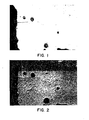
- Figure 1 is a photomicrograph of a crossection of a tile of this invention, showing a solidified mass of slag in contact with but with no penetration below the surface of a refractory.
- Figure 2 is a silica-calcia map generated by energy dispersive spectroscopy of the test area of the refractory shown in Figure 1, confirming the lack of penetration by the calcia rich slag.
- Chromia containing refractory surfaces have been found to be particularly useful for containing the slags produced in the usual gasifier furnaces typically used for producing methane from coal, petroleum coke, and other carbon containing sources as well as in glass processing furnaces.
- slag has been found to be very corrosive when it is dispersed into the interconnected pores found in the bodies of the usual sintered brick liners or rammed refractory liner materials that are fired in-situ. It has been found that such refractory furnace liners spall, crack, and erode after a relatively short period of use, requiring frequent costly shut down of the furnace for repairs and maintenence.
- a refractory body is formed that is a dense alumina-chromia solid solution.
- a gasifier furnace for example, may be lined with bricks made of such a refractory body to provide an improved wall surface that resists slag penetration and also exhibits excellent thermal stability.
- the preferred body is made from alumina that is at least 98% pure. Calcined alumina that has been finely ground so that all the particles pass through a 325 mesh U.S. Standard sieve has been used for making the refractory shown in Figure 1. This alumina particulate material was codispersed with particles of light green pigment grade chromium oxide. The chromia was specified to be at least 98% pure. Substantially all of this chromia was ground to pass through a 325 mesh U.S. Standard Sieve.
- the alumina and chromia particles were mixed in proportions of from 10% chromia and 90% alumina to 90% chromia and 10% alumina.
- the selected particles of chromia and alumina must be thoroughly interdispersed before the green refractory product is molded and any suitable mixing procedure may be used. It has been found that a high energy shearing method can be used by dispersing the particles in isopropyl alcohol or de-ionized water. After processing with this method, the interdispersed particles were first dried in an oven and the mixture screened through a 325 mesh U.S. Standard sieve for further processing. Alternatively, a mechanically activated dry grinding mill may be used.
- the blended particles were loaded into a graphite mold and compacted.
- the mold and its charge were then placed in an induction furnace and the mixture in the mold placed under a pressure of approximately 1.5 tons per square inch.
- the interdispersed and pressed particles were heated to a temperature of about 1600°C. and held soaking for a time depending upon the size of the refractory being made to cause all of the alumina and chromia particles to enter into a solid solution.
- the completed refractory was then allowed to cool to room temperature and removed from the mold.
- a mix of 10% chromia and 90% alumina was found to have a fired density of 4.09 g/cc as compared with a theoretical density of 4.09 g/cc for such a mix.
- a sample brick or tile element made with a 75% chromia and 25% alumina mix 2" thick and measuring 6" by 6" on its sides was sintered under 1.5 tons per square inch at a temperature of 1600°C. for a period of 30 minutes.
- Such a tile was found to have a density of 4.76 g/cc as compared with a theoretical density of 4.9 g/cc.
- This fired refractory was then subjected to a siliceous molten slag utilizing the A.S.T.M. Standard Drip Slag Test C768, the slag being a worst-case black mesa coal slag which is an after product of coal gasification that is a particularly corrosive and erosive slag.
- the test was run at a temperature of 1570°C. for 6-1/2 hours. Only a very slight surface erosion was noted upon completion of the test.
- Figure 1 is that photomicrograph and shows the slag as it solidified on the refractory with no penetration.
- Figure 2 shows a silica, calcia map that was generated by an energy dispersive spectroscopic technique applied to the same area as that shown in Figure 1.
- Silica and calcia are the major constituents found in gasifier furnace slag which is known to penetrate prior art cold pressed 80% dense alumina refractory furnace liners. As shown in Fi g . 2, such deleterious penetration does not occur with a dense, 75% chromia, 25% alumina solid solution refractory is made as here disclosed.
- Such porosity as may exist, is uniformly dispersed throughout the mass of such a refractory in the form of minute closed pores.
- the refractory is molded and fired in the form of.bricks adapted to be fitted together within the furnace chamber to surround the area for containing the slag.
- the refractory of the present invention is of particular value for containing slag such as is found in gasifier furnaces for producing methane but it is obvious that it can be used for other slags and especially where high furnace temperatures make the slags and glasses particularly corrosive.
Landscapes
- Chemical & Material Sciences (AREA)
- Engineering & Computer Science (AREA)
- Ceramic Engineering (AREA)
- Materials Engineering (AREA)
- Organic Chemistry (AREA)
- Manufacturing & Machinery (AREA)
- Structural Engineering (AREA)
- Compositions Of Oxide Ceramics (AREA)
Applications Claiming Priority (2)
| Application Number | Priority Date | Filing Date | Title |
|---|---|---|---|
| US85597386A | 1986-04-25 | 1986-04-25 | |
| US855973 | 1992-03-23 |
Publications (2)
| Publication Number | Publication Date |
|---|---|
| EP0242769A2 true EP0242769A2 (fr) | 1987-10-28 |
| EP0242769A3 EP0242769A3 (fr) | 1989-07-26 |
Family
ID=25322578
Family Applications (1)
| Application Number | Title | Priority Date | Filing Date |
|---|---|---|---|
| EP87105472A Withdrawn EP0242769A3 (fr) | 1986-04-25 | 1987-04-13 | Corps réfractaire dense pour revêtements de fours |
Country Status (3)
| Country | Link |
|---|---|
| EP (1) | EP0242769A3 (fr) |
| JP (1) | JPS62260767A (fr) |
| CA (1) | CA1267916A (fr) |
Cited By (6)
| Publication number | Priority date | Publication date | Assignee | Title |
|---|---|---|---|---|
| WO1999001399A1 (fr) * | 1997-07-01 | 1999-01-14 | Didier-Werke Ag | Materiau refractaire a base de corindon de chrome, pierre en corindon de chrome et utilisation de celle-ci |
| RU2563506C2 (ru) * | 2011-03-11 | 2015-09-20 | Сэнт-Гобэн Керамикс Энд Пластикс, Инк. | Огнеупорное изделие и способ формирования стеклоизделий |
| US9796630B2 (en) | 2011-03-30 | 2017-10-24 | Saint-Gobain Ceramics & Plastics, Inc. | Refractory object, glass overflow forming block, and process of forming and using the refractory object |
| US9902653B2 (en) | 2012-01-11 | 2018-02-27 | Saint-Gobain Ceramics & Plastics, Inc. | Refractory object and process of forming a glass sheet using the refractory object |
| CN115321961A (zh) * | 2021-05-10 | 2022-11-11 | 淄博市鲁中耐火材料有限公司 | 一种高纯度致密六铝酸钙系耐火材料及其制备方法 |
| US11814317B2 (en) | 2015-02-24 | 2023-11-14 | Saint-Gobain Ceramics & Plastics, Inc. | Refractory article and method of making |
Families Citing this family (4)
| Publication number | Priority date | Publication date | Assignee | Title |
|---|---|---|---|---|
| US4792538A (en) * | 1987-09-30 | 1988-12-20 | Dresser Industries, Inc. | Spall resistant chrome-alumina refractory brick |
| JPH04114957A (ja) * | 1990-08-31 | 1992-04-15 | Harima Ceramic Co Ltd | 連続鋳造用耐火物およびその製造方法 |
| FR2883282B1 (fr) * | 2005-03-15 | 2007-05-25 | Saint Gobain Ct Recherches | Revetement interne de reacteur de gazeificateur |
| JP7192754B2 (ja) * | 2019-12-09 | 2022-12-20 | Jfeスチール株式会社 | 不定形耐火物硬化体およびその製造方法 |
Family Cites Families (3)
| Publication number | Priority date | Publication date | Assignee | Title |
|---|---|---|---|---|
| GB810519A (en) * | 1955-09-29 | 1959-03-18 | Corning Glass Works | Method of making a refractory body and articles made thereby |
| FR1181549A (fr) * | 1956-08-24 | 1959-06-16 | Carborundum Co | Matières céramiques dures |
| DE2744700C2 (de) * | 1977-10-05 | 1987-05-27 | Feldmühle AG, 4000 Düsseldorf | Sinterwerkstoff auf Basis von dichten, nichtmetallischen Hartstoffen wie hochschmelzenden Metallcarbiden, Metallnitriden, Metallboriden und Metalloxiden mit darin eingelagerten Zirkon- und/oder Hafniumoxid |
-
1987
- 1987-03-12 CA CA000531845A patent/CA1267916A/fr not_active Expired - Fee Related
- 1987-04-13 EP EP87105472A patent/EP0242769A3/fr not_active Withdrawn
- 1987-04-24 JP JP62100225A patent/JPS62260767A/ja active Pending
Cited By (10)
| Publication number | Priority date | Publication date | Assignee | Title |
|---|---|---|---|---|
| WO1999001399A1 (fr) * | 1997-07-01 | 1999-01-14 | Didier-Werke Ag | Materiau refractaire a base de corindon de chrome, pierre en corindon de chrome et utilisation de celle-ci |
| DE19727917C1 (de) * | 1997-07-01 | 1999-02-25 | Didier Werke Ag | Feuerfester Versatz auf Basis Chromoxid/Aluminiumoxid und dessen Verwendung |
| AU725355B2 (en) * | 1997-07-01 | 2000-10-12 | Didier-Werke A.G. | A refractory material based on chromium corundum, a chromium brick and the use of said brick |
| US6352951B1 (en) | 1997-07-01 | 2002-03-05 | Didier-Werke Ag | Refractory material based on chromium corundum, a chromium corundum brick and the use of said brick |
| RU2563506C2 (ru) * | 2011-03-11 | 2015-09-20 | Сэнт-Гобэн Керамикс Энд Пластикс, Инк. | Огнеупорное изделие и способ формирования стеклоизделий |
| US9796630B2 (en) | 2011-03-30 | 2017-10-24 | Saint-Gobain Ceramics & Plastics, Inc. | Refractory object, glass overflow forming block, and process of forming and using the refractory object |
| US9902653B2 (en) | 2012-01-11 | 2018-02-27 | Saint-Gobain Ceramics & Plastics, Inc. | Refractory object and process of forming a glass sheet using the refractory object |
| US10590041B2 (en) | 2012-01-11 | 2020-03-17 | Saint-Gobain Ceramics & Plastics, Inc. | Refractory object and process of forming a glass sheet using the refractory object |
| US11814317B2 (en) | 2015-02-24 | 2023-11-14 | Saint-Gobain Ceramics & Plastics, Inc. | Refractory article and method of making |
| CN115321961A (zh) * | 2021-05-10 | 2022-11-11 | 淄博市鲁中耐火材料有限公司 | 一种高纯度致密六铝酸钙系耐火材料及其制备方法 |
Also Published As
| Publication number | Publication date |
|---|---|
| EP0242769A3 (fr) | 1989-07-26 |
| JPS62260767A (ja) | 1987-11-13 |
| CA1267916A (fr) | 1990-04-17 |
Similar Documents
| Publication | Publication Date | Title |
|---|---|---|
| US4823359A (en) | Furnance having dense refractory oxide liner | |
| JP5879414B2 (ja) | 向上した耐熱衝撃性を示す焼結耐火物 | |
| US4152166A (en) | Zircon-containing compositions and ceramic bodies formed from such compositions | |
| KR20190122728A (ko) | 다공성 소결 마그네시아의 제조 방법, 소결 마그네시아 과립을 포함하는 중점토 세라믹 내화성 제품의 제조를 위한 뒤채움재, 그 제품 및 그의 제조 방법, 공업로의 라이닝, 및 공업로 | |
| US5098873A (en) | Low cement refractory | |
| CA1267916A (fr) | Refractaire oxyde dense | |
| CN103626503A (zh) | 一种热风炉用长寿莫来石砖及其制备方法 | |
| CN1050591C (zh) | 烧成微孔铝炭砖及其制作方法 | |
| US3992213A (en) | Heterogeneous refractory compounds | |
| US5206191A (en) | Method of producing refractory materials and their applications in the casting of corrosive alloys | |
| US3929498A (en) | Sintered zirconia bodies | |
| US3230100A (en) | Refractory | |
| US4126654A (en) | Alumina or alumina-chromia refractories | |
| US3378383A (en) | High magnesia product and process of making the same | |
| Hubble | Steel plant refractories | |
| CA1331631C (fr) | Brique liee par fusion | |
| US1952120A (en) | Refractory and method of making same | |
| JPH08259313A (ja) | マグクロ質耐火れんがの製造方法 | |
| US3384500A (en) | Refractory | |
| US3282579A (en) | Refractory lining | |
| US3551172A (en) | Ceramic refractory | |
| Moertel | Porcelain for fast firing | |
| WO2024231191A1 (fr) | Mélange de sole à disposer sur le fond de sole d'un four à arc électrique, utilisation d'un mélange de sole à disposer sur le fond de sole d'un four à arc électrique, four à arc électrique, procédé de disposition d'un mélange de sole sur le fond de sole d'un four à arc électrique et utilisation de spinelle de magnésie dans une garniture intérieure d'un four rotatif à ciment | |
| AU622727B2 (en) | Low cement refractory | |
| US3262797A (en) | Refractory shapes |
Legal Events
| Date | Code | Title | Description |
|---|---|---|---|
| PUAI | Public reference made under article 153(3) epc to a published international application that has entered the european phase |
Free format text: ORIGINAL CODE: 0009012 |
|
| AK | Designated contracting states |
Kind code of ref document: A2 Designated state(s): DE FR |
|
| PUAL | Search report despatched |
Free format text: ORIGINAL CODE: 0009013 |
|
| AK | Designated contracting states |
Kind code of ref document: A3 Designated state(s): DE FR |
|
| 17P | Request for examination filed |
Effective date: 19891117 |
|
| STAA | Information on the status of an ep patent application or granted ep patent |
Free format text: STATUS: THE APPLICATION IS DEEMED TO BE WITHDRAWN |
|
| 18D | Application deemed to be withdrawn |
Effective date: 19911105 |
|
| RIN1 | Information on inventor provided before grant (corrected) |
Inventor name: AULT, NEIL N. Inventor name: TROSTEL, LOUIS J. Inventor name: BUTKUS, ANTHONY K. |