EP0242899A2 - Composition de polysiloxane thermodurcissable pour revêtement protecteur et procédé de revêtement de feuillles de polycarbonate - Google Patents
Composition de polysiloxane thermodurcissable pour revêtement protecteur et procédé de revêtement de feuillles de polycarbonate Download PDFInfo
- Publication number
- EP0242899A2 EP0242899A2 EP87200483A EP87200483A EP0242899A2 EP 0242899 A2 EP0242899 A2 EP 0242899A2 EP 87200483 A EP87200483 A EP 87200483A EP 87200483 A EP87200483 A EP 87200483A EP 0242899 A2 EP0242899 A2 EP 0242899A2
- Authority
- EP
- European Patent Office
- Prior art keywords
- component
- components
- composition according
- composition
- tank
- Prior art date
- Legal status (The legal status is an assumption and is not a legal conclusion. Google has not performed a legal analysis and makes no representation as to the accuracy of the status listed.)
- Withdrawn
Links
- 239000000203 mixture Substances 0.000 title claims abstract description 44
- 239000004417 polycarbonate Substances 0.000 title claims abstract description 29
- 229920000515 polycarbonate Polymers 0.000 title claims abstract description 25
- 238000000034 method Methods 0.000 title claims abstract description 20
- 229920001187 thermosetting polymer Polymers 0.000 title claims abstract description 6
- 238000000576 coating method Methods 0.000 title abstract description 27
- 239000011248 coating agent Substances 0.000 title abstract description 23
- 239000011253 protective coating Substances 0.000 title abstract description 6
- WSFSSNUMVMOOMR-UHFFFAOYSA-N Formaldehyde Chemical compound O=C WSFSSNUMVMOOMR-UHFFFAOYSA-N 0.000 claims abstract description 38
- 239000002904 solvent Substances 0.000 claims abstract description 19
- XLYOFNOQVPJJNP-UHFFFAOYSA-N water Substances O XLYOFNOQVPJJNP-UHFFFAOYSA-N 0.000 claims abstract description 16
- 230000001476 alcoholic effect Effects 0.000 claims abstract description 4
- 239000003085 diluting agent Substances 0.000 claims abstract description 4
- 239000000126 substance Substances 0.000 claims abstract description 4
- 238000002156 mixing Methods 0.000 claims abstract description 3
- LFQSCWFLJHTTHZ-UHFFFAOYSA-N Ethanol Chemical compound CCO LFQSCWFLJHTTHZ-UHFFFAOYSA-N 0.000 claims description 12
- 125000000217 alkyl group Chemical group 0.000 claims description 10
- KFZMGEQAYNKOFK-UHFFFAOYSA-N Isopropanol Chemical compound CC(C)O KFZMGEQAYNKOFK-UHFFFAOYSA-N 0.000 claims description 8
- OKKJLVBELUTLKV-UHFFFAOYSA-N Methanol Chemical compound OC OKKJLVBELUTLKV-UHFFFAOYSA-N 0.000 claims description 6
- 229910000077 silane Inorganic materials 0.000 claims description 5
- WYTZZXDRDKSJID-UHFFFAOYSA-N (3-aminopropyl)triethoxysilane Chemical group CCO[Si](OCC)(OCC)CCCN WYTZZXDRDKSJID-UHFFFAOYSA-N 0.000 claims description 4
- BGJSXRVXTHVRSN-UHFFFAOYSA-N 1,3,5-trioxane Chemical group C1OCOCO1 BGJSXRVXTHVRSN-UHFFFAOYSA-N 0.000 claims description 4
- LRHPLDYGYMQRHN-UHFFFAOYSA-N N-Butanol Chemical compound CCCCO LRHPLDYGYMQRHN-UHFFFAOYSA-N 0.000 claims description 4
- 125000003277 amino group Chemical group 0.000 claims description 4
- 125000004423 acyloxy group Chemical group 0.000 claims description 3
- WSFSSNUMVMOOMR-NJFSPNSNSA-N methanone Chemical compound O=[14CH2] WSFSSNUMVMOOMR-NJFSPNSNSA-N 0.000 claims description 3
- 125000006729 (C2-C5) alkenyl group Chemical group 0.000 claims description 2
- BHWUCEATHBXPOV-UHFFFAOYSA-N 2-triethoxysilylethanamine Chemical compound CCO[Si](CCN)(OCC)OCC BHWUCEATHBXPOV-UHFFFAOYSA-N 0.000 claims description 2
- ULRCHFVDUCOKTE-UHFFFAOYSA-N 3-[3-aminopropyl(diethoxy)silyl]oxybutan-1-amine Chemical compound NCCC[Si](OCC)(OCC)OC(C)CCN ULRCHFVDUCOKTE-UHFFFAOYSA-N 0.000 claims description 2
- 229930040373 Paraformaldehyde Natural products 0.000 claims description 2
- 229920002866 paraformaldehyde Polymers 0.000 claims description 2
- 125000000391 vinyl group Chemical group [H]C([*])=C([H])[H] 0.000 claims description 2
- 238000010422 painting Methods 0.000 claims 1
- 239000007795 chemical reaction product Substances 0.000 abstract description 4
- 229920002037 poly(vinyl butyral) polymer Polymers 0.000 description 9
- 239000002966 varnish Substances 0.000 description 9
- 238000005299 abrasion Methods 0.000 description 8
- 238000001035 drying Methods 0.000 description 8
- 238000012360 testing method Methods 0.000 description 7
- 239000010410 layer Substances 0.000 description 6
- 239000000758 substrate Substances 0.000 description 6
- 230000001681 protective effect Effects 0.000 description 5
- CSCPPACGZOOCGX-UHFFFAOYSA-N Acetone Chemical compound CC(C)=O CSCPPACGZOOCGX-UHFFFAOYSA-N 0.000 description 4
- 125000003668 acetyloxy group Chemical group [H]C([H])([H])C(=O)O[*] 0.000 description 4
- 239000000243 solution Substances 0.000 description 4
- 238000004017 vitrification Methods 0.000 description 4
- 238000005406 washing Methods 0.000 description 4
- 239000004698 Polyethylene Substances 0.000 description 3
- BLRPTPMANUNPDV-UHFFFAOYSA-N Silane Chemical compound [SiH4] BLRPTPMANUNPDV-UHFFFAOYSA-N 0.000 description 3
- XAGFODPZIPBFFR-UHFFFAOYSA-N aluminium Chemical compound [Al] XAGFODPZIPBFFR-UHFFFAOYSA-N 0.000 description 3
- 229910052782 aluminium Inorganic materials 0.000 description 3
- 239000007767 bonding agent Substances 0.000 description 3
- -1 poly(diethyleneglycol-bis-allyl-carbonate) Polymers 0.000 description 3
- 239000000047 product Substances 0.000 description 3
- 238000003756 stirring Methods 0.000 description 3
- VYPSYNLAJGMNEJ-UHFFFAOYSA-N Silicium dioxide Chemical compound O=[Si]=O VYPSYNLAJGMNEJ-UHFFFAOYSA-N 0.000 description 2
- MCMNRKCIXSYSNV-UHFFFAOYSA-N Zirconium dioxide Chemical compound O=[Zr]=O MCMNRKCIXSYSNV-UHFFFAOYSA-N 0.000 description 2
- NOZAQBYNLKNDRT-UHFFFAOYSA-N [diacetyloxy(ethenyl)silyl] acetate Chemical compound CC(=O)O[Si](OC(C)=O)(OC(C)=O)C=C NOZAQBYNLKNDRT-UHFFFAOYSA-N 0.000 description 2
- 150000001298 alcohols Chemical class 0.000 description 2
- 239000000428 dust Substances 0.000 description 2
- 230000007613 environmental effect Effects 0.000 description 2
- 238000011049 filling Methods 0.000 description 2
- 239000011521 glass Substances 0.000 description 2
- 238000010438 heat treatment Methods 0.000 description 2
- 230000003301 hydrolyzing effect Effects 0.000 description 2
- 229920000573 polyethylene Polymers 0.000 description 2
- 229920000642 polymer Polymers 0.000 description 2
- 239000002987 primer (paints) Substances 0.000 description 2
- 150000004756 silanes Chemical class 0.000 description 2
- 229920000742 Cotton Polymers 0.000 description 1
- 206010037660 Pyrexia Diseases 0.000 description 1
- 125000001931 aliphatic group Chemical group 0.000 description 1
- PNEYBMLMFCGWSK-UHFFFAOYSA-N aluminium oxide Inorganic materials [O-2].[O-2].[O-2].[Al+3].[Al+3] PNEYBMLMFCGWSK-UHFFFAOYSA-N 0.000 description 1
- 238000013459 approach Methods 0.000 description 1
- 125000003118 aryl group Chemical group 0.000 description 1
- 230000033228 biological regulation Effects 0.000 description 1
- 230000001413 cellular effect Effects 0.000 description 1
- 239000003795 chemical substances by application Substances 0.000 description 1
- 238000004140 cleaning Methods 0.000 description 1
- 239000011247 coating layer Substances 0.000 description 1
- 229910052681 coesite Inorganic materials 0.000 description 1
- 238000004891 communication Methods 0.000 description 1
- 230000000052 comparative effect Effects 0.000 description 1
- 229910052593 corundum Inorganic materials 0.000 description 1
- 229910052906 cristobalite Inorganic materials 0.000 description 1
- 230000032798 delamination Effects 0.000 description 1
- 238000010586 diagram Methods 0.000 description 1
- 238000010790 dilution Methods 0.000 description 1
- 239000012895 dilution Substances 0.000 description 1
- 238000003618 dip coating Methods 0.000 description 1
- 239000012153 distilled water Substances 0.000 description 1
- FWDBOZPQNFPOLF-UHFFFAOYSA-N ethenyl(triethoxy)silane Chemical group CCO[Si](OCC)(OCC)C=C FWDBOZPQNFPOLF-UHFFFAOYSA-N 0.000 description 1
- 238000001704 evaporation Methods 0.000 description 1
- 230000008020 evaporation Effects 0.000 description 1
- 238000000605 extraction Methods 0.000 description 1
- 239000012530 fluid Substances 0.000 description 1
- 238000001879 gelation Methods 0.000 description 1
- 230000005484 gravity Effects 0.000 description 1
- 150000007522 mineralic acids Chemical class 0.000 description 1
- 230000003472 neutralizing effect Effects 0.000 description 1
- 230000003287 optical effect Effects 0.000 description 1
- 150000007524 organic acids Chemical class 0.000 description 1
- 229920000620 organic polymer Polymers 0.000 description 1
- 239000002245 particle Substances 0.000 description 1
- 229920003229 poly(methyl methacrylate) Polymers 0.000 description 1
- 239000004926 polymethyl methacrylate Substances 0.000 description 1
- 239000002244 precipitate Substances 0.000 description 1
- 238000002360 preparation method Methods 0.000 description 1
- 238000012545 processing Methods 0.000 description 1
- 239000011541 reaction mixture Substances 0.000 description 1
- 230000035484 reaction time Effects 0.000 description 1
- 239000000377 silicon dioxide Substances 0.000 description 1
- 235000012239 silicon dioxide Nutrition 0.000 description 1
- 238000004528 spin coating Methods 0.000 description 1
- 230000002269 spontaneous effect Effects 0.000 description 1
- 238000005507 spraying Methods 0.000 description 1
- 230000003068 static effect Effects 0.000 description 1
- 229910052682 stishovite Inorganic materials 0.000 description 1
- 238000003860 storage Methods 0.000 description 1
- 238000002834 transmittance Methods 0.000 description 1
- 229910052905 tridymite Inorganic materials 0.000 description 1
- CPUDPFPXCZDNGI-UHFFFAOYSA-N triethoxy(methyl)silane Chemical compound CCO[Si](C)(OCC)OCC CPUDPFPXCZDNGI-UHFFFAOYSA-N 0.000 description 1
- JCVQKRGIASEUKR-UHFFFAOYSA-N triethoxy(phenyl)silane Chemical compound CCO[Si](OCC)(OCC)C1=CC=CC=C1 JCVQKRGIASEUKR-UHFFFAOYSA-N 0.000 description 1
- 238000001771 vacuum deposition Methods 0.000 description 1
- 229910001845 yogo sapphire Inorganic materials 0.000 description 1
Images

Classifications
-
- C—CHEMISTRY; METALLURGY
- C08—ORGANIC MACROMOLECULAR COMPOUNDS; THEIR PREPARATION OR CHEMICAL WORKING-UP; COMPOSITIONS BASED THEREON
- C08G—MACROMOLECULAR COMPOUNDS OBTAINED OTHERWISE THAN BY REACTIONS ONLY INVOLVING UNSATURATED CARBON-TO-CARBON BONDS
- C08G77/00—Macromolecular compounds obtained by reactions forming a linkage containing silicon with or without sulfur, nitrogen, oxygen or carbon in the main chain of the macromolecule
- C08G77/48—Macromolecular compounds obtained by reactions forming a linkage containing silicon with or without sulfur, nitrogen, oxygen or carbon in the main chain of the macromolecule in which at least two but not all the silicon atoms are connected by linkages other than oxygen atoms
- C08G77/54—Nitrogen-containing linkages
-
- C—CHEMISTRY; METALLURGY
- C08—ORGANIC MACROMOLECULAR COMPOUNDS; THEIR PREPARATION OR CHEMICAL WORKING-UP; COMPOSITIONS BASED THEREON
- C08G—MACROMOLECULAR COMPOUNDS OBTAINED OTHERWISE THAN BY REACTIONS ONLY INVOLVING UNSATURATED CARBON-TO-CARBON BONDS
- C08G77/00—Macromolecular compounds obtained by reactions forming a linkage containing silicon with or without sulfur, nitrogen, oxygen or carbon in the main chain of the macromolecule
- C08G77/60—Macromolecular compounds obtained by reactions forming a linkage containing silicon with or without sulfur, nitrogen, oxygen or carbon in the main chain of the macromolecule in which all the silicon atoms are connected by linkages other than oxygen atoms
-
- C—CHEMISTRY; METALLURGY
- C08—ORGANIC MACROMOLECULAR COMPOUNDS; THEIR PREPARATION OR CHEMICAL WORKING-UP; COMPOSITIONS BASED THEREON
- C08J—WORKING-UP; GENERAL PROCESSES OF COMPOUNDING; AFTER-TREATMENT NOT COVERED BY SUBCLASSES C08B, C08C, C08F, C08G or C08H
- C08J7/00—Chemical treatment or coating of shaped articles made of macromolecular substances
- C08J7/04—Coating
- C08J7/0427—Coating with only one layer of a composition containing a polymer binder
-
- C—CHEMISTRY; METALLURGY
- C08—ORGANIC MACROMOLECULAR COMPOUNDS; THEIR PREPARATION OR CHEMICAL WORKING-UP; COMPOSITIONS BASED THEREON
- C08J—WORKING-UP; GENERAL PROCESSES OF COMPOUNDING; AFTER-TREATMENT NOT COVERED BY SUBCLASSES C08B, C08C, C08F, C08G or C08H
- C08J7/00—Chemical treatment or coating of shaped articles made of macromolecular substances
- C08J7/04—Coating
- C08J7/043—Improving the adhesiveness of the coatings per se, e.g. forming primers
-
- C—CHEMISTRY; METALLURGY
- C08—ORGANIC MACROMOLECULAR COMPOUNDS; THEIR PREPARATION OR CHEMICAL WORKING-UP; COMPOSITIONS BASED THEREON
- C08J—WORKING-UP; GENERAL PROCESSES OF COMPOUNDING; AFTER-TREATMENT NOT COVERED BY SUBCLASSES C08B, C08C, C08F, C08G or C08H
- C08J7/00—Chemical treatment or coating of shaped articles made of macromolecular substances
- C08J7/04—Coating
- C08J7/044—Forming conductive coatings; Forming coatings having anti-static properties
-
- C—CHEMISTRY; METALLURGY
- C08—ORGANIC MACROMOLECULAR COMPOUNDS; THEIR PREPARATION OR CHEMICAL WORKING-UP; COMPOSITIONS BASED THEREON
- C08J—WORKING-UP; GENERAL PROCESSES OF COMPOUNDING; AFTER-TREATMENT NOT COVERED BY SUBCLASSES C08B, C08C, C08F, C08G or C08H
- C08J7/00—Chemical treatment or coating of shaped articles made of macromolecular substances
- C08J7/04—Coating
- C08J7/046—Forming abrasion-resistant coatings; Forming surface-hardening coatings
-
- C—CHEMISTRY; METALLURGY
- C09—DYES; PAINTS; POLISHES; NATURAL RESINS; ADHESIVES; COMPOSITIONS NOT OTHERWISE PROVIDED FOR; APPLICATIONS OF MATERIALS NOT OTHERWISE PROVIDED FOR
- C09D—COATING COMPOSITIONS, e.g. PAINTS, VARNISHES OR LACQUERS; FILLING PASTES; CHEMICAL PAINT OR INK REMOVERS; INKS; CORRECTING FLUIDS; WOODSTAINS; PASTES OR SOLIDS FOR COLOURING OR PRINTING; USE OF MATERIALS THEREFOR
- C09D183/00—Coating compositions based on macromolecular compounds obtained by reactions forming in the main chain of the macromolecule a linkage containing silicon, with or without sulfur, nitrogen, oxygen, or carbon only; Coating compositions based on derivatives of such polymers
- C09D183/14—Coating compositions based on macromolecular compounds obtained by reactions forming in the main chain of the macromolecule a linkage containing silicon, with or without sulfur, nitrogen, oxygen, or carbon only; Coating compositions based on derivatives of such polymers in which at least two but not all the silicon atoms are connected by linkages other than oxygen atoms
-
- C—CHEMISTRY; METALLURGY
- C08—ORGANIC MACROMOLECULAR COMPOUNDS; THEIR PREPARATION OR CHEMICAL WORKING-UP; COMPOSITIONS BASED THEREON
- C08J—WORKING-UP; GENERAL PROCESSES OF COMPOUNDING; AFTER-TREATMENT NOT COVERED BY SUBCLASSES C08B, C08C, C08F, C08G or C08H
- C08J2369/00—Characterised by the use of polycarbonates; Derivatives of polycarbonates
-
- C—CHEMISTRY; METALLURGY
- C08—ORGANIC MACROMOLECULAR COMPOUNDS; THEIR PREPARATION OR CHEMICAL WORKING-UP; COMPOSITIONS BASED THEREON
- C08J—WORKING-UP; GENERAL PROCESSES OF COMPOUNDING; AFTER-TREATMENT NOT COVERED BY SUBCLASSES C08B, C08C, C08F, C08G or C08H
- C08J2483/00—Characterised by the use of macromolecular compounds obtained by reactions forming in the main chain of the macromolecule a linkage containing silicon with or without sulfur, nitrogen, oxygen, or carbon only; Derivatives of such polymers
Definitions
- the present invention relates to thermosetting organosiloxanic compositions for protective coating of policarbonate.
- the invention relates also to a process for coating polycarbonate sheets, which uses said compositions.
- Polycarbonate even if is endowed with acceptable optical properties, good mechanical properties, such as impact strength and low specific gravity, cannot be used as a substitute for glass, because it has undesirable surface properties, such as poor abrasion strength, easy attack by solvents and, more generally, poor resistance to weather agents.
- organofunctional silanes For example, U.S. Patent 3,451,838 describes the use of a composition constituted by a mixture of methyl-triethoxy-silane and phenyl-triethoxy-silane, to coat policarbonate or polymethylmethacrylate; however, the resulting coating has a poor abrasion strength.
- composition which is composed by reactive silanes and tetraalkyltitanates or tetraalkylzirconates.
- composition is then laid off on the substrates and cured by exposure to U.V. light, or by heating.
- compositions for coating in particular for polycarbonate coating, which are obtained by starting from an organo-alkoxy-silane, formaldehyde, a monocarboxylic organic acid and possibly an inorganic acid.
- compositions although they are advantageous under various viewpoints, have not shown to be completely satisfactory in case of coatings of relatively high thickness and crosslinked to a high degree, i.e., able to show optimum values of abrasion strength, and of resistance to hydrolytic action by water.
- thermosetting organosiloxanic composition able to coat polycarbonate with coating endowed with high characteristics of evenness, adhesion, abrasion strength, and resistance to hydrolytic action by water, also at relatively high thicknesses.
- a simple and convenient process has also been found for the application of said composition to sheets of polycarbonate.
- thermosetting organosiloxanic composition according to the present invention is the product of reaction of four components, each one being selected from one of following classes:
- R is a C1-C2 alkyl group and m has values of from 1 to 3.
- Examples of (a) component useful to the purpose are ⁇ -aminopropyl-triethoxy-silane, aminoethyl-triethoxy-silane and 2-aminoethyl-aminopropyl-triethoxy-silane.
- R1 is a C1-C2 alkyl group and R2 is vinyl group.
- An example of (c) component is vinyl-triethoxy-silane.
- trioxane or paraformaldehyde lower polymer of formaldehyde
- components (a) and (b) are reacted with each other with an HCHO/NH2 ratio comprised within the range of from 1.2/1 to 4.0/1, by operating in the absence of solvents or diluents, and at temperatures of from 22 to 60°C and preferably of from 32 to 52°C, until a clear solution is obtained.
- the times necessary for this reaction are shorter than 12 hours and are normally comprised within the range of from 2 to 6 hours.
- components (c) and (d) are reacted with each other with a ratio of water moles to acyloxy groups comprised within the range of from 0.1/1 to 0.66/1, by operating in an alcoholic solvent, and at a temperature comprised within the range of from 5 to 30°C.
- the solvents suitable to the purpose are lower alifatic alcohols such as methanol, ethanol, butanol and isopropanol.
- the preferred reaction temperatures range from 15 to 22°C.
- the reaction times are generally comprised within the range of from 1 to 18 hours, and preferably of from 3 to 6 hours.
- the two reaction products are then mixed with each other, by operating at a temperature of from 15 to 30°C and preferably at a temperature of from 20 to 25°C, in such relative amounts that the molar ratio of (c) component to (a) component, as initially charged, is comprised within the range of from 0.1/1 to 2.5/1.
- compositions can be used, after a possible dilution, to coat polycarbonate, in the form of sheets, films or other shaped manufactured articles, in particular flat or curved sheets and cellular sheets.
- the so-coated articles are useful as windows, protective shields and, generally, articles of this type can be conveniently used in building, as well as in transportation industry.
- compositions are particularly suitable to the purpose of coating aromatic polycarbonate, i.e., poly(diphenyl-2,2 ⁇ -propane-carbonate) and can also be used on aliphatic polycarbonates, such as poly(diethyleneglycol-bis-allyl-carbonate).
- the composition must be carefully filtered, so to remove any suspended particles, or possibly precipitates which might give rise to faults in coating.
- the process of substrates coating can be conveniently performed by one of well-known varnish laying-off techniques, such as dip coating spray coating and still such techniques as flow coating, roll coating, spin coating.
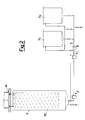
- the polycarbonate sheet is placed inside a varnishing tank, the tank is then filled, by bottom-feed, with the composition of the instant invention, until the sheets are completely covered by the composition, and finally the tank is emptied of composition.
- polycarbonate sheets provided with a protective peelable coating film on both of their faces, are fastened, by suitable fasteners, onto the overhead conveyor system.
- the sheets are then brought, always by the overhead conveyor, on the vertical of varnishing tanks, and are lowered down inside the empty tank (4).
- the tank is then filled and subsequently emptied.
- the sheets are then removed from the tank, and made rest in a drying station (5), wherein the volatile portion of the varnish evaporates, and the step of vitrification of applied layer begins.
- the sheets are then submitted to high-temperature curing (6), during which the vitrification is completed and the adhesion-bonding of varnish coating to polycarbonate occurs.
- the sheets are coated again with a protective peelable layer (7), in order to prevent abrasions due to possible contacts with mechanical devices; and allow the handling.
- the sheets are finally stacked on each other and stored; the sheets exiting the oven and before being stored, can be possibly submitted to a further varnishing (8) with a top coat, which improves their characteristics of abrasion resistance, and then submitted again to a curing step (9).
- the sheets are supplied as provided with a protective coating (generally polyethylene).
- a protective coating generally polyethylene.
- the sheets are placed on a roller conveyor, which positions them in a suitable position for them to be fastened onto the overhead conveyor line.
- the sheets are then submitted to an antistatic treatment, for example, by a ionized air stream, produced by using antistatic bars installed is a special chamber (e.g., such as those manufactured by C.E.A.S.T.).
- a special chamber e.g., such as those manufactured by C.E.A.S.T.
- the sheets are positioned on the vertical of the tank, and are lowered into the tank, with this latter being empty.
- the tank is then filled and emptied, with a filling speed and an emptying speed comprised within the range of from 0.5 to 2 m/minute, and with the temperature inside the tank being kept constant at values comprised within the range of from 15°C to 30°C, and preferably of from 20°C to 22°C.
- the sheets When exiting the tank, the sheets must stop for 5-30 minutes inside the drying station; here, the process of gelation and vitrification of the coating layer begins.
- the varnishing and drying room shall be in communication with the cleaning room, by means of a tunnel, which allows the chamber to be physically bounded, in order to comply with most severe environmental specifications.
- the high-temperature curing step must take place at temperatures comprised within the range of from 100 to 135°C, with residence times longer than 90 minutes, generally not longer than 200 minutes.
- the drying takes place in an oven.
- This operation is carried out by a machine which, after a preliminary heating (50°C) of the film (in general, a polyethylene film), directly applies the peel-away protection onto the polycarbonate.
- a preliminary heating 50°C
- the film in general, a polyethylene film
- the pressure exerted by the rollers is suitably controlled, so as not to deform the sheets.
- the sheets, before being treated, must release the sensible heat accumulated inside the oven, up to reach their operating temperature.
- the characteristics of the environment inside which a processing is carried out do not constitute a process parameter, but they supply, at best, some indications as to the safety criteria to be applied.
- the mixture inside reactor is maintained at 22°C for about 110 minutes, and is then cooled to 5°C.
- the contents of first reactor is then slowly poured into the second reactor, kept cooled, within a 30-minute time, so that the temperature of reaction mixture does not exceed 20°C.
- the mixture is diluted with 2000 ml of ethanol and is kept stirred for three days.
- composition The so-obtained composition (“A" composition) is filtered and used for coating polycarbonate specimens.
- compositions from “B” to “F” are prepared, with the ratio between components being varied.
- TABLE 1 the values are reported of the ratio of amino groups of (a) component to formaldehyde moles of (b) component (HCHO/NH2); of the ratio of water moles in (d) component to acetoxy groups in (b) component (H2O/acetoxy); and of the molar ratio of (c) component to (a) component ((c)/(a)).
- the specimen is heated to 60°C inside in an oven, and in then vertically dipped inside a bath of distilled water, thermoregulated at 80°C; the specimen is periodically inspected visually, until spontaneous delamination of coating occurs.
- compositions were used to coat polycarbonate specimens of 15 cm ⁇ 15 cm ⁇ 3 mm of thickness, cutout from an extruded sheet of SINVET (R) , Type 273/01.
- the adhesion test was performed as follows: on the multi-layer specimen a strip of 2.5 cm in thickness has been cutout throughout aluminum and PVB thickness; to this strip a static weight of 1 kg has been applied, so to exert a peeling action in a direction of 90° relatively to substrate.
- the not-coated polycarbonate is opacified by PVB and the adhesion strength results null.
- silane is then reacted with 135 g (7.5 mol) of water diluted in 3 litres of ethanol, and is maintained at 22°C for about 3 hours.
- the ratio of water moles to acetoxy groups results thus equal to 0.17/1. Furthermore, the ratio of the second silane to the first silane is equal to 1.16/1.
- the reactor is then cooled to 5°C.
- first reactor The contents of first reactor is then slowly poured into the second reactor, in such a way that the temperature of the mixture never exceeds 20°C.
- the mixture was then diluted with 7.5 l of isopropanol, is maintained stirred for 3 days and is then carefully filtered.
- Example 15 The varnish of Example 15 was used to coat sheets of SINVET (R) Type 273/01 polycarbonate, of dimensions of 1050 mm ⁇ 500 mm and of 6 mm in thickness.
- the coatings obtained with this composition resulted to have an average thickness of 6 microns.
- the characteristics of the sheets coated according to as described in Example 16 were tested by checking their transmittance in the visible range, their resistance to solvents, and their abrasion resistance.
Landscapes
- Chemical & Material Sciences (AREA)
- Chemical Kinetics & Catalysis (AREA)
- Organic Chemistry (AREA)
- Health & Medical Sciences (AREA)
- Medicinal Chemistry (AREA)
- Polymers & Plastics (AREA)
- Life Sciences & Earth Sciences (AREA)
- Engineering & Computer Science (AREA)
- Materials Engineering (AREA)
- Wood Science & Technology (AREA)
- Laminated Bodies (AREA)
- Coating Of Shaped Articles Made Of Macromolecular Substances (AREA)
- Paints Or Removers (AREA)
- Silicon Polymers (AREA)
Applications Claiming Priority (4)
| Application Number | Priority Date | Filing Date | Title |
|---|---|---|---|
| IT19894/86A IT1188629B (it) | 1986-03-27 | 1986-03-27 | Composizioni organo-silossaniche termoindurenti per rivestimenti protettivi di policarbonato |
| IT1989486 | 1986-03-27 | ||
| IT19892/86A IT1191719B (it) | 1986-03-27 | 1986-03-27 | Processo per la verniciatura ottica di lastre di policarbonato |
| IT1989286 | 1986-03-27 |
Publications (2)
| Publication Number | Publication Date |
|---|---|
| EP0242899A2 true EP0242899A2 (fr) | 1987-10-28 |
| EP0242899A3 EP0242899A3 (fr) | 1990-06-13 |
Family
ID=26327338
Family Applications (1)
| Application Number | Title | Priority Date | Filing Date |
|---|---|---|---|
| EP87200483A Withdrawn EP0242899A3 (fr) | 1986-03-27 | 1987-03-16 | Composition de polysiloxane thermodurcissable pour revêtement protecteur et procédé de revêtement de feuillles de polycarbonate |
Country Status (4)
| Country | Link |
|---|---|
| US (1) | US4726969A (fr) |
| EP (1) | EP0242899A3 (fr) |
| DK (1) | DK151487A (fr) |
| IL (1) | IL81893A (fr) |
Cited By (2)
| Publication number | Priority date | Publication date | Assignee | Title |
|---|---|---|---|---|
| US7033673B2 (en) | 2003-07-25 | 2006-04-25 | Analytical Services & Materials, Inc. | Erosion-resistant silicone coatings for protection of fluid-handling parts |
| US11413652B2 (en) | 2020-04-10 | 2022-08-16 | Formula No. 37, Llc | Coated oilfield operational components and methods for protecting and extending the service life of oilfield operational components |
Families Citing this family (5)
| Publication number | Priority date | Publication date | Assignee | Title |
|---|---|---|---|---|
| JP2624254B2 (ja) * | 1987-05-22 | 1997-06-25 | 東京応化工業株式会社 | シリカ系被膜の膜質改善方法 |
| US5004625A (en) * | 1987-08-11 | 1991-04-02 | North American Philips Corporation | Solid state light modulator incorporating metallized gel and method of metallization |
| US5069942A (en) * | 1990-04-30 | 1991-12-03 | E. I. Du Pont De Nemours And Company | Process for improving adhesion of polysiloxane coatings to polymeric substrates via reduced alkali metal cation content |
| US6737494B2 (en) * | 2001-11-09 | 2004-05-18 | General Electric Company | Synthesis and use of alkylalkoxyacyloxysilanes and blends thereof for use as a crosslinking agent in moisture curing RTV'S |
| JP6513361B2 (ja) * | 2014-09-30 | 2019-05-15 | 株式会社Screenホールディングス | 基板処理方法 |
Family Cites Families (9)
| Publication number | Priority date | Publication date | Assignee | Title |
|---|---|---|---|---|
| US3309220A (en) * | 1964-04-10 | 1967-03-14 | Gen Electric | Method of producing an ultraviolet resistant polycarbonate article |
| US3451838A (en) * | 1965-12-03 | 1969-06-24 | Owens Illinois Inc | Process of coating plastics with organopolysiloxanes and articles made thereby |
| US3971872A (en) * | 1974-09-30 | 1976-07-27 | American Optical Corporation | Process for the production of an abrasion resistant optical element |
| US4017556A (en) * | 1975-03-20 | 1977-04-12 | American Cyanamid Company | Polymeric substrates coated with reaction product of hydroxy-terminated urethane and melamine resin |
| US4018941A (en) * | 1976-05-18 | 1977-04-19 | American Cyanamid Company | Process for coating polymeric substrates with mar-resistant coating |
| JPS5540743A (en) * | 1978-09-19 | 1980-03-22 | Mitsubishi Gas Chem Co Inc | Surface treatment of polycarbonate resin molded article |
| US4186026A (en) * | 1978-10-30 | 1980-01-29 | American Optical Corporation | Abrasion-resistant coating composition |
| JPS5820263A (ja) * | 1981-07-28 | 1983-02-05 | Mitsubishi Rayon Co Ltd | 合成樹脂成形品の表面硬化処理方法およびその装置 |
| IT1205310B (it) * | 1983-12-27 | 1989-03-15 | Anic Spa | Composizioni organo-silossaniche per rivestimenti protettivi resistenti all'abrasione e promotori di adesione |
-
1987
- 1987-03-11 US US07/024,603 patent/US4726969A/en not_active Expired - Fee Related
- 1987-03-13 IL IL81893A patent/IL81893A/xx unknown
- 1987-03-16 EP EP87200483A patent/EP0242899A3/fr not_active Withdrawn
- 1987-03-25 DK DK151487A patent/DK151487A/da not_active IP Right Cessation
Cited By (14)
| Publication number | Priority date | Publication date | Assignee | Title |
|---|---|---|---|---|
| US7033673B2 (en) | 2003-07-25 | 2006-04-25 | Analytical Services & Materials, Inc. | Erosion-resistant silicone coatings for protection of fluid-handling parts |
| US11413652B2 (en) | 2020-04-10 | 2022-08-16 | Formula No. 37, Llc | Coated oilfield operational components and methods for protecting and extending the service life of oilfield operational components |
| US11446700B1 (en) | 2020-04-10 | 2022-09-20 | S+S Industries Technology Llc | Methods for preparing coating compositions for protecting oilfield operational components |
| US11484909B1 (en) | 2020-04-10 | 2022-11-01 | S+S Industries Technology Llc | Coated oilfield operational components and methods for protecting and extending the service life of oilfield operational components |
| US11559826B2 (en) | 2020-04-10 | 2023-01-24 | S+S Industries Technology Llc | Methods for providing flexible and/or elastic coatings on oilfield operational components |
| US11583892B1 (en) | 2020-04-10 | 2023-02-21 | S+S Industries Technology Llc | Coated oilfield operational components and methods for protecting and extending the service life of oilfield operational components |
| US11596976B2 (en) | 2020-04-10 | 2023-03-07 | S+S Industries Technology Llc | Methods for preparing coating compositions for protecting oilfield operational components |
| US11618055B2 (en) | 2020-04-10 | 2023-04-04 | S+S Industries Technology Llc | Methods for providing flexible and/or elastic coatings on oilfield operational components |
| US11826780B2 (en) | 2020-04-10 | 2023-11-28 | S+S Industries Technology Llc | Methods for providing flexible and/or elastic coatings on oilfield operational components |
| US11845107B2 (en) | 2020-04-10 | 2023-12-19 | S+S Industries Technology Llc | Methods for protecting oilfield operational components from damage from fluid flow |
| US12059706B2 (en) | 2020-04-10 | 2024-08-13 | S+S Industries Technology Llc | Methods for preparing coating compositions for protecting oilfield operational components |
| US12059705B2 (en) | 2020-04-10 | 2024-08-13 | S+S Industries Technology Llc | Coating and methods for extending service life of oilfield operational components |
| US12128442B2 (en) | 2020-04-10 | 2024-10-29 | S+S Industries Technology Llc | Coated fluid handling components and methods for protecting and extending the service life of fluid handling components |
| US12220725B2 (en) | 2020-04-10 | 2025-02-11 | S+S Industries Technology Llc | Coated oilfield operational components and methods for protecting and extending the service life of oilfield operational components |
Also Published As
| Publication number | Publication date |
|---|---|
| EP0242899A3 (fr) | 1990-06-13 |
| DK151487D0 (da) | 1987-03-25 |
| IL81893A (en) | 1990-12-23 |
| DK151487A (da) | 1987-09-28 |
| US4726969A (en) | 1988-02-23 |
| IL81893A0 (en) | 1987-10-20 |
Similar Documents
| Publication | Publication Date | Title |
|---|---|---|
| US5316855A (en) | High abrasion resistance coating materials from organic/inorganic hybrid materials produced by the sol-gel method | |
| US3336253A (en) | Method of solubilizing resinous materials | |
| CA1165492A (fr) | Enduits pour matieres thermoplastiques | |
| US4444973A (en) | Coatings for thermoplastics | |
| US20060167176A1 (en) | Organosilicone resin emulsion composition and article having coating thereof | |
| WO1993003088A1 (fr) | Procede d'enduction de substrats en matieres plastiques et laque utilisee pour mettre en ×uvre ce procede | |
| US3024216A (en) | Compositions of partially hydrolyzed vinyl chloride-vinyl acetate copolymers and polyurethane resins, polyethylene coated with same and process for making coated article | |
| EP0242899A2 (fr) | Composition de polysiloxane thermodurcissable pour revêtement protecteur et procédé de revêtement de feuillles de polycarbonate | |
| US4681714A (en) | Multiple release mold coating | |
| US5366807A (en) | Primer composition, coating method and coated silicone substrates | |
| EP0146995B1 (fr) | Compositions d'organopolysiloxanes pour des revêtements protecteurs résistants à l'abrasion et ayant une excellente adhésion | |
| US5115023A (en) | Siloxane organic hybrid polymers | |
| US3477901A (en) | Compositions and processes for adhering polyolefins to surfaces | |
| US4289672A (en) | Sizing glass fibers for thermoplastic resin reinforcement | |
| US5008349A (en) | Silicone primer compositions | |
| US4115607A (en) | Process of coating aluminum materials molded by extrusion with polysiloxane coating | |
| EP0114512B1 (fr) | Compositions de siloxane-polyester et leur utilisation | |
| US3819745A (en) | Coatings giving controlled release | |
| JPS62185764A (ja) | 透明かつ耐候性の接着性塗料組成物 | |
| US3460981A (en) | Water repellent and/or release treatment | |
| EP0761738A1 (fr) | Composition de couche de fond | |
| EP0738768B1 (fr) | Méthode de protection des circuits imprimés | |
| US3551376A (en) | Adhesion-resistant organopolysiloxane coatings | |
| US4923946A (en) | Composition and method for priming and coating silicone substrates | |
| US6030444A (en) | Mixture for treating silicon-containing substrates |
Legal Events
| Date | Code | Title | Description |
|---|---|---|---|
| PUAI | Public reference made under article 153(3) epc to a published international application that has entered the european phase |
Free format text: ORIGINAL CODE: 0009012 |
|
| AK | Designated contracting states |
Kind code of ref document: A2 Designated state(s): AT BE CH DE ES FR GB GR LI LU NL SE |
|
| PUAL | Search report despatched |
Free format text: ORIGINAL CODE: 0009013 |
|
| AK | Designated contracting states |
Kind code of ref document: A3 Designated state(s): AT BE CH DE ES FR GB GR LI LU NL SE |
|
| 17P | Request for examination filed |
Effective date: 19901122 |
|
| 17Q | First examination report despatched |
Effective date: 19910620 |
|
| STAA | Information on the status of an ep patent application or granted ep patent |
Free format text: STATUS: THE APPLICATION IS DEEMED TO BE WITHDRAWN |
|
| 18D | Application deemed to be withdrawn |
Effective date: 19911031 |
|
| RIN1 | Information on inventor provided before grant (corrected) |
Inventor name: TINTINELLI, ALBERTO Inventor name: DE ANTONIIS, MARIO Inventor name: BOCCALON, GIANFRANCO Inventor name: MAZZAMURRO, GIUSEPPINA Inventor name: CARCIOFI, PIERO |