EP0243072A2 - Régulateur de vitesse de moteur - Google Patents
Régulateur de vitesse de moteur Download PDFInfo
- Publication number
- EP0243072A2 EP0243072A2 EP87303261A EP87303261A EP0243072A2 EP 0243072 A2 EP0243072 A2 EP 0243072A2 EP 87303261 A EP87303261 A EP 87303261A EP 87303261 A EP87303261 A EP 87303261A EP 0243072 A2 EP0243072 A2 EP 0243072A2
- Authority
- EP
- European Patent Office
- Prior art keywords
- carburettor
- speed
- engine
- valve
- control
- Prior art date
- Legal status (The legal status is an assumption and is not a legal conclusion. Google has not performed a legal analysis and makes no representation as to the accuracy of the status listed.)
- Withdrawn
Links
Images


Classifications
-
- F—MECHANICAL ENGINEERING; LIGHTING; HEATING; WEAPONS; BLASTING
- F02—COMBUSTION ENGINES; HOT-GAS OR COMBUSTION-PRODUCT ENGINE PLANTS
- F02D—CONTROLLING COMBUSTION ENGINES
- F02D31/00—Use of speed-sensing governors to control combustion engines, not otherwise provided for
Definitions
- This invention relates to carburettors, and more particularly to engine speed governors incorporated therein.
- governors which seek to maintain engine speed with variation in load, is to effect automatic opening of the throttle valve in the carburettor with increased load and, therefore, falling engine speed, and automatic closing as the load is shed. If achieved effectively a manually selected speed of the engine can be maintained constant regardless of load charges.
- Centrifugal and pneumatic systems i.e. using a flag or a diaphram, which have been proposed rely upon response to an engine condition which trails an initial dropin speed with increased load, and consequently react less than instantaneously.
- many of these systems require exposed linkages, and for stable operation under different conditions, such as barometric pressure and engine conditions, a richer mixture than at full load has to be maintained.
- a carburettor incorporating a governor for speed control of an engine serviced by said carburettor, and comprising a passage for delivering working fluid from the carburettor, a throttle valve for controlling the volume of said fluid delivered by the carburettor, a pneumatic element associated with the carburettor and connected to said throttle valve and having a chamber to receive air of a pressure other than atmospheric pressure to effect movement of said throttle valve between open and closed positions, a control valve for controlling venting of said chamber via an orifice, and an electronic circuit responding to the speed of said engine to control operation of said control valve in order to return the engine speed to a predetermined speed whenever it varies therefrom.
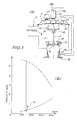
- the carburettor 10 consists of an air intake chamber 11 having a venturi 12 to one side whereat fuel is inducted or injected via a passage 13 whereby the resulting working fluid is induced into the throat 14 for delivery to the intake manifold 15 of an I.C. engine (not shown).
- a throttle valve 16 is axially moved along the throat 14 to control the flow of working fluid to the manifold 15.
- the throttle valve 16 may be of any kind, such as a poppet valve as shown, or a butterfly valve.
- the stem 17 of the poppet valve 16 is supported in a bearing and is connected at its distal end 19 to a flexible diaphragm 20 which with a sealing casing 21 defines an air chamber 22.
- Bias springs 23 and 24 of predetermined rate act upon the diaphragm 20 to maintain it in equilibrium.
- a vacuum line 25 connects the chamber 22 with the intake manifold 15 to create sub-atmospheric pressure within the chamber 22 during running of the engine serviced by the carburettor 10. It will be noted that as shown in Fig. 1(A) the chamber 22 is sealed and the reduced pressure therein permits the diaphragm 20 to move upwardly to close the poppet valve 16 upon the venturi 12. As is conventional, idling passages may be provided around the valve 16 for sufficient fuel intake to maintain the engine at idling speed. It will be appreciated that the carburettor 10 is depicted purely diagrammatically in Fig. 1(A) for simplicity of explanation. The carburettor housing may be of a variety of forms without departing from the spirit of the invention and may or may not enclose the casing 21.
- An orifice 26 defined say by a grommet, allows the entry of air into the chamber 22 to prevent the creation of a vacuum.
- the orifice 26 is arranged to be closed by a flap valve 27 under control of an electro-mechanical relay 28.
- An electronic control circuit as shown in either Fig. 4 or Fig. 5, and described hereafter, energises the relay 28 to attract the flap valve 27 and close the orifice 26, as shown in Fig. 1(A).
- Alternatively, with appropriate modification of the system attraction of the valve 27 may open the orifice 26.
- Selective manual throttle control for the engine is intended to be effected via the electronic circuitry.
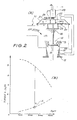
- the engine condition shown by Fig. 2 assumes operator setting of engine speed at 2,500 RPM with an increased load imposed upon the engine, thus requiring generation of increasing torque.
- the flap valve 27 under control of the solenoid 28 will be oscillating between open and closed conditions to maintain the position of the throttle valve 16 as stable as possible and the condition of the governor shown in Fig. 2(A) is purely transitory.
- the flap valve 27 will be opened to increase fuel flow to the engine by further opening of the valve 16.
- the valve 16 With practically no hunting, due to the immediate response to the electronic control circuit to changes in engine speed, the valve 16 will finally stabilise at an increased open condition capable of restoring engine speed at the selected level with the increased load.
- Fig. 3 relates to a fully loaded state of the engine which is travelling at its governed speed. This speed may be preset by the manufacturer or set by an operator of the engine.
- the throttle valve 16 is fully open, with the flap valve 27 open so that should additional load be imposed upon the engine no response occurs in the diaphragm 20 and valve 16.
- Figs. 1(B), 2(B) and 3(B) plot resulting torque against engine revolutions with rising and falling of torque, as indicated by the arrows x, to meet changing loads.
- the invention is not limited to any specific source for deriving reduced pressure in the chamber 22. It is only necessary that sufficient sub-atmospheric pressure exists in the chamber 22 to ensure movement of the diaphragm 20 to close the valve 16.
- the source may be derived from any part of the engine, or even from complimentary equipment.
- a significant advantage flows from the use of a check valve (not shown), either in the casing 21 or in the line 25, which will vent the chamber 22 during pressure rises during the engine stroke, thereby to derive a reasonably stable and adequate vacuum within the chamber 22.
- a conventional form of connection from the diaphragm 20 may be used to obtain the necessary opening and closing of a conventional pivotted butterfly throttle valve is use of such a valve is desired.
- the invention also contemplates the use of super-atmospheric pressure within the chamber 22 and a modified connection to a butterfly throttle valve will be required to achieve closure of such valve with downward displacement of the diaphragm 20.
- the modification to the butterfly valve need only be confined to the linkage connection thereto from the diaphragm 20.
- more substantial modification will be required in the case of use of a poppet valve 16. This can be achieved by locating the poppet valve 16 at the opposite side of the venturi 12, with corresponding relocation of the fuel passage 13, or can be achieved by modification of the control system. This is possible by arranging the equilibrium of the diaphragm 20 to correspond to a closed condition of the throttle valve 16 with reverse function of the flap valve 27.
- the orifice 26 will be opened by the valve 27 during idling to allow for exhaust of pressurized air entering the chamber 22. Energisation and de-energisation of the relay 28 would then be achieved in a reverse sense from the electronic control circuit.
- the flap valve 27 opens to allow the entry of atmosphere when the chamber 22 is subjected to sub-atmospheric pressure, filtering of the entering air is often necessary on many small engines likely to operate in foul atmospheres, such as experienced by domestic lawnmowers.
- the throttle valve 16 may be made to open in response to application of sub-atmospheric, or super-atmospheric, air pressure from the line 25.
- the solenoid 28 will be arranged for operation to ensure closure of the orifice 26 with sub-atmospheric pressure, or opening thereof with super-atmospheric pressure.
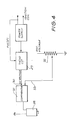
- Fig. 4 One suitable form of electronic control circuit is shown in Fig. 4.
- the circuit input is connected to the ignition coil of the engine and pulses therefrom supplied to a tachometer 29 which produces an analogue signal on output line 30 applied to one side of a comparator 31.
- a reference voltage is derived by adjustment of the rheostat 32 through operator manipulation of a throttle control connected therewith and applied via line 33 to the other side of the comparator 31.
- An energising signal is delivered to the relay 28 only when the engine speed represented by the input voltage on line 30 rises above the selected speed indicated by the voltage on line 33. At all other times the relay 28 is de-energised.
- spark plug 34, ignition coil 35 and ignition module 36 together comprise the existing spark ignition system for the engine in which a magnetic field rotating with the crankshaft (not shown) passes the ignition coil 35 and this affects the low tension voltage VL to the ignition module 36 which itself then causes a sudden change in VL producing through the ignition coil 35, a high tension voltage VH for the spark plug 34.
- a diode D1 and capacitor C1 combine to give a semi-smoothed analogue voltage which is applied to the voltage regulator 37 to produce a regulated output voltage VR which is used to drive the remainder of the circuit.
- the voltage VL is also applied to the timing shaper 38 which provides an output which swings through the required level to reset a pulse generator 39 once for each crankshaft revolution.
- Resistor R1 and capacitor C2 are used in the pulse generator 39 to determine the pulse width of the outgoing signal and resistor R2 and capacitor C3 are used to determine the shape of the signal going to the positive input of a comparator 40 and which has a mean value which increases with crankshaft speed.
- the comparator 40 continuously responds to the mean value of the applied pulses to achieve immediate reaction by the solenoid 28 to engine speed change with less hunting than would occur if the input signal was strictly analogue.
- variable resistor R3 and fixed resistor R4 and R5 can be used to set the specified value, and the upper and lower limits, of the voltage applied to the negative input of the comparator 40.
- This set voltage represents the desired speed for the engine governing.
- the mean value of the voltage representing the actual engine speed at the positive input to the comparator 40 is greater than the voltage representing the desired speed at the negative input to the comparator 40 the output voltage of the comparator 40 goes high thus operating the control solenoid 28, and when the voltage representing the actual speed is less than the voltage representing the desired speed the comparator output drops to zero, thus releasing the control solenoid 28.
- the invention will be found to have most merit when applied to small I.C. engines such as used with lawnmowers, marine craft, portable power tools and the like. Although it might be possible to control movement of the throttle valve 16 purely by electrical means in order to obtain a governing facility, the necessary amount of electrical power is not readily available in such small engines. By use of the invention instantaneous and reliable response is achieved with the limited electrical power available.
Landscapes
- Engineering & Computer Science (AREA)
- Chemical & Material Sciences (AREA)
- Combustion & Propulsion (AREA)
- Mechanical Engineering (AREA)
- General Engineering & Computer Science (AREA)
- Control Of Throttle Valves Provided In The Intake System Or In The Exhaust System (AREA)
Applications Claiming Priority (2)
| Application Number | Priority Date | Filing Date | Title |
|---|---|---|---|
| AU556086 | 1986-04-21 | ||
| AU5560/86 | 1986-04-21 |
Publications (2)
| Publication Number | Publication Date |
|---|---|
| EP0243072A2 true EP0243072A2 (fr) | 1987-10-28 |
| EP0243072A3 EP0243072A3 (fr) | 1988-07-20 |
Family
ID=3696028
Family Applications (1)
| Application Number | Title | Priority Date | Filing Date |
|---|---|---|---|
| EP87303261A Withdrawn EP0243072A3 (fr) | 1986-04-21 | 1987-04-14 | Régulateur de vitesse de moteur |
Country Status (1)
| Country | Link |
|---|---|
| EP (1) | EP0243072A3 (fr) |
Cited By (1)
| Publication number | Priority date | Publication date | Assignee | Title |
|---|---|---|---|---|
| US5358573A (en) * | 1991-03-25 | 1994-10-25 | Orlande Sivacoe | Method of cleaning a pipe with a cylindrical pipe pig having pins in the central portion |
Family Cites Families (4)
| Publication number | Priority date | Publication date | Assignee | Title |
|---|---|---|---|---|
| US3332406A (en) * | 1965-08-24 | 1967-07-25 | Gen Motors Corp | Electronic speed control system |
| GB1496488A (en) * | 1974-12-10 | 1977-12-30 | Lucas Ltd Joseph | Servo-mechanism for an internal combustion engine throttl |
| GB1602487A (en) * | 1978-05-31 | 1981-11-11 | Ass Eng Ltd | Vehicle speed control systems |
| JPS6050234A (ja) * | 1983-08-29 | 1985-03-19 | Nippon Carbureter Co Ltd | エンジンの吸入空気制御方法 |
-
1987
- 1987-04-14 EP EP87303261A patent/EP0243072A3/fr not_active Withdrawn
Cited By (1)
| Publication number | Priority date | Publication date | Assignee | Title |
|---|---|---|---|---|
| US5358573A (en) * | 1991-03-25 | 1994-10-25 | Orlande Sivacoe | Method of cleaning a pipe with a cylindrical pipe pig having pins in the central portion |
Also Published As
| Publication number | Publication date |
|---|---|
| EP0243072A3 (fr) | 1988-07-20 |
Similar Documents
| Publication | Publication Date | Title |
|---|---|---|
| US3661131A (en) | Speed controls | |
| US4161929A (en) | Exhaust gas recirculation control system for an internal combustion engine | |
| CA1127273A (fr) | Regulateur de ralenti a correction asymetrique des rapports pour moteur de vehicule automobile | |
| CA1229899A (fr) | Methode de regulation du couple d'un moteur a combustion interne en fonction de la teneur en fumees de l'echappement et appareil connexe | |
| US4048964A (en) | Fuel metering apparatus and method | |
| US4467607A (en) | System for controlling the inlet pressure in a turbocharged combustion engine | |
| US3921612A (en) | Apparatus for and method of controlling air-fuel mixture in a carburetor of an automotive internal combustion engine | |
| US3861366A (en) | Air-fuel mixture supply control system for use with carburetors for internal combustion engines | |
| US4301883A (en) | Device for the control of the traveling speed of a motor vehicle | |
| US4392352A (en) | Apparatus for regulating turbochargers and internal combustion engines associated therewith | |
| US4563989A (en) | Regulation system for an internal combustion engine | |
| US4174617A (en) | Turbocharger control system | |
| EP0067445A2 (fr) | Système de commande de turbocompresseur | |
| GB1563500A (en) | Fuel/air mixture supply systems | |
| US4085724A (en) | Fuel regulator for internal combustion engines with injection system | |
| US4813394A (en) | Carburetion systems | |
| CA1046366A (fr) | Dispositif regulateur pour moteurs diesel | |
| GB1476852A (en) | Electro-pneumatic device for regulating the supply of air to an internal combustion engine | |
| GB2043167A (en) | By-pass valve apparatus of an exhaust turbocharger for an internal combustion engine | |
| KR900700743A (ko) | 공회전 및 감속중의 내연기관의 공기비를 조절하는 방법 및 그 장치 | |
| US4385604A (en) | Method and device for operation of an internal combustion engine in particular for a vehicle | |
| US4286433A (en) | Control system for turbocharger | |
| EP0084737A2 (fr) | Système de contrôle de récirculation de gaz d'échappement pour moteur | |
| US4175530A (en) | Pneumatic governor control apparatus for engine fuel injection system | |
| EP0243072A2 (fr) | Régulateur de vitesse de moteur |
Legal Events
| Date | Code | Title | Description |
|---|---|---|---|
| PUAI | Public reference made under article 153(3) epc to a published international application that has entered the european phase |
Free format text: ORIGINAL CODE: 0009012 |
|
| AK | Designated contracting states |
Kind code of ref document: A2 Designated state(s): AT BE CH DE ES FR GB GR IT LI LU NL SE |
|
| PUAL | Search report despatched |
Free format text: ORIGINAL CODE: 0009013 |
|
| AK | Designated contracting states |
Kind code of ref document: A3 Designated state(s): AT BE CH DE ES FR GB GR IT LI LU NL SE |
|
| STAA | Information on the status of an ep patent application or granted ep patent |
Free format text: STATUS: THE APPLICATION IS DEEMED TO BE WITHDRAWN |
|
| 18D | Application deemed to be withdrawn |
Effective date: 19890121 |
|
| RIN1 | Information on inventor provided before grant (corrected) |
Inventor name: CHOTAR, ANTHONY PAUL Inventor name: GRAY, DAVID ALLAN Inventor name: KERR, GAVIN Inventor name: CRIMMINS, RUSSELL IAN Inventor name: NEJTEK, GEORGE |