EP0243975A2 - Capteur de température électrochimique - Google Patents
Capteur de température électrochimique Download PDFInfo
- Publication number
- EP0243975A2 EP0243975A2 EP87106307A EP87106307A EP0243975A2 EP 0243975 A2 EP0243975 A2 EP 0243975A2 EP 87106307 A EP87106307 A EP 87106307A EP 87106307 A EP87106307 A EP 87106307A EP 0243975 A2 EP0243975 A2 EP 0243975A2
- Authority
- EP
- European Patent Office
- Prior art keywords
- temperature sensor
- temperature
- sensor according
- electrodes
- electrolyte
- Prior art date
- Legal status (The legal status is an assumption and is not a legal conclusion. Google has not performed a legal analysis and makes no representation as to the accuracy of the status listed.)
- Withdrawn
Links
Images

Classifications
-
- G—PHYSICS
- G01—MEASURING; TESTING
- G01K—MEASURING TEMPERATURE; MEASURING QUANTITY OF HEAT; THERMALLY-SENSITIVE ELEMENTS NOT OTHERWISE PROVIDED FOR
- G01K7/00—Measuring temperature based on the use of electric or magnetic elements directly sensitive to heat ; Power supply therefor, e.g. using thermoelectric elements
- G01K7/16—Measuring temperature based on the use of electric or magnetic elements directly sensitive to heat ; Power supply therefor, e.g. using thermoelectric elements using resistive elements
- G01K7/26—Measuring temperature based on the use of electric or magnetic elements directly sensitive to heat ; Power supply therefor, e.g. using thermoelectric elements using resistive elements the element being an electrolyte
-
- H—ELECTRICITY
- H01—ELECTRIC ELEMENTS
- H01M—PROCESSES OR MEANS, e.g. BATTERIES, FOR THE DIRECT CONVERSION OF CHEMICAL ENERGY INTO ELECTRICAL ENERGY
- H01M6/00—Primary cells; Manufacture thereof
- H01M6/14—Cells with non-aqueous electrolyte
- H01M6/18—Cells with non-aqueous electrolyte with solid electrolyte
-
- Y—GENERAL TAGGING OF NEW TECHNOLOGICAL DEVELOPMENTS; GENERAL TAGGING OF CROSS-SECTIONAL TECHNOLOGIES SPANNING OVER SEVERAL SECTIONS OF THE IPC; TECHNICAL SUBJECTS COVERED BY FORMER USPC CROSS-REFERENCE ART COLLECTIONS [XRACs] AND DIGESTS
- Y02—TECHNOLOGIES OR APPLICATIONS FOR MITIGATION OR ADAPTATION AGAINST CLIMATE CHANGE
- Y02E—REDUCTION OF GREENHOUSE GAS [GHG] EMISSIONS, RELATED TO ENERGY GENERATION, TRANSMISSION OR DISTRIBUTION
- Y02E60/00—Enabling technologies; Technologies with a potential or indirect contribution to GHG emissions mitigation
- Y02E60/10—Energy storage using batteries
Definitions
- the invention relates to a temperature measuring device (temperature sensor) for electrochemical temperature measurement.
- thermocouples are mainly used for this; temperature measurement using thermocouples is based on the temperature-dependent potential jump between two different metallic conductors.
- a major disadvantage of this method is the very low level of the measurement signal, for example of only 0.01 mV / ° R for the Pt / PtRh system (10%), or of 0.04 mV / ° K for the NiCr / Ni system, as well in the need for a reference point, e.g.
- thermocouples are also limited in their application to the temperature to be measured, and the change in voltage with temperature is not linear (requiring complicated numerical approximations).
- a high-temperature measuring, control or regulating circuit with a switching element exposed to the high temperature is known, in which the switching element is a solid electrolyte, the temperature dependence of the conductivity of which is used to measure, control or regulate the temperature .
- ionic conductivities are mostly sensitive to impurities (doping), manufacturing processes and resistances at grain boundaries and electrodes.
- Such a temperature sensor requires the use of voluminous, complicatedly constructed and thus also very fault-prone gas electrodes which do not allow miniaturization of the measuring device.
- Another disadvantage is the very low sensitivity; the change in voltage with temperature is only approx. 0.03mV / ° K.
- the object of the present invention is to provide a temperature sensor with which the disadvantages described above, in particular in connection with the use of thermocouples, can be avoided, and also in a miniaturized form, i.e. is technically easy to manufacture in small and smallest dimensions and shows good results. This object is achieved with the present invention.
- the invention relates to a temperature sensor for electrochemical temperature measurement, which is characterized in that it contains, as a temperature-dependent element, a galvanic chain consisting of two dissimilar electrodes and an electrolyte, and a measuring device for measuring the temperature-dependent EMF of this chain.
- the temperature sensors according to the invention can in principle be miniaturized while maintaining their full performance and usability, because the EMF (cell voltage) is independent of the size and geometry of the galvanic chain (cell).
- the leads of the galvanic chain at the temperature to be determined to the measuring device which are preferably an electrical voltmeter, e.g. a voltmeter or electrometer are typically made of the same material. But even if thermal voltages should arise from the use of different materials in the supply lines, they are generally negligible compared to the voltage of the galvanic cell and therefore need not be taken into account in most cases.
- the galvanic chain is therefore preferably a galvanic solid body chain.
- a galvanic chain is used as the temperature-dependent element, in which a solid electrolyte is contacted with two different electrodes have precisely defined chemical potentials of the ion type transferred in the electrolyte at each predetermined temperature and predetermined total pressure, the chemical potentials of which are essentially independent of their composition at a predetermined temperature and predetermined pressure.
- n is preferably an integer from 1 to 5, and in particular from 1 to 3.
- the electrode can, for example, consist solely of the component that can be converted in the electrolyte, for example of copper, from a 2-phase mixture with two components , e.g. Cu0 / Cu20, consist of a 3-phase mixture with three components, e.g. GeO 2 / Cu 2 O / CuGeO 3 , etc. It can also contain impurities and other components which, as inactive chemical species, do not exchange with neighboring phases and are therefore not involved in setting the chemical potential. A combination of electrodes with a temperature dependence of the chemical potentials of the transferred components that is as different as possible is preferably used.
- the chemical potential of the transferred component stands with the change in the Gibbs energy ⁇ G during the (virtual) passage of 1 ion or 1 mol ion A Z + in the following relationship: that is, the chemical energy released or required during the course of the cell reaction is equivalent to the electrical energy obtained or required. Since the change in the Gibbs energy of the cell reaction is generally temperature-dependent, the cell voltage is thus a function of the temperature.
- thermodynamic data can therefore be used if these are known sufficiently precisely, or a calibration measurement is carried out for a specific system, which is then built up for all of this system Cells can apply.
- the change in cell voltage per temperature unit depends on the selected pair of electrodes, in particular on the enthalpies of formation of the chemical compounds present in the electrodes. In order to achieve the highest possible sensitivity, electrodes with different enthalpies of formation are preferably used.
- the changes in cell voltage with temperature are linear with good accuracy.
- changes can also occur, in particular if a phase change occurs in one of the electrodes as the temperature changes, or new phase equilibria are established.
- the temperature dependence of the cell voltage is composed of two curves, each of which is a straight line with good accuracy. Complicated descriptions of the curve shape of the measurement signal as a function of temperature, as is the case with thermocouples, can therefore be dispensed with in temperature sensors according to the invention.
- electrolytes and electrodes suitable under the respective application conditions can be used as electrolytes and electrodes. It is only necessary for the electrolyte to be predominantly ionically conductive, the size of the conductivity being of no importance as soon as a minimum value is exceeded which depends on the input resistance of the voltage measuring device.
- Solid electrolytes in particular come into question, for example: for extremely high temperatures, corundum-based ceramics and cubically stabilized Zr0 2 as O-ion conductor; for the range between room temperature and several 100 ° C silver ion conductors, such as Ag 4 RbJ 5 or ⁇ -AgJ, copper ion conductors, such as copper halides, lithium ion conductors, e.g.
- lithium compounds especially lithium nitride halides or Li 4 SiO 4 / Li 3 PO 4 , sodium ion conductor, for example NASICON, ß-Al 2 O 3 as ion conductor for a large number of monovalent ions, and ß "-Al 2 O 3 for double-charged ions, for example Pb ++ .
- Liquid electrolytes are, for example, molten salts.
- Temperature sensors for example known thin-film and thick-film techniques, can be used with which, for example, electrolyte and / or electrode coatings can be applied to one another or to a substrate.
- the electrodes are arranged on different surface sides of the electrolyte, for example, in another embodiment on the same surface side.
- the electrolyte is preferably designed as a mechanically load-bearing element, but the electrolyte and electrodes can also be located on an insulated or electrically conductive substrate as a mechanically load-bearing element, for example on a sapphire substrate.
- the manufacturing methods of microelectronics can be used to produce miniaturized embodiments of the invention. Temperature sensors produced in this way can be integrated in microelectronic circuits.
- the galvanic chain or at least some of its components, such as electrolyte and / or electrodes with a protective coating , especially with an insulating or gas-tight coating.
- a protective coating especially with an insulating or gas-tight coating.
- the galvanic chain e.g. are melted into a glass bead or a protective coating is applied, e.g. by vapor deposition or sputtering.
- Conductors of any type can generally be used as leads to the voltage measuring device.
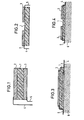
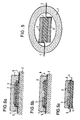
- Figures 1 to 6 show in cross section a schematic representation of various arrangements according to the invention of electrolyte (1), electrodes (2,3) and leads (4,5).
- the electrodes are arranged on opposite sides of the electrolyte, in Figure 2, the electrodes are on the same side of the electrolyte, the electrolyte (solid electrolyte) as being mechanical the element is formed.
- FIGS. 3 and 4 the electrolyte and electrodes are on a substrate (6) as a supporting element, FIG. 3 showing an arrangement of the electrodes on opposite sides of the electrolyte, and FIG. 4 an arrangement of the electrodes on the same side of the electrolyte.
- FIG. 5 shows an arrangement in which the galvanic chain is melted into a pearl made of glass or another suitable gas-tight material (7).
- Figures 6a, b and c show embodiments with a protective layer, e.g. from A1203, as can be applied by vapor deposition or sputtering.
- a temperature measuring device which delivers a direct electrical signal with high temperature sensitivity; Comparative elements with a defined reference temperature are not required. Due to the large number of suitable ion conductors and electrodes and their combinations, a wide range of electrolyte electrode systems is available, making it possible to select the most appropriate system for the respective field of application; the choice of the most appropriate system depends on the particular measurement task, and in particular on the temperature range. By using high-melting ceramics as electrolytes and electrodes, the temperature sensors according to the invention are also suitable for measuring very high temperatures. Another advantage of the temperature sensors according to the invention is the construction structure, which is generally much simpler than that of thermocouples, and which enables configurations which are optimally adapted to the respective intended use.
- Temperature sensors according to the invention in which a strong change in the EMF occurs at a certain temperature, can also be used to calibrate conventional thermocouples be used; This occurs particularly in those T em on temperature sensors in where the Phasendiagrarm changes, so to form, for example, new phases or stages are otherwise in equilibrium. If, for example, the concentration of the components is chosen so that a mixture of the phases Fe 1-y O / YFe 2 O 4-x / YFeO 3 is present above 1010 ° C., the logarithm of the oxygen partial pressure changes with the reciprocal absolute temperature; below 1010 ° C, the YFe 2 O 4-x phase is no longer stable.
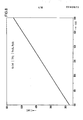
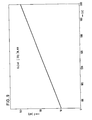
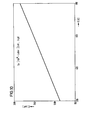
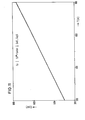
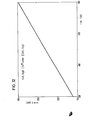
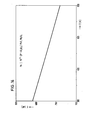
- FIGS. 7 to 14 A number of systems are mentioned below by way of example, and the temperature dependence of the EMF of these systems is shown in FIGS. 7 to 14:
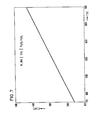
- FIG. 7 shows the measured dependency of the cell voltage on the absolute temperature of a galvanic solid-state chain with cubically stabilized Zr0 2 as O - ion conductor with amounts of Ni / NiO and Fe 2 0 3 / Fe 3 0 4 as electrodes.
- the temperature dependence of the voltage is 0.245mV / ° K. It is therefore much higher than for thermocouples.
- FIGS. 8 to 14 relate to the temperature dependence of the EMF determined from the thermodynamic data of the systems used:
- FIGS. 8 and 9 show the temperature for the same electrolyte used for FIG dependencies with Co / CoO and Fe 3 0 4 / Fe 2 0 3 - ( Figure 8) as well as for Co / CoO and Ni / NiO electrodes ( Figure 9).
- the change in voltage with temperature has an extraordinarily high value of 0.319mV / ° K for the former electrode combination, and 0.073mV / ° K for the latter electrode combination.
- FIG. 11 there is a copper ion conductor between elementary copper and an electrode made of CuS / Cu 2 S. This results in the extremely high temperature sensitivity of the cell voltage of 0.389 mV / ° K.
- a CuO / Cu 2 O counterelectrode can be used, for example, while maintaining the CuS / Cu 2 S electrode; this results in the temperature profile of the voltage shown in FIG. The slope is 0.229mV / ° K.
- the temperature dependence of the cell voltage E shown in FIG. 13 results for the equilibria of different sodium sulfides (Na 2 S / NaS and Na 2 S 3 / NaS 2 ); the sensitivity in this case is even 1.172mV / ° K.
- FIG. 14 shows the relationship between the cell voltage and the temperature using a lead ion conductor Pb ++ - ⁇ "-Al 2 O 3 with an electrode made of elemental lead and a mixture of Pb0 / Pb304.
- the temperature coefficient of the cell voltage in this case is 0.115mV / ° K.
Landscapes
- Chemical & Material Sciences (AREA)
- Chemical Kinetics & Catalysis (AREA)
- Electrochemistry (AREA)
- Physics & Mathematics (AREA)
- General Physics & Mathematics (AREA)
- Engineering & Computer Science (AREA)
- Manufacturing & Machinery (AREA)
- General Chemical & Material Sciences (AREA)
- Secondary Cells (AREA)
- Measuring Temperature Or Quantity Of Heat (AREA)
- Thermistors And Varistors (AREA)
Applications Claiming Priority (2)
| Application Number | Priority Date | Filing Date | Title |
|---|---|---|---|
| DE3614686A DE3614686C1 (de) | 1986-04-30 | 1986-04-30 | Elektrochemischer Temperatursensor |
| DE3614686 | 1986-04-30 |
Publications (2)
| Publication Number | Publication Date |
|---|---|
| EP0243975A2 true EP0243975A2 (fr) | 1987-11-04 |
| EP0243975A3 EP0243975A3 (fr) | 1989-06-21 |
Family
ID=6299896
Family Applications (1)
| Application Number | Title | Priority Date | Filing Date |
|---|---|---|---|
| EP87106307A Withdrawn EP0243975A3 (fr) | 1986-04-30 | 1987-04-30 | Capteur de température électrochimique |
Country Status (3)
| Country | Link |
|---|---|
| EP (1) | EP0243975A3 (fr) |
| JP (1) | JPS62261934A (fr) |
| DE (1) | DE3614686C1 (fr) |
Cited By (5)
| Publication number | Priority date | Publication date | Assignee | Title |
|---|---|---|---|---|
| US9793525B2 (en) | 2012-10-09 | 2017-10-17 | Johnson Battery Technologies, Inc. | Solid-state battery electrodes |
| US10333123B2 (en) | 2012-03-01 | 2019-06-25 | Johnson Ip Holding, Llc | High capacity solid state composite cathode, solid state composite separator, solid-state rechargeable lithium battery and methods of making same |
| CN110137563A (zh) * | 2019-05-31 | 2019-08-16 | 深圳小穗科技有限公司 | 一种硫化铜固态电池及其制作方法 |
| US10566611B2 (en) | 2015-12-21 | 2020-02-18 | Johnson Ip Holding, Llc | Solid-state batteries, separators, electrodes, and methods of fabrication |
| USRE49205E1 (en) | 2016-01-22 | 2022-09-06 | Johnson Ip Holding, Llc | Johnson lithium oxygen electrochemical engine |
Families Citing this family (2)
| Publication number | Priority date | Publication date | Assignee | Title |
|---|---|---|---|---|
| JP4826780B2 (ja) * | 2006-10-16 | 2011-11-30 | 株式会社島津製作所 | ナノ粒子の測定方法および装置 |
| DE102014012771A1 (de) * | 2014-09-02 | 2016-03-03 | Gensoric Gmbh | Verfahren zur Bestimmung der Temperatur an Elektroden in einem Medium |
Family Cites Families (2)
| Publication number | Priority date | Publication date | Assignee | Title |
|---|---|---|---|---|
| GB1379204A (en) * | 1970-12-18 | 1975-01-02 | Graviner Ltd | Flamedetection methods and apparatus |
| US4294898A (en) * | 1980-05-05 | 1981-10-13 | International Business Machines Corporation | Solid state battery |
-
1986
- 1986-04-30 DE DE3614686A patent/DE3614686C1/de not_active Expired
-
1987
- 1987-04-28 JP JP62103447A patent/JPS62261934A/ja active Pending
- 1987-04-30 EP EP87106307A patent/EP0243975A3/fr not_active Withdrawn
Cited By (8)
| Publication number | Priority date | Publication date | Assignee | Title |
|---|---|---|---|---|
| US10333123B2 (en) | 2012-03-01 | 2019-06-25 | Johnson Ip Holding, Llc | High capacity solid state composite cathode, solid state composite separator, solid-state rechargeable lithium battery and methods of making same |
| US9793525B2 (en) | 2012-10-09 | 2017-10-17 | Johnson Battery Technologies, Inc. | Solid-state battery electrodes |
| US10084168B2 (en) | 2012-10-09 | 2018-09-25 | Johnson Battery Technologies, Inc. | Solid-state battery separators and methods of fabrication |
| US12315873B2 (en) | 2012-10-09 | 2025-05-27 | Johnson IP Holding, LLC. | Solid-state battery separator including low melt temperature inorganic electrolyte and method of fabricating the same |
| US10566611B2 (en) | 2015-12-21 | 2020-02-18 | Johnson Ip Holding, Llc | Solid-state batteries, separators, electrodes, and methods of fabrication |
| US11417873B2 (en) | 2015-12-21 | 2022-08-16 | Johnson Ip Holding, Llc | Solid-state batteries, separators, electrodes, and methods of fabrication |
| USRE49205E1 (en) | 2016-01-22 | 2022-09-06 | Johnson Ip Holding, Llc | Johnson lithium oxygen electrochemical engine |
| CN110137563A (zh) * | 2019-05-31 | 2019-08-16 | 深圳小穗科技有限公司 | 一种硫化铜固态电池及其制作方法 |
Also Published As
| Publication number | Publication date |
|---|---|
| DE3614686C1 (de) | 1987-11-05 |
| EP0243975A3 (fr) | 1989-06-21 |
| JPS62261934A (ja) | 1987-11-14 |
Similar Documents
| Publication | Publication Date | Title |
|---|---|---|
| DE2826515C2 (fr) | ||
| DE3116884C2 (fr) | ||
| DE2820474C2 (de) | Elektrochemischer Meßfühler | |
| DE69737627T2 (de) | Analysezelle | |
| DE69123896T2 (de) | pH-Messelektrode und Verfahren zur Herstellung derselben | |
| EP0783689B1 (fr) | Detecteur a electrolyte solide permettant de mesurer des anhydrides gazeux | |
| DE3614686C1 (de) | Elektrochemischer Temperatursensor | |
| DE4112896C2 (de) | Gasdetektor mit geschichtetem Aufbau | |
| DE102019108890A1 (de) | Sensorelement für einen potentiometrischen Sensor | |
| DE2000949C3 (de) | Vorrichtung zum Messen des Druckes eines Gases | |
| CA1223042A (fr) | Calibrage d'electrodes en oxyde de metal amorphe | |
| EP0087590B1 (fr) | Cellule électrochimique à electrodes solides et une électrolyte à conduction ionique céramique intermédiaire | |
| EP0408039A2 (fr) | Détecteur de courant limite pour mesurer la pression partielle d'un gaz | |
| DE68916743T2 (de) | Gasdetektor. | |
| DE4112302A1 (de) | Amperometrischer gassensor zur selektiven bestimmung von partialdrucken eines gases | |
| EP0649018B1 (fr) | Appareil pour la surveillance continue de la concentration de composants gazeux dans des mélanges de gaz | |
| DE202004015400U1 (de) | Sensor sowohl zur Sauerstoffmessung als auch zur Volumenstrom- und/oder Anströmmessung | |
| DE3620092C2 (fr) | ||
| DE69006503T2 (de) | Verfahren und Messfühler zur Bestimmung von Sauerstoffpartialdruck. | |
| DE3543768C1 (de) | Galvanische Festkoerperkette zur Messung des Sauerstoffpartialdrucks | |
| DE3727485A1 (de) | Festkoerper-ableitsystem zur verwendung mit einem ionenselektiven element | |
| DE2842645A1 (de) | Konzentrationszelle und verfahren zur messung einer ionenkonzentration | |
| DE3639518A1 (de) | Chemische halbzelle | |
| EP0471330A1 (fr) | Dispositif de mesure de pH | |
| DE10022210A1 (de) | Einstabmesskette |
Legal Events
| Date | Code | Title | Description |
|---|---|---|---|
| PUAI | Public reference made under article 153(3) epc to a published international application that has entered the european phase |
Free format text: ORIGINAL CODE: 0009012 |
|
| AK | Designated contracting states |
Kind code of ref document: A2 Designated state(s): CH DE FR GB LI NL |
|
| PUAL | Search report despatched |
Free format text: ORIGINAL CODE: 0009013 |
|
| AK | Designated contracting states |
Kind code of ref document: A3 Designated state(s): CH DE FR GB LI NL |
|
| 17P | Request for examination filed |
Effective date: 19891107 |
|
| 17Q | First examination report despatched |
Effective date: 19910308 |
|
| STAA | Information on the status of an ep patent application or granted ep patent |
Free format text: STATUS: THE APPLICATION IS DEEMED TO BE WITHDRAWN |
|
| 18D | Application deemed to be withdrawn |
Effective date: 19910919 |
|
| RIN1 | Information on inventor provided before grant (corrected) |
Inventor name: WEPPNER, WERNER |